



Abstract
In the aftermath of 9/11, the academia witnessed a surge in the number of studies dealing with Islamophobia, the representations of Muslims in Western media and complex realities created by such (mis)representations. This article hopes to contribute to such scholarly efforts by examining the demonisation of Islam through the fashioning of celebrity Muslim ‘hate preachers’ (i.e. Abu-Hamza, Abu-Qatada and Omar Bakri) in British tabloids (i.e. The Sun and the Daily Mail ). Drawing upon insights from Serge Moscovici’s theory of social representations, the article aims to diverge from the traditional approaches of content and discourse analysis to shed light on the nexus between forms of social thinking and the unique portrayal of these preachers in tabloids.
Keywords
Introduction
In the aftermath of 9/11, the academia witnessed a surge in the number of studies dealing with Islamophobia, the representations of Muslims in Western media and complex realities created by such (mis)representations (see, for example, Ciftci, 2012; Poole, 2002; Richardson, 2004). This article hopes to contribute to such scholarly efforts by examining the demonisation of Islam through the fashioning of celebrity Muslim ‘hate preachers’ (i.e. Abu-Hamza, Abu-Qatada and Omar Bakri) in British tabloids (i.e. The Sun and the Daily Mail). Drawing upon insights from Serge Moscovici’s theory of social representations, the article aims to diverge from the traditional approaches of content and discourse analysis to shed light on the nexus between forms of social thinking and the unique portrayal of these preachers in tabloids. By querying social thinking as the antithesis of scientific thinking, the theory of ‘social representations’ shares with ‘discourse analysis’ a deep interest in the construction of knowledge and its link to checks and balances of power relations within a social order, but deviates therefrom by assigning social psychology a privileged place in explaining discursive phenomena. The theory of social representations also differs from discourse analysis in its ability to extrapolate on the processes that prompted tabloids to demonise on the basis of certain schemata. More specifically, this approach explores how ‘collective meaning’ had been anchored in one dynamic set of representations which served to introduce these previously unknown preachers to the masses as concrete examples of an abstract notion of terrorism before the preachers eventually emerged as meta-similes for other forms of social representations.
The Europol (2011) report revealed there was a total of 249 terrorist attacks in European Union (EU) countries in 2010, only 3 of which were attributed to Islamist terrorist groups. Similar findings were reported by Europol (2010), which concluded that separatist terrorism continues to be the type of terrorism which affects the EU most in terms of the number of attacks carried out. The Europol (2009) situation report listed 515 terrorist attacks but none by Islamists. The Europol (2008) report placed the number of terrorist attacks by Islamists at only 4 out of 583 in EU countries.Figures are not much different in the United States where, according to the Federal Bureau of Investigation (FBI) database (2005) of the terrorist attacks on US soil from 1980 to 2005, only 6 percent were by ‘Islamic extremists’, while the rest were by Latinos (42%), extreme Left-Wing groups (24%), others (16%), Jewish extremists (7%) and communists (5%).
On the basis of these figures and definitions of terrorism, it would stand to reason to assume that fear of separatists or Latinos would be higher than any sense of alarm that could arise from the presence of Muslims. Empirical evidence would suffice to point out that one has little if anything to fear from Muslim extremists, let alone the average Muslim. However, the reality on the ground could not be further from these figures. The 26th report of the British Social Attitudes published in 2010 reveals that ‘religion – and particularly Islam – now appears to provoke more anxiety than other traditional distinctions’ (Park et al., 2010, p. 66). A survey by YouGov in 2010 for the Exploring Islam Foundation paints a very grim picture; 58 percent of those surveyed associate Islam with extremism, 50 percent with terrorism and only 13 percent and 6 percent with peace and justice respectively. 1
The French social psychologist Serge Moscovici (2000) uses the term ‘cognitive miser’ to refer to a person or entity with a ‘tendency to neglect the information given, to think in a stereotypical way, failing to take into account the error this produces’ (p. 122). In other words, faced with facts and empirical evidence, an individual and a group persist in drawing direct and indissoluble links between Islam and terrorism/violence. Moscovici (2000) further argues that social thinking ‘owes more to convention and memory than to reason’; when offered a choice between two contradictory facts, one scientific and one social, an individual or a group would rather draw upon ‘common knowledge’ and ‘common sense’ than science (p. 39).
The contrast, Moscovici (2000) comments, with ‘science is striking. Science proceeds in the opposite way, from premise to conclusion’ (p. 40). Human reasoning is not governed by the rules of science and empirical evidence but the modes of social thinking. To argue that publishing the EU situation reports on a much wider scale would convince people that only a very small fraction of terrorists are Muslims and that only a very small fraction of Muslims are terrorists would be naïve and futile.
Islam is unique in being singled out as the one source of terrorism with which other sources are contrasted and often seen as less menacing. The validity of empirical evidence ceases to be pertinent here as attempts to argue that Muslim terrorists perpetrated only a very small fraction of terrorist activities in Europe and the United States are met with the disclaimer that, while true, the Islamic branch of terrorism is far more dangerous, apocalyptic, irrational, blind, all-encompassing and non-discriminating (Hudson, 2002). This view renders any argument about actual figures moot. Islamophobia has entered the mainstream as a normative practice; professing one’s own Islamophobia without fear of recrimination is fashionable (Toynbee, 2004).
Moscovici (2000) poses the question,
What is it in society which goes to ‘make sense’ and sustain the emergence and production of discourse? And, in consequence, how is it that certain representations – among all of those produced by each discourse – can come to be qualified as social, and on what basis precisely? (p. 161)
The work of Moscovici and Michel Foucault are central to the analysis of the news reports at hand. Moscovici’s work on social representations aims to situate phenomena such as discourse, social thinking, knowledge structures and schemata within modes of social thinking that differ slightly from traditional Foucauldian tradition. That said, there is no reason that the two approaches cannot be reconciled. While Foucault’s oeuvre consisted of a life-long project of uncovering the links that exist between discourses, knowledge and power relations, Moscovici’s social representations take the nature of discourses a step further. They do so by examining them as embodiments of social rationality or social thinking rooted in social psychology rather than an expression of networks of power relations, an approach which often fails to take into consideration elements such as human reasoning and psychology. Discursive practices in the Foucauldian sense – closely mirrored by the notion of ‘themata’ in Moscovici’s approach – that construct knowledge about Islam and Muslims respond in the first instance to state policies and their declared war on terror, but soon take on a life of their own as they interpellate with existing modes of social thinking in the production of Islamophobia.
In Society Must be Defended, Foucault (2003) revisits the issue of race stipulating it has two functions: ‘to fragment, to create caesuras within the biological continuum addressed by biopower’ (p. 255). He situates racism within the normalising power of society. Moreover, he does not restrict race to biological determinism, but opines that ‘we speak of races and racism’ whenever one writes the history of ‘two groups which do not, at least to begin with, have the same language, or in many cases, the same religion’ (p. 76).
Islamophobia, as a form of racism, is not only an expression of the normalising forces within social order (state-governed or otherwise), but, as will become evident from the analysis below, operates on racist terms within the framework of that which is socially dictated as normal or abnormal. The other equally important conclusion is grounded in the subjectivity of the racist or the Islamophobe and pertains to his or her conception of himself or herself. Juxtaposed with the abnormal, the normal is defined auto-referentially, by using the self as a point of reference.
Islam in the tabloids
In the aftermath of 9/11, three ‘clerics’ rose to prominence in British Media, especially the tabloid press. Abu-Hamza, Abu-Qatada and Omar Bakri were plucked from discursive obscurity and propelled forward as the ‘icons’ of terrorist Islam, and soon Islam itself.
The events of 9/11 were unique in their ability to resist interpretation and simultaneously be open to all forms of interpretation. On the eve of the first anniversary of 9/11, three major thinkers Žižek (2002), Baudrillard (2002) and Virilio (2002) were invited to contribute to a burgeoning field of philosophical analysis of the event that had shaken the world. The three resultant – and very divergent – essays are testimony to the event’s hold on the human imagination and the sheer impossibility of situating it within any familiar terms. The scale, nature and target of the event posited it as an empty signifier that invited an endless series of interpretations. The three preachers merged within this context of attempting to integrate the events into the commonsensical, into that which can be iconised, discussed and debated. Terrorism as an abstract notion is not communicable or describable. Nor were the events of 9/11 a concretisation of terrorism; the collapse of the Twin Towers was merely a symptom of terrorism, the ‘mother of all events, the pure event uniting within itself all the events that have never taken place’ the aftermath of which imprinted itself on a global scale as the abstract par excellence (Baudrillard, 2002: 4).Concretisation allows for naming, labelling and solidification of that
which is anonymous, unnameable, cannot become a communicable image, or be readily linked to other images. It is relegated to the world of confusion, uncertainty, and inarticulateness, even when we are able to classify it approximately as normal or abnormal. (Moscovici, 2000: 46)
Social representations, according to Moscovici (2000), are borne out of the need to make the unfamiliar familiar, ‘first by transferring it to our own particular sphere where we are able to compare and interpret it’ and second by ‘reproducing it among the things we can see and touch and thus control’ (p. 42).He refers to these mechanisms as anchoring and objectifying. When something unfamiliar, disturbing and not immediately comprehensible occurs, the immediate impulse is to search our repository of social thinking and endless store of categories for something to which we could compare it. We need to anchor it in something the way a ship drops its anchor to prevent drifting away and getting lost at sea. The process involves the act of naming and classifying things. When 9/11 occurred, the phenomenon became immediately associated with concepts like terrorism, evil, Islamism, us and them and so on. Explosions on this grand scale on US soil were not going to remain solitary acts of incomprehensible damage. They had to make sense from within schemata that someone living in the United States or Europe would understand. This explains why it is erroneous to believe that the link between Islam, terrorism and violence was a post-9/11 phenomenon. Had it been so, the process of anchoring would not have succeeded. It would have been akin to someone making the absurd claim that florists perpetrated these acts to increase the sale of flowers. The anchoring had to have a prototype in social thinking, categories that preceded the occurrence of 9/11. Anchoring is ‘meaning given to that which previously had none in the consensual world’ (Moscovici, 2000: 47).
The second mechanism, objectification, refers to the mechanism in which the abstract becomes concrete; ‘objectification saturates the idea of unfamiliarity with reality, it turns it into the very essence of reality’ (Moscovici, 2000: 49). Turning ‘the word for a thing into a thing for a word’, as Moscovici aptly described objectification, is precisely what happened in the case of the British tabloids. It was not sufficient to anchor – to speak of Islam, violence and terrorism. The abstract had to have a basis in reality and that was the role of the Muslim preachers. Much has been written about climate change, but without associating that abstract notion with concrete events such as tsunamis, droughts or temperature increases, people would not be able to make sense of its meaning or significance.The materialisation of abstract thought is almost a work of magic that draws a nod and murmurs, ‘Oh yes, I understand now’. In other words, it is the power of example. As Muslim preachers gradually entered the public imagination as examples of terrorist Islam, they soon became examples of Islam, period. The conflation between the two happened over nearly a decade of extensive coverage of the preachers by the tabloids, as will become evident in the analysis below.
The unique nature of social representations, Moscovici argues, allows them to be dynamic rather than static. Moreover, they are not imposed upon individuals or independent of them, but are given life through communication until the point wherein their origin becomes a thing of the past and they seem as natural and familiar as any other category and classification within the group’s modes of social thinking. This process ‘of the exchange and composition of ideas is all the more necessary since it responds to the twofold demands of the individuals and collectives’. These demands are ‘on the one hand to construct systems of thought and understanding, and on the other to adopt consensual visions of action which allow them to maintain a social bond, even a continuity of communication of the idea’ (Moscovici, 2000: 157).
It is important to note at this juncture that social representations do not necessarily refer to consensus on the level of society, but rather on the level of groups. In other words, the readership of the Daily Mail and The Sun can be seen as a social group quite distinct from the readership of broad sheets. Moscovici talks about the ‘normative integrity’ of the group, which essentially refers to the thematas or discourses which circulate within that group and guarantee that the group knows how to adapt and orient itself. And because new social representations rely extensively on existing thematas, the analysis below will demonstrate how the Muslim preachers were appropriated and situated within schemata that already governed the mind and psychological make-up of the audience, such as the notion of the taxpayer, welfare, benefits, immigration, Britain’s relationship with the EU and so on. This fundamentally means that the social representations which engendered certain thematas/discourses had to already be familiar to the readers.
The Daily Mail and The Sun coverage of the Muslim preachers
Abu-Hamza, Abu-Qatada and Omar Bakri are Muslim preachers with very few followers. The circumstances that brought them to the United Kingdom were varied, but one thing is certain; most members of the Muslim community in the United Kingdom view them with great disdain, suspicion and consider them a great embarrassment to Muslims and Islam. Yet Muslims are also quick to stress these figures were demonised and used to tarnish Islam at large (Muslims react to Hamza conviction, 2004). By highlighting these Muslims with their horrid pasts and messages of hate and jihad against the West, the tabloids, many Muslims insist, have anchored Islam in the characters of these men who are far from representative of the true essence of Islam and the vast majority of Muslims. Two newspapers played a hugely influential role in this anchorage.
The British tabloid newspapers The Sun and the Daily Mail enjoy the highest circulation in the United Kingdom at 2,582,301 and 1,945,496 respectively. The figures are high when compared with broad sheets such as The Times (397,549), The Guardian (215,988) and The Independent (105,160). 2 The Daily Mail has also recently seen its website traffic increase exponentially, making it the most visited newspaper in the world according to a recent survey of website traffic. 3 Although the circulation of The Sun and the Daily Mail has varied over the years, the two newspapers continued to occupy the two most dominant rankings in terms of their circulation, a testimony to their far-reaching influence. The Daily Mail is generally considered the voice of the middle-class, middle-aged, middle England and caters for a conservative readership (Sointu, 2005).The Sun is a red-top tabloid (a reference to the colour of its front-page title) whose dominant motive is ‘to attract high readership’, which entails that they be ‘accessible, so editorial matter is presented in emotive language, in easy-to-consume formats, with large headlines and an extensive use of photographs, graphics and colour’ (Rooney, 2000: 91).
The discussion is based on the analysis of all the news reports published in the Daily Mail and The Sun from September 2001 until March 2012 in which any of the three Muslim preachers’ name is mentioned (see Figure 1).

Number of newspaper articles in which preachers appear.
Figure 2 lists the dates the preachers’ names appear for the first time in the Daily Mail and The Sun. Although all three had been living in the United Kingdom prior to those dates, it was only after 9/11 that there was a surge in interest in the three of them as the numbers of news reports in Figure 1 reveal. The initial shock of 9/11 necessitated drawing upon the cognitive mechanisms of anchoring and objectification unique to those papers to create referential values that could offer material forms for the abstract notions of terrorism, Islam and violence. The tabloid press, by virtue of its unique nature, thrives on individuals, rather than events. Typically and predominately offering a mixture of celebrity news and sensationalist/alarmist stories from the lives of ordinary people, tabloid press is people-centred rather than news-centred; it is the individual who makes the news rather than the converse. Despite the plethora of celebrities, tabloid press tends to focus on a select few who form the figurative core of an ongoing print soap opera. Similar to a soap opera, the characters are many but delimited. Leslie (2011) comments that celebrity ‘depends on regular media exposure’ (p. 11). Rather than accomplishments, achievements or fame, the elements of regular coverage and high visibility are essential to attain the status of celebrity. The narrativisation of these celebrities guarantees familiarisation and acquaintance with every aspect of their lives. The Daily Mail and The Sun are not the exception to this trend. On one level, there is this urgent need to keep celebrities in the news to maintain a level of interest in the pool of celebrities on whom the newspaper chooses to focus, but, more importantly, the tabloid press channels its values and views through news about these celebrities. In the case of the Daily Mail, one editor summarised it succinctly: ‘the paper’s defining ideology is that Britain has gone to the dogs’. 4 The paper peddles an alarmist/sensationalist right-wing canon ‘fuelling paranoia about everything from immigration to skin conditions’ (Collins, 2012).
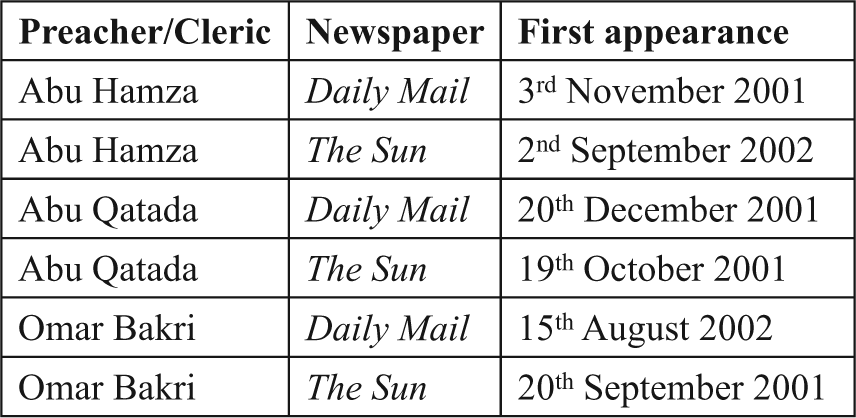
Preachers by first date of appearance in British tabloids.
During the course of the analysis, a number of strategies emerged in the narrativisation of the Muslim Preachers.
The Mosque as an ideological space
Brown (2008) remarks that the function of mosques in the United Kingdom has undergone a number of transformations from safe havens for early Muslim migrants in the mid-20th century to socialisation hubs promoting community cohesion before emerging as part of a security agenda in the context of counter-terrorism. Mosques, Brown (2008) argues, are often seen as crucial sites in the process of terrorist activity, and he uses the term ‘securitisation’ to refer to this phenomenon (p. 476).
The securitisation of mosques is a recent theme. In an article published in February 2001 – only a few months before 9/11 – the Daily Mail opined that going to places of worship including mosques promotes good behaviour. 5 Between 1997 to December 2001, mosques were mentioned in the Daily Mail either in the context of travel pages as part of touristic sites (14 news reports) or other news unrelated to Muslims (13 news reports). Between 1 January 2000 and 31 August 2001, The Sun’s website did not return any results for the term ‘mosque’.
Abu-Hamza’s very first appearance in the Daily Mail was in a news report about his advice to England’s cricket team that they not take part in England’s imminent tour of India. Ian Woolridge begins by remarking that the proximity between Finsbury Park Mosque and Lord Cricket’s Ground had emboldened Abu-Hamza. 6 The contiguous relationship between Abu-Hamza and the mosque almost implies that the cleric lives there. Other references to mosques throughout the coverage of the Muslim preachers depict mosques as centres of recruitment rather than places of worship. In many instances, a relationship is created between the three preachers and other suspected terrorists or Muslims simply by virtue of having prayed at the same mosque. In other words, the mosque is gradually presented as a space fraught with political signification rather than spaces of piety. In a very early example soon after 9/11, the Daily Mail claimed in December 2001 that Richard Reid, who tried to blow up an American passenger jet, was a member of Osama Bin Laden’s terror network and had attended the same mosque as Zacarias Moussaoui, who was suspected of being one of the 9/11 hijackers. The information was predicated on unfounded claims, and the same news report spoke at length about the mosque as an alleged centre of terrorism. 7 According to the Daily Mail, another terror suspect, Feroz Abbasi, was schooled by Abu-Hamza at Finsbury Park mosque (no source was provided for these claims by the paper). 8 The Sun equally devotes hundreds of pages to demonstrating that the Muslim clerics used these mosques as sites of recruitment. In January 2003, The Sun reported that police raised a London mosque ‘where radical handless cleric Abu Hamza is based’. 9 The newspaper referred to the mosque as ‘Captain Hook’s lair’, a reference to his being a predatory animal.
Mosque space is simultaneously situated within the schema of the church space (a category familiar to the Daily Mail and its readers) and juxtaposed with it. The Anglican and Catholic churches have historically operated as very powerful institutions rather than mere spaces of worship. With a hierarchy, wealth and value systems, in addition to the political, economic and social power they historically wielded, they played an instrumental role in the life of the individual. The church still regulates the business of marriage, death, salvation, passage to heaven and christening. In Christianity, the notion of the congregation is very much central to the practice of religion. McNeal (2011) comments that the first three centuries of Christianity lacked the notion of the congregation and Christianity was a way of life practised outside a meeting place, which is very similar to Islam today. Cleric, preacher, congregation, priest, disciple, incarnation, reformation, medieval orthodoxy and weekend school are all terms borrowed from Christianity and its history; these terms are used by both The Sun and Daily Mail in the context of referring to Muslims and Islam despite their having very little relevance to Islam. Islam never had a Reformation movement, medieval Orthodoxy is unique to Christianity in the Middle Ages, weekend school is inspired by Bible lessons and so on.
The mosque, on the other hand, is an individual space of worship not linked to an institution or a hierarchy. Nor is a Muslim required to regulate his life through the mosque. The relationship between an individual and God is thus one of direct and personal contact. Drawing upon the notions of social representations, the tabloid press sought to situate the mosque within cognitive classifications familiar to their readers and the church was the most logical choice. Returning to the notion of the familiar in Moscovici’s social representations, a mosque is an example of an unfamiliar space made familiar by association with a similar construct in the reader’s social thinking, in this instance the church. Because the Daily Mail regards the mosque as an institution – due to schemata drawn from Christian legacy – it must invest it with certain power. The tabloids cannot envisage a mosque as a neutral place; it has to be assigned either negative or positive values. As Moscovici (2000) remarks, ‘neutrality is forbidden by the very logic of the system, where each object and being must have a positive or a negative value and assume a given place in a clearly graded hierarchy’ (p. 4). Although the mosque is more similar to the church in a Protestant tradition than it is a Catholic or Anglican one, the Daily Mail operates in the context of the Anglican Church, thus divesting the mosque of its neutrality and passing a value judgment on it. As the coverage progressed, the newspaper gradually began painting the mosques in an even grimmer light, where a mere visit or a worship at a mosque won the individual the label of ‘terrorist’ if it so happened that any of the preachers prayed there or visited the mosque at some point. Metonymically, the preachers became the mosque and the mosque became them. The Sun, for example, described a mosque as a ‘hate mosque’. 10 Choosing the church as a paradigm to identify and demystify the mosque as an ideological space eventually established the mosque as its own prototype of terrorism. Over the years, readers learned to associate the mosque with notions of terror and violence, hence the huge debate that surrounded the establishment of a mosque near Ground Zero in New York. Once the mosque became assimilated into a discourse that invests it with those values, the points of origin (the Anglican Church and the Catholic Church that provided the original prototype) are easily forgotten, and the mosque emerges as its own prototype for other spaces associated with ideologies of terror. This consequently gave fruition to the term ‘hate mosque’, whose signification was entrenched by continuous references to mosques as centres of training for terrorists. In May 2011, a school in London cancelled a cultural trip to a mosque for fear of reprisals for the death of Osama bin Laden, although the mosque in Hounslow has never been associated with any activities deemed illegal or threatening. 11
The notion of the network
The narrativisation of terrorism in the United Kingdom has operated on the basis of structures not much different from those adopted by soap operas. The latter often depict a huge number of characters, yet enough plotlines are created to maintain coherence and continuity. They may be separate and some of them may not know the others, but they form a network where eventually they are all connected in one way or another. The Daily Mail and The Sun’s coverage of the Muslim preachers has followed a similar trajectory. Almost all terror suspects indicted, arrested or even merely suspected of terror-related activities are traced back to one of the three preachers, either by virtue of having prayed at the same mosque, attended a barbecue or spoken to any of the preachers at some point. Although Finsbury Park Mosque where Abu-Hamza preached for years was closed down after a raid in 2003, it continued to feature heavily in the two papers’ coverage of the preachers as an organising principle of terrorism. Once the three preachers were established as familiar – and representative – figures of Islam in the United Kingdom, and once they were anchored in the ideological space of the mosque, the next natural step seemed to force all other terror suspects to fit into this social representation of Islam and terrorism. Once a society has adopted such a paradigm or figurative nucleus it finds it easier to talk about whatever the paradigm stands for, and because of this facility, the words referring to it are used more often. The formulae and clichés emerge that sum it up and join together images that were formerly distinct. (Moscovici, 2000: 50)
An amalgamation of characters in a network is easier to grasp than a litany of distinct characters that do not fit neatly within a social representation. Anyone suspected of being a terrorist was made to fit neatly within the imaginary network the two newspapers established over the years.
The ogrefication of the preachers
The two papers displayed an obsessive interest in the three preachers’ physical features. Abu-Hamza’s hook hand earned him the moniker ‘Captain Hook’, a well-known fictional character famed for his narcissism and neuroticism. The interpellation between Abu-Hamza and Captain Hook would not be lost on British readers who are generally familiar with the story of Peter Pan. While the Daily Mail often referred to him as the ‘hook-handed, one-eyed cleric’, The Sun used the Captain Hook moniker more often. In many cases, both newspapers did not need to mention Abu-Hamza’s name, which was replaced by these references to his physical deformities. The photos chosen to accompany the news reports always depicted his hook hand raised to face level, a very unflattering portrayal of the preacher. Abu-Qatada did not fare any better. Although he had no visible physical deformities, he was referred to as a fat, bushy-bearded, greying man and verbs were used to depict him as a lascivious and lewd monster. 12 In one news report in the Daily Mail, he was described as ‘fondling his prayer beads’ and ‘stroking his bushy, greying beard’, verbs with clear sexual connotations meant to portray him as a lewd, old man. Omar Bakri was described by the Daily Mail as ‘the most poisonous of the extremist clerics and a lightning rod of hatred for a whole generation of impressionable young Muslims’. 13 He was referred to as a ‘monster’ and a ‘devil’. All photographs accompanying the news reports of the preachers were meant to maximise the effect of depicting them as monsters. The beard in particular has become associated with being Muslim and Islamist. In a news report about a ‘moderate’ Muslim doctor in the United Kingdom, the Daily Mail remarks that ‘in an age when the highest-profile Muslim preachers are bearded – anti-Western firebrands such as Abu Hamza or Omar Bakri – Dr. Hargey seems an anomaly’. 14 Thus, the moderate, good-looking, clean-shaven Muslim is an anomaly while the ‘devilish-looking’ monsters, such as the preachers, are the norm.
A moderate Muslim is the one who toes the right-wing line
Not all Muslims are bad. Ramadan (2010) speaks of a post-9/11 ‘febrile search’ for ‘moderate’ Muslims, ‘people who would provide answers, who would distance themselves from this outrage and condemn the violent acts of “Muslim extremists,” “Islamic fundamentalists” and “Islamists”’.
The Daily Mail and The Sun provide their own unique understanding of what constitutes a ‘good’ or ‘modern’ Muslim, one that is rooted in the value system traditionally associated with right-wing, conservative knowledge constructs.
The three preachers who enjoy very little support in the United Kingdom have enjoyed disproportionate coverage compared to other ‘modern’ (by the standards of the two papers) Muslim figures who may have been featured but often sporadically, intermittently and on a scale too small to register significantly in the public imagination. As the definitive face of terrorist Islam in the United Kingdom, the three preachers embodied a set of doctrines that the papers deemed incompatible with its values. But while one would expect the preachers to be juxtaposed with moderate Muslims or leaders from the Muslim community, the two papers often presented a definition of moderate Islam that stemmed from the projection of their own values regarding Muslims. Once again, the notion of the anchoring of definitions within the familiar takes precedence over the urgent need to open a dialogue with the unfamiliar other. The schism between the definition of a ‘moderate’ Muslim according to Muslims themselves and that afforded by the two papers is nowhere more apparent than in the following comment in The Sun: ‘Some extreme interpretations of the Koran teach that Jews and homosexuals are fit only for extermination’. 15 The thousands of news reports suggest that a moderate Muslim is someone who supports homosexuality, Jewish rights in occupied Palestine, the War in Iraq and women’s right to enjoy open sexual relations. Any deviation from these stands is enough to brand someone radical, extremist and a fanatic. The Sun, in particular, places a lot of emphasis on these preachers’ view of Jews, often without proper reference to the wider context of the Arab–Israeli conflict, leaving viewers with the impression that these preachers, purportedly similar to many Muslims, are anti-Semitic or Jew-haters by virtue of their religion rather than due to the history of the conflict in the Middle East.
Extensive use of passivisation, nominalisations, very loose evidence and generalisations
Readers’ first encounter with Abu-Qatada in the Daily Mail in December 2001 introduced him as the man who ‘is said to be one of Osama Bin Laden’s key lieutenants in Britain’. 16 The paper does not name the source of this information but resorts instead to the use of the passive voice to hide the agent. Moreover, the lexical item ‘lieutenant’ strongly hints at the existence of a hierarchy within an army led by Osama Bin Laden. The Daily Mail dropped the military reference after one news report and began referring to him as Osama Bin Laden’s ambassador to Europe, as all the reports from 2001 until 2012 have revealed. The first time Abu-Qatada’s ambassadorial post is mentioned, the paper neglects to include the source of the information and again resorts to an agentless passive voice to make the claim: ‘An Islamic radical described as Osama bin Laden’s ambassador in Europe was today reported to be in custody after being seized in an armed raid on a London address’. 17 The Sun’s first mention of a similar post occurred in its second news report about Abu-Qatada back in November 2001: ‘An Islamic cleric living in Britain has been named as Osama bin Laden’s European ambassador and the “spiritual leader” of Al-Qa’ida’. 18 It was not clear who named him as such or the source of the information. In covering the three preachers, both newspapers employed extensive passivisation and general anonymous agents (i.e. experts, people, neighbours, passers-by, commentators, public opinion, etc.) and nominalisations as hedging strategies to avoid giving the readers the impression these were the opinions of the newspaper editors. In one news report, the Daily Mail states that ‘The exact details of the location where the Qatada family are living on benefits of an estimated £50,000 a year are protected by court orders’. It then proceeds to claim, ‘Neighbours who came forward soon after Qatada was freed spoke of their outrage over having such a man in the area while British soldiers are being killed in Afghanistan and Iraq’. 19 Not only does the newspaper fail to mention the names of any of the neighbours, but a more serious question pertains to how the newspaper could have had access to the neighbours if the information was confidential. Fowler (1991), Fairclough (2003) and Billing (2008) maintain that the use of passivisation and nominalisation is ideologically charged. Lexicalisations such as the use of abstract entities (i.e. experts, neighbours, commentators, etc.) play a similar role. By omitting the agent and using abstract entities, these newspapers ‘obfuscate agency and therefore responsibility’ (Fairclough, 2003: 144). The two papers can pass any piece of unauthenticated information through the use of passive or abstract entities while protecting themselves from being held liable for what they print. The end result has been to perpetrate a form of epistemic violence against Islam and Muslims in the form of three marginal preachers whom these papers have implanted in the public imagination as the biggest terror threat the United Kingdom had ever faced.
The British self and the notion of the taxpayer
Discursive practices would be meaningless had they not had the ability to assign the readers subject positions to occupy in the interpretation of themata or social representations. Readers are constructed as readers occupying certain subject positions while simultaneously partaking of a tacit understanding that the paper would respond to their schemata as the occupiers of those subject positions. In other words, when a reader singles out a newspaper as his or her favourite, he or she is in effect accepting the subject position it assigns him or her. Mediated notions of the self require by default the construction of an Other against which the self may be measured, judged and finally evaluated as far superior than the deviant Other; one cannot know the self without juxtaposing it with an often deeply flawed and perverse Other. Greer and Jewkes (2005) argue that images of otherness in the media reflect a spectrum of deviance with two polar extremes, the stigmatised others and the absolute other, from minor non-conformity (i.e. single mothers, welfare scroungers, petty offenders) to the other extreme of total deviance and perversion (i.e. paedophiles, terrorists, serial killers). As respondents to a deeply conservative agenda, the tabloid press presents an Other as any ‘enemies within’ that pose a threat to the ‘British way of life’ (Greer and Jewkes 2005: 20). The two authors’ sliding scale of otherness is slightly problematic as it does take into account how deviants/perpetrators may sometimes occupy several positionalities on the scale. The three Muslim preachers, for example, have been represented as asylum seekers, welfare thieves, petty offenders, inciters of hatred and murderers. This means they fluctuated between the stigmatised and absolute other, often in the same news report. The two newspapers did not spare any effort in portraying any of their acts as an affront against all values of common decency, ethics and humanity. Otherwise, how would one explain Abu-Qatada being chastised by the Daily Mail for smiling while shopping a few hours after a memorial service is held in memory of 7/7 victims?
20
In one fell swoop, the same news report painted a picture of a welfare scrounger, a man that lacks proper respect for the memory of 7/7 victims, a preacher of hate and a suspected killer. Greer and Jewkes’ spectrum of deviancy may be slightly modified to account for Others who occupy several positionalities in relation to a Self. As agents of an imaginary British Self, the Daily Mail and The Sun adopt as their point of departure the Self rather than the Other in constructing the spectrum of deviancy. A major feature of that self is its status as a taxpayer, a theme so recurrent in the coverage of the two tabloids that it could be argued that it is the main subject position of the Self that the newspaper adopts. The Sun and the Daily Mail resort extensively to the notion of the taxpayer in constructing/interpellating with their readers’ subjectivity. Thus,
the interpellation of the ‘ordinary taxpayer’ brings into play a set of discourses about the forms of political calculation which are presupposed to motivate taxpayers that celebrate selfishness in political judgment and that set up the possibility of opposition to ‘welfare scroungers’ and other undesirables. (Purvis and Hunt, 1993: 483)
The welfare scroungers or undesirables in this instance are those who live off the hard-earned income of those with ‘real jobs’, and similar to Greer and Jewkes’ stigmatised and absolute others, the undesirables are all those who pose a threat to the way of life of the taxpayer as envisioned by the two tabloids. The campaign to get the three preachers deported, or in the case of Abu-Hamza, even to have his British citizenship revoked, required the preachers to be demonised and ‘Otherised’ in an all-out war where no discursive effort has been spared, but of particular importance has been the appeal of the British readership’s sense of entitlement as taxpayers. Similar to Moscovici’s (2000) contention that social thinking could be irrational even when individuals themselves are very capable of processing the world in a very rational manner, Maruna et al. (2004) and Voruz (2004) speak of punitive public attitudes and the role of the media in orientating the public towards irrational hatred and aggression of all forms of transgressions. Drawing upon insights from psychoanalysis, Maruna et al. and Voruz attribute the rise in punitive public attitudes less to perceived levels of crime and more to deep-seated anxieties, feelings of insignificance, jealousy and sadistic impulses. Thus, a conservative readership/public may seem to demand severe punishment of offenders due to a desire to protect itself and an aversion for said perpetrators, but desire for punishment is not reducible to this instrumental reasoning. Maruna et al. (2004) attribute public punitive attitudes to what they term the ‘shadow’ of the self, which in psychoanalytic terms represents those transgressive aspects of the self one abhors and wishes to project onto others (p. 286). They offer five explanations for severe public punitiveness:
A sense of inferiority or shame at one’s own insignificance;
Guilt over one’s own role in the creation of the crime problem;
Sublimated jealousy and admiration for the criminal’s exploits;
Sadistic impulses to humiliate others;
Guilt regarding one’s own sexual desires.
Voruz (2004) attributes these attitudes to the rise in media power and the conservative agenda of tabloid press. What this effectively means is that contrary to common belief that the tabloid press is acting out of revulsion towards these acts of horror, they are indeed expressing deep-seated anxieties, a sense of inferiority, jealousy and sadistic tendencies. The Daily Mail and The Sun’s ferocious attack and concerted efforts to portray the three preachers, not so much as murderers and preachers of hate, but as the ones who succeeded in surviving on hundreds of thousands of taxpayer’s money in the form of housing, child support and legal fees, reflects almost a sublimated jealousy and admiration for the three preachers’ exploits. Although Maruna et al. do not directly discuss the role of the media, their findings are easily applicable to the Daily Mail and The Sun and their readership, who are after all the public whose punitive attitude the authors address.
On the basis of Maruna et al.’s and Voruz’s research, the picture that emerges is one of a powerless public (the two newspapers and their readership) overpowered by extreme feelings of aversion, jealousy and admiration for those who skimmed off public money. Feelings of insignificance abounded as the campaign to eject the three preachers from the country intensified. It was not punishment the public was seeking; it was an ejection of those preachers from what the newspapers perceived as a haven of benefits and support. The two papers even begrudged them the treatment they received in jail as evident in the criticisms levelled against authorities for providing the preachers with a ‘pink fluffy holiday camp’. 21 The demonisation of the preachers can thus be argued to be rooted in notions of a marginalised, sidelined, jealous, anxiety-ridden, insecure and sadistic British Self (at least as a subject position constructed by the two newspapers) and an outsider, foreigner, Other seen as transgressing on the inalienable rights of that Self. It is worth noting here that this British Self is an imaginary position in which the papers situate their readers. A newspaper such as The Guardian and The Independent will adopt a different positionality for its readers, and hence the different point of view that will emerge. The danger inherent in tabloid coverage lies in their discursive strategising which aims to elicit emotional responses from readers, nudging them gradually towards irrational aggression. As an extreme Other, Islam – and by default Muslims – are ripe for this discursive picking. One can even argue that antipathy and animosity against Islam reflected in these papers’ coverage is reflective of equal animosity against all that is different. Thus while a single mother may incur the wrath of the Daily Mail for living off benefits, it is not allowed to unleash the full force of its aversion by demanding that this woman be ejected from the country. This explains why Islam and the Muslim preachers (as alien, non-British, foreign Others) provided a very suitable springboard for uncovering the deep-seated anxieties and sadistic tendencies of the two papers.
The preachers as meta-similes
The thrust of the two papers’ coverage of the preachers facilitated their incorporation into the public imagination. From obscure preachers of whom comparatively very few had heard prior to 9/11, the preachers were embedded into social representations which transformed them from an unfamiliar object of inquiry into very familiar names which helped concretise the newspapers’ agenda vis-a-vis immigration, human rights, Islam and other conservative pursuits. Once the obscure preachers became entrenched in the social thinking of the two papers’ readership, the newspapers began using them as an anchoring device. In other words, they had become so familiar they could now serve as examples with which the readers could easily relate. The following phrases have become commonplace: ‘like Abu-Hamza’
22
or ‘someone like Abu-Qatada can stay in Britain … while on the other hand, Arnel Cabrera has his wife killed by the NHS’
23
and, in a news report about the Labour party,
The party who care only about those who contribute. That’s why there’s more than four million on benefits and monsters like Abu Hamza would have been sticking two fingers up at all of us if he still had a hand.
24
Examples abound of writers resorting to the preachers as examples of what is wrong with Britain today, even when the topic is not related to Islam or Muslims. The preachers have emerged as meta-similes for conceptualising social, political and economic maligns. Mediating controversial issues through the example of the preachers further cemented Islam and Muslim’s image as the repository of social and political evil.
The list outlined above is not exhaustive. To it, one may add the demonisation of the preachers served also as a vehicle for the two papers’ Europhobia and Eurosceptic sentiments presented in the guise of opposing Europe’s Court of Human Rights’ decisions not to deport Abu-Qatada or strip Abu-Hamza of his British citizenship. As such, and as demonstrated above, the papers seized upon the preachers as discursive vehicles for sublimating the papers’ irrational aggression and fear, not only towards Muslims but any foreign Other or immigrant. Preachers were used to attack the notion of multiculturalism and for advancing a view of Islam as a system of thought that breeds neuroses and psychoses.
Concluding remarks
The dialogical interpellation between the events of 9/11 and 7/7 and the two most popular papers in the United Kingdom led to the re-conceptualisation of Islam within a very conservative agenda where certain icons were chosen as representative of Islamic and Muslim threat in the United Kingdom. The social representations that were cultivated fed off a mixture of Islamophobia, xenophobia, anxiety and fear rooted in a convoluted sense of the Self and an extreme view of the Other. The resultant epistemic violence against Muslims spilled into the reality of everyday life as reflected by the plethora of surveys and polls outlined above which revealed an irrational fear of Muslims quite disproportionate to their numbers, the frequency of terrorist acts perpetrated by Muslims and most importantly, the complexity of regarding Muslims as one homogenous group. Mediated extrapolations of Muslims and Islam through the figures of the preachers were not born in a vacuum, and thus the coverage of the preachers shares much with the papers’ own conservative agenda in the coverage of other social and political issues. While Islamophobia can be singled out as a unique phenomenon, it is equally important to situate it with the psychological schemata that drive the papers’ public punitiveness. In other words, while one may argue that media coverage of Islam and Muslims in the form of the preachers is very biased and requires that proper responses be reformulated on the basis of this particular issue, some generalisations may be made about the manner in which the papers orchestrate and negotiate their relationship with any Other.
The tabloids’ parasitic relationship with the preachers bears a lot of discursive resemblance to their Diana-isation of any celebrity, the unsettling interest in the lewd, the deviant, the dangerous, the thieving, the imperfection and the flawed nature of those figures. Except in the case of Islam, Muslims found themselves socially disenfranchised, feared and discriminated against. In hunting the spectre of Islamophobia, one will most likely come face-to-face with a sinister tabloid formulation that routinely launches ferocious attacks against a multitude of Others and often in the same text. The three preachers are simultaneously unique and generic.
Adopting Moscovici’s theory of social representations to British tabloids’ coverage of the so-called ‘hate preachers’ uncovered a complex process at work, a painstaking ‘structure’ of discursive practices that was constructed and deployed over more than a decade. As a tool distinctly different from media ‘content analysis’, the theory of social representations grounded the coverage in a ‘gradual’ valorisation of Islam and terror as abstract notions that found concrete embodiment in the preachers. Social representations were especially pertinent to the examination of the ‘anchoring’ trajectory the coverage of the preachers followed. The analysis confirmed Foucault’s (2003) contention that racism is couched in normative practices that determine what is ‘normal’ or ‘abnormal’, not only in terms of physical features but the whole array of techniques of power that determine how some groups are deemed ‘abnormal’. The paradigms of ‘difference’ deployed by the two tabloids produced the three preachers as ‘concrete’ examples of Islam and Islamic terrorism and assigned the same subject positions as all the other groups deemed ‘abnormal’ by the two newspapers. The message that emerges is not simply about Islam and Muslims, but one that is conflated with the whole value system of the newspaper and its ideal, taxpaying British reader.
Footnotes
Funding
This research received no specific grant from any funding agency in the public, commercial, or not-for-profit sectors.