



Abstract
Selfies have become more dangerous than sharks, if the 15 reported selfie deaths in 2015 are compared to the eight shark attacks in the same year. Determining the exact parameters for a selfie death or death by selfie is difficult; in some cases, one may argue that the selfie is not the cause of death but in fact only occurs tragically before the event. The focus of this article falls on those selfies that were taken in pursuit of experiencing a sublime encounter with mortality and that in the end succeeded in evoking that looming encounter. It is argued that the obsession to experience the inexplicable is, however, not a recent endeavour, and the sublime is a useful aesthetic category to unpack the phenomenon of selfie deaths. In the analysis, three categories are identified to interpret the subject, namely, selfies unknowingly taken before death, selfies of death where the taker’s death is almost witnessed and selfies with death where the taker stands by while someone else dies. The emphasis falls on the analysis of selfies of death that overlaps with the sublime experience almost entirely, and it becomes nearly impossible to distinguish between selfie and sublimity.
According to the popular press, in 2015 it was more likely that you would die while taking a selfie than being attacked and killed by a shark. 1 The deadly ‘monster’ from the Jaws franchise has officially become less frightening than capturing one’s image via a smartphone, that is, if the 15 reported selfie deaths are compared to the eight shark attacks of 2015. Determining the exact parameters for death by selfie or selfiecide is difficult, and in some cases, one may argue that the selfie is not the cause of death but in fact only tragically captured before the event. In these cases, selfies signify more as memorials for remembering and mourning the departed before their imminent demise.
What interests me here, however, are those selfies taken in pursuit of experiencing a sublime encounter with mortality and that, in the end, then evoke that looming encounter. These are the selfies taken from the top of a skyscraper while dangling in mid-air or perched on the brink of an overhanging cliff just before the taker of the selfie’s foot slipped. As such, these images are breath-taking and awesome, and providing one does not slip, the taker of the selfie may be rewarded with hundreds of ‘likes’ on social media. Takers of dangerous selfies are after all considered to be heroes who unflinchingly put themselves in harm’s way to experience what should not be experienced. Even more, what cannot be experienced as a viewer, namely, one’s death? But, perhaps unknowingly, that is what death selfies aim for, specifically to become a witness to one’s death.
The obsession to experience the inexplicable is, however, not a recent endeavour, and the discourse on and of the sublime is a useful aesthetic category to unpack the phenomenon of selfie deaths. The sublime experience has been described among others as awe-inspiring, overwhelming and unrepresentable by its very nature. In what follows, the sublime as an aesthetic category is briefly unpacked before its relevance to selfie deaths is considered. Then, the phenomenon of the selfie and the most significant research on the reasons why they have become so popular are explored, before the themes of selfie death, and sublimity are fleshed out. In the analysis, three categories are identified to focus the scope: namely, selfies unknowingly taken before death, selfies of death where the taker’s death is almost witnessed and selfies with death where the taker stands by while someone else dies. The emphasis falls on the analysis of selfies of death that overlaps with the sublime experience almost entirely, and it becomes nearly impossible to distinguish between selfie and sublimity.
On the sublime
Most often, the sublime is identified as a ‘signifier of excess’ (Libby, 2004: 1), thus exceeding all efforts to contain or represent it. Thomas Weiskel (1976) describes the sublime as the lapse of the relationship between signifier and signified and as ‘that moment when the relation between signifier and signified breaks down and is replaced by an indeterminate relation’ (p. ix). In other words, the sublime is mostly interpreted as an instant or event where the correlation between what is meaningful (representable) and what escapes meaning (unrepresentable) is shaken. Because the sublime is unrepresentable, it is also formless as delineated by the most important modern interpreter of the concept, Immanuel Kant, when he pronounced the sublime as Das Unform – that which obstinately refuses to take form. Announcing itself in the negative,
the mind is not just attracted by the object but is alternatively always repelled as well, the liking for the sublime contains not so much a positive pleasure as rather admiration and respect, and so should be called a negative pleasure. (Kant, 1952 [1790]: 245)
Thus, best outlined in the negative, the sublime is an experience that results in discomfort by revealing the imagination’s inadequacy and inability to grasp the event. The sublime can only be alluded to by referring to its ripple effects, its shadows, its aftershocks, but it cannot be affirmed in the positive.
In the formalised discourse created on the sublime since the 18th century, the links with modern aesthetics have been entrenched. In fact, the sublime has become shorthand for most of the central issues concerning modernist aesthetics (e.g. the abyss between object and subject, the crisis of representation, iconoclasm and abstraction). As Jean-Francois Lyotard asserts, modern aesthetics cannot be understood without necessarily also exploring the concept of the sublime when he claims ‘it is in the aesthetic of the sublime that … the logic of avant-gardes finds its axioms’ (Lyotard, 1984: 79). In brief: Initially, the classical sublime was associated with performing a speech act (rhetoric) that had transformative consequences (as put forward in Longinus’ treatise On the Sublime), while it turned into an aesthetic category during the 18th century. The aesthetic sublime was most notably developed by the British empiricist Edmund Burke in his treatise A Philosophical Inquiry into the Origin of Our Ideas of the Sublime and the Beautiful (Burke (1990 [1757]) and the German Idealist Immanuel Kant’s volume Critique of Judgement (Kant, 1952 [1790]). How do the 18th century’s theories on the sublime figure in the contemporary sublime, if at all?
During the revival of the sublime as an aesthetic category in the 18th century, it was moulded into a particular formula. The sublime referred to an overwhelming encounter that shocks and enthrals the subject, but which is always participated in from a distance. In other words, in the Burkean (favouring the empirical) and Kantian (veering towards the ethical) versions of the sublime, although they differ in significant ways, the dangerous object (e.g. volcano, tornado, and Abyss) is always viewed by the subject from a safe distance. When the sublime encounter was depicted in art, as in the case of German Romanticist Caspar D. Friedrich (1774–1840), it was mostly done with the subject perched on a mountain top with his back to the viewer (so-called Rückenfigur) while the grand panorama unfolds at his feet (Figure 1). Although the impressions left by the image are contradictory as Gaddis notes, we are not certain whether the wanderer’s stance signifies ‘mastery over a landscape’ or in fact ‘the insignificance of an individual in it’ (Gaddis, 2004: 1). As we do not see his face, ‘it’s impossible to know whether the prospect confronting the young man is exhilarating, or terrifying, or both’ (Gaddis, 2004: 1). What is evident, however, is that the traveller stands at a healthy distance while observing the unfolding landscape. The object (landscape) and the subject (wanderer) do not coincide. According to both Burke’s and Kant’s formulations, the sublime is best experienced from afar. Burke (1990 [1757]) notes, ‘for terror is a passion which always produces delight when it does not press too close’ (p. 42). The delight would quickly dissipate if the two were to collapse, and then the event would be considered a tragedy and no longer sublime. So, it is important to note that the subject is not completely immersed in the sublime object but has the luxury of reflecting on the encounter. Also, it is worth pointing out that nature was identified as the prime source for sublime encounters and rarely were human artefacts considered to inflict sublimity. 2
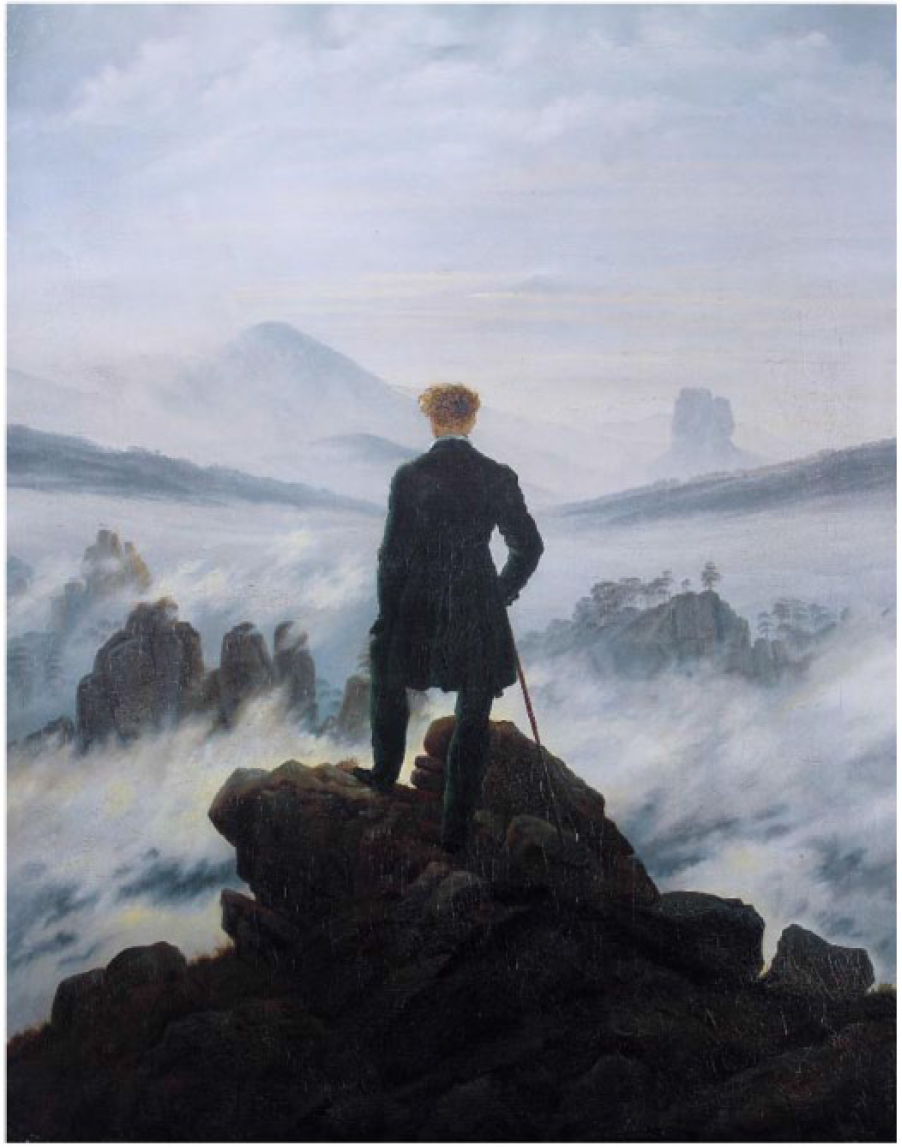
Wanderer above the Sea of Fog (1818) by Casper D. Friedrich. Oil on canvas, Kunsthalle Hamburg.
This scenario changed drastically with industrialisation and the advent of modern technologies. No longer was nature deemed to be an ominous threat but, phrased in Heidegger’s (1977: 17–35) terms, in fact, became a Bestand to be tapped into and made into an instrument by the ever expanding Gestell. As nature’s threat and mystery faded, it was substituted by a fascination with humanity’s own devices. Quickly, the traditional viewpoints on the sublime gave way to a new constitution, namely, the ‘technological sublime’ (Marx, 1964) or the techno-sublime. As humanity became infatuated with the ability to construct humbling structures like the Brooklyn Bridge (1883) and the Hoover Dam (1936), cultural artefacts now stirred imaginations instead of hurricanes. Since then, the sublime has seen many imitations, such as the nuclear sublime (Ferguson, 1984), the American sublime (Wilson, 1992), the digital sublime (Mosco, 2004), the cinematic sublime (Sobchack, 2008) and the affective sublime (French and Shacklock, 2014). What these versions all have in common is that the sublime encounter is progressively mediated by techno-artefacts while nature is cast merely as a beautiful backdrop for these events. These sublime encounters are also increasingly immersive, requiring the distance between subject and object to shrink to millimetres and nanoseconds.
Contemporary sublime experiences
Sublime experiences are induced in contemporary culture, among others, in the so-called culture of extremes that propagates extremity as the only measure of experiences. The culture of extremes induces the sublime in many of its manifestations, from bungee jumping to extreme ironing and storm watching. It is the elusive encounter with the infinite, unrepresentable, the void, self-annihilation and the final frontier that inspires and feeds the culture of extremes. As I have argued elsewhere, it is also the encounter with death that is confronted by many extreme activities. 3
It is against the background of the culture of extremes that the self-mediated documentation of death or selfie death can be interpreted. To take a selfie of one’s death is a technologically mediated encounter with the unthinkable and can, therefore, be considered a sublime experience. The contemporary obsession to take an ‘epic selfie’, an ‘extreme selfie’ or the ‘ultimate selfie’ may be interpreted as an extension of the pursuit of the sublime. The latest invention of the selfie stick (a monopod used to take selfies by positioning a smartphone or the digital camera beyond the normal range of the arm) has worsened the situation because reports show that tourists no longer look where they are going but are transfixed by their images on the screen. Many landmarks and places of tourist interests have now started to ban selfies and especially selfie sticks to prevent unfortunate accidents and even deaths. Putting these safety measures in place does not stop adventurous souls from continuing to push the boundaries and limits of dangerous activities. The latest extreme craze exported from Russia is called skywalking (Figure 2), which entails ‘standing or walking atop very tall structures at dangerous heights, such as the rooftop of a skyscraper building or a bridge’ (Know Your Meme website). 4
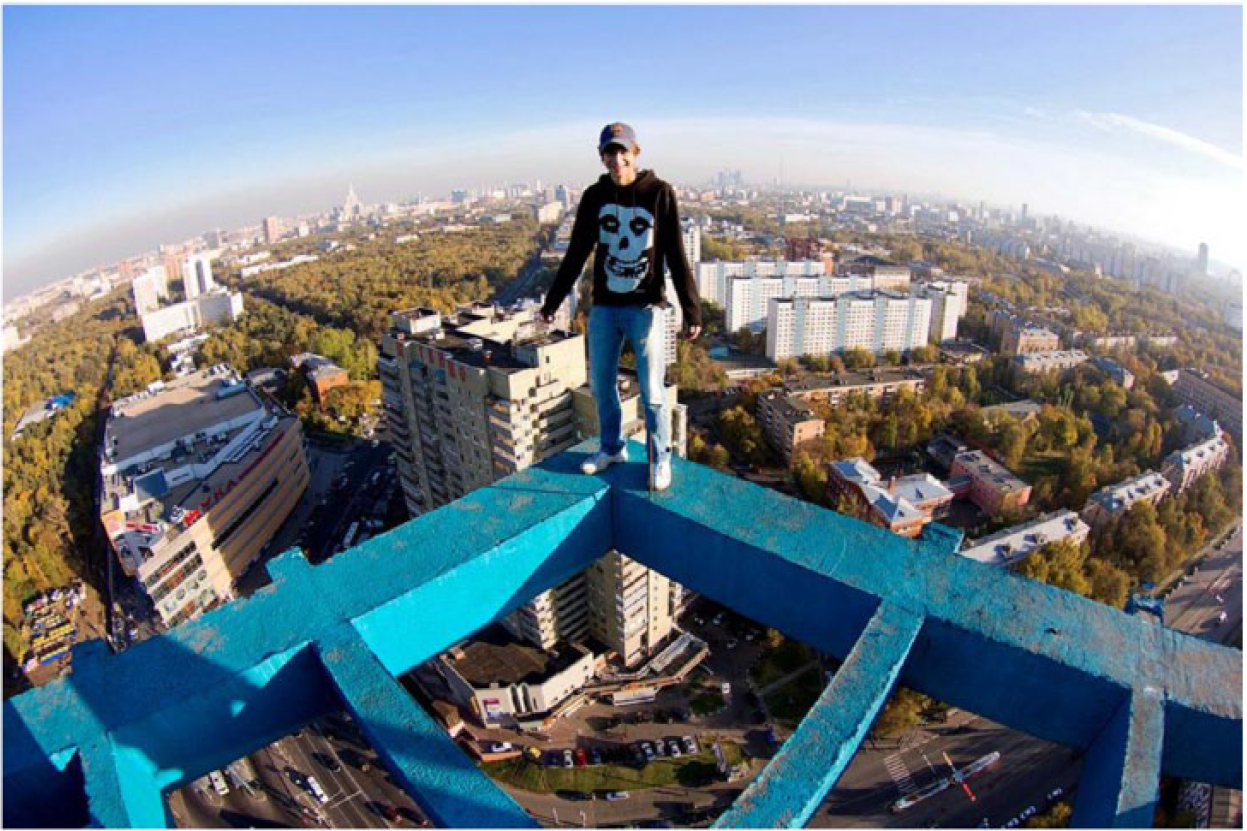
Image of Skywalker Alexander Remnev on top of Moscow skyscraper (2013–2014). Skyscraper Dictionary.
The traveller of Friedrich’s Romantic painting (referred to above) has now progressed from his safe position to being a hairbreadth away from tumbling towards death. The distance between the threatening object and overwhelmed subject has shrunk to such a degree that it is more accurate to refer to this event as immersive rather than reflective. Burke (1990 [1757]) had already predicted this ever-increasing attempt to move closer to the danger: ‘The nearer it [the sublime experience] approaches the reality, and the further it removes us from all idea of fiction, the more perfect is its power’ (p. 43). Taking a selfie while experiencing a vertigo-inducing event such as skywalking testifies to bravery in the face of death. 5 The fictitious nature of the event also presses ever closer to reality and death. But some introductory notes on the selfie phenomenon are required before the sublimity of death selfies can be explored.
The selfie game
The selfie, defined as a ‘self- generated digital photographic portraiture, spread primarily via social media’ (Senft and Baym, 2015: 1558), has become the preferred means for self-expression in the digital age. 6 Even those in high dignitary positions cannot resist its mesmerising pull, as the selfie taken by US President Barack Obama and UK Prime Minister David Cameron with Danish Prime Minister Helle Thorning-Schmidt, attending Nelson Mandela’s memorial service in December 2013, demonstrates. 7 Many scholars have engaged with the phenomenon in an attempt to explain its popularity, anthropological groundings, art historical background, psychological effects and affects, and philosophical implications. 8 These ‘technologies of the self’, to paraphrase Foucault’s terminology, are enabled and aided by technological interventions, such as the double-sided camera fitted to smartphones for instance. Similar to developments in self-portraiture that can be traced to technological advances in mirror technologies, for example, or where oil painting substituted the medium of frescoes and watercolours, while photography and the video camera replaced the canvas, selfies are the latest development in the lineage of self-expression. The selfie, in contrast to traditional self-portraiture, has the added advantage of being accessible to a bigger segment of the population than any other form of self-representation before. In this regard, the selfie is a democratising instrument that does not exclude participants regarding their class, race, sex or gender, neither religion nor age. It has rightly been referred to as the ‘folk art’ of the digital age.
The democratisation of self-portraiture was notably introduced with the development of photography in the 19th century, and the first traceable ‘selfie’ can be identified as a daguerreotype taken by Robert Cornelius in 1839. In this experimental self-portrait photograph, the lamp-maker from Philadelphia, USA, acted as both ‘operator and sitter’ (Dinius, 2015: 446) of his portrait. Cornelius’ ‘daguerreotype portrait and the modern-day selfie resemble each other in […] that the first viewer of every selfie is, inevitably, its subject’ (Dinius, 2015: 448) since both daguerreotype and screen share a ‘mirror-like image surface’ (Dinius, 2015: 449), hence the apparent association between selfies and narcissism. As Marcy Dinius (2015) notes, ‘Because looking at a daguerreotype also inevitably meant looking at oneself, the supposedly distinguishing narcissism of the selfie is, in fact, inherent in the origins of the medium’ (p. 449).
Add to this the demand to be ‘always on’, as Sherry Turkle (2011) has shown, especially via social networks; it means that the need to expand networks, create connections, share information or merely to be entertained is ever-increasing, as is the growing demand for self-expression and self-disclosure. It is for this reason that selfies are often linked to narcissism, and if reality TV star Kim Kardashian’s recently released publication, Selfish (Kardashian, 2015) containing more than 1200 selfies, is any indication, this may be a very likely conclusion. However, it would be erroneous to deduce from this trend that all selfies can be understood in terms of narcissism only.
For instance, Senft and Baym (2015) interpret the selfie as both a ‘photographic object that initiates the transmission of human feeling’ and as ‘a practice – a gesture that can send different messages to different individuals’ (p. 1589). The selfie thus negotiates the complex intersection between subject and object as the self is both photographer and the subject photographed, creator and created. However, it is important to note that although ‘the selfie signifies a sense of human agency’, it is transmitted, displayed and tracked through nonhuman agents. Therefore, the digital presence of the selfie tends to ‘out[live] the time and space in which it was orginal[ly] produced’ (Senft and Baym, 2015: 1589). What remains is a human–nonhuman assemblage, and it is probably more accurate to refer to selfies as ‘distributed forms of agency’ or ‘affective agency’ (Hillis, 2015: 76) spread over network connections. Selfies stand in for their creators and may be regarded as online doppelgangers that induce both positive and negative affects at a distance. An analysis skewed towards narcissism may tend to ignore the affective encounters afforded by social network sites and how (extreme) selfies in particular produce intense responses through their circulation and exchange.
Furthermore, as Marshall McLuhan (1994) explains in his essay ‘The Gadget Lover’, wherein the Narcissus myth is employed to interpret technology use, it would be an over-simplification to identify only self-reflection and self-love with the legend. If the myth is opened to the roots of the meaning of Narcissus’ name, which stems from the Greek term narcosis or numbness, a richer understanding arises. What it reveals is that the myth does not suggest self-recognition as such, but rather self-amputation. McLuhan (1994) maintains, ‘The youth Narcissus mistook his own reflection in the water for another person. This extension of himself by mirror numbed his perceptions until he became the servomechanism of his own extended or repeated image’ (p. 41). Narcissus did not fall in love with his ‘selfie’ but more accurately was self-amputated, numbed by the image and stood in service of the image: ‘He had adapted to his extension of himself and had become a closed system’ (McLuhan, 1994: 41). Thus, McLuhan (1994) tries to explain our fascination with technologies as an extension of ourselves and how it leads to a ‘kind of autoamputation’ or ‘generalised numbness or shock’ (pp. 42–43) to cope with the over-stimulation of the new device or technology. As our bodies are extended by new technologies, they are also amputated in the process to obtain equilibrium again (e.g. the invention of the wheel led to the ‘amputation’ of our legs). According to the myth, Narcissus was not so much flattered by his image as shocked into numbness. Thus, two main processes can be extracted from McLuhan’s discussion of our interaction with technologies, namely, self-amputation and self-amplification (extension of the self; see Wendt, 2014). The selfie both extends (viewed from a narcissist angle) and amputates (viewed from a shocked and numbed point of view) its taker.
Selfies meet sublimity
At the rate that selfies are taken and the shortened intervals between them, as well as the lengths to which people will go to capture them, the category of the sublime may become useful. I have already hinted at two such instances, namely, in the case where a selfie is uploaded shortly before the taker dies (in this case, the taker did so unaware of the imminent disaster) and in the other circumstance where the taker puts himself or herself in great danger knowing that it may end in death. There is another category, however, where the selfie is taken with someone who is at peril and about to perish. I am not referring to fashionable selfies taken at funerals but rather to those rare voyeuristic selfies (although perhaps on the rise) taken with death that speaks to the same sublime complex that I would like to unpack here. Perhaps it is useful to distinguish between the three categories as selfies before death, selfies of death and selfies with death. The first two overlap considerably and only differ in timing and intention, while the latter is induced from a reasonably safe distance.
Selfies before death
In the case of selfies taken just before death, the examples confront us, for instance, with a group of friends in an airplane minutes before the airplane destructs (Figure 3) or a motorist just before a fatal accident. In these cases, the viewer cannot help but interpret the faces gazing at us as sad and tragic. In fact, one may even convince oneself that the sadness is palpable in the eyes of the deceased as in the case of the Rapper Jadiel (real name Ramon Alberto Gonzalez Adam) who posted a selfie in May 2014 shortly before a fatal motorbike accident. However, these projections, although intense, are clouded by the knowledge that this person was on his or her way to death. This knowledge not only evokes empathy but also ‘an affective jolt, or even an uncanny sense of awe’ (Paasonen et al., 2015: 1) knowing that it is them who died and not me. 9

Selfie of Jenni Rivera (Mexican singer) and her crew before aeroplane crash in December 2012.
If we weigh Burke’s analysis of the sublime with these cases, the pain–pleasure principle or ‘delightful horror’ announces itself clearly. As Burke (1990 [1757]: 43) explains, ‘The passions which belong to self-preservation, turn on pain and danger; … they are delightful when we have an idea of pain and danger, without actually being in such circumstances […] Whatever excites this delight, I call sublime’ (p. 43). At first, we experience pain (empathy, sadness) at their demise, which quickly sets into motion another feeling, namely, the shudder of relief or pleasure brought on by the realisation that it is they who died and not me. Burke used the example of public execution to explain how the death of someone else quickly turns into an experience of pleasure. This shift from pain to pleasure forms the crux of Burke’s empirical analysis of the sublime. Ferguson (1984) explains the delightful realisation as follows:
The trick with the sublime, of course, is that we live to tell the tale of our encounters with it – which is of course one good reason why even Burke cannot sustain a thorough-going empiricism about the sublime – because it never proves to be quite as deadly in experience as it had in thought. (p. 6)
And if the event does prove as dangerous, it would move into the realm of the tragic, also, literally that which cannot be thought or contained. Or to be more precise: death.
What is confronted by the sublime experience and forms the ‘the real object of fear … is not the object but rather our own death’ (Young, 2005: 133). Young (2005: 133) adds that similar to Burke’s notion of delightful horror, the Kantian sublime is also a bitter-sweet experience, precisely because although we may be terrified of a menacing object, we are not truly threatened. The reason for this is that the sublime can only be experienced from a position of security. As Battersby (2003) notes, ‘If actual terror was felt, then the sublime is ruled out’ (p. 85). The modern subject overcomes this temporarily negative emotion, according to Kant (1952 [1790]), through a sense of ‘self-preservation (Selbsterhaltung) entirely different from what can be attacked and brought into danger by external nature’ (p. 101). This sense of self-preservation springs from the subject’s alignment with a ‘supersensible faculty’ (Kant, 1952 [1790]: 88) that links with immortality and transcendent Ideas. Thus, although confronted with death, the modern subject escapes through the transcendent, and fear promptly turns into pleasure because ‘the positive aspect of the sublime is precisely the intimation that that death is not “mine”’ (Young, 2005: 138). When we stare into the oblique faces unknowingly captured just before death, we realise that their death is not our death. Therefore, selfies before death activate the aesthetics of the modern sublime. Through them, we face the ‘almost-hereness of death’ (Young, 2005: 138) that is not our own – yet.
Selfies of death
In the cases of selfies of death or death by selfie, we see the expectant faces of adventurers, extremists and the unlucky ones. Although these selfies overlap with the previous category of selfies before death, they do differ in the sense that they are taken in circumstances that can be considered as mortally dangerous, for example, a grizzly bear in proximity or at immense height. As is the case of the selfie by the young Russian girl (Xenia Ignatyeva) who in April 2014 climbed on a high bridge to impress her friends, but then slipped and fell and was executed by electric fences (Figure 4). We cannot help but to be pierced by an affective jolt, a punctum, as her beautiful young face stares into the camera – exhilarated and energised. Faced with the sublime, her selfie gazes back at her from the smartphone screen with the devouring abyss at her back. Is this the image of her death framed by expectation and self-grandeur? Here, the re-reading of the Narcissus myth by Marshall McLuhan can aid in engaging this arresting image.
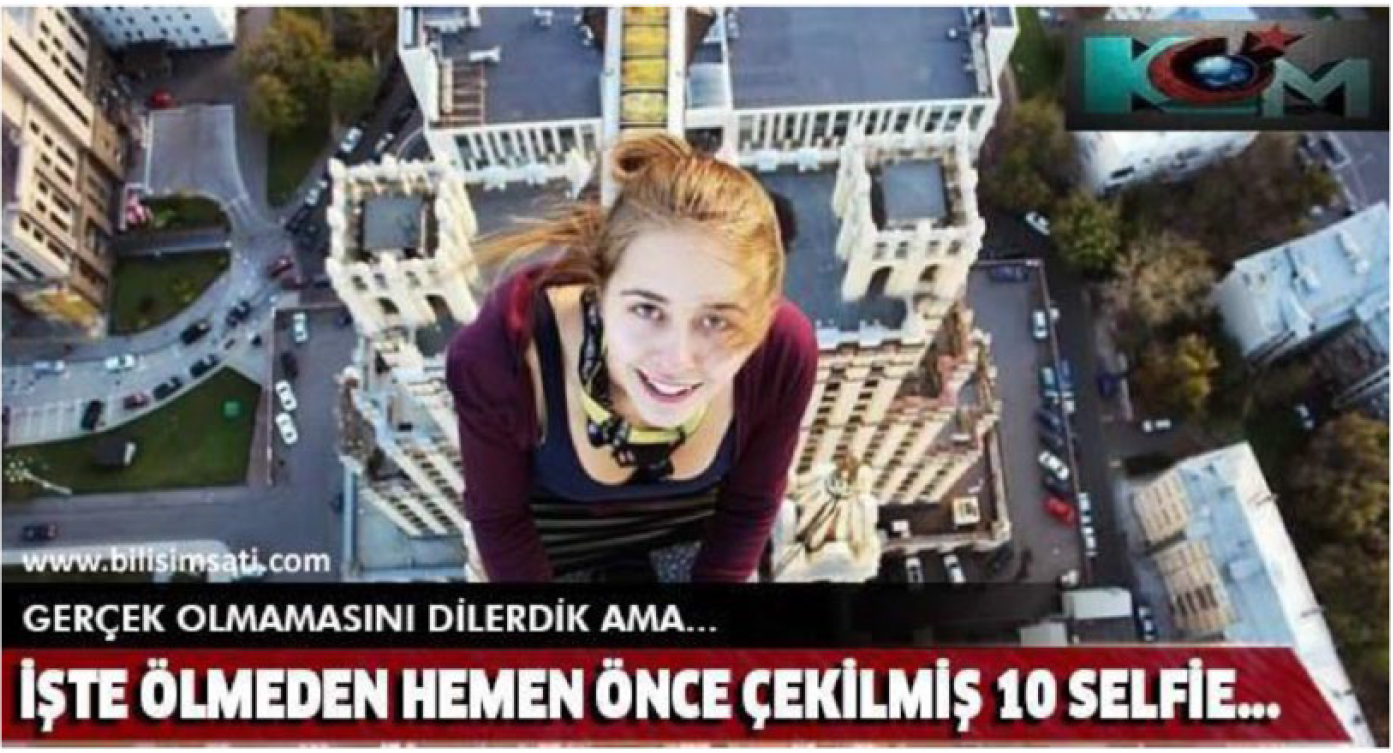
Image of selfie taken by Xenia Ignatyeva (2014).
As already suggested, McLuhan underlined the double meaning locked in Narcissus’ name. With its roots in both self-love and self-numbing Narcissus did not fall in love with his image as much as he was estranged from himself, numbed by the image and even narcotised by it. He did not fall into his reflection because he thought he was reuniting with himself but plunged into the surface, thinking the reflection was another being. Interestingly, the Burkean formulation of the sublime experience correlates with McLuhan’s identification of self-numbing, when Burke describes the sublime encounter as having a paralysing or stunning effect on our intellectual capacity. He argues that the mind is so filled with the object of contemplation that ‘it cannot reason on that object’ (Burke, 1990 [1757]: 39). That feeling (or affect) of ‘astonishment’, which ‘is that state of the soul, in which all its motions are suspended, with some degree of horror’ (Burke, 1990 [1757]: 57) corresponds with McLuhan’s notion of the numbing effect of technological devices.
If we contemplate the selfie death of the Russian girl, it becomes entirely plausible to interpret the image as more than self-obsession. Is it not possible that she is mesmerised by the tool that numbs her into oblivion? Phrased in terms of late capitalism’s affects, is she not caught in the ‘self-perpetuating erotics of narcotic risk and distraction?’ (Anker, 2011: 474) Or what Michael Petit (2015) identifies as the oscillation between digital disaffects and affective responses? Entranced to capture the ‘ultimate selfie’, she forgoes rationality, sensibility and common sense. In the process, she relinquishes the fundamental principles of the sublime experience, by completely immersing herself as the viewing subject into the object of her wonderment. The healthy distance, required between the subject in awe and the awe-inspiring object, has imploded into an ecstatic moment. In turn, as the ecstatic moment circulates online, it gains ‘sticky intensity’ (Paasonen, 2015: 28) by connecting viewers’ bodies and signs, platforms and texts affectively while shared and re-posted.
Xenia’s selfie is taken split seconds before the spell is broken and she plummets to her death, realising too late that the tool created a spectre that cannot save her from mortality. If we meander back to Ovid’s (1955) myth, which inspired McLuhan’s interpretation, the tragedy befalling this young woman is already foretold in Narcissus’ tale who ‘fell in love with an insubstantial hope, mistaking a mere shadow for a real body’ (p. 85). As Ovid (1955) states,
Poor foolish boy, why vainly grasp at the fleeting image that eludes you? The thing you are seeing does not exist: only turn aside and you will lose what you love. What you see is but the shadow cast by your reflection; in itself it is nothing. It comes with you, and lasts while you are there; it will go when you go, if go you can. He did not know what he was looking at, but was fired by the sight, and excited by the very illusion that deceived his eyes. (p. 85)
Transfixed by the reflection, Narcissus
separates himself from his image and becomes a spectator to his own spectacle, to the spectacle he becomes. The image he sees is a shade, and his fixation on it will eventually turn him also into a shadow, as if the phantom effect were contagious. (Lippit, 2015: 105)
In the same way, the Russian girl is transfixed by the reflective screen aiming to capture that impossibility of being both spectre and spectator. Just as Narcissus ‘sees what he has not previously seen but sees also that he has not seen: he sees in the moment of self-discovery, his own blindness … Narcissus gives life to the image; Narcissus gives his life to the image’ (Lippit, 2015: 107), sadly Xenia Ignatyeva also gave her life to the image.
Although it may be argued that her image gains a second life or even an afterlife (see Brager, 2015) as it circulates global networks, the selfie’s afterlife is, however, doomed to become a ‘ghostly image of the self’ (Featherstone, 2015: 217) or ‘specular agency’ (Bartsch, 2006: 92). The screen may promise escape and redemption, even closeness, but for Featherstone (2015) it becomes a ‘negative abyss … where absolute surface creates the effect of infinite depth and a sense of absolute freedom obscures the truth of solipsistic self-reflection and enclosure’ (p. 213).
10
Taking the picture eager to gain friends (translated to likes on Facebook) and to induce positive affects, the selfie of death can never ‘replicate embodied sociability’ or compensate for the loss of ‘thick social relations’ (Featherstone, 2015: 219–220). Featherstone (2015) argues that selfies are a ‘desperate defense mechanism against the fall into fragmentary identity or psychosis’ and a failed attempt to ‘remember [our] existence’ (p. 218). In other words, although they try very hard, selfies cannot forge real, although always incomplete and imperfect, embodied encounters. What happens instead is that
the face is reduced to the flatness of the image, which we scrutinize for imperfection and so on, and incompleteness is screened out in favor of imaginary totality. There is no abyss behind this face but only the effect of distance, the effect of self and other, individuation, and transindividuation, which hides the reality of destroyed subjectivity. (Featherstone, 2015: 219)
Featherstone presents us with a strong case of how selfies, and selfies of death in particular, offer destroyed subjectivity, not only literally but also figuratively. In the place of the real, the embodied subject, a young woman, in this case, we are instead confronted with the ‘event of the trauma’ (Foster, 1996). The subject has sublimely been ‘evacuated and elevated all at once’ (Foster, 1996: 124) by the traumatic event, and all that is left is an image witnessing and testifying that someone once has been present, before being relegated to a ghostly and spectral agency.
Selfies with death
Finally, the case of selfies taken with death is briefly unpacked. These are selfies taken with a dead person, often a dead relative. Social media is filled with so-called ‘funeral selfies’ or photographs tagged #funeral where death is relegated to a status update (e.g. ‘rest in peace Granny’). Funeral selfies have caused a furore in 2013 with the Obama selfie at Mandela’s memorial service, mentioned above, and Jason Feifer’s infamous Tumblr site ‘Selfies at Funerals’. Despite the negative press, there is evidence that social media affords and mediates memorialising practices in new complex ways. 11 Funeral selfies are thus not all the same; despite ‘self-centring’ selfies, there are those selfies that rather create a ‘presencing’ (Gibbs et al., 2014: 263) space where ritualised commemoration can take place.
It is, however, the more blasphemous type that attracts me here, such as the notorious Italian nurse who took selfies with her dead patients and became known as the ‘angel of death’. 12 Most significant is the Turkish police officer who took a selfie in September 2014 while a person commited suicide in the background by jumping off a bridge (Figure 5). Naturally, the selfie was shared on social media by the police officer. The ethical implications of his rather insensitive act are beyond the scope of my analysis, but suffice it to state the police officer was investigated afterwards. 13 In terms of the aesthetics of the sublime, this is an example of pushing the boundaries and limits between subject in awe and awe-inspiring object without paying the final penalty. Once again, if we are guided by Burke’s empirical explanation of the sublime experience, the officer inserts himself in the presence of death without putting himself in danger physically. The act has been described as ‘heartless’ (Best, 2014) and even ‘arrogant’ (Fairbanks, 2014). It is an undeniable thrill- and attention-seeking strategy, to be in the presence of another’s death while experiencing how pain subsides into pleasure. One may speculate that if the technology were available during the 18th century, for instance, whether people would have taken selfies during executions. No doubt, a selfie taken with the beheading of Queen Marie-Antoinette in the background would be considered an ‘ultimate selfie’. Burke has established, as already noted, that witnessing a public execution was far more appreciated than attending the theatre.

Image of police officer taking a selfie with man who jumps from bridge in Ankara, Turkey (2014).
No matter how heinous the police officer’s deed, the image corresponds most closely with the modern parameters of the sublime, more so than the previous two categories of selfies before death and selfies of death. The police officer is in no immediate danger; he is standing at a safe distance from the peril while capturing the selfie. As determined by Burke and Kant, the subject is faced with a humbling event without being in real danger during the sublime encounter. The man dangling from the bridge just before he jumps to his death is, however, immersed in the threat. In fact, the image captures a tragedy from the perspective of the suicide victim but shows the police officer taking a sublime selfie. If this picture is compared to the Romantic painting of Friedrich introduced earlier, although the two depictions differ significantly, they also share certain themes. Both subjects observe an amazing scene from safety, and both have their backs turned. In the event of Friedrich’s traveller, his back is turned to the audience with the intention to invite viewers to participate in viewing the unfolding sublime landscape. In the case of the Turkish police officer, his back is ironically turned at the horrible event while he stares into the camera to take a selfie. Ontologically speaking, these two images differ in how they address the sublime: the Romantic image bows to the aesthetics of the sublime, while the contemporary selfie converts the sublime into a spectacle or a networked affect.
Conclusion
When the aesthetic category of the sublime is considered with selfies taken before and with death, it seems that the obvious point is that one can take a selfie of another’s death but not of one’s own. As analysed in the modern sources of the sublime, a healthy distance between the self and its demise needs to be retained for sublimity to be experienced. In the cases of the selfies before death, taken unknowingly prior to the taker’s death, the audience may view them as reminders of their mortality. This is a painful experience, but the pain quickly subsides into pleasure when the viewer realises that there is a healthy distance between her or his death and reality. Both Burke (‘delightful horror’) and Kant (‘negative pleasure’) identified the dissolving of fear into a pleasurable experience as part of the sublime event.
In the tragic instances of what has been termed selfies of death, the taker endangers himself or herself by climbing on a high bridge, or dangling from a cliff, or even taking a selfie with a dangerous animal such as a grizzly or shark. In all reasonability, these are extremely precarious circumstances that could lead to death and, in the end, did. The selfies taken just before the sad event, although not corresponding with death completely, bring the sublime event too close for comfort. The drive to experience extremity – to brush up against death – and survive to tell the awesome tale or to post the epic selfie means that some adventurers are pushing the healthy distance required to experience the sublime over the limits. In these cases, the thrill-seeking subject and the awesome object collide to the detriment of the first. When self and death implode in a selfie of death, all that is left is a memento for others to be reminded of their transience. Attempting to witness one’s death remains risky even with the aid of tools that promise instantaneous presence in the moment.
Footnotes
Funding
The author(s) disclosed receipt of the following financial support for the research, authorship, and/or publication of this article: The author received financial support from the National Research Foundation, South Africa.