



Abstract
Imagined intergroup contact (Crisp & Turner, 2009) is a new indirect contact strategy for promoting tolerance and more positive intergroup relations. Despite its relatively recent inception, there have now been over 70 studies showing that imagining a positive interaction with an outgroup member can reduce prejudice and encourage positive intergroup behavior. With this meta-analysis, we provide the first quantitative review of imagined contact effects on four key measures of intergroup bias: attitudes, emotions, intentions, and behavior. We also test for moderators arising from both group and study design characteristics. The analysis found that imagined contact resulted in significantly reduced intergroup bias across all four dependent variables (overall d+ = 0.35). The effect was significant for both published and unpublished studies, and emerged across a broad range of target outgroups and contexts. The effect was equally strong for explicit and implicit attitude measures, but was stronger on behavioral intentions than on attitudes, supporting the direct link between imagery and action proposedly underlying mental simulation effects. Most design characteristics had no significant impact, including valence of the imagined interaction, type of control condition, and time spent imagining contact. However, the more participants were instructed to elaborate on the context within which the imagined interaction took place, the stronger the effect. The imagined contact effect was also stronger for children than for adults, supporting the proposition that imagined contact is a potentially key component of educational strategies aiming to promote positive social change.
When you visualised a man or a woman carefully … when you saw the lines at the corners of the eyes, the shape of the mouth, how the hair grew, it was impossible to hate. Hate was just a failure of imagination.
Researchers developing prejudice-reduction interventions have a powerful tool at their disposal in Gordon Allport’s contact hypothesis (1954). This hypothesis proposes that contact between groups reduces prejudice, a prediction which has been confirmed across more than 500 studies (Pettigrew & Tropp, 2006). Intergroup contact works via a range of cognitive and affective processes including reduced anxiety, increased self-disclosure, and increased trust, and it is unquestionably integral to efforts aimed at improving intergroup relations (see Hodson & Hewstone, 2013). But what if contact is prevented, either by physical or psychological barriers? In many of the situations where intergroup conflict is most pervasive, geographical or social segregation means that contact between groups is either impossible or unlikely, and there are many reasons why people may not seize opportunities for contact even when they become available. In recent years, however, it has become apparent that the contact hypothesis has an application that transcends face-to-face interaction. The imagined intergroup contact hypothesis (Crisp & Turner, 2009) proposes that the very concept of contact, mentally articulated in the form of an imagined interaction, can have a positive impact on intergroup perception and behavior. There have now been over 70 studies of imagined contact, testing its impact on a range of measures related to the reduction of prejudice and intergroup bias. In this meta-analysis, we provide the first quantitative review of these imagined contact effects.
Imagined Intergroup Contact
Imagined intergroup contact is defined as “the mental simulation of a social interaction with a member or members of an outgroup category” (Crisp & Turner, 2009, p. 234). Crisp and Turner argued that imagined contact may be valuable as an application of the contact hypothesis where actual contact is impossible or unlikely; for example, where there are a lack of opportunities to meet people from other groups. However, they also noted that imagined contact may be valuable as a means of preparing people for future contact. Imagined contact may, for instance, make people more likely to seek out and seize opportunities for contact. It may also improve the quality of direct contact by preparing them to engage in these interactions with a positive and open mind. In turn, this may make it more likely that future direct contact will meet the conditions Allport believed were necessary for prejudice reduction (equal status, common goals, a co-operative environment, and support from authority). The idea that imagined contact prepares people for future contact can be seen as a logical extension of Allport’s original theorizing. Indeed, Crisp and Turner (2012) note that in The Nature of Prejudice Allport discusses the potential of “fantasy level” contact as an effective first step to improving intergroup relations, particularly when “realistic discussion” between groups could constitute a threat (1954, p. 453). Where contact encounters are possible, but where groups do not act upon these opportunities, imagined contact may therefore be a critical first step towards establishing direct contact.
Processes and Outcomes
Since its inception, research has shown positive effects of imagined contact on intergroup attitudes, emotions, behavioral intentions, and behavior. There is substantial evidence showing that imagined contact, especially when positively toned, has beneficial effects on intergroup relations. For instance, early enquiries demonstrated that it improves intergroup attitudes (Turner, Crisp, & Lambert, 2007), perceptions of outgroup variability (Turner et al., 2007), and enhances projection of positive traits to the outgroup (Stathi & Crisp, 2008). Subsequent studies found that it fosters more positive intentions to engage in outgroup contact (Husnu & Crisp, 2010a, 2010b), increases self-efficacy concerning future outgroup contact (Stathi, Crisp, & Hogg, 2011), and facilitates outgroup trust (Pagotto, Visintin, De Iorio, & Voci, 2012; Vezzali, Capozza, Stathi, Giovannini, 2012). Other studies have shown it reduces negative aspects of outgroup evaluation such as intergroup anxiety (Birtel & Crisp, 2012b; Husnu & Crisp, 2010a; Turner et al., 2007; West, Holmes, & Hewstone, 2011), infrahumanization of the outgroup (Vezzali, Capozza, Stathi, et al., 2012), negative stereotypes (Brambilla, Ravenna, & Hewstone, 2012; Cameron, Rutland, Turner, Holman-Nicolas, & Powell, 2011; Stathi, Tsantila, & Crisp, 2012) and stereotype threat (Abrams et al., 2008). Research has also revealed that imagined contact can combat subtle forms of bias such as implicit prejudice (Turner & Crisp, 2010; Vezzali, Capozza, Giovannini, & Stathi, 2012) and negative nonverbal behaviors (Birtel & Crisp, 2012a; Turner & West, 2012).
As well as a large number of supportive studies, imagined contact has stimulated a great deal of debate. With this meta-analysis, we address some of these critiques. For example, the “real world” significance of the effect has been questioned (Lee & Jussim, 2010), and others have questioned whether the effect is present for non-self-report measures, suggesting that it is subject to demand characteristics (Bigler & Hughes, 2010). While these issues have been debated from a conceptual standpoint (Crisp, Birtel, & Meleady, 2011; Crisp & Turner, 2010), with this meta-analysis we provide a quantitative riposte. For instance, if imagined contact has significant effects when its outcomes are measured implicitly, this would suggest the effect cannot be attributable to demand characteristics. If it has significant effects on actual behavior towards outgroup members, then the implications for real-world interaction are clear.
Aims of the Present Meta-Analysis
Previous theoretical and narrative reviews have established key principles of imagined contact (Crisp & Turner, 2009), documented its impact on behavioral intentions (Crisp, Husnu, Meleady, Stathi, & Turner, 2010), proposed both cognitive and affective pathways through which it has a positive impact (Crisp & Turner, 2012; Crisp et al., 2010), and elucidated links with Allport’s original theorizing (Crisp & Turner, 2012). With this meta-analysis, we provide the first quantitative review of the effectiveness of imagined contact on four key dependent measures: attitudes, emotions, intentions, and behavior. We also examine moderating conditions that may limit or enhance its effectiveness. To identify these moderators, we draw upon key theoretical predictions, as well as the contributions of other researchers. We were able to assess the impact of multiple moderators relating both to group-based characteristics (i.e., variability relating to participants or to the outgroup being imagined) and design-based characteristics (i.e., variability relating to the imagined contact manipulation). We discuss how we identified and assessed these characteristics next.
Group Characteristics
Is imagined contact more effective for some outgroups than for others?
Pettigrew and Tropp (2006) found that the beneficial effect of direct contact “applies beyond racial and ethnic groups to embrace other types of groups as well” (p. 768). In order to determine whether the same is true for imagined contact, we coded the type of outgroup participants were asked to imagine contact with. All but five studies could be categorized into the outgroups of ethnic group, nationality, mental illness, disability, age, sexual orientation, religion, or weight.
Do age, gender, and nationality of participants predict the effectiveness of imagined contact?
We coded the participant characteristics of age, gender, and nationality as potential moderators. Our decision to examine these factors as moderators was guided by the diversity of participants represented in our sample, and our aim was to discover whether imagined contact was effective across all participant groups. Of particular note, recent evidence shows that imagined contact improves intergroup relations not only among adults but also among children (Cameron et al., 2011; Vezzali, Capozza, Giovannini, et al., 2012; Vezzali, Capozza, Stathi, et al., 2012). Given that the formative years of prejudice development are school years (Cameron & Rutland, 2006; Cameron, Rutland, Brown, & Douch, 2006) and the clear appeal of imagery interventions for children, this is an obvious place to intervene with imagined contact. Thus, it is important to establish its effectiveness within this group. We therefore tested for differential effectiveness of imagined contact on adult participants as compared to child participants, as well as coding age as a continuous variable to test for any changes in the effectiveness of imagined contact across the lifespan.
Design Characteristics
Is positive imagined contact more effective than neutral imagined contact?
Based on findings that quality of contact is particularly important in order for it to benefit intergroup relations (e.g., Eller & Abrams, 2004; Stathi & Crisp, 2010; Voci & Hewstone, 2003), studies of imagined contact often specify that participants should imagine a positive interaction. The importance of this has been argued theoretically (Crisp & Turner, 2009), and empirical studies comparing positive contact with neutral contact also support this idea (Stathi & Crisp, 2008; West et al., 2011). Specifying a positive interaction may be important because it guards against a possible negative tone, which might emerge if participants were given no direction and relied upon negative stereotypes as a basis for the imagined interaction (cf. West et al., 2011). Thus, we coded whether participants were asked to imagine a positive interaction, or whether this was not specified.
Does it matter what participants in the control condition do?
When calculating effect sizes on the basis of a comparison between two groups, it is important to consider the quality of the control condition. If an intervention is very effective when compared to one type of control group, but less effective when compared to another, this may suggest possible alternative explanations. For example, where one group is asked to imagine a positive interaction with an outgroup member and is then compared with another group which does nothing, any differences in intergroup bias between the two groups could be attributable to the general effect of imagined social interaction, or to positive affect. However, if the second group is asked to imagine a positive interaction with a nonoutgroup member, these explanations are effectively controlled for, representing a more stringent test of the hypothesis (and, potentially, a smaller effect size). We examined the control conditions in our included studies, and found that they could be categorized into four types: (a) imagine contact with a nonoutgroup member, (b) imagine a neutral scene, (c) think about the outgroup, and (d) no task.
Does elaboration improve the effectiveness of imagined contact?
Husnu and Crisp (2010a) found that an elaborated version of the imagined contact task (where participants thought about specifically when and where the imagined interaction took place) enhanced the effect of imagined contact on anxiety, attitudes, and intentions towards the outgroup. The reason why elaborated imagined contact should enhance intentions was derived from research showing that when we make more detailed plans, this provides an available behavioral script that can provide the cognitive roadmap for future behaviors (Gollwitzer, 1993). The elaborated instructions should therefore have a greater impact on intentions because they help participants to create a more cue-rich simulation that makes the imagined behavior subsequently more available at the judgmental phase. More general research on mental simulation supports this hypothesized relationship between elaboration and future behavior. For many situations we have a behavioral script, and the more elaborate and detailed the script, the stronger its impact on subsequent attitudes and behavior (Anderson, 1983; Ross, Lepper, & Hubbard, 1975). Therefore, it seems likely that studies which include greater elaboration will obtain larger effects. We found that studies varied in a number of ways in terms of the level of elaboration specified by their imagined contact instructions, and coded four variables accordingly: the amount of detail provided about the situation or context of the imagined interaction, the amount of detail specified about the outgroup target, the amount of time participants spent imagining contact, and whether participants described what they had imagined after the manipulation.
Publication Bias, or the File Drawer Problem
Finally, as with all reviews, our overall effect sizes need to be considered in light of the “file drawer problem” (Rosenthal, 1979)—the likelihood that additional studies have been conducted on imagined contact, but neither been published nor made available to us. To quantify the impact of the file-drawer problem on our findings, we sought both published and unpublished studies (with the final sample containing 50% of each type), and coded publication status as a potential moderator of effect size. We also conducted a number of different analyses to assess the potential size and impact of publication bias on our set of studies, including fail-safe N, Egger’s regression, and trim and fill analyses.
Summary of Aims
In this meta-analysis, we draw upon 71 published and unpublished studies to present a comprehensive assessment of the size and variability of imagined contact effects, their relative size across different measures of intergroup bias, their universality across participant groups and outgroups, and whether there are any necessary or facilitating conditions in order for them to occur.
Method
Inclusion Criteria
We adopted an inclusive approach when searching for studies, both to ensure that our effect sizes represented a comprehensive assessment of the effectiveness of imagined contact, and to address concerns over whether the imagined contact effect is only apparent for certain groups of people or under certain circumstances (Bigler & Hughes, 2010). Thus, we included any study, published or unpublished, which randomly assigned one group of participants to imagine positive or neutral contact with an outgroup, assigned another group of participants to complete an alternative task, and included a subsequent measure of intergroup bias. We employed the following inclusion criteria in order to select these studies.
Criterion 1
The study included an experimental manipulation of imagined contact, as defined by Crisp and Turner (“the mental simulation of a social interaction with a member or members of an outgroup category”; 2009, p. 234). In order to be eligible, the manipulation had to include both the mental simulation and the interaction components. Therefore, studies where contact was not real, but where participants believed it was, were excluded because they did not include the simulation component (e.g., Finchilescu, 2010; Vorauer, Hunter, Main, & Roy, 2000, Study 2; e.g., interacting with an outgroup member via an Internet chat room, where the outgroup members’ responses were programmed via computer). Furthermore, studies in which participants mentally simulated an outgroup member but did not imagine interacting with that outgroup member were excluded because they did not include the interaction component (e.g., taking the perspective of an outgroup member, Todd et al., 2011; imagining being in the presence of an outgroup member, Desforges et al., 1997; imagining a counterstereotypic outgroup member, Blair, Ma, & Lenton, 2001). We also further specified that the interaction must occur between the participant and the outgroup member; therefore, studies in which participants mentally simulated social interactions that did not involve themselves were excluded (e.g., watching or reading about ingroup–outgroup interactions; Cameron et al., 2006; Mazziotta, Mummendey, & Wright, 2011). Thus, we limited our analysis to studies which met the strict definition of imagined intergroup contact, and excluded studies on various related constructs such as counterstereotypic mental imagery (Blair et al., 2001), perspective taking (Todd, Hanko, Galinsky, & Mussweiler, 2011), vicarious contact (Mazziotta et al., 2011) and experimental extended contact (Cameron et al., 2006).
Criterion 2
As there is a theoretical and empirical basis to suggest that negative imagined contact is ineffective or even harmful (Crisp & Turner, 2009; see also Harwood, Paolini, Joyce, Rubin, & Arroyo, 2011; West et al., 2011), we did not include any studies or conditions in which the interaction was explicitly negative.
Criterion 3
The study had to include a comparison condition, in which participants completed any task which did not involve imagined contact with the same outgroup. This criterion was employed in order to ensure that all our effect sizes were comparable, in that they represented the effectiveness of imagined contact on intergroup bias, rather than the relative effectiveness of one type of imagined contact versus another. Studies in which all participants imagined contact with the same outgroup (e.g., Babbitt & Sommers, 2011; Husnu & Crisp, 2011, Experiment 2; Kuchenbrandt, Eyssel, & Seidel, 2013) were therefore excluded, as they did not allow us to calculate an effect size representing the effectiveness of imagined contact.
Criterion 4
The study had to include at least one measure indicative of intergroup bias, taken after the imagined contact manipulation. Eligible dependent variables were measures of emotion, attitude, behavior, or intended behavior towards the outgroup (see the following for specific information concerning each category).
Search Strategy
Our primary strategy was to search social scientific databases (PsycInfo, Web of Knowledge) for studies published before the 6th of June 2013 and containing any term related to intergroup contact (e.g., contact, interaction, intergroup, outgroup), as well as any term related to mental simulation (e.g., imagine, mental simulation, mental imagery). To ensure that we did not omit any study which used nonstandard terms to describe an imagined contact manipulation, we conducted additional searches including more general terms which might be used to describe imagined contact (e.g., hypothetical, simulated, vicarious) in conjunction with terms relating to both contact and outgroups (e.g., outgroup, ingroup, intercultural, prejudice, disability, ethnic, nationality, schizophrenia).
We also conducted an extensive search for unpublished work. To obtain unpublished research, we (a) searched ProQuest Dissertations and Theses using the search terms described earlier; (b) contacted the authors of relevant conference papers; and (c) contacted the email listservs of major social psychological societies (Social for Personality and Social Psychology, Society of Experimental Social Psychology, Society for the Psychological Study of Social Issues) to request unpublished or in press work.
Finally, we employed ancestry and descendancy approaches (Johnson & Eagly, 2000) to ensure that our search included all relevant studies. The reference lists of all papers included in the meta-analysis were examined, as were later citations of each paper (retrieved using the Social Sciences Citation Index and Google Scholar), and later citations of key theoretical imagined contact papers.
Our search identified 6,490 papers, theses, and unpublished works. Titles and abstracts were reviewed independently by two coders in order to identify potentially relevant studies, and full text articles were then reviewed independently by two coders in order to determine eligibility. In total, we were able to compute effect sizes for 71 independent tests of imagined contact versus a control condition which met our inclusion criteria. Of these tests, 34 were taken from 24 published papers, and 37 were taken from unpublished studies. We were able to calculate precise effect sizes based on means and standard deviations for the vast majority of these (67 studies, or 94% of the total sample), either from information provided in the report or from correspondence with the authors. For the remainder (6%), effect sizes were estimated using summary statistics, such as t values. This resulted in k = 71 separate tests of imagined contact effects, which were included in the meta-analysis. Table 1 presents the effect sizes and characteristics for each of these tests.
Characteristics and effect sizes for studies included in the meta-analysis.

Note. Country = nationality of participants, or country where study took place; Outgroup = group with which participants imagined contact; NE = number of participants in the experimental condition; NC = number of participants in the control condition; Att = effect size of imagined contact on attitudes; Emot = effect size of imagined contact on emotions; Bhvr = effect size of imagined contact on behavior; Int = effect size of imagined contact on intended behavior.
Selection of Comparisons Within Studies
The basis of our effect sizes was a comparison between an imagined contact condition and a control condition. Where studies included more than one experimental or more than one control condition, we adopted a systematic approach in either selecting or averaging those conditions to compute a single effect size. This was because including two separate effect sizes would violate the assumptions of independence in meta-analysis.
For studies that included more than one manipulation of imagined contact, we adopted the recommended approach of combining groups in order to create one pair-wise comparison (Higgins & Green, 2009). In other words, we allowed all manipulations of imagined contact to contribute to the final effect size, whether or not they were hypothesized to be effective (e.g., West & Bruckmüller, 2013, presented imagined contact instructions in either an easy-to-read font or a hard-to-read font, proposing that imagined contact would be ineffective in the latter condition; we included both of these conditions when computing our effect size). In order to compute combined effect sizes, individual meta-analyses were performed on data from each study, to ensure that summary effect sizes were correctly weighted by the number of participants in each condition.
However, where studies included multiple control conditions, we did not simply average these, as the most stringent test of the imagined contact hypothesis was provided by a more selective approach. Theoretical predictions suggest that certain control conditions are likely to inflate effect sizes; for example, simply thinking about the target group (Turner et al., 2007, Study 2) may actually have a negative effect on intergroup bias (by priming outgroup stereotypes), thus increasing the observed effect size for imagined contact. Therefore, where studies included multiple control conditions, we selected the condition that most closely resembled the imagined contact condition, and used this as the basis for our comparison. Where possible, we selected a control condition in which participants imagined contact with a nonoutgroup member (e.g., for Chen & Mackie, 2013, we chose “imagine contact with a stranger” rather than “think about Muslims”); otherwise, where possible, we selected another control condition which did not involve thinking about the outgroup (e.g., imagining a neutral scene). We then empirically assessed the influence of type of control condition on effect sizes through moderator analyses.
Coding of Dependent Measures and Calculation of Effect Sizes
Again, we adopted an inclusive approach when selecting eligible dependent variables, to provide the broadest possible test of the imagined contact hypothesis. Thus, any measure related to intergroup bias was included in our analysis. As imagined contact may not have the same effect across different components of intergroup bias, we coded dependent variables into four categories, to enable us to assess whether imagined contact was equally effective across these categories. These categories were attitudes, emotions, intentions, and behavior towards the outgroup.
The category attitudes towards the outgroup included explicit measures of attitudes towards the outgroup (both cognitive and affective), measures of implicit attitudes (e.g., implicit association tasks), measures indicative of general outgroup evaluation (e.g., feeling thermometers), ratings of specific outgroup characteristics (e.g., perceived variability, warmth, competence, dangerousness), measures assessing the relationship between the participant and the outgroup (e.g., perceived commonality, inclusion of other in self, social distance), projection of positive traits to the outgroup, and measures of stereotyping.
The category emotions towards the outgroup included measures of intergroup anxiety, ratings of other intergroup emotions (e.g., trust, anger, fear), and ratings of general positive or negative affect towards the outgroup.
The category intended behavior towards the outgroup included measures of future contact intentions, intentions to help an outgroup member, contact self-efficacy, perceived importance of contact, self-disclosure, perceived tolerance, motivation to respond without prejudice, approach and avoidance tendencies, and measures concerning future interactions (e.g., anticipated enjoyment, uncertainty).
Finally, the category behavior towards the outgroup included measures of actual behavior towards outgroup members (whether self-reported or observed), such as seating distance from an outgroup member, making the decision to work with an outgroup member, self-disclosure to an outgroup member, time spent with outgroup members, and number of outgroup friends formed after the intervention.
Decisions about which measure belonged in which category were made independently by two postgraduate coders, who agreed with high reliability (Cohen’s κ = 0.94). Effect sizes for each measure were also calculated independently by both coders (their effect size calculations differed by less than d = 0.02). In both cases, disagreements or discrepancies were resolved by the first author. For all dependent variables, effect sizes were coded such that a positive effect represented reduced intergroup bias (i.e., more positive attitudes, fewer negative emotions, or increased intentions for contact).
The majority of the studies included in the meta-analysis (77%) assessed intergroup bias using more than one dependent measure. If we were to include a separate effect size in our meta-analysis for each of these dependent measures, studies with more measures would have a disproportionate influence on the overall effect size. This method would also be problematic from a statistical point of view, as meta-analysis assumes that each effect size is independent, whereas two measures taken from the same study will clearly share variance with one another. The options, as with multiple conditions, are either to select one dependent variable or to compute an average. Consistent with our inclusive approach, we chose to include all eligible dependent variables and to compute summary effect sizes. We first computed up to four summary effect sizes for each study, representing the average effect of imagined contact on attitudes, emotion, intentions, and behavior, as applicable. Then, we averaged these effect sizes into a single overall effect size for each study, representing an estimate of the effect of imagined contact across all measures of intergroup bias, with effects on attitude, emotion, intention, and behavior contributing equally.
Coding and Moderators
We coded a total of 11 group and design characteristics which might moderate the effectiveness of imagined contact. First, we coded the group characteristics of the outgroup with which participants imagined contact (ethnic group, nationality, mental illness, disability, age, sexual orientation, religion, weight, other); participant gender (recorded as percentage of women in the sample); participant nationality (where this was not reported, we substituted nationality with the country where the study took place, if known); and participant age. Age was coded both as a continuous variable and as a dichotomous one (children, adults; i.e., whether participants were under or over 18).
Second, we coded a number of design characteristics assessing the methodological decisions made in each study. These were the valence of the imagined contact (positive, neutral/unspecified); the type of control condition (imagine contact with a nonoutgroup member; imagine a situation that does not involve contact; think about the outgroup member; no task); and four variables relating to the level of elaboration. These variables were the level of detail participants were given about the context of the imagined scenario (coded on a 5-point scale from minimal to very detailed); the level of detail participants were given about the outgroup target in the imagined scenario (coded on a 5-point scale from minimal to very detailed); the amount of time participants spent imagining contact (in minutes); and whether participants wrote about or described the imagined contact afterwards (yes, no).
Coding was performed independently by two postgraduate students, and a subset of the papers was also coded by the first author. Interrater reliability was assessed using Pearson’s r for the continuous variables and Cohen’s kappa for the categorical variables. Overall, there was a high level of agreement between coders (mean r = 0.89, range 0.78–0.97; mean κ = 0.86, range 0.74–1.00), and disagreements were resolved through discussion.
Meta-Analytic Strategy
Calculations were performed using STATA Version 12, and were based on random effects models. These assume that the true effect size of imagined contact in each study varies as a function of differences in study characteristics as well as sampling error. We computed weighted average effect sizes using the STATA command metan (Harris et al., 2008), which implements the random effects model specified by DerSimonian and Laird (1986). The effect sizes in this analysis were computed using Cohen’s d (d+), and the standard errors used to weight each effect size were calculated according to the formula specified by Lipsey and Wilson (2001). We interpreted these effect sizes using standard convention (Cohen, 1992), in which values of 0.2, 0.5, and 0.8 represent small, medium, and large effect sizes, respectively; these roughly correspond to Pearson’s r values of 0.1, 0.25, and 0.4. We examined our effect sizes for outliers, and as no effect sizes exceeded 2.5 standard deviations from the mean (either within each of the four categories of dependent measure, or overall), we made no adjustments. However, we observed that two studies had a sample size over 6 times the average (Chen & Mackie, 2013; Lai et al., 2013). To ensure that these studies did not contribute disproportionately to the summary effect size, we capped their sample size at 180 (the size of the next largest study) when computing the standard error variable used to weight each effect size.
Heterogeneity was evaluated using Cochran’s homogeneity Q statistic and the I2 statistic. Where the Q statistic is significant, this indicates that the effect of imagined contact across the relevant set of studies is moderated by factors other than sampling error. The I2 statistic estimates the percentage of variability in the effect size estimate that can be attributed to these moderating factors, rather than to sampling error. As a general guideline, an I2 statistic of 30% to 60% indicates moderate variability, and over 75% indicates considerable variability (Higgins & Green, 2009).
Moderator analyses were conducted using two approaches. Our main approach was to employ metaregression (Thompson & Sharp, 1999), which can be used to assess the effect of both continuous and categorical moderators, in order to assess whether each moderator was associated with significant variation in the effect size (the beta and p values in metaregression indicate the strength and significance of this association, respectively). These analyses were performed using the STATA command metareg (Hardbord & Higgins, 2008). However, where it was most informative to examine the absolute size of the imagined contact effect for each level of a moderator rather than to assess whether moderation was significant, we used meta-analysis (as described in the previous section) to give an estimate of the magnitude of the size of the imagined contact effect.
Results
Effectiveness of Imagined Contact in Reducing Intergroup Bias
Meta-analysis showed that imagined contact had a reliable small-to-medium effect across all measures of intergroup bias (see Table 2). The overall sample-weighted effect of imagined contact on intergroup bias was d+ = 0.35 (95% CI [0.26, 0.44]), based on 71 studies and 5,770 participants. There was significant variation in the effect of imagined contact across studies (Q[70] = 158.37, p < .001), with a moderate-to-high level of heterogeneity across studies (I2 = 55.8%). Therefore, moderator analyses are justified in order to determine the sources of this variability.
Sample-weighted average imagined contact effect as a function of measure of intergroup bias.

Note. CI = confidence interval.
p < .05. **p < .01. ***p < .001.
We next examined the effect of imagined contact on different types of intergroup bias. The sample-weighted average effect of imagined contact on attitudes to the outgroup was d+ = 0.35, with a 95% confidence interval from 0.24 to 0.45, based on 57 comparisons and a total sample size of 4,935. We also computed separate effect sizes based only on explicit or implicit measures of attitudes; imagined contact had an average effect size of 0.31 on measures of implicit attitudes, (95% CI [0.05, 0.58]), and an average effect size of 0.36 on measures of explicit attitudes (95% CI [0.25, 0.48]). These effect sizes did not differ from one another (Q[1] = 0.95, p = .329).
The average effect size of imagined contact on emotions towards the outgroup was d+ = 0.41, with a 95% confidence interval from 0.22 to 0.61, based on 28 comparisons and a total sample size of 1,697. Imagined contact had a medium effect on both intentions (d+ = 0.46, 95% CI [0.32, 0.59]) and actual behavior towards the outgroup (d+ = 0.46, 95% CI [0.16, 0.76]), although far more studies included a measure of intentions (32 studies, 2,076 participants) than included a measure of actual behavior (10 studies, 530 participants).
We also compared the relative effectiveness of imagined contact between these four types of intergroup bias. These analyses suggested that imagined contact had a larger effect on intentions than on attitudes (Q[1] = 4.04, p = .033), but no other comparisons approached significance (Qs < 1.49, ps > .22).
Moderators of the Effectiveness of Imagined Contact: Group Characteristics
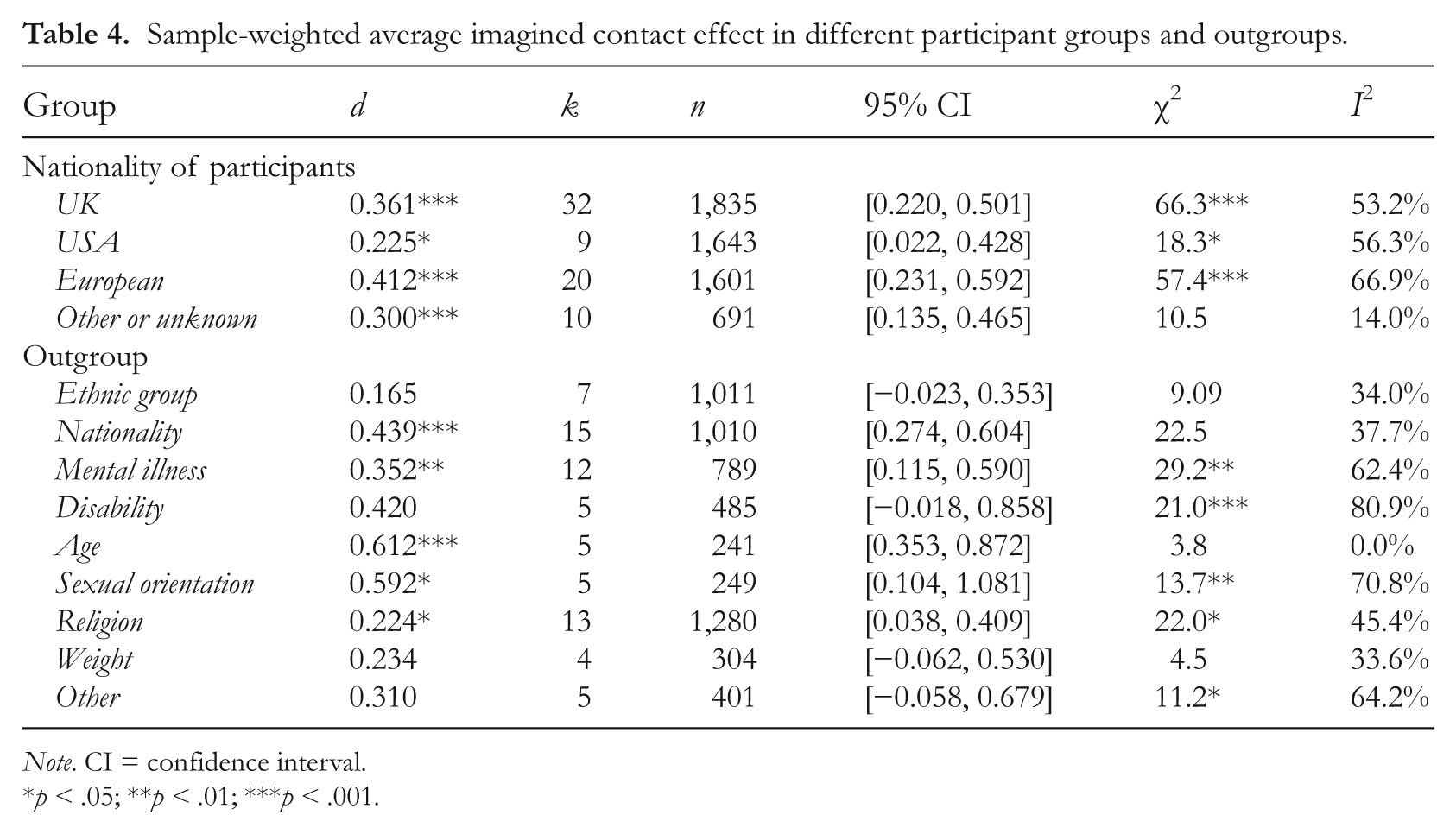
We evaluated five group characteristics as moderators of the effectiveness of imagined contact (see Table 3). Across the studies included in our analysis, dozens of different outgroups were represented, including some which were unique to their specific study. We classified the majority of the studies (k = 66) into eight outgroup categories, and calculated effect sizes for each of these categories (see Table 4). Imagined contact had a positive effect on intergroup bias across all outgroups, with particularly robust effects for outgroups based on nationality and age. The confidence intervals for some outgroups indicated that there was insufficient evidence for a significant effect of imagined contact on that specific outgroup (ethnic group, disability, weight); however, all of the nonsignificant effect sizes were based on seven or fewer studies, and metaregression found that none of the outgroup categories were associated with significantly larger or smaller effect sizes than the rest of the sample as a whole (βs < .303, ps > .130). Thus, there seem to be no substantive differences in the effectiveness of imagined contact across outgroups, but there is a need for more studies to provide evidence for the effectiveness of imagined contact with some specific outgroups.
Moderators of the imagined contact effect.

Note. Columns k and n represent number of studies and number of participants, respectively. Where applicable, these are reported separately for each level of the moderator variable (indicated in parentheses at the end of each moderator name). Where a variable is coded as “absent, present,” absent was coded as 0 and present was coded as 1; thus, a positive regression coefficient indicates that studies in which the variable was present had larger effect sizes, and a negative regression coefficient indicates that studies where that variable was present had smaller effect sizes.
p < .05; **p < .01; ***p < .001.
Sample-weighted average imagined contact effect in different participant groups and outgroups.
Note. CI = confidence interval.
*p < .05; **p < .01; ***p < .001.
There was also considerable variation in group factors relating to the participants themselves. The studies in our analysis were conducted with samples from nearly a dozen different countries, and we found little evidence that imagined contact was more or less effective across these different samples. Categorizing studies according to whether they were performed in the UK, USA, elsewhere in Europe, or elsewhere in the world, we found that imagined contact had a significant effect in all these samples (see Table 4), and metaregression confirmed that whether a study was conducted in one of these geographical areas did not predict significant variation in its effect size, compared to the rest of the sample (βs < .138, ps > .268). Likewise, the gender of participants did not moderate the observed effect size (β = –.003, p = .197).
The effect of imagined contact was reliable for both children (d+ = 0.81, 95% CI [0.53, 1.09]) and adults (d+ = 0.32, 95% CI [0.21, 0.43]), as neither confidence interval included zero. Furthermore, within adult participants only, age did not influence the effectiveness of imagined contact (β < –.002, p = .866). Age was, however, a significant moderator when considered as a continuous variable (β = −.025, p = .013), which appeared to be due to the fact that the effect of imagined contact was larger in children than in adults, resulting in a significant moderation of effect size (β = .495, p = .003). However, we also observed differences in design characteristics between studies with young participants and studies with adult participants, which could partly account for this effect. For example, studies with children tended to be delivered in multiple sessions, and provided their participants with significantly more detail about the imagined interaction than did studies with adults (t[53] = 2.58, p = .013; see the following section on elaboration).
Moderators of the Effectiveness of Imagined Contact: Design Characteristics
We evaluated six design characteristics as moderators of the effectiveness of imagined contact. Whether participants were asked to imagine contact for longer than 1 or 2 minutes (β = .158, p = .172), explicitly told they should imagine a positive interaction (β = .010, p = .931), or asked to describe what they had imagined afterwards (β = −.102, p = .447) did not influence the effectiveness of imagined contact. Similarly, the level of detail participants were given about their imagined interaction partner had no influence on effect size (β = .034, p = .395). Overall, the control condition with which imagined contact was compared did not significantly influence effect sizes (βs < .137, ps > .372; see Table 3).
However, the amount of detail participants were given about the context of the imagined interaction significantly moderated how effective it was at reducing intergroup bias (β = .133, p = .005). In the 30 studies which provided participants with no information or minimal information about the situation they should imagine, the average effect size was 0.21 (95% CI [0.09, 0.33], p = .001); in the 41 studies which provided more detailed information, effect size was 0.46 (95% CI [0.34, 0.58], p < .001).
Publication Bias
Given that our analysis included a large number of both unpublished and published studies, we were able to assess the impact of publication status on effect size and to quantify the effect size within both types of study. Publication status was a significant moderator of the observed effect size (β = .244, p = .007). Imagined contact had a small effect in unpublished studies (d+ = 0.24, 95% CI [0.13, 0.35]), and a medium effect in published studies (d+ = 0.49, 95% CI [0.36, 0.62]). Thus, while the effect was significantly larger in published studies, the effect of imagined contact was reliable in both published and unpublished studies, as neither confidence interval includes zero.
We also computed further analyses to assess the likelihood that yet more unpublished studies exist, and to quantify the possible implications for the size of our observed imagined contact effect. We assessed bias in our effect sizes using three methods, which all had converging results: a significant correlation between effect size and sample size (r[69] = −.32, p = .006), significant bias on an Egger’s regression (β = 3.06, p < .001), and inspection of the funnel plot (see Figure 1). As a whole, these results suggest that small studies with small positive or negative effect sizes are underrepresented in our sample, and that the smaller studies in our sample were more likely to display positive effect sizes.
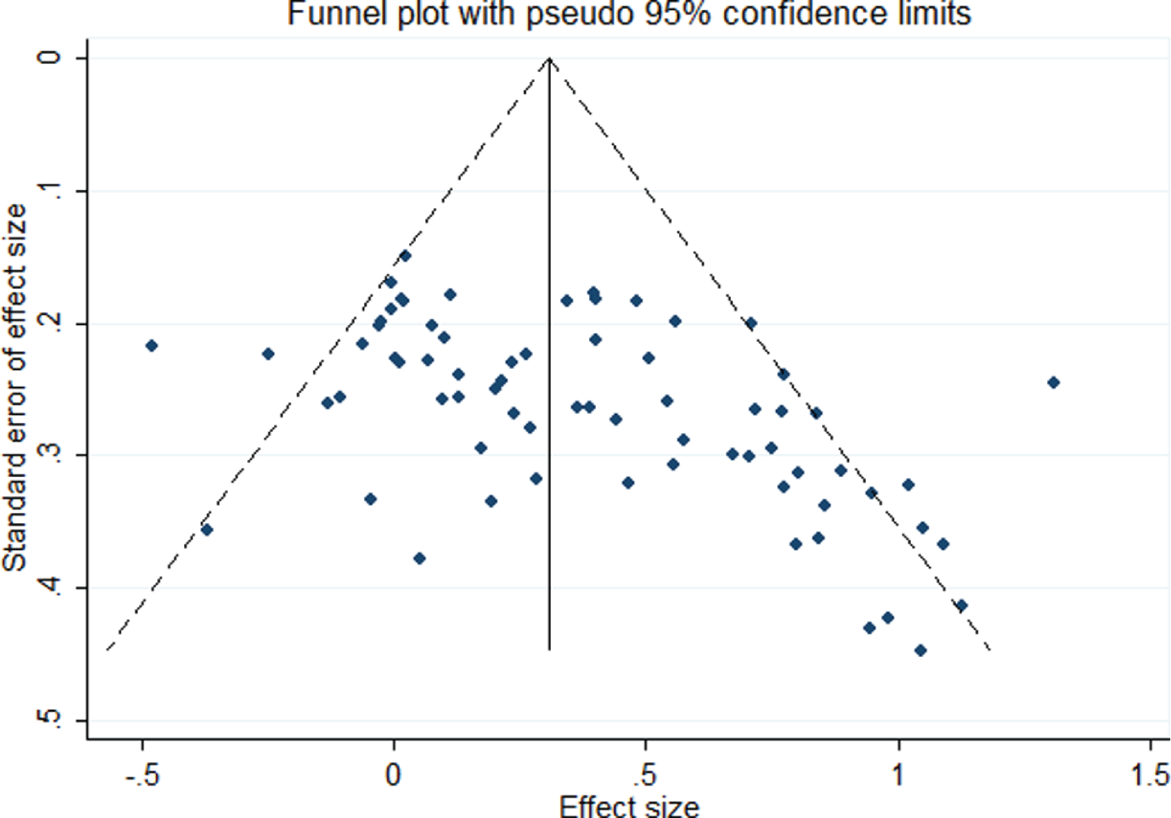
Funnel plot of effect sizes (d) for imagined contact, across all measures of intergroup bias.
The relevance of these results to our findings is that if additional unpublished studies have been conducted but did not show up in our literature search, then the true effect of imagined contact could be smaller than we believe it to be (although it should be noted that publication bias is not the only possible explanation for small study effects). However, it is also possible to allay these concerns by performing additional analyses to determine whether our results are indeed resistant to publication bias. Accordingly, using the trim and fill procedure (Duval & Tweedie, 2000), we found that the effect of imagined contact remained significant when 16 small studies with negative effect sizes were imputed (resulting in an overall effect size of d+ = 0.22, 95% CI [0.13, 0.32]). In addition, fail safe N (Rosenthal, 1979) indicated that 3,481 studies with null effects would need to exist in order to overturn the conclusion that imagined contact has a significant effect on intergroup bias, which greatly exceeds the recommended value of 5n + 10 (which equates to 365 for our meta-analysis). Therefore, the overall effect of imagined contact is reliable despite the small study effects, and appears to be resistant to any publication bias. We conclude that, while unpublished studies in our sample do have smaller effects than published ones, and while it is likely that yet more unpublished studies exist in file drawers, the effect of imagined contact on intergroup bias is robust.
General Discussion
This meta-analytic review provides the first quantitative tests of the effectiveness of imagined contact on four key measures of intergroup bias: attitudes, emotions, intentions, and behavior. Overall, the effects of imagined contact appear to parallel those of direct contact: there is a clear and robust effect on all dependent measures, and while some group or design characteristics facilitate the effect, none of them appear capable of eliminating it. Furthermore, just as Pettigrew and Tropp (2006) observed that contact situations which met Allport’s desirable criteria were more effective, but that even situations that did not meet those criteria were associated with reduced prejudice, so we found that imagined contact was effective even when our significant moderators were absent. For example, while giving participants more detail about the to-be-imagined interaction resulted in a larger impact on intergroup bias, significant reductions in bias were also observed in studies which gave participants little or no detail. Similarly, while the effect of imagined contact was larger in children than in adults, the effect was still robust and significant in adults.
Moderators of the Imagined Contact Effect
Type of dependent measure
Our analysis revealed an overall significant impact of imagined contact on all dependent variables, and for both published and unpublished studies. In particular, we observed no significant difference between the effects on implicit and explicit attitudes, a finding that has significant theoretical implications, particularly for the debate over the role of demand characteristics in imagined contact effects (cf. Bigler & Hughes, 2010). In combination with the highly significant effect of imagined contact on actual behavior, this provides the most convincing evidence to date that demand characteristics cannot account for imagined contact effects. It is highly unlikely that participants would have been able to modify their responses on such implicit tasks even if they were able to guess the hypothesis. Furthermore, the observation of a clear imagined contact effect in studies employing measures of subtle nonverbal behavior, assessed by independent coders (Birtel & Crisp, 2012a; Turner & West, 2012) further strengthens this assertion. Thus, our results appear to dispel the demand characteristics critique.
Effect sizes were similar across most dependent variables. However, we did observe that imagined contact has a stronger effect on behavioral intentions than on attitudes (the effect of imagined contact on actual behavior was identical to the effect on intentions, but due to the smaller number of studies, the comparison with attitudes was not significant). This is consistent with the wider literature on mental simulation, in particular with evidence that mental simulation taps directly into the neurological architecture involved in action initiation (e.g., Kosslyn, Ganis, & Thompson, 2001). It is also consistent with research on the “perception–behavior expressway” (Dijksterhuis, Bargh, & Mark, 2001), which has demonstrated that activating representations in memory can automatically activate the associated behaviors. Through these processes, we suggest that imagined contact may operate at a different psychological stage to other attitude change interventions. Whereas attitude change interventions first change attitudes, and then exert their impact on behavior through intentions (Ajzen, 1991), imagined contact arguably intervenes at a point more proximal to actual behavior. Thus, it may eventually be found to have an advantage over prejudice-reduction interventions that focus instead on changing precursors of behavioral intention.
Group characteristics
We observed little variation in the imagined contact effect across a broad range of participant groups and target outgroups, although nonsignificant effects were observed for some groups, in particular those based on ethnicity. This could be because prejudices against these groups are stronger and more embedded in the culture, meaning that elaborated variants of imagined contact are needed to overcome bias in these settings. On the other hand, there were few studies with this type of outgroup (N = 7), so the absence of an effect here could simply be due to low power. Either way, the clear implication is that more research is needed into the effects of imagining contact with other ethnic groups.
Another important observation arising from our analysis is that the imagined contact effect is stronger for children than adults. This makes sense: at school age, children are at a formative stage where imagery is a key component of how they learn about the world (Cameron & Rutland, 2006; Cameron et al., 2006). This finding that imagined contact is not only effective in children, but is actually more powerful, may be related to the typical features of the interventions used with school-age children, as well as to their age. Such interventions are typically more involved than those used with adults, often occurring over multiple sessions (e.g., three sessions in Vezzali, Capozza, Giovannini, et al., 2012) with highly elaborated instructions. Although no study has directly compared multiple sessions of imagined contact with the relatively brief instructions typically given to adults in the laboratory, this chimes with our meta-analytic finding that elaborated instructions are more powerful. While this type of extended and detailed task is partly a consequence of the requirements and constraints of the educational setting, it is possible that an extended program of imagined contact may also reinforce and sustain the effect in adults, and it is also reassuring that these studies find results extended over weeks, rather than the typical single session in adult studies (e.g., Brambilla et al., 2012; Crisp & Husnu, 2011; Turner et al., 2007).
The confirmation that imagined contact works well in school contexts has important practical implications for extending the application and impact of imagined contact. As discussed by Crisp and Turner (2012, 2013), the majority of programs used to reduce prejudice in educational settings, such as the multicultural curricula approach (Appl, 1996) and the antiracist approach (Dei, 1996), are not developed from evidence-based theory (Aboud & Levy, 2000). While educational psychologists advocate active thought over more passive approaches (Randi & Corno, 2000), existing programs often rely on outdated assumptions that children are passive recipients of information. Thus, they may fail to reduce prejudice in children for the same reason that passive programs often fail to change attitudes in adults; because the attitude-incongruent information is forgotten, distorted, or ignored (Rothbart & John, 1985). Imagined contact presents an active, evidence-based approach which may offer the means of effectively implementing contact theory in an educational setting.
Design characteristics
While few design factors influenced the effectiveness of imagined contact, we found that the effect was stronger when participants were instructed to elaborate on the context within which the imagined interaction took place (exemplified by the instructional set developed by Husnu & Crisp, 2010a). This finding has practical implications for the implementation of imagined contact to reduce prejudice, and is also consistent with the wider literature on mental simulation. In particular, researchers in the mental simulation literature have proposed that effects of mental imagery on behavior occur through the availability of mental scripts or cognitive representations of sequences of behaviors (Schank & Abelson, 1977). As discussed earlier, there is evidence that the more elaborate and detailed the script, the stronger the impact on subsequent attitudes and behavior (Anderson, 1983; Ross et al., 1975). Thus, our findings are consistent both with previous research on simulation and with the proposition that imagined contact may work by forming a mental script. Further investigating this and other mechanisms underlying the imagined contact effect is an important focus for future work.
Contrary to theoretical predictions, positive imagined contact was no more effective than neutral imagined contact. The majority of our included studies specified that the imagined contact should be positive, consistent with theoretical recommendations (Crisp & Turner, 2009), yet those studies that did not specify the valence of the effect still obtained reliable imagined contact results, which were not significantly smaller. Pettigrew and Tropp (2006) found that contact reduced prejudice even in nonideal circumstances, proposing a “mere exposure effect” of contact on prejudice. It is possible that there may also be a mere imagined exposure effect on prejudice, whereby thinking about any type of imagined interaction has a beneficial effect. However, there is also evidence that negative imagined contact may actually increase rather than decrease intergroup bias (e.g., Harwood et al., 2011; West et al., 2011), which stands against this hypothesis. Given this evidence, it is possible that effects of valence appear only when interactions have a strong emotional tone (i.e., a mildly positive interaction works just as well as a neutral one; most “positive” imagined contact studies provide only minimal specification, e.g., by including the word “positive” in their instructions). Alternatively, participants may tend to imagine a positive interaction even when they are not asked to do so, rather than relying on negative stereotypes to populate their imagination (as originally suggested by Crisp & Turner, 2009). Perhaps negative stereotypes define imagined interactions only in the most intractable intergroup conflicts, or when imagining interactions with the most feared or hated outgroups. Future research may wish to take a more controlled and systematic approach to the valence of imagined contact, by comparing the effects of more nuanced instructions (e.g., mildly positive vs. very positive), and by including postmanipulation checks to determine whether the valence of the actual imagined interaction was consistent with the instructions.
Future Directions
In addition to the moderators assessed in our analysis, there are other factors which may influence the effectiveness of imagined contact, but which we were unable to assess due to lack of variability across studies. For example, we know little about the duration of imagined contact effects over time, which is an important direction for future research. To date, few studies have introduced a delay between performing imagined contact and measuring intergroup bias (but see Husnu & Crisp, 2010b; Vezzali, Capozza, Giovannini, et al., 2012; Vezzali, Capozza, Stathi, et al., 2012). Our findings and recommendations parallel those of Pettigrew and Troop (2006), who called for more research on the duration of direct contact effects, citing the relative lack of longitudinal studies.
Additionally, many other moderators have been suggested by previous theoretical work, but have not been investigated in sufficient numbers to permit moderator analyses; for example, the effect of third- versus first-person perspective has been investigated in only one study (Crisp & Husnu, 2011). Indeed, many of the studies included in this meta-analysis aimed to compare the effect of different types of imagined contact, in order to test hypotheses about moderators of the effect. So far, researchers have identified a number of design characteristics that appear to influence the size of the effect, but for which there are not yet enough studies for meta-analysis (e.g., providing participants with information about the typicality of the outgroup target; Stathi et al., 2011). Researchers have also identified participant characteristics which influence the size of the imagined contact effect, such as majority versus minority status (Stathi & Crisp, 2008) and authoritarianism (Asbrock et al., 2013). We recommend, consistent with the conclusions of Pettigrew and Tropp (2006), that the investigation of moderating variables continues to be a direction for future research.
Finally, the conception of imagined contact as not only a direct method of reducing prejudice, but also a method of reducing barriers to future contact and improving the likelihood that contact will go well, leads to a number of predictions for future tests. For instance, imagined contact should increase the likelihood of engaging in direct contact in the “real world,” improve the quality of that contact, and make that contact more effective in reducing prejudice. Additionally, the previous finding that attitudes predict behavior more strongly when the person has direct experience with the attitude object (Glasman & Albarracín, 2006) leads to a related prediction: that imagined contact may be most effective either when participants have already had past contact with the outgroup, or in combination with direct contact (for initial findings in this regard, see Husnu & Crisp, 2010a). As research combining elements of mental simulation with perspective taking has also shown promising results with respect to prejudice reduction (Hodson, Choma, & Costello, 2009), we also suggest this as a promising focus for future research into augmenting and strengthening the imagined contact effect.
Conclusion
In Graham Greene’s The Power and the Glory, set in Mexico during a time of religious persecution, the protagonist concluded that “Hate was just a failure of imagination” (1940, p. 131). In this meta-analysis, we demonstrate that through imagination, meaningful reductions in prejudice can be obtained. Our key finding of a clear, overall moderate effect of imagined contact on all dependent variables parallels Pettigrew and Tropp’s (2006) meta-analysis of direct contact effects. Across diverse participant groups, dependent measures, and experimental designs, imagined contact leads to reduced intergroup bias; and, like direct contact, imagined contact “applies beyond racial and ethnic groups to embrace other types of groups as well” (2006, p. 768), with significant effects across diverse outgroups.
Our finding that imagining an intergroup encounter has reliable effects not only on attitudes and emotions towards that group, but also on intentions and behavior, means there is great potential for imagined contact as a tool to improve intergroup relations. Echoing Pettigrew and Tropp, we recommend that researchers continue to explore the influence of “individual, structural and normative antecedents of the contact” (2006, p. 768; see also Brown & Hewstone, 2005), which are largely uninvestigated at the present time. Overall, we recommend that future research move beyond the debate about whether imagined contact works, or whether it is a “real” effect, to focus on what prevents it from working, and what facilitates its effectiveness, in different contexts and with different groups.
Footnotes
Acknowledgements
We gratefully acknowledge the assistance of Carla Chivers and Laura Di Bella in coding studies. We would also like to thank the authors of the papers included in this review for providing us with unpublished data and responding to requests for additional information.
Funding
This research received no specific grant from any funding agency in the public, commercial, or not-for-profit sectors.