



Abstract
We suggest that self-construal and face concerns influence individuals’ collective action intentions against sexism. We examined female students from Germany (N = 105), Japan (N = 112), and Turkey, (N = 111), exposed them to a benevolent and a hostile sexism scenario, and compared their collective action intentions and indirect conflict management styles (avoiding, outflanking) within countries. As predicted, German and Turkish female students’ collective action intentions against sexism surpassed their intentions for indirect conflict management styles, whereas the reverse was true for Japanese female students. However, Japanese female students had an unaccomplished desire for collective action, suggesting that they wish to act but decide against open confrontation to maintain ingroup harmony. The higher individuals’ independent self-concept and the less they value face, the higher their collective action intentions against hostile sexism in all three countries. We discuss culturally appropriate ways of collective action.
Keywords
Sexism constitutes “individuals’ attitudes, beliefs, and behaviors, and organizational, institutional, and cultural practices that either reflect negative assessments of individuals based upon their gender or support unequal status of women and men” (Swim & Hyers, 2009, p. 407). Sexism exists across cultures (Glick et al., 2000), but studies examining how women respond to sexism in different cultural contexts are missing. In the present research, we examined female students’ collective action intentions in reaction to sexism in Germany, Turkey, and Japan. In what follows, we review the effectiveness of collective action as a means for reducing sexism, and then discuss how self-construals and face concerns might influence collective action intentions.
Collective Action as a Way to Reduce Sexism
Collective action is one of the most effective responses to sexism (Becker, Zawadzki, & Shields, 2014). Collective action is an action on behalf of one’s group that aims to maintain or enhance the status of that group (Wright, Taylor, & Moghaddam, 1990). It can be performed collectively (e.g., participating in a demonstration) or individually (e.g., signing a petition, standing up and defending one’s group when being exposed to discrimination)—as long as it benefits the ingroup. As outlined in previous research, individual confrontation of sexism is an act of collective action as long as it aims at reducing sexism in general (Becker, Barreto, Kahn, & de Oliveira Laux, 2015). Collective action against sexism can effectively reduce future sexism (Hyers, 2007; Swim & Hyers, 1999), empower confronting women, and boost their self-esteem and self-efficacy (Gervais, Hillard, & Vescio, 2010; Kaiser & Miller, 2004). It also reduces men’s use of sexist language (Mallett & Wagner, 2011).
Studies so far have examined how women respond to sexism in the US and other Western countries (Netherlands: Barreto & Ellemers, 2005b; Germany: Becker & Swim, 2011; US: Hyers, 2007; Greece, Denmark, and New Zealand: Pollay & Lysonski, 1993; in ethnic minority women: Matheson & Foster, 2013). However, we are not aware of any empirical research that explicitly examined cultural variables as predictors of collective action against sexism.
The main objective of the present work is to examine whether culture is related to female students’ responses to sexism. Culture can be defined as “shared attitudes, beliefs, categorizations, expectations, norms, roles, self-definitions, values, and other such elements of subjective culture found among individuals whose interactions were facilitated by shared language, historical period, and geographic region” (Triandis, 1972, p. 3).
Self-Construal and Collective Action
Individuals who strive to be unique, and express and promote their own goals are said to have an independent self. Individuals who place a higher value on maintaining harmony and “fitting in,” and primarily define themselves through their relationships with others, are said to have an interdependent self. An independent self is assumed to be more prevalent (i.e., chronically activated) in individuals in North America and Western Europe, whereas an interdependent self is assumed to be more prevalent in Asia, Latin America, and Southern Europe (Markus & Kitayama, 1991). We expect that an individual’s chronically activated self-construal affects reactions to sexism. Individuals with an activated independent self strive to be unique, to express their opinion, and to promote their own goals (Markus & Kitayama, 1991). Thus, when they are exposed to sexism, they are likely to stand up for themselves and thus respond with collective action rather than remain silent (or use more indirect conflict management). In contrast, individuals with an activated interdependent self strive to maintain harmony, be accepted by others, and avoid arguments (Kim, Aune, Hunter, Kim, & Kim, 2001). Collective action is difficult to combine with maintaining harmony because activists are often perceived as complainers (Kaiser & Miller, 2001). Therefore, we expect that the more interdependent an individual’s self-construal, the weaker their collective action intentions and the stronger their preference for indirect conflict management.
Face Concern and Collective Action
Face is the social worth that others see in a person (Leung & Cohen, 2011). It is thus a belief about what is important in a person, an expectation of how others behave, and a shared norm of behavior. Face is maintained through role-consistent behavior (Choi & Lee, 2002; Leung & Cohen, 2011; Mak, Chen, Lam, & Yiu, 2008; Ting-Toomey et al., 1991) and is irretrievably lost when others think that one behaves inappropriately, when one is criticized, or criticizes others (Leung & Cohen, 2011; Mak et al., 2008). Individuals high on face concern downplay the expression of their own opinions, emotions, and rights (Ting-Toomey & Kurogi, 1998) and adjust them to situational norms (Kanagawa, Cross, & Markus, 2001). We therefore expect that when face concerns are salient, collective action against sexism is very unlikely to occur because standing up for themselves is deemed inappropriate for the target of the deviating behavior. In a face culture (a geographic region that shares beliefs, expectations, and norms concerning face), individuals use indirect conflict management strategies: They avoid conflict to maintain relationships (Ohbuchi & Atsumi, 2010; Ohbuchi & Takahashi, 1994). An avoiding conflict management style means that a conflict topic, conflict partner, or conflict situation is avoided altogether. Alternatively, a third person known by both conflict parties can be engaged unobtrusively to negotiate the conflict. This is called an outflanking conflict management style. We expect that in a face culture, due to the more widely spread negative connotations of criticism, indirect conflict management styles such as avoiding and outflanking are used more frequently compared to collective action against sexist behavior. We expect that women in a face culture have an unaccomplished desire to engage in collective action: They perceive discrimination and consider it to be negative (Lee, Soto, Swim, & Bernstein, 2012), they wish to stand up, but decide to comply with cultural norms due to social pressures to be polite (Swim & Hyers, 1999), and the social costs of violating those norms (Shelton & Stewart, 2004) and thus do not engage in collective action.
The Present Research
We compared reactions to hostile and benevolent sexism in Germany, Turkey, and Japan, countries varying on the independent/interdependent self-construal and face concern. Hostile sexism reflects openly negative views on women (Glick & Fiske, 1996). Benevolent sexism is subtler and reflects supposedly positive views of women, for example, the belief that men should protect and provide for them. Benevolent sexism seems positive at first glance and is often not perceived as sexism (Barreto & Ellemers, 2005a; Swim, Mallett, Russo-Devosa, & Stangor, 2005). However, benevolent sexism has several negative consequences. For instance, it predicts hostile sexism (Sibley & Perry, 2010), “rewards” only those women who behave in line with traditional gender roles (e.g., Becker, 2010; Glick & Fiske, 1996), and makes women more likely to support the status quo (Becker & Wright, 2011; Jost & Kay, 2005).
We compared these two types of sexism to achieve a maximum contrast in terms of collective action intentions. Benevolent sexism is often perceived as benign (Barreto & Ellemers, 2005b; Bohner, Ahlborn, & Steiner, 2010) and seems to render collective action against it unnecessary. Our hostile sexism scenario, on the contrary, is unambiguously negative and allows us to examine the role of face concerns under conditions that are clearly threatening for women.
We selected Japan as a face culture in which individuals have a more interdependent (compared to independent) self-construal. We selected Germany as a nonface culture in which individuals have a rather independent (compared to interdependent) self-construal. We selected Turkey as a nonface culture that has been found to combine the agency of an independent self with the connectedness of an interdependent self (Kagitçibasi, 1996). Turkey has not often been the subject of cross-cultural research despite its intriguing combination of self-construals. We aim to extend the scope of cross-cultural research beyond the Western–East Asian dichotomy. Furthermore, in the last 10 years, Turkish society has been polarized into women fulfilling traditional demands and women opposing them (Kandiyoti, 2015). We were interested in Turkish female students’ approach to collective action after these societal changes.
Summary of Hypotheses
In the following, we refer to female students as “students.” As outlined before, we expect that German and Turkish students’ independent self-construal should be more pronounced than Japanese students’. In contrast, Japanese students’ interdependent self should be more pronounced than German students’. We hypothesize that Japanese students’ face concern will be higher than German and Turkish students’ face concern. In terms of our main predictions, we expect that collective action is more likely as a response to hostile than to benevolent sexism (Hypothesis 1). We further expect that German and Turkish students will prefer collective action to indirect conflict management styles (avoiding, outflanking) when faced with both forms of sexism (Hypothesis 2a), whereas Japanese students will prefer indirect conflict management to collective action (Hypothesis 2b). We expect that all students support rather than confront benevolent sexism (Hypothesis 3a). We hypothesize that German and Turkish students confront rather than support hostile sexism (Hypothesis 3b), whereas Japanese students support rather than confront hostile sexism (Hypothesis 3c). We expect that for both types of sexism, German and Turkish students’ collective action intentions will surpass their unaccomplished desire to engage in collective action (Hypothesis 4a), whereas Japanese students’ unaccomplished desire to engage in collective action will surpass their collective action intentions (Hypothesis 4b). This would indicate that they perceive sexism negatively but social norms prevent them from acting against it.
However, variation in endorsement of cultural norms within countries is high, meaning that, for instance, not all individuals in Japan score high on face concern and higher on interdependent self than independent self. Similarly, Turks and Germans can also have concerns for losing face. We therefore expect that the three cultural factors can affect students in all three cultures in a way that (a) a stronger interdependent self-construal, (b) a weaker independent self-construal, and (c) more face concerns are related to weaker collective action intentions (but to a stronger unaccomplished desire to confront) across cultures. We expect these correlations for hostile sexism but not necessarily for benevolent sexism because benevolent sexism is often perceived positively, rendering collective action against it unnecessary. Finally, we do not expect that the cultural dimensions affect the perceptions of sexism, because it is the public action not the private perception that can threaten cultural norms.
Method
Participants
All participants were students in metropolitan areas. They were recruited in undergraduate classes and asked to report on “the behavior of different persons in interpersonal situations.” In Germany, data was collected at a university in the North-West of the country (N = 126). We excluded 21 participants because they did not have German nationality (6), did not indicate nationality (9), did not indicate for how long they were abroad (1), were 60 years old (1), were men (2), and multivariate outliers (2). The final German sample included 105 female students aged 18–33 years (M = 21.83, SD = 3.35). The majority studied psychology but minors in other subjects also participated. In Japan, students were recruited from two universities in the Northern part of the country (N = 121). We excluded nine participants from the analysis because they did not indicate their sex (4), were men (2), had been abroad for more than 5 years (1), did not understand the questionnaire (1), or were multivariate outliers (1). The final Japanese sample included 112 female students aged 18–23 years (M = 20.13, SD = 0.99) with the majority studying psychology. In Turkey, students were recruited at a university in the North-West of the country (N = 112). We excluded one participant because she indicated that she had been in Germany for an unknown period of time. The final Turkish sample included 111 female students aged 19–26 years (M = 21.92, SD = 1.69) with majors in business, economy, psychology, and other subjects. Little’s Missing Completely at Random Test (MCAR-test) showed that missing values were completely at random in every sample. Thus, we replaced them with maximum likelihood estimation (expectation maximization). No participant spent more than 5 years abroad; hence, all our participants were acculturated in their respective society (Masgoret & Ward, 2006).
Procedure
All participants completed a printed version of the questionnaire. In Germany, students could also participate online. 1 Germans answered the questionnaire in German. For the Japanese version, the first and second author and their team translated and back-translated the German questionnaire into English. Then, English–Japanese bilinguals translated and back-translated the English questionnaire to Japanese, and the third author and her team carefully checked the adequacy of translation. For the Turkish version, the fourth author and her team translated and back-translated the German questionnaire into Turkish. The questionnaire included two scenarios of sexist behaviors, 2 and participants were asked to imagine being the woman exposed to sexism in those scenarios and to answer questions about them. At the end of the questionnaire, participants answered items measuring cultural dimensions, demographic questions, and whether and how long they had been abroad. Finally, participants were thanked and fully debriefed.
Scenarios
Participants were presented with a benevolent and a hostile sexist scenario. All coauthors agreed that the scenarios were realistic and relevant in their respective cultural context. In the benevolent sexism scenario, participants read that, at work, a male colleague offers to do a virus scanner update for a female colleague because “As a woman you do not have to grapple with it” (taken from Becker, Glick, Ilic, & Bohner, 2011). In the hostile sexism scenario we focused on a very blatant form of sexism. Specifically, participants read about a 21-year-old woman travelling in a crowded bus who is touched inappropriately by a man.
Measures
Positive and negative perception of the man’s behavior
After each scenario, participants reported how positively (nice, right, well-meant) and how negatively (problematic, discriminating, sexist) they perceived the man’s behavior. These and all other items were answered on 7-point scales (1 = totally disagree, 7 = totally agree). Both perception scales were adopted from Becker and Barreto (2014) and were reliable across countries (positive perception: benevolent sexism: all αs > .73, hostile sexism: all αs > .81; negative perception: benevolent sexism: all αs > .85, hostile sexism: all αs > .62; country-specific Cronbach’s alphas are provided in the supplementary material).
Collective action intentions
Three items were taken from Becker and Barreto (2014). In the benevolent scenario, the three items were: “I would tell my colleague that he is discriminating against women,” “I would talk to my colleague about the fact that his behavior was sexist,” and “I would slap my colleague in the face.” We removed the last item from the scale to improve reliability (all αs > .76). Decreased reliability is probably due to the nonnormative nature of this item. Additional analyses regarding this item can be found in the supplementary material.
In terms of hostile sexism, the three items were: “I would say loudly that someone has groped me and that that is discriminating against women,” “I would say loudly that he should stop groping me because it is sexist,” and “I would slap that man in the face.” Again, we removed the last item to improve reliability (all αs > .78). Consequently, the range of intentions provided is comprised of intentions to confront and criticize on behalf of women as a group, not on behalf of the individual woman in the scenario, and thus constitutes collective action intentions.
Support of sexist behavior
In the benevolent sexism scenario, participants indicated “I would let my colleague sit on my chair to carry out the update,” “I would thank my colleague for carrying out the update,” and “I would reject to let my colleague do the update” (all αs > .77). In the hostile sexism scenario, items were “I would not do anything,” “I would pretend to not have noticed anything,” and “I would sidestep.” Due to low reliabilities, we dropped the last item. All three scales were reliable (αs > .78).
Avoiding
In the benevolent sexism scenario participants indicated whether, in the future, they would avoid their colleague and try to avoid having contact with him (all αs > .90). Items in the hostile sexism scenario referred to avoidance of the situation (Rahim, 1983). Due to low reliability (all αs < .38) we did not create this scale.
Outflanking
Following previous work (Tjosvold & Sun, 2002), in the benevolent sexism scenario, two items were used “I would try to talk to a supervisor about what had happened in order to avoid my colleague but to still change his behavior” and “I would talk to someone we both know about what had happened in order to change his behavior” (all αs > .57). In the hostile sexism scenario, participants indicated “I would tell the driver what happened and ask him/her for help” and “I would contact the bus company and tell them what happened in order to encourage them to maybe do something against this kind of behavior” (all αs > .71).
Unaccomplished desire for collective action
In terms of benevolent sexism, items assessing an unaccomplished desire for collective action were “I would like to do something about his statement but then I would prefer to do nothing” and “I would have the impulse to do something against my colleague’s statement, but then I would not do it” (all αs > .75). For hostile sexism, we replaced “my colleague’s” with “this man’s” and “statement” with “behavior” (all αs > .69). 3
Face
We used 19 items (Mak et al., 2008) to assess to which extent participants were concerned about face loss. Sample items are “During a discussion, I try not to ask questions because I may appear ignorant to others” and “I maintain a low profile because I do not want to make mistakes in front of other people” (all αs > .68).
Self-concept
We used a three-dimensional model (Hashimoto & Yamagishi, 2013) to measure participants’ self-concept. Interdependent self-concept consists of rejection avoidance and harmony seeking. Three items measured rejection avoidance, the sensitivity towards rejection from important others. Sample items are “I find myself being concerned about what other people think of me” and “I worry about what people think of me, and always feel that someone is watching me” (all αs > .65). Seven items measured harmony seeking. Due to low reliability in the German sample (α = .50) we decided not to use this scale any further. Eight items measured the independent self-concept. Sample items are “I always express my opinions clearly” and “I always speak and act confidently” (all αs ⩾ .59). 4
Results
Table 1 shows that, as expected, German and Turkish students scored higher on independent self-construal than on rejection avoidance and face concern. Japanese students scored higher on face concern and rejection avoidance than on independent self-construal. Measurement invariance was not established. 5 Given the lack of invariance, we made only within-country comparisons.
Means and standard deviations of cultural dimensions.
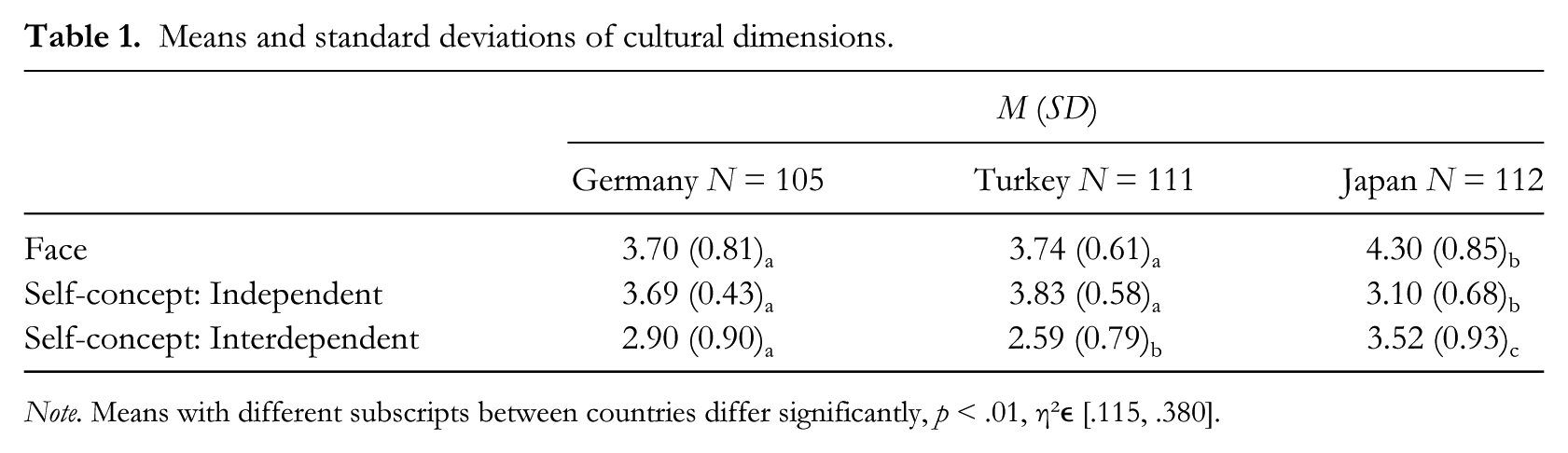
Note. Means with different subscripts between countries differ significantly, p < .01, η2∈ [.115, .380].
To check whether the scenarios were perceived as intended, we tested whether participants in all countries perceived benevolent sexism more positively and less negatively than hostile sexism. Descriptive statistics are provided in Table 2. We compare the two types of sexism within country with Wilcoxon’s signed-rank test because the perception of hostile sexism was not distributed normally. As predicted, students in all countries perceived benevolent sexism more positively and less negatively than hostile sexism (all zs < −7.40, all ps < .001, all rs < −.70; zs < −5.97, all ps < .001, all rs < −.57, respectively). In line with that and supporting Hypothesis 1, results showed that collective action against hostile sexism was more likely than against benevolent sexism in Germany and Turkey, F(1, 104) = 49.91, p < .001, η2 = .324; F(1, 110) = 10.36, p = .002, η2 = .086, respectively. Japanese students had similarly low levels of collective action for both types of sexism, F(1, 111) = 1.75, p = .188, η2 = .016.
Means and standard deviations for the benevolent and hostile sexist scenario.
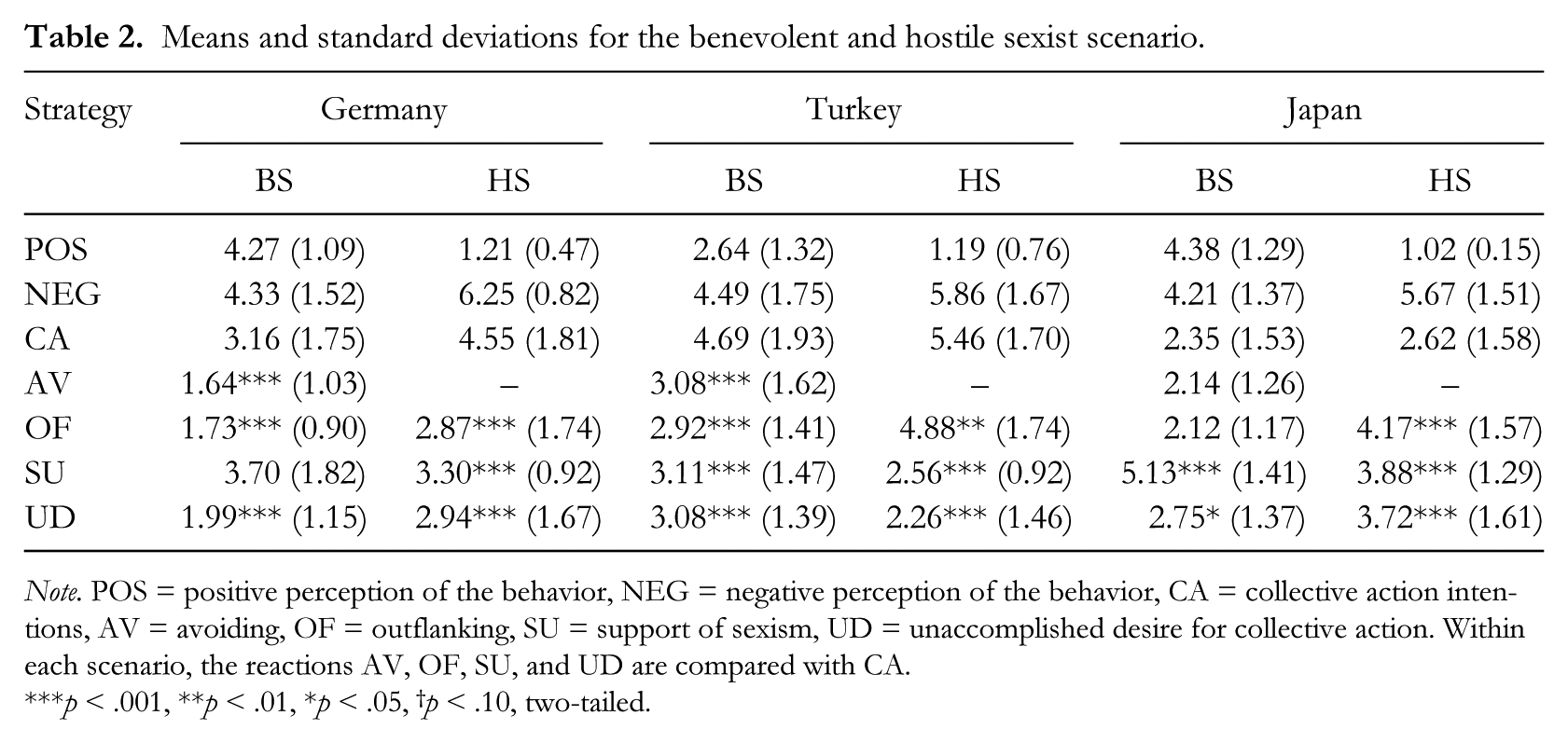
Note. POS = positive perception of the behavior, NEG = negative perception of the behavior, CA = collective action intentions, AV = avoiding, OF = outflanking, SU = support of sexism, UD = unaccomplished desire for collective action. Within each scenario, the reactions AV, OF, SU, and UD are compared with CA.
p < .001, **p < .01, *p < .05, †p < .10, two-tailed.
Collective Action Intentions Versus Indirect Conflict Management (Avoiding, Outflanking)
Descriptive statistics are provided in Table 2. We tested our main hypotheses that for both types of sexism, German and Turkish students would show more collective action intentions than avoiding and outflanking intentions (H2a), whereas Japanese students would show more avoiding and outflanking than collective action intentions (H2b) using a repeated measures ANOVA with type of reaction as repeated factor. All comparisons of strategies were conducted separately for each type of sexism. In the text, we report the overall F-tests with Greenhouse–Geisser correction. Table 2 shows significance levels of planned contrasts comparing collective action intentions versus avoiding and collective action intentions versus outflanking within scenarios. H2a was confirmed: German and Turkish students were more likely to show collective action intentions than avoiding or outflanking: benevolent sexism: F(1.51, 157.40) = 70.84,p < .001, η2 = .405; F(1.57, 172.81) = 57.19, p < .001, η2 = .342, respectively; hostile sexism: F(1.85, 192.08) = 35.82, p < .001, η2 = .256; F(1.88, 206.75) = 34.57, p < .001, η2 = .239, respectively. H2b was partly supported: In response to hostile sexism, Japanese students were more likely to show indirect conflict management styles than collective action intentions, F(1.96, 217.31) = 82.88, p < .001, η2 = .427. In response to benevolent sexism, however, Japanese students showed equally low levels of collective action intentions and indirect conflict management styles, F(1.71, 189.69) = 2.28, p = .114, η2 = .020.
Collective Action Intentions Versus Support of Sexist Behavior
We expected that when faced with benevolent sexism, female students in all countries would support sexism rather than intend to engage in collective action against it (H3a). The hypothesis was supported for Japanese students, F(1, 111) = 135.34, p < .001, η2 = .549, and approached significance for German students, F(1, 104) = 3.11, p = .081,η2 = .029; but Turkish students intended to engage in collective action rather than support benevolent sexism, F(1, 110) = 32.75, p < .001, η2 = .229.
As predicted (H3b), German and Turkish students intended to engage in collective action to confront hostile sexism rather than to support it, F(1, 104) = 25.94, p < .001, η2 = .200;F(1, 110) = 238.82, p < .001, η2 = .685, respectively. As expected (H3c), Japanese students were more likely to support hostile sexism than intending to engage in collective action, F(1, 111) = 33.33, p < .001, η2 = .231 respectively.
Collective Action Intention Versus Unaccomplished Desire for Collective Action
We predicted and found that German and Turkish students’ unaccomplished desire to engage in collective action was weaker than their actual intentions to do so (H4a), all Fs > 29.55, all ps < .001, all η2 > .221. The reverse was true for Japanese students (H4b): benevolent sexism: F(1, 111) = 6.59, p = .012, η2 = .056; hostile sexism: F(1, 111) = 22.68, p < .001, η2 = .170.
Within-Country Relations Between Cultural Dimensions and Collective Action Intentions
Finally, we tested whether self-construal and face concern were related to collective action intentions across countries. As can be seen in Tables 3 and 4, in line with predictions, the three cultural dimensions were mostly unrelated to perceptions of sexism. In terms of hostile sexism, as expected, face concern was negatively related to collective action intentions and positively related to the wish to confront in all three countries. The reverse was true for the independent self-concept. Thus, the less students have an independent self-concept and the more they value face, the more they refrain from collective action (although they would like to engage) in all three countries. Finally, the more German and Japanese students had an interdependent self, the higher their unaccomplished wish to confront. Interdependent self-concept was negatively related to collective action intentions only in Germany. Results of regression analyses (see supplementary material) are mostly in line with the correlations. Face concern predicted collective action intentions negatively in all students, but only in German students the relationship was significant. The independent self as a positive predictor of collective action intentions approached significance in all three countries. The interdependent self did not predict collective action intentions. In terms of benevolent sexism, as expected, only few correlations were significant.
Zero-order correlations of face, independent, and interdependent self with perception of sexist behavior, collective action intentions, avoidance, outflanking, and unaccomplished desire for collective action in the benevolent sexism scenario.
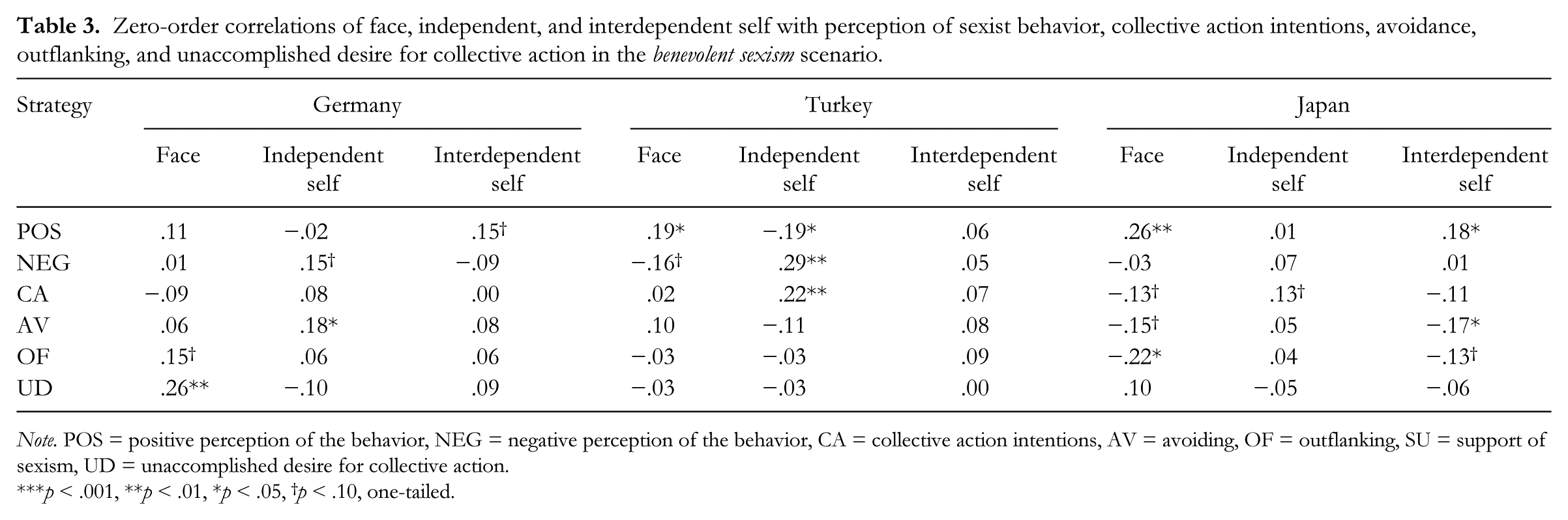
Note. POS = positive perception of the behavior, NEG = negative perception of the behavior, CA = collective action intentions, AV = avoiding, OF = outflanking, SU = support of sexism, UD = unaccomplished desire for collective action.
p < .001, **p < .01, *p < .05, †p < .10, one-tailed.
Zero-order correlations of face, independent, and interdependent self with perception of sexist behavior, collective action intentions, avoidance, outflanking, and unaccomplished desire for collective action in the hostile sexism scenario.
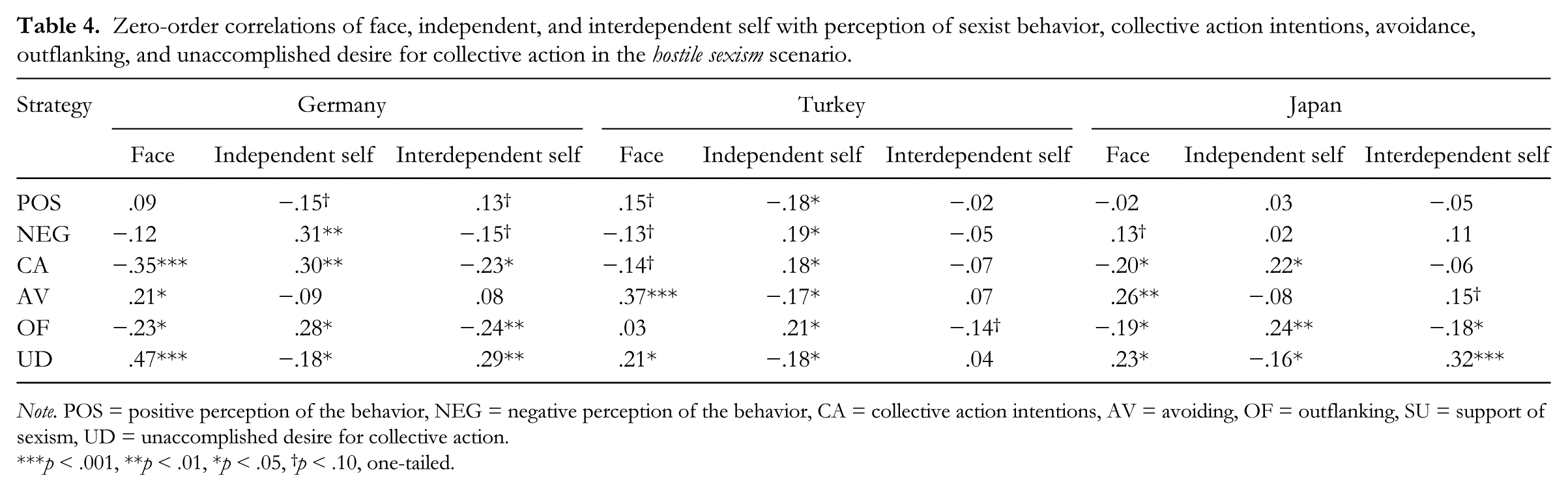
Note. POS = positive perception of the behavior, NEG = negative perception of the behavior, CA = collective action intentions, AV = avoiding, OF = outflanking, SU = support of sexism, UD = unaccomplished desire for collective action.
p < .001, **p < .01, *p < .05, †p < .10, one-tailed.
Discussion
Collective action against sexism has many positive effects. However, so far, research has not investigated cultural differences in responding to sexism. In the present work, we examined female students’ responses to sexism in Germany, Japan, and Turkey. In addition, we tested whether cultural variables (self-construal and face concern) are related to collective action intentions within countries. The main finding of the present work is that when faced with sexism, German and Turkish female students intended to engage in collective action rather than to use indirect conflict management styles, whereas Japanese female students preferred indirect conflict management although they had a high unaccomplished wish to engage in collective action. In addition, the more pronounced German, Japanese, and Turkish female students’ independent self and the less they were concerned with losing face, the more likely they were to engage in collective action against hostile sexism.
A strength of the present work is that we compared reactions to benevolent and hostile forms of sexism. Prior work on confronting has mostly focused on one form of sexism only. By including two forms of sexism, we were able to make within-country comparisons. These comparisons reveal that when examining collective action as a response to sexism, not only culture is important, but also the type of sexism is. In the following, we summarize and outline the contributions of the present work for each culture separately, highlight novel findings, and then continue with an overall discussion.
Collective Action Intentions in Germany
The results for German female students are in line with prior work on collective action against sexism (e.g., Becker & Barreto, 2014). Their independent self-concept was higher than their interdependent self-concept. German female students perceived benevolent sexism more positively and less negatively than hostile sexism, intended to engage in collective action against hostile but not benevolent sexism, were more likely to support benevolent sexism than to engage in collective action against it, and preferred collective action to avoiding and outflanking for both types of sexism, and to supporting hostile sexism.
Collective Action Intentions in Japan
Japanese female students scored highest on face concern and have a more interdependent self as indicated by a relatively high endorsement of rejection avoidance. Similar to German female students, Japanese female students perceived benevolent sexism more positively and less negatively than hostile sexism, but their collective action intentions against benevolent sexism were as low as those against hostile sexism. In line with our reasoning that the expression of criticism is inappropriate in a face culture, Japanese female students were more likely to employ indirect conflict management than collective action when faced with sexism, but had an unaccomplished desire to engage in collective action.
The unaccomplished desire to engage in collective action
This novel finding suggests that Japanese female students would like to confront sexism. Why don’t they do so? First, speaking up as an individual against sexism might be too individualistic an approach. As outlined in the introduction, speaking up threatens ingroup harmony and is not appreciated in face cultures (Leung & Cohen, 2011). Second, a truly collective approach to collective action, that is, not acting as an individual on behalf of the group of women but acting as a group of women, might be a more appropriate approach in Japan. Japanese women have accomplished some major changes in policy through their engagement in women’s associations, such as co-ops (Yamaguchi, 2013). This suggests that for Japanese women, engagement in women’s associations might be more effective than individual actions to achieve social change. We interpret this finding as suggesting that although Japanese female students perceive hostile sexism negatively and would like to act against it, responses such as open confrontation do not fit societal norms. Thus, they actively choose the culturally appropriate way to deal with sexism. Low levels of outflanking suggest that this strategy is not an alternative for Japanese female students. We hypothesize that other way of indirect confrontation could be telling a metaphorical story to the person showing a sexist behavior in which the female student addressed their discomfort with this type of behavior as a way to make the other person reflect upon it and change. This could help maintain both persons’ face (Brett, Behfar, & Sanchez-Burks, 2014). Future research should investigate the effectiveness of this strategy. Importantly, our results also show that the lower Japanese female students’ (and German and Turkish female students’) face concern and the higher their independent self-concept, the higher their collective action intentions. This means that the less Japanese female students accept their face culture, the more similarly to German and Turkish female students they respond. Thus, within-country differences in face concern and self-construal impact female student’s decision of how to deal with sexism.
Collective Action Intentions in Turkey
As expected, Turkish female students scored low on rejection avoidance and face concern and had a rather independent self. Their independent self might reflect the societal changes that occurred in Turkey during the last few years in the educated middle class (for a summary, see Kandiyoti, 2015). Turkish female students responded similarly to female students in Germany: They were more likely to intend to engage in collective action when faced with hostile sexism compared to using indirect conflict management and to supporting sexism. Contrary to our expectations, Turkish female students intended to engage in collective action against benevolent sexism rather than supporting it. This is surprising given that previous research found that most women support benevolent sexism (e.g., Bohner et al., 2010; Kilianski & Rudman, 1998). Why do Turkish female students want to act against benevolent sexism?
Responses to paternalism in Turkey
Paternalistic behavior is very common in Turkey and perceived positively (Öner, 2012), but only when directed from a superior to a subordinate. Paternalism is not necessarily resented by those lower in the hierarchy (Jackman, 1994; Pellegrini & Scandura, 2008). However, if someone uses this kind of behavior in a situation that does not involve the hierarchical relationship in which the behavior is expected—for instance, if one colleague uses it toward another as in our scenario—the recipient of the behavior might need to confront it because accepting the behavior might imply acknowledging the other’s superior position. Our participants will likely work in later life and thus consider it important to defend their hierarchical position. Second, the increasing polarization of Turkish society in recent years (Kandiyoti, 2015) has led modern women such as female students to become more politicized and participate in protests (Erhart, 2013). Policy rewards women fulfilling traditional roles and punishes women rebelling against traditional roles. Thus, benevolent sexism is embedded in politics (Kandiyoti, 2015). Experience with this polarization might render nontraditional women sensitive to the double message expressed in benevolent sexism and with increasing collective action intentions against it. Third, in communication in Arab societies people negotiate who dominates and who is dominated (Khūrī, 1990). Paternalism suggests that men dominate women. The need to determine who dominates and who is dominated might render the unequal status hidden in paternalistic behavior especially salient. Therefore, Turkish women might be more likely to protest against it. Future research could examine whether Turkish women are more inclined to protest against paternalistic behavior when they experience it from a coworker compared to when they experience it from a superior.
Limitations and Future Research
First, we could not establish measurement invariance. Consequently, we cannot conduct between-country comparisons to establish whether the differences we observe between samples are due to cultural differences. Therefore, our results are based on within-country comparisons. Future research could try to develop measurement invariant scales for collective action and indirect conflict management to compare women’s responses across countries.
Second, we measured collective action intentions and not collective action behavior. Prior work illustrates that women tend to overestimate their engagement in collective action (e.g., Swim & Hyers, 1999; Woodzicka & LaFrance, 2001). Thus, future work needs to study real-life protest behavior.
Thirdly, we assessed collective action intentions with a relatively short scale and did not distinguish between normative and nonnormative forms of collective action. Future research could use more comprehensive scales (see, e.g., Tausch et al., 2011). Besides the distinction between normative and nonnormative collective action, culture-specific forms of collective action would be interesting to assess. As noted before, it might be more appropriate for women scoring high on face concern to address the problem of sexism in a group or using metaphors. In line with this, we controlled neither for the perceived efficacy of our collective action behaviors, nor for the perceived efficacy of avoiding and outflanking behaviors. Future research could examine which strategies are perceived as effective countermeasures against sexism in face cultures.
Fourthly, we relied on student samples only. Students are a highly selective sample (Henrich, Heine, & Norenzayan, 2010). We cannot predict how they differ from a representative sample from each country. Therefore, we strongly recommend that future work uses more diverse and representative samples in terms of age, gender, social class, education, and area of living (urban vs. rural), in order to be able to generalize the findings and investigate cultural differences within countries.
Finally, we assumed outflanking to be an indirect conflict management style. We expected it to correlate positively with face concern and interdependent self, but negatively with independent self. Correlations are exactly reversed. The operationalization of outflanking might still have been too direct. Future research could identify behaviors perceived as outflanking behavior by individuals in a face culture.
Conclusions
To our knowledge, this study is the first examining collective action intentions as a response to sexism in cultures beyond the US, Australia, and Western Europe. We demonstrate that cultural-psychological variables predict female students’ collective action intentions. The higher female students’ independent self-construal and the lower their face concerns, the higher their intentions to engage in collective action against hostile sexism. Moreover, German and Turkish female students intended to engage in collective action when faced with hostile or benevolent sexism compared to using indirect conflict management, whereas Japanese female students engaged less in collective action, but had a strong unaccomplished desire to do so.
Footnotes
Acknowledgements
We would like to thank Angelika Benz and Lea Hartwich for their helpful comments on this article, Andrea Schröder for helping with data collection in Germany and Turkey, and Misato Inaba for helping with data collection in Japan.
Funding
Parts of this work were supported by a grant from the German Research Foundation awarded to Julia Becker (DFG BE 4648/1-3), and an EASP travel grant and a mobility grant from Osnabrueck University awarded to Freyja Fischer.
Notes
References
Supplementary Material
Please find the following supplemental material available below.
For Open Access articles published under a Creative Commons License, all supplemental material carries the same license as the article it is associated with.
For non-Open Access articles published, all supplemental material carries a non-exclusive license, and permission requests for re-use of supplemental material or any part of supplemental material shall be sent directly to the copyright owner as specified in the copyright notice associated with the article.
