



Abstract
As demonstrated in past research, institutional sexual stigma negativly affects the well-being of nonheteronormative individuals. In this contribution we investigate the effects that heterosexist legal regulations exert on collective action of LGB (lesbian, gay, and bisexual) people. Building on different theoretical traditions, we propose a model linking institutional sexual stigma (a macrolevel phenomenon) to individual behaviour (a microlevel phenomenon). To verify our assumptions we use data from a cross-cultural study (N = 1,365) conducted in five East European countries (i.e., Croatia, Hungary, Latvia, Lithuania, and Poland) differing in the extent to which they grant full civil rights to sexual minorities. In line with our hypotheses we find that, by promoting internalized homophobia and subsequently undermining in-group identification, institutional sexual stigma suppresses collective action of LGB individuals. As weak LGB activism impedes social change towards more progressive legislation, a vicious circle is set in motion.
Keywords
This state marginalizes me; it wishes it could get rid of me at all. It doesn’t recognize me in its legal system, not only as a hate crime victim, but also as a citizen who has the right to start his own family. It doesn’t accept the deepest, most emotional aspects of my personality associated with the needs to have home, family, love and care. The state does just the opposite, saying these aspects of me are morally wrong, illegal and invisible.
Despite the ongoing change in the social perception of sexual minorities, LGBTQI (lesbian, gay, bisexual, transgender, queer, and intersex) individuals still attract immense prejudice. In some countries, negative attitudes toward nonheterosexual individuals find their expression in the legal regulations concerning sexual minorities, referred to in the literature as institutional sexual stigma (Herek, 2009). Legal discrimination of LGBTQI people may take various forms, such as imposing the death penalty for homosexual conduct (e.g., Article 308 of the Mauritanian Penal Code; Ghai, 2011), criminalizing pro-LGBTQI events held in public places (e.g., the “homosexual propaganda” law in Russia; Johnson, 2015), or denying same-sex couples the right to marriage (Article 18 of the Polish Constitution; Mizielińska, 2001). What is common to all these cases is that power differential between heterosexual and nonheterosexual citizens is sanctioned and perpetuated by the state’s legal arrangements.
Prior work investigated how institutional sexual stigma—a macrolevel phenomenon that shows considerable cross-cultural variability (Weiss & Bosia, 2013)—translates into attitudes and experiences of both heterosexual (e.g., Kuntz, Davidov, Schwartz, & Schmidt, 2015) and LGBTQI individuals (e.g., Hatzenbuehler & McLaughlin, 2014). No attention, however, was paid to the effects that legal discrimination exerts on collective action of sexual minorities. In this contribution we aim to fill this gap. Building on a range of theoretical traditions with a leading role of the sexual stigma conceptual framework (Herek, 2009), we propose that regulations enforced by state institutions shape political engagement of nonheterosexual individuals by sequentially affecting internalized homophobia and in-group identification. To verify our expectations, we utilize the data obtained from LGB (lesbian, gay, and bisexual) individuals living in five East European countries (Croatia, Hungary, Latvia, Lithuania, and Poland) that differ significantly in the scope of rights they guarantee to sexual minorities.
Institutional Sexual Stigma
Despite the worldwide cultural change (Inglehart & Welzel, 2005), sexual stigma—“society’s shared belief system through which homosexuality is denigrated, discredited, and constructed as invalid relative to heterosexuality” (Herek, 2009, p. 171)—still pervades our social life. The various areas of its manifestations have been captured within the sexual stigma conceptual framework (Herek, 2009). As posited by this perspective, disapproval of homosexuality may be expressed not only through the beliefs, feelings, and actions of straight and nonheterosexual individuals, but also by social institutions.
Institutional sexual stigma, also termed heterosexism (Herek, 2009) or structural stigma (Hatzenbuehler, 2014), involves a set of organizing principles that either do not recognize the interests of LGBTQI people or overtly subject this group to discrimination and denigration (Herek, 2009). Its instances differ in their severity and may be observed in various areas such as religion, medicine, or law. In the present contribution, we focus on the legal aspect of heterosexism.
As pointed out by Herek (2009), legal manifestations of sexual stigma may take at least three forms: (a) punishing sexual acts between two adult individuals of the same sex (i.e., sodomy laws), (b) denying basic civil liberties to members of sexual minorities (e.g., the “homosexual propaganda” law in Russia), and (c) reinforcing the power differences between heterosexual majority and sexual minorities (e.g., the absence of antidiscrimination laws in some European countries; International Lesbian, Gay, Bisexual, Trans and Intersex Association Europe [ILGA] Europe, 2015a, 2015b). Because such regulations efficiently limit LGBs’ life opportunities, the need for change is at the core of LGBTQI advocacy (ILGA Europe, 2015a).
One may expect that heterosexist legal arrangements would also translate into the activism of sexual minorities. Political opportunity structure perspective (POS; see D. S. Meyer, 2004) posits that institutional setting is vital for social movements’ development. While political systems characterized by inclusiveness promote popular civic engagement, closed regimes with strong concentration of power hamper protest behaviour (for empirical evidence, see e.g., Corcoran, Pettinicchio, & Young, 2011). Therefore, by perpetuating power differences between heterosexual majority and sexual minorities, institutional sexual stigma should suppress LGBs’ collective action. Two psychological properties may account for such effect: internalized homophobia and in-group identification.
Internalized Homophobia
Apart from denying gay men, lesbians, and bisexuals access to certain resources, discriminatory legal regulations also communicate and legitimize the unequal status of heterosexual majority and sexual minorities in a given society. Importantly, the message conveyed by the biased legislation may facilitate the development of self-stigmatization among homosexual and bisexual individuals (Herek, 2009; Herek, Gillis, & Cogan, 2009).
Internalized homophobia is a negative effect that gay, lesbian, and bisexual individuals project onto themselves as a result of their acceptance of societal antihomosexual attitudes (Herek, 2009; I. H. Meyer, 2003). Similarly to other forms of self-stigmatization, it leads to any combination of adverse psychological consequences such as low self-esteem (Herek et al., 2009), relationship problems (Frost & Meyer, 2009), anxiety and depression (Newcomb & Mustanski, 2010).
Following Herek (2009), we propose that institutional stigma fosters the development of internalized homophobia among LGB individuals. Since people are motivated to legitimize, defend, and bolster the systems they reside in (Jost & Banaji, 1994), adhering to the status quo and thus to legally sanctioned discrimination may “get under the skin” (Hatzenbuehler, 2010) as a result of general system justification mechanisms. Similarly to other low-status groups that accept the disadvantageous hierarchies and hierarchy-enhancing legitimizing myths (see Jost, Banaji, & Nosek, 2004), LGB individuals may perceive heterosexist social arrangements as fair and thus internalize the ideology on which this order is founded (see Pacilli, Taurino, Jost, & van der Toorn, 2011). Thus, it is reasonable to expect that stronger expression of heterosexism in the realm of law would entail a greater degree of internalized homophobia among sexual minorities’ members (for empirical evidence, see Berg, Ross, Weatherburn, & Schmidt, 2013).
In-group Identification
On the other hand, structurally evoked self-stigmatization may affect in-group identification, which is the central prerequisite of engagement on behalf of one’s group (Simon & Klandermans, 2001; Tajfel & Turner, 1979, 1986). As demonstrated by meta-analytical evidence (van Zomeren, Postmes, & Spears, 2008), in-group identification not only propels collective action directly, but also enhances other predictors of engagement, that is, injustice perception and group efficacy. Besides facilitating active response to collective disadvantage, in-group identification provides protection against factors that may undermine collective action such as superordinate category salience (Crisp, Stone, & Hall, 2006). In LGBTQI context, in-group identification was shown to predict nonheterosexuals’ support for social change independently of other theoretically relevant factors such as group relative deprivation or in-group pride (Górska & Bilewicz, 2015).
Discrimination experiences may exert both positive and negative effects on in-group identification. If one perceives in-group’s disadvantage as a result of illegitimate and stable prejudice, identification with the devalued group increases because it is seen as the best strategy to compensate for the feeling of rejection. However, when an individual fails to attribute discrimination to perpetrator’s prejudice, distancing from the low-status in-group is more probable (Bettencourt, Charlton, Dorr, & Hume, 2001; Branscombe, Schmitt, & Harvey, 1999). Thus, given that internalized homophobia indicates deeply entrenched legitimization of heterosexist hierarchy (see Pacilli et al., 2011), it should lead to lower in-group identification among LGB individuals. Indeed, prior research involving sexual minorities revealed the negative association between self-stigmatization and in-group identification (Frost & Meyer, 2009; Herek et al., 2009).
When we put the pieces together, two novel hypotheses may be proposed. First, we expect that, by enhancing internalized homophobia, institutional sexual stigma would weaken in-group identification among LGB individuals (Hypothesis 1). Second, we assume that, by strengthening internalized homophobia and then lowering in-group identification, institutional sexual stigma would pacify collective action intentions of LGB people (Hypothesis 2). Figure 1 presents the model summarizing our assumptions.
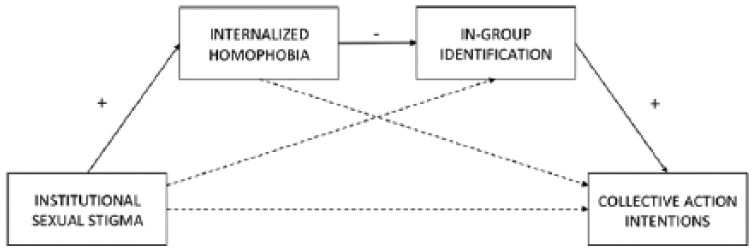
Effects of institutional sexual stigma on collective action intentions via internalized homophobia and in-group identification—theoretical model.
Study Context
We verified our hypotheses in the context of five East European countries: Croatia, Hungary, Latvia, Lithuania, and Poland. While all of these states share a common history (transition from Communism to democracy at the end of the 20th century), enjoy similar geopolitical status (i.e., are new EU members), and exhibit a comparable level of economic development (World Bank, 2016), they grant a different scope of rights and institutional protection to LGB individuals (ILGA Europe, 2015a, 2015b). The lowest degree of institutional sexual stigma is observed in Croatia, which recognizes registered same-sex partnerships, provides legal hate crime protection, and respects the freedom of assembly. Similar though slightly weaker rights are guaranteed to LGB individuals living in Hungary. By contrast, Poland, Latvia, and Lithuania do not acknowledge the relational rights of their LGB citizens or penalize hate crime based on sexual orientation (ILGA Europe 2015a, 2015b).
The origin of these differences may be traced back to the ideology endorsed by political elites just after their countries’ accession to the EU. Centre-left ruling parties in Hungary and Croatia went to great lengths to enact registered partnerships, bypassing the principles of the Constitution (Holzhacker, 2012) and the results of a national referendum (Slootmaeckers & Touquet, 2016), respectively. On the other hand, conservative authorities in Lithuania (Duvold & Aalia, 2012), Latvia, and Poland (O’Dwyer & Schwartz, 2010) were far from willing to mitigate the structural stigmatization of their sexual minorities, capitalizing instead on homophobic attitudes in their societies.
From a more general perspective, differences in the strength of institutional stigma may reflect the direction of cultural change in these countries. Modernization—a macrolevel process involving shifts towards greater secularization and emancipation (Inglehart & Welzel, 2005)—is closely bound up with the legal status of sexual minorities. Since most world religions, including the three branches of Christianity prevalent in Eastern Europe (i.e., Catholic, Protestant, and Eastern Orthodox), condemn homosexuality (Pickett, 2009), secularization should facilitate the adoption of progressive laws. Emancipation, which rests on the respect for freedom and equality, should exert similar effects.
The countries we consider in our research manifest different degrees of both emancipation and secularization (World Values Survey [WVS], 2016). Importantly, these differences correspond to the extent of structural heterosexism. Latvia and Lithuania—two states with strong institutional stigma—are high on secularization and low on emancipation. Poland—the other country blind to its LGB citizens—exhibits low degree of secularization and high level of emancipation. By contrast, Croatia and Hungary, which grant the most extended rights to LGB individuals, have medium positions on both criteria. It seems that when considered separately, neither emancipation nor secularization of a given society is by itself sufficient for legal recognition of sexual minorities. For the latter to occur, these factors must both be present.
Besides shaping institutional stigma, society’s degree of secularization and emancipation may also affect collective action of LGB individuals. For example, since internalized homophobia shows a positive relationship to religiosity (Herek et al., 2009), it is reasonable to expect that living in a highly religious society would translate into stronger self-stigmatization and lower engagement. On the other hand, emphasis on freedom and equality expressed in the quality of democratic institutions may encourage LGB individuals to participate in collective action (Norris, 2002). Thus, to assess the unique effects of institutional stigma, both these factors should be taken into account.
Method
Collective action and its individual-level predictors were examined as part of a larger Internet-based, cross-sectional study of LGBTQI individuals commissioned by the Campaign Against Homophobia, a Polish nongovernmental gay rights organization. Apart from the scales of internalized homophobia, in-group identification, and collective action intentions, the survey questionnaire included the measures of other constructs such as hate crime experience, life satisfaction, or attitudes toward law enforcement institutions (for details, see Górska, Bilewicz, & Winiewski, 2016). 2 Back-translation procedure was used to adapt the original English-worded questionnaire to six languages: Croatian, Hungarian, Latvian, Lithuanian, Polish, and Russian.
Participants
The survey questionnaire was hosted on a dedicated website (http://hatenomore.net). A welcome message presented the survey objectives and assured the participants of data confidentiality. The respondents were offered an opportunity to contact the questionnaire’s authors. If desired, the participants could leave their email address and take part in a lottery with financial rewards. The link to the survey was promoted via social media (Facebook), local LGBTQI organizations’ newsletters, and LGBTQI portals (e.g., queer.pl). The data collection period spanned from September to October 2015.
In total, 1,818 adult LGBTQI individuals completed the survey. Since only lesbian, gay, and bisexual participants filled in the Internalized Homophobia Scale, the present sample was restricted to 1,365 respondents (28.9% lesbian women, 45.5% gay men, 20.6% bisexual women, 5.0% bisexual men). Due to disparities in the general population size (and, presumably, in the LGB subpopulation size), each individual country contributed differently to the current sample (Croatia 3.6%, Hungary 7.3%, Latvia 1.8%, Lithuania 5.3%, Poland 82.0%). 3 Table 1 presents the sociodemographic characteristics of participants divided by country.
Sociodemographic characteristics of respondents divided by country.
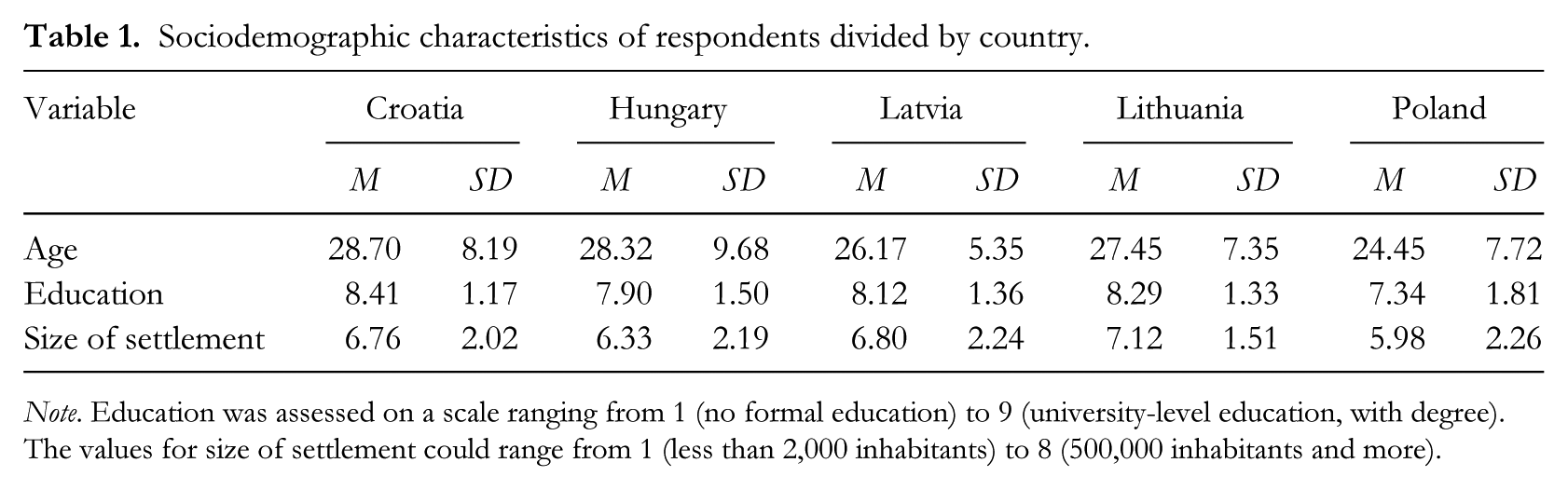
Note. Education was assessed on a scale ranging from 1 (no formal education) to 9 (university-level education, with degree). The values for size of settlement could range from 1 (less than 2,000 inhabitants) to 8 (500,000 inhabitants and more).
Measures
The wording of all measures matched the respondents’ country, gender, and sexual orientation declared in the initial part of the questionnaire. The participants’ gender was measured with a single item asking them to indicate the gender they identify with. Three responses were available: male, female, and other. To measure sexual orientation, we asked the participants to choose one of seven options: lesbian, gay, bisexual, queer, bisexual, heterosexual/straight, and other. As for the remaining measures, the participants indicated their agreement or disagreement with each statement on a 7-point scale (1 = strongly disagree, 7 = strongly agree), unless otherwise noted. The composite scores were created by averaging responses to items comprising the relevant scale.
Dependent variable
Collective action intentions were measured with three items (αHR = .85, αHU = .88, αLV = .73, αLT = .87, αPL = .85): “I want to get involved in actions designed to advance the interests of LGBTQI individuals in [Croatia/Hungary/Latvia/Lithuania/Poland]”; “I do not see a need to participate in the actions aimed to improve the position of LGBTQI individuals within [Croatian/Hungarian/Latvian/Lithuanian/Polish] society” (reverse-scored); “I will engage in collective action on behalf of [Croatian/Hungarian/Latvian/Lithuanian/Polish] LGBTQI people.”
Mediators
In-group identification was measured with three items (αHR = .66, αHU = .80, αLV = .60, αLT = .65, αPL = .79) taken from Cameron (2004): “I have a lot in common with other LGBTQI individuals,” “I often think about the fact that I am an LGBTQI individual,” and “In general, I’m glad to be an LGBTQI individual.”
To assess internalized homophobia we used four items (αHR = .80, αHU = .84, αLV = .77, αLT = .68, αPL = .82) taken from the Revised Internalized Homophobia Scale (IHP-R; Herek et al., 2009) 4 : “If someone offered me the chance to be completely heterosexual, I would accept the chance”; “I wish I weren’t [lesbian/gay/bisexual]”; “I feel that being [lesbian/gay/bisexual] is a personal shortcoming for me”; “I would like to get professional help in order to change my sexual orientation from [lesbian/gay/bisexual] to straight.” The participants recorded their responses on a 5-point scale (1 = strongly disagree, 5 = strongly agree). As revealed by exploratory factor analysis (EFA) results, internalized homophobia and in-group identification formed two separate factors, explaining 38.82% and 18% of the variance, respectively (all cross-loadings < .40, see the online supplemental material).
Independent variable
We employed two alternative measures of institutional sexual stigma. The first of them utilized the Rainbow Europe Index 2015—an assessment provided by the European division of International Lesbian, Gay, Bisexual, Trans and Intersex Association (ILGA Europe, 2015b) and applied in past social research (e.g., Kuntz et al., 2015). The original index combines various areas of LGBTQI individuals’ legal recognition, such as protection from discrimination and hate crime, relational rights, or freedom of expression. In order to tap on legal regulations specific to LGB people, the current study used the refined version of this measure. 5 The values of the adapted index could range from 0 (most progressive law) to 24 (least progressive law). The second measure of institutional sexual stigma drew on the time (in years) elapsed since the institutionalization of same-sex civil partnerships was introduced in a given country. The variable was recoded so that higher values reflected greater sexual stigma. The values observed in the present sample ranged from −6 (Hungary) through −1 (Croatia) to 0 (Latvia, Lithuania, and Poland).
Covariates
Individual covariates included LGB subgroup, education, size of settlement, and age. All of these variables were demonstrated to predict internalized homophobia, collective action engagement, or both in past research (e.g., Berg et al., 2013; Corcoran et al., 2011; Herek et al., 2009).
LGB category was coded on the basis of participants’ responses to gender identity and sexual orientation items (1 = gay men, 2 = lesbian women, 3 = bisexual men, 4 = bisexual women). Prior to main analyses, the variable was effect-coded so that gay men served as the reference group.
Education was assessed by asking the respondents to indicate the highest educational level they had attained (1 = no formal education, 2 = incomplete primary school, 3 = complete primary school, 4 = incomplete secondary school: technical/vocational type, 5 = complete secondary school: technical/vocational type, 6 = incomplete secondary school: university-preparatory type, 7 = complete secondary school: university-preparatory type, 8 = some university-level education, without degree, 9 = university-level education with a degree). Size of settlement was recorded on an 8-point scale (1 = less than 2,000 inhabitants; 2 = 2,000–4,999 inhabitants; 3 = 5,000–9,999 inhabitants; 4 = 10,000–19,999 inhabitants; 5 = 20,000–49,999 inhabitants; 6 = 50,000–99,999 inhabitants; 7 = 100,000–499,999 inhabitants; 8 = 500,000 inhabitants and more). The participants’ age was calculated on the basis of the declared year of birth.
Contextual covariates involved societal level of religiosity and the quality of democracy—potential alternatives for institutional sexual stigma as the antecedent of LGB activism. Religiosity was operationalized as the proportion of Christians in a given society (Pew Research Center, 2011). To assess the quality of democracy, we applied the Democracy Index provided by The Economist Intelligence Unit (2015). The index assesses five areas of political system functioning (i.e., electoral process and pluralism, civil liberties, political participation, political culture, and the functioning of government) and has been successfully used in prior research (e.g., Brandt, 2013). The possible values range from 1 (authoritarian regime) to 10 (full democracy).
Analytical Strategy
To verify our hypotheses, we performed a five-stage analysis. First, we checked if the presence of institutional sexual stigma (as assessed with the refined Rainbow Europe Index) affected the respondents’ level of internalized homophobia, in-group identification, and collective action intentions. We did so by regressing each of these variables on the covariates (Step 1) and legal heterosexim (Step 2). The control variables involved LGB subcategory, age, education, size of settlement, societal level of religiosity, and quality of democracy. Then we examined whether, as predicted by Hypothesis 1, institutional sexual stigma diminished the participants’ in-group identification by enhancing internalized homophobia. To assess the indirect effect of structural stigma on in-group identification we employed Model 4 of the PROCESS macro (Hayes, 2013). Next, we tested Hypothesis 2 stating that institutional sexual stigma undermined engagement intentions through promoting internalized homophobia and subsequently lowering in-group identification. To attain this goal we used Model 6 of the PROCESS macro, which assumes a causal relationship between two or more mediators (Hayes, 2013). In this solution structural stigma was specified as an independent variable, internalized homophobia and in-group identification served as the two consecutive mediators, and collective action intentions constituted the dependent variable (see Figure 1). The next stage of the analytical process aimed to establish whether the operationalization of institutional stigma might have any effect on the results. To this end, we repeated the prior analyses replacing the Rainbow Europe Index with the measure based on the time elapsed since the introduction of same-sex civil unions.
Results
Correlations
Table 2 displays means, standard deviations, and intercorrelations for variables measured in the current study.
Means, standard deviations, and intercorrelations.
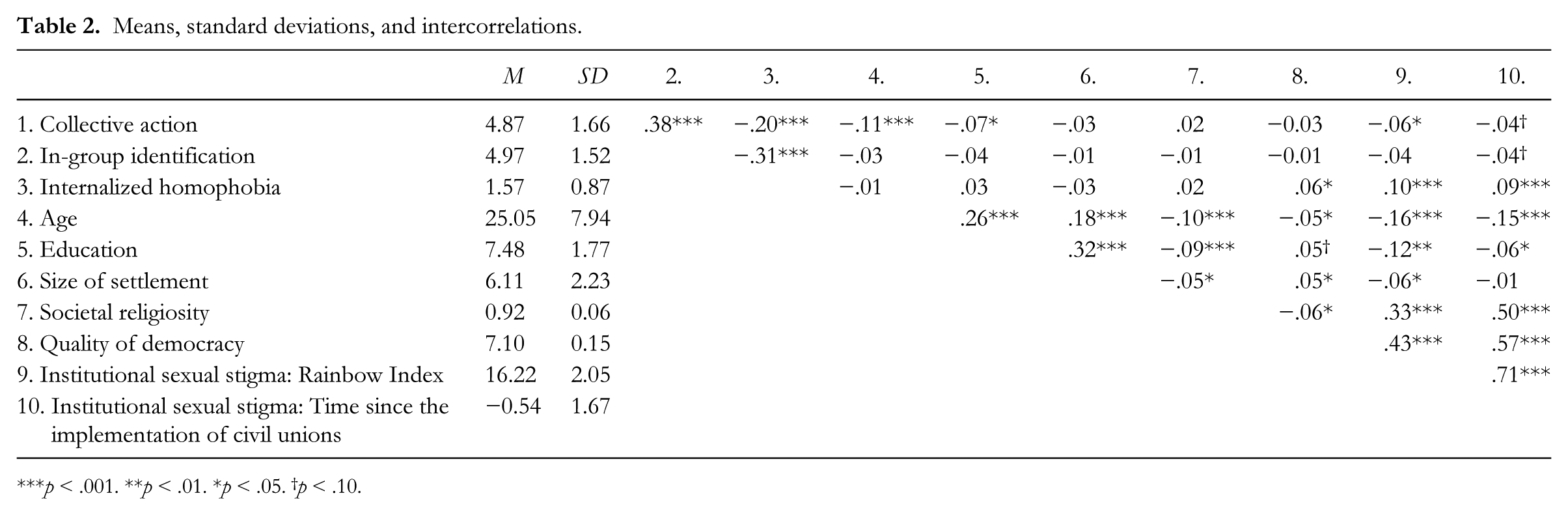
p < .001. **p < .01. *p < .05. †p < .10.
In line with past results (Berg et al., 2013; Frost & Meyer, 2009; Herek et al., 2009), internalized homophobia correlated positively with institutional sexual stigma (r = .10, p < .001 and r = .09, p < .001) and negatively with in-group identification (r = −.31, p < .001). As far as collective action was concerned, positive correlation with in-group identification (r = .38, p < .001) as well as negative associations with internalized homophobia (r = −.20, p < .001) and institutional stigma (r = −.06, p = .027 and r = −.04, p = .098) were observed. Depending on its operationalization, institutional stigma was either unrelated (r = −.04, p = .125) or negatively related (r = −.04, p = .092) to in-group identification.
Total Effects of Institutional Sexual Stigma (Refined Rainbow Europe Index)
As shown in Table 3, structural stigma affected internalized homophobia (Model 2), in-group identification (Model 4), and collective action intentions (Model 7) above and beyond the effects of the control variables. 6 Discriminating legal regulations increased the level of internalized homophobia (B = 0.05, SE = 0.01, 95% CI [0.02, 0.08], p < .001). By contrast, institutional sexual stigma exerted a negative effect on in-group identification (B = −0.05, SE = 0.03, 95% CI [−0.10, −0.001], p = .044) and collective action intentions (B = −0.09, SE = 0.03, 95% CI [−0.14, −0.03], p = .002).
Structural and individual-level predictors of internalized homophobia, in-group identification, and collective action among LGB individuals.
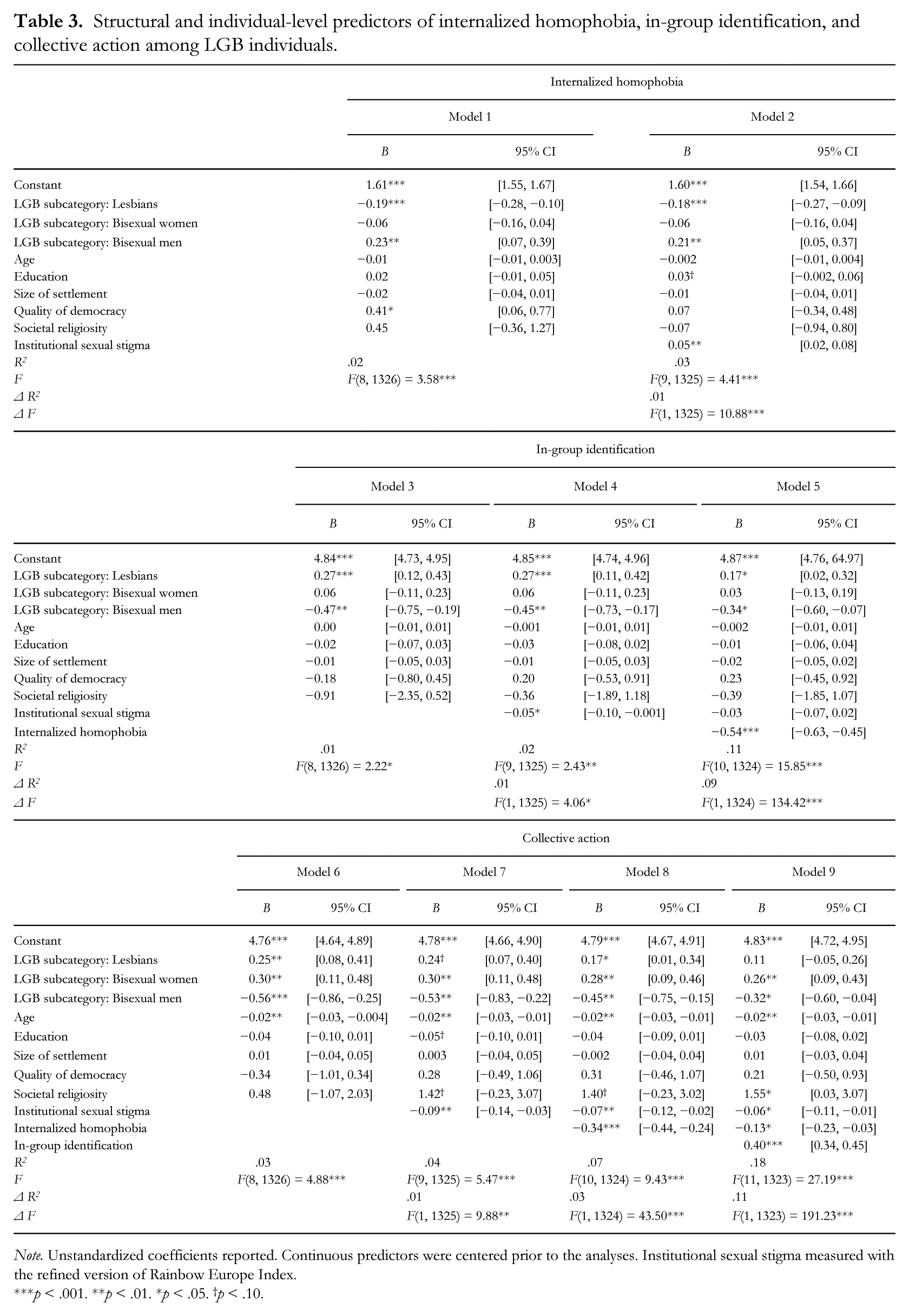
Note. Unstandardized coefficients reported. Continuous predictors were centered prior to the analyses. Institutional sexual stigma measured with the refined version of Rainbow Europe Index.
p < .001. **p < .01. *p < .05. †p < .10.
Indirect Effect of Institutional Sexual Stigma (Refined Rainbow Europe Index) on In-Group Identification
In order to verify Hypothesis 1, in-group identification was regressed on control variables, structural stigma, and internalized homophobia (Model 5, Table 3). Similarly to past results (Herek et al., 2009), internalized homophobia predicted in-group identification negatively (B = −0.54, SE = 0.05, 95% CI [−0.63, −0.45], p < .001). Moreover, when internalized homophobia was added into the regression equation, the negative effect of institutional sexual stigma from Model 4 (Table 3) lost significance (B = −0.03, SE = 0.05, 95% CI [−0.07, 0.02], p = .290). In line with Hypothesis 1, structural stigma diminished in-group identification by promoting internalized homophobia (IE = −0.03, SE = 0.01, 95% CI [−0.04, −0.01], Z = −3.16, p = .002).
Sequential Indirect Effect of Institutional Sexual Stigma (Refined Rainbow Europe Index) on Collective Action
Next, we examined Hypothesis 2 by regressing collective action on the control variables, institutional sexual stigma, internalized homophobia, and in-group identification (Model 9, Table 3). In line with past research (e.g., van Zomeren et al., 2008), collective action was increased by in-group identification (B = 0.40, SE = 0.03, 95% CI [0.34, 0.45], p < .001). By contrast, internalized homophobia lowered engagement intentions (B = −0.13, SE = 0.05, 95% CI [−0.23, −0.03], p = .012), although this effect was smaller in comparison to Model 8 (Table 3), which did not involve in-group identification as the predictor. Upon entering two sequential mediators into the model, the direct effect of structural stigma decreased but remained significant (B = −0.06, SE = 0.03, 95% CI [−0.11, −0.01], p = .018).
Sequential indirect effect of institutional sexual stigma on collective action intentions via internalized homophobia and in-group identification was significant (B = −0.01, SE = 0.003, 95% CI [−0.02, −0.01]). Discriminatory legal arrangements inhibited collective action intentions by strengthening internalized homophobia and subsequently mitigating in-group identification. This finding lends support to Hypothesis 2. Additional analyses showed that institutional sexual stigma diminished engagement intentions by solely strengthening internalized homophobia (B = −0.01, SE = 0.003, 95% CI [−0.01, −0.001]). However, discriminatory legislation did not affect collective action by changing solely in-group identification (B = −0.01, SE = 0.01, 95% CI [−0.03, 0.01]). As demonstrated by the contrast analyses (see the online supplemental material), the indirect effects that institutional sexual stigma exerted on collective action intentions did not differ regarding their strength.
Effects for the Alternative Measure of Institutional Sexual Stigma
When the alternative measure of institutional sexual stigma (i.e., time elapsed since the introduction of same-sex civil unions) was employed, the substantial conclusions remained intact. Institutional stigma decreased in-group identification by facilitating internalized homophobia (IE = −0.04, SE = 0.01, 95% CI [−0.07, −0.02], Z = −2.99, p = .003), which corroborated Hypothesis 1. In line with Hypothesis 2, the sequential indirect effect of institutional stigma on collective action through internalized homophobia and in-group identification was negative and significant (IE = −0.02, SE = 0.01, 95% CI [−0.03, −0.01]). 7
Discussion
Using the data collected in five East European countries, we found that sexual stigma engrained in the legal system (a macrolevel phenomenon) suppressed collective action among LGB individuals (a microlevel phenomenon). This effect was explained by sequential changes in internalized homophobia and in-group identification among sexual minorities’ members. Importantly, the chain effect of institutional stigma was independent from other societal properties such as religiosity or quality of democracy and emerged when different operationalizations of legal heterosexism were employed. Thus, the present results attest to the integrative model we proposed, borrowing insights from a range of separate theoretical traditions.
First, our results speak in favour of the association between structural heterosexism and internalized homophobia assumed within the sexual stigma conceptual framework (Herek, 2009). Sexual stigma perpetuated by LGB-directed legislation was demonstrated to “get under the skin” of nonheterosexual individuals and magnify their self-stigmatization. The more a given country was blind to the rights of sexual minorities, the higher was the level of internalized homophobia among its LGB citizens. As far as the consequences of institutional and internalized sexual stigma are concerned, the present results extend previous work by demonstrating their detrimental effects on the collective action of LGB individuals. The positive relationship between the adoption of the hierarchy legitimizing myths (i.e., internalized homophobia) and unchallenging behaviour in relation to the status quo (i.e., low collective action intentions) also conforms to the predictions of the system justification theory (Jost & Banaji, 1994; Jost et al., 2004; Pacilli et al., 2011).
Second, in accordance with social identity theory (Tajfel & Turner, 1979, 1986), in-group identification was shown to be a function of in-group status. The narrower scope of LGB rights translated into lower in-group identification of nonheterosexual individuals.
Third, support is lent to the implications of POS (see I. H. Meyer, 2003), which assumes that protest behaviour depends on extraindividual, contextual factors such as the system’s political openness. Analogically to power concentration and high responsiveness in the general population (e.g., Corcoran et al., 2011), legal recognition of nonheterosexual individuals encouraged LGB activism.
Fourth, our results add to the collective action literature by clarifying some of the psychological mechanisms that may underlie the relationship between political system properties and individual engagement. We show that political culture and its regulations concerning sexual minorities’ rights affect collective action involvement due to specific psychological processes occurring among LGB individuals. Thus, the present research addresses the call for more integrative theorizing in political action research (van Zomeren, 2016). Utilizing the potential of psychological and sociological theories of engagement, our theoretical model at the same time overcomes their shortcomings. It takes into account the institutional setting, a factor often neglected in social psychological models of collective action, and it adds an intervening psychological element to the link between formal arrangements and individual behaviour postulated by sociological theories of political action (see D. S. Meyer, 2004). We believe that beyond explaining collective action of sexual minorities’ members, the current integrative approach may inform the research on engagement of other low-status groups.
Finally, current results shed light on the vicious circle created by discriminatory legal regulations. By weakening in-group identification and collective action among LGB individuals, institutional sexual stigma impedes social change and reproduces itself. Thus, structural heterosexism seems to play a double role as both the target of and an obstacle to LGB activism.
Nonetheless, the current study is not without limitations. The heavily unbalanced sample size between countries constitutes its major weakness. Since unequal group sizes may affect standard error estimates and p-values, confidence in the present conclusions should be limited.
One may also ask whether the nested structure of the current dataset should not be recognized by the adoption of a multilevel modeling (MLM) framework. MLM, which allows linking the macro- and microlevel of analysis, is a standard tool to investigate how context affects individuals (Hox, 2010). However, when the number of observations at the macrolevel is limited (i.e., N < 50 for ML estimation), MLM fails to provide accurate estimates (Maas & Hox, 2005). Thus, due to the small size of the current sample (five observations at the macrolevel), we decided to apply linear regression instead of MLM. Nevertheless, research aimed at the replication of our findings should employ a larger number of countries to perform optimal MLM analysis.
Another limitation of this study stems from its cross-sectional design, which does not allow firm causal conclusions. Two relationships involved in our theoretical model appear particularly problematic. First, it may be questioned whether the detrimental effects of institutional stigma are first manifested in internalized homophobia and translate into in-group identification afterwards or if structural stigma leads to low in-group identification that entails high internalized homophobia. Since the stage models of LGBTQI identity development (see Bilodeau & Renn, 2005) suggest that prior to establishing stable bonds with LGBTQI community (i.e., developing in-group identification) LGB individuals have to overcome negative feelings toward their own sexual orientation (i.e., internalized homophobia), we assume the precedence of self-stigmatization over in-group identification. The second question concerns the relationship between institutional stigma and individual collective action. Our model assumes a top-down causal flow from structural stigma to LGB activism. The alternative direction of causality would involve a bottom-up process, in which collective action of LGB individuals leads to the extension of sexual minorities’ rights at the country level. Since in East European countries nondiscrimination regulations were rather externally imposed than adopted (O’Dwyer & Schwartz, 2010; Slootmaeckers & Touquet, 2016), we have excluded the second option. However, the informed response to both causal order questions requires longitudinal data.
It is also unclear if the current findings apply to other sociopolitical contexts. Extrapolating from Allport’s continuum of prejudice (1954), the forms of institutional sexual stigma may be ordered from severe (e.g., subjecting sodomy acts to the capital punishment) to relatively mild (e.g., absence of automatic coparent recognition). Since the current data was obtained in countries situated in the middle of such continuum, it may be questioned whether the pacifying effects of structural stigma on LGBs’ collective action are similar in settings characterized by a higher and lower degree of lawful discrimination. For example, it is not evident whether the difference in the intensity of collective action intention between countries penalizing homosexual conduct with life imprisonment and countries punishing this activity with death sentence would be the same as between countries providing hate crime protection or not. Again, the knowledgeable response to the universality question needs cross-cultural data obtained in countries with a diversified strength of institutional stigma.
Future studies would also benefit from examining other factors that may influence LGB activism. It seems possible that structural stigma weakens collective action of this group through mechanisms different than those considered in the present research. For example, state-sponsored heterosexism may operate through the anticipated social costs of confrontation (see Barreto & Ellemers, 2015)—in a hostile institutional setting LGB individuals may refrain from challenging the status quo due to fear of retaliation from the state or prejudiced majority. Furthermore, collective action of LGB people may be affected by other macrolevel properties such as societal attitudes toward sexual minorities or dominant values. Although the current research accounted for societies’ secularization and emancipation by using societal religiosity and quality of democratic institutions as proxies, future research may employ the aggregate measures of secular and emancipative values (Inglehart & Welzel, 2005) instead.
To conclude, despite its shortcomings, the present study delivers evidence on the role of the sociopolitical context in promoting LGB individuals’ political engagement. By shaping the beliefs and identities of LGB people, sexual stigma entrenched in state institutions may thwart political activism of sexual minorities and thus conserve the status quo. At the same time, as evident in the East European context, state-sponsored heterosexism emerges from the interaction of ideological inclinations of political elites and the leverage of international institutions. Therefore, it seems crucial for social-psychological research to acknowledge the institutional setting of particular protests; distant and often unrecognized macrolevel phenomena may determine whether a person comes out of the closet and gets into the streets.
Footnotes
Funding
This work was supported by the European Commission [Action: JUST/2013/FRC/AG]; the National Science Centre Poland [2013/11/N/HS6/01187; UMO-2014/13/B/HS6/0407] and Polish Ministry of Science and Higher Education [IP2014 002273].
Notes
References
Supplementary Material
Please find the following supplemental material available below.
For Open Access articles published under a Creative Commons License, all supplemental material carries the same license as the article it is associated with.
For non-Open Access articles published, all supplemental material carries a non-exclusive license, and permission requests for re-use of supplemental material or any part of supplemental material shall be sent directly to the copyright owner as specified in the copyright notice associated with the article.

