



Abstract
Many of the most important decisions in our society are made within groups, yet we know little about how the physiological responses of group members predict the decisions that groups make. In the current work, we examine whether physiological linkage from “senders” to “receivers”—which occurs when a sender’s physiological response predicts a receiver’s physiological response—is associated with senders’ success at persuading the group to make a decision in their favor. We also examine whether experimentally manipulated status—an important predictor of social behavior—is associated with physiological linkage. In groups of 5, we randomly assigned 1 person to be high status, 1 low status, and 3 middle status. Groups completed a collaborative decision-making task that required them to come to a consensus on a decision to hire 1 of 5 firms. Unbeknownst to the 3 middle-status members, high- and low-status members surreptitiously were told to each argue for different firms. We measured cardiac interbeat intervals of all group members throughout the decision-making process to assess physiological linkage. We found that the more receivers were physiologically linked to senders, the more likely groups were to make a decision in favor of the senders. We did not find that people were physiologically linked to their group members as a function of their fellow group members’ status. This work identifies physiological linkage as a novel correlate of persuasion and highlights the need to understand the relationship between group members’ physiological responses during group decision-making.
Keywords
From juries deliberating to teams of physicians diagnosing patients, the decisions that groups of people make have important implications for our daily lives (Davis, 1973; Devine, Clayton, Dunford, Seying, & Pryce, 2001; Hogg, 2010; Janis, 1972; Woolley, Chabris, Pentland, Hashmi, & Malone, 2010). In trying to understand how people make decisions together, scholars have examined the ways in which individual group members respond physiologically while making decisions in groups (e.g., van Prooijen, Ellemers, van der Lee, & Scheepers, 2018), which can provide insight into the psychological processes group members experience. For example, research has shown that when a group member’s ideas get rejected by the group, the rejected group member experiences greater vasoconstriction, suggesting that they experience more psychological threat (Jamieson, Valdesolo, & Peters, 2014). Although prior research on group decision-making has focused on individual group members’ physiological responses, to our knowledge, it is not yet known how the relationships between group members’ physiological responses might be associated with the decisions that groups make.
In the current work, we draw from research showing that people who are interacting with one another can exhibit similarity or correspondence between their physiological responses (Palumbo et al., 2017; Timmons, Margolin, & Saxbe, 2015) and that this can occur, in particular, when groups are working together on collaborative tasks (e.g., Haataja, Malmberg, & Järvelä, 2018; Mønster, Håkonsson, Eskildsen, & Wallot, 2016). We extend this research to examine how physiological linkage of autonomic nervous system (ANS) responses is related to the decisions groups make when they are working together. Specifically, we study groups—similar to hiring committees and juries—where two people in the group are trying to persuade the group to make a particular decision. We study physiological linkage of ANS responses, which occurs when the physiological response of one group member, referred to as the “sender,” predicts the physiological response of another group member, referred to as the “receiver,” at a following time point (see Figure 1). We examine whether linkage is associated with the sender’s success at persuading the group to make a decision in the sender’s favor. In other words, when the sender’s physiology predicts the subsequent physiological responses of their group mates (the “receivers”), is that associated with the sender successfully persuading those group mates as well?
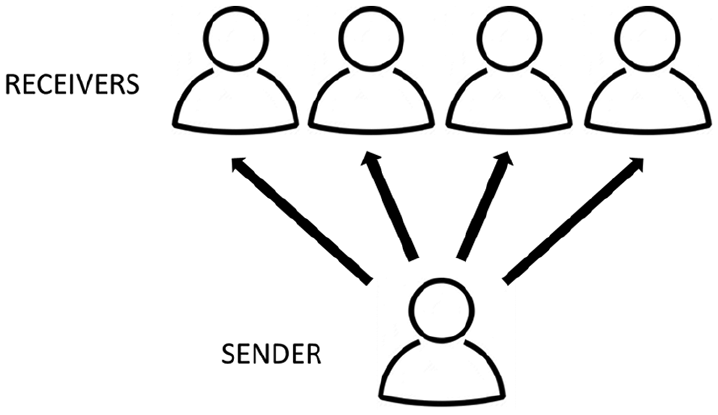
Model of physiological linkage. The sender’s physiological response predicts the physiological responses of each of the receivers at a following time point. The receivers are said to be “physiologically linked” to the sender.
Past empirical and theoretical work related to the processes underlying physiological linkage suggests that the physiological responses of successful persuaders might predict the physiological responses of the people they are trying to persuade. This might occur because successfully influencing other people requires getting their attention (Fiske, 2010; Paluck & Shepherd, 2012; Paluck, Shepherd, & Aronow, 2016), and recent studies suggest that physiological linkage occurs when people are most attentive to one another. For example, similarity between skin conductance responses is lower between patients and therapists when therapists deliberately ignore the emotional states of their patients (Marci & Orr, 2006). In dyadic interactions between African Americans and European Americans, African Americans show physiological linkage of preejection period responses to European Americans under conditions when African Americans are expected to be most attentive to European Americans: when they “leak” nonverbal cues of prejudice (e.g., appearing tense and uncomfortable; West, Koslov, Page-Gould, Major, & Mendes, 2017). Indeed, researchers have theorized that for linkage to occur, the physiological response of the sender must be associated with signals that the receiver notices. The receiver must be attentive—either consciously or nonconsciously—to these cues in order to then experience a similar physiological state (Thorson, West, & Mendes, 2018).
To test the relationship between successful persuasion and physiological linkage, we study groups of five people in which two people are told to convince the group to make a particular (but different from each other) decision. We then examine whether physiological linkage to senders (which occurs when the sender’s physiological response predicts the receivers’ subsequent physiological responses) is associated with the group making a final decision that is in the sender’s favor.
We also examine how linkage is associated with an important predictor of behavior in groups—people’s social status. One of the most consistent drivers of group decision-making is status: people who have more status—respect and admiration from others (Fiske, 2010; Magee & Galinsky, 2008)—are more likely to influence others in group decision-making than people who have less status (Berger, Cohen, & Zelditch, 1972; Devine et al., 2001; Kalkhoff & Barnum, 2000; Liberati, Gorli, & Scaratti, 2016). For example, senior physicians influence decision-making in medical teams and the tenor of communication in operating rooms (Lingard, Reznick, Espin, Regehr, & DeVito, 2002), and high-status jury forepersons influence the process and outcomes of juror deliberations (Devine et al., 2001).
In the present research, we randomly assigned people to be “high,” “middle,” or “low” status before a group interaction to examine how status influences physiological linkage during group decision-making interactions. We manipulated status so that we could see how the perception of status (when it is not associated with other traits that are often tied to status, like task-related competence and leadership skill) within groups affects physiological linkage. To our knowledge, little research has directly examined the influence of status on physiological linkage. Given that physiological linkage often occurs when people are paying attention to one another, and that high-status people often receive more attention than low-status people (Fiske, 2010; Foulsham, Cheng, Tracy, Henrich, & Kingstone, 2010), we predicted that people would show more physiological linkage to high-status group members (i.e., high-status others would predict the physiology of lower status people—both the low-status group members and the middle-status group members) than vice versa. Such a pattern has been found within dyadic negotiations (Kraus & Mendes, 2014), but to our knowledge, no research has examined this question within groups that are making decisions. In this context, having two people compete for attention from the rest of the group might disrupt the previously found relationship between status and linkage during dyadic negotiations.
Current Research
We assigned groups of five new acquaintances with a cooperative task that required them to come to a joint selection of one of five executive search firms. Within the five-person group, one person randomly assigned to a high-status role and one person assigned to a low-status role (described in what follows) surreptitiously were instructed to argue on behalf of a particular search firm. We assessed the autonomic nervous system (ANS) activity of all five group members continuously throughout the group interaction by measuring cardiac interbeat intervals (IBI), which is the amount of time in milliseconds between successive heartbeats. We chose this measure of ANS activity because (a) it is sensitive to quick changes in affect, motivation, and emotion, which we were interested in tracking within group members over time, (b) it can easily be obtained from five group members simultaneously, and (c) measuring it (with a heart rate monitor in the middle of the torso) does not require group members to be inhibited in their speech or movements, allowing for natural social behavior. Because IBI represents a measure of general autonomic arousal and the intensity of people’s experiences, we interpret linkage on IBI responses as indicating the extent to which individuals “track” the fluxes and flows of the intensity of their partners’ psychological states through both verbal and nonverbal cues that their partners provide.
We calculated physiological linkage scores for each person in the group that represent the extent to which all other group members show physiological linkage to that person, from one moment to the next, throughout the interaction. Other quantifications of physiological correspondence have been used by researchers (for overviews, see Palumbo et al., 2017; Thorson et al., 2018); however, we chose the present operationalization for three reasons. One, it utilizes a time-lagged component where the sender’s physiological response predicts the receivers’ physiological responses at a following time point. This allows us to track the extent to which people might be attentive to each other’s verbal and nonverbal behaviors during an interaction and experiencing physiological changes as a result (in contrast to covariation models, which examine physiological responses at the same time point, presumably tracking the extent to which people concurrently share psychological experiences). Second, this model allows us to examine physiological linkage while accounting for physiological stability—which is the extent to which people’s physiological responses at one time point predict their own responses at a following time point—which is important because it typically accounts for a large share of the variance in predicting people’s physiological responses at any time point. Third, this approach allows us to examine associations between physiological linkage and the outcome of persuading group members, which not all models can accommodate.
Consistent with prior research, we expected that groups would be more likely to select firms advocated for by high-status group members relative to low-status group members. We also expected that both high- and low-status people would be similarly motivated during the task. Thus, we examined ANS reactivity of these group members (relative to each other and to middle-status group members), given that ANS reactivity can reflect greater effort and engagement (Obrist, 1981; Wright & Kirby, 2001). We then tested two key questions. First, we examined whether physiological linkage from senders to receivers—which occurs when a sender’s physiological response predicts a receiver’s physiological response—is associated with senders’ success at persuading the group to make a decision in their favor. Second, we examined whether experimentally manipulated social status is associated with physiological linkage in groups.
Status Manipulation
We randomly assigned status using a manipulation from past research on social hierarchies (Anderson & Berdahl, 2002; Galinsky, Gruenfeld, & Magee, 2003; Lammers, Galinsky, Gordijn, & Otten, 2008). Participants completed a leadership questionnaire about themselves, which was ostensibly scored by the experimenters. Group members then received randomly assigned feedback about who had the most leadership experience (the high-status group member), who had the least leadership experience (the low-status group member), and who had experience in between these two persons (the middle-status group members).
Research using this manipulation (i.e., where participants receive feedback ostensibly on the basis of a leadership questionnaire) has often combined the feedback component with control over valued resources (e.g., money; Anderson & Berdahl, 2002; Galinsky et al., 2003), which is a traditional manipulation of power. In this research, we did not give the person who had the most leadership experience explicit control over resources. Therefore, we refer to the manipulation as a status manipulation, where status is conceptualized as the amount of respect or admiration that people have because they have more expertise or skills than others in a certain domain (in this case, in leadership; Fiske, 2010). However, we acknowledge that this could also be considered a manipulation of “expert power,” given that those with the most leadership experience are likely considered to have valuable expertise (French & Raven, 1959).
Pilot Study
First, we present a pilot study of our status manipulation, where we examined (a) whether participants accurately recalled the information provided in the manipulation and (b) whether the manipulation affected how much status people think their fellow group members have. The purpose of this study was to make sure that the status manipulation had the intended effects on people’s perceptions of status (study materials, data, and syntax are available at https://osf.io/xu6ep/).
Methods
Participants
Participants were undergraduate students who participated in the study for partial course credit (Nparticipants = 330; Mage = 19.94 years, SDage = 1.25 years; 67.6% female, 31.2% male, 0.6% gender-queer, 0.3% transgender male; 37.6% Asian, 33.9% White, 9.4 % Black, 7.6% multiracial, 0.9% other, 0.3% Native Hawaiian or other Pacific Islander, 0.3% Native American; 81.2% non-Hispanic, 18.5% Hispanic). Twenty-five participants who are not included in the aforementioned numbers participated in the study but chose to have their data deleted after learning about the manipulation at the end of the study.
Procedure
Participants were students in large psychology courses who were given the opportunity to participate during class time in a 10-minute study about group decision-making. Participants were told that the study would involve interacting with other students in the class via the Internet and were asked to complete the study on a smartphone, tablet, or laptop. Tablets were provided for students who did not have devices that could access the Internet.
Status manipulation
After providing consent, all participants completed a leadership questionnaire in which they rated themselves on traits related to leadership and listed their past leadership positions and current grade point average (GPA). Questionnaires were ostensibly processed and scored. Participants were then told that they would be entering a chat room with four other group members from their class and that they would see a symbol and letter combination next to each of their names in the chat room. We told participants that these symbols and letters were based on the questions they answered about their leadership experiences. We said that the person with the gold diamond and the letter A had the most leadership experience (high status), that the person with the gray circle and the letter E had the least leadership experience (low status), and that the three people with blue squares and the letters B, C, and D were somewhere in the middle. We told participants that all of their group members also received the same information and that if they needed to remind themselves what the symbols meant before moving on, they could use the “Back” button. Next, each participant was randomly assigned to one of the three roles, ostensibly based on their answers to the leadership questionnaire.
Search firm task
Before completing the following self-report measures, approximately half of the participants were randomly assigned to receive instructions for the group decision-making task used in the main study. We did this so that we could check if the effects of the status manipulation varied by whether participants received instructions about the task alongside the manipulation. Each set of instructions included a portion that was common to all participants, explaining that the group’s task was to select the best of five executive search firms to assist in hiring a senior vice president of business development. The common instructions also listed a brief description of each of the five search firms. High- and low-status participants were also told that their task was to convince the group to hire one particular search firm that was specified on the instructions sheet, and they would receive a 5-dollar reward if they were successful at convincing the rest of the group to select their search firm without revealing this goal. High- and low-status participants did not know that anyone else in the group was also trying to advocate for a particular search firm. Participants were told they would have 10 minutes to reach a group decision. Participants were told that they could select a firm with (a) a unanimous vote (all five people agreed), (b) a majority vote (three or four people agreed), (c) a figurehead vote (the group selected one person to make a final decision, even if it was not unanimous), or that they could make no decision. Participants then completed the measures listed in what follows, after which the study ended. They did not engage in an online discussion. They were debriefed about the nature of the study. They were told that the results regarding their leadership questionnaire and how they related to other group members were not real and were randomly assigned.
Measures
Recall of the manipulation
To examine whether participants could accurately recall the information provided in the manipulation, we asked them to indicate the group member who had the most leadership experience and the group member who had the least leadership experience.
Perceived status of group members
To examine whether the manipulation affected how much status people thought their group members had, we used a four-item measure of status that has been used in the small groups literature and incorporates multiple components of status, including respect and influence (Anderson, Brion, Moore, & Kennedy, 2012). On 7-point scales (1 = not much at all, 7 = very much), participants rated how much respect and admiration each group member deserved, as well as how much they thought each group member would influence decisions, lead the decision-making process, and contribute to decisions when their group worked together. We averaged participants’ responses on these items to create a measure of perceived status (α = .85).
Results
Recall of the manipulation
Nearly all participants (97.3%) correctly recalled who had the most leadership experience, and nearly all participants (99.1%) correctly recalled who had the least leadership experience.
Perceived status of group members
We analyzed the data using the MIXED procedure in SPSS to account for nonindependence in people’s ratings across multiple targets. This procedure uses the Satterthwaite (1946) method to calculate degrees of freedom, which involves a weighted average of the between and within degrees of freedom (see Fitzmaurice, Laird, & Ware, 2011; Kenny, Kashy, & Cook, 2006). Degrees of freedom in this method, which can be fractional, are based on the total number of data points considered, adjusted for the nonindependence of ratings. Because effects of nonindependence are considered by the Satterthwaite approximation, the degrees of freedom for different effects also vary across different tests.
The dependent variable was how much status people thought each group member had. The fixed effects were the assigned status of the target (the person being perceived), the assigned status of the perceiver (the person doing the perceiving), and an interaction between target and perceiver status. We also included a main effect of whether or not perceivers had been randomly assigned to receive instructions for the group decision-making task used in the main study (“instructions”), as well as interaction terms between the instructions variable and all other terms in the model. Because each perceiver judges multiple targets, we included a random intercept for each perceiver.
The main effect of instructions, all interactions with instructions, and the interaction between target and perceiver status were nonsignificant (ps > .30), so we trimmed them from the following models. To control for Type I error in post hoc pairwise comparisons, we applied Bonferroni corrections (Abdi, 2007). To do this, we took the p values obtained from each pairwise comparison and multiplied each one by the number of comparisons that were done. As is convention, we report this adjusted p value and compare it to an alpha of .05 to determine significance.
As predicted, we found a significant main effect of target status, F(2, 988) = 579.95, p < .001. People who were assigned to the high-status role were judged to have more status (M = 5.84, SD = 0.94) than those in the middle-status role (M = 5.10, SD = 0.90; p < .001) and in the low-status role (M = 4.41, SD = 1.20; p < .001). People in the middle-status role were also judged to have more status than those in the low-status role (p < .001). We also found a significant main effect of perceiver status, F(2, 330.65) = 5.69, p = .004. People who were assigned to the high-status role did not perceive other group members to have more status (M = 5.16, SD = 1.02) than those who were assigned to the middle-status role (M = 5.12, SD = 1.10; p = .14). However, people in the high-status role did perceive other group members to have more status than those in the low-status role (M = 5.03, SD = 1.04; p < .002). People who were assigned to the middle-status role did not perceive other group members to have more status than those in the low-status role perceived (p = .081).
Summary
In this pilot study, we found that participants could accurately recall the information provided in the manipulation and that the manipulation affected how much status people thought their fellow group members had: high-status targets were seen as having more status than middle- and low-status targets, and low-status targets were also seen as having less status than middle- (and high-) status targets. Next, we use this manipulation in the main study to test our two key questions about how physiological linkage is associated with successful persuasion and how status affects physiological linkage in groups.
Main Study
Methods
Additional methodological and analytic details are provided in the supplemental material (SM; a video of the procedure is provided at https://www.youtube.com/watch?v=m9sZFp8qVjU&t=6s; study materials, data, and syntax are available at https://osf.io/xu6ep/).
Participants
Participants were undergraduate students who participated in the study for partial course credit (Ngroups = 46, Nparticipants = 230; Mage = 20.00 years, SDage = 1.26 years; 71.3% female, 27.8% male, 0.9% gender-queer; 41.3% Asian, 25.7% White, 13.0% Hispanic, 10.0% multiracial, 6.1% Black, 0.4% Pacific Islander, 0.4% other). Participants were prescreened to ensure that they did not have a pacemaker, doctor-diagnosed heart murmur, or hypertension (Blascovich, Vanman, Mendes, & Dickerson, 2011).
Procedure
Baseline
Previously unacquainted participants arrived at the lab in groups of five people (see Figure 2), where they were each brought to a private room with an experimenter, who explained how to wear a heart rate monitor at heart height. We then recorded a 5-minute physiological baseline while participants watched a relaxing video about nature.
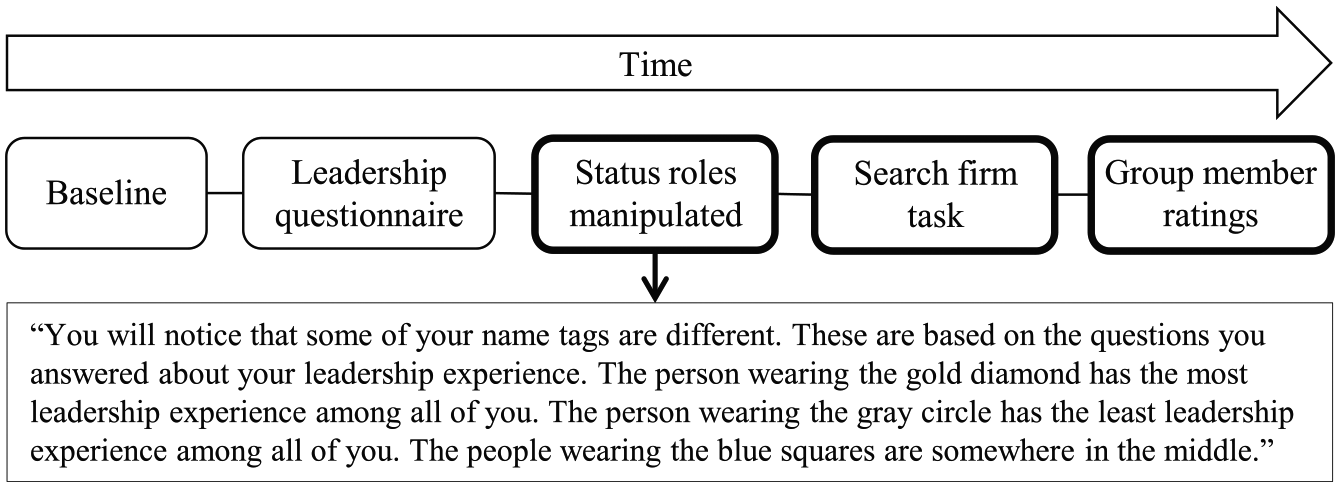
Overview of the procedure.
Status manipulation
To manipulate status, all participants completed the same leadership questionnaire as in the pilot study. As in the pilot study, participants were then told that we would use their responses to provide them with more information about their group mates prior to working with them, and questionnaires were then ostensibly scored. Next, the experimenters brought all five participants into the same room. Participants were seated around a rectangular table that measured 30 inches by 60 inches in a room that was approximately 120 inches by 136 inches (see the SM for an exact layout of the room). Each participant was given a randomly assigned name tag with a letter and a symbol. We told participants that the person with the gold diamond and the letter A had the most leadership experience (high status), that the person with the gray circle and the letter E had the least leadership experience (low status), and that the three people with blue squares and the letters B, C, and D were somewhere in the middle.
Search firm task
Participants were given the same instructions for the search firm task as in the pilot study and asked to read them privately. As in the pilot study, each person’s set of instructions included a portion that was common to all participants, explaining that the group’s task was to select the best of five executive search firms to assist in hiring a senior vice president of business development. The common instructions also listed a brief description of each of the five search firms.
High- and low-status participants were also told that their task was to convince the group to hire one particular search firm that was specified on the instructions sheet, and that they would receive a 5-dollar reward if they were successful at convincing the rest of the group to select their search firm without revealing this goal. High- and low-status participants did not know that anyone else in the group was also trying to advocate for a particular search firm. The specific search firms were randomized across sessions (the following percentages of high- and low-status people, respectively, were assigned to argue for each of the five firms: Firm 1 [17.4%, 19.6%], Firm 2 [21.7%, 13.0%], Firm 3 [19.6%, 23.9%], Firm 4 [17.4%, 21.7%], and Firm 5 [23.9%, 21.7%]). The maximum number of times that a particular assigned firm was chosen was 23.9% (compared to chance of 20%; z = 0.90, p = .37). Thus, no one firm was particularly likely to account for success at persuading the group. People in the high- and low-status conditions in the same group were never assigned to advocate for the same search firm. People in the middle-status condition could advocate for any search firm, as they did not receive any special instructions to argue for a particular firm.
Participants were told they would have 10 minutes to reach a group decision. Participants were told that they could select a firm with (a) a unanimous vote (all five people agreed), (b) a majority vote (three or four people agreed), (c) a figurehead vote (the group selected one person to make a final decision, even if it was not unanimous), or that they could make no decision. During the 10 minutes of discussion, participants openly discussed the search firms in whatever manner they wanted to (with the exception that high- and low-status members could not reveal that we had instructed them to argue for a particular firm). We did not provide the participants with any additional instructions as to how they should talk with each other or how they had to make their decision. Interbeat intervals were obtained continuously for the entire group task. Experimenters viewed the interaction from a control room to ensure that people in the high- and low-status conditions did not disclose that they were assigned to advocate for particular search firms; none did. Each participant completed a questionnaire and was debriefed. 1
Measures
Mean interbeat intervals
We measured autonomic nervous system activity via mean cardiac interbeat intervals (IBI); IBI is the amount of time in milliseconds between heartbeats. All participants wore Polar H7 Bluetooth Heart Rate Sensors on their torsos at heart height, which recorded IBI during baseline and the group search firm task using the Elite HRV smartphone application.
Each participant’s physiological data were processed by two of three trained researchers. If the first two researchers disagreed on how to process a file, then the third researcher resolved the discrepancy. In Step 1, we used an Excel macro to divide each participant’s baseline and group task recordings into 30-second segments. We added 12 seconds of data on each end of each 30-second measurement interval for Step 3, when the data are filtered to pass the respiratory frequency range (0.12 to 0.40 Hz). These seconds are lost to the filter and, thus, do not factor into the calculations of IBI. 2 During this step, the Excel macro also identified potential artifacts and missing signals in each 30-second segment (according to a set of specifications listed at https://osf.io/xu6ep/; e.g., any instance of an IBI 30% greater than the prior IBI). In addition, the Excel macro created line graphs of each 30-second segment of IBIs so that the researchers could visually inspect the data for artifacts and missing signals.
In Step 2, we applied corrections to any potential issues or artifacts in the data (according to a set of guidelines listed at https://osf.io/xu6ep/; e.g., if there was an IBI twice as long as the others in a 30-second segment, we split that IBI in half). If there was more than one issue in one 30-second segment, we marked that segment as missing. Overall, we took a conservative approach in Steps 1 and 2 to eliminate any potential artifacts or extreme responses. In Step 3, we obtained a mean IBI for each 30-second segment using CMetX Cardiac Metric Software Version 2.63 (available from John J. B. Allen at www.psychofizz.org; described more fully in Allen, Chambers, & Towers, 2007). We then computed reactivity scores by subtracting the mean IBI from the last 30-second segment of baseline from the mean IBI of each 30-second segment of the group search firm task. 3 Each participant could have a maximum of 20 reactivity scores, across the 10 minutes of the group search firm task.
Physiological linkage
We calculated a physiological linkage score for each person in each dyadic interaction that represented the extent to which that person (the “receiver”) was physiologically influenced by another person (the “sender”) in the group. We calculated linkage scores for all of the 10 dyadic interactions in one group so that there are four linkage scores for each person as a sender (when their physiology predicts each other group member’s physiology) and four as a receiver (when their physiology is predicted by each other group member’s physiology). In our analyses, all participants are both senders and receivers, and we examine how much each participant’s reactivity score (a) predicts each of their partners’ reactivity scores and (b) is predicted by each of their partners’ reactivity scores. To calculate these physiological linkage scores, we conducted a regression model for each person in each dyad, where the receiver’s reactivity score at time T+1 was predicted by their partner’s (the sender’s) reactivity score at time T and their own reactivity score at time T. We adjusted for stability—receivers’ own prior physiology—when calculating linkage, based on the approach outlined in Thorson et al. (2018). Any linkage estimates made from fewer than 10 observations (50% of the possible time points) were marked as missing (11.5% of linkage estimates total).
Results
Group Decisions
Out of 46 groups, 42 groups (91.3%) came to a decision regarding which search firm to choose; the remaining four groups did not reach a decision either before or at the 10-minute mark for the conclusion of the task. Fifteen out of the 42 decisions (35.7%) were reached unanimously, and 27 of the 42 decisions (64.3%) were reached by a majority vote (i.e., three or four people chose the same firm). In our analyses, we make no distinction between whether a group chose unanimously or via a majority vote given that there were no systematic differences in patterns of effects if decisions were made unanimously or through a majority.
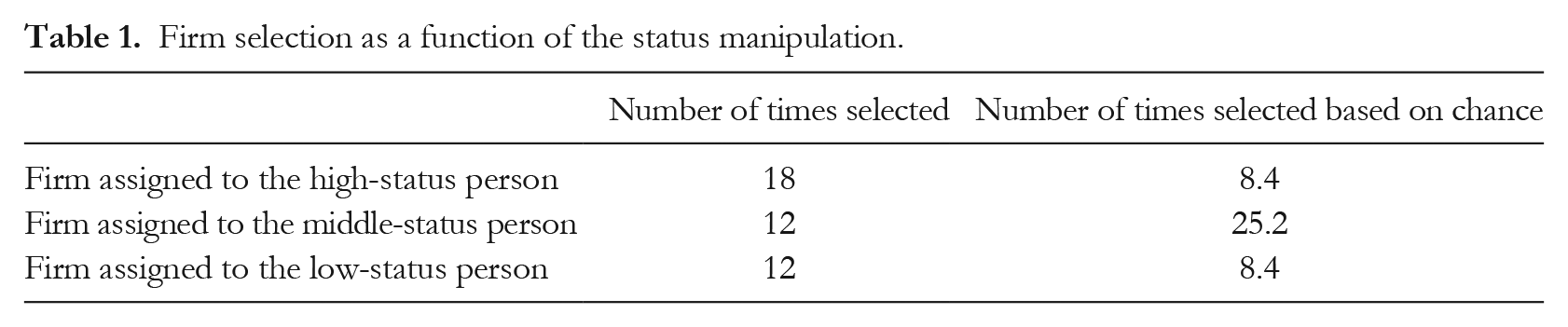
We conducted a chi-square test of independence to examine whether the observed frequencies for firm selection were different than what would be expected based on chance. In every group, one firm was advocated for by a high-status participant, one firm was advocated for by a low-status participant, and three firms were not specifically advocated for by anyone. Thus, based on chance, there is a 20% likelihood that the firm advocated for by the high-status person would be selected, a 20% likelihood that the firm advocated for by the low-status person would be selected, and a 60% chance that a firm that was not advocated for by either a high- or low-status person would be selected; we used these as the expected frequencies in our analysis.
The observed frequencies were different than expected by chance, χ2(2) = 19.43, p < .001 (see Table 1). Using the approaches outlined by MacDonald and Gardner (2000) and Sharpe (2015), consistent with prior research, groups were more likely than chance to select the firm advocated for by the high-status person, z = 3.31, p = .003. In addition, post hoc comparisons revealed that the firms advocated for by the high-status participant were selected at a significantly higher rate than those advocated for by the low-status participant, χ2(1) = 12.51, p = .001, ϕ = 0.65. Firms advocated for by the high-status participant were also selected at a significantly higher rate than those that were advocated for by no one, χ2(1) = 17.89, p < .001, ϕ = 0.77. These findings are consistent with prior research showing that high-status people tend to wield more influence in groups.
Firm selection as a function of the status manipulation.
IBI Reactivity
We expected to find that high- and low-status individuals would exhibit greater IBI reactivity during the task than middle-status participants, given that high- and low-status participants were given a more demanding task than middle-status participants. We modeled IBI reactivity per 30-second interval of the task. We anticipated that all participants would show decreases in reactivity over time, given expected habituation to the task, so we included a linear effect of time in the models and a Status × Time interaction term (see Fitzmaurice et al., 2011). Group members were nested within groups, and group members were treated as indistinguishable by forcing equality constraints on their variances and covariances (see West, 2013). We specified a random intercept, a random slope for time, and the within-person covariance between the two (i.e., the relationship between the random intercept and the random slope for time). As a reminder, IBI is the amount of time in milliseconds between heartbeats, so more negative reactivity values indicate faster heartbeats.
A main effect of status was found, F(2, 145) = 7.97, p < .001. High-status people (M = −157.24 ms, SD = 104.49) were more reactive than middle-status people (M = −80.92 ms, SD = 90.28; p < .001) but were similarly as reactive as low-status people (M = −136.57 ms, SD = 108.23; p = .37). Low-status people were significantly more reactive than middle-status people (p = .011). A main effect of time was found, F(1, 121) = 23.60, p < .001, indicating that, on average, reactivity decreased over time, but this was not moderated by status, F(2, 121) = 0.15, p = .86. These findings are consistent with what we anticipated and suggest that both high- and low-status people were similarly engaged throughout the decision-making task. Although we did not anticipate finding any, we examined whether there were differences in reactivity between people whose group made a final choice that matched the choice they were arguing for (which we refer to as successful persuaders) and others in the group, and found no evidence of differences (ps > .14).
Physiological Linkage
We next examined our two key questions of interest. First, we examined whether physiological linkage was associated with successful persuasion. To do this, we compared physiological linkage when it was followed by the group making a decision in the sender’s favor (“successful persuasion”) versus the group making a decision not in the sender’s favor (“unsuccessful persuasion”), collapsing across status. Although success was measured at the end of the group task, we treat success (i.e., whether the group made a final choice that matched the choice the high- or low-status member was arguing for) as a predictor in these models. This is because success is a group-level variable and linkage is a dyad-level variable. In multilevel modeling, outcomes cannot be at a higher level than predictors (in this case, the outcome cannot be at the group level with a predictor at the dyad level). To examine linkage scores without first averaging them at the level of the group (which would mean losing their original dyadic unit), we treat success as the predictor and linkage as the outcome. We are not inferring that being a successful persuader necessarily causes linkage, but rather, testing whether it is associated with linkage. To account for the nonindependence between dyad members (in other words, to account for the fact that dyad members’ linkage scores are not independent observations from one another; see Kenny et al., 2006), we use a repeated statement using the MIXED procedure in SPSS, where dyad members’ linkage scores are nested within dyads. In this model, the main effect of sender success was significant, F(1, 134.96) = 4.24, p = .041, indicating that physiological linkage to senders was higher when it was followed by successful persuasion (M = 0.10, SD = 0.35 ) on behalf of the sender than by unsuccessful persuasion (M = −0.01, SD = 0.27). In other words, the more that senders predict their fellow group members’ physiology, the more likely it is that they also successfully persuade the group.
Second, we examined whether status was associated with physiological linkage by testing whether a sender’s status predicted how much others showed physiological linkage to that sender (i.e., how much other group members’ physiology was predicted by the sender’s physiology). We found that sender status had no effect on physiological linkage, F(2, 328.26) = 0.78, p = .46. Thus, people did not show different amounts of physiological linkage to high-status (M = 0.05, SD = 0.31), middle-status (M = −0.02, SD = 0.27), or low-status (M = 0.01, SD = 0.30) partners.
Discussion
When making decisions in groups, we found that, throughout the group decision-making process, the more that people were physiologically linked to certain group members, the more likely groups were to make a decision in those group members’ favor. In other words, when groups made a decision in one group member’s favor, that group member’s physiological response (as a “sender”) was likely to predict other group members’ physiological responses (as “receivers”) during the group decision-making task. These findings suggest that people were particularly attuned to group members who were skilled at getting the group to make a decision in line with their own interests.
We did not find that people were more likely to be physiologically linked to higher status group members. That is, higher status group members were not more likely to be “senders” of physiological responses. This finding contrasts with prior research showing that lower status people are linked to higher status ones during dyadic negotiations (Kraus & Mendes, 2014), and work suggesting that higher status people typically garner the most attention (which has been associated with physiological linkage) in groups. However, such research often examines status in isolation from other variables that could also drive attention (such as the motivation to convince others to do something). It could be the case that in the present study, we altered the degree to which status shapes attention by adding an additional experimental layer of incentivizing two group members (with opposing status roles) to influence the group outcome.
To this end, our design might mirror what is often found in many group interaction contexts: people come into a group with some amount of preexisting status, but this status might work in combination or in competition with other factors that also shape how people behave and who they attend to. For example, in a team with people who have clear status roles, a low-ranking member might emerge as a skilled persuader who knows exactly what to say and when to capture the attention of the group. This person might garner the attention of the group—taking it away from high-status members—such that by the end of the interaction the status hierarchy has shifted. Our research suggests that the status people hold coming into group interactions might not necessarily guide every aspect of group behavior and attention in the same ways throughout the full course of a group interaction.
This is the first research, to our knowledge, that has investigated how similarity between group members’ physiology is ultimately associated with decisions that those group members make together. These results show that it is not just individual group members’ physiology that is important in understanding the decisions that group members make and how they make them, but also the relationships between group members’ physiology. Importantly, our work shows that when groups make decisions in a particular person’s favor, that person’s IBI reactivity is uniquely related to the other group members’ IBI reactivity and predicts their IBI reactivity over time.
Given prior work showing that physiological linkage of ANS responses tends to occur under conditions when people should be most attentive to one another (Marci & Orr, 2006; Thorson, Forbes, Magerman, & West, 2019; West et al., 2017), we believe this pattern occurs because successful persuaders are engaging in behaviors that grab the attention of other group members and are associated with successful persuasion—for example, perhaps they are making more convincing arguments or using more sophisticated language. We attempted to uncover several of these behaviors (see the supplemental material). Although we found several behaviors (e.g., talk time) that were associated with the status manipulation, we did not find any that were associated with physiological linkage. However, future research should examine the particular behaviors that underlie physiological linkage in this context and how those are ultimately associated with successful persuasion. We are not arguing that group members to whom others physiologically link are consciously trying to predict or influence the physiology of their fellow group members. Rather, they likely engage in behaviors that result in the process of linkage.
Limitations and Future Directions
We did not find that randomly assigned status was associated with physiological linkage, but it is possible that a stronger form of status—status that is coupled with the control of valuable resources (also considered to be power; Fiske, 2010; Magee & Galinsky, 2008)—might be. We intentionally did not introduce power into this study, but certainly status and power often co-occur in the real world (Fiske, 2010). Given that people attend upward to those with power (because those people have control over desired outcomes and resources; Schmid Mast, Jonas, & Hall, 2009), when status is combined with power, it may exert a particularly strong influence on people’s judgments and attention, and may, therefore, lead to greater physiological linkage. In addition, when randomly assigned status is coupled with other cues that indicate status (e.g., race or gender; Berger et al., 1972), it might also have a stronger influence on how people behave in group decision-making contexts and who captures other group members’ attention.
The models we used to analyze physiological linkage do not indicate whether linkage is occurring because both partners are increasing in reactivity or decreasing in reactivity (see Butler, 2011)—and in fact, both patterns could occur for different combinations of group members or for the same two group members at different times. Future research might examine if successful persuasion is associated with persuaders predicting increases in reactivity or decreases in reactivity over time, using techniques such as a coupled linear oscillator model (Reed, Barnard, & Butler, 2015). Such results would be useful for understanding the contexts in which people are able to successfully persuade groups by, for example, increasing or decreasing group members’ physiological arousal.
Conclusion
Many of the most important decisions in our society are made within groups. In the current work, we found that physiological linkage from senders to receivers was associated with senders’ success at persuading groups to make a decision in their favor. However, we did not find that physiological linkage was associated with experimentally manipulated social status within the group. Our results suggest that, when groups are making decisions, one key predictor of the group’s final decision is how much the group members’ physiological responses are predicted by the responses of another group member who wants to persuade the group. This work identifies physiological linkage as a novel correlate of persuasion. It also opens the door for understanding not only how individual physiological responding is related to group processes, but also for understanding how the relationships between group members’ physiological responses affect the choices that groups make together.
Supplemental Material
NLI2_paper_SM_9.21.19 – Supplemental material for Influencing the physiology and decisions of groups: Physiological linkage during group decision-making
Supplemental material, NLI2_paper_SM_9.21.19 for Influencing the physiology and decisions of groups: Physiological linkage during group decision-making by Katherine R. Thorson, Oana D. Dumitru, Wendy Berry Mendes and Tessa V. West in Group Processes & Intergroup Relations
Footnotes
Acknowledgements
The authors would like to thank Gavin Kilduff for his comments on an earlier version of this paper, the research assistants from West Interpersonal Perception Lab for their dedication to this research, and Michael Mendes and Kevin Thorson for their help designing the search firm task.
Funding
The author(s) disclosed receipt of the following financial support for the research, authorship, and/or publication of this article: This research was supported by a grant from the National Science Foundation awarded to Tessa West (DRL1535414).

Supplemental material
Supplemental material for this article is available online.
Notes
References
Supplementary Material
Please find the following supplemental material available below.
For Open Access articles published under a Creative Commons License, all supplemental material carries the same license as the article it is associated with.
For non-Open Access articles published, all supplemental material carries a non-exclusive license, and permission requests for re-use of supplemental material or any part of supplemental material shall be sent directly to the copyright owner as specified in the copyright notice associated with the article.
