



Abstract
Narrative media interventions in the form of edutainment are increasingly used to change behaviors, social norms, and attitudes. The present study examines the effects of a narrative intervention using role models on efficacy beliefs, behavioral options, social norms, and attitudes. I utilize data from a cluster randomized controlled trial with two arms (treatment vs. control) conducted in 132 villages in Burkina Faso (N = 2,904 participants). Randomly selected participants in intervention villages participated in group listening sessions of a radio drama over 3 months. Compared to a business-as-usual control, the narrative intervention increased self- and collective efficacy beliefs to bring about social change, and influenced endorsement of behavioral options to fight corruption. The intervention also reduced the perception that reporting corruption is viewed as dangerous by the community. The findings contribute to the literature on narrative media interventions and social modeling of action.
Narrative media interventions, also referred to as edutainment, weave messages into a story “to both entertain and educate, in order to increase audience members’ knowledge about an educational issue, create favorable attitudes, shift social norms, and change overt behavior” (Singhal et al., 2004, p. 5). Narrative interventions use storytelling to effect change. Different from communication strategies that use direct persuasive techniques through providing information, the audience gets immersed in the story, identifies with its characters, and, for a short time, vicariously experiences the fictional reality and emotions of the characters (M. C. Green & Brock, 2000). The audience’s identification with the characters and transportation to the imaginary reality reduce resistance and possible counterarguments that are typical of more direct persuasive attempts (e.g., Murrar & Brauer, 2019; Slater & Rouner, 2002). Narrative interventions, such as serial dramas delivered through media, have been used successfully to induce behavior change in domains including health (Wakefield et al., 2010), poverty (La Ferrara, 2016), corruption (Blair et al., 2019), gender-based violence (D. Green et al., 2020), prejudice (Murrar & Brauer, 2018; Paluck, 2009), or intergroup reconciliation (Bilali & Vollhardt, 2013).
The present study contributes to and builds upon prior research from field experiments that have explored the impact of media narrative interventions on endorsement of behavioral options, social norms, and attitudes (Blair et al., 2019; Paluck, 2009). The present research extends this literature in two ways. First, this study examines the impact of a narrative intervention for social change on self-efficacy and collective efficacy beliefs. This is a core tenet of Bandura’s (2004) theory regarding the influence of role models used in media, but there is surprisingly little causal evidence testing it. Second, using qualitative analyses of group discussions that occurred during and after listening sessions, this study assesses how the influence of a media narrative intervention might be mediated through social interactions and dynamics. Importantly, this study examines these issues in a unique randomized controlled trial of a 12-week-long intervention delivered to a representative sample in one of the most disadvantaged provinces of Burkina Faso in West Africa.
Do Media Narrative Interventions Influence Efficacy Beliefs?
Narrative interventions draw from different theoretical frameworks, including social psychological theories such as the elaboration likelihood model (Petty & Cacioppo, 1986), belief system theory (Rokeach, 1968), and the theory of reasoned action (Fishbein & Ajzen, 1975; for a review, see Sood et al., 2004). However, the main theoretical perspective at the basis of almost all narrative interventions is Bandura’s (1986) social cognitive theory, which posits that human beings learn through observation and imitation of role models (see also Singhal & Rogers, 1999). People learn and adopt behaviors by observing the behaviors of others—a phenomenon called vicarious learning (Bandura, 1986). Building off of this, narrative interventions use fictional role models to portray desirable and undesirable behaviors, such as encouraging people to engage in behaviors to change their personal or social circumstances. Observing others, including fictional characters, engage in effective action can influence perceived efficacy, outcome expectancies, and behaviors (Greitemeyer, 2011, 2022; see also Bandura, 2004). While some prior research has examined the impact of narrative interventions using role models on behavioral and attitudinal outcomes, we know little about whether fictional role models influence efficacy beliefs. This is surprising considering the centrality of efficacy beliefs in Bandura’s theorizing about the mechanisms through which role models influence behavior.
There is little research on the impact of social modeling in media narrative interventions on efficacy beliefs. For example, Papa et al. (2000) conducted interviews of listeners of a radio drama intervention in India and found that the drama sparked conversations among community members about addressing social problems in their community, and increased collective efficacy to bring about changes in one’s community. In a survey of listeners and nonlisteners of a radio drama on fertility and family planning in Rwanda, Shelus et al. (2018) found that listeners exhibited higher self-efficacy related to the themes of the show than nonlisteners.
Only two studies in the eastern Democratic Republic of Congo (DRC) have examined the causal effect of role modeling on collective efficacy beliefs to bring about social change (Bilali et al., 2017). In the first study, short fictional scenes that included role modeling of actions for social change (compared to scenes without role modeling) increased collective efficacy beliefs following a 15-minute listening session. In the second study, participants discussed the show for 30 minutes before reporting efficacy beliefs. Participants in the role modeling condition made more statements about efficacy and actions for change, and drew more positive lessons in the form of injunctive norms. However, despite these differences in discussions between groups, the results did not reveal differences in self-reported collective efficacy beliefs. The lack of observed effects may be due to factors such as low sample size (n = 12 group per condition) or discussions’ characteristics, such as a lack of focus on a specific social issue and course of action. The present study builds on this previous research by testing the effects of a radio drama intervention using role modeling, delivered over 12 weeks, on self-efficacy and collective efficacy beliefs to bring about change. Additionally, the study examines participants’ group discussions related to the drama.
Do Media Narrative Interventions Influence Behavioral Choices, Social Norms, and Attitudes?
In addition to the theorized influence on efficacy beliefs, role models are also used in narrative media to convey social norms. Experimental research on media narrative interventions suggests that social norms are an important mechanism through which exposure to role models influences behavior. In a pioneering field experiment of a radio drama intervention in Rwanda, Paluck (2009) showed that the intervention increased prosocial norms about intergroup relations (e.g., outgroup trust and reduced social distance toward outgroups) and behaviors such as cooperation, but did not change personal beliefs. Other studies examining the causal impact of media narrative interventions to reduce gender-based violence in Uganda (e.g., Green et al., 2020) have found a similar effect on social norms, but no effects on beliefs or attitudes.
The effects of narrative media interventions on social norms are likely complex. One reason is that narrative shows often depict problematic behaviors, such as portrayals of corruption or gender-based violence, which can influence the perceived prevalence (i.e., descriptive norms) of these behaviors in the community. This, in turn, might increase their incidence rather than reduce it (Paluck & Ball, 2010), especially if injunctive norms (i.e., messages about what is right) are not made salient. One study (Blair et al., 2019) examining the impact of a narrative intervention (a movie) that used role models to increase corruption reporting in Nigeria revealed mixed effects of the influence of media interventions on social norms. The intervention increased reporting of corruption, as well as the perceived prevalence of corruption and the perception that the community views corruption reporting to be dangerous. However, the intervention did not increase perceptions of corruption reporting as being common or typical, which was hypothesized to be the key mechanism to shifting corruption reporting behavior. The authors argue that the media campaign may have increased reporting through a different mechanism, specifically, the perceived typicality of corruption and anger about it.
Building on this work, the present study examines the impact of the intervention on both the perceived prevalence of problematic behaviors (in this case, corruption) and the perceived prevalence of prescribed behaviors by role models (countering corruption by speaking out or reporting it), and the perceived norm about the danger of reporting corruption.
Importantly, the influence of role models through media is not straightforward, as the audience does not emulate role models mindlessly (Prentice & Paluck, 2020). As Prentice and Paluck (2020) argue, the behaviors of role models go through reality testing (i.e., checking their acceptance in the community). People often listen to and discuss media programs with other people, which in turn helps to boost the ideas and behaviors promoted in the media. For instance, both Paluck (2009) and Shelus et al. (2018) in their studies in Rwanda note that discussions of the media intervention seem to have mediated or boosted the intervention’s influence. However, social interactions can also have the opposite effect by undermining the messages embedded in the intervention (e.g., if they are deemed unacceptable, unrealistic, or dangerous in one’s context). Some people might express their disapproval, they might come up with examples in which modeled actions were not successful in their community, or they might focus on other aspects of the narrative altogether (see Bilali & Vollhardt, 2015). In Bilali et al.’s (2017) study in the eastern DRC, an analysis of discussions following a short listening session suggested that the discussions did not focus on addressing one specific social problem, but rather focused on multiple grievances without discussing specific ways to address them, which in turn can undermine the intended effects. Considering the importance of the audience’s reactions to and discussions of the narrative, I examine such reactions and discussions to aid the interpretation of the intervention’s impact.
The Present Study
I use data from a field experiment that examined the impact of a narrative intervention (52 episodes) designed and implemented by the NGO Equal Access International in the Sahel region of Burkina Faso. Burkina Faso is listed as one of the poorest countries in the world, with over 76% of the population living under the poverty line (Ardigo, 2019). Inequality is significant, and corruption (mainly in the form of bribery) is widespread across public and business sectors (Ardigo, 2019). The Sahel region of Burkina Faso has witnessed a significant rise in terrorist attacks in the past few years (International Crisis Group, 2017).
The goals of the narrative intervention were threefold: (a) to denounce extremist violence, (b) to raise awareness about the importance of police–community collaboration to curb violence, and (c) to increase people’s efficacy beliefs to bring about change in their community and encourage engagement in behaviors to address grievances such as corruption. Each episode of the drama consisted of three scenes, each featuring one of the three storylines. The effects of the narrative intervention on justification of violent extremism and on police collaboration are presented elsewhere (Bilali, 2022), and showed that the drama reduced justification of violence, increased prioritization of violent extremism as an important issue to be addressed, and increased willingness to collaborate with the police.
In the present paper, I examine whether the narrative intervention influenced (a) perceived self-efficacy and collective efficacy to bring about social change; (b) behavioral choices to fight corruption, which was one of the main targets of action by role models; (c) perceived social norms about the prevalence of the issue (corruption) and of the modeled solutions (e.g., fighting corruption), the prescriptive norm about corruption reporting (i.e., perceived danger), as well as attitudes toward authorities. Lastly, I examine reports of participants’ utterances and discussions during and following listening group sessions to understand how the program exerts its influence through social dynamics.
The Design and Content of the Narrative Intervention
Design of the intervention
The NGO Equal Access International created a radio drama using education entertainment design principles. The team selected the main themes for the story: extremist violence, police–community collaboration, and participatory governance and prevalence of corruption. They then identified the social change problems associated with each theme along with relevant outcomes and goals. The scriptwriters then developed one storyline for each theme by incorporating elements of the social change process. Although the storylines are interconnected, each one has its own focal characters and narrative.
The content of the drama
The drama is set in the fictional city of Wuro Potal, where corruption, violent attacks by armed gangs, and poverty are rampant. The 52 episodes that we tested feature several violent attacks that culminate in an assault on the governor’s residence. The armed groups exploit the city’s poverty and lack of employment opportunities to recruit young people, sometimes through the use of threats and coercion. One storyline depicts the complex relationship between the police and the community. The police are often shown as corrupt or abusive, which poses a dilemma for community members who must decide whether to collaborate with them or not. The drama emphasizes the importance of procedural justice and building trust between law enforcement and the community. The third storyline focuses on two positive characters who organize the community to address social problems in the city. One of the main issues highlighted is the corruption of local authorities, along with youth unemployment and migration. The two role models take action to address these problems by rallying the community, speaking out against corruption, and creating employment opportunities for young people. The aim is to increase the audience’s belief in their ability to effect change and encourage them to take action against corruption and other social ills.
I coded the content of the drama to examine the extent to which it portrayed corruption and actions taken by characters, particularly role models, to address corruption and other social issues. Eight scenes/episodes depicted instances of corruption, such as an official taking a bribe or a local leader profiting from public funds. Additionally, 16 scenes/episodes featured role models taking action to address community problems. Half of these action scenes, eight in total, specifically addressed corruption by speaking out in local governance meetings and demanding accountability from leaders who misused public funds. The other eight action scenes showed role models organizing community meetings to tackle other social problems, such as finding employment opportunities for youth or assisting community members in need.
Method
The questionnaire and data analysis code for the experiment are available at the Open Science Framework (https://osf.io/78a9d/?view_only=0b09b21af44447b3af5252564dce16de).
The data are confidential and not publicly available. Permission to access data to reproduce results can be requested by the author from NORC at the University of Chicago (norc.org).
The field experiment was a clustered randomized controlled trial with two arms—intervention versus business-as-usual control—conducted in 132 villages (66 villages per condition) in the Seno province of Burkina Faso. I examined the impact of the first 52 episodes of a new radio drama. The study was conducted before the show was publicly broadcast on the radio. Facilitators trained by the media NGO visited each intervention village to play the episodes of the show in weekly listening sessions, over 12 weeks.
Selection of villages and random assignment
Seno province in Burkina Faso has 208 villages. Among these, 190 villages met the inclusion criteria for participation in the study: villages were excluded if they were reported to be of high security/violence risk, were inaccessible due to lack of roads, had less than 76 households, or their main language was different from the language of the intervention. Of the 190 villages that met the inclusion criteria, 132 were then randomly selected to participate in the study and randomly assigned to the control or intervention condition (i.e., 66 villages per condition).
A cluster block randomization procedure (using R allocation algorithm “blockTools”) was used to increase power by matching villages based on several characteristics while ensuring that control and intervention villages were at least 2 kilometers away from each other in order to reduce spill-over effects (see also Bilali, 2022). Because the intervention lasted 12 weeks, it was important to minimize potential spill-over effects from treatment to control group participants by selecting participants and villages in a way that interactions among them would be minimal. Specifically, in the first step of this procedure, geographic coordinates of the villages collected during baseline data collection were used to group villages that were closer than 2 kilometers into clusters. In a second step, villages from different clusters were matched and paired. Pairing was done using 13 variables (e.g., population size, distance to nearest health center, distance to nearest market) that were collected from Burkina Faso’s National Statistics Institute or during baseline data collection. In the last step, villages in each pair were randomly assigned to either the treatment or the control group, such that villages in the same cluster always received the same treatment (to reduce contamination and potential spill-over effects of treatment). Random assignment resulted in excellent balance between treatment and control groups: there were no significant differences across groups on any village- or individual-level variables measured at baseline.
Data collection procedure
The data were collected by a local survey company (CERFODES: https://cerfodes.com/) that was not connected to the implementation of the intervention. The data were collected by 50 enumerators who received a 1-week-long training on household and participant selection, the questionnaire, and the use of smart tablets for data collection.
Data were collected through individual face-to-face interviews by the mentioned local survey firm at baseline and endline. The baseline data were collected about 2 months prior to the intervention implementation, whereas the endline data were collected within 4 weeks after the final listening session.
Participants were randomly selected from 22 households in each village. The households were chosen using the random walk procedure. In the selected household, the enumerator listed all members of the household over the age of 16, and then a program was used to randomly select which household member would be interviewed.
Sample
The sample size (number of clusters/villages and participants per village) was determined a priori to achieve 80% power, α = .05 (two-tailed test), minimum detectable effect size of 0.2 SD, and intracluster correlation of .10, based on prior research in the region (Finkel et al., 2021). The sample included 2,904 participants: 22 participants per village in 132 villages (66 villages per condition).
The sample included 1,638 males (56.4%) and 1,266 females (43.6%). Participants’ mean was 40 years (SD = 15.77). The majority of participants (78.2%) were of Fulani origin, and their first spoken language was Fulfude (94.0%). Over 96.5% of the participants identified as Muslim. Over half of the sample (about 52.6%) reported that they did not complete any formal education, and about a third reported to have completed some nonformal education (e.g., religious school); 64.0% of the participants reported to be employed either full time or part time. The level of poverty in the sample was high (e.g., over half of the sample reported to lack food and drinking water at least sometimes).
Attrition from baseline to endline was low (6.3%, n = 185), with lower attrition in treatment (4.9%, n = 71) than in control (7.8%, n = 114; t = −3.27, p = .001). Attrition was predicted by treatment status (b = −0.23, SE = 0.09, p = .009), age (b = −0.01, SE = 0.00, p = .018), gender (female: b = −0.26, SE = 0.10, p = .007), employment (b = 0.22, SE = 0.09, p = .010), and education status (b = 0.29, SE = 0.12, p = .016). In order to reduce bias due to differential attrition across experimental conditions, the analyses use inverse probability weighting, as per guidelines in Gomila and Clark (2022).
Adherence to the experimental treatment (i.e., intervention)
In each listening session, participants listened to four to five episodes. Participation data suggest that 82.2% of participants in the intervention condition participated in at least one listening session, and about 70.0% attended at least 10 listening sessions (i.e., 17.8% of participants assigned to the intervention did not participate in any listening sessions; and about 30.0% participated in less than 10 listening sessions).
Outcome measures
I examined efficacy beliefs for change, behavioral strategies to fight corruption, social norms about corruption, and attitudes toward authorities. Two other measures relevant to this storyline are described in the online supplemental material (SI Text 1).
Efficacy beliefs
Four items (e.g., “I can influence the community in which I live,” “I have a say on what happens in my community”) assessed self-efficacy (α = .85) to impact one’s community. I also examined collective efficacy beliefs because the show emphasized working together to improve one’s community. Two items adapted from van Zomeren et al. (2012; “We, as a community, together can overcome our difficulties,” “We, as a community, together can change the difficult conditions that we are confronted with”) assessed collective efficacy beliefs (ρ = .60; r = .64).
Endorsement of behavioral options: Fighting corruption
An open-ended question taken from an Afrobarometer survey (Buchanan-Clarke & Lekalake, 2016), assessed only at endline, asked, “What is the most effective thing that people like you could do to help fight corruption in this country?” Participants’ responses were coded by the interviewer into 10 categories. About 43.9% (n = 1,156) of participants said “report corruption,” 22.0% (n = 579) said “refuse to pay bribes,” about 10.4% said that people “can do nothing,” and 10.5% that people can “talk about corruption with their friends.” The rest of categories were mentioned by fewer than 6.0% of participants each. Based on these frequencies, I merged participants’ responses into three categories. The first category includes six strategies to actively fight corruption: reporting corruption, voting for an anticorruption party candidate, joining an anticorruption organization, participate in a march, sign a petition, and talk publicly about the problem, e.g., by calling the radio. The second category includes only the “refuse to pay” responses. I considered the “refusing to pay” as distinct from the “actively fighting corruption” category because there are different reasons for refusing to give bribes, including the inability to do so financially; alternatively, paying a bribe might not be optional if that is necessary to meet a basic need. Lastly, in a third “do nothing publicly” category, I included participants who said that people “can do nothing,” “can talk with friends about corruption,” or those participants whose responses were categorized as “other” (only 27 participants were in the “other” category).
In sum, in the transformed variable, 21.89% (n = 577) of participants were categorized into the “do nothing”; 21.97% (n = 579) into the “refuse to pay”; and 56.25% (n = 1,480) into the “actively fighting corruption” category.
Social norms about corruption
Several social norm items (measured at endline only) examined how portrayals of corruption and of role models fighting corruption influence (a) perceived prevalence of corruption by authorities as well as of citizens’ complicity in corruption; (b) perceived prevalence of corruption reporting; and (c) the injunctive norm about dangers of reporting corruption.
Perceived prevalence of corruption
Three items examined perceptions of the degree to which local authorities are corrupt. One item asked, “How much corruption by officials do you think there is in your area?” (1 = not at all, 4 = completely). Two other items asked participants how many officials in their community refuse (Item 1) or accept (Item 2) gifts and bribes for providing services (4-point scale; 1 = none, 2 = a few, 3 = many, 4 = the majority). These items were aggregated into a scale (α = .76).
Perceived prevalence of community members’ involvement in corruption
Two items, measured on a 4-point scale (1 = none, 2 = a few, 3 = many, 4 = the majority), asked participants how many people in their community give gifts or money to government workers to receive services (Item 1) or to get out of trouble (Item 2). The two items were aggregated into a scale (r = .85).
Perceived prevalence of corruption reporting
Two items modified from Blair et al. (2019) asked how many people (4-point scale; 1 = none, 2 = a few, 3 = many, 4 = the majority) in the community publicly speak out against or report corruption when they witness it. The items were aggregated into a scale (r = .72).
Perceived danger of reporting corruption (injunctive norm)
One item (4-point scale; 1 = none, 2 = a few, 3 = many, 4 = the majority) adopted from Blair et al. (2019) examined the perceived degree to which other people in one’s community think it is dangerous to report corruption.
Attitudes toward authorities
I examined whether the intervention influenced the audience’s attitudes toward authorities, including trust, perceived fairness, and critical attitudes toward them. While these attitudes were not targeted by the show (i.e., the goal was not to change attitudes toward authorities), I measured them because the show portrayed the authorities as corrupt or incompetent.
Perceived fairness of authorities
Two items examined perceptions of whether authorities are fair to citizens: “All members of the community are treated in the same way by the local authorities” and “All members of the community have confidence in the fairness and impartiality of the judicial system” (r = .60).
Trust in authorities
In three items, participants were asked to what degree they trusted (a) community leaders, (b) local authorities, and (c) the government (α = .80).
Critical attitudes toward authorities
Four items, measured at endline only, examined critical attitudes toward leaders: “People should critique the statements made by people in position of authority,” “People in position of authority generally tell the truth” (reversed), “People should be skeptical of all the statements made by those in authority positions,” “We should believe what leaders tell us” (reversed; α = .69).
Discussions during and following the listening sessions
Because the impact of narrative media interventions can be determined by discussions and social interactions amongst listeners, facilitators wrote short notes capturing what participants discussed during the listening sessions. Two research assistants coded the notes written by facilitators (793 notes corresponding to 12 sessions for 66 experimental groups) to examine whether participants (a) brought up issues related to local governance and corruption, and (b) affirmed the social norms expressed in the show, such as approval of actions to improve local governance and disapproval of corruption and bad governance.
In addition, the listening groups engaged in one discussion/feedback session over the course of the intervention following one of the listening sessions. The goal was to examine participants’ perceptions and reactions towards the narrative intervention. Groups were randomly assigned to have a discussion in one of the 12 weeks of the intervention. In these sessions, facilitators asked group members what they thought about the episode of the drama they just listened to. These sessions were recorded, transcribed, and translated. The comments were coded by two research assistants. Seven topics were discussed in these sessions: peace and social cohesion, collaboration with the police, governance, unemployment, youth migration, children’s education, and women’s issues. Here, I examine how participants discussed the topic of governance and the role models in the show.
How the intervention was received by participants?
Because engagement with the narrative is a prerequisite for the effectiveness of narrative interventions, at endline, participants in the experimental condition were asked several questions to assess narrative engagement and identification with the characters. Participants reported (on 4-point scales) whether they felt part of the story (M = 3.35, SD = 0.57), and whether the characters were similar to people they knew personally (M = 3.26, SD = 0.65). They were more likely to report that the fictional town was a real town resembling their community (M = 3.05, SD = 0.81) than an imaginary town with no connection to their reality (M = 2.31, SD = 0.88), t(1227) = 25.72, p < .001. Importantly, when asked about the character that they wished to be like the most, and the character that they liked the most, out of the 24 characters in the show, the majority of participants (65.7%) named the two role models in the community participation storyline. By contrast, the third most liked character was mentioned by only 5.2% of the participants.
Data analytic procedure
The analyses were conducted using the intent-to-treat approach by assessing the effect of assignment to treatment on outcomes, independent of intervention compliance. No data were excluded from the analyses. This is a conservative approach in analyzing impact, as 17.8% of participants in the treatment condition did not participate in any listening sessions. Regressions were conducted in Stata 15.1 using robust standard errors and the cluster option to account for clustering at the village level. The fixed effects of the 66 village randomization blocks, and the baseline value of the outcome if available, were included in the equation. In addition, each regression controlled for the following individual-level variables: age, gender, education level, employment status (employed vs. unemployed), and economic grievances (examined as the degree to which participants reported to lack five basic necessities: food, drinking water, medication, fuel for cooking, and money); and the following village-level characteristics: population size, accessibility (i.e., whether there was a paved road leading to the village), and service index (i.e., whether the village had community services/resources such as a power grid, wastewater disposal system, school, health center, market, etc.). All covariates were assessed at baseline (data analysis code is accessible at https://osf.io/78a9d/?view_only=0b09b21af44447b3af5252564dce16de).
Results
Efficacy beliefs
Compared to control (Mcontrol = 2.70, SD = 0.72), the intervention (Mtreatment = 2.79, SD = 0.69) significantly increased self-efficacy to bring about change in one’s community (b = 0.09, SE = 0.03, t = 3.28, p = .001, 95% CI [0.04, 0.15]). It also increased collective efficacy (Mtreatment = 3.40, SD = 0.56; Mcontrol = 3.36, SD = 0.60) for social change (b = 0.06, SE = 0.03, t = 2.05, p = .042, 95% CI [0.00, 0.11]). These findings demonstrate small effects of the intervention on efficacy beliefs. Specifically, self-efficacy increased by 0.09, while collective efficacy increased by 0.06 in the treatment condition compared to the control. These changes represent approximately one eighth of the standard deviation of the control group mean for self-efficacy, and one 10th of the standard deviation of the control group mean for collective efficacy beliefs.
Behavioral strategies to fight corruption
In the experimental condition, 58.18% of participants provided a strategy to actively fight corruption, 21.21% said “refuse to pay bribes,” and 20.61% reported that they would do nothing. By contrast, in the control condition, 54.05% of participants provided a strategy to actively fight corruption, 22.74% said “refuse to pay bribes,” and 23.21% reported that they would do nothing. I conducted a multinomial probit regression, comparing actively fighting corruption to the “refuse to pay” and “do nothing publicly” categories. The results revealed a significant effect of treatment, such that the narrative intervention increased the likelihood of “actively fighting corruption” by .17 probits compared to “do nothing” (SE = 0.08, z = 1.99, p = .046, 95% CI [0.00, 0.34]), and it marginally increased it by .17 probits compared to “refuse to pay” (b = 0.17, SE = 0.09, z = 1.93, p = .053, 95% CI [0.00, 0.35]). The average marginal effect estimates indicate that, in the treatment condition, the probability of answering “actively fighting corruption” was approximately 8.0% higher (5.0 percentage points higher) compared to the control condition (p = .020). However, there were no significant differences in the predicted probability of choosing the other two categories between the treatment and control conditions.
Social norms about corruption
Table 1 presents the results for the social norm outcomes. The intervention did not influence perceived descriptive norms about the prevalence of corruption by citizens, the prevalence of corruption by authorities, or the prevalence of reporting corruption in the community.
Impact of the intervention on social norms about corruption.
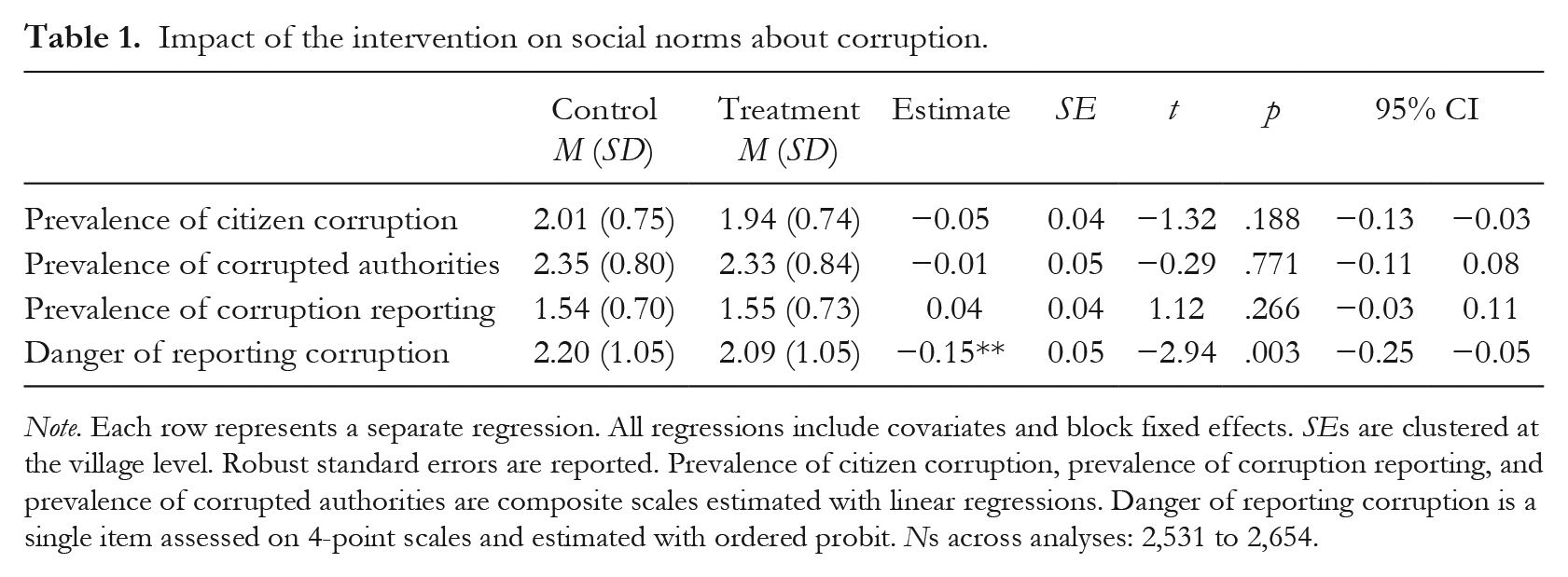
Note. Each row represents a separate regression. All regressions include covariates and block fixed effects. SEs are clustered at the village level. Robust standard errors are reported. Prevalence of citizen corruption, prevalence of corruption reporting, and prevalence of corrupted authorities are composite scales estimated with linear regressions. Danger of reporting corruption is a single item assessed on 4-point scales and estimated with ordered probit. Ns across analyses: 2,531 to 2,654.
However, the intervention had a significant impact on reducing the perception that reporting corruption is seen as dangerous by other community members, with a decrease of .14 probits, compared to the control condition. The average marginal effects estimates revealed that participants in the treatment condition were 5 percentage points more likely to select “none” on the response scale (indicating that no one in their community views reporting corruption as dangerous) compared to the control. Additionally, the predicted probability of treatment participants selecting either “many” or “the majority” on the response scale, signifying that many or the majority of community members view reporting corruption as dangerous, was 5.2 percentage points lower in the treatment condition compared to the control condition.
Attitudes toward authorities
The intervention did not have an effect on responses to attitude measures (see Table 2).
Impact of the intervention on attitudes toward the authorities.
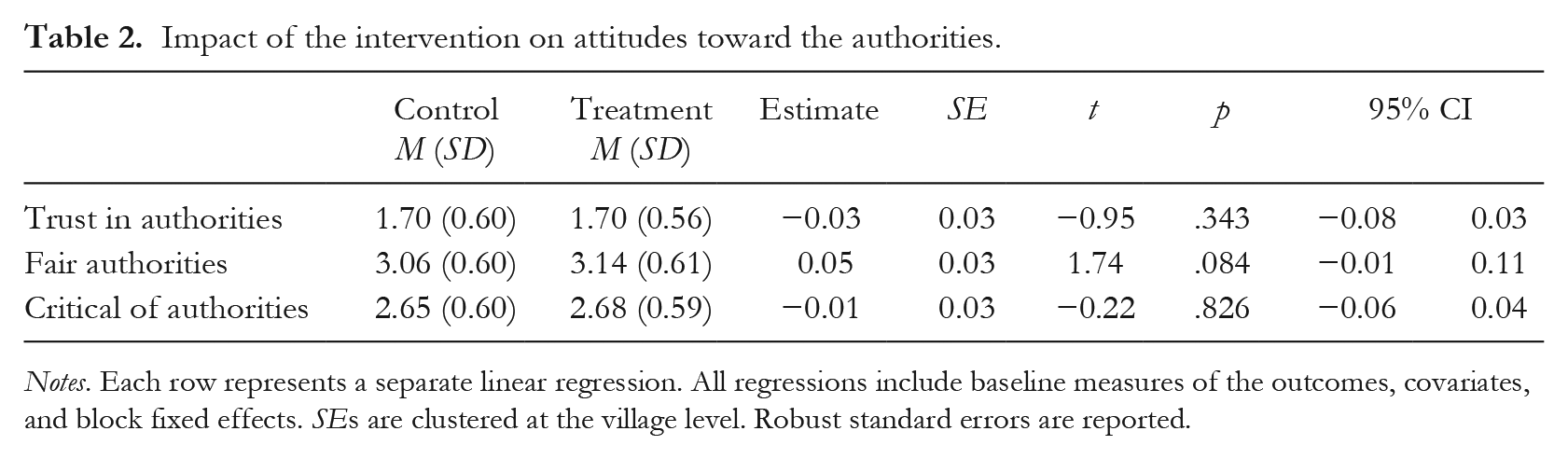
Notes. Each row represents a separate linear regression. All regressions include baseline measures of the outcomes, covariates, and block fixed effects. SEs are clustered at the village level. Robust standard errors are reported.
Discussions during and following listening sessions
Facilitator notes during listening sessions
Participants brought up local governance in 243 out of the 793 listening sessions (i.e., 30.6% of the listening sessions; other discussions revolved around the other two storylines, and other topics; roughly, each storyline was brought up relatively equally). In 41.9% of the notes referring to local governance (n = 102), facilitators noted that participants approved of characters’ actions that supported good governance or disapproved of corruption.
Discussions of governance
Participants’ discussions focused on the importance of good governance, avoiding corruption, and the importance of participation in governance. For instance, one participant said, “We have to work with our government, revealing its flaws and not sticking to false promises like [those made by] the Mayor of Wuro Potal [the fictional town].” Participants disapproved of the dishonest actions of government officials portrayed in the show. For example, they reported that the mayor (in the show) “enriching himself illegally was not a good thing because it is the people who voted for him . . . he has a duty to his people.”
Participants applauded the actions of the two role models (Wellhore and Pendo) that worked with the mayor to end corruption and to include villagers’ voices in decision-making. They voiced appreciation when characters stood up against corrupt officials, saying for instance, “I appreciate the ones who criticize the authorities for the promises they did not hold” and “I liked the part where a woman met the mayor to tell him that they did not respect their electoral promises. I found this woman brave.” They appreciated when authorities in the show started to become more inclusive, and the positive impact that the actions of Wellhore and Pendo had on addressing corruption, ending the misuse of taxes, keeping officials accountable, and finding employment for the youth.
In all, the narrative intervention gauged reactions that supported, and likely boosted, the social norms in line with the main message of the story.
Discussion
The present study examined the impact of one storyline of a narrative intervention that featured role models acting for community change on efficacy beliefs to bring about change, behavioral options to address corruption, and social norms about corruption, as well as attitudes toward authorities. Prior field experiments assessing the causal impact of media narrative interventions have focused on their influence on social norms as a main mechanism through which such interventions influence behavioral change. However, beyond social norms, as theorized by social cognitive theory (Bandura, 1986), efficacy beliefs could also be an important mechanism to understand the effects of narrative media on behavioral change. The present study makes an important contribution to this literature by showing that role modeling intervention increased self-efficacy and collective efficacy beliefs to bring about change in one’s community.
Although the present study did not include behavioral measures, when asked to suggest behaviors that citizens can engage in to counter corruption, participants in the intervention condition were more likely to report strategies to fight corruption (e.g., reporting corruption, speaking out publicly). This finding is consistent with other research showing that narrative media interventions influence behavior, including corruption reporting (e.g., Blair et al., 2019). In the present study, the intervention seems to have made salient different behavioral options to counter corruption. Narrative interventions might shift behaviors by presenting different behavioral choices that citizens can engage in and apply to their own setting.
This study also aimed to contribute to the growing evidence on the influence narrative media interventions on social norms, by examining different types of norms, that might have differential impacts on behavior. Interestingly, the intervention did not influence the perceived prevalence of corruption, either by authorities or by community members, but it reduced the injunctive norm that the community views reporting corruption as dangerous. Noteworthy, the intervention’s effects on social norms are somewhat in contrast to Blair et al.’s (2019) study which finds that a narrative intervention (a movie) aimed at increasing corruption reporting in Nigeria increased perceived prevalence of corruption, perceived community’s anger about corruption, and the perception that the community views reporting corruption as dangerous. The present study did not influence perceived prevalence of corruption, but reduced the norm that the reporting corruption is dangerous.
Further, the comments made by participants during and following listening sessions seem to have reinforced the norms presented in the show, such as through voicing approval of the role models’ actions and disapproval of corruption.
It is likely that the different program format (movie vs. serial drama) and content in conjunction with different characteristics of the social settings (e.g., different norms and prevalence of corruption in each country) result in differential impacts on perceived social norms across settings. For instance, a serial drama narrative intervention that is presented over multiple episodes and several weeks might provide different opportunities for reflection, discussions, and thereby impact, compared to a single movie.
Importantly, although the intervention portrayed the local authorities as untrustworthy (e.g., corrupt), it did not influence attitudes toward them (e.g., trust, perceived fairness, or critical attitude). These null results are in fact encouraging because the intervention’s portrayals of the corrupted authorities were not meant to increase distrust or a critical attitude of authorities, but rather to raise awareness about a social problem and encourage ways to address it. These results are encouraging in that they show that such portrayals of corrupt authorities don’t necessarily result in backlash effects of the intervention.
There are several limitations of this study. One limitation is the lack of a placebo control condition. There were two main reasons why a placebo control condition was not feasible in this study: First, we couldn’t find an existing radio program in the Fulani language that could serve as an effective placebo. Second, the great financial cost of setting up and running 792 additional listening sessions (i.e., 12 sessions over 12 weeks in 66 different villages) would have resulted in reducing the village sample size (e.g., by including 33 villages per condition) which would have reduced the power of the experiment to detect effects. Yet, the lack of a placebo control group means that participants gathered weekly to listen to the show in the experimental condition, but not in the control condition. Therefore, the possibility that weekly gatherings per se, rather than the narrative intervention, might have influenced the outcomes cannot be ruled out. However, it is unlikely that any community gathering would impact the specific outcomes measured in this study, such as strategies to fight corruption or social norms about corruption. This is especially the case in the rural villages participating in this study, in which small community gatherings are part of the daily life.
Further, the role modeling storyline was part of a larger narrative intervention that included two additional storylines on a different topic (violent extremism). The present study cannot empirically parse out the influence of role modeling from other aspects of the narrative. However, there are strong reasons to believe that it was specifically the role modeled actions in the governance and community participation storyline that drove the observed effects (e.g., efficacy beliefs). First, the majority (65.7%) of participants in the intervention condition mentioned the two positive role models that acted for social change in this storyline as the characters they liked the most and as those with whom they identified the most. Second, the storylines focusing on violent extremism did not use role models to address this issue (instead, they focused on awareness raising), and there were no actions portrayed in those storylines leading to social outcomes. So, it is unlikely that elements of those stories would have led to the changes observed in this study’s outcomes. Importantly, the intervention did not influence perceived efficacy to prevent or cope with violent extremism (Bilali, 2022). Therefore, the use of role modeling in the community participation storyline versus lack of role modeling in the extremist violence storylines can explain the differences in the intervention’s impact across different types of efficacy beliefs.
Finally, it should be noted that the intervention’s effects were small in size. It is uncertain whether such small effects would translate into actual behavioral change. However, it is possible that the present study might have underestimated the true effect of the intervention. This is due to several factors; first, a portion of participants (17.8% in the experimental condition) did not listen to the show at all, and a considerable percentage missed out on the full intervention (30.0% of participants in the treatment condition listened to less than 10 out of the 12 sessions). Additionally, unlike many intervention studies in social psychology, the outcome measures were not assessed immediately following the intervention’s delivery. Instead, they were evaluated 1 to 4 weeks after the last listening session of the show by a separate team, distinct from the one administering the intervention. These aspects of the study design have likely contributed to the small effect sizes.
To conclude, the present study adds to the evidence from previous field research that has highlighted social norms as a main mechanism through which role models in narrative interventions influence behavioral change, and it provides evidence for two additional potential mechanisms, efficacy beliefs and behavioral options for actions.
Supplemental Material
sj-docx-1-gpi-10.1177_13684302231186243 – Supplemental material for Narrative media interventions influence efficacy beliefs, social norms, and choice of behavioral options: A field experiment in Burkina Faso
Supplemental material, sj-docx-1-gpi-10.1177_13684302231186243 for Narrative media interventions influence efficacy beliefs, social norms, and choice of behavioral options: A field experiment in Burkina Faso by Rezarta Bilali in Group Processes & Intergroup Relations
Footnotes
Acknowledgements
The author thanks the NORC’s team, especially Brian Kirchhoff for overseeing the data collection and Gregory Haugan for assistance with data management and analysis; Equal Access International for designing and implementing the intervention; CERFODES survey firm; Morgan Holmes and Noel Bauer of USAID for facilitating the research collaboration; Eric Arias for power analysis; NYU research assistants who helped with data coding and analysis; and EGAP 27 Geneva meeting participants for feedback on an early draft.
Funding
The author(s) disclosed receipt of the following financial support for the research, authorship, and/or publication of this article: This research was funded by a USAID contract (No. GS-10F-0033M, Task Order No. AID-OAA-M-13-00013) to NORC at the University of Chicago.

Supplemental Material
Supplemental material for this article is available online.
References
Supplementary Material
Please find the following supplemental material available below.
For Open Access articles published under a Creative Commons License, all supplemental material carries the same license as the article it is associated with.
For non-Open Access articles published, all supplemental material carries a non-exclusive license, and permission requests for re-use of supplemental material or any part of supplemental material shall be sent directly to the copyright owner as specified in the copyright notice associated with the article.
