




Abstract
This article proposes to model and empirically study social networks as emerging, stabilizing, and changing in the process of communication. Rather than starting from actors, communicative events are conceptualized as the basic units. In the sequence of communication, these events are attributed to actors, together with underlying dispositions. Relational expectations about the behavior of actors towards others result, effectively structuring communication and making for the regularities of communication we observe as relationships and networks. Not only individuals, but also collective and corporate actors can feature as nodes in social networks – as long as action is attributed to them, and relational expectations about their behavior to other actors develop. The approach combines recent developments in the theory of social networks by Harrison White and others with Niklas Luhmann’s theory of communication.
In recent years, sociological network research has advanced from its traditional structuralist stance in two ways: first, relational sociology around Harrison White has come to incorporate a systematic concern for culture and meaning (Fuhse, 2009; Pachucki and Breiger, 2010; Mische, 2011). Network and meaning are inextricably intertwined and can only be separated analytically. Second, recent developments account for dynamics in network constellations (Moody, 2009; Snijders, 2011). These advances focus on the appearance or disappearance of ties over time. But they mostly model network constellations formally, with ties switching from 0 (no tie) to 1 (tie), or vice versa. The same applies to well-established network mechanisms like transitivity and homophily that are seen as ‘causing’ observed network constellations (Monge and Contractor, 2003). These models remain silent about the micro-processes in relationships – they are formal models, not substantive theories that would render the mechanisms at play plausible. A slightly different path is taken by Snijders (2011) and the SIENA algorithm. Here, individual relationships are interpreted as the result of two separate decisions for a relationship by the actors involved. The model also allows for one-sided relationships. This seems odd when you consider ties like friendship or love. And then there is the question whether two independent decisions make a relationship. As I will argue, relationships are primarily realized in communication, not (only) in the minds involved.
We need a thorough and convincing substantive account of the basic processes that make for the emergence, stability and change of social networks. This article takes up this challenge and develops a communication theoretical account of social networks. Sociological theory offers a number of basic concepts to model basic social processes, from ‘social action’ and ‘practices’ to ‘exchange’ and ‘symbolic interaction’. All of these (and more) can be fruitfully adopted in theoretical accounts of social networks, and some of them already have been. I consider the merits and the disadvantages of these various concepts in a companion article (in preparation).
Without being able to justify these claims here, an ideal conceptualization of network processes should fulfill the following demands: (1) it accounts for the effects of networks on events, but also for the effects of these events on network change; (2) following the perspective of relational sociology, networks are seen as meaningful social constructs; (3) we should avoid assumptions about unobservable mental dispositions and processes as the driving factors of processes in networks. Neither academic observers nor participants are able to look into each other’s heads; and (4) the change of networks is accounted for by reference to processes between actors, rather than individual behavior.
My claim is that the concept of communication (derived from Niklas Luhmann, but with some amendments) leads to a consistent account of the basic processes in networks that meets these demands. Social networks arise out of communication and effectively structure future communication. This theoretical perspective provides answers to the questions: (1) what exactly are social networks?; (2) how do networks change, and why should they be relatively stable?; (3) why should social networks be central mediators of social processes, as a lot of research testifies?; and (4) can we study and interpret networks between collective and corporate actors (like firms, states, or street gangs) in the same way as networks between individuals?
The following section presents the concept of communication, highlighting the aspects pertinent to a theory of network processes. Afterwards, this concept of communication is connected to a theory of social networks as relational expectations arising, stabilizing and changing in the course of communication.
Communication
Network processes in relational sociology
Relational sociology already offers a number of formulations for the basic processes in networks. In line with the demands above, Mustafa Emirbayer’s and Charles Tilly’s concept of ‘transactions’ consists of dyadic processes taking place between actors. Emirbayer in the famous ‘Manifesto for a Relational Sociology’ conceives of ‘trans-action…as a dynamic, unfolding process’, and views the ‘units involved’ (the individual actors or nodes in a network) as secondary in the analysis (1997: 287). Similarly, Charles Tilly argues for ‘interpersonal transactions as the basic stuff of social processes’ (2005: 6). Following formulations by John Dewey and Arthur Bentley, Emirbayer’s and Tilly’s concept of transaction accords secondary importance to the inner mental processes in relation to the observable processes between nodes. However, the specifics of this theoretical option remain rather vague.
White’s own recent theoretical writings point in a similar direction. In Identity and Control (1992, 2008) and in occasional articles, he sometimes uses the interaction concept, but never referring to the subjective processing of symbols and meanings. More importantly, White introduces the concept of ‘switchings’ in networks as central to the emergence of meaning (and the concurrent change of network constellations; White, 1995, Godart and White, 2010). Switchings constitute the communicative shift between network-domains. Like Emirbayer’s and Tilly’s ‘transactions’, they do not seem to result from subjective dispositions. In a recent article, White picks up on Luhmann’s concept of ‘communication’ and claims compatibility with his theoretical account of networks (White et al., 2007).
These diverse formulations have a number of aspects in common: They do not accord much importance to mental states and processes. And they focus on processes between actors, rather than on individual behavior. But none of them leads to a detailed and consistent account of these processes. The two editions of Identity and Control are more concerned with conceptualizing an array of social structures (networks, disciplines, styles, institutions) out of different constellations of communicative uncertainty (ambivalence, ambiguity, ambage). Such types of social structures are not at issue here. I focus on a theoretical account of the emergence, stability and change of social networks – something only treated in passing by Emirbayer, Tilly and White. The closest ally can be found in David Gibson’s work on turn-takings among managers (2005). Here, the sequence of communicative events is seen as incorporating and enacting networks. Gibson even cites Luhmann’s concept of communication approvingly (2003: 1357). Can it take us further than ‘transactions’, ‘interaction’ and ‘switchings’?
Forebears
The concept of communication has a long tradition in the social sciences. Apart from some casual usages, e.g. in interactionist writings, we find the first prominent conceptualization in the work of Claude Shannon and Warren Weaver (1949). Shannon and Weaver view communication as consisting of three parts: a sender, a receiver, and a channel of communication between them. The emphasis lies on the channel of communication that implies some sort of coding and decoding of the message. This is most obvious for the examples of mediated communication (telephone calls, letters, etc.), but it generally holds for all kind of communication: thoughts have to be translated into speech by the sender, and back into thoughts by the receiver.
Gregory Bateson and Paul Watzlawick provide a slightly different concept of communication – one that leads halfway to the model favored here. Communication here not only entails the neutral transmission of some information. It also gives clues on how to interpret the communication. Bateson argues that gestures and facial expressions ‘frame’ the situation in which communication occurs (1972: 178, 188, 215–16). This ‘metacommunication’ situates sender and recipient with regard to each other. It is more concerned with the relationships at play than with the information transmitted. In a similar vein, Watzlawick and his coauthors distinguish between the content level and the relationship level of communication. While the content level is about the neutral information transmitted, the relationship level ‘refers to what sort of message it is to be taken as, and, therefore, ultimately to the relationship between the communicants’ (Watzlawick et al., 1967: 52; original emphasis).
Consequently, social ties should not be seen as pre-existing channels of communication. Rather, communication itself builds up, sustains, and changes social relations: ‘the messages constitute the relationship, and words like ‘dependency’ are verbally coded descriptions of patterns immanent in the combination of exchanged messages’ (Bateson, 1972: 275).
Goffmanian interaction and conversation analysis
Even Bateson and Watzlawick conceptualize communication with regard to individual mental processes: the sender’s intentions and the receiver’s understanding. The development of social relationships would have to be modeled and studied with recourse to mental processes. The same holds true for most of the symbolic interactionist tradition. The interaction concept of George Herbert Mead and Herbert Blumer links social processes between people to their inner psychic processes. Erving Goffman and George McCall and J.L. Simmons, in contrast, focus on the supra-personal dynamics of communication.
A core interactionist concept is the ‘definition of the situation’. Goffman points out that this definition is an interactive accomplishment, and that it does not even have to be shared subjectively: ‘The maintenance of this surface of agreement, this veneer of consensus, is facilitated by each participant concealing his own wants behind statements which assert values to which everyone present feels obliged to give lip service’ ([1959] 1990: 20–1).
People often hold up and follow a social definition of the situation as an ‘interactional modus vivendi’ even if they subjectively disagree with it, for example, by tactfully saving each other’s face. In this view, social processes by and large follow the paths laid out in prior social processes. McCall and Simmons, in particular, emphasize that individual identities – what people are seen as in their social environment – are the result of supra-personal processes ([1966] 1978). The inner thoughts of participants in interaction are less important than the communication relating the participants to each other. Indeed, Goffman later sketches interaction as consisting of a sequence of utterances ‘with each in the series carving out its own reference’ (1981: 52, cf. 72). Here, it is the utterances doing the important work of providing the ground for future utterances. The internal dispositions of actors only become important within the confines of communicatively established definitions of the situation.
Conversation analysis takes a similar stance. It treats interaction sequences as ‘generic orders’, looking for recurrent regularities of sequences of conversation. Any single utterance is treated as part of an interactive sequence rather than as the result of individual action (Schegloff, 2007: xiv). Every utterance lays the ground for subsequent utterances. In line with Luhmann’s formulations discussed next, conversation consists of a ‘stream of communicated meaning’. Utterances are analyzed with regard to their connections back and forth; the subjective meaning of the actors involved is ignored both in interpretation and in research practice.
Luhmann’s theory of communication
Niklas Luhmann picks up on these various approaches by focusing on observable processes between sender and receiver. He radically departs from the Shannon and Weaver and the Bateson and Watzlawick traditions by removing both the sender and the receiver from the concept. Luhmann conceptualizes communication as a self-referential process – an autonomous sequence of processing meaning (2002: 155–68). This perspective views utterances in a conversation not as based on subjective definitions of the situation or motivations. Rather, they spring from previous communication, as in Goffman’s work and in conversation analysis. Any utterance has to pick up on the topics discussed; and it has to conform to the type of conversation taking place: a job interview, a discussion among colleagues, or a chat at a bar. It has to follow the expectations established in the course of previous communication (the social definition of the situation).
Of course, communication would not be possible without individual minds (‘psychic systems’). It actually breaks down without psychic systems participating (Luhmann, 2002: 169–84). But Luhmann leaves this ‘participation’ out of his basic model – partly for analytic simplicity, and partly because thoughts and other mental processes do not directly enter communication. When communication takes place, psychic systems operate relatively independently, pondering what has been said and what they want to say, but also succumbing to the general course of communication and continuously adapting to it. Conversely, psychic systems can have an impact on communication in the form of ‘irritations’ that may or may not be picked up in the sequence of communication.
The disjunction of psychic and communicative processes is based on the inability of psychic systems to observe each other’s operations directly, as Luhmann argues with reference to the figure of ‘the double contingency of action’ by Talcott Parsons ([1968] 1977: 167–8, Luhmann, [1984] 1995a: 103–36). Action is contingent, according to Parsons, because participants in social situation always want to make their action dependent on what others expect of them. In this situation, no action occurs because both parties (alter and ego) wait for the other party to act first. The double contingency enters with ego not only making her action contingent on alter’s action, but also on alter’s reaction to ego’s action. Parsons’s solution to this problem is to assume a shared value system and common normative orientations of alter and ego. Luhmann, in contrast, claims that communication solves the problem step by step over time: At first, alter tentatively determines his behavior in a situation that is still unclear. He begins with a friendly glance, a gesture, a gift – and waits to see whether and how ego receives the proposed definition of the situation. In light of this beginning, every subsequent step is an action with a contingency-reducing, determining, effect. (Luhmann, [1984] 1995a: 104–5)
Luhmann builds his theory of autonomously operating systems (encounters, organizations, functional subsystems like the economy or law) on this model of communication. I do not engage with this wider systems theory at this point. I merely argue that his concept of social micro-events as communication provides a useful basis for a theoretical account of processes in networks.
Information, message, understanding
Luhmann conceptualizes communication as the ‘synthesis of three selections, namely information, utterance, and understanding (including misunderstanding)’ (1990: 3; [1984] 1995a: 141–4; 2002: 157–8). The ‘information’ component resembles that of Shannon and Weaver and stands for Watzlawick and his coauthors’ ‘content level’ of communication. Information usually refers to something outside of the communication process, for example, when people talk about the weather. The second selection is termed ‘Mitteilung’ in German and is provisionally translated as ‘utterance’ by Luhmann. It includes the ‘how’ and ‘why’ of communication (Luhmann, 1990: 4). Why and how do people talk about the weather? For the perspective offered here, this aspect can be slightly better captured as (relational) ‘message’ than mere ‘utterance’. What is the message conveyed from alter to ego (as opposed to the information) when talking about the weather? In this version, the ‘Mitteilung’ or message parallels Watzlawick’s ‘relationship component’ and Bateson’s ‘metacommunication’.
Finally, the ‘understanding’ of communication establishes the meaning of the event in subsequent communication (this, of course, can involve misunderstanding of the underlying intention). The information and the message component are only decided upon in the course of their being understood. This third selection should not be seen as taking place on the mental, subjective level. Understanding is realized in subsequent communication. For example, a yawn in a discussion about jazz music can be tactfully ignored (Goffman) and not affect the process of communication at all. Or it can lead to questions like: ‘Are you bored?’, which then could be taken as relating to the information aspect (alter finds it boring to talk about jazz music) or to the message aspect (alter is bored from talking to ego).
The understanding as the establishment of the meaning of a communicative event is realized in the course of three subsequent turns (Schneider, 2000: 128). The first (say, the yawn) is the event in question. The subsequent event presents a tentative interpretation, e.g. with the follow-up question: ‘Don’t you like jazz music?’ The third event confirms or modifies this interpretation (e.g. ‘Uhm, no, I’m just tired.’). From that point onward, the meaning of the original event is fixed provisionally. This changes something about the future communication process. For example, alter and ego may refrain from talking about jazz music. Every communicative event leads to expectations regarding the consequences of particular communication, and these expectations effectively structure the communication process.
Communicative meaning
This basic model of communication meets the demands sketched in the Introduction: It avoids assumptions about unobservable subjective dispositions and processes and incorporates this very unobservability into its theoretical model (3). Communication as a process is placed on the social level – it focuses on the observable micro-events between actors (4). In contrast to the concepts of exchange and behavior, communication is firmly entwined with meaning (2). It can actually be seen as the sequential unfolding of meaning, and we will see how networks as structures of (meaningful) expectations arise in this process, stabilize, and change (1). But first, I discuss the implied concept of meaning.
Like Max Weber and Alfred Schütz, Luhmann conceptualizes meaning as the vast array of symbols and the connections between them (1990: 21–79; [1984] 1995a: 59–102). All communication, but also mental processes, is based on meaning. The term is wider than both language and culture: language is obviously part of meaning, it consists of symbols (words), their meaning (in relation to each other) and the rules of their deployment (grammar). But also gestures (e.g. shaking hands), non-linguistic signs (e.g. traffic lights), and mimic (e.g. a yawn) mean something. And if we know the meaning of all the words in a sentence, we still do not know what it means in a specific context.
The concepts of culture and meaning are closely connected: both refer to the world of symbols and their interconnections. But culture is always shared in a designated social context (and differs from the culture in other contexts). In this sense, we talk (and write) about group cultures, national cultures, or the culture of financial markets. Meaning is not always shared; it can also divide people and relate them asymmetrically. Accordingly, ethnic categories or status differences can separate people into different cultures, but they would still relate them meaningfully. Difference and heterogeneity are thus part of the wider concept of meaning, but not of culture (which suggests homogeneity). Building on the structural linguistics of Ferdinand de Saussure, meaning can be seen as organized in networks of relations between symbols (like words, categories). Consequently, we can use text analysis and apply formal network analytical models to concepts and categories in order to discern structures of meaning (Mohr, 1998).
In contrast to Weber and Schütz, Luhmann does not locate meaning only on the subjective level in the thoughts and dispositions of actors. The primary location of meaning is the social, with the mental heavily imprinted by the communicative processes of diffusion and socialization. Luhmann opts for the unfolding of meaning in communication as the main focus of sociological enquiry. But he concedes that mental processing (thoughts) is similarly based on meaning ([1984] 1995a: 255–77; 1995b: 55–112). The overall model is not that different from that of symbolic interactionism with its simultaneous consideration of mental and intersubjective processes. In contrast to interactionists, Luhmann dismisses mental processes from communication for analytical simplicity (and also because of their unobservability).
However, he does see the dual processing of meaning in psychic and in social systems as a basis for their interplay through selective mutual observation and adaptation (Luhmann, [1984] 1995a: 210–54; 2002: 169–84). Thoughts adopt the symbols, schemes, and scripts processed in communication. And communication observes the irritations from the participation of psychic systems by attributing them to ‘persons’ and attaching specific expectations to them (1995b: 142–54; see below). All of this requires that we allow for communicative events (and not just thoughts) to carry meaning: a handshake means something, even if we do not know the intentions behind it. Even if this meaning cannot exist independently of subjective interpretations (by sender and receiver, both of which will remain unknown), we can fruitfully conceptualize meaning to be realized in communicative events – and study how events relate meaningfully to previous or future events.
In a communication theoretical framework, expectations cannot be conceptualized as subjective. Rather they form relatively stable structures inherent in the process of communication (Luhmann, [1984] 1995a: 96–7). In Parsons’s theory, action is always oriented to other people’s expectations (Parsons et al., [1951] 1959: 19–20). Properly modeled, we would have to say that individuals act on the basis of their perceptions of the (cognitive) expectations and prescriptions (normative expectations) of others (Galtung, 1959). A single relationship in a network then consists of ego’s perception of alter’s expectations and prescriptions, and alter’s perception of ego’s expectations and prescriptions. While logically coherent, such an account seems awfully complicated not only in theory but also in empirical operationalization. It is much simpler to conceive of expectations as (recurring but continuously negotiated) communicative patterns that not only structure subsequent communication but also serve as effective points of orientation for psychic processes. Expectations are inherent in any communicated definition of the situation – they are the sediments of previous communication that channel future communication. In general, expectations form a ‘memory’ of communication (Schmitt, 2009). Of course, we can think of communicative expectations as partly relying on mental states (and these on neurological structures, on physical and chemical processes). But they can also be grounded in material symbols, for example, with a wedding ring or with documents. In any case, expectations have to be communicated to be of consequence.
All social structures, not only networks, consist of such communicative expectations: the price of a product is an expectation that guides market behavior; the roles of professor or student are bundles of expectations defined in relation to each other, forming part of a larger array of expectations of a university. Such expectations can concern factual questions (e.g. political issues or the quality of Italian food), but also social relations, social timing (e.g. an appointment or a conference schedule) or space (like territorial borders). Factual expectations result from the information component of communication (and structure it). The message component, in contrast, concerns the social dimension – it relates alter and ego to each other, thus leading to the emergence of social networks (as argued below). 1
Theoretical ambitions
At this point, a number of readers have probably found they disagree profoundly with the premises of this article: actors are seen as secondary to communicative events; meaning is located in communication; and agency seems to be neglected, if not denied. How could anybody seriously adopt such a perspective? This is a common reaction to any theoretical framework that accords secondary importance to individuals (Smith, 2010). Instead of arguing against the ontological importance of individuals, I merely defend the feasibility of alternative frameworks in sociological theorizing. Whether individual decisions or communicative events are seen as the driving forces in a particular perspective lies on the level of abstract theoretical assumptions. Such assumptions (unlike conjectures) can never be proved right or wrong in research, only more or less useful (Popper, [1935] 2002: 50–4). In this sense, no theory arrives at a true description of social phenomena. Rather, theories are tools for the uncovering of certain aspects of reality.
The perspective developed here does not make ontological claims about the primacy of events over actors. Following Gabriel Abend, there are different kinds of theorizing in the social sciences (Abend, 2008). While there is no perfect separation of these meanings of theory, I try to stay away from philosophical problems (Abend’s ‘Theory7 ’) like the structure–agency debate. Instead I want to explore how a particular overall perspective on the social world (‘Theory5 ’) leads to theoretical expectations about social networks (‘Theory1 ’) and potentially even to methods for studying them. This can be classified as an attempt in the ‘analytical theorizing’ Jonathan Turner argues for (Turner, 1987). This represents a radical departure from Luhmann’s thinking which remains unconcerned with fruitfulness in empirical research.
When I depict communicative events as springing from previous communicative events, this does not mean that individual dispositions and human agency do not ontologically matter in the process. I only argue that we are better off (for certain purposes) to abstract from these complexities, and to model communicative events as if they by and large follow the tracks laid by communicative events. 2 In a similar vein, psychologists know that neurological and biological processes play a central role in human thinking, but they nevertheless model cognition as an autonomous level of reality.
The communicative construction of actors in networks
The exposition of communication as a distinctly social process establishing and building on social definitions of the situation leads to a theoretical account of social networks. I develop this account in this section, mainly by emphasizing the relational aspects of communication neglected by Luhmann, and by connecting them to the arguments about stories in network from White and Tilly.
Action in communication
Communication yields factual as well as relational expectations. I illustrate this claim with two ideal typical communication sequences. The situation features two co-workers conversing over lunch. Two alternatives start from the same initial sentence but then proceed very differently (Table 1).
Two ideal-typical sequences of communication.
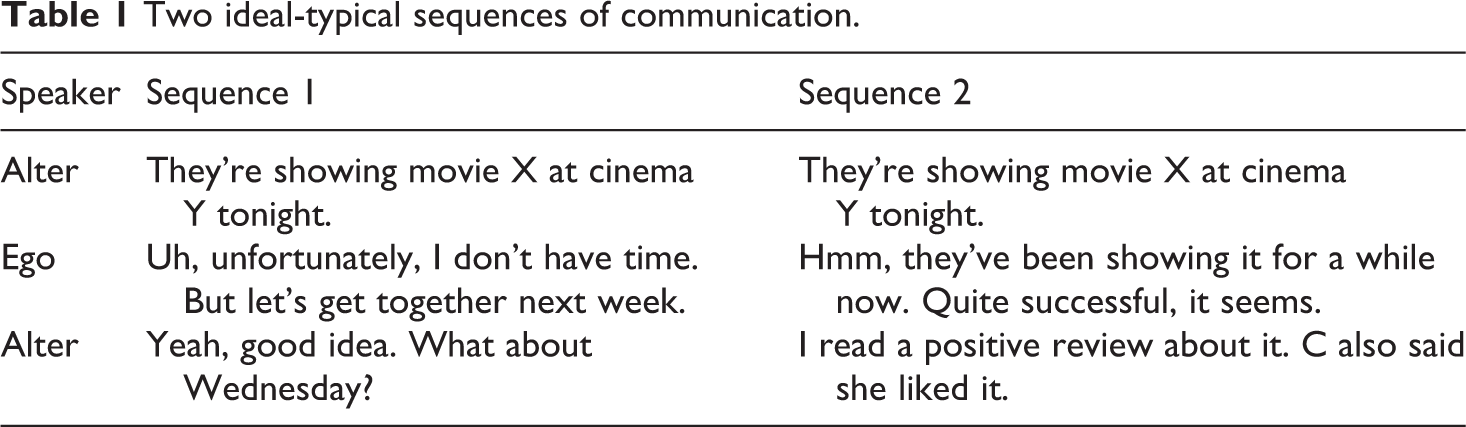
In the first sequence, ego’s reaction picks up on the relational message of the first sentence: It reads the sentence as the suggestion to spend some time together away from work. Alter’s response confirms this interpretation, but we do not know whether alter initially meant it that way. Notwithstanding this contingency of subjective dispositions, the sequence establishes the meaning of the first sentence as a suggestion to go to the movies together. The information component (a particular movie will be shown at a specific cinema) is not taken up.
The second sequence realizes an entirely different interpretation. Ego’s reaction turns to the information component and leads to a conversation about the movie. Alter’s response in the third turn still centers on the movie. The interpretation of the first sentence as a suggestion to spend some time away from work together is manifestly absent from this second sequence. However, ego’s response may also be read as deliberately avoiding the suggestion, and alter’s final statement as a renewal of that suggestion.
Two important conjectures result from this contrast: (1) No matter what the initial intention behind a communicative event or its subjective understanding by a partner in conversation, its meaning will only be established in the process of communication. We do not know whether ego in sequence 2 understood the initial utterance in the same way as in sequence 1. But we can see the utterance comes to mean very different things in the two sequences. (2) As in sequence 2, the subjective meaning behind communicative events can remain uncertain for a while; it need not even ever be clarified. Flirts are examples of conversations with the ‘real meaning’ left ambiguous. The different courses of the two sequences may reflect a difference in subjective dispositions (ego’s in particular), but we will never know for sure. Also, the first utterance is more likely to lead to trigger sequence 1 if alter and ego already have a pre-established friendship. Thus communication builds on the expectations from previous communication (that we sometimes call ‘friendship’).
The two sequences also illustrate how social networks as webs of meaning emerge in the course of communication. Over the two sequences, alter and ego become visible as actors with specific dispositions and with a particular relation between them. Every communicative event leads to a definition of the situation comprising expectations about the participation of the persons involved, and these expectations constitute their relationship. How exactly does this happen?
Following Luhmann’s model of communication, alter and ego as human beings or as psychic systems do not themselves form part of the social process. But with the distinction between information and message, communication observes itself as action (Luhmann, [1984] 1995a: 164–71). Communication operates self-referentially as a sequence of communicative events. In the course of this self-referential process, every communicative event is observed (in subsequent communicative events) as being selected by somebody as a reaction to somebody else’s behavior – the message component of a communicative event (see above). These observations concern irritations from psychic systems in the process of communication, and tackle the question what future irritations are to be expected from particular persons in communication. But this is not to say that psychic processes could become part of or even be observed directly in communication (or by other psychic systems). What people think remains fundamentally unknown –we only observe what they say and do. On the level of observations, then, communication consists of a series of actions by the people involved. The message component leads to expectations in the social dimension of meaning about the participation of particular people in communication.
For example at a scientific conference, the various presentations and contributions can (ideally) be seen as cumulating to a body of knowledge – a shared culture – consisting of factual expectations, e.g. about nanotechnology. Here the information components of many communicative events connect to each other. The message components, in contrast, do not lead to a body of knowledge. Particular presentations and contributions are seen as originating from particular scientists. Some of the contributions turn out to be more innovative, others as dull or even faulty. As a consequence, the scientists involved are observed as smart and innovative, or boring and out-classed. So the message component leads to the attribution of capacities (e.g. smartness) and dispositions (e.g. ambitions) to the people involved. They are constructed as ‘persons’ with particular qualities, with a specific cultural background (for example, from their home institutions), and with interests and motivations (Luhmann, 1995b: 142–54). Both these types of expectations are definitions of the situation and constitute different ‘memories’ of communication – culture and social networks.
In the same vein, sequence 2 from the example in Table 1 cumulates information components into a body of knowledge about movie X (where it is shown and when, that it is quite successful, positively reviewed and liked by C). Sequence 1 with the stress on the relational messages leads us to see alter and ego as persons with particular capacities and dispositions for action: Alter is interested in going to the movies; both want to spend time together away from work. In any case, the events in such sequences leave a trace, a ‘memory’ of communication that subsequent events can build on, and have to deal with.
Stories and identities
This observation of communication as action and the concurrent construction of the participants as actors with specific dispositions can easily be translated into the theoretical vocabulary of relational sociology: According to White, social networks are ‘phenomenological realities as well as measurement constructs’ (1992: 65). For White, the ‘reality’ of a network is ‘phenomenological’, based on meaning. This meaning of a network comprises identities that are linked by stories (1992: 66–70). Unfortunately, White’s concept of identity is a little fuzzy (2008: 10–11). It encompasses both psychic systems as the sources of irritation in communication, and the communicative observation of these irritations as ‘persons’. Let me disentangle these two senses of identity as: (1) primordial sources of action; and as (2) social constructions, and stick to the latter. According to White: Identity here does not mean the common-sense notion of self, nor does it mean presupposing consciousness and integration or presupposing personality. Rather, identity is any source of action not explicable from biophysical realities, and to which observers can attribute meaning. An employer, a community, a crowd, oneself, all may be identities. (1992: 6)
Charles Tilly provides the best elaboration on how stories define and relate identities. His ‘standard stories’ (the prevalent type of narrative in informal conversation) always view individuals with their capacities and dispositions as responsible for events (2002: 8–9, 26–7). Structures and unintended consequences of action are little taken into account. The social world consists of autonomously acting individuals: ‘To construct a standard story, start with a limited number of interacting characters, individual or collective…Treat your characters as independent, conscious, and self-motivated. Make all their significant actions occur as consequences of their own deliberations or impulses’ (Tilly, 2002: 26).
The identities of actors arise in these stories through the attribution of actions to them (Tilly, 2002: 80). Behind these actions, motivations or intentions are assumed that lead the identities to act the way they do (Blum and McHugh, 1971). Action is constructed as rooted in the subjective meaning a situation has for the actor. Our everyday communication thus adopts an action theoretical stance: communication regularly looks for the initiator of incidents and for the motivations (beliefs and interests) behind her actions. From the perspective adopted here, motivations appear not as subjective reasons for behavior, but as typical patterns for how to ‘understand’ behavior in communication (as in C. Wright Mills’s ‘vocabularies of motive’; 1940).
With these elaborations, the story concept translates well into the framework of expectations. If actors are constructed as acting out of subjective dispositions, these attributed dispositions constitute expectations about the behavior of the actors in a new situation. For example, it is expected that a person’s like or dislike of jazz remains stable from one situation to the next. Similarly with capacities for action: a scientist who was observed to give a good presentation at one conference is expected to be similarly smart and witty at the next. For these expectations to arise, communication first has to be attributed to actors. Second, as in Tilly’s standard stories, the capacities and the subjective dispositions of the actors have to be seen as causing the yawn in the discussion about jazz music or the good presentation at the conference. And this sets the course for future communication, for example, when talk about jazz is avoided, or the scientist is invited to the next conference.
Since the basic linguistic structures are geared to an action theoretical description of social processes, they render a communication theoretical account quite difficult. Here, communicative events and not actors ‘do’ things; actors are ‘seen’ as the sources of actions; interests and motivations are attributed rather than causing things to happen. This poses a serious obstacle: theoretical accounts in the social sciences also have to convince as ‘stories’. Since the communication theoretical perspective does not conform to standard story-telling, it is equally difficult to write and to grasp. This article, too, sometimes resorts to standard linguistic forms (of ‘people doing something’) in order to avoid overly technical language.
Identities in relations
These considerations fit nicely with Luhmann’s account of communication: communication is routinely observed as action through the message component. This leads to the construction of actors with specific dispositions for action (based on the motivations we attribute to them in standard stories), and to expectations about their future behavior. But up to now, we only see isolated individuals with their dispositions and autonomous actions. How are these individual identities related to each other to form a network? In this regard, the message component of communication has to be interpreted not only as pointing to an identity as the source of an utterance, but also as inherently relational.
If we look back at the two exemplary communication sequences in Table 1, we find that there is something more at play than the construction of isolated identities. In sequence 1, alter not only appears as somebody who likes to go to the movies. Instead, over the three-step sequence, the initial sentence gets to signify a suggestion to go to the movies together, maybe out of a wish for friendship with ego or even a romantic interest. Ego’s response is not only about his available time, but also reciprocates alter’s amicable or romantic interest. From sequence 2, we learn something about alter’s interest in movies. But we also suspect alter to be interested in shared activities with ego, and ego as probably avoiding alter’s advances. In both instances, the message component results in expectations about the individual actors involved, and about their relation to each other, as captured by Watzlawick’s concept of ‘relationship level’.
For this, communication is observed as action, but in particular as ‘social action’ in the sense of Weber. When understanding picks up on the message component, it not only asks for individual dispositions but also for the orientation of the underlying subjective-meaning to the behavior of others. What does ego mean to alter? Does alter hope for a joint evening activity? Does she want a deeper friendship (or maybe she already thinks she is friends with ego) or only to reduce existing tensions with a work colleague? These questions are a routine part of every communication, but rarely explicit nor answered explicitly. With the message component, communication incessantly looks for clues about the relationship between the participants. Which propositions will be successful, which ones will not? From these routine observations, ‘relational expectations’ result about the ties between the participants. Identities are related and defined in relation to each other and thus connect to a network.
Therefore, the story concept has to be spelled out in more detail. In network theory, stories are not about isolated identities. Rather, stories place identities in relation to each other. The subjective meaning of actors is still part of the story – but primarily in its orientation to others. We are dealing here with admiration and enmity, with superficial instrumental relationships as well as with trust, mistrust or envy. These subjective orientations do not feature explicitly in communication, but they become part of the stories told about identities and their relationships with each other in the social dimension of meaning. The message component more often than not remains unspoken. But it carries important consequences by establishing expectations about how particular actors will behave in relation to particular others.
From this perspective, social networks do not consist of individual nodes that are linked to each other. Rather, the links are the primary feature of networks. I have elaborated elsewhere that social networks consist of two levels: (1) regularities in communication pattern; and (2) relational expectations underlying these regularities (the ‘meaning structure of social networks’; Fuhse, 2009: 52–4). Individual nodes themselves do not form part of both of these aspects of the network, at least as long as we think of them as human beings of flesh, blood, and thought. Neither cognition nor digestion nor blood circulation enter social networks, but they can be communicated about. Human beings are part of the network’s environment; and as such they are continuously observed by the communication in the network – by attributing individual motives behind specific observable behavior. The nodes connected in relational expectations are not human beings but their observation in the form of ‘persons’, that is: the bundle of expectations attached to a human being structuring her participation in communication. In this sense – as constructed actors that are expected to behave in specific ways in relation to other actors – individuals (but also organizations or collective identities) play a vital role in networks: Through these actors, relationships are linked to one another to form a network – precisely as the term ‘node’ implies.
How can we tell whether a relationship between two actors exists? What is a social relationship? In the communication theoretical perspective, the reality of social relationships consists of regularities in the process of communication that mirror relational expectations between the actors involved. It is not only important how often you meet somebody, say, the waiter in your favorite café (often), or your best friend from school (almost never). It also matters how you communicate when you do. A relationship comprises the idiosyncratic expectations concerning the behavior of two actors in relation to one another, insofar as it differs from general expectations about the behavior of people belonging to particular categories (e.g. male/female) or occupying formal roles (e.g. waiter/customer). As soon as the communication between two people deviates from general or purely formal courses, such idiosyncratic relational expectations develop.
Network research bases its formal analyses on whether particular ties exist or not. I claim that this question is often impossible to answer. Rather, we should ask: what kind of relationship do we find between two actors at a certain point of time; what kinds of expectations govern their communication? Of course, this more qualitative assessment has to be reduced to ties (1) and non-ties (0) for network analytic algorithms. But this quantification is always imperfect. We continuously have to ask ourselves about the ‘reality’ of ties and non-ties.
Networks of communication, actors, and meaning
All of this suggests that we are dealing not with one, but with three types of networks: Communication itself is organized as a network, with micro-events (as the nodes) related to each other. As operations, communicative events always connect to the preceding event, and realize their meaning only in the follow-up sequence of communication. But on the level of observation, communicative events can relate back to a wide range of past events, and they can anticipate future events, such as responses or planned events. However, communication networks are mainly organized recursively, because it is much easier and more common to refer to actual communicative events in the past than to anticipated events in the future. For example, if we look at scientific communication, texts relate to other texts already published, leading to a citation network of texts (Leydesdorff, 2007). From this network of communication, the network of actors emerges through the attribution of communicative events as actions of identities. If we identify authors of texts, we can interpret the recursively organized citation network as the ongoing dialogue of scientists in a field. Actors are connected to each other through relational expectations. I term this network of actors ‘social network’, because only this one is governed by the basic constellation of double contingency between actors and by the gradual build-up of relational expectations. The third network consists of the structures of meaning available within a given context, its ‘culture’. As argued above, meaning is organized by linking symbols to each other. Terms like ‘chair’, ‘table’, and ‘sit’ only carry meaning in relation to each other. In this sense, the body of knowledge emerging in scientific discourse can be mapped into networks of concepts (Fuchs, 2001; Leydesdorff, 2007). The level of culture most relevant in the study of social networks consists of the codes of conduct, the relationship frames, and the social categories that are used in communication to relate actors. Relationship frames like friendship and love can acquire different meanings in separate network contexts and lead to very different network structures (Yeung, 2005). Similarly, the meanings of role categories or of social boundaries like gender or ethnic descent are important for the structuring of social relations, and change over time.
These three networks – of communicative events relating back and forth, of actors connected in expectations, and of symbols and terms related in culture – are layered and interconnect in a number of ways. However, their logics of structuration and their dynamics differ greatly. A full account of their relations to one another is beyond the scope of this article.
Excursus on collective and corporate actors
For reasons of simplicity and intuitive accessibility, I have focused on networks of expectation between individual human actors so far. Can we analyze and interpret networks between collective and corporate actors in the same way as those between individuals (Laumann, 1979)? The perspective adopted here mainly requires that something is seen as an acting entity, a ‘source of action’ (White, 1995) in the network. This constructivist definition of actors leads to the attribution of agency as the decisive variable for something to count as a node in a social network. The entity in question (be it a person, a collective or corporate actor, or even transcendental identities like gods or spirits) has to be regarded as reasonably coherent, that is, not composed of separate parts actually following their own will, and as acting out of inner dispositions, that is, not determined by outside forces. In this sense, a traffic jam would not count as an actor because it is composed of different parts, but a protest march would because of acting coordinately and pursuing a common objective.
Let us look at social movements as an important case of collective actors. In contrast to individual actors, their unity is not immediately obvious. Rather, it is realized in the course of communication and in successful story-telling about the movement (Tilly, 2002). In such story-telling, very different behavior is portrayed as the coordinated action of the collective. Symbols and slogans flag forms of protest as part of the collective and not as isolated individual acts. These symbols both construct an identity in the diversity of individuals and their behaviors and draw a boundary to the outside (of opponents and audience). Generally, we have institutionalized models for what an actor looks like and what she, he or it does (Meyer and Jepperson, 2000). These models change over time and from one cultural context to another. But at any point in cultural time and space, they provide clear frames for the construction of social actors, and for the interpretation of their actions (Fuhse, 2012: 378–80). For example, the (changing) repertoire of social movements can be seen as marking a relatively new class of social actors, as scripts for the construction and the identification of social movements as collective actors (Tilly and Wood, 2009).
As a consequence of the attribution of actions to the collective, expectations about future behavior develop. The construction of values and interests (the ‘motives’ of collective actors) in a communicative story-telling leads to expectations about the position of social movements in the ensemble of political and civil society actors. For example, the identity of a gang (its position in the network) is very much a result of previous interaction (homicides) with other gangs – and this network position affects what homicides take place in the future (Papachristos, 2009). As between individuals, the relational expectations in the network of gangs give orientation and make specific communication more likely and other communication improbable. The communicative dynamics of networks of collective and corporate actors does not differ in principle from those between individual actors.
Conclusion
The communication theoretical perspective on social networks draws on a number of sources. It centrally builds on Niklas Luhmann’s concept of communication and his account of meaning, arguing that social networks (as structures of meaning) evolve in sequences of communicative events recursively linked to each other. However, I do not embrace Luhmann’s wider theory of autopoietic systems here, focusing instead on networks of links between actors as one structure of expectations emerging in and guiding communication. This leads to relational sociology, with Harrison White as its central theoretical figure. I adopt White’s assertion that social networks are phenomenological realities, linking identities through stories. More precisely, these stories embody relational expectations about the behavior of actors in relation to other actors. Communicative events are continuously attributed to actors, and this attribution leads to the projection of inner dispositions and to expectations about their future behavior in relation to other actors. Here, Paul Watzlawick’s distinction between the content aspect and the relationship aspect of communication is relevant, as are Erving Goffman’s insights about the negotiation of definitions of the situation in interaction. Charles Tilly provides important considerations on the attribution of motives and the resulting construction of stories about identities.
This theoretical inventory allows me to answer the four questions from the introduction:
1. What exactly are social networks sociologically?
Social networks are not mere patterns of links, but structures of relational expectations between actors. This web of expectations emerges in the process communication, and guides its future course.
2. How do networks change, and why should they be relatively stable?
Social networks of expectations are continuously confirmed and modified in the course of communication. But since communication builds on pre-existing networks, it tends to conform to these expectations and thus confirm them. The transformation of networks moves slowly.
3. Why should social networks be central mediators of social processes, as a lot of research testifies?
Social networks are inert. Once they have emerged, they change slowly, but channel communication effectively. For example, market actors tend to transact with the same suppliers or buyers with the expectations from previous transactions reducing economic uncertainty.
4. Can we conceptualize and study networks between collective and corporate actors (like firms, states, or street gangs) in the same way as networks between individuals?
Identities feature as nodes in a network when they are identified as relevant actors in the communicative story-telling in the network. This mechanism does not differ between individuals and corporate or collective identities. All of these regularly serve as focal points of attribution and orientation in communication.
A number of caveats are in place: First, this article combines divergent theoretical building blocks, more often than not betraying the original intentions and frameworks behind them. I do not claim full compatibility with Luhmann’s or White’s theory or with Tilly’s work. Second, the sketch offered here is far from a full-blown theory. A number of claims are provisional and should be tested and likely modified in empirical research. More importantly, while Luhmann and White offer far-reaching accounts of social structures, the approach sketched here has a much narrower scope. I only deal with social networks, and remain unconcerned with other structures such as markets, organizations, or societal fields. All of these may feature social networks, but they are certainly not reducible to them.
Third, the communication theoretical perspective obviously does not capture all there is to social networks and their dynamics. Any theoretical account only offers a particular perspective that allows you to see certain things. In this case, the focus is on the production and modification of relational expectations in the sequence of communicative events. Other things – like the impact of individual cultural imprints on network processes, or the advantages or disadvantages of particular network positions – would better be modeled with action theory. No perspective will provide us with a full view of any phenomenon.
As mentioned above, I regard this theoretical perspective as a tool to guide and facilitate research. Two important steps should follow in order to do this: first, well-known network mechanisms like transitivity and homophily can be reformulated in communication theoretical accounts. This will probably not yield fundamentally new theoretical expectations. But it should lead to a better, more substantial understanding of what is play here, and also to some specification on when these mechanisms are more or less likely to occur.
Second, we have to develop methods that tackle social networks in communicative process. Instead of readily reducing social constellations to stable patterns of 1 s (ties) and 0 s (non-ties), we should trace their occurrence in communicative events and their development in communicative sequences. This leads to the combination of network research with approaches studying naturally occurring communication, such as conversation analysis or interactional sociolinguistics. Their qualitative methods can be used for an ‘understanding’ of the relational meaning realized in communicative events, with quantification and formal analysis ‘describing’ and ‘explaining’ the sequences of communicative events and their network patterns (Fuhse and Mützel, 2011). There are already studies pointing in this direction (McFarland, 2001; Mützel, 2002; Gibson, 2003, 2005; Papachristos, 2009; Häußling, 2010). The communication theoretical perspective should be able to inform these studies, but also benefit from their empirical results.
Footnotes
Acknowledgements
Previous versions of this article were presented at the 2010 Sunbelt Conference and at workshops at Rutgers University, the University of Arizona, and the University of Chicago. The DAAD and the University of Bielefeld generously supported these trips. I am grateful to Ron Breiger, Jenni Brichzin, Gwen van Eijk, Ofer Engel, Joe Galaskiewicz, Neha Gondal, Boris Holzer, Corinne Kirschner, Monica Lee, John Levi Martin, Paul McLean, Ann Mische, Wouter de Nooy, John Padgett, Jörg Raab, Marco Schmitt, Eric Schoon, Hendrik Vollmer, Harrison White, and the anonymous reviewers for their insightful criticisms and suggestions.