




Abstract
The Global Gateway represents a strategic adaptation of the EU’s role enactment amid an increasingly fragmented international order. Confronted with the challenges posed by China’s Belt and Road Initiative and a weakened Liberal International Order, the EU recalibrated its external action to preserve liberal norms and institutions. Drawing on role theory, this article interprets the Global Gateway as a manifestation of role adaptation, enabling the EU to assert itself geopolitically while promoting a development model grounded in liberal principles and values. This initiative underscores the EU’s evolving self-conception as a defender of the Liberal International Order in a competitive global landscape.
Keywords
Introduction
The Liberal International Order (LIO), which has underpinned international relations since the end of the Second World War, has in recent years entered a multifaceted crisis. Ikenberry (2010, 2018) acknowledges that, although the LIO is not destined to disappear, it faces profound challenges arising from the decline of US leadership, the emergence of new powers, the crisis of democracy, economic deregulation, and the erosion of multilateralism and liberal values. Mearsheimer (2019), by contrast, contends that despite the waning of American dominance and the rise of powers seeking to reshape the status quo, the LIO was, from its inception, inherently unsustainable.
Acharya (2017), in turn, attributes the crisis to a slowdown in international trade, the fragmentation of global governance, the stagnation of democratic expansion, and the weakening of liberal norms. Similarly, Adler-Nissen and Zarakol (2021) describe a crisis driven by the resentment of actors who feel undervalued, together with the resurgence of populism, nationalism, authoritarianism, and the erosion of internal consensus. Other scholars, such as Kim and Kim (2023) and Son (2025), emphasise the growing contestation of liberal norms and institutions by emerging powers, notably China. Pires (2022) further examines the crisis through both internal factors – including populism and shifts within successive US administrations – and external dynamics, such as the rise of China and the re-emergence of great-power competition.
This study proceeds from the assumption that the LIO’s crisis stems primarily from the dilution and disregard of fundamental international norms and institutions, alongside the rise of new, revisionist powers. Within this framework, the aim is to explore how the European Union (EU) behaves and responds to these dynamics in an increasingly fragmented international environment. To this end, particular attention is devoted to the Global Gateway initiative. Announced by the European Commission in December 2021, the Global Gateway is a global investment initiative in connectivity infrastructure, concentrating on the digital, energy, health, education, and transport sectors (European Commission, 2021a).
Since its launch, the Global Gateway has attracted only a limited number of academic studies. Some have examined its geopolitical and geoeconomic character (Heldt, 2023; Tagliapietra, 2024), while others have assessed its prospects for success and the challenges it may face (Karjalainen, 2023; Kondratieva, 2024). Further contributions have analysed the initiative in relation to China’s influence through the Belt and Road Initiative (BRI) (González and Marquina, 2024; Rech, 2024), while others have compared it and its financing model with similar cases (Abels and Bieling, 2024; Larsen, 2025; Neves and Honório, 2024).
Overall, the literature remains limited, with a predominance of geopolitical and geoeconomic readings and relatively little attention paid to the normative dimensions of the Global Gateway. Moreover, no study has yet examined the motivations linked to safeguarding the LIO that underpin the initiative. Nor has the Global Gateway been interpreted through the theoretical lens of role theory. This article seeks to address these gaps by examining the Global Gateway as the EU’s response to a fragmented and evolving international order.
Starting from the premise that the LIO has faced successive challenges to its stability and even its very existence in recent years, this article argues that the Global Gateway represents an adaptation of the EU’s global strategy in a changing international order. This adaptation enables the EU to strengthen its international standing and, in doing so, actively defend the principles, values, norms, and institutions underpinning the LIO. Accordingly, this research aims to explore how the Global Gateway fits within the EU’s external action, with a particular focus on its role as a defender of the LIO. By addressing this topic, we seek to contribute to a deeper understanding of the EU’s position and role in the contemporary international order, as well as the future prospects for the LIO at a time when the continuity of liberal internationalism is increasingly under debate. In this regard, the study is guided by the following research question: How does the Global Gateway reflect the EU’s evolving international role amid a changing international order?
To address our research question, this study is grounded in a theoretical framework that combines the concept of international order with the tenets of role theory. This framework enables an understanding of the EU’s role within the prevailing international order and sheds light on how recent challenges to the LIO have shaped its role conception. In this article, we follow the European strand of Role Theory, influenced by constructivism and symbolic interactionism, as opposed to the North American strand, which is closer to political psychology and decomposes decision-making agency, placing greater value on the individual level of analysis (Breuning, 2023 [2022]).
Methodologically, our research is based on a qualitative approach, grounded in an interpretative epistemology and operationalised through the exploratory method. This methodological choice arises from the need to examine complex phenomena composed of multiple variables and embedded in specific social, political, and economic contexts, whose dynamics may not be fully captured by quantitative methods. The exploratory focus is justified by the emerging nature of the object of study, seeking to investigate its dynamics in order to generate insights and hypotheses, offering interpretations without any claim to universal validity or systematic generalisation.
The operationalisation of this methodological approach involves the use of interpretative document analysis, as well as qualitative analysis of political and institutional discourse and narratives. Specifically, our methodological option is anchored in interpretative textual analysis, following the work of Hansen (2006) and Milliken (1999). By employing this analytical technique, we aim to examine discourses and documents, identifying patterns and relationships, and uncovering and interpreting their political meanings. This choice is thus consistent with the application of an International Relations theoretical lens. This methodological framework is therefore compatible with role theory, which employs narrative analysis to identify discursive and narrative elements in speeches, official documents, and the press (Breuning, 2023 [2022]). In this sense, our analysis will draw on a range of sources that are triangulated to reconstruct the interactive processes of role definition, socialisation, and enactment.
In terms of data collection, the study prioritises primary sources, particularly official documents from the European Commission – such as the 2016 EU Global Strategy and communications related to the Global Gateway – alongside political speeches by Ursula von der Leyen and Josep Borrell, and news articles published on the websites of the European Commission and the European External Action Service (EEAS), as well as by outlets such as the Financial Times. Relevant secondary sources have also been incorporated, including recent academic literature and reports from think tanks such as the European Centre for Development Policy Management, the Centre for European Policy Studies, the Finnish Institute of International Affairs, and the Real Instituto Elcano. Applying interpretative textual analysis we seek to identify elements that would enable us to characterise how the EU perceives itself and how it believes it should behave internationally (role conception); elements that reveal how the EU’s partners and other actors understand its international conduct (role expectations); and elements that shed light on the EU’s difficulties in enacting its role (role enactment) and support our argument that the Global Gateway reflects a change in the instruments employed by the EU to perform that role (role adaptation). Our analysis focuses on the conception and launch of the Global Gateway, between late 2020 and early 2021. This timeframe forms the basis for examining the motivations underlying the initiative’s creation. Subsequent sources are used solely for illustrative purposes – particularly to evaluate the initiative’s reception, implementation, and limitations – without influencing the causal explanation.
The article is structured as follows. The first section introduces the theoretical framework underpinning our analysis, linking the concept of international order with the tenets of role theory. The subsequent section presents a characterisation of the contemporary international order and an exploration of the challenges it currently faces. This is followed by the identification of the international role played by the EU, emphasising its role conception. Building on this foundation, we then analyse the Global Gateway in relation to the outlined framework. Finally, the conclusion summarises our findings, highlighting the Global Gateway as the outcome of an EU role adaptation.
Connecting the dots: International order, role theory, and the EU
In this section, we introduce the theoretical framework underpinning our analysis. We begin by presenting the concept of international order, subsequently linking it to state behaviour. This connection is grounded in the influence of foreign policy on the dynamics of international order. Accordingly, understanding state behaviour requires the integration of an explanatory theory of foreign policy – namely, role theory.
The concept of international order can be understood in various ways, depending on the theoretical lens through which it is examined. From a liberal perspective, Ikenberry (2014: 85) defines international order as ‘the settled arrangements that define and guide relations between states’. In this view, institutional arrangements provide the overarching framework for interactions among international actors and play a pivotal role in shaping the rise and fall of great powers (Ikenberry, 2018).
By contrast, Mearsheimer (2019: 9), adopting a realist standpoint, describes international order as ‘an organized group of international institutions that help govern the interactions among the member states’. According to this perspective, great powers are both the architects and custodians of the international order and thus occupy a position above it.
Constructivist scholars such as Acharya (2018) and Bull (1977) offer a different interpretation. They argue that international order arises not only from material factors and power dynamics but also – and more importantly – from the norms and social interactions that shape international relations. These norms establish appropriate forms of behaviour and, consequently, influence state action.
There are also notable divergences among the major theoretical perspectives concerning the factors that determine the creation and collapse of an international order. Neorealists, such as Gilpin (1981) and Mearsheimer (2019), argue that international order emerges when a group of states creates new rules and institutions, and collapses when those states withdraw their support, typically as a result of relative decline.
Liberals, such as Ikenberry (2014: 85), maintain that international order depends on the establishment of new norms and institutions, and collapses ‘when the settled rules and arrangements are thrown into dispute or when the forces that perpetuate order no longer operate’. Finally, from a constructivist standpoint, Bull (1977) asserts that international order arises from the shared norms, values, and ideas among a group of states, and collapses when discrepancies emerge in the values and ideals upheld by those states. In this regard, it is important to note that, because norms, values, expectations, and beliefs shape institutions and define the roles of states, challenges to the norms and values underpinning the international order are reflected in its institutions. This, in turn, alters the nature of international society and consequently the international order itself (Bull, 1980; Knudsen, 2019; Parrat, 2024).
Despite theoretical divergences and occasional variations in conceptualisation, there is a relatively broad consensus regarding the notion of international order. Building on the premises outlined above, this article argues that international order should be understood as a set of institutions and norms created by international actors with the aim of regulating relations among them. Accordingly, international order is best seen as the dynamic outcome of two interrelated components: a material and structural component – referring to the international distribution of power and its underlying dynamics – and a normative and institutional component, comprising the norms, principles, values, and institutions that shape and sustain the order.
In this sense, the creation and decline of an international order are inextricably linked to the maintenance of the norms and institutions that embody it, as well as to the continued predominance of the powers that uphold and defend it.
The preservation of international order is therefore closely tied to the behaviour of international actors. To understand and explain the international conduct of the EU – the focus of this analysis – it is necessary to employ a theoretical tool capable of illuminating its foreign policy choices. Traditionally, the foreign policy of international actors has been examined through a realist lens, which prioritises power, national interest, and balance, or through a liberal lens, which emphasises cooperation, trade, and institutions. Although applying the former to the EU is debatable and controversial, given that it is not a state, the use of either lens remains limiting, as each provides only a partial understanding of the EU’s international behaviour by focusing almost exclusively on structural factors. In contrast, Role Theory offers a broader analytical framework, interpreting the EU’s international behaviour through the interaction between its identity and self-image, and the expectations of other international actors. From this perspective, the Global Gateway is understood not merely as an economic or geopolitical tool, but as an instrument through which the EU enacts its international role.
Role theory is firmly rooted within the constructivist paradigm, sharing affinities with concepts such as identity, norms, self-image, and culture. It also adheres to an ontology in which facts are understood as socially constructed and phenomena are seen as emerging through processes of social interaction (Breuning, 2011; Harnisch, 2011). This connection is particularly evident in the notion of role, defined as a social category that links state action, identity, and norms, all of which are themselves socially constructed through interaction (McCourt, 2012). The embeddedness of this perspective is most apparent in the European approach, which tends to prioritise the study of norms and broader social structures. By contrast, the North American approach is more closely associated with social psychology, and places greater emphasis on the individual level of analysis (Thies, 2017).
The central concept in role theory is that of the ‘role’, which may be defined as ‘a coherent set of “norms” of behaviour which are thought by those involved in the interactions being viewed, to apply to all persons who occupy [the same] position’ (Wahlke et al., 1962: 8–9). More specifically, Harnisch (2011: 8) defines roles as ‘social positions (as well as a socially recognized category of actors) that are constituted by ego and alter expectations regarding the purpose of an actor in an organized group’. In this view, a role corresponds to the behaviour of an international actor shaped by both internal self-conceptions (ego) and external expectations (alter) about the appropriate norms of conduct for that actor, in light of its status (Harnisch, 2011; Holsti, 1970).
The operationalisation of role theory involves the use of several core concepts that help elucidate states’ international behaviour through the lens of their roles. These concepts include role conception, role performance, and role prescriptions. Role conception refers to an actor’s understanding of ‘its position and functions, and the behaviour appropriate to them’ (Holsti, 1970: 239), or, more precisely, to ‘an actor’s perception of its own position in relation to others (the ego part of a role) and its perception of others’ role expectations (the alter part of a role)’ (Harnisch, 2011: 8). Role conception is therefore rooted in an actor’s self-image – that is, in the identity it attributes to itself – but also in the manner in which it interprets the expectations and perceptions that other actors hold about it (Harnisch, 2011; Holsti, 1970). Role performance, in turn, concerns the actions and decisions undertaken by an actor in enacting its role (Holsti, 1970). Role prescriptions refer to the ‘refers to expected or appropriate behaviour’ assigned to an actor within a given context (Turner, 1956: 316).
The development of role theory within the field of International Relations has introduced additional elements that broaden the concept of role conception. These include the recognition of agency in role-shaping and the incorporation of concepts such as role enactment, role expectations, role adaptation, role learning, and role socialisation (Breuning, 2023 [2022]; Wehner and Thies, 2021). Role enactment refers to the actual implementation of a role by an actor, a notion closely aligned with Holsti’s original concept of role performance, although the latter is now more commonly associated with the evaluation of that enactment (Harnisch, 2011).
Role expectations encompass both ‘ego expectations – that is, domestic and/or individual expectations as to what the appropriate role is and what it implies – and alter expectations – that is, implicit or explicit demands by others’ (Harnisch, 2011: 8). Role adaptation involves ‘changes of strategies and instruments in performing a role’ (Harnisch, 2011: 10). While role adaptation pertains to tactical and strategic adaptations in response to a changing environment, without affecting the role performed, role learning refers to a more gradual process of change in both role conception and performance, resulting from socialisation and interaction with other actors (Harnisch, 2012; Hermann, 1990; Levy, 1994). Role socialisation, in turn, is the process through which the role enactment of an international actor aligns with the role expectations of other actors (Breuning, 2023 [2022]; Thies, 2012). Breuning (2022) emphasises that this is an interactive process in which both actors adjust their positions, expectations, and roles, thereby showing that roles are negotiated rather than imposed.
Analytically, a role results from role conception (the subjective definition by decision-makers), role expectations (external expectations), and role enactment (the role ‘in practice’) (Breuning, 2023 [2022]). Thus, a role is not only defined but also altered through processes of socialisation, domestic contestation, and the decisions of political leaders (Wehner and Thies, 2021).
Roles do not exist in an objective and independent manner. What truly matters is not the role in an objective sense, but rather the role conception, since it is according to this that the international behaviour of a state or another international actor is defined and enacted (Breuning, 2023 [2022]; Holsti, 1970; Wehner and Thies, 2021; Wish, 1980). Role conceptions are therefore defined as policymakers’ perceptions of the most appropriate international position and behaviour, including cognitive expectations and ideas concerning the kinds of decisions, commitments, and functions that should be undertaken (Wish, 1980).
Their composition, however, is much more complex. It involves policymakers’ perceptions of internal and external factors, as well as pressures arising from both environments. It also reflects past experiences and historical traditions that convey a persistent identity, the interpretation of which is shaped by ideational concerns and personal traits (Holsti, 1970; Wehner and Thies, 2021; Wish, 1980).
Nevertheless, role and role conception do not merge analytically. A role conception may not fully correspond to the role enactment of an actor, particularly when there are discrepancies between role conceptions and role expectations, or when an actor is unable to implement its role conception in full (Breuning, 2023 [2022]).
Applying role theory to the EU may raise concerns, given that it is not a state. However, role theory has evolved beyond its initial state-centric foundations, increasingly emphasising the role of agency in decision-making. Busch (2023: 3), supports this view, arguing that the EU can be considered an actor assuming roles, as it functions ‘as an entity that does more than simply bring together the positions of its member states’, and instead asserts itself ‘as an actor with a sense of self and social relations’. In this context, it is also pertinent to reference the work of Zwartjes et al. (2012), who argue that the EU’s international role is grounded in the values and norms it seeks to promote. Similarly, Klose (2018) contends that this role is shaped both by the authority and autonomy of its member states and by the recognition it receives from third parties.
Building on this, and while acknowledging that the EU is not a state, this study treats it as a unitary actor, following previous works that apply Role Theory to the EU from a European constructivist perspective (Biba, 2025; Gurol and Starkmann, 2021; Klose, 2018; Michalski and Pan, 2017). Drawing on Biba’s (2025) analysis, we argue that the EU possesses a self-image (role conception) grounded in collective values and identities, articulated through speeches and strategic documents, while simultaneously shaped by the expectations of other actors. The analysis of its role performance, in turn, will be based on the EU’s behaviour as a collective entity within specific policy areas (Biba, 2025).
Having thus outlined the theoretical framework guiding our analysis, we now proceed to apply it in interpreting the EU’s international conduct in the context of a fragmented international order, with particular attention to the role of the Global Gateway.
The Liberal International Order under strain
Having introduced the theoretical framework and operationalised the key concepts, we now turn to situating our study within the broader context of the international order. The aim is to examine the current threats to the LIO in order to gain a deeper understanding of the EU’s position and role enactment within this setting. Accordingly, we first outline the main features of the LIO before addressing its principal challenges, with particular attention to the BRI.
The contemporary international order is described as a liberal international order due to the influence of liberal internationalism in its conceptualisation and functioning. This order is founded on liberal principles and values such as freedom, equality, free trade, democracy, the rule of law, progress, shared sovereignty, and cooperative security (Acharya, 2017; Ikenberry, 2010; Steinberg, 2022). It is also grounded in norms established under international law, including the renunciation of the use of force, the responsibility to protect, and human rights. These principles, values, and norms are embodied in a set of secondary institutions that support this international order. The United Nations serves as the cornerstone of these institutions, alongside the Bretton Woods institutions – namely the World Bank, the International Monetary Fund, and the World Trade Organization (Deudney and Ikenberry, 1999; Duncombe and Dunne, 2018; Ikenberry, 2010).
The LIO is further characterised by the hegemony and leadership of the United States, which, since the end of World War II, has embodied liberal political and economic values, promoting democracy, freedom, free trade, and its model of development worldwide (Ikenberry, 2014; Steinberg, 2022).
However, the current international order faces several challenges that undermine both its normative and empirical components. Normatively, there is a notable disregard for the values and principles of the LIO. This is evident in the case of the United States under the Trump administration, which repeatedly rejected these values and principles, as seen in its withdrawal from the Paris Agreement and adoption of protectionist policies. Moreover, there have been recurrent violations of international law norms, most starkly exemplified by Russia’s invasion of Ukraine. Finally, this level reveals disrespect for the institutions underpinning the international order. This is observable in the Trump administration’s withdrawal from the World Health Organization and its blocking of the World Trade Organization’s dispute settlement mechanism. Similarly, China under Xi Jinping has established institutions that compete with those of the LIO, operating outside organisations such as the IMF.
Empirically, the rise of revisionist powers – most notably Russia and China – stands out, as does the refusal of the United States under Trump to maintain its role as the world’s policeman and defender of the LIO.
Most scholars agree that the crisis of the LIO stems from factors such as the decline of US hegemony and the consequent erosion of American authority, the rise of new powers, the resurgence of populism and nationalism, the paralysis of the United Nations, and persistent development challenges (Acharya, 2017; Amadi, 2020; Duncombe and Dunne, 2018; Ikenberry, 2018). Ikenberry (2018) even refers to a crisis of liberal internationalism itself, driven by widening inequality, a weakening belief in cooperation, the erosion of democratic legitimacy, and the replacement of the traditional link between liberalism and progress with neoliberalism.
At the same time, the literature recognises the contradictions inherent in both the LIO and liberalism more broadly. Duncombe and Dunne (2018) identify several tensions: between the ideal of equality and the reproduction of imperial hierarchies; between the defence of universal values by great powers and the pursuit of their national interests; between the promise of prosperity and the reality of deregulation and inequality; and between the ideal of universalism – particularly in the sphere of human rights – and the persistence of diverse cultural contexts and beliefs. Mearsheimer (2019), for his part, points to the self-defeating foundations of the LIO, arguing that the internationalisation of democracy provokes resistance, that liberalism clashes with the nationalism intrinsic to human societies, and that hyper-globalisation exacerbates inequality. The crisis of the LIO should therefore be understood not only as a result of exogenous and internal pressures, but also as a manifestation of the inherent contradictions and structural weaknesses of liberal internationalism itself.
Despite the various challenges facing the LIO, we argue that the principal challenge is China’s rise, reflected and reinforced by the BRI, and the subsequent response from the United States. Indeed, China has adopted an increasingly assertive posture in recent years, demonstrating its desire to play a more prominent role in global governance (Allison, 2017; Chang Liao, 2018). Furthermore, the evolution of the international order towards what Ikenberry (2009) terms ‘liberal internationalism 3.0’, which weakens state sovereignty, has been unwelcome to Beijing.
In the aftermath of the 2008 crisis and the consequent weakening of Western economies, China declared the decline of the Western development model (Harper, 2024; Kim and Kim, 2023). In response, Beijing proposed its own development model as a solution. Simultaneously, it also put forward an alternative financing model to the prevailing one, which has been promoted through the BRI (Harper, 2024). In this regard, China contrasts the Western model – based on stringent criteria and financial conditionalities, commonly known as the Washington Consensus – with a more flexible model that lacks political or ideological demands, referred to as the Beijing Consensus (Harper, 2024; Smith, 2021).
Moreover, perceiving that its new power capabilities were not reflected in the global governance system and existing international institutions, China opted to create alternative institutions, notably the Asian Infrastructure Investment Bank (AIIB) (Beeson and Li, 2016; Xu and Liu, 2022). Intrinsically linked to the BRI and China’s development and financing model, the AIIB represents China’s effort to reform the international system of global governance (Kim and Kim, 2023; Qian et al., 2023). Concurrently, the AIIB has also been used by China to promote the use of its currency, the renminbi, especially by facilitating debt issuance by less developed countries when denominated in its currency (Financial Times, 2024). In competing with the Bretton Woods institutions that underpin the LIO, the AIIB threatens the principles and institutions of the contemporary international order, gradually establishing a global governance system more aligned with China’s interests (Allison, 2017; Harper, 2024).
The challenges posed by the BRI to the normative dimension of the LIO are not limited to financial and economic institutions. By promoting its currency, China threatens the dominance of the US dollar, seeking to enhance its global influence (Kwon, 2015; Wang and Wang, 2024). Furthermore, through the digital, green, and health corridors of the BRI, China is able to promote alternative standards to those currently in place, as well as alternative global governance solutions, thereby challenging the global governance system of the LIO (Coenen et al., 2021; Hemmings, 2020; Yuan, 2023).
However, the BRI does not threaten only the normative dimension of the LIO. By boosting trade and the export of Chinese goods and services, the BRI promotes China’s domestic economic development, thereby strengthening Beijing’s international economic power. Furthermore, owing to the attractiveness and flexibility of China’s financing model, as well as the investment and development needs of less developed countries, there is a risk of dependency associated with the BRI. Ultimately, this could grant Beijing increased capacity for influence, manipulation, and coercion (Trang, 2020; Wang et al., 2025). In this way, China enhances its international status, challenging the international balance of power and American hegemony.
In response to Beijing’s advances, the United States has done little or nothing, allowing the BRI to continue to attract less developed countries and consequently strengthening China. Under the administration of Donald Trump, the United States adopted a posture of rejecting its role as the world’s policeman and demonstrated disregard for the LIO, thereby losing legitimacy as a leader (Stokes, 2018). In this context, the United States opened the door for China, which, through the BRI, seeks gradually to achieve global leadership on multiple fronts. Thus, we can speak of China’s attempt to lead in sustainability, the digital domain, and public health, gradually shaping a global governance system in its own image until it can supplant the US-led LIO (Coenen et al., 2021; Hemmings, 2020; Yuan, 2023).
Currently, the LIO faces numerous challenges. However, this does not necessarily imply its collapse. It is plausible that we will witness the emergence of an alternative international order that coexists with the current one, in a manner similar to what occurred during the Cold War. As Mearsheimer (2019) points out, at that time two distinct orders coexisted: one led by the West and another by the Soviet Union, with above them an international order centred on the United Nations, which served as a space for dialogue and cooperation. Another hypothesis is that proposed by Acharya (2017) of a ‘Multiplex World Order’. In this vision, the hegemony of a single state and the maintenance of a largely unified international order become unfeasible. Instead, we observe a more fragmented and decentralised global configuration, where multiple regional orders coexist in parallel.
EU’s actorness and its global role
Having established the study’s theoretical foundations and contextualised the international dynamics of the liberal order, this section analyses the European Union’s position and role within the current international order. The objective is to contextualise the EU’s international behaviour, enabling us subsequently to assess the significance of the Global Gateway within the Union’s external action.
To this end, we will first examine the EU’s capacity to act internationally through the concept of actorness. We then will seek to identify the EU’s self-image in relation to its role.
Debating the EU’s actorness
The EU’s capacity to act as an international actor has been the subject of extensive debate. The seminal work on this subject dates back to the period of the European Community (EC) and to the study conducted by Gunnar Sjöstedt. Aiming to determine whether the EC could genuinely be regarded as an international actor, Sjöstedt (1977: 16) introduced the concept of ‘actor capability’, which he defined as ‘the ability of an entity to behave actively and deliberately in relation to other actors in the international system’. He also identified three essential conditions for such capability to exist: the ability to articulate interests and mobilise resources; the ability to make decisions under pressure; and the existence of mechanisms for implementing those decisions (Sjöstedt, 1977).
Subsequently, Allen and Smith (1980) revisited this discussion, choosing not to refer to the ability to act internationally or to the condition of being an international actor, but rather to the notion of ‘international presence’. They conceptualised ‘presence’ as the quality of an actor, a set of institutions, or even an idea to exert influence in the international arena without necessarily relying on a centralised actor (Allen and Smith, 1980). According to the authors, such presence depends on recognition of legitimacy by others, on the capacity to act and mobilise resources – even symbolically – and on the formulation of expectations and perceptions among policymakers (Allen and Smith, 1980).
Finally, during the 1990s, the works of Jupille and Caporaso (1998) and Bretherton and Vogler (1999) systematised the earlier contributions, leading to the widespread use of the term ‘actorness’. They acknowledge that, although the EU is not a state, it possesses legal personality and the capacity to act across a range of international domains and to exert influence on the international system even when it does not act with that intention (Bretherton and Vogler, 1999; Jupille and Caporaso, 1998). Defining actorness as the ability to formulate autonomous decisions and to act internationally on the basis of those decisions, Bretherton and Vogler (1999) argue that the EU does indeed exhibit actorness since it is capable of mobilising instruments of foreign policy and, consequently, of exercising agency and exerting influence in international politics. However, this capacity is shaped by a complex interaction between structural factors and agency. Moreover, the EU faces challenges in terms of coherence between domestic policies and consistency among the policies of its member states, which hinder the development of a unified foreign policy (Bretherton and Vogler, 1999).
Furthermore, Bretherton and Vogler (1999) argue that the EU operates internationally as a civilian power, an economic actor, and a humanitarian agent, with its actions shaped by the perceptions and expectations of third-party actors.
In recent years, the EU’s actorness has evolved considerably, largely as a result of changes in the international system. In this sense, Gehring et al. (2017) note that, following the Ukrainian crisis – which began with Russia’s annexation of Crimea in 2014 – the EU’s capacity for international action has been reinforced. In particular, the EU demonstrated, albeit unintentionally, its ability to exert geopolitical influence, and, at the same time, by being perceived by Moscow as a threat, it was also recognised as a significant international actor (Gehring et al., 2017). Furthermore, Michalski and Pan (2017) observe that the rise of new powers, particularly China and Russia, prompted the EU to redefine its self-conception from that of a normative power capable of socialising other actors, to that of an actor that must negotiate norms with other powers, acknowledging that its own identity and role are also subject to constant renegotiation.
The EU’s actorness is therefore more complex and multifaceted than it might initially appear. The EU has shown not only the ability to act on the international stage, but also the capacity to assert itself within it, gaining recognition from other global actors as not merely a participant, but as a significant and influential one.
The EU’s traditional identity
According to Michalski and Pan (2017), the EU’s actorness cannot be regarded as something fixed or immutable, but rather as something constructed and continuously negotiated. Role theory therefore enables us to recognise that the EU’s international behaviour is shaped both by its identity and self-perception, as well as by external expectations concerning its conduct. In this context, it becomes necessary to examine the EU’s identity and its traditional role conception, in order to better understand the adaptations undertaken by Brussels.
Published in 2016, the European Union Global Strategy (EUGS) was intended to serve as the EU’s grand strategy. As such, the EUGS seeks to guide the pursuit of the EU’s external objectives by defining the means, resources, and tactics necessary to achieve them. The EUGS also refers to the principles and values guiding the EU’s international action, such as peace, freedom, equality, non-discrimination, security, prosperity, democracy, justice, the rule of law, and sustainable development (Global Strategy, 2016). Similarly, it highlights the EU’s commitment to respecting and promoting international law, human rights, and multilateralism (Global Strategy, 2016). In this way, the EU not only establishes this commitment as a foundation for its external action but also uses it as a framework for its relations with other international actors.
In this regard, the EU recognises that the promotion and defence of these values depend on its capacity for attraction, which in turn relies on the effectiveness of its policies, the appeal of European values, the success of European public diplomacy, its ability to intervene in crisis zones, and the promotion of sustainable development (Global Strategy, 2016). These represent necessary challenges that the EU commits to addressing through reform, aiming to strengthen its credibility and international influence.
However, the EUGS does not merely convey the objectives and priorities of the EU’s external action; it also expresses the EU’s perception of the role it should play in the international system – that is, its role conception. In this respect, the EUGS demonstrates that the EU identifies itself as a credible global actor committed to promoting an international order based on normative relations. It affirms its dedication to international law and multilateralism and highlights its commitment to international peace and security. Moreover, the EUGS shows that the EU sees itself as an actor concerned with assisting its partners in managing risks and conflicts, as well as promoting their development.
Thus, the EUGS reveals that the EU conceives of itself as an international actor focused on defending and promoting global norms, international security and stability, and cooperation in global governance. It emphasises that the EU perceives itself as a defender of the existing international order, its norms and institutions, as well as the current international economic and trade system – an open system founded on the Bretton Woods institutions.
Besides helping us identify the EU’s role conception, the EUGS also allows us to understand how role expectations affect and shape both the EU’s role conception and its role enactment. In this regard, passages such as ‘our partners expect the European Union to play a major role, including as a global security provider’ (Global Strategy, 2016: 3) stand out. We observe, therefore, that the EU’s role – and the way it perceives and conceptualises this role – depend on an interaction between its own conception and the expectations of its partners.
In this context, as emphasised by Barroso and Cruz (2019), the EUGS reflects the EU’s ambition to assert itself as an international actor endowed with strategic autonomy, thereby seeking recognition as a great power. Complementarily, Tereszkiewicz (2020) highlights that the EUGS embodies the evolution of the EU’s identity and role from a sui generis actor to a ‘normal international actor’.
Through this section, we have thus been able to understand the contours of the EU’s international engagement. Despite its challenges and non-state status, the EU is an international actor by virtue of its presence and capacity to act within the international system. Building on this premise and exploring the EUGS, we have identified the EU’s identity and role conception, emphasising its commitment to defending the international liberal order, as well as the dynamic between its role conception and external expectations. We can now proceed to the next phase: examining the significance of the Global Gateway in relation to the EU’s international role.
Adapting its role enactment to defend the liberal order: The EU’s Global Gateway
In this section, we will explore the Global Gateway as an element of the EU’s international behaviour. Starting from the identification of the EU’s international role as a defender of the LIO, we will examine how the Global Gateway contributes to enabling the EU to fulfil this role. To this end, we will first consider the limitations to the EU’s role enactment and subsequently analyse the creation of the Global Gateway as an instrument that allows the EU to promote the values, principles, norms, and institutions of the LIO, thus representing a role adaptation enabling it to fulfil its role.
Despite this identified role and the interest shown by the EU in promoting the LIO, its success has been limited. This position is supported by Szewczyk (2019), who argues that the EU has a vital interest in protecting the LIO, especially in an era when the LIO faces significant challenges. Nevertheless, the author reiterates that the EU encounters difficulties in this process and must capitalise on its potential to lead important reforms and promote values such as democracy (Szewczyk, 2019). Similarly, Didier (2021), analysing the EU’s attempt to lead the LIO in the face of isolationism under the first Trump administration, concludes that there is a discrepancy between the EU’s willingness and its actual capacities. According to the author, the EU seeks to overcome this through a ‘hedging’ strategy, aiming to avoid conflict with the United States while defending the LIO (Didier, 2021).
In this context, Ursula von der Leyen, shortly after assuming office as President of the European Commission in November 2019, declared her intention to create a ‘geopolitical Commission’ (European Commission, 2019a). Recognising that the main powers were adopting isolationist stances and neglecting their responsibilities, von der Leyen called for a ‘more outward-looking Europe’, a ‘Europe which collectively defends our common values’, and a ‘Europe that brings together those who are apart, but at the same time, that demands responsibility’ (European Commission, 2019a). Thus began a process of role adaptation, through which the EU, recognising that in such a sensitive international context it needed to adopt a more assertive stance to fulfil its international role, introduced gradual changes in the way it conducts itself abroad – in other words, in the way it enacts its role.
This stance was further reinforced when, at the end of November 2019, von der Leyen reiterated that ‘the world needs our leadership more than ever’ (European Commission, 2019b). In doing so, the EU revealed its perception of the external expectations regarding its role, highlighting that its partners expect the EU to act as a responsible actor and as a ‘force for peace and for positive change’ (European Commission, 2019b). On the same occasion, von der Leyen also stated that the EU should be the driving force behind a ‘better global order’ (European Commission, 2019b).
It is in this context that the Global Gateway initiative emerged. This initiative was presented by the European Commission in December 2021 as an investment plan focused on infrastructure and, above all, as ‘a template for how Europe can build more resilient connections with the world’ (European Commission, 2021a). The primary objectives of the Global Gateway are the development of global connectivity infrastructure, sustainable development, and the promotion of clean, smart, and secure digital, energy, transport, health, and education systems (European Commission, 2021a, 2021b). In this way, the EU seeks to address the global investment gap, enhance global connectivity and international cooperation, while also tackling climate change, supporting the digital transition, improving public health, and ensuring the security and stability of global supply chains (European Commission, 2021a, 2021b).
The Global Gateway primarily involves relatively small-scale investments aimed at improving infrastructure quality and is structured around five cooperation priorities: the digital sector, climate and energy, transport, health, and education and research (European Commission, 2021b). Overall, the Global Gateway aims to mobilise €300 billion in financing between 2021 and 2027 (European Commission, 2021a). This funding relies on a range of EU institutions and instruments, most notably the European Investment Bank (EIB) and the European Fund for Sustainable Development Plus (EFSD+). It also mobilises non-EU sources, including private investment and the European Bank for Reconstruction and Development (EBRD) (European Commission, 2021a).
Compared with the previous funding model, the EU seeks through the Global Gateway to harmonise existing instruments to enhance their efficiency, while also aligning investments more closely with its strategic interests (Karjalainen, 2022; Keijzer et al., 2023). Unlike the earlier approach, the Global Gateway places greater emphasis on private investment, promotes stronger coordination among institutions, and provides greater clarity regarding objectives and priorities. It also maintains a clear focus on sustainability and technological capacity-building, while directing conditionalities more towards technical and socio-economic aspects than political ones (Benaglia and Ergenc, 2025; Karjalainen, 2022; Rizzi and Varvelli, 2023).
The Global Gateway thus marks a shift from a paternalistic model based on a donor-beneficiary duality towards a more strategic approach aimed at building balanced and mutually beneficial partnerships (Benaglia and Ergenc, 2025). Through the adaptation of its instruments and mechanisms – and the evolution from a paternalistic posture to one grounded in equality – the process of role adaptation underlying the Global Gateway becomes increasingly evident. The initiative therefore reflects the EU’s response to the expectations expressed by its partners regarding the nature of its relationships and its broader international conduct.
If part of the motivation behind the Global Gateway relates to the expectations of the EU’s partners, another stems from the broader expectations of the international community regarding the EU’s role – and, above all, from Brussels’ own perception of how that role should be fulfilled. In this regard, and as previously discussed, the Global Gateway should also be seen as a response to China’s BRI. In contrast to the BRI, the Global Gateway is based on a financing model akin to the Washington Consensus. This model is grounded in strict criteria aimed at avoiding over-indebtedness and reducing risks related to the sustainability of public finances (European Commission, 2021a). Moreover, it includes political and ideological conditionalities linked to the values and principles of the European development model, such as democratic values, the rule of law, human rights, social rights, international intellectual property norms, good governance and transparency, equity, sustainable development, and security (European Commission, 2021b).
This relates to a parallel mission of the Global Gateway: the promotion of liberal and European values. The initiative thus reflects the EU’s commitment to the values of liberal internationalism. This is also evident in the Global Gateway’s alignment with existing international commitments, such as those of COP27, the Paris Agreement, the 2030 Agenda, and the Sustainable Development Goals (European Commission, 2021a). Likewise, the EU emphasises the importance of collaborating within the Global Gateway framework with international institutions such as the G7, the IMF, the World Bank, and the OECD (European Commission, 2021a). In doing so, the EU once again demonstrates its interest in and necessity for promoting the principles, values, and institutions of the LIO, striving to safeguard this international order amid a global context marked by various challenges and adversities.
The Global Gateway is further presented as an initiative designed to respond to a complex international context, enabling the EU to position itself as a responsible actor and a ‘trusted partner’ for developing countries to overcome development gaps through a fair, sustainable financing model that avoids dependency (European Commission, 2021b). During the First Global Gateway Forum in October 2023, Ursula von der Leyen and Josep Borrell emphasised the EU’s role as a promoter of stability, cooperation, and international security (EEAS Press Team, 2023; European Commission, 2023). In this regard, the alignment of the Global Gateway with the promotion and safeguarding of the principles, values, and institutions of the LIO becomes clear.
It is also noteworthy that, beyond its normative objectives, the Global Gateway functions as a geopolitical and geoeconomic instrument, signalling a shift in the EU’s external action agenda towards a more geopolitical approach (Bilal and Teevan, 2024; Heldt, 2023). Through this initiative, the EU seeks to enhance its capacity for influence, asserting itself as a strong and relevant actor (Teevan et al., 2022). doing so, the EU aims to attract developing countries to adopt its development model rather than the Chinese one, thereby countering the success of the BRI. At this level, the Global Gateway provides an alternative to the BRI, helping to prevent developing countries from becoming dependent on Beijing or, at least, too closely aligned with China.
Consequently, the Global Gateway should be understood as the outcome of an adaptation in the EU’s external role. Although the EU seeks to uphold and defend the LIO, it has encountered difficulties in fully performing this role owing to both internal and external constraints. In response, it has adjusted its instruments and strategies, adopting a more geopolitical stance and developing an initiative aimed at strengthening its global presence and influence, while seeking to respond more effectively to the expectations of the international community as a whole and of its partners in particular. Furthermore, through the Global Gateway, the EU seeks to demonstrate the benefits of liberal internationalism, enticing developing countries to remain within the LIO. More than that, the Global Gateway also serves as a direct countermeasure to the BRI, thus undermining the success of China’s revisionist project. We observe, therefore, that the Global Gateway enables the EU to fulfil its role by promoting and defending the LIO through a more assertive and markedly geopolitical stance (see Figure 1).
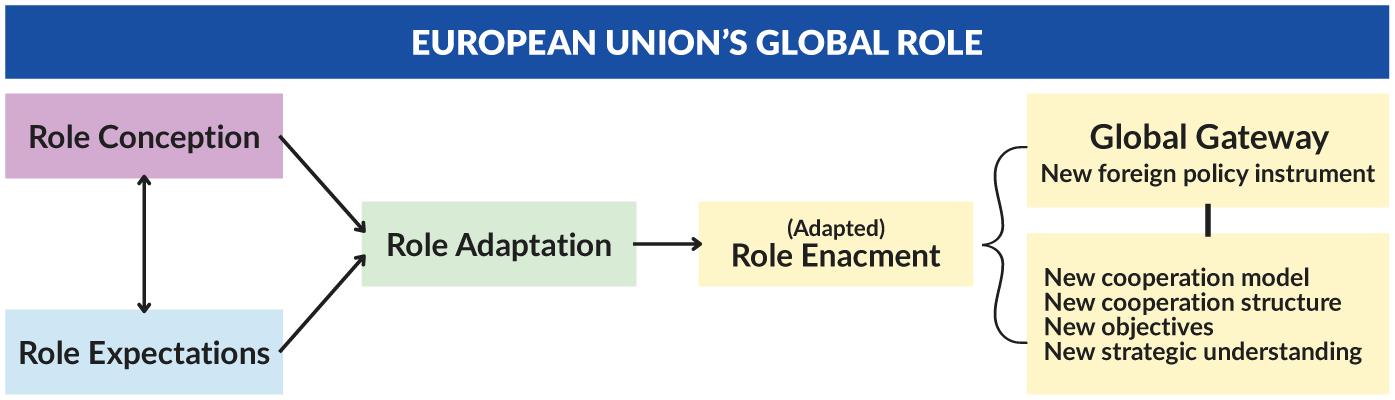
EU role adaptation process leading to the Global Gateway.
However, it is important to recognise that the Global Gateway is a complex and evolving initiative, with potential for both success and failure. The project has attracted criticism from experts and recipient states alike. A study conducted by the ECDPM among African, Asian, and Latin American specialists and diplomats revealed that, although the EU is regarded as a relevant actor, its credibility remains fragile due to negative perceptions among partner countries (Veron, 2025). The study highlights enduring views of hypocrisy and paternalism in the EU’s approach, noting that the Global Gateway is often seen as ‘a new label for old practices’ (Veron, 2025: 12). Moreover, compared with Chinese investments under the BRI framework, Global Gateway projects are frequently criticised for insufficient local dialogue and coordination, as well as for their slow implementation (Veron, 2025).
These observations are consistent with other studies. A report by the Centre for European Policy Studies found that key obstacles to the Global Gateway’s success stem from the perceptions of Latin American and African countries regarding European interests, alongside limited consultation and cooperation with local authorities (Benaglia and Ergenc, 2025). Similarly, another ECDPM study identified difficulties linked to partners’ perceptions and the absence of a coherent coordination structure (Bilal et al., 2025). Additional challenges arise from the EU’s normative requirements and regulatory standards, which many countries consider overly demanding or unrealistic (Foretia et al., 2024).
In this regard, although the Global Gateway represents an adaptation of the EU’s role, it must be recognised that this adaptation may not necessarily prove successful. The initiative has encountered several challenges, and for the EU to fully realise its role conception, it must remain mindful of these difficulties and actively seek ways to address them. This calls for a moderate recalibration of the initiative’s operational design and investment strategy – in other words, a recalibration of its role implementation. Should this occur, we would not be witnessing a new role adaptation, since the instruments themselves would remain unchanged, but rather a process of fine-tuning in the operationalisation of those instruments – that is, the Global Gateway.
This section thus has provided an in-depth analysis of the EU’s role conception and implementation, using the Global Gateway initiative as a case study. Through this analysis, we have confirmed elements related to the EU’s identity and role definition, as well as examined how the Union seeks to realise this role amid transformations in the international order. Despite the challenges, the Global Gateway appears to stand as one of the few remaining bastions of the LIO as we know it.
Conclusion
This article explored how the Global Gateway serves to assist the EU in fulfilling its international role. To this end, we begin with a theoretical framework grounded in the concept of international order and the principles of role theory, situating the phenomenon under analysis within the context of the crisis facing the LIO. This approach allowed us to address our research question by highlighting how the Global Gateway assists the EU in promoting and safeguarding the values, principles, and institutions of the prevailing international order.
By analysing the EUGS, we identify that the EU perceives itself, among other roles, as a defender of the LIO – a role conception shaped also by external expectations. However, recent years have seen the LIO face several challenges, notably the isolationism of the US under the Trump administration and the revisionist stance of China under Xi Jinping. Consequently, the international context has been marked by the US retreating from its role as the world’s policeman and leader of the LIO. Meanwhile, China, through the BRI, has been promoting alternative norms, values, and institutions, thereby challenging and undermining the established international order.
In this context, the EU acknowledged the limitations of its previous approaches. Combined with its perception of external expectations, this recognition prompted the adoption of a more assertive stance. In other words, faced with an increasingly challenging international environment, the EU recognised that, in order to fulfil its international role, it needed to adapt its instruments and strategies, thereby initiating a process of role adaptation. This shift became evident with von der Leyen’s ‘Geopolitical Commission’, which, shortly after taking office, launched the Global Gateway initiative.
This role adaptation should also be viewed as a response to the EU’s perception of the expectations held not only by the international community as a whole, but also by its partners. It reflects the EU’s transition from a paternalistic model of cooperation to one that is more balanced and equitable. In doing so, the EU seeks to present a credible alternative to China’s BRI while encouraging its partners to support the LIO.
The Global Gateway has thus become one of the central pillars of the EU’s external action, through which it aims to reinforce its geopolitical and soft power capacities, enhance its global influence, and provide a viable alternative to the BRI. It may therefore be concluded that the Global Gateway represents the outcome of a role adaptation aimed at enabling the EU to perform its international role as a defender of the LIO more effectively.
This role adaptation carries significant geopolitical implications. Like the BRI, the Global Gateway has the potential to alter global power dynamics and economic structures. However, it is distinguished by its foundation in rhetoric and practices aligned with the LIO, positioning it as the only initiative capable of countering China’s revisionist project. In this respect, the Global Gateway may assume a prominent role in the defence and maintenance of the LIO.
At the same time, it is necessary to reflect on the future of the LIO, questioning whether this initiative will be sufficient to safeguard it, and indeed whether efforts to preserve the order as we know it might instead intensify contestation from voices that feel excluded and from actors who perceive themselves as disadvantaged. Beyond merely defending the LIO, it may be important for the EU to take the lead in its reform, upholding the values and principles that underpin it while promoting a more inclusive and representative structure capable of addressing the limitations of liberal internationalism.
It is also important to emphasise, as previously discussed, that the Global Gateway continues to face considerable challenges. The EU’s partners frequently highlight a lack of dialogue and coordination, as well as the excessive bureaucratic constraints imposed by Brussels. At the same time, negative perceptions persist, with some actors continuing to view the EU as operating under the same paternalistic approach that has long characterised its external relations.
Although the Global Gateway was conceived as a means of enabling the EU to fulfil its international role, this objective will only be fully realised if Brussels manages to address the initiative’s weaknesses and overcome the challenges it faces. A priori, this is unlikely to entail a new process of role adaptation, but rather a fine-tuning of the mechanisms already in place.
Future research should continue to monitor the evolution of the Global Gateway, examining European investments in specific regions and exploring how Latin American, African, and Asian leaders and societies perceive the initiative. Quantitative analyses could also be undertaken to assess the effects and impacts of the Global Gateway on the international economy and on broader global power dynamics.
