




Abstract
Previous research has emphasised the importance of institutions that allow representation of opposition groups’ interests in reducing the risk of civil war. However, the extant research has overlooked the function of top executive policymaking bodies that play a key role in formulating legislative agendas and are responsible for policy implementation. Considering the role of top policymaking bodies (cabinet and state councils), this article examines the effect of variation in civilian control of political decision-making institutions. I argue that weak civilian control of political decision-making increases the risk of civil conflict by reducing civilian input in policy formulation and enabling the translation of the military’s hawkish preferences into core policies. The results provide strong support for my hypothesis and are robust to alternative explanations. I complement these results with a case study of El Salvador (1975–1980), which corroborates the causal mechanisms highlighted in the theory.
Introduction
A central aspect of democratic civil peace is that democracies experience less risk of civil war than non-democratic regimes (Fearon and Laitin, 2003; Fjelde et al., 2020). The fundamental argument is that democracies allow grievances to be addressed via means other than violence (Buhaug, 2006). Going beyond examining the relationship between regime type and civil conflict, scholars have recently investigated the particular features of institutions that help to reduce the risk of civil war (e.g. Fjelde et al., 2020). Broadly speaking, studies have emphasised the role of institutions that allow the representation of broader segments of society and those that place checks and balances upon (elected) executive officials (Fish and Kroenig, 2008; Gandhi and Przeworski, 2006; Snyder, 2000; Walter, 2015b). Specifically, in this regard, research has highlighted the importance of electoral institutions, legislatures, and judicial institutions (including independent courts) in reducing the risk of civil war (e.g. Dunning, 2011; Fjelde et al., 2020; Sievert, 2018).
While various studies have emphasised the role of the legislature in representing the interests of opposition groups to reduce the risk of civil conflict, the role of executive policymaking bodies in this regard remains poorly understood. Executive policymaking bodies (e.g. cabinet and state councils) play a significant role in translating the representation of societal interests into policy outcomes. In addition to exercising executive prerogatives in policy implementation, executive government plays a dominant role in introducing bills in the legislature (O’Brennan, 2012) and thus has considerable control over legislative agendas. Even in parliamentary democracies, legislatures ‘have increasingly entrusted substantial authority to the prime minister and the cabinet’ (Martin and Vanberg, 2005: 94). Previous research has shed light on the role of executive policymaking bodies in the context of international conflicts (e.g. White, 2021). These studies suggest that weak civilian control of political decision-making (PDM) increases the chances of international conflict. Importantly, the civilian control of PDM institutions is not captured by the typology of regime type used in the existing literature, and countries characterised by similar regime types exhibit varying levels of civilian control. For example, some military regimes have significant civilian participation (e.g. Turkey from 1980 to 1983), whereas others considerably exclude civilian input in decision-making (e.g. Brazil from 1964 to 1985).
I argue that studying this institutional feature of civilian control of PDM is important in understanding civil conflicts, because the military plays a significant role in domestic security policymaking. Moreover, civilians and military leaders differ in terms of their political behaviour, connection with society, and preferences regarding the use of force – all of which could have consequences for the risk of civil war.
I address this omission in the literature and argue that weak civilian control of PDM institutions increases the likelihood of the outbreak of civil war. The first channel is the reduction of civilian input in policymaking. I argue that military culture is disconnected from wider society, and in countries with weak civilian control of PDM, the input of civilian leaders that reflects the interests of diverse segments of society is often neglected (Beliakova, 2021a; 2021b). Reduced civilian input calls into question the legitimacy of the policy outcome and leads to the regime having a poor understanding of the grievances of the rebel group. The second channel that connects weak civilian control to the risk of civil war is the divergent preferences of civilians and military leaders on the use of force (Horowitz and Stam, 2014; Jost et al., 2022; Sechser, 2004). Military leaders, because of their organisational selection, socialisation, and military training, are likely to resort more quickly to military solutions and indiscriminate violence that fuel the grievances of disgruntled groups. Therefore, I expect that weak civilian control of PDM increases the risk of civil war.
I test this argument using Kenwick’s Civilian Control Scores (CCS) data on civilian control of PDM institutions. This dataset is appropriate to test the theory because the dominance of civilians in PDM institutions – a vehicle for the dominance of civilian preferences – is undermined by the involvement of military elite in these institutions. Moreover, this dataset has a unique aspect: it takes into account both institutional aspects and the history of civilian control over PDM institutions, as such civilian control is reinforced over time (Kenwick, 2020). My results show that countries with weak civilian control of PDM are more likely to experience the onset of civil war. This finding is robust to various model specifications and alternative measures of key variables.
Additional analysis also helps rule out an alternative explanation of civil–military competition under weak civilian control, as such competition operates independently of preferences regarding the use of force. Following White (2021), I apply his empirical strategy to the civil war context to distinguish the military aggression mechanism developed here from the alternative civil–military competition explanation. My findings suggest that increasing military presence in security portfolios significantly increases the risk of civil war because these positions enable military elites to pursue their preference for the use of force. While military presence in non-security areas, which gives rise to civil–military competition, does not affect the likelihood of civil war. Thus, the study provides evidence for the military’s hawkish preferences to affect the outbreak of civil war.
This article makes contributions to the civil war literature in the following ways. First, it highlights the importance of civilian control of PDM institutions in understanding the risk of civil war outbreak. Theoretically, I highlight the mechanisms that connect weak civilian control to the likelihood of civil war onset. Existing literature examining the preferences of military regimes has primarily focused on interstate conflicts (e.g. Weeks, 2012). This study, however, shows the role of weak civilian control of PDM in the context of civil war.
Second, this study contributes to the literature that emphasises the need to investigate specific regime features that exacerbate or mitigate the risk of civil war. Previously, scholars have studied the role of legislative bodies, checks and balances on executive authority, and independent courts. This study complements this line of research by investigating another important feature of institutional configuration, that is, the extent of weak civilian control of PDM, which exists across regime types.
Third, the study contributes to the literature on the consequences of civilian control of PDM for the conflict behaviour of states (Asghar, 2025; White, 2021). Specifically, White (2021) shows that increased military participation in policymaking increases the chances of interstate conflict through civil–military competition. In the case of civil conflicts, this study finds support for the military aggression view.
Theory development and hypothesis
Civil war
Extant research on civil conflict has identified various factors that drive rebellion. Most prominently, these studies highlighted that information asymmetry and commitment problems play a pivotal role in preventing governments from reaching an agreement to avoid civil war (Fearon, 1995; Powell, 2006; Reiter, 2003). The problems arising from information asymmetry and the inability to make credible commitments tend to be particularly severe in domestic conflicts because opposing sides are incentivised to withhold information, and there is a vast power imbalance between the government and rebel groups (Walter, 2009). In light of these findings, one line of research examines the role of domestic institutions that may help reduce information asymmetry and alleviate commitment problems, thereby lowering the risk of civil war. For example, strong parliaments are believed to reduce the risk by providing an official platform for opposition groups to discuss contentious issues and enabling them to influence policy changes (Maves and Braithwaite, 2013). Similarly, features of electoral institutions such as competitive multiparty elections and extensive franchise rights reduce the likelihood of civil war by helping leaders overcome commitment problems. This is because citizens can utilise these institutional channels to depose leaders who fail to fulfil their commitments (Fjelde et al., 2020). Judicial institutions such as independent courts also serve to address information asymmetry, as the litigation helps leaders gain information about the resolve and commitment of the opposing groups. Such information enables leaders not to risk miscalculating the level of concession necessary to satisfy the demands of such groups (Sievert, 2018). Furthermore, these institutions also provide protection to minorities regarding their rights.
Overall, the aforementioned studies suggest that various democratic institutions provide an avenue for opposition groups to express their grievances and pursue their agendas through non-violent means. While allowing opposition groups to voice their preferences is important, a key role in translating these preferences into policymaking is played by the chief executive and the top executive policymaking bodies (i.e. the cabinet and state councils). The cabinet is responsible for approving bills before introducing them to the legislature for voting. Thus, in addition to policy implementation powers, the executive also controls the legislative agenda.
Previous literature has suggested that top policymaking bodies play an important role in international conflicts. Researchers have shown that increasing military participation in PDM can enhance the risk of interstate conflict initiation (Horowitz and Stam, 2014). However, existing research on civil conflict has overlooked the role of this important institutional variation – that is, the extent of weak civilian control of PDM. Examining this institutional feature is important because, across various regime types, militaries play a significant role in domestic security policymaking. Furthermore, this feature is not captured in the aggregated measures of democracy, and there exists a substantial variation regarding civilian control within democratic and non-democratic regimes. In addition, as I argue below, civilians and military leaders differ in terms of political behaviour and preferences regarding the use of force. Therefore, an increased military presence in policymaking is likely to have implications for the likelihood of civil war occurrence.
Civilian control
Civilian control is conceptualised as the extent to which civilian versus military elites exert control over PDM institutions (Huntington, 1957; Kenwick, 2020). Such civilian control weakens as the military’s influence in PDM increases because, in this way, the ‘military has a major role in the process by which major policy decisions for the state are made, as opposed to having merely an advisory role in the implementation of defense-related directives’ (White, 2017). In this study, I adopt this conceptualisation of civilian control, which is characterised by the dominance of civilians relative to the military in ‘controlling the state at the highest levels of governance’ (Kenwick, 2020: 72).
States need strong armed forces to defend their borders, but armed forces that are strong enough to do so may also pose a threat to the civilian leadership. This dilemma is known as the civil–military problematique. Huntington (1957) argued for the objective control of the military, which aims to promote military professionalism by establishing a clear division of responsibility between the military and its civilian bosses. The military maintains an independent culture and ethos that are distinct from those of civilian society (Kiyani et al., 2023). The military’s apolitical character would then ensure that it remains deferential to the civilian authority (Brooks, 2020).
Feaver (2003) examines the interaction between civilian and military authorities through the lens of a principal–agent framework in which civilians act as the principal and the military as the agent. As agents’ preferences may differ from those of the principal, the latter must monitor the agent’s behaviour. Divergent preferences between the principal and the agent can lead to issues such as ‘shirking’. In this scenario, the agent does not make a sufficient effort to achieve the policy goals set by the principal and instead pursues its own preferences (Hawkins et al., 2006).
The principal–agent framework of civil–military relations suggests that the military, as the agent, can maximise its own preferences when civilian leaders, as the principal, lack mechanisms and institutional structures to monitor and punish the military’s behaviour (Kiewiet and McCubbins, 1991). The principal has to decide the extent to which they monitor because there are costs associated with it. When the principal fails to monitor the agent’s behaviour adequately, it provides the agent with political space to pursue their own objectives (Feaver, 1999). Thus, to prevent agency slack, consistent civilian oversight is required (Feaver, 2003), which is undermined when the military’s involvement in PDM increases.
Previous literature has studied the relationship between military governments and civil war (e.g. Fjelde, 2010). Yet, more recent scholarship shows that regime type alone does not fully account for the variation in civilian control over PDM. Such variation often emerges from path-dependent political processes, elite bargains, and strategic choices that shape how civilian and military actors share or contest authority. Early choices made regarding the military’s role in governance during the country’s trajectory – whether to institutionalise it as a guardian of the state, a partner in ruling coalitions, or a subordinate instrument – tend to generate self-reinforcing patterns of civil–military interaction. Consequently, even regimes with similar institutional forms may differ markedly in the extent of civilian oversight.
For instance, both Saudi Arabia and Pakistan are non-democratic regimes, yet their civil–military dynamics diverge sharply. In Saudi Arabia, the monarchy’s hereditary legitimacy, oil-based rents, and control over coercive institutions have enabled rulers to monopolise political authority, which leaves little space for military participation in policymaking. By contrast, Pakistan’s postcolonial inheritance of a military designed to safeguard imperial interests of curbing internal rebellion, coupled with greater civilian reliance on the military for regime stability and national defence following independence, made the armed forces a central actor in governance. As a result, the military acquired a significant influence over defence and foreign policy matters. Similarly, among military regimes, variation in civilian control could arise from the idiosyncratic choices the junta made to structure the authority. Brazil’s military government (1964–1985) concentrated decision-making within the armed forces, whereas Turkey’s junta (1980–1983) incorporated civilian technocrats and party elites, resulting in varying levels of civilian influence in the two regimes.
Civilian control of PDM and the risk of civil war
In this section, I argue that weak civilian control of PDM enhances the risk of civil conflict in two ways. One, it reduces civilian input in policymaking, which amplifies the grievances of opposition groups. Two, it enables the military to translate its preferences regarding the use of force into policy by advocating for a more permissive approach to the use of force.
Reducing civilian input in policymaking
The composition of policymaking bodies affects the policymaking process and, in turn, policy outputs. Weak civilian control of policymaking institutions reduces civilian input in policy formulation, which in turn makes policy outcomes less reflective of the diverse interests of society (Beliakova, 2021a). Military officers are often disconnected from the wider society, and they develop a ‘military mind’ (Burk, 2002; Janowitz, 1960) due to their training, which fosters a culture of aloofness by emphasising professionalism (Brooks, 2020). Ricks (2011) narrates this dynamic using General Barno’s words: Today’s Army – including its leadership – lives in a bubble separate from society. Not only does it reside in remote fortresses – the world’s most exclusively gated communities – but in a world apart from the cultural, intellectual and even geographic spheres that define the kaleidoscopic United States. This splendid military isolation – set in the midst of a largely adoring nation – risks fostering a closed culture of superiority and aloofness.
Furthermore, research has shown that the military elite consider their culture superior to that of civilians and develop a contemptuous attitude towards the political elite and civilian society (Brooks and Grewal, 2022). Such an attitude is carried over into the policymaking process when people with military backgrounds occupy policy positions. For example, Snodgrass (2019: 49) describes General Mattis’ style of working as the United States Secretary of Defense in the following way: Feeling that he needed to take charge at the Pentagon [. . .] led Mattis to seek his comfort zone, largely surrounding himself with military personnel of two predominant flavors: those who served with him at US Central Command (the majority of the office) and officers from the Navy and the Marine Corps (myself included). The argument went that since we came from a shared background, we’d know how to get the job done to his satisfaction [. . .] Senior staffers throughout the Pentagon, especially in the policy shop, saw their products marginalized and shunted aside in order to react to pointed questions from the front office [. . .] A number of talented career civilians left their jobs to pursue other opportunities.
An implication arising from the wide chasm between military and civil society, as well as a sense of superiority among military officers, is that military elites in policymaking positions tend to exclude political input from the policymaking process. Ministers with military backgrounds hold a contemptuous attitude towards political elites. They disregard civilian policy professionals and staff available within their ministries, instead preferring to listen to individuals who share their military backgrounds (Beliakova, 2021a). This dynamic was on display in Indonesia following the appointment of Prabowo Subianto, a former general, as Minister of Defence. Mietzner (2023: 16) observes, Using his discretion, Prabowo inserted former military allies into the defence ministry as advisers . . . As a result, he re-insulated both his ministry and the military from civilian scrutiny. . . The head of the civilian body may be able to submit proposals, but it is hard to ascertain how much of their content is adopted.
Under these conditions, civilian participation becomes largely procedural rather than substantive, while effective influence is concentrated within a narrow military-linked network. It also suggests that individuals with similar kinds of training and experiences dominate policy deliberations, which will give rise to the phenomenon of groupthink in which members of a group fail to appraise courses of action alternative to the dominant perspective.
Moreover, policymaking inherently entails finding compromises between competing demands and accommodating the interests of diverse segments of society. However, individuals with military backgrounds are often perceived as being ‘psychologically rigid’ due to their discipline and training, which may not align well with performing political duties (Jackson et al., 2012). Consequently, the voices of dissident groups may be excluded from policymaking, which can generate resentment among them. In this way, the true nature of the grievances of disillusioned groups will also remain poorly understood by the government. Beliakova (2021a) argues that ‘A heavy reliance on the military in policy making may amplify biases in decision making and limit the input of underrepresented communities in politics’.
Conversely, a higher level of civilian control of PDM increases the utilisation of inclusive practices and recognition of diverse viewpoints in policymaking. Civilian members of the cabinet are more knowledgeable about the demands and grievances of various groups because of their connections with civil society. A policymaking process that is perceived to be inclusive and involves consideration of diverse perspectives increases the legitimacy of policy outcomes and is likely to reduce support for rebel groups. For example, previous research suggests that improving gender inclusion in society increases the likelihood of negotiated settlements in civil war (Demeritt et al., 2014). In a similar vein, the exclusion of diverse perspectives through weak civilian control would increase the chances of disillusionment among various segments of society, raising the prospect of violent mobilisation.
Beyond increasing the legitimacy of the policymaking process, civilian control of PDM also directly operates through the resolution of information problems that lie at the core of many theories of civil war (Fearon, 1995). Through greater access to civilian input and institutionalised engagement with social groups, governments acquire more reliable information about the capabilities, preferences, and resolve of potential opposition actors (Besley and Burgess, 2002). At the same time, opposition groups also gain access to more detailed information about the government’s intentions and likely responses (Powell, 2006). The severance of these information linkages, in which civilian control of PDM is weaker, heightens mutual uncertainty and increases the likelihood of rebellion.
Enabling repression and excessive use of force
Another channel through which weak civilian control of PDM increases the risk of civil war is through the divergent preferences of the military and civilians on the use of force. The existing theoretical literature offers two distinct perspectives on the military’s predisposition regarding the use of force. One view is that of military conservatism, which suggests that military elites are less likely to advocate the use of force or resist the initiation of war because they are familiar with the costs of war (Huntington, 1957). The other view suggests that military elites are more likely to be permissive of the use of force (Sechser, 2004). In this tradition, scholars point out two possible reasons for the more liberal attitude of military officers towards the use of force: first, more hawkish people are going to self-select for military service (Jost et al., 2022), and second, they undergo professional training and socialisation that make them more likely than civilians to overestimate the appropriateness and utility of the use of force (Sechser, 2004; White, 2021). Brecher (1996: 220) argues that ‘Violence is normal behavior for the military in power, for the military generally achieves and sustains power through violence . . . They also see violence as legitimate and effective’.
Although theoretical perspectives present contrasting views, empirical analysis has found considerable support for reduced civilian control resulting in increased chances of conflict initiation and war (Sechser, 2004; Weeks, 2012). Scholars have shown that military officers often display hawkish attitudes in the context of international conflicts (Holsti, 1999; Klingler and Chatagnier, 2014). Horowitz and Stam (2014) suggested that combat military experience may temper enthusiasm for the use of force. Yet, recent research has highlighted that this tempering effect of combat experience is insufficient to overcome the hawkishness gap between civilians and military elites, which persists regardless of the combat experience of military officers (Jost et al., 2022).
Divergent attitudes of civilians and military elites towards the use of force extend to incidents in a domestic context (Kiyani et al., 2023). When a state’s sovereignty is likely to be challenged from within, the military perceives it as a threat to its legitimacy and raison d’être. Civilians are more used to negotiating with the opposition groups, but military elites are reluctant to recognise rebel forces as equal partners at the negotiating table. Thus, the military’s default response is to use overwhelming force to quickly suppress internal resistance and restore the state’s authority, rather than attempting to find a negotiated compromise (Nordlinger, 1977). Fjelde et al. (2020) argue that, among authoritarian regimes, military regimes are more likely to employ coercive methods against opposition groups. Thus, when military-linked members are in charge of policymaking within government, they are more likely to ‘turn to the military to solve problems that arise, rather than employing other elements of national power’ (Eaton, 2018: 62).
These divergent civil–military tendencies with respect to the use of force are also driven by their perspectives about the strategic consequences of offering concessions to challengers. Walter (2015a) argues that incumbents often resist compromise with rebels because concessions signal weakness and encourage the emergence of additional challengers. This logic is likely to be especially salient for military leaders as they dislike future challengers and view the use of force as a deterrence strategy against renewed mobilisation. It, combined with military elites’ propensity to discount the political costs of conflict, results in a preference of repression over bargaining and raises the probability of conflict escalation rather than settlement.
Civilians and military elites also differ in their attitudes towards the amount of force to be used in dealing with internal threats. Research suggests that while civilians prefer incremental use of force, military elites often advocate going against enemies with decisive force, which has the potential to descend into indiscriminate violence. For example, Kiyani et al. (2023) show that a weakening of civilian control increases the likelihood of the emergence of domestic terror groups due to greater repression and human rights abuses. This predilection to use excessive force is visible in the actions of Marine Units when they were deployed for peacekeeping purposes during the Los Angeles Riots of 1992. Their actions reflected military’s preference towards use of overwhelming force to quell unrest. While exercising operational autonomy, the marine unit interpreted a civilian law-enforcement directive to provide ‘cover’ through the lens of overwhelming force rather than calibrated policing. Major General Timothy Reeves (1995) documented: . . . a law enforcement team issued orders to a ground Marine unit to provide cover while confronting an armed suspect barricaded in his residence. The Marines that were issued the covering order commenced to lay down covering fire on the face of the apartment building. Marines fired approximately 30 rounds into the building before law enforcement personnel stopped them. Clearly, the definition of the word ‘cover’ had a different definition to what the law enforcement team wanted, and what the Marine unit delivered.
A similar mechanism is evident in Pakistan’s management of the insurgency in Balochistan, where decisions on counterinsurgency strategy and the use of force have remained concentrated within the military, with civilian authorities exercising limited influence even during the civilian rule. Military has retained full authority over insurgency policy and has consistently pursued coercive solutions marked by disproportionate force. A 2013 Economist article, ‘Cruel Beyond Belief’, reported that ‘many Pakistanis believe their country’s generals are largely to blame for Balochistan’s conflict [. . .] the Baloch separatist rebellion is fueled by the army’s brutal counter-insurgency campaign. People “disappear” into unknown prisons; bullet-riddled bodies are dumped at the roadside’. Human rights organisations similarly document extrajudicial killings, torture, and mass arrests carried out under military-led operations (Amnesty International, 2023). Although much of the civilian leadership favoured negotiations after 2005, the military opposed talks with separatist groups and prevailed in blocking reconciliation efforts (Rasheed, 2014). In this way, military’s dominance in security policy making has resulted in the use of overwhelming force that has led to intensifying grievances.
In sum, I have argued that as civilian control of cabinet and top executive bodies decreases, the policymaking process is more likely to exclude political input and rely on professional advice. This dynamic widens the information gap between the regime and its opponents, intensifying the latter’s grievances. In this environment, regimes with weak civilian control become more prone to deploy repression and indiscriminate violence against opposition groups as military-linked members within policy-making forums are more likely to advocate the use of force to deal with opponents:
Hypothesis: States with weak civilian control of PDM institutions are more likely to experience civil war.
Research design
Variables and measures: Dependent variable – civil war onset
My dependent variable is civil war onset. For information on this, I use the Uppsala Armed Conflict Dataset (ACD) (Version 19.1), updated in 2019. The ACD defines armed conflicts as incidents of violence involving at least one state actor that generate more than 25 casualties in a given calendar year, over some incompatibility classified as control over the central government or territory, where groups seek secession or autonomy of a particular piece of territory (Gleditsch et al., 2002).
The ACD categorises armed conflicts into four different types: interstate wars, civil wars, internationalised civil wars, and extra-systemic wars. Following Cunningham (2011), I include all types of conflicts except interstate wars. A new civil war is coded if the conflict starts at least 2 years after the break in fighting, per Sambanis (2004). For robustness, I also use data on civil war onset from the Correlates of War (COW) Intra-State War Data. COW defines a civil war as sustained combat between a state government and non-state actor(s) resulting in at least 1000 battle-related deaths annually and taking place within the state territory. This variable is coded as 1 for all country-years in which a civil war started, and 0 otherwise.
Independent variable – civilian control of PDM
To operationalised civilian control of PDM, I rely on Kenwick’s index of civilian control of PDM institutions. Kenwick (2020) constructs a latent variable using Bayesian item response theory modelling to measure the ‘extent to which civilians dominate political decision-making and the robustness of this dominance to military involvement in politics’ (Kenwick, 2020: 71). Specifically, the measure is based on three observable indicators of military involvement in politics: (1) whether a country’s political elites have served in or maintained ties with the military; (2) whether military regimes preceded a given regime or whether the current leader came to power with the support of the military; and (3) the extent to which executive political authority in a state is concentrated in the institution of the military. In this way, it captures different facets of civilian control, rather than relying on narrow individual proxies, such as regime type or the military backgrounds of leaders. The final variable of civilian control ranges roughly from −3 to 3, with higher values indicating greater civilian control of PDM (Figure 1).
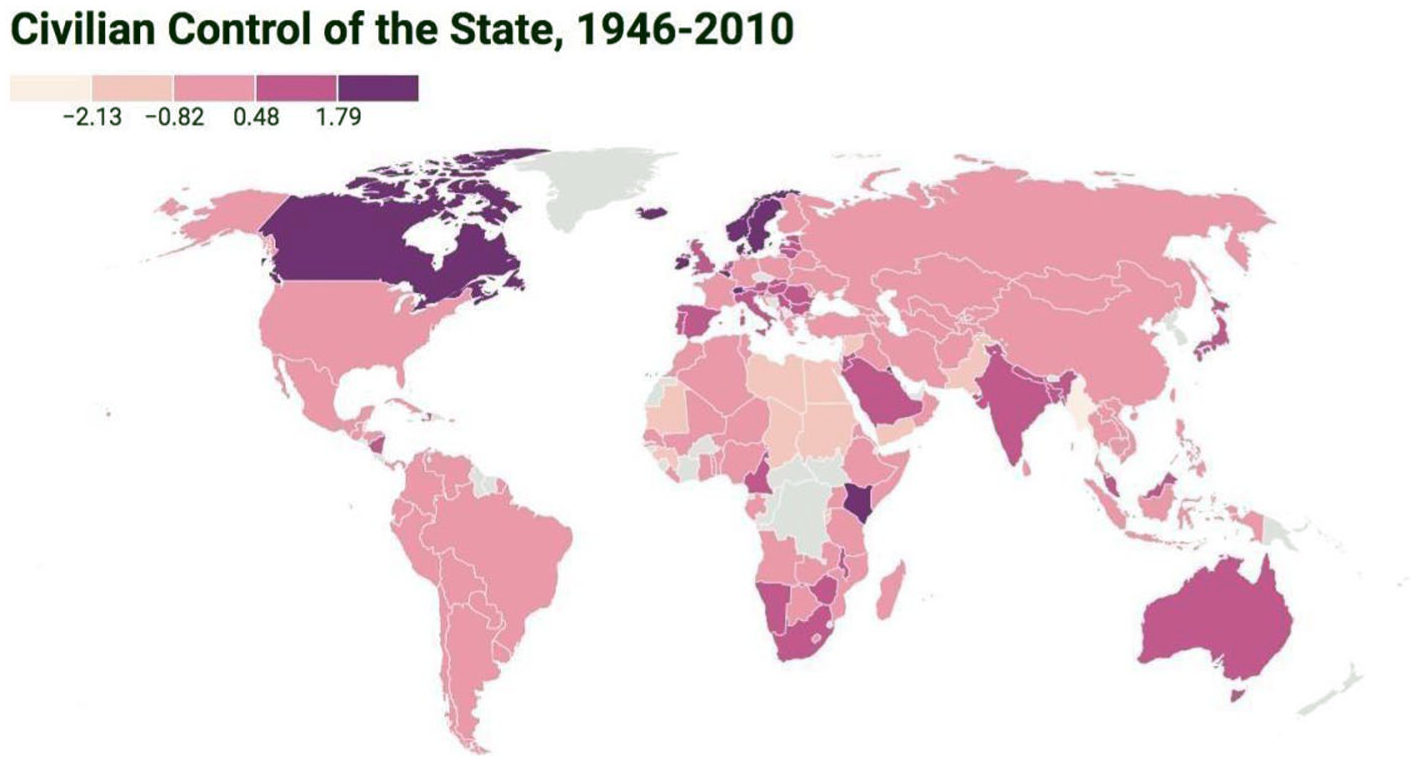
Civilian Control Scores in 2010.
Control variables
I include several control variables that may confound the relationship between civilian control of PDM and the onset of civil war. The opportunity cost of war has a significant impact on the likelihood of joining a civil war. Thus, following Hegre and Sambanis (2006), I include GDP per capita. To account for the effect of state capacity, I include a Composite Index of National Capability (CINC) from the National Material Capabilities dataset (Singer, 1987). Specifically, this variable is based on the values of the total population, urban population, iron and steel production, energy consumption, military personnel, and military expenditures.
Similarly, countries with strong democratic institutions and inclusive political processes are better equipped to address the grievances of opposition groups within the political system, thereby weakening incentives for armed conflict. To control for the effects of regime type, I include the Polity variable, which is a continuous scale ranging from −10 (autocracy) to +10 (democracy). For information on this variable, I draw on data from the Polity IV project. I include both linear and squared terms of the Polity variable because previous research has identified a curvilinear relationship between democracy and the onset of civil war (e.g. Regan and Bell, 2010). The Polity variable also partly influences the arrangement of civilian oversight of the military and is likely to affect military presence in policymaking positions.
I control for population because governments in countries with large, young populations are more likely to use repression as they anticipate higher levels of dissent (Nordås and Davenport, 2013). Previous research (e.g. Kustov, 2017) has suggested that ethnic grievances are associated with civil war conflicts. To account for that, I use information from the Ethnic Power Relations (EPR) dataset, which codes the extent of political discrimination against minority groups within countries. I also control for recent political instability, which may heighten the risk of civil war (Fearon and Laitin, 2003). Political instability encompasses periods of institutional volatility that could facilitate greater military involvement in policymaking. Finally, following Carter and Signorino (2010), I add cubic polynomials of peace years to control for temporal dependence, as countries recently emerging from conflict have a higher likelihood of experiencing military involvement in governance.
Empirical model
Given that the dependent variable in this study is a dummy, I use logistic regression and cluster standard errors at the country level to address concerns of autocorrelation in panel data. The time period of the study spans from 1946 to 2010, and the final sample comprises 5402 country-year observations from 142 countries. I also report the results of alternative model specifications, including random effects logistic and probit regressions. All explanatory variables are lagged by 1 year. Furthermore, I run various robustness tests that use alternative measures of key variables and attempt to mitigate endogeneity concerns.
Main results
Table 1 presents the main results of the study. Model 1 includes only the control variables. In Model 2, I include Civilian Control of PDM along with the control variables to predict the likelihood of the onset of civil war. The results show that the coefficient of Civilian Control of PDM is negative and statistically significant. Model 3 shows the results of random-effects logistic regression. Model 4 presents the results of random-effects logistic regression with decade and region dummies included. Model 5 presents the results of random-effects probit regression with country-level intercepts. These results show that the coefficient of the Civilian Control of PDM is robust across various model specifications. Thus, the hypothesis of my study is supported, suggesting that the risk of civil war onset decreases with a stronger civilian control of PDM institutions. Figure 2 (based on Model 2 of Table 1) and Figure 3 (based on Model 2 of Supplemental Appendix Table S2) show the substantive effects of Civilian Control of PDM on the onset of civil war.
Main results using UCDP data.
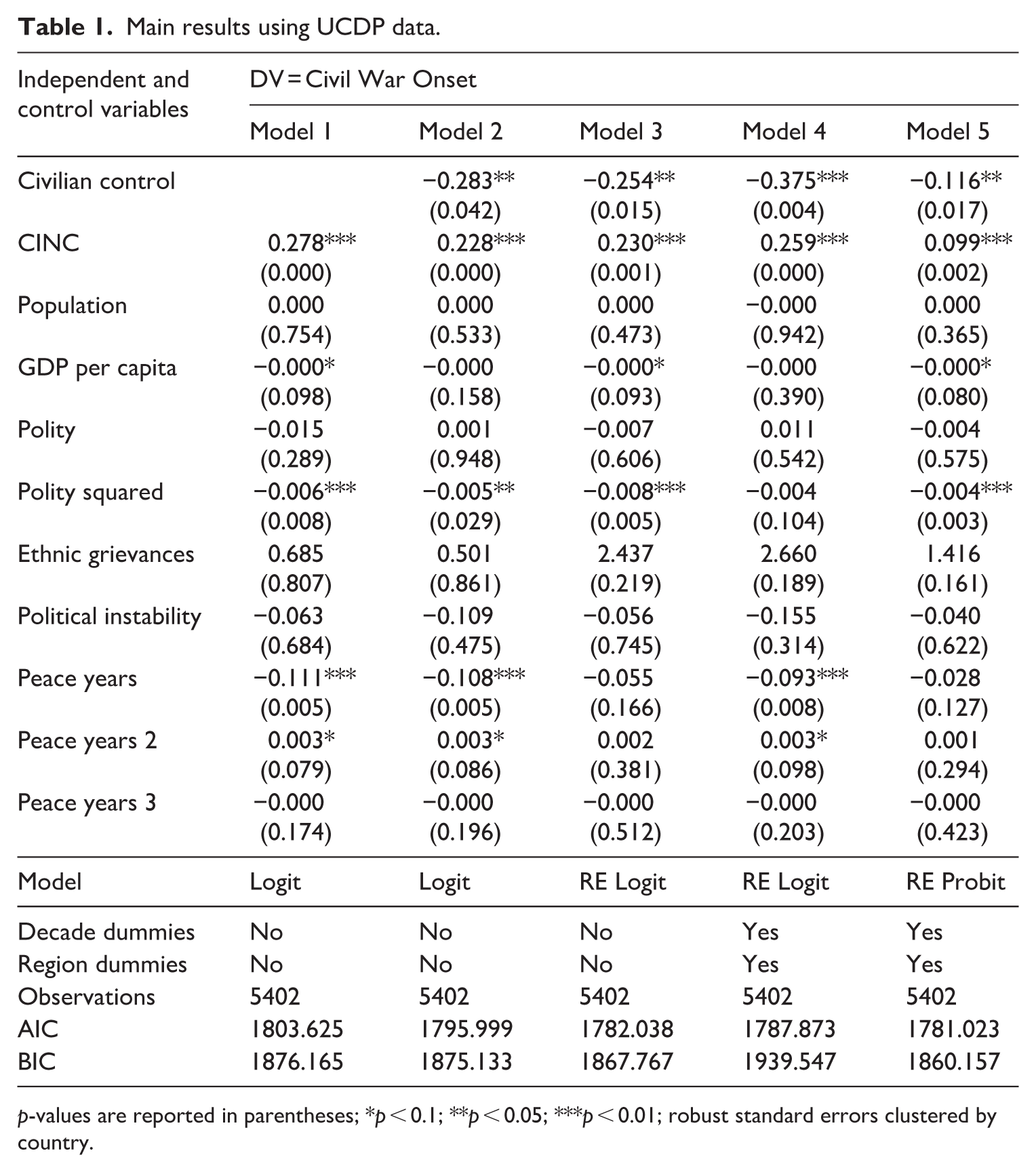
p-values are reported in parentheses; *p < 0.1; **p < 0.05; ***p < 0.01; robust standard errors clustered by country.
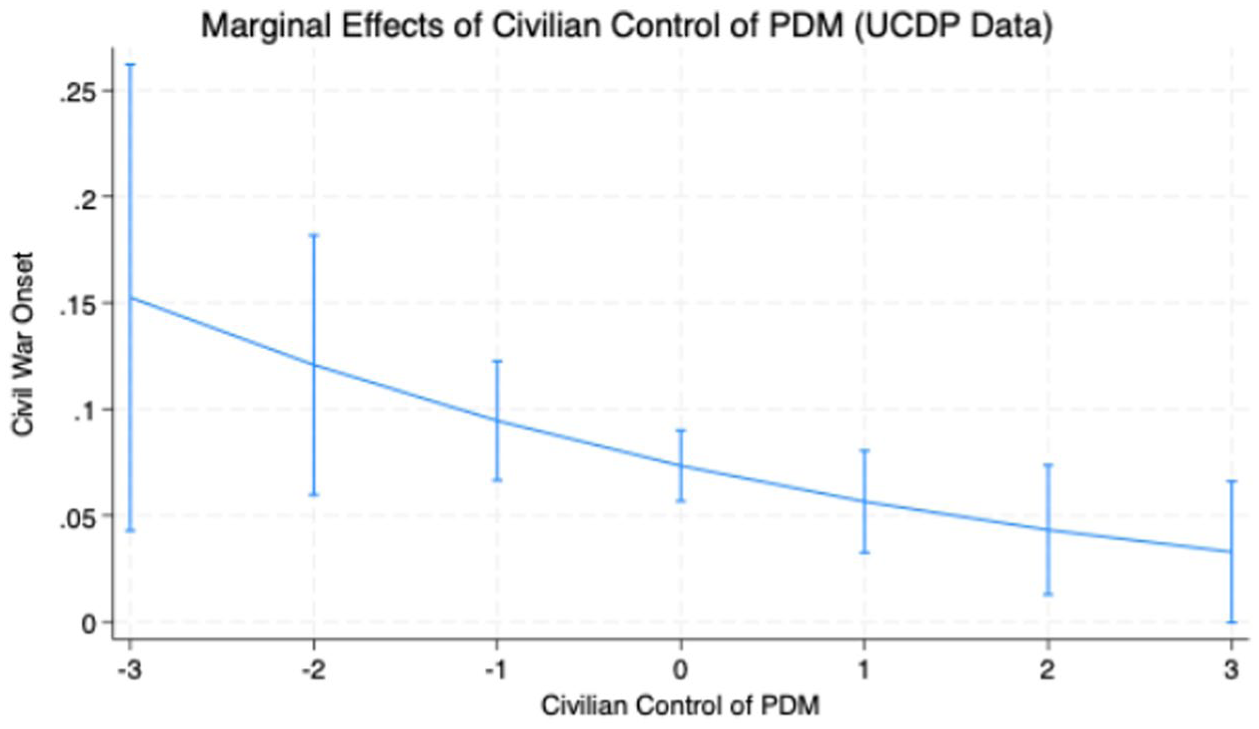
Substantive effects of civilian control of PDM on civil war onset (UCDP data).
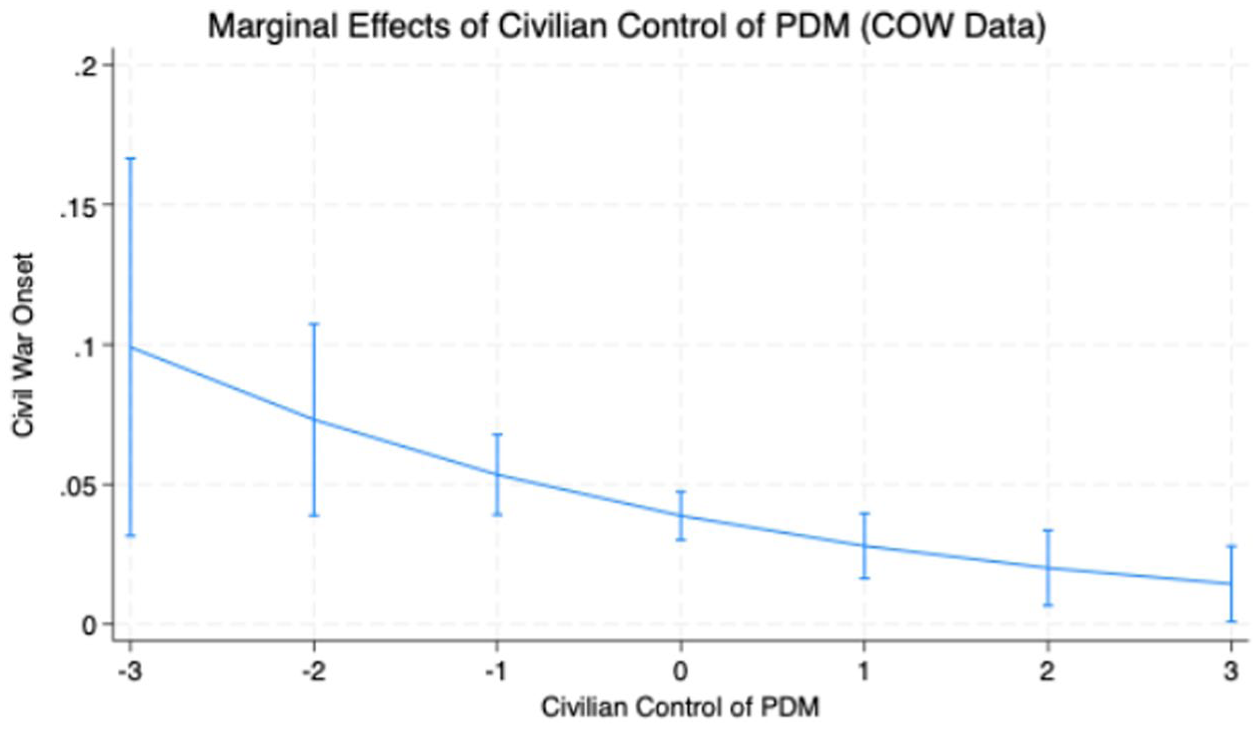
Substantive effects of civilian control of PDM on civil war onset (COW data).
Robustness checks
Inclusion of additional control variables
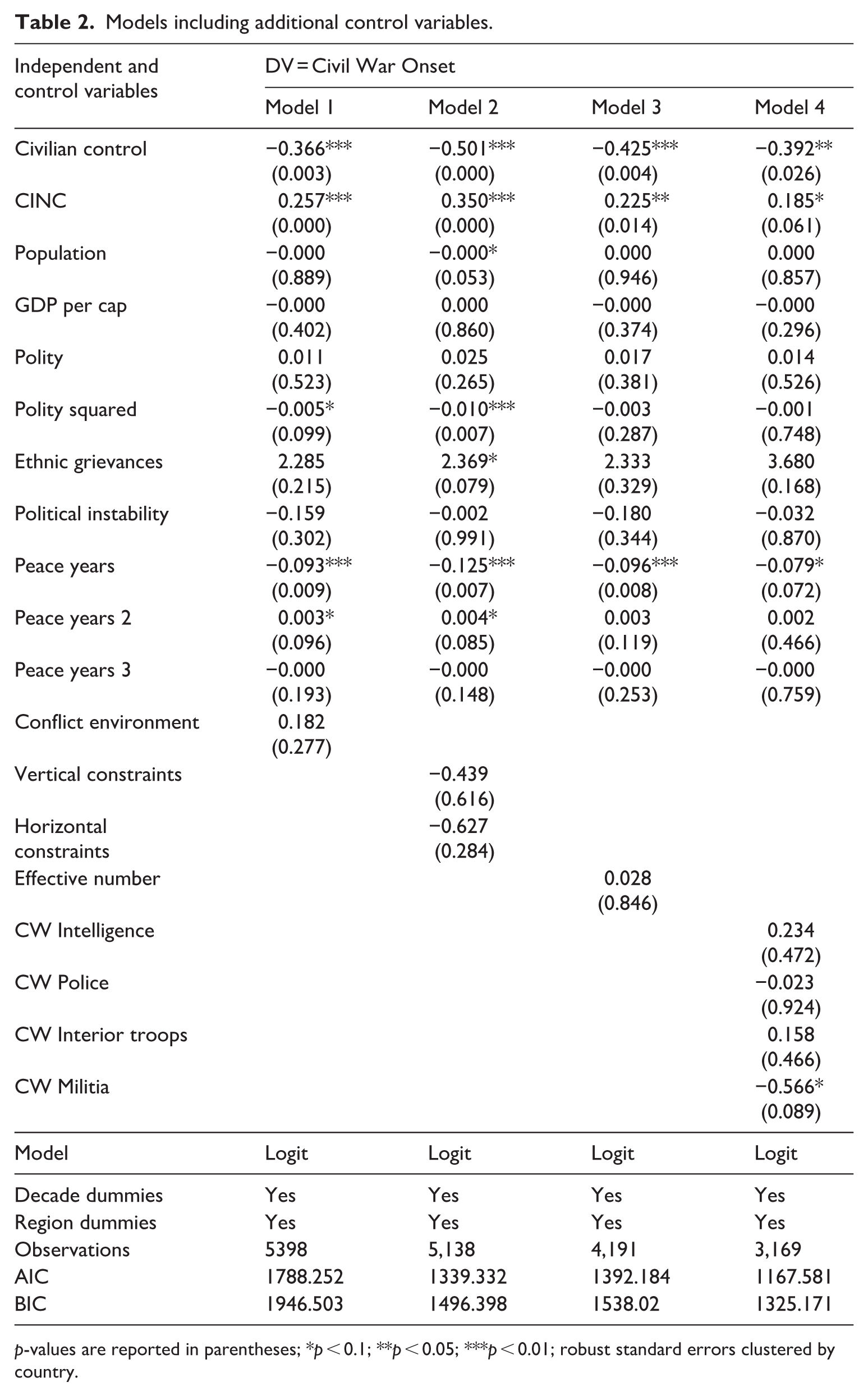
A potential concern is that the conflict environment of a country, which varies across space and time, may also affect the likelihood of civil war onset (e.g. Reid et al., 2020). Studies show that as conflict becomes more spatially proximate and as its lingering effects accumulate over time, the risk of a country experiencing civil war onset increases. Thus, to account for the potential influence of the conflict environment, I include a variable indicating the conflict environment score from Reid et al. (2020). It is calculated as a distance-weighted spatial lag of nearby conflict onsets, combined with a temporal decay function that models how exposure to violence dissipates or endures over time. Table 2, Model 1, demonstrates the robustness of my findings to accounting for the conflict environment.
Models including additional control variables.
p-values are reported in parentheses; *p < 0.1; **p < 0.05; ***p < 0.01; robust standard errors clustered by country.
Similarly, research has shown that institutional constraints on the executive could play a role in reducing the risk of civil war (e.g. Fjelde et al., 2020). To account for this possibility, I ran an analysis that included the indices of horizontal (legislative and judicial) and vertical (free and fair elections and inclusive citizenship) constraints from Fjelde et al. (2020). The results are shown in Table 2, Model 2. My primary findings for Civilian Control of PDM remain robust.
Another potential concern is that the institutional coup-proofing measures or the structure of armed forces may affect both the onset of civil war and the relative balance of power between civilians and the military in policymaking. I attempt to mitigate this concern in three ways. First, I include a variable of the effective number of military organisations (based on Pilster and Bohmelt’s, 2011 data). Second, I include variables measuring the number of potential counterweights in the security sector (based on De Bruin’s, 2021 data). Third, I include the variable on the recent coup history (Peyton et al., 2025). The results, incorporating these variables, are presented in Models 3–5 (Table 2). The primary findings of the study remain consistent.
Alternative measures of dependent and independent variables
I run robustness checks using alternative measures of the key variables. First, I use an alternative measure of civil war onset using COW data, which has a higher death threshold criterion (1000 battle-related deaths). Table S2 (Supplemental Appendix) shows that the results using an alternative measure remain consistent with the primary findings in Table 1.
Second, I run analyses using alternative measures of the Civilian Control of PDM. In the main analysis, I used Kenwick’s measure of civilian control. For robustness, I draw on data from White’s (2017) Military Participation in Government (MPG), which captures the number of active-duty military officers in national cabinets. In addition, I use data from Multidimensional Measures of Militarization (Bayer, 2023), which identifies whether the regime leader is linked to the military. The results based on these alternative measures are substantively similar to the main findings (Supplemental Appendix Table S4, Models 1 and 2).
Addressing rare outcomes
Since civil war is a rare event, standard logistic regressions may potentially produce biased results. To rule out this possibility, I employ Firth’s penalised likelihood logistic regression model, which modifies the standard maximum likelihood estimation to penalise extreme parameter estimates, thereby mitigating analytical biases rooted in small sample biases (Williams, 2024). The results remain consistent, which increases confidence in my findings (Supplemental Appendix Table S3, Model 2).
Addressing within-country variation
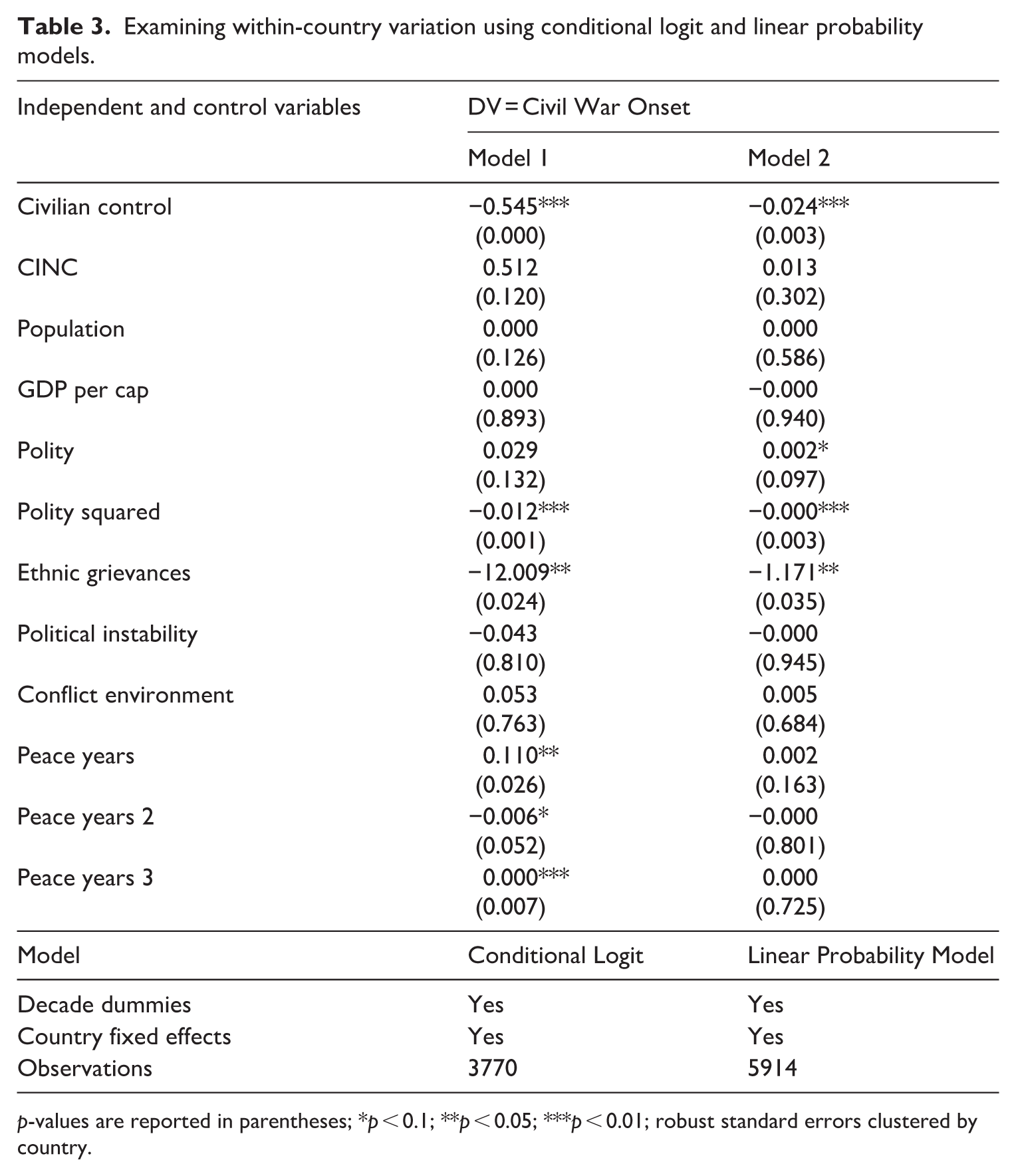
To further evaluate the robustness of the results, I run analyses using country fixed effects and decade dummies. However, if there is only little variation in the independent variable, the use of unit fixed effects could bias the coefficient downwards. Therefore, I computed the within-country variation in civilian control of PDM and used a dummy variable to indicate if there is an increase in such civilian control. I run analysis using a conditional logit model (with country as a group variable and decade dummies) and a linear probability model (with country and decade fixed effects). The results are presented in Table 3 and are consistent with the main analysis.
Examining within-country variation using conditional logit and linear probability models.
p-values are reported in parentheses; *p < 0.1; **p < 0.05; ***p < 0.01; robust standard errors clustered by country.
Sensitivity checks
Next, I implemented the diagnostic test developed by Oster (2019), which determines the sensitivity of my estimates to the selection of unobservables. Oster’s method suggests that as control variables are added to a model, if the coefficient of interest remains approximately the same and the R-squared rises, then there is likely less unobserved variation than is needed to overturn the results. Oster’s diagnostic test estimates a parameter δ (Oster’s delta) that incorporates these conditions. When the absolute value of δ is greater than 1, the selection on unobservables would need to be stronger than the selection on observables to drive the estimated effect to 0. I find that in all cases δ is greater than 1, which provides statistical evidence that unobserved variation likely does not influence the direction of my estimates.
In addition, I performed the sensitivity analysis test suggested by Cinelli and Hazlett (2020). The results demonstrate that the estimated coefficient (−0.0126, p = 0.045) remains robust. The robustness value (RVq = 1) of the point estimate is 4.6%. Furthermore, a fairly strong confounder would be required to render my estimates indistinguishable from zero. For example, when benchmarked against the Polity variable (which is considered a strong predictor of civil war and is negatively associated with Civil War), a three-times stronger confounder than the Polity variable is also not able to make my estimates statistically insignificant. Similarly, when benchmarked against the National Capabilities variable (which is very strongly correlated with civil war risk), my estimates remain statistically significant even in the presence of a confounder that is as strong as the National Capabilities.
Addressing endogeneity
To address the issue of endogeneity more directly, I also employ a control function approach. The endogeneity concern is that variation in civilian control of PDM might be correlated with unobserved factors that also influence the likelihood of civil war outbreaks.
In this approach, I use foreign military training programmes as a source of exogenous variation in civilian control. Prior research indicates that military training programmes have a significant impact on the political role of militaries, affecting the relative balance of power between the military and civilians (Savage and Caverly, 2017). However, such training programmes are unlikely to directly affect the outbreak of civil war, which makes them a theoretically sound and relevant instrument.
Specifically, I operationalised the instrument using a variable that tracks the lagged number of students trained through the International Military Education and Training (IMET) programme database in a given year (Savage and Caverly, 2017). I run the first-stage model by regressing civilian control on the number of students enrolled in the IMET programme, along with the control variables used in the main analysis. Results confirm the relevance of the instrument (F-statistic is 271.334, which is well above the conventional threshold of 10). In the second stage, I rerun the main logistic regression after including residuals from the first-stage model. The coefficient of the key variable of the Civilian Control of PDM remains significant after correcting for endogeneity (Supplemental Appendix Table S6).
There could be a concern about the exclusion restriction in relation to my instrument that military training programmes could affect civil war onset by increasing the competence of military and, thereby, raising the expectations of victory. I have presented the causal diagram in Supplemental Appendix Figure S1. To block the direct path between the instrument variable and the outcome variable, I implement two steps. First, I include the variable of conflict environment as the enhanced competence is likely to be consequential in cases in which a country has a more hostile conflict environment. The results, presented in Models 3 and 4, are robust. Second, the logic of the competence channel is most likely to be present when a country has recently faced internal security threats, such as civil war. This is because, in such situations, countries are most likely to send military officers abroad for foreign training to enhance their competence. Therefore, excluding such cases helps mitigate the concern that gains in capability from training are most likely to directly influence conflict behaviour.
Analogous to the main models, all independent and control variables, as well as the instrument, are lagged by 1 year (t-1). The results, presented in Models 5 and 6, remain substantively similar.
Mechanism test
After establishing the robustness of my results, I sought further support for the postulated mechanisms of the theory. My theory suggests that weak civilian control of PDM increases the risk of civil war through (1) exclusion of civilian input and (2) enabling the coercive approach of the military to influence policy.
Testing exclusion of civilian input from policy making
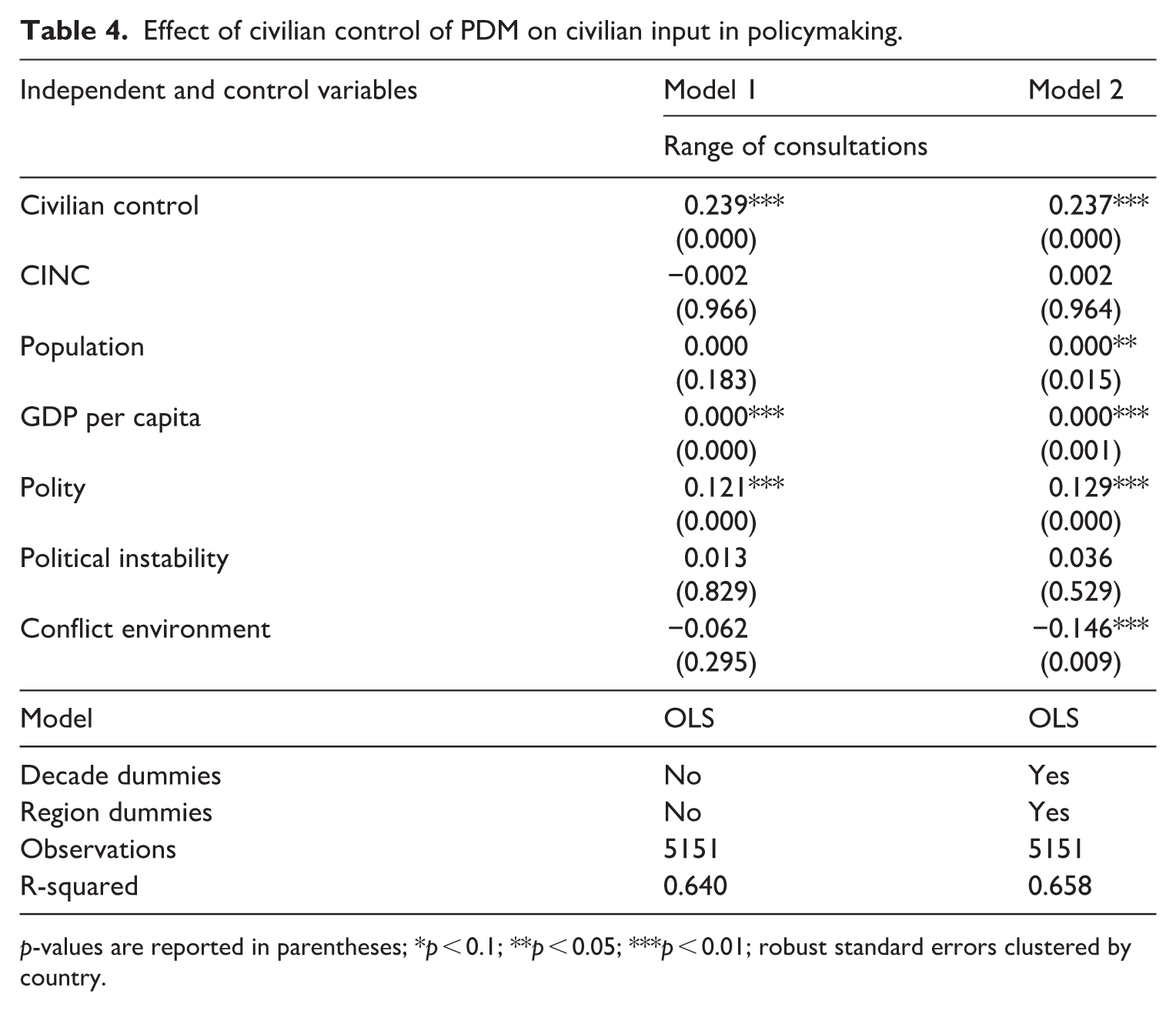
To test the effect of civilian control of PDM on the incorporation of civilian input in policy making, I employed a measure of Range of Consultations from the V-Dem dataset. This measure captures the breadth of societal sectors that are consulted for major policy decisions. The values of the variable range from 0 to 5, with higher values indicating that consultations are held with a broader segment of society. The expectation, according to the logic of my theory, is that a stronger (weaker) civilian control of PDM is associated with a broader (narrow) range of consultations. The results, presented in Table 4, support this expectation. The coefficient of Civilian Control is positive and significant. It suggests that when the civilian control of PDM becomes weak, the range of segments of population who are consulted in policy formulation narrows.
Effect of civilian control of PDM on civilian input in policymaking.
p-values are reported in parentheses; *p < 0.1; **p < 0.05; ***p < 0.01; robust standard errors clustered by country.
Testing the mechanism of military preferences for the use of force
To test the mechanism of military preferences for the use of force in my theory, I draw on White’s (2021) framework. White (2021) argued that in theory there could be three perspectives on military influence in policymaking: first, military officers are more reluctant to use force (military conservatism), reducing the risk of conflict; second, military officers are more permissive regarding the use of force (military aggression), increasing the risk of conflict; and third, the increased MPG introduces various pathologies in decision-making processes (civil–military competition), resulting in escalation of conflict. Among these, the military aggression perspective maps directly onto the second mechanism developed in this study, which centres on how weak civilian control enables the translation of military preferences for the use of force into policy.
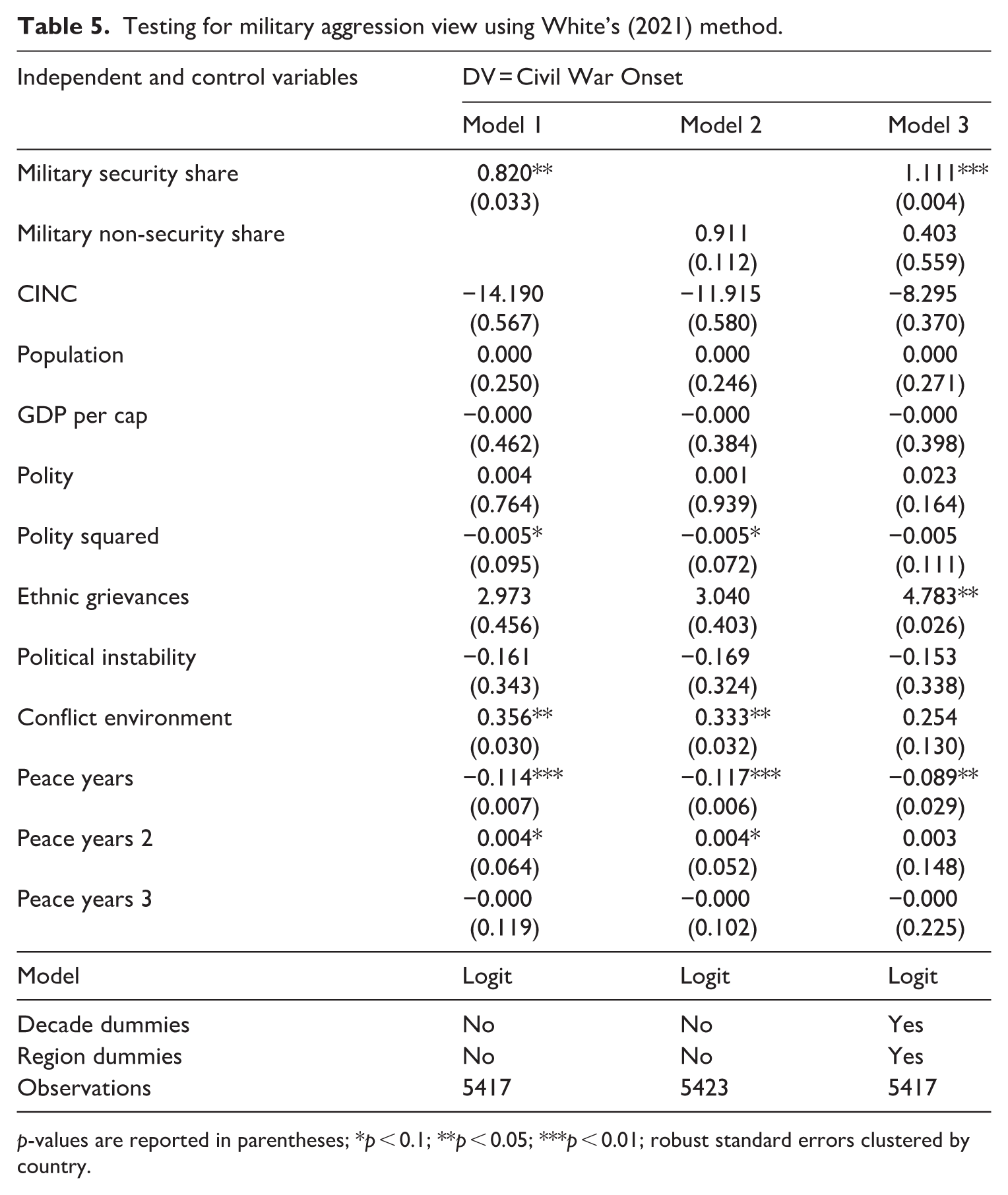
White (2021) suggested that an empirical way of differentiating the military aggression view from civil–military competition is to examine the influence of increased military participation in security policymaking positions versus non-security policymaking positions. I run this analysis by using White’s MPG data.
The results are shown in Table 5. Model 1 includes the share of active-duty military officers in security portfolios. Model 2 includes the share of active-duty military officers in non-security portfolios. Model 3 includes both variables simultaneously. The results suggest that only increasing the military share in security policymaking positions enhances the risk of civil war. These results support the view that military officers are more hawkish in their approach, and their involvement in PDM enables their preferred solution in situations when the regime faces a challenge.
Testing for military aggression view using White’s (2021) method.
p-values are reported in parentheses; *p < 0.1; **p < 0.05; ***p < 0.01; robust standard errors clustered by country.
Overall, these additional tests provide support for the theoretical mechanisms – exclusion of civilian input from policymaking and the military’s preference towards the use of force – developed in this study. In addition, the findings rule out a competing channel of civil–military competition.
Case illustration
In this section, I examine the case of civil war in El Salvador to show weak civilian control of PDM leads to increased reliance on use of force, which contributes to civil war onset. The Salvadoran military, which had massive involvement in domestic politics for most of the 20th century, had gradually marginalised civilian actors from the policymaking process and was able to pursue coercive strategies despite having plenty of opportunities for negotiations. This case illustration shows how the two mechanisms outlined in the theory section – exclusion of civilian input from policymaking and preference for use of force – played out in El Salvador, which supports the argument of how weak civilian control of PDM increases the risk of civil war onset.
El Salvador (1973–1980)
The history of El Salvador, a small Central American country, is characterised by the military’s massive involvement in domestic politics for most of the 20th century (Ching, 2014; Stanley, 2020). An examination of the 8-year period before the onset of civil war in El Salvador helps to demonstrate how a government with weak civilian control of PDM relied inordinately on the policies that led to the onset of civil war.
Although the country held elections periodically with a civilian government in power, the real authority rested in the hands of the military (Walter and Williams, 1993; Wood, 2000). The military sidelined the civilian actors from PDM both institutionally and informally. Decisions on matters of internal reform were reserved for the military leaders (Almeida, 2008). In many instances, the military disregarded the civilian input by labelling civilian leaders as subversives or accusing them of being communist sympathisers (Chavez, 2017). As a consequence, the nominal civilian government in power had become entirely reliant on the military hierarchy (Moodie, 2010). This closed the door to civilian input in the formulation of major policy decisions. Many civilian leaders who attempted to push for political reform were either removed from office or found themselves in danger of physical harm. Rural poor, workers, and peasants lacked effective channels to influence national decisions or voice their grievances, and efforts to organise for labour rights, land reforms, or political representation were quickly suppressed by the military. Politics became the domain of uniformed personnel pursuing their own interests, leaving most Salvadorans voiceless and disenfranchised (Commission on the Truth for El Salvador 2001). By weakening democratic participation, increased military influence magnified social polarisation.
In the late 1960s, the government of El Salvador came under increased public pressure from domestic opposition in the wake of increased willingness on the part of governments in other countries of South America to yield to public demands for politico-economic reforms. The protests were underpinned by the poor socioeconomic conditions in El Salvador. However, the Salvadoran government perceived these limited protests as a daunting security challenge and chose to use repression rather than negotiation to quash protests. In July 1975, more than 35 students were killed as a result of the use of force by security forces against a peaceful march protesting the Miss Universe pageant. The violence against protesters escalated rapidly after constitutional protections were suspended in 1977. In February 1977, security forces opened fire on a protest vigil for more than 4 hours, which resulted in the killings of more than 160 people (Americas Watch and ACLU, Goshko, 1982). This regular recourse to repression rather than compromise is believed to have been a major factor that led the country into civil war in 1980 (Wood, 2000). By the early 1980s, the Salvadoran military was killing at least 1000 people a month (Stanley, 2006). The number of citizens killed by the military in El Salvador during the period prior to the civil war was among the highest in the hemisphere in per capita terms. According to some estimates, more than 42,000 people were killed by the government from 1978 to 1983 (Socorro Juridico Cristiano, 1984), which constituted almost 1% of the country’s total population.
The indiscriminate violence of the security forces gradually pushed even moderate individuals to take up arms to defend themselves (Mason and Krane, 1989). Many scholars agree that the use of indiscriminate violence by the military was largely counterproductive in El Salvador because it led the moderate elements, who were originally unwilling to become part of mass protests and wanted institutional reforms within the existing institutional framework, to support the Salvadoran guerrilla forces (Stanley, 1996; Wood, 2000). State repression also caused different guerrilla groups to unite to form a combined armed opposition front, Farabundo Marti National Liberation Front (FMLN), which later emerged as a formidable military challenge for the government. The most surprising aspect of this situation was that the military used violence even against opposition groups who wanted to negotiate with the government. In November 1980, the military killed the top leaders of non-guerrilla leftist groups just hours before they were going to offer a negotiated solution to the government in a scheduled press conference (Wood, 2000). As my theory suggests, domestic opposition groups were not the only target of this irrational and indiscriminate use of violence by the military. Even moderate elements within the government who advocated negotiations with domestic opposition were attacked by their hardline colleagues.
In 1980, a government official chosen to represent reformist elements barely survived two attempted assassinations. A month later, three of his junior colleagues who favoured reforms were killed by hardline elements within the military. This indiscriminate use of repression made it hard for the government to effectively silence dissent; rather, it exacerbated grievances and widened opposition groups’ support base. As a result, many moderate elements who initially avoided protests against the government joined domestic opposition groups and eventually adopted the path of armed resistance. This explains why repression by the military was unable to thwart the onset of civil war.
How can we explain this overreliance on the use of force by the Salvadoran military? The conventional view suggests that states use violence as a logical response to opposition that may threaten their internal sovereignty or control of the society (e.g. Gurr, 1988). States are also faced with a domestic security dilemma. Any failure to respond adequately to domestic threats may encourage opposition groups; however, the use of overwhelming repression may also further radicalise domestic opposition (Mason and Krane, 1989). One problem with this view is that it assumes that states must employ force to deal with domestic opposition. Yet, this is a problematic assumption because states can choose between coercive and non-coercive means to deal with the opposition. The Salvadoran government could have made concessions to appease the opposition and offer moderate elements some share in power. Instead, its response was consistently coercive and, as discussed earlier, it chose to eliminate even strictly non-violent opposition groups that wished to negotiate.
The government in El Salvador used indiscriminate repression against domestic opposition groups and it led to the onset of civil war in 1980. The interests of the Salvadoran state might have been better served by negotiation, but the government chose to rely on repression. For what reason? This question can be answered by analysing how indiscriminate violence served the parochial interests of the military. In the words of William Stanley (1996), ‘military leaders used conspicuous violence against civilians from the popular sectors in order to manipulate economic elites and preempt them from challenging the authority of the military’. According to some accounts, the military was even behind the kidnappings of high-level government officials, which were otherwise blamed on the leftist guerrilla forces such as the People’s Revolutionary Army (ERP) and the Popular Forces of Liberation (FPL) at the time. As one former US diplomat stated, the Salvadoran military was essentially a mafia like organization. Military officers were kidnapping people, and there was extensive informal transference of money from the oligarchy. The kidnapping was partly to put the fear of God into the oligarchs [. . .] many in the military viewed kidnapping as a legitimate transfer of wealth. It also brought with it a transfer of political power (Stanley, 1996).
The use of indiscriminate violence also served the military’s institutional interests indirectly. Negotiating with potential rebels would have required sharing power and material resources, thereby threatening the military’s oversized influence in policymaking processes.
The case of El Salvador supports the theoretical argument that weak civilian control of PDM increases the risk of civil war onset. By considering the marginalisation of civilian input, hawkish tendencies, and parochial institutional interests of the military, and lack of accountability, we can explain El Salvador’s preference for repression/fighting over bargaining. By eliminating moderate elements that wanted to negotiate with the government, the military deliberately created a violent environment in which its services became all the more necessary for the state. These mechanisms did not work in isolation; rather, their effect was mutually reinforcing, producing an environment in which the likelihood of negotiated settlement decreased and the risk of civil war increased.
Conclusion
A substantial body of literature highlights the importance of domestic political institutions in explaining the likelihood of civil war. Scholars have highlighted the role of popularly elected parliaments, independent judicial institutions, and checks-and-balance mechanisms in reducing the risk of civil conflict. However, top executive policymaking bodies, despite playing a critical role in translating their preferences into policy outcomes, remained understudied.
This article develops an argument explaining how civilian control of PDM bodies may increase the risk of civil war. I draw on the differences between civilian and military elites in terms of political behaviour and their attitudes towards the use of force. I theorise that civilian control of PDM reduces political input in policymaking and allows military elites to pursue their preferences towards the use of force. Empirical findings strongly support the argument that an increase in civilian control of PDM increases the risk of civil war. These results are consistent across various model specifications, underscoring their robustness.
The implications of my argument and this study’s findings are significant. They highlight that it is essential to focus on strengthening civilian control in PDM bodies. Ceding PDM space to the military may breed a culture that marginalises diverse civilian perspectives in the policymaking process and enhances the risk of rebellion. This is important because even in established democracies, PDM authority is sometimes delegated to military figures for various reasons. The findings of this study demonstrate that it is necessary to carefully calibrate the benefits and costs of involving the military in the PDM arena.
An interesting aspect of the study’s findings is that they support the idea that members of the military elite influence the likelihood of civil war when they occupy executive decision-making positions in security portfolios. This contrasts with White’s (2021) finding in the context of international conflict, where the influence of military participation in non-security areas supported the civil-military competition view instead of the military aggression view. In this way, this study provides evidence that the inherent hawkishness of military officers affects the likelihood of civil war. While this study focused on civil war onset, future studies could theorise about how civilian control of PDM bodies affects the likelihood of negotiations after the onset of war and how it might affect civil war duration.
Supplemental Material
sj-docx-1-bpi-10.1177_13691481261433378 – Supplemental material for Civilian control of political decision-making institutions and civil war
Supplemental material, sj-docx-1-bpi-10.1177_13691481261433378 for Civilian control of political decision-making institutions and civil war by Rizwan Asghar in The British Journal of Politics and International Relations
Footnotes
Funding
The author received no financial support for the research, authorship and/or publication of this article.

Supplemental material
Additional supplementary information may be found with the online version of this article. Table S1. Summary statistics and correlation matrix. Table S2. Alternative measure of dependent variable using COW data. Table S3. Accounting for rare outcome events. Table S4. Alternative measures of the independent and control variables. Table S5. Naïve model and model with bootstrapped standard errors. Table S6. Addressing endogeneity using two-stage residual inclusion approach. Table S7. Robustness test including coup history and autocratic regime variables. Table S8. Robustness test treating ongoing conflict years as missing values. Table S9. Confusion matrices for out-of-sample predictions (Data-Driven Cutoff). Figure S1. Causal diagram. Figure S2. Baseline model. Figure S3. Full model.
References
Supplementary Material
Please find the following supplemental material available below.
For Open Access articles published under a Creative Commons License, all supplemental material carries the same license as the article it is associated with.
For non-Open Access articles published, all supplemental material carries a non-exclusive license, and permission requests for re-use of supplemental material or any part of supplemental material shall be sent directly to the copyright owner as specified in the copyright notice associated with the article.
