




Abstract
Silos and tanks are both industrial storage containers, so it may be imagined that they can be treated in a common manner for structural design. However, the statistical base of reliability theory shows that tanks are exceptionally invariant in their loading, while loads in silos are possibly the most unpredictable of all structural engineering loads. This article sets out the arguments why the statistical scatter of loads on tanks should be seen as very small indeed. It then treats the problems of loads on silos at length, showing that a wide range of different factors dramatically influence the safety of the structure, leading to a situation in which the use of a single value for the partial factor on stored solid loads could be either very uneconomic or else unsafe. It shows that the known key parameters that define the form of the structure, the aspect ratio, the properties of the stored solids, the manner of filling and discharge, and the frequency of usage of the silo should all play a strong role in determining appropriate values of design partial factors. The recommended values for the partial factors should therefore be evaluated using rules placed in EN 1991-4.
Introduction
Every silo or tank is individually designed to store a specific product. As a result, the variability of the specific bulk particulate solid or liquid plays a dominant role in determining the statistical scatter of loading that the container experiences. The structural safety and economic feasibility of silo and tank structures designed according to the European structural standards may be seen as the result of considerations related to
The quality of the load models prescribed in standards as a representation of real loads;
The partial factors applied to these loads;
The combination rules applied;
The structural design based on all relevant load combinations.
In the European structural standards (the Eurocodes), load models are prescribed in Eurocode 1- Actions on structures EN 1991 (2002 - 2006), recommended partial factors and combination rules are currently dealt with in Eurocode 0–Basis of structural design EN 1990 (2002 - 2005), and the structural design of concrete and steel structures is dealt with in Eurocode 2–Design of concrete structures EN 1992 (2004 - 2006) and Eurocode 3–Design of steel structures EN 1993 (2005 - 2007), respectively.
The rules in each of these Eurocodes are considered to be generally valid for all geometries and stored materials in silos and tank structures. However, it has been argued that load models for silos cannot be developed without a clear reference to the relevant structural design situation (Nielsen, 1998, 2008; Rotter et al., 1986). In particular, the dominant failure mode of buckling in thin-walled steel silos calls for load models that have quite different requirements from those that address the bending of a concrete silo wall. Such differences are reflected in EN 1991 (2006) by prescribing different load models with specific reference to the considered structural response.
No comparable reference to special conditions in silos was considered in the drafting of the combination rules currently given in EN 1990 (2002 - 2005). In a paper addressing load combinations for silos, Nielsen et al. (2012) concluded:
This paper has presented a wide-ranging discussion of the many factors that affect the definition of load combinations for silo structures, with special reference to ultimate limit states. These structures are clearly identifiable as requiring considerably more information concerning the planned usage and operation of the silo to be available to the designer if load combination factors are to be based on rational decisions.
This article deals especially with the prescription of partial factors. This aspect challenges the Eurocode philosophy that attempts to treat safety elements independently and without reference to the fundamental characteristics of the structural systems or to the operation of the facilities to be designed. In EN 1990 (2002 - 2005), the following statement relates to the definition of the characteristic value of an action, Fk:
In so far as a characteristic value can be fixed on statistical bases, it is chosen as to correspond to a prescribed probability of not being exceeded on the unfavourable side during a ‘reference period’ taking into account the design working life of the structure and the duration of the design situation.
For silos, this statement is problematic in at least two ways.
First, the complexity and a serious lack of appropriate data mean that a characteristic load on a silo cannot be prescribed on a statistical basis. The complexity arises from several different particulate solid and shell structural silo phenomena as described in Nielsen (1998). The difficult challenge of prescribing loads is outlined in Nielsen (2008), where part of the conclusion is:
Considering the complexity of silo phenomena it is a continuous challenge to develop simple and economic feasible load models for standards. The present rules shall be seen as only rough estimates to real loads in silos, with a level of simplification which in some cases implies a considerable loss in economy and in other cases may compromise the intended safety level. Furthermore, the present level of simplicity has only been achieved by excluding difficult cases (certain silo shapes and certain stored materials).
Second, ‘a reference period’ must be seen as associated with a specific silo and its operation. Unlike other loads, such as wind, that are dictated by nature and location and for which extreme cases occur with more or less the same frequency for all buildings, the frequency of extreme loads on a silo or tank wall depends very much on the operating conditions. Therefore, different types of silo will have a different probability of exceeding the characteristic load during a chosen reference period. This should be reflected by different partial coefficients. During a period of 1 week, a silo which serves as a harbour facility and is filled and discharged every day may experience the same number of extreme loads as is experienced over an entire year by a silo that is used for annual grain storage. In line with EN 1990 (2002 - 2005), the characteristic loads specified in EN 1991-4 (2006) are intended to correspond to values that have a probability of 2% that they will be exceeded within a reference period of 1 year, but the vital influence of the frequency of filling and discharge has been ignored in prescribing the design loads for silos and tanks.
The load models for silo and tank loads have been developed using physical laws as the starting point. For tank loads, an accurate physical law covers the loads experienced in practice. But for silos, there are no such laws, and the silo loads must be estimated using approximate theories of very limited applicability. These must then be supplemented by appropriate magnification factors and the definition of special load cases with different magnification factors to arrive at what is estimated to be the characteristic values of the loads. These magnification factors contribute to a reduction in the statistical variation that has to be dealt with by partial factors on the defined loads, so they have the same effect as would larger partial factors and combination factors to bring the assessed design loads towards the extreme values that provide a safe and economic structural design. The magnification factors are chosen in EN 1991-4 (2006) to depend, to some extent, on the chosen stored solid, the aspect ratio of the silo and the mode of operation. They consequently significantly reduce the required partial factor by reducing the variability that would otherwise be associated without such a specification of the deterministic features of the relevant conditions for the particular silo.
This means that the magnification factors that are used in defining silo loads must be seen as an integral part of the complete safety assessment and must lead to differences in the required magnitudes of the ensuing partial factors. However, these magnification factors for specific stored solids and silo geometries were historically developed quite separately from the Eurocode partial factor system and the relationship between the two has not been properly discussed in choosing partial factors in EN 1990 (2002 - 2005).
EN 1991-4 (2006) is required to address both silos for particulate solids and fluid storage tanks, so this article discusses the currently chosen values for these magnification factors with reference to the currently specified partial factors for silo and tank loads. There is a huge contrast between the variability of tank loads and that of silo loads. The differences are brought out in this article: tanks have an extremely well-defined load where a ‘statistical basis’ will reveal that the only scatter that can possibly contribute significantly to the magnitude of the load derives from the filling height, and this itself is effectively always controlled by overflow or secure electronic detection systems. This aspect is a key part of every design.
By contrast, silos call for a much more careful and informed treatment. An individual silo is designed to store a specific product, but these particulate solid products vary enormously. The loads depend on many different mechanical properties, and these properties each can have a significant or a small range of values depending on the solid. Quite apart from the variability of the accepted properties, some solids are very well behaved, but others are very unpredictable. The mode of operation of the silo discharge and the aspect ratio of the silo are absolutely dominant in controlling the variability of the loads, but the stored solid also plays a huge role (e.g. grains are mostly well behaved; coal with small clay and moisture content is not; powders can range from smooth flowing to electrostatically sticky; cement clinker flows poorly because the particles are extremely angular, whilst some plastic pellets are very smooth). Some materials are very variable, and others are very precisely controlled by industrial processes.
Finally, it should be recognised that a statistical assessment of silo load probabilities is not currently possible. First, only a few solids have been used in silo tests to measure wall pressures. Grains and sand have been the most widely used, but Annex E of EN 1991-4 (2006) lists 24 different solids whose properties are to be used in design. Very few of these have been tested in a silo, so appropriate test data for loads in such silos do not exist. Second, most silo tests have been undertaken at laboratory or model scales. It is well known that there are major problems of interpretation of these smaller tests due to scale errors (Nielsen, 1998; Nielsen and Askegaard, 1977). Third, the laboratory control tests on the properties of particulate solids do not accurately lead to predictions of what is observed in silo experiments, so attempts to extrapolate from materials tests to a system test are poor (Ooi et al., 1990). In addition, no current theory permits even the most sophisticated computer models to reproduce what is observed in silo tests. Fourth, it is very difficult to decide which pressures that are measured in a silo test actually matter to the safety of the structure (Rotter, 2008) since we have little information on the influence area of transitory high pressures, and since locally low pressures can be more damaging than high pressures (Rotter, 2008). Thus, even the interpretation of such tests as exist is very problematic. In conclusion, it is not possible to base the silo pressures to be used for structural design on an assessment using reliability theory. The necessary data do not exist. The partial factors needed for silos must be based on professional judgements using what is known to occur, existing practice, and on some statistics based on input data from experienced professionals as a guide in determining appropriate magnitudes of the factors in line with the general philosophy of the Eurocode system.
Physical background
Tank loads and silo loads differ very much in their nature, as is briefly explained in the following section.
Tanks
The characteristic load due to a stored liquid in a tank is simply defined (EN 1991-4, 2006) by

where
Equation (1) is a well-established physical law, the accuracy of which is so precise that the scatter of loads from filling many tanks of similar heights with the same liquid will be so small that it is outside the concerns of engineering design. The fluid to be stored is well defined, since using the same tank to store different fluids is generally prohibited and would lead to contamination of the product. The fluid density is thus accurately known by the designer. The mean (expected) and characteristic values of the loads in the fully filled tanks are thus practically the same, and the probability of this load being exceeded by even a few percent is extremely small. A graphical illustration is shown in Figure 1.
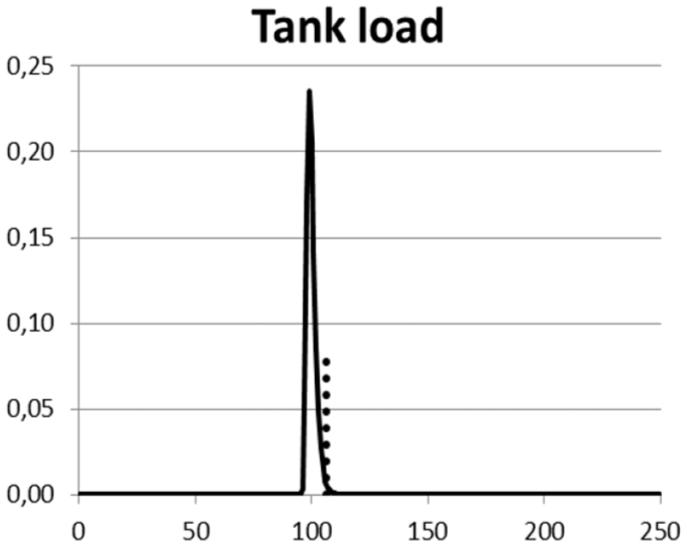
Plot of the probability density function for a Gumbel distribution (expected value = 100) with a small relative standard deviation (2%) which is typical of tank loads. The 98% quantile is 106 (marked with a vertical line).
Silos
For the particulate solids stored in and discharged from silos, a very much more complex condition occurs. Both the static and dynamic behaviours of these solids remain scientifically very unpredictable, and the simple characterisation of each kind of solid remains very uncertain. The resulting loads must be specified for different plan shapes of silos, for silos of different aspect ratios, for flat bottoms and for sloping hoppers. The discussion here is limited, for space reasons, to the loads on vertical walls of slender silos, but it should be understood that this is only one geometry and that quite different difficulties are found in other geometries.
Symmetrical pressures for filling and during storage are specified as mean values of horizontal pressure,



in which



where γ is the characteristic value of the unit weight, μ is the characteristic value of the wall friction coefficient for solid sliding on the vertical wall, K is the characteristic value of the lateral pressure ratio, z is the depth below the equivalent surface of the solid, A is the plan cross-sectional area of the silo interior and U is the internal perimeter of the plan cross-section of the silo.
Equations (2) to (7) are the equilibrium equations developed more than 100 years ago by Janssen (1895). Being equilibrium equations, they are correct and accurate to the extent that the assumptions underlying them are accurate. Unfortunately, that is not always the case as discussed later. The critically important assumptions are as follows:
Mean values of the pressures at any level may be used to define the load state;
Wall friction coefficient, μ, is constant throughout the entire silo wall;
Lateral pressure ratio, K, is constant throughout the entire silo wall;
Vertical pressure depends only on the depth below the equivalent surface of the solid;
Behaviour of the solid is entirely frictional and without cohesion.
The parameters used to characterise the particulate solid, γ, μ and K, are considered to be stochastic variables for different reasons:
γ varies as a consequence of The method of filling; Stress level in the solid; Differences in particle composition; Variations in harvests or industrial processes from time to time;
μ varies mainly due to Wear of the internal silo surface; The stress and the moisture levels of the solid; The orientations and segregation of particles caused by the filling process;
K varies mainly due to Stress–strain state of the stored material; The level of pressure; The proportion of very fine particles (dust caused by particle asperity fracture); The moisture content; Anisotropy and inhomogeneity resulting from particle shape and filling method.
The variation in these parameters is recognised in EN 1991-4 (2006) using different combinations of characteristic values (upper or lower, based 90% and 10% fractiles) in equations (2) to (7). The resulting loads for each combination satisfy equilibrium and remain correct, provided that these extreme values for the stored solid properties are appropriate. Loads on different parts of the silo (normal wall pressure, frictional drag and bottom loads) will be extreme for different combinations of extremes of the three parameters, but it will not be the same combination that leads to the extreme load on all of these parts. The critical characteristic silo load for a specific failure criterion for a particular part of the structure calls for one specific combination of extreme values of the material properties, and other combinations are needed for other parts of the silo and/or for different failure criteria.
The overall effect is to greatly reduce the risk of exceeding the chosen loads in each load case, but to make the increase in the chosen load dependent on the known variability in the measurable properties of the specific solid to be stored.
It is far from the truth to suggest that all scatter observed in pressure measurements in silos is attributable to variations in the properties of the stored solid. The reasons for the very large scatter in tests has been the main focus of research since the equations were first developed, though they have not been superseded by any alternative formulation. The chief reason is that the five assumptions identified above are not accurately fulfilled. Some of the main causes are summarised in Rotter et al. (1986) and Nielsen (1998). They mostly relate to the strength gain in particulate solids under pressure and to the different ways in which the silo may be filled, causing the mass of solid to be inhomogeneous and to behave anisotropically. This results in higher local wall pressures than those prescribed by equations (2) to (7) in some areas, while these higher values are balanced by smaller wall pressures in other areas, still maintaining the overall mean equilibrium as expressed by the equations. This potential to redistribute the load depends very much on the character of the stored material, so the specific material is critical in the identification of the variability of the loads and the partial factor that should be associated with that stored solid. Some types of coal with a substantial component of fines (clay) and a small water content, for example, may develop cohesion and thus gain a substantial strength that is not included in the frictional equations. By contrast, a stored liquid is very different with perfect isotropy, perfect homogeneity, no internal frictional strength, no cohesion and no capacity to redistribute pressures.
The extent to which this potential to redistribute the forces from a stored solid to different parts of the container walls depends on many aspects. The more important ones are (Nielsen, 1998, 2008) as follows:
Properties of the stored particulate solid;
Operating method and conditions;
Absolute size of the silo;
Geometry of the silo, of which the main features are as follows: Aspect ratio and plan form (circular, rectangular, hexagonal, etc.); Placement of the discharge outlet and any inserts within the silo; Shape of bottom (flat or a hopper or inverted cone); Type of inlet (central, periphery, with or without horizontal velocity);
Stiffness of the silo wall relative to the stiffness of the stored solid.
Some solids have been extensively studied in some types of silos, but experiments on silos containing most stored materials are unknown, and other shapes of silos have been very little studied and the loads on them rarely measured. The relationship between laboratory measurements of the relevant material properties and the resulting loads on a silo structure remains difficult to predict.
Factors introduced to arrive at characteristic loads
It is obvious that if all deviations from the pressures calculated by equations (2) to (7) are considered to be stochastic, the scatter on loads in silos will be very large, and with reference to Figure 2, this would lead to very large partial factors on loads that may be considered to be characteristic. The application of such large partial factors would render very many long serving silos to be judged as unsafe.
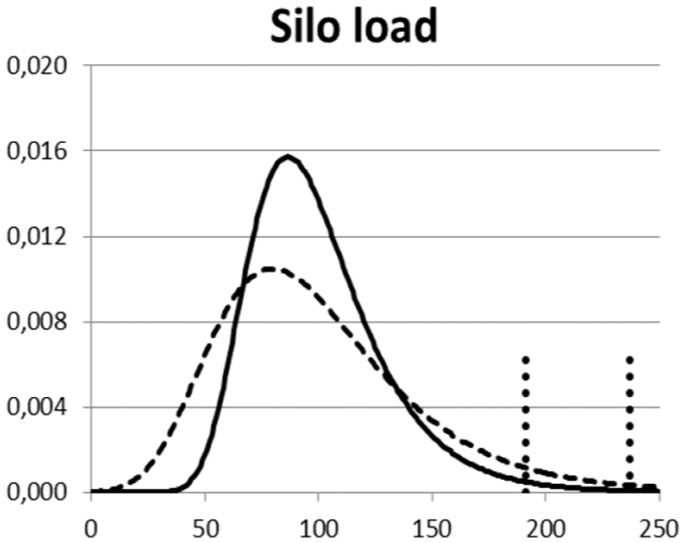
Plot of the probability density functions for Gumbel distributions (same expected value = 100) with two different relative standard deviations (30% and 45%), which may be typical for silo loads. The 98% quantiles are 191 and 237 (marked with vertical lines).
To compensate for the scientific weakness in the basic equations for silo loads, EN 1991-4 (2006) applies magnification factors on the loads calculated using equations (2) to (4) (to assess ‘discharge loads’), and an extra set of load cases, termed patch loads, with different magnification factors are used to cover the most relevant of the known deterministic effects. Some of these are based on empirical rules. The magnification factors depend on the expected potential for pressure redistribution within the stored material. This is particularly important, because it is well known that some solids are rather predictable and some others are very variable. The patch loads are used as representative loads to create load effects in different design situations (buckling, yielding, etc.).
The result of this carefully contrived treatment is that the part of the load that must be treated as stochastic becomes much smaller. Figure 2 illustrates the economic benefit produced by a reduced scatter when extreme loads are estimated. The aim is to introduce as much determinism as possible into the load assessment of characteristic loads so that the design loads, based on an evaluation of the area below the extreme part of the probability distribution tail (98% quantile), are as close as possible to the characteristic values. If all silos are designed according to a single simple load model, the scatter of possible loads would be so large that characteristic loads would lead to very uneconomic design. Such a treatment would also lead to a large proportion of existing silos being deemed unsafe, despite decades of safe use.
Discussion of current values of partial factors
For space reasons, the discussion here is limited to partial coefficients for traditional ultimate limit design.
Tanks
For tanks, the partial coefficient is currently defined (EN 1993-4-2, 2007) as 1.35, which leads to very large pressures that absolutely cannot occur on the tank walls. Each tank is designed for a specific stored liquid, and the maximum design liquid level is controlled so that it cannot be exceeded. Figure 3 illustrates the fact that the product of deterministically defined magnification factors and statistically defined partial coefficients should not exceed 1.1, and there should be no influence of how intensively the tank is filled and discharged.

Plot of the density function shown in Figure 1 with indications of 98%, 90% and 60% quantiles. The table shows the corresponding input and output data from calculations based on the Gumbel distribution for the annual maximum load.
A partial factor of 1.35 cannot serve any useful rationally justified purpose. Of course the complete reliability of a structure depends partly on the safety associated with the loads and partly on that associated with the resistance of the structure, but for tanks, the scatter associated with loads is much smaller than that associated with the structural resistance, so either an unjustifiably large part of the total safety is put on the load side or, more probably, the total safety is too large and Eurocode tank design is not competitive.
A partial factor on the tank load of 1.1 or at most 1.2 seems to be the largest justifiable value. The value 1.35 could be adopted for very exceptional circumstances where there is uncertainty about the possible stored contents or situations. But it should be clearly stated that this value is only for exceptional cases of considerable uncertainty.
Silos
For silos, the partial coefficient is currently required (EN 1991-4, 2006) to be 1.5. However, a uniform use of this value seems certain to lead both to some uneconomic designs and to some potentially unsafe designs.
Using equations (2) to (7) alone, with mean values of the particulate solid properties, the model for loads in silos will demand a partial coefficient that exceeds 3 to cover known extremes. Therefore, in EN 1991-4 (2006), magnification factors based on known physical phenomena have been used to create a load model where extreme load values are already generated as deterministic values. By doing so, the safety reflects reality, leaving less scatter to be covered by the partial coefficients. Instead of having a fixed partial coefficient of 1.5 on silo loads, it would be much better to use a smaller value and to distribute the remaining part using the biased load calculation with fractiles of the parameters for the particular stored solid, and different partial factors in the load model dependent on the geometry and design situation. This implies a differentiation of partial coefficients and/or load factors dependent on the type of facility due to
The mode of operation, especially the manner of discharge;
The interaction between the structure and its loading, which leads to different sensitivities to extreme loads (e.g. bending in flat wall silos);
The aspect ratio.
Silos and tanks are built for many different purposes, some are intensively used and some may only be discharged a few times a year. This is another situation that especially calls for partial coefficient differentiation.
The intensity of usage of a storage facility should have a bearing on the statistical quantile that is deemed to be relevant in its design. The annual maximum load on a tank is almost independent of the frequency of its use. The Gumbel distribution shown in Figure 3 applies and even the 98% quantile differs little from the mean. But silo loads differ considerably. A daily filled and emptied silo, used for 50 years, will certainly be well represented by even the 98% quantile in Figure 4 and will require a large factor to arrive at the design loads. But for silos that are used less intensively, the 90% or even 60% quantiles may be more appropriate. Only the designer of the silo can know its role and the corresponding intensity of usage, so this aspect should also be treated in the proper place where the design decisions are made, which is the loading standard EN 1991-4 (2006).

Plot of one of the density functions shown in Figure 2 with indications of 98%, 90% and 60% quantiles. The table shows the corresponding input and output data from calculations based on the Gumbel distribution for the annual maximum load.
Figure 4 illustrates silo structures that call for total factors that lie between 1.2 and 2.4, dependent on the intensity of use of the silo. These numbers will be different for other silos with another standard deviation of the distribution, but the outcome will be the same: this effect is far from negligible and is not achievable if a uniform partial factor is applied. For silos, the use of the facility must have a significant influence on the magnitude of the partial factor if the design is to be economically viable and in line with accepted practice.
The most critical observation to be made here is that the key features of a silo: the geometry, aspect ratio, stored solid and mode of usage, should all play an important part in the definition of both the characteristic loads and the partial factors to be used with them. These aspects are only definable within EN 1991-4 (2006), so it would be a helpful arrangement if EN 1990 were to define the conditions under which the silo should be designed, but leave the choice of values of partial factors to EN 1991-4.
It should also be appreciated that the variability in silo loads associated with the stored solid is only included in the design process inasmuch as it can be reflected in the variability of the measured properties on which the assessed loads are deemed to depend (equations (2) to (7)). As a result, the additional variability of behaviour in these stored solids (simple behaviour or very unpredictable behaviour) remains untreated by the magnification factors, and probably should have a place in the final determination of the partial factors. If it were decided that such a treatment should be adopted, the relevant partial factors would again need to be defined in EN 1991-4 (2006), where the difficult and easy solids could be identified, rather than in EN 1990 Annex A.4.
Conclusion
Tank loads are extremely well defined and the currently defined partial factors (
By contrast, the loads in silos are very complex and the partial factors cannot be defined on a theoretical safety concept alone, but a good basis for an engineering judgement can be achieved from different kinds of calibration studies using input parameters generated by informed professionals. Specialist knowledge of the situation for a particular class of structure, of the different behaviour of stored materials and on the planned operation of the facility is vital in defining appropriate partial factors and should be an integral part of the description of loads.
This demands that the partial factors (and load combination factors) for silos and tanks should be developed with a close cooperation between experts, where the many factors that should affect them can be defined using appropriate information. Ideally, these values should be placed in the silos loading standard EN 1991-4 (2006), where the many critical aspects leading to variability can be taken into account.
Footnotes
Acknowledgements
Professor John Dalsgaard Sørensen, Department of Civil Engineering, Aalborg University, Denmark, has kindly commented on the paper and advised on the type of density function to be used for the illustrations.
Declaration of Conflicting Interests
The author(s) declared no potential conflicts of interest with respect to the research, authorship and/or publication of this article.
Funding
The author(s) received no financial support for the research, authorship and/or publication of this article.