




Abstract
Explosive blasts from accidental or malevolent sources constitute an extreme event resulting in abnormal loads on buildings and other structures. A reinforced concrete (RC) multistorey building is assumed to be attacked by a terrorist vehicle-borne improvised device. Structural reliabilities are calculated for each RC column in the multistorey building exposed directly to the blast event. The probability of progressive collapse for the building is then estimated using system reliability analysis comprising of ground floor columns exposed to the explosive blast. The RC columns are designed according to United States blast-resistant design standard based on (i) threat dependent and (ii) alternate path design methods. The effects of threat dependent and alternate path design methods on column sizing, column reliability, and building collapse probability are investigated by conservatively assuming that collapse occurs if one or more columns fail. The robustness is also dependent on the location of the explosive. It was also found that a threat-dependent design appears to be more effective than the alternate path method in reducing building collapse risks.
Introduction
Explosive blast loading may be accidental or malevolent. Either way, there is considerable uncertainty and variability with the likelihood, intensity and damage of explosive blast loading. Airblast variability has been observed from explosive field trials when range, explosive type and mass and other factors are held constant and this variability can exceed 30% in some cases. Such variability is not unexpected, as the sudden release of energy following detonation of an explosive is a complex phenomenon with temporal and spatial variability associated with the emanation of a shock-wave.
Explosive blast loading may arise from a terrorist improvised explosive device (IED), accidental detonation of explosives or munitions, or the deployment of bombs, missiles or other weapons by the military. The variability of explosive mass and range will differ for each blast scenario. For example, the variability of explosive mass (i.e. energetic potential) for a weapon is negligible as they are manufactured to high standards. On the other hand, there is significant uncertainty about (i) the energetic properties of a home-made terrorist IED and (ii) where such a device is located (e.g. Stewart, 2018). Added to this is an understanding of the model error (or model uncertainty) associated with widely used blast load design models, such as ConWep (1991), UFC 3-340-02 (2014), as well as weaponeering software (Driels 2020).
Probabilistic and structural reliability methods underpin the development of modern codes of practice. They can also be applied to explosive blast loading. Hence, the U.S. Department of Defense Design and Analysis of Hardened Structures to Conventional Weapons Effects (UFC 3-340-01 2002) describes the benefits of performance-based or reliability-based design, which helps to ‘understand airblast uncertainty, intelligently select design loads, and conduct cost-survivability tradeoff studies’. A reliability-based design load factor (RBDF) is multiplied by the nominal load to ensure that the actual load is equal to the reliability level. A load factor greater than one increases loads resulting in safer structural designs. A risk-averse decision maker may prefer there to be 95% certainty (0.95 reliability level) that the actual blast is less than the nominal (predicted) value.
RBDFs were first proposed by Twisdale et al., (1994) for general purpose (GP) bombs where the only source of uncertainty was model error. Stewart (2018) developed an analytical model to assess RBDFs that included range, explosive mass and model errors variabilities to derive RBDFs for pressure and impulse for a hemispherical charge detonating against a reflecting surface. This blast scenario provides the basis for the design of many protective structures. The analytical RBDF model developed by Stewart (2018) involved the use of nine design charts due to the large number of combinations of range and explosive mass variabilities where closed-form solutions do not exist. Stewart (2021a) developed a simplified approach where regression equations may be used to predict airblast variability and RBDFs for all combinations of range, explosive mass and model errors for spherical free-air and hemispherical surface bursts. The benefit of this simplified approach is that Monte-Carlo or other probabilistic methods are not needed.
Previous work has focused mainly on how RBDFs affect the reliability-based design of a single reinforced concrete (RC) column exposed to terrorism threats or the accidental detonation of stored explosive ordnance (e.g. Stewart, 2019). This work is somewhat idealised, however, as (i) it assesses damage assuming the location of detonation is directly in front of the building (or column) with an angle of incidence of 0o, (ii) while a column may be heavily damaged there is no 100% surety that it will collapse, (iii) often more than one column is exposed and vulnerable to blast loading, and (iv) load sharing can occur between damaged columns. Hence, a more realistic assessment is one based on structural reliability that considers the damage and safety of all RC columns exposed to the blast allowing for variability of resistance, dead and live loads, and airblast. Hence, the present paper considers these more realistic features by assessing structural performance as an idealised structural system that considers the effect of load sharing in the estimation of probability of progressive collapse. The paper considers a terrorist VBIED scenario, and compares the effect that reliability-based design and alternate path design methods have on column sizing, column reliability, robustness and building collapse probabilities.
Stochastic approaches to blast-resistant design and damage assessment
Stochastic (probabilistic) methods have a long history for developing disaster risk reduction measures for natural hazards, safety and load rating assessment of bridges, asset management of pipelines, tunnel safety from vehicle fires, safety cases for offshore platforms and chemical process plants, reliability of electricity infrastructure, etc. (Stewart & Melchers, 1997). They also underpin the development of safety factors and design loads for civil engineering design codes and standards; for example, design wind speeds may be set with an annual exceedance probability of 1 in 1000 or 0.001.
Twisdale et al. (1994) were among the first to estimate airblast variability, in this case, based on a statistical analysis of explosive field trials consisting of GP bombs. The statistical analysis were for GP bombs with known range and explosive mass, so measured blast load variability was categorised as model error (or model uncertainty). Twisdale et al. (1994) found a coefficient of variation (COV) of 0.30 for peak pressure and 0.25 for impulse, and suggested that the high variability was due to casing effects. However, these statistics are only applicable to this weapon type, and ignore the effects of range, explosive mass, temperature, and atmospheric pressure variability. Bogosian et al. (2002) reported a COV of 0.23 for peak reflected pressure results of 190 blast tests involving TNT, C-4 and ANFO explosives for scaled distances of 1.2–15.9 m/kg1/3 (see also Bogosian et al., 2014). Campidelli et al. (2013) and Rigby and Sielicki (2014) also conducted a statistical analysis of blast test data.
Professor Hong Hao has been an early advocate of probabilistic methods for blast-resistant design and assessment. Low and Hao (2002) found that variability of peak reflected pressure was COV = 0.32 at various scaled distances in their review of available data. The other source of variability is on the resistance side, and Hong Hao and his colleagues have also published extensively in the variability of the resistance, and how blast load and resistance variability affects the reliability of RC slabs and columns (e.g. Low & Hao, 2001; Hao et al., 2010, 2016).
The work of Hong Hao and his colleagues provided motivation for Stewart (2004) being his first publication on this topic. Added to this was airblast reliability and development of RBDFs (e.g. Stewart et al., 2006, 2020; Netherton and Stewart, 2010; Stewart, 2018; 2021a; 2021b), airblast variability in complex urban spaces (Alterman et al., 2019; Marks et al., 2021), damage risks and structural reliability of RC and Ultra High Performance Concrete columns and walls, as well as glazing (e.g. Netherton and Stewart, 2009; Shi and Stewart, 2015a, 2015b; Stewart 2019, 2021b; Stewart and Li, 2021), fragmentation hazards (e.g. Sielicki et al., 2021; Qin and Stewart, 2021), and risk and cost–benefit analysis of blast-resistant design (e.g. Stewart, 2008, 2010, 2011, 2017, 2021c; Stewart and Li, 2021; Thöns and Stewart, 2019, 2020).
There is also much other work related to the use of probabilistic methods to estimate the safety and reliability of structures subject to explosive blast loading, such as Yasseri (2003), Ellingwood (2006, 2007); Olmati et al. (2014, 2017); Le and Xue (2014); Eamon (2007); Razaqpur et al. (2012); Kelliher and Sutton-Swaby (2012); Song (2020); Beck et al. (2020) and Qi et al. (2022).
Airblast variability
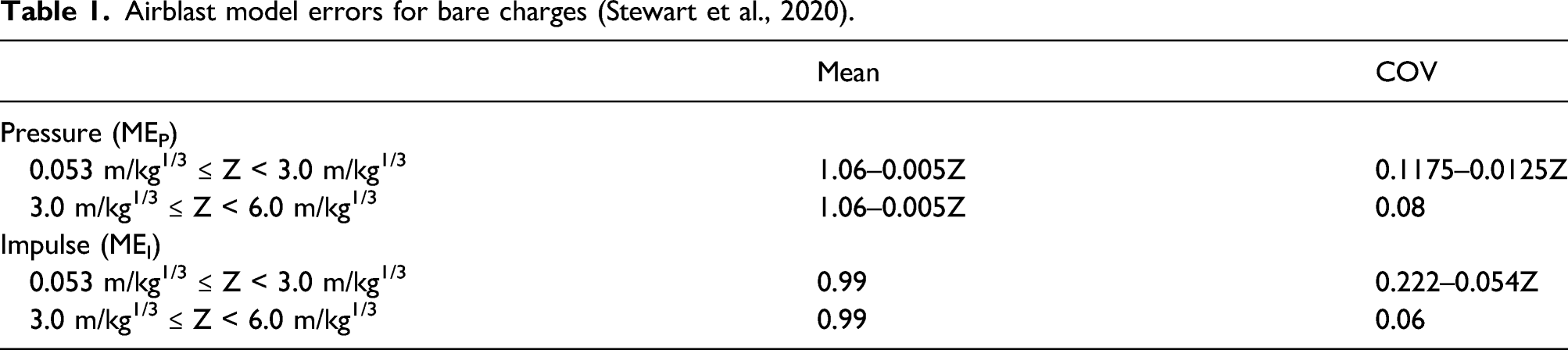
Airblast model errors for bare charges (Stewart et al., 2020).
Reliability-based design load factors
The magnitude of airblast is often normalised to be a function of scaled distance (Z=R/W1/3) where R is stand-off distance (m) and W is explosive mass (kg). The mass of explosive, range, type of explosive, angle of incidence (AOI), and air temperature and pressure will influence blast loading. However, airblast variability and RBDFs are independent of AOI, and relatively insensitive to the mean and COV of air temperature and pressure (Stewart 2018). Hence, blast load variability and RBDFs are dependent on: • nominal scaled distance Z = Rnom/Wnom1/3, • variability of range (VR) and explosive mass (VW), and • statistics of airblast model error for pressure (MEP) and impulse (MEI).
RBDFs for peak reflected pressure for VR=0.05 and VW=0.25.

It is important to note that airblast variability is mostly dominated by variability of range and model error. Variability of explosive mass has a relatively minor effect on airblast variability and RBDFs.
Damage probabilities for RC columns
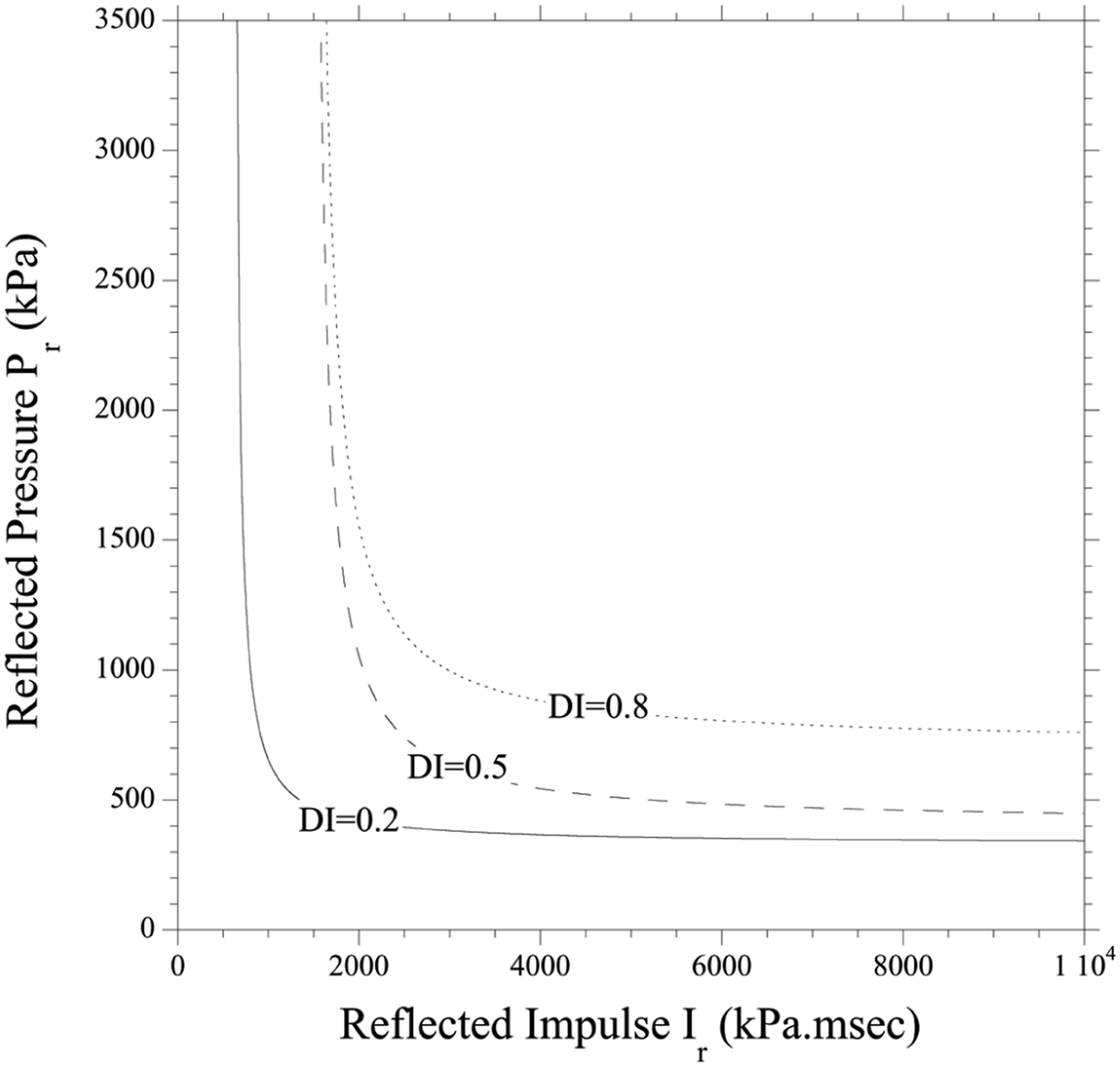
In the present paper, building damage is predicted from Pressure-Impulse (P-I) curves developed by Mutalib and Hao (2011) for far-field detonations. Figure 1 shows a typical P-I diagram for a RC column. The damage index is defined as • DI = (0–0.2) low damage • DI= (0.2–0.5) medium damage • DI = (0.5–0.8) high damage • DI = (0.8–1) collapse P-I diagrams for a RC column.
The design axial capacity for a RC column is

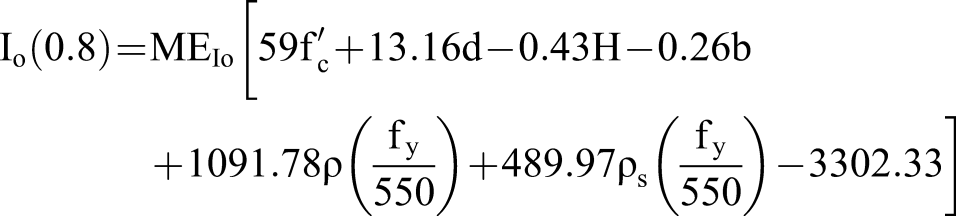
The reflected pressure and reflected impulse asymptotes for threshold of RC column collapse (DI = 0.8) are (Mutalib & Hao, 2011)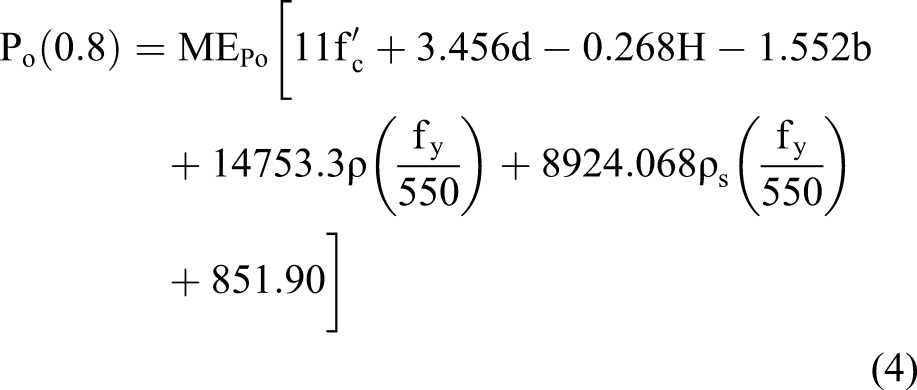
The probability of damage conditional on a hazard H (e.g. explosive blast loading) is (Hao et al., 2016)


Parameter D* is the distance to the loading point (Pr,Ir) and D is the distance to the intersection point for each P-I curve.
Case study – terrorist VBIED
VBIED terrorist scenario
The terrorist blast scenario involves a vehicle-borne improvised explosive device (VBIED) containing 500 kg of home-made grade ANFO (ammonium nitrate fuel oil). If commercial explosives are unavailable to terrorists, they will likely attempt to make home-made explosives, which will most likely exhibit considerably higher variabilities than military or commercial explosives. Terrorists in Western countries are mostly lone-wolves or self-starters (Mueller and Stewart 2016). Hence, they often lack knowledge and training, lack access to bomb making equipment, and lack the opportunity to test their product. Thus, it may be hypothesised that a terrorist produced home-made ANFO explosive will have low net equivalent quantity (NEQ) of 0.6 with lower and upper bounds of approximately 0.35 and 0.9. Mass variability might be quite high as well. If it is assumed that there is ±20% accuracy in measuring, mixing and storing the quantity of the home-made explosive. If these limits represent 95% percentile bounds of a lognormal distribution the variability of home-made ANFO may be considerable with VW = 0.25. If the VBIED is located within a car spacing of ±2.5 m tolerance then COV of R is approximately VR = 0.12 for a range of R = 10 m. The quantification of the variability of R and W is heuristic and will highlight the type of information that may be required for probabilistic analysis, for more details see Stewart (2019, 2019).
It is assumed that R, W and Z are lognormally distributed. Note that blast load variability (and hence, load factors) is expected to increase if a more realistic assessment of charge shape and orientation, casing effects, etc. are considered.
Structural configuration
The RC building is assumed to be 10 stories high. The RC columns of interest are the exterior columns – that is, those closest to the external blast loading (see Figure 2). The results to follow assume that the explosive detonates on or very near to the ground. It is thus considered a hemispherical charge detonating against a reflecting surface. The blast load is from a single uninterrupted emanation of the shock-wave, and that reflections from other structures or surfaces are not considered. All detonations are assumed to occur within air that is at 15o C and 1013.25 hPa. These assumptions provide the basis for the design of many protective structures. It is also assumed that only the outer face of the RC is exposed to the blast, as the facade will shield blast loading in the y-direction. Blast loading is calculated from the Kingery–Bulmash model that also accounts for AOI. Building layout showing 5 columns and VBIED.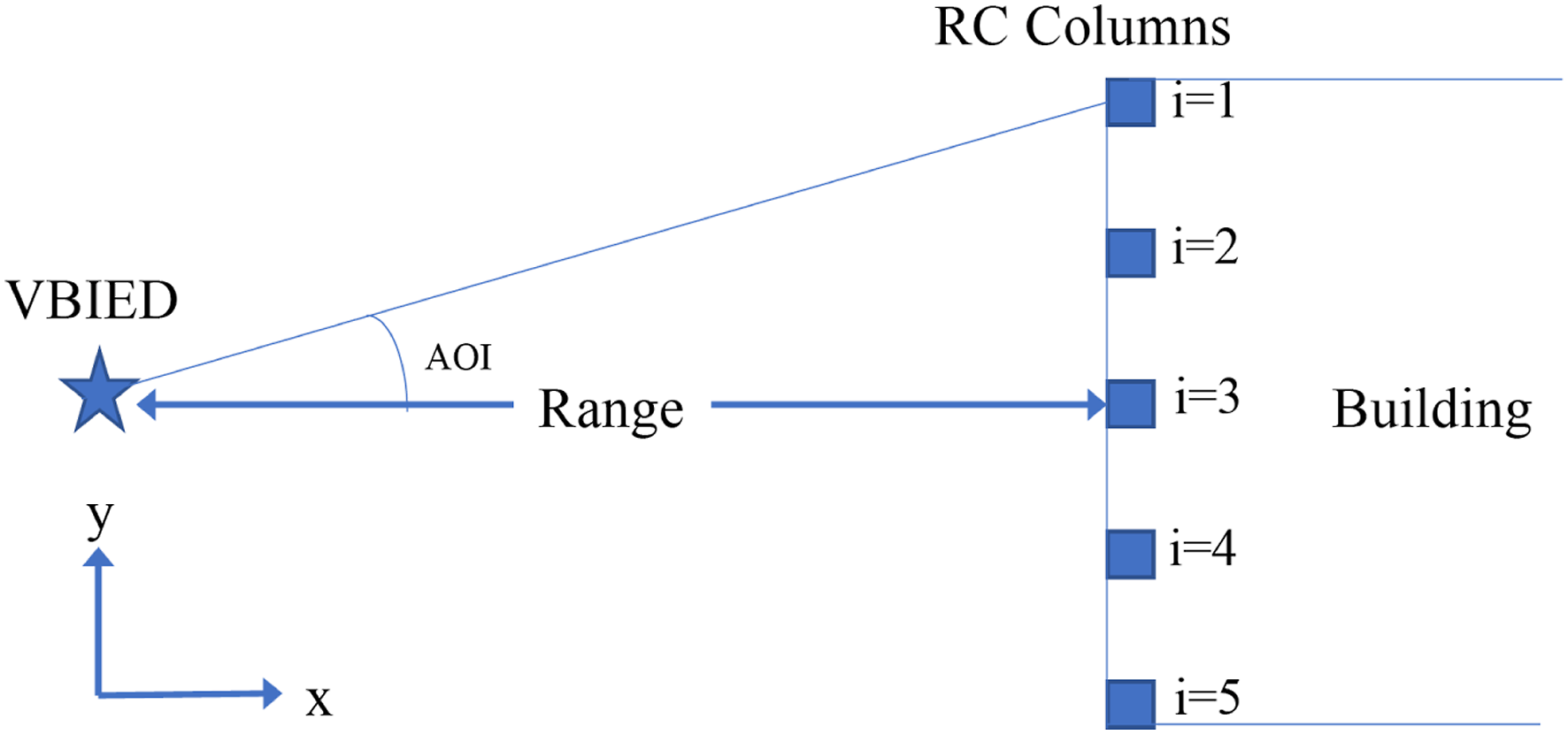
Limit states design is predicated on the concept that structural reliabilities are consistent for different structural elements and loadings, and that the reliability should exceed a target value (e.g. Stewart and Melchers 1997). Hence, a conventional RC column not designed to be blast-resistant is sized to ensure that its annual reliability does not exceed the target reliability index defined by ISO 2394 (2015). For the present design situation the failure class is large. The Joint Committee on Structural Safety Probabilistic Model Code (JCSS 2001) recommends that the relative cost of safety is medium. Hence, the annual target reliability for economic optimisation is βT = 4.4 or pf = 5.4 × 10⁻⁶. For a 50-year lifetime, this is equivalent to pf =2.7 × 10⁻⁴.

Statistical parameters for structural reliability analysis.

RBDFs, RC column sizes, and system probabilities of collapse conditional on the explosive hazard.

Blast damage and collapse probabilities
In reality, the VBIED location will be variable in x and y directions. In this case, column spacing and the overall size of the building are important. The office building is of RC construction with the perimeter of the building comprising of five RC columns at 6 m spacings (see Figure 2). The variability of range (VR) is measured along the x-axis. However, there is also uncertainty of where along the building the VBIED will be placed and detonated. A reasonable assumption is it will be desired to have it centrally placed (i.e. directly in front of the middle column) with a 95% tolerance of ±5 m leading to a standard deviation of σY=2.5 m assumed normally distributed. There is also a need to more accurately predict how column damage affects its load-carrying capacity and the probability of failure (collapse).
To assess the reliability of a RC column subject to damage from explosive loading, the actual resistance for column i is
The probability of failure given occurrence of damage is
Given occurrence of an explosive blast event (the hazard H), the probability of failure for each column i is thus
The damage index used to estimate resistance Ri given in equation (9) is linearly interpolated between the P-I curves for DI = 0.2, 0.5 and 0.8.
The COV for reflected pressure and impulse are 0.48 and 0.29 for the middle column. These high COVs are due to the variability of range, explosive mass, AOI, and model error. The mean-to-nominal resistance (mean (Ri)/Pdesign) for an undamaged RC column is 1.14 with a COV of 0.15.
Mitigation of progressive collapse
Progressive collapse can be minimised by two structural design approaches applicable to new or leased United States federal government (civilian and defence) buildings: • Threat Dependent – ‘a reduction of progressive collapse potential can be achieved either by precluding failure of load-carrying elements or by bridging over their loss. The first approach reduces the risk of progressive collapse for a defined threat by directly limiting the initial damage through hardening of structural elements’ (GSA 2016). In other words, each column is designed to be blast-resistant, for example, by ensuring compliance to US Department of Defense Structures to Resist the Effects of Accidental Explosions (UFC 3-340-02 2014). • Alternate Path – ‘reduces the risk of progressive collapse by limiting the propagation of the initial damage, without explicit consideration for the cause of the initial event, through implementation of GSA Guidelines’ (GSA 2016). This is generally achieved by ensuring that the building is stable when one exterior supporting column is removed from the structure (UFC 4-023-03 2016; GSA 2016).
Threat-dependent approach
The US Department of Defense Structures to Resist the Effects of Accidental Explosions (UFC 3-340-02 2014) is typically used for the design of RC columns subject to explosive blast loading. The RC column is not permitted to attain large plastic deformation; hence, design is based on elastic or slightly plastic action. This leads to a design damage index of DI = 0.2 (Stewart 2019). In the following examples it is assumed that blast-resistant RC columns will be designed using the Mutalib and Hao (2011) P-I curves for a damage index of 0.2.
The RC columns are designed assuming: 1. Not blast-resistant (conventional design) 2. Blast-resistant design with no load or safety factors, and 3. Reliability-based design load factors (RBDF) for 0.95 reliability estimated from the procedure described by Stewart (2018, 2021a).
It is assumed that progressive collapse occurs if at least one column fails. This is conservative. If the building is a special moment resisting frame or designed against progressive collapse it is likely that loads from the most heavily damaged column will be redistributed to adjacent columns. This will reduce collapse probabilities. However, there is no surety about the ability of a building to redistribute loads so this consideration is ignored leading to slightly conservative collapse probabilities.
Table 4 shows the RC column sizes for a conventional design, or when designed to be blast-resistant considering no load factors, or load factors associated with the 0.95 Reliability RBDFs. This assumes that the VBIED will attempt to be centred directly in front of the middle column (e.g. σY = 2.5 m). The probability of at least one column failing is modelled as a series system of five columns estimated using Monte-Carlo simulation. As expected, the collapse probabilities are very high at 73% for the conventional columns exposed to the design threat (R = 10 m, W = 500 kg - i.e. a far-field detonation). For a blast-resistant design with no load factors the collapse probability reduces to 1.4 × 10⁻³ for the design threat. This is to be expected, as a blast-resistant design should provide a reasonable margin of safety against major structural damage. Designing RC columns for a 0.95 reliability level leads to load factors of 2.26 and 1.57 for pressure and impulse, respectively. In this case, the columns are much larger leading to significantly reduced collapse probabilities. These larger columns reduce collapse risks by a further five orders of magnitude for the design threat.
Table 4 also shows that as the stand-off increases or the charge mass reduces these probabilities reduce. If the actual attack is worse than anticipated, such as a 50% reduction in stand-off, or a doubling of charge mass, the probability of building collapse can increase by at least ten-fold. As expected, collapse risks are more sensitive to reductions in stand-off than to increases in charge mass.
Damage Likelihoods and Failure Probabilities for Each Column Not Designed to be Blast-Resistant for Design Threat.

Probabilities of Collapse Conditional on the Explosive Hazard when VBIED is Uniformly Distributed Anywhere in Front of the Building.

Alternate path approach
It is assumed that loads from the most heavily damaged column will be redistributed to the adjacent columns. In this case, the Alternate Path approach would require that adjacent columns have their structural resistance to conventional loads (not designed to be blast resistant) increased by 50% to ensure safe load transfer to adjacent columns in the event of column removal. Since the structure is designed to ensure that there is no progressive collapse following the removal of one column, collapse is now defined to occur if more than one column is removed – that is, the probability that at least two columns fail. To be sure, this is a simplification of the Alternate Path method; however, it will suffice for a preliminary comparison of collapse probabilities. The probability of at least two columns failing is estimated using Monte-Carlo simulation.
Probabilities of failure conditional on the explosive hazard, for alternate path method.

It might be that to protect against progressive collapse column strength may need to be increased by more than 50% for adjacent columns to safely redistribute loads. If a 75% increase in column capacity is assumed, the collapse probability for the design threat reduces from 6.8% to 2.0%.
Hence, it appears that a threat-dependent design is more effective than the alternate path method in reducing collapse risks. To be sure, this is a preliminary finding, and needs to be validated with more detailed structural design and reliability analyses.
If the placement of the VBIED is now uniformly distributed anywhere in front of the target building, Table 6 shows that the collapse probabilities increase slightly from the case where the desired placement is more central (e.g. Table 7). As there is now an increased chance that the VBIED will not be directly in front of the central column this reduces the probability of failure of the central column. However, the probability of failure of the adjacent columns increase due to higher likelihood that the VBIED will be located further from the central column. Since at least two column failures are needed to cause progressive collapse, the probability of collapse increases.
Conclusions
The paper described how RBDFs and structural reliability methods can be applied to assessing failure probabilities for RC columns subject to explosive blast loading. Hence, the present paper predicts damage and collapse risks to a reinforced concrete office building from a large terrorist VBIED. It is conservatively assumed that progressive collapse occurs if at least one column fails. It was found that RC columns designed to be blast resistant has a building collapse probability of about 1 in 1000. This is to be expected, as a blast-resistant design should provide a reasonable margin of safety against major structural damage. However, the building collapse probability reaches close to 100% for the design threat if the building is not designed to be blast-resistant. It was also found that a threat-dependent design appears to be more effective than the alternate path method in reducing collapse risks. However, a more detailed structural design and reliability analysis is needed to validate these preliminary findings.
Footnotes
Acknowledgements
The support of the Australian Research Council Discovery Project DP210101487 is gratefully acknowledged.
Declaration of conflicting interests
The author(s) declared no potential conflicts of interest with respect to the research, authorship, and/or publication of this article.
Funding
The author(s) received no financial support for the research, authorship, and/or publication of this article.
