



Abstract
With the rapid development of computation technologies, swarm intelligence–based algorithms become an innovative technique used for addressing structural damage detection issues, but traditional swarm intelligence–based structural damage detection methods often face with insufficient detection accuracy and lower robustness to noise. As an exploring attempt, a novel structural damage detection method is proposed to tackle the above deficiency via combining weighted strategy with trace least absolute shrinkage and selection operator (Lasso). First, an objective function is defined for the structural damage detection optimization problem by using structural modal parameters; a weighted strategy and the trace Lasso are also involved into the objection function. A novel antlion optimizer algorithm is then employed as a solution solver to the structural damage detection optimization problem. To assess the capability of the proposed structural damage detection method, two numerical simulations and a series of laboratory experiments are performed, and a comparative study on effects of different parameters, such as weighted coefficients, regularization parameters and damage patterns, on the proposed structural damage detection methods are also carried out. Illustrated results show that the proposed structural damage detection method via combining weighted strategy with trace Lasso is able to accurately locate structural damages and quantify damage severities of structures.
Keywords
Introduction
During their long-term service, civil infrastructures may be slowly deteriorated in its performance, be damaged severely or even collapsed when subjected to natural disasters, such as earthquakes, flooding, and strong winds. However, they should meet the requirements of integrity, safety, serviceability, and sustainability. Structural health monitoring (SHM) technology provides a way to evaluate the integrity and safety of a structure during its service life, to ensure its serviceability and sustainability (Chang et al., 2003; Ou and Li, 2010; Yi, Kim, Go, et al. (2012a)).
Structural damage detection (SDD) is a critical part of SHM technology. In the last decades, SDD has been widespread concerned by researchers all over the world (Farrar and Worden, 2007) and numerous damage detection methods have been proposed so far. For example, the methods based on modal parameters are used to identify structural damage, including flexibility matrix (Pandey and Biswas, 1995), natural frequency (Salawu, 1997), and modal strain energy (Doebling et al., 1997; Shi et al., 1998). Usually, the model-based damage detection methods are implemented by finite element analysis (Zou et al., 2000), and it can be divided into dynamic characteristics method (Zhu et al., 2011) and model-updating method (Katafygiotis et al., 2000; Link and Weiland, 2009). Unfortunately, this method is hard to apply to complex structures because it requires finite element models (FEMs) of structures with high accuracy (Tappet et al., 1995). According to the extracted method of various response characteristics, this kind of methods can be divided into modal analysis method, frequency domain method and time domain method (Li et al., 2014; Link and Weiland, 2009). In addition to the above methods, there is another kind of SDD method, including statistics-based methods (Jiang et al., 2006; Sohn et al., 2000; Xiang et al., 2014) and time–frequency analysis methods based on dynamic responses (Fu et al., 2011; Lei et al., 2015; Yang et al., 2004).
The model-updating-based SDD is generally accepted and widely used in civil engineering. In this kind of method, the SDD inverse problem is usually transformed into mathematical constrained optimization problem (Yu et al., 2008). Nevertheless, the high-dimensional and complex optimization problems cannot be solved by the mathematical model of traditional constrained optimization methods as they are extremely complex. In order to overcome this problem, some researchers introduced swarm intelligence (SI) optimization algorithms to solve the SDD optimization problems in large-scale infrastructures (Yu et al., 2012), such as particle swarm optimization (PSO) algorithm (Chen et al., 2012), ant colony optimization (ACO) algorithm (Yu and Xu, 2011), and monkey algorithm (MA; Yi, Li and Zhang (2012b)). Whereas most of algorithms have some disadvantages, for example, PSO is easy to fall into local extreme point and it needs too long computation time, and ACO is instable for solving high-dimensional problems. Accordingly, traditional SI optimization–based SDD methods mostly focus on the improvement of the intelligent algorithm. In the past few decades, several researchers have proposed improved algorithms, such as global artificial fish swarm algorithm (GAFSA; Yu and Li, 2014), self-adaptive Firefly–Nelder–Mead (SA-FNM) algorithm (Pan et al., 2016), multi-stage particle swarm optimization (MS-PSO) algorithm (Seyedpoor, 2011), and hybrid particle swarm optimization (HPSO) algorithm (Chen and Yu, 2018). However, some improved algorithms still have drawbacks, for example, GAFSA algorithm has difficulty in determining the key parameters for SDD. Therefore, several researchers began to shift their focus to the processing of objective function by sparse regularization and weighted strategy (Hou et al., 2018; Wang and Hao, 2013b). Some studies have shown that sparse regularization and weighted strategy can enhance the deficiency of detection accuracy and robustness in SDD. For example, Tikhonov regularization (Li and Law, 2010; Weber et al., 2007), l1 regularization (Zhou et al., 2015; Hernandez, 2014), and compressive sensing (Wang and Hao, 2010, 2013a) are employed in SDD. And the objective function is weighted by Yu and Yin (2010). However, the above weighted methods have a drawback that the selection of weighted coefficients does not reach the optimal value. In addition, Tikhonov and l1-norm can be integrated into a formula proposed by Grave et al. (2011), that is, the trace Lasso. They concluded that the adaptive behavior of the trace Lasso leads to better estimation performance. And other research shows that the trace Lasso is used to regularize the basis vectors since it can benefit both from l2-norm and l1-norm (Lu et al., 2016). Therefore, the trace Lasso is introduced as an attempt to solve the SDD optimization problem in this study. A novel SDD method is proposed by combining weighted strategy with the trace Lasso for exploring a new solution to SDD optimization problem. Meanwhile, the antlion optimizer (ALO) algorithm, a novel SI-based algorithm proposed by Mirjalili (2015), is introduced to solve SDD optimization problem. The trace Lasso uses the trace norm, which is a convex replacement of the rank of the selected covariates as the criterion of model complexity. When the trace Lasso is in two special cases, it will be equivalent to
This article begins with a brief introduction of the SDD methodologies based on FEM updating, structural damage definition, objective function, and noise. Second, weighted strategy is employed to improve SDD results. The trace Lasso is then introduced with a special emphasis on the difference between considering and not considering the trace Lasso, and the difference among the trace Lasso, l1-norm, and Tikhonov regularization is also compared. After that, ALO algorithm is introduced to solve SDD optimization problem. Finally, two different numerical simulations and one laboratory experiment are utilized to verify the proposed SDD method. All illustrated results show that the proposed SDD method can accurately locate structural damages and quantify damage severities of structures.
Theoretical background
Structural damage definition
The reduction in element stiffness to simulate true structural damage is adopted in this article. The analytical structure is divided into several elements with various material constants and physical dimension based on FEM theory. SDD aims to identify the parametric change in each element. Usually, the reductions of mass and stiffness are employed to quantitatively analyze structural damages. The reduction of mass can be neglected compared to the reduction of stiffness (Pan et al., 2016). Consequently, damage model based on the linear relationship between structural global stiffness matrix and element stiffness matrix is as follows

where
Objective function definition
The objective of SDD is to define the


where

where superscript
The problem of SDD can be transformed into a mathematical optimization problem by used frequency and mode shape of vibration. If the discrepancy reached minimum, then the corresponding damage factor vector

Noise definition
In order to study the noise robustness of the proposed method, noise is added into frequencies and mode shapes as well. According to the suggestion of Messina et al. (1996) and Pan et al. (2016), the noise level is set to be 0.15% and 1%. The equation of noise contaminated in measured modal parameters is formulated as follows

where
Methodologies
ALO
The core idea of the ALO algorithm is to simulate the hunting mechanism of antlion larvae hunting ants to achieve a global seeking optimization. Before hunting, antlion larvae will dig a cone-shaped pit in sand by moving along a circular path and throwing out sands with its massive jaw and hides underneath the bottom of cone to wait for prey (this study only discusses ant). Once ants were caught into the trap, the antlion will consume it. After consuming ants, antlions throw the leftovers outside the pit and amend the trap for next hunt.
The ALO algorithm is adopted to realize the interaction between ants and antlions to optimize the problem. The random walk of ants is introduced to achieve global search, and the roulette and elite strategy are adopted to guarantee the diversity of population and the optimization performance of algorithm. The antlion is equivalent to the solution of optimization problem, and it updates and preserves the approximate optimal solution by hunting highly adapted ants. The detailed formula of the ALO algorithm can refer to the reference (Mirjalili, 2015). The ALO algorithm is introduced to the continuous optimization of SDD in the following section.
Weighted strategy
Weighted coefficients are introduced to the objective function and equation (5) is rewritten as follows

where both
Generally, weighted strategy in the objective function is rarely employed. There are a few reasons; for example, the objective function only has a modal function or inappropriate weighted strategy can be found. In this article, two weighted coefficients
Due to the above reasons, the weighted coefficients of


where

Trace Lasso
The problem of predicting

where

where l, a loss function, is used to measure the error (Grave et al., 2011) made by predicting
Lasso and trace Lasso
Grave et al. (2011) believed that the Tikhonov regularization and the Lasso penalty can be transformed into the norms of matrix
The
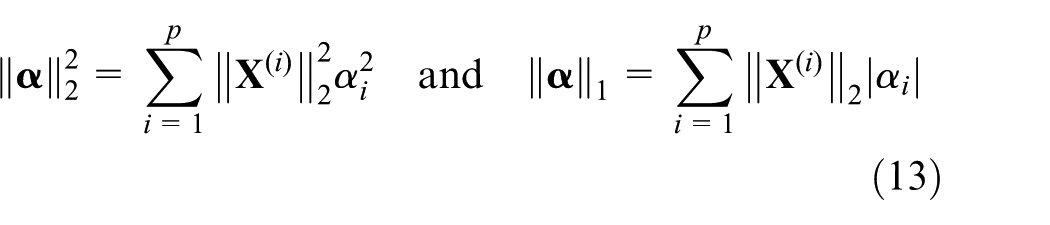
The matrix

where
Here, Grave et al. (2011) proposed a different measure of complexity which can be demonstrated to be more adapted in model selection settings (Hastie et al., 2001), and the dimension of the subspace is spanned by the selected predictors. It is equivalent to the rank of the selected predictors or also to the rank of the matrix

The trace Lasso has two significant properties: it is equivalent to the l1-norm when all the predictors are orthogonal. In another aspect, it is equal to the Tikhonov regularization when all the predictors are equivalent to
Without sparse regularization
In the ideal condition of measuring information integrity and neglecting the influence of noise, the result of the closest to real damage can be obtained by using equation (7) for SDD. However, there is no ideal condition in real engineering. Therefore, there are usually two problems in practical application:
The limited modal information and large number of parameters to be identified often lead to large errors in the damage detection equation, which leads to the deviation of detection results, that is, measurement of incomplete data leads to multiple detection results (Rahai et al., 2007). For example, using frequency to identify the damage of simply supported beam is prone to appear as false estimation in symmetric elements, which is mainly attributed to the consistent damage sensitivity of symmetric elements.
The SDD accuracy will lower if the structural responses exist noise. The SDD is a typical inverse problem in structural dynamics. The optimization problem based on structural characteristics is usually ill-conditioned, that is, small signal destabilization will bring large errors to detection results (Wu and Wang, 2011).
With trace sparse regularization for objective function
True damage usually occurs in local positions of structures, so it is sparse in physical space. Therefore, in order to enhance the accuracy of SDD, the trace Lasso is introduced to rewrite the objective function as follows

where


where
Equation (16) is the SDD equation under the trace sparse regularization condition. Compared with equation (7), the greatest advantage of equation (16) is to introduce the trace sparse regularization of the damage variable, which can not only describe the sparsity of true damages in the physical space but also improve the ill-conditioned extent of original problem and enhance noise robustness of the SDD result (Grave et al., 2011; Hou et al., 2018). In brief, the trace sparse regularization could provide a certain noise robustness and a good SDD accuracy for the proposed SDD method. Meanwhile, it should be noted that the trace Lasso will be equivalent to l1-norm and Tikhonov regularization in two special cases, respectively (Grave et al., 2011). The overall flowchart for entire methodology is shown in Figure 1.

Overall flowchart of methodology.
Numerical simulations
10-element simply supported beam
The simply supported beam is 3-m long. The beam is divided into 10 finite elements with equal length. Each element has two nodes and four degrees of freedom (DOFs). The parameters of the beam are shown as follows: elastic modulus
Advantages of ALO algorithm
In order to prove the superiority of the ALO algorithm, both PSO algorithm and firefly algorithm (FA) are compared with the ALO algorithm. Since most SI-based SDD methods are inaccurate for low damage recognition, low damages in three cases are compared using the above three algorithms. Here, only noise-free cases are considered. The damage cases are set as follows: single damage (10%@5), two damages (10%@4 and 10%@8), and three damages (10%@4, 20%@6, and 15%@8). It notes that the symbol 10%@5 indicates that there is 10% damage at element 5, similar meanings for other symbols. The parameters of three algorithms are set to be the same. The population size is 100, the max iteration number is 100, and the dimension of variable is 10. The range of damage factor is

SDD results from different algorithms: (a) element 5 damaged by 10%, (b) both elements 4 and 8 damaged by 10%, and (c) elements 4, 6, and 8 damaged by 10%, 20%, and 15%, respectively.
As shown in Figure 2, it can be seen that the SDD results in three cases by the ALO algorithm are obviously superior to the results by both PSO and FA algorithms. In addition, the false identifications of the ALO algorithm are less than that by both PSO and FA algorithms as well. Therefore, the ALO algorithm is employed to solve the SDD optimization problem in this study.
Selection of weighted coefficients
In order to prove the feasibility of weighted coefficient selection, the weighted coefficients adopted by Yu and Yin (2010) is compared with the proposed method in this article. Meanwhile, 0.15% noise is added to all cases. The specific cases and the SDD results are shown in Table 1, where
SDD results under different weighted coefficients.

SDD: structural damage detection.
Form Table 1, it can be seen that the SDD results are better when considering frequency and mode shape at the same time. If the weight of mode shape is greater, the SDD results are better. When
Selection of parameter
In order to make sparsity play the best role in the objective function, the parameter
10-element SDD results with trace sparse regularization.

The proposed method can accurately identify structural damage and damage position in this study.
When
When
Furthermore, in order to prove the advantage of adding sparse regularization in objective function, a comparative study, such as effects of noise, the trace sparse regularization, and three different sparse constraints are performed. It can be seen from Table 3 that the SDD results are better if the trace sparse regularization is considered under noise or noise free.
Effect of with and without sparse constraints on SDD results.

A comparison on the SDD results for
Meanwhile, the parameter
Effect of different sparse constraints on SDD results.

SDD results under different damage cases
Different damage cases and the SDD results are set as listed in Table 5. And the SDD results in cases 4 and 5 are shown in Figure 3. Two damages, three damages, the asymmetric damage cases, and the symmetric damage cases are considered here. Five cases are identified by the proposed method, and the regularization parameter is
SDD results under five cases.


SDD results in two symmetric damaged elements for (a) case 4 and (b) case 5.
From Table 5, it can be seen that the ALO algorithm based on the weighted strategy and the trace Lasso can accurately locate damages and quantify damage severities even after adding noise. It can be seen that when the noise level is 0.15%, there is only one misidentification in case 4. However, there are several misidentifications in each case when the noise level is 1%. It shows that the higher the noise level, the more the misidentifications. Meanwhile, it can also be seen that the SDD results in the strong damage case are better than those in the weak damage case in this study. However, the weak damage is more sensitive to noise than the strong damage. In addition, it can also be concluded that the SDD results in single-damage cases are better than those in multiple-damage cases when noise level is 0.15% and 0%. And cases 4 and 5 are symmetrical damage cases, and the results have complementary trend on damage elements when the noise is free. This confirms the conclusion that the symmetrical element of simply supported beam has the same damage sensitivity.
As shown in Figure 3, it can be seen that although there are several misidentifications in cases 4 and 5 when the noise level is 1%, these misidentifications are obviously lower than the simulated true damage especially in case 5 which includes strong damage of 10%. And the identified damage severities are lower than the true ones when adding noise. In addition, it should be noted that a complementary trend on the damage severities is occurred among the false identifications at both sides of the damage elements and damage elements. All results show that the higher the noise level, the greater the impact on the SDD results. Nevertheless, the proposed method can accurately locate the damage and precisely quantify the damage severity in this study. It indicates that the proposed method has a good robustness to noise in this study. Taking all the SDD results into consideration together, it can be concluded that all the SDD results are sparse and the damage severities in major elements are slightly lower than the simulated true damage under five cases. This is because that the SDD results based on the sparse regularizations belong to the bias estimation.
20-element simply supported beam
20-element FEM for the simply supported beam is considered as well. In addition to the weighted coefficients and the regularization parameter

SDD results under different cases: (a) element 3 damaged by 10%, (b) both elements 3 and 18 damaged by 10%, (c) elements 3 and 15 damaged by 15% and 20%, respectively, and (d) elements 3, 10, and 15 damaged by 20%, 25%, and 15%, respectively.
From Figure 4, when noise is contaminated in modal responses, the SDD accuracy declines slightly, but the proposed method can still accurately locate the damage elements and quantify the damage severities. Although some misidentifications occur in each case especially in the cases containing the weaker damage, these misidentifications are obviously lower than the true damage. Moreover, the highest misidentifications happen near to the damaged elements and two supports of the beam; however, they still cannot lead to a large enough misidentification to the SDD results for all cases. It shows that the SDD results are highly accurate for all cases, which indicate that the proposed method can accurately identify the true damages of the structure even when the number of structural elements increases to be of 20 in this study.
Experimental verifications
Experimental setup
In order to assess the validity and feasibility of the proposed method for SDD, a simply supported beam with box-section is designed and fabricated in laboratory, and some different crack damage cases are also designed. The length of steel beam is 3 m and dimensions of its section are 0.14 m in width and 0.06 m in height with thickness of 0.003 m. Experimental setup is shown in Figure 5, and more details of excitation point and measuring point arrangements can be seen in Chen and Yu (2018). In order to record acceleration responses and force time histories, acceleration sensors and force sensor are fixed at the corresponding locations. In the process of SDD, all the SDD parameters for the proposed method are taken as the same as previous. More details of the experiment can be seen in the reference as well (Chen and Yu, 2018).

Experimental setup.
Model updating
The initial physical properties of the steel beam can be set up as the beam of numerical simulations. Only the first three frequencies and mode shapes between original FEM and experimental beam are adopted and shown in Table 6, in which Exp and FEM mean experimental and FEM results, respectively. It shows that the discrepancy in frequencies between experiment and FEM enlarges with the increase in the mode order. It means that the physical characteristics of the beam should be updated to adapt the real structure. Contrary to the theory of vibration, the bearing of the beam cannot perfectly simply support. This means that the stiffness of bearing should be updated together.
Modal parameter comparison between FEM and experiment before and after model updating.

FEM: finite element method.
In view of the above problems, the final decision is to update four parameters, including flexural rigidity EI, linear density
Parameters before and after updating.

SDD of steel beam
As shown in Figure 6, the structural damage can be created by cutting the cross section of the beam. The extent of real damage is estimated by reducing the extent of beam stiffness (Pan et al., 2016). The reduced stiffness can be approximately calculated by changing the inertia moment, and the equation is as follows

where


where


Experimental cutting diagram for making damage: (a) cross section used to approximately estimate true damage severity and (b) cutting seam.
In addition to the regularization parameter
Four damage cases and corresponding measured frequencies.

The SDD results are shown in Figure 7. It can be seen that the proposed SDD method can accurately locate structural damages and quantify damage severities under four cases. Although there occur some false identifications at healthy elements in cases 3 and 4, false identifications are obviously less than the true damage values. It can confirm that the proposed SDD method is reasonable and effective to a certain extent. Furthermore, comparing with all results, the SDD results at elements 2 and 8 are all lower than the true damage severities. The reason is that the estimation method of true damage severities is an approximate method (Pan et al., 2016). Anyway, we are performing further studies by crack function model and will confirm whether or not this approximate method will estimate the true damage too highly. Moreover, the SDD results in case 4 show that the damages at elements 2 and 8 are almost equal. This is because the depth of corresponding cracks in two elements is the same, and it shows the sound SDD results to a certain extent. Therefore, the proposed SDD method by combining weighted strategy with the trace Lasso in the study is effective and feasible.

SDD results under four cases: (a) element 2 damaged by 70.1%, (b) element 2 damaged by 95.2%, (c) elements 2 and 8 damaged by 95.2% and 70.1%, respectively, and (d) both elements 2 and 8 damaged by 95.2%.
Conclusions
In this study, a novel SDD method via combining weighted strategy with the trace Lasso is proposed. First of all, the SDD inverse problem was transformed into a constrained optimization problem in mathematics according to the FEM updating principle, and the objective function on the SDD optimization problem was defined by the structural modal parameters. The weighted strategy and the trace Lasso were further introduced into the objection function. After that, the ALO algorithm was employed to solve the SDD optimization problem. Numerical simulations on simply supported beam with 10 and 20 finite elements and experimental investigations on simply supported box-section beam were carried out to make a full realization to the proposed SDD method with a novel updating strategy in SDD. Some conclusions can be made as follows:
The proposed SDD method via combining weighted strategy with the trace Lasso is feasible and effective.
The selection method for both weighted coefficients and regularization parameter of the trace Lasso involved in the SDD objective function is reasonable, and the proposed method can be applied to the SDD optimization problem based on model-updating theory.
The proposed SDD method can accurately locate structural damages and quantify damage severities in different damage cases. Even if the measurement noise is added, the SDD results are still satisfactory. It shows that the trace Lasso provides the proposed SDD method with a certain noise robustness and a good SDD accuracy.
Four different crack damage cases are made on a steel simply supported box-section beam in laboratory to verify the proposed SDD method in dealing with SDD of real structures. It is found that the proposed SDD method can detect the structural damages under four cases, and the first three measured modal parameters are sufficient to identify crack damages in simply supported beam.
Although the proposed SDD method can accurately detect the structural damages simulated in this study, much work remains to be done in near future. The possibilities in application of the proposed method into more complex structures are still to be explored. The rational effects of higher level noise on the proposed method need further investigation. Greater efforts must be made to apply incomplete modal parameters in practice. In addition, a better design matrix
Footnotes
Declaration of Conflicting Interests
The author(s) declared no potential conflicts of interest with respect to the research, authorship, and/or publication of this article.
Funding
The author(s) disclosed receipt of the following financial support for the research, authorship, and/or publication of this article: This work was jointly sponsored by the National Natural Science Foundation of China with grant numbers 51678278 and 51278226, respectively.
