



Abstract
Although empirical formulas have been provided in relevant design code for estimating wind loads and wind-induced responses on square high-rise buildings, the effects of corner modification treatments on wind loads and wind-induced responses of square high-rise buildings need to be evaluated quantitatively. In this study, wind pressure measurements for a benchmark square high-rise building and three corner modified square high-rise buildings were first carried out to acquire the spatial-temporal varying pressure distributions. Moreover, the corresponding full-scale finite element models were established in ANSYS software to get their dynamic properties. Combined with wind tunnel test results and modal analysis, wind loads and wind-induced responses of the four square high-rise buildings were calculated and compared for designing the best aerodynamic treatment of reducing wind effects on square high-rise buildings. This article aims to provide visual comparisons of wind effect reduction for structural designers and owners of square high-rise buildings.
Introduction
Modern high-rise buildings are very sensitive to dynamic wind-induced excitations due to their excessive heights and application of lightweight materials. How to estimate the wind loads and wind-induced responses on high-rise buildings has always been a great concern of wind engineering researchers (Davenport, 1995; Gu and Quan, 2004; Kareem, 1992; Liang et al., 2004; Simiu, 1976; Solari, 1985). It has been widely recognized that wind effects on high-rise buildings are mainly decided by geometrical shape, dynamic properties of buildings, and terrain category. Reduction of wind effects can bring great financial profits to the clients during construction of high-rise buildings (Tse et al., 2009). Since aerodynamic treatments for high-rise buildings (such as corner modifications, tapered, and openings) are very effective for the reduction of wind loads and wind-induced responses, a large amount of studies have been carried out on this field in recent years based on wind tunnel tests or computational fluid dynamic (CFD) simulations (Dutton and Isyumov, 1990; Elshaer et al., 2014; Kawai, 1998; Kim and You, 2002; Li et al., 2017; Tanaka et al., 2012; Xie, 2014). However, the previous studies almost focused on the non-dimensional characteristics of wind loads in terms of force coefficients, power spectral densities, and span-wise correlations. There is a need to visually compare the wind loads and wind-induced responses on different high-rise buildings with aerodynamic treatments, which will be more efficient for the structural designers and clients to understand the benefits of aerodynamic treatments.
Since square section has been widely used for architectural and structural design of high-rise buildings due to its simple and symmetrical horizontal shape (Kareem and Cermak, 1984), an experimental testing has been carried out in a boundary layer wind tunnel for four different square high-rise building scale models. Moreover, the corresponding finite element (FE) models have been established by ANSYS software. Based on wind tunnel tests results and the dynamic properties obtained from FE models, wind loads and wind-induced responses including along-wind, across-wind directions, and torsional moment have been calculated in frequency domain respectively and compared with the results of the representative square high-rise building. The purpose of this article is to assist wind engineers and structural designers directly by understanding the benefits of aerodynamic treatments and the findings will be useful for the prediction and vibration control of wind loads and wind-induced responses on square high-rise buildings.
Wind tunnel experiment
Wind tunnel experiments were carried out in a boundary layer wind tunnel to acquire spatial-temporal varying pressure data on scale models of four different square high-rise buildings. The wind tunnel has a working section of 21 m long with a cross-section of 4.0 m wide by 3.0 m high. The exposure category C specified in the Loads Standard Code of China (GB50009-2012, 2012) was simulated at a length scale of 1/500. Figure 1 shows the condition of the approaching turbulent boundary flow with a power law exponent of
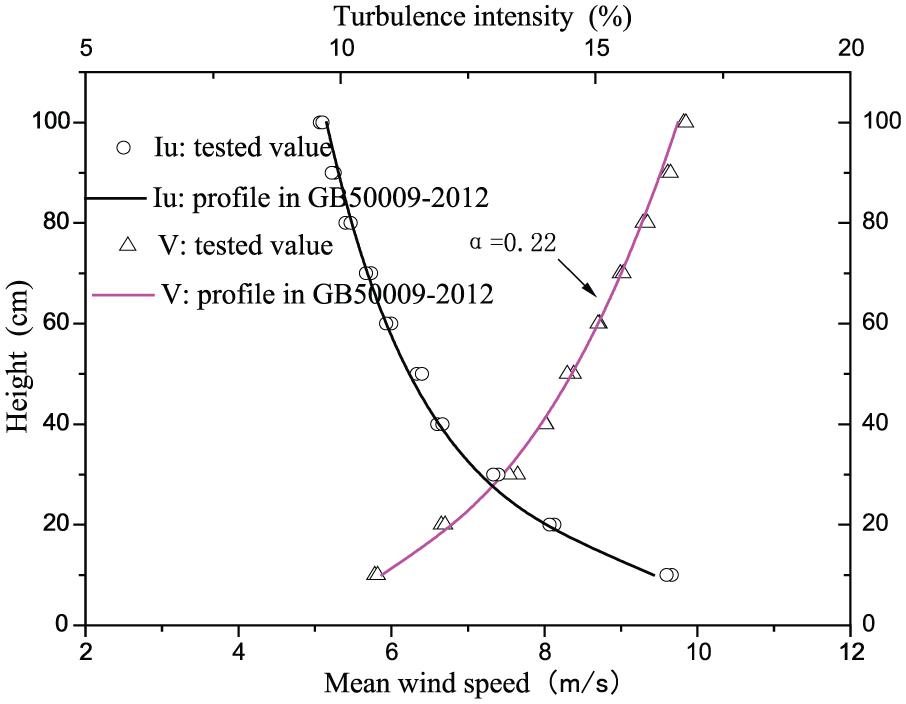
Flow conditions of wind tunnel experiment.
The synchronous multi-pressure sensing system (SMPSS) technique was applied to measure wind pressures on the rigid models. There are four scale models used for the pressure measurements. The representative model is a square cylinder with width of 0.1 m and height of 0.8 m, giving an aspect ratio of 8.0. Due to the 1/500 geometric scale of the wind tunnel experiments, the heights of the high-rise buildings are 400 m in full scale. It has been proved that 10% is the best optimization corner cut rate for wind effect reduction of tall buildings (Miyashita et al., 1993). Therefore, three similar square models with 10% corner modification including recessed, chamfered, and rounded were designed and tested to compare the wind loads and wind-induced responses on square high-rise buildings. The test models used for the pressure measurements are listed in Figure 2. Each model in the test was unevenly divided into 12 measurement levels in the vertical direction. There are a total of 432 pressure taps for square and recessed models, while 384 pressure taps for chamfered and rounded models. The representative square model in wind tunnel test is shown in Figure 3.
First three natural frequencies.

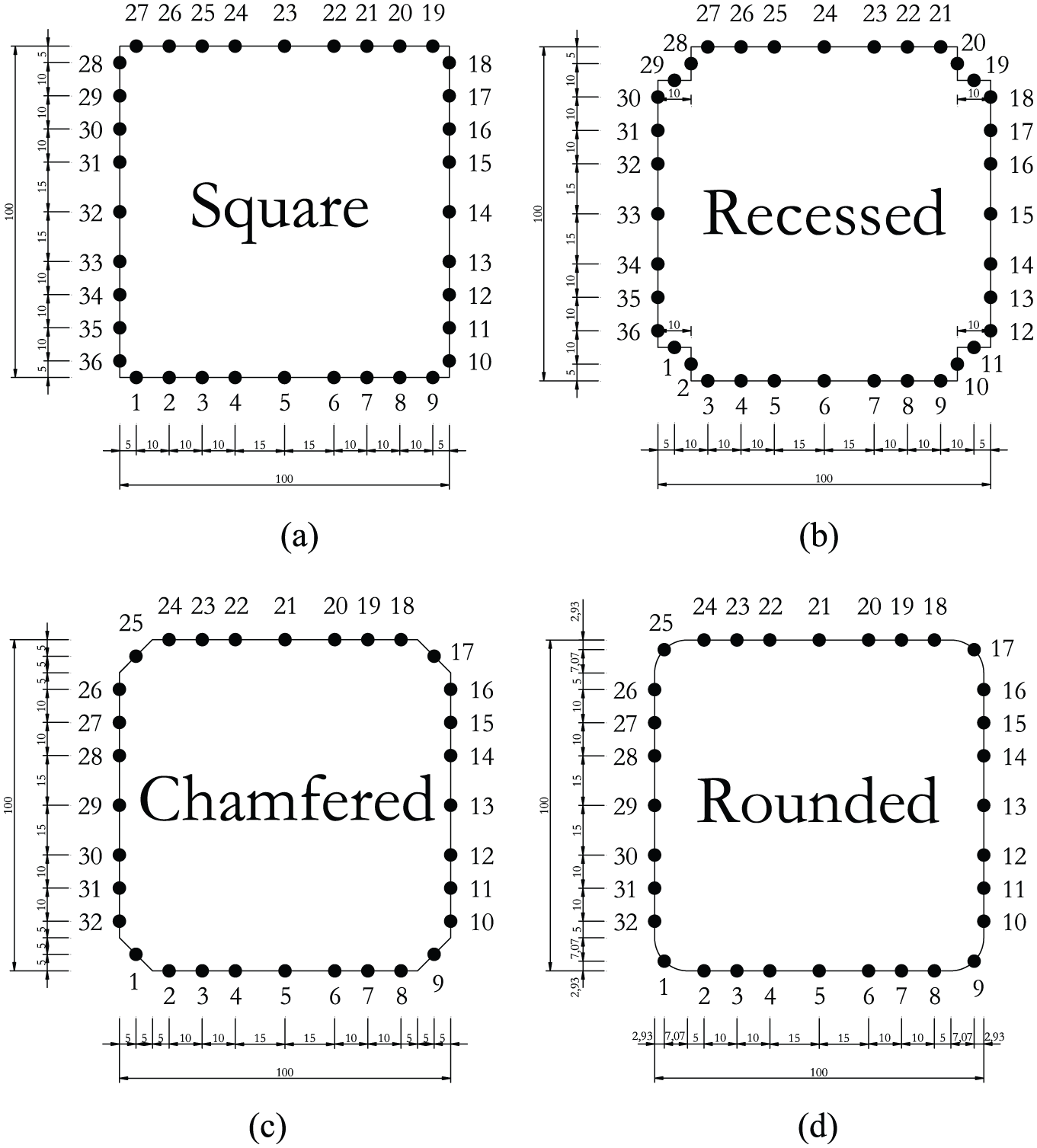
Test models for pressure measurements: (a) square, (b) recessed, (c) chamfered, and (d) rounded.
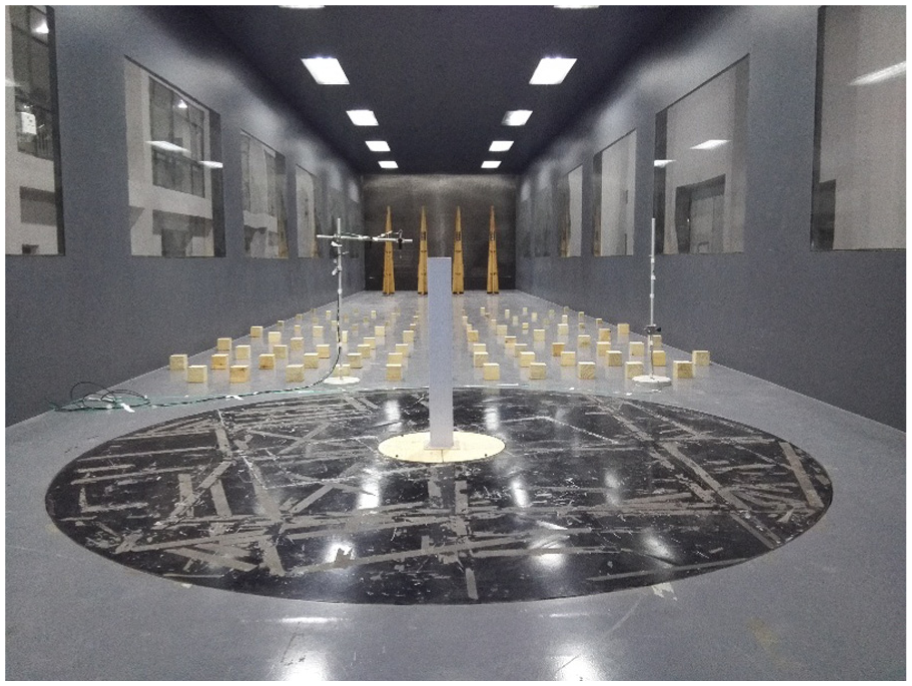
Representative square model in wind tunnel.
Each pressure tap was connected to one of the 64 ports of a PSI pressure scanner made by Scanivalve, Inc. (USA) with a PVC tube of length 100 cm. Numerical compensation was employed to correct the tubing effects before data processing. The maximum blockage ratio was 0.67% and no corrections were made for the blockage effects. Pressure measurements on the models were conducted for wind direction from 0° to 90° at an interval of 5°. Figure 4 shows the definition of wind forces on building models. The data sampling frequency was set to be 333 Hz and the sampling length was 30 s.
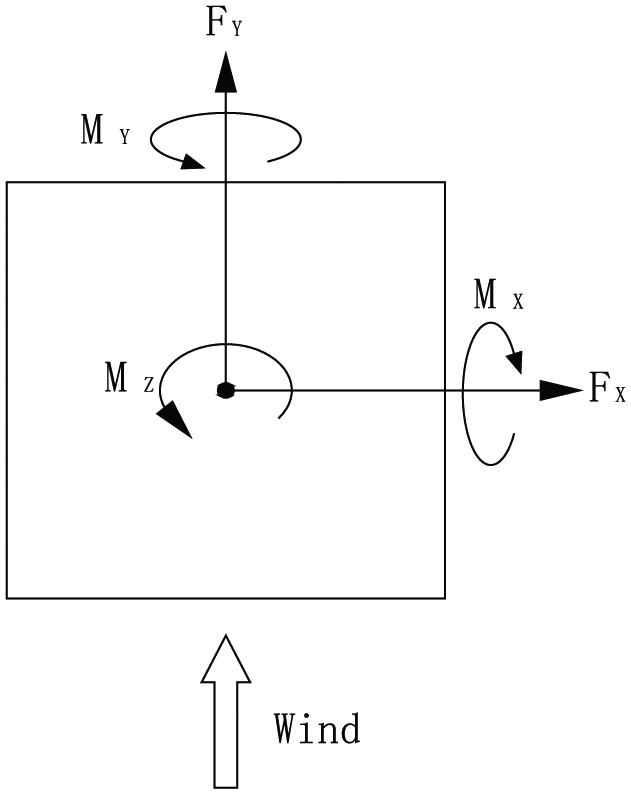
Definition of wind forces.
FE model simulation
The dynamic properties of structures are of significance for the estimation of wind loads and wind-induced responses on high-rise buildings (Vickery et al., 1983). In order to get the dynamic properties of the high-rise buildings for calculating wind loads and wind-induced responses in frequency domain, four 80-story reinforced concrete high-rise buildings corresponding to the scale models in wind tunnel experiments were simulated using ANSYS software. The external geometry and the structure layout of high-rise buildings are shown in Figure 5. The height of the buildings is 400 m, and their structural systems are frame core-tube structure. The floor height of each FE model was set to be 5 m. Three-dimensional (3D) beam elements with six nodes were employed for columns and beams. The floors and shear walls were modeled with shell elements. The sizes of each structural member were adjusted so that the first translational natural periods are very close to H/67 (Tamura, 2012). The connections between the structure and its foundation were assumed to be fixed. The rigid floor hypothesis was adopted for the structural analysis.
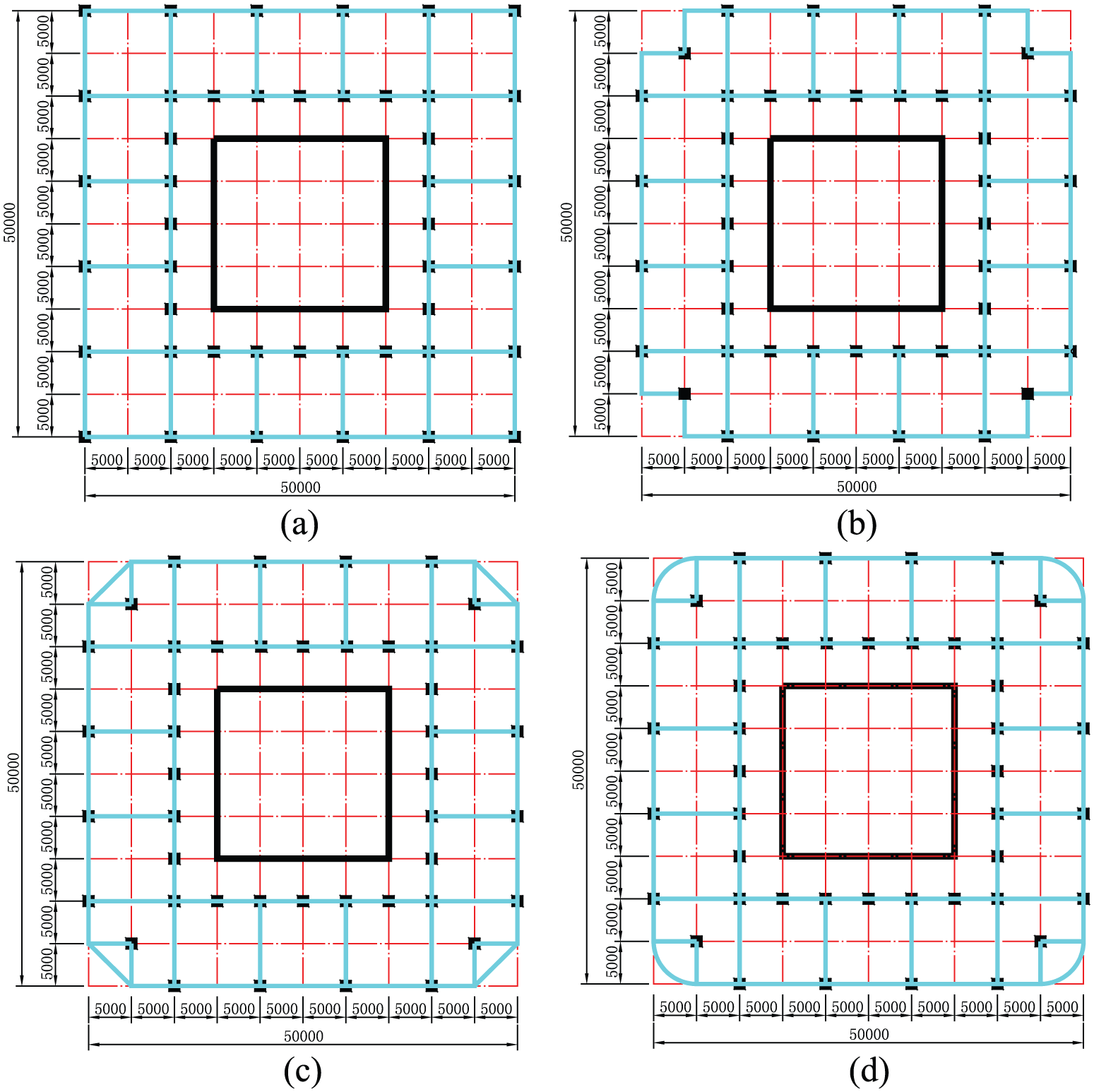
Structural layout (unit: mm): (a) square, (b) recessed, (c) chamfered, and (d) rounded.
Design wind pressure with a return period of 50 years at 10 m height is assumed as
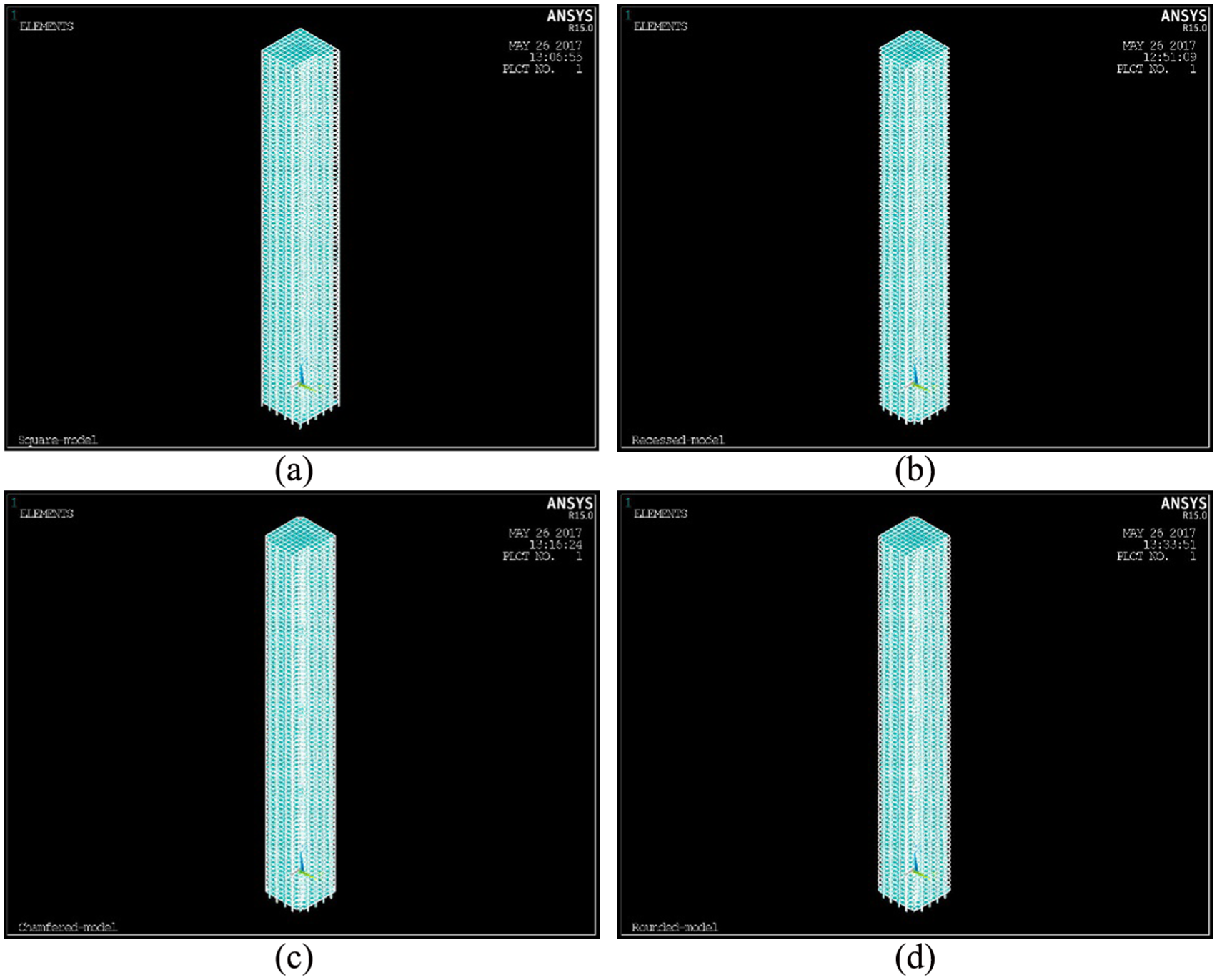
3D view of four FE models: (a) square, (b) recessed, (c) chamfered, and (d) rounded.
Results and discussions
The mass distributions, natural frequencies, and mode shapes of the four different square high-rise buildings were obtained from the FE models by eigenvalue analysis. The total masses are 1.549 × 10⁵, 1.534 × 10⁵, 1.552 × 10⁵, and 1.554 × 10⁵ kN for square, recessed, chamfered, and rounded FE models, respectively. Wind tunnel test arrangements and detailed results including wind pressure distributions, wind force coefficients, power spectral densities, and vertical correlation coefficients are presented and analyzed in Li et al. (2018). Combined with the wind tunnel test results, wind loads and wind-induced dynamic responses of high-rise buildings can be calculated accordingly. Wind effects on high-rise buildings can be divided into three components including along-wind, across-wind loads, and torsional moment. Since the approaching flow perpendicular to the windward is the most unfavorable for wind resistance of square high-rise buildings (Li et al., 2018), hereby only the results at wind direction of 0° were presented in the following discussions.
Dynamic properties
Natural frequency
Natural frequency is one of the most important parameters for describing the dynamic characteristics of high-rise buildings. Wind-induced dynamic responses are mainly dominated by the fundamental modes along the three orthogonal principal directions (Huang and Chen, 2007). Therefore, the first three natural frequencies of the four FE models are presented in Table 1. It can be found that the first two natural frequencies of each FE model are very close to each other due to the symmetrical sections of the models. The first natural frequencies of the four models are all very close to the recommended value (Tamura, 2012). 10% rate corner modifications have little influence on the first three natural frequencies of square high-rise buildings.
Base moments.

Mode shape
The mode shapes of three corner modified high-rise buildings are almost the same as those of the representative square high-rise building. Therefore, only the first three mode shapes of the representative square high-rise buildings are presented in Figure 7. The mode shapes were normalized to 1.0 at the top floor for each model. The empirical expressions suggested in the existing code (GB50009-2012, 2012) and literature (Liang et al., 2002) were also provided for discussion. It can be seen that the 3D mode shapes are composed of the X and Y translation components and the rotation component around Z axis. The first mode is primary to the translational motion in Y direction, the second mode is primary to the translational motion in X direction, and the third mode is primary to the torsional motion about the vertical axis. Mode shape of Y direction in the first mode has been demonstrated to be the same as the mode shape of X direction in the second mode. The translational motion mode shape adopted in the design code is larger than those obtained from the FE model at the lower part of building, implying that estimation of the along- and across-wind loads on the basis of the empirical expressions of mode shape will lead to conservative results for wind-resistant design of square high-rise buildings. The torsional mode is often ignored by wind engineers and structural designers for its complication and small contributions for wind effects. The torsional mode shape curves obtained from the FE model in Figure 7(c) also show that the torsional mode shape of square high-rise buildings does not change exponentially with the elevation. The empirical formulas fitted by Liang et al. (2002) are not proper for estimation of the torsional moments on square high-rise buildings.
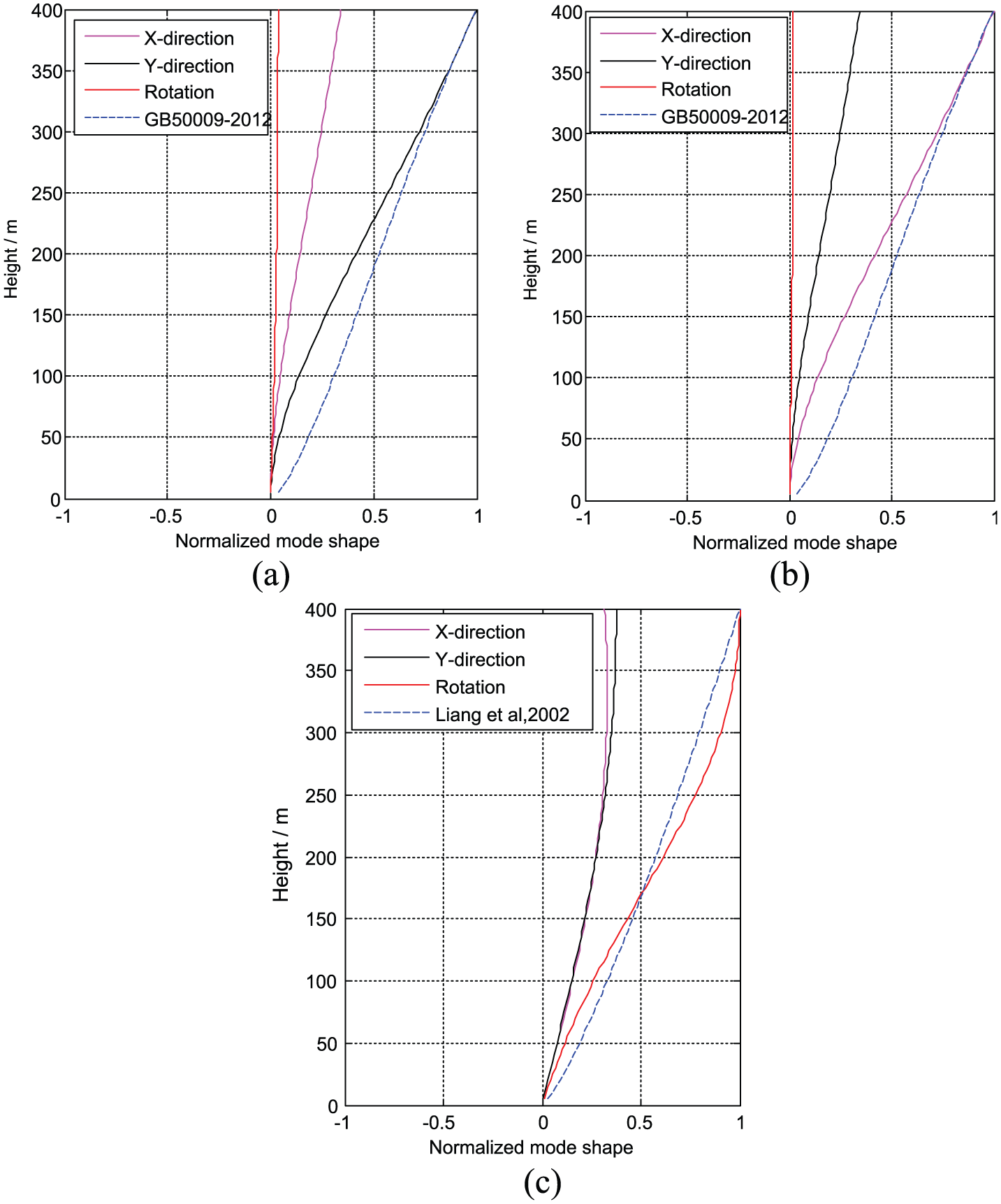
First three mode shapes of square high-rise buildings: (a) first mode, (b) second mode, and (c) third mode.
Wind loads
Wind loads on high-rise buildings are composed of two lateral components (along-wind and across-wind) and torsional moment. The along-wind loads of high-rise buildings can be theoretically analyzed by the gust factor approach (Davenport, 1995). However, it is quite difficult to estimate the across-wind loads and torsional moment of high-rise buildings by analytical approaches due to their complex mechanisms. Although empirical formulas for estimating such non-steady wind loads have been proposed in the design code (GB50009-2012, 2012), wind tunnel tests combined with random vibration theory is still the most effective and reliable method to evaluate the dynamic across-wind loads and torsional moment of high-rise buildings. In this section, wind loads on the four square high-rise buildings will be integrated in frequency domain on the basis of the wind tunnel test results and dynamic properties obtained from the FE models. Based on the assumption of fundamental modes, the shear force

where


in which
Due to the normal external shape and even mass distribution, wind loads of square high-rise buildings including along-wind, across-wind, and torsional direction can be evaluated by the empirical formulas of Chinese design code; hereby the wind loads calculated by the empirical formulas are also provided for verification and comparison.
Along-wind
Along-wind loads on high-rise buildings are divided into mean, background, and resonant components. According to the formulas stipulated in Chinese design code, the mean wind loads

where
The fluctuating wind loads

in which
Once the mean wind loads

Figure 8 shows the comparisons of along-wind loads at wind direction of 0°. As shown in Figure 8(a), the mean along-wind loads of square high-rise building integrated by wind tunnel test results are consistent with those calculated by the design code, indicating the formulas stipulated in the design code are available to estimate the mean along-wind loads on square high-rise buildings. The mean along-wind loads of square high-rise buildings are greatly reduced after corner modifications. The largest reductions have been found by corner chamfered, while the smallest reductions have been found by corner rounded. This trend is similar to the change of the mean drag coefficients (Li et al., 2018). It can be seen from Figure 8(b) that the trend that the fluctuating along-wind loads calculated by the design code varied with elevation keeps the same as the variation of mode shape, which is caused by the mode shape assumption for calculation of the background component factor. Moreover, the fluctuating along-wind loads calculated by the design code are obviously smaller than those integrated from wind tunnel tests from about the 30th floor. Corner modifications can also reduce the fluctuating along-wind loads of square high-rise buildings. ESWLs are available for structural design of high-rise buildings. Comparisons of ESWLs between the corner modified high-rise buildings and the representative square high-rise buildings are more visual for the structural designers and clients to understand the wind load reductions of aerodynamic treatments. As shown in Figure 8(c), ESWLs calculated by the design code are smaller than those obtained from wind tunnel tests, implying the estimation methods for fluctuating along-wind loads in the Chinese design code will lead to less conservative results. Corner recessed and chamfered treatments can further reduce the along-wind ESWLs of square high-rise buildings.
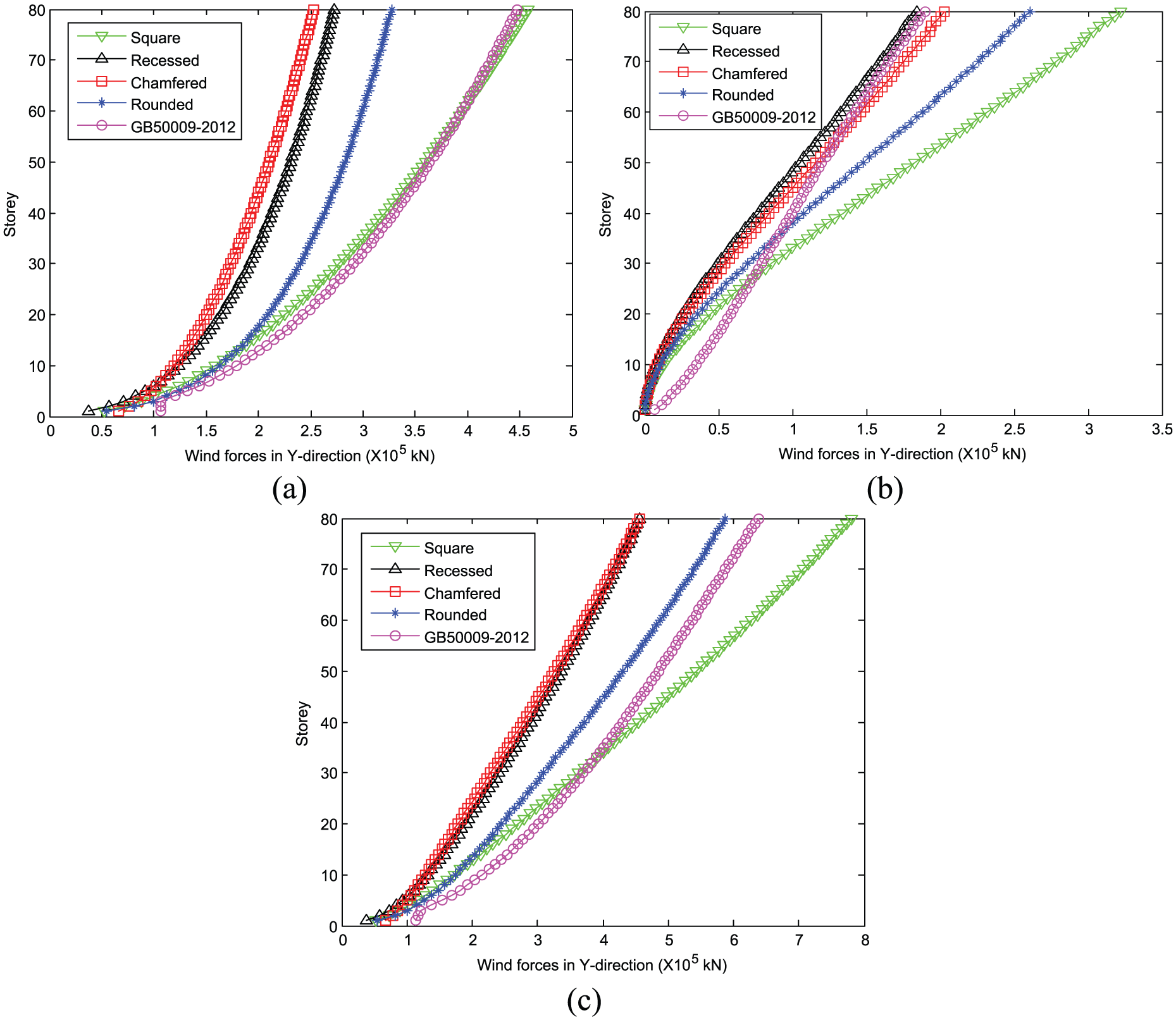
Comparisons of along-wind loads: (a) mean wind loads, (b) fluctuating wind loads, and (c) equivalent static wind loads.
Across-wind
The across-wind loads have been found to be larger than the along-wind loads in previous wind tunnel tests (Gu and Quan, 2004). Since the mean across-wind loads are almost equal to zero when the approaching flow is perpendicular to the windward, the across-wind ESWLs

where
Comparisons of across-wind loads at wind direction of 0° are illustrated in Figure 9. It can be observed that the across-wind ESWLs of square high-rise building calculated by the design code are larger than those integrated by wind tunnel test results under about 50th floor and become smaller as the height increases. Corner recessed can furthest reduce the across-wind ESWLs of square high-rise building. Reduction of across-wind ESWLs caused by corner rounded is smallest among the three corner modification treatments.
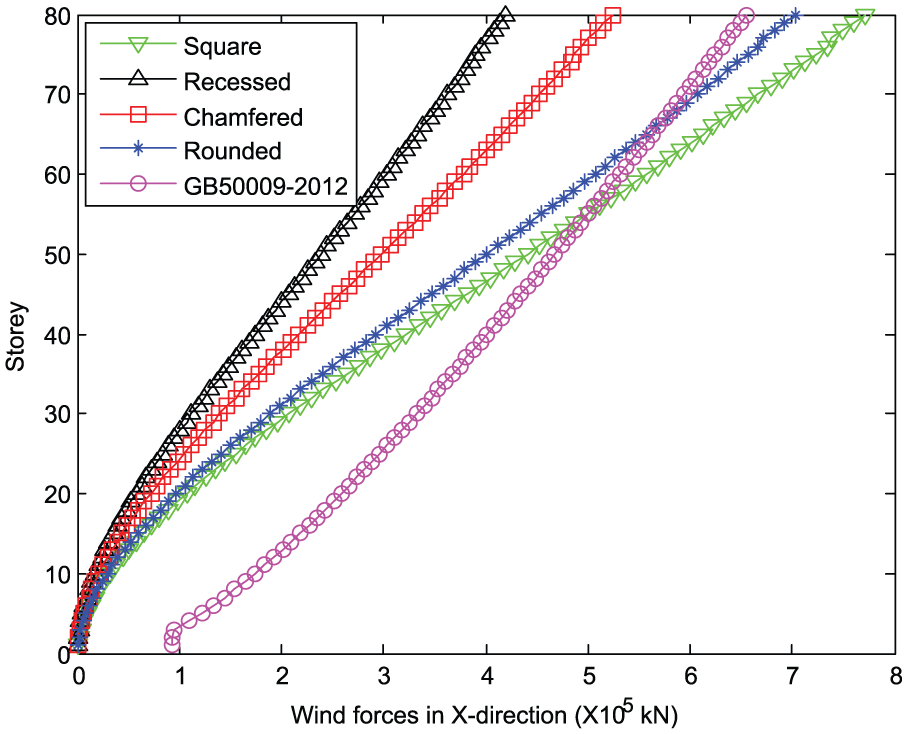
Comparisons of across-wind loads.
Torque
Although wind-induced torques are usually smaller than along-wind and across-wind loads on the symmetric sectional high-rise buildings, it should not be ignored for the enlarged uncomfortable rotations near the peripheries of buildings caused by wind-induced torsional vibration (Talllin and Ellingwood, 1984). The effects of corner modifications on the wind-induced torques have rarely been reported. Therefore, wind-induced torques on square high-rise buildings will be discussed based on the Chinese design code and wind tunnel test results. The torsional ESWLs

in which
Figure 10 presents the comparisons of wind-induced torques of four different models. Empirical formulas in the design code severely underestimated the torsional ESWLs of square high-rise building. Corner recessed can reduce the torsional ESWLs of square high-rise building effectively. However, corner rounded even enhance the torsional ESWLs of square high-rise building, which should be paid attention during the structural design.

Comparisons of wind-induced torques.
Base moments
Base moments caused by wind excitations are very important for the design of building foundation. The reductions for base moments will save construction cost in the foundation treatment design. Table 2 illustrates the base moments of four high-rise buildings. The numbers in the bracket of the three modified buildings indicate the effects of different corner modification treatments. As shown in the table, corner chamfered is the best optimization method to reduce along-wind base moments, Mx, with a reduction of 0.40. Corner recessed is the best optimization treatment to reduce across-wind base moments, My, with a reduction of 0.46. Corner recessed is also an effective way to reduce the torsional moment. Corner rounded shows disadvantage for torsional moments of square high-rise building.
Wind-induced responses
Displacement
Wind-induced displacements of high-rise buildings may result in damage to the nonstructural partitions. It is well known that lateral displacements caused by winds are much larger than torsional displacements, especially for high-rise buildings with regular and symmetrical shape (Li et al., 2014, 2017). Therefore, only the lateral wind-induced displacements are considered in this study. According to the stipulations in the design code for high-rise buildings in China (JGJ3-2010, 2010), lateral wind-induced displacement at the top of the buildings should be limited to 1/500 H. In order to get the wind-induced displacements of the four square high-rise buildings, the ESWLs integrated by wind tunnel test results were applied to the mass center of each FE model. The wind-induced displacements were acquired directly from the static solution in ANSYS workbench.
Figure 11 shows the comparisons of wind-induced displacements among the four high-rise buildings. All the corner modification treatments can reduce the wind-induced displacements at X and Y directions. The optimization effects of corner modifications on wind-induced displacements of square high-rise building keep the same trend as those of the ESWLs.
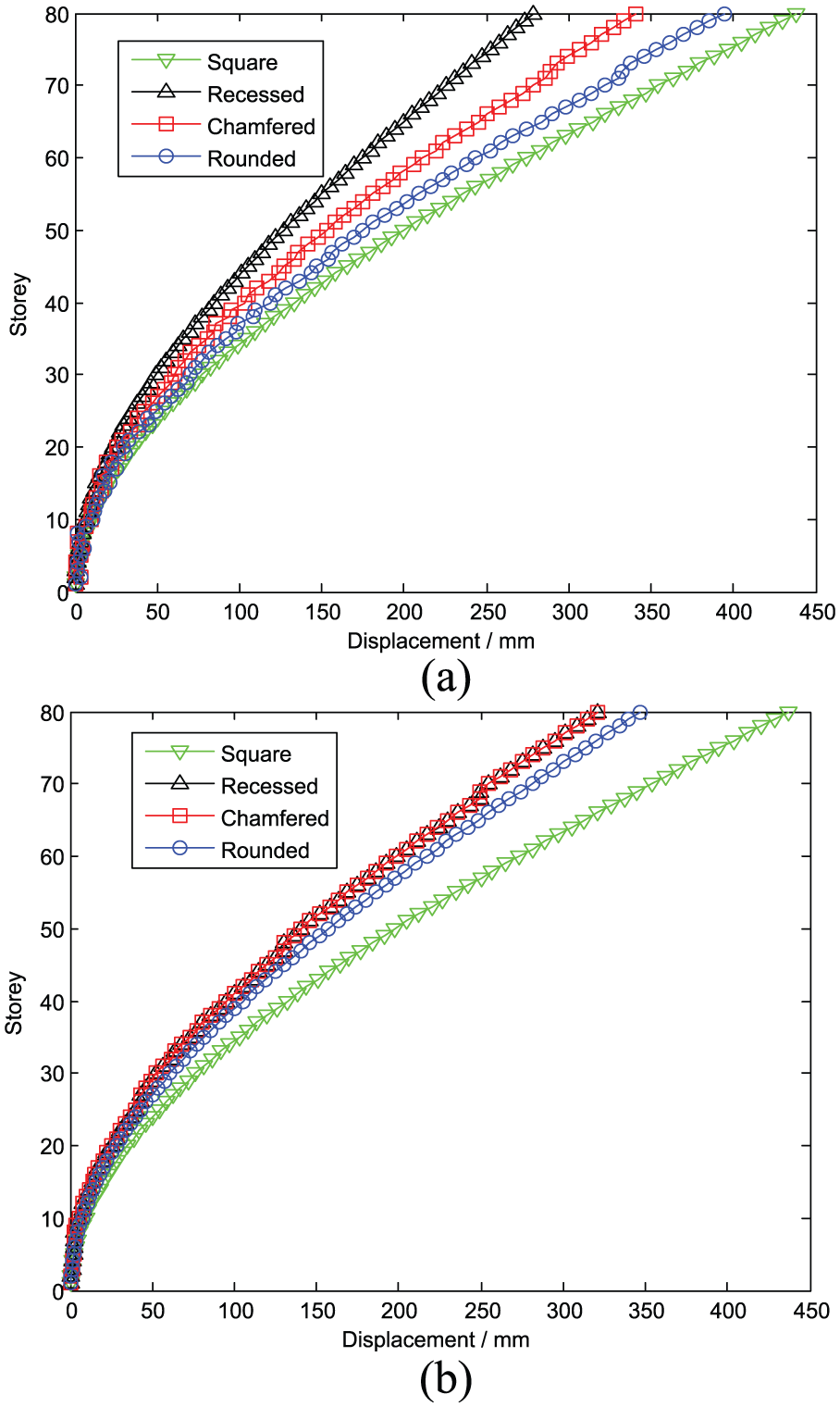
Comparisons of wind-induced displacements: (a) X direction and (b) Y direction.
Wind-induced acceleration
Occupants in high-rise buildings are more sensitive to wind-induced accelerations rather than displacements. The maximum wind-induced accelerations of along-wind and across-wind directions on the top floor of high-rise buildings are limited to 0.15 and 0.25 m/s2 for residential buildings and office buildings, respectively (JGJ3-2010, 2010). In order to compare the effects of corner modification on the wind-induced accelerations of square high-rise building, the vertical profiles of wind-induced accelerations for 10-year return period design wind pressure are presented in Figure 12. Wind-induced accelerations calculated by the empirical formulas in the design code are also provided for verification and comparison.
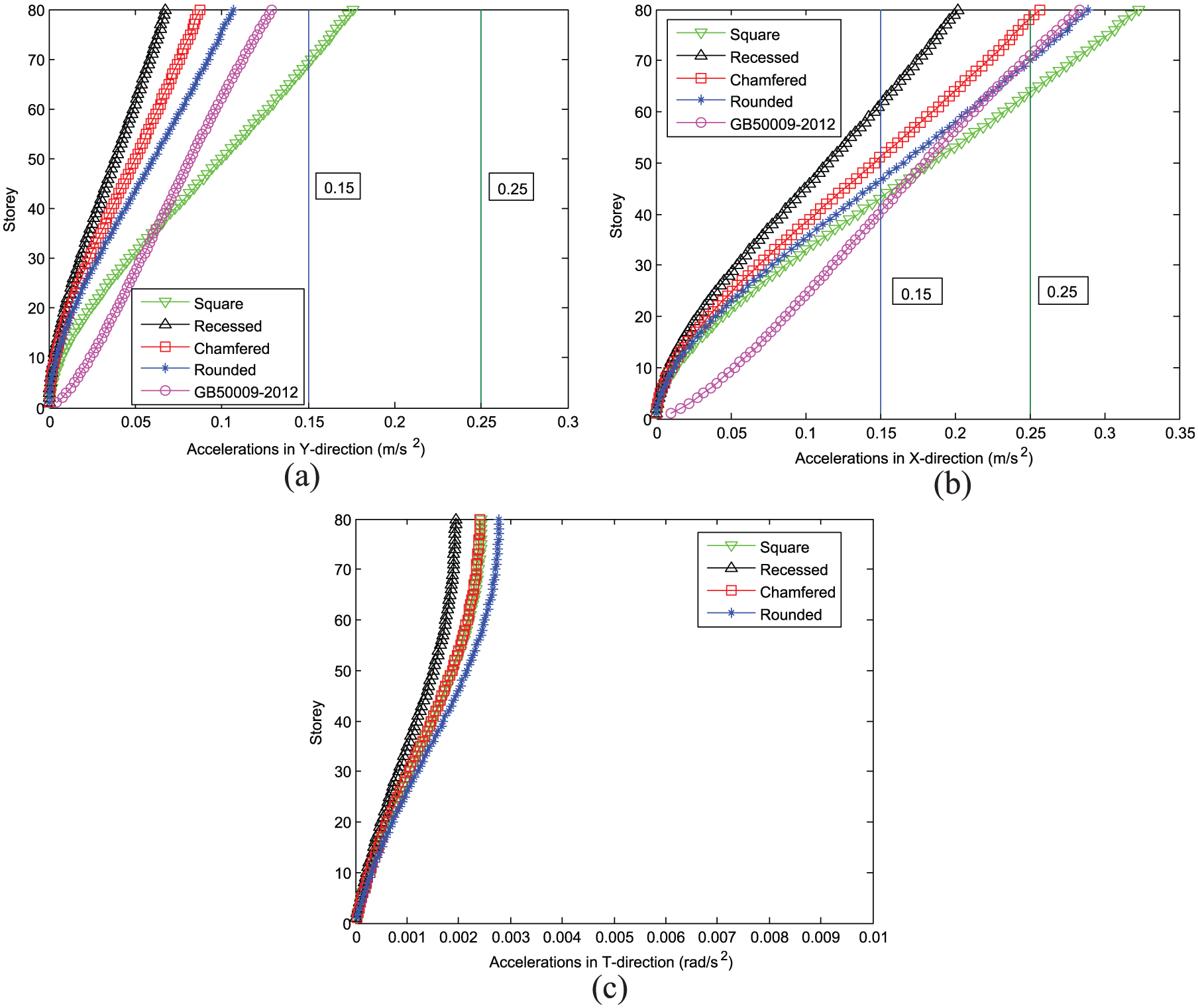
Comparisons of wind-induced accelerations: (a) along-wind direction, (b) across-wind direction, and (c) torsional direction.
As shown in Figure 12, the along-wind-induced accelerations of square high-rise buildings integrated by wind tunnel test results are larger than those calculated from empirical formulas in the design code from about 35th floor, and even exceed the limitation for residential buildings from about 70th floor. Across-wind-induced accelerations of square high-rise buildings are obviously larger than along-wind directions, indicating the across-wind vibration is the key factor for the comfort design of similar high-rise buildings. Due to the inadequate stiffness, the across-wind-induced accelerations of square high-rise buildings calculated from empirical formulas in the design code even exceed the limitation for office buildings from about 70th floor. The wind tunnel tests show that the across-wind-induced accelerations of square, chamfered, and rounded high-rise buildings are larger than 0.25 m/s2 at the top of the buildings. Wind-induced torsional accelerations are much smaller than those in along-wind and across-wind directions. In general, all the three corner modifications can reduce the along-wind- and across-wind-induced accelerations of square high-rise building effectively, of which the corner recessed is the best aerodynamic treatment and the corner rounded is the worst one. Corner rounded will result in the enlargement of the torsional wind-induced accelerations of square high-rise building.
Conclusion
Wind pressure measurements and FE analysis were conducted for a benchmark square high-rise building and three corner modified square high-rise buildings. Modal analysis, wind loads, and wind-induced responses of the four different square high-rise buildings are analyzed and compared at the most unfavorable wind direction. The empirical formulas in the design code are also provided for verification. The main conclusions of this study are summarized as follows:
Minor corner modifications have little influence on the first three natural frequencies of square high-rise building.
Mode shapes are very essential to evaluate wind loads and wind-induced responses of high-rise buildings. Simplified empirical expressions for mode shapes may lead to conservative estimation of along-wind and across-wind loads on square high-rise buildings. The torsional mode shape of square high-rise buildings does not change exponentially with the elevation.
The empirical formulas in the design code for estimating the along-wind and across-wind ESWLs on square high-rise buildings are unsafe at the upper half part of the buildings. The torsional ESWLs will be severely underestimated by the empirical formulas in the design code.
The three corner modification treatments can effectively reduce the wind loads of square high-rise building. Among them, corner chamfered is the best aerodynamic treatment for reduction of along-wind loads with a reduction of 0.40 for base moments. Corner recessed is the best aerodynamic treatment for reduction of across-wind loads and it can reduce across-wind base moment with a reduction of 0.46. Corner rounded can enhance the torsional ESWLs of square high-rise building, which should be paid attention during the structural design.
The optimization effects of corner modifications on wind-induced displacements of square high-rise building keep the same trend as those of the ESWLs. All the three corner modification treatments can reduce the along-wind- and across-wind-induced accelerations of square high-rise building effectively, of which the corner recessed is the best aerodynamic treatment and the corner rounded is the worst one.
Footnotes
Declaration of Conflicting Interests
The author(s) declared no potential conflicts of interest with respect to the research, authorship, and/or publication of this article.
Funding
The author(s) disclosed receipt of the following financial support for the research, authorship, and/or publication of this article: The work described in this paper was fully supported by the grants from National Nature Science Foundation of China (project nos: 51708207, 51508183, 51578236, and 51578237) and a grant from the Research Grants Council of Hong Kong Special Administrative Region, China (project no.: CityU 11256416). The first author is very grateful to the State Scholarship Fund supported by the China Scholarship Council (CSC).