



Abstract
Background
The significant feature of the remote field ECT method is that the two coils that consist of the ECT probe, the excitation and search coil, are separated by twice of the testing pipe outer diameter. Consequently, the probe length increases and makes it difficult to insert into the bent part of the testing pipe.
Object
This paper aims to propose a compact probe design for the RF-ECT with ferromagnetic shield rings and to verify effects of reducing the probe length and its compact design on detection sensitivity.
Method
This research, three types of eddy current testing probe ware fabricated, and their detection performance was compared based on their detection sensitivity. Furthermore, nonlinear eddy current analysis using the 3D finite element method was employed to analyze the effect of ferromagnetic rings on detection sensitivity.
Result
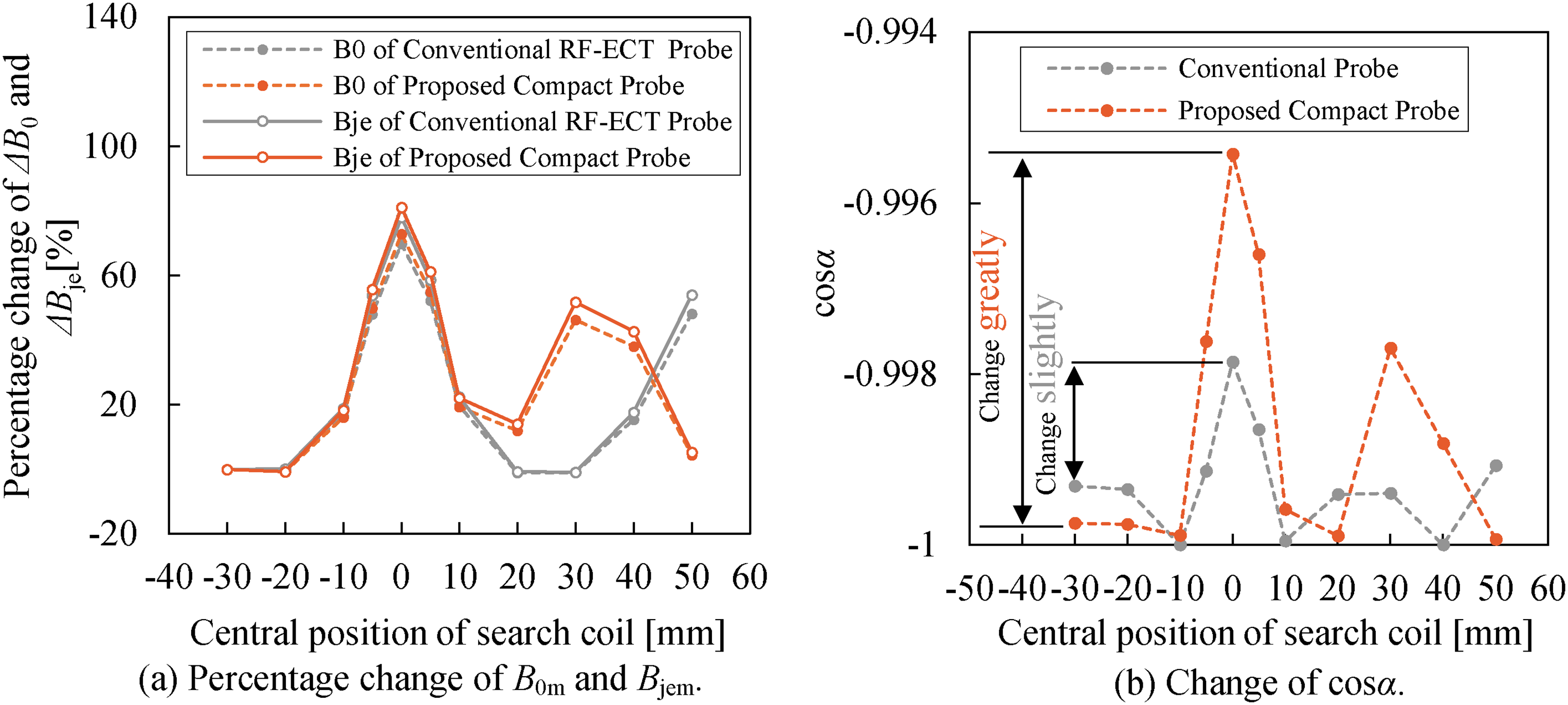
In the measurement result, ferromagnetic rings that combined into the RF-ECT probe makes the probe length decrease. In addition, the detection sensitivity of proposed probe is significantly improved compared to the conventional RF-ECT probe. According to the results of FEM analysis, it was found that the change of the phase angle between the average flux density in the search coil due to the excitation current and due to the eddy current increased compared to the conventional RF-ECT probe, and it contributes to improve detection sensitivity.
Conclusion
This research investigated the effects of the proposed probe with ferromagnetic rings on probe length reduction and defect detection sensitivity to make the remote field eddy current testing probe compact. This research does not require an ethical statement.
Introduction
A remote field eddy current testing (RF-ECT) method is one of the non-destructive maintenance methods using a magnetic field and eddy current. This method is known to be effective for outer defect inspection of small-diameter, ferromagnetic pipes such as heat transfer steel pipes. The RF-ECT method is a mutual induction-type eddy current testing method that uses two coils, an excitation coil and a search coil, and it has the significant feature that the distance between the coils is set to about twice the pipe outer diameter.1,2 However, due to this feature, it causes the RF-ECT probe length to increase and makes it difficult to insert it into the bent part of pipes. Because these issues cause dead zones during inspection, the RF-ECT method has not gained widespread adoption in industry. In previous research, FEM analysis has shown that placing thin shielding plate and ferromagnetic rings simultaneously inside and outside the pipe, respectively, can improve detection sensitivity. 3 However, when the inspection target is equipment with structural constraints, such as multi-tube heat exchangers, it is impractical to place the ring on the outside of the inspection pipe. In this research, we focused on the magnetic shielding effect of rings and investigated the compact probe design by incorporating rings into the interpolation inspection probe.
Model and method
Measurement model and conditions
Figure 1 shows the proposed electromagnetic probe for RF-ECT with ferromagnetic rings inside a ferromagnetic pipe. The steel pipe is STB340SC steel specified in JIS with an artificial external defect. The pipe length is 460 mm, and its inner and outer diameters are 15 mm and 19 mm, respectively. The electromagnetic probe consists of an excitation coil, a search coil, and four ferromagnetic rings. The ferromagnetic ring is S45C steel specified in JIS and it has a thickness of 2 mm, an outer diameter of 13 mm and an inner diameter of 6 mm. In this research, three types of electromagnetic probe are fabricated, and comparative experiments are carried out to verify the detection ability of the probes. The first probe is the proposed compact probe shown in Figure 1(a). The second probe is a conventional RF-ECT probe, which has a long probe length because the distance between the excitation and the search coils is twice the pipe outer diameter, that is 38 mm. The third probe is a simple compact probe, which is a short probe with a reduced distance between the excitation and the search coils without a ferromagnetic ring. The distance between the coils of the proposed compact probe and the simple compact probe is 19 mm.
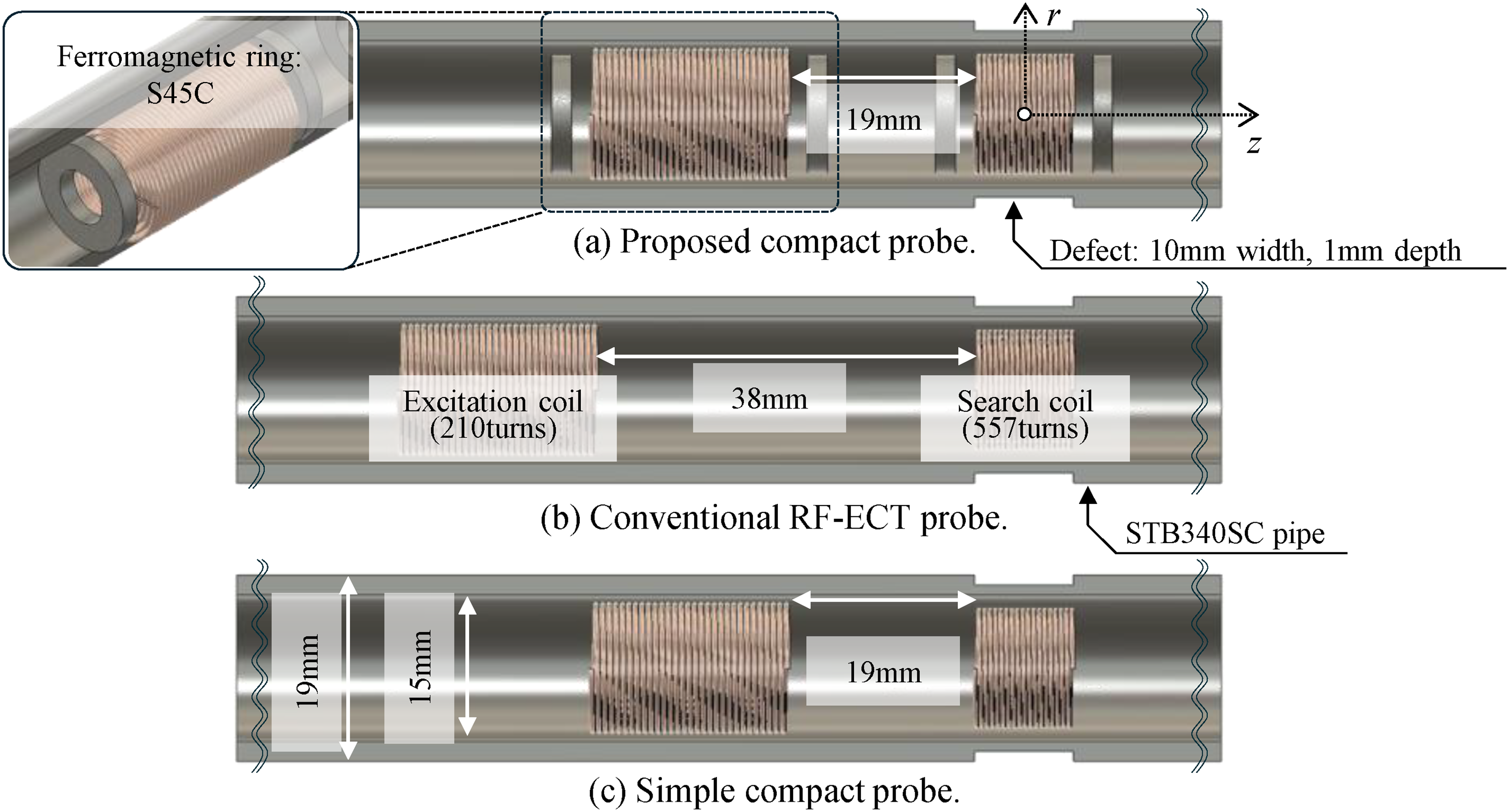
Inspection model.
In the measurement, the axial direction of the inspection ferromagnetic pipe was defined as the z-axis and the central position of the defect was defined as the origin on the z-axis. The probe was then moved inside the pipe so that the center of the search coil of the probe was located at z = -30 to +50 mm, and induced voltage obtained at the search coil was measured. To evaluate the sensitivity of the defect detection, the measured output signal voltage was converted to the average flux density in the search coil based on Faraday's law. In other words, the flux density component projected onto the z-axis within the search coil cross-sectional area is evaluated. Then, the percentage change of the average flux density in the search coil at each measurement position was determined based on the value of the average flux density in the search coil at z = −30 mm, where the defect and the probe are farthest apart. The average flux density Bs(t) T and the percentage change of the average flux density in the search coil ΔBz % at each position are given by these equations as follows:


Nonlinear eddy current analysis method and analysis conditions
The flux density and eddy current distributions are calculated by electromagnetic analysis using a finite element method (FEM) to confirm the validity of the measurement results and to clarify the inspection phenomenon of the proposed probe.
In the nonlinear eddy current analysis, the initial magnetization curve of the STB340SC pipe that is shown in Figure 2 is considered. The linear permeability of the S45C steel ring which is 50 is also considered. The fundamental equations are as follows:



Initial magnetization curve of STB340SC.
The transient analysis is carried out using the step-by-step method, in which the time step is set to 16 per period, and several cycles are calculated to reach the steady-state solution. The Fourier fundamental wave component from the final period of periodic steady-state solution is extracted to evaluate the phase.
For detailed analysis, to investigate the electromagnetic field inside the pipe by separating it into two magnetic field components. In previous research, the magnetic field components forming the remote field region can be defined as follows
4
:

Investigation of ferromagnetic ring effect
Measurement sensitivity of detection signal
Figure 3 shows the measurement sensitivity of detection signal, which is percentage change of the average flux density in the search coil relative to z = -30 mm for each probe type. We can see that the peak signal of the conventional RF-ECT probe occurs at 0 mm; thus, the detection ability of RF-ECT method is confirmed. However, the sensitivity of the simple compact probe is approximately zero. This result means that if the distance between the coils is simply reduced, the detection ability of the probe is significantly decreased, making inspection impossible. On the other hand, the proposed compact probe with additional ferromagnetic rings not only detects the defect but also significantly improves the detection sensitivity compared to that of the conventional RF-ECT probe.
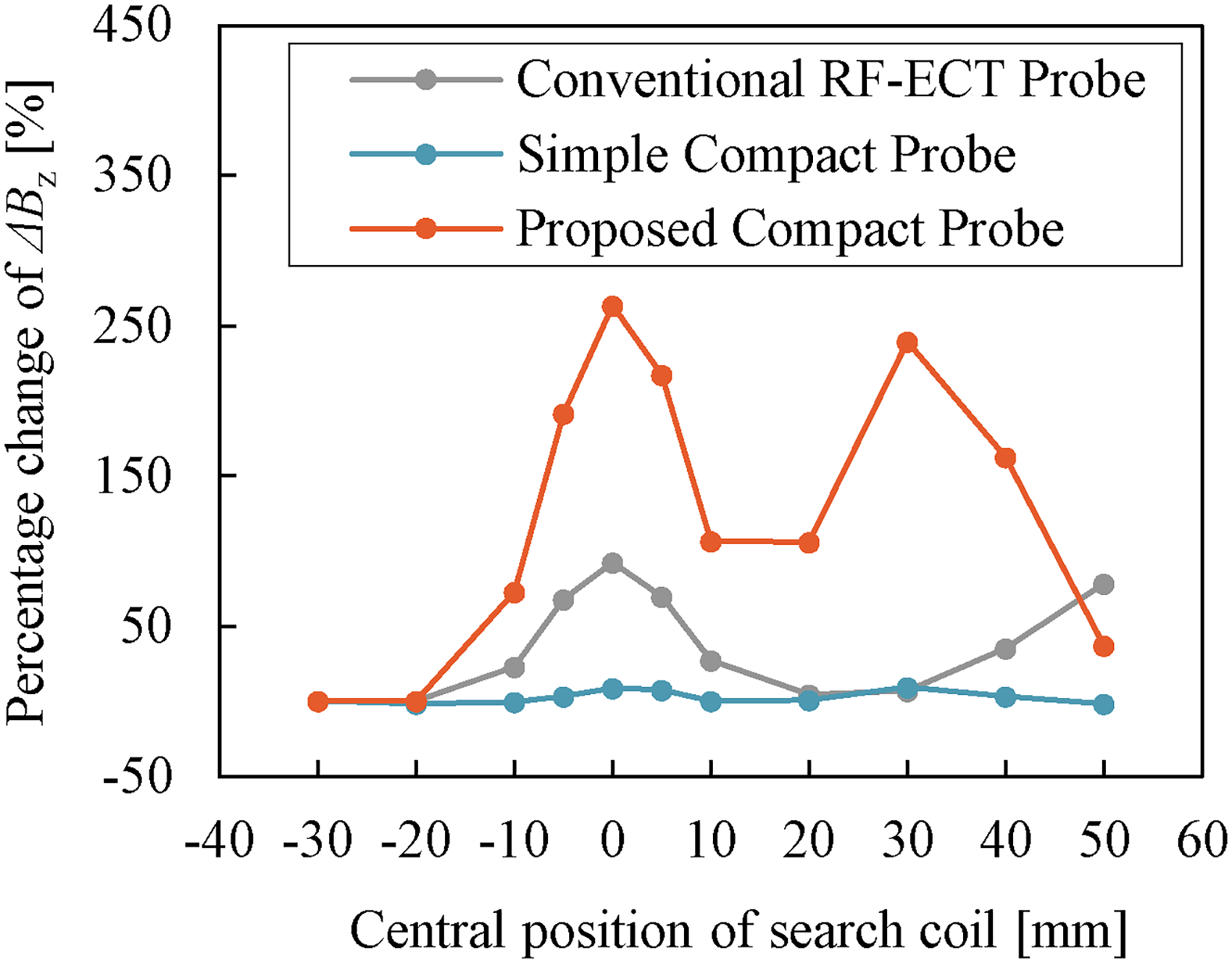
Measured detection sensitivity.
Numerical evidence for detection ability compared to the simple compact probe
Figure 4 shows the flux density distribution for each probe to investigate the ferromagnetic ring effect on the spatial vector of the electromagnetic field. In Figure 4(a) and 4(c), which successfully detect the defect, the direction of the flux density within the pipe wall is consistent with that within the search coil. In contrast, for the simple compact probe, which fails to detect the defect, the flux density within the pipe wall is opposite in direction to that within the search coil. Figure 5 shows the phase spectrum of the Fourier fundamental component of the coil-axis direction average flux density in the pipe wall at the defect and in the search coil. We can see that for probes capable of defect detection, the flux density within the search coil lags that within the pipe wall by approximately 30° in phase, indicating that the search-coil flux density varies in accordance with the pipe-wall flux density. In contrast, for the simple compact probe, the flux density within the search coil lags that within the pipe wall by approximately 250° in phase. Instead, it is seen to be nearly identical in phase to the excitation current waveform. Therefore, in the simple compact probe, the flux density within the search coil is dominated by the direct magnetic field from the excitation coil, making it impossible to detect changes in the pipe wall thickness.
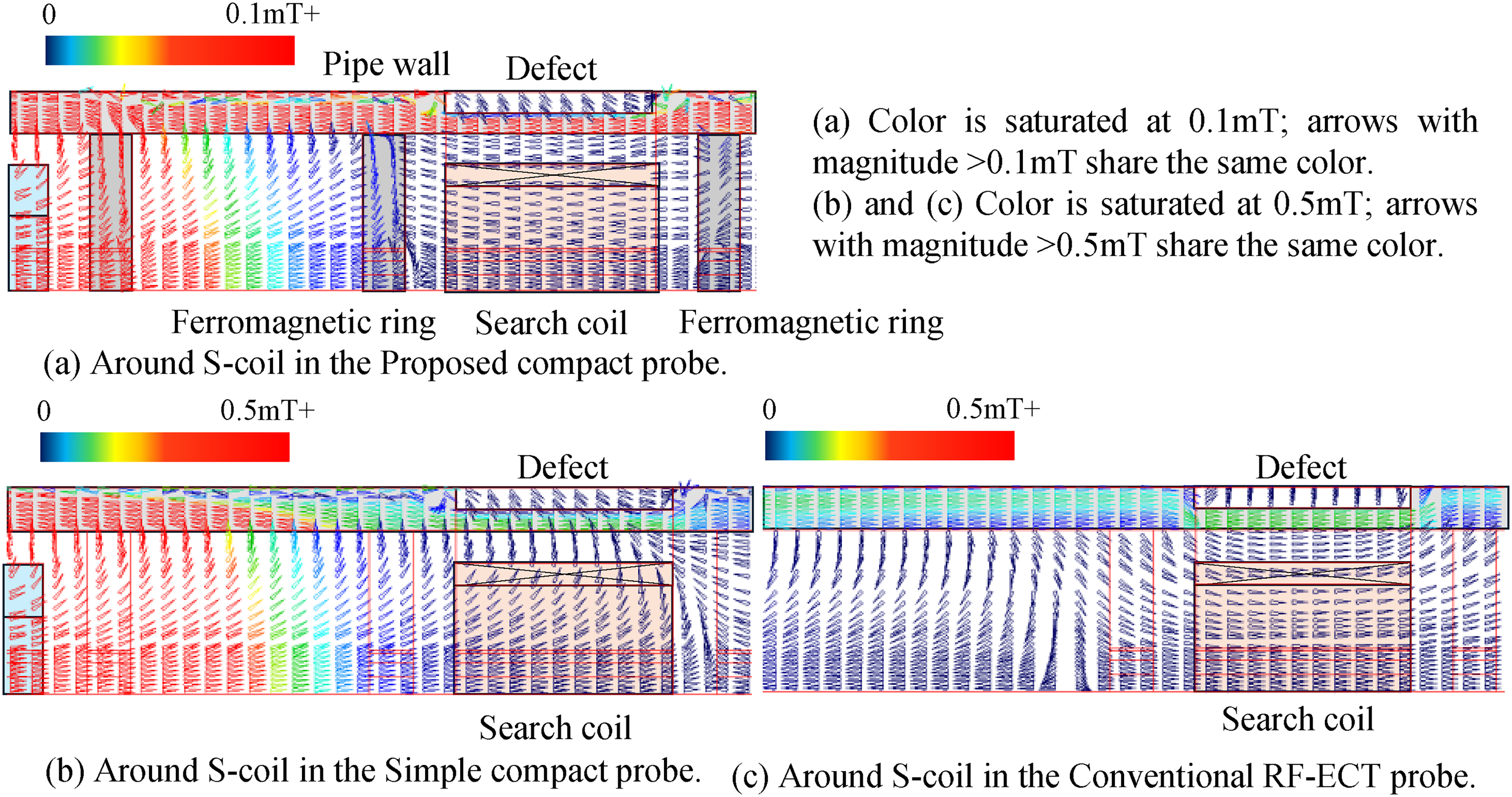
Flux density distribution of each probe.
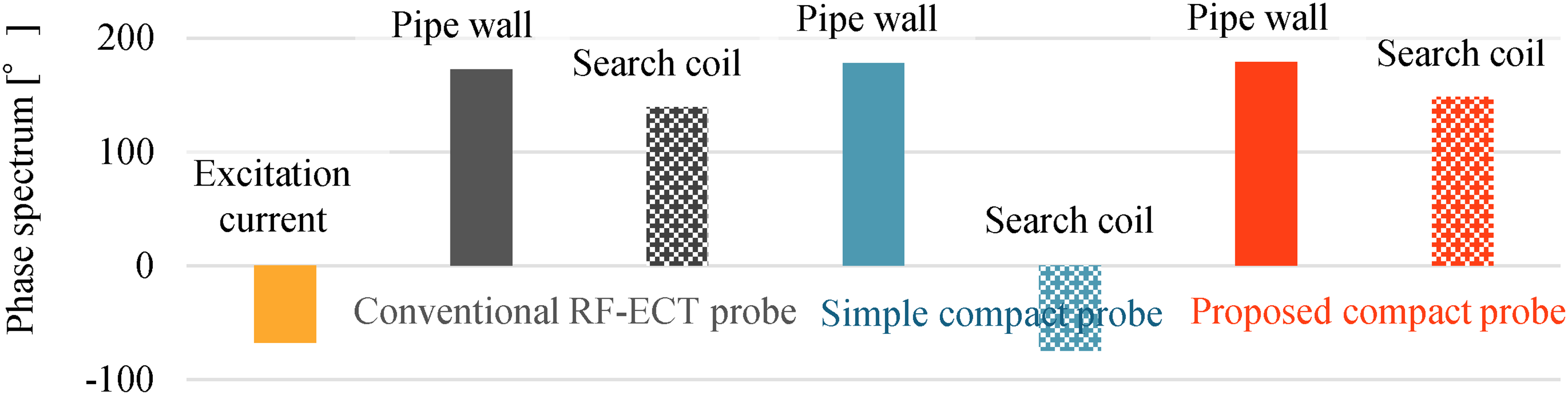
Phase spectrum of flux waveforms within the pipe wall and the search coil of each probe.
Theoretical evidence for sensitivity improvement compared to RF-ECT probe
According to previous research, the signal measured in the experiment is determined by the average inter flux density in the search coil (Bsz) according to Faraday's law, and its magnitude is the phase vector summation of B0 and Bje.5,6 Therefore, the amplitude of Bsz is given by:


Change of B0m, Bjem, and α versus position of the measurement.
Conclusion
This research investigated the effects of the proposed probe with ferromagnetic rings on probe length reduction and defect detection sensitivity to make the RF-ECT probe compact. In the experiment, detection sensitivity is measured and compared using three different probes, including the proposed compact probe, to verify the effect of ferromagnetic rings on probe length reduction. In addition, nonlinear eddy current analysis is carried out using FEM to identify factors contributing to probe length reduction and detection sensitivity improvement. Therefore, it is found that the improvement of the probe can be realized by the magnetic shield effect due to the permeability of rings and the enlargement of the amount of crack-derived phase change due to the eddy current generated in the rings.
Footnotes

Funding
The authors received no financial support for the research, authorship, and/or publication of this article.
Declaration of conflicting interests
The authors declared no potential conflicts of interest with respect to the research, authorship, and/or publication of this article.