



Abstract
Background
Young-onset Alzheimer's disease (YOAD) is defined as when the disease starts before 65 years old. Compared with late-onset AD (LOAD), the progression is faster and more aggressive. However, the impact on social cognition deficits may not follow the same clear pattern.
Objective
The present study aims to investigate the relationship between social cognition, global cognition, and other clinical variables in people with YOAD and LOAD and their caregivers.
Methods
Using a cross-sectional design, we included 48 people with YOAD and 118 with LOAD, and their caregivers. We assessed social cognition, global cognition, quality of life, dementia severity, mood, functionality, neuropsychiatric symptoms, and caregiver burden.
Results
The YOAD group was more impaired in general cognition (p = 0.002, d = 0.06), had a worse quality of life (p = 0.036, d = 0.36), and presented more neuropsychiatric symptoms (p = 0.044, d = 0.35). However, social cognition did not exhibit the same disease progression and showed no difference when compared with the reports of their caregivers or with individuals with LOAD. The multifactorial regression analyses showed that functionality was related to social cognition impairment in YOAD (p = 0.035), and LOAD (p = 0.001).
Conclusions
Our study found that people diagnosed with YOAD showed more global cognitive impairment but maintained social and emotional functioning.
Introduction
Alzheimer's disease (AD) is a neurodegenerative disorder closely associated with memory impairments in older adults. However, this condition is not limited to this age group. In some cases, symptoms may begin in midlife before the age of 65, which is classified as young-onset AD (YOAD), affecting distinctive stages of life.1,2 Socially, people with YOAD are more active in society than those with late-onset AD (LOAD). They still have children living at home, have more obligations, are physically fit, and are an essential part of the workforce.2,3 In addition to these changes, the disease presents a different pattern of impairments.
People with YOAD have a significant genetic predisposition, and the progression is faster and more clinically aggressive.1,4,5 Concerning cognitive functions, people with YOAD exhibit impairment not so prominent in episodic memory, while language, visuospatial, and executive function deficits are more present and associated with behavioral and functional difficulties.4,6,7 Kimura et al. (2022) conducted a cross-sectional study with 120 people with AD and vascular dementia (41 young-onset dementia (YOD) and 79 late-onset dementia (LOD) and their caregivers). The study reported that people with YOD were more cognitively impaired and had worse functionality when comparing the groups. 8
In contrast to the global results, people with YOAD present an improved awareness of their condition and, therefore, a better ability to recognize changes caused by the disease process. 9 Awareness is always related to something, to a specific deficit; thus, it could vary across different domains that, in general, are related to cognitive functioning, activities of daily living, and emotional and social difficulties.10,11 According to Baptista et al. (2021), in a cross-sectional study that included 50 people with YOD and 86 people with LOD, only awareness domains related to their emotional state and social functioning and relationships did not present group variation. 9 Despite the deficits in the other clinical aspects, this finding sheds light on the possibility of no difference in social cognition functioning in people with YOAD and LOAD.
Social cognition is a broad concept that includes domains such as emotion recognition, empathy, and Theory of Mind, responsible for the fundamental and adaptive skills related to social situations.12,13 In AD, the most common social cognition impairments are related to difficulties in understanding social situations, such as reading emotions in other people's faces, reduced ability to process social signals, decreased interpersonal relationships, and the presence of inappropriate social behaviors.14–16 Frequently, these disabilities could be associated with reduced functional autonomy, poor quality of life, and caregiver burden. 15
In a recent review, social cognition deficits in AD were not as evident compared to healthy controls and commonly did not follow the pattern of cognitive decline, especially in the early stages of the disease. 17 A longitudinal study conducted by Kelly et al. (2021) followed 20 months of the different types of dementia diagnosis (AD, vascular dementia, and mixed dementia) in the early stages. The study used the Social and Emotional questionnaire (SEQ) that analyzed the discrepancy between patients’ and caregivers’ points of view and demonstrated that the group with vascular and mixed dementia had lower social functioning at the beginning of the disease compared to the AD group. Socioemotional functioning declined over time but at a slower rate as dementia symptoms and severity increased.18,19 Another longitudinal study conducted by Belfort et al. (2023) assessed people with mild and moderate AD and their caregivers and also used the same instrument for social cognition evaluation. 20 The research showed a more stable pattern of social cognition impairment during 12 months compared with cognitive disabilities in different stages of the disease. 12
Research findings from cross-sectional studies on social cognition generally align with data from longitudinal studies. Schild et al. (2021) investigated the components of social cognition in 30 young participants and 29 older adult controls. They compared these groups with 28 individuals diagnosed with amnestic mild cognitive impairment and 30 people with AD. The results indicated that the cognitive domain of Theory of Mind was correlated with cognitive impairment; however, this trend was not observed in emotional recognition or in the affective component of Theory of Mind. 21 Hutchings et al. (2015) conducted a study involving 41 participants, including 16 with behavioral-variant frontotemporal dementia, 15 with semantic dementia, 10 with AD, and 17 control subjects. Notably, individuals with behavioral-variant frontotemporal dementia and semantic dementia exhibited deficits in emotional recognition and empathy, while people with AD demonstrated stable performance in these areas. 13
In a study analyzing social cognition impairment at different stages of progression in AD, Belfort et al. (2020) evaluated 137 dyads of people with AD—87 in the mild stage and 50 in the moderate stage—along with their respective caregivers. They found that while the moderate AD group showed more global impairment compared to the mild AD group, there was no significant difference in social cognition functioning between the two groups. 15
Given this relevance and the gap in the literature related to social cognition in YOAD, we hypothesized that even though YOAD is associated with more significant global impairment compared to late-onset diagnosis, social cognition deficits do not follow this pattern. In an attempt to control the potential impact of impairment on the social and emotional domain of awareness, we assessed the perspectives of people with AD and their caregivers and the discrepancy between the reports. This study aims to investigate the relationship between social cognition, global cognition, and other clinical variables in people with YOAD and LOAD and their caregivers.
Methods
We included 166 dyads of people with AD (48 YOAD and 118 LOAD) and their caregivers recruited at the Center for Alzheimer's Disease of the Institute of Psychiatry of Universidade Federal do Rio de Janeiro, Brazil. A psychiatrist made the diagnosis using clinical interviews with the person with AD and the caregiver, cognitive screening tests, laboratory tests, and imaging. Participants were diagnosed according to DSM-5. 22
Exclusion criteria were head trauma, alcohol abuse, previous history of psychiatric disorders, and epilepsy, defined by DSM-5 criteria.
The study included only family members, defined as the person chiefly responsible for caring for the person with AD. Caregivers with a reported history of psychiatric or cognitive disorders were excluded.
The Institutional Review Board of the Institute of Psychiatry (IPUB) (number: 44791715.6.0000.5263) of Universidade Federal do Rio de Janeiro (UFRJ) approved this study. All participants provided formal written consent.
Assessment of the people with AD
Social cognition
The Social and Emotional Questionnaire (SEQ) is based on the discrepancy between self-report of people with AD (SEQ1) and their caregivers reports concerning the person with AD (SEQ2). The questionnaire includes questions about emotion recognition and empathy. The score varying from “strongly disagree” (1 point) to “strongly agree” (5 points). Then the useful discrepancy is calculated and scores close to 0 indicate good agreement. In this study, in addition to the discrepancy, we separately analyzed the SEQ1 scores, or self-reports by people with AD, and SEQ2, or ratings by caregivers on the people with AD, and total SEQ, or discrepancy results.18,20
The Facial Expression Recognition Test (FACES) is an adaptation of an experimental task developed by Shimokawa et al. (2000) and consists of four tasks that assess facial emotional recognition and recognition of emotional situations. Task 1 assesses the visual perceptual capacity to identify basic emotions (anger, happiness, surprise, or sadness) displayed on face drawings. Task 2 explores the capacity to understand facial emotions. Task 3 assesses the ability to acknowledge an emotional expression conceptually, therefore, whether the participant understands the verbal label of emotion. Task 4 examines the ability to understand a particular situation and the emotional state experienced in it. The respondent receives one point for each correct answer. The total score is the sum of correct answers, and the highest possible score is 16. Lower scores indicate impaired recognition. 23
Awareness of disease
Assessment Scale of Psychosocial Impact of the Diagnosis of Dementia (ASPIDD) is a 30-question scale developed to investigate the awareness of one's disease according to the scoring of discrepant responses between people with AD and their caregivers. Each discrepant answer receives 1 point, and the total score is the sum of the points. Ratings of awareness range from preserved (0–4), mildly impaired (5–11), and moderately impaired (12–17) to absent (over 18). 24
Cognition
Mini-Mental State Examination (MMSE) is a general cognitive screening task, which includes items related to temporal and spatial orientation, attention and calculation, memory and constructive praxis. The score is calculated by the number of correct answers, and the maximum score is 30. Lower scores indicate impaired cognition.25,26
The Alzheimer's Disease Assessment Scale–Cognitive Subscale (ADAS-Cog) was developed to investigate the intensity of cognitive changes of this disease. This cognitive part of battery includes items 1–11, with a maximum score of 70. Evaluates different cognitive functions, such as memory and learning abilities, spatial and temporal orientation, language (comprehensive and expressive), and constructive praxis. Each wrong answer receives 1 point. Higher scores indicate worse performance. 27
Quality of life
Quality of Life in AD (QoL-AD) is a questionnaire that involves 13 different domains of quality of life (Physical health, Energy, Mood, Living situation, Memory, Family, Marriage, Friends, You as a whole, Ability to do chores, Ability to do things for fun, Money, Life as a whole) ranging from 1 to 4, with the score of 1 for poor and a score of 4 for excellent, where total score ranged from 13 to 52. People with AD and their caregivers answer the questionnaire. People with AD answer questions about themselves (QoL-AD1), and caregivers rate the respective people with AD QoL (QoL-AD2). Higher scores indicate better QoL.28,29
Caregiver assessment of people with AD
Social cognition
In SEQ 2, the caregiver provides the answers about the person with AD social and emotional functioning.18,20
Functionality
The Pfeffer Functional Activities Questionnaire (PFAQ) is an inventory that investigates impairments in activities of daily living and the score vary between total independence (1 point); intermediate status (2 points) and dependent status (3 points). The total maximum score is 30, which indicates a worse functional status. 30
Neuropsychiatric symptoms
Neuropsychiatric Inventory (NPI) is a questionnaire that investigates the presence of neuropsychiatric symptoms (delusions, hallucinations, dysphoria, anxiety, agitation/aggression, euphoria, disinhibition, irritability/lability, apathy, and aberrant motor activity, night-time behavior disturbances, and appetite and eating abnormalities). Each symptom was assessed by frequency and severity and calculated (frequency × severity). The total score is the the sum of the scores for each symptom. The maximum score is 144 points; high scores indicate frequent neuropsychiatric symptoms.31,32
Quality of life
QoL–AD2 analyzes the caregiver's point of view about the person with AD.28,29
Caregiver's assessment
Cognition
MMSE is a screening scale applied to global cognition assessment.25,26
Quality of life
QoL – AD3 analyzes the caregiver's point of view about yourself.28,29
Burden
Zarit Burden Interview (ZBI) is a questionnaire that investigates the impact of caring for a family member with dementia. Includes 22-items to assess carers’ burden associated to the patient's functional and behavioral disability and to the situation at home (health, social and personal life, financial situation, emotional well-being and interpersonal relationships). Each item of the scale is scored from 0 to 4, being 0 = never, 1 = rarely, 2 = sometimes, 3 = quite frequently, 4 = nearly always. Higher scores indicate a high level of burden.33,34
Data analysis
The analyses were conducted in IBM SPSS Statistics for Windows (Version 24.0). The initial step was a comprehensive analysis of the participants’ sociodemographic and clinical variables.
Independent samples t-tests were performed to assess whether there were differences between the groups (YOAD and LOAD) in all used clinical measures. In the event of heterogeneity of variance, Welch's statistic was considered. Bootstrapping procedures were carried out (1000 re-samples; CI: 95% BCa) to correct deviations from the normal distribution of the sample and present more robust confidence intervals (95%) for the differences between the means. 35 Hedges’ g was used to measure the effect size. Hedges’ g provides a measure of the effect size weighted according to the relative size of each sample and is an alternative where there are different sample sizes. 36 The following cut-off points were considered: small effect = 0.2, medium effect = 0.5, and large effect = 0.8.
Multiple linear regressions were carried out considering the SEQ caregivers version (SEQ 2), SEQ Patient version (SEQ 1), and the SEQ total outcome and the predictors MMSE, Pfeffer, NPI, ASPIDD, FACES, and ZARIT. For all analyses, participants with diagnoses of YOAD and LOAD were considered separately. The following assumptions were checked: Independence between residuals (Durbin-Watson Coefficient - between 1.5 and 2.5), Standardization of residuals by Z score (up to 5% of the sample with a Standardized Residual above 2), Cooks Distance for sample evaluation, Collinearity statistics (VIF: < 5). The significance level adopted for all analyses was α ≤ 0.05.
Results
Sociodemographic characteristics
People with YOAD and LOAD
Regarding gender, the sample of individuals with YOAD (N = 48) was composed of a majority of males (54.17%, N = 26), in contrast to individuals with LOAD (N = 118) who were mostly female (66.95%, N = 79). The individuals with LOAD were older, with an average age of almost ten years (79.76 SD 5.67) than those with YOAD (63.67 SD 5.74). This age difference is also reflected in the onset of LOAD, 75.10 (SD 5.87), and YOAD, 58.38 (SD 4.32).
People with YOAD had more years of schooling (10.33 years SD 4.31) than LOAD (7.51 years SD 4.00).
Another contrast is related to marital status. People with YOAD super pass in a number of married (66.67%, N = 32) the people with LOAD (41.53%, N = 49), meanwhile the people with LOAD were mostly widowed (43.22%, N = 51).
Caregivers
The female gender was the most common in the caregivers sample as much in people with YOAD (83.33%, N = 40) as LOAD (79.66%, N = 94).
The results of age (YOAD: 52.54 SD 13.73) (LOAD: 57.98 SD 14.16) and schooling (YOAD:12.94 SD 3.92) (LOAD: 12.14 SD 3.57) for both groups were similar.
The comparison between people with YOAD and LOAD and their caregiver's characteristics is presented in Table 1.
Sociodemographic characteristics of persons with young and late AD and their caregivers.
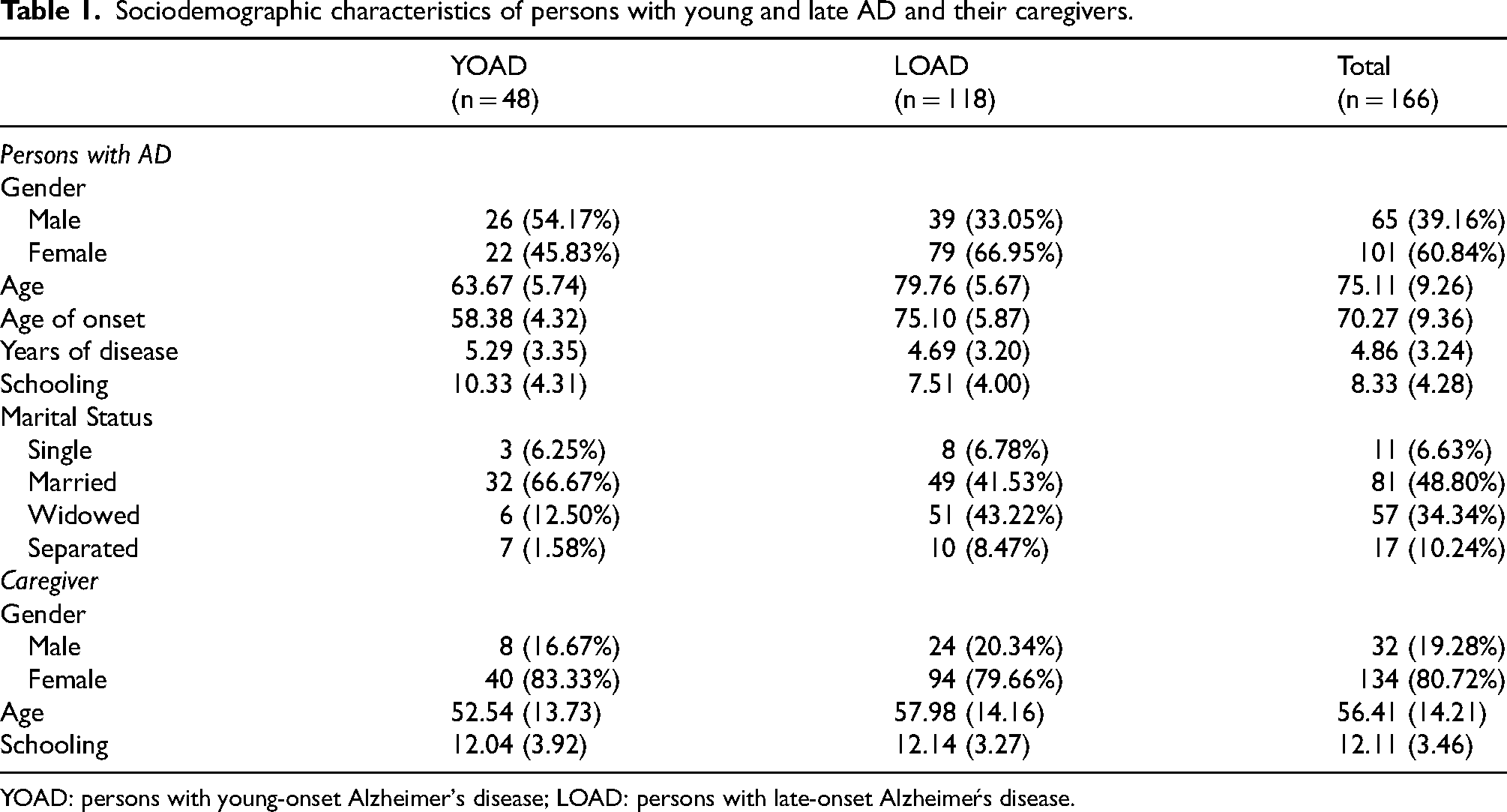
YOAD: persons with young-onset Alzheimer's disease; LOAD: persons with late-onset Alzheimeŕs disease.
Clinical profile of people with YOAD and LOAD and caregivers
The results relating to the MMSE showed people with YOAD obtained statistically lower scores (M = 17.50 SD = 4.91) than the people with LOAD (M = 19.29 SD = 4.15; t(164) = −2.380, p = 0.018; [95% CI BCa −3.560; −0.121]), the effect size of the difference was small (Hedge's g = 0.41). For the ADAS-Cog, the results showed that the people with YOAD obtained statistically higher scores (M = 32.94 SD = 12.87) than the people with LOAD (M = 26.12 SD = 10.07; t(71.551) = 3.284, p = 0.002; [95% CI BCa 2.892; 10.838]), the effect size of the difference was medium (g for Hedge = 0.62). Our results presented that people with YOAD showed a significantly poorer performance on cognitive tasks when comparing with LOAD.
Social cognition showed no differences either from the perspective of people with YOAD (SEQ 1) (M = 114.31 SD = 12.59) or LOAD (M = 112.49 SD = 9.91; t(169) = 0.989, p = 0.324 [95% CI BCa −2.321; 5.813]). The same pattern was found from the perspective of the carer (SEQ 2) of people with YOAD (M = 103.67 SD = 15.07) and LOAD (M = 107.05 SD = 6.74, t(164) = −1.214, p = 0.227 [95% CI BCa −8.629; 1.741]) and, consequently, in the discrepancy analyses (SEQ Total) from people with YOAD (M = 0.10 SD = 0.17) and LOAD (M = 0.07 SD = 0.21; t(164) = 0.714, p = 0.476 [95% CI BCa 0.044; 0.941]).
Awareness (ASPIDD), facial expression recognition (FACES), and other clinical variables did not differ.
Concerning the caregiver's point of view about the people with YOAD status, the quality of life (QoL 2) presented statistically lower scores (M = 28.21; SD = 5.67) than the LOAD (M = 30.29; SD = 5.79) (t(164) = −2.109, p = 0.036; [95% CI BCa −3.868; −0.314]), the effect size of the difference was small (Hedge's g = 0.36). In line, more neuropsychiatric symptoms (NPI) were found in people with YOAD (M = 23.60; SD = 18.69) than the LOAD (M = 17.36; SD = 17.65) (t(164) = 2.029, p = 0.044; [95% CI BCa 0.016; 12.954]), the effect size of the difference was small (g for Hedge = 0.35).
Regarding the caregivers, there was no difference between their clinical variables.
The differences between the clinical characteristics of both groups are summarized in Table 2.
Clinical characteristics of persons with young and late AD and their caregivers.
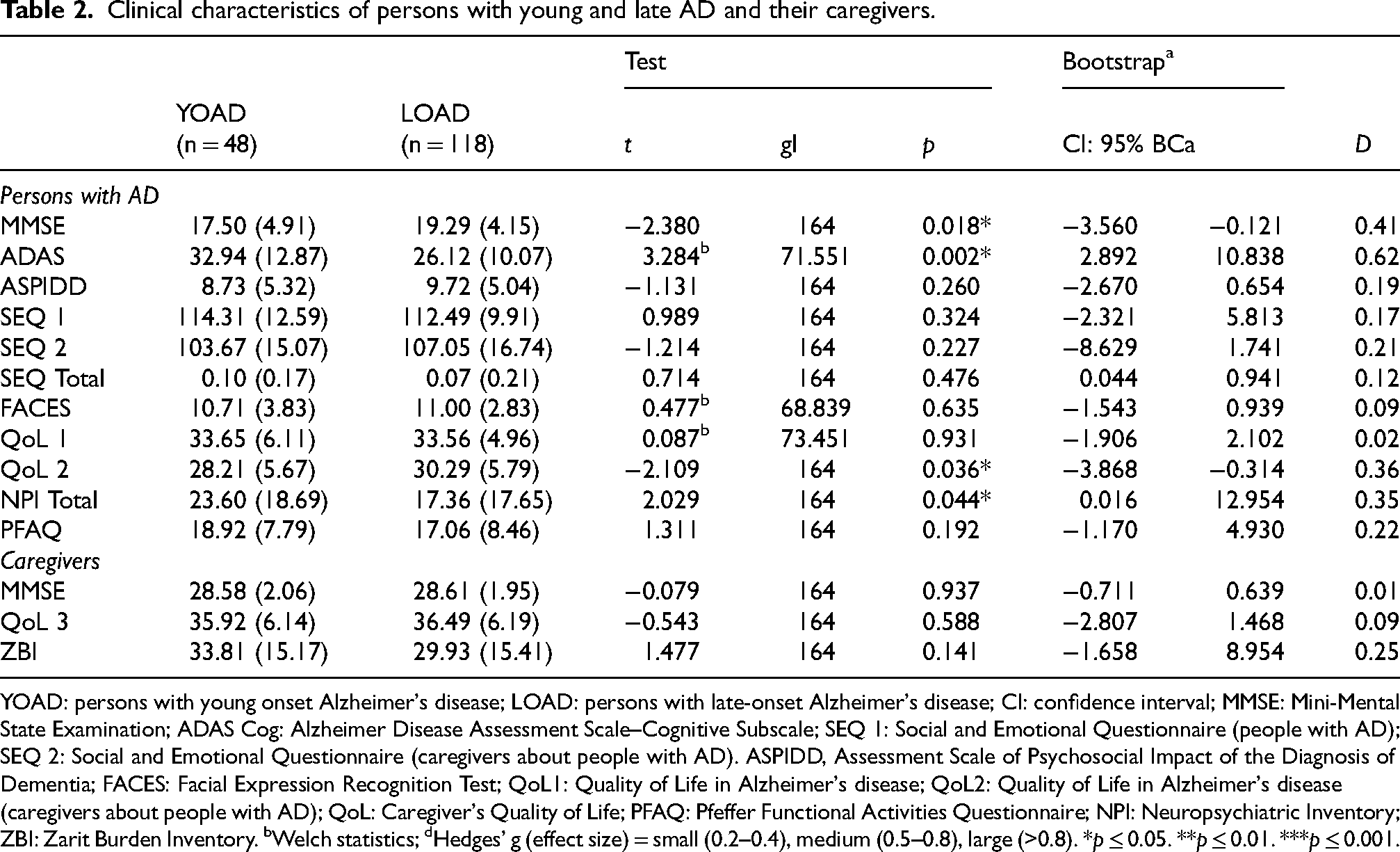
YOAD: persons with young onset Alzheimer's disease; LOAD: persons with late-onset Alzheimer's disease; CI: confidence interval; MMSE: Mini-Mental State Examination; ADAS Cog: Alzheimer Disease Assessment Scale–Cognitive Subscale; SEQ 1: Social and Emotional Questionnaire (people with AD); SEQ 2: Social and Emotional Questionnaire (caregivers about people with AD). ASPIDD, Assessment Scale of Psychosocial Impact of the Diagnosis of Dementia; FACES: Facial Expression Recognition Test; QoL1: Quality of Life in Alzheimer's disease; QoL2: Quality of Life in Alzheimer's disease (caregivers about people with AD); QoL: Caregiver's Quality of Life; PFAQ: Pfeffer Functional Activities Questionnaire; NPI: Neuropsychiatric Inventory; ZBI: Zarit Burden Inventory. bWelch statistics; dHedges’ g (effect size) = small (0.2–0.4), medium (0.5–0.8), large (>0.8). *p ≤ 0.05. **p ≤ 0.01. ***p ≤ 0.001.
Multivariate analyses
The perspective of people with AD (SEQ 1), did not reach statistical significance for either the YOAD (F(5, 42) = 1.161, p = 0.344; R2ajusted = 0.01) or LOAD (F(5, 112) = 1.156; p = 0.336; R2ajusted = 0.007) group. The results of the regression analyses for SEQ 1 (YOAD and LOAD) are presented in Table 3.
Regression models of the factors related to SEQ in persons with young and late AD.

YOAD: persons with young onset Alzheimer's disease; LOAD: persons with late-onset Alzheimer's disease; SEQ 1: Social and Emotional Questionnaire (people with AD); MMSE: Mini-Mental State Examination; ASPIDD: Assessment Scale of Psychosocial Impact of the Diagnosis of Dementia; FACES: Facial Expression Recognition Test; PFAQ: Pfeffer Functional Activities Questionnaire; NPI: Neuropsychiatric Inventory. *p ≤ 0.05, **p ≤ 0.01, ***p ≤ 0.001.
With regard to the caregivers’ perspective (SEQ 2), as in SEQ 1, there was no significant relationship for the YOAD (F(6, 41) = 1.890, p = 0.106; R2ajusted = 0.102). However, in the LOAD group, social cognition was significantly related to people with AD cognition (MMSE p ≤ 0.05) and functionality (PFAQ p ≤ 0.001).
The results of the regression analyses by SEQ 2 (YOAD and LOAD) are presented in Table 4.
Regression models of the factors related to SEQ in caregivers about persons with young and late AD.

YOAD: persons with young onset Alzheimer's disease; LOAD: persons with late-onset Alzheimer's disease; MMSE: Mini-Mental State Examination; SEQ 2: Social and Emotional Questionnaire (caregivers about people with AD); ASPIDD: Assessment Scale of Psychosocial Impact of the Diagnosis of Dementia; FACES: Facial Expression Recognition Test; PFAQ: Pfeffer Functional Activities Questionnaire; NPI: Neuropsychiatric Inventory; ZBI: Zarit Burden Inventory. *p ≤ 0.05, **p ≤ 0.01, ***p ≤ 0.001.
Considering discrepancy analyses (SEQ Total), functionality was related to social cognition in both YOAD (PFAQ p ≤ 0.05) and LOAD (PFAQ p ≤ 0.001) groups. The results of the regression by discrepancy analyses (YOAD and LOAD) are presented in Table 5.
Regression models of the factors related to total SEQ (discrepancy analysis).
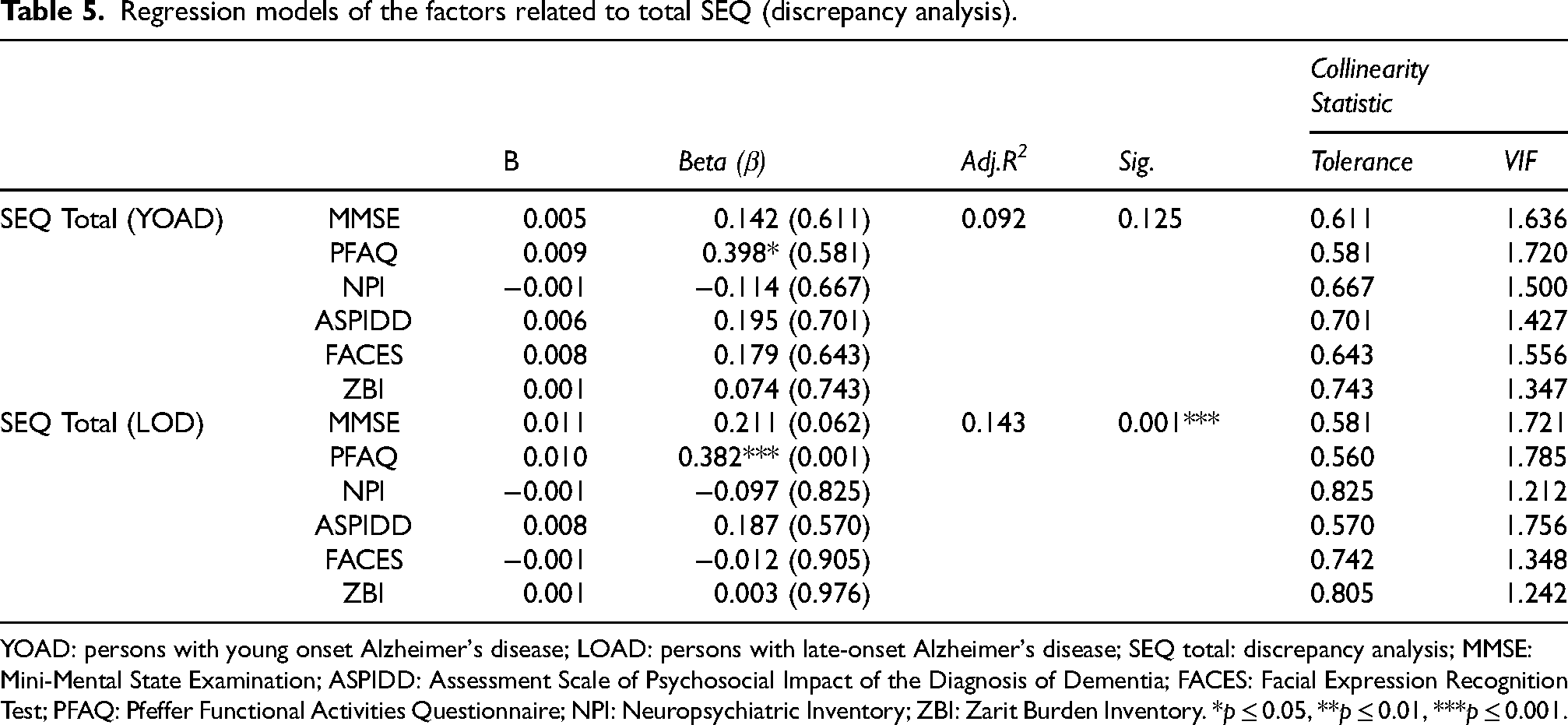
YOAD: persons with young onset Alzheimer's disease; LOAD: persons with late-onset Alzheimer's disease; SEQ total: discrepancy analysis; MMSE: Mini-Mental State Examination; ASPIDD: Assessment Scale of Psychosocial Impact of the Diagnosis of Dementia; FACES: Facial Expression Recognition Test; PFAQ: Pfeffer Functional Activities Questionnaire; NPI: Neuropsychiatric Inventory; ZBI: Zarit Burden Inventory. *p ≤ 0.05, **p ≤ 0.01, ***p ≤ 0.001.
Discussion
Our study investigated the relationship between social cognition, global cognition, and other clinical variables in people with young-and-late-onset AD and their caregivers. The results align with our hypothesis that social cognition deficits in people with YOAD do not follow the same pattern of faster global impairment when compared to late-onset diagnosis.
Young and late-onset AD: similarities and differences
The literature describes a specific profile in people with YOAD, mainly related to faster disease progression and more significant global cognitive impairment compared to people with LOAD.1,4 The more aggressive pattern of deficits may be explained by the fact that early diagnosis of AD is associated with more severe gray matter atrophy, more senile plaques, synaptic loss, and, consequently, more acetylcholine deficits. 37 We found that, in addition to presenting more significant cognitive impairment, our sample of YOAD participants had a high level of schooling, more neuropsychiatric alterations, and, consequently, functional impairments.
Interestingly, even though the YOAD group has shown a more disease-impaired pattern, it is essential to mention that the quality of life, when assessed from different perspectives, showed different results. For people with YOAD, the data found was positive (33.65 SD 6.11), which aligns with the data for people with LOAD (33.56 SD 4.96). Following our results, Hartmann et al. (2021) assessed the quality of life in 191 dyads, 93 with YOD and 98 with LOD, in advanced dementia stages, and no differences were detected. 38 Therefore, the severity of cognitive impairment does not seem necessarily associated with a lower quality of life.38,39 In opposition to this perspective, caregivers recognized a worse quality of life in people with YOAD (28.21 SD 5.67) compared to those with LOAD (30.29 SD 5.79). Kimura et al. (2018) presented a cross-sectional study with 134 dyads that included 53 people with YOAD and 81 with LOAD and found that in both groups, caregivers reported poorer quality of life. However, only the results in the late group were directly related to the people with AD perception. 40 Additionally, Dixit et al. (2020) reported that the most significant discrepancy between reports was related to social functioning, suggesting an impact of reduced social interaction on the quality of life caregivers’ reported. 41
Our major finding is that social cognition did not vary according to the age of onset or different assessment perspectives (people with AD and caregivers). To better understand this pattern of functioning, we searched for other studies that used the same instrument of social cognition evaluation (Social and Emotional Questionnaire) in people with AD. Aligned with our findings, a study in Australia by Hutchings et al. (2018), with frontotemporal dementia-behavioral variant, semantic dementia, and AD, showed that people with AD displayed largely preserved social cognition. The caregivers’ reports did not differ from those of healthy controls, confirming relatively preserved socio-emotional functioning. 42 Similarly, Kelly et al. (2021), in the United Kingdom, followed 101 dyads during 12 and 20 months. The study included people with early stages of AD, vascular dementia, and mixed dementia and found that social cognition declined over time, but at a slower rate of functioning. 19 Furthermore, a recent study in Brazil by Belfort et al. (2023) followed during 12 months 137 people with AD and their caregivers, and the results were in line with the others that applied the same questionnaire. 12 Therefore, we are left wondering why social cognition, as a neurocognitive function, does not decline in the same pattern as other cognitive and clinical functions.
Adolphs (2009) proposed two broad processes to understand the functioning of the social brain: controlled and automatic. Controlled processes are more abstract and reflective, related to superior mental functions such as declarative reasoning and reflective thinking. In contrast, automatic processes are spontaneous, present early in development, and often involve emotions. 43 Albeit, both processes are essential to adequate social functioning. In AD, social cognition impairments are not as obvious as in other dementias like frontotemporal dementia. 17 However, changes are still noticeable in the early stages of AD, particularly in more complex tasks, such as those involving the second order of theory of mind.44–46 According to Arioli (2018), social cognition results from integrating three main domains. Initially, individuals may have difficulties making social decisions, followed by challenges in understanding others’ mental states. Lastly, the ability to differentiate between objects and people may be affected. This can be influenced by personal experiences, motivations, reasons, and intentions. 47 Thus, more straightforward and spontaneous tasks may be associated with automatic processes and appear more stable, whether in a moderately advanced stage of the disease or a more aggressive progression, such as YOAD.
Social cognition and related factors
As important as understanding the social cognition pattern, it is essential to understand the factors related to both participants with AD and caregivers.
In our study, we aimed to explore the factors associated with social cognition in individuals with young and late-onset AD. Despite the prevalence of variables such as cognition, quality of life, neuropsychiatric symptoms, functionality, recognition of facial expression, and awareness of the disease in existing literature, we were surprised to find that none of these variables proved to be significant in the social cognition perspectives of individuals with YOAD and LOAD.
To better interpret our findings, we referred to previous research. When examining the relationship between social cognition and the severity of dementia (mild and moderate), we found that age, years of schooling, and gender showed significant associations. 15 Furthermore, we discovered a longitudinal association between cognition and specific subtests such as declarative memory, working memory, orientation, and constructive praxis. 12 Given these findings, we recommend further investigation into social cognition functioning by including sociodemographic data and examining measurement tools based on each area or function, especially for neuropsychiatric symptoms and cognition. This can be understood through the argument proposed by Hutchings et al. (2015) that the social cognition functioning of people with AD is comparable to healthy controls, especially in the early stages of the disease. 13
It is essential to note that while individuals with YOAD may exhibit more neuropsychiatric symptoms and cognitive impairments, caregivers of individuals with LOAD believe that social cognition functioning is linked to functional changes and cognitive decline. Some points may help in understanding this result. Firstly, these groups are in different stages of life, socially, personally, and professionally. People with YOAD are more active in society than those with LOAD.2,3 Thus, even though they are more affected by the disease, they are more intensely stimulated by the environment. In addition, the characteristics of our sample included people with YOAD who had higher levels of education and were in the early stages of the disease (MMSE 17.50 SD 4.91) (ADAS-Cog 32.94 SD 12.87). We can then consider that people with YOAD had a higher cognitive reserve, which suggests a better problem-solving capacity, especially for adapting to new situations. The most common measures associated with the cognitive reserve are educational level, occupational complexity, and leisure activities. 48 According to Wilson et al. (2019), more relevant than formal education for the cognitive reserve of people over 50 are cognitive changes, socially engaging activities, cognitively demanding work, and a sense of purpose in life. 49 In line with this result, when social cognition was investigated by comparing the accounts of individuals with AD and their caregivers, functionality was associated in both the early-onset and late-onset groups. Therefore, impairments in instrumental activities of daily living, which typically lead to increased responsibility and a greater need for caregiver support, were linked to the social and emotional functioning of individuals with AD. 50 Interestingly, this relationship with functionality also appeared in our previous studies with different samples, but only in patients with mild AD and in the first moment of our longitudinal study.12,15 These findings could suggest that this relationship appears when a person with AD, even with difficulties, still retains a level of autonomy.
Limitations
Our study may present some limitations. Regarding sociodemographic characteristics, individuals with YOAD had more formal education than those with LOAD. A more homogeneous sample may help to discriminate better the potential influence of social, professional, and leisure factors. In this study, due to the small sample size of people with YOAD, we did not separate the groups according to the severity of dementia, and the pattern of overall impairment differs from mild to moderate participants.
It is important to note that the scale used to assess social cognition is currently undergoing psychometric studies for the Brazilian population. Nevertheless, our results align with other published findings.
Additionally, another limitation of this study is its cross-sectional design. Only longitudinal studies can provide more comprehensive insights into the functioning of social cognition over time.
Conclusion and clinical implications
Individuals diagnosed with YOAD showed more global cognitive impairment but maintained their social and emotional functioning. This finding was consistent with participants’ self-reported perspectives and with reports from their caregivers. These findings highlight the need to better understand social cognition as a distinct cognitive function with a specific pattern. This functioning appears to be supported by more automatic processes that require integration with higher-level (controlled) resources for appropriate social decision-making. However, despite the impaired functions, these processes may persist through more primitive and instinctual resources.
Advances in the study of social cognition in AD can enhance the quality of life for both people with AD and their caregivers. The early assessment and identification of socio-emotional problems in treating dementia could reduce stress and burden, thereby improving their ability to provide care. It is important to use more direct communication that prioritizes basic emotions, and tasks should be clearer and more direct in order to reduce cognitive demands and emphasize the functioning of more automatic processes.
For both caregivers and people with AD, in specially for YOAD, recognizing difficulties as symptoms of the disease progression can help reduce stigma and promote better coping strategies.
Footnotes
Acknowledgments
Marcia Cristina Nascimento Dourado is a researcher funded by the Brazilian National Council for Scientific and Technological Development (CNPq) and the Carlos Chagas Filho Foundation for Research Support of the State of Rio de Janeiro (Faperj).
Marcela Lima Nogueira is a researcher funded by Carlos Chagas Filho Foundation for Research Support of the State of Rio de Janeiro (Faperj).
ORCID iDs

Ethical considerations
The Institutional Review Board of the Institute of Psychiatry (IPUB) (number: 44791715.6.0000.5263) of Universidade Federal do Rio de Janeiro (UFRJ) approved this study.
Consent to participate
All participants provided formal written consent.
Consent for publication
Not applicable.
Author contributions
Tatiana Belfort (Conceptualization; Data curation; Formal analysis; Funding acquisition; Investigation; Methodology; Writing – original draft; Writing – review & editing); Marcela Lima Nogueira (Funding acquisition; Writing – original draft); Julia Gaigher (Data curation; Visualization); Rogeria Rangel (Data curation; Visualization); Natalie de Souza (Data curation; Visualization); Marcia Cristina Nascimento Dourado (Conceptualization; Funding acquisition; Project administration; Supervision; Writing – review & editing).
Funding
This study was funded by the Carlos Chagas Filho Foundation for Research Support of the State of Rio de Janeiro (Faperj), grant number 204.264/2021 SEI 260003/014768/2021
Declaration of conflicting interests
The authors declared no potential conflicts of interest with respect to the research, authorship, and/or publication of this article.
Data availability
The data supporting the findings of this study are available within the article.