



Abstract
Background
The Picture Free and Cued Selective Reminding Test (P-FCSRT) has proven useful in assessing episodic memory while controlling for interference from attentional processes. In Chile, studies have supported its diagnostic utility in detecting dementia in older adults, however, it lacks both normative data that account for the influence of age and educational level from mid-adulthood onwards, and the quantification of intrusive errors which have significant clinical value.
Objective
The aim of this study is to determine normative scores and intrusive errors for the P-FCSRT, controlling for sociodemographic factors (age and educational level) in the Chilean population.
Methods
A total sample of 185 healthy participants from the Aging Mets cohort were recruited from three regions in Chile (Antofagasta, Santiago, and Puerto Montt). The P-FCSRT was administered to all participants. A multivariate regression-based normative approach was used to generate normative data, considering the effects of age, years of schooling, and sex.
Results
Significant effects of age and years of schooling were found on P-FCSRT free recall, total recall, delayed recall, intrusions, and sensitivity to cues. Age had a distinct effect on each P-FCSRT dimension, whereas years of schooling had a consistent effect across them. Sex did not influence any P-FCSRT dimension.
Conclusions
This study is the first to provide normative data for the Chilean version of the P-FCSRT and will be beneficial for clinical neuropsychologists in improving the procedures for a more accurate assessment of episodic memory and related impairments.
Introduction
Memory is the brain's ability to encode, store, and retrieve environmental experiences.1,2 It is composed consists of different subsystems with specific functions, distinct neural substrates, 3 and well-defined spatial and temporal dimensions.4,5 Episodic memory is a cognitive system that allows individuals to encode, store, and retrieve information about personal experiences, including their temporal and spatial contexts of those experiences in daily life. 6 It involves circuits in the medial temporal lobe -including the hippocampus- which mediate the organization and persistence of the memory network. 7
Ageing affects different memory systems to varying degrees and with notable interindividual differences. Episodic memory, in particular, is significantly affected by ageing, starting as early as age 45. 8 Similarly, a history of traumatic brain injury often leads to amnestic disturbances in young individuals and increases the risk of developing dementia later in life.9,10 The encoding process appears to be more disrupted by ageing, with encoding deficits predominating over retrieval deficits. 11 While retrieval is strongly affected by ageing, the extent of such age-related differences depends on the task used to assess episodic memory performance (e.g. free recall, cued recall, or recognition) or the use of stimulus enrichment (pictures). 12 Age-related declines in processing speed hinder efficient encoding and retrieval processes. 13 Performance on episodic memory tasks among older adults shows considerable variability due to individual differences, such as age 14 and educational level. 15
One of the most commonly used tests to assess episodic memory is the Free and Cued Selective Reminding Test (FCSRT). 16 Unlike other episodic memory tests, the FCSRT begins with a phase designed to control the effects of attention during the encoding process. This allows for the identification of amnestic alterations that are not secondary to other cognitive deficits.16,17 The FCSRT has been shown to be associated with amyloid pathology, 18 the ability to predict progression from mild cognitive impairment to dementia, 19 and the differentiation of Alzheimer's disease from frontotemporal dementia. 20 There are few normative studies of the FCSRT. In Spain, the NEURONORMA study revealed a significant effect of age and educational level on FCSRT performance, with no effect of sex. 21 On the other hand, there is a non-equivalent form of the FCSRT that uses visual stimuli (P-FCSRT). 22 While a moderate correlation between the FCSRT and P-FCSRT has been reported, the latter typically shows higher performance, suggesting that visual input benefits episodic memory performance.23,24 Likewise, the administration of the P-FCSRT has proven useful in illiterate individuals as it is not influenced by educational level. 25 In the case of Chile, a diagnostic utility of 0.90 has been reported for the P-FCSRT in identifying individuals with major neurocognitive disorders. 26 However, there are no normative studies determining the effect of age and educational level on the performance of the different dimensions (free recall, cued recall, delayed recall, and sensitivity to cues) of the P-FCSRT.
On the other hand, the identification of intrusive errors during memory tests has been reported to likely predict progression from normal cognition to mild cognitive impairment.27–29 These studies suggest the need to identify other patterns to assess during neuropsychological testing in order to characterize and detect cognitive transitions between physiological and pathological ageing. The aim of this study is to determine normative scores and intrusive errors for the P-FCSRT, controlling for sociodemographic factors (age and educational level) in the Chilean population.
Neuropsychological tests capable of exploring memory in its different chronological or pathological contexts represent a primary demand in clinical care centers. Accurate assessment may allow for the differentiation between neurodegenerative pathologies (e.g. Alzheimer's disease) or the provision of an early tool for monitoring at a young age. 17 Currently, no established standard exists for defining when a clinically meaningful change in test performance has occurred. Furthermore, this study adapts and normalizes the P-FCSRT test, therefore enabling clinical psychologists and researchers to have a diagnostic tool with Chilean standards of interpretation.
Methods
Aging MetS cohort
The Aging MetS Cohort aims to recruit healthy adults over 45 years old with metabolic syndrome (MetS). Each participant underwent a semi-structured baseline assessment, to collect data on age, sex, educational level, and medical history (hypertension, diabetes, dyslipidemia, cerebrovascular disease). Data on age at onset, diagnosis, and family history were also gathered. Participants in the Aging MetS Cohort were recruited from community and health centers in three regions of Chile: the northern zone (Antofagasta), the central zone (Santiago), and the southern zone (Puerto Montt).
Volunteers were eligible for the study if they met the following criteria: a) born and living in Chile, b) aged between 45 and 95, c) having between 0 and 25 years of education, d) native Spanish speaker, e) no diagnosis of dementia or mild cognitive impairment, f) a standard score of ≥8 on the Montreal Cognitive Assessment (MoCA, Chilean validation) 30 adjusted for age and years of schooling; and ≤8 on the Hospital Anxiety and Depression Scale (HADS). 31 A total of 185 volunteers from the Aging MetS Cohort met the inclusion criteria and were recruited for this study.
Ethical considerations
The research protocol was approved by the Zonal Ethics Committee: Servicio de Salud Antofagasta No. 0026/22; Servicio de Salud Metropolitano Central No. 048975; Servicio de Salud Araucanía Sur No. 15871. Written informed consent to participate in the study will be obtained from all participants in the Aging MetS Cohort, in accordance with the Declaration of Helsinki.
P-FCSRT procedure
Sixteen visual elements were presented in groups of four on consecutive cards. Each element was associated with a unique semantic cue provided orally by the evaluator. Once the first four elements were correctly identified and encoded, the cards were removed, and the participants were asked to recall them aloud to monitor the encoding process. If the participant failed to recall the presented items, the procedure was repeated up to a maximum of five times. Upon completion of the immediate recall phase of the first set of four items, another set of four items was presented sequentially until all sixteen items were encoded. The next phase consisted of three consecutive recall attempts after a 60-s delay. Participants were asked to count backwards from 100 while waiting for each attempt to begin. Each recall attempt consisted of a free recall phase lasting up to two minutes. If participants failed to recall any of the sixteen items, they were verbally cued (e.g. What was the insect? or What was the animal?). This phase produced an free recall (FR) score and a Total recall (TR) score: FR refers to the total number of items recalled in free recall (without cue support) across the three attempts, while TR refers to the total number of elements recalled with cues during free recall across the three attempts. The maximum possible score for FR and TR was 48 points. Although previous studies have excluded the use of delayed recall (DR) after 20 min,25,32 its inclusion was decided due to its clinical value and diagnostic utility.26,33 The Sensitivity to Cues Index (SCI) was calculated as a percentage, using the formula SCI = (TR − FR)/(48-FR) × 100. This index assesses the effectiveness of semantic cues in facilitating the retrieval of previously stored information that was not recalled during the free recall phase. Finally, given the predictive value of intrusive errors in memory and learning tests, the total number of these errors was recorded.27,34
Statistical analysis
Pearson zero-order correlations between the P-FCSRT scores and age, sex, and schooling were computed to examine the association structure between the outcomes and the covariates (Table 1). Next, a generalized least squares (GLS) multivariate multiple regression was calculated using the R package version 3.1-166. Multicollinearity was evaluated through the variance inflation factor (VIF), 35 with a threshold of <10. Influential values were diagnosed and analized based on Cook's distance using ≥1 as a parameter, 36 calculated with predict means R package version 1.1.0. Homoscedasticity and normality of the residuals were assessed using Q-Q plots.
Descriptive statistics and Pearson zero-order correlations between the P-FCSRT scores and the demographic covariates.
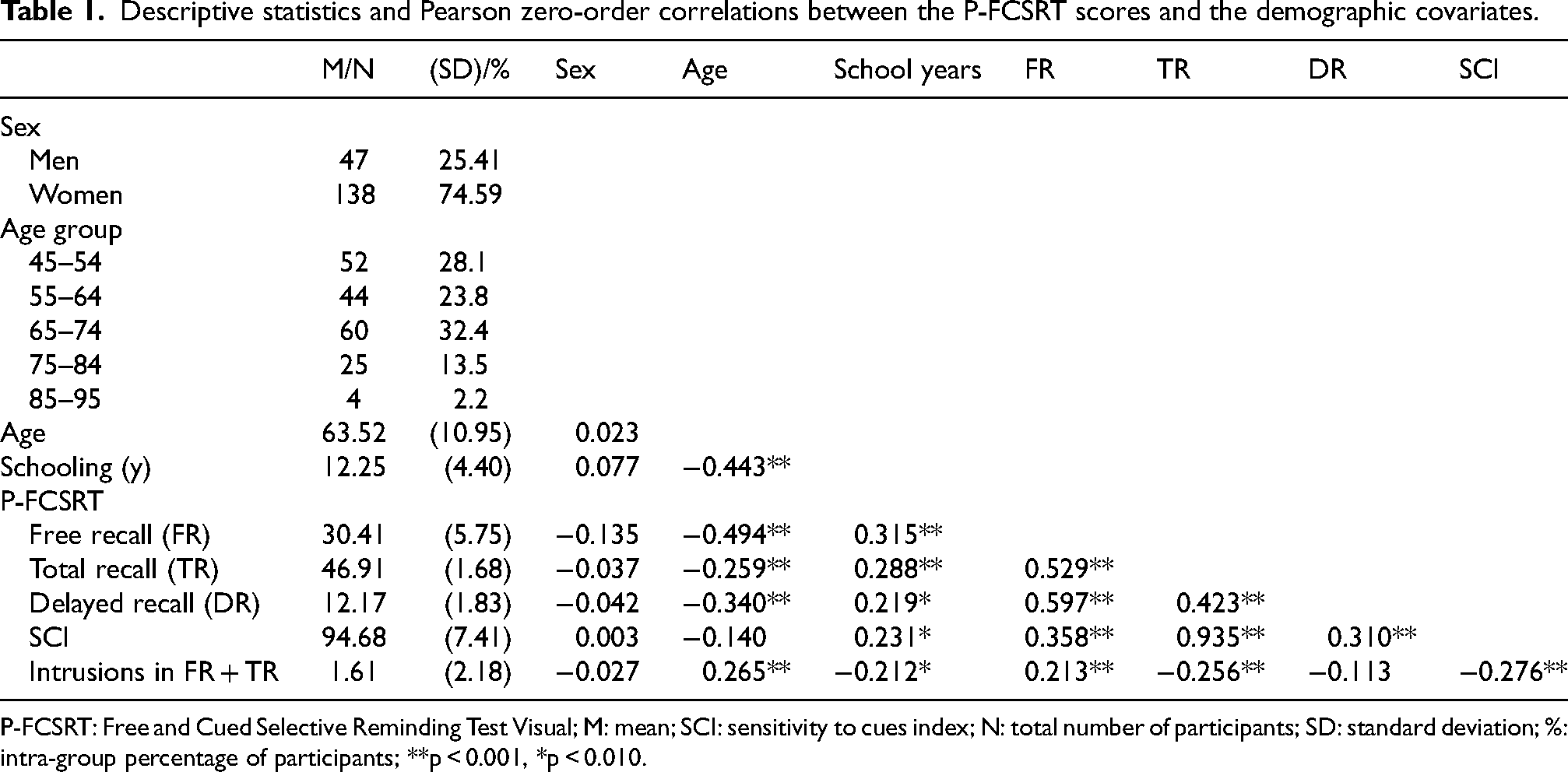
P-FCSRT: Free and Cued Selective Reminding Test Visual; M: mean; SCI: sensitivity to cues index; N: total number of participants; SD: standard deviation; %: intra-group percentage of participants; **p < 0.001, *p < 0.010.
Results
Normative data of the P-FCSRT score according to age and educational level
To obtain normative data, we followed the procedure described by Van der Elst et al. 37 A multivariate regression-based normative model was used to build a predictive model that included centered continuous age (agec = age − 62.5) and years of schooling centered (yearsc = years − 12) variables, along with sex (dichotomized as 1 = male, 0 = female) as a dichotomous variable. In this model, all dependent variables were pooled into one, using a set of independent dummy variables to identify each scale. FR was defined as the base category in this dummy set. Since each P-FCSRT scale has its own metric, a heterogeneous covariance structure was defined for the residuals.
As suggested by Van der Elst et al., 37 the model also included as independent variables the first-, second- and third-order polynomials of the centered continuous variables, as well as their interaction with all dummy variables. An iterative procedure was used to remove non-significant variables. After estimating the full model, a reduced model that excluded the least significant interaction between the scale dummies and the original independent variables was adjusted. If the difference in fit between the two models was not significant (alpha ≥ 0.05), the second model was retained, and the process continued. After testing the exclusion of all interactions between the scale dummies and the original independent variables, the interactions between the categorical independent variables and the polynomials of continuous independent variables were tested in decreasing order, followed by the polynomials of independent continuous variables (also in decreasing order) and the categorical variables. According to Van der Elst, 38 if a polynomial is retained, all lower polynomials of the same variable must also be retained, as eliminating lower-order polynomials biases the obtained norms.
The final model (see Table 2) includes the first-, second-, and third-order polynomials of age-centered, the first- and second-order polynomials of education-centered, the dummy set for P-FCSRT scales, and the interaction between age-centered × P-FCSRT scales dummy set. This model shows that sex has no effect on FCSRTV scales when accounting for the combined influence of age and years of schooling. These last variables have a non-linear effect on FCSRTV scales, up to the third-order polynomial in age-centered and up to second-order polynomial in education-centered (years of schooling). Age-centered had a negative effect on the first- and third-order polynomials, and a non-significant positive effect on the second-order polynomial. This suggests that as age increases, the FCSRTV scores decrease (negative first-order polynomial), and that the relationship between age and FCSRTV scores follows a wave-like pattern (negative third-order polynomial). Education-centered (years of schooling) variables have a non-significant positive effect on the first-order polynomial and a negative effect on the second-order polynomial. This suggests that as years of schooling increase, the FCSRTV scores show a small increase (non-significant positive effect in the first-order polynomial) but progressively decrease as years of schooling increase (negative effect in the second-order polynomial). Finally, the significant effect of the interaction between FCSRTV scales dummy set and age-centered variables shows that the effect of age on FCSRTV scores is less negative in TR, DR, Intrusion, and SCI compared with TR. Actually, for Intrusions, the main effect of age is positive: B_age-B (age × intrusion) = −0.238 + 0.312 = 0.074. This suggests that as age increases, the intrusions also increase and not decrease, as with the other FCSRTV scores. Figures 1 and 2 show the different relationships between age-centered variables and each one of FCSRTV scores, and between education-centered (years of schooling) and FCSRTV scores, respectively.

Relationship between age centered and FCSRTV scores.
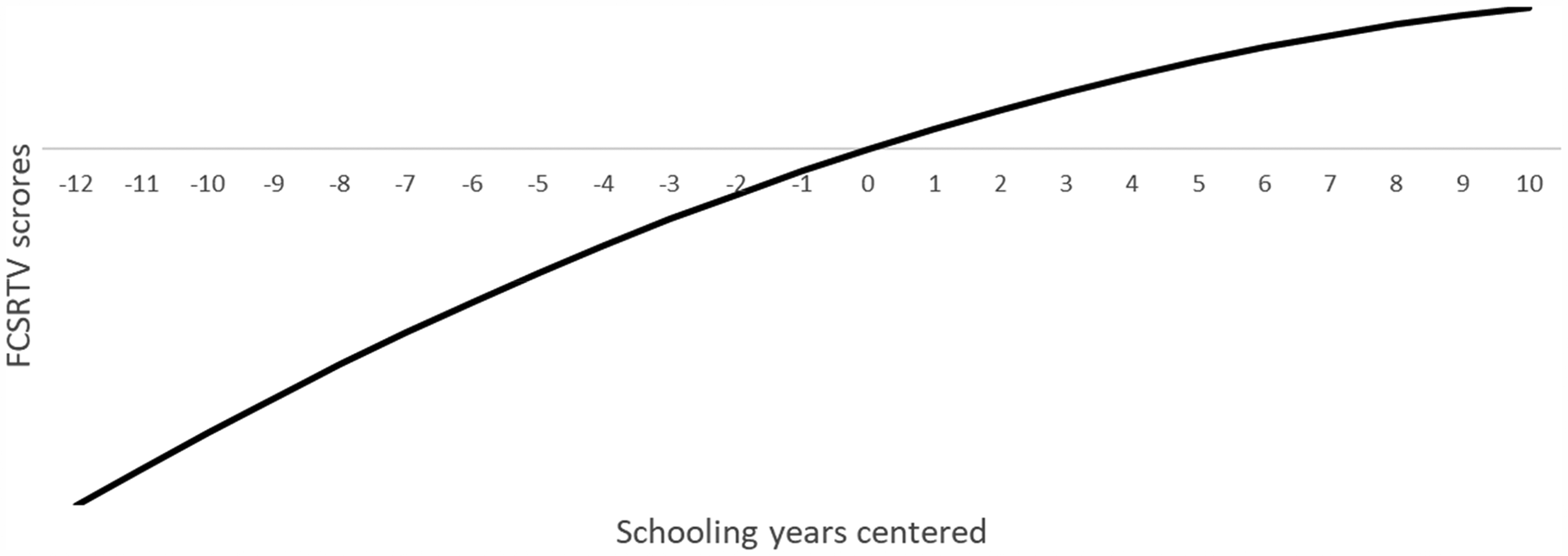
Relationship between years of schooling centered and FCSRTV scores.
Final linear regression model for the P-FCSRT scores (N = 185).
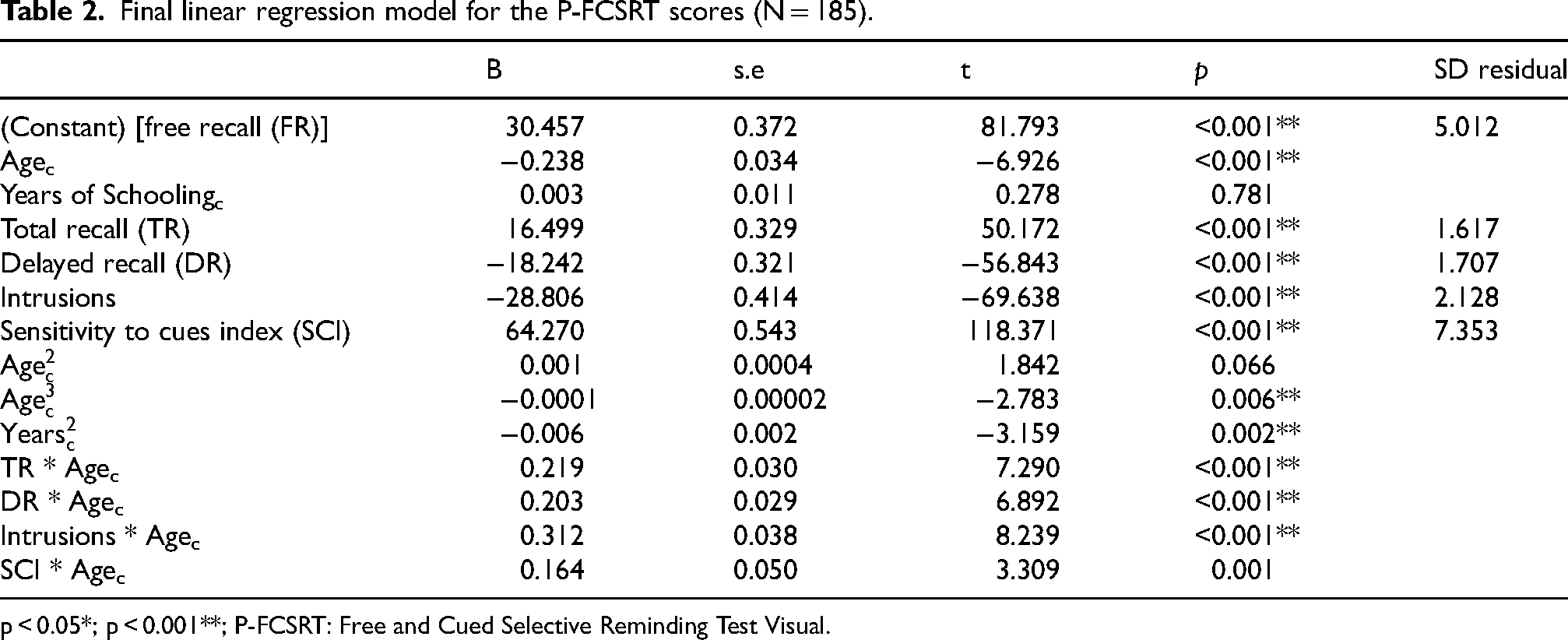
p < 0.05*; p < 0.001**; P-FCSRT: Free and Cued Selective Reminding Test Visual.
As observed in Figure 1, the relationship between age-centered variables and FR is negative and almost linear. TR, DR, and SCI also exhibit a negative relationship with age-centered, but clearly not linear. Among these, DR (dotted line) shoes the steepest line, while SCI (small-dashed line) shows the flattest. Lastly, Intrusions have a generally positive relationship with age-centered that becomes negative at the extremes.
It was assessed whether the variance–covariance structure of the residuals could be simplified using homogeneous and heterogeneous compound symmetry (CS) variance–covariance structures, as well as a homogeneous unstructured covariance structure; however, this was not the case (see models 15–17 in Table 3). The final model was refitted using REML (REstricted Maximum Likelihood) as this approach tends to exhibit less small sample bias than ML. 39 Pseudo R-Squared values show good fit (McFadden = 0.235, Cox and Snell = 0.738, Nagelkerke = 0.740, Efron = 0.984). Diagnosis by cases (Cook's distance) revealed no influential single cases, with the highest value being 0.354. High collinearity (VIF > 10) was observed in agec, TR (dummy), TR (dummy) × agec and SCI (dummy) × agec; however, this is expected due to the inclusion of variables derived from the originals. 38
Likelihood ratio tests to evaluate the fit of a series of nested multivariate regression models.
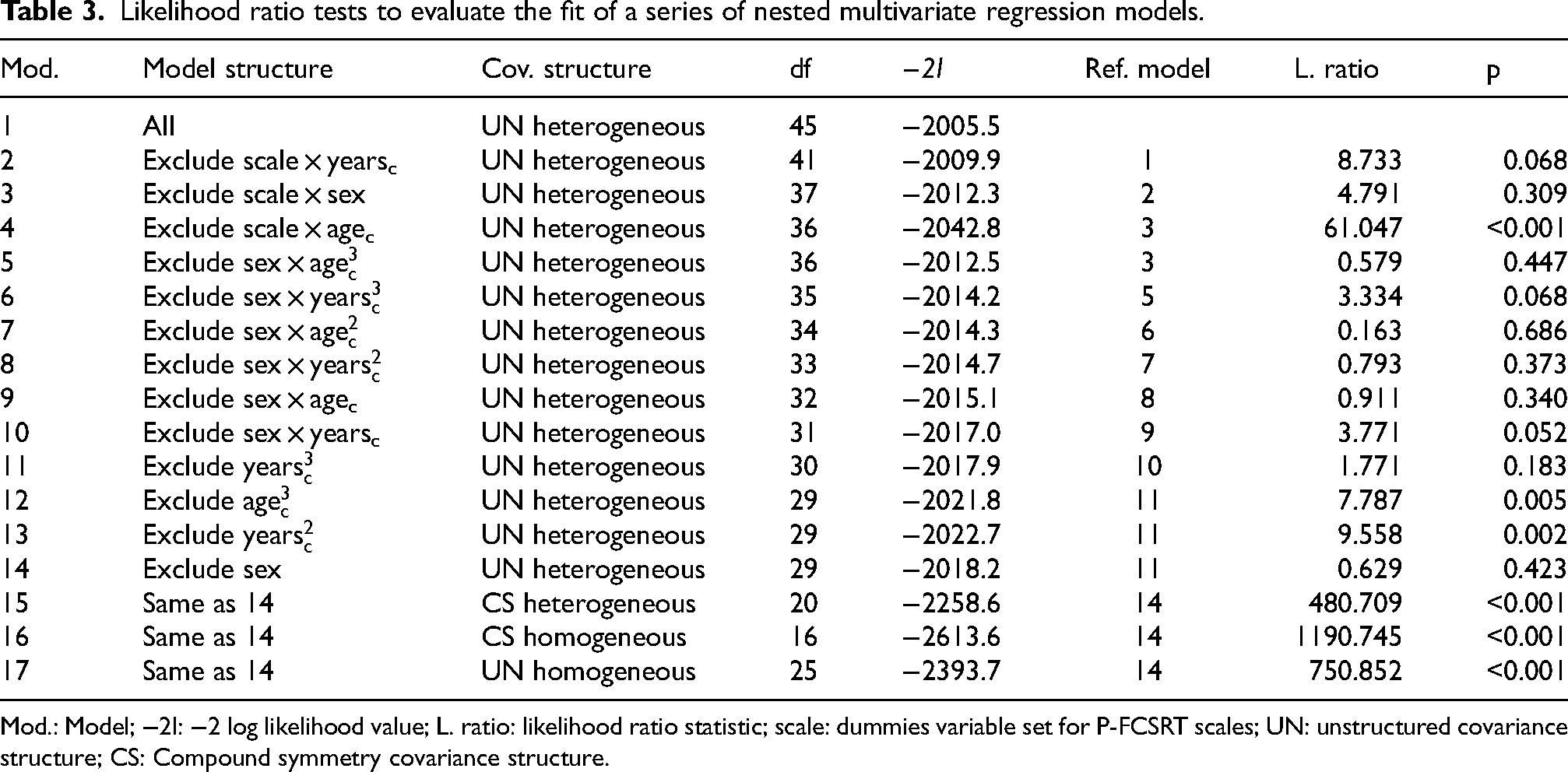
Mod.: Model; −2l: −2 log likelihood value; L. ratio: likelihood ratio statistic; scale: dummies variable set for P-FCSRT scales; UN: unstructured covariance structure; CS: Compound symmetry covariance structure.
Finally, residual scores were calculated for each scale based on the final model (ei = yi − ŷi). Residual scores (residual SDe) obtained from GLS regression were standardized as follows: z-score = ei /residual SDe (standard deviation of residuals in the normative sample). The distributions of the standardized residuals for the different P-FCSRT scales in the normative sample did not significantly deviate from normality (see Figure 3). To facilitate the use of norms in clinical settings, the percentiles obtained were labeled according to the guidelines of the American Academy of Clinical Neuropsychology. 40 This entire procedure was automated in an Excel spreadsheet, which is available for free as a download from the Supplemental Material.

Q-Q plot for P-FCSRT FR, TR, DR, intrusions and SCI.
Normative data of the P-FCSRT scores
Two examples are provided below to better illustrate the procedure for obtaining the z-score associated with a raw score. To facilitate the calculation of standardized scores and their corresponding descriptive categories, new consensus criteria defined by the American Academy of Clinical Neuropsychology (AACN) have been used to label scores on cognitive performance tests based on percentiles (Pr). 40
For FR, the z-equation is:
If a 75-year-old individual with 16 years of schooling scored 27 points in FR, the formula would be:
FR z-score = −0.14. This, in turn, corresponds to a percentile of 45, which, according to AACN, is classified as an “average score”.
For DR, the z-equation is:
The same individual in the first example scored 5 points in DR. In this case, the formula would be:
DR z-score = −3.43. This, in turn, corresponds to a percentile of 1, which, according to AACN, is classified as an “exceptionally low score”.
To facilitate the calculation of these normative scores, as well as those for TR, SCI, and Intrusions, an automated calculator has been developed and included in the Supplemental Material. As shown in Figure 4, the patient's age and raw scores (light blue cells) must be input into the calculator. The z-scores, equivalent percentiles, and their respective labels according to AACN are automatically generated.
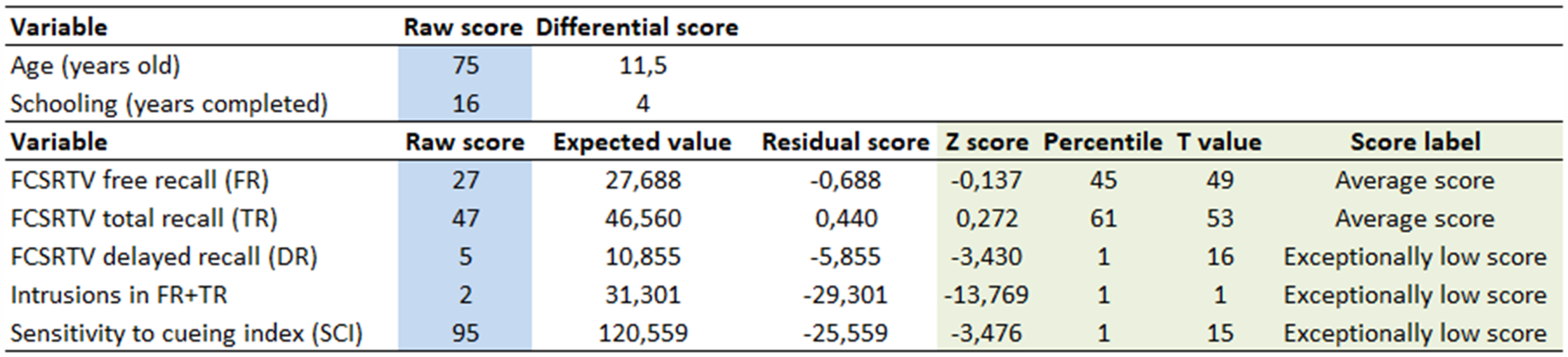
P-FCSRT calculator.
Discussion
The purpose of this study was to establish normative data for the pictorial version of the P-FCSRT, controlling for the effects of sociodemographic factors such as age, sex, and educational level, based on a sample of healthy middle-aged and older adults from the Chilean population.
In terms of obtaining normative data, the multivariate regression-based normative model for P-FCSRT reflected a significant effect of age on free recall, total recall, delayed recall, sensitivity to cues index, and intrusions scores. This effect was mostly linear for Free Recall, while for the other P-FCSRT subtests, the effect of age was weaker and non-linear.
This is consistent with the fact that ageing disproportionately affects the process of free search and retrieval in memory, rather than facilitated recall.24,41,42 This has been confirmed in several memory tests that assess free and facilitated recall43,44 and has also been observed in the specific case of the FCSRT. 45 In this regard, a multivariate regression-based normative model is considered appropriate, in which raw scores for the P-FCSRT are transformed into normalized scaled scores by calculating their percentile rank based on cumulative frequency distributions, thus controlling for the effect of age.
As recommended by Van der Elst, 38 considering both linear and quadratic effects, years of schooling as a continuous variable were found to positively influence all P-FCSRT subtests (FR, TR, DR, SCI, and Intrusions). However, from 12.5 years of schooling, this effect progressively decreases.
The effect of years of schooling on the P-FCSRT can be understood through the lens of cognitive reserve.46,47 Cognitive reserve refers to the brain's ability to resist or compensate for the effects of ageing or neurodegenerative pathologies. In fact, individuals with higher educational levels tend to have greater cognitive reserve, which appears to enhance performance on various cognitive tests, including episodic memory tasks.43,44 Furthermore, individuals with higher educational levels benefit from more advanced strategies for encoding information.48,49
Additionally, the P-FCSRT may offer an extra advantage, as it integrates both auditory and visual input during encoding. 50 On the other hand, the recall phase of episodic memory requires more sophisticated retrieval strategies, which are typically associated with higher educational levels. This is because educational environments often foster the development of such skills. 14
In the case of Intrusions, these represent inhibitory errors during the retrieval process. 51 Our study found a higher frequency of intrusive errors among individuals with lower educational levels. This finding is consistent with previous reports, 27 which identified a similar trend and attributed it to reduced inhibitory control in individuals with fewer years of schooling. Finally, the progressive decline in the effect of years of schooling has been described as a “ceiling effect”, where the incremental effect of education diminishes once a sufficient level of cognitive skills has been reached. 37
The assessment of intrusive errors offers an interesting strategy for identifying cognitive patterns that may reflect a distinct configuration during memory formation, associated with an increased risk of cognitive impairment or dementia.27,34 In this context, the inclusion of normative data on the number of intrusions was deemed appropriate, as several studies27,52 have highlighted the importance of screening for subtle or preclinical manifestations of cognitive impairment. These manifestations extend beyond test performance, with processing errors (such as intrusions) serving as valuable clinical information, 53 as they are sensitive to the early stages of cognitive impairment.27,54
The use of z-scores and percentiles was implemented to obtain normative scores and classify them according to AACN. 40 This approach facilitates work in clinical environments and allows for better control of linearity and homoscedasticity issues often encountered in studies involving cognitive tests. 55 The approach used in this study contributes to the standardization of cognitive performance classification on the P-FCSRT. 40 These normalized data will allow clinicians and researchers to compare cognitive test scores using standardized scores, thereby reducing the risk of misdiagnosing cognitive impairment among normal individuals.
This study was not without limitations, as there is still a limited number of standardized neuropsychological instruments for memory assessment in Spanish. Normative studies are essential for improving diagnostic accuracy without the influence of sociocultural diversity; for example, in rural areas with lower levels of schooling and higher levels of illiteracy, ethnic groups, etc. Furthermore, the normative equations obtained show less accuracy at the upper end of the ageing spectrum, particularly for individuals aged 85 and older, as the sample included only four participants between the ages of 85 and 95 (see Table 1). Future research should consider these underrepresented groups who were not included in this study.
Despite these limitations, the P-FCSRT can be applied to Chilean individuals aged 45 and older, regardless of the age, years of schooling, and sex of the participants.
Supplemental Material
sj-docx-1-alz-10.1177_13872877251332513 - Supplemental material for Picture free and cued selective reminding test (P-FCSRT): A normative study for Chilean middle-aged and older adults
Supplemental material, sj-docx-1-alz-10.1177_13872877251332513 for Picture free and cued selective reminding test (P-FCSRT): A normative study for Chilean middle-aged and older adults by Miguel Ramos-Henderson, Marcelo Avalos-Tejeda and Claudia Carvallo1 in Journal of Alzheimer's Disease
Supplemental Material
sj-sav-2-alz-10.1177_13872877251332513 - Supplemental material for Picture free and cued selective reminding test (P-FCSRT): A normative study for Chilean middle-aged and older adults
Supplemental material, sj-sav-2-alz-10.1177_13872877251332513 for Picture free and cued selective reminding test (P-FCSRT): A normative study for Chilean middle-aged and older adults by Miguel Ramos-Henderson, Marcelo Avalos-Tejeda and Claudia Carvallo1 in Journal of Alzheimer's Disease
Footnotes
Acknowledgments
We thank Laboratorio Lavoisier (Antofagasta), Laboratorio Clínico del Departamento de Salud Municipal (P. Montt), Centro Comunitario Casa Félix (P. Montt), Centro Médico Español for his skillful support and advice in patient care.

Ethical considerations
The research protocol was approved by the Zonal Ethics Committee: Servicio de Salud Antofagasta No. 0026/22; Servicio de Salud Metropolitano Central No. 048975; Servicio de Salud Araucanía Sur No. 15871.
Consent to participate
Written informed consent to participate in the study will be obtained from all participants in the Aging MetS Cohort, in accordance with the Declaration of Helsinki.
Author contributions
Miguel Ramos-Henderson (Conceptualization, Investigation, Methodology, Supervision, Writing - original draft, Writing - review & editing); Marcelo Avalos-Tejeda (Data curation, Formal analysis, Methodology, Writing - review & editing); Claudia Carvallo (Conceptualization, Funding acquisition, Investigation, Writing - original draft, Writing - review & editing).
Funding
The author(s) disclosed receipt of the following financial support for the research, authorship, and/or publication of this article: This work was supported by Agencia Nacional de Investigacion y Desarrolllo, ANID, grant: SA77210016; FONIS SA24I0065, NAM22I0009 and FOVI220134 to C.C. Miguel Ramos-Henderson's doctoral studies were funded by ANID-Subdirección de capital humano /Doctorado Nacional/2023/Folio (21231230).
Declaration of conflicting interests
The author(s) declared no potential conflicts of interest with respect to the research, authorship, and/or publication of this article.
Data availability
The data supporting the findings of this study are available on request from the corresponding author.
Supplemental material
Supplemental material for this article is available online.
References
Supplementary Material
Please find the following supplemental material available below.
For Open Access articles published under a Creative Commons License, all supplemental material carries the same license as the article it is associated with.
For non-Open Access articles published, all supplemental material carries a non-exclusive license, and permission requests for re-use of supplemental material or any part of supplemental material shall be sent directly to the copyright owner as specified in the copyright notice associated with the article.
