



Abstract
Background
The epidemiology of Alzheimer's disease and related dementias (ADRD) in China is understudied as compared to global levels.
Objective
The aim of this study was to examine the trend of dementia epidemiology in China from 1990 to 2021 and provide predictions for the next two decades.
Methods
The Global Burden of Disease study (GBD) 2021 were used to analyze the prevalence, incidence, mortality, and disability-adjusted life years (DALYs) rates due to ADRD in China and globally. Joinpoint regression analysis was used to analyze the epidemiological trends from 1990 to 2021. A forecast of ADRD prevalence trends was conducted utilizing Autoregressive Integrated Moving Average (ARIMA) models.
Results
China was experiencing a growing burden of ADRD. As of 2021, the number of people with dementia in China had risen to 56.85 million (95%CI: 49.38, 64.98), up from 21.80 (95%CI: 19.07, 24.84) million in 1990. The prevalence, incidence, mortality, and DALY rates all indicated a greater disease burden among the Chinese population compared to global levels, with a significantly higher burden in the female group. The projected prevalence rate was expected to increase by 60% compared to the current prevalence rate.
Conclusions
As the population in China continues to age, ADRD presents an undeniable challenge. To mitigate the growing burden of ADRD and improve the overall health of the population, it is essential to establish a comprehensive plan that focuses on increasing public awareness and enhancing the quality of life for all, with special attention given to women.
Introduction
Dementia is a progressive and irreversible neurodegenerative disorder, with Alzheimer's disease (AD) being the most common subtype. AD typically begins with gradual memory deficits, followed by language impairment, and eventually impaired activities of daily living. 1 The projected global prevalence of AD, estimated to affect 152.8 million individuals by 2050, presents a formidable challenge not only for the elderly population and their families but also for healthcare systems and society at large. 2 For instance, in the United States, it has been estimated that the direct and indirect costs associated with AD account for approximately $350 billion in the population aged above 65 years old. This amount is equivalent to approximately 8% of the total US health-care spending in 2021, which is similar to the combined cost attributed to cancer and heart disease. 3 Similarly, in China, dementia is officially listed as the sixth leading cause of morality prior to the COVID-19 pandemic period. 4 However, the COVID-19 pandemic has further exacerbated the situation for individuals with AD, resulting in increased negative impacts on emotional, mental, and physical health. This has resulted in a higher demand for medication and caregiving support. 5
The demographic changes clearly indicate a transition towards an aging society. By 2050, the population structure is predicted to resemble an inverted pyramid, with a higher number of individuals over the age of 60 compared to younger individuals. 4 It is estimated that nearly 38% of the population will consist of people aged 65 years or older at that time. 4 Similar to the aging pattern, the global average life expectancy increased to 73.1 years in 2019. China, being one of the most populous countries, has seen a rise in life expectancy from 71.6 years in 2000 to 77.3 years in 2019, attributed to the rapid increase in gross domestic product (GDP) and subsequent improvements in living standards. 6 However, the growth pattern in life expectancy has changed during the pandemic: globally, life expectancy decreased to 71.4 years in 2021, while in China, it continued to show a slight increase to 78.2 years. 6 Since the medical and economic environment varies greatly in different time periods, it is therefore critical to study the secular trend of aging related diseases by segregating time periods in order to gain a more accurate understanding of the total trend.
Previous studies have primarily focused on a comprehensive understanding of AD and related dementias (ADRD), including its epidemiology pattern, economic burden, relative risk factors, and the prevention and guidance towards dementia.7–9 However, these data are limited in that they only focus on the changes during a specific period of time, without taking into account the variations across different segments of that time period. This may lead to an incomplete picture of the health trend. 10 Additionally, there is a lack of investigation regarding the comparison of prevalence of dementia between China and global levels, as well as gender difference. Therefore, the aim of this study is to create a detailed picture of dementia in China using a segmented regression model. This study also aims to compare the prevalence of ADRD in China with global trends, explore gender differences, and forecast future prevalence rates.
Methods
Data source
Data used in the current study were obtained from the Global Burden of Disease study (GBD) 2021 via the updated online platform: Global Health Data Exchange (GHDx) website (https://vizhub.healthdata.org/gbd-results/). GBD 2021 represents the most extensive collection of disease burden data, covering 288 causes of death, 371 diseases and injuries, and 88 risk factors in 204 countries and territories. To ensure the consistency of data from different areas, all estimates were reported as age-standardized rates (ASRs). ASRs is calculated by applying weights based on the proportions of a standard population in the corresponding age groups. 11 DALY is a metric that quantifies the difference in the number of healthy years lived by a population in comparison to a standard benchmark. DALY is defined as the sum of Years Lived with Disability (YLD) and Years of Life Lost (YLL) which can reflect the true suffering caused by certain medical conditions compared to prevalence and incidence.12,13 Due to the data constraint, three risk factors for AD were investigated including tobacco, high body mass index (HBMI), and high fasting plasma glucose levels (HFPG). The definition of ADRD is recorded previously using Diagnostic and Statistical Manual of Mental Disorders (DSM)-III, DSM-III-R, DSM-IV, DSM-V, the International Classification of Diseases (ICD)-8, ICD-9, or ICD-10 13. HFPG refers to fasting plasma glucose levels exceeding 4.9–5.3 mmol/L. HBMI is classified as a body mass index greater than 20–23 kg/m2 for individuals over 20 years of age, while it is defined as being overweight based on International Obesity Task Force standards. 14
Statistical analysis
All data including prevalence rates, incidence rates, morality rates and ASRs were present with their 95% confidence intervals. Joinpoint regression analysis was conducted to demonstrate the yearly variation in age-standardized incidence, prevalence, and mortality rates on both a national and global scale using Joinpoint Trend Analysis Software (version: 5.2.0, National Cancer Institute, Rockville, MD, USA). Different time periods offer estimates of changing values and are connected by turning points. The Average Annual Percentage Change (AAPC) was computed to show the average annual percentage change of these rates over time. The remaining data is visualized through R software (version 4.4.1) and GraphPad Prism (version 8.0.2). Paired t test was used to make comparison of DALY value among different age groups in China and the world. p value is regarded as significant when it is below 0.05. ARIMA model was conducted in SPSS (version 26, IBM, Armonk NY, USA). The best ARIMA models were selected based on a comprehensive consideration, taking into account the models with the highest values of R-square (R2) and stationary R2, minimum MAPE value, and white noise.15,16 Accordingly, ARIMA (0,2,1) and ARIMA (0,2,0) were chosen as the best models for China and Global, respectively.
Results
Trend in prevalence, incidence, morality, and DALY of ADRD
Between 1990 and 2021, the global prevalence rate of ADRD increased slightly from 672.22 [588.73, 763.95] to 694.01 [602.88, 794.08] per 100,000, whereas there was a 28% increase rising from 703.14 [608.36, 809.51] to 900.82 [770.92, 1043.22] per 100,000 in China (Table 1 and Supplemental Table 1). The age-standardized prevalence rate was highest in high Social Demographic Index (SDI) countries in 1990 (724.21 [637.60, 815.94]) but has since shifted towards high-middle SDI countries (766.20 [659.80, 879.64]) in 2021 (Supplemental Table 1).
Age-standardized prevalence, incidence, and morality rates in 1990 and 2019 for dementia in China segregated by sex.

All the data are present in estimated values with their 95% uncertainty intervals.
UI: uncertainty Intervals.
The global incidence rate remained stable during the study period, but in China, there was a 25% increase in incidence, rising from 121.11 [105.50, 137.99] to 151.47 [131.22, 173.34] (Table 1 and Supplemental Table 1). Despite a stable mortality rate over the past 30 years, the number of deaths due to dementia has increased by 194% globally (from 663,294 to 1,952,677). Notably, in China, there has been a sharp increase of 313% (from 119,809 to 491,774) in deaths numbers due to dementia.
In 2021, ADRD accounted for 1.26% of DALYs across both sexes (1.26 [0.62, 2.64]) in the general population. The DALY rate was observed to begin at the age of 40 and increase steeply after the age of 65. The results highlighted that the DALY rate in China was significantly higher than the global level (p = 0.045) across all age groups, with the age group of those who aged over 85 years old showing the greatest difference (Figure 1). Furthermore, both YLD and YLL showed a higher increase at a later time period (after 75 years), as depicted in Figure 2. China had higher rates of both YLDs and YLLs compared to the global level, with YLDs being particularly higher (Figure 2).

Age distribution of Dementia DALY in China and the world, 2021. DALY: disability-adjusted life years; The p value comes from statistical analysis in DALY rates of different age groups between China and the global level.

Years of life lost (YLL) and years of life with disability (YLD) rates among per 100,000 segregated by age groups in China and the world. (a) Years of life lost (YLLs) rates segregated by age groups in China and the world among per 100,000; (b) Years lived with disability (YLDs) rates segregated by age groups in China and the world among per 100,000. (c) Years of life lost (YLLs) rates segregated by age groups in Chinese male and female per 100,000; (d) Years of life with disability (YLD) rates segregated by age groups in Chinese male and female per 100,000.
Gender difference
It was evident that there was a gender difference in dementia patterns, with females generally experiencing higher prevalence, incidence, and mortality rates in comparison to their male counterparts (Table 1). In China, the prevalence of dementia in females was 40% higher than in males, with prevalence rates of 1025.11 and 731.21, respectively, in 2021. Chinese women had a higher probability of developing dementia than men (171.81 [150.12, 195.90] versus 126.48 [107.78, 145.62] per 100,000) (Table 1). Additionally, Chinese women had experienced more years of life with disability due to dementia compared to men, and a higher number of women died due to dementia in 2021 (33.80 [8.60, 87.19] versus 25.90 [6.51, 73.20] per 100,000) (Table 1).
From a global perspective, the disease pattern has remained consistent from 1990 to 2021, with women bearing a higher burden of dementia. Interestingly, the gap in prevalence rates between men and women had remained consistent, with a 29% gap in 1990 and a 30% gap in 2021 (Supplemental Table 1).
Joinpoint regression analysis
The average annual percentage change (AAPC) of incidence rates in China was 0.71 for both males and females. Increases in the annual percentage change of incidence rates were observed in the early 1990s (1990–1995), early 2010s (2011–2015), and during the pandemic years (2019–2021). No significant increase was found in 1995–2011 and 2015–2021. A similar pattern of annual prevalence change was observed in the prevalence rates for both males and females, with the highest increase occurring during 1990–1995 and 2019–2021.
In terms of the average annual mortality change, women reported a non-significant increase. Specifically, the annual change declined significantly from 1990 to 2019, followed by a substantial rise reported during the pandemic years. For men, the average annual change was 0.09 [0.01, 0.17], with a similar decrease during 1990–2019 and an increase during 2019–2021. The increase during the pandemic period was higher than that of women (Table 2 and Supplemental Table 2).
Joinpoint regression analysis: trends in age-standardized incidence, prevalence, mortality rates (per 100,000 persons) among both sexes, males, and females in China, 1990–2021.
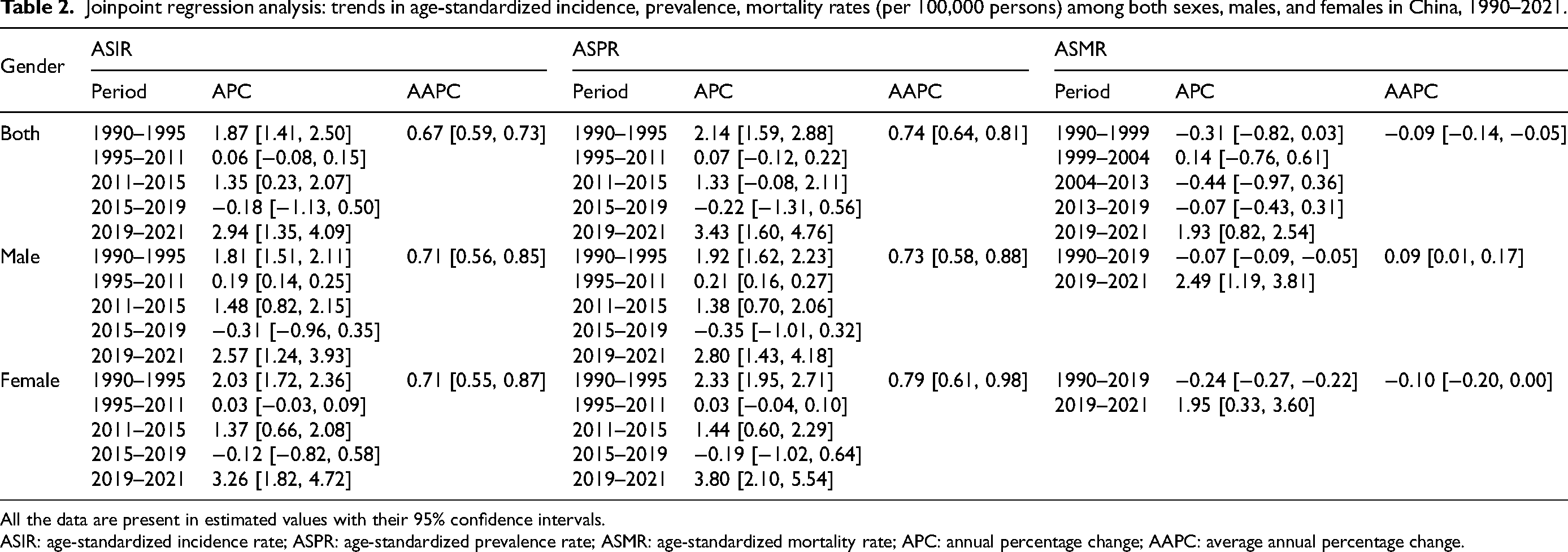
All the data are present in estimated values with their 95% confidence intervals.
ASIR: age-standardized incidence rate; ASPR: age-standardized prevalence rate; ASMR: age-standardized mortality rate; APC: annual percentage change; AAPC: average annual percentage change.
Risk factors
In GBD 2021, three major risk factors for dementia were investigated, including HFPG, high body mass index, and smoking habits. In China, the highest DALY was caused by HFPG among all three risk factors (66.72 [3.91, 177.01]), followed by tobacco (30.63 [12.98, 69.65]) and high body mass index (24.75 [−1.75, 98.65]). Globally, HFPG were the main risk factor for dementia (66.42 [3.83, 178.85]), followed by high body mass index (32.86 [−5.97, 115.18]) and tobacco use (18.36 [7.90, 42.07]). Additionally, morality in dementia caused by blood glucose was the highest in both China (3.64 [0.14, 11.53]) and the world (3.73 [0.15, 11.84]), a similar trend with DALY (Figure 3).

Risk factors resulting in DALY and morality rates in Alzheimer's disease and related dementias (ADRD) among per 100,000 segregated by age groups in China and the world. (a) Risk factors contributing to DALY rates in ADRD; (b) Risk factors resulting in mortality rates in ADRD.
Trends in the future
The ARIMA model-based statistical forecast, utilizing prevenance data of ADRD from 1990 to 2021, was illustrated in Figure 4. The results showed a consistent increase in the prevalence of ADRD, projected to reach 1899.94 per 100,000 in China by 2040. The upper confidence limit for this projection was 2323.92, while the lower limit was 1475.96. This represents a significant 60% surge compared to the prevalence rate in 2021. On a global scale, the predicted prevalence for ADRD was 1004.85, with a confidence interval ranging from 941.61 to 1069.65 (Supplemental Table 3). To test the sensitivity and stability of the ARIMA model, two regression models (Cubic regression and Polynomial regression) were employed, and they exhibited similar trends to the ARIMA model (Supplemental Figure 1 and Supplemental Table 4).

Trend in the prevalence rate of ADRD from 1990 to 2040. ADRD: Alzheimer's disease and related dementias; Confidence intervals were shown in dotted lines.
Discussion
This study provides a comprehensive analysis of the temporal trends in ADRD epidemiology in China. During the last 30 years, there has been a gradual increase in the prevalence, incidence and mortality rates of dementia in China mirroring findings from previous publications.17,18 The increase can be primarily due to population aging, as China now has the largest population of older adults, accounting for almost a quarter of all older people in the world. 19 Meanwhile, life expectancy has also increased, rising from 71.6 years in 2000 to 78.2 years in 2021, higher than the global levels. The increase in the prevalence, incidence and mortality rates of ADRD can also be attributed to the increased awareness in physical health and advancements in medical technology, leading to more efficient diagnoses. 20 The increased frequency of physical examinations, accompanied by the adoption of a wider range of diagnostic tools, including neuroimaging and biofluid, has greatly improved the efficiency of AD diagnosis. 21
Economic status is another factor that appears to play a role in dementia. High SDI countries have borne the largest burden of dementia in the early decades, while high-to-middle SDI countries have borne the largest burden in the recent years. The underlying reason may be that high SDI countries took the lead in responding to the challenges posed by AD which has become more prevalent as life expectancy and risk factors have increased.22,23 High SDI countries have implemented effective control measures, including lifestyle interventions, resulting in a reduction in AD incidence rates during the last thirty years. 24 The highest incidence rates in high-middle SDI countries indicate that they are also undergoing a similar journey as high SDI countries and requiring more investment and effort to control AD incidence rates. As one of the middle-SDI countries, China, is likely to experience the similar fluctuation pattern in dementia incidence in the recent years.
The secular trend analysis of AD prevalence in China indicates a fluctuating pattern, with initial increased observed from 1990–1995, followed by a stable period from 1995–2011. Subsequently, there was another increase from 2011–2015, followed by another stable period from 2015–2019. However, the pandemic period saw a significant elevation in the incidence rate of AD to a higher level, with similar fluctuating trend observed in incidence rates before the pandemic. While we cannot pinpoint the exact reason for the turning point, we speculate that the advancement in global economic development and healthcare policies played a significant role. Our study reports a sharp increase in mortality rates for both male and female in China during the pandemic period, consistent with previous studies which reported excess morality rate in ADRD during the pandemic years. 25 This is likely due to patients with AD being more vulnerable to viral infections, experience an increased incidence of psychological disorders, and facing issues with inadequate caregiving. 26 Interestingly, while the mortality rate increased in China during the pandemic period, the global morality rate remained relative stable during the COVID-19 pandemic period. This can be attributed to ageing which is a sensitive tool in COVID prognosis, and the fact that there was a higher proportion of elderly population in China, leading to an increase in the morality rates.27,28 Apart from the pandemic, both China and the world are experiencing significant changes in their economies and populations, leading to higher demands for medical policies and forms of healthcare. It is therefore crucial for policymakers and healthcare professionals to work together to develop comprehensive and sustainable healthcare systems that can effectively address the complex and evolving health needs of the elderly population in modern societies.
The gender disparity in AD prevalence, incidence, and mortality rates in China suggests that women are at a greater risk of developing dementia and bearing the associated burden compared to men. The results are consistent with previous studies which show nearly doubled values of ADRD in Chinese women than men.7,29 The underly reason cannot be solely attributed to a longer lifespan in Chinese women. Gender disparities may be attributed to physical differences inherent in males and females, which can manifest in various ways, such as differences in physical and psychological characteristics. These differences are a result of inherent reproductive hormones that shape education levels, lifestyles, and health conditions.30,31 A systematic review has shown that females and males differ in susceptibility to different types of dementia, with females having a twice fold of risk for AD, while males are more likely to develop vascular dementia. 31 Such findings suggest that interventions and medications targeted at dementia should also take into account age and gender differences.
Against the backdrop of global aging, it is worth noting that Alzheimer's disease and related dementias (ADRD) ranked third among diseases with the highest increase in Disability-Adjusted Life Years (DALYs) between 2011 and 2021. 14 Notably, the elderly population who lives longer are more greatly affected by disabilities related to dementia. This not only affects their quality of life but also places a greater burden on healthcare services. In traditional Chinese families, individuals with dementia typically remain at home during the later stages of the disease. 32 It is important to consider how these individuals can maintain their dignity in their later years and pass away with grace, while also allowing caregivers to have a life of their own. This is an important topic that warrants contemplation.
During the study period, a consistent upward trend was found in blood glucose levels, high body mass index, and smoking-related dementia morality and DALY. Of these factors, HFPG were identified as the leading cause of dementia-related morality and DALY. The connection between HFPG and dementia could be attributed to various conditions, including acute and chronic hyperglycemia, insulin resistance, and heightened microvascular disease within the central nervous system.33–35 Glucose metabolism plays an essential role in the link between dementia and diabetes. The decline in self-care practices resulting from dementia could lead to HFPG, and HFPG may further lead to the deterioration of dementia. 33 This is supported by population studies, which have found postprandial glucose levels in diabetic patients are related with clinical cognitive decline in dementia, including hippocampal volume change in MRI. 36 Interestingly, other clinical evidence suggested HFPG are an independent risk factor for dementia, regardless of diabetes. 33
In comparison to the global level, the Chinese population has a relatively controlled BMI index but a higher smoking rate. This finding indicates that tobacco exerts a heavier burden on Chinese population. Likewise, a previous study reported that tobacco dependence is a major challenge in China, with an estimated prevalence of current smoking at 25.1%. 37 These findings together indicate an urgent need for prevention and cessation of smoking to reduce the addictive nature of tobacco dependence. Efforts against tobacco may yield long-term result, not only limited to improving the overall heath, such as cardiovascular health and respiratory health, but also may improve the prognosis of dementia. 38
Since the launch of the “MPOWER policy” (short for Monitoring, Protecting, Offering help, Warning, Enforcing bans, and Raising taxes) by the World Health Organization in 2008, which includes monitoring tobacco use, protecting people from tobacco smoke, offering help to quit tobacco use, warning about the dangers of tobacco, enforcing advertising bans, and raising taxes on tobacco, 39 many policies have been implemented in China. These policies include city smoke-free laws in certain areas, and smoke bans in educational and healthcare-related places. However, these efforts are not adequate to combat the increasing burden caused by smoking and smoking-related disease based on our findings. Given the high prevalence of tobacco use and China's large population, there is still much work to be done in the fight against tobacco.
Although not all risk factors, such as smoking, glucose levels and weight control, contribute equally to a healthy lifespan, maintaining a healthy lifestyle is generally strongly associated with a longer lifespan. 40 This impact benefits equally both healthy individuals and individuals with chronic medical conditions. 40 Promoting and adopting a healthy lifestyle is important in achieving substantial gains in healthy life expectancy.
While ARIMA models were originally applied in economic sectors, they have been widely used in predicting various diseases, including infectious and degenerative diseases.41,42 Although machine learning algorithms such as Support Vector Machines and Random Forest have been incorporated into other models for epidemiological prediction, it often results in similar results with ARMIA and requires big data for training. 41 Compared with machine learning algorithms, ARIMA model as selected for its well-structured modelling foundation and satisfactory predictive capabilities in analyzing linear time series as reported previously.43–45 In previous publication, ARIMA model was applied in predicting the morality trend of ADRD in US. 20 Additionally, the dataset features of the GBD dataset, which include limited time and prevalence data spanning the past 30 years, determined the selection of the ARIMA model for this study. 42 Based on our results, the undeniable fact is the upward trend of ADRD in the next 20 years, with China bearing a heavier burden. While ARIMA models may show volatility in their predictions, the insights they provide are valuable in uncovering the future trends of ADRD in both China and globally.
In conclusion, dementia remains a significant health challenge in China, and progress in addressing this issue has been limited over the past three decades. With population growth and an aging trend, it is projected that there will be a significant rise in the number of individuals diagnosed with dementia in the coming decades. It is therefore crucial to focus on evaluating the effectiveness of controlling risk factors such as tobacco use, adapting healthcare to an aging population, and addressing physiological aspects for both patients and their caregivers. Attention must be paid to these issues to effectively address the growing burden of dementia, especially among women, in China.
There are several limitations inherent in this study that need to be addressed. Firstly, data collection tends to overestimate the actual burden from the underprivileged areas and regions, since individuals in these areas may not have access to adequate medication and may suffer from clinical symptoms of dementia that are not reflected in the data. Secondly, other established factors, including carrier of APOE ε4 and education levels are not provided in the current dataset. 31 It is desirable to include additional relevant risk factors to facilitate our understanding on dementia prevention in future iteration. An additional limitation of this study is the lack of incorporation of age and social-demographic factors into our model predictions. Investigating the evolving demographic trends and their influence on our forecasting models will be a primary focus of our future research efforts.
Conclusion
The present study reveals gradual increases in age-adjusted prevalence, mortality, incidence, and DALY rates among both males and females in China, with Chinese women bearing a greater burden. The predictive model highlights a substantial burden expected in the prevalence rate of ADRD in China in the upcoming decades. These results indicate that dementia is an important public health concern in both sexes in China. To mitigate the negative impact of dementia on quality of life and mortality, promoting a healthy lifestyle and adapting medical practices to meet the needs of an aging population are crucial. The findings of this study can inform policymakers in monitoring and evaluating current prevention and treatment strategies for dementia, and ultimately contribute to creating a friendly environment for the elderly population.
Supplemental Material
sj-docx-1-alz-10.1177_13872877251333108 - Supplemental material for Patterns and trends in the burden of Alzheimer’s disease and related dementias in China (1990–2021) and predictions to 2040
Supplemental material, sj-docx-1-alz-10.1177_13872877251333108 for Patterns and trends in the burden of Alzheimer’s disease and related dementias in China (1990–2021) and predictions to 2040 by Hui Min Chen, Kuo Shen, Ling Ji, Colman McGrath and Hui Chen in Journal of Alzheimer's Disease
Footnotes
Acknowledgments
The authors have no acknowledgments to report.
Ethical considerations
Not applicable.
Consent to participate
Not applicable.
Consent for publication
Not applicable.
Author contributions
Hui Min Chen (Conceptualization, Data curation, Formal analysis, Project administration, Writing - original draft); Kuo Shen (Data curation, Formal analysis, Writing - original draft); Ling Ji (Methodology, Writing - review & editing); Colman McGrath (Investigation, Writing - review & editing); Hui Chen (Investigation, Supervision, Writing - review & editing).
Funding
The author(s) received no financial support for the research, authorship, and/or publication of this article.
Declaration of conflicting interests
The author(s) declared no potential conflicts of interest with respect to the research, authorship, and/or publication of this article.
Data availability

Supplemental material
Supplemental material for this article is available online.
References
Supplementary Material
Please find the following supplemental material available below.
For Open Access articles published under a Creative Commons License, all supplemental material carries the same license as the article it is associated with.
For non-Open Access articles published, all supplemental material carries a non-exclusive license, and permission requests for re-use of supplemental material or any part of supplemental material shall be sent directly to the copyright owner as specified in the copyright notice associated with the article.
