



Abstract
Background
High cardiorespiratory fitness has been associated with greater neuroplasticity, and slower neurodegeneration and cognitive decline in healthy adults. Yet, less is known about whether low-to-intermediate cardiorespiratory fitness is associated with lower markers of disease progression in the preclinical stage of Alzheimer's disease (AD).
Objective
We investigated whether cardiorespiratory fitness was associated with plasma biomarkers for AD-related pathology, neural injury and astrocyte reactivity, and episodic memory in Presenilin-1 E280A carriers without dementia from the world's largest kindred with autosomal-dominant AD.
Methods
Twenty-seven mutation carriers (25 cognitively unimpaired, 2 with mild cognitive impairment; ages: μ=30.22 years, SD = 5.24; 74% female) participated in the study. Participants underwent a graded aerobic fitness test to assess cardiorespiratory fitness, measured in maximum metabolic equivalent of task (MET). Plasma biomarkers included amyloid 42/40, phosphorylated tau-181, neurofilament light chain, and glial fibrillary acidic protein. Participants completed the Consortium to Establish a Registry for AD word list learning and delayed recall. We conducted multiple linear regressions controlling for age, sex, and years of education.
Results
Fourteen participants’ MET values were indicative of low cardiorespiratory fitness (<
Conclusions
Our findings suggest that low-to-intermediate cardiorespiratory fitness may not be associated with biomarkers for AD-related pathology, neural injury and astrocyte reactivity, or memory in people at genetic risk for dementia. Longitudinal studies and randomized-controlled trials are needed to better understand the relationships among cardiorespiratory fitness and AD progression.
Keywords
Introduction
Alzheimer's disease (AD) is a significant public health concern that is expected to worsen as the population ages. 1 New drugs have proved to be effective at modifying AD progression. 2 However, access to treatment remains a significant challenge, as not all individuals qualify for treatment, and availability is limited.3,4 Moreover, no cure currently exists. Consequently, there is increasing emphasis on prevention strategies, many of which are accessible to individuals across diverse socio-demographic backgrounds. Research suggests that modifying lifestyle factors across the lifespan could prevent nearly 40% of AD and related dementia (ADRD) cases. 5 Among these factors, a growing body of evidence indicates that high cardiorespiratory fitness, enhanced through physical activity and exercise, is linked to a lower risk of dementia, slower cognitive decline, and healthier aging.6–10
Cardiorespiratory fitness refers to the ability of the respiratory and circulatory systems to supply oxygen and nutrients to working muscles during sustained exercise. 11 Cardiorespiratory fitness levels have been suggested to be more sensitive to predicting health risks than self-reported physical activity. 11 Higher cardiorespiratory fitness, objectively measured by VO2max (i.e., the maximal rate of oxygen consumption during exercise) or maximum metabolic equivalent of task (MET), has been associated with thicker cerebral cortex, lower grey matter blood flow in the left hippocampus, greater brain volume and functional connectivity; better memory, executive function, and psychomotor speed; lower cardiovascular risk; and greater white matter integrity, across healthy young, middle-aged and older adults.10,12–18 Growing evidence suggests that higher cardiorespiratory fitness is also linked to a reduced risk of ADRD. A longitudinal study found that individuals who increased or maintained a high estimated cardiorespiratory fitness over an average of 20 years had a 40–50% reduced risk of incident dementia and 30–40% of dementia-related mortality compared to those with lower cardiorespiratory fitness. 19 Moreover, individuals who increased their cardiorespiratory fitness experienced a delayed dementia diagnosis by approximately two years, even after adjusting for baseline age, sex, smoking status, body mass index (BMI), diabetes, education, hypertension, cholesterol levels, and family history of stroke. 19 Similarly, a study that followed a group of men for an average of 22 years found that those with low cardiorespiratory fitness had a 1.95-fold higher risk of developing dementia. 20 Another longitudinal study that followed women for over 40 years reported that high cardiorespiratory fitness delayed the onset of dementia by 9.5 years and extended the time to dementia onset by five years compared to medium cardiorespiratory fitness. 21 Additionally, a retrospective study of nearly 650,000 American veterans aged 30–95 years followed over 20 years found that higher cardiorespiratory fitness levels were associated with a lower incidence of ADRD. 22 This study, which gathered exercise treadmill data using different protocols (i.e., Bruce, Balke, Naughton) from Veterans Affairs (VA) national electronic health records, showed consistent findings even after adjusting for age, race, sex, marital status, BMI, geographic region, income level, comorbid conditions, and medication use. More recently, data from the UK Biobank confirmed similar associations among over 60,000 participants aged 39–70 years, followed for nearly 11 years. 23 This study utilized a six-minute submaximal exercise test on a stationary bike, applying individualized protocols, along with baseline cognitive testing. Researchers also accounted for genetic risk of ADRD using a polygenic risk score. Higher cardiorespiratory fitness, measured in METs, was dose-dependently associated with better cognitive performance, including on tests of global cognition, memory, and processing speed, adjusting for genetic risk. Similarly, a higher cardiorespiratory fitness was associated with a reduced risk of ADRD. Specifically, compared to individuals with low cardiorespiratory fitness, those with high fitness had a 40% lower risk of all-cause dementia and a 38% lower risk of AD. Additionally, high cardiorespiratory fitness delayed dementia onset by 1.48 years and AD onset by 1.77 years. Notably, the study also found that high cardiorespiratory fitness was associated with a 35% lower risk of developing dementia among people with a moderate/high polygenic risk score.
Despite these compelling findings, many studies on cardiorespiratory fitness and AD are retrospective or use varying effort-testing protocols within the same study. Additionally, most existing studies do not include individuals in the preclinical stage of AD, those who have AD-related pathology and neural injury but have not yet developed cognitive impairment.24,25 To address this gap, we investigated cardiorespiratory fitness in individuals with a highly penetrant mutation (E280A) in the Presenilin-1 (PSEN1) gene that causes autosomal-dominant AD (ADAD). PSEN1 E280A mutation carriers typically develop mild cognitive impairment (MCI) at a median age of 44 and dementia at 49.26,27 They exhibit high levels of amyloid pathology in neocortical association regions approximately 20 years before MCI onset, followed by tau pathology in temporal lobe regions nearly 6 years before MCI.28,29 They also demonstrate significantly reduced levels of plasma biomarkers of amyloid 42/40 and elevated levels of phosphorylated tau-181 (ptau-181), markers of AD-related pathology, neurofilament light chain (NfL), a marker of neural injury, and glial fibrillary acidic protein (GFAP), a marker of astrocyte reactivity, several years before estimated symptom onset.30–32 Young PSEN1 E280A mutation carriers are generally healthy and with minimal confounding factors that impact brain and cognitive functioning (e.g., cardiovascular risk, aging). Specifically, we tested the association between cardiorespiratory fitness and plasma amyloid 42/40, ptau-181, NfL, and GFAP, and episodic memory in mutation carriers without dementia. We hypothesized that higher cardiorespiratory fitness would be associated with higher levels of amyloid 42/40, and lower levels of plasma ptau-181, NfL, and GFAP, as well as better episodic memory.
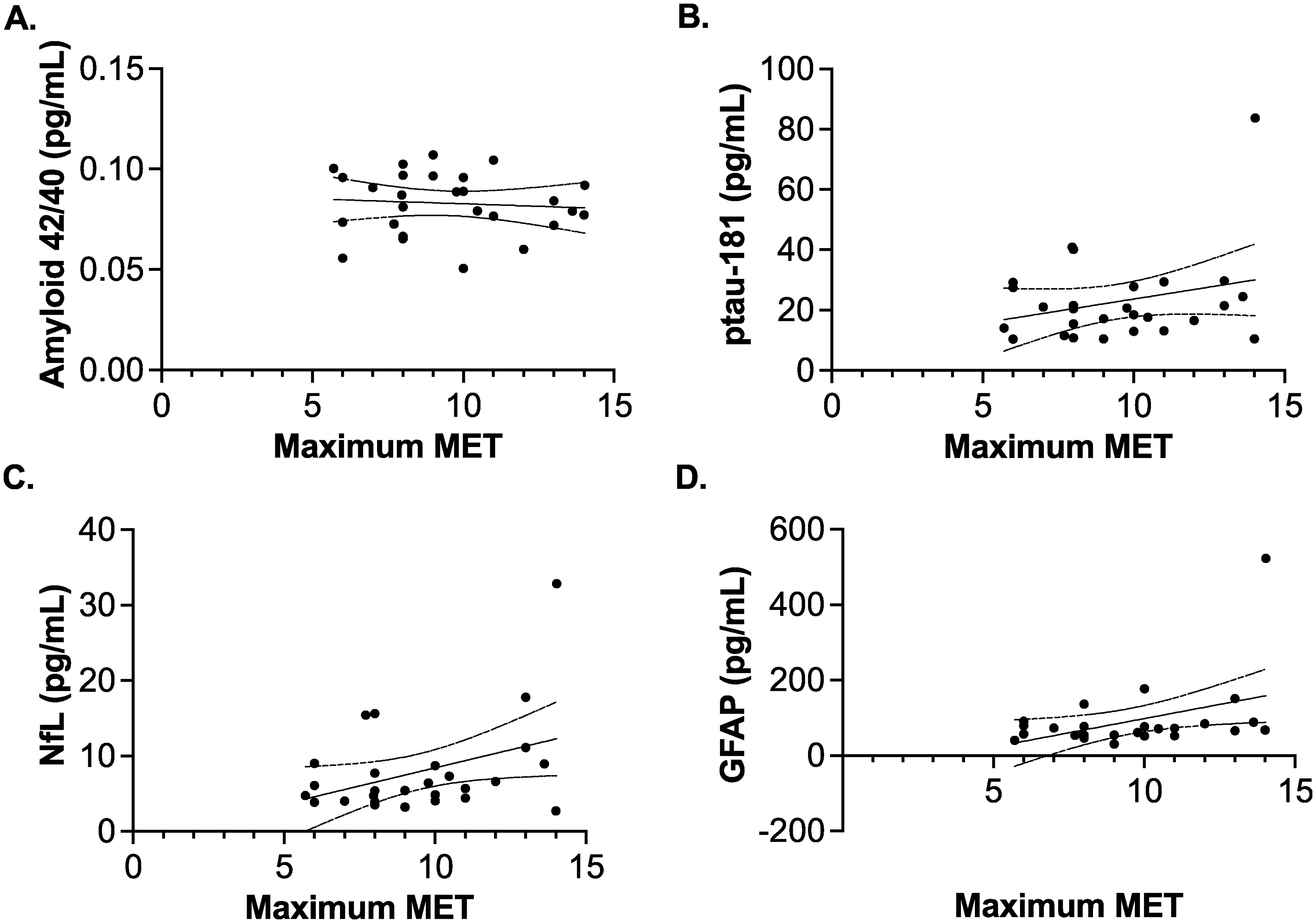
Relationship between fitness levels and biomarkers. Circles represent raw data for mutation carriers. The solid line represents the best-fit line, and the dotted lines represent the confidence intervals. (A) Amyloid 42/40, (B) ptau-181, (C) GFAP and (D) NfL were not significantly associated with maximum MET values.
Methods
Study design and participants
A total of 27 PSEN1 E280A mutation carriers (25 cognitively unimpaired and 2 with MCI) who were enrolled in the Massachusetts General Hospital (MGH) COLBOS (Colombia-Boston) longitudinal biomarker study or the COLBOS remote study, completed all study procedures. COLBOS has been collecting neuropsychological, biomarker and neuroimaging data on PSEN1 E280A mutation carriers for over a decade to characterize AD progression and identify early biomarkers of AD. To be eligible for this study, participants needed to have: (1) a minimum of 5 years of formal education; and (2) normal vision or corrected-to-normal. Participants were excluded if they had a: (1) history of neurological disorder or medical disorder that affects nervous system functioning (2) history of psychiatric disorders; (3) history of learning disability; (4) history of cardiovascular disease; (5) metal that would interfere with MRI scanning safety; (6) claustrophobia that would interfere with scanning comfort; (7) pregnancy; and/or (8) dementia as reported by their most recent neuropsychological and clinical assessment. Individuals were classified as cognitively unimpaired if they demonstrated no cognitive impairment on the Consortium to Establish a Registry for Alzheimer's Disease neuropsychological battery (CERAD) word-list recall and a visuospatial memory test, had a clinical diagnostic rating scale (CDR) score of 0, a Functional Assessment Staging Test (FAST) score of 2 or less, and a Folstein Mini-Mental State Examination (MMSE) score of 26 or greater. Individuals classified as having MCI were diagnosed based on Petersen et al. (2014) 33 criteria, which includes subjective cognitive concerns, impairment in memory tests (1.5 standard deviation below the mean), and intact activities of daily living (FAST of 3). We also excluded individuals with contraindications for maximal effort testing (e.g., injuries in lower extremities, history of heart disease, pain in knees or legs, and abnormal electrocardiogram (EKG) at baseline, among others).
Participants who were eligible completed an aerobic fitness test within 3 months of the neuropsychological and neurological evaluations and blood sample collection.

Relationship between fitness levels and episodic memory. Circles represent raw data for mutation carriers. The solid line represents the best-fit line, and the dotted lines represent the confidence intervals. Word list learning and delayed recall scores were not significantly associated with maximum MET values.
Standard protocol approvals, registrations, and patient consent
The study was approved by both the institutional ethics review boards of the University of Antioquia in Medellín, Colombia and the Mass General Brigham (MGB) in Boston, MA. All participants provided written informed consent before participating in any procedures.
Genotyping
Participants and investigators were blinded to the genetic status of all participants, as the longitudinal study includes cognitively healthy non-carriers. Genomic DNA was extracted from the blood by standard protocols, and PSEN1 E280A characterization was done at the University of Antioquia. Genomic DNA was amplified with the primers PSEN1-S 5′ AACAGCTCAGGAGAGGAATG 3′ and PSEN1-AS 5′ GATGAGACAAGTNCCNTGAA 3′. 34 We used the restriction enzyme BsmI for restriction fragment length polymorphism analysis.
Cardiorespiratory fitness test
Maximal aerobic fitness test
Five participants with plasma biomarker data completed maximal aerobic fitness testing at the Spaulding Rehabilitation Hospital's Cardiovascular Research Lab in Cambridge, MA. We used a standard graded maximal exercise test performed on a treadmill to assess participants’ VO2max, measured in milliliters of oxygen per minute per kilogram body-mass (mL/kg/min). Participants were asked not to engage in strenuous physical activity for at least 48 h prior to their scheduled fitness test, and not to consume alcohol for at least 24 h prior. Before the test, participants assumed the supine position for a 5-min measure of resting heart rate and blood pressure. We then determined maximal O2 consumption using a modified Balke protocol with online computer-assisted open-circuit spirometry. Participants walked or jogged on a treadmill while the grade or speed was increased every 2 min until exhaustion. A 12-lead ECG was used to provide continuous monitoring of heart rate. Maximal aerobic capacity was determined by meeting at least 3 of the following 4 criteria: (1) a plateau in O2 consumption despite increasing workload; (2) respiratory exchange ratio >1.10 at the end of exercise; (3) achievement of age-predicted maximal heart rate (i.e., 220-age); and (4) a rating of perceived exertion >17 on the Borg scale of 5 to 20. We report the MET as an indicator of cardiorespiratory fitness. A MET is the ratio of the person's working metabolic rate relative to their resting metabolic rate. One MET, for example, equals the energy spent sitting quietly, and the higher the MET, the greater the energy spent, or effort exerted during the test. We calculated METs for each individual by dividing the VO2max value by 3.5, as one MET is equivalent to 3.5 mL/kg/min.
Submaximal aerobic fitness test
Twenty-two participants completed submaximal aerobic fitness testing at the University of Antioquia in Medellín, Colombia, given that they were unable to travel to Boston from Colombia during the pandemic due to COVID-19-related travel restrictions and the equipment for measuring O2 consumption was unavailable at the University of Antioquia. The test was performed on a treadmill using a modified Balke protocol. Before starting, participants assumed the supine position for a 5-min measure of resting heart rate and blood pressure. The initial treadmill speed was set at 3.5 mph for males and 3.0 mph for females and the gradient at 0%. The gradient was increased by 3% every 2 min/stage for 6 min (3 stages). For males, the speed was then increased to 5.5. mph for 8 min (4 stages) and to 6 mph for 4 min (2 stages), and the gradient decreased to 0% and then increased by 2% every 2 min/stage. For females, the speed was increased to 4.5 mph after the initial 3 stages for 4 min (2 stages), then to 5 mph for 4 min (2 stages) and 5.5 mph for 4 min (2 stages), and the gradient decreased to 0% and then increased by 2% every 2 min/stage. The maximum MET was calculated from the mean workload during the last minute of the test. A 12-lead ECG was used to provide continuous monitoring of heart rate. The test was terminated when the participant achieved age-predicted maximal heart rate and rated perceived exertion as >17 on the Borg scale of 5 to 20.
Biochemical measures and analysis
Plasma samples were collected at the University of Antioquia in Medellín, Colombia or at MGH in Boston, MA, USA. As previously reported, 30 plasma was collected in the morning (non-fasting collection). Samples were stored at −80˚C. Analytes reported here were measured using bead-based SIMOA assays and performed using a fully automated Quanterix HD-X analyzer (Quanterix; Billerica, MA). Assays were performed, as previously described, 35 according to manufacturer's instructions at the MassGeneral Institute for Neurodegenerative Diseases (MIND) Biomarker Core after determining optimal dilution factors by serially diluting four pooled plasma samples within the range of published recommendations. All samples were assayed in duplicate and serially diluted standard curves were included on every plate.
Clinical and cognitive assessments
All clinical and cognitive assessments were performed at the University of Antioquia in Medellín, Colombia in Spanish by neuropsychologists or by psychologists trained in neuropsychological assessment. Participants underwent a clinical interview and were administered the MMSE, 36 and the FAST, a measure that assesses functional status. 37 A person in stage 1 is considered cognitively normal with no subjective cognitive decline, stage 2 refers to someone who is cognitively normal with subjective cognitive decline, people in stage 3 have MCI and those in stages 4 to 7 have dementia.
Participants were administered the Spanish version of the CERAD word list learning and delayed recall, which has been shown to be sensitive to early memory changes in PSEN1 E280A carriers.26,27 In this test, participants were asked to recall a list of 10 unrelated words that were repeated 3 times and to say as many words from the list as they could remember after a 10-min delay. A total learning score was calculated by adding the total number of words recalled correctly during the learning phase (/30; word list learning total) and a delayed recall score with the total number of words recalled after the delay (/10; word list recall).
Statistical analyses
We conducted descriptive statistics for all variables. We conducted separate linear regressions to examine the association of MET with age since it is a proxy of disease progression in PSEN1 E280A carriers. We then conducted multiple linear regressions to test the association of MET with plasma biomarkers and cognitive test scores controlling for age and sex. We also controlled for education in all models examining cognition. There were no significant differences between sites (i.e., Boston [maximal aerobic fitness testing] versus Colombia [submaximal aerobic fitness testing]) in demographics, clinical, biomarker, and MET variables. As such, we did not control for site. Data points with a standard deviation ≥3 from the mean were considered outliers and removed from the analyses. Analyses used a family-wise significance threshold of p < 0.05 and were performed using SPSS (V.28.0; SPSS Inc, Chicago, IL, USA).
Results
Demographic and cognitive variables
All demographic, cognitive, and biomarker data are reported in Table 1. On average, mutation carriers were in their early thirties (range 23 to 46) and 19 years from expected dementia onset, had a high school degree (range 5 to 16 years of formal education), and were mostly female and cognitively unimpaired. MMSE scores were, on average, within normal limits considering age and level of education (range 21 to 30). Word list learning total scores ranged from 7 to 26, and from 0 to 10 in the word list delayed recall.
Demographic, cognitive, and biomarker variables.

SD: standard deviation; MMSE: Mini-Mental State Exam; FAST Functional Assessment Staging Test; CERAD: Consortium to Establish a Registry for Alzheimer's Disease; MET: metabolic equivalent of task; ptau-181: phosphorylated tau-181; NfL: neurofilament light chain; GFAP: glial fibrillary acidic protein.
Aerobic fitness, biomarkers, and cognitive functioning
Descriptive statistics for maximum MET values are presented in Table 1. The maximum MET value range in our sample is indicative of low (<9 METs) to intermediate (9–14 METs) cardiorespiratory fitness and not high fitness (≥14 METs). 11 Specifically, 14 participants’ maximum MET values indicated low cardiorespiratory fitness, and 13 intermediate cardiorespiratory fitness. Maximum MET values were not associated with age (p = 0.331). Maximum MET values were also not associated with amyloid 42/40 (p = 0.658), ptau-181 (p = 0.616), NfL (p = 0.373), or GFAP (p = 0.191) in mutation carriers when accounting for age and sex (Figure 1).
There were also no associations between maximum MET values and word list learning total (p = 0.710), word list delayed recall (p = 0.644), or MMSE (p = 0.828) scores in mutation carriers after accounting for age, sex, and years of formal education (Figure 2).
Discussion
Cardiorespiratory fitness is a modifiable factor that may help reduce the risk of brain disease and support healthy brain function.19–21,38 However, its potential effects on individuals in the preclinical and prodromal stages of AD remain unclear. To address this gap, we examined cardiorespiratory fitness, measured with effort-based tests, and AD plasma biomarkers in young PSEN1 E280A mutation carriers without dementia who were, on average, 19 years from their expected dementia onset. Participants exhibited low to intermediate cardiorespiratory fitness levels, ranging from generally inactive to moderately active individuals, 11 with none classified as highly fit. 11 We found no association between cardiorespiratory fitness levels and age, a proxy for disease progression in ADAD, indicating that fitness levels did not vary based on proximity to the expected dementia onset in this population. Additionally, cardiorespiratory fitness was not linked to plasma markers of AD pathology, neural injury, astrocyte reactivity, or episodic memory performance.
Overall, we found no associations between low to intermediate cardiorespiratory fitness and AD biomarkers or cognitive function in individuals with ADAD at high risk for dementia. In contrast, longitudinal population and community-based studies have found that those with high cardiorespiratory fitness, but not those with low cardiorespiratory fitness, may delay dementia onset and reduce mortality, including in those at a higher genetic risk for AD.19–23 For instance, cognitively unimpaired APOE ε4 carriers with high baseline cardiorespiratory fitness have shown a slower annual decline in total grey matter volume and cognitive function.24,25 While intermediate fitness levels (9–14 METs) has significant health benefits, 11 it is possible that a higher level of cardiorespiratory fitness is necessary to observe meaningful effects on disease progression and cognitive decline in the preclinical and prodromal stages of AD.
Our study had several shortcomings. First, the participants’ cardiorespiratory fitness ranged from low to intermediate, preventing comparisons with those at higher cardiorespiratory fitness levels. Further, the relatively small sample size underscores the need for larger studies. We also conducted assessments at two locations using slightly different protocols, which may have introduced variability. However, our findings showed that there were no differences between the two locations in demographics, clinical, biomarker, and MET variables, leading us to hypothesize that the outcomes would have been similar if the equipment and procedures had been the same. However, we cannot be certain, and more research is needed to replicate our findings. Future studies should include individuals with a wider range of cardiorespiratory fitness and longitudinal data to clarify its relationship with AD progression and cognitive decline. Randomized controlled trials are also needed to establish causal effects of fitness training on AD outcomes.
Our study also has several strengths. We used objective measures of cardiorespiratory fitness rather than self-reports or actigraphy-based estimates, assessed key biomarkers linked to brain health and dementia risk, and included well-characterized non-demented individuals with AD. Studying this population allowed us to examine preclinical AD at an earlier stage than typically possible. Finally, the young age of PSEN1 E280A carriers minimize vascular disease as a confounding factor.
Altogether, our findings showed that low-to-intermediate cardiorespiratory fitness was not associated with markers of AD pathology, neural injury, and astrocyte reactivity, or cognitive function in individuals with ADAD without dementia, raising the possibility that higher fitness levels may be necessary to detect an effect. However, further research is needed to elucidate the role of cardiorespiratory fitness in disease progression among individuals already exhibiting AD pathology.
Footnotes
Acknowledgements
We thank all participants for contributing their time to this study and for their continued commitment to this research. We also thank the staff at the Universidad de Antioquia's Grupo de Neurociencias and Universidad de Antioquia Hospital for their contributions to data collection. The authors would also like to acknowledge Dr Francisco Lopera for his lifetime dedication to studying Alzheimer's disease and other dementias, as well as his invaluable contributions to the COLBOS Biomarker Study during his time as coordinator of the Grupo de Neurociencias, Universidad de Antioquia in Medellin, Colombia.

Ethical considerations
The study was approved by both the institutional ethics review boards of the University of Antioquia in Medellín, Colombia and the Mass General Brigham (MGB) in Boston, MA (2017P001280).
Consent to participate
All participants provided written informed consent before participating in any procedures.
Author contributions
Funding
The author(s) disclosed receipt of the following financial support for the research, authorship, and/or publication of this article: Dr. Guzmán-Vélez received funding from the National Institute on Aging (grant number. K23 AG061276). Dr. Quiroz received funding from the US National Institutes of Health (NIH) NIA (grants number R01 AG054671 and RF1 AG077627), the Alzheimer's Association, and the MGH Executive Committee on Research (MGH Research Scholar Award). Ms. Rivera-Hernández received funding from the US NIH-NIGMS Neuro-ID program (grant number. R25 NS080687). The sponsors had no role in the design and conduct of the study; in the collection, analysis, and interpretation of data; in the preparation of the manuscript; or in the review or approval of the manuscript.
Declaration of conflicting interests
The author(s) declared the following potential conflicts of interest with respect to the research, authorship, and/or publication of this article: Dr. Quiroz serves as a consultant for Biogen. Dr. Guzmán-Vélez serves as a consultant for VarMed Management outside the submitted work. Dr. Arnold has consulted and/or served on advisory boards for Allyx Therapeutics, BioVie, Bob's Last Marathon, Daewoong Pharmaceuticals, Foster & Eldridge, LLP, Quince Therapeutics, Sage Therapeutics, and Vandria. He has received sponsored research grant support via his institution from the following commercial entities: AbbVie, Amylyx, Athira Pharma, Chromadex, Cyclerion Therapeutics, EIP Pharma, Ionis Pharmaceuticals, Janssen Pharmaceuticals, Inc., Novartis AG, Seer Biosciences, Inc. and vTv Therapeutics, Inc. He has received sponsored research grant support via his institution from the following non-commercial entities: Alzheimer's Association, Alzheimer's Drug Discovery Foundation, Challenger Foundation, Cure Alzheimer's Fund, John Sperling Foundation, the National Institutes of Health and the Prion Alliance. The remaining authors declared no potential conflicts of interest with respect to the research, authorship, and/or publication of this article.
Data availability statement
The data that support the findings of this study are available on request from the corresponding author, Dr Quiroz. The data are not publicly available because they contain information that could compromise research participants privacy and anonymity.