



Abstract
Background
The introduction of new Alzheimer's disease (AD) treatments necessitates updated health utilities for economic evaluations.
Objective
Measure health utilities of US adults with mild cognitive impairment (MCI) and AD and their caregivers.
Methods
We conducted a web-based survey using the EuroQol EQ-5D-5L and Quality of Life in AD (QoL-AD), stratified by disease stage and care setting. Individuals with MCI or mild Alzheimer's dementia self-reported their utilities. Caregivers randomly received either a proxy survey to complete on behalf of the person with moderate to severe AD they cared for, or a caregiver survey that asked them to self-report their own utilities.
Results
We received 241 patient responses and 176 caregiver responses. Patient EQ-5D-5L scores decreased monotonically as disease severity increased, with a 0.55 utility difference between individuals with MCI and severe AD in the community setting. EQ-5D-5L values were generally lower for individuals residing in nursing homes (0.04 to 0.78) compared to those in community settings (0.22 to 0.77). Patients’ QoL-AD scores did not exhibit a consistent association with their disease severity. Similarly, caregivers’ EQ-5D-5L scores did not exhibit a monotonic trend with the patient's disease severity, although caregiver utilities were generally higher for those caring for someone in a nursing home than for those caring for patients in the community.
Conclusions
Our results contribute to improving AD economic evaluations by reflecting the lived experience of more contemporary populations and facilitating the value assessment of novel therapies that delay progression from MCI to more severe disease stages.
Keywords
Introduction
Although the development of therapies for Alzheimer's disease (AD) has faced many challenges, recent advances hold promise. 1 Since 2021, the US Food and Drug Administration (FDA) has approved three anti-amyloid monoclonal antibodies, aducanumab (Aduhelm®, discontinued in 2024), lecanemab (Leqembi®), and donanemab (Kisunla®), for the treatment of mild cognitive impairment (MCI) or mild dementia due to AD.2–4 At the beginning of 2023, 164 AD clinical trials testing over 127 treatment regimens were ongoing, with almost one-third in Phase 3—the last stage before possible regulatory approval, and more than 3 in 4 of these trials involving potentially disease modifying therapies.5–7
Promising new therapies pose challenges to health care payers when making coverage decisions, as they can be costly8,9 and may involve side effects.10–12 Health technology assessments (HTAs) aim to inform coverage decisions for treatments by systematically and quantitatively evaluating their incremental costs and benefits, relative to the current standard of care, and sometimes relative to each other. 13 HTA organizations use analytic models to project how alternative treatments affect disease progression. To quantify the attendant costs and benefits, the assessments depend on data characterizing the relationship between disease progression and its consequences, including patient quality of life and caregiver burden.
Although an extensive literature has explored the impact of AD on downstream outcomes, the data have gaps for HTA modeling. First, none of the nearly dozen US-based studies of AD and quality of life, measured in terms of health state “utility” (a commonly used standard used in health economics), reports findings stratified by care setting. 14 That complicates assessment of how drugs that slow progression to institutional care improves patient quality of life, as studies in other countries have shown that this outcome can depend on care setting. 14 Nor do more recent studies stratify health utilities by disease stage.15–18 Second, MCI constitutes an important target of treatment, but US-based health utility data for this early stage of AD are sparse. Although one recent survey reported utilities for MCI based on caregiver proxy assessments (n = 27), it did not stratify results by care setting due to the small sample size. 19 Third, despite the well-documented impact of AD on caregivers, few studies investigate how disease progression affects caregiver health utilities.20–22 Without considering these “spillover effects” on caregivers, HTAs may mischaracterize the broader value of an AD intervention to society.22,23
Finally, one of the most widely used sources of AD utility estimates, 24 is nearly a quarter of a century old. Despite diminished relevance to contemporary AD care management, its lack of patient population diversity (e.g., 90% of the study sample was White), and its lack of information on caregiver impacts, those estimates remain a widely used source of utility estimates in US-based value assessments, including the Institute for Clinical and Economic Review's (ICER's) recent HTAs for aducanumab and lecanemab.25,26 All of these limitations underscore the need for updated and more generalizable estimates for AD treatment evaluations.
This paper describes a survey of US adults living with MCI and AD and their caregivers. Our study updates utility value estimates for this population and explores the relationships between health utilities and both disease stage and care setting. Our findings contribute to improving AD economic evaluations by reflecting more contemporary populations and current clinical practices while enabling inclusion of societal impacts, including caregiver spillover effects.22,23
Methods
We conducted a web-based survey to characterize health-related quality of life (HRQoL) of US adults aged 18 and older with self-reported MCI or AD, and adults who self-identified as a current caregiver of someone with MCI or AD. The survey identified respondents with MCI or AD based on an affirmative answer to the screening question, “Has a doctor or other health care professional ever told you that you have Mild Cognitive Impairment or Alzheimer's disease?” The survey then described common symptoms in each disease stage (MCI, mild, moderate, and severe AD), based on the literature,27,28 and asked respondents to select the stage that best described their current symptoms. Similarly, to identify caregivers, the survey asked participants, “Are you currently providing care to someone with Mild Cognitive Impairment or Alzheimer's disease?” Caregivers then identified the set of symptoms that best described the person they care for. The survey questionnaires are available in Supplemental Material 1.
Survey design
We developed two surveys. For the first, which measured patients’ utilities, we created two versions. “Version A” elicited self-reports for participants with MCI or mild Alzheimer's dementia, while “Version B” relied on caregiver proxy reports for individuals with moderate or severe AD (Supplemental Material 1).
Our second survey elicited caregivers’ utilities (Supplemental Material 1). We administered this survey to all caregivers of individuals with MCI or mild Alzheimer's dementia. We randomly assigned caregivers of individuals with moderate or severe AD to respond to either the caregiver HRQoL survey or to Version B of the patient HRQoL survey (the “proxy-report” version). We randomized caregivers to one of these two surveys to minimize respondent burden and mitigate potential bias, as taking both surveys can make it difficult to maintain separate perspectives (proxy-report and self-report). 29 The questionnaires also collected participant information, including sociodemographic characteristics (e.g., age, gender, race and ethnicity, education, income, and employment status).
Health utility measures
The surveys assessed patient and caregiver HRQoL using the EuroQol EQ-5D-5L (EQ-5D-5L), a generic utility-based instrument. The surveys also used the Quality of Life in Alzheimer's disease (QoL-AD), a disease-specific instrument, to assess patient HRQoL. Investigators often use these instruments in clinical trials, cohort studies, and economic evaluations.14,18,25 Briefly, the EQ-5D-5L estimates utilities by assessing five health dimensions: mobility, self-care, usual activities, pain/discomfort, and anxiety/depression.30,31 Each dimension has five levels: no problems, slight problems, moderate problems, severe problems, and extreme problems. The Visual Analogue Scale (VAS) is a standardized scale ranging from 0 (“worst imaginable health state”) to 100 (“best imaginable health state”) used to quantify self-reported health status as part of the EQ-5D-5L instrument. The QoL-AD is tailored to measure various HRQoL domains most salient to individuals with AD, such as mood, memory, physical health, functional abilities, interpersonal relationships, and environmental interactions. 31 Despite challenges in measuring HRQoL for persons with cognitive impairment, investigations frequently use the EQ-5D-5L to collect patient and caregiver proxy-reported utility values for AD. 14 Additionally, the QoL-AD is well-validated and has been found reliable for both patient and proxy groups. 32
Sample recruitment and survey administration
UsAgainstAlzheimer's, a non-profit advocacy organization, administered the web-based survey. The survey sample was drawn primarily from UsAgainstAlzheimer's A-LIST® cohort, an online community comprising more than 7500 consented individuals who self-identify as living with MCI, AD and other dementias, and family caregivers. A-LIST surveys have been used to convey the experiences of both persons living with AD and their caregivers to inform regulatory reviews, value assessments, and policy.33,34 In addition, UsAgainstAlzheimer's collaborated with organizations including the Global Market Research Group, the Global Alzheimer's Platform, and Survey Monkey to increase study sample size and representativeness. The study sample included US adults who reported fluency in English. We screened participants to confirm that they had been told by a clinician that they have MCI or AD, and screened caregivers to confirm that they currently provide care to someone with MCI or AD.
UsAgainstAlzheimer's pilot tested the survey by interviewing 7 participants on Zoom to confirm the instrument's flow, understandability, and comprehensiveness. The pilot included one individual living with mild Alzheimer's dementia who reviewed Version A of the patient HRQoL survey, three caregiver proxies who reviewed Version B of the patient HRQoL survey, and an additional three caregivers who reviewed the caregiver HRQoL survey. Pilot test participants received a $25 gift card. The final survey required approximately 15 min to complete; respondents received no financial incentives for completing the survey. The Tufts Medical Center and UsAgainstAlzheimer's Institutional Review Boards approved the study design.
Statistical analysis
We computed mean utility scores for patients and caregivers separately, stratified by disease severity (MCI, mild AD, moderate AD, and severe AD) and care setting (community and nursing home). Using the five-level EQ-5D, we estimated disutility values by assigning weights to each domain based on U.S. preferences and summing the weighted scores. 35 We subtracted each subject's disutility value from 1.0 to arrive at an estimate of that subject's overall utility. The EQ-5D can produce health utility values ranging from as low as −0.57, corresponding to the most severe health conditions, to as high as 1.0, corresponding to the hypothetical state of “perfect health.”
For the QoL-AD instrument, we scored patient and proxy responses on a scale from 1 to 4 (poor, fair, good, or excellent) for each item.32,36 Summing scores for all 13 items yielded a maximum QoL-AD score of 52. Our research team added a “not applicable” response option to questions asking participants to rate current relationships with their spouse, family, and friends (e.g., respondents with no living partner could respond “not applicable” to the question asking about their spouse). For scoring purposes, we coded “not applicable” responses as a “2”, corresponding to a “fair” rating.
We used one-way analysis of variance (ANOVA) to test differences in health utilities across AD stages. To validate our survey's AD severity assessment, we assessed the association between participant-reported disease staging and functional limitations – i.e., the number of activities of daily living (ADLs) and instrumental activities of daily living (IADLs) limitations. We reasoned that a positive association would lend credibility to the staging instrument, as a greater number of functional limitations is consistent with more advanced disease. Additionally, we conducted a sensitivity analysis that limited attention to patients aged ≥ 61 years to evaluate the robustness of the results. To characterize central estimates and dispersion for population distributions, our results specify mean ± standard deviation. We used Stata, version 17 (StataCorp LLC) for all statistical analyses.
Results
Survey responses
From February to July 2024, 424 individuals with MCI or mild Alzheimer's dementia opened and started Version A of the survey, 462 caregivers who served as proxy respondents for individuals with moderate or severe AD opened and started Version B of the survey, and 435 caregivers opened and started the caregiver survey (Figure 1). A total of 419 completed screening and agreed to participate in Version A of the patient survey, 448 caregiver proxies completed screening and agreed to participate in Version B of the patient survey, and 425 caregivers completed screening and agreed to participate in the caregiver survey. We excluded 312 people from Version A, 311 proxies from Version B, and 244 caregivers from the caregiver survey who did not meet screening criteria. Finally, we dropped a small number of incomplete responses (2 in Version A, 1 in Version B, and 5 in the caregiver survey). Our final sample included 105 respondents with MCI or mild Alzheimer's dementia who completed Version A of the patient survey, 136 proxies who completed Version B of the patient survey, and 176 caregivers who completed the caregiver survey.

Sample consort diagram.
Sample characteristics
The final analytic sample comprised 241 patient responses (patient self-reports: n = 105; caregiver proxy-reports: n = 136) and 176 caregiver responses (Table 1). The median age category for the individuals with MCI/AD was 71–80 years; most were female (53.9%), White (76.3%), had a college degree (76.8%), and were living in the community (81.7%). Thirteen percent of the patient sample included Hispanic individuals. Individuals with more advanced AD had more ADL and IADL limitations (Supplemental Material 2).
Sample characteristics.
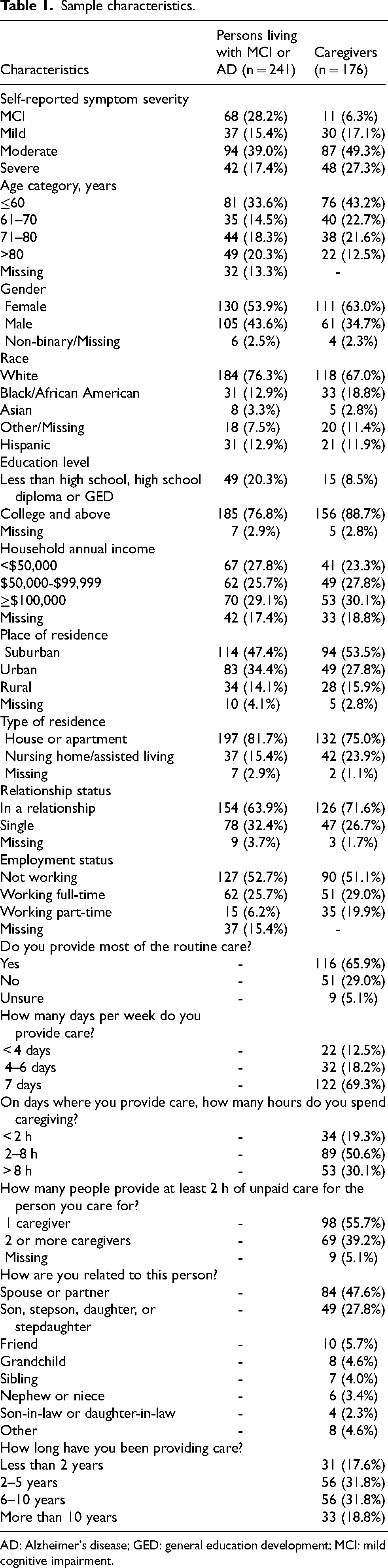
AD: Alzheimer's disease; GED: general education development; MCI: mild cognitive impairment.
In our caregiver survey (n = 176), nearly half of respondents reported caring for individuals with moderate AD (49.3%) and most cared for individuals living in the community (75.0%). The median age category for caregivers was 61–70 years. Most caregiver respondents (51.1%) were currently not working. Most (65.9%) reported that they provided most of the routine caregiving, spending 2–8 h per day (50.6%), 7 days per week (69.3%). Most caregivers (55.7%) were sole caregivers, while 39% reported that two or more caregivers provided at least two hours of routine, unpaid care per week for the person with MCI or AD. Nearly half of caregivers reported caring for their spouses or partners (47.6%). Caregivers in our sample reported that they have been providing care for 2–5 (31.8%) or 6–10 years (31.8%).
Health utilities for individuals with MCI or AD
Health utilities for individuals with MCI or AD decreased with more advanced disease stages (Table 2). Among community-dwelling patients (n = 197), EQ-5D-5L scores ranged from 0.77 ± 0.22 for those with MCI to 0.22 ± 0.43 for those with severe AD. Trends for the VAS scores were similar, although the scores had a narrower range across disease stages, particularly for those living with moderate or severe AD. The QoL-AD scores also varied across disease stages, with the highest mean score (i.e., best HRQoL) observed for individuals with MCI (37.6 ± 6.3).
Health utilities for individuals with MCI or AD.

AD: Alzheimer's disease; MCI: mild cognitive impairment; VAS: visual analogue scale.
EQ-5D-5L scores range from −0.57 to 1; EQ-5D VAS scores range from 0 to 100; Quality of Life-AD scores range from 0 to 52.3. Higher scores represent better quality of life.
Insufficient sample size to compute meaningful p-value.
Nursing home residents with MCI or AD generally had lower utility scores than community dwelling patients. EQ-5D-5L scores for nursing home patients decreased with disease progression, ranging from 0.78 ± 0.18 for individuals with MCI to 0.04 ± 0.24 for those with severe AD. In contrast, the QoL-AD scores did not exhibit a consistent association with disease stage, although the sample was small (n = 37).
Sensitivity analysis performed that included only older individuals with MCI or AD (aged ≥ 61 years) yielded substantively similar results, confirming lower health utilities among those with more advanced disease and residing in nursing homes (Supplemental Material 3).
Health utilities for caregivers
Caregiver utility scores measured by the EQ-5D-5L did not exhibit a monotonic association with the patient's disease severity (Table 3). Among caregivers of community-dwelling patients, EQ-5D-5L utility scores (0.85 ± 0.17) and EQ-5D VAS scores (80.0 ± 7.2) were greatest for the caregivers of individuals with MCI. For the caregivers of individuals with mild, moderate, or severe AD, EQ-5D-5L scores were greater among caregivers of individuals residing in nursing homes than among caregivers of individuals living in the community.
Health utilities for caregivers of individuals with MCI or AD.

AD: Alzheimer's disease; MCI: mild cognitive impairment; VAS: visual analogue scale.
Care setting and disease severity of the person living with MCI or AD.
Insufficient sample size to compute meaningful p-value.
EQ-5D-5L scores range from −0.57 to 1; EQ-5D VAS scores range from 0 to 100. Higher scores represent better quality of life.
Discussion
Our survey provides utility-based HRQoL estimates for U.S. adults living with MCI and AD and their caregivers. Our results contribute to improving AD economic evaluations by reflecting more contemporary populations and facilitating value assessments of novel therapies that delay the progression from MCI to more severe disease stages. Our EQ-5D-5L results indicate that patient utilities decline by around 0.09 as community-dwelling individuals progress from MCI to mild Alzheimer's dementia, by another 0.19 from mild to moderate AD, and by 0.27 from moderate to severe AD. These differences exceed estimates by previous studies but are consistent with established trends in the literature. 14 For example, ICER assumed that progression from MCI to mild Alzheimer's corresponds to a utility weight reduction of 0.05. 26 Earlier literature has reported a utility decline of 0.14 between mild and moderate AD,24,37 somewhat less than our value of 0.19. The decline in HRQoL measured by the QoL-AD instrument is also noteworthy: it decreases by nearly 4 points on a 52-point scale from MCI to mild Alzheimer's dementia, and by another 2 points from mild to moderate AD. Contrary to expectations, the QoL-AD scale showed a modest increase between moderate and severe AD, a finding that warrants further investigation.
Our results indicate that EQ-5D-5L utility values decline with disease progression among nursing home residents with MCI or AD, consistent with the health utility trajectories documented in a systematic review. 14 However, we note that these findings are subject to greater uncertainty due to the small sample size, as we did not observe a consistent trend with the QoL-AD. Nonetheless, our findings suggest that slowing disease progression would contribute to gains in quality-adjusted life-years (QALYs). The EQ-5D-5L results suggest that disease progression is associated with a large impact on HRQoL (0.74 between MCI and severe AD), while the corresponding VAS-measured decline (about 20 of 100 points) and QoL-AD measured decline (about 9 of 52 points) are proportionately smaller. Additionally, findings based on unadjusted EQ-5D-5L and VAS scores suggest that individuals living in the community have greater HRQoL than individuals living in a nursing home.
Associations between caregiver utilities and the disease severity of the person under their care did not exhibit a consistent trend. The limited sample size may help to explain the unexpected patterns, especially for caregivers of individuals living in a nursing home, a group in our sample that included only two individuals living with either MCI or mild Alzheimer's dementia. However, our results suggest that EQ-5D-5L scores for caregivers of individuals with MCI exceed the scores for caregivers of individuals with more severe cognitive impairment. These findings suggest that treatments delaying the progression from MCI to more severe disease stages could contribute to QALY gains for caregivers.
Research has documented discrepancies between dementia patient self-reported and caregiver proxy-rated HRQoL, with patients typically reporting higher ratings than their caregivers. 14 These discrepancies become more pronounced as dementia severity increases. While individuals at milder stages of dementia can generally self-report HRQoL reliably, assessments for those with moderate to severe dementia increasingly depend on proxy input because disease progression diminishes the ability of patients to experience and communicate insights.14,29 On the other hand, various factors may influence caregiver proxy reports, including the caregiver's own well-being, caregiving burden, and the caregiver-patient relationship dynamics.29,38 These considerations are important when interpreting proxy-reported health utilities when they differ from patient perceptions of their own HRQoL.
Like all studies of HRQoL for this population, our study has limitations. First, because we did not have access to respondents’ clinical data, our survey relied on self-reported disease status and symptom-based self-classification. Additionally, we relied on caregiver-provided information for individuals with moderate to severe disease. False-positive reports of MCI or AD would tend to obscure associations between disease severity and health utilities. Instead of asking directly about disease stage, our study used standardized descriptions to help respondents self-classify their symptoms. We developed these descriptions based on literature from the National Institute on Aging and the Alzheimer's Association and pilot-tested the descriptions with individuals with AD and with caregivers. Feedback from pilot interviews informed revisions to improve clarity and readability, ensuring that respondents could more accurately align their symptoms with the provided descriptions. Because our study was web-based and did not include clinician-confirmed diagnoses, we could not directly assess symptom severity or validate participant-reported disease staging based on clinical assessments. In lieu of patient-specific clinical assessments, we evaluated our approach, by verifying the expected positive relationship between participant-reported disease staging and functional limitations (a higher number of ADL and IADL difficulties). Prior AD utility studies have relied on clinical trial participants, clinic-based cohorts, or physician referrals from selected sites for case ascertainment.17–19,24,39,40 The representativeness of these studies is likewise unassured and the populations from which these trials draw their samples may also be different from the final study sample. The choice of methods often reflects tradeoffs between achieving rigorous clinical diagnosis standards (internal validity) and ensuring the research represents a broad, diverse population (external validity), a challenge exacerbated by underrepresentation of racial, ethnic, and socioeconomically diverse populations in AD research. 41
Second, our survey relied on an online, convenience sample. It is possible that some respondents did not fully understand the questions, reflecting challenges in measuring health utilities in this vulnerable population with cognitive impairment. Although our survey sample demonstrates greater racial diversity than many previous studies, we acknowledge sociodemographic differences between our sample and the broader U.S. population with AD. For instance, women comprise about two-thirds of AD cases, 28 whereas our sample was 54% female. The prevalence of AD is approximately twice as high among Black Americans compared to non-Hispanic white individuals, and about 1.5 times higher among Hispanic individuals. 28 Among individuals with AD in our study, 13% were Black and 13% were Hispanic. For caregivers in our study, approximately 10% were Black and 8% were Hispanic, proportions that fall below corresponding national figures of 19% (Blacks) and 12% (Hispanics) among the caregiver population. 28 These differences, along with the higher median household income and education levels in our sample, reflect challenges in AD research associated with recruiting study participants from under-represented groups. 41 Differences may also reflect our use of an online survey format and the possibility that individuals with lower socioeconomic status may have less access to this mode of communication. While these limitations may have influenced our health utility estimates, there is no obvious reason why the associations we observed between disease stage and health utilities are biased in a particular direction.
Third, this study's nursing home sample is small, comprising only 37 participants with MCI/AD—including 5 self-respondents (with only one having mild Alzheimer's dementia) and 32 subjects represented by proxies. Additionally, only two caregiver HRQoL survey respondents cared for nursing home residents with MCI or mild Alzheimer's dementia. This small sample size makes our utility estimates for nursing home residents uncertain, particularly for those with milder disease, and precludes robust statistical testing or multivariate analyses to explore potential confounding factors, such as age or other sociodemographic characteristics. Although our findings exhibit expected associations, further research should seek to employ larger samples to validate our results and enhance generalizability.
Finally, the EQ-5D-5L assesses a limited range of health domains, although the instrument remains widely used in economic evaluations due to its strong psychometric properties, including demonstrated reliability and validity in assessing health utilities among people with dementia.14,42 Prior research indicates that the EQ-5D-5L may not fully capture all salient attributes of AD because of its emphasis on physical impairments. 43 While direct utility elicitation methods such as standard gamble or time trade-off could address this limitation, these approaches often present challenges for respondents, potentially compromising response rates and internal validity. In our survey, we included the QoL-AD, a disease-specific instrument, in addition to the EQ-5D-5L. The QoL-AD enables HTA organizations to better understand disease-specific impacts that generic instruments do not fully capture, particularly cognitive and functional impacts critical to people with AD. We also reported the VAS scores, which provide an intuitive measure of overall health status that contextualizes utilities and offers additional evidence for characterizing treatment impacts. We found that the association between utilities and disease severity was more evident when measured using the generic EQ-5D-5L than when measured using the QoL-AD. We acknowledge that other dementia-specific, preference-based instruments such as the AD-5D and DEMQOL-U exist, but utility value sets for these instruments are currently not available for the United States.
Substantial advances in managing AD have emerged over the past two decades, including diagnostics, pharmaceutical treatments, non-pharmacological interventions, and care delivery paradigms.44,45 Our utility estimates reflect the lived experiences of more contemporary populations with MCI and AD and their caregivers. Our findings suggest that AD economic evaluations that rely on health utility estimates from data published nearly a quarter of a century old may underestimate the value of novel treatments that slow progression from early stages of the disease. To further enhance the accuracy and reliability of AD economic evaluations, future research should collect longitudinal utility data, as cross-sectional utility data, while useful, may not adequately account for evolving disease impacts and expectations. Further, health fluctuations are common in dementia, which affect HRQoL assessments. 46 Longitudinal studies and multiple, consecutive assessments would be able to characterize how HRQoL changes as individuals experience varying cognitive and functional impairment, thus better characterizing the impact of treatments that slow disease progression.
Supplemental Material
sj-docx-1-alz-10.1177_13872877251350381 - Supplemental material for Health utilities in Alzheimer's disease: A survey of patients and caregivers in the United States
Supplemental material, sj-docx-1-alz-10.1177_13872877251350381 for Health utilities in Alzheimer's disease: A survey of patients and caregivers in the United States by Pei-Jung Lin, Abigail G Riley, Patricia G Synnott, Terry L Frangiosa, Amber Roniger, Peter J Neumann and Joshua T Cohen in Journal of Alzheimer's Disease
Footnotes
Acknowledgements
We gratefully acknowledge our survey participants for their contributions, without whom this research would not have been possible. We also thank UsAgainstAlzheimer's for their contributions to survey design and data collection.

Ethical considerations
The Tufts Medical Center Institutional Review Board approved our study (approval: STUDY00004041) on August 15, 2023. The questionnaire and methodology for this study was also approved by the Human Research Ethics committee of UsAgainstAlzheimer's (approvals: MOD01878448, MOD02063285, MOD02072930, and MOD02080735).
Consent to participate
All respondents provided written informed consent prior to participating.
Author contributions
Funding
The author(s) disclosed receipt of the following financial support for the research, authorship, and/or publication of this article: This study was supported by research funds from Biogen, Eisai, Eli Lilly, and Roche to Tufts Medical Center. The funders had no role in the study design, data collection, analysis, interpretation, writing of the manuscript, or the decision to submit the article for publication.
Declaration of conflicting interests
The author(s) declared the following potential conflicts of interest with respect to the research, authorship, and/or publication of this article: The Center for the Evaluation of Value and Risk in Health at Tufts Medical Center, which employs Pei-Jung Lin, Abigail Riley, Patricia Synnott, Peter Neumann, and Joshua Cohen, receives sponsorship funding from government agencies, nonprofit institutions, and drug and device manufacturers, to support research projects and to maintain and update multiple databases. Researchers at Tufts Medical Center retain full control over question formulation, study selection, data extraction, data analyses, and interpretation and publication of results. Pei-Jung Lin, Patricia Synnott, Peter Neumann, and Joshua Cohen report receiving consulting income from companies in the life sciences industry, outside the submitted work.
Data availability statement
The datasets generated and analyzed for the current study are available from the corresponding author on reasonable request.
Supplemental material
Supplemental material for this article is available online.
References
Supplementary Material
Please find the following supplemental material available below.
For Open Access articles published under a Creative Commons License, all supplemental material carries the same license as the article it is associated with.
For non-Open Access articles published, all supplemental material carries a non-exclusive license, and permission requests for re-use of supplemental material or any part of supplemental material shall be sent directly to the copyright owner as specified in the copyright notice associated with the article.
