




Abstract
The 27th Computer Olympiad was held online during August/September 2024. There were 60 participating programs competing in 22 events. This was the fifth online Olympiad, and it is time to assess this experiment.
Keywords
Introduction
The first 22 Olympiads (1989 to 2019) were in-person competitions, usually held alongside the World Computer Ches Championships and/or the ICGA-organized Advances in Computer Games or Computers and Games conference. In 2020, the pandemic forced us to move the Olympiad and the conferences online. The 2024 Olympiad was our fifth virtual competition. This report summarizes the results and offers reflections on the ICGA's experiment in moving the Olympiad online.
By now, the Olympiad organization event had been standardized, with the 2024 event using the identical format and rules as in 2022 (Computer Olympiad, 2022; Computer Olympiad Rules, 2022). This year, there was no overlap with other ICGA events, as the Olympiad was held in August–September, the World Computer Chess Championships in October, and the Computers and Games conference in November.
As done for the past four years, each Olympiad competition was self-organized. For each event, the participants were asked to agree on the following competition details:
Format, with a round-robin being the standard. Number of games played between competitors (more is better). Time controls (most games have an established standard). Playoffs. For most events, the final round-robin standings served to decide on the medals. Short playoff matches were used to break ties.
The original schedule had one week to complete all the games, but some events ran for up to three weeks because of scheduling constraints.
Results
There were 60 programs competing in 22 events. An additional 10 competitions were not held because there was only one entry.
The 2024 Olympiad failed to reach the registration count of last year – 102, the third highest total in Olympiad history behind only 108 (Kanazawa, Japan, in 2010) and 103 (Taipei, Taiwan, in 2018) as in Schaeffer (2021). The reason for the decline this year was three-fold. First, the team of Quentin Cohen-Solal and Tristan Cazenave entered ‘only’ 15 competitions, down from 21 last year (some additional competitions that they entered had no other entries). Second, Katsuki Ohto tried his luck in all 32 events last year, but this year entered only four. Finally, the sad passing of long-time Olympiad competitor and multiple-time Draughts champion Ton Tillemans meant the cancelation of the Brazilian Draughts and Canadian Draughts competitions.

Ton Tillemans (Damier Club du Léman, 2024)
As has happened for all five of the online Olympiads, the powerhouse partnership of Quentin Cohen-Solal and Tristan Cazenave dominated the medals list, winning 11 gold! Congratulations to them for another outstanding year. The innovative technology behind their programs can be found in (Cohen-Solal & Cazenave, 2023).
This year, the team (in alphabetical order) of Yu-Hung Chang, Hung Guei, Yan-Ru Ju, Hung-Tse Lin, Pei-Chiun Peng, Chung-Chin Shih, Jui-Yu Wang, and Ti-Rong Wu entered 13 competitions using the program name M
The ICGA congratulations all the gold, silver, and bronze medal winners, and thanks all the participants of the 26th Computer Olympiad. The Appendix includes the results from all 32 competitions.
Ten Years of Olympiad Participation.

Ten Years of Olympiad Participation.
As discussed in the previous Olympiad reports, increasing the participation rate is critical to the success of this event. Because of the pandemic, out of necessity the Olympiad moved online in 2020. The hope was that being online would increase the participation rate, given that the impediment of expensive travel costs were eliminated. Table 1 shows the number of competitions (# Games) and the number of competitors (# Entries) for the five online Olympiads (2020–2024) and the five preceding in-person Olympiads (2015–2019).
Contrary to expectations, it does not appear that the move to an online format has increased the participation rate. The average number of total participants per year in the online era and the previous era is roughly the same.
Table 1 might lead to misleading conclusions for two reasons. First, as shown in Table 2, in the online era the number of programs per Olympiad competition has been decreasing, from an average of 4.27 pre-pandemic to 2.94 online. This is a serious concern, as it means most of the competitions have only two entries. In effect, this says that the comparable pre- and post-pandemic participation numbers are due to an increased number of tournaments, most of which have only two competitors.
Number of Entries per Competition.
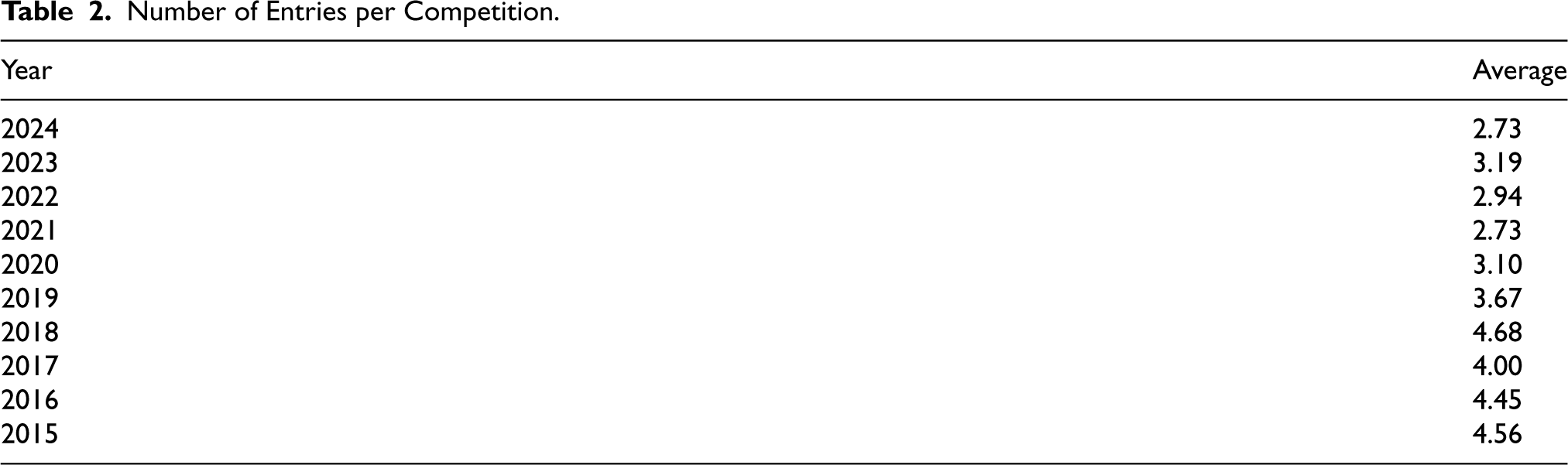
Number of Entries per Competition.
Second, post-pandemic participation rates are skewed higher by the many Cohen-Solal/Cazenave entries over the years, and the enormous number of Ohto last year. This suggests that the number of individuals competing is going down, but the number of entries per team is going up. For example, for 2023 and 2024 well over half of the entries came from two teams.
To repeat the question posed in previous year's reports (e.g., Iida et al., 2021b), how do we increase the number of Olympiad entries? Being online allows the event to easily handle more entries without incurring additional costs (which is not true for the in-person events). The Olympiad is advertised on the ICGA web site (low traffic), through several mailing lists (probably low impact), and from various mailouts (mostly to past participants). None of these methods seems to be reaching a new audience. Globally, game programming is a popular activity, but we have been unable to reach more game-AI programming aficionados.
The above data presented in this report is concerning. We welcome your suggestions for helping to grow the Olympiad and ensure that it continues for many years to come.
The 2024 Olympiad was a success. The Olympiad attracted a historically average number of entries (60). It is a fun event for all who enter.
Looking ahead, the new ICGA President needs to decide whether to continue the Olympiad as an online event or return to the in-person competitions. Regardless of the choice, efforts must be made to increase participation. The Olympiad has a 35-year history. It is important to ensure it remains a vibrant and successful part of the ICGA mandate.
Footnotes
Funding
The authors received no financial support for the research, authorship, and/or publication of this article.
Declaration of Conflicting Interests
The authors declared no potential conflicts of interest with respect to the research, authorship, and/or publication of this article.