




Abstract

The WCSCC is quite different from the other two tournaments. Not only because of the time control which is faster but also the rules on operator errors and technical failures.
Where operator errors in the WCCC and WCSC will have to be repaired (and clock time of the opponent to be compensated where applicable) an operator error in the WCSCC will constitute a loss. The second difference is regarding technical failures. This could be a crash of the computer system but nowadays where all participants play with remote machines a communication failure is the most common one. In the WCCC and WCSC, a participant gets up to 30 min to repair this failure during which the clocks are stopped. In the WCSCC, a technical failure will need to be solved while the clocks are running. Of course, this means that a well prepared and skilled operator is very important.
The Blitz competition was played interleaved with the WCCC. So after each standard game for the WCCC a blitz game was played with opposite colors.
From this competition, one game fragment deserves to be shared as it caused quite some excitement.
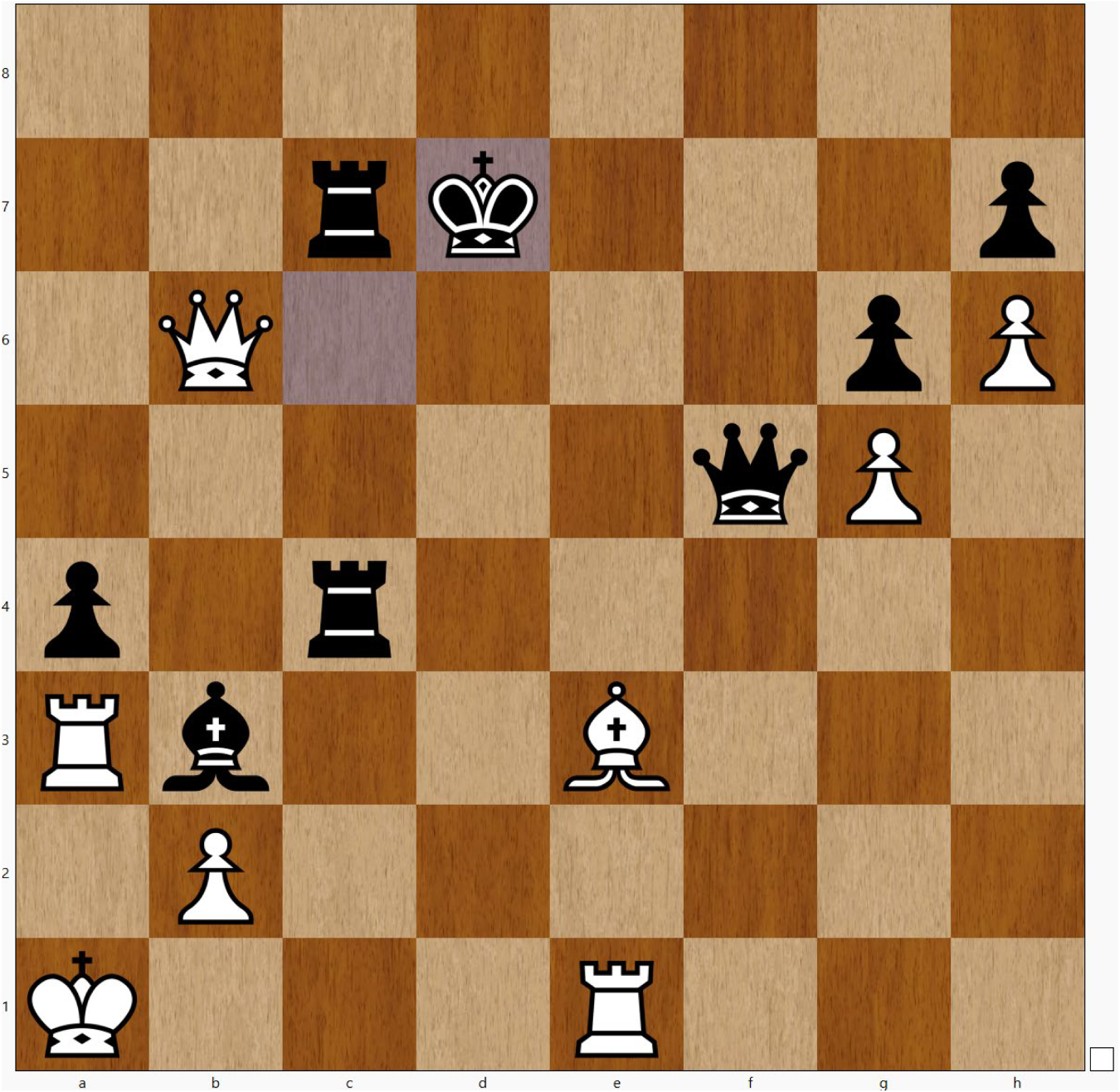
Rofchade – Raptor after 57. … Kd7
The programs were both indicating 0.00 for quite some time. Then suddenly Rofchade played
Black has only two options, all others will give white the advantage. There followed
58. … Rxf4
Not 58..Qxf4 due to 59.Qe6 + and mate on the next move.
The other option was 58..Qe5!. The exclamation mark is just for the surprise factor. Taking the queen is not possible due to the mate following Rc1 + . What can follow is 59.Qxc7+ Qxc7 60.Bxc7 Rxc7 61.Rxb3 axb3 and draw.
59.Rxb3! axb3
There is no choice. All other moves will lead to mate.
60.Re7+ Kxe7
Other moves are of course mate in one.
61.Qd6+
And we have a crazy queen. Taking the queen is stalemate. Black can decide not to take the queen, but then it will give a similar check again. Which only needs to make sure the black queen cannot intervene, as that would cancel the stalemate. Raptor did not want to drag on the game:
61.Kxd6 and stalemate

This playoff match between Raptor and Gridchess was required. In the playoff, preset positions are used, and the operators were obliged to turn off the opening books.
The first game was a relatively easy win by Raptor. It was noticed that Gridchess was moving instantly during the first moves of the game. And these moves were not really the best ones possible. The operator insisted that he turned off the book.
Upon closer inspection after the game it turned out that the book was actually not disabled, just closed in the GUI. And as the book settings were not configured the GUI played a more or less random move from the book.
This actually meant that when Gridchess would not have lost the game the arbiter would be obliged to forfeit the game due to a rules transgression.
The second game, now with the books correctly turned off, was a draw which meant that
Raptor is the 2024 world champion speed chess.
A CODA
Before the tournament, there were rumors around that after 50 years we now see almost perfect play by the top chess programs. Some believed it would be a good moment to organize just one last tournament alongside the CHESS event where major contributors from past and present were coming together to see the results of what they had started and what their successors had achieved.
Admittedly, seeing the tournaments in the form as they were organized during the last 50 years that may be a point of discussion and closer attention. Indeed, the draw rate between the top engines makes it very hard to award the title to one specific program. However, such a final does not fit with our academic standards: quitting the arena when the scientific task has not been fulfilled is not a good advice.
As long as the game of chess has not been solved there is room for organizing tournaments. The question is just what form should it have? Two scientific breakthroughs, such as (1) deep learning in combination with pattern matching, and (2) quantum computing are candidates to help us further.
Let we see what the future will bring us.