




Abstract
The traditional concept of filial piety characterising Asian cultures has undergone change. However, research is limited on how filial support is redefined and negotiated in Asian immigrant families in the context of acculturation. This study adopted theories of acculturation and life course to examine how continuity and change of filial piety were practised in Asian immigrants’ families in Australia. Data were collected from interviews with 73 older immigrants from Chinese, Vietnamese, Korean, Malaysian, Japanese, Myanmar, Lao, Indian, and Pakistani cultural groups. Their age ranged from 65 to 93 years. Thematic analysis showed that participants continued to value filial piety as their cultural tradition, but adjusted expectations of filial practices in response to acculturation experiences, age at immigration, and sociocultural contexts. The findings revealed the interconnections between continuity and change of culture and suggested integrating community and family care to better support older immigrants to age well in a foreign land.
Introduction
Research shows that older immigrants of Asian cultural backgrounds expect family to provide care and support. This expectation is commonly attributed to the culture of filial piety where it is presumed younger generations will care for their older family members. However, traditional filial practices have undergone change in immigrant families because of acculturation of both younger and older generations in western countries where self-reliance and independence are valued (Zhang, 2022). Despite recognising cultural change, there is limited research that advances understanding of the process through which filial piety is redefined, practised, and negotiated in families of older Asian immigrants in the context of acculturation.
Immigration and ageing carve out an intersection for exploring cultural continuity and change (Oxlund, 2018). Immigrants, especially first-generation immigrants, never completely leave their home culture behind, but live between cultures, physically and symbolically (Georgeou et al., 2023). In addition, the desire to connect to cultural roots can increase as they grow older (Zhan et al., 2017). As a Chinese saying goes, ‘Every falling leaf returns to its own roots’, meaning that people find a sense of home in where their roots are. The ability to continue home culture into the host country and to pass it on to young generations gives older immigrants a sense of home and facilitates their adjustment into the host culture (Ayika et al., 2018). However, limited research has examined how cultural continuity and change shape family care when older immigrants may not acculturate into the host country at the same speed as their younger generations (Fokkema & Ciobanu, 2021).
This study explored how older immigrants living at home in Australia experience and redefine filial piety, drawing on theories of acculturation (Berry, 1997) and life course (Elder, 1994). The research question was: How is filial piety redefined and negotiated by older Asian immigrants in Australia in the context of acculturation? In addition to contributing to scholarly debate at the intersection of ageing and immigration, this study has the potential to inform aged care practice and policies on culturally responsive support for older immigrants to age well in a foreign land.
Integration of Theories of Acculturation and Life Course
The acculturation literature relies heavily on Berry's (1997) fourfold model that delineates immigrant acculturation strategies based on their orientations to ethnic and new host cultures. These strategies reflect a willingness to identify with the old ethnic culture only (separation), new host culture only (assimilation), both (integration), or neither (marginalisation). Although Berry's model explains ethnic versus host cultural identification and the intersection of both, its universalistic perspective has been criticised by researchers because acculturation is not a universal process (Ward, 2013). Acculturation involves change in an individual's ‘cultural patterns’ including identities, values, and practices within family, community, social, and cultural contexts (Ward & Geeraert, 2016, p. 98). These experiences can vary as a function of demographic characteristics, ethnic cultural backgrounds, age at immigration, and sociocultural contexts, among various other factors. Further, acculturation is neither a universal nor a linear process (Liu et al., 2020). Immigrants’ choice of the cultural elements they wish to maintain, adapt, or reject may depend on the contexts in which they find themselves (Schwartz et al., 2010). For example, research in Australia showed that identity change in some contexts and continuity in others within the same individual is common among older immigrants (Jetten et al., 2018). Moreover, because acculturation strategies themselves can vary within the same individual, it is important for acculturation research to focus more on the lived experiences of immigrants (Ward, 2013).
Life Course Theory (LCT; Elder, 1994) complements acculturation theory in understanding cultural continuity and change in that LCT explains how human lives are shaped by the experiences and choices we make throughout our lives. LCT posits that: (a) human lives are shaped by individual choices we make; (b) the choices we make are situated in the social, economic, and historical contexts in which we live; and (c) our choices can impact not only our own lives, but also the lives of those around us because our individual lives are interconnected with those of others (Elder, 1994). These three key principles of LCT provide a lens for us to see how contextual factors shape older immigrants’ interpretation of filial care in families (Ferrer et al., 2017). In line with the work by Hutchison (2011), acculturation strategies of immigrants can be shaped by the historical time in which they grew up, their age at migration, and reason for migration. Moreover, older immigrants’ choice of what cultural elements to maintain and which ones to adapt can influence and be influenced by not only their own lives but also the lives of their younger generations, as well as being shaped by intergenerational relationships in the family. Integrating acculturation with life course theories provides a conceptual framework to explore how older immigrants redefine, experience, and negotiate filial piety within personal, familial, community, cultural, and societal contexts as they live and age in Australia.
Practice of Filial Piety in Families of Older Asian Immigrants
Filial piety is commonly defined as values, norms, and practices that prescribe children's obligations to their parents, encompassing care responsibility, maintenance of family harmony, repayment of parental sacrifice, and emotional or material support (Bedford & Yeh, 2021). While filial practices can manifest in diverse cultural groups, for example, Middle Eastern, Latin American and African cultures (see Shrestha et al. 2023 for a review), historically filial culture is associated with Confucian societies and hence has been regarded as an integral part of Asian cultural tradition (Kyeong et al., 2025). For example, notions of repaying parental sacrifice are applied among Vietnamese, Japanese, Chinese, and Korean families through valuing interdependence, harmony, and collectivism (Lim et al., 2022). In addition, filial practices reflect broader structural, social and cultural systems, such as religious influences in Malaysia, legal mandates in Singapore, and kinship-based care in Indonesia (Iskandar et al., 2025).
International research shows that older immigrants, particularly late-life immigrants from non-English-speaking countries, heavily rely on family care (Andruske & O’Connor, 2020). Apart from limited English-language ability (Olofsson et al., 2021) and unfamiliarity with social systems in the host country (Cheung et al., 2020), a key contributor to their heavy reliance on family care is cultural tradition. Caring for older family members is considered a filial obligation of adult children and is often taken for granted in Asian cultures (Xu et al., 2025). However, traditional practice of filial piety is changing due to acculturation into western countries, resulting in discrepancies in care expectations between older and younger generations in Asian immigrant families in Australia (Baldassar et al., 2022). For example, living together with ageing parents was traditionally considered a filial practice for children to repay their parents in Chinese culture, but such living arrangements are less common nowadays among Chinese families in Australia (Gao et al., 2023). Hence, a significant part of acculturation of older Asian immigrants involves negotiating intergenerational differences in maintaining traditional values of filial practices and adjusting to the host country that values self-reliance and independence. A recent study revealed that older Vietnamese Australians increasingly strive for self-care, independence, and financial autonomy in Australia (Nguyen et al., 2024). In the same vein, a study in Canada found that Chinese immigrants adjust their filial expectations to prioritise emotional over instrumental support from their children (Zhang, 2022). Despite such observations regarding change in filial practices, there is limited understanding of how filial piety is redefined, negotiated, and practised by older immigrants living in countries with more westernised values and norms (Guo et al., 2019). This study aimed to fill this gap.
Methods
Participants
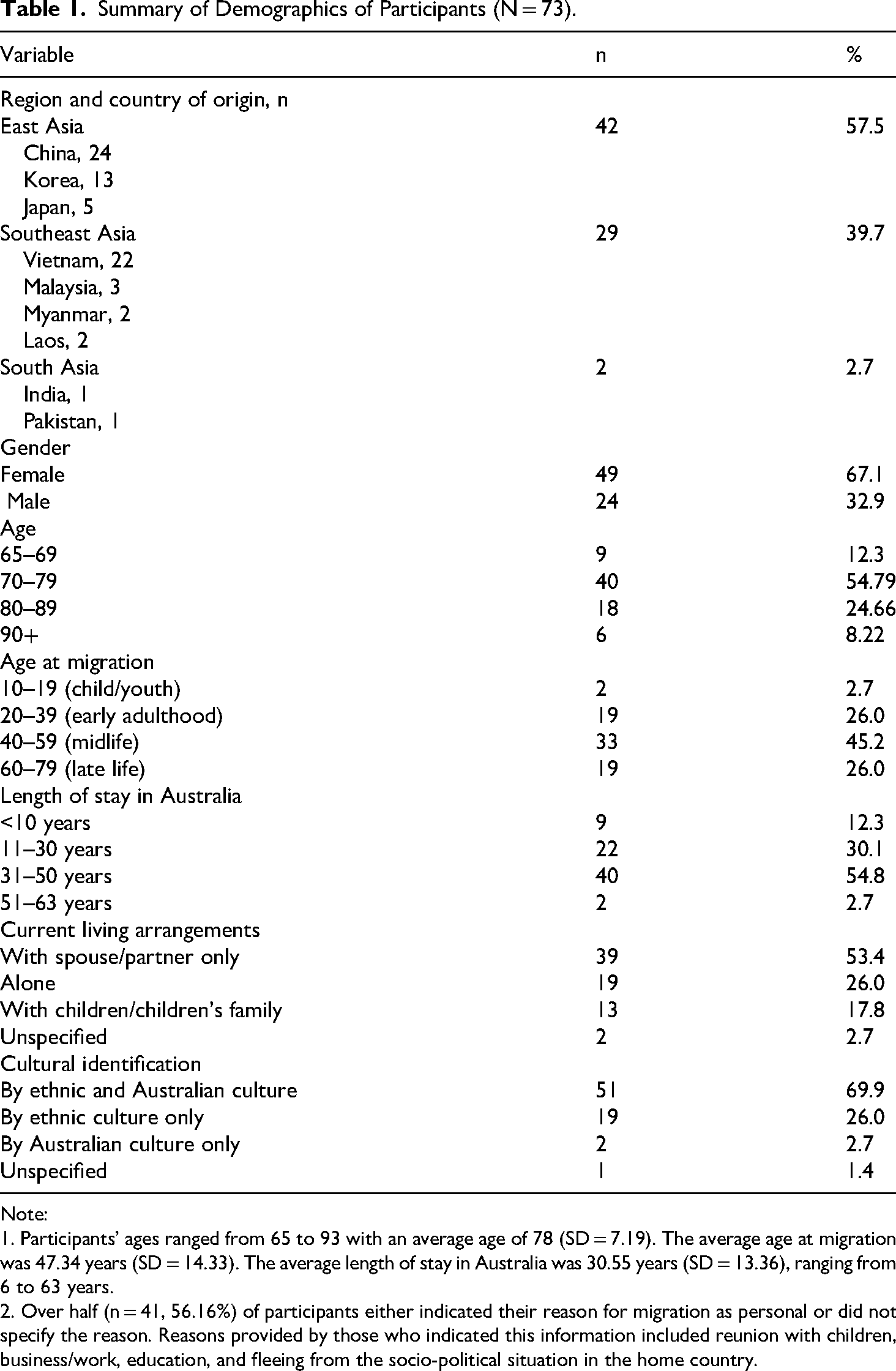
This study forms part of a larger research project that received ethical approval from the Human Ethnics Committee at the University of Queensland. Purposive-snowball sampling was used to recruit older immigrants of multiple cultural groups. Informed by the definition of the Australian Bureau of Statistics (ABS, 2022), older Asian immigrants in this study were defined as people aged 65 or over, overseas born, speaking an ethnic language other than English at home, and from an Asian cultural background. Participant recruitment was facilitated by our advertising the study in community newsletters, assistance from community aged care service providers, and our promotion of the study at social gatherings of older people organised either by community service providers (e.g. health seminars, workshops) or ethnic community associations. Personal contacts of the research team were also used to help with recruiting participants. This mixed approach is commonly used to recruit participants who are difficult to reach, such as older immigrants (Vang et al., 2021). Table 1 summarises the demographics of participants.
Summary of Demographics of Participants (N = 73).
Note:
1. Participants’ ages ranged from 65 to 93 with an average age of 78 (SD = 7.19). The average age at migration was 47.34 years (SD = 14.33). The average length of stay in Australia was 30.55 years (SD = 13.36), ranging from 6 to 63 years.
2. Over half (n = 41, 56.16%) of participants either indicated their reason for migration as personal or did not specify the reason. Reasons provided by those who indicated this information included reunion with children, business/work, education, and fleeing from the socio-political situation in the home country.
Interview Questions and Procedure
The interview questions were open-ended to encourage participants to share their stories of aged care experiences. Examples were ‘Who do you consider important in enabling you to live at home and why?’; ‘What type of care do you expect from the family member you mainly rely on for care support, and why? Could you give an example?’; ‘Any other support you’d like to have from family but find it difficult? Why?’; ‘In your view, what is most important in aged care for older people like you?’ Participants were asked to talk about the cultural influence on their care experiences, including what practices were similar or different from those in their ethnic culture. We did not specifically ask about filial piety because we wanted participants to use their own terms to describe their cultural expectations of family care. The concept of filial support as a cultural tradition and its change emerged from each participant's stories. Interview questions were pilot tested, and the wording of a few questions was revised to improve clarity.
In line with ethics protocols, each participant was provided an information sheet in their preferred language prior to each interview. A consent form was signed by each participant before interview. Interviews were conducted one-on-one by the research team members between January and May 2023 across four states and in six languages based on participant preference: English, Burmese, Mandarin, Cantonese, Korean, and Vietnamese. Interviews in English and other languages were conducted by members of the research team, including research assistants, who were native speakers of the specific ethnic language. Prior to each interview, the research assistants received training and role-play practice scenarios provided by the project team to ensure that questions were accurately explained to participants. Approximately 70% interviews were conducted face-to-face in participants’ homes or a venue of the participant's choice. The remaining 30% interviews were conducted online on Zoom or Teams, primarily for interstate participants. All interviews were audio recorded with participants’ consent. On average each interview took about one hour.
Data Analysis
Interviews in English were transcribed by a professional transcription company. Interviews in ethnic languages were transcribed and translated into English by the research assistants and members of the research team who were native speakers of the respective ethnic language and conducted the interviews. To protect confidentiality, each participant was assigned an identification number at the time of recruitment, and these numbers were retained in data analysis. The numbers used in cited extracts were not consecutive because this study was part of a larger project and not all project participants took part in this study.
Data analysis was carried out by the first two authors and the last author. A hybrid approach of deductive and inductive coding (Fereday & Muir-Cochrane, 2006) was adopted to combine codes derived from the research questions (concept-driven) with inductive codes which emerged from thematic analysis (data-driven). At the deductive step, relevant interview content was categorised under concepts in interview questions (e.g. care expectations, role of family carers, cultural norms governing aged care, what types of care are expected from whom and why). Filial piety emerged as a strong concept permeating participants’ stories and experiences.
At the second step of inductive coding, the coders focused on narratives around filial support to derive data-driven themes (e.g. cultural traditions, cultural change, acculturation). This step of coding involved examining the selected interview extracts and refining initially identified concept-driven themes. The focus was on situating filial piety in the context of culture, cultural change, and acculturation experiences. Disagreements between the three coders were discussed through written feedback on multiple drafts until consistency was reached. The demographic characteristics of participants including ethnicity, cultural identification, age at migration, length of stay, and living arrangements were taken into consideration when interpreting the data.
Results
Redefining Filial Piety after Immigration to Australia
All participants recognised filial piety as their cultural value, regardless of living arrangements (with children, alone, or with spouse/partner), cultural identification (by ethnic and Australian cultures, by ethnic culture only, or by Australian culture only) or length of stay in Australia (less than 10 years or several decades). They embraced the cultural tradition that younger generations looked after older family members because that was the cultural norm they adhered to when caring for their own parents in their home countries. However, participants were aware that such cultural expectations were not realistic in their host country, Australia, where their adult children placed more value on self-reliance and preferred independent living arrangements. A 73-year-old Vietnamese participant who defined her cultural identity as Vietnamese Australian explained: I want and hope to have my children's care support, but I know it's not possible. In Vietnam it is the duty of children and grandchildren who live nearby. If this child can’t look after their parents, then there is another one to do it. While the children here live independently from their parents. How could they be expected to provide care for their parents like in Vietnam? (#84; female, immigrated at the age of 36, living alone, reason for migration: personal)
Another 79-year-old Vietnamese participant noted that filial care practice was shaped by social systems. In Vietnam, older adults depended entirely on their children for care support due to the absence of pensions, while in Australia older people could rely on an ‘established government welfare system’ (#67, female, immigrated at the age of 36, living with children, reason for migration: settling family in Australia). Similarly, a 68-year-old Korean participant, who defined his cultural identity by ethnic culture only, shared his view on change in filial expectations after moving to Australia: I wish I could see them [his children] more often, but it is simply not possible. In today's world [Australia], everyone should look after themselves. The tradition of children looking after their parents no longer exists. (#57; male, immigrated at the age of 40, living alone, reason for immigration not stated)
Participants acknowledged that their adult children, being immigrants themselves, often juggled between commitments to work and looking after their own children. They adjusted expectations of filial responsibility from adult children being a personal carer to adult children providing emotional and financial support for old parents. Financial support included paying phone bills and living expenses (#79, Vietnamese, female, aged 90, immigrated at the age of 56, living alone, reason for immigrating not stated) or covering medical expenses (#68, Chinese, female, aged 89, immigrated at the age of 79, living with children, reason for immigration: family reunion). Late-life immigrants who moved to Australia for the reason of reunion with children, and who had lived in Australia for less than 10 years, were unlikely to be eligible for a government pension initially and more likely to need children's financial support, along with emotional support. A 79-year-old Pakistani participant explained his reliance on financial support from children: I don’t get any financial support from the government so far because I’m not entitled to a pension. My two sons support me in that respect. … Actually, that is the only support, even sometimes for medical expenses, medicines, if I need to see a doctor. (#1, male, immigrated at the age of 72, living alone, reason for immigration: family reunion)
Nevertheless, not all participants received the financial and emotional support they desired at home. Nor were acculturation experiences the same for participants with varying age at migration and levels of English proficiency. Some late-life immigrant participants could not integrate into Australian society even after living in Australia for more than two decades. They did not understand Australia's aged care and social welfare system due to limited English-language proficiency and limited social networks. Discrepancies between their filial expectations and those of their children resulted in family conflicts. A 91-year-old Chinese participant described his experience this way: We thought my son's family would always look after us. We did not apply for government aged care support because we thought we were not eligible. But we learned later that they are separate things. We didn’t know how Australia's aged care policies work. Otherwise, we could have applied for home care packages while my son's family still looked after us. Now my daughter-in-law said she is not responsible for looking after us anymore because she is at the age of aged pension herself. (#66; male, immigrated at the age of 65, living with partner/spouse only, reason for migration: family reunion)
In sum, participants upheld filial piety as their cultural tradition but recognised that they could not expect their adult children to provide filial care in the same way they had cared for their own parents in their home countries. Differences in social systems between home and host countries, along with adult children's commitments to work and their own young family necessitated redefining filial piety from adult children traditionally being a personal carer to providing emotional and financial support. Discrepancies in filial expectations between parents and children could result in intergenerational conflicts, especially among late-life immigrant participants with limited English-language proficiency and knowledge of Australia's social system, who found it hard to integrate into Australia.
Negotiating Independence within Interdependence in the Context of Acculturation
In line with redefined filial practice, participants shared a general desire to not be a burden to their younger generation, mostly adult children. They strived for the self-reliance and independence valued in Australian culture in which their younger generations were educated and acculturated. Such desire for self-reliance was reflected in the practice of self-care, mutual care between partners or spouses, and reciprocal care between parents and children.
Self- and mutual care were found mainly among midlife immigrants (age at migration 40–59) who lived with their partner/spouse and chose to manage daily routines themselves even though their children lived nearby (#30, Malaysian, female, aged 75, age at migration 52, reason for immigration: education). Similarly, a 73-year-old Chinese participant who moved to Australia with his parents for reasons of family business, described his self-care: ‘I tried to do things myself instead of asking for help [from children]’ (#120, male, immigrated at the age of 10, living with partner/spouse only, reason for migration: family business).
A 69-year-old Indian participant described the mutual care she and her husband provided for each other: I now have some sort of allergy or skin infection. He makes sure that he rubs the ointment on my back, which I can't reach. And when his back was aching, I took on all the household chores so that he could recover. And whoever is feeling better will do the cooking and washing and all the domestic chores. (#49; female, immigrated at the age of 53, living with partner/spouse only, reason for migrating not stated)
Reciprocal care between parents and adult children's family was regarded as a way of showing independence and self-sufficiency. Such practice was common, especially among participants who immigrated to Australia for the reason of family reunion and who lived with their children's family. A 72-year-old Chinese participant, who self-identified as Chinese Australian, pointed out that she and her husband chose to share domestic chores with children and looked after grandchildren: My grandchildren are already in school, and my daughter takes care of them. We help them with domestic chores because we are still able to, and my daughter must work. We also help with looking after my grandchildren. (#75; female, immigrated at the age of 42, living with children's family, reason for immigration: family reunion)
Some participants chose to get external in-home care services to assist with domestic chores. Interestingly, such services were often first agreed by their children and applied through them, showing an independence within interdependence dynamic. Those participants who were able to access formal in-home care services felt such services filled the gap of informal filial support. For example, a 74-year-old Vietnamese participant explained that assistance from community care services with cooking and cleaning helped her to maintain quality of life without relying on her adult children (#82, female, immigrated at the age of 52, living alone, reason for immigration not stated). Similarly, an 80-year-old Burmese participant explained that her community care worker spoke her ethnic language and provided transportation because she could not drive (#116; female, immigrated at the age of 65, living with spouse only, reason for immigration not specified).
While accepting services from formal community care providers, participants still preferred to rely on their children or family for certain type of care support, such as communication with government agencies, medical appointments, and dealing with banking paperwork. A 75-year-old Chinese participant who lived with his spouse expressed the need to have his son to accompany them to medical appointments even though the doctor spoke their ethnic language. He needed his son to explain medical terminologies (#71; male, immigrated at the age of 41, living with partner/spouse only, reason for immigration: family reunion). Similarly, an 84-year-old Vietnamese participant noted that he preferred to rely on his children when communicating in English with government agencies due to his own limited English proficiency (#77, male, immigrated at the age of 51, living with partner/spouse only, reason for immigration not stated).
However, not all participants were able to be as self-sufficient and independent as they desired. While early and midlife immigrant participants maintained more independence and a relatively higher level of integration into life in Australia, most late-life immigrant participants, particularly those who moved to Australia to reunite with their adult children, felt it difficult to get integrated into Australian society and navigate daily routines independently. They found it hard to learn the English language at an older age and this language barrier led to limited contact with the larger Australian society. Their marginalisation acculturation strategy resulted in feelings of loneliness. An 89-year-old Hong Kong Chinese who immigrated at the age of 79 described her feeling this way: I often stay in my room doing exercise and looking at my phone alone. … I lived in Hong Kong for a long time. I know where to buy things and how to get around. But, here in Australia, I need someone to accompany me when going out because I can’t drive. Since the road signs here are all in English, I can’t find my way, and I worry about getting lost. (#68, female, immigrated at the age of 79, living with children, reason for immigrattion: family reunion)
Further, acculturation strategies could change within the same individual during the life course. For example, an 82-year-old Korean participant who had lived in Australia for 42 years planned to return to South Korea due to the difficulty in getting care support from children and adjusting to Australian food in late life. Although his wife's declining health compelled him to abandon the plan, this case illustrated that, as people grew older, the desire to connect to their ethnic culture could become stronger and acculturation strategies could change along the life course. Support from children would be difficult. They have to work to make a living. … Actually, we wanted to return to Korea but as she [his wife] got unwell, I gave up the plan. Before she was sick, I was determined to return to Korea and eventually die there. The food here is not good for me. (#33, male, immigrated at the age of 42, living with partner/spouse only, reason for immigration not stated)
In sum, participants strived for independence through self-care, mutual care between spouses, reciprocal care with their children's family, as well as seeking formal in-home care services to supplement family care. But not all participants could be as self-sufficient as they desired. While early and midlife immigrants maintained more independence in navigating life in Australia, late-life immigrants who immigrated to reunite with their children were more likely to depend on their adult children and found it hard to adjust to Australian life. Acculturation experiences varied across age at immigration, levels of English proficiency, and reasons for immigration. Nevertheless, family remained central, especially for late-life immigrant participants, for financial matters, housing, medical accompaniments, and administrative tasks where English was required. This produced a dynamic in which independence existed within interdependence.
Expanding Filial Care to Incorporate Social Support as Pathway to Integration
While empathising with their children's juggling between work and family demands, participants noted generational gaps not only regarding different speeds of acculturation but also adherence to cultural traditions. Many participants, regardless of their reasons for moving to Australia, had low English-language proficiency, despite living in Australia for several decades. They preferred to live in suburbs densely populated by residents from their ethnic culture. They shopped at nearby ethnic shops and built a social network consisting only of people from the same ethnic culture. Some long-term immigrant participants with children born and raised in Australia experienced language barriers even when interacting with their own children at home. A 73-year-old Vietnamese participant described her difficulty in talking with her youngest son: My daughter doesn’t have time for me to talk to her or share thoughts. So, I don’t know who to talk to. … The youngest son doesn’t know much Vietnamese and he does not understand Vietnamese, either. There is no point talking with him as he can’t understand much for sharing. (#94, female, immigrated at the age of 29, living alone, reason for immigration: settling family in Australia)
The realisation of the intergenerational gap motivated older immigrants to reach out to ethnic communities for social support to fill the gap, especially for emotional support. Participants generally embraced Australian culture and appreciated life in Australia (e.g. the good environment, quality of life, government-funded aged care support, friendly people, and good social welfare systems). Even participants who identified with ethnic culture only saw the importance of integrating into the larger Australian society. A 68-year-old Korean participant expressed: In my opinion, individual efforts to integrate into Australia is important. If someone lives here like oil and water, then Australia would never be their first choice. It's important to break one's familiar boundaries and get to know what's going on in the society. … We should maintain Korean cultural traditions while making our best effort to integrate into Australian culture. While doing so, we can also bring our culture to Australian society. (#57; male, immigrated at the age of 40, living alone, reason for immigration not stated)
In line with the view expressed by the previous quote, participants recognised the importance of extending their ethnic culture into Australia. For example, a Japanese couple who were midlife immigrants were active in building social networks in a Japanese social club where they met with other older Japanese immigrants each month (#105 and #106, aged 79, immigrated at the age of 31, reason for immigration not stated). Similarly, a 71-year-old Chinese late-life immigrant participant, who moved to Australia to reunite with his son's family, highlighted the importance of connecting with his ethnic community as a means of social support: You should get out and about more frequently, make friends, and share experiences. This is the most important thing. The best thing is that we have an association like this here [the Chinese ethnic association] for people to talk with one another about culture and experiences of life in Australia. (#121, male, immigrated at the age of 65, living with partner/spouse only, reason for immigration: reunion with children)
Connection with immigrants of similar age and culture provided emotional and mental health support for older immigrants who experienced intergenerational conflicts at home. A 78-year-old Chinese participant, who self-identified as Chinese Australian and immigrated with her son's family, noted some older immigrants who experienced intergenerational conflict at home had no one to talk to: I saw some older people sit on a bench outside supermarket, crying…. They don’t know who to talk to…. Young people cannot understand. They [old people] abandoned all things they are familiar with in their home country and started all over again at an old age. This is indeed very difficult. They cannot do anything if there is no support and if their children don’t understand their feelings. (#14; female, immigrated at the age of 63, living with children's family, reason for immigration: immigrating with son's family)
Moreover, connecting with people who shared similar immigration experiences not only facilitated maintenance of ethnic culture but also adjustment into Australia, as well as providing opportunities for receiving and giving social support. A 75-year-old long-term Malaysian participant, who self-identified as a Malaysian Australian, expressed the importance of sharing culture and interest in art with other older immigrants of different cultural groups: We can have a little bit of social events and you bring a plate and I bring a plate, a cultural thing once a month…. You interact with other people from different cultures. Even though we are old, we may be artistic. It could be Indian, Greek, Vietnamese, but they are all interested in art. (#30; female, immigrated at the age of 52, living with partner/spouse only, reason for immigration: education)
Furthermore, maintaining ties with ethnic communities also served as a platform for providing social support to others. The ability to give social support contributed to participants’ well-being. For example, a 70-year-old Vietnamese participant said: I feel very happy because I can help others. For example, when a neighbour needs me … or people in the church ask me to help to alter their clothes, I will do anything to support them. Anyone [in her friend circle] needs someone to drive them to the shop I will come and give them a lift. When I help others, I feel comforting and happy. (#85; female, immigrated at the age of 41, living alone, reason for migrating not stated)
In sum, negotiating filial expectations required understanding between older immigrants and their adult children or younger family members. Participants empathised with their children's work and family demands. At the same time, they reached out to their ethnic communities to receive and provide social support. Social connection not only facilitated maintenance of ethnic culture but also helped acculturation into life in Australia. Interacting with people from the same ethnic culture and age group extended filial support, maintained their culture, and facilitated integration.
Discussion
This study explored how filial piety is redefined, negotiated, and practised in families of older immigrants in Australia. The interviews with 73 older Asian immigrant participants identified three key findings. First, participants uphold filial values as an important part of their culture, but at the same time, recognise the need to adjust their care expectations after immigrating to Australia where independence is valued. Second, participants strive for self-reliance and independence while negotiating filial support in relation to certain types of care (e.g. medical appointments, translation, and managing administrative paperwork in English), creating a dynamic of independence within interdependence. Third, participants reach out to their ethnic community to receive and give social support, maintain ethnic culture, and facilitate integration into life in Australia. Together, these interconnected themes reveal cultural continuity and change of filial piety underpinning acculturation experiences of older immigrants. We discuss these three findings in more detail below.
First, this study supports the argument that older immigrants always live in-between cultures (Zhang, 2022). They redefine ethnic cultural traditions to align with their host country’s cultural context, but they continue to uphold filial piety as an integral part of their ethnic cultural tradition, regardless of how many decades they have lived in their host country. In addition, our data show that what the concept of filial piety entails is very similar across participants from different regions (East Asia, South Asia, Southeast Asia). What shapes similarities and differences in filial practices across participants, however, is acculturation strategies and life course-related factors such as age, age at immigration, English-language proficiency, and intergenerational relations. These findings provide support for recent scholarship that argues that filial piety practices could be more universal and are shaped by sociocultural contexts and life events (Kyeong et al., 2025).
Second, older Asian immigrants, regardless of cultural identification and length of residence in the host county, desire independence; but such independence and interdependence are simultaneously activated in their ageing experiences at home. The findings reveal that participants strive for self-reliance and independence through self-care, mutual care between spouses and reciprocal care with children, as well as using formal in-home care services for instrumental support. At the same time, participants continue to expect certain types of care, such as being accompanied to doctor's appointments, translation, and administrative tasks with banks to be provided by their family members only rather than external care services. This finding reflects the interdependence of human lives proposed by Life Course Theory (Elder, 1994). In addition, the findings of this study show that acculturation is shaped by life course factors. While early and midlife immigrants maintain desired independence in navigating life in Australia, late-life immigrants who immigrated to reunite with their children are more dependent on their adult children for filial support. They are more likely to adopt separation or marginalisation acculturation strategies, sometimes not because they want to but because they have to, due to the language barrier making it difficult for them to integrate into the larger Australian society. In addition, acculturation strategies are fluid and may change within the same individual at different stages in life. As people get older, their desire to connect to their ethnic culture could grow stronger (see quote of participant #33 who planned to return to Korea).
Third, this study shows that participants build social networks with people of similar age and immigration experiences as another source of social support in addition to family care and external care services. As stages of life shape experiences (Elder, 1994), older immigrants who are similar in age are likely to have gone through the same historical events in their home countries. Our findings support previous research on older immigrants in Australia in that the opportunity to meet, talk, and share experiences reminiscent of certain historical times, culture and language through singing old songs, cooking, and telling personal stories can significantly strengthen cultural connections (Tran et al., 2022). The findings also show that being able to give social support to others in the community provides a sense of joy. Echoing previous research, our findings suggest that engagement with fellow immigrants through social groups and shared interests complements filial support at home and facilitates integration, fostering a sense of home in the host country (Liu, 2019).
In terms of implications for policy and practice, our findings underscore the need to foster intergenerational understanding through communication. In line with Life Course Theory (Elder, 1994), generational differences in defining filial responsibilities and adherence to cultural traditions are situated in historical contexts, age at immigration, length of residence in the host country, and acculturation experiences. A lack of understanding between parents and children may result in intergenerational conflicts. Current social activities organised by community aged care service providers in Australia usually include older immigrants only as such activities are funded by government aged care programs. Aged care policies may include funding to support regular social activities that involve both older immigrants and their younger family members to provide opportunities for improving intergenerational understanding through communication. In addition, this study has identified a vital role ethnic communities can play in maintaining social and cultural connections. Ethnic community associations can extend filial care at home to incorporating social support, and serve as a bridge between older people, family, service providers, and government departments to identify care needs. However, ethnic community associations are often not recognised and funded, limiting their ability to exercise their full potential in supporting older immigrants. We suggest that aged care policies provide grants to enable and empower ethnic community associations to play their role in supporting older immigrants. Integrating community and family care can leverage existing service capacity and family support to facilitate the delivery of culturally responsive services to meet the needs of older immigrants from diverse cultural backgrounds.
Conclusion
This study shows that the life of older immigrants involves ongoing negotiation between people, culture, and relationships in the host country. Navigating two cultures, and sometimes incompatible practices, can be challenging, particularly for those who made their immigration journey at a relatively older age. This is due in part to their increasing dependence on other people in their late life and cultural differences experienced at home with younger family members (Liu et al., 2020). Older immigrants may hold culturally informed care expectations and simultaneously engage in negotiation with notions and values of the host country (Oxlund, 2018). Through exploring cultural change and continuity of filial piety from the perspectives of acculturation and life course, this study provides new insight into lived experiences in adapting to cultural change through an interplay of cultural values, family dynamics, and social networks. Acculturation is an ongoing journey for immigrants. Exactly how immigrants engage in acculturation processes and the implications for continuity and change in both the ethnic and host cultures is a key question for future research at the intersection of immigration and ageing.
Footnotes

Ethical Approval
The study received ethical approval from the Human Ethnics Committee at the University of Queensland (2022/HE000799).
Participant Informed Consent to Participate in the Interviews
Informed consent to participate in this study was obtained from each participant before their interview.
Contribution of Authors
Authors 1–2 (writing/editing the paper and data analysis), Author 3–4 (editing/writing the paper), Author 5 (data analysis).
Funding
This research project is supported by The Australian Research Council Linkage Grant Scheme (LP210200703; 2022–2025).
Declaration of Conflicting Interests
The authors declared no potential conflicts of interest with respect to the research, authorship, and/ or publication of this article.
Data Availability Statement
The data that support the findings of this study are not publicly available due to research ethics restrictions but some de-identified data may be available from the corresponding author on reasonable request. The data that support the findings of this study are not publicly available due to ethical restrictions but may be available from the corresponding author on reasonable request.