



Abstract
Life satisfaction is an important concept for both police and other law enforcement organizations. Past research on the spillover theory has found that higher life satisfaction results in better physical health, being more open-minded, improved effort, and longer life expectancy. The spillover theory holds what happens at work does not stay at work but spills over and affects a person’s overall life. Workplace variables, particularly job stress, job involvement, job satisfaction, and organizational commitment do not just affect people at work, but also affect people’s satisfaction with their overall lives. The current study examined how job stress, job involvement, job satisfaction, and organizational commitment were associated with life satisfaction among a sample of 827 police officers from the state of Haryana in India. In a multivariate ordinary least squares regression analysis, job stress had a significant negative effect on life satisfaction, whereas job involvement, job satisfaction, and organizational commitment had significant positive effects. The results suggest that police administrators should attempt to lower job stress and increase job involvement, job satisfaction, and organizational commitment among officers to raise their life satisfaction, which, in turn, should benefit the individual officers, the police agency, and the community being served.
Keywords
Across the globe, the police provide important services. Police departments are labor-intensive organizations that exist to serve and protect the public (Roberg et al., 2012). Officers perform many tasks to meet their organization’s mission, goals, and objectives. Not only do police officers have significant effects on their organizations, but, through workplace factors, police organizations have significant effects on their officers. A growing body of research has examined how workplace factors affect officers. This research has explored how workplace variables affect officers’ job stress, job involvement, job satisfaction, and organizational commitment (Currie and Dollery, 2006; Jaramillo et al., 2005; Johnson, 2012; Lambert et al., 2015b; Lord, 1996; Qureshi et al., 2017; Tyagi and Dhar, 2014). These are important outcomes but they are not the only ones. One area not fully researched is how workplace variables are associated with police officer life satisfaction. According to the spillover theory, workplace variables affect life satisfaction (Erdogan et al., 2012). Under this theory, positive work experiences result in optimistic psychological feelings, which result in greater happiness with life. Conversely, negative work experiences result in psychological strain, which detracts from the overall quality of life (Erdogan et al., 2012). Policing is a stressful occupation, and job stress results in psychological strain for officers (He et al., 2002). Job stress does not stay at work when officers end their shifts; it continues and results in less satisfaction with life. Job involvement (i.e., feeling connected to the job), job satisfaction (i.e., liking the job), and organizational commitment (i.e., being bonded to the police organization) can result in a more upbeat psychological state not only at work, but also at home, and, in the end, life satisfaction should increase for officers (Johnson, 2012, 2015). Officers matter, and if their life satisfaction were to be increased, it would benefit not only officers, but also the police agency and the community.
Life satisfaction is the degree to which people are satisfied (i.e., happy) with their overall lives (Suh et al., 1998). Satisfaction with life has been found to be related to better physical health, being more open-minded, improved mental health, prosocial behaviors, enhanced social interactions, creativity, and longer life expectancy (Chida and Steptoe, 2008; Donovan and Halpern, 2002; Duckworth et al., 2009; Erdogan et al., 2012; Greguras and Diefendorff, 2010; Lyubomirsky et al., 2005). Policing is a human services occupation that requires that officers interact with citizens. Improving officers’ psychological states and increasing the quality of their interactions with citizens will help officers, the police agency, and the community being served. When police are more motivated, they are more likely to engage in more prosocial behaviors (i.e., going beyond what is expected at work), which will aid both the police agency and the community. Policing is a demanding job that contributes to a shorter life span for officers (Brandl and Smith, 2013). Increasing officers’ life spans will not only aid officers, but also their loved ones. Additionally, life satisfaction has been reported to lower absenteeism, decrease the desire to retire early, and lower both turnover intent and turnover (Erdogan et al., 2012; Lambert et al., 2005; Murphy et al., 2006; von Bonsdorff et al., 2009). Donovan and Halpern (2002: 32) contended, “when people are happier, they tend to be more open-minded and creative in their thinking. In contrast, people who are unhappy, stressed or dissatisfied tend to exhibit ‘tunnel vision’ and rigid thinking”. Jones (2006) reported that satisfaction with life was a stronger predictor of job performance than job satisfaction. If police organizations can lower absenteeism, turnover intent, and turnover, it will not only save limited financial resources but also allow trained, experienced officers to remain on the job to serve the community (Smith et al., 2014). Reducing tunnel vision and rigid thinking should help officers deal with the varying and often complex tasks they encounter. Officers are not only a valuable resource but also an expensive one. Police organizations should invest in their officers, and one way to do that is to understand how job stress, job involvement, job satisfaction, and organizational commitment are related to officers’ life satisfaction. Officers have a demanding job. Police agencies should focus on building officer life satisfaction.
No published studies could be located that explore how job stress, job involvement, job satisfaction, and/or organizational commitment are associated with the life satisfaction of police officers. The current study explored how job stress, job involvement, job satisfaction, and organizational commitment affect the life satisfaction of officers employed by the police agency in the Sonipat and Rohtak districts in the state of Haryana in the Republic of India (henceforth India). Police are important in India, including Haryana, and being an Indian police officer is a demanding occupation (Kaur et al., 2013). Further, studying the effects of these workplace variables on police officer life satisfaction is an important area that needs to be explored for both theoretical and practical reasons. Theoretically, this study explores whether workplace variables are linked to police officer life satisfaction, as has been found in studies of other occupations. Practically, this study can provide police administrators with information concerning how the workplace variables of job stress, job involvement, job satisfaction, and organizational commitment relate to officer life satisfaction. Administrators are encouraged to use the findings of the current study to increase the life satisfaction of their officers, thus increasing possible positive outcomes.
Literature review
Concepts
Life satisfaction
Tatarkiewicz (1976: 8) argued:
that satisfaction is only happiness when it is complete satisfaction. Next, even complete satisfaction does not necessarily add up to happiness. Satisfaction with particular things, however important – health or an untroubled conscience, success or position – falls short of happiness if it is not accompanied by other satisfactions. It is then only partial satisfaction; happiness requires total satisfaction, that is satisfaction with life as a whole.
Satisfaction with life as a whole is part of the larger concept of subjective well-being (Diener, 1984; Erdogan et al., 2012). The three parts of subjective well-being are positive affect, negative affect, and life satisfaction (Diener, 1984). Diener et al. (1985) indicated that positive and negative affect “refer to the affective, emotional aspects” of subjective well-being and life satisfaction refers to the “cognitive-judgmental aspects” of subjective well-being. Happiness is based on the positive and negative effects in life experienced by the individual (Diener, 1984). Life satisfaction is an integral part of happiness (Diener et al., 2013). Life satisfaction results from an individual’s assessment of many different life domains, including social, home, recreation/leisure, and work, with work being an important domain for working adults (Diener et al., 2013; Erdogan et al., 2012). Life satisfaction is an evaluation by a person of his or her life overall (Diener et al., 1985). Despite being part of the broader concept of subjective well-being, life satisfaction is a distinct concept that is often studied on its own (Pavot and Diener, 2008). Work is a salient domain for most adults, including police officers (Erdogan et al., 2012). As such, workplace variables are theorized to contribute to the overall life satisfaction of working adults, including police officers, who work in an interesting and sometimes demanding occupation (Erdogan et al., 2012; Lambert et al., 2005).
The spillover model explains why workplace variables would be related to life satisfaction (Lambert et al., 2005). Under the spillover model, workplace variables can spill over from the work domain and affect other domains (Erdogan et al., 2012). Under this model, positive work variables result in positive psychological feelings, which in result in greater happiness with life. Conversely, negative work variables result in negative psychological states, such as frustration, which detract from the overall quality of life (Erdogan et al., 2012). Past research has examined the relationship job satisfaction with life satisfaction, finding a positive link with workers in general (Erdogan et al., 2012) and with correctional staff (Lambert et al., 2005). Other workplace variables remain to be examined. As pointed out by Erdogan et al. (2012: 1061), “broader construct of quality of work life, consisting of job satisfaction, career satisfaction, and perceived stress at work, may be a better indicator of attitudes regarding the work domain”. The current study examined how job stress, job involvement, job satisfaction, and organizational commitment are associated with Indian police officer life satisfaction.
Job stress
Job stress is generally defined as feelings of work-related tension, anxiety, and frustration (Crank et al., 1995). The resulting psychological strain from job stress is not likely to end once an officer leaves work. The response to job stress can be physiological, psychological, cognitive, behavioral, affective, and/or emotional (House, 1981). Policing is a demanding occupation in which job stress occurs (Roberg et al., 2012). Job stress can take its toll on police officers. Research has found that job stress is linked to negative and harmful outcomes for police officers, such as depression, substance abuse, job burnout, absenteeism, turnover intent/turnover, physical health problems, family problems, poorer mental health, reduced job satisfaction, lower job performance, and even premature death (Howard et al., 2004; Martinussen et al., 2007; Qureshi et al., 2019; Tyagi and Dhar, 2014). Job stress is a negative workplace variable for police officers and is likely to spillover and reduce satisfaction with life. Erdogan et al. (2012: 1057) pointed out that “life satisfaction depends on the presence of positive conditions as well as the absence of negatives”. Job stress was, therefore, hypothesized to have a negative association with life satisfaction for police officers (Hypothesis 1).
Job involvement
Lodahl and Kejner (1965: 25) are given credit for proposing the concept of job involvement, which they defined as “the degree to which a person is identified psychologically with his work, or the importance of work in his total self-image” and how “work performance affects a person’s self-esteem”. Kanungo (1982a, 1982b) solidified the definition of job involvement as a cognitive identification and connection with the job. As noted by DeCarufel and Schaan (1990: 86), “an individual with a high degree of job involvement would place the job at the center of his/her life’s interests. The well-known phrase ‘I live, eat, and breathe my job’ would describe someone whose job involvement is very high”. Job alienation, which is the feeling of not being psychologically connected to the job, is at the opposite end of the continuum of job involvement (Kanungo, 1982a, 1982b). Job involvement is an important workplace variable for officers and their employing agencies. Job involvement has been reported to result in higher work performance, lower turnover intent, and reduced job burnout for police officers (DeCarufel and Schaan, 1990; Lambert et al., 2018; McElroy et al., 1999). Job involvement tends to increase positive outcomes and reduce negative ones at work. Having a connection with the job is likely to result in feeling good, spilling over to result in greater satisfaction with life. As such, job involvement was hypothesized to be positively related to police office life satisfaction (Hypothesis 2).
Job satisfaction
Locke (1976: 1300) defined job satisfaction as “a pleasurable or positive emotional state resulting from the appraisal of one’s job or job experiences”. According to Brief (1998: 86), job satisfaction is “an internal state that is expressed by affectively and/or cognitively evaluating an experienced job with some degree of favor or disfavor”. Job satisfaction is simply the degree to which a person likes (or dislikes) his or her job (Spector, 1996). Job satisfaction is a work variable that is linked to increased positive outcomes and reduced negative outcomes for police officers. For example, past policing research has found that job satisfaction results in greater self-esteem, more support for innovative policing initiatives, higher support for community policing, lower level of cynicism, less at-risk alcohol consumption, reduced burnout, and a drop in turnover intent/turnover (Brough and Frame, 2004; Kohan and O’Connor, 2002; Lambert et al., 2018; Lee and Moon, 2011; Manzoni and Eisner, 2006; Martinussen et al., 2007; Pelfrey, 2004, 2007; Wycoff and Skogan, 1994). Job satisfaction is a workplace variable that tends to result in positive outcomes and positive feelings. These feelings do not need to remain at work. Job satisfaction is likely to spill over and result in seeing life in a more positive manner. Among police officers, job satisfaction was hypothesized to have a positive effect on life satisfaction (Hypothesis 3).
Organizational commitment
Organizational commitment is the bond between the individual and the employing organization (Meyer and Allen, 1997; Mowday et al., 1982). Depending on how the bond is formed, there are different forms of organizational commitment. Continuance and affective commitment are the two major forms studied (Lambert et al., 2015a; Meyer and Allen, 1997). The bond under continuance commitment forms because of investments (e.g., pay, benefits, lost opportunities for other careers, pension, and nontransferable job skills) made in the organization (Allen and Meyer, 1990). A person commits to the organization to protect these investments (Meyer and Allen, 1997). These investments result in remaining with the organization and staying because the costs of exiting the organization would be too great. The literature also refers to continuance commitment as calculative commitment because a person calculates in some manner the costs and benefits of bonding to the organization or leaving (Meyer and Allen, 1997). The bond for affective commitment represents a psychological connection with the organization and a willingness to remain with organization (Allen and Meyer, 1990; Mowday et al., 1982). The affective bond occurs because the organization is seen as treating the person in a fair and positive manner and represents identification with the organization, internalization of organizational goals, acceptance of organizational core values, and willingness to put forth effort to help the organization be successful (Lambert et al., 2015b; Mowday et al., 1982). As noted by Allen and Meyer (1990: 3), “employees with strong affective commitment remain because they want to and those with strong continuance commitment because they need to”.
In the current study, affective commitment was measured because it has more positive effects and is the most common form of organizational commitment studied in policing (Lambert et al., 2015b). In policing studies, affective organizational commitment has been found to be linked to greater support for community-oriented policing, increased adherence to organizational rules, lower job burnout, reduced misconduct, and lower turnover intent/turnover (Ford et al., 2003; Haarr, 1997; James and Hendry, 1991; Lambert et al., 2018; Manzoni and Eisner, 2006; Martinussen et al., 2007). As this type of commitment forms because officers feel they are treated well by the agency, it is likely this work variable results in a more favorable psychological state of mind, and these positive feelings likely spill over from work to raise the level of happiness in life. Among police officers, organizational commitment was hypothesized to have a positive effect on life satisfaction (Hypothesis 4). A graphical representation of what is proposed to be tested in multivariate regression analysis is presented in Figure 1.
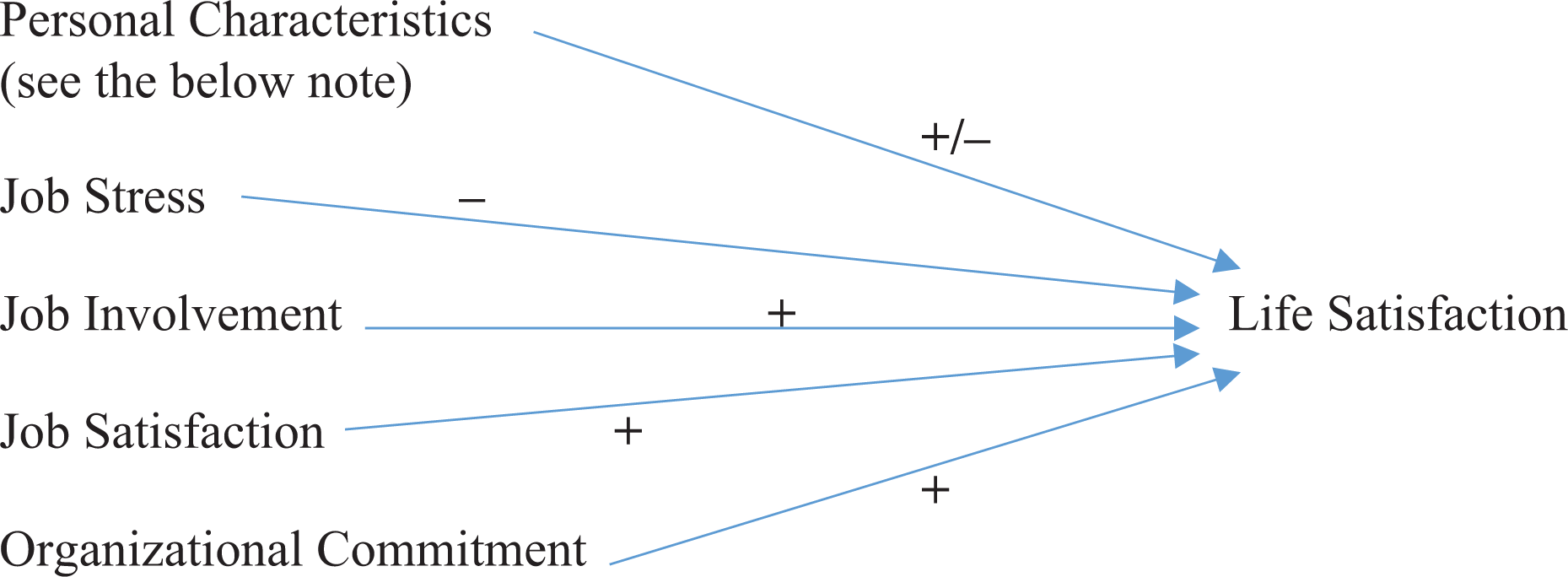
Proposed multivariate analysis for Indian police life satisfaction.
Brief overview of Indian and Haryana police
To aid in placing the current study and results into context, a brief overview of Indian policing is presented. Although owing much of its structure to British colonial rule, the current system of policing is based on the Indian Police Service’s approach (Shah, 1999). Although the federal government maintains several central law enforcement agencies (e.g., border security force and central bureau of investigations) and certain large cities maintain a metropolitan police force, the bulk of the responsibility for Indian policing is carried out by India’s 28 state police agencies, and the seven union territories also have their own police forces, which are run by the union governments (Raghavan, 1999). The federal government recruits and appoints top police administrators to run the state, territories, and federal law enforcement agencies. All senior-level command officers must be college graduates, pass a civil service exam, and meet national training requirements (Shah, 1999; Singh, 2002). The state governments have a significant amount of control through the hiring and training of officers (Singh, 2002). Each state police agency is headed by a director general of police who is responsible for the operation and control of the police in the state. The state police agency is further divided into districts, with a police force under the direction of a superintendent of police. Districts are divided into sub-districts, sub-districts are broken down into police circles, and within police circles are police stations. Larger cities operate a metropolitan police force, answering to a director general (Lambert et al., 2015b; Raghavan, 1999). The majority of Indian police officers occupy the position of constable, which is the entry level for most officers and is a line position.
The police are the most visible part of the criminal justice system in India (Verma, 1999). Policing in India is a demanding career. Kaur et al. (2013) indicated that law enforcement is one of the most challenging occupations in India. Officers are not unionized and most Indian police officers work more than ten hours on their scheduled days and can be called into work whenever the need arises (Ranta and Sud, 2008). Public–community relations for the police in Indian can be strained at times. There are religious and caste public disturbances, which the police try to end. Some Indian citizens feel that the police try to meet the needs of the wealthy and powerful more so than the needs of the general public (Nalla and Madan, 2011). As with many nations, the challenges faced by a typical Indian police officer are many. As such, it is important to explore how job stress, job involvement, job satisfaction, and organizational commitment may affect the life satisfaction of Indian police officers.
The data for the current study was obtained from officers assigned to the Sonipat and Rohtak districts the State of Haryana police force. The State of Haryana has an area of 17,070 square miles and a population of 25.5 million. Haryana is adjacent to the national capital of New Delhi, and it is considered a relatively well-developed state (Census2011.co.in, 2015). The population density is 573 per square kilometer (i.e., 1,485 per square mile), which is higher than the Indian national average of 382 individuals per square kilometer. Until 2007, the Haryana police worked under the Indian Police Act of 1861. In 2007, the State of Haryana passed the Haryana Police Act, which provided new regulations and management to meet the needs of the public better. Based on this new law, the Haryana police have embarked on several innovative professional programs. The motto of the Haryana police is sewa suraksha sahyog (service, security, and cooperation). For example, to reduce corruption and to facilitate the delivery of services and interactions with the public, the Haryana police created an online portal called Harsamay, where 31 citizen services, including complaint registration, missing property reports, etc. are available (Sehrawat, 2017). The Haryana police force employs approximately 57,000 officers and is divided into 21 districts. Approximately 1500 officers are assigned to the Rohtak district and another 1500 officers are assigned to the Sonipat district. There are about 2.5 million people living in these two districts. The Sonipat and Rohtak districts are each divided into 21 police stations (Haryana Police, 2016).
Method
Officers in the Rohtak and Sonipat districts of Haryana State of India were surveyed. A systematic sampling design was used to collect data based on a personnel roster, where every third office received a study packet. This packet contained an informed consent form, a cover letter, the survey, and a return envelope. The back-translation method was used, wherein survey materials were translated into Hindi, the national language of India, and then a second scholar translated the survey back into English to determine whether there were any translation problems. The cover letter explained the study, indicated that participation was voluntary, that respondents could stop taking the survey at any time or could skip any question, noted that responses would be anonymous and kept confidential, and provided directions for return of the survey. Officers were allowed to take the survey at a time and location of their own selection. Completed surveys were returned in an unmarked envelope included in the survey packet. Of the 1000 packets distributed, 827 surveys were returned, which was a response rate of approximately 83%.
For the current study, the dependent variable was life satisfaction. The independent variables were job stress, job involvement, job satisfaction, affective organizational commitment and personal characteristics of age, gender, position, district, tenure, educational status, marital status, Scheduled caste, and Backward caste. These personal characteristics were included more as control variables than explanatory variables for two reasons. First, these variables can influence the dependent variable of life satisfaction and may play a role in shaping the level of job stress, job involvement, job satisfaction, and organizational commitment (Erdogan et al., 2012; Johnson, 2012, 2015; Lambert et al., 2005, 2018; Pelfrey, 2004; Qureshi et al., 2019). The effects of these personal characteristics can be controlled for in the regression multivariate analysis used in the current study, so the effects of job stress, job involvement, job satisfaction, and organizational commitment on Indian police officer life satisfaction can be estimated independent of the possible shared effects with the personal characteristics (Berry, 1993; Tabachnick and Fidell, 2013). Second, these personal characteristics were often included in past research on police officers (Brough and Frame, 2004; Johnson, 2012, 2015; Lambert et al., 2018; Martinussen et al., 2007; Pelfrey, 2004; Qureshi et al., 2019). The two measures for caste were included because caste is a social force in India (Nalla and Madan, 2011). Caste is a form of social organization in India, although its hold is now weakening. It is similar to race/ethnicity in Western nations, in that it sometimes determines how people from one group treat members of other groups. Many times, the caste identity of an individual becomes significant in social interactions. In this sense, caste may be treated roughly equivalent to the concept of race, although race is more associated with the color of skin while caste is associated with being born in a specific social group. The Scheduled caste occupy the lowest social status in the hierarchical caste division of Indian society. They have been given constitutional protection from discrimination and preference in jobs to improve their socio-economic status. The Backward caste comprise the next group who are also economically and socially disadvantaged, and the General category includes all other castes.
The mean age of those who responded was 36.53 years, with a standard deviation of 9.46. Approximately 86% of surveyed officers were men, and 69% were line officers (i.e., held the rank of constable). Approximately 50% of the participants were assigned to work in the Rohtak district, and the other half were assigned to the Sonipat district. The mean tenure in the current position was 2.44 years, with a standard deviation of 3.05. In terms of highest educational level, 23% had a matric degree (grade 10), 35% had a senior degree (grade 12), 35% had an undergraduate college degree, and 7% had a graduate or professional degree. About 88% were married. Finally, 20% of the responding officers indicated they were part of the Scheduled caste, 33% indicated they were part of the Backward caste, and 47% indicated that they were part of the General castes. The responding officers appeared to be representative to the overall complement of officers in terms of age, gender, position, and district. Information on the other characteristics could not obtained.
Variables
Dependent variable
The dependent variable was life satisfaction, and it was measured using four items adapted from Diener et al. (1985). These items are presented in the Appendix, along with their response options. The items had a Cronbach’s alpha value (a measure for internal reliability) of .80. Exploratory factor analysis was performed using principal axis factoring with oblimin rotation (Gorsuch, 1983). The items loaded on a single factor, indicating unidimensionality of the items. In addition, all the factor loading scores were .49 or higher, which is above the usual cutoff score of .40. The responses to the four items were summed to form an additive index for the life satisfaction variable.
Independent variables
The four independent variables of focus in this study were job stress, job involvement, job satisfaction, and affective organizational commitment. The items used to measure these latent concepts and the response options for the items are presented in the appendix. Job stress was measured using four items adapted from Crank et al. (1995). Job involvement was measured using four items adapted from Kanungo (1982a). Job satisfaction was measured by three items adapted from Brayfield and Rothe (1951). Affective organizational commitment was measured using four items adapted from Mowday et al. (1982). The job stress items had a Cronbach’s alpha of .63. While this alpha value is above the usual cutoff of .60 (Gronlund, 1981), it was low. The job involvement items had an internal reliability Cronbach’s alpha of .63 and job satisfaction had a Cronbach’s alpha of .62, both of which are low. Affective organizational commitment had a Cronbach’s alpha value of .68. The low alpha values could be the result of surveying Indian police officers or of measuring these latent concepts with only a few items. Using few items was the result of limiting the length of the survey that could be administered. The low Cronbach’s alpha values raised concern about the reliability and validity of these items. As such, factory analysis was conducted. For job stress, job involvement, job satisfaction, and organizational commitment items, exploratory factor analysis was performed using principal axis factoring with oblimin rotation (Gorsuch, 1983). The items loaded on the appropriate factor, indicating the unidimensionality of the items and providing support for construct validity of these latent concepts. In addition, all the factor loading scores were .57 or higher, which is above the usual cutoff score of .40. The items for each concepts were summed to form a variable for that particular concept. As noted earlier, the personal characteristics of age, gender, position, district, tenure, educational level, marital status, and caste were included in the current study more as control than explanatory variables because they can influence life satisfaction and job stress, job involvement, job satisfaction, and organizational commitment. See Table 1 for how these variables were coded.
Results
The descriptive statistics for the study variables are presented in Table 1. There appeared to be significant variation in the dependent and independent variables (i.e., none were constants). The data conformed approximately to a normal distribution based on various statistical tests. Likewise, the median and mean values for the variables are similar to one another, also suggesting a normal distribution. The average participant was a married man in his mid-30s who held the position of constable and who did not have a college degree. The average tenure in the position was between 1 and 2 years. Many of the participants (47%) marked being in the General caste. The participants were evenly split between the two districts of Rohtak and Sonipat.
Descriptive statistics.
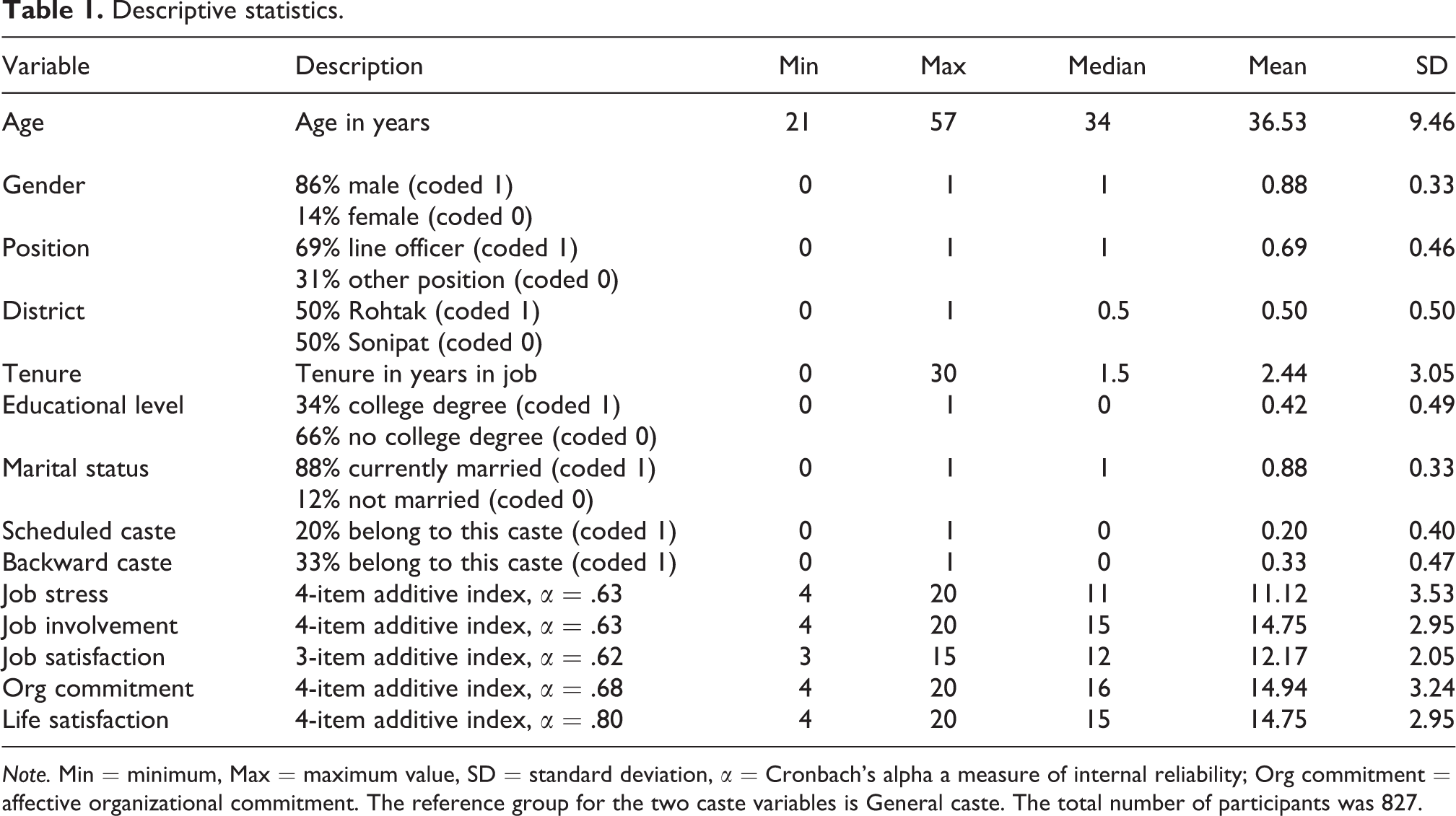
Note. Min = minimum, Max = maximum value, SD = standard deviation, α = Cronbach’s alpha a measure of internal reliability; Org commitment = affective organizational commitment. The reference group for the two caste variables is General caste. The total number of participants was 827.
A correlaion matrix of the study variables is presented in Table 2. All variables except educational level and caste had significant correlations with life satisfaction. Increases in age, tenure, job involvement, job satisfaction, and organizational commitment were associated with higher satisfaction with life. Female and married officers reported higher life satisfaction than male or unmarried officers. Officers holding the position of constable in general reported lower life satisfaction. Higher job stress was associated with lower values on the dependent variable. The district variable had a negative correlation, indicating officers assigned to the Rohtak district had lower life satisfaction compared with that reported by officers assigned to the Sonipat district. Job stress, job involvement, job satisfaction, and organizational commitment had larger correlations compared with the control variables.
Correlations for variables.
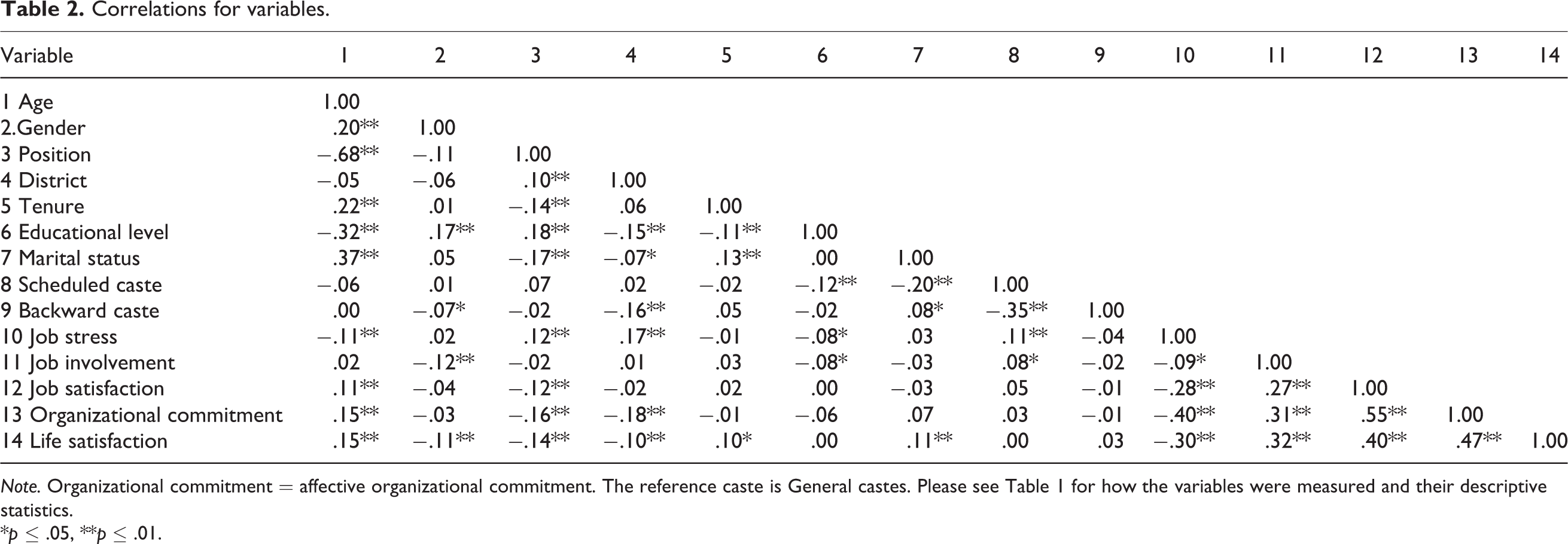
Note. Organizational commitment = affective organizational commitment. The reference caste is General castes. Please see Table 1 for how the variables were measured and their descriptive statistics.
*p ≤ .05, **p ≤ .01.
An OLS regression equation was estimated with life satisfaction as the dependent variable and age, gender, position, district, tenure, educational level, marital status, job stress, job involvement, job satisfaction, and organizational commitment as the independent variables. The results are reported in Table 3. Multicollinearity (i.e., when two or more independent variables share too much overlap) was not an issue. Multicollinearity is seen as a problem when variance inflation factor scores (VIF) exceed 5 (Tabachnick and Fidell, 2013). As indicated in Table 3, none of the VIF scores were higher than 2.49. Outliers, influential cases, normality, linearity and homoscedasticity of residuals, and independence of errors (all of which can affect the regression results) were tested and were not issues (Berry, 1993; Tabachnick and Fidell, 2013).
The R-squared value for the regression equation was .33, which means the independent variables as a group accounted for about 33% of the observed variance in the life satisfaction variable. Age, position, educational level, and caste each had nonsignificant effects, whereas gender, district, tenure, marital status, job stress, job involvement, job satisfaction, and organizational commitment had statistically significant effects. Officers with higher tenure reported higher satisfaction with life. Married officers generally reported greater life satisfaction. Male officers and officers working in the Rohtak district reported lower life satisfaction. Among the workplace factors, increases in job stress were associated with lower life satisfaction. On the other hand, higher levels of job involvement, job satisfaction, and organizational commitment were associated with greater satisfaction with life. Based on the standardized regression coefficients (β-values in Table 3), the magnitude of effects can be arranged by absolute value. Organizational commitment had the largest effect, followed by job involvement and job satisfaction.
OLS regression results for life satisfaction as the dependent variable.
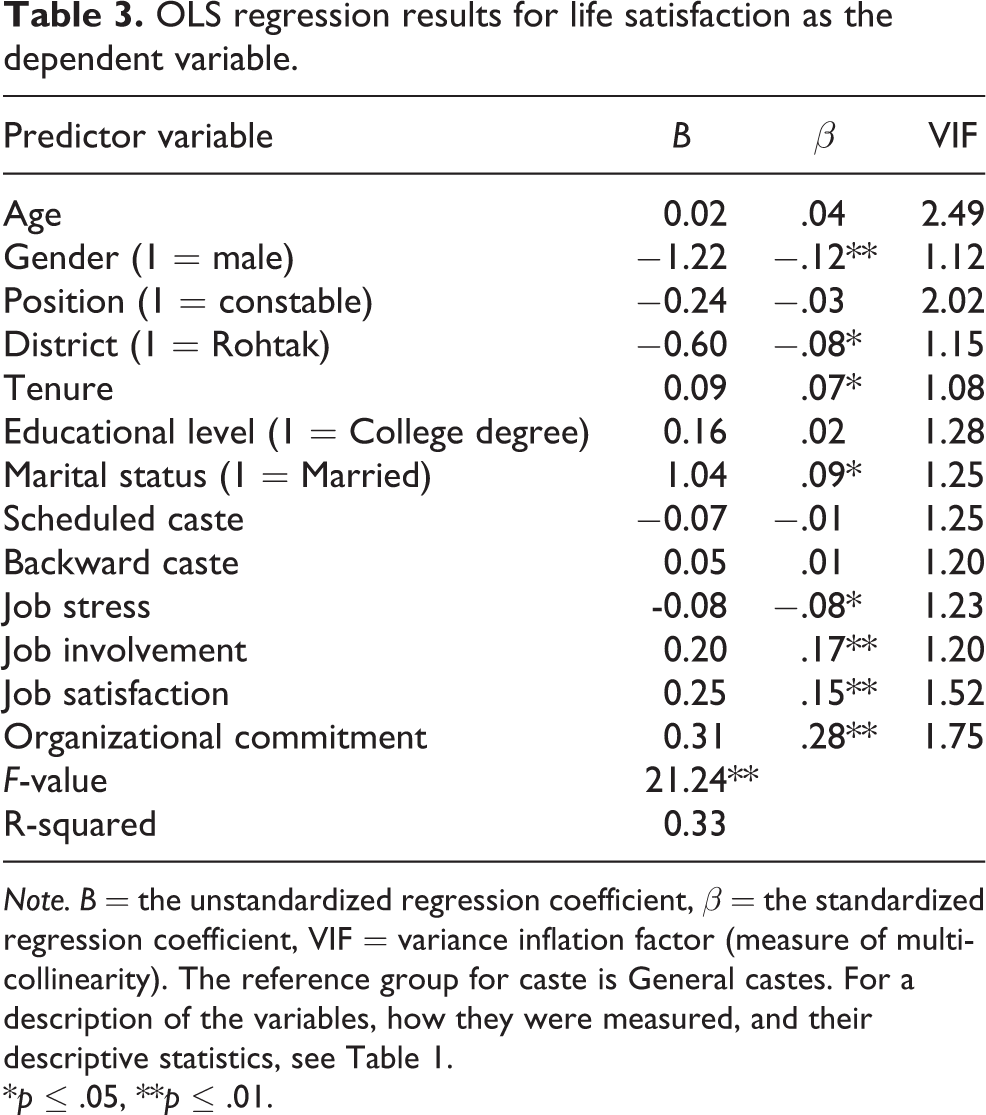
Note. B = the unstandardized regression coefficient, β = the standardized regression coefficient, VIF = variance inflation factor (measure of multicollinearity). The reference group for caste is General castes. For a description of the variables, how they were measured, and their descriptive statistics, see Table 1.
*p ≤ .05, **p ≤ .01.
Discussion and conclusion
Results from this exploratory study support the spillover theory. All four hypotheses were supported. Specifically, job stress (Hypothesis 1) had a negative effect on the life satisfaction of the surveyed police officers, whereas job involvement (Hypothesis 2), job satisfaction (Hypothesis 3), and organizational commitment (Hypothesis 4) had positive effects. The current findings suggest what happens at work can and does influence the life satisfaction of police officers, an occupational group not studied in terms of this outcome until now. Because officers spend a great deal of time at work, what happens to them at work spills over to their overall life. Job stress, job involvement, job satisfaction, and organizational commitment are salient major workplace variables. These major variables were expected to play a role in the overall life satisfaction of officers. Job stress is not a pleasant experience, especially over time. Feeling psychologically strained and tense from the job probably will not end when the shift is done. This negative experience likely follows the officer home and detracts from home life and life in general. In the end, our results support the contention that job stress detracts from the level of overall life satisfaction for officers.
Job involvement, on the other hand, appears to increase officer life satisfaction. Having a connection with the job is likely to result in a positive psychological sense, which in turn results in greater happiness with life. Being a police officer provides security for the community. Working as a police officer could provide a sense of purpose, which allows for more satisfaction with life overall. Having a connection to this type of job may give Indian officers a sense of pride, which allows them to feel better about themselves. Further, besides the direct positive psychological state resulting from this workplace variable, job involvement may help officers be successful at work. High job involvement tends to result in greater motivation, greater work engagement, and being more productive at work (Chen and Chiu, 2009). Being more successful at work because of higher job involvement could allow officers to feel psychologically better about themselves, and they might be rewarded by the organization for their higher work performance. In the end, life satisfaction increases. By contrast, having little connection to a job is likely to be a trying experience, resulting in psychological strain, ultimately detracting from satisfaction with life.
As hypothesized, job satisfaction had a significant positive effect on life satisfaction among the studied police officers. In other words, when Indian officers are satisfied with their jobs, they are happier with their overall lives. Work is more than just providing funds to meet basic needs: it gives people a sense of purpose and accomplishment. As Terkel (1974: XI) noted, work for many people provides “daily meaning as well as daily bread”. Job satisfaction is an emotional response towards the job. As noted earlier, it refers to the degree of liking or disliking one’s job (Spector, 1996). These psychological feelings toward the job spill over, affecting overall level of satisfaction with life.
As postulated, affective organizational commitment had positive effects of officer life satisfaction. As noted earlier, this form of commitment is a psychological bond to the overall organization and forms due to being treated positively by the organization (Allen and Meyer, 1990; Mowday et al., 1982). Positive organizational treatment allows the officer to have positive feelings about the organization, which spill over, resulting in feeling better about life. In addition, having a connection with the police agency likely results in officers feeling they made a good decision, which allows them to feel better about themselves. Moreover, organizational commitment’s effect on the dependent variable was the largest. This indicates that this workplace variable plays a meaningful role in the lives of officers. Work is a very important domain for most people. Officers who have a stronger psychological connection with the organization likely feel a greater sense of purpose about what they are doing, which, in the end, results in overall positive feelings and leads to seeing life in a more favorable light.
Among the eight control variables, three had significant associations with life satisfaction in the multivariate regression analysis. Specifically, gender, district, tenure, and marital status each had significant relationships with the dependent variable. Female officers in general reported higher life satisfaction than male officers. Policing in India has been a male-dominated occupation. Women had to fight for the right to be police officers, which has resulted in some women being hired as officers (14% of respondents). These female officers may feel a sense of accomplishment by joining an occupation once closed to them. In terms of district, Rohtak officers reported lower life satisfaction. Work demands could explain this difference. The Rohtak district is the hometown of the chief minister of the Haryana (i.e., position is similar to that of a U.S. state governor), which requires more security work. Additionally, protests occur more frequently in Rohtak. Tenure had a positive relationship, which means more time in the job resulted in greater life satisfaction. Those who stay longer may do so because they like what they are doing. Married officers, on average, reported higher life satisfaction. This is consistent with what has been found for other occupations (Erdogan et al., 2012). Is probable that being married provides social support to help deal with life’s challenges. Further, being married is socially valued in India. The control variables of age, position, educational level, and caste did not have significant associations with life satisfaction in the regression equation. The workplace variables accounted for far more variance in the life satisfaction measure than did the control variables (R 2 .29 versus .07, based on regression equations run but not reported in the Results section). This is good news for police administrators interested in increasing life satisfaction. Some of the control variables, such as gender and age, are beyond the control of police administrators and should not be manipulated. Reducing job stress and improving job involvement, job satisfaction, and organizational commitment are more often within the ability of administrators to improve.
If the current results are replicated, police administrators should undertake interventions to decrease officers’ job stress and increase their job involvement, job satisfaction, and affective commitment. Efforts are needed to reduce the level of stress experienced from the job. Although being a police officer can be a demanding and trying experience, the literature suggests that workplace variables play a role in job stress among officers. A lack of administrative support, poor organizational communication, harassment, role ambiguity, poor supervision, poor/inadequate training, role overload, lack of input in decision-making, and a lack of organizational fairness have been reported to result in job stress for officers (Gershon et al., 2009; He et al., 2005; Jaramillo et al., 2005; McCarty and Skogan, 2013; Morash et al., 2006; Noblet et al., 2009; Shane, 2010; Tyagi and Dhar, 2014). Efforts to reduce workplace variables that contribute to job stress are needed. Additionally, scholars need to undertake new research on how workplace variables increase or reduce job stress.
Changes should be made increase job involvement. Research findings indicate that quality supervision, job variety, formalization, instrumental communication, and quality training increase involvement for officers, whereas role overload, role ambiguity, role conflict, and role underload decreases involvement (Lambert et al., 2015b, 2017; Qureshi et al., 2019; Redman and Snape, 2006). Scholars also need to continue to explore how workplace variables influence officer job involvement, including identifying new ones.
Finally, changes to improve both officer job satisfaction and organizational commitment should be undertaken. Job autonomy, quality supervision, job variety, formalization, supervisory support, organizational support, quality training, instrumental communication, and organizational fairness have been reported to result in greater officer job satisfaction and commitment (Allisey et al., 2014; Farmer et al., 2003; Jaramillo et al., 2005; Lambert et al., 2015b, 2017; Miller et al., 2009; Qureshi et al., 2017; Zhao et al., 1999). Likewise, scholars need to continue to study what workplace variables raise or lower satisfaction and commitment, as well as what interventions make a difference.
As with many studies, the current exploratory study had limitations. It was a single study of Indian police officers. Additional research is needed to confirm the results not only among officers in other Indian states but police organizations across nations. What is not known is whether the current findings can be replicated or will be found in other nations. The results could be situational and contextual, and might vary for other police agencies in India and elsewhere. Future research needs to attempt to raise the Cronbach alpha values for job stress, job involvement, job satisfaction, and organizational commitment. The Cronbach alpha values for these latent concepts, although above the usual cutoff value, were low, and, as such, raise the issue about reliability and validity. Future studies should measure these concepts with more items to determine whether this raises the reliability level. Similarly, future research should use confirmatory factor analysis to see if the reliability and validity of the measures for job stress, job involvement, job satisfaction, and organizational commitment are confirmed. The current study used exploratory factor analysis, but confirmatory factor analysis may provide more information about the low Cronbach alpha values and would provide more information about the fit of the data to the model proposed in Figure 1.
Other workplace variables should be examined to determine whether they play a role in shaping life satisfaction. The latent concepts of life satisfaction, job stress, job involvement, job satisfaction, and affective commitment were measured with three or four items. Future research should measure these concepts with additional items. Additionally, the Cronbach’s alpha values of these measures need to be raised. The R 2 value in the multivariate regression analysis was .33, which means that 67% of the variance in the life satisfaction index was accounted for by variables other than the independent variables in the current study. Studies are needed to determine what other workplace variables help shape the life satisfaction of police officers. In addition to other work variables, future studies should explore how other aspects of life, such as social relationships, financial resources, family interactions, and health, contribute to officer satisfaction with life. While grounded in theory from the literature, the current study used a cross-sectional design. Without longitudinal data, it is not empirically possible to show the causal direction of the effects observed. In addition, future research that examines the effects of life satisfactions on outcomes, such as turnover intent, voluntary turnover, burnout, absenteeism, work performance, and organizational citizenship behaviors (i.e., prosocial behavior of going beyond what is expected at work) is needed. With future studies, a better understanding of police officer life satisfaction will be gained.
In closing, over the past several decades, there has been a movement to make workplaces more person-oriented, which includes being concerned about workers’ life satisfaction (Erdogan et al., 2012). Although past research has examined life satisfaction among different occupational groups, policing has largely been ignored. Policing is a unique occupation, and it affects officers. Officers are an important and expensive resource for police organizations. Protecting this salient resource is critical. The life satisfaction of officers is vital not only to the individual officers, but to the overall police agency and the community. Erdogan et al. (2012: 33) pointed out that “life satisfaction is an important outcome to consider alongside other key management variables such as job attitudes and behaviors. In addition, given that life satisfaction is related to important outcomes, comprehensive research should consider life satisfaction as an essential factor in organizational research”. Donovan and Halpern (2002: 41) noted that “a greater knowledge of the causes of life satisfaction holds up a mirror in which we can see ourselves better”. The current findings add to the contention that workplace variables spill over, affecting the quality of life of officers, at least the Indian law enforcement personnel studied here. Specifically, job stress had a negative effect on life satisfaction, and job involvement, job satisfaction, and affective organizational commitment had positive effects. Police administrators need to be aware of life satisfaction and how to increase it. Officers matter, including the quality of their overall lives. Far more research among police officers in other nations is needed to determine whether these workplace variables have significant effects before it can be declared that these variables and other workplace variables have universal spillover effects on life satisfaction. At the very least, we hope this study will spark interest in researching the life satisfaction of officers in nations across the world.
Footnotes
Appendix
Acknowledgements
The authors thank the editor and anonymous reviewers for their comments and suggestions. The authors also thank Janet Lambert for editing and proofreading the paper.
Declaration of conflicting interests
The author(s) declared no potential conflicts of interest with respect to the research, authorship, and/or publication of this article.
Funding
The author(s) received no financial support for the research, authorship, and/or publication of this article.
