




Abstract
What does ‘Internet studies’ entail as a field of social science research? We aim to answer the question by mapping research themes, theorization, and methodology of Internet studies based on 27,000+ articles published in Social Sciences Citation Index and Arts & Humanities Citation Index journals over the last 10 years. In analyzing the articles, we adopt a ‘bottom-up’ approach – classifying keywords of the Internet studies without any a priori categorization – to identify the boundaries, major divisions, and basic elements of the field talis qualis. The research strategy results in a number of expected, as well as surprising, patterns and trends. Internet studies have evolved into a viable field that has witnessed a booming decade. The field is clustered around four primary research themes: e-Health, e-Business, e-Society, and Human–Technology Interactions. Two or three sub-themes with different research foci and methodologies emerge within each theme. The evolution of popular keywords in each sub-theme further shows that the field has become more concerned with intricate relationships between Internet use and specific behaviors/attitudes/effects; Internet usage patterns have increasingly attracted research attention; and network perspectives and approaches have become popular. Internet studies in the past decade have been modestly theorized. Established research methods (e.g., survey, experiment, and content analysis) still prevail in the Internet studies reviewed.
Internet studies involve a wide-ranging agenda of established disciplines, including psychology, sociology, marketing, and communication. To what extent have Internet studies been engaged in these disciplines? Has Internet studies become an independent field of study or is it still an interdisciplinary subject area encompassing other fields (Baym, 2005)? Some researchers have debated the disciplinary nature of Internet studies (e.g., Hunsinger, 2005; Jones, 2005; Shrum, 2005). However, before addressing the disciplinary status of Internet studies, we require systematic and comprehensive information about this emerging field.
Some efforts have been made to explore the state of art of Internet studies by focusing on research themes and popular keywords within different timeframes. Kim and Weaver (2002), Tomasello et al. (2010), and Rice and Fuller (2013) examined the characteristics of Internet studies within one subject area (communication). Cho and Khang (2006) expanded the horizon to include studies in three subject areas (i.e., communication, advertising, and marketing).
Both Kim and Weaver (2002) and Tomasello et al. (2010) found that Internet studies have become more and more visible in the communication discipline during the respective timeframes that they have examined. Kim and Weaver (2002) found that law and policy issues concerning the Internet and use of the Internet were prominent research topics in Internet studies. Tomasello et al. (2010) found that a small set of keyword terms (i.e., Internet, computer, digital, web/www, and online) was heavily used in the titles of new media research. More recently, Rice and Fuller (2013) have reviewed the major theoretical approaches for studying social aspects of the Internet. They found that the most frequent global themes in the study of communication and the Internet were social relations, followed by media implications/use and understanding, participation, societal, media attributes, and general theory frameworks. By analyzing Internet studies published in 15 journals in communication, marketing, and advertising between 1994 and 2003, Cho and Khang (2006) found that there was a definite pattern of increase in Internet studies in the examined timeframe. The authors observed that ‘Internet usage, perception, and attitude toward the Internet’ (Cho and Khang, 2006: 151) was the most popular topic.
Lievrouw et al. (2001) reviewed research carried out by members of Communication and Technology (CAT) Division of the International Communication Association and identified several issues in CAT research as prominent, such as access and equity issues, flows of information and communication content, and applications of CAT in social interaction and education. By analyzing the papers presented at the annual conferences of the Association of Internet Researchers (AoIR) in 2003 and 2004, Rice (2005) identified two dimensions in AoIR research themes: one is the traditional dimension from general social science research of ‘online/Internet/technology communication/community at individual and cultural level’ to specific areas ‘ranging from public/political/user to development/process/design/knowledge’ (Rice, 2005: 293), and the other is a movement from specific usage and content realms to more general and abstract processes and concepts.
These reviews thus provide some information for understanding the problems and opportunities in Internet studies. However, these studies focused on a pre-determined list of journals or associations, which has obscured the interdisciplinary nature of Internet studies and which may ‘lead to ordering, memory, familiarity, anchoring, or selection biases’ (Polites and Watson, 2009: 597). As none of the established disciplines or associations can claim that their field is ‘just one academic realm concerned with the Internet’ (Rice, 2005: 286), a ‘bottom-up’ approach (i.e., without any a priori categorization) is more appropriate for drawing a comprehensive knowledge map for Internet studies.
To fill this gap in the literature, the study aims to map the landscape of Internet studies without any pre-defined journals or disciplines. This is of particular value for delineating the boundaries of Internet studies in a larger context and presenting first-hand and quantitative understanding of the interactions between Internet studies and other established disciplines or other emerging fields. Specifically, the following research questions will be addressed:
RQ1: What is the state of art of Internet studies in general?
RQ2: What are the major themes in Internet studies?
RQ3: What are the popular keywords under each theme of Internet studies?
RQ4: How have these popular keywords evolved over time?
RQ5: What theoretical orientations and research methods are the most popular in Internet studies?
Methods
The Social Sciences Citation Index (SSCI) and Arts & Humanities Citation Index (A&HCI) of the Institute for Scientific Information (ISI) Web of Science have been used to retrieve the data for the study. The data were collected in September 2010. Six query words (i.e., Internet, web, cyberspace, cyber-space, online, and on-line) were used to search titles/abstracts/keywords of Internet-relevant articles from 2000 to 2009. Article language was limited to English, and document type was limited to scholarly journal articles. Document-level information from 27,340 relevant articles was retrieved, including author(s), article title, journal title, abstract, author keywords, and cited references.
Analytical strategy
Firstly, words in abstracts were analyzed to extract research themes from the retrieved Internet studies. Cluster analysis, which has been applied in business research (e.g., Sheppard, 1996) and educational research (e.g., Huberty et al., 2005), is adopted to analyze the abstracts’ words in order to assign retrieved articles into theme clusters. Articles in the same theme cluster are more similar to each other than to those in other theme clusters. Specifically, two-step cluster analysis (Zhang et al., 1996) had been employed to extract theme clusters from retrieved articles.
To identify popular keywords used in Internet studies, a text-mining approach (‘word co-occurrence network’ analysis) is adopted to examine which keywords are the most popular in Internet studies of the past decade. A network linkage between two keywords is created when they co-occur in a study. The more frequently a keyword co-occurs with other keywords, the more links the keyword has in the network, and the more popular the keyword is assumed to be in Internet studies. Due to the fact that different words can be used to describe the same concept, all words were standardized before processing (e.g., plural forms were standardized to their singular forms). The word co-occurrence network analysis was performed with Wordij 3.0 software (Danowski, 2009).
To explore the evolution of popular keywords in Internet studies, we examine the rise and fall of the use of selected authors’ keywords during two periods: 2000–2002 and 2007–2009. The occurring frequencies of keywords during the first three-year period (2000–2002) and the last three-year period (2007–2009) are summed as two composite scores. According to the change of rank order of the total word frequencies between the two periods, these keywords are classified into four categories: all-time favorites, rising stars, fading stars, and peripherals. 1 ‘All-time favorites’ refers to keywords that were in the list of the top 50 frequently used keywords and remained at the same rank percentiles during both periods; ‘rising stars’ refers to keywords whose rank orders moved up in 2007–2009; ‘fading stars’ refers to keywords that had moved down in rank order in 2007–2009; and ‘peripherals’ refers to keywords whose frequencies of appearance were not on the top 50 list in either period.
Findings
Overall patterns
To assess whether Internet studies have become a viable field in the social sciences, we first examine the sheer quantity of relevant research activities (measured by the number of publications). As reported earlier, we find 27,340 articles on Internet studies in SSCI and A&HCI journals from 2000 to 2009. Is the volume of research output sufficient for Internet studies to be considered as a field within the social sciences? We compare it with the number of publications in four long-standing fields (each represented by a central keyword of the respective field, including ‘politics’, ‘economy’, ‘society’, and ‘culture’) and two newer fields (‘globalization/globalisation’ and ‘environment’) in the same databases during the same period of time. As it turns out, ‘Internet’ ranks third among the seven fields, below ‘environment’ (38,719) and ‘society’ (27,357), but above ‘culture’ (26,937), ‘economy’ (20,596), ‘politics’ (20,165), and ‘globalization’ (7,457). A closer look at the changes within each of the seven fields reveals that ‘Internet’ has experienced the second-fastest rate of growth in the last decade, trailing behind ‘environment’ only, as shown in Figure 1. We recognize that these are crude measures, but they make clear that Internet studies have witnessed a booming first decade in the 21st century.
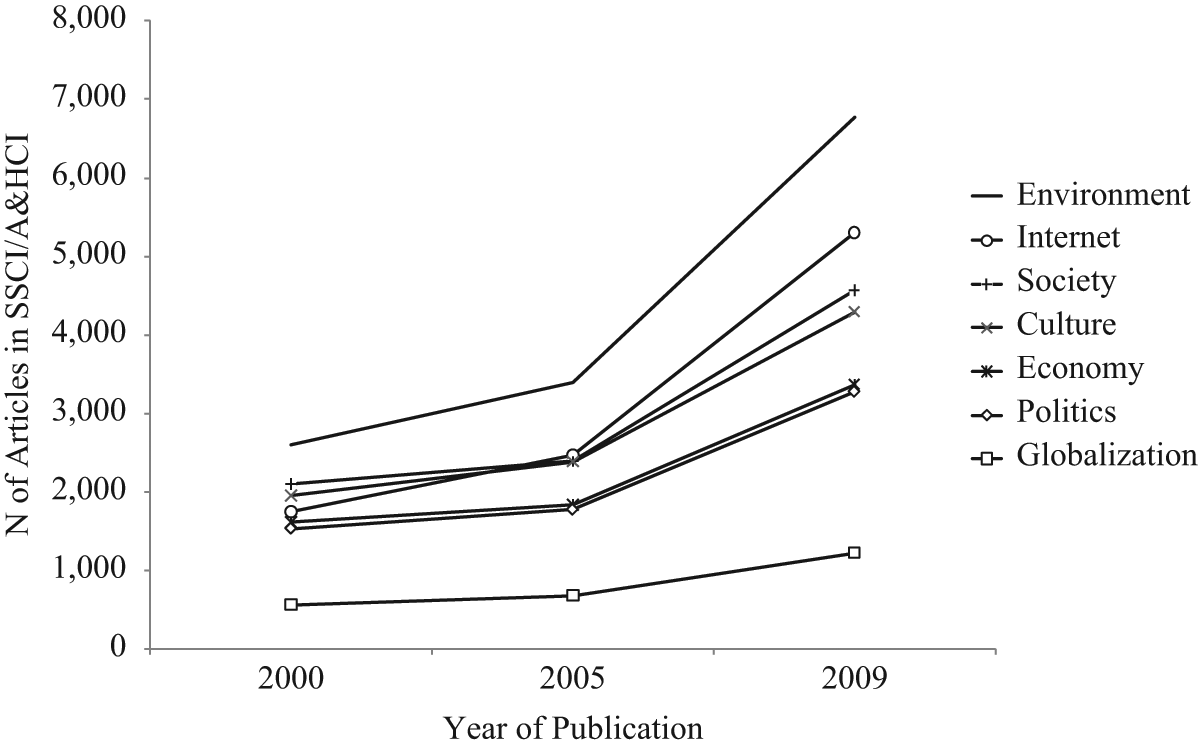
Number of publications in Social Sciences Citation Index (SSCI)/Arts & Humanities Citation Index (A&HCI) journals with seven central keywords in respective fields.
In the past decade, the Internet has transformed from the media-centric Web 1.0 to the user-centric Web 2.0. It is informative to explore how responsive Internet researchers have been to these technological advances. In our 10-year sample, the term ‘Web 2.0’ began to emerge in 2005. We therefore split the sample into two periods, 2000–2004 and 2005–2009, and then identified Web 2.0 studies by searching Web 2.0-relevant words (e.g., Facebook, Wiki, YouTube, and Twitter) in the titles/abstracts/keywords of the articles. It turns out that Internet researchers had paid attention to Web 2.0 applications even before the word ‘Web 2.0’ formally appeared in 2005. Of the sample, 5% of the studies in 2000–2004 dealt with Web 2.0 applications; the share rose to 9% in 2005–2009. Some earlier forms of Web 2.0 applications (e.g., search engines, social shopping, instant messaging, and peer-to-peer technologies) attracted scholarly interests in 2000–2004 and have continued to do so since 2005. Meanwhile, newer forms of Web 2.0 applications, such as blogging, social networking, wiki, and micro-blogging, have entered the radar screen of Internet researchers since 2005 and have become increasingly popular topics of Internet studies.
Research themes and popular keywords
Out of 27,340 articles of Internet studies located, 25,685 (94%) included an abstract, from which we extracted 23,486 unique (i.e., non-duplicated) words for classifying research themes. The use of particular words in the articles is highly uneven, with some popular words (e.g., ‘use’, ‘survey’, ‘system’, ‘support’, ‘need’, ‘design’, ‘student’, and ‘process’) appearing in many articles (up to 14,924), whereas other words (e.g., ‘technofetishism’ and ‘unboundedness’) being unique to only one article. This skewed distribution reflects a pattern (known as power-law distribution or Zipf’s law) similar to that in the use of language in daily life (Cancho and Sole, 2003; Zipf, 1949) and other academic writings (Chen et al., 2009; Zhang et al., 2010).
The finding that the use of words in Internet studies follows a power-law distribution suggests that we could classify the articles based on a small set of the most commonly used words without losing much information in the rest of the words. After discarding our search query words (i.e., ‘Internet’, ‘online’, ‘web’, ‘cyberspace’ and their variants) and non-discriminant words (e.g., ‘study’ and ‘paper’), we came up a list of the 1,885 most commonly found words. Each of the 1,885 common words is used in at least 50 articles. Put differently, all 25,685 articles contain at least one of the common words and 90% of the articles include at least 24 common words. We use the 1,885 words as clustering variables to assign the 25,685 studies into different theme clusters.
Two rounds of two-step cluster analysis were performed. In the first round, four primary theme clusters (e-Health, e-Business, 2 e-Society, 2 and HTIs) were produced, each accounting for 27%, 18%, 21%, and 34% of the sample, respectively. In the second round, a separate cluster analysis was performed within each primary cluster for further decomposition, generating eleven secondary clusters or sub-themes of smaller size and more homogenous content, including two within e-Health (‘Generic Applications’ and ‘Specific Behaviors’), three within e-Business (‘Acceptance Studies’, ‘Management and Internet’, and ‘Marketing and Internet’), three within e-Society (‘Social Interactions and Internet’, ‘Law/Policy and Internet’, and ‘Communication and Internet’), and three within HTIs (‘Psychological Processing and Internet’, ‘Web Search/e-Library’, and ‘e-Learning’). The structure and relative share of the four primary themes and eleven sub-themes are reported in Figure 2.
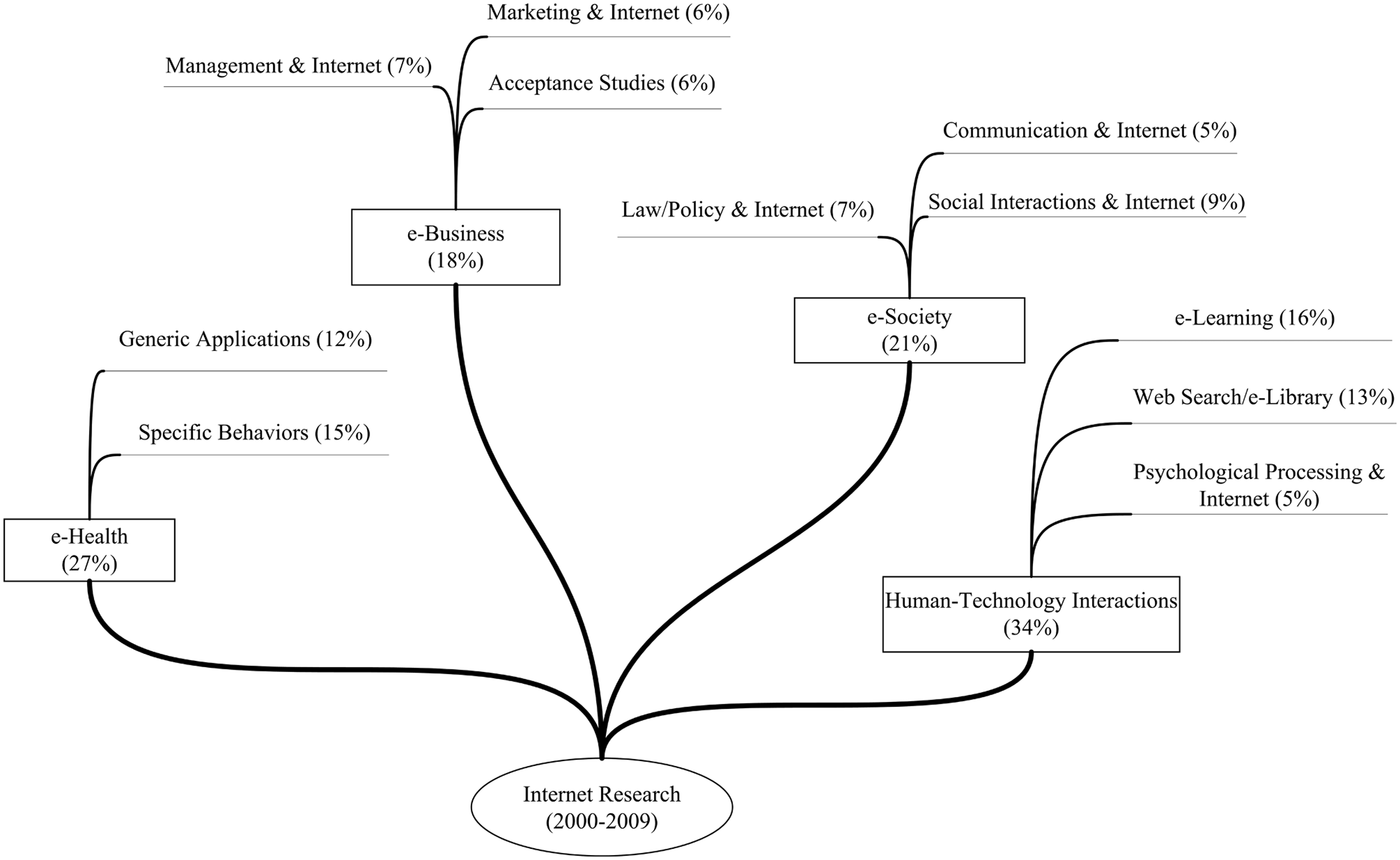
Family tree of research themes and sub-themes of Internet studies (N = 25,685).
While we will further elaborate in the following sections the research themes and sub-themes, two surprising observations are in order here. Firstly, mainstream social scientists probably will not expect e-Health to emerge as a unique and prominent theme; as such, a conventional literature review will not be able to detect its existence. Secondly, Internet studies are not divided along the disciplinary boundaries of social sciences, such as sociology, political science, economics, public administration, etc.; instead, the studies scatter around key issues such as interactions, communication, and regulation.
To discover popular keywords under each research sub-theme, a ‘co-occurrence network analysis’ was performed to extract useful knowledge structure from large collections of author’s keywords of journal articles (Cohen et al., 2005). After excluding 184 commonly used English words, 3 11,778 unique words were extracted from the keywords provided by the original authors of the retrieved articles. Eleven co-occurrence networks were constructed based on the paired presence of keywords in articles of 11 sub-themes. The characteristics of these 11 co-occurrence networks are summarized in Table 1.
Characteristics of keyword co-occurrence networks of 11 research sub-themes.

E-health
Of the top 20 most frequently occurring keywords in networks of two sub-themes in e-Health, seven keywords in ‘e-Health: Generic Applications’ (‘health’, ‘care’, ‘nursing’, ‘patient’, ‘cancer’, ‘medical’, and ‘nurse’) are about health; and six in ‘e-Health: Specific Behaviors’ (‘health’, ‘sexual’, ‘disorder’, ‘depression’, ‘intervention’, and ‘alcohol’) are related to health, after excluding Internet-relevant buzzwords (e.g., Internet, online, information, research, and technology) in the co-occurrence networks.
In the two sub-themes of e-Health, different research foci emerge when we examined the most frequently used keyword pairs in the two clusters. The research foci of ‘e-Health: Generic Applications’ include: (1) generic applications of the Internet in healthy contexts, such as health care, home nursing, public health, mental health, and community health; and (2) generic applications of the Internet to improve health services, care quality, and nursing quality and to provide education and information for patients. The research spotlight of ‘e-Health: Specific Behaviors’ is on the relationships between the Internet and specific behaviors among specific groups of individuals. Those behaviors include Internet addiction, sexual behavior, alcohol use, and smoking behavior. Specific groups of individuals constituting the research subjects include, but are not limited to, college students, adolescents, men, and HIV carriers.
E-business
After excluding the Internet-relevant buzzwords, keywords most frequently co-occurring with other keywords in networks of three sub-themes in e-Business are about business issues (‘e-commerce’, ‘consumer’, ‘service’, ‘management’, ‘market’, ‘marketing’, ‘chain’, ‘auction’, ‘price’, and ‘pricing’).
Out of three e-Business sub-themes, consumers’ acceptance of online shopping and the role of trust in consumers’ acceptance of e-commerce are two prominent research topics of ‘e-Business: Acceptance Studies’. Supply chain management in e-commerce and customer services in e-commerce are two popular topics in ‘e-Business: Management and Internet’. Studies in ‘e-Business: Marketing and Internet’ focus on auction/bidding in e-commerce and pricing mechanisms in e-commerce.
E-society
Keywords most frequently co-occurring with other keywords in networks of three sub-themes in e-Society are about social science issues (‘social’, ‘network’, ‘media’, ‘communication’, ‘community’, ‘public’, ‘identity’, ‘culture’, ‘policy’, and ‘development’).
Among three e-Society sub-themes, the popular keyword pairs of ‘e-Society: Social Interactions and Internet’ are online/virtual community, social capital/social community, social identity, and political participation. The popular keywords in ‘e-Society: Law/Policy and Internet’ include digital divide, governments’ policies towards the Internet, and information privacy and security. The popular topics of ‘e-Society: Communication and Internet’ are individuals’ communication behaviors on the Internet.
Human–Technology Interactions
The three sub-themes in HTIs emphasize applications of the Internet as a technological platform in three different settings. After excluding the Internet-relevant buzzwords, keywords most frequently co-occurring with other keywords in network of ‘HTI: Psychological Processing and Internet’ are those about psychological processing (‘memory’, ‘visual’, ‘comprehension’, ‘attention’, ‘perception’, and ‘ERP’); those keywords in the network of ‘HTI: Web Search/e-Library’ are terminologies in computer science and library science (‘search’, ‘retrieval’, ‘database’, ‘design’, ‘engine’, ‘library’, ‘document’, and ‘system’); and those keywords in the network of ‘HTI: e-Learning’ are concepts about learning (‘learning’, ‘education’, ‘e-learning’, ‘teaching’, ‘student’, ‘instruction’, and ‘teacher’).
Motor control, language processing, and memory processing are three popular keyword pairs in ‘HTI: Psychological Processing and Internet’. Information retrieval, digital library, and knowledge management are three prevalent topics in ‘HTI: Web Search/e-Library’. Web-based/distance learning and interactive/cooperative/collaborative learning are popular keywords in ‘HTI: e-Learning’.
Evolution of popular keywords
To examine the evolution of popular keywords in different sub-themes of Internet studies, we developed a typology to classify keywords of Internet studies into four categories: all-time favorites, rising stars, fading stars, and peripherals.
Internet studies in the 11 sub-themes have been dominated by a small set of all-time favorite keywords during 2000–2009, while most of the keywords are in the peripheral area. Moreover, different sub-themes vary in the sustainability of popular keywords. The percentages of all-time favorites in the three e-Business sub-themes are higher than those in the other eight sub-themes, implying that researchers have developed a set of sustainably shared interests in these three sub-themes. The percentages of rising stars and fading stars in ‘e-Society: Communication and Internet’ are substantially higher than those in other sub-themes, suggesting that research topics in this sub-theme come and go at a faster pace than those in other sub-themes.
Although these all-time favorites, rising stars, and fading stars are categories of discrete words, some general trends can be observed. Firstly, Internet studies have become more concerned with intricate relationships between the Internet and specific behaviors/attitudes/effects among specific research subjects. Secondly, although ‘acceptance studies’ remained a popular topic over the past decade, studies on Internet usage patterns have grown in popularity in recent years. Thirdly, contextualizing Internet studies in a network perspective is either an all-time practice or a promising trend for the future.
In ‘e-Health: Generic Applications’, researchers demonstrate consistent interest in applications of the Internet in health information acquisition and in nursing and care. Moreover, researchers have become increasingly interested in adoption of the Internet among specific groups of people (e.g., cancer patients, nurses, and children) and in specific healthy settings (e.g., training, therapy, and learning). In ‘e-Health: Specific Behaviors’, relationships between the Internet and sexual behavior, alcohol behavior, and smoking behavior have attracted more research attention over time, while Internet-related addiction phenomena has declined in popularity.
In three e-Business sub-themes, e-commerce was a shared all-time favorite keyword in the past decade. In ‘e-Business: Acceptance Studies’, trust, satisfaction, intention, loyalty, and decision are ‘rising star’ keywords. Interestingly, ‘use’ emerges as a rising star and ‘acceptance’ is a fading star in this sub-theme, suggesting that acceptance studies have entered into a post-acceptance era focusing more on consumers’ post-adoption behaviors. In ‘e-Business: Management and Internet’, network, mobile, satisfaction, and security have become popular keywords in recent years. In ‘e-Business: Marketing and Internet’, auction, pricing, competition, and bidding are four all-time favorite keywords, whereas game, channel, choice, advertising, and retailing became rising stars in 2000–2009.
In three e-Society sub-themes, ‘social’ is a shared all-time favorite keywords. In ‘e-Society: Social Interactions and Internet’, culture, globalization, sociology, and power have begun fading away, while network, identity, discourse, blog, news, politics, and relation have become more visible since 2007. In ‘e-Society: Law/Policy and Internet’, network and community, as well as security, divide, and risk issues about the Internet and e-government, have also grown in popularity; while regulation, development, and capital have lost their initial prevalence. In ‘e-Society: Communication and Internet’, law issues about the Internet have become less popular, along with journalism and e-commerce, while broadband, gambling, advertising, and game have grown in popularity over time.
In ‘HTI: Psychological Processing and Internet’, visual, prime, cognitive, ambiguity, acquisition, and semantics have become more visible in 2007–2009, while attention, performance, and response have begun to lose their prevalence. In ‘HTI: Web Search/e-Library’, researchers paid more attention to users and semantics/language/text in 2007–2009; while database, software, and navigation appear less and less frequently. In ‘HTI: e-Learning’, e-learning has become an ad hoc keyword among researchers, while evaluation and assessment are two all-time favorite keywords.
Theoretical orientations and research methods
Our final research question is that of the theoretical orientations and research methods in Internet studies. Firstly, we assess the theoretical orientation (or lack of it) of the studies based on the most frequently used references in Internet studies. 4 The results are reported in Table 2.
Theoretical orientation of Internet studies.
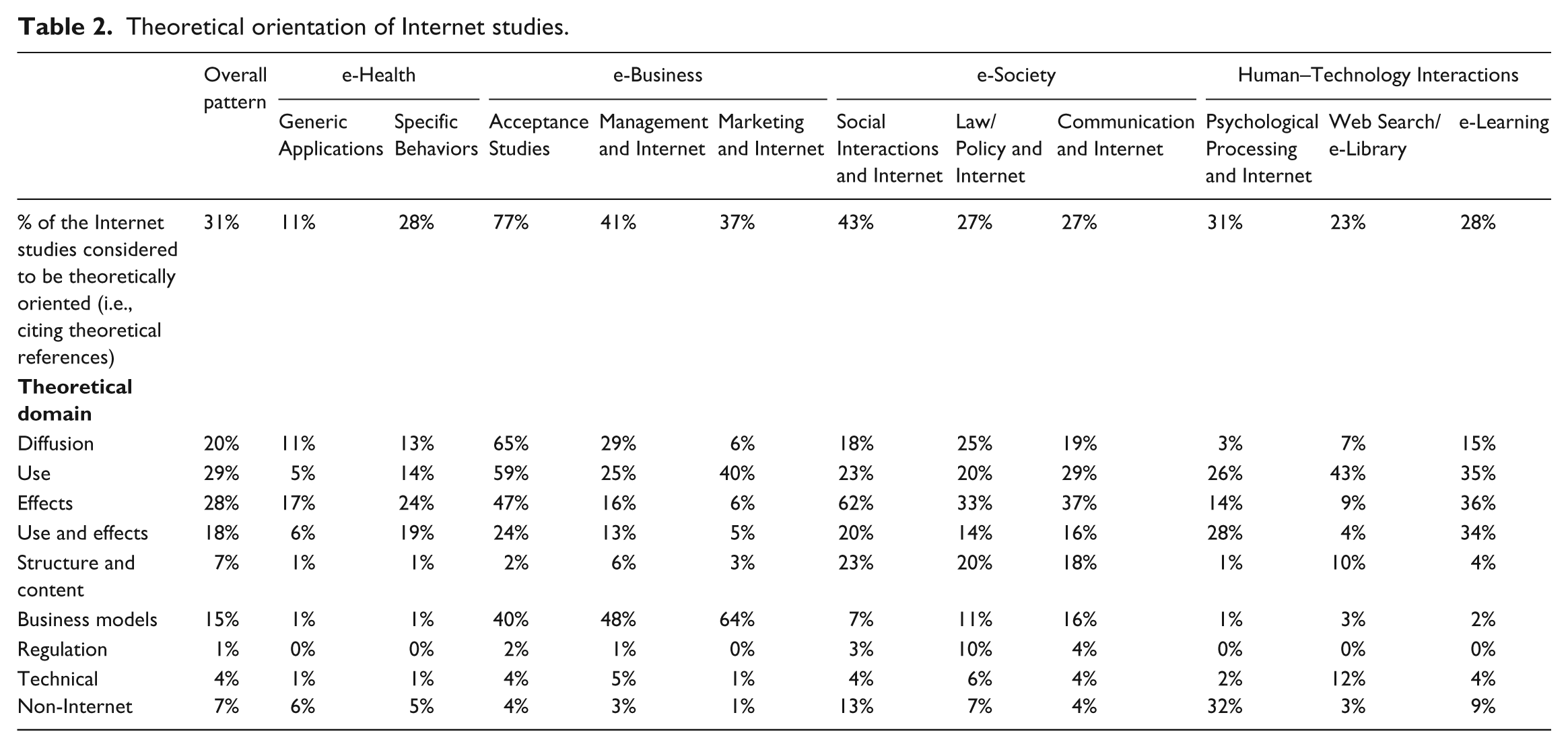
Only about 30% of Internet studies cite one or more theoretical references, suggesting that Internet studies in the past decade were modestly theorized. However, different sub-themes vary substantially. Studies in e-Business sub-themes are the most theoretically oriented, followed by those in e-Society and HTI. Internet studies in e-Health are the least theoretically driven.
Interestingly, a few theoretical domains are popular across the research sub-themes. As shown in Table 2, the studies in most of the sub-themes cite references in the domains of Diffusion, Use, and Effects. In addition, studies in e-Business are more likely to cite theories of Internet Business Models, the studies in e-Society are more likely to draw on theories of structure and content of the Internet, and the studies in ‘HTI: Web Search/e-Library’ are more likely to follow technical theories of the Internet.
To understand what methods were used in Internet studies in the past decade, we have randomly drawn a sub-sample from the data, with 100 studies from each of the 11 sub-themes, and then have coded manually the methods employed in these studies. The coding result is summarized in Table 3. Generally speaking, quantitative approach, employed by 59% of the sub-sample, dominated Internet studies in the past decade. Qualitative approach and other approaches (e.g., system evaluation, algorithm development, and policy discussions) account for 19% and 11%, respectively. Of quantitative methods, survey, experiment, and content analysis were the most frequently used, whereas case study and in-depth interviews/focus groups were the most commonly used qualitative methods. It is worth noting that 5% of the sub-samples did not involve any explicit method, quantitative or qualitative, as there is no empirical test or evaluation in the studies. Another 5% are reviews that assess the history, current status, or future of Internet-related issues.
Research methods of Internet studies.

The Internet studies in different sub-themes differ from each other in the diversity of research methods used. The studies in e-Society are the most heterogeneous in research methods, with no single method playing a clear-cut leading role in any of the sub-themes. On the other hand, four other sub-themes are highly homogenous, including ‘e-Health: Specific Behaviors’ and ‘e-Business: Acceptance Studies’, both of which heavily rely on surveys; ‘e-Business: Marketing and Internet’, which concentrates on econometrics, experiment, and field data; and ‘HTI: Psychological Processing and Internet’, which focuses on experiment research. Overall, the established social science research methods are well present among the Internet studies reviewed. However, newer methods of data collection, such as web content mining and user traffic records, are infrequently used to study the new medium.
Conclusion and discussion
To map the landscape of Internet studies, the study has adopted a ‘bottom-up’ approach (i.e., without any a priori categorization) to analyze social sciences journal articles on the Internet published in 2000–2009. The findings of the study advance our understanding of the research themes, theorization, and methodology of Internet studies in a comprehensive and quantitative way.
Firstly, Internet studies have developed into a substantial field in terms of number of studies published in the past decade, contrary to Herring’s (2004) speculations about a demise of Internet studies. Journal articles on the Internet have demonstrated a dramatic increase in the past decade, with an average growth rate of 13%. Secondly, Internet studies can be clustered around four primary research themes: e-Health, e-Business, e-Society, and HTIs. This finding seems to support the argument that ‘specific genres of Internet studies seem to fairly easily domesticate into existing university rubrics’ (Baron, 2005: 270). However, research sub-themes and popular keywords emerging within primary themes suggest that Internet studies cannot perfectly fit into established disciplines. For example, the second sub-theme of e-Health, which focuses on the relationship between the Internet and specific behaviors, can be a concern of sociologists, psychiatrists, communication scholars, and political scientists. Therefore, we argue that Internet studies are a melting pot that attracts researchers from different disciplines to transcend their disciplinary boundaries to develop new theoretical, methodological, and practical concerns.
Future trends in Internet studies: Usage studies and network perspectives
The study empirically confirms the taken-for-granted statement that adoption, use, and effects of the Internet have been investigated among individuals (i.e., either among the general public or among individuals with certain characteristics), organizations (e.g., commercial organizations, healthy organizations, and education institutions), and the society. Adoption has received the most extensive examination, which has developed into a unique sub-theme (e-Business: Acceptance Studies) in Internet studies. Effect studies are also extensively conducted in every sub-theme, which is consistent with the observation that ‘there is no social science discipline that does not study the effects of the Internet’ (Walther, 2010: 489).
The most under-developed field in the past decade is usage studies, which is expected to become more prominent in the near future, as shown by the occurrence of ‘use’ or ‘user’ as rising stars of keywords in several sub-themes of Internet studies. The increasing popularity of Web 2.0 studies will catalyze the development of usage studies in Internet studies. This pattern has recurred in media studies – the earliest publications just expressed concerns or enthusiasms for the new medium, whereas later studies became more realistic and focused less on effects and more on how the medium is used, because ‘technology is not independent of context (users, situation, economics, etc.) nor is it “neutral” in relation to those who design, implement, and use it’ (Fulk and Gould, 2009: 764). To better understand individuals’ behavioral pattern on the Internet, it is necessary to unpack or decompose general Internet use into use of specific features of the Internet (Baym, 2009; Fulk and Gould, 2009; Walther et al., 2005) and examine how Internet users interact with each other using different features (e.g., blogging, photo-sharing, video-sharing) offered at multiple platforms (e.g., Facebook, Twitter, YouTube, Amazon, Flickr). More importantly, researchers should go beyond technical features and uncover the underlying communicative processes these surface features of technologies serve, as this can help recognize ‘common cause with researchers working on broader domains and theories of communication’ (Parks, 2009: 725).
Another noticeable trend is the increasing popularity of a network perspective in Internet studies, which is well illustrated by the fact that network/community has become a rising star among keywords in six sub-themes of Internet studies. This trend embodies a research paradigm shift brought about by the Internet. In the past, agents using the Internet (i.e., individuals, groups, or organizations) were considered either ‘senders’ or ‘receivers’ of information. However, network perspective ‘entails both aspects of communication simultaneously according to communicators’ contexts, meanings, and purposes’ (Lievrouw et al., 2001: 287). The old criticism that network studies were ‘merely descriptive’ or ‘just methodological pieces’ is no longer tenable. Nowadays, network perspectives are a rich resource of explanations for social phenomena in a wide variety of disciplines (Borgatti et al., 2009). Network perspectives can be applied to examine the structure of the Internet itself (e.g., Zhu et al., 2008), and to examine the structure of communication (e.g., Panzarasa et al., 2009) and social networks (e.g., Chau and Xu, 2007) formed over the Internet. The Internet, which was originally characterized a network of networks (Berners-Lee, 1999), provides a platform to falsify, test, and/or develop different network theories/perspectives.
Theorization to be enhanced and methods to be innovated
Internet studies have been criticized as trailing the development of technologies without taking serious consideration of the theoretical implications of technical features (Walther et al., 2005). Our work empirically shows that (1) Internet studies in some sub-themes (e.g., e-Society: Communication and Internet) demonstrate less sustainability concerning popular keywords than Internet studies in other themes; (2) Internet studies over the past decade have generally been only modestly theorized; and (3) Internet studies in different sub-themes vary substantially in the extent of theorization.
It is understandable that researchers trace emerging Internet applications, because this can provide useful heuristic information for sophisticated studies. Nevertheless, a better response to rapid technological development is to draw on theories and models to identify and understand emerging technologies and their users (Scott, 2009). We agree with the argument of Rice and Fuller (2013) that Internet researchers should balance breadth and depth in theorization.
Firstly, in terms of breadth in theorization, researchers affiliated in one field should look outside to connect their studies with broader theoretical frameworks available in other fields. In our work, Internet studies in each sub-theme share theories concerning three domains (diffusion, use, and effects). These shared theoretical domains can help researchers interested in various research themes or topics to exchange views and perhaps collaborate with one another. However, the shared theoretical approaches need to be broadened to include domains beyond just diffusion–use–effects domains.
One possible and promising theoretical domain might be the structure and content of the Internet. The popularity of Web 2.0 and the semantic web has made issues of the structure and content of the Internet more prominent in Internet studies across different sub-themes. For example, how do consumers interact with each other by posting comments at eBay or Amazon? How do cancer patients interact with each other on Facebook to form a network, and what are the characteristics of the network? How do students in universities interact with professors via Twitter or Facebook? Theories in the domain of Structure and Content could help researchers address these interesting questions efficiently.
Secondly, with regard to the depth of theorization, researchers should try to identify the triggering or boundary conditions of theories (i.e., how, and under what conditions, cause–outcome relationships can take place) (Walther, 2010). Studies in three e-Business sub-themes did this. In these studies, some classical theories, such as the Theory of Reasoned Action (TRA; Ajzen and Fishbein, 1980) and the Theory of Planned Behavior (TPB; Ajzen, 1991), have often been applied as theoretical frameworks to address Internet-relevant issues. Nevertheless, these applications were not simply replications of the theories in the context of the Internet, but had ‘been stretched, reboundaried, and expanded’ (Walther et al., 2005: 651) to identify some niche variables to explain Internet-related behaviors or to discover some moderating variables that can condition their explanatory power. For example, some new factors have been incorporated into the TRA or Technology Acceptance Model (TAM, see Davis et al., 1989) to explain the adoption of the Internet or specific applications, such as playfulness (Moon and Kim, 2001), trust and perceived risk (Pavlou, 2003), and product involvement (Koufaris, 2003).
Although Internet studies are a domain ‘plagued by the notion that everything is new’ (Baym, 2009: 720), methods employed in Internet studies are not so innovative, and traditional social science research methods (i.e., survey, experiment, and content analysis) remain dominant. These traditional methods have played and will continue to play significant roles in Internet studies. However, in addition to these, the rise of user-centered studies and network perspectives in Internet studies calls for innovative research tools. Nowadays, the development of information technologies has made ‘terabytes of data describing minute-by-minute interactions and locations of entire populations of individuals’ (Lazer et al., 2009: 722) accessible to Internet researchers, allowing them to describe, explain, and predict Internet users’ online behavioral pattern in a more reliable manner. Web 2.0 technologies have provided golden opportunities to ‘capture, tag, and manifest high-resolution high-fidelity relational metadata’ (Contractor, 2009: 744), which can help us understand the structure of complex social networks and explore the mechanisms driving the evolution of those networks.
Limitations and future direction
The present study is limited by the quality of abstracts and keywords used to extract research themes and to identify popular keywords of Internet studies. We certainly cannot claim that abstracts and keywords of all journal articles included in the study perfectly convey the themes or foci of the articles concerned. However, the journals listed in the two databases (i.e., SSCI and AandHCI) are top journals in their subject categories. We are confident that the abstracts and keywords of articles published in these journals are of adequate quality for analysis.
Although four primary themes and eleven sub-themes emerge for Internet studies in the study, it is necessary to emphasize that these themes are not mutually exclusive, but in fact overlap each other. Our analysis of the evolution of popular keywords in each sub-theme provides some evidence for this type of inter-theme overlap. However, this evidence is far from adequate. It is theoretically significant to explore inter-theme interaction in Internet studies to examine how these research themes co-evolve with each other.
The study also suffers from the so-called ‘file drawer effect’. Although the study analyzes a large volume of Internet studies, it does not exhaust all. One neglected source is those studies presented at various conferences, of which only a small proportion is published in the journals listed in the two databases of ISI. It would be informative to compare research themes of Internet studies between conference proceedings and journal articles in the future.
Footnotes
Acknowledgements
We thank Hai Liang, Heng Lu, Jie Qin, Chengjun Wang, and Zhenzhen Wang for their advice on the study, Xiyue Cao for her assistance in data collection, and anonymous reviewers and editors of this special issue for their insightful comments.
Funding
This study has been funded by Strategic Research Grant (7002652) from City University of Hong Kong.