



Abstract
The communication model of the network society is not horizontal and flat. Different mediated constructions and centreing performances on new media platforms work towards integrating the symbolic environment, and towards representing the imagined mediated centres. Wikipedia aspires to become ‘the sum of all human knowledge’. Despite being built on anonymous contributions its underlying dynamic is a process of empirically traceable social construction of knowledge. A case study of English Wikipedia’s In the news (ITN) section will be presented. Through flexible mediated content production, based on the routinization of the process in policies and guidelines, Wikipedia constructs social centres through consensus-driven media rituals, based on the neutral point of view. Wikipedia has blurred the border between different types of knowledge in the process of ‘searching for a centre that holds’. It constantly negotiates the border between its internal collaboration and its external symbolic environment.
Keywords
Introduction
Duality is the human fate, and human existence will stay dual, bound to recognize itself simultaneously in two utterly dissimilar images of systemness and contingency. No monistic ‘solutions’, whether practical or theoretical, will either extirpate that duality from existence or theorize it out of the way. No selection, however wisely or cleverly made, will ever exhaust the infinity of possibilities that human ‘undetermination’ opens up. Each order is in the end a selection, but each selection just because it is a selection will therefore arouse anger and prompt rebellion, though rebellion against a selection can only be made in the name of another selection (Bauman, 1995: 143).
Bauman’s argument is focused on explaining the fluidity and ambivalence of human societies. In contemporary societies there are no solid centres that can hold them together, so Bauman explains. Contemporary media ecology has also become increasingly complex due to the proliferation of the internet and various new and social media. It has been claimed that the internet has fragmented (e.g. Dahlgren, 2005) the sphere of public communication with the multiplication of information sources and fragmentation of audiences and mediated realities. However, certain websites such as Facebook, YouTube and Wikipedia drive large amounts of user interest to their platforms and thus, in a certain way, act as mediated centres and nodes in the networking communication model. Wikipedia is unique in that context because of its goal of creating a free online encyclopaedia. That goal does not work in the direction of fragmentation and segmentation of public communication, but instead towards integrating the available knowledge from globally dispersed sources and through the work of globally dispersed editors. The content production process is also highly flexible, adaptable and consensus-driven.
This paper will focus on the self-organizing and self-governing online community whose goal is a desire for creating the ‘sum of all human knowledge’ 1 through user-generated content from anonymous users. In the pursuit of that goal, Wikipedia has become an important reference point in the search for online information of internet users worldwide. It reached a top ten website status in the US in 20072 and that position has been relatively stable until today within national contexts and globally as well. 3 The paper combines social constructivism with media and communication studies. The classical theory of Berger and Luckmann (1966) is used along with the media-specific theory of media rituals by Couldry (2003) to analyse Wikipedia as a mediated centre and an important node in the network society (Castells, 1996/2001, 2004, 2009) and networking communication model (Cardoso, 2006, 2008). The main goal of the article is to focus on the connection between the social system of a wiki project and its broader, networked environment. I argue that through a specific and novel form of mediated content production and consumption Wikipedia constructs societal centres, through performing consensus-driven media rituals.
The first section establishes the basic theoretical context for the relationship between knowledge, communication technologies and mediated realities. In the second section Couldry’s (2003) argument of the myth of the mediated centre is extended into the networking communication model by focusing on the role of nodes in the network. The third section deals with the social and technological basis for networked content production on Wikipedia and its basic content production policies. The fourth section introduces a case study of Wikipedia’s main page section, the In the news section. The fifth section deals with the position of Wikipedia in the web and its relation to search engines that act as gatekeepers and drivers of interest towards Wikipedia. The paper concludes by connecting different arguments that have influenced the position of Wikipedia as an important node of knowledge production, and consumption, in the network society. Wikipedians have blurred the border between encyclopaedic and popular knowledge, everyday knowledge and ephemeral news media knowledge in the process of ‘searching for a centre that holds’.
Knowledge, communication and mediated reality
Not all knowledge is necessarily scientific knowledge. What is common to all the different types of knowledge is that they are developed in social contexts and within different group and institutional dynamics. This is the core idea behind the sociology of knowledge sub-discipline. In its original form Karl Mannheim (1936/1985: 237) founded the sociology of knowledge as a sub-discipline that ‘seeks to analyse the relationship between knowledge and existence; as historical-sociological research it seeks to trace the forms which this relationship has taken in the intellectual development of mankind’. In other words, knowledge is closely connected to the social and historical context in which it comes into existence. With that premise he focused closely on ideology and utopia as two different forms of knowledge claims and definitions of reality. He analysed ideology in relation to the social position of those who make ideological claims. Ideology can be distinguished from utopia by the degree to which both ideas can be realized. Unlike Mannheim, whose analysis came close to class foundations of ideologies and utopias, Berger and Luckmann (1966) focus neither on class foundations of knowledge, nor on scientific, formal knowledge. They focus, instead, on the process of constructing reality and knowledge regardless of the social position of the actors involved. Everyday life and knowledge that is necessary for functioning in everyday life are what interest them the most. They define reality as a ‘quality appertaining to phenomena that we recognize as having a being independent of our own volition’ and knowledge as ‘the certainty that phenomena are real and that they possess specific characteristics’ (Berger and Luckmann, 1966: 13). Following that trail of thought, it is their opinion that sociology of knowledge ‘[m]ust concern itself with whatever passes for “knowledge” in a society, regardless of the ultimate validity or invalidity (by whatever criteria) of such “‘knowledge”’ (Berger and Luckmann, 1966: 15). Their social constructivism and sociological phenomenology has had substantial implications on research into everyday life.
However, newer directions in sociology of knowledge expanded these basic concepts beyond ideology, utopia and everyday life. Swidler and Arditi (1994: 306) argue that new sociology of knowledge approaches ‘examine how kinds of social organization make whole orderings of knowledge possible, rather than focusing in the first instance on the differing social locations and interests of individuals and groups’. New sociology of knowledge departs from studying contents of knowledge and focuses more on the forms and practices of knowing. In their overview Swidler and Arditi analysed and connected sometimes disparate fields and perspectives such as media, collective memory, authority and organization, power and practices, identity, boundaries and differences as well as informal knowledge. What is crucial for this paper, however, is their claim that ‘shifts in the media through which knowledge is transmitted, especially the transition to print, have dramatic effects on the entire organization of knowledge systems’ (Swidler and Arditi, 1994: 322). Media analysis is therefore one of the key aspects of the new sociology of knowledge.
Luhmann (1986) argues that communication is essential to sustaining and maintaining social systems. Communication consists of information, utterance and understanding. However, while face-to-face communication is essential as a foundation of society and social systems, different technologies alter the communication types and communicative possibilities of human beings. Altheide and Snow (Altheide and Snow, 1979: 16) argue that through adopting a media logic people have, developed a consciousness that affects how they perceive, define, and deal with their environment. What emerges as knowledge in contemporary society is, to a significant extent, the result of this media consciousness.
In a very general sense, the medium is ‘something that modifies communication’ on four different levels: as a technology, as a societal institution, as an organizational machine and way of setting content in a scene, and as a space of experience for a recipient (Krotz, 2009: 23).
Wikis are specific media with technological affordances that modify communication. In related research Cress and Kimmerle (2008) analysed Wikipedia by combing the social system theory of Luhmann with Piaget’s equilibration theory. The authors showed how the social system of a wiki interacts with the cognitive system of individual contributors in a process of knowledge construction. However, this study focuses on the connection between Wikipedia’s internal social system and its external environment in the process of knowledge construction.
Mediated centres and centreing performances in the network society
Manuel Castells (1996/2001) described the rise of the network society, and the rise of networks, as main organizational types of the Information Age. In the network society, which is a global society, the social structure is made up of networks powered by microelectronics-based information and communication technologies. By social structure Castells (2004: 3) understands the ‘organizational arrangements of human relations of production, consumption, reproduction, experience, and power expressed in meaningful communication coded by culture’. These networked social structures consist of interconnected nodes. Nodes increase their relevance by absorbing more relevant information, and processing it more efficiently. Networks also process flows or streams of information between nodes (Castells, 2004: 4). In his recent work Castells (2009) turned from the structural logic of the network society to analyse communication, and its relation to power struggles more closely. The power of communication comes from the ability to transform people’s minds and if that is the case, Castells (2009: 27, 28) claims that the media are key networks that reach people’s minds.
Cardoso (2006, 2008) argues that the media system of the network society can be described as a networking communicational model. This model is largely user-driven since internet users do not focus on one central mass media institution to obtain information but combine various information sources into a unique media experience. Media are not isolated technologies, but ‘objects of social appropriation that are diversified and combined depending on the objectives set to reach by the user’ (Cardoso, 2008: 597).
Taking a philosophical stance towards the role of media in contemporary societies, Couldry (2003) analyses the social position and ‘centrality’ of mass media institutions. He is not interested in the communication process, and content production chain, but more on how the media create a specific image of social reality, and how they construct claims of the centrality of these images to the societies they represent. These institutions perpetuate what Couldry (2003: 2) calls the ‘myth of the mediated centre’ or, the belief, or assumption, that there is a centre to the social world, and that, in some sense, the media speaks “for” that centre. The myth underlies our orientation to television, radio and the press (and increasingly the Internet) as social centre and our acceptance of that centre’s position in our lives as legitimate.
Couldry states that the existence of central categories and institutions forms a paradox in complex societies with so many contradictory belief systems. However, the media perform that role through media rituals or specific media discourses that are accepted by the media audiences. Media institutions act as beneficiaries of society’s concentration of symbolic resources and they act to legitimate that concentration (Couldry, 2003: 46, 47). Taking the argument one step further Hepp and Couldry (2010) claim that the centrality of mass media institutions in producing symbolic content within a specific national territory is destabilized in the global network society. Instead we can find different ‘centreing’ performances across different media products and communicative forms. The authors claim that these performances, especially in cases of global events, form transcultural ‘thickenings’ of mediated communication and discourses within the network society.
Similarly, the social aspects behind the construction of web search algorithms were criticized by Pariser (2011). He claimed that the “filter bubble” limits the choices of information search while tailoring them to individual search query histories and preferences. And in related research, Srinivasan (2012: 219) strongly argued that new media research should focus more on ontology to remind us that networks, algorithms, and databases are social and cultural constructs. By looking at the social processes and performances oriented towards the creation of (new) mediated centres we can unmask the sometimes taken-for-granted assumptions about the neutrality and objectivity of networked knowledge and technologies, as well as their assumed impact on and benefit for society. Wikipedia is interesting in this regard as it promotes neutrality and integration as its core principles.
Networked content production on Wikipedia – technological and social modus operandi
English Wikipedia was created on 15 January 2001 and its initial purpose was to serve as a feeder project for Nupedia – an online peer-reviewed encyclopaedia established in 2000 by Jimmy Wales and Larry Sanger. Nupedia was developing slowly and in 2003 its servers were shut down. By 2007 English Wikipedia reached one million articles and in mid-2008 all language versions combined surpassed the 10 million articles mark. In February 2012, 271 language versions surpassed the 21.5 million articles mark. 4
Liang (2011: 61) claims that encyclopaedias do not just provide greater stability and authority to our worlds but also destabilize our worlds by suggesting new modes of classification, new methods of compilation, and new authorities of knowledge. Compared to earlier encyclopaedic projects, an unusual feature of Wikipedia is its ability to cover current events. This is made possible throught technological affordances of networked technologies and collaborative wiki software. However, the ways in which wikis will be used are not determined by software. The social system develops over time, creating a sense of community for long-term collaborators on Wikipedia (Bryant et al., 2005). Actors create behavioural expectations and roles on wikis that in time structure communication and collaborative processes (Schmalz, 2007: 2, 3).
Through technological preconditions and continued communication and interaction between the editors, wikis and wiki-based projects serve as ‘knowledge-building environments’. This term is used in educational psychology to emphasize the role of technologies for supporting constructive, collective and open knowledge-building processes (Scardamalia and Bereiter, 1994). Forte and Bruckman (2007) analysed wikis as potentially powerful learning tools in educational contexts for collaborative construction of texts. Kimmerle et al. (2010, 2011) used Wikipedia as an example of ‘knowledge-building’ and emphasized how collaboration leads to ‘co-evolution’ of the individual knowledge of contributors and collective knowledge shared within the community of collaborators. Halatchliyski et al. (2010) also argued that wikis are ‘knowledge-building environments’ that consist of three dimensions: a content dimension, or the current status of knowledge in the community; discursive dimension or the process of how the knowledge was constructed; and network dimension or the structure of the community with the relative position of its authors.
Community rules and policies
There are five fundamental principles or ‘five pillars’ by which Wikipedia operates. First, Wikipedia is an encyclopaedia. Second, Wikipedia is written from a neutral point of view. Third, Wikipedia is free content that anyone can edit, use, modify, and distribute. Fourth, editors should interact with each other in a respectful and civil manner. Fifth, Wikipedia does not have firm rules (Wikipedia: Five pillars). 5 The last rule is intended to keep the flexibility of the editing process and avoid strict adherence to rules since they change over time.
Three core content production policies stand out: 6 Neutral point of view (NPOV), Verifiability (V) and No original research (NOR). Neutral point of view means representing significant views fairly, proportionately and without bias. 7 Verifiability implies that articles should be attributed to reliable, published sources. 8 No original research implies that Wikipedia does not publish original thought and may not contain new analysis or synthesis that serves to advance a certain position. 9 Other rules are basically derivatives from these core policies.
These basic policies form the core of the organizational process on Wikipedia and also act as organizational filters between encyclopaedic and other media content. That border, however, is not easy to establish and it is a source of continuous debates about encyclopaedic knowledge within this online community and more generally about the role of Wikipedia in contemporary society. These debates form the core of Wikipedia’s existence, longevity, global productiveness and community identity. Rules and policies are discussed and enforced through coordination of the work process and through ritual communication whose ultimate goal is the establishment of the neutral point of view.
Case study: Negotiating the border between news and encyclopaedic knowledge
In this section English Wikipedia’s In the news (ITN) main page section is analysed. 10 This section offers a particularly fruitful area to study since the speed at which Wikipedia articles are created and updated to keep track of current and ongoing events enables us to observe the border between Wikipedia and its external environment. The ITN section was chosen because it is the section on Wikipedia that closely connects its internal social organization and knowledge construction processes with the external, networked symbolic environment. The ITN is an unusual part of Wikipedia and as such makes an interesting case study that challenges the assumptions about what Wikipedia is and how it performs its role in constructing neutrality, objectivity and what Couldry (2003) calls the mediated centre. The analysis of the ITN section also provides insights into how rules are created on Wikipedia and how the process of producing content develops over time.
Methodology
Compared to offline contexts, online communication offers stored interactions that can be elaborate in terms of the richness of communication while at the same time having a high level of anonymity and privacy (Hewson and Laurent, 2008: 60). Unlike interviews and focus groups where the influence of the researcher is particularly emphasized, Wikipedia’s talk archives offer ‘non-reactive data’ (Janetzko, 2008) or data that are recorded in their natural interaction setting. This makes content analysis a useful method for studying these types of social phenomena since ‘[c]ontent analysis is a research technique for making replicable and valid inferences from texts (or other meaningful matter) to the contexts of their use’ (Krippendorf, 2004: 18). In this explorative study qualitative content analysis is employed to interpret and understand this part of Wikipedia.
The chosen approach to the analysis was ethnographic content analysis (ECA) (Altheide, 1996) which is similar to grounded theory (Charmaz, 1998; Glaser and Strauss, 1967). However, unlike grounded theory, which is focused on creating substantive or formal hypotheses and theories by following clearly defined coding procedures, ECA is not oriented to theory development, but towards clear descriptions and definitions compatible with the materials (Altheide, 1996: 17). This allows for keeping the results emergent from the data analysis, while also leaving room for theoretically informed interpretations of emerging processes and routines. However, just like in grounded theory, ECA demands constant comparisons, contrasts and theoretical sampling of data.
Data and coding
One of the specificities of Wikipedia is the existence of talk pages that are used for discussing conflicting views. Unlike the articles, the ITN section is used to display short information, or blurbs on articles that have been updated or created in connection to the mass media agenda. Discussions by anonymous editors and editors with established community identities, on what to publish and how to streamline this part of Wikipedia are stored and archived. These documents were analysed to understand ‘the process and the array of objects, symbols and meanings that make up social reality shared by members of a society’ (Altheide, 1996: 2).
Wikipedia talk
The In the news 11 document was downloaded on 27 February 2012 and it contained 1282 pages of discussions spanning the time period from 21 July 2004 until 26 February 2012. Several documents connected to this archive were also downloaded on the same date including Wikipedia: In the news/Admin instructions, 12 Wikipedia: In the news, 13 as well as Wikipedia: In the news 2.0,14 Wikipedia talk: In the news 2.0 15 and Wikipedia talk: In the news 3.0 16 , which elaborate reforms of the ITN section. The main questions in the coding process were focused on uncovering the organizational and social process that drives this Wikipedia section and connects it to the external media environment (see Table 1).
Coding protocol questions.
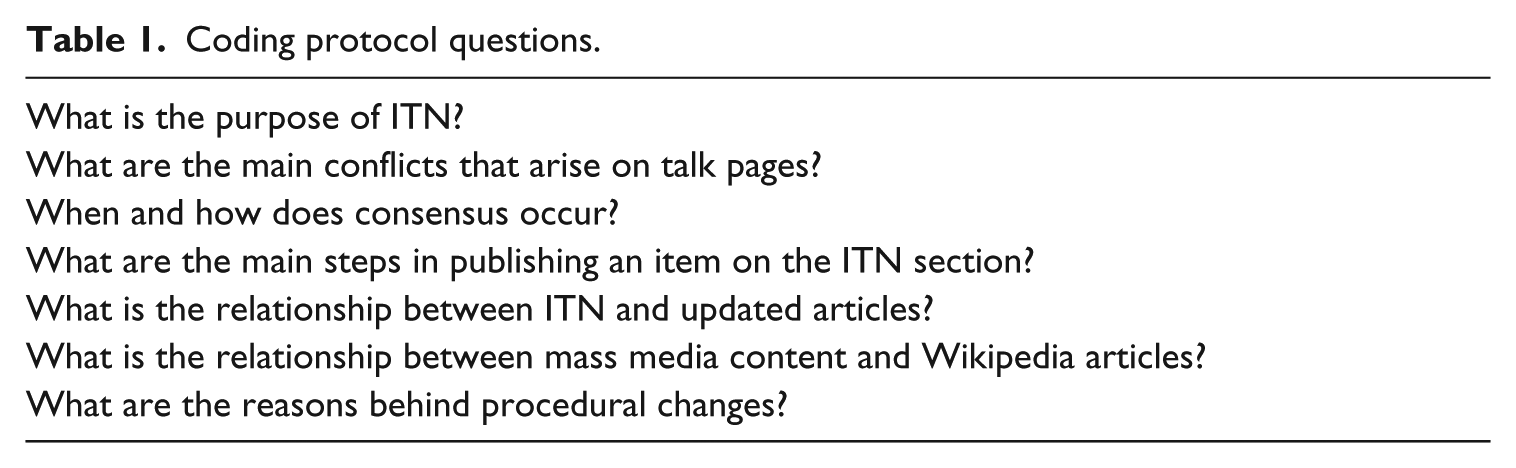
Coding was performed only when general discussions about the section arose in the talk pages. Thus, sections of the ITN talk archives, which were discussions focusing on specific instances and concrete news postings on ITN relating to a single news event, were not included in the coding process unless the discussion changed into a general ITN discussion. In this way only theoretically relevant discussions were sampled within the data set. Initial analysis was performed using analysis software Atlas.ti 6.2 that produced an initial 24 codes through open coding until page 603 of the Wikipedia talk: In the news document. The analysis continued with Nvivo9 software for the remaining pages and other documents. 17 The initial 24 codes were tested, refined and expanded into a final 46 codes. These were organized into three categories: structural (ITN system), process (ITN criteria) and environmental (new media ecology) (Table 2). These categories were put into relationship through a model that explains the position of Wikipedia and ITN in the media and information environment.
List of codes.
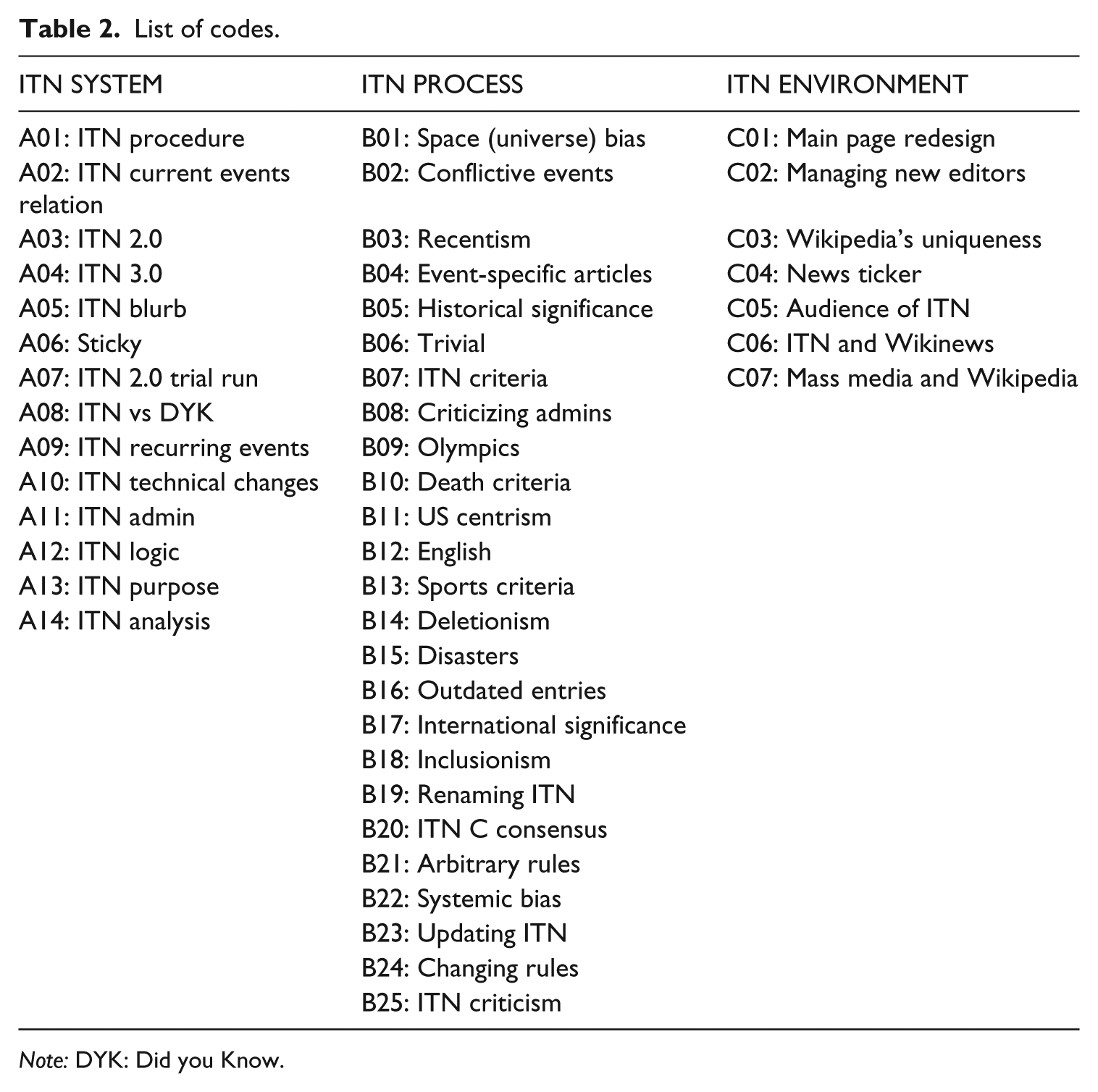
Note: DYK: Did you Know.
Due to the explorative nature of the study, a single coder performed the analysis. A large data set, combined with the need to keep a certain level of theoretical flexibility in the analysis, would have made the training of a second coder time-consuming and ineffective. This is a possible weakness, as different interpretations of the data are always possible. In future research, this type of method should be supplemented by using additional coders and by expanding document analysis with interviews or other data.
Results
The results were selected on the basis of interpretative and theoretical value, not frequency of appearance or other quantitative indicators. They are presented here within two sections. The first outlines the main conflict lines that were identified, coded and gathered in the ‘ITN process’ category. The second section focuses on the organizational procedures and presents the data from the ‘ITN system’ and ‘ITN environment’ categories.
Conflict lines and consensus
News as a form of knowledge was recognized by Robert E. Park (1940). He starts from a distinction between ‘acquaintance with’ and ‘knowledge about’ as two different forms of knowledge. The first is the type of knowledge that one acquires through personal and first-hand encounters with the world. In contrast, the second type of knowledge is formal, rational and systematic. Park (1940: 675) concludes that these types of knowledge are ‘not so different in character or function – since they are, after all, relative terms – that they may not be conceived as constituting together a continuum – a continuum within which all kinds of knowledge find a place’. This ‘knowledge continuum’ is traceable on Wikipedia. Mass media news knowledge and knowledge as constructed on Wikipedia are a part of the same timeframe in the networked communication model. However, Wikipedians go to great lengths to create a line and a division between mass media and Wikipedia through a constructed image of a digital encyclopaedia.
Although there are many specific conflicts in the content production process, the ones that stand out on the ITN can be summarized as forming three basic conflict lines. The first one is the border between Wikipedia and mass media. The second is the opposition between inclusionism, the tendency to include all content available in the information environment, and deletionism, which argues that it is necessary to be selective and choose only encyclopaedic knowledge, however illusive it may be. And finally, conflicts that form around discussions of the international relevance and significance of English Wikipedia. Sharp distinctions between the news media and Wikipedia are formed and often serve the purpose of establishing specific organizational changes that can implement that distinction.
Firstly, Wikipedia is not Wikinews.
18
It’s an encyclopedia not a newspaper. The In The News section is not a news ticker, that’s Wikinews’s job. ITN is intended to highlight Wikipedia Articles with background information to items in the public’s eye. Where we don’t have a suitable article on an item it doesn’t get listed. Secondly, there has been previous and ongoing talk here about changing the inclusion criteria so this section serves that purpose better, without the complication of being mistaken for a news service, and trying to lessen the complaints you mention above. See the similar point raised just above this for an archive of the previous round of criteria discussions. It will be brought up again after we’ve all had a think about it and how to solve some of the minor problems we’ve identified. (Wikipedia talk: In the news)
The ITN purpose of highlighting articles coupled with the name of the section are the causes of constant confusion for new editors who are not familiar with the procedures, specific rules and organizational processes. The name of the ITN section, which emphasizes news, is often taken as an indicator that the purpose of the section is to give quick information on relevant events in the news media, and not the updated articles on Wikipedia.
It took me a while to get why if something was all over the news it wasn’t necessarily ITN material, but I do now. Which is why the name needs to be changed sharpish, so we don’t get arguments along the lines of ‘but look, its on BBC, CNN etc’. News websites are 24 hours, and it is their sole purpose to report news, whereas we can pick and choose the most important stories, from an encyclopaedic perspective, when they come along. (Wikipedia talk: In the news)
The name of the section has been the cause of continuing controversy since its inception, and there have been several attempts at renaming it. However, consensus was never reached and the name remained the same.
One immediate and possibly significant change we could make is to the name, which clearly completely misleads people at present. This has been mooted before. Something like ‘Topics of interest’ or ‘Recently updated’ or similar (we could do better than those I’m sure) would be far better than ‘In the News’. People read ‘in the news’ and they hear ‘news service’. So we can either make it into one, or we can try and reduce their confusion. (Wikipedia talk: In the news)
The rapid nature of content production in the mass and news media creates strains on the ITN section. However, due to networked technologies and wiki software, Wikipedia editors are able to respond quickly to these external influences. Questions of how, and what, to display on the ITN are not resolved with technologies but through discussions and communication processes. Discussions on politics and especially elections in smaller countries, popular culture, sports (particularly connected to sports popular in the US such as football or baseball), and deaths of famous people are some of the reasons why these opposite values occur.
We could also report more sports (all types of football), more space (shuttle goes up, shuttle comes down), more economic news (Yahoo, Northern Rock), and more politics (more Kosovo, and yes, maybe even U.S. election coverage). It would allow us to support more ITN candidates and get more editors involved in editing current events. In short, it would help us put the ‘new’ back in ‘news’. What do you think? (Wikipedia talk: In the news)
On the other hand opposite views can also be traced.
I think that somewhere keeping in mind WP: NOTNEWS when forming content criteria, especially routine news reporting on things like announcements, sports, or celebrities is not a sufficient basis for inclusion in the encyclopedia. While including information on recent developments is sometimes appropriate, breaking news should not be emphasized or otherwise treated differently from other information. And the same should be for ITN, as well. (Wikipedia talk: In the news 3.0)
For analytical and conceptual clarity these conflict lines are separated but in the discussions they often blend into one another or develop from one into the other. For example, conflicts concerning inclusion or deletion can revolve around the argument of the international significance of English Wikipedia and whether certain topics should be more, or less, represented. English Wikipedia is edited by users from all English-speaking countries but, because of its biggest population, users from the US are over-represented. Another issue is the fact that English is the lingua franca language of globalization and because English Wikipedia has the biggest number of articles and editors, internet users from other countries often use English Wikipedia instead of their smaller and localized language Wikipedias. Since the majority of global media companies have their headquarters in English-speaking countries they also over-represent topics connected to these countries. Trying to avoid this bias, Wikipedians post ITN items that have international relevance, and are not solely connected to one country. However, as demonstrated by the ITN discussion, this also proves to be a hard line to negotiate.
India, and a few others get the short end of the stick because of the fact that they are not broken up into more than 50 countries like Europe is. I think the point that is being made is valid. If there was a drought or massive flooding in the Balkans and several nations were affected then that would qualify for ITN, but if something similar happened in New England or the Southeastern US, the inclusion of a similar item would be questioned. Even the coverage of elections is biased toward small nations. The state of California has one of the largest economies of any nation in the world, but the gubernatorial races there would never be on ITN, even though the elections in Moldova would be. Again, something that is deeply important in the United States, China, etc. should be given a little more weight than something that has marginal importance to two smaller countries. Something being ‘international’ just because 2 or more countries are involved or interested simply doesn’t cut it anymore. (Wikipedia talk: In the news)
One of the main functions of mass media is the construction of messages to desired and imagined audiences. In a similar vein, Wikipedia editors construct the desired content for imagined audiences.
What demographic are we aiming to satisfy? Possible demographics (all of which implicitly also include the requirement for an internet connection) include: the whole world, everyone who can read some English, everyone with a high standard of English (others can go to simplewiki), everyone whose first language is English, residents of all countries where English skills are common, residents of all countries where English is an official language, residents of the Anglophone countries (ie English as the dominant language), or perhaps some more restrictive options. We need to remember that not everyone reading ITN is from the US, UK, Canada or Australia, and many will not have English as their first language. (Wikipedia talk: In the news)
Negotiating these complicated conflict lines is the purpose of ITN talk pages. Consensus is difficult to establish but it nevertheless arises after, at times, fierce edit wars and entrenched positions.
Organizational system for content production on ITN
Consensus drives the content production process forward and improves the organizational system to avoid recurring issues and conflicts. At its current stage, consensus on what articles to include for publishing on the ITN depends on four procedural requirements. First, there must be an updated non-stub article that cites credible sources. Second, a blurb must be listed at the portal designed for displaying current events. 19 Third, the item has to be nominated on the page for nominating ITN candidates. Fourth, if there is consensus the blurb is added to the ITN section (Wikipedia: In the news). 20 These rules were established through the routinization of this content production process. 21
The model (Figure 1) explains the relationship between the mass media agenda, Wikipedia articles and the ITN section. The term ‘agenda setting’ was introduced by McCombs and Shaw (1972) to study the effects mass communication has on the audience in terms of topic salience and relevance of certain issues. In this study we use the ‘mass media agenda’ as a term that describes the pool of available news media reports that are external to the community of Wikipedians and which they use to create encyclopaedic entries. The mass media and Wikinews’ agenda drive this process. However, in order for an item to be posted on ITN four procedural rules, as stated above, must be fulfilled. If an item is nominated without a sufficiently updated article or directly as a result of an event being prominent in the mass media agenda, the item will not gain consensus and will not be posted on the ITN section. The arrows in the model display intentions and directions of the process for ITN posting from interested editors. The numbered relation represents the current procedurally correct process. If an editor attempts to post an item directly from Wikinews or a mass media agenda, these items will not gain consensus or will immediately be reverted by administrators who monitor the ITN section. The other option is that the administrators point those nominations towards articles that need to be updated and then the process starts all over again. However, although a precise procedure is in place, sometimes it gets bypassed if a high-impact global event occurs, confirming the flexibility of content production on Wikipedia.
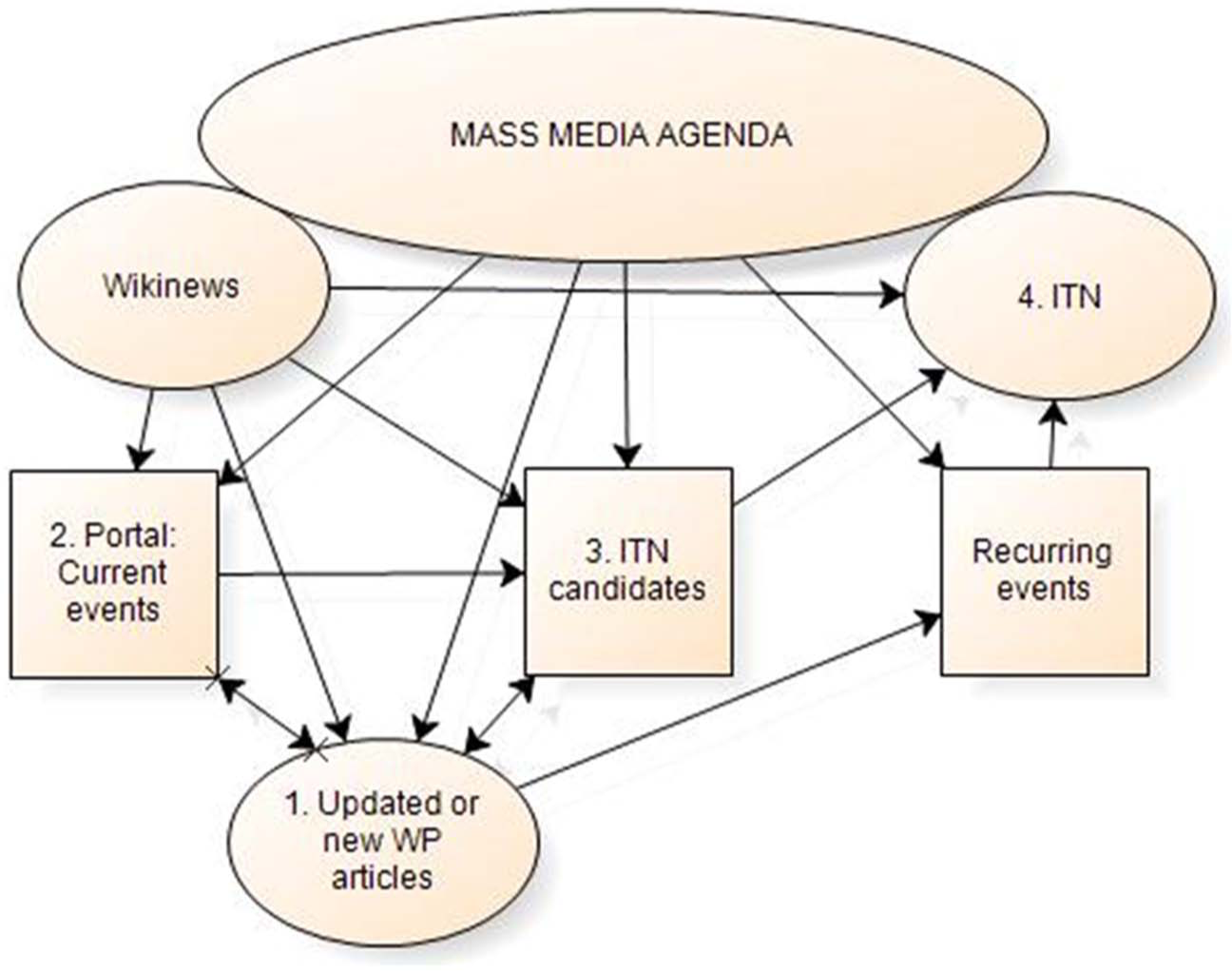
TN content production model.
Procedural criticism, discussions, and changes are a constant on Wikipedia and ITN. However, some of them stand out and are labelled as organizational reforms. The In the news 2.0 reform attempted to revitalize the section because it lost the editor’s interest and certain items were displayed for an over-extended period of time.
Wikipedia is of course an encyclopedia, not a news service. This is an important thing to remember when discussing ITN. However, today’s news is tomorrow’s history, and Wikipedia, unlike a print encyclopedia, can change to reflect current events. When something newsworthy happens, editors flock to Wikipedia to update pages accordingly. We should encourage this as much as possible, and make it easier for editors old and new to link to current-event articles. The current ITN does not do this well enough, and we must reform it. (Wikipedia: In the news 2.0)
The initial intention of the reform was to increase the diversity of subjects on ITN and to speed up the change of ITN to reflect current happenings. Additionally, two more criteria were introduced: openness of the section to various suggestions instead of adherence to procedural rules; and increasing the volume of posted items. Because of the flexibility of the organizational process and constant inflow of new users and editors who are not familiar with the process and reforms, it is difficult to trace the success of the reform. However, this also reflects the non-hierarchical and non-formalized organizational structure of Wikipedia.
The purpose of the ITN is to highlight encyclopaedic articles that have been updated or created as a result of ongoing events. Only significantly updated articles get to be published on the ITN through flexible and constantly changing organizational procedures. During this process neutrality is hard to reach due to multiple conflicts that arise. Neutral point of view and No original research policies act as its cornerstones, but the social construction process of reaching these ideals displays difficulties in accommodating to different cultural and political perspectives.
Wikipedia in the experience of internet users
Wikipedia is more than an encyclopedia; it’s an organic part of the web. (Wikipedia talk: In the news)
The ITN organizational system is not intended to be a system for editing articles, but a system to negotiate the thin line between mass media agenda and digital encyclopaedia. In that sense, this organizational system operates on a higher level of abstraction than content production processes on the article level. Because ITN is a section on the English Wikipedia’s main page it is also a highly visible section for internet users. 22 At any point in the article construction process, or ITN content production process, users gain access to this dynamic digital resource and dynamically constructed knowledge. One of the main reasons for the popularity of Wikipedia, besides convenience and availability of information, 23 is its connection to search engines that act as information gatekeepers. Although we cannot draw conclusions about the broader social significance of Wikipedia based solely on the limited case study of the ITN, we can make some inferences from the evidence available from various market research data that places Wikipedia on the top 10 list of global websites (Alexa: topsites). In the experience of internet users the articles and information from the ITN appear as objectified realities since underlying content production processes, despite being transparent and available, are not immediately visible. Internet users observe the externalization of the social construction of knowledge on Wikipedia and use it according to their own social realities, social contexts and information needs.
Conclusion
In this study social constructivism was combined with media and communication studies. These two fields closely overlap and provide a fruitful theoretical position for analysing contemporary new media phenomena. A specific part of Wikipedia – the ITN section – was analysed to describe Wikipedia as a social and new media phenomenon embedded in a broader context of the network society. The internal, social, collaborative process on Wikipedia is based on consensus and reaching the neutral point of view as detailed in Wikipedia’s policies and guidelines. Regardless of whether we are talking about the ITN or any other section and article on Wikipedia, all of them have to reach and construct the collectively defined neutral point of view on all language versions of Wikipedia.
The ITN deals with contemporary events that make the boundary between the internal collaborative system of Wikipedia, and its external environment clearly visible. Unlike ideologies as forms of knowledge in highly conflictive articles and topics (Bilić and Bulian, in press), the ITN represents the negotiating process between news as knowledge and encyclopaedic knowledge as promoted by Wikipedia. These types of knowledge are part of one ‘knowledge continuum’ (Park, 1940). The continuum is not only a theoretical construct but also an empirical reality that can be traced because of the specificities of this wiki project that enable detailed records of communication, interaction, biases and desires of its collaborators to be collected and retained. While Wikipedia produces articles on many other topics that are not necessarily connected to current events and include topics of ‘classical’ encyclopaedic interest, its uniqueness in responding quickly to the mass media agenda makes it a well-adapted representative of the Information Age.
Wikipedia cannot compete with news organizations because it lacks the financial means, professional editors and organizational and technological capacity to respond and construct news on current events ‘from the field’ and on a daily basis. It also does not produce scientific knowledge because it does not allow original research, and lacks the methodological rigour and systematic approach to research before the writing of articles begins. However, as a secondhand source it creates a unique knowledge format enabled by digital and networking technologies, MediaWiki software and a globally dispersed network of editors. In that process rules and policies are created and specific organizational patterns occur. As a form of popular knowledge Wikipedia has also become extremely widespread and ubiquitous because it is deeply integrated into the everyday practices of internet users and information search in the networked communication model. As such it represents one of the main nodes (Castells, 2004), mediated centres (Couldry, 2003) and symbolic resources for knowledge production, dissemination and consumption in the network society. Through knowledge construction procedures it (re-)creates the myth of the social centre (Couldry, 2003) through delimitation with other media institutions, and especially through non-bias, neutrality policies. In that sense Wikipedia perpetuates notions of rationality and rational debate that can be traced back to the Age of Enlightenment and the encyclopaedic projects of that era. However, its popularity shows us that myths of the social centre are far from deconstructed in late modern, fragmented societies and that they occur and are performed in new, online spaces in the network society. With all its hopes for creating the sum of all human, encyclopaedic and neutral knowledge, Wikipedia also embarks on an entirely different quest of searching for a centre that holds everything together.
Footnotes
Acknowledgements
This research was conducted during a doctoral research fellowship at the University of Alberta in Edmonton, Canada. My gratitude goes to Sylwia Adam-Ross from the Wirth Institute for her assistance in acquiring the data analysis software, and Rychele Wright for reading the first draft of the conference paper. I am especially grateful to Nada Švob-Đokić for her continuous support in doing this research. Finally I thank two anonymous NMS reviewers for their valuable comments and guidelines.
This paper was first presented at the 47th annual Canadian Sociological Association (CSA) conference (29 May – 2 June 2012) at the University of Waterloo and Wilfrid Laurier University. It received the Best Student Paper award in 2012 from the CSA. Parts were also presented at the doctoral consortium at WikiSym (27–29 August) 2012 in Linz, Austria.
Funding
This research received no specific grant from any funding agency in the public, commercial, or not-for-profit sectors.