




Abstract
This article explores the contradictions inherent in new media representations of sexual minorities in two bordering post-Soviet countries, Belarus and Lithuania. These nations are divided by their non/membership of the European Union and, being at the western periphery of the former Russian imperial centre, remain directly affected by the Russian mediascape and its information flows. While both countries’ state media closely adhere to the Russian establishment’s homophobic discourse, the role of new media remains largely uncharted. This article uses discourse analysis to (a) examine the influence of Russian media on each nation’s digital discussions about sexual minorities and (b) explore new media’s potential to mediate the intersection of sexual minorities and nation-building in two post-Soviet states. The analysis is centred on a set of online media publications (including their ‘comments’ sections), generated by the Eurovision Song Contest 2014 being won by Conchita Wurst, a drag performer with a beard.
Introduction
Digital technologies have reshaped the media landscape by transcending national boundaries, media channels and communication platforms, to create a ‘hybrid media system’ (Chadwick, 2013). The Russian media is part of this global mediascape. Under the leadership of President V. Putin, Russia has built a powerful media empire which includes the multilingual international channels, RT (previously Russia Today), MIR (which targets the former Soviet Union [fSU] republics), Rossiya 24 and RTR Planeta (which is available to Russian speakers across the world). Russian-language newspapers and their regional supplements are also popular in the post-Soviet arena (Szostek, 2013). These channels successfully utilise multiplatform systems to produce and distribute content in the post-broadcast media era such as television-Internet hybrids, micro-file sharing and participatory audience engagement (Turner and Tay, 2009). However, the influence that such Russian-language media wield in the post-Soviet region remains underexplored. This article addresses this gap, using online discussions of Eurovision 2014 in Belarus and Lithuania to scrutinise the role of Russian media flows in informing digital discourses in two dramatically different neighbouring states.
This article focuses on these two states at the western periphery of the former Russian imperial state – as they seem to share a homophobic societal stance, closely follow recent changes in Russian legislation which prohibits the promotion of homosexuality (especially in Lithuania) and have a significant number of Russian-language media consumers (particularly in Belarus). Lithuania is the largest of the three Baltic States, with a population of around 3 million. Russians constitute 5.8% of its overall population and 84% of ethnic Lithuanians speak the official national language, Lithuanian (Lithuania, 2014). The country actively campaigned for independence from the Union of Soviet Socialist Republic (USSR) in 1990 and became a member of the European Union (EU) in 2004. Belarus is an authoritarian dictatorship which has been governed by President A. Lukashenko since 1994 and is dubbed the ‘last Soviet republic’ (Parker, 2007). Despite having two official languages – Russian and Belarusian – 72% of the 9.7 million people in Belarus use Russian, although only 8.3% are of ethnic Russian origin (Population Census, 2009).
Eurovision 2014 is of particular interest because of the participation, and consequent victory, of the Austrian singer Thomas Neuwirth who performed in a dress, as his drag queen alter ego, Conchita Wurst. This appearance provoked a wave of heated discussion in Russian media, ranging from explicitly homophobic remarks to a conflation of the performance with nation-building and geopolitics, expressed through a pronounced anti-Western sentiment and linked to the ongoing turmoil in Ukraine. Examples of this include a Facebook statement that ‘a bearded woman stopped the war in Ukraine’ (Svaboda’s citations, 2014) and a Tweet from the pro-Kremlin government advisor Surkov that ‘If Conchita is a woman, then Ukraine is a country’. This article traces how themes related to Eurovision 2014 travel across the post-Soviet national borders. Lotman’s (1990) model of intercultural dialogue – particularly the notion of the boundary (or periphery) and its ambivalent nature – elucidates logic for the transformation of meanings crossing national borders. The Russian media in this case constitutes a ‘dynamic centre of information flows and counter-flows’ (Flood et al., 2012: 215). Proximity to this centre and the significant role that Russian-language media play in these two countries are both expected to inflect their digital discourses.
The modulation of Russian discourse within the two countries’ mediascapes (lack of freedom of speech in Belarus and an artificially ‘installed’ European discourse of political correctness in Lithuania) provides a premise for the first assumption. It is likely that the Russian framing of the Eurovision 2014 winner will be transcoded differently in the media peripheries of Belarus and Lithuania. Furthermore, the focus on online media channels (online forums, etc.) constitutes an additional periphery, compared to traditional media. By embracing a wider range of voices, online media may potentially have a higher discursive inconsistency. Therefore, the second assumption is that new media might provide an alternative public space (especially in their ‘comments’ sections) and acquire a dual potential to both challenge or authenticate the establishment’s discourse. This article first delineates the relationship between homosexuality, media and nation-building in the fSU states. Then it outlines the role of Eurovision in post-Soviet nation-building. After each country’s case is described, the methodology and data analysis are presented, followed by the conclusion.
Context of the study
Post-Soviet nation-building and homosexuality
Nation-building efforts in Russia, Belarus and other fSU states centre on consolidating each nation against a hostile imagined ‘other’ within an unfinished modernisation project (Miazhevich, 2012). Gudkov (2004) defines this as a phenomenon of ‘negative’ identity where, instead of being unified ‘for’ something, a nation is set ‘against’ someone. The ‘other’ might fluctuate; however, one constant dimension is its anti-Western sentiment. 1 Denouncing the non-heterosexual community is currently being used to criticise Western notions of liberalism and tolerance and to imply Western decadence and sexual degradation. This is known as a Gayrope discourse (Hutchings et al., 2015) and is particularly evident in Russia, where Putin’s ‘traditional values’ agenda is becoming more prominent. For instance, Putin quoted Berdiaev in his Valdai speech in 2013 to describe the West as ‘genderless and infertile’ (McElroy, 2013). This feeds into a post-Soviet context which is dominated by a nationalist-populist discourse with heroic ideals like the Unknown Soldier or the Soviet cosmonauts (Novikova, n.d.) and where mainstream mass media are explicitly homophobic (Martínez, 2012). Lithuania and Belarus are also pursuing a conservative nation-building agenda and have overtly homophobic leading political figures including Lithuania parliamentarian, P. Gražulis, and Belarus’ President, Lukashenko (Aalia and Duvold, 2012; Nechepurenko, 2014).
During the Soviet era, homosexuality was illegal. After its decriminalisation in 1993 and a short period of sexual liberation (Baer, 2009), Russia introduced legislation prohibiting the promotion of homosexuality to minors (27 Nobel laureates urge Putin to repeal the gay propaganda law, 2014). This did not re-criminalise homosexuality but linked it to paedophilia and a variety of ‘deviations’. So the legislation has recently been used to censor children’s books and to persecute openly non-heterosexual people (Turovskii, 2014). Lithuania introduced legislation prohibiting the exposure of minors to ‘negative’ public information in 2009, on the grounds that it would threaten family values (Vitureau, 2010), and attempts are currently being made to adopt legislation similar to Russia’s ‘gay propaganda’ law (Four homophobic initiatives to be considered at the spring session of the Lithuanian Parliament, 2014). Although Belarus has not introduced any such legislation to date, there are speculations of upcoming similar legal initiatives (Newsdesk, 2014).
Eurovision, post-Soviet nation-branding and sexuality
The annual Eurovision media event gains a great deal of coverage in the fSU (starting with the in-country selection rounds) and constitutes a nation-branding exercise (Miazhevich, 2010, 2012). Recently, this aspiration to impress and/or win has been combined with a contradictory, disapproving attitude towards the contest. It culminated in calls from Russia, Belarus and Armenia to ban the broadcast of Eurovision 2014 (or at least to censor the broadcast during Conchita’s performance) and to replace Eurovision with an alternative ‘The Voice of Eurasia’ contest (Adams, 2014).
‘Excessive’ or non-conventional sexuality is a customary feature of Eurovision, based around camp culture. Andrei Danilko representing Ukraine in 2007 as his cross-dressing stage persona, Verka Serduchka, came second (Miazhevich, 2012), and Israel’s winning entry in 1998 was transgender, Dana International. The ‘allegedly’ lesbian duo (t.A.T.u.) represented Russia in 2003 showing that the Russian state is also capable of using non-heteronormative sexuality for its own purposes (Miazhevich, 2010), in contradiction to the conservative nation-building strategy of post-Soviet states. However, that dimension of inquiry is beyond the scope of this article.
An overview of Russian-language media shows that confusion was caused by Conchita’s non-heteronormative sexuality. Most of the anti-Conchita media disparagement centred less on the fact that he was gay than on his appearance as ‘a woman with a beard’ (What is written about Eurovision results on social networks, 2014). References to a pre-Eurovison YouTube clip where comedian Pavel Volya referred to the artist as ‘it’ (‘ono’) were frequently recirculated (YouTube, 2014). 2 Thus, the Russian media’s attack on Conchita can be seen as part of a broader assault on non-conventional sexualities, including transgenderism, which is portrayed in the official Russian discourse as evidence of the West’s ‘decadence’. I will now explore whether online reactions in Belarus and Lithuania followed the same pattern.
Country cases: Belarus and Lithuania
Contemporary debates on homosexuality play out in a different media environment in each country. Freedom House ranks Belarus as 193rd out 196 countries, having a ‘not free status’ because it lacks freedom of speech and press (Global press freedom ranking, 2013). In contrast, Lithuania is ranked as ‘free’ (Freedom of the Press, 2013). In 2013, 65% of private households in Lithuania were connected to the Internet (Lithuania, 2014). In 2012, allegedly, approximately half of the population of Belarus used the Internet (47%) and mobile phone web-connectivity is on the rise. However, there are restrictions on what content can be accessed (Freedom on the Net, 2013).
The dilemma of discussing homosexuality within the ‘free’ Lithuanian mediascape comprises combining a European discourse of political correctness, tolerance and liberalism in a quasi-patriarchal nation. Meanwhile, the Belarusian media operate within a constrained environment, having to adhere to a code of practice (refraining from inciting hatred, respecting various subcultures, etc.) while balancing this with the official (homophobic) line. The centre-periphery flows complicate the matters even further. The role of Russian media and Russia-related news is important in both states. On the one hand, Lithuania is attempting to promote use of the state language and limit Russia’s influence on its mediascape. Because of allegations of propaganda, Rossiya and RTR are temporarily banned in Latvia and Lithuania (Rakuzina, 2014). On the other hand, Russia-related news represents a significant ‘Other’ in Lithuanian mediascape irrespectively of the broadcast language/channel (especially after the annexation of Crimea by Russia). Most Belarusian media is in Russian, with a significant number of Russian TV channels and newspapers (Szostek, 2013). The role of the Russian media is also determined by the Union State, which has its own set of media resources (souzveche.ru). People in both countries in question can freely access Ru-net or Russian Internet (albeit there is no reliable statistics to date).
Methodology and data analysis
In order to uncover the dynamics of translation between Russian, Belarusian and Lithuanian cultural codes, this study refers to Lotman’s model (1990), which emphasises the role of peripheries and boundaries as key points of interchange, where their porous nature is crucial for cultural exchange. When the boundaries of a receiving culture are penetrated by ‘extra-systemic factors’, new meanings are generated. Through this process, both the receiving and the transmitting cultures acquire the potential for ‘revitalisation’ (Lotman, 1990: 16–17). This article extends Lotman’s original focus on cultural texts to include media discourses. Thus, Russian discourses on Eurovision 2014, which are initially perceived as alien, can ultimately restructure the codes of the receiving culture. They will simultaneously be transformed themselves, during the same process of retranslation and restructuring.
This study employs some elements of discourse analysis (Fairclough, 1995), considering narrative, framing (the promotion of certain interpretations of events [Entman, 1993: 52]), voice, rhetorical strategy, concepts and visual imagery. A multiplicity of discourses, such as state leaders, scientific-technical, or references to the legal system, interact and intersect with those of ordinary citizens (Fairclough, 1995: 99). The mediation of ideas from the official realm to the public or ‘the discourse of public life’ (Fairclough, 1995: 164) is explored at the official media level (online channels) and then traced to the semi-official mediation level (online comments). The online sphere, which allows a multiplicity of voices and flexibility of discourse, is seen as enabling participation in public discourse and having the potential to challenge, mediate or authenticate establishment discourse (Hutchings et al., 2015). Discursive elements are also explored, to uncover ideological predispositions and power relationships behind media texts (Fairclough, 1995).
My analysis encompasses three channels: the most popular official and alternative newspaper, a popular online platform in two countries (Table 1). The key word used to retrieve relevant articles was ‘Conchita Wurst’, during the period January–June 2014. I analysed relevant articles and one discussion thread under the most popular article (with the highest number of comments) per channel. While all the channels have a (not very transparent editorial) moderation policy, they do not require the user to officially register to post comments. The close reading of the articles was carried out by the author and the assistant with the native knowledge of Lithuanian language. As comments within two Lithuanian online platforms became unavailable, an additional online resource (15 minutes) within the same time period is used.
The analysed media outlets in Belarus and Lithuania.

The focus on the comments section of the above mentioned online channels is determined by a number of factors. First, Lithuanian and Belarusian Internet users are not widespread adopters of Twitter, Facebook, Instagram and so on. (Birzhevoi lider, 2014; Elta, 2014). This is due to the infrastructural constraints (the speed of the Internet, etc.), affordability of the Internet, the demographics (e.g. the youth tends to be more Internet savvy) and so on. Second, the cultural importance of literary genre in the post-Soviet region results in the extreme popularity of (micro)blogging (e.g. LiveJournal [Kovalev, 2011]) and online commentaries.
The analysis is structured as follows. First, (where possible), a brief introduction of the outlet and its audience are provided. It is problematic to categorise them as being pro- or anti-Russian, as the situation is more complex than that (e.g. an ambivalence after the annexation of Crimea). Then, the analysis includes the most prominent headlines and/or terminology used. Finally, the major themes are presented and illustrated with examples. Some of the re-occurring themes include ‘decadent’ Europe, Russian initiatives (the notion of ‘gay propaganda’ and its effect on under-aged), the contest (camp) and non-heteronormative sexualities.
Belarus
The search found 12 relevant articles on Sovetskaya Belorussiya (SB), 10 on Nasha Niva (NN) and 19 on Naviny.by.
Sovetskaya Belorussiya
Sovetskaya Belorussiya (SB) (as a flagship of the establishment) is known for its highly controversial and opinionated coverage. Its reporting on Eurovision 2014 is an odd combination of comments in passing (such as statistics on sex changes in Belarus; Conchita’s pre-election campaign to the European parliament) and extensive articles. Two articles have provocative titles: ‘This is the end to everything’ (‘Konchita vsemu’ – a play on the similarity of the name Conchita and the colloquial term ‘kapets’, meaning ‘game over’ or irreversible doom and an allusion to ‘fucked up’); and ‘Blue beard of European culture’ (a play on the title of Perrault’s fairy-tale). The first article includes references to ‘lewd and sick’ (razvratnaya i presyshchennaya) Europe and Eurovision propagating Sodom and Gomorra. In contrast, the second article contextualises the camp format of Eurovision: ‘the European audience is watching this mad people’s ‘Sabbath’ with a smile, they are freaks and jesters’. On the whole, however, the contest is presented with a note of condescension: ‘get used to it’, a ‘parade of the LGBT (Lesbian, Gay, Bisexual, Transgender)’, ‘tribune to shout about their nature (sushchnost’)’. Among the terms used are ‘bearded woman’, ‘bearded diva/singer’, (bearded) ‘transvestite’, a clown and a person who needs to be pitied. SB’s coverage is characterised by a contradictory and fragmented narrative. Where Conchita and her manager are quoted (‘this is steb 3 and provocation’ or, alternatively, the ‘beard is not important, the person is’), their statements are not commented on. Neither is there any reflection on Conchita’s statement that people need to think about the nature of xenophobia. Instead, they are intersected with the newspaper’s homophobic statements and social outrage.
The topic provoked an unusually high number of comments. The first stream is pop culture, with parallels being made with Lady Gaga (also discussed in Lithuanian online fora) and a ‘troll who pokes fun both at transgender people and pop artists’. Conchita is described as ‘Estrada’s product’ 4 and a representation of contemporary cultural trends (‘she made everyone talk about herself – the goal is achieved’). The singer is referred to tolerantly as a ‘wonder (chudo)-man’. At the same time, neutral references to comparable local pop figures B. Moiseev and Serduchka coexist with more ironic comments (‘divide future participants on gay, lesbi and trans – the rest are old-fashioned’ [‘otstali ot zhizni’]). The nature of the contest is a site for ‘propaganda of sexual deviations’ or a place for showing off (vypendrivayutsya).
The second stream of comments is debates about non-heteronormative sexualities. Some use strong language: it is ‘against nature’ (‘protivoestestvenno’), ‘unnatural’, ‘perverse’; ‘normal men feel disgusted; it makes them throw up’. In some cases, various ‘others’ are (ironically) brought in (‘gay, fascists and benderovtsy’). 5 A counter-flow narrative includes calls for broadmindedness and tolerance: ‘did not harm anyone; let it be – the forbidden fruit is even tastier; nobody is forcing you to vote; individual freedoms; stop discussing somebody’s else genitals’. This debate results in the didactic assertion that ‘whatever you teach a child before s/he is five is impossible to change’ and a short discussion about effects of such TV viewing on children. As in all the other outlets, there are occasional comments about the role of religion.
The final set of comments reveals anti-American sentiments: ‘this is all a Washington masonic conspiracy – turning the population gay (‘pedrilizatsiya’), supporting perverts on both sides of the Atlantic’. There is also a more polarised, ‘European’ debate, which includes several streams: (a) degrading Europe (‘what’s happening to European values?’; ‘a tragedy of contemporary civilisation’; ‘the cause of human degeneration’; ‘Europe – a nation without roots’; ‘there will be a factory of cloned kids’; ‘signs of the rapid decline of European civilization … reminiscent of ancient Rome and Athens’), (b) a counter-argument (discussing Belarusian alcoholism as ‘degraded’), and (c) creativity and ‘euro-gay achievements’.
Nasha Niva (NN)
Nasha Niva (NN) is predominantly an online newspaper, due to the media’s regulatory environment. Its coverage reflects its limited resources – most of the articles are reprinted from sources such as major news agencies Belapan or Interfax (the Church’s stance, the call to boycott Eurovision, etc.) and it provides few independent opinions. The recurring term used to describe Conchita is ‘a bearded woman’, alongside information that he is a transvestite, not a transsexual, and a discussion on the notion of ‘freaks’. Overall, NN’s coverage is contradictory, combining recycled news posts, tabloid articles and occasional well-informed academic items.
Despite this, NN’s debates are quite rigorous. It has an established pro-liberal, anti-Russian, anti-establishment readership and a distinct, oppositional agenda, which is reflected in some of the comments. It takes a critical stance towards Russia’s propaganda (‘people of Europe cast their vote; there is no space for bribery here. The rest is Russian fascism which is built on a pietism (hanzhenstvo) of the easily “programmed” society’) and the rise of the far right, positioning Belarus between Gayrope and fascist Russia (‘from the West are gays and from the East are fascists. God save Belarus; it is better “homo” than Moscow imperialists’). It derides Russia’s ‘double standards’: ‘Russia is rising from its knees and singing … with a horrible Russian accent. Yet, when they brought t.A.T.u. to Eurovision did they also bring light and spirituality to decadent Europe?’ The double standards of Belarus’ political establishment (‘President Lukashenko kissing Serduchka is OK?!’) and society are also mentioned. And finally, the idea of mimicking ‘European trends’ for nation-branding purposes is posited: ‘we also need to find a transvestite’ or a ‘man with boobs’.
The debates about ‘normality’ are sarcastic: it is not even outrages and scandalous. [If she] attacked the presenter and drank his blood … or maybe there are batteries in her pants; if she at least organised an orgy on stage or carried a rainbow flag, then you could talk about homosexual propaganda; her beard is better than our local pop singers’ facelifts, this is politically correct good quality pop.
There are multiple statements about the need to view the contest and the performance as steb. Another clear theme is the decadence of Europe (which has gone mad or ill or reached its ‘apoGay’). However, the debates on Europe are quite polarised: ‘catholic European countries voted for Conchita; if he had not won, they would cry ‘discrimination’ or ‘Hitler needs to come and shave all these Conchitas’; ‘old Europe will only be saved by tanks from Russia’.
Such homophobic exclamations and statements (‘disgraceful’, ‘shameful and disgusting’; ‘repugnant’ [as a hair in a soup]) coexist with counter-responses. This maps further to debates about ‘sexuality’ in general: ‘like kids giggling when someone said willy; what are we supposed to call him: boy+girl=borl; not gays but transvestites have won and this is a big difference, as gays are men and trans are not clear who they are’. The fact that Conchita causes a dissonance on an aesthetical level correlates with references to class (the proletariat will not be able to ‘get it’) and a lack of open-mindedness among ‘tolerant’ Belarusians (‘you are no better than moskali [a derogatory name for Russians] who label everyone who thinks differently as fascist’).
Naviny.by
Naviny.by (NB) has the most diverse and multifaceted coverage, with 19 articles. It provides a platform for various opinions: (a) opponents within the establishment (the church, pro-President groups) and the general public and (b) supporters of Conchita (under-represented due to the nature of the social reaction). NB’s terminology is quite balanced, using various phrases (‘transsexual’, ‘gay who came out’, ‘bearded woman’). However, in contrast with the (derogatory) Russian coverage, the ‘woman with the beard’ is treated merely as a stage image of the singer. NB mentions the homophobia which the singer experienced as a teenager, comments on the intolerance of Belarusian society and relates homophobia to a weak civic society. NB talks about (a) public dissatisfaction with the contestant (and intolerance) in Western and Eastern Europe and (b) uncovers Russia’s hypocritical reaction, as shown in Figure 1 (contrasting Western values to ‘our values’ of Serduchka, Moiseev and t.A.T.u.):

An image of Conchita and a set of performers exploiting non-mainstream sexuality in Russia (Available at: http://naviny.by/rubrics/society/2014/05/16/ic_articles_116_185520/).
The portal quotes national celebrities’ homophobic remarks, such as ‘fag’ (gomosyatina) and ‘abnormal’, infiltrating the narrative with grassroots homophobia. Overall, NB treats the performance as outrages and scandalous and underlines the self-irony of the performer who purposely chose his stage name. Unlike other channels, it devotes lots of space to humorous (graphic) responses to the performance, often linking this satire to the president.
Comments indicate a slightly less monitored online space than, for instance, SB. Confusion about Conchita’s sexuality and attacks on non-conventional sexualities are more pronounced. There are occasional statements similar to those on Ru-net: ‘go and shave! You are not a woman!’, ‘instead of men in Gayrope there are now only konchitas’, or ‘first gays, now transvestites, all deviations can exist but they have been always limited to minorities, now we, normal people, risk being left as a minority’. Nonetheless, the hostility is subdued: the singer is referred to as a ‘bearded creature in a dress’ or ‘an unknown animal’ (nevedoma zverushka); 6 ‘you will not think that it is a girl as it has a beard’. There is also a conscious irony about Conchita’s genitals: ‘willy with a sausage or an ass’.
Debate about Europe is less conspicuous and more nuanced. Occasional references like a ‘spiritual (dukhovnaya) degradation’ of Europe or the suggestion that ‘tolerance leads to apocalypses’ coexist alongside statements that not all Europeans think this way. In fact, the ‘decadent Europe’ discourse is linked to degradation in Belarus, where alcoholism is widespread. The idea that tolerating drunkards is more acceptable than gay people is questioned: ‘exactly! where is a place for those like Conchita among this degrading drunken crowd’. Moreover, some contributors explicitly distance themselves from Russia’s homophobic (gomophobskoe) society.
Secondary topics discussed include the role of religion and the belief that sexual matters should remain private, to avoid ‘promoting (sexual) orientations unlike all these “finished” (konchenye) Conchitas’. There are contrasting opinions about homosexuals, who are either described as incapable of being talented (geteroseki=bezdarnost’) or having a ‘good vocal’. This divergence of opinion reflects the fragmentation of society in the post-broadcast era and changes in patterns of media consumption. The comments contrast broadcast television audience (‘the TV-dependent bee-hive is buzzing’, a ‘herd’ [‘bydlo’]) to an ‘elite’, tolerant online audience.
Thus, the Russian narrative is transcoded in the media periphery of Belarus and loses its meaning during the process. Although certain similarities of cultural fields produce similar accounts: homosexuality is presented as abnormal, or a disease (‘freaks’), and is medicalised (the notion of ‘orientation’, genitals and the recirculation of a sex change story). There is a certain anxiety about Conchita’s sexuality (transvestite and transvestit-ka (m/f), ‘it’, ‘wonder’ or ‘creature’ [chudo]). However, there is less concern that the non-heteronormative ‘other’ might be dangerous or even contaminating than in Russian discourse, and the terminology is more normative (an ‘outrageous’ [epatazh] participant). People rarely use derogatory slang such as ‘fag’ (‘pedik’ or pederast), which is particularly notable when compared to the Lithuanian mediascape. However, this might be due to the stricter moderation rules in force in Belarus. It is difficult to discern how much of the ‘decadent Europe/paedophilia’ narrative is imposed by pro-Russian online ‘trolls’, because of the anonymity of online communication. The discussions only partially echo the Russian narrative of a ‘decadent’ Europe. In fact, instead of ‘attacking’ Europe, users discuss the moral degradation due to widespread alcoholism in their own country. They make almost no comparisons between homosexuality and paedophilia; instead, they argue that parents should monitor their own children’s exposure to television. Rather than following Russian discourse of ‘propaganda of homosexuality’, the dilemma is restructured as belonging to the private domain (‘these matters are private and should stay so’). Finally, despite online channels’ attempts to generate specific discussions by quoting religious figures or declaring support for an alternative ‘The Voice of Eurasia’ contest, the lack of support at a grassroots level is demonstrated through the insignificant levels of resulting debate.
On the one hand, there are certain echoes and variations of Russia’s constructed image of Gayrope. On the other hand, its influence on intercultural information flows is less distinct than might be expected in a predominantly Russian-language environment. Some of Belarus’ main narratives are about distancing itself from Russia and positioning itself between Europe and Russia and this is even more evident since Russia annexed Crimea. The modification of a mediated homophobic discourse indicates the existence of a semiotic border (Lotman, 1990) between two countries’ mediascapes. This narrative restructuring reveals the divergent cultural significance of the issue and (possibly) the distinctiveness of digital flows, as discussed in the conclusion.
Lithuania
The search found 29 articles in Lietuvos Rytas, two in Respublika, 35 in Delfi and 34 in 15 minutes. Two online channels – Lietuvos Rytas and Delfi – removed comments during the study period, so the analysis of online debates is based on preliminary observations made during the initial screening of articles and comments.
Respublika
The search found two articles in Respublika’s archives with three and 20 comments, respectively. Both articles are very generic, lacking any diversity of voices, providing broad coverage such as an overview of Eurovision and ‘Austria triumphs at the Eurovision song contest’. In both articles, Conchita is described as a ‘bearded transvestite’ (barzdotas transvestitas).
On the whole, the public response is very negative. The most commonly used term is ‘perverts’ (plural), referring to the entire LGBT community. Here, as in Belarus, homosexuality is seen as ‘abnormal’: ‘disgusting, not normal; it’s a disease, it needs to be treated’. In contrast to Belarus, though, there are numerous references to Putin, who should ‘stop them’; the ‘sooner Putin comes and disperses all these fags (piderus), then we will live in a normal country, unlike now, when homosexuals are given freedom and normal families are burdened with taxes’. The few positive comments focus on the quality of the song and performance.
The discourse about a ‘decadent Europe’ is slightly modulated, probably because Lithuania is a member of the EU, although the benefits and drawbacks of membership are discussed: ‘It is the triumph not of Austria, but of perverts. Do you still want to be in the EU? Apparently so, because you voted for Grybe’ (President D. Grybauskaite); ‘European values are being forced on us. We need to cut ourselves off from Europe, it is worse than Soviet propaganda. At least in kids’ cartoons the Soviets advocated kindness and respect for your parents; Europe is sick’. Finally, this discourse is combined with anxiety about non-normative sexualities: ‘Eurovision – a transvestite orgy’: we need a strong tsunami, like the one in Indonesia, the world needs to be saved, cleared; by looking at this creature no medical books are necessary; it is a disease and a very contagious one. Are there any vaccinations? I hope Lithuanian people will withstand it.
‘where is the world going?’
Lietuvos Rytas
The search found 29 articles in Lietuvos Rytas (LR), which had the most diverse terminology of all the channels: ‘transvestite from Austria’; ‘transvestite with a beard, who enjoys wearing sexy dresses’; ‘transvestite dressed as a woman’; ‘bearded woman from Austria’; ‘a woman with a beard’ (moteris su barzda) and ‘bearded diva’. The newspaper attempts to provide neutral, balanced coverage without any bias towards or against the gay community, but this is difficult to balance against homophobic grassroots discussions using pejorative terms such as ‘pedrytis’ (from the word ‘pedikas’ [fag]).
The articles cover diverse aspects: ‘A psychologist notes: bearded Conchita will be soon forgotten’, ‘A nail in the coffin of homophobes’, ‘Is the bearded woman to blame for floods in the Balkans?’ Among the most prominent voices are Conchita herself, explaining what motivated him to create the performance, Lithuanian politician, P. Gražulis, and Lithuanian Gay League leader, V. Simonko. Gražulis asks the national television station LRT how broadcasting Conchita’s performance contributes to national identity building (echoing the Russian discourse). Simonko expresses surprise that Lithuania awarded Austria 10 points and criticises a Lithuanian TV presenter’s remark that it was time to shave the beard off, miming a razor action during the voting results. A psychologist explains that a man who feels compelled to dress as a woman has a psychological disability and, like all other disabled people, should be tolerated, rather than condemned.
Initial observations of the comments before they were taken down noted disparagements of non-traditional sexuality: ‘it is disgusting, images like these are revolting and sickening’ and assertions of European ‘degradation’: ‘Eurovision is becoming a contest of perverts and degenerates (“Gayvision”); the world is coming to an end; Europe is going downhill’. Conchita is likened to a ‘monster’, a ‘thing’. The website allows readers to ‘dis/like’ comments posted; positive comments receive a lot of negative votes and vice versa. Although comments on articles relating to Conchita became unavailable during this study’s timeframe, 65 comments about a recent item on Russian police dispersing Conchita’s supporters show that the topic is still being discussed. These comments support the Russian police: ‘I completely agree with the police actions’; ‘nature wants to eliminate them, they don’t reproduce but paradoxically their numbers are growing; it’s a huge threat for Europe, I think Russians did the right thing’; ‘respect for Putin and the nation of Russia’; ‘well done Russians, exterminate those perverts’; ‘the less of those perverts the better’; ‘no to pyderastai!’.
Delfi
Delfi contains a diverse range of voices. Terminology used includes ‘a bearded Austrian’; ‘woman with a beard’; ‘bearded woman’. Noteworthy headlines are: ‘Conchita Wurst virus is spreading rapidly’, ‘Lithuanians have forgotten having their own Conchita Wurst – comedian Apoloniya Zizirskiene’, ‘Eurovision victory of Austrian transvestite resulted in indignation (‘pasipiktinimas’) with gays in Russia’. The video of Conchita’s Eurovision song on this website has 133 ‘likes’ versus 163 ‘dislikes’. One article concerns the Lithuanian TV comedy show, ‘Dviračio šou’ (The Bike Show), which uses a parody news format to mock politicians. Beside the article is a satirical photograph of President D. Grybauskaitė (Figure 2), one of only a few images (in comparison to Belarusian Internet or By-net).
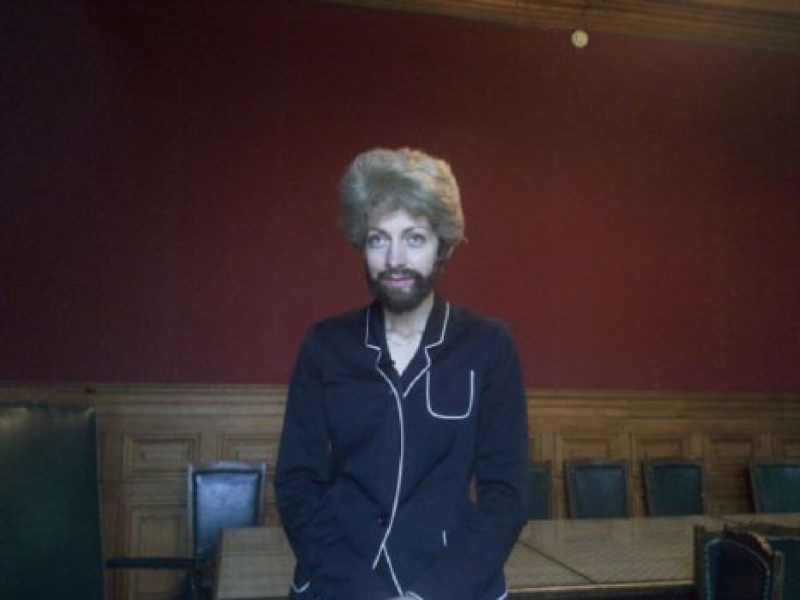
A satirical image of the Lithuanian president (Available at: http://www.delfi.lt/pramogos/eteris/dviracio-sou-i-antraji-prezidento-rinkimu-tura-zengs-su-barzda.d?id=64771719).
Key themes include appeals against public demonstrations of any sexuality, which may be rooted in concerns about the conflation of private and public spheres, seeing sexuality as a ‘taboo’ subject, as in: ‘there was no sex in the USSR’. Concerns about how to explain a woman with a beard to children are discussed by numerous people (including Lithuania’s own Eurovision 2014 entrant). These are countered by a Lithuanian journalist living in New York and a psychologist, thereby rearticulating debates about ‘promoting’ homosexuality, rather than re-coding the Russian narrative.
The most prominent public figures cited are as follows: Conchita, interviewed about her childhood, fashion icons, participants of Dublin Pride 2014 and so on; celebrities such as Sir Elton John, Cher, Robbie Williams, Serduchka and Celebrity Big Brother star R. Clark (dressed up as Conchita) expressing their support; and Lithuanian transsexual R. Mammadli talking about his childhood, sexuality and discrimination. A number of Russian figures also give their opinions, including politician V. Milotov, who instigated the anti-gay legislation: ‘the competition is an insult to millions of Russians and this is shameful propaganda of homosexuality and spiritual degradation’; controversial politician V. Zhirinovskii, on his resentment towards Conchita and ‘European values’; and singer F. Kirkorov, asserting that perhaps Conchita will make Russians re-evaluate and change their opinions about gays. Another theme includes the director of ‘Harmony Life’ explaining how sales of hair removal cream have increased since Conchita’s victory; and a scandal about a Lithuanian dancer who shaved his beard at around the same time. Finally, one Lithuanian artist, known by his stage name SEL, left a very negative comment on a social network saying that if Putin decided to toss an atomic bomb over Europe, he wouldn’t mind.
Only a few articles on this channel have accessible comments. Calls for tolerance include ‘he’s only a transvestite’ or ‘awful that there are so many intolerant people in Lithuania; the song is awesome! Don’t look at Tom. Listen to the song […] And live your life. And why are Russians so worried? They have had their Serduchka for a long time now’. However, these are outnumbered by homophobic comments such as: ‘I’m ashamed to live in Europe; it turns out that gays are the ones organising Eurovision. Everybody knows that they are dominant in music, photography, fashion and movie business and so on. Pathetic; and they want to have families, raise children … horror’)’. Negative comments received lots of ‘likes’ by other users, and there was indignation about ‘European values’, the aftermath of this ‘propaganda’ on children and the perception of Conchita’s performance as not being normal.
15 minutes
The 34 articles on 15 minutes defined Conchita as ‘a bearded transvestite, who triumphed at Eurovision in 2014’. While the terminology used is the same as on other channels (‘transvestite with a beard’; ‘bearded transvestite’), the headlines are more provocative and diverse: ‘Eurovision winner Conchita Wurst: “I don’t know if Putin is watching the conference, but I will repeat – we are unstoppable”’, ‘Conchita Wurst – bearded diva propagating tolerance’, ‘Star of “Eurovision” Conchita Wurst: where is the line between tolerance and degeneracy?’, ‘Internet users and butchers rushed into creating sausages in the name of “Eurovision” winner Conchita Wurst’ and ‘Conchita Wurst did not return to Austria alone: she was greeted by a bearded stewardess’.
The comments sections reveal confusion about Conchita’s sexuality, with ‘perverts’ being the most common term used. A number of users conflate gender, referring to Conchita as ‘she’/’her’ and sometimes ‘he/man’. One article ran a poll, inviting readers to vote how they felt about the Eurovision winner. One of the answers to chose from was ‘The victory is a misunderstanding, it is unpleasant to look at him/her’. There are calls for politicians to act: ‘where is Gražulis when we need him?’; ‘Putin was right, shoot those perverts’. Echoing comments on By-net, one user says, ‘I hope there will be a second Hitler who will kill all the fags (py de rus). The ‘decadent Europe’ narrative (‘Europe is becoming a continent of degenerates’) is combined with a refusal to watch the contest (‘these European visions will be watched by perverts. Decent people will cross Eurovision off their favourite shows’. ‘This Eurovision was the last; disgusting that’s all’ (Šlykštuma ir tiek … ).
Thus, Eurovision exposed confusion about sexualities and sparked rigorous discussions about homosexuality and LGBT rights in Lithuania. Homosexuality is seen as abnormal and there is a conflation of homosexuality and paedophilia. People refuse to accept ‘new Europe’ and its values although, ironically, they enjoy the freedom of expression this has brought. The ‘free’ Lithuanian media provides a wider range of voices than in Belarus, but this has both benefits and drawbacks. On the one hand, the voices include representatives of Lithuanian society living in the country and abroad but on the other, they feature lots of (frequently overtly homophobic) Russian opinions. While the Belarusian state considers Russia to be a significant ally, its national media displays ambivalence towards this ‘older brother’, whose positive predisposition might change, as is the case in gas crises between Belarus and Russia.
While - discourses about TV’s (negative) ‘influence on children’ and the ‘promotion of moral degradation’ undergo certain revitalisation, the other dicourses ‘migrate’ without any significant re-coding. For instance, concerns about the need for men to shave, refusal to watch the contest in future, and references to Putin and requests for his help in tackling homosexuality. This suggests that the two nations’ mediascape borders are porous, reflecting the importance of bounded geo-cultural spaces and establishment discourses. In Lithuania, a broader assault on non-conventional sexualities, including transgenderism is not particularly evident, with online disparagement centring more on the fact that he is gay (‘fag’ or ‘pidor’), or a transvestite, rather than the fact that he self-presents as a woman with a beard (which is the case in Russia). This may be due to a partial transcoding of the Russian discourse and to the fact that the Lithuania media are also more involved in other media flows (the Baltic States, Scandinavia), which contribute to the formation of different discursive zones. Finally, a lack of any cross-reference between Belarus and Lithuania’s online mediascapes signifies a lack of engagement between peripheries and a predisposition of ‘centre to periphery’ media flows.
Conclusion
This article explores the circulation of digital discourses about Eurovision 2014 from the core (Russian centre) to its peripheries (Belarus and Lithuania). By utilising Lotman’s (1990) model of intercultural dialogue, the study offers a new perspective on trans-border media flows. Accounts of Conchita Wurst’s performance reveal the existence of multiple and overlapping digital discursive zones which change as they travel across borders, being re-coded, re-translated (in Belarus and Lithuania) and, at times, refreshed (in Lithuania). It is noticeable that the dominance of the Russian-language media in Belarus did not result in a higher penetration of Russian narratives, probably, partly because Belarus is currently engaged in its own nation-building. The country must differentiate itself from the imperial centre while recognising the importance of its heritage. To use terminology from Lotman’s theory, if the ‘extra-systemic’ elements of the ‘other’ culture are seen as threatening components situated closer to the cultural core of the native culture, then resistance comes to the fore. The lower importance of Russian-language media in Lithuania is combined with a high level of similarity in their narratives which, at first glance, appears counterintuitive. However, this receptivity to Russian framing intersects with the overt homophobia apparent in both the political establishment and in widespread social attitudes (the issue’s cultural significance), as well as the need to monitor the Russian stance to be aware of the perspectives from which narratives are constructed. 7 This is in line with Lotman’s suggestion that the most vigorous restructuring occurs at peripheries, where the overlapping elements of various cultures intersect and trigger the system’s renewal.
These peculiar findings reveal the complex roles that new media play. Although they enable more cross-national information flows, digital narratives and online public discussions tend to stay within national borders. This study reveals that this may be due to a number of factors: different languages (Lithuania), the influence of competing identities and nation-building efforts (Belarus), the tendency to form digital associations based on affective bonds such as belonging to a nation or a specific online community, and the post-Soviet culture of low trust and consequent inclination to form confined circles (Fossato and Lloyd, 2009). These digital flows illustrate the multifaceted core-periphery dilemma whereby: (a) the core notions of Russian discourse are transformed through interaction with incongruities from the peripheries of Belarus and Lithuania and (b) the core of officialdom becomes ambivalent once it has migrated to the peripheries in the online sphere.
Finally, this analysis shows new media’s limitations in mediating extreme notions such as homophobia. Online reactions following Conchita’s victory show that the term ‘homophobia’ is used as a convenient shorthand for a wider, diverse range of phenomena than anti-gay prejudice in both states. It is used to include various abnormalities and deviations such as transgenderism, transsexuality and sexual promiscuity. The digital discourses accentuate the lack of any consensus about homosexuality, since widespread homophobic comments coexist online with occasional calls for tolerance, largely authenticating the official anti-homosexual narrative and, thereby, challenging the assumption that new media have the potential to increase democratisation (Rheingold, 1993). It seems that technological determinism (i.e. idealism about the Internet) should be placed within the context of existing power relations such as the mainstreaming of homophobia within the post-Soviet online mediascape. A compelling topic for future research would be an examination of this new media potential, including how members of communities who identify with subordinated forms of sexuality perceive and respond to such heightened homophobia online.
Footnotes
Acknowledgements
The author wishes to thank research assistant A. Simkute for her help with Lithuanian data.
Funding
This work was supported by College of Social Science, University of Leicester.