



Abstract
This study explored American job seekers’ network of information sources using a random sample. Results revealed a pattern that job seekers segmented information sources by social (i.e. personal and professional acquaintances, family, and friends), formal (i.e. employment agencies, printed advertisements, and career events), and online (i.e. online pages and social network sites) types. Although online sources were particularly central in the network, job seekers who used one source type did so at the expense of other types of sources. Older and poorer job seekers were more likely to use formal sources, while online sources were used more by job seekers with higher education and Internet efficacy. The discussion offers advice for job seekers and those who coach job search. This study extends strength of weak ties theory by demonstrating the importance of online sources in job search.
Keywords
Mark Granovetter’s (1973, 1983, 1995 [1974]) landmark theory, the strength of weak ties (SWT), contends that weak social connections offer more novel information in greater quantities than do strong social connections in the job search process. The original paper alone has reached more than 50,000 citations (Google Scholar, 2018) and many scholars have replicated portions of the study (Lin et al., 1981; Yakubovich, 2005). However, the growth of the Internet and the proliferation of ubiquitous computing have brought many changes in Americans’ social networks both in their work and home lives (Chen, 2014). Tie accessibility has increased with the always-on Internet. Online platforms have enabled users to turn latent connections into weak ties easily and cheaply (Haythornthwaite, 2002). In short, Internet users have the ability to quickly add, replace, and maintain ties (Feuls et al., 2016; Haythornthwaite, 2005).
Given the changing availability of social connections online, this study explores how the modern job seeker uses available resources during the job search process via a nationally representative dataset from the Pew Internet and American Life Project (detailed in Smith, 2015). Pew’s survey offers novel questions about job seekers’ use of social networking sites (SNSs) and the Internet in general as part of the search process. Based on the past research findings, this study employs network cohesion and correspondence analyses to test job information source utilization. Results reveal the centrality of online sources in current job search networks. In addition, results demonstrate Americans use formal, social, or online types of sources in conjunction while using fewer of other source types. The study concludes job seekers and job coaches can benefit from using a variety of source types, rather than additional sources, in general.
Literature review
Despite extensive citation in the context of job searches, evidence for SWT has been contradictory. One reason is that many studies of job search use the Current Population Survey (CPS; Bortnick and Ports, 1992). In addition to neglecting the importance of online-only sources, these datasets (1) use the same arbitrary categories of job information source, (2) do not include individuals who are already employed, and (3) do not differentiate strong and weak ties. Instead, studies using CPS data broadly differentiate between formal and informal sources (e.g. Blau and Robins, 1990; Holzer, 1987; Kuhn and Mansour, 2014). Formal sources include job postings, newspaper ads, and other information generated by the hiring organization or other established job search services. Informal sources (or personal contacts) refer to connections accessed through job seekers’ social networks, including talking to close friends and family and distant acquaintances and coworkers (Montgomery, 1992). Both formal and informal types of sources are available online and offline. However, Marsden and Gorman (2001) argue that the different informal sources (i.e. strong vs weak tie) matter and caution that “an undifferentiated informal category conceals much important variation” (p. 473).
Many different media do not fit easily into this classification of either formal/informal or strong/weak. For instance, Glassdoor.com and Indeed.com consist primarily of informal information posted by current and past employees but may also include content sponsored by organizations. Similarly, Craigslist.com includes people venting about their jobs, an informal use; in contrast, it also has ads posted by companies likely serve as a formal means of job information. In addition, new forums for job information are growing in size. Kroft and Pope (2014) report the number of Craigslist posts between 2005 and 2007 across several cities outnumbered print advertisements of jobs. Overall, employers are rapidly expanding e-recruitment efforts (Ryan and Ployhart, 2014) and job seekers are moving online as well. Pew data from 2000 to 2015 show a steady increase in Internet usage to search for jobs (see Table 1).
Job search online.
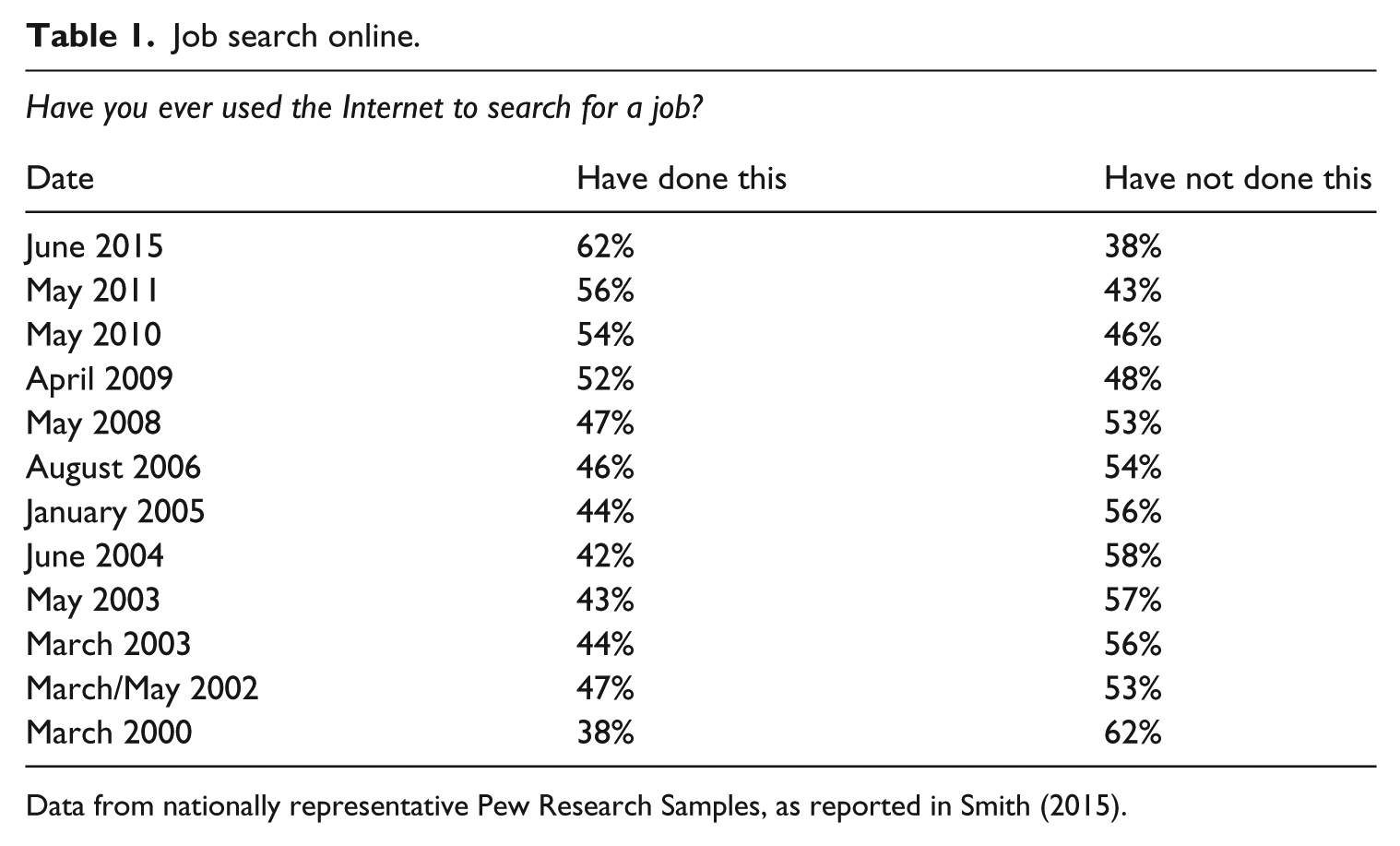
Data from nationally representative Pew Research Samples, as reported in Smith (2015).
Despite the increased availability of online job resources, studies have not, thus far, been able to “assess directly whether the Internet has had an impact on the mix of job search methods used by workers” (Kuhn and Mansour, 2014: 1215). The following sections review evidence of the changing composition of job seekers’ socio-technical networks.
A profile of the job search process
Using proprietary Facebook data combined with psychological measures, Burke and Kraut (2013) show those who recently lost a job are more likely to find a job within 3 months if they interact more with strong ties on Facebook. In their study, communication with weak ties on Facebook was not associated with finding a job. Follow-up evidence using proprietary Facebook data challenges this finding, showing that because of their numbers, weak ties are more likely to provide a job in absolute terms; at the same time, because of their willingness to intervene in hiring practices, strong tie use is more predictive of actually finding a job (Gee et al., 2017). Restated, the observed number of strong ties helping with job search is higher than expected, but the quantity of jobs found through weak ties is much larger than those found through strong ties. Although seemingly contradictory, these findings align with Granovetter’s (1983) clarification of SWT theory.
Importantly, SWT evidence shows that job sources are not used in isolation: both strong and weak ties are useful (Granovetter, 1983). Furthermore, many individuals find jobs through non-social sources like direct application and newspaper postings. Van Hoye et al. (2009) conclude “networking, print advertising, Internet and public employment service were only moderately correlated (r’s varied between .15 and .34), supporting their relevance as separate search behaviors” (p. 678, emphasis added). In the age of social Internet, it may still be the case that “personal contacts are of paramount importance in connecting people with jobs,” but the online accessibility of both social partners and dynamic review platforms changes job search (Granovetter, 1995 [1974]: 22). Stevenson’s (2009) and Kuhn and Mansour’s (2014) research findings suggest job searches using the Internet along with other sources, like personal requests, leads to faster job attainment.
Although past evidence has demonstrated networking explains variance above other job search behaviors (Van Hoye et al., 2009), SWT research has not explored how sources are used in conjunction to attain a job. Past research suggests that source or communication channel utilization may follow a logical structure. Katz et al. (2001) report that higher telephone use coincides with increased dispersed social interactions among early Internet adopters. Haythornthwaite (2002) contends that face-to-face interactions are often a supplement to online communication. That is, first individuals communicate digitally and then move to other channels including face-to-face. The evidence suggests online resources use leads to additional face-to-face interaction as well. When it comes to a job search, the use of some channel is likely associated with increases in other channels usage as well. The most suggestive evidence of the supplemental use of media with face-to-face interaction comes from Haythornthwaite’s (2005) finding that the media use across two different contexts, distance learners and scientists, formed a one-dimensional scale whereby users who “use only one medium, use the same medium; those who use two, tend to use the same second medium, etc.” (p. 130).
Like other Internet users, job seekers likely supplement online and face-to-face communication with other, perhaps complementary, methods of communication. Understanding which job search sources correspond in use reveals more than just the coincidence of overlapping methods; it can show which methods are paired by job searchers. A typology of source utilization has not been explored in the job search context. Given the variety of sources available to modern job seekers, participants of this study likely use sources in conjunction at a rate greater than chance. Thus, the following hypothesis is posed:
H1. Job search sources are used in conjunction at a rate greater than chance.
Bringing technology in the job search network
Stevenson (2009) reports that as the Internet use has proliferated in America, the number of sources used in a job search is increasing. Granovetter’s (1995 [1974]) original analysis focuses on the single source that “secured the job” and choosing how to classify sources was primarily a researcher’s judgment call (see Granovetter, 1995 [1974], Appendix B “Coding Rules and Problems”). Thus, only the most important source was analyzed in the classic study.
Recent evidence suggests that Internet sources are an important part of the modern job search and that information sources are generally used in concert, not as stand-alone resources. For instance, Brouer et al. (2015) explored the use of websites and found 65% of job seekers used Facebook, 59% LinkedIn, 31% Twitter, and 46% used resume websites like Indeed.com. Recently, the Pew Research Center, using the same dataset this study does, reported that among those who searched for jobs in the last 2 years, the most frequently used and most important source was online information and resources. A summary of all source utilization is provided in Table 2.
Job search sources.

N = 490. Americans who have sought jobs in the 2 years prior to 10 June through 12 July 2015.
In this Pew data, it is clear that the SWT hypothesis is only partially confirmed: the combined categories of weak ties (i.e. professional contacts and acquaintances) account for the largest proportion of contacts used and the second largest proportion of “the most important” sources after “online sources.” However, the importance of “online sources” signals that SWT is in need of an update. Furthermore, these respondents were later asked if they had used SNSs during the job search: 51% had used them, although participants were not given the option to select SNSs as the most important source.
The Pew data and Brouer et al.’s (2015) data highlight that individuals are using multiple, more and certainly online sources during the job search. Contractor et al. (2011) hypothesize that the use of technological resources along with human resources composes a fluid network for a social actor. Specifically, they theorize, “as technologies begin to store greater amounts of information that were once only held in the heads of people, individuals begin to ‘use’ technologies in much the same ways that they ‘use’ coworkers and friends” (p. 683). Once a technology has been integrated into the job search process, it makes sense to consider the technology as part of the network.
In summary, technology (e.g. a job information website) can be integrated into the job search network as a particular kind of contact, not just a means to access others. Technology can serve as a repository of information and provide access to resources that were previously only available through direct contact with other humans. That is not to say that humans and technologies are indistinguishable; in fact, it is often easy for a user to distinguish between humans and technologies (Pentland and Feldman, 2008). Including technological sources as nodes in social networks enables researchers to disentangle the resources utilized in the job search process and their potentially distinctive and/or combinatory effects.
Contractor et al. (2011) suggest the relationship between human and technological actors can be conceptualized as an affiliation network between human information seekers and technological repositories. For this study, job seekers could be considered one mode and the available sources (including human and non-human sources) the other mode of social network. Thus, we should ask,
RQ1. How does the inclusion of Internet-based sources affect the affiliation network of job seekers and job sources?
Past research has consistently found differences in job search techniques based on age (Granovetter, 1973), socio-economic status (Lin et al., 1981), and race (Holzer, 1987). Those who are older tend to use fewer social resources, those at higher socio-economic positions tend to benefit less from use of contacts and Black Americans tend to have and use fewer social resources. In addition, women have traditionally held fewer organizational memberships and tend to use contacts less in job attainment (Granovetter, 1995 [1974]). Meta-analytic evidence suggests that self-efficacy also positively predicts job search process (Wanberg, 2012). Online competencies are a necessary tool for reemployment efforts (Feuls et al., 2016; Gist-Mackey, 2017). However, these socio-demographic differences have not been explored in light of the changing demography of the workforce or in light of the technology usage during a job search. Therefore, the following research question is posed:
RQ2. What job seeker socio-demographic attributes are associated with source utilization preferences during a job search?
Method
This exploratory study analyzes random-digit dial data collected by the Pew Internet and American Life (2016). Pew Research Center bears no responsibility for the interpretations presented or conclusions reported. Survey respondents were asked if they had sought a job within the past 2 years; 30% had (n = 605). These respondents then answered several questions about the job search process (see “Measures”). Of these respondents, a subset of 490 (81%) received an additional question asking if they had used social media during the job search. Because of the importance of Internet sources usage during the job search, this subset of individuals (24.5% of the full sample) is included in the final analyses. Smith (2015) offers a detailed explanation of the data collection.
Measures
Survey respondents answered questions regarding their current job as well as their job search process. Respondents were asked, “Are you now employed full-time, part-time, retired, or are you not employed for pay?” Fifty-nine percent were currently employed full-time (n = 288), 19% part-time (n = 95), 4.1% of respondents were retired (n = 20), and 14% were not employed for pay (n = 70); 17 (3.4%) other participants were self-employed, disabled, students, or did not report. No differences in source use and employment status were present.
Participants were given the prompt, “People may use many different resources when looking for a job. Thinking of your MOST RECENT job search, please tell me if you used any of the following resources.” Participants were also asked, “Thinking about social media sites like Facebook, Twitter, or LinkedIn have you ever used social media to look for or research a job?” Social media use was not one of the available options for the most important source; therefore, it was not possible for participants to rank social media as the most important source. All answer options are shown in Table 2. Because the Pew dataset does not provide the open-ended response to other resources mentioned, this category was dropped from the analysis (n = 73, 12.5%).
The demographic questions included sex (nmale = 236, 48.2%; nfemale = 254, 51.8%), age (range = 18–96, M = 37.18, SD = 15.13), education (1 = less than high school, 2 = high school incomplete, 3 = high school graduate, 4 = some college, no degree, 5 = 2 year/associate degree, 6 = 4 year degree, 7 = some postgraduate or professional schooling, no degree, 8 = postgraduate or professional degree), and income (1 = less than $10,000, 2 = 10 to under $20,000, 3 = 20 to under $30,000, 4 = 30 to under $40,000, 5 = 40 to under $50,000, 6 = 50 to under $75,000, 7 = 75 to under $100,000, 8 = 100 to under $150,000 and 9 = $150,000 or more). Race was dummy coded to represent quantifiable categories; specifically, two dummy codes were created: White (White/non-White) and Black (Black/non-Black). Marital status was also dummy coded as married (married/not married).
Finally, Internet efficacy was computed using four questions based on the prompt: “If you needed to look for a new job, how easy would it be to”: with a scale ranging from 1 = very easy to 4 = not at all easy. The prompts were “Go online to find a list of available jobs in your area,” “Fill out a job application online,” “Use a social media profile or personal website to highlight your employment skills,” and “Go online to look up services and programs that are available to help job seekers.” The scale was reverse coded so higher score indicated greater efficacy (M = 3.62, SD = 0.51) and was reliable, α = .74. Because the scale was negatively skewed and leptokurtotic, the cubed score of Internet efficacy was used for analysis.
Results
The first hypothesis predicts that source utilization co-occurs at a rate greater than chance. To test H1, the job seeker and job sources data were reconfigured into an affiliation network with one mode as job seekers and the second mode as job information sources. An affiliation (or two-mode) network is a network in which the interaction between the actors (job seekers) and events (sources used) are modeled as two networks with relations between each mode. Next, a correspondence analysis, a “technique for studying correlations among two or more sets of [binary] variables” in affiliation networks was conducted (Wasserman and Faust, 1994: 334). Similar to canonical correlations or factor analysis, this technique examines covariance explained by an underlying factor. In this case, the underlying factors were types of job search.
UCINET 6 (Borgatti et al., 2002) was used to conduct the correspondence analysis, which revealed the dimensions of joint variance shared between job seekers and sources. Looking at shared variance allowed for the job seekers and job sources to be displayed in the same conceptual space. This analysis showed how actors were different or similar in terms of source utilization and “which actors and events [sources] were located ‘close’ to one another” (Hanneman and Riddle, 2005: 269). The results generated by UCINET provided numerical distances between each source used by job seekers. These results showed sources associated with one another and commonalities in their utilization, yielding a profile or typology of job search.
The analysis yielded values including factor loadings (also called an axes value) and variance proportion values called cosine-squared, which are similar to squared correlations (Bendixen, 1996, 2003; see Table 3). Bendixen (1996, 2003) recommends including factors with values greater than chance; thus, factors accounting for more than 14.3% (1/7th, one over Nsources minus one) of variance were retained and reported. Figure 1 provides a visual representation of variance explained (i.e. Cos2 values via R package FactoMineR; visualization generated by Corrplot) by each source in the four factors. The correspondence model accounts for source utilization at a rate greater than chance, χ2(4, 380) = 4943.53, p < .001, with the four factors explaining 64.6% of variance. Therefore, H1 was supported as sources were used in conjunction at a statistically significant level.
Correspondence values for job information sources.

These values are coordinates weighted from UCINET 6.6, Cos2 from R package FactoMineR refers to percentage of variance accounted for by these sources in a given factor.
Formal sources category.
Online sources category.
Social sources category.

Cosine2 values for each source by dimension (R package Corrplot).
The reported values are UCINET’s default coordinate weighting which adjusts scores for both the marginals and the eigenvalue dimension weights. The results with non-weighted values were similar. Hanneman and Riddle (2005) recommend visualizing meaningful patterns in the data with correspondence analysis. Thus, the 3D XY Scatter Chart macro (Pope, 2004) was used to visualize the first three factors from the analysis in a three-dimensional space (see Figure 2).
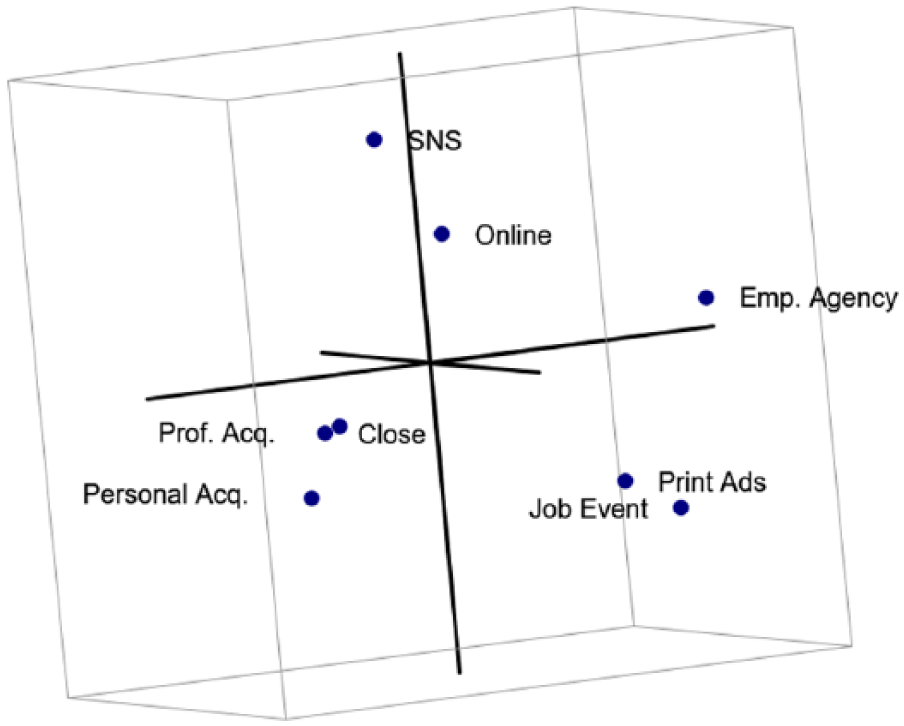
3D correspondence values for job information sources.
Both the visualizations and values indicate there were three predominant types of job search sources with the fourth factor explaining nuanced differences between distinct formal sources. The first factor accounted for 18.5% of variance and mostly accounted for differences between formal sources (i.e. job events, print ads, and employment agencies) and social/informal sources (i.e. professional and personal acquaintances, close friends, and family). The second factor accounted for 16.4% of variance and represented unique variance of the two types of online sources. Specifically, the second factor differentiated both types of online sources (i.e. online resources and information [ORI] as well as SNS) from personal acquaintances. The third factor accounted for 15.1% and distinguished print advertisements from the other formal means. The final factor accounted for 14.6% and primarily distinguished employment agencies from job events.
These results showed social and formal sources were distinct and they were different from online sources. However, not all formal sources were the same, with unique variance accounted for by distinguishing between print advertisements, employment agencies, and job events. In all, it seemed that multiple job sources were used in combination by the modern job seeker. Sources were equally grouped by which sources were and were not used together; for example, social sources were not used in conjunction with employment agencies or print ads (factor 1) and online sources were defined by their difference from both formal and social sources (factor 2).
RQ1 asked how the affiliation network of the modern job seeker changed when online sources were incorporated in the network. The average number of sources used by job seekers in this study was 4.23 (SD = 1.88). An acceptably normal distribution of source use was found with only two of 490 participants not using any of the sources and only four participants using all the sources included in the survey. The majority used several types of sources. To test for differences in types of sources, the sources were broken into the categories based on the outcome of correspondence analysis (see subscripts in Table 3). Overall, the least used sources were formal sources: still, 57.4% of participants (n = 281) used these sources. Both online sources and informal or social connections were, however, used more frequently: 86.5% (n = 424) used online sources (i.e. ORI as well as SNS) and 82% (n = 402) used social connections (i.e. close friends and family, personal and professional acquaintances). This evidence suggests that formal sources were utilized less than both online and social sources.
The network was quite full; of all possible relationships, many are present. The network density was .516 (51.6% of all possible relationships were included). A cohesion analysis, conducted with UCINET, showed that for every three-path pattern, there was a 70% chance of a four-cycle pattern being present (Xtransitivity = .70). Restated, for every source two job-seekers shared, there is a 70% chance they will share a second source. This was because transitivity equals, “the number of quadruples with 4 legs divided by number with 3 or more legs, in bipartite graphs” (Borgatti et al., 2002). That means among job seekers, there were common ways of searching for jobs. Additional investigation of this network revealed that online sources were particularly central with a degree (or number of connections with job seekers) of .81 and a betweenness centrality (or number of instances in which online sources were used in conjunction with other sources) of .35 (the next closest were professional weak ties with a degree of .67 and a betweenness of .17). Results of a full cohesion analysis are displayed in Table 4.
Centrality of job information sources in Pew data.

Degree refers to number of connections; these values match the percentages reported in Table 1. Normalized degree is relative to each other source. Eigenvector centrality explains how much of the overall differences between ties is accounted for by each source; it is the sum of eigenvalue scores. Closeness is the average distance of each source from the other sources given each actor’s ego network. Betweenness refers to the number of times a node appears in an actor’s ego network with other sources.
Across each category, it is clear that online resources and information (ORI) are at the center of the affiliation network for job seekers and job information sources. The high betweenness score, 0.35, signals that the single ORI category is the most frequently co-occurring source in actors’ job search networks. Similarly, the closeness value, 0.75, signals that the average distance from any source to ORI is very short. In other words, ORI are used in conjunction with basically every other type of source. However, close friends and family and professional acquaintances also have high closeness scores (.61 and .62), but are much lower on betweenness (.17 and .18). This may signal that while social sources are also often used in conjunction with another source, they are not used with multiple other sources. In contrast, it seems formal sources are used far less frequently in conjunction with other types of sources; the betweenness scores for employment agencies, print ads, and job events are .05, .04, and .02, respectively. Despite their low frequencies, when job seekers use such formal sources, they seem to use just those sources and use the other types less.
RQ2 asked what socio-demographic characteristics related to the affiliation network of job seekers and job resources. To examine what characteristics might correspond with job search-source networks, demographic variables and job search sources were recoded to be suitable for regression analysis. Predictor variables included age, education, sex, race, marital status, and Internet efficacy. These predictors were entered into four equations, one for each relevant criterion variable: degree (i.e. total number of sources used, exported from the affiliation network), online sources (0 = did not use online sources, 1 = used one online source, 2 = used SNS and online sources), use of personal connections (0 = no personal connection, 1 = used one type of personal connections, 2 = used two types, 3 = used three types), and use of formal sources (0 = no formal sources used, 1 = used one formal source, 2 = used two, 3 = used three). To avoid issues with multicollinearity, scales were entered into a regression model with a dummy outcome variable and collinearity diagnostics were checked using Tabachnik and Fidell’s (2013) guidelines for correlation, tolerance, and variance inflation factor scores.
Degree, or number of sources used, was not related to any socio-demographic variables (p = .749). The second regression tested online sources and the model was significant: F(8, 412) = 3.63, R2 = .066, p < .001. The significant predictors of the online source usages were education (β = .101, B = 0.036, p = .058) and Internet efficacy (β = .191, B = 0.008, p < .001). Thus, those with higher levels of education and perceived Internet efficacy were more likely to use online sources.
For the third regression on social sources (i.e. personal connections), the model was not significant (p = .720). Finally, for formal sources, the model was significant: F(8, 411) = 2.39, R2 = .044, p = .016. The significant predictors of the formal sources usages were age (β = .115, B = 0.008, p = .031) and income (β = –.134, B = –0.051, p = .019). Thus, those who were older and had less income were more likely to use formal sources. Socio-demographic differences did not seem to be present for overall number of sources or for social source usage. This result may indicate that regardless of gender, race, socio-economic status, and age, job seekers utilized personal connections. However, some socio-demographic predictors such as age, education, and income affected online and formal source use.
Discussion
This exploratory study describes the affiliation network of job seekers and job information sources, including online sources, using a nationally representative sample from the Pew Internet and American Life project. Results provided heuristic evidence about SWT theory and demonstrated online sources have become at least as important as social (human and in-person) sources to job seekers. Despite the prevalent use of many different types of sources, correspondence and cohesion analyses revealed meaningful patterns of job sources used in conjunction. Regression analyses demonstrated older and poorer adults used formal sources more; furthermore, job seekers with more education and computer efficacy used Internet-based sources more. Certain job seekers may benefit more from their social position and knowledge. In all, including technological sources as nodes in the job search network illuminates significant patterns of job source use.
Initially, each source in the affiliation network just represents one type of source, not necessarily a single source. In other words, the typology provided in this analysis is about types of sources used together rather than individual sources used together. A job seeker may have referenced several close friends and family and only one online resource. Alternatively, a job seeker may have used 38 webpages but only one career fair; each type of source represents one connection in this dataset. There are millions of contacts and websites and thousands of formal sources a job seeker could use. Therefore, this should be thought of as an affiliation network of job seekers and types of sources at the macro or global level (Contractor et al., 2006). These data reflect a network-of-networks tapped by job seekers.
Job seekers use a particular type of source at the cost of not using other types of source. The high transitivity value of the affiliation network shows that when a job seeker uses two sources, it is also highly likely that another job seeker will use the same two sources together. In other words, source overlap is quite frequent when sources are categorized by their type. In general, it seems job seekers turn to either social, online, or formal sources, but the overlap between each of these types varies from person to person. While online and social source are commonly used together, formal sources are more frequently utilized in isolation. This finding is compounded by the RQ2 results which show older and poorer Americans are more likely to use formal sources and those with higher level of education and Internet efficacy are more likely to use online sources. The use of formal sources by older and poorer job seekers may suggest job search processes are fundamentally different among those groups, perhaps leaving them at a “double” disadvantage. In contrast, the findings about Internet efficacy affecting online source use mirror past research suggesting efficacy enables successful job searches (Wanberg, 2012).
The commonly used dichotomy between strong and weak ties (e.g. Harvey, 2008; Yakubovich, 2005) may be arbitrary when online/technological sources are considered. Based on the correspondence analysis findings, close connections and professional acquaintances were closely linked to each other, blurring the conceptual lines between strong and weak ties. Professional acquaintances, traditionally considered weak ties, were more closely linked to close friends and family (i.e. strong ties) than to other type of weak ties, such as personal acquaintances. This is surprising given calls by researchers to distinguish ties based on strength (e.g. Marsden and Gorman, 2001); but, it is also intuitive given many ties fall somewhere between strong and weak (Granovetter, 1983). Perhaps Burt’s (1992) argument that tie strength is a correlate of relationship, not a cause of interaction, explains this finding. All personal connections loaded together in the correspondence analysis and shared similar values across network centrality measures. Distinguishing between strong and weak ties may be less important than distinguishing between formal, social, and online sources. Furthermore, it is plausible that these dimensions reveal a propensity for a type of search rather than types of source. Some people may see the job search as a social network (i.e. relational) task while others see it as an information search task conducted privately. Future research can benefit by considering tie strength as a continuum, how online sources alter the network of job seekers, and how job seekers compartmentalize sources during the job search process.
The pattern of information seeking during the job search provides practical insight. Some are social job seekers, some are online job seekers, and others use printed ads, agencies, and networking events to find jobs. However, virtually all job seekers turn to several sources, not just one, during the search. Job seekers and job hunting coaches would do well not only to search the broad social network (Granovetter, 1973) but also to expand their types of networked connections both on- and offline. When job seekers are in a proverbial rut, unable to find work, the solution may be recognizing the types of sources they are using. Using a variety of source types may be a competitive advantage for the modern job seeker (Burt, 1992). Given past evidence showing that the use of additional sources above a few can lead to reduced job attainment (Blau and Robins, 1990), those who are struggling with the job search may need to consider using different types of sources rather than additional similar sources.
Distinct types of job information sources have relative advantages and disadvantages. The Internet is continuously available to many, but not all, job seekers in terms of both access and ability. Formal sources such as job agencies and printed ads can have highly concrete and clear information about available jobs; simultaneously, formal sources are less flexible in terms of timing, access, and modifiability. Job applicants cannot obtain insiders’ perspectives on potential jobs and organizations through formal sources. Contrastingly, informal sources such as social connections and online sources can be highly accessible and flexible, but the accuracy of job information provided by those informal sources may be dubious without verification. Future research should investigate what benefits and diminishing returns are experienced with additional source type use during the job search. At what point does adding more contacts to one’s job search network increase or reduce overall effectiveness of search?
On its face, these data challenge the SWT theory that the majority of jobs came from weak ties (Granovetter, 1973). At least as many jobs seem to come from online sources as do from weak human ties. Perhaps this is because strong ties and online sources are more effective bridges today with the always-on Internet than in the past (Bruggeman, 2016). Strong social connections may be willing or able to connect job seekers with information found via additional online research. For example, imagine a job seeker’s close friend is a particularly adept Internet user for whom search comes easily. The job seeker may reap the benefits of a bridging strong tie because of this friend’s skill. In contrast, the reduced importance of weak social connections prompts researchers to question whether websites connecting a job seeker to others online represent a weak or strong tie, or something else entirely. Haythornthwaite (2002, 2005) suggests that websites connecting us to previously unknown others allow for the activation of latent ties. Latent ties transform into weak ties once they are called upon. In this sense, latent tie theory is confirmed if websites are used to call upon weak connections. Additional research is needed to investigate what attributes job seekers assign to websites and the strength of online ties. Even the strength of tie with online sources is called into question when the scope of a job seeker’s social network is expanded to include technological sources (Contractor et al., 2011).
Demographic findings may reveal social inequality in access to job information. For example, Feuls et al. (2016) found social media usage provides contact with others, can structure daily activities, and fills time in a personally meaningful way for some unemployed individuals. Our results showed older job seekers and those with less income were more likely to turn to formal sources. This finding may signal formal sources are less popular with younger individuals because they are more familiar with Internet use than are older adults. Perhaps formal sources are more cheaply and easily accessible than social sources (e.g. visiting the unemployment office is easier than building new relationships). Alternatively, information about the types of jobs younger people look for (e.g. entry level) may be disseminated differently than those older Americans seek.
Non-significant demographic effects for social sources may represent the changing nature of workforce. This challenges some previous findings about discrepancies in network use related to gender and race (Holzer, 1987). Still, older and poorer Americans may benefit from expanding beyond formal source types. However, the finding that Internet efficacy relates to online source use validates evidence suggesting that disadvantaged individuals have less access to online sources (McQuaid et al., 2004). Those who felt better able to use the Internet for job search and who were more educated did so in the present study. Those who feel ill-equipped to apply for jobs online may be missing out on essential job search resources (Gist-Mackey, 2017).
The Internet is enabling a shift in social relationships with benefits materializing through a critical mass of use (see Table 1 and Kraut et al., 2002). Still, future research should ask if there are diminishing returns with using the Internet as number of users increases. In network terms, the value of a structural hole (or a disconnected part of a network) is negatively related to the number of people who have access to it (Bruggeman, 2016). In the case of job information on the Internet, most Americans are turning to online sources. Thus, online resources may be less capable to provide novel information because of their ubiquitous use.
Strengths, limitations, and future directions
The national random-digit dial sample provides a high level of generalizability for these findings. The data were revealing as a typology of job search sources seems to be present in the information sources used by American job seekers. Job seekers are using online information and social media now more than ever and the importance of these resources are clear given this study’s findings. It seems that Americans use all sorts of social connections together perhaps even parlaying contacts from weak to strong ties as part of the job search process.
The most internally differentiated source of job information, but least used, was formal sources. Still, more than half of American job seekers turn to these formal sources. Older and poorer job seekers see more value in printed advertisements, career events, and employment agencies. However, in line with traditional SWT theory, formal sources were rated as the least important; the “most important” sources were both social and online sources. Each source has advantages and disadvantages; for instance, formal sources are less dynamic than a conversation with a strong or weak connection or a vast database of employee reviews (e.g. Glassdoor.com). Thus, the modest role of formal sources, in this study, confirms the SWT hypothesis. Social connections and, now, online sources seem to be the most important sources of job information for the modern job seeker.
This study is not without limitations. Although the analysis was based on a robust and random dataset, it was a secondary data analysis. Therefore, the survey questions were not originally created for the study detailed here. Measuring tie by relationship category likely conceals meaningful variation that might come from measuring tie strength directly (Marsden and Gorman, 2001). Furthermore, online sources or those contacted via SNSs could be strong, moderate, weak or even latent ties, but it is not possible to know that based on these data (Haythornthwaite, 2005). This study examines a socio-technical network and as one anonymous reviewer pointed out, modality is not mutually exclusive in relation to relational closeness. Future research would benefit from measuring tie strength as well as type of job source. While this study demonstrated that formal sources were less important than social ties, in support of the SWT theory, the inability to distinguish between strong, moderate, and weak ties of job seekers within the various online and informal sources made it infeasible to address other aspects of SWT.
The findings that job seekers use some sources while not using others and Internet efficacy affects the search have both theoretical and practical implications. Efficacy and motivation are key to reemployment (Wanberg, 2012). Job coaches and researchers may need to consider the role of skill and experience with various sources types. In this national sample, some job seekers seem to lag behind in areas that may help increase reemployment. Future research would do well to (1) include websites as distinct job information sources and (2) consider skill and means as part of the reemployment equation. Because job search is viewed differently by individuals, reframing the search may provide one key to a successful search.
Finally, these data cannot answer how and why job seekers turn to the sources as they do during the job search. Simply put, these findings do not demonstrate benefits of using one type of source over another, nor do they explain job seeker motivations to use a particular source. Questions remain about why job seekers tend to use online sources. Perhaps these sources provide high-quality information or easy access. Certainly, the ubiquity of online information sources (including accessing social sources through SNSs) is changing the modern job search. At the same time, searching for information online affords job seekers the ability to discreetly look for jobs. This anonymity means that job seekers who are already employed can look for another job easily and those who are unemployed, know how to access the Internet, and have the means to do so can avoid the social stigma associated with being unemployed (Gist-Mackey, 2017). Furthermore, the low use of formal sources could be related to the inability of these sources to influence employers (relative to social sources) or some other source attributes. Perhaps other job seeker attributes, such as task familiarity and network composition, determine what sources are used during the job search. Future research on job search source utilization and motivation is needed.
Footnotes
Acknowledgements
Pew Research Center bears no responsibility for the interpretations presented or conclusions reported based on analysis of the data. This research is part of the first author’s dissertation, co-chaired by the second author. The authors wish to thank co-chair Dr. Michael Kramer and the other committee members at the University of Oklahoma for their insights and feedback. The authors would also like to thank the anonymous reviewers for their helpful feedback.
Funding
The author(s) received no financial support for the research, authorship, and/or publication of this article.
