



Abstract
This study explored how job seekers perceived human and technological sources in their sociotechnical ego-networks. United States residents (N = 285) who had sought jobs in the past 2 years responded to questions about their perceptions of sources used during the job search (n = 1297). Participants rated each source they used across a variety of perceived attributes. We measured tie strength using an amalgam of frequency of interaction and closeness, and strong tie sources included humans contacted online and in-person as well as websites. In contrast, the weakest tie sources were direct online application, employment agencies, and career events. Results showed a newly developed perceived bridging scale, social support, ease of access, and homophily were all positively related to tie strength. Influence was negatively related to tie strength. Information quality was not related to tie strength. We discuss implications for network and job search research, theory, and practice.
Keywords
The modern job search is marked by technological ubiquity (Fetherston, 2019; Garg & Telang, 2018; Nikolaou, 2014). Approximately 80% of Americans use the Internet during their job search and 27% claim online resources were their most important resource (Piercy & Lee, 2019). Today, job seekers move fluidly between asking others about job opportunities and searching online databases for information. Websites (e.g., Indeed.com, LinkedIn) serve as information repositories and provide access to resources previously only available through direct contact with other humans. Job seekers use social contacts (i.e., friends and acquaintances), online resources (i.e., job boards, review websites), and traditional sources of job information (i.e., career fairs, employment agencies) forming a sociotechnical job search network (Contractor et al., 2011). Information available online through search engines, social-networking sites, review websites, and other sources offers unique value to job seekers (Gossett & Kilker, 2006). This study investigates how perceived job information source attributes relate to tie strength in the job seekers’ sociotechnical ego-networks.
Though it generally remains easy for a user to distinguish between human and technological sources (Contractor et al., 2011; Pentland & Feldman, 2008); in practice, job seekers use their finite time to interact with sources they deem capable of providing key resources. Still, why job seekers turn to particular sources, and not to others, remains relatively unknown (Wanberg et al., 2020). In addition to seeking information and influence, other perceived source attributes like ease of access, social support, homophily, and perceived bridging ability may also drive source utilization.
To date, research has generally focused on either human or technology as a job information source. Given the prevalence of using technological sources, considering them as communication partners (or nodes) in job search networks along with human connections enables researchers to compare the effects of various job information sources relative to tie strength. Using Strength of Weak Ties (SWT; Granovetter, 1973, 1974[1995], 1983) and Lin’s (1999, 2001) network contingencies theory, this study explores the ego-network of recent job seekers. We follow Shumate et al.’s (2013) call to explore the antecedents of “communication flow networks” by focusing on “node resources. . .and perceptions of others” (p. 105). Specifically, we examine how job seekers ascribe relevant source attributes to sources of varying tie strengths. Findings reveal how perceived source attributes match and differ from classical network assumptions about tie strength, and offer implications for business communication and network theory. We next present the theoretical background guiding hypotheses and research questions.
Strength of Weak Ties
Granovetter (1973, 1974[1995]) theorized SWT to explain how job seekers find information about job opportunities. Though SWT has been investigated extensively, with more than 58,000 citations on Google Scholar, debate surrounding tie strength abounds. Granovetter (1983) reviews the basic premise of the SWT: “Our acquaintances (weak ties) are less likely to be socially involved with one another than are our close friends (strong ties)” (p. 201). Weak ties are more likely to have access to novel information than strong ties (Granovetter, 1974[1995]). This study seeks to clarify assumptions about tie strength (e.g., information quality, bridging ability) while considering both traditional and technological job information sources.
The elegance of SWT theory comes in the counterintuitive, but mathematically probable, relationships proposed: There are proportionally more weak ties in one’s social network and weak ties are far more likely to offer access to disconnected parts of the network (Granovetter, 1974[1995]). Further, strong ties are more likely to get to know one another over time than are weak ties. Restated, our close relationships form more tightly-connected and redundant networks. In contrast, our weak ties have access to their own close friends and acquaintances. Because weak social connections are in different social circles, they have more potential to offer novel information and access to inaccessible resources than do strong ties (Granovetter, 1974[1995]).
The counterintuitive predictions of SWT theory have garnered research attention across fields (e.g., Barbulescu, 2015; Burt, 2005; Haythornthwaite, 2005; Smith, 2012; Yakubovich, 2005). The theory has yielded significant advances in social network research (Marsden & Campbell, 2012). However, the multifarious ties available in the changing media landscape mean the definition of ties is ripe for additional exploration (Burke & Kraut, 2013; Chen, 2014; Gee et al., 2017). When job seekers use technology alongside humans as information sources (Contractor et al., 2011; Sundar et al., 2013), they likely attribute different qualities to sources of varying tie strength. This study looks at a variety of sources co-existing in a single ego-network to capture the source attribute-tie strength relationship across various types of ties.
SWT as Communication Phenomenon
Granovetter (1983) calls SWT a “communications argument” (p. 202). The theory proposes communication with strong and weak social connections differs. Communication with close others is elaborated (laden with complex shared meaning); whereas, communication with weak connections is restricted (simple, direct messages with explicit meaning). In all, the SWT argument focuses on whom one talks to in accomplishing a task, like finding a job.
Sharing job information is not without costs (Watzlawick et al., 1967). Sharing information or making recommendations based on relationships incurs penalties if it leads to negative outcomes (e.g., an ineffective worker may reflect poorly on the recommender). Growing evidence suggests when sharing job information with others knowledge about the character and life-circumstances of the potential target is important. Specifically, Smith (2012) proposes cognitive and affective perceptions of strong ties led some participants to not share job information. If a job seeker is a close contact but is also known to be a poor worker, a referrer is not likely to share job information (cf. Marin, 2012). Inquiring about jobs also requires workers to leverage relationships (Gist-Mackey, 2018). These costs affect where one routes their question (e.g., to a database or social-networking site; Oeldorf-Hirsch et al., 2014). Thus, job seekers use communication to form and activate networks, and communication in and out of their networks becomes critical in finding employment (Gist-Mackey, 2018).
This study uses an ego-network approach to examine how job seekers perceive a variety of alters (i.e., job sources) in terms of relevant information criteria and tie strength (Crossley et al., 2015). Ego refers to the central social actor being investigated, the job seeker. Alter refers to any information source to which the ego is connected (e.g., sister, Glassdoor.com, Midwest Career Expo). Finally, perceived tie strength is defined as a combination of closeness to a source and frequency of interaction with a given source during the job search (Marsden & Campbell, 2012). Below we explore how various source attributes relate to tie strength.
Network Contingencies and Tie Strength
The network approach to studying job search offers insight into how network structures both facilitate and constrain job search. Job search is aided by social connections who have access to quality information. However, another important component of network utilization is a job seekers’ perceptions of information sources. A friend who is perceived to have power over hiring may be more beneficial than a friend with no power. Put simply, a network actor’s perception of alter-attributes influences how the actor leverages their network (cf. Burt, 2005). Thus, the present study focuses on the attributes job seekers ascribe to the sources they used during job search. This approach fits a network research tradition focusing on perceived network attributes and flow in communication networks (Shumate et al., 2013).
Lin (1999) presents two foci of network interactions to explain how resources are transferred through a network: embedded resources and network positions. Embedded resources come from alter-attributes, including information the alter has access to which the ego does not. For instance, a job seeker may benefit from a contact’s information when that person is willing and able to share the information. Embedded resources both enable and constrain individual choices and actions (Lin, 2001). A job seeker may think contacting an influential source is helpful, but if the job seeker does not know any alter who can influence, their ties lack embedded resources. Granovetter (1973) defined strength of ties (SOT) by embedded resources: SOT “is a (probably linear) combination of the amount of time, the emotional intensity, the intimacy (mutual confiding), and the reciprocal services which characterize the tie” (p. 1361). Few studies have attempted to integrate or measure the intuitive components of SOT. Granovetter’s original study used only interaction frequency to trichotomize ties, and many follow-up studies have repeated this pattern (e.g., Yakubovich, 2005).
In contarst, the network position approach focuses on ability of alters to serve as bridges to unique information. Network positions refer to how close or far an actor is from resources in the network. For a job seeker, network position is akin to being connected to a source with unique information and which can offer access to otherwise inaccessible information (i.e., bridge). Weak ties are often able to offer novel information because of their network positions (Granovetter, 1973).
When it comes to network use, the resources available to an individual flow from both alter-attributes (i.e., embedded resources) and alters’ ability to connect across otherwise impassible social boundaries (i.e., network positions). Therefore, communication network researchers are obligated to consider not only network structure but also the kinds of resources the ego associates with each alter. Both the opportunity and decision to communicate with any given alter dictate how job seekers access networked information sources (Obukhova & Lan, 2013).
Embedded Resources
Information
SWT theory posits informational benefits are the primary advantage of weak ties (Burt, 1992, 2005; Granovetter, 1973, 1974[1995], 1983). Job seekers have access to more novel information through weak ties (Granovetter, 1974[1995]). Thus, information quality, the ability of ties to provide novel information during the job search, is central to SOT. Su and Contractor (2011) ingeniously tested consultants information seeking from both human and nonhuman sources. Human sources were used when they were perceived to have expertise and technological sources were used when they were expected to provide a large quantity of knowledge.
Technology shortens the distance between a job seeker and job information (Fountain, 2005; Haythornthwaite, 2005). Further, it is easier and cheaper to access information from weak ties online (Rozzell et al., 2014). Recently, increased use of media has been associated with increased information attainment during the job search (Nikolaou, 2014). Put simply, when job seekers perceive information is available from a source, it is likely they contact that source (Fountain, 2005; Granovetter, 1974[1995]). If SWT theory’s premises hold, the added availability of weak ties online should give rise to easy access to high-quality information (cf. Garg & Telang, 2018; Gee et al., 2017). Therefore, we hypothesize:
Influence
Strong ties are useful because of their willingness to exert influence. Influence refers to the ability to advocate on behalf of the job seeker (Granovetter, 1983). This could be a friend putting in a good word, a career-focused website (e.g., Indeed.com, Researchgate.com) recommending opportunities, or a website revealing who works for a given company (e.g., LinkedIn). Recent evidence suggests weak ties are often more likely to exert influence than are strong ties (Barbulescu, 2015; Marin, 2012; Smith, 2012). These studies speculate weak ties are willing to exert influence because ‘sticking one’s neck out’ for a stranger does not incur the same social costs as vouching for a close friend or family member. In contrast, among Chinese job seekers the use of social connections (i.e., guanxi) in occupational attainment has both increased over time and become more reliant on strong ties (Bian & Huang, 2015). Studying a Russian community, Yakubovich’s (2005) speculated: “When a tie leads to an intermediary whose main resource is the ability to provide referrals, motivations become crucial and stronger ties are better at ensuring it” (p. 418). Given these mixed findings, and the growing potential for technological sources to influence, we ask:
Accessibility of source
One of the benefits of strong ties is they are obliged to help because of existing relationships (Granovetter, 1983). Strong ties, by definition, make themselves accessible, but may not always be willing to assist considering the costs associated with helping (Marin, 2012; Smith, 2012). In mediated contexts, weak and latent ties tend to be more accessible due to the low cost of contacting others online (Haythornthwaite, 2005; Rozzell et al., 2014). Complimentarily, strong ties are accessible because of the low burden associated with asking a close connection to help (Granovetter, 1983). Since both strong and weak ties may be easily accessible, especially via mediated channels, we ask:
Social support
Social support is “information and actions” which help a person feel cared for, esteemed, or valued (Rozzell et al., 2014, p. 273). Social support, provided by social networks, is crucial to reemployment (Bolíbar et al., 2019). Traditionally research assumes non-close others do not provide support (Granovetter, 1983). But recent evidence suggests both weak and strong ties are capable of providing social support online (Rozzell et al., 2014). Further, job seekers gain support from their social connections online (e.g., commenting on a status update; Bolíbar et al., 2019; Fieseler et al., 2014). Internet use facilitates exchanging social support, which leads to increased job seeking behavior. Still, scraped Facebook data shows more interactions with stronger ties on Facebook led to faster job attainment and greater levels of social support (Burke & Kraut, 2013).
Support takes many forms including talking with others about the job search process, or helping to create job materials (Gist-Mackey, 2018). Job seekers who received support from others online engaged in more active job search behavior (Fieseler et al., 2014). Still, increased contact with strong ties on Facebook led to increased perceptions of support and decreased unemployment duration (Burke & Kraut, 2013). The majority of research suggest social support is a benefit conveyed by strong ties. Thus, we propose:
Homophily
Finally, homophily, or the tendency of network actors to connect with similar others, serves as one of the foundational principles of social network formation (Lazarsfeld & Merton, 1954). The job search is not immune to this “basic organizing principle” that birds of a feather flock together (McPherson et al., 2001, p. 416). Further, critiques of SWT research emphasize the importance of homophily in network formation and demonstrate some of the value of contacts used during the job search can be attributed to homophily (Mouw, 2003). In other words, the ubiquity of homophily in networks accounts for meaningful variance in how people choose ties. Therefore, we predict:
Network Positions
Lin (1999) contends network positions compliment embedded resources in explaining network interaction. Burt (1992, 2005) and Granovetter (1973, 1974[1995]) argue the benefits of weak ties derive from the structural positions they assume. As above, this section focuses on perceived network composition, highlighting how actors’ perceptions affect perceived SOT.
Bridging contacts
Burt (1992) argues bridging ties, rather than weak ties, provide novel information. A bridge is an alter that connects otherwise separated portions of a network (Wasserman & Faust, 1995). A bridging tie is able to connect the information seeker to previously inaccessible resources in the network. Websites like Glassdoor.com and Indeed.com serve as a bridge between a job seeker and human ties more than one network step away. These websites share information on culture, pay, interviews, or other business details between the reviewers and information seekers. The website is a bridging tie because the source, whom the information seeker is not directly connected, is only available through the website.
Granovetter (1974[1995]) acknowledges jobs were often found through bridging ties. For instance, in interviews Granovetter found 39.1% used direct connections whereas 60.9% connected through intermediaries (i.e., bridging ties). To this end, Granovetter concludes that ties which bridge, not just strong or weak ties, offer valuable information. But, statistically these bridges are usually weak ties (Burt, 2005).
Thus, scholars examining SWT have routinely treated weak ties as bridging connections (Burt, 1992). Weak ties are not inherently useful; instead, a weak tie that bridges to connections in otherwise inaccessible networks (i.e., structural holes) is useful. SWT focuses on accessing novel information through weak ties, and the Internet is making weak ties more accessible (Haythornthwaite, 2005). Further, the modern social web is making unknown secondary ties available through social aggregations of data and accessible network structures (Kim et al., 2018). Thus, we predict:
Bridging ties are important in the process of finding a job. These brokered connections served as the best lead for jobs among those in China (Bian & Huang, 2015). Websites create “more and shorter paths” to novel information (Granovetter, 1973, p. 1365). Indeed, the Internet serves as a “labor market intermediary” (Fountain, 2005, p. 1255). Assuming job seekers see the job information websites as valuable storehouses of information (e.g., Indeed.com hosts millions of job opportunities), they ought to perceive websites have the highest bridging ability. Therefore, we predict:
Finally, the relationship between technological job information sources and longstanding sources (i.e., employment agencies, weak social connections) deserves additional examination (Wanberg et al., 2020). Both strong and weak ties are more accessible via new media platforms. Anyone can call up an unknown other in a chat room or find information from a business insider on an employer review website. In addition, asynchronous messaging allows us to request help from strong and weak ties any time and receive a response at their convenience. Mediated-communication often facilitates relationships with latent ties, those with whom a tie is available but has yet to be activated through interaction (Haythornthwaite, 2005). Websites like Glassdoor.com, Indeed.com, and even Craigslist offer such latent connections. Haythornthwaite (2005) explains, “a new medium. . .(1) creates latent ties, (2) recasts weak ties – both forging new ones and disrupting existing associations – and (3) has minimal impact on strong ties” (p. 136). Applying this reasoning to job search, we ask:
Method
Sample
Participants (N = 285) lived in the United States and were recruited from Amazon’s Mechanical Turk (MTurk) between January and February of 2017. Participants were required to have sought employment in the last two years and paid $5.00 for completing this 30–45-minute survey. By using attention check questions, open-ended questions, and manually screening the data, MTurk offers a high-quality sample at low costs (Cheung et al., 2017). Compared to a convenience sample of undergraduate students or a pool of participants from a single organization or industry, MTurk has a participant pool more varied in age and work-experience (Shank, 2016).
Participants completed a survey regarding the information sources (n = 1,297) used during their job searches. Participants’ age ranged from 19 to 62 years old (M = 35.81, SD = 9.03, Med. = 34). Slightly over half of participants were male (52.2%, n = 149). Most participants reported having a college degree (n = 182, 63.9%) while the rest reported high school degree or less. The majority were Caucasian (n = 246, 86.3%).
Many participants had never married (n = 139, 48.8%), 37.2% were married (n = 106), and 14.0% were divorced, widowed, or separated (n = 40). One hundred twenty-eight participants (44.9%) reported a household income of less than $40K per year, 76 (26.9%) between $40K and $70K, 79 (27.7%) earned more than $70K per year, and two participants (0.7%) did not answer. Participants came from 42 different U.S. states. Most participants were employed at the time they completed the survey (80.0%, n = 228) with 16.5% unemployed (n = 47) and looking for work, and ten reported being unemployed and not currently seeking work.
This sample is slightly younger and more educated (both p < .001) than the U.S. population, but sex did not differ, χ2(1) = 0.18, p = .671. This sample is also limited in racial composition. Network utilization differs by race (Mouw, 2003), and this sample most closely represents Caucasians’ networking.
Measures
To reduce participant burden, shorter versions of measures were utilized whenever possible. Survey items were scrutinized for suitability across the variety of sources. Measures focus on perceptions, based on attributes the job seeker perceives each information source possesses, and SOT with each source. Thus, we embrace the ego’s view of their network.
Job information sources
The Current Population Survey (CPS) has served as the basis for much research on job search (Kuhn & Mansour, 2014; Mouw, 2003; Mukoyama et al., 2018). We used CPS and recent Pew data (Piercy & Lee, 2019) to strategically chose ten sources which: (1) represent the common sources used during job search and (2) capture ties of various strengths. The job information sources included both online and offline relationships. The list consisted of: close relational partners contacted in-person, acquaintances or professional contacts in-person, close relational partners contacted online, acquaintances or professional contacts online, websites (e.g., Monster.com, LinkedIn.com), company websites, in-person application, employment agencies, print ads, and job fairs. Participants could also select an “other” option.
For all ten sources, we asked participants to name the tie (e.g., “Please write the first name or title (e.g., Jane, sister)” for this job information source). This prompt makes the identity of job information sources salient and populates the name of each source into subsequent questions about each source’s attributes. Table 1 details participants’ source utilization and SOT.
Closeness and Frequency of Interaction by Source.

Note. The SOT measure is the sum of IOS plus frequency of interaction scores (standardized on a 7-point scale). Sources with significantly different SOT values were tested using the Bonferroni multiple comparison correction. Sources that vary in SOT at the p < .05 level are marked with superscriptsa throughh. The reference source-type is marked with an apostrophe (’); for example, Websites (c’) are significantly different (p < .05) from all other sources except strong tie in person, strong tie online, and job board/listserv.
For each source used, participants also answered questions about SOT. Afterwards, participants were presented with randomized source attribute scales (e.g., information quality, influence, etc.) with the name of the source they entered piped into the question’s text. Table 2 below presents bivariate correlations between all variables.
Pooled Bivariate Correlations between Study Variables.
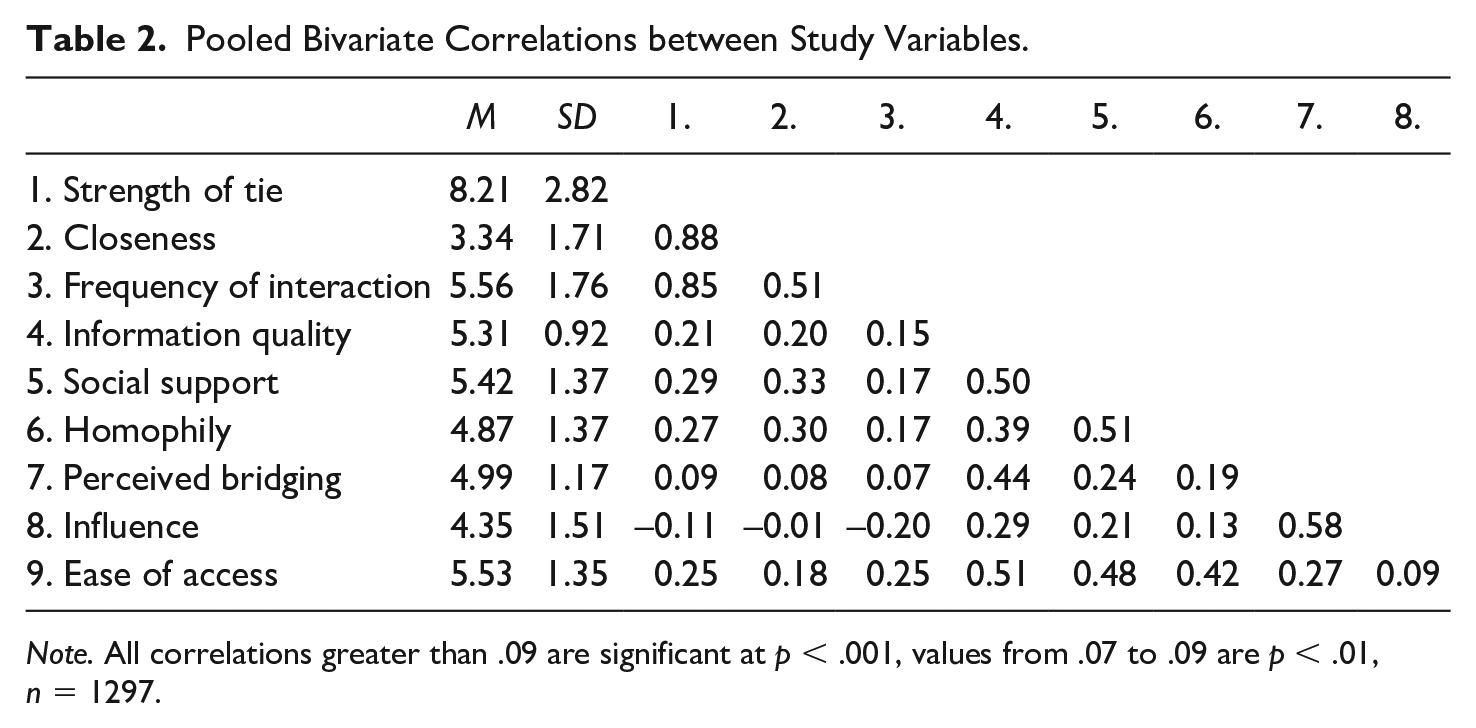
Note. All correlations greater than .09 are significant at p < .001, values from .07 to .09 are p < .01, n = 1297.
Strength of Tie
SOT is the primary outcome variable. Literature generally argues for two measures of tie strength: closeness and frequency of interaction (Marsden & Campbell, 2012). Closeness was measured using the inclusion of other in the self (IOS; Aron et al., 1992) scale. The IOS scale has good discriminant and convergent validity compared with more complex closeness scales (Gächter et al., 2015). IOS does so with only one item, a pictorial representation of the other and self as progressively overlapping circles (see Figure 1). Past research has used this as an indicator of SOT (Rozzell et al., 2014). Participants were asked to, “select the picture that best describes your current relationship with the source.”

Inclusion of other in the self (IOS): Relationship closeness measure.
Additionally, frequency of interaction (Granovetter, 1974[1995]) was used to capture SOT (1 = Never, 2 = About once a year, 3 = Several times a year, 4 = Every few months, 5 = Monthly, 6 = Weekly, 7 = Several times a week, 8 = Daily). Though closeness and interaction frequency are separate constructs, they are considered fundamental to SOT (Marsden & Campbell, 2012). Table 1 shows closeness and frequency of interaction values for each source; they were combined to create the SOT variable (r = .51, Spearman-Brown = 0.67).
Source Attributes
Information quality
Information quality was measured using a truncated version of Sun et al. (2015) scale. Participants were prompted with “[Source] provides job information that is. . .” and five completion words: accurate, objective, complete, relevant, and novel (1 = strongly disagree to 7 = strongly agree). The scale was reliable (Cronbach’s α = .84).
Perceived influence
A modified version of Anderson et al.’s (2012) sense of power scale was used to measure influence. Respondents answered how well a source was capable of influencing others on a 7-point scale (1 = strongly disagree to 7 = strongly agree). The scale adaptation focuses on perceived power of others. Participants responded to seven questions including: “[Source]’s wishes do not carry much weight with a hiring organization,” and “I think [source] has a great deal of power over a hiring organization.” The scale was reliable (Cronbach’s α = .94).
Accessibility
This study used two items from O’Reilly’s (1982) scale of perceived accessibility. This scale items were: “How accessible or easy is it to get job information from [source]?” (1 = not easy at all, 7 = very easy) and “How difficult is it on average to get information from [source]?” (1 = very difficult, 7 = not difficult at all). The scale was reliable (r = .51, Spearman-Brown = .77).
Social support
A truncated social support measure (Rozzell et al., 2014) was used to test perceived social support. Participants were prompted with “Interactions with [source] are:” Participants responded on a 7-point scale to three semantic differentials: “supportive/not supportive,” “positive/negative,” and “encouraging/not encouraging.” This scale was reliable (Cronbach’s α = .96).
Homophily
Perceived homophily was measured using a modified version of the attitude homophily developed by McCroskey et al. (1975) and an item from Andersen and de Mancillas (1978). Three, 7-point semantic differentials were used to measure perceived homophily: [source] “is like me/is unlike me,” “is different from me/is similar to me,” and “has goals similar to mine/has goals different from mine.” The scale was reliable (Cronbach’s α = .88).
Perceived bridging ability
Bridging estimates have been available only when whole network data or name inter-relators are collected (Burt, 1992). However, the concept of a network bridge is well documented in the literature (Burt, 1992, 2005; Wasserman & Faust, 1995). Therefore, a scale was developed for this study in order to test job seekers’ perceptions that a job information source can span a structural hole.
Using existing literature, five items were developed to measure bridging ability. Participants were asked the extent to which they agreed on a 7-point scale that each source could connect them to otherwise inaccessible job information: “[Source] is capable of connecting me with information I could not otherwise access,” “[Source] serves as an intermediary between myself and the job I sought,” “[Source] is not able to connect me with potential employers,” “[Source] is not capable of connecting me with others who have valuable information about the job I sought,” and “[Source] is connected to employers who I could not access otherwise.”
A confirmatory factor analysis was conducted using the R package lavaan (v. 0.6-3; Rosseel, 2018) and the DWLS estimator, to verify the factor structure of this newly developed scale. The fourth item, which loaded poorly on the latent (R2 = .29) and shared similar wording with the third item, was excluded yielding a sufficient model fit: χ2(2) = 10.37, p < .001, χ2/df = 5.19, RMSEA = .06, 90% CI[.03, .09], CFI = 1.00, SRMR = .02. The four-item scale was reliable, Cronbach’s α = .81.
Analysis
These network data presented an issue with repeated responses from each participant, commonly called autocorrelation. Though participants were randomly presented with questions about sources, additional statistical techniques were necessary to address this interdependence in the data (Crossley et al., 2015). We used multi-level modeling (MLM) with fixed and random effects. Specifically, variables in hypotheses and research questions were entered as fixed effects and participant ID and source as random effects. This allowed us to test for the relationship between source attributes and SOT while controlling for both individual interdependence in participant responses and between-source effects. We conducted a power analysis using the R-package SIMR (Green & MacLeod, 2016) with small fixed-effect (0.10) and random-effect (1.00) estimates for the number of participants (N = 285) and sources (10 types, n = 1,297). We used SIMR to generate 1,000 Monte Carlo simulations, ensuring the model was sufficiently powered (Power = 90.40%, CI [88.40, 92.15]).
Results
For H1 through H4 and first two RQs, we constructed an MLM predicting SOT using the R package lme4 (v. 1.1-21; Bates et al., 2019). We constructed this model using a build-up approach, whereby each indicator was iteratively entered. This approach yielded a model fit value (Δχ2) demonstrating incremental improvement and estimates for each variable (see full model summary in Table 3 and summary in Supplemental Table A). We initially computed an intercept-only model then entered the random effects. These random-effects models both significantly improved model fit with both the addition of participant ID, Δχ2(1) = 68.50, p < .001, ICCparticipant = 0.19, and source effects, Δχ2(1) = 365.69, p < .001, ICCsources = 0.26. Including these random effects controls for source effects and allows for hypothesis testing associated with SOT regardless of source. Below, we report incremental model fit improvement and the coefficients from the final model (the rightmost columns in Table 3).
Multilevel Model Estimating Strength of Tie (SOT).
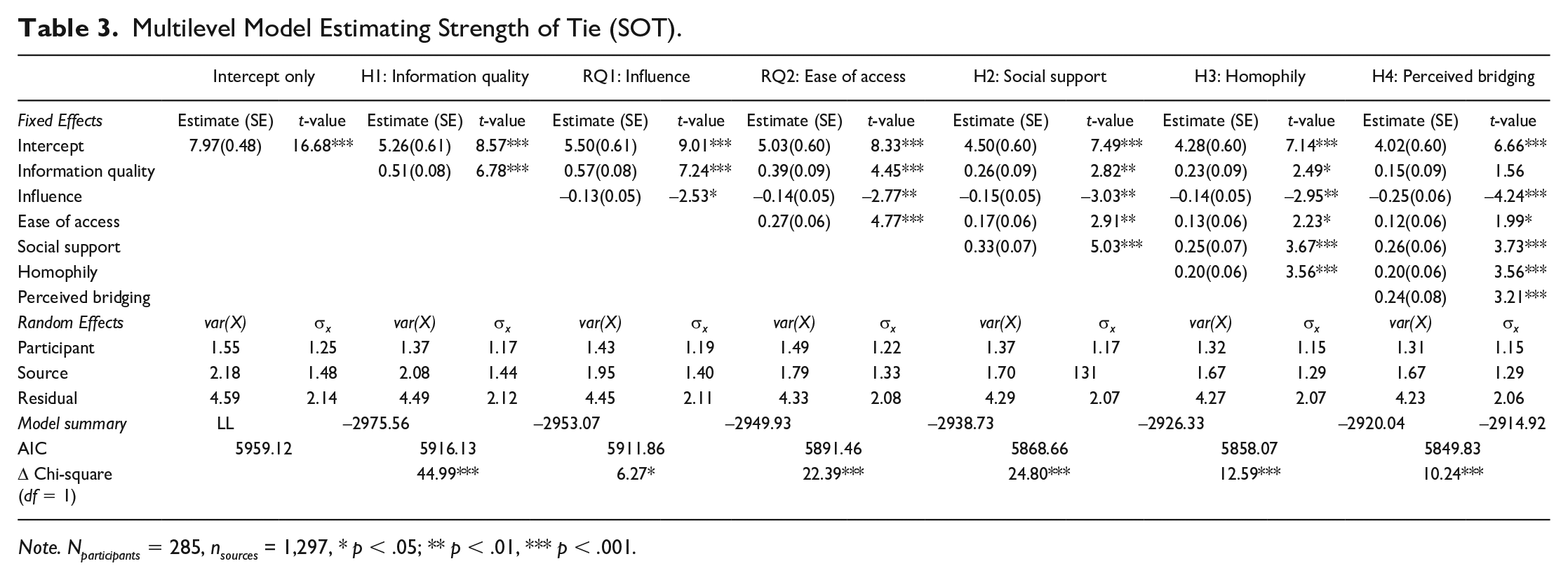
Note. Nparticipants = 285, nsources = 1,297, * p < .05; ** p < .01, *** p < .001.
Information quality (H1) was added first. The model fit improved significantly, Δχ2(1) = 44.99, p < .001; however, the relationship did not persist in the final model, t = 1.56, p = .120. Thus, H1 was not supported. Influence (RQ1) was added next, which significantly improved the model, Δχ2 (1) = 6.27 p = .012 and negatively predicted SOT in the final model, t = -4.24, p < .001. Therefore, higher influence was related to weaker ties.
Ease of access (RQ2) positively predicted SOT, Δχ2(1) = 22.39, p < .001; t = 1.99, p = .046. Therefore, easier access is attributed to stronger ties. Social support (H2) was added to the model and significantly improved fit, Δχ2(1) = 24.80, p < .001; t = 3.73, p < .001. This finding supports H2, higher social support is associated with stronger ties. Homophily (H3) was entered into the model next. It significantly improved model fit, Δχ2 (1) = 12.59, p < .001, and remained an influential predictor in the final model t = 3.56, p < .001. H3 received support; more perceived similarity with the job information source was related to stronger ties.
Perceived ability to bridge (H4) was the final variable entered in this MLM. Perceived bridging ability significantly improved model fit, Δχ2(1) = 10.24, p < .001. Perceived bridging was positively related to SOT: t = 3.21, p = .001. Contrary to H4, higher levels of perceived ability to bridge were associated with stronger ties. In sum, MLM results supported our predictions that social support and homophily were positively related to SOT. Against hypotheses, perceived bridging ability was also positively associated with SOT. Answering the research questions posed, ability to influence was negatively and ease of access was positively associated with SOT. Surprisingly, job seekers’ perceptions of information quality did not significantly relate to SOT.
We constructed two additional MLMs to examine the relationship between type of source and SOT (RQ3) and perceived bridging ability (H5). Following the procedures outlined above, these MLMs also fit significantly better with the inclusion of participant ID for both SOT, Δχ2(1) = 68.50, p < .001, ICC = .18, and bridging, Δχ2(1) = 68.75, p < .001, ICC = .18. While the SOT model differed significantly based on source, Fcorrected(1197.30) = 218.75, p < .001, the perceived bridging model did not, Fcorrected(1198.10) = 1.47, p = .23. Thus, the answer to RQ3 is different types of job information sources were significantly associated with varying SOTs. However, H5 was not supported as different types of sources were not significantly related to perceived bridging ability.
Post hoc tests using estimated SOT means and the Bonferroni correction are presented in superscripts in Table 1. Broadly, job information sources differed as follows: strong ties contacted online and in-person had the highest SOT ratings; websites and job boards were the second highest; weak social connections and employment agencies, third; direct applications, fourth; and career events were the weakest source. In all, the sources used by job seekers varied in terms of SOT across both social and technical sources.
Discussion
Network actors’ perceptions affect how they use available information sources because perceived communication networks “function as a set of rules and resources that actors draw upon in accomplishing communication behavior” (Corman & Scott, 1994, p. 181). This study compliments existing SWT research with ego-based perceptual measures of job information source attributes, including technological sources. These findings are important to understand network motivation with various types of ties a modern job seeker uses and reinforce previous theorizing that actors move fluidly between human and technological sources in practice (Contractor et al., 2011; Sundar et al., 2013).
The findings demonstrate network perceptions do not directly match the probabilistic structural effects of networks (i.e., Granovetter, 1973). Network actors associate attributes to ties based on myopic perceptions. Perceived bridging ability, accessibility, homophily, and social support were positively associated with stronger ties. Though a whole-network approach can clearly demonstrate the benefits of bridging weak ties, a job seeker’s ego-centric view of the network generally favors stronger ties. This result highlights how sociotechnical networks, with ties of varied strengths, present opportunities for business communication and network theory. Specifically, we argue aggregated social websites are both human and technological network connections which demand researchers’ attention. Websites provide access to humans (e.g., ‘friends’ on Facebook or strangers on Indeed.com) and represent meaningful ties that can be tapped during job search.
Though many studies only capture SOT via interaction frequency, we used a combination of frequency and closeness measures. Considering only frequency of interaction ignores those ties actors feel close to, but do not interact with often (e.g., siblings, grandparents at a long-distance) and over-represent ties with whom one interacts frequently without closeness (e.g., coworkers, websites, employment agencies). Specifically, measuring closeness to and frequency of interaction with different types of sources (including technological sources) together yields a reliable and replicable measure of SOT suitable for a wide variety of sources. When technology is called upon for information once only available through social interaction, a fluid sociotechnical network has been formed (Contractor et al., 2011). Future research ought to explore social and technological sources using measures applicable to both types of sources.
We also created a new scale to measure perceptions of a network connection’s bridging ability. Because this measure was perceptual, it only captured how the actor considered sources, not the sources’ actual ability to bridge in the network. However, the measure was reliable for both human and technological sources and measured tie perceptions in increasingly common sociotechnical contexts (Sundar et al., 2013; Wanberg et al., 2020). This measure speaks to how network actors perceive structural holes (Burt, 1992; 2005). Sources with higher perceived bridging ability had stronger tie strength. The role of weak ties in spanning network boundaries seemed less apparent to network actors than it is to network theorists. Future research should explore this perceptual disconnect between network reality and actor perceptions.
Job seekers in our sample showed a positive bias toward strong ties (Burt, 1992; Lazarsfeld & Merton, 1954). They did not perceive job information sources in SWT terms. Higher homophily, supportiveness, ease of access, and, rather surprisingly, perceived bridging ability were all related to stronger ties. Homophily may explain actors’ positive bias, as McPherson et al. (2001) claim “similarity breeds connection” (p. 41); and, perceived homophily was attributed to stronger ties in this study. However, the inverse may also be true: connection breeds similarity—and other positive traits. Ties one is close to and interacts with frequently are considered trustworthy, committed, obligated, and motivated to help (Lin, 2001). With the exception of influence, job seekers associated more positive traits with stronger ties.
Job seekers seemed to have matched their communication needs to the job search task through increased interaction and closeness with stronger ties, both human and technological. For example, websites were significantly stronger ties than either weak social ties (both online and offline) or traditional job information sources. Through media use, network actors are able to parlay the latent ties accessible through websites into stronger ties quickly and efficiently during a job search. Though this is primarily driven by increased interaction, closeness is a meaningful correlate. Strong ties, like a romantic partner, are often available to talk at nearly any time; analogically, websites and job boards are easy to access. These findings suggest online interactions (with both repositories and people) allow network actors to recast weak and latent ties into stronger ties as part of the task. The conceptualization of SOT may need to be (re)defined and (re)interpreted based on the context of the communication network. In a job search network, a technological sources such as Indeed.com can be considered stronger ties than human acquaintances who may offer less support or be more difficult to access.
Despite power to detect an effect, there was not a significant relationship between information quality and SOT. This shows a difference between SWT predictions and perceived networks. There are two explanations for this finding; first, in the iterative MLMs information quality was initially significant, but fell out when other predictors were added. Thus, information quality was trivial relative to other attributes associated with SOT. Additionally, this finding could be related to the increased use of (strong tie) online resources by all job seekers. Past research showed human sources as superior information providers to databases (Su & Contractor, 2011); however, recent evidence suggests online review information can be more influential than social relationships with others (Kim et al., 2018). Perhaps the perception that online review websites provide information from a much larger pool of people who have relevant experiences explains this finding. Unknown others accessed online can provide both credible and useful information. Therefore, this study’s findings reveal a bias in how job seekers see and use ties. Websites and job boards (e.g., the COMMnotes job postings), rated as strong ties, were perceived no better or worse than human sources at providing quality information.
Moderating relationships may also explain the null relationship between information quality and SOT. Evidence suggests weak ties are unable to communicate complex or elaborated information (Granovetter, 1983; Hansen, 1999). Indeed, websites (with their relatively high SOT rating) can carry quite complex views of organizations (e.g., culture, pay, interview questions). It seems unlikely a connection would be used frequently if the information it yielded was low quality. Alter-trust also affects perceived information usefulness (Levin & Cross, 2004). Additional research should investigate the complexity of information and trust in source as potential moderators between information quality and SOT.
Even more surprisingly, perceived source influence was negatively related to SOT. Though this is inconsistent with early SWT theory, it matches subsequent findings. Specifically, qualitative evidence from Smith (2012) and Marin (2012) demonstrated weak ties were willing to influence more than stronger ties. This finding adds to empirical evidence linking weak ties to influence in job search. This perception aligns with classic and recent evidence suggesting weak social connections have greater potential to and tend to hold positions that facilitate vertical moves for job seekers (Chen, 2014). More research is needed to clarify what benefits ties of varied strength offer at different stages of job search (Barbulescu, 2015).
Inaccurate network perception can have tangible outcomes for organizing. While job seekers rate ties as varying in strength, they do not see the benefits of their job information sources as network theory does. This makes sense because network actors are not well-equipped to accurately leverage the benefits and pitfalls a whole network can offer due to their lack of structural viewpoints. At best, a person can see one or two steps away from the self in the network (Bruggeman, 2016). Job seekers disproportionally rely on their strong ties including both human and technological sources; but, overreliance on strong ties might inhibit job attainment (Piercy & Lee, 2019). One explanation for job seekers’ reliance on stronger ties is easy access, especially in the case of websites. This justifies the increased use of online sources during the job search: high availability at a low cost. Future SWT studies must acknowledge that both network actor perceptions and nature of tasks affect network utilization.
Limitations and Future Directions
This study was not a direct test of SWT theory. To test SWT, the study would need to focus on the most helpful source during the job search. We did ask participants to rate their most important source (see Table 4). Many participants (44.6%, n = 127) reported websites were the most important; the next highest category was direct online application (13.3%, n = 38). Overall, 91.6% of the sample used websites. Thus, this study was a contemporary test of the job search and SWT. Our results help account for the modern information environment marked by mediated partners and databases. It appears websites and job boards/list servs fell in-between human strong and weak ties, and these socio technical sources occupied more central positions within job seekers’ information network (Piercy & Lee, 2019).
Self-Reported “Most Important” Sources.

Although job seekers may not have an accurate knowledge of the network structure, they can intuitively recognize websites carry more information from diverse groups of people with relevant experiences (i.e., crowd sourcing; Kim et al., 2018). The availability of websites allows near-ubiquitous access to human sources in terms of both quantity and speed. Thus, scholars might question whether technical sources like review websites (e.g., Glassdoor.com) ought to be considered non-human. As much as they are non-human (technological), they also bring other humans’ experiences to a network actor.
This study is unable to causally identify how ties change over the course of a job search, though recent evidence suggests tie strength varies across the search (Barbulescu, 2015). Additional clarification of the temporal components (including relational persistence) of SOT is needed. Like a high school classmate or long-lost cousin (whom one knows but does not often interact with), an information rich web-environment (e.g., Craigslist.com) could be considered ‘strong and important’ for a short-term in obtaining job information. A longitudinal study of job search processes, or other information-seeking task in which ties are temporarily made stronger or weaker, is needed. Both the task and perceived source attributes are important in network actors’ decision-making.
Conclusion
The counterintuitive wisdom of SWT is weak social connections are particularly helpful in providing novel information to job seekers because of their bridging network positions (Granovetter, 1973). Job seekers perceive benefits of both strong and weak ties, but disproportionally rate stronger ties as possessing more positive attributes. This study’s findings highlight the implications of increased access to job search sources (both human and nonhuman) via the Internet. Perceived source attributes are related to SOT, but do not match known network compositions. Models predicting SOT across sources show perceived influence is associated with weaker ties while greater support, perceived bridging, easier access, and more similarity with job seekers are attributes of stronger ties. This study adds to our understanding of actors’ myopic actions within their perceived networks. Perceptions of network-driven tasks (e.g., job search) affect how actors approach the task, especially as networks begin to include both human and technological sources.
Supplemental Material
Supplemental_Table_A – Supplemental material for Reconsidering ‘Ties’: The Sociotechnical Job Search Network
Supplemental material, Supplemental_Table_A for Reconsidering ‘Ties’: The Sociotechnical Job Search Network by Cameron W. Piercy and Sun Kyong (Sunny) Lee in International Journal of Business Communication
Footnotes
Declaration of Conflicting Interests
The author(s) declared no potential conflicts of interest with respect to the research, authorship, and/or publication of this article.
Funding
The author(s) received the follwing financial support for the research, authorship, and/or publication of this article: This article is based on the first author’s dissertation co-advised by the second author and Dr. Michael Kramer. Data collected in this manuscript were funded by the University of Oklahoma Graduate College Robberson Research and Creative Endeavors Grant and the Department of Communication Dissertation Grant.

Supplemental Material
Supplemental material for this article is available online.
Author Biographies
References
Supplementary Material
Please find the following supplemental material available below.
For Open Access articles published under a Creative Commons License, all supplemental material carries the same license as the article it is associated with.
For non-Open Access articles published, all supplemental material carries a non-exclusive license, and permission requests for re-use of supplemental material or any part of supplemental material shall be sent directly to the copyright owner as specified in the copyright notice associated with the article.
