



Abstract
Much of the research involving perceived characteristics of so-called “gamers” has been directed at deconstructing traditional stereotypes associated with the term. As gaming has become mainstream, research has investigated the changing nature of the term “gamer” as well as the factors which influence the perceptions of gamers. This study extends the literature by examining modern perceptions of “gamer” among a set of college-age adults. The study explores factors which impact self-identification as a “gamer” and uses content analysis to explore perceived characteristics of gamers. The results confirm that previously found factors influencing self-identification (frequency of play, gaming in the social network) still correlate with the “gamer” identity. The results also show that while traditional stereotypes still persist, the perceived meaning of the term “gamer” may be evolving. These results provide a foundation for future examinations of the gamer identity and provide insight into the evolution of the traditional gamer stereotype.
Introduction
The past 20 years have seen a widespread growth in the global video game industry as well as demographic changes in who plays these games. The available statistics indicate that gaming communities are more diverse and more connected than perhaps ever before (Entertainment Software Association, 2018). Game players are commonly referred to as “gamers,” though concrete definitions of the term are challenging at best (Deshbandhu, 2016). However, the term “gamer,” representing a socially constructed identity is often tied to traditional stereotypes. These stereotypes are commonly perceived as negative and exclusionary and contrast with available data about the game-playing population. The term “gamer” brings with it a set of underlying assumptions about the individuals adopting this label. Beyond just individual perceptions, “gamer” can color conceptions of the wider game culture (Shaw, 2010). As gaming has become more socially acceptable, it raises the question as to whether the perceived characteristics of a “gamer” have evolved as well and what factors may play role in this identity formation.
This study extends the existing literature on gamer identity by examining modern perceptions of the term “gamer” among a set of primarily college-age adults. The purposes of this research are twofold. First, this study investigates the factors which may impact self-identification as a “gamer,” including gender, frequency of play, duration of exposure to video games, and gaming within one’s social circle. Second, this study uses qualitative techniques to explore characteristics attributed to “gamers” by the study participants. By examining the characteristics reported by both self-identified gamers and non-gamers alike, this study attempts to uncover the implied meanings associated with the “gamer” label. The results of this study will provide a foundation for future examinations of the gamer identity and provide insight into the evolution of the traditional gamer stereotype.
Background
Traditional perceptions of “gamer”
The term “gamer” is generally accepted to mean, at a minimum, those individuals who play digital games as a leisure or professional activity (Shaw, 2012). The traditional gamer stereotype is often perceived as negative and exclusionary. The traditional perceptions of “gamer” involve a young, typically White male, who is both socially inept and professionally unsuccessful or, at the very least, idle and unmotivated (Deshbandhu, 2016; Evans and Janish, 2015; Kowert et al., 2014). Gamers have also been perceived as overweight and unattractive (Kowert et al., 2014). Gamers are traditionally perceived as heterosexuals (Shaw, 2012). “Gamer” encompasses a wide spectrum of player activity, ranging from causal gamers—those who tend to play positive, simple games—to so-called hardcore gamers—those who devote significant time and effort to gaming and enjoy more negative, complex games (Juul, 2010). Gamers are often thought to be obsessive about their games and game play, including a desire to continually challenge themselves with the latest games (Kerr, 2006; Shaw, 2010). This extreme focus is thought to block out other socially accepted activities such as dating or professional achievement.
Modern perceptions of “gamer”
Over time, gaming has become a socially acceptable form of entertainment (Consalvo and Paul, 2013; Williams et al., 2008). The acceptance of gaming in the United States is exemplified by the penetration of gaming into households: as of 2017, 64% of households owned at least one gaming device, and 60% of Americans were said to play video games daily (Entertainment Software Association, 2018). As gaming has become more widely ingrained into the American culture, a number of studies have attempted to debunk the traditional gamer stereotype. Williams et al. (2008) argued that the traditional gamer stereotype has been largely disproven by both academic scholarship and the wider culture, though a review of the literature suggests that elements of the stereotype persist among gamers and non-gamers alike.
Persistence of the negative stereotype
Studies which have examined the negative gamer stereotype have focused on the core elements of gender (male-centric), race/ethnicity (White), and social ineptitude (including physical activity levels, professional achievement, and social interactions). For example, Kowert et al. (2014) conducted 2500+ interviews to determine if online game players exhibited commonly accepted gamer stereotypes such as unpopularity, unattractiveness, idleness, and social incompetence. Their study found that online gamers did not exhibit the stereotype more than non-gamers, though the study found significant inverse relationships between the level of gaming involvement and exercise frequency, social support, and employment success. Other studies point to the sheer volume of popular games that involve a protagonist who is a White, heterosexual male displaying hypermasculine traits as evidence that the traditional gamer stereotype is still salient (Evans and Janish, 2015). Williams et al. (2008) found that while the “young” stereotype was no longer applicable, the male-focused stereotype persists. Euteneuer (2016) also argues that video games are still viewed as a male-centric activity. One reason for this perceived gender gap is the frequency and amount of game play by males and females. Prior research suggests that while females do play games, they often play less frequently than males in their age bracket, on average (Royse et al., 2007).
Stereotypes can be reinforcing. Research into the impact that traditional gaming stereotypes have on female participation (e.g. Cote, 2017; Kaye et al., 2018) has suggested a reinforcing effect between gender-based stereotypes and female identification as “gamer” as well as female participation in gaming communities. For example, Vermeulen et al. (2017) found that perceptions of male discrimination in gaming may lead female game players to avoid and/or reject the “gamer” label, thus reinforcing the traditional negative stereotype of gaming as a male-dominated activity. The #GamerGate movement may have also deterred some players from adopting the “gamer” label. A backlash against perceived feminist influence, GamerGate was fueled by fear that the traditional White-male-hetero gamer identity was under attack by a more diverse population of players, leading to harassment and threats against prominent female community members (Evans and Janish, 2015). Paaßen et al. (2017) argued that the male-dominated stereotype persists because females are not highly visible within the gaming community and that such dominance negatively impacts female participation in the community. The perceptions that members of a group believe outsiders have about them (meta-stereotypes) can play a role in self-perceptions about the group and its relations with “outside” groups. For example, Steltenpohl et al. (2018) found that members of the fighting game community (FGC) felt misunderstood by other groups, including the media, though less so by those groups with whom the FGC community had shared interests or values (e.g. gaming affiliation). The FGC group perceived negative stereotypes as being present among outsiders, though they were largely perceived as inaccurate, out of date, and the result of inadequate research or engagement.
Concerns over a lack of diversity in gaming have persisted even as gaming has grown in popular acceptance. Studies on the relationship between gaming frequency and race/ethnicity are limited, though existing race-oriented gaming studies have focused on the transference of social prejudices and stereotypes to online gaming outlets (e.g. Gray, 2012; Harrell, 2009; Higgin, 2009) as well as the lack of diverse representations in many games and game elements (e.g. Gardner and Tanenbaum, 2018; Passmore et al., 2017). Recently a number of scholars have examined the exclusion of LGBTQ community from traditional gamer perceptions, including the persistent issues in producing games and characters which reference different sexual orientations (e.g. Condis, 2015; Evans and Janish, 2015; Shaw, 2012). The lack of diversity in the traditional gamer stereotype has not gone unnoticed by the gaming industry, especially since the number of females playing games has grown over time. An estimate by the Entertainment Software Association (2018) suggests that females aged 18 and older comprise more of the gaming population than males aged 18 and younger. In recent years, game media companies have attempted to be more inclusive in terms of marketing and game development, with varying results. Research by Shaw (2012) argues that the marketing of games to specific categories—for example, gender, race, and sexuality—may have a negative effect rather than broadening the participation of these groups. Shaw argues that the greater diversity in the construction of the medium will necessarily broaden participation. In contrast, Euteneuer (2016) argues that different groups do have different experiences in their day-to-day lives, and thus games must acknowledge those differences. Play is contextual, and the virtual spaces afforded by games should be reflective of the wider context and the unique characteristics of the players. Rather than simply swapping one group for another in character formation, for example, inclusion of diverse characters should involve group-specific traits and experiences rather than a generic outline.
Sociality
The issue of whether active game players are socially inept has been challenged in light of the movement toward more socially active gaming spaces. The growth of the Internet since the 1990s has enabled social connectivity like never before, albeit in virtual rather than physical terms. This connectivity has led gaming to move increasingly away from isolated, individual gaming experiences and toward networked, multiplayer games. This progression has led to reexaminations of the term “gamer” and its perceived social isolation; in fact, some now consider the modern gamer to have a great propensity for community and social activity (Shaw, 2010; Zhang and Kaufman, 2015).
The potential for gaming-based social interaction is most often seen in massively multiplayer online role-playing games (MMORPGs) such as World of Warcraft. These MMORPGs represent a modern forum for long-term social interaction and community building (Williams, 2006). MMORPGs often promote the long-term evolution of a player’s virtual character(s), and the virtual communities offered by these games are active places of commerce, social interaction, and game play (Griffiths et al., 2003; Steinkuehler and Williams, 2006; Yee, 2006; Zhang and Kaufman, 2015). This growth in MMORPGs is said to offset the decline in traditional social spaces used for community building (Williams, 2006). Participation in these virtual communities can provide social support for participants, including both online and offline issues, as well as a sense of community (O’Connor et al., 2015). Participation can promote both meaningful relationships and a sense of belonging, the latter of which is considered a fundamental human need (Zhang and Kaufman, 2015). In fact, social bonds are said to strengthen after playing these games (McGonigal, 2011).
Gamer identity is a socially constructed identity; as Shaw (2015) points out, gamer identity is heavily influenced by sociality. Participation in the virtual communities afforded by MMORPGs can represent a new source of social capital. Social capital, defined by Putnam (1995) as those elements of social life which facilitate mutually beneficial cooperation, has two faces. Social capital is both an individual resource involving relationships with others as well as a collective resource created via social interactions (Zhang and Kaufman, 2015). Games provide not only a means of accruing social capital but also an outlet for identity expression and experimentation (De Grove et al., 2015). Identity itself implies both similarity and difference: it implies both individuality and group membership (Buckingham, 2008). Social Identity Theory suggests that individual identity is shaped according to the social group, though the relationship is bidirectional (Neys et al., 2014). The influence of peers and friends on gamer identity formation should not be discounted, as both groups have previously been shown to be important elements of personal identity development (Meeus et al., 2002). An argument can therefore be made that self-identification as a gamer may be influenced by the level of social interaction experienced while gaming or by the influence of gamers within the immediate social network.
The impact of personality
Given the traditional perceptions of “gamer,” behavioral and personality theories have been abundantly applied and developed in the gaming literature. Some studies have argued in-game behavior is similar to a players’ behavior in the real world; personality drives behavior in everyday life, so it stands to reason that in-game behavior would be similarly influenced (Worth and Book, 2015). A number of studies have attempted to form models of player motivation, in the hopes of explaining why people game, what games they choose, and how they game. Much of the prior motivation-based research derives from communication research, specifically a focus on gaming to satisfy certain needs such as diversion, arousal, challenge, or social interaction (Neys et al., 2014). For example, Yee’s (2006) examination of MMO players found 10 motivational subcomponents from the three primary motivations of achievement, social, and immersion, including subcomponents of competition, escapism, and building supportive relationships. Kallio et al. (2011) extended the work of Yee to identify a multidimensional categorization of player mentalities. Three components were formed into a heuristic model—intensity, sociability, and games actually played—and the study results suggest that gaming mentalities are complex, multidimensional phenomena which are socially and culturally constructed. The study suggests that the multiple contexts and experiences of gaming and game players necessitate a multidimensional analytical approach rather than generic categorization.
Prior studies have also examined how the gamer identity is formed by game players. Deshbandhu’s (2016) ethnographic study of how gaming identity is formed suggests that self-definitions of game players are driven by the games played, the patterns of play, and the perceived relationship with gaming in general. De Grove et al. (2015) surveyed high school students to identify why game players attribute the term “gamer” to both themselves and to others. The results showed that frequency of play was the most significant predictor that an individual would consider themselves a gamer, though youth and a tendency to play core game genres were also found to be significant predictors. Similar to prior studies, females were less likely to identify as “gamer.” In terms of extending the term “gamer” to their social network, the amount of game talk and play frequency were significant predictors of whether participants applied the “gamer” term to their friends; the amount of joint play with friends was not a significant predictor. Gaming frequency may also impact the strength of in-group beliefs about stereotypes; research by Vermeulen and Van Looy (2016) found that gaming frequency was a predictive factor in the level of stereotypical beliefs held by female game players—in short, more frequent gaming meant less belief in negative stereotypes about gaming among females.
The duration of exposure to games and gaming can have a significant impact on the self-perception of being a gamer. For many individuals born since the 1970s, video games have been a part of their life from an early age. Gaming companies such as Atari, Sony, and Nintendo have long been part of the cultural landscape and represent a pop culture touchstone for multiple generations. This mainstream integration of gaming has coincided with societal shifts including an increased female presence in the workforce and a greater proliferation of digital technology (Williams, 2003). Continuing to play games from childhood through adolescence and beyond can impact self-perception as a gamer, as childhood and adolescence are considered a key era in forming an identity (Zemmels, 2012).
Methods and procedures
Purpose and research questions
This study builds on the work of De Grove et al. (2015), Deshbandhu (2016), and others to investigate modern perceptions of the term “gamer” and the factors which influence those perceptions. There are two purposes of this research. First, this study investigates the factors which may impact self-identification as a gamer, including gender, frequency of play, duration of exposure to video games, and gaming within one’s social circle. Second, this study uses qualitative techniques to explore the perceived characteristics of a “gamer” among a sample of college-age adults, including both self-identified “gamers” and those who do not identify with this label. This exploration is intended to investigate the current implied meanings of the “gamer” label to identify which elements of the traditional stereotype persist and how “gamer” perceptions have evolved beyond the stereotype. The study explores the following research questions:
RQ1. What factors are related to self-identification as a “gamer”?
RQ2. What are the currently perceived characteristics of a “gamer”?
This study utilizes both quantitative and qualitative techniques. For RQ1, the following set of testable hypotheses were proposed:
H1. Males are s.ignificantly more likely to self-identify as a “gamer” than females.
H2. Self-identification as a “gamer” is positively associated with the frequency of game play.
H3. There are significant differences between males and females in frequency of game play.
H4. Self-identification as a “gamer” is positively associated with the duration of exposure to video games.
H5. There are significant differences between males and females in the duration of exposure to video games.
H6. Self-identification as a “gamer” is positively associated with the number of immediate social groups who play video games.
H7. There are significant differences between males and females in the number of immediate social groups who play video games.
Hypotheses H1–H3, H6, and H7 are similar to those found in prior research; by testing these hypotheses, we can assess whether traditional outcomes persist among the study sample. Hypotheses H4 and H5 are based on the idea that the duration of exposure to games and gaming activity plays a significant role in whether or not an individual self-identifies as a “gamer.” In this context, duration of exposure is defined as the number of years in which participants have been playing video games.
For research question RQ2, qualitative content analysis was used to uncover perceptions of the term “gamer” among the study participants. This approach differs from Deshbandhu (2016) in which it includes the perceptions of self-identified gamers and non-gamers alike.
Sampling and data collection procedures
Students from five campuses of a state university in the northeastern United States were solicited to take an electronic survey. The author worked with a set of faculty members from multiple disciplines at four of these campuses to recruit students. This solicitation included direct e-mail requests from course instructors during the 2017–2018 academic year. Specific courses used for recruitment were in the disciplines of computing, engineering, business, criminal justice, and economics, though most courses were general education courses open to students of all majors. At the fifth campus, additional students were recruited via a posting on the University’s StudyFinder site. Identical surveys were administered using SurveyMonkey (for students recruited from classes) and the university’s Qualtrics software license (for StudyFinder recruits). The student population was chosen as out of convenience, though this youthful population is not an uncommon source of data in the gaming literature (e.g. De Grove et al., 2015; Royse et al., 2007; Sherry et al., 2006; Worth and Book, 2015).
The survey included both open-ended and closed-ended questions, facilitating both qualitative and quantitative analysis of the response data. The survey included a set of closed-response questions regarding common demographics, the prevalence of gaming within the respondents’ social circle (parents, friends, and significant others), the frequency of game play, and the duration of gaming exposure. A single open-ended question was used to allow respondents to list five perceived characteristics of gamers. This open-ended response was intended to provide respondents an opportunity to express their own perceptions about those who identify with the term and to ascertain whether modern perceptions of “gamer” align with the traditional stereotype.
Method of analysis
Quantitative and qualitative techniques were used for analysis. For the stated hypotheses, survey data was examined using SPSS with standard statistical techniques. For the second research question, qualitative content analysis was employed to uncover currently perceived characteristics of so-called “gamers” among the survey respondents. NVivo qualitative analysis software assisted in the coding, re-coding, and interpretation of results. All study methods and procedures were approved by the Penn State Office of Research Protections.
Results
Sample demographics
The survey collected 238 responses, though not all respondents answered all questions. Percentages are therefore reported based on the number of responses for the specific questions. Respondents included 130 males (64.03%, n = 203; 35 non-responses) and 73 females (35.96%). Respondents were asked to identify their age group using a set of categories (1 = 18–30 years old, 2 = 31–40 years old, 3 = 41 years old or more). As can be expected from the population of study, 96.57% (n = 204; 34 non-responses) reported being in the 18- to 30-year-old age category (M = 1.03, SD = 0.18). A majority of respondents reported a major in a computing or engineering discipline (57.07%, n = 205; 33 non-responses), while 17.07% self-reported as a social science major and 9.27% as a natural or health science major. A non-trivial portion of participants (16.59%) reported their major as “undecided” or “other.” Diversity by race and ethnicity was limited in the sample. A total of 68.78% (n = 205; 33 non-responses) self-identified as White/Caucasian, 19.51% self-identified as an Asian or Pacific Islander, 8.78% identified as African-American or Black, and 7.32% identified as Latino or Hispanic. A total of 6.83% (n = 205) selected more than one race or ethnicity.
Gamer identification and gaming behavior
A majority of the participants self-identified as a gamer (57.81%, n = 237; 1 non-response) while 37.55% did not self-identify as a gamer and 4.64% were unsure. The results show that survey participants are active game players. Participants were asked to report the frequency at which they play video games through the question, How often do you play video games? Participants were given a 9-level scale in which to respond (1 = I do NOT play video games, 2 = Less than once a month, 3 = Between once a month and once a week, 4 = 2 days a week, 5 = 3 days a week, 6 = 4 days a week, 7 = 5 days a week, 8 = 6 days a week, 9 = 7 days a week). The majority of participants reported playing video games at least 2 days per week (59.75%, n = 236; 2 non-responses) with 19.49% playing video games daily. Only 16.10% reported that they do not play video games.
Exposure to gaming was a long-term prospect for the participants. Participants were asked to report their duration of exposure to gaming through the question, How long have you been playing video games? Participants were given a 5-level scale in which to respond (1 = I do NOT play video games, 2 = 1–5 years, 3 = 6–10 years, 4 = 11–15 years, 5 = 16 years or more). The majority of participants reported playing video games for 6 years or more (74.79%, n = 234; 4 non-responses) with 24.36% playing for 11–15 years and 24.79% playing for 16 years or more. Only 15.81% reported that they do not play video games, and 9.40% reported playing games only for the last 1–5 years.
Gaming within the immediate social network (friends, parents, and significant other) was a mixed bag. Only 35.47% (n = 234) of participants reported that their parents play (played) video games, while only 36.75% (n = 234) reported that their significant other plays video games. In contrast, 90.64% (n = 235) reported that their friends play video games. In total, 43.40% (n = 235; 3 non-responses) of participants responded that only one of the three requested groups in the immediate social network play video games, 41.70% reported that two groups play video games, and 11.91% reported all three. A small percentage (2.98%) reported that neither friends, parents, or significant others played video games.
Group differences: self-identification as “gamer”
A series of Mann–Whitney tests were conducted to compare differences in frequency of game play and duration of gaming exposure (ordinal measures) between those who self-identified as a gamer and those who either did not self-identify or were unsure. For this analysis, self-identification as a gamer was treated as a yes/no measure. The results showed a significant difference between those who identified as a gamer (M = 5.80, median = 6.00, SD = 2.11, n = 136) and those who did not (M = 1.36, median = 1.00, SD = 1.55, n = 100) in their frequency of play; Mann–Whitney U = 824.00, p < .01. The median gaming frequency for self-identified gamers (6 = 4 days a week) was much higher than for non-gamers (1 = I do NOT play video games). These results are not unexpected, as an increased level of play would logically cause an individual to have a greater sense of gaming identity. This result supports hypothesis H2 and is consistent with earlier findings (e.g. De Grove et al., 2015).
Significant differences were also found between self-identified gamers and non-gamers in terms of duration of gaming exposure. Those who identified as a gamer exhibited longer exposure (M = 2.97, median = 3.00, SD = 0.92, n = 134) than those who did not identify as gamer (M = 1.47, median = 1.00, SD = 1.40, n = 100); Mann–Whitney U = 2771.50, p < .01. The median duration of gaming exposure for self-identified gamers (3 = 6–10 years) was much longer than for non-gamers (1 = I do NOT play video games). These results are also expected as playing games for a greater number of years would naturally cause an individual to have a greater sense of gaming identity. Hypothesis H4 is therefore supported.
An independent samples t-test was used to compare differences in the number of immediate social groups who play games (an interval measure) between those who self-identified as a gamer and those who either did not self-identify or were unsure. Once again, self-identification as a gamer was treated as a yes/no measure. Self-identified gamers had a higher number of immediate social groups that play games (M = 1.72, median = 2.00, SD = 0.72, n = 135) than those who did not identify as gamer (M = 1.50, median = 1.50, SD = 0.73, n = 100); t(233) = 2.29, p < .05. These results indicate that the number of immediate social groups—friends, family, and/or significant others—which include game players impacts the likelihood of self-identification as a gamer, thus supporting hypothesis H6.
Group differences: gender
A commonly reported finding in the literature suggests that males are more likely to identify as a gamer than females. Self-identification as a gamer was found to have a significant correlation with gender (χ2 = 79.24, φ = −0.63, p < .01), supporting hypothesis H1. This result indicates that males were significantly more likely to self-identify as a gamer than females, thus aligning with prior research findings.
A series of statistical tests were conducted to compare differences in frequency of game play, duration of gaming exposure, and the number of social groups who play games between male and female participants. Significant differences were found between males (M = 5.28, median = 6.00, SD = 2.43, n = 130) and females (M = 1.63, median = 1.00, SD = 1.95, n = 73) in their frequency of play; Mann–Whitney U = 1264.00, p < .01. The median gaming frequency for males (6 = 4 days a week) was significantly higher than for females (1 = I do NOT play video games). Significant differences were also found between males (M = 2.85, median = 3.00, SD = 1.06, n = 130) and females (M = 1.52, median = 2.00, SD = 1.41, n = 73) in their duration of exposure; Mann–Whitney U = 2263.00, p < .01. The median duration of gaming exposure for males (3 = 6–10 years) was significantly longer than for females (2 = 1–5 years). Hypotheses H3 and H5 are therefore supported. However, no significant differences were found between males (M = 1.67, median = 2.00, SD = 0.70, n = 130) and females (M = 1.67, median = 2.00, SD = 0.77, n = 73) in the number of social groups who play games; t(201) = 0.02, p > .05. These results indicate that males were more frequent game players, with a longer history of gaming but not necessarily a higher number of social contacts that play games. Hypothesis H7 is rejected.
Perceived characteristics of “gamer”
Participants were asked to describe a gamer through the open-ended survey question, Please list five characteristics of people who are gamers. In sum, there were 866 specific characteristic responses. Of these, 839 (96.88%) contained usable data (responses such as “I don’t know” or “idk” were eliminated from consideration). Those who self-identified as “gamer” contributed 482 of the 839 responses (57.45%) while those who did not self-identify as “gamer” contributed 357 (42.55%). Self-identification as a gamer was not found to have a significant correlation with whether or not the individual provided at least one characteristic (χ2 = 0.02, φ = −0.01, p > .05).
A total of 186 of the 238 respondents (78.15%) provided at least one characteristic; 159 of those responses (85.48%) provided five characteristics (M = 4.66, median = 5.00, SD = 0.924, n = 186). A majority of those who self-identified as “gamer” responded to the question (108 responses or 78.83%, n = 137) while the remaining 78 of the 186 responses came from those who did not self-identify as “gamer” (78.00%, n = 100). No significant differences were found between those who self-identified as “gamer” (M = 3.64, median = 5.00, SD = 2.071, n = 137) and those that did not self-identify (M = 3.67, median = 5.00, SD = 2.113, n = 100) in the number of characteristics provided per individual, t(235) = 0.10, p > .05.
Coding process
To perform the content analysis, data were coded and analyzed using the qualitative analysis program NVivo. An open, deductive coding process was used as the first step in the analysis. Sampling units were the individual responses from each participant, specifically five units from each respondent. These units were often single words (e.g. “nerdy”) but sometimes were short phrases (e.g. “Play a lot of video games”). These units were grouped into categories based on their content. This initial review process detected 10 high-level coding units in the responses (Table 1). It is important to note that gender, race and ethnicity, communication skills, and age were not commonly cited characteristics; in sum, they accounted for only 16 (1.91%) of the 839 coded responses. As a result, the corresponding categories—Gender, Race/Ethnicity, Communication Skills, and Age—were eliminated from further consideration. The Other category was also eliminated from further consideration, as it contained a combination of vague or otherwise irrelevant characteristics that were not easily grouped into other categories (e.g. “stereotyped,” “timeless,” and “know”).
Top-level coding categories.
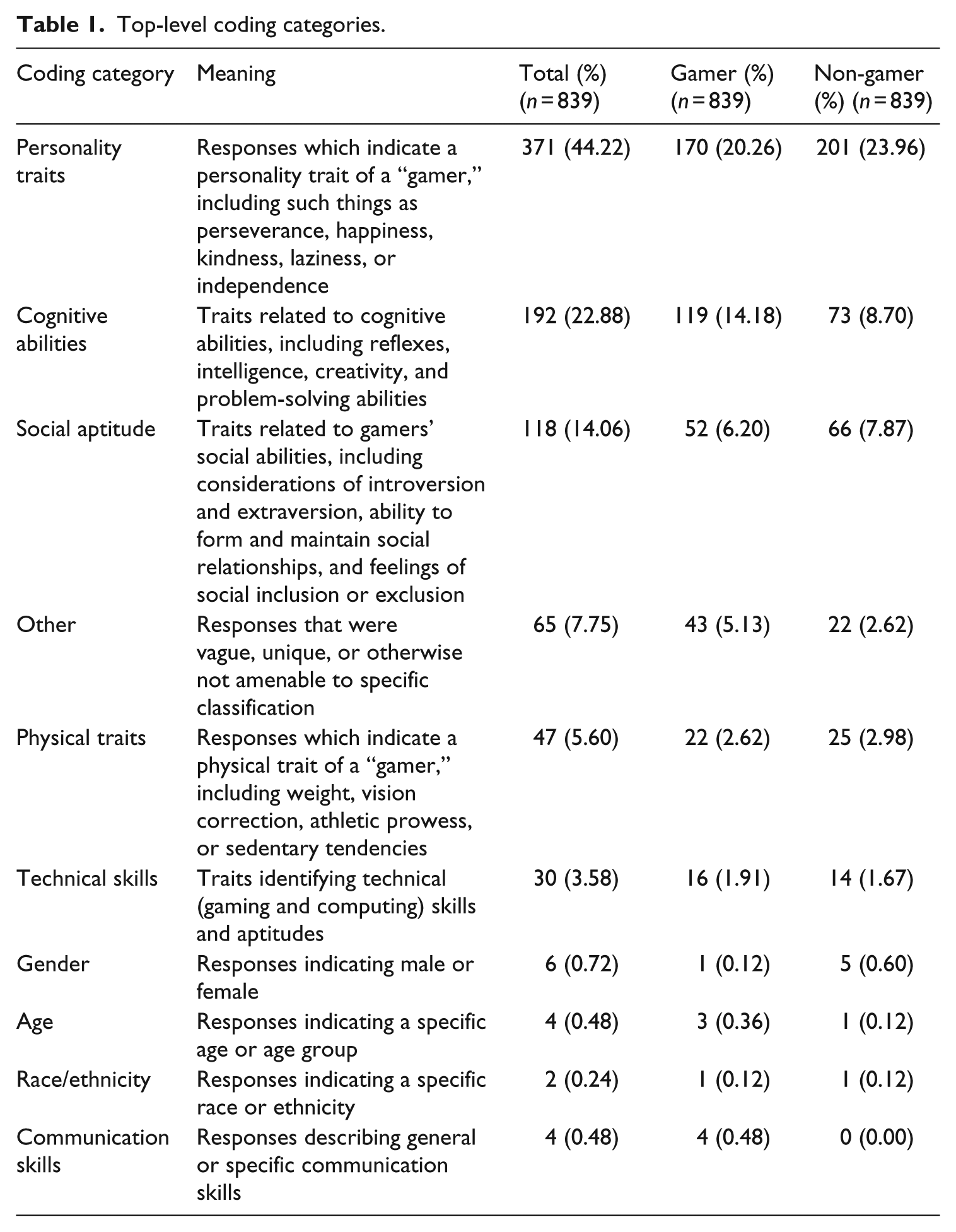
Once the high-level coding units were determined, multiple rounds of analysis for each unit resulted in a more refined set of subcategories. Hand inspection and categorization, as well as NVivo frequency counts and query tools, were used to refine the original coding units into 5 primary categories and 22 subcategories (Table 2). Each subcategory was determined by grouping initially coded items into subcategories appropriate for their definition. Units which included vague and/or infrequently occurring terms were excised from further analysis (e.g. “Pokémon lovers” or “interesting” were examples of dross). The subcategories represent the most frequently seen groupings of units in each category and represent 545 of the original 839 responses for a coverage rate of 64.96%. Analysis proceeded based on these 22 subcategories.
Coding subcategories.

What are the perceived characteristics of a “Gamer”?
Analysis of the coded responses suggests a diverse opinion about “gamer” characteristics. For many respondents, the traditional gamer stereotypes—socially inept, idle or unmotivated, overweight and unattractive, and intelligent—persist. However, analysis of the coded responses shows positive signs that the perception of “gamer” may be shifting.
Personality traits was, by far, the most common response category (44.22%, n = 839). The responses were mixed between positive, non-stereotypical characteristics (e.g. “strategic” and “humorous”) and more traditional, negative characteristics (e.g. “lazy” and “nerd”). On the negative side, the subcategory with the most frequently coding was Nerd, Geek, or Unusual (5.00%). Terms like “nerd,” “geek,” “quirky,” or “weird” were often used to describe gamers, aligning with traditional stereotypes of both gamers and technology-oriented individuals in general. In terms of the percentage of respondents, those who did not self-identify as “gamer” had twice as many coded responses in the Nerd, Geek, or Unusual subcategory as those who self-identified as “gamer” (Table 2). Gamers were also described as lazy or unmotivated (2.50%) and quiet (1.55%). On the positive side, gamers were often described as competitive (5.00%), funny (2.38%), collaborative (2.26%), and strategic (1.91%). Self-identified “gamers” were coded more than twice as often for the Competitive subcategory (6.64% of “gamer” responses) than those who did not self-identify (2.80% of “non-gamer” responses). A non-trivial number of responses indicated that gamers exhibited some element of perseverance (4.05%). Responses such as “determined,” “dedicated,” “goal-oriented,” “driven,” and “committed” described gamers as people who work hard toward a specific goal, even in the face of difficulty or challenge (Figure 1).

Personality traits by subcategory and self-identification status.
The second most common response category was Cognitive Abilities (22.88%, n = 839). The responses coded as Cognitive Abilities suggest that gamers are perceived as being very intelligent, with enhanced analytic and reflex skills. The most common subcategory was General Intelligence (7.87%) that comprises responses such as “smart” or “intelligent.” Gamers are also considered to be highly creative, with strong imaginations (3.34%), with strong analytical/problem-solving skills (3.34%), and a strong ability to focus on the task at hand (1.43%). Strong hand–eye coordination, as well as “quick reflexes” and “quick reaction time”, was also frequently cited characteristics (2.03%). Self-identified “gamers” had a much higher percentage of responses coding in the Analytic Skills and Reflexes/Reaction/Coordination subcategories than those who did not self-identify. In sum, gamers are perceived to be highly intelligent individuals with the enhanced ability to focus on solving complex problems in real time (Figure 2).

Cognitive abilities by subcategory and self-identification status.
The reported characteristics involving Social Aptitude (14.06%, n = 839) were diverse but still heavily slanted toward traditional gamer stereotypes. Descriptions of social ineptitude comprised approximately 11.20% of reported characteristics. Social isolation was the predominant subcategory, depicting gamers as “antisocial,” “loner,” and “outcasts” with “no life” and “living at home with parents in their basement.” These negative characteristics fit the traditional stereotype of a socially inept individual who cares more about games than about human interaction. Gamers were also frequently described as socially awkward (e.g. “shy” and “awkward”) and introverted (e.g. “introverts” and “introverted”), again fitting the traditional gamer stereotype. A small proportion of responses (2.26%) described a gamer as being socially engaged, including responses such as “sociable,” “group-oriented,” “outgoing,” and “strong sense of community.” These responses act as counter to the traditional stereotype, though they occurred far less frequently than the descriptions of the isolated, awkward, and introverted “gamer.” An examination of the percentage of respondents in each self-identification category shows that those who did not self-identify as “gamer” were coded in the more negative subcategories—isolation, awkwardness, and introversion—at much higher percentages than those who self-identified as “gamer” and at a much lower percentage for the more positive subcategory of social engagement (Table 2 and Figure 3).

Social aptitude by subcategory and self-identification status.
Although mentioned far less frequently than personality, cognitive concerns, or social aptitude, all the comments coded as Physical Traits (5.60%, n = 839) were negative in some respect and fit many of the traditional physical stereotypes of a gamer (Figure 4). The dominant subcategories involved comments suggesting that gamers are perceived as overweight and sedentary, with problematic eyesight. Sleep patterns and problematic physical appearance were mentioned far less frequently but still involved a negative tone. For example, gamers were described as “unkempt,” “unathletic,” and “people with acne.” The key takeaway from these reported characteristics is that physical traits were mentioned infrequently but were always of a negative and stereotypical connotation.

Physical traits by subcategory and self-identification status.
Survey respondents were far more kind in their Technical Skills comments, though remarks about technical skill were also mentioned infrequently (3.58%, n = 839). All of the comments for technical skills were positive: gamers are seen to be quite adept at both gaming and computer technology. Responses such as “tech-savvy,” “skilled at games,” and “computer smart” were common. The perceived technological aptitude is not unexpected; game playing necessarily requires some degree of comfort with and skill in the use of digital technology.
Sexuality was not mentioned in any of the survey responses. The only response close to describing sexuality was a simple “virgin” response. While the traditional stereotype involves a male heterosexual, the limited indication of gender and the virtually non-existent remarks on sexuality may indicate that these aspects of the stereotype are waning. A similar argument can be made for race/ethnicity and age, both of which were infrequently mentioned. It should be noted, however, that the few responses involving gender and age did fit the traditional gamer stereotype of young, male game players.
Discussion
The closed-ended survey and subsequent analysis show that commonly accepted factors (e.g. gender and frequency of game play) still impact self-identification of one’s self as a gamer and that the duration of exposure to video games and frequency of gaming also plays a significant role. Significant gender differences were found between duration of exposure play frequency: males were more likely to be involved with gaming for a greater number of years and typically play video games more frequently. The number of immediate social groups (friends, parents, significant other) with game players also plays a significant role in self-identification as “gamer,” though there were no significant differences between males and females in the number of these social groups which include game players. Social relationships, along with duration of exposure and play frequency, can act as an important influence on “gamer” identity development.
The characteristics of gamers reported by survey participants describe individuals who fit many of the common stereotypes, despite the fact that a majority of participants self-identified as a gamer. Gamers are still seen as highly intelligent with strong technical and cognitive skills, especially among self-identified gamers. It is obvious from the responses that gamers are held in high esteem for possessing many of the skills so desirable to modern employers. However, these positive perceptions are counterbalanced by responses which highlight the negative aspects of the traditional gamer stereotype.
Gamers are still perceived as socially inept, introverted, and isolated individuals with undesirable physical traits. This view is seen more frequently in the responses provided by those who did not self-identify as a “gamer,” though some self-identified “gamers” also reported these traits as “gamer” characteristics. Even though gaming has become a socially accepted activity, negative perceptions of those who regularly play games persist in the sample demographic. This finding is somewhat ironic, as the sample demographics also align with two aspects of the traditional gamer stereotype—that is, predominantly male and Caucasian—and a majority of participants identified themselves as falling within the “gamer” group. As games have become more social through MMORPGs and other online communities, it is reasonable to expect that the perception of gamers as socially isolated individuals would wither over the past 20 years. If this study is any indication, the traditional social and physical perceptions of gamers persist, especially among non-gamers.
Future work should consider whether this dualism—reporting as a member of a group, and then describing the same group with less than positive characteristics—is a matter of group pride and perceived self-awareness, a matter of contradiction, or the result of the respondents “speaking to the stereotype.” The original question asked for the characteristics of a “gamer” and nothing more. The question therefore exists as to whether the survey respondents—especially those who self-identified as “gamer”—are listing traits they would apply to themselves or are simply listing traits they feel others would ascribe to a “gamer.” Future research should attempt to uncover the motivations behind the characteristics that individuals attach to the “gamer” label. One potential enhancement to this study would involve rephrasing the original request for characteristics to promote a lengthier and (perhaps) more complete response. The 186 sets of characteristics analyzed by the study represented 1569 words (M = 8.44, median = 7.00, SD = 6.312). While these responses provided meaningful insight into perceptions of the “gamer” label, a question requesting more nuanced, detailed explanations of those characteristics could enhance our understanding of those perceptions and their origin.
The self-reported gamer characteristics from the survey can also be used as the basis for building an inventory of how a gamer is perceived and, ultimately, assist in future work regarding motivations and behaviors of those individuals. Construction and testing of this inventory are left to a future study.
Limitations of the study
Limitations of the study include the population from which the sample was drawn, that is, college-age adults. This represents a sample of convenience, though this sample is consistent with other previously published studies in this area. However, future work in this domain should target a more diverse population, including diversity in terms of gamer identification, age, gender, predominant type of gaming activity (console-based, mobile, MMORPG, etc.), and race and ethnicity. The use of a binary response scale for identifying gender (male/female) may also be a limitation of the study, given contemporary understanding of gender. It may also be advisable for future studies to measure the magnitude of group differences in numerical form rather than in categories, especially in regard to gaming frequency, duration of exposure, and the number of game players in the immediate social network. The request for five characteristics may also be limiting; future work should consider expanding this number or perhaps rephrasing the question to permit more detailed responses. The most salient limitation of the study is the lack of multiple coders for the open-ended data set. Attempts of securing other coders were unsuccessful. To reduce this limitation, efforts were made in this article to provide a systematic discussion of how the analysis was conducted; however, this is a recognized limitation of the study.
Conclusion
Much of the research involving perceived characteristics of so-called “gamers” has been directed at deconstructing the traditional stereotypes associated with the term. As gaming has become more mainstream, academic research has investigated the changing nature of the term, as well as influencing factors in gaming, gaming behavior, and gaming communities in an attempt to show the evolution of “gamer” in the eyes of gamers and non-gamers alike. The findings of this study confirm that previously found factors influencing self-identification as a gamer (frequency of play and gaming in the social network) still contribute to self-identification. The results also show that many of the traditional stereotypes still persist in common perceptions of gamers. However, study participants also applied positive attributes to the term “gamer,” suggesting an evolution of the term’s meaning. While still perceived as socially challenged and perhaps physically awkward, this study shows that desirable characteristics such as perseverance, strong cognitive skills, and technical prowess are also associated with “gamer.” Future research should investigate the potential contradiction of self-identification as a “gamer” with the attribution of negative characteristics to the term, as well as other factors which influence this identity.
Footnotes
Acknowledgements
The author thanks previous reviewers of this work for their insightful comments and suggestions.
Funding
The author(s) received no financial support for the research, authorship, and/or publication of this article.
