




Abstract
Based on Bourdieu’s theory, this article focuses on the third-level digital divide in relation to offline outcomes of Internet use. Based on 30 in-depth qualitative interviews with young people in Madrid, we analyzed the mechanisms used to convert three main forms of capital—economic, cultural, and social—into digital capital (DC) and the subsequent reconversion of DC back into the three main forms of capital. We conclude that economic capital is the most basic form of digital inequality, imposing material barriers to access. Cultural capital is transformed into DC through people’s techno-socialization, while social capital is converted into DC by means of social practices and social support. DC can be retransformed into each of the three main forms of capital: to economic capital by means of professional networking and access to goods; to cultural capital through access to knowledge; and into social capital by the differential management of social ties.
Introduction: the information society and digital inequality
In our contemporary techno-social landscape (Sáez Vacas, 2011), often described as a third industrial revolution (Castells, 2010; Rifkin, 2011), productivity is based on the generation, control, and distribution of knowledge at a global scale. In this context, the Internet is the most important technological infrastructure oriented to information transmission in the contemporary world (Lupač, 2018: 34). From the 1990s on, because of rapid digitalization, the problem of the digital divide emerged as one of the main social, not just technological, concerns of contemporary societies (Ragnedda, 2017). The term “digital divide” was originally proposed in the 1990s by the US government to refer to the gap between “those who do and those who do not have access to new forms of information technology” (Ghobadi and Ghobadi, 2015: 331). At the time, the main concern was unequal incorporation of different countries and regions to the global information revolution (Norris, 2000). However, the notion of a digital divide soon shifted focus to the domestic sphere (Dalvit, 2018) by studying digital inequalities among disadvantaged groups in relation to gender, class, age, and education, among others variables.
By the turn of the century, the conceptualization of the digital divide became inadequate. The term evoked a gap or cleavage between connected and disconnected citizens, the “haves vs have nots” (DiMaggio and Hargittai, 2001): however, physical connectivity was no longer the main issue among the general population in developed countries. As such, digital inequality did not disappear, it just transformed and diversified, focusing instead on quality of access (Robinson, 2009) and the material conditions of access (Van Deursen and Van Dijk, 2019), which included type of devices, quality of technological infrastructure, and the possibility of maintaining access over time (Gonzales, 2016). Furthermore, a second digital divide was theorized in connection with the skills needed to use digital devices (Hargittai, 2002; Van Deursen and Van Dijk, 2014), differential digital practices, and particular uses of the Internet (Castaño, 2008; Correa, 2016). In terms of stratification diffusion theory (Norris, 2000; Ragnedda, 2017), it became evident that differential technological domestication of the Internet was associated with distinctive ways of taking advantage of its potentialities. Hence, the digital divide became a more complex and diversified concept (Haight et al., 2014). Because of the difficulty of reducing digital inequalities when they are structural characteristic of the information society and global capitalism (Lupač, 2018), new digital gaps or divides have been theorized during the last few decades. For example, the four-gaps model establishes a motivation, access, skills, and usage gap as being those that most affect digital inclusion (Van Deursen and Van Dijk, 2015; Van Dijk, 2005). The motivation gap (Dutton and Blank, 2015; Eynon and Geniets, 2016), which is related to internalized dispositions, attitudes, and interest in using digital technologies, can be distinguished from an emotional gap (Huang et al., 2015), which relates to the affective experiences of engaging in digital practices.
In spite of the vast production of empirical evidence, one of the main problems of research on the digital divide relates to its lack of theoretical reflection (Ragnedda and Muschert, 2018), such as connecting particular dimensions of digital inequality with more general mechanisms of social stratification. One exception is Helsper’s (2012) corresponding model, which theoretically connects social and digital exclusion. Helsper remarks that most research has focused on social impact mediators that affect digital exclusion (access to information and communications technology [ICT], digital skills and attitudes) but very little has been written about digital impact mediators that affect social exclusion (relevance of digital practices, quality of experience, agency, and sustainability of subjects’ experience of use). Therefore, certain digital practices are only relevant in particular social contexts and fields of interaction, so “even if an individual engages with a certain digital field and this benefits from this, those with more resources still take more advantage of the same type of uses” (Helsper, 2012: 417). In this sense, recently a number of authors (Ragnedda, 2017; Van Deursen and Helsper, 2015) have started to discuss a third digital divide, related to the differential offline outcomes that people obtain from their use of digital technologies and “the ability to exploit these benefits in a digital-driven market to improve one’s life chances” (Ragnedda, 2017: 5). This new dimension of the digital divide, known as a utility gap (Calderón Gómez, 2018), re-integrates digital inequalities into social structure, rejecting the strict opposition between online and offline spheres of activity. In fact, as we live in a highly digitalized world in which technologies remediate social practices, it is better to think of the online and offline worlds as being entangled (Lasén, 2014). Therefore, in order to understand the importance of digital inequality in contemporary society, it is crucial to articulate empirical evidence with theory about stratification and inequality. Recently, some authors have begun to use sociological theory as frameworks for research on the digital divide, including Simmel’s model of information (Muschert and Gunderson, 2018), Weber’s theory of stratification (Ragnedda, 2017), Giddens’ structuration theory (Helsper, 2012), or Bourdieu’s constructivist structuralism (Helsper, 2012; Robinson, 2009; Straubhaar et al., 2012; Villanueva-Mansilla et al., 2015).
Our theoretical approach to this study is based on Bourdieu’s theory of capitals because of its suitability for theorizing the interconnection between social practices, based on subjects’ dispositions (schemes for action), and social structure, which emerges from continuous position-taking in a hierarchized space of social positions. Our research question (RQ) focuses on understanding how traditional forms of capital (economic, cultural, and social) are converted into digital capital (DC), as well as the reverse processes or reconversion of DC back into economic, cultural, and social capital. By doing this, our aim is to understand, at the level of agential practice, the mechanisms that locate social inequality at the base of digital inequality and, furthermore, how digital inequality reproduces (or even intensifies) social inequality. Helsper’s (2012) corresponding model and Ragnedda’s notion of third digital divide are useful to quantitatively measure the digital impact mediators of social exclusion and the offline outcomes and benefits of Internet engagement. Thus, our conceptualization of DC will advance the qualitative understanding of how this process of domestication and engagement with technology is phenomenologically experienced by subjects.
The objectified and embodied dimensions of DC
In order to introduce the notion of capital in the information society, we need to understand its articulation with two other important concepts: field and habitus. Broadly, capital can be defined as a social energy that acquires its value in a distinctive field in which it is produced and reproduced (Bourdieu, 1979: 127). Among many others, Bourdieu (1986) identified three fundamental forms of capital: (a) economic capital, related to the monetary resources and property titles which are directly convertible to money; (b) cultural capital, which can be presented in three different states: (b.1) an embodied state, meaning internalized cognitive competencies, knowledge, and “long-lasting dispositions of the mind and body” (p.243); (b.2) an objectified state, that is, materialized in cultural goods one has access to; and (b.3) institutionalized state, a specific type of objectification linked to socially validated credentials and qualifications. Finally, (c) social capital relates to the actual and potential network of social relationships whose economic and cultural capital can be mobilized by people in order to enhance their possibilities of action. Fields can be understood in two different ways. As a modeled system of objective forces imposed on social agents and as a relational space of confrontation in which such agents deploy their practices (Bourdieu and Wacquant, 2005: 46). In other words, fields conform the objective relational system of positions in which specific forms of capital are relevant, like markets for goods and services, in the case of economic capital, or cultural and educational capital in the academic field. Finally, the habitus refers to the embodied form of social structure, a system of dispositions oriented through practice in a reciprocal process in which agents’ habitus is simultaneously determined by social position (structured structure), but which also generates new practices that reproduce social order (structuring structure).
In contemporary society, we require a more nuanced view of Bourdieu’s model. The erosion of traditional social bonds in reflexive modernity (Beck, 1996) has produced more and more singular forms of socialization (Lahire, 2013). Subjects are multi-determined by a huge variety of distinctive, alternative, and contradictory dispositions which do not necessarily correspond with all practical situations of social interaction. Nevertheless, the concept of capital is still useful for understanding the social reproduction of inequalities in a digitally mediated reality. Notions such as technological capital (Gonzales, 2016; Selwyn, 2004), techno-capital (Straubhaar et al., 2012), information habitus (Robinson, 2009), or DC (Ragnedda et al., 2020) have been developed to try to understand the importance of internalized dispositions in how people live in the information society. Of particular note, Ragnedda (2018) understands DC as an independent form of “bridge capital” between “online and offline life chances” (p. 2). In a digitally mediated environment, it enables specific processes of transference and reconversion of traditional forms of capital (economic, cultural, social, personal, and political). A cycle emerges through differential offline outcomes obtained from technological appropriation that suggests that digital technologies are not just reproducing social inequality but also reinforcing it (Ragnedda, 2017: 47).
Based on Bourdieu’s (1986: 243) notion of cultural capital being simultaneously embodied in social actors’ dispositions but also materialized in socially objectified positions and Ragnedda’s (2018) notion of “bridge capital” (p. 2), which allows reconversions from other capitals in a highly digitalized society, we conceptualize DC as a sub-form of cultural capital linked to the use of digital technologies and contemporary cyber culture (Levy, 2007). Under this proposal, DC can be found in two distinctive states. First, (a) as embodied digital capital (EDC), it is internalized in the habitus by means of digital skills, dispositions, motivations, interests, expectations, and past experiences that affect digital practices. Apart from digital skills, EDC also includes a vast repertory of digital cultural dispositions that constitute digital literacy (Sefton-Green et al., 2009). These dispositions are understood as being founded in durable biographical processes of socialization in the use of ICTs. Second, (b) objectified digital capital (ODC) is materialized in digital equipment, devices, and the technological infrastructure assimilated to social actors’ lives through technological domestication processes (Silverstone, 1993).
Taking into account both forms of DC, we can conceptualize the process of reconversion between capitals, which is presented in Figure 1. The connection between DC and other capitals is bidirectional (Ragnedda, 2017: 75) since it arises from specific levels of economic, cultural, or social capital, but it can also be transformed into higher levels of economic, cultural, and social capital. This process of reconversions is conceptualized to work in three circular phases: (1) conversion of previous capital into ODC by people’s domestication of technology, that is, incorporating digital devices to personal practices; (2) conversion of ODC into EDC by means of digital literacy, that is, the acquisition of dispositions and schemes of action (habitus); (3) conversion of EDC into new forms of economic, cultural, and social capital by means of offline outcomes and benefits that people obtain in their different uses of digital technologies. These three phases need to be seen as hermeneutical tools that enable an understanding of the process of technological appropriation that are entangled in ordinary practices and that happen simultaneously.
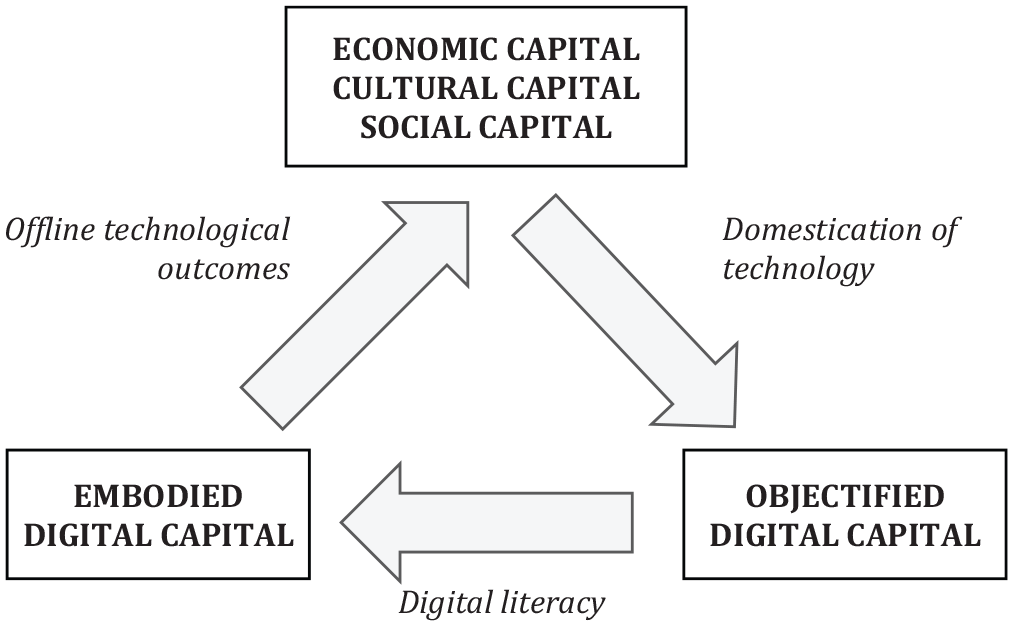
Cycle of reconversion of digital capital from (and into) other capitals.
Methodology
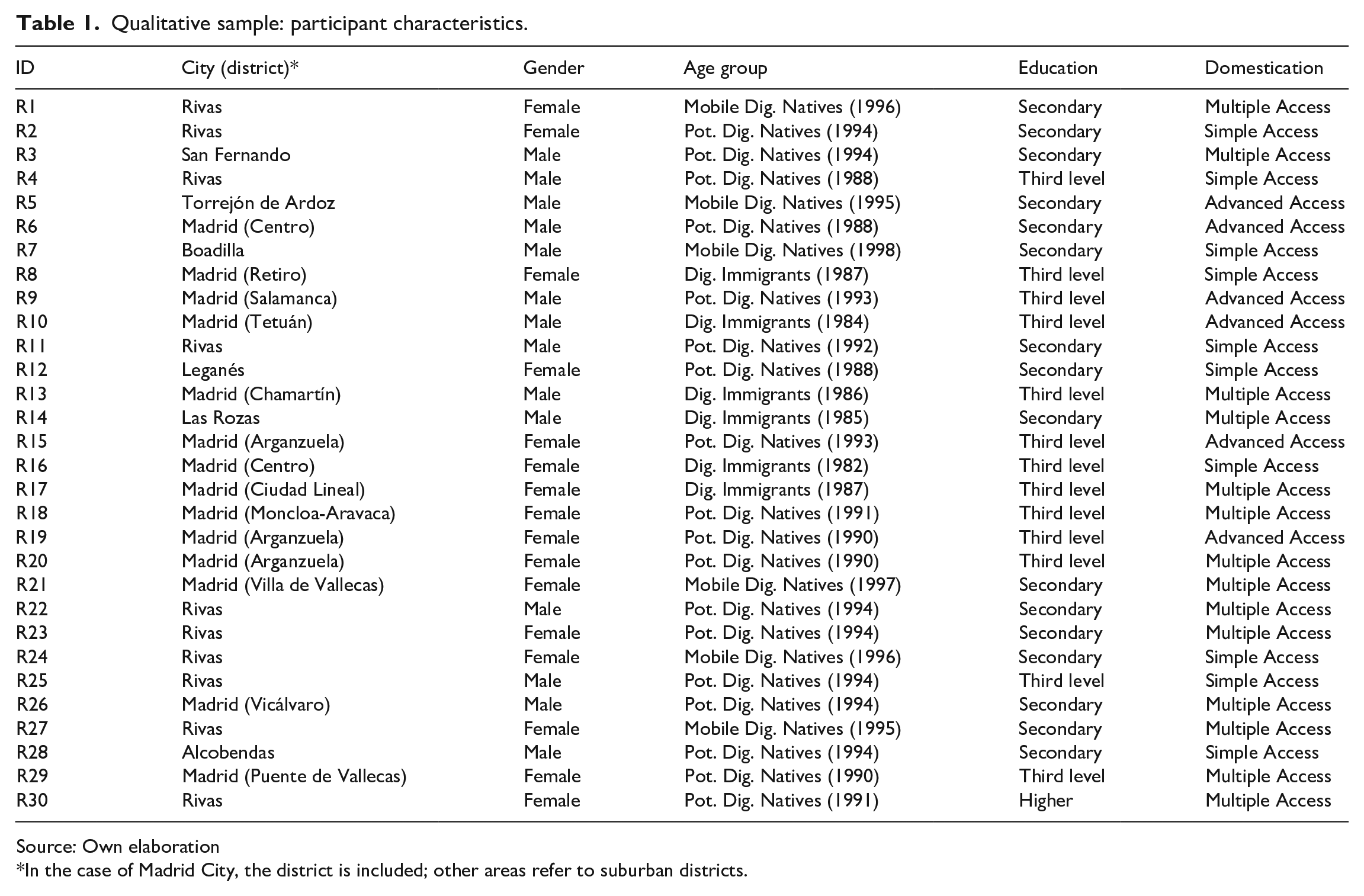
Based on a qualitative methodology, we undertook 30 in-depth interviews with young people living in the metropolitan area of Madrid (Spain) between 2017 and 2018. Our objective was to understand processes of technological domestication and offline outcomes resulting from the use of digital technologies, or, in other words, the production of inequalities known as the third-level digital divide (Ragnedda, 2017). We focus on subjects who used the Internet frequently, which excluded people in digitally marginalized groups, such as those affected by the first-level digital divide. In terms of age, we focused on the so-called “digital natives,” born between 1982 and 1999 (Palfrey and Gasser, 2011; Prensky, 2001), in order to explore the suitability of this nominal social category as a basis for understanding the diversity of people’s digital practices. The concept of digital natives, which associates young people with superior digital performance, has been criticized for being reductionist (Bennett and Maton, 2011; Kirschner and De Bruyckere, 2017; Selwyn, 2009) because it obscures the influence of sociodemographic, cultural, and economic variables on digital inequality. In our sample, we contrast the effect of belonging to a particular age group with three other relevant variables: gender, educational level, and type of technological domestication (Table 1).
Qualitative sample: participant characteristics.
Source: Own elaboration
In the case of Madrid City, the district is included; other areas refer to suburban districts.
Sampling criteria
Our qualitative design relies on a structural sampling criteria (Valles, 2014: 77) based on the theoretical relevance of the sociological variables considered (gender, age group, education, and type of techno-domestication), instead of the statistical significance of quantitative research. People’s narratives illustrate particular examples of the social positions occupied in the social space of interaction and of the typical dispositions internalized in such contexts, rather than just individual experiences, so the close of fieldwork depends on the saturation (Saunders et al., 2018) of the prototypical discourses deployed by subjects. The sociological relevance of the variables included in the sample is presented below:
Gender. This variable plays an important role in the second-level digital divide as gender inequalities are more commonly associated with digital skills and distinctive digital practices rather than different forms of accessibility (Antonio and Tuffley, 2014; Haight et al., 2014). Moreover, in the Spanish context, the gender-based digital divide and inequality is a field of research that has received a lot of attention during the last few decades (Castaño et al., 2009, 2011). The final sample included 16 women and 14 men.
Age group. While acknowledging the limitations of the digital natives’ approach, it is clear that differential domestication of technological tools during childhood and adolescence can affect later life stages, engendering distinctive inter-generational digital identities (Bolin, 2018). With this in mind, we theorized three prototypical age groups in relation to the particular technological landscapes during participants’ digital socialization:
Six interviews with Forced Digital Immigrants (1982–1987) who lived through the transition from analogic to digital technologies, meaning that personal computers and Internet broadband were not introduced to their lives until late adolescence and early adulthood.
Eighteen interviews with Potential Digital Immigrants (1988–1994) who were socialized through the intensive use of personal computers and the Internet during adolescence, but who did not get access to smartphones and other mobile digital devices until early adulthood.
Six interviews with Mobile Digital Natives (1995–1999) who were born into a highly flexible mobile landscape and digital connectivity with a huge variety of possibilities for accessing the Internet (computers, smartphones, tablets, etc.).
Educational level. Cultural and educational capital are extremely relevant in the case of second-level digital divide studies (Dutton and Reisdorf, 2019; Haight et al., 2014; Mariën and Prodnik, 2014; Robinson, 2009), while economic capital is generally necessary for basic access to digital devices (first-level digital divide). Consequently, in our sample, we included 16 subjects with a second-level education and 14 subjects with third-level education.
Type of technological domestication. Accessibility is still an important variable in digital divide studies. However, the focus has shifted from physical connections to quality of access (Robinson, 2009), different forms of domestication of technology (Silverstone, 1993), and the incorporation of different digital tools to daily life. Hence, we proposed three prototypical forms of connectivity:
Smartphone access (10 interviews). They almost only use smartphones as their primary device to connect to the Internet.
Multiple access (14 interviews). They combine smartphones and personal computers, differentiating on the basis of distinctive personal needs.
Advanced access (6 interviews). They use a wide variety of digital devices to connect to the Internet, including smartphones, personal computers, tablets, videogames consoles, smart-TVs, wearables, and so on.
Our sociological discourse analysis is based on the socio-hermeneutic approach developed by Alonso (1998). We focus on the pragmatic level of language, connecting subjective experiences elaborated during the interview with their social context of production and reproduction. By doing this, the three phases of the process of reconversion of DC can be understood: (1) domestication of technology is described by subjects’ narratives of appropriation and incorporation of technology to ordinary life; (2) digital literacy is analyzed by subjects’ biographical narratives of learning about the use of ICT and experiences, which become internalized in terms of dispositions toward practice; (3) offline outcomes are described by subjects’ narratives about personal practices and activities mediated by digital technologies, as well as by the reflection about the utility and potential of ICT in their contextually situated social lives. The comparison between gender, age group, educational level, and type of technological domestication is relevant because, as Helsper (2012) remarks, there is no universal set of forms of access, skills, or uses of ICT, but differential forms of engagement with ICT mediated by subjects’ economic, cultural, social, and personal resources: digital impact mediators (Helsper, 2012).
Results
Results of the qualitative analysis are presented in three sections, each one dealing with the transference between economic, social, or cultural capital and DC. In each section, the analysis considers such transference in terms of: (1) domestication of technology (previous capital into ODC), (2) digital literacy (ODC into EDC), and (3) offline outcomes (EDC reinvestments into other capitals).
Transferences between economic capital and DC
In the context of a capitalist mode of production, economic capital constitutes the most important form of capital because it is directly convertible to money (Bourdieu, 1986). Technological equipment is no different to other commodities subsumed into a market economy, so the monetary cost of technological domestication is the most basic vector of digital exclusion, especially among vulnerable and economically deprived social groups. Nowadays, this is particularly relevant, since the first-level digital divide is no longer confined to mere physical access to the Internet but with quality of access, including the types of devices used (smartphones, computers, tablets, wearables, TVs), device sophistication, and capability (high, medium, or entry-level devices), coverage, connection quality (broadband, fiber optics, 4G, 5G, etc.) and, as Gonzales (2016) remarks, the possibility of maintaining good connectivity over time (Internet cost, repairs, or replacements). In relation to this, the problem of having to continuously update devices and equipment emerged as a theme of the narratives. In a context of incessant transformation, lagging behind was particularly problematic for study participants who possessed old or low-quality devices, particularly in relation to smartphones and computers that are not technologically capable of updating to new apps, programs, videogames, webpages, and so on. In addition, if users wished to get full ad free premium access to media platforms, such as Netflix and Spotify, they had to bear the economic cost of subscriptions (Figure 2):
I always said that once I was able to get Spotify on my smartphone at a reasonable cost I would stop downloading music. [. . .] The problem with Spotify is data consumption, but if you have the premium account, which is 10 euros, you can download music onto your phone. (R9, Male, 1993)

Feedback cycle between economic and digital capital.
Furthermore, we found that the transformation from ODC to EDC (phase 2) usually has a significant economic cost. Among participants’ narratives, we identified three monetary costs associated with digital literacy processes and acquisition of EDC: (1) First, the autodidactic processes that lead people to teach themselves how to use technology throughout their lives is determined by the possibility of maintaining a sufficiently good level of digital connectivity over time, which relates to technological maintenance theory (Gonzales, 2016). Consequentially, as early adopters of top of the range devices, younger people in higher socio-economic positions have an informational advantage (Robinson, 2009) over lower income social groups because this ODC can be easily transformed into the acquisition of higher levels of EDC. (2) Second, another autodidactic process associated with economic capital relates to labor literacy. Working with digital technologies, in particular computers, was an extremely important form of digital skill acquisition. For the study participants, this led to both the practical mastery of devices and behavioral dispositions in digital environments that could be transferred to other spheres of digitally mediated social activity. This form of literacy acts as an important complement to autodidacticism and served to increase participants’ informational advantage after adolescence. In this sense, we can conceptualize it as a dynamic form of secondary technological socialization building on primary socialization processes from previous life stages (Berger and Luckmann, 2008). (3) Finally, a third type of economic transference is linked to the monetary cost of autodidacticism and education, which is not as important in the acquisition of digital competencies as in the attainment of cultural, academic, and educational competencies in general:
Nowadays everything has been computerized and more and more tasks require a computer. There are a lot of new developments, but if you don’t know how to use it [excel], you have a problem. [. . .] In the end, I was forced to learn it, because they love Excel in my work, so you say to yourself: “I need to learn how to use it.” You watch a tutorial, ask some colleagues for help, [. . .] little by little. (R30, Female, 1991)
Finally, economic outcomes of digital practices (phase 3) can also be identified in the interviewee’s narratives. Specifically, we have been able to reconstruct three distinct dynamics of reinvestment of economic capital into DC: (1) Among the younger age group, job seeking was more likely to be conducted with specialized digital apps and platforms rather than through traditional means. In some cases, EDC was needed to identify which platforms work better or how to maximize the search processes. However, in many cases, getting a job was mediated by participants’ social capital. In these cases, digital technologies were useful for getting in contact with potential employers, but, generally speaking, previous social capital was more important than higher levels of EDC. (2) Second, professional networking was another important outcome that is potentially enhanced by the possibilities of a global network of communication, which arises from the ambivalent nature of the Internet. However, while it has become an important tool within working environments, it also engenders technological dependence. People must constantly update their professional profiles, skill sets, and social ties in a fast-moving environment where the distinction between work and leisure is eroded (Agger, 2011). (3) Third, the possibility of engaging in commercial activity was enhanced by access to a global marketplace of goods and services, although not everybody took advantage of these potentialities at the same level. The use of online commercial platforms, such as classified ad pages and collaborative economy platforms, depends on the economic capital mobilized by study participants, both directly in terms of cost and indirectly in terms of the EDC needed to make effective use of the huge array of technological options. The progressive colonization of study participants’ lives by the digital economy suggests that DC is becoming an important factor in increasing economic inequalities in contemporary society, although much more research is needed in order to measure its actual impact:
I think everything has become more horizontal. For instance, you don’t need travel magazines, you can become your own photographer, and someone can recruit you directly. Feeding the system. In the end, we’re the same slaves as before, but in a slightly more horizontal environment. (R15, Female, 1993)
Transferences between cultural capital and DC
As we understand DC to be a sub-form of cultural capital, with its own objectified and embodied dimensions, it is important to state that material digital technologies (the access gap) are just a particular form of objectified cultural objects. The domestication of these cultural objects depends on economic capital and the mobilization of embodied cultural capital, which we have called motivated accessibility (see Figure 3). In other words, embodied cultural capital influences dispositions toward the use of digital technologies (EDC) because digital tools are used for particular purposes that depend on personal motivation and interests, which are often much broader than just technological goals. People use technology for many reasons (communication, information, leisure, work, commercial activities), which subsequently condition the ways that they incorporate digital tools to their ordinary life. This is why Van Deursen and Van Dijk (2015) place motivation (reason for use) as the primary factor that affects technological appropriation in their four-gaps model; later gaps (access, skills, and usage) are based on the interests and motivations incorporated at the first level.
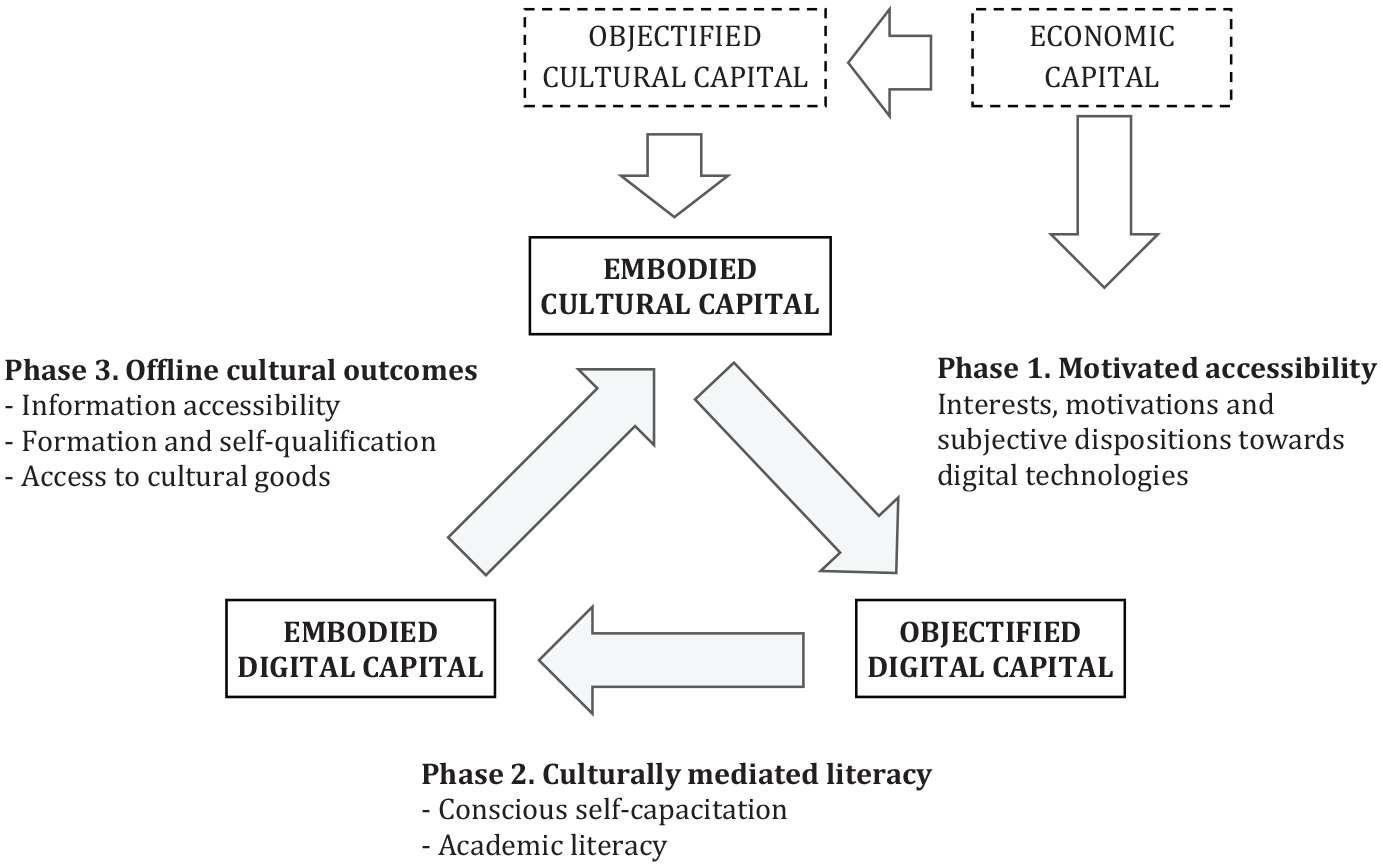
Feedback cycle between cultural and digital capital.
Hence, we can see how, essentially, technological domestication was derived from study participants’ motivations and interests, which were not just technological but also socially and culturally conditioned. Thus, a first form of social stratification of digital practices came from the mobilization of embodied cultural capital to use digital technologies for specific purposes. Consequently, participants who experienced intense processes of technological domestication during their childhood and adolescence were in a better position than those that experienced material constrains on accessibility. As Robinson (2009) observes, this is not just because of their digital skills but because of the possibility of reinvesting their previous acquired cultural capital into the digital world and increasing their confidence, familiarity, and awareness of the cultural possibilities of digital media. Participants who were unmotivated and unconfident tended to feel more stress and frustration when they had to undertake difficult digital tasks. Therefore, they developed a more practical approach toward technology, only incorporating those digital practices to their lives that they considered to be indispensable for their social contexts:
Since I was a child I was interested in experimenting with it, watching things you weren’t supposed to, downloading pirate music, movies, etc. [. . .] It wasn’t just to have the latest technology for the sake of it, it was about being interested in new things and learning. (R21, Woman, 1997)
On the other hand, the mandatory use of digital technologies, particularly personal computers in schools and especially universities, was another culturally mediated form of acquiring EDC that drove academic digital literacy. Similar to working digital literacy, there was a secondary process of technological socialization that complemented unconscious autodidacticism among those who had not experienced intense technological domestication during adolescence. As such, among our interviewees, there was a significant asymmetry in terms of education level. Participants who had attended university narrated how they were forced to increase their digital skills, particularly those associated with personal computers, while those who finished education at secondary level were more dependent on their previous learning dynamics:
I started to use computers intensively during my degree course to give presentations and because we had to use certain software programs that I had to download. [. . .] Basically, without my computer and the programs I wouldn’t have been able to finish my degree. (R28, Male, 1994)
Finally, EDC also affects cultural offline outcomes in three distinct ways: (1) First, there was the problem of information sifting, because it is increasingly necessary to conduct effective filtering of the vast amount of updates and notifications that users receive to their devices. (2) Second, another cultural outcome was linked to autodidacticism whereby participants took advantage of the potentialities of the Internet to access information and increase embodied cultural capital. However, it should be noted that, once again, the key factor was motivation. Participants with high cultural capital could multiply it in the digital realm, while those with low cultural capital had not internalized the specific dispositions that engendered this dynamic. (3) Third, access to cultural goods (media, music, films, etc.) represented the final reconversion of DC into cultural capital. This did not only occur through subscriptions to media services, awareness of the vast amount of content in the digital world was also an important form of cultural distinction. In brief, cultural capital was continuously reproduced in the digital world, where access to information has become easier and more democratic than ever. However, it required a highly motivated individual and significant investment in time to select, filter, and manage increasingly large amounts of information. As a result, by means of their particular adoption of digital technologies, the participants become more differentiated rather than less:
Maybe the problem now is filtering information, because there’s too much of it now. So you learn which sources are reliable, which are not reliable [. . .] What counts is your experience. (R10, Male, 1984)
Transferences between social capital and DC
In Bourdieu’s (1986) theory, social capital is a form of pseudo-capital related to the potential mobilization of economic and cultural capital in people’s social environments. Because of the communication potentialities of digital media (globalization, instantaneousness), social capital is also enhanced and reproduced in a digitally mediated world. First of all, participants’ mobilization of social, economic, and cultural resources were materialized in ODC, that is, in the possibilities of having access to digital technologies. This depended significantly on the socioeconomic status of participants’ families, particularly during childhood and adolescence, which enabled distinctive biographical processes of technological domestication. In addition, particular social practices were mediated by digital technologies, such as learning during school or peer practices that progressively configured people’s technological dispositions. In this respect, it is important to remark that most digital practices were essentially social, since they related to digitally mediated interaction, shared ICT-based leisure actives, and so on (Figure 4):
Yes, it depends on the social group, I mean, I work with kids, infants. I’m in a [whatsapp] group with other instructors who I studied with. [. . .] I’m also in a [whatsapp] group at work, where we put everything: how things went, if we need to buy something or whatever has happened during the day. (R2, Woman, 1994)
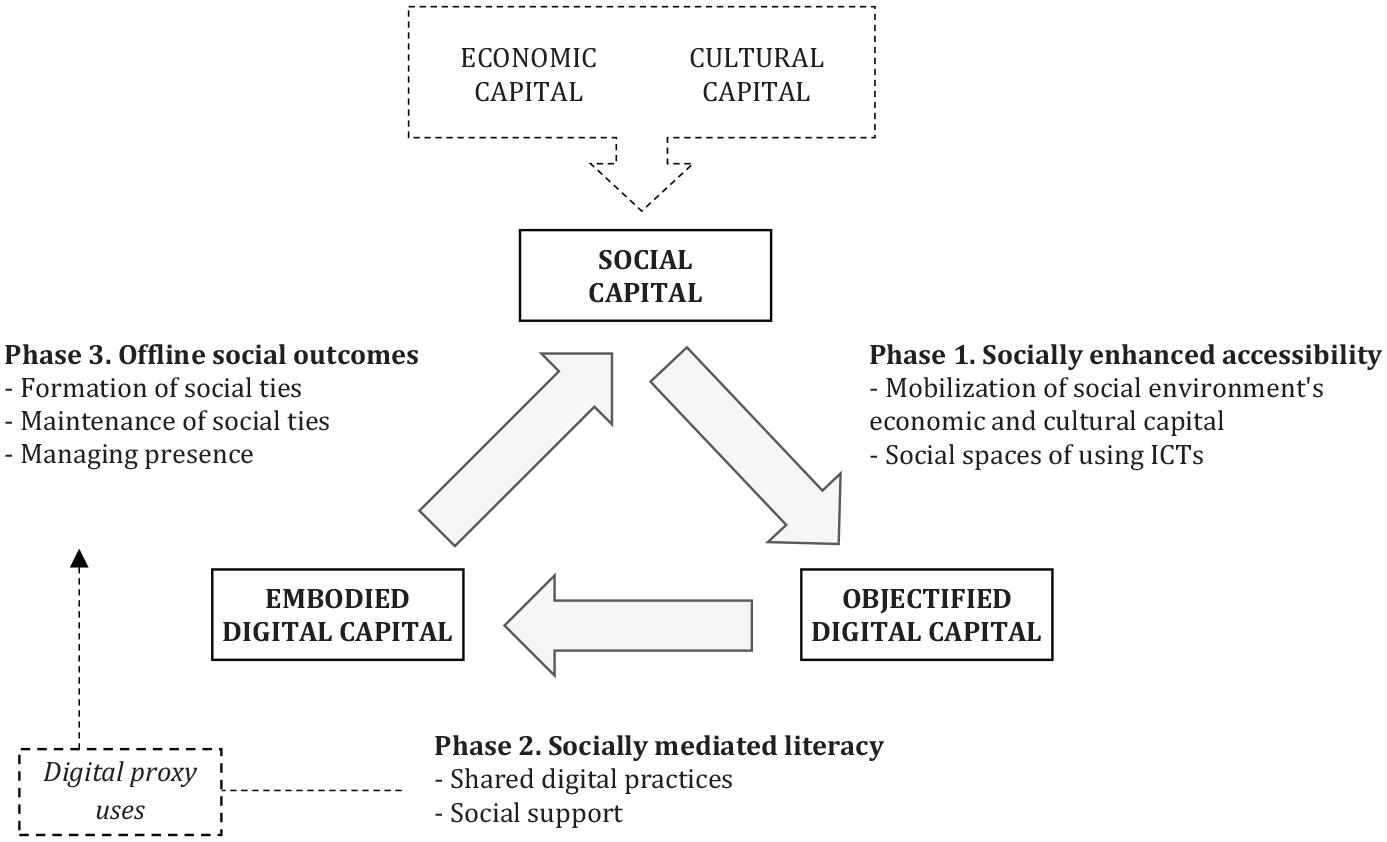
Feedback cycle between social and digital capital.
Furthermore, socially enhanced domestication was converted into EDC by two distinct means: (1) First, this happened through shared social practices. This is important because it overturns the idea that digital domestication is an individualized practice (Lupač, 2018)—most human activities are social after all. Some common examples in the narratives related to participants that were members of different types of social groups, including work colleagues that coordinated their activities by means of social media, friends that played videogames together, and groups that used an app to chat or share content in social media. (2) Social support was another important source of digital literacy (Courtois and Verdegem, 2016) that became relevant when participants related how they had to ask somebody in their social environment to help them complete a task or activity. The problem of social support was in its inherent ambivalence. In the case of those that were already motivated to acquire new digital skills, it engendered learning that incremented EDC. On the contrary, among those that were disinterested in digital tools, it could result in self-exclusion from learning and the possibility of acquiring new EDC as they relied on their social circle (digital proxy users) to fulfill problematic digital issues:
I have always relied on others instead of learning on my own. For instance, with torrents, I asked a friend for help. [. . .] I also ask my father, because he knows a lot about computers and he can fix any problem, restoring or updating my computer. [. . .] I am not a fan of technology, so I never got into it. (EP13, Male, 1986)
Finally, social outcomes of the mobilization of DC can be categorized into three areas: (1) First, the creation of new online social relationships. Networking with potential colleagues or clients, for example, was particularly important in academic and professional contexts. This type of networking typically took place on meeting-up platforms or virtual communities (Smith and Kollock, 1999) associated with shared hobbies or interests. Occasionally, these virtual ties were transferred to offline contexts, but generally the relationship ceased when the common interest no longer existed, for instance, in an online gaming community. (2) Second, the most common social outcome of using digital media was the extension of offline ties into online interaction spaces. Synchronous and asynchronous ICTs intensified sociability by making it possible for participants to interact beyond geographical and temporal constraints. (3) The final social outcome derived from the importance of managing online presence in a hyper-connected and information saturated technological landscapes, where participants competed with others to make themselves heard. Attempts to gain visibility in the digital world were extremely unequal as the Internet has become a highly competitive market where people occupy the dual roles of information producers and consumers, otherwise known as prosumers (Ritzer et al., 2012). Participants who were better positioned to generate viral content were more likely to reconvert digital practices into positive social outcomes:
For me, Linkedin is mainly a professional networking platform, for getting in touch with people in the sector because you need to keep in contact as you might need them in the future. (R10, Male, 1984)
Discussion
Based on Bourdieu’s notion of capital and a sociological model that connects social and digital inequalities, this article has analyzed the feedback mechanisms for reconversions between traditional forms of capital (economic, cultural, and social capital) and DC. The main contribution of the research lies with a proposed understanding of the third-level digital divide as related to offline outcomes of Internet use (Ragnedda, 2017; Van Deursen and Helsper, 2015). In line with Ragnedda (2018), we also found that DC works as a sort of “bridge capital,” enabling reconversions from other forms of capital. However, the research results suggest that instead of viewing DC as a completely new form of capital, we should conceptualize it as a sub-form of cultural capital linked to ICTs. There are two reasons for this. First, we agree with Lupač’s (2018) critique of the information society model, in which technological landscape is isolated from the cultural environment and the socio-economic mode of production. Instead, we see technology as part of the cultural background of society, so DC is therefore conceptualized as a specific and specialized form of cultural capital. Second, the two main levels of cultural capital (embodied and objectified) identified by Bourdieu (1986) can also be identified in the digitalized world. As EDC, it is incorporated into subjects’ dispositions by long-term biographical trajectories, and, as ODC, it is materialized in the continuous process of externalization of digitally mediated practices. Although, as Bourdieu’s model of habitus proposes, it is not possible to establish a perfect homology between objective and subjective structures in contemporary society: Lahire (2013) remarks that subjects are produced by multiple and contradictory processes of socialization and re-socialization. This generates incertitude, frustration, and insecurity due to the erosion of traditional social categories and ontological security (Giddens, 1995).
There are some limitations and future lines of research that are important to consider. On one hand, our cyclic theoretical process of reconversion of DC—in its objectified and embedded dimensions—can serve to clarify the different phases of the process of technological socialization (domestication or technology, digital literacy, and offline outcomes) in order to construct variables in quantitative research: particularly, longitudinal quantitative studies could measure this process of socialization and incorporation of technology through different life stages. Our approach to domestication of technology and digital literacy helps to connect Helsper (2012) social and digital impact mediators in her corresponding model, since forms of accessibility, skills, and use of ICT depend on phenomenologically experienced forms of appropriation by subjects, who use digital technologies for contextual and socially situated purposes. In this sense, more quantitative research is needed to measure the importance of different offline outcomes that people obtain from their digital practice (Helsper et al., 2015; Ragnedda et al., 2020). On the other hand, as Lupač (2018) suggests, some people just do not need to acquire DC in order to improve their life chances in contemporary society, so more research is needed to clarify the specific fields of human life where digital proficiency is increasingly a necessity. Finally, from a qualitative perspective, ethnographic studies are needed to better understand people’s phenomenological subjective experiences and the influence of motivational and emotional costs on the digital divide, which would contribute to the development of an interactive approach to technological appropriation processes (Mingo and Bracciale, 2018; Robinson, 2014).
Conclusion
This article uses biographical qualitative interviews to connect study participants’ digital practices with their experiences of technological socialization over the life course, as some recent generational approaches are currently investigating (Taipale et al., 2018). By means of the qualitative reconstruction of young people’s biographies, we have described how those positioned in better socioeconomic positions, with higher levels of cultural capital and more diversified social networks, are better placed to take advantage of the opportunities in the digital world. Thus, there is no homogeneous group of digital natives but differential outcomes that young people get from digital technologies in relation to their technological socialization and distinctive position in the social space. In our analysis of young people’s narratives, we have identified some patterns for how economic, cultural, and social capital is accumulated through DC. As expected in a capitalist society, economic capital constitutes the most basic form of social stratification associated with ODC because accessibility to technological resources is a necessary condition for domestication. In addition, job seeking, professional networking, and access to goods and services were economic outcomes that were mentioned across the narratives. Nevertheless, more research is needed in order to clarify the potential convertibility of DC into economic capital. In cultural terms, the Internet promotes a more democratic, direct, and immediate form of accessing information, but it requires important digital skills related to filtering and selecting relevant information. This means that the practical potential of technological devices, in terms of education and access to knowledge, is driven by EDC that young people acquire during their lives. Cultural capital, then, is closely linked to the situated appropriation in each life stage of digital technologies, continuously generating new inequalities related to the differential capacity of people to take advantage of the information available online. Finally, social capital is linked with the acquisition of DC by means of shared social practices and social support that help people develop new digital skills. Nonetheless, the benefit of social capital is ambivalent. It engenders the acquisition of new skills among users already motivated to improve their competencies, but it also promotes self-exclusion from the digital world among unmotivated, disinterested, and unconfident people, who simply delegate digital tasks to others in their social milieu. Although the Internet allows people to create new online social relationships, we found that far more common was the role of online interaction in buttressing relationships formed in offline contexts. Furthermore, the problem of managing online presence is intensified in the content saturated digital world. People with higher social capital are in a better position to spread their content production through the grid of networks and nodes that constitute the Internet. Based on these findings, the main conclusion of the research is to question the emancipatory potential of the Internet, finding that digitalization not only reproduces social inequalities but also reinforces them (Ragnedda, 2017).
Footnotes
Funding
The author(s) disclosed receipt of the following financial support for the research, authorship, and/or publication of this article: This article is funded by the Complutense University of Madrid under the project “Estudios sobre la Desigualdad Social/Social Inequality Studies” (reference FEI-EU-17–24).
