




Abstract
Persistent concerns about the digital divide are typically framed as a deficit of Internet access, skills or participation. Despite advances remedying first- and second-level divide issues, scholars have found that not all benefit equally from the Internet use resulting in the theorising of a third-level digital divide exploring the social determinants critical to benefit from the Internet use. Presenting analysis for three families from Aotearoa New Zealand, this work highlights the importance of the family in creating children’s digital disposition. Applying Bourdieu’s Theory of Practice concepts, we illustrate how parent’s habitus informs children’s responses to the digital world, shaping diverse forms of ‘digital capital’ which may result in ‘capital gains’ for some, and less capital benefits for others. Findings suggest that the forms of digital capital that are valued by families are closely tied to class positioning and cultural background.
Keywords
Introduction
At the end of the 20th century, the Internet was rapidly deemed essential to the social and economic progress of nation-states. The democratisation of information and communication globally held great promise to address social disparities through empowering people to find work, widen social networks, increase civil and political participation, improve educational outcomes and thereby improve life circumstances (Castells, 1996; D’Allesandro and Dosa, 2001). However, by the turn of the century, the economic costs of Internet and information and communications technology (ICT) excluded many from participating, raising concerns about an emerging digital divide (first-level digital divide) with those without access seen as falling behind (National Telecommunications and Information Administration, 1995).
However, the discovery that not everyone used the Internet profitably (Newhagen and Bucy, 2005) led to the conceptualisation of a second-level digital divide which focused on disparities in digital skill and participation (Hargittai, 2002; Hargittai and Walejko, 2008; van Deursen and van Dijk, 2014), that have variously been attributed to factors, such as gender (Robinson et al., 2020), age (Bonfadelli, 2002), education, and income and ethnicity (Scheerder et al., 2017).
More recently, research has demonstrated that despite equivalent access and digital skill sets, not everyone benefits equally from using the Internet (Robinson et al., 2020). The observation that different digital practices render different social, cultural and economic outcomes (Ragnedda, 2017; van Deursen et al., 2017; van Deursen and Helsper, 2018) has led to a theorising of a third-level digital divide that explores how ‘sociodemographic and socioeconomic differences translate into inequalities in the offline benefits gained through Internet use’ (van Deursen and Helsper, 2015: 45). For instance, recent scholarship observed that upper-middle-class families appear to be more playful and information seeking (Lareau, 2011; Robinson, 2009), while lower-class households tend to be task- and leisure-oriented (Micheli, 2015). Furthermore, such digital dispositions lead to very different outcomes; some scholars claiming those from more privileged backgrounds are more likely to use the Internet to enhance outcomes, such as ‘learning, information-seeking, productivity, and other activities that enhance their income and influence, as opposed to using the Internet for entertainment or sports’ (Robinson et al., 2020: 3). More importantly, these studies suggest that familial conditions may play an important role in shaping children’s digital dispositions and subsequent digital inclusion outcomes.
Although Bourdieu applied his Theory of Practice concepts in educational fields (Bourdieu, 1977), he never applied these concepts to the issue of digital communications (Apps et al., 2019). However, these conceptual tools have increasingly informed digital inclusion research (Ignatow and Robinson, 2017: 950–951) and are particularly well suited to the task of understanding the reproduction of social inequality. Drawing from Bourdieu’s Theory of Practice, this article explores how parents’ habitus affects their responses to the digital world, and how this in turn shapes children’s digital disposition and ultimately influences their ability to function and compete within the digital society. We argue that familial habitus and access to capital influence the type of ‘digital capital’ that are valued and accrued within families impacting how well the children will compete in the modern world.
Theoretical framework
Bourdieu’s Theory of Practice concepts (Bourdieu, 1986: 101) commonly expressed as ([habitus][capital] + field = practice) are employed to explore the social and cultural conditions underlying the digital practice of parents and children of households from different socio-economic backgrounds. To Bourdieu, three forms of capital – economic, cultural and social – act as currency within a field where actors attempt to ‘accumulate and monopolize capital based on the field-specific rules of the game, with more successful actors being more adept at both accumulating and reinvesting capital’ in the field (Ignatow and Robinson, 2017: 952). While sociologists have applied these concepts extensively to the educational field, they increasingly view the online space as a new field of practice (Levina and Arriaga, 2014).
Bourdieu’s concept of cultural capital refers to both ‘internalized ability and aptitude’ and those scarce ‘externalized resources’ of social value (Ignatow and Robinson, 2017: 952). To achieve cultural capital, individuals need to acquire those things which have the most value within the dominant social order and which are supported and legitimised by the established political and economic interests of the day.
For Bourdieu, an individual’s embodied history consists of both disposition (values, orientations and motivations underlying social action) and strategies (tactical choices made to attain the best outcome for oneself throughout life) (Tan and Chan, 2018: 125). To explain human action (how well actors monopolise capital), Bourdieu introduces the notion of habitus as shaped through our upbringing, but which is not so much an individual affair as it is collective in nature (Bodovski, 2013: 392; Bourdieu, 1977; Reay, 2004: 434), reflecting the aspects of our class position which are transferred from generation to generation. Habitus emerges from a person’s underlying consciousness, forms of conditioning, unwritten rules, values and orientations, creating an individual’s disposition that is both lasting and transposable, suggesting that practices shaped in childhood endure into adulthood and are passed on to the next generation. Parents’ accumulated beliefs, values, experiences, orientations along with their cultural tastes and knowledge therefore configure a primary habitus for children’s emerging habitus where children come to know the boundaries of what is appropriate, acceptable and even possible (Atkinson, 2020: 135–136). Children’s life-worlds, expectations and imagined futures are not merely the manifestation of economic or social factors in the present but of their relationship to family habitus (France et al., 2019).
As such, parents and children share ‘a common “way of seeing the world” well beyond Internet use, but that nonetheless importantly influences it’ (Micheli, 2015: 15). Consequently, digital sociologists have debated the need for ‘technological capital’ (Selwyn, 2004), ‘informational capital’ (Ignatow and Robinson, 2017; van Dijk, 2005) and most recently ‘digital capital’ (Ragnedda and Ruiu, 2020) to compete in the digital field. But is ‘digital capital’ a capital in its own right? Ragnedda and Ruiu (2020) claim digital capital produces social benefits that ‘can be accumulated’, ‘requires some investment’, and ‘can be converted into other forms of capital’, and therefore qualifies as a new form of capital (p. 19). Bourdieusian devotees would more likely view digital capital as secondary to primary forms of economic and cultural capital. As a secondary capital, digital capital might then be thought of as the ‘reach, scale and sophistication’ of a person’s online digital activities (Ignatow and Robinson, 2017: 952), as serving a bridging function to mobilise offline resources in the online space, which can generate benefits that enhance an individual’s economic, social and cultural capital (Ragnedda and Ruiu, 2020).
While it is tempting to expand Bourdieu’s Theory of Practice to include new forms of capital, such as digital capital, it is argued here that cultural capital remains central and that in this digital age, there are digital forms that may well be important to cultural capital, while other digital forms are not. Equally, it is fair to say that ‘agreement about what constitutes high-quality engagement is more controversial’ (Helsper, 2012: 412), as it is difficult to disengage from judgements about what constitutes a good digital outcome. Scholars have suggested that not all forms of digital capital enhance our ability to participate and flourish in an information-based society (Ragnedda, 2018: 2368). For instance, Ignatow and Robinson (2017) suggest that some forms of digital capital, such as programming ability, may improve an individual’s attractiveness to future employers, while other forms of digital capital, such as gaming, may not be as easily transferred into economic or cultural forms of capital that are valued within western capitalist society (pp. 953–954).
Applying Bourdieu’s concepts to the digital field allows us to explore how familial habitus informs and shapes different forms of digital capital, which may overcome, maintain or worsen social inequalities. However, within a multicultural society, such as New Zealand, we argue that care should be taken when prioritising western capitalist values as these may perpetuate deficit framings of some groups as unwilling and under-resourced, rather than recognising that western values may not resonate with their cultural values.
Methodology
The central theoretical objective is to explore how parents’ habitus informs and shapes their own and their children’s responses to the digital world, and how habitus along with their existing capital constrain or enhance digital capital. Bourdieu’s empirical concepts were applied in the interview design and analysis. It draws from field theory to think about the objective structures within the familial field that shape digital technology use. Although habitus cannot be directly observed in empirical research, it was ‘apprehended interpretively’ (Reay, 2004: 439) through participants’ self-reports on their background, attitudes, beliefs and concerns and their generative role with respect to digital outcomes within the family. Bourdieu’s conceptual tools were applied in the design of research instruments and in the analysis of texts.
A mixed-methods approach combined questionnaires and semi-structured qualitative interviews which were conducted between July and September 2020. The project sought to get families from diverse socio-economic backgrounds. To achieve this, we recruited families from two socio-economically different areas in Auckland, New Zealand. We sought to interview a parent and a child (aged anywhere between 10 and 18 years who were still living at home). Seven predominantly Māori and Pacific households were recruited with the assistance of the 20/20 Trust, a non-profit working in the digital inclusion space. Eight predominantly European/Pākehā (European non-indigenous) families were recruited through the recommendations of teachers at a high school in a comparatively affluent suburb (following a snowballing method) (Patton, 2002). In total, 15 families took part. The sample was made up of 15 mothers and 2 fathers, 12 girls and 6 boys, leaving males somewhat underrepresented.
Parents and children each completed a questionnaire and consent form. Questionnaires generated data, such as household income, parents’ education, school decile ratings and parental occupation as a proxy for social class (Milne et al., 2013). More than 50% of participants were identified as European New Zealanders, 27% as Māori and 20% as Pacific. Educational achievement among parents ranged from no high school qualification to having multiple tertiary qualifications.
Parents were interviewed first to build trust and facilitate recruiting their children. As many parents and teenagers were using Zoom for work and school during the pandemic, they were happy to do interviews via Zoom. Zoom recordings were transcribed and generated more than 400 pages of single-lined text. Initial memos were written after each parent and child interview to record the first impressions for each, and these were then revisited and further developed during a first reading of the texts. These memos were then reviewed and expanded by applying Bourdieu’s key concepts to think about how parents’ habitus and existing capital informed parents’ responses to the digital world, and how this in turn shaped children’s digital disposition. Individual profiles were developed working iteratively between parent and child profiles, after which a family profile was developed for each of the 15 families.
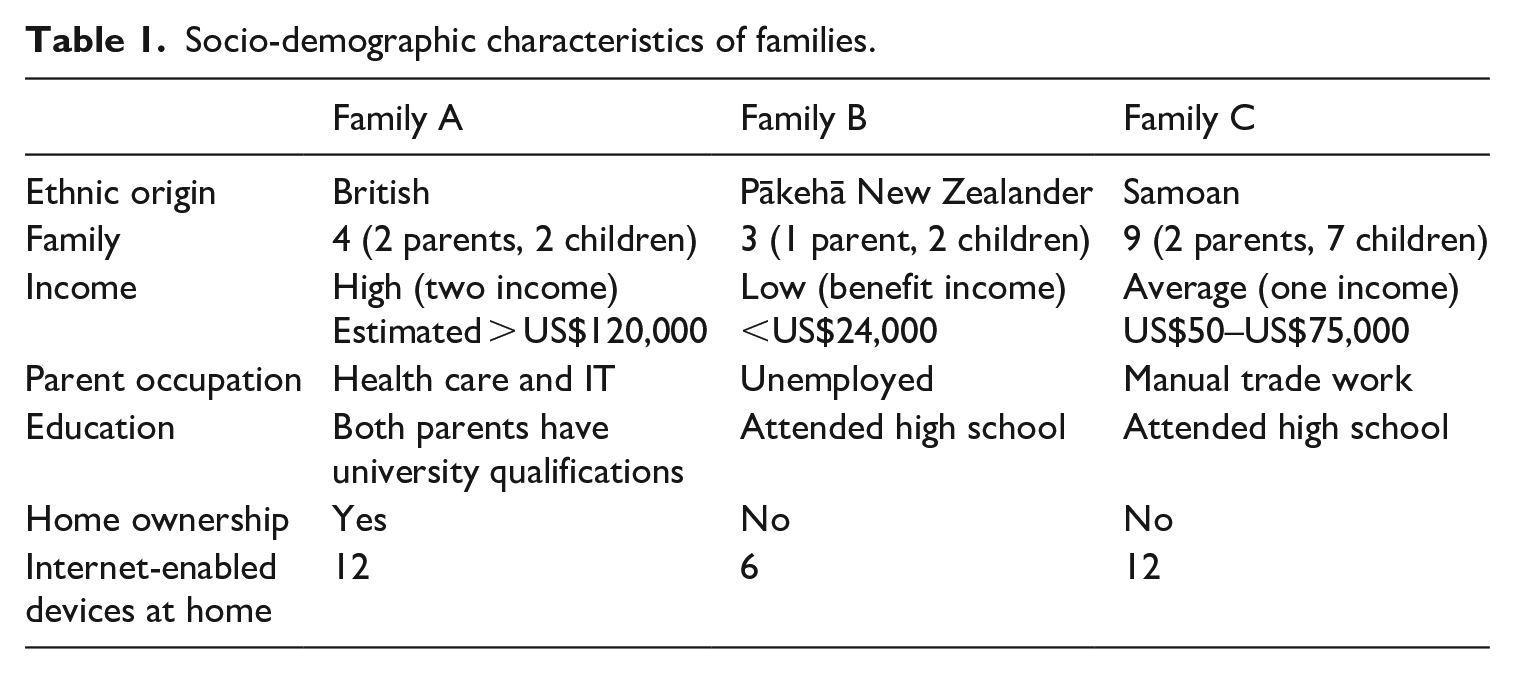
Although each family in our study had a unique digital disposition, for the purposes of elucidating how habitus and capital function to reproduce digital exclusion, we take a case study approach presenting analysis for three different families from Aotearoa New Zealand. As highlighted in Table 1 below, Family A is a family of four of British origin where both mother and father have tertiary qualifications and well-paid professional jobs; Family B is a European/ Pākehā family, where a single mother of two with no high school qualification is on a government benefit. Family C is a Samoan family of nine, father is employed as a tradesman on an average income, mother is a homemaker and neither parent has any formal qualifications. By presenting households from three very different class and cultural backgrounds, we can highlight the points of disjuncture and diversity that emerge between them. Using a case study approach also allowed us to illuminate the linkages across generations that underpin familial habitus and reveal not only very different capital gains but also how families differ in the way that they value digital technology, ultimately affecting how they engage with it.
Socio-demographic characteristics of families.
Limitations
As a characteristic of most qualitative research, these findings cannot be taken as a reflection of all families across New Zealand. We do not aim to correlate children’s digital practices with factors, such as wealth, gender, age and ethnicity, but intend to give a more nuanced account of how digital exclusion is socially reproduced (Helsper and Eynon, 2013).
While this article looks at issues of class and culture, there emerged a particular set of issues around the relations between Māori and the Crown, with respect to the Te Tiriti o Waitangi (Treaty of Waitangi), the complexities of which will be addressed in a separate publication.
Findings
Family A: European British/Pākehā family of four
Our first case is an upper-middle-class European Pākehā family of four. The mother and father were born and educated in the United Kingdom. They each had tertiary qualifications obtained in the United Kingdom before emigrating to New Zealand in 2007. They now live in a rural lifestyle block (big enough to have horses and animals) with their daughter (almost 13 years of age) and son (aged 11 years), their several horses, two Staffordshire bull terriers and other farm animals. The father’s IT profession gave him the flexibility of working from home, and the mother was a health professional able to work flexible hours at a local clinic. Their well above average household income was largely unaffected by the Covid-19 pandemic as they both continued to work from home during lockdown.
The mother explained that she came ‘from a kind of engineering and medical background’, as her father and grandfather had been structural engineers, and her mother a psychologist. As both her parents had professional careers, her upbringing provided her with a sense of confidence, purpose and vision about her life from an early age. She described how she had made a calculated decision early on to do something in the medical science field that would enable to travel, work and motherhood mirroring her parent’s expectations that she pursue a professional career which could be fashioned around raising a family.
During a separate interview with the daughter, it became apparent that she too possessed the same sense of confidence and certainty about how she might actively pursue her ambitions. She too was attracted to the sciences and would be the fourth generation to do so. Attaining higher education and having a professional career were perceived as normal and attainable, and this relates strongly to her habitus and access to capital. Tertiary qualifications were considered a highly valued form of cultural capital that would facilitate the children’s path to independence. Not yet 13 years of age, the daughter was clearly very motivated, having decided she would train to be a vet and confidently mapped out her future saying, ‘Well, I can do my first year in Albany in Auckland, and then I have to do the rest in Palmerston North’.
The familial habitus empowered greater parental investment of time in their children. It was evident that the parents invested considerable time and energy in helping their children to develop cultural capital valued within western capitalist society. Having considerable economic, social and cultural capital, these parents were able to provide both resources and supervision to foster extracurricular skills not learned in the educational setting. The father’s ability to work from home ensured that the children’s time after school could be carefully structured around extracurricular activities designed to embolden individual achievements. This ‘concerted cultivation’ (Lareau, 2011) of skill and knowledge (including but not limited to digital knowhow) fostered independence and autonomy in preparation for adult work life. The daughter’s confidence and sense of entitlement enabled a mature interaction with the adult interviewer, a disposition which has previously been associated with middle class families (Lareau, 2011).
While the rural Internet connection could be problematic and might be considered poor access, everyone managed to achieve their work and education goals from home. There were three iPhones, one laptop, three iPads, one iMac, one PC, one smart TV, one gaming device and one abandoned Fitbit. Despite the father’s obvious IT expertise and the family’s high income, the number of digital devices was not excessive, but it is worth noting that the digital devices were of a high quality, suited to in-depth learning and project work, and accessible to the children. For instance, the mother’s iMac had been given to her daughter.
Although the mother did not talk about restricting the children’s time online, the daughter was aware that her mother monitored her digital activities for safety purposes. She was acutely aware of the rules of digital engagement in relation to global Internet regulatory conventions, informing the interviewer of her right to open a Facebook account when she turned 13 years of age:
So, like mum kind of manages a lot of our accounts, you know, like she checks up on it, but then when I’m thirteen, which I am nearly, I’ll be legally allowed to have it [Facebook] myself. (Daughter)
By and large, digital technology was used for daily administrative tasks and to meet work and school requirements. Although the mother claimed to be ‘quite undigital really’, she was proficient in managing daily life online, interacting with key services, communications and accessing information. Furthermore, she had successfully adapted to conducting telehealth consults during lockdown. While this mother stressed that home life was not structured around digital technology, this family certainly did not lack digital knowhow or support. With sufficient confidence and motivation to try new things without hesitation, family members were able to accrue new forms of digital capital. This high level of digital capital was not experienced by all families in this study; for as Bourdieu explains to appropriate and use technology (machines), individuals must have access to ‘embodied cultural capital; either in person or in proxy’ (Bourdieu, 1977: 50). A high level of cultural capital in the digital space (digital capital) was evidenced by the family members’ already considerable ‘embodied’ expert knowledge, access to quality digital ‘objects’ and ‘institutionalized’ ICT support (Selwyn, 2004: 353). With considerable digital capital, the daughter was able to accomplish her schoolwork more efficiently from home than school:
Because in my classes, there’s a lot of silly boys. So, a lot of the time the teacher has to tell them off, but now I could get all my work done in about an hour or two because I work quite fast and then I went outside and helped my parents with the jobs and ride my horses. (Daughter)
The privileged familial habitus was beautifully illustrated through the daughter’s account of her extracurricular activities and home life. Both mother and daughter often attended regular equestrian competitions around the country. Not a simple matter of joining a sports club, membership to the equestrian lifestyle constituted a familial habitus that multiple generations enjoyed:
I was born in like a horsey world, like, you know, mum was like horsey too. So, like I think I started riding at three years old. (Daughter)
The daughter had greater access to capital to support this extracurricular interest than our other families described later in this text. She explained,
Well, I’ve got four that I own, but one’s out like on lease. Yeah, but we still own him, and then I’ve got [Dancer] who’s like my main one. And then I’ve got [Lightning], who was my main one, but she’s like pulled a muscle in her back. So, she’s out for a bit. And then I’ve got a baby. (Daughter)
She posted pictures of her horses on her Instagram account to promote her social capital within the equestrian community.
The mother used Facebook to keep in touch with family and friends who lived overseas, but apart from this she was not an avid user of social media. Similarly, her daughter did not value the socialising aspects of social networking services such as Instagram, even reporting that she and her brother spent less, not more time online during Covid-19 lockdown:
Most of the time we were outside a lot, like riding horses and like finishing heaps of stuff, jobs. Yeah. So, I wasn’t actually doing much on my device. Like I got this app, and it said my screen time was down like five hours during lockdown. (Daughter)
She did, however, value the Internet and digital services for their ability to grow economic capital:
If it wasn’t there, like if it suddenly got deleted, I wouldn’t have a big fit, I wouldn’t really care. It would be kind of sad, I couldn’t run my business, but like it’s not the end of the world, but then some of my friends would be like, ‘ahh, I’m gonna die!’ (Daughter)
Not only did she have considerable social, economic and cultural capital at her disposal but she also worked on developing capital in her own right within the digital space. For instance, although she did have an Instagram account, she was also building a network of customers for her budding business enterprise manufacturing horse treats which she sold via her Instagram account, and a Facebook business page set up by her mother. In her account, she seamlessly found and used the digital tools and services she needed to start and manage her enterprise from which she had saved a few thousand dollars. The daughter’s homelife illustrates how this family encouraged ‘capital-enhancing’ uses of digital technology that reflected western values of self-actualization and independence.
Although her parents proudly claimed their daughter’s achievements to be her own, they supported her entrepreneurial use of digital technology, providing extracurricular support for learning a range of skills that would bolster her ability to compete in the adult world. The father claimed her to be brighter than most for her age saying,
If you look at all of her friends at school, I think [she] is way above, you know, she’s got a good head on her shoulders . . . She looks at the profit and loss and she looks at how much money she has spent, how much she sells. So, she’s pretty good. (Father)
Not yet 13 years of age, this young girl had made calculated decisions to use digital technology in ways that enhanced her social, economic and cultural capital on and offline. For instance, when asked how she might use digital technology in the future, she imagined new technologies that could help her in her professional career as a vet, saying you might,
. . . have a robot that comes around with you and like speaks and like books appointments for you . . . if you got an iPhone that could X Ray your animals. (Daughter)
Although having considerable economic, social and cultural capital provides greater access to opportunities, this case demonstrates how familial habitus shaped by middle-class cultural tastes and values is integral to building the forms of digital capital to compete in the modern world. In this case, the familial habitus emboldened the daughter by embedding a sense of self-belief, confidence and entitlement, evident from her accomplishments, and a clear plan for her educational and career goals. Consequently, she was motivated to build forms of digital capital in ways that enhanced capital and the likelihood of achieving her personal goals.
Family B: European/Pākehā single mother of two
Our second case study is a European/Pākehā family; a single mother with a girl of 14 years of age and a boy of 10 years of age. This mother grew up in the rural Manawatū-Whanganui region of New Zealand’s North Island. She testified that a flourishing gang culture in her community had made life difficult. From a less privileged background than our first family, her father worked as a chef and her mother as a nurse. She left high school without a qualification, had moved away as a young woman and was now a single mother of two children, sharing a home with her sister and niece, north of Auckland. She had recently held a child-minding job, had started part-time study in social work and was on single parent benefit. She was attracted to the idea of working in a community service role caring for others like her mother had but would need to gain a qualification to do so. Although only in her 40s, she had little digital experience having worked in unskilled service roles that did not require or build digital capabilities.
Despite a lack of economic capital, each family member had the means to access the Internet. There were six digital devices. Both mother and her daughter had cell phones, the son had inherited the mother’s old iPad and had an Xbox, and the daughter had been gifted a laptop from her father, and the mother had only just saved enough to buy one herself having previously been given one:
Yeah. I saved up for my laptop. Um, and the laptop I had before that, um, I was gifted that. but this one’s the first one I’ve ever bought myself . . . The iPad that I’ve had for about four or five years, my son has got it and I don’t plan on upgrading that, so yeah . . . I think my phone is probably the only thing I’ve ever upgraded, and I’ve only ever done that once. (Mother)
In comparison to our first family, there was much less financial investment in technology as digital devices were often recycled or provided by external sources. This family lacked digital knowhow having little embedded, objectified or institutionalised forms of IT knowledge or support. The Internet represented social, financial and technical risks that the mother felt powerless to resolve:
I think my biggest worry or concern would be how accessible you are to other people . . . people trying to come in and steal your bank accounts and . . . people that try to plant viruses and stuff on your, like they send you emails, and you open it up and once you’ve opened it, there’s a virus on your computer. So those are scary. Yeah. (Mother)
Nevertheless, they each had their own personal device and were able to carry out necessary daily administrative tasks for home and school, consume digital entertainment and keep in contact with close friends and relations. They rarely used the Internet beyond these administrative and consumer requirements. However, this low Internet use can be better explained by exploring the familial habitus. For instance, this mother had an anxious and distrusting social disposition claiming to suffer from social anxiety which extended to her online communications. That she and her daughter wished to do the interview together is a case in point. The mother’s social footprint was low, using Facebook to remain connected with close family and friends. Social memberships outside of this circle were perceived as risky and leading to unwanted communications. In this vein, neither the daughter or mother had joined any online communities missing opportunities to build social capital that might be transferred to economic or cultural capital offline.
As with most adults and children interviewed, the mother and daughter claimed to have the digital skills they needed to accomplish ‘necessary tasks’ mirroring Robinson’s (2009) finding that less advantaged families have ‘a taste for the necessary’. However, while appearing to support Robinson’s claim that less advantaged families have fewer opportunities to build digital capital, here lower digital participation can be explained by the familial habitus which favours more practical offline pursuits. In this case, a socially constrained familial habitus placed limits on their digital engagement creating barriers to building digital capital. Although this mother valued social media platforms for ‘how easy it is to access people now, like family and friends’ she rarely interacted with people outside of her intimate circle, choosing to remain a spectator:
I do a little bit of social media. I’ve got, um, Facebook, uh, Instagram, uh, TikTok but I mainly just go on to look at like what other people are doing. I don’t tend to express myself or anything like that really . . . Just have a nosy at other people. (Mother)
Although the daughter, like other children of her age, had several social media accounts (Snapchat, Instagram, Facebook and Pinterest), like her mother she had a small circle of friends and did not use social media to make new friends or garner support from communities online.
Although resigned to the fact that technology was increasingly seeping into daily life, the mother derided its potential to detract from ‘real life’ maintaining there should be some separation from digital technology:
I would like to think I could do without it, but I really don’t anymore. Like I think it’s one of those things that once you’ve got it, you’ve got it . . . I like the idea, especially of an iWatch, but again, that’s kind of like, well when do you separate yourself from technology? Like, it would be quite nice just to have a normal watch. (Mother)
The daughter echoed this resistance to digital technology which she saw as competing with more practical achievements offline:
I would honestly love it if we weren’t all so obsessed with digital technology but hey it is what it is . . . [technology] is pretty important to me because, like I have to use it for everything that needs it, but if I had a choice, I wouldn’t use it . . . Yeah. I just prefer doing things manually. Yeah. (Daughter)
Consequently, the desire to accrue digital capital was limited. For instance, irrespective of class, she and the daughter from the first family were high achievers in their extracurricular pursuits. The daughter in this second family was a confident and prolific writer claiming,
I’ve fully written one children’s book. And I have a whole bunch of other books and ideas that I’m working on at the moment. (Daughter)
However, unlike the daughter in our more advantaged family, neither mother nor daughter had consciously sought online opportunities for the daughter to build digital capital. For instance, they had not considered or sought online resources to improve her writing skills, get feedback and support from other writers, and had little knowledge about writing and publishing opportunities online. A lack of cultural capital limited their vision of how the digital space might be used to grow or leverage the daughter’s talents online.
Habitus plays a strong role in undergirding children’s expectations of life, what job they might want to do after completing their education. Unlike our first family, the daughter did not have a clear vision of her future, but thought she might enjoy a role in the social sector, as her grandmother had:
Um, well I think I want to be either an actress, author, or paediatric nurse . . . I love working with children and helping people, and I’ve been trying to find a job for a while that would be right for me, but I haven’t really. And then I came across that [paediatric nurse] and I was like, ooh yeah. (Daughter)
In contrast to our first family in this study, the low engagement with digital technology was not entirely born of financial constraints, but a habitus that valued privacy and practical real-life activities, and which was sceptical of the value that digital technology could add to daily life. The mother’s ability to provide extracurricular supervision that would develop her daughter’s ability to leverage her talents online was severely limited. Equally, the expectations of what the daughter might achieve in her career were constrained by a more working-class familial habitus.
Family C: a Samoan family of nine
Our third case study is a family of nine, with seven children ranging from 18 months to 8 years of age. Both parents had attended high school in Samoa but left without any qualifications. The mother was a full-time parent and the father worked as a manual labourer in the kitchen supplier industry. With a household income below US$75,000, financial resources were stretched. Their home was situated in a less affluent suburb of Auckland where the children attended low-decile schools. The mother was nostalgic about her Samoan upbringing, reflecting fondly on her own ‘natural’ childhood which was unimpeded by digital technology and placed a high value on offline in-person interactions or handwritten notes, seeing these as trustworthy, sincere and meaningful. She had considerable purchase in the local community, volunteering and being a member on one of the children’s school boards for some years. As such, she was the eyes and voice for her Samoan community within a western education system.
It was especially important that her children grew up to have the same values, to have personal connection, care and respect, integrity, and obedience to elders were paramount (Pearson, 1992). These personal attributes were essential to gain acceptance and respect of others in your social sphere (largely conceptualised as offline) and to be able to contribute to the safety and well-being of your community:
I think most importantly for me, I want my kids to be . . . sure of themselves . . . I want them to be confident, cause if you don’t have that, you can’t do anything . . . And I want them to treat other people as the way they want to be treated. Yeah. To be kind, you know, it’s no use being smart, if you’re rude nobody will like you and nobody will hear you. I have always taught them that, it’s how I was brought up. (Mother)
Spending time on digital devices was considered far less important than learning how to communicate sincerely and confidently with people around you:
[L]ike computing, yeah, that’s second, you know, they all know how to use the computer and stuff, technology, but I think it’s the way you’re brought up that makes who you who you are. (Mother)
Furthermore, in her view, spending too much time online worked counter to her own natural Samoan childhood:
Yes, I prefer them not to be online too much . . . I don’t like them being on devices. I’d rather they were reading a book, going outside to run around and kick the ball, than just be stuck in the house, you know, looking at a screen all day. To me, that’s not a thing. I think it’s because of how I grew up, I never had all this technology. (Mother)
Mindful of money, her husband had been urging the older boys to get part-time jobs to help contribute to family finances. For this and other Pacific families interviewed, tertiary education was out of the norm; nevertheless, both parents aspired for their children to gain tertiary qualifications, seeing this as essential to break the cycle of poverty:
[T]hey’ve seen the difference of someone who had a degree get a job and get money, buying stuff they like, and then a person that doesn’t have a degree . . . When they see boys, they used to know that just don’t go to school anymore, they don’t work, they just walk around the place . . . my husband always points that out [saying] ‘look at those boys, where’s the future?’ We have a niece who had a baby at 15 and we say, ‘she’s not a child anymore, she’s a mom . . . and she has no job, she has no education and now the grandma will have to look after the baby’. (Mother)
Although they aspired for their children to get tertiary qualifications, their Pacific familial habitus was built on Samoan cultural values that prioritised care, respect, cooperation, responsibility to family and community. The expectations emerging from this familial habitus were that their children would find work that enabled them to practice these values. Unlike our first family where the almost 13-year-old daughter had her future mapped out, the 16-year-old Samoan son had no idea of what he wanted to do. This familial habitus excluded the notions of individual achievement, while imagining the children would work in community roles. For instance, his older brothers, and other children from other Pacific families interviewed, frequently aspired to take up roles serving their community, that is, to join the police force or the military, or play rugby, reflecting their parent’s habitus that prioritised social well-being, being responsible and admired members of their community. This mother was clear that
The older ones are aiming to go join the army . . . it’s always good to go in the army [but] to have something else other than to be a soldier . . . so you can join the army as an engineer . . . so [our eldest son] is doing engineering next year at Unitech and yes, he wants to be in the army. My second one doesn’t know yet . . . the third one wants to be a policeman and be an All Black [New Zealand national rugby team] as well. (Mother)
Interestingly, digital knowhow was not considered important to these and other roles in the community. The culture of technology use reflected this view. This household of nine had five smart phones, one laptop and one desktop, one smart TV, and one gaming device before the Covid-19 pandemic. The parents and older children relied on their cell phones for school, while the PC, PlayStation and TV were shared devices used largely for entertainment. The new Covid-19 pandemic requirement to attend school from home was problematic as having only one laptop meant the boys could not attend class, but when this was remedied by schools providing three laptops during Covid, it contradicted the norms of digital engagement in the household:
I think that the only bad thing about it is they spent most of their time online doing their work or talking to the teachers. It is something that they’ve had to get used to because before in our family, they had a certain time limit. It was like an hour per child to go online and usually it’s just for schoolwork. But then during the lockdown, it’s like right on the dot nine o’clock my boys have to sign in and do their work and talk to their tutors. And it’s like, it was a whole thing. It was like a whole day thing. It’s like, aarg! (Mother)
Despite the absence of quality digital artefacts in the home historically, and a lack of formal IT education in the family, this mother was confident that the children had sufficient digital knowhow to attend school, and that she had sufficient skills to accomplish daily administrative tasks, such as banking, using email, handling documents and using Zoom in her volunteer work. A task-oriented approach prevailed (Robinson, 2009), and nonessential activities were restricted. For instance, attending school online was deemed necessary to gain a qualification (a cultural artefact valued in western society), while additional time online was constructed largely as a luxury, a reward for good behaviour, rather than an opportunity for the children to accrue new forms of digital capital. Like other Pacific families interviewed, this mother heavily restricted Internet access through controlling data allowances and time online:
I have time set up for their phones as well, so they only have a certain time to go online on the phone. Okay, okay so I sound like a really bad mother, but my boys have a PS4 as well . . . they only get a certain amount of hours a day. So, during school week, it’s no games for any of them. [on the weekend] I only turn on the internet for gaming at 12 and it finishes at 7. (Mother)
Cell phones ensured she could monitor her children’s whereabouts, but she was apprehensive about not being able to oversee their safety on social media networks. She claimed that as ‘bad things happen on Facebook’ she prohibited all her children from using it. Although she had accrued significant civic and personal capital offline in her community and at the school where she was a voice for her community, she did not use the Internet to increase her civic or political voice (capital) online, seeing online communities as toxic and dangerous.
Like most teenagers, the son had Instagram, TikTok and Snapchat accounts but claimed ‘I just use it to keep in touch with my friends and family’ rather than creating, uploading, posting or commenting on anything online. Like his mother, he did not attempt to use social media in ways that might build his social capital online.
Interestingly, this mother’s ‘luxury’ time online was spent searching out for information to reinforce her cultural identity, such as looking at the pictures of the ‘Golden Years of Samoa’ Facebook group and learning about Samoan plants so she could recreate this feeling at home. Her favourite thing to do with digital technology was to photograph family life and use the Google timeline to revisit family outings and events. When allowed time on the Internet, the son’s activities were largely random, rather than intentionally designed to achieve capital gains as the daughter of our first family activities had been.
We could say this disciplinary approach has emerged out of a scarcity of economic capital; however, the Samoan values embedded in their familial habitus contradict the western values underpinning the digital society. As such, their habitus prioritised being present and committed to family and community, over being online and in effect immersed in western culture and ideals. The parents had had a strong desire to keep their children within the Samoan cultural context. This led to a paradoxical view of digital technologies as both necessary and yet culturally unsupportive. Although children’s time online was regarded as necessary to comply with educational demands, it also threatened their life-world which imagined children’s futures as contributing to their community, suggesting that the notion of digital exclusion as one of deficit requires deeper evaluation.
Conclusion
As these three case studies demonstrate, habitus and capital arising not only from one’s class position but also from one’s cultural values can powerfully shape an individual’s engagement with digital technology. This work has shown the importance of familial habitus to build digital capital, and that the forms of digital capital accrued within these family contexts have significant impact on the quality of digital use (second-level divide) which in turn dictate how well such capital is converted into other forms of capital (third-level divide), resulting in very different capital gains for each family.
For our first family, familial habitus predisposed the children to view the Internet and digital technology as something they were entitled to, and as a resource to support them in enhancing capital to advance their individual life goals. The daughter’s sense of confidence contrasted sharply with the children from the other families, whose relation to the world (social position) revealed entirely different expectations, social support, levels of confidence and motivation towards using digital technology.
In the case of our second family, familial habitus engendered a more practical, offline lifestyle resulting in a resistant disposition towards digital technology which although acknowledged as increasingly necessary, was viewed as reductive as it did not add to ‘real life’. This impeded the children’s ability to visualise and take action to build the forms of digital capital that could produce offline capital gains that might ultimately improve their life circumstances.
For our third family, Samoan cultural values inhibited ‘capital-enhancing’ digital practices as these values worked counter to the individualistic ideals which are supported and legitimised by dominant political and economic interests, demonstrating that an unwillingness to engage is a matter of cultural difference worthy of further research. In New Zealand, deficit framings in digital divide debates tend to see Pacific cultures in a negative light as it describes them as under-resourced and unwilling to engage with the dominant westernised infrastructure and conform to existing capitalist expectations in the digital society. However, it is important to acknowledge that there are different world views that are being contested here and that we cannot assume western ideals are necessarily appropriate for all (France et al., 2019).
Overall, this analysis provides nuanced empirical data that demonstrate how familial habitus emerges, how it is passed down through families, its collective nature as a product of class-based practices with embedded cultural patterns and values that shape children’s life-worlds, expectations and their outcomes of digital technology use. In addition, while illuminating themes relating to social class, this work also builds on Bourdieu’s concept of habitus by addressing the impact of ‘race’ on habitus, which as Reay (2004) points out, is largely absent from Bourdieu’s writing (p. 436). It demonstrates how people’s relationship to the dominant culture is conveyed through the forms of digital capital that are valued and accrued. Finally, this work challenges existing third-level ‘digital divide’ scholarship which evaluates an individual’s digital outcomes against a westernised framework which may ultimately perpetuate deficit framings for some cultural groups in the digital society.
Footnotes
Authors’ Note
Both authors have agreed to the submission of this article titled ‘Capital Gains in a Digital Society’. This article is not currently being considered for publication by any other print or electronic journal.
Caroline Keen is now affiliated to Sociodigital Research Limited, New Zealand.
Funding
The author(s) disclosed receipt of the following financial support for the research, authorship, and/or publication of this article: The principal author received a research grant from the non-profit organisation InternetNZ.
