



Abstract
Plastic reduction policies are important for addressing plastic pollution however, the success of such policies relies on establishing new social norms. This study advances knowledge on public expressions of social norms by exploring the interplay between news media and social media in response to a new environmental policy. It is the first study to explore this phenomenon with the explicit aim of identifying and comparing information related to social norms. A content analysis was conducted in relation to the 2018 Australian supermarket plastic bag ban. Results demonstrate how social norms related to a new policy are created, reinforced and expressed in the contemporary media landscape. The interaction between news media and social media offers a window into public expressions of social norms, where social media provides a platform for civic participation in a public and real-time environment in which users can challenge the dominant narrative presented by the news media.
When news stories covering the introduction of a new policy are posted on social media, users do not just receive information about the policy, they can also share the content, discuss the pros and cons, and indicate their support or opposition (Shehata and Strömbäck, 2018). Media is most effective at inducing change when it is combined with the development of social networks (McLeod et al., 2009). This active participation in a networked environment provides increased opportunities for civic and political engagement (Skoric et al., 2016). It also means that messages delivered by mass media are now subject to reinforcement, or rejection, by social media users in real-time.
User-generated content provides a public and accessible indicator of common behaviours and opinions. This has important implications from a theoretical perspective, because such content could influence others’ perceptions about what is normal (Lapinski and Rimal, 2005; Rimal and Lapinski, 2015). Aggregate data from social media also offers policymakers a novel source of information regarding public interests and perceptions (Ilieva and McPhearson, 2018). Unlike opinion polls, social media data are not fixed in time but changes with public interest (Anstead and O’Loughlin, 2015). These data can provide policymakers with ongoing practical insights into public reactions to policy, beyond news reports which are more likely to focus on sensational and dramatic elements of a story (Ryan et al., 2001). Therefore, analysing social media reactions to news reports would be invaluable for policymakers when introducing a new policy as a means of tracking ongoing public response.
Researchers have started to use social media data as a proxy measure to understand public opinion and reactions to politics and policies. User-generated data have been used to measure political opinion (Anstead and O’Loughlin, 2015; O’Connor et al., 2010) and to understand general expressions of opinion (Puschmann and Powell, 2018; Su et al., 2017). It has also been used to compare journalist and community reactions to real-world events – for example, the 2010 BP oil spill (Watson, 2016). However, to the best of our knowledge, no studies have investigated these phenomena with the explicit aim of identifying and comparing information about social norms.
Using the 2018 Australian supermarket plastic bag ban as a case study, we explore the interplay between news media and social media reactions to the new policy through a social norms lens. Our case study advances knowledge on the expression of social norms – that is, behaviours, opinions and expectations – by analysing the interaction between news media and social media as an environmental policy was announced, introduced and changed. We argue that by monitoring and understanding how social media users react to news about the introduction of a new policy, from a social norms perspective, policymakers can make more considered decisions. In this article, we illustrate how information about social norms can shift and change over time, as reflected in changing patterns of behaviours and opinions expressed in both news and social media. Specifically, this study sought to address the following research questions:
RQ1. What behaviours, opinions and expectations are described/expressed in news media and related social media comments regarding the supermarket plastic bag bans?
RQ2. Did the common behaviours, opinions and expectations differ between news media and social media comments?
RQ3. Did the prevalence of behaviours, opinions (including social media engagements) and expectations described/expressed in news media and social media change over time?
Plastic bag reduction
We are in the middle of a global trend away from single-use plastics which is ‘gathering momentum through social media’ (Vince and Stoett, 2018: 202). Evidence of this shift can be seen in the global spread of plastic bag reduction policies at various country and jurisdiction levels (Xanthos and Walker, 2017). However, the success of any single-use plastic intervention hinges on community acceptance and behaviour change (Schnurr et al., 2018). When South Africa banned lightweight plastic bags and introduced a levy on thicker bags, the initial levy price was lowered after community backlash, which led to a gradual increase in the use of thicker bags as a single-use item (Dikgang et al., 2012; Hasson et al., 2007). The lack of sustained behaviour change in South Africa has been attributed to the lack of persuasive campaigning (Dikgang et al., 2012), which was instrumental in the success of similar policies – such as the 2002 Irish ‘plastax’ (Convery et al., 2007).
Australia is also in the middle of a single-use plastic transition. Before 2018, there were a number of public policy bans on lightweight plastic bags and corporate policy bans at nationwide chain stores. In mid-2018, two more States (Queensland and Western Australia) and Australia’s two largest supermarket chains (Coles and Woolworths) also introduced plastic bag bans and Victoria announced they would ban bags by the end of 2019. 1 Lightweight plastic bags were removed nationally on 20 June 2018 for Woolworths and 1 July 2018 for Coles, and State-wide on 1 July 2018 for Queensland and Western Australia. Given the concurrent nature of public and corporate policies in Australia during this time, throughout this article ‘plastic bag policies’ refers to any external rule which affects consumer’s abilities to obtain a free lightweight plastic bag.
When supermarkets removed lightweight bags, they also introduced a fee (15 cents) for thicker reusable plastic bags. The reusable bags were initially provided for free for the first 10 days, in addition to discounts and reward points for customers who brought their own bags. Coles then extended the free-reusable bag offer until the end of July 2018, and on 1 August 2018, announced that they would again extend their free bag offer, indefinitely. This decision was commonly referred to as backflipping or flip-flopping (indicating the company’s lack of commitment to banning free plastic bags, regardless of thickness). The following day Coles confirmed that the free bag period would end on 30 August 2018.
During this period, it was common to see news articles reporting on the bans (including reports of social media users’ reactions), and to see social media users sharing news related to the bans. While campaign material was limited, the high level of attention from news media and social media may have functioned as an unofficial form of social marketing (Andreasen, 1994). Because media messages are delivered on a large-scale and in a public manner, reports of how people were responding to the bans could have influenced individual’s perceptions about the attitudes and behaviours of others – that is, social norms (Arias, 2019).
Media and social norms
Social norms are the unwritten rules of society that guide and constrain how we behave based on what others are doing (descriptive norms) and what others approve and disapprove of (injunctive norms) (Cialdini et al., 1990). Social norms are socially negotiated, context dependent, and malleable, changing to fit the time and place (Rimal and Lapinski, 2015). While it can take many years for new norms to form and become embedded, change can also happen rapidly – particularly, when there is a period of social or political upheaval (Nyborg et al., 2016; Rimal and Lapinski, 2015).
According to the theory of normative social behaviour (TNSB; Lapinski and Rimal, 2005; Rimal and Lapinski, 2015), behavioural intentions are influenced by perceived descriptive norms, but this relationship is moderated by other factors, such as injunctive norms and outcome expectations. Outcome expectations refer to the anticipated consequences of engaging in a given behaviour, drawn from social learning theory (Bandura, 1977). These expectations can then strengthen or weaken the relationship between descriptive norms and behavioural intentions (Rimal, 2008). In addition, it has been suggested that social norms are more likely to influence intentions when the behaviour is ambiguous or new (e.g. in response to a new policy), public (e.g. shopping at a supermarket) and when the behavioural consequences are well-known (e.g. when media coverage is high) (Lapinski and Rimal, 2005).
Perceptions about social norms are shaped through exposure to various cues from the physical, social and symbolic environments (Mead et al., 2014). While the social environment is most influential in norm formation, it has long been recognised that ‘a vast amount of information about human values, styles of thinking, and behavior patterns is gained from the extensive modeling in the symbolic environment of the mass media’ (Bandura, 2009: 98). Media can influence perceptions about social norms by determining what and how behaviours are depicted. For example, Witzling et al. (2019) found that the news media was associated with normative beliefs about local food purchasing. However, this influence is dependent on how such messages are framed (Scheufele, 1999).
Framing desirable behaviours, such as using reusable shopping bags, as common and acceptable in the media could promote these behaviours as normal. Whereas, framing single-use bags as commonly used could normalise the undesirable behaviour. Previous research has found that when mass media focuses on desirable behaviours and attitudes, it can be an effective tool for influencing perceived social norms for intergroup prejudice (Paluck, 2009), violence against women (Arias, 2019) and family planning (Gunther and Storey, 2003). Research has also found that media use can influence adoption of pro-environmental behaviours (Holbert et al., 2003; Howell, 2014; Huang, 2016). However, no studies have specifically explored the role of media in the context of plastic avoidance.
Furthermore, while evidence suggests that mass media can influence perceptions of social norms, more research is required to understand the role of new media (Nyborg et al., 2016). Social media, for example, provides an online platform (symbolic environment) for individuals to learn about social norms directly from their social networks (social environment). As argued by Rimal and Lapinski (2015), the more open or public the behaviour, the stronger the influence on perceptions about others. Social media engagement metrics (such as the number of views, retweets/shares, comments and reactions/likes) have been found to influence perceptions about how important an issue is to others as well as perceptions about the popularity and believability of the associated message (Kim, 2018; Spartz et al., 2015).
The role of social media in the new media landscape is inescapable. It has become common practice for journalists to use social media activity as evidence of public response to a news event (Anstead and O’Loughlin, 2015). At the same time, many people are exposed to news through social media, often incidentally (Fletcher and Nielsen, 2018), where they can share and discuss the content of news stories within their own networks or as a means of public discourse (Lester and Hutchins, 2012; Shehata and Strömbäck, 2018). While the tendency for news to transfer between different media sources (known as intermedia agenda-setting) is not new, the increasing popularity of news websites and social media has changed the nature of this phenomena (Harder et al., 2017).
Given that normative perceptions can influence behaviour and media can influence normative perceptions, it is important to understand what messages are present in the media regarding common behaviours (which could influence perceived descriptive norms), expressions of opinions regarding approval or disapproval of related behaviours (injunctive norms), and expressed beliefs relating to the consequences of related activities (outcome expectations).
Methods
Sampling
This study used the following two sample frames: (1) Online news articles, posted on the news source’s public Facebook page and (2) Facebook users’ comments and reactions to sampled articles. Comments on news websites were not included as such comments do not provide opportunities to engage with existing social networks. Facebook was the chosen platform because of its relative popularity among the 79% of Australians who use social media, where 91% use Facebook compared to 53% or less for YouTube, Instagram, Snapchat and Twitter. 2 Facebook was also chosen due to the variety of available responses. Users can comment, tag others, share and react to posts using several reaction icons (‘like’, ‘love’, ‘angry’, ‘sad’, ‘wow’ and ‘haha’). While interpretation of these reactions should be made with caution, such information provides a more nuanced understanding of user responses.
The chosen online news sources represent the three most visited news websites in Australia, based on data collected in 2018. 3 The selected news sources were News.com.au (average visitation: 5.9 million), Sydney Morning Herald (SMH) (5.3 million), and Australian Broadcasting Corporation (ABC) News (5.0 million) – the next most popular new website was Daily Mail with an average of 3.9 million visitors each month. The chosen sources also have active public Facebook pages and represent a mixture of media ownership and political orientation among readers. News.com.au is followed by 1.3 million Facebook users, owned by News Corp Australia, and the orientation of online readers is towards the right of the political spectrum; SMH is followed by 1.1 million Facebook users, owned by Fairfax Media, and online readers are more likely to identify towards the left of the political spectrum; and ABC News is followed by 4 million Facebook users, owned by the Australian Government, and the online audience identify towards the centre of the political spectrum (see Figure 8.7 in Sora et al., 2020).
It should be noted that while the selected outlets were the most visited news websites overall and had an active social media presence, not all Australians use online news or social media, and those who do may not use it in the same way. For example, two of the three sources were not among the top preferences of those born between 1991 and 2005. 3 Similarly, research has found that Australians with higher education and income levels.are more likely to access news online compared to those with low education and income (Sora et al., 2020). This suggests that our sample is less-representative of the behaviours, opinions and expectations of young adults and those with low education and income levels.
Data extraction
Data were extracted in November 2018. Extraction involved searching each news source’s public Facebook page for the keywords ‘plastic bag’ and ‘Coles’ or ‘Woolworths’. Posts were screened to ensure (1) they linked to a news article, (2) that the supermarket plastic bag ban was central to the article content and (3) that the article was posted between July 2017 (when the bans were announced) and September 2018 (one month after the bans were completely implemented). Of the 42 included news articles, three were posted when the ban was announced in July 2017. The next article was posted in April 2018, when Woolworths piloted the ban in selected stores (n = 1 article). The number of articles increased in June when Woolworths’ ban was initially introduced (n = 8) and in July when Coles’ ban was introduced (n = 12). The number of articles peaked at the beginning of August, when Coles extended its free bag policy ‘indefinitely’, before confirming a final end date (n = 18). No articles were posted after August 30.
Once the articles were identified, Facebook comments (N = 23,001), shares (N = 5625) and reactions (N = 54,950) were extracted. No user information was obtained and only users whose privacy settings allowed for public display were included in comment extraction, in line with Facebook’s privacy rules. To protect user anonymity direct quotes which could identify users are not reported. Monash University Human Research Ethics approval was obtained on 13 November 2018 (#17390).
Content analysis and coding protocol
Articles and Facebook comments were coded using NVivo Pro 12. In addition to content coding, news source, date published and article timing were recorded for each article and comment. To address RQ1, each article and each Facebook comment were coded where content reflected descriptions of behaviours of individuals or groups (descriptive norms), expressions of opinions indicating approval or disapproval of behaviours (injunctive norms), and expressions of expectations regarding the consequences of the ban and related behaviours (outcome expectations). Comments which indicated tagging and the number of shares for each article were also recorded. Comments which did not relate to waste or the plastic bag ban were coded as other.
First, a selection of articles and associated Facebook comments from each time period (see ‘Article timing’ section below) were read to identify specific codes which reflected the broad categories of behaviours, opinions and expectations. Once the initial code frame was identified, coding was conducted by the first author, after which the second and third authors coded a random sample (5% each) of content to establish inter-coder reliability. Scott’s Pi was calculated for each broad category (behaviours, opinions, expectations and tagging). Reliability achieved a minimum of .70 for each variable 4 which is appropriate for newly developed codes involving nominal data and a large sample (Riffe et al., 2005).
Articles and comments could be coded multiple times. For example, the comment ‘[Tagged name] – how good is this?!?!!’ in response to news announcing the ban was coded as tagging and as an opinion indicating ‘approval of the ban/bringing reusable bags’. Codes could also be used more than once within the same article. For example, some news articles included multiple references to other retailers, countries or States in Australia with pre-existing or upcoming plastic bag bans.
Article timing
Articles and Facebook comments were grouped according to the date that the article was posted for additional analysis:
Pre-ban (n = 5) – posted between 14 July 2017 and 14 June 2018, before the bans were introduced.
Woolworths ban (n = 7) – posted between 20 June 2018 and 29 June 2018, when Woolworths introduced its ban, including an initial period of free reusable bags.
Coles ban (n = 12) – posted between 1 July 2018 and 20 July 2018, when Coles introduced its ban, including an initial period of free reusable bags.
Coles backflip (n = 6) – posted on 1 August (with 1 article posted on 2 August) 2018, when Coles extended the free bag period indefinitely.
Coles confirms end date (n = 5) – posted on 2 or 3 August 2018, when Coles confirmed the free-reusable bag period would end on 29 August.
Post-end date confirmed (n = 7) – posted between 5 and 30 August, after the end date for free-reusable bags had been confirmed.
Behaviours
Six behaviour codes were identified in the news articles: ‘Already avoiding single-use plastic bags or bringing a reusable bag’; ‘Comparisons to others states, countries, or retailers with bans/fees for single-use plastic bags’; ‘Shopping at stores with bans/without free bags’; ‘Shopping at stores with free bags/without bans’; ‘Being abusive towards staff/stealing supermarket baskets or trolleys’; and ‘Changing other shopping behaviours’ (including purchasing fewer items when shopping). Similar behaviours were identified in the Facebook comments with an additional category identified for ‘Already engaging in other waste reduction behaviours’ (including composting, using newspaper bin liners and recycling). Some codes differed slightly in the Facebook comments, for example, commenters did not describe abuse towards staff, but they did describe taking supermarket baskets or trolleys.
Opinions
Six opinion codes were identified across the articles and comments: ‘Approval of ban/bringing reusable bags’; ‘Disapproval or sceptical of ban/bringing reusable bags’; ‘Approval of/advocating for more waste reduction initiatives’ (such as government interventions); ‘Disapproval of abusing staff/complaining about the ban’; ‘Approval of free reusable bags/reward scheme/miniatures campaign’ 5 ; and ‘Disapproval of free reusable bags/rewards scheme/miniatures campaign’. One other code was identified in the Facebook comments, ‘Approval of stealing baskets or trolleys’.
Expectations
The following six expectation codes were identified: ‘Adjusting/bringing bags will be hard/expensive/confusing for consumers’ (e.g. forgetting to bring bags, or not bringing enough bags); ‘Adjusting/brining bags will be easy for consumers’; ‘Ban will help the environment/reduce waste’; ‘Ban will not help the environment/reduce waste’; ‘Supermarkets will not make/are donating money’; and ‘Supermarkets will make money’.
Tagging
When Facebook users named another user, these were coded as ‘tagging’.
Other
Where Facebook comments reflected content unrelated to waste or the plastic bag ban, the comment was coded as other (6% of the 23,001 comments). As this category was not a primary area of interest for the current research, it was not extensively analysed however, some common discussion topics were identified. These included references to ‘first world problems’, a series of grocery-related puns, discussions of supermarket issues unrelated to waste (such as self-service check outs and halal certification), expressions of laughter with no other context and expressions of scepticism towards the media.
Results
Content coding
To address RQ2, Table 1 presents the frequency of coding references across behaviours, opinions and expectations, comparing news articles and Facebook comments. Figures 1, 2 and 3 address RQ3 by presenting the aggregate number of references (news articles and Facebook comments) over time for behaviours, opinions and expectations, respectively.
News article (N) and Facebook comment (F) content coding frequency.


Aggregate (news articles and Facebook comments) coding frequency over time – Behaviours.
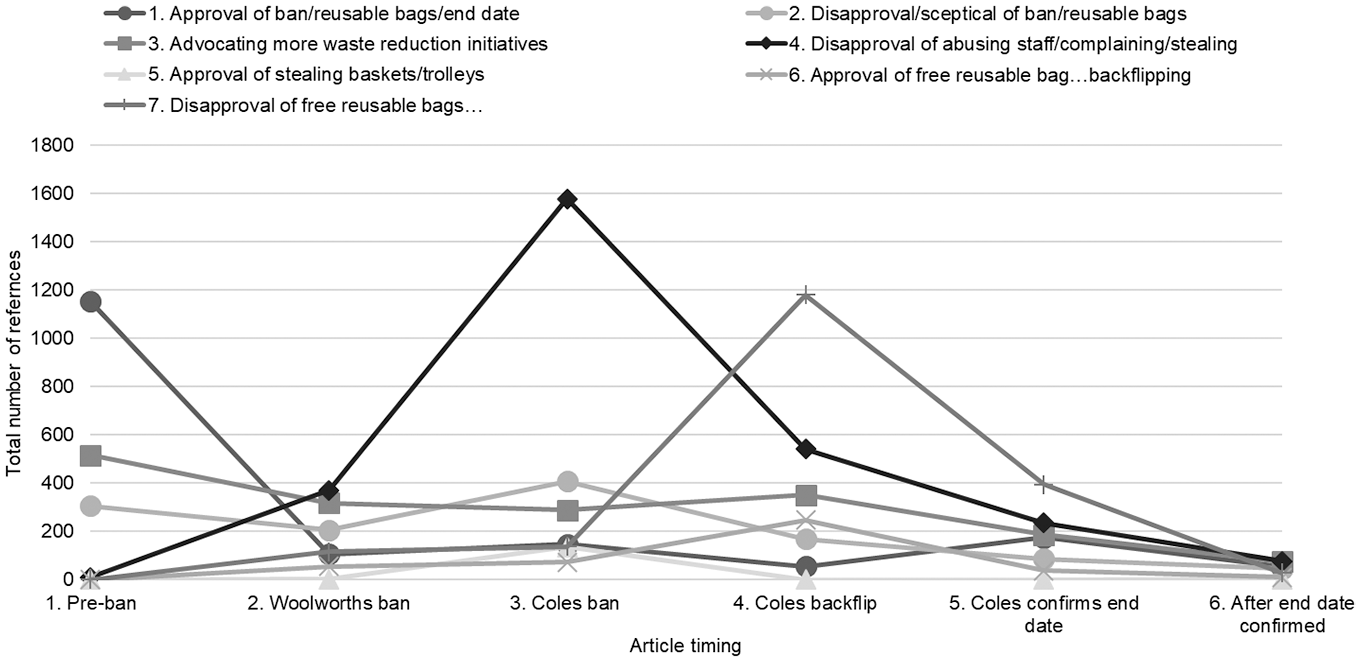
Aggregate (news articles and Facebook comments) coding frequency over time – Opinions.
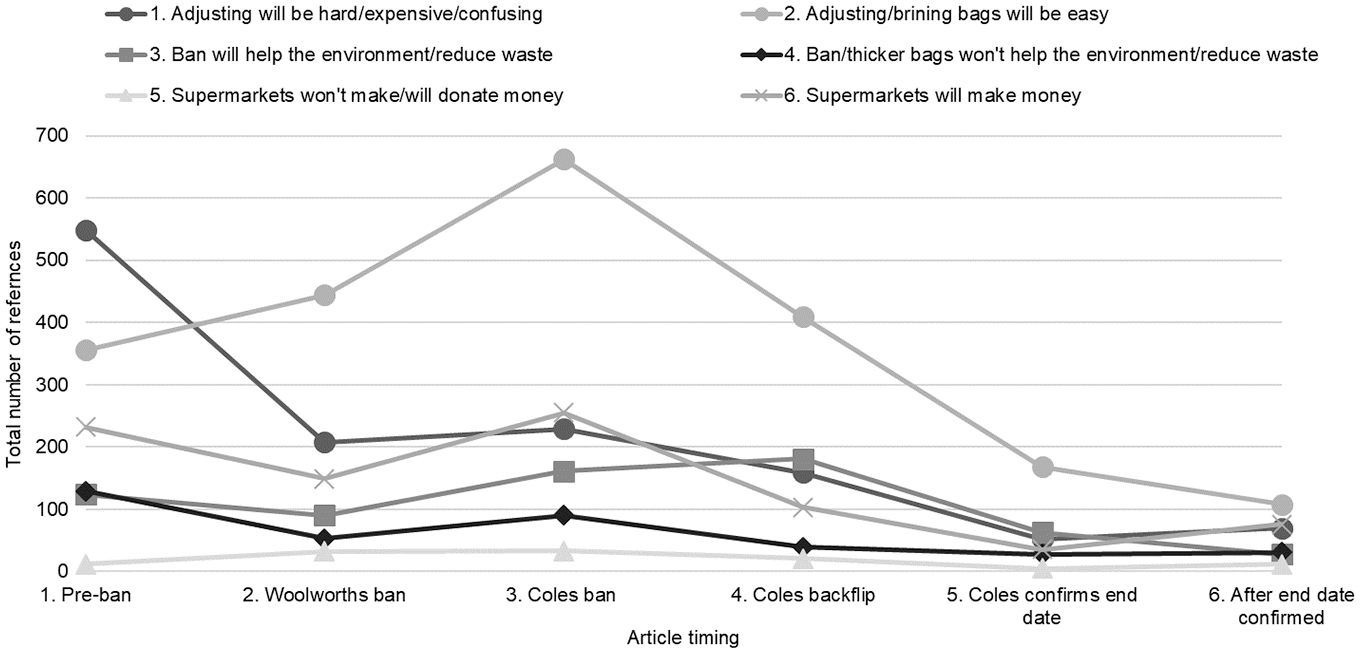
Aggregate (news articles and Facebook comments) coding frequency over time – Expectations.
Behaviours
The most common behaviour described in the sampled content was that most of Australia (and other countries) were already avoiding single-use plastic bags due to existing bans. Prominent descriptions of behaviours occurred when the bans were first announced (often individuals stating that they already avoided single-use bags), when the bans were introduced (as news stories emerged about resistant behavioural reactions), and during Coles’ backflip (where individuals indicated their intent to boycott Coles). When Woolworths first announced the ban, and when Coles backflipped, a number of Facebook commenters also intended to boycott stores that did not provide free bags (single-use or reusable).
Opinions
Expressed opinions regarding approval and disapproval of actions related to the ban were more common than expressed behaviours, with the dominant expression changing notably over time. When the bans were announced, the strongest message among Facebook commenters was approval of the ban/avoiding single-use bags (with support for more waste reduction initiatives). After the bans were introduced, expressed opinions became more salient in the news articles, indicating approval or disapproval of the ban/avoiding single-use bags. When Coles’ ban was introduced the dominant opinion in the Facebook comments shifted to disapproval of resistant behaviours (abusing staff, complaining and stealing baskets/trolleys). During this time, fewer commenters indicated approval/disapproval of the ban itself. When Coles backflipped, approval of the ban and disapproval of providing reusable bags and backflipping (i.e. not committing to a decision) became the most common expressed opinions. This sentiment continued until the end of the case study period, even after Coles confirmed that they would stop providing free-reusable bags on 30 August 2018.
Expectations
Before the bans were implemented, the news articles focused on the anticipated benefits to the environment and waste reduction, whereas Facebook commenters focused on the anticipated difficulty and confusion in adjusting. Once the bans were introduced, the news articles shifted focus to the difficulties that consumers were experiencing, while Facebook commenters emphasised the ease of adjustment. There was also an expectation that the supermarkets would make money from the bans. In contrast, after Coles confirmed the end date for their free-reusable bag period, the message shifted to expectations that the supermarkets were not making money from the ban. The environmental impact of the ban was an outcome of contention among Facebook commenters with some indicating, it would and others indicating it would not help the environment or reduce waste.
Social media engagement
Social media users were also exposed to real-time reactions associated with article posts which provided additional information about others’ opinions. Of the 54,950 reactions, over half (56%) were during the pre-ban period, mostly responding to the initial announcements. Of the 23,001 comments, over 5000 (23%) involved tagging other users.
Reaction types
Before the bans were implemented, 88% of the 31,000 reactions were ‘like’ and 10% were ‘love’ – the remaining reactions comprised only 2% of pre-ban reactions (see Figure 4). Although ‘like’ was also the dominant reaction during the introduction of the bans, there was a spike in ‘haha’ reactions when Coles’ ban was introduced – in response to an article titled ‘“My free reusable bag”: Coles customer steals shopping basket to protest plastic bag ban’. During Coles’ backflip, there was a spike in ‘angry’ reactions – in response to ‘Coles backs down on plastic bag ban, will hand out thicker bags as customers “need more tim”’, and ‘Coles caves and will give away free plastic bags indefinitely’.
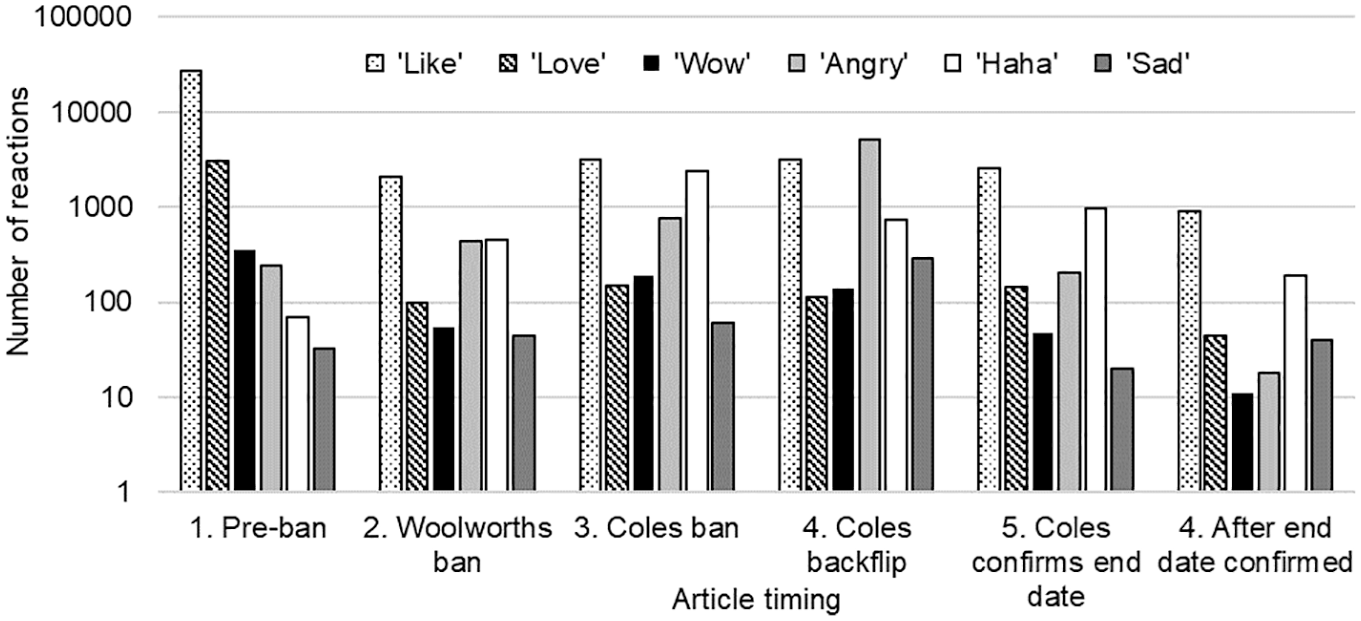
Facebook user reactions to news article by article timing (Log scale).
Sharing and tagging
The number of shares and tags also peaked when the ban was initially announced, with over 2500 shares and almost 2000 commenters tagging another user (see Figure 5). After the bans were introduced, sharing and tagging continued, although sharing was more common. Tagging became more prominent when Coles’ ban was introduced and when Coles finally confirmed an end date for their free-reusable bag period – often reflecting conversation threads between a small number of users.
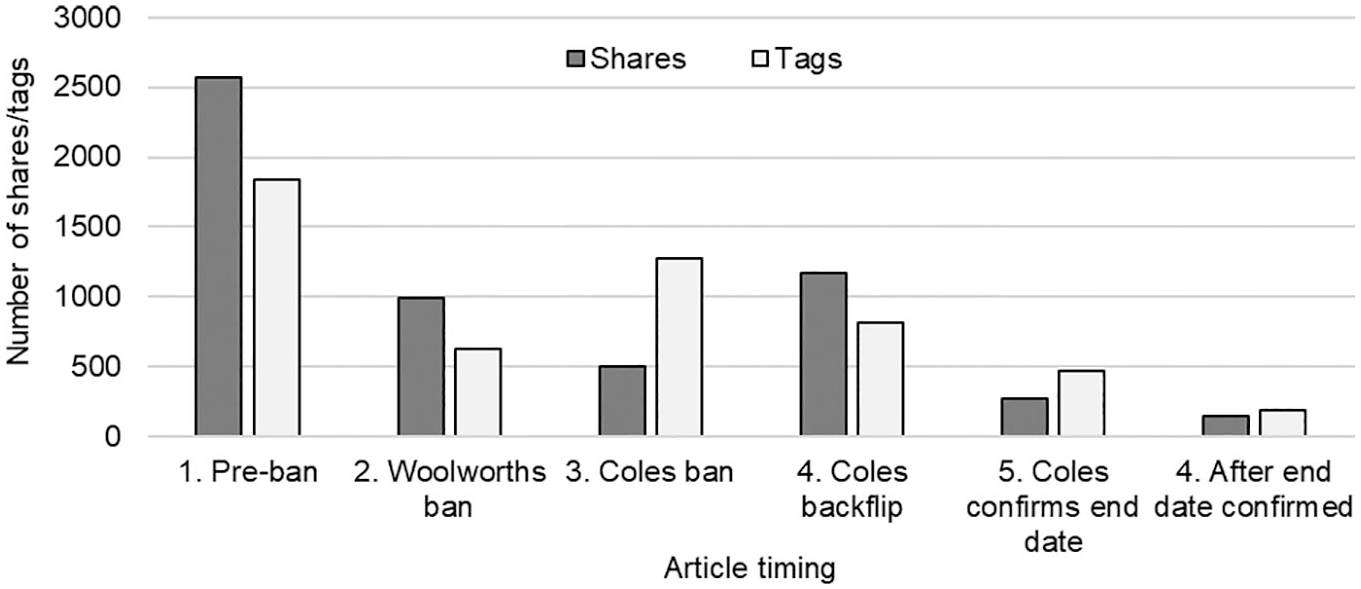
Facebook user sharing and tagging other users by article timing.
Summary
In response to the supermarket plastic bag ban, Australians were exposed to a variety of behaviours, opinions and expectations from news and social media. In addition to illustrating the different behaviours, opinions and expectations that were present in the media (RQ1), the findings from this study indicate that the prevalence of specific behaviours, opinions and expectations differed between news media and social media (RQ2). Furthermore, dominant behaviours, opinions and expectations changed over time (RQ3), ranging from apprehensive approval when the bans were announced, to relative indifference by the time they were completely implemented.
After the initial announcement, news articles and Facebook comments often described existing plastic bag bans. Facebook users generally expressed opinions in favour of banning plastic bags. News articles focused on the anticipated benefits to the environment, while Facebook commenters initially expected that adjusting would be difficult, expensive and confusing. This expectation changed once the bans were implemented as commenters learned that it was relatively easy to adjust. After the bans were implemented, articles also started to report on the ‘backlash’, describing instances of consumers struggling to adjust or resisting the ban. The main article to receive strong disapproval of the ban from Facebook commenters related to a customer who stole a shopping basket in protest. When Coles offered free-reusable bags indefinitely (‘backflipped’), many commenters indicated that they did not feel strongly about the ban but wanted Coles to commit to a decision. While the impact on consumers remained a focal point of the news articles, the financial impact of the ban was also prominent after Coles confirmed an end date to free reusable bags. In contrast, commenters appeared to lose interest as they virtually stopped interacting with the remaining articles.
Discussion and Conclusions
This study is the first to explore the interplay between news media and social media in response to a new environmental policy with the explicit aim of identifying and comparing information related to social norms. Our findings provide valuable insights for communication scholars and policymakers by demonstrating how social norms related to the introduction of a new policy are created, reinforced and expressed in the contemporary media landscape. The interaction between news media and social media offers a unique window into public expressions of social norms over time. Furthermore, social media provides a platform for civic participation in a public and real-time environment, allowing users to challenge the dominant narrative presented by the news media.
Social media as a challenging force
By including both media texts (news articles) and the reactions of receivers (Facebook comments), our findings support the assertion that social media platforms enable civic participation by allowing message recipients to engage with and contribute to public discussions, taking control away from media owners and policymakers (Lester and Hutchins, 2012). As found by Skoric et al. (2016), increased use of social media is generally associated with higher levels of social capital, civic engagement and political participation. This shift in control not only allows citizens to engage in these public conversations, but it means that social media users are able to challenge the media narrative regarding ‘how everyone is reacting’ to the introduction and implementation of a new environmental policy.
Banning lightweight plastic bags from supermarkets interrupted existing social norms in Australia. This period of changing norms was apparent in this study, despite the short time frame. The dominant sentiment shifted from approval and expectations of difficulty in adjusting (before the bans were implemented), to disapproval of negative behaviours and expectations of ease (after the bans were introduced). This shift may have reflected changes in actual behaviours, opinions and expectations – that is, collective social norms (Rimal and Real, 2005). For example, while news articles continued to report on the ban during August 2018, Facebook users virtually stopped commenting and reacting. This may indicate that, by this time, social media users had lost interest in the subject because they had adjusted to the new norms of buying thicker plastic bags or bringing reusable ones to the supermarket – knowing that complaining would be met with social disapproval.
The shift in sentiment observed in our study aligns with behavioural theory. That is, attitudes towards a behaviour and its consequences are influenced by direct experience with the underlying behaviour (Fishbein and Ajzen, 2011). Furthermore, previous research regarding plastic bag reduction policies typically finds that support for banning (or taxing) plastic bags generally increases after the policy is implemented, once shoppers have time to adjust to the new behaviour (Poortinga et al., 2013; Sharp et al., 2010). This supports the proposition that although social media reactions do not necessarily represent collective behaviours and attitudes, reviewing social media data in aggregate can provide an accessible window into public opinion (O’Connor et al., 2010).
Journalists actively seek news stories that will pique the public’s interest – often using social media engagement metrics (comments, shares and reactions) as indicators of impact (Powers, 2018). In contrast, most social media users want to interact with others and want their opinions to be heard (Whiting and Williams, 2013). While those who are more passionate about an issue are likely to be more outspoken (aka the vocal minority; Shepherd, 2017), online environments have been found to increase the likelihood that individuals will publicly express their beliefs, even if they think it does not align with popular opinion, particularly when anonymity is high (Wu and Atkin, 2018). This appears to be the case in this study – evidenced by the overwhelming number of supportive messages and aggressive condemnation of resistant behaviours expressed by Facebook commenters, despite the number of news articles which reported on the apparent consumer ‘backlash’.
Socialising norms
The number of Facebook users who shared news articles or tagged others in this study demonstrates that many users treated the articles as a platform for communicating within their networks, signalling their interest in the topic to their own personal audiences. This aligns with previous research which has identified that many people use social media to express their opinions and to learn information about others (Whiting and Williams, 2013). Given that normative information is most influential when it is shared by referent group members (Tankard and Paluck, 2016), and that frequency of exposure to a particular behaviour or message in social environments can influence perceived norms (Geber et al., 2019), normative information from social media is likely to have been more influential than the news media alone.
In the absence of persuasive campaign material promoting the plastic bag bans, it appears that the abundance of social media engagement may have functioned as an unofficial source of social marketing where social media users, rather than policymakers, were the communicators. It is likely that the influence of Facebook reactions and comments on normative perceptions was strengthened by the social nature of social media, given the social environment is more influential than the symbolic environment (Mead et al., 2014). However, further research is required to determine the extent to which exposure to such messages from different media sources actually influence individual’s perceptions about social norms.
While this study provides valuable insights for policymakers and communication scholars, we acknowledge that it is not without limitations. For one, not all Australians use the Internet and social media, so the opinions and behaviours of particular segments are likely underrepresented in social media data (Borg and Smith, 2018; Murphy et al., 2014). In general however, social media data have been found to correspond with traditional opinion polls (O’Connor et al., 2010). In the case of plastic bags, several opinion polls have found that Australians generally support bans – for example, 71% supported the supermarket ban (Canstar Blue, 2018), and 84% of Western Australians and 68% of Victorians support State-wide bans (Ashton-Graham, 2017; Colmar Brunton, 2018). This suggests that our findings from social media, which primarily indicate support for the supermarket bans, closely approximate public opinion in this case.
We also recognise that Facebook comments may reflect a variety of opinions beyond the focus of our research. Social media users may have used the ban and related articles as a platform to discuss other opinions – for example, a dislike of large corporations, or reactions to having change imposed on them. This was partly evident in the other coding category where some commenters raised issues unrelated to plastic, such as the use and consequences of self-service check outs. Nevertheless, we are reasonably confident that our results reflect reactions to the plastic bag bans because this was the focus of the selected news articles.
Implications for policymakers
Media visibility of an event can be valuable but it can equally work against those seeking to influence environmental policy outcomes (Lester and Hutchins, 2012). News coverage can undermine a new policy by emphasising negative reactions and problem behaviours (e.g. abusing staff or stealing shopping baskets), indicating that undesirable behaviours are common and normal (Walsh-Childers and Brown, 2009). On face value, Coles’ backflip addressed the backlash presented in the news articles. That is, consumers were struggling to adjust and needed more time, so Coles offered free reusable bags for longer periods. This response mirrors the South African plastic bag ban where policymakers were criticised for responding too quickly to the apparent backlash (Dikgang et al., 2012).
Policymakers considering future environmental policies could learn from the Australian supermarket experience. If the policymakers at Coles and Woolworths had paid attention to the aggregate behaviours and opinions expressed in social media in response to the initial announcement (i.e. largely supportive), rather than relying on news reports, which focused on extreme reactions, they may have been less rash in implementing additional policies related to the bans. The process of ‘backflipping’ appears to have negatively affected the Coles brand in particular. As seen in this study, disapproval of ‘backflipping’ became the dominant opinion during the latter half of the case study period, resulting in a new behavioural category as many users indicated that they intended to boycott Coles. By committing to the original intent of the bans, the supermarkets could have avoided drawing additional unfavourable attention to their brands by allowing consumers to adjust in their own time.
Policymakers should recognise that it takes time for consumers to adjust to a change, and they may not like it at first, but they are capable of adjusting. While this study focused on a new corporate policy, our findings are similar to the experience of the South Australian State-wide ban. Although shoppers were initially hesitant (because of the perceived effort), once the ban was implemented resistance decreased as consumers learned that the actual effort involved was minimal (Sharp et al., 2010). Steg and Vlek (2009) suggest that ‘initial resistance does not necessarily indicate that a policy should not be implemented’ (p. 314; or in this case study, that the policy should be changed) because perceived effectiveness and acceptability often change once a policy has been introduced. This may explain why many Facebook comments regarding the ease of adjusting were often in conjunction with comments highlighting existing State-wide bans.
By monitoring and understanding the interplay between news media and social media reactions over time (and beyond initial kneejerk reactions), corporate and public policymakers could better design implementation strategies for future environmental policies. As found in this study, while it takes time for people to develop new habits, as more people adjust the social pressure to ‘just get on with it’ also increases, and social media provides an opportunity for this social pressure to occur in real-time and in a public manner. To conclude, we argue that analysing social media reactions to news reports can be a valuable tool for policymakers when introducing a new policy as a means of tracking ongoing public response and for understanding related social norms.
Footnotes
Acknowledgements
This research was completed as part of a PhD undertaken at Monash University, supported by the Australian Government Research Training Program and the Victorian Department of Environment, Land, Water, and Planning.
Author’s note
This work is original and has not been published nor is it currently under consideration for publication elsewhere. All authors have agreed to the submission.
Funding
The author(s) disclosed receipt of the following financial support for the research, authorship, and/or publication of this article: This research was funded by the Victorian Department of Environment, Land, Water, and Planning.
