



Abstract
This article discusses how Brazilian platform workers experience and respond to platform scams through three case studies. Drawing from digital ethnographic research, vlogs/interviews of workers, and literature review, we argue for a conceptualization of “platform scam” that focuses on multiple forms of platform dishonesty and uncertainty. We characterize scam as a structuring element of the algorithmic management enacted by platform labor. The first case engages with when platforms scam workers by discussing Uber drivers’ experiences with the illusive surge pricing. The second case discusses when workers (have to) scam platforms by focusing on Amazon Mechanical Turk microworkers’ experiences with faking their identities. The third case presents when platforms lead workers to scam third parties, by engaging with how Brazilian click farm platforms’ workers use bots/fake accounts to engage with social media. Our focus on “platform scams” thus highlights the particular dimensions of faking, fraud, and deception operating in platform labor. This notion of platform scam expands and complexifies the understanding of scam within platform labor studies. Departing from workers’ experiences, we engage with the asymmetries and unequal power relations present in the algorithmic management of labor.
Introduction
Felipe is annoyed as he is rarely able to benefit from Uber’s surge pricing, so he instigates other drivers to meet up and simultaneously go offline to trigger it. Maria is often blocked without reason by microwork platform Amazon Mechanical Turk (AMT), so she has multiple family members’ accounts to keep on working. Carlos works on the Brazilian click farm platform GanharNoInsta (“EarnOnInstagram”), where he likes and comments on posts. To do this, he needs to use bots and fake accounts, with the risk of being blocked by social media platforms. Brazilian workers like these are part of a circuit of platform labor (Qiu et al., 2014), invisibilized pieces in global value chains. These stories reveal multiple forms of platform dishonesty and uncertainty faced by platform workers, who find themselves having to turn to alternative tactics to “play the platform’s game.”
In this article, we analyze workers’ experiences as they expose the existence of what we term “platform scams,” the dishonesties and uncertainties lying in platforms’ algorithmic management. 1 As discussed in various studies (Abílio, 2020; Rosenblat and Stark, 2016; Wood et al., 2019), algorithmic management is related to unsafe, unstable, and precarious working conditions. Wood et al. (2019: 70), for example, argue that algorithmic management should be understood in relation to the “weak structural power of workers vis-a-vis clients” and, by consequence, platforms. We propose the notion of platform scam to argue that, in addition to inequality and precarity, dishonesty and uncertainty are at the core of platform’s operations and power. This concept advances debates on platform labor studies by showing a more nuanced framework on how platform power affects workers across different sectors.
We depart from the vernacular definition of scam as “an illegal plan for making money, especially one that involves tricking people” (Cambridge Dictionary, 2020) and “to swindle (someone) by means of a trick” (Collins Dictionary, 2020). 2 Frauds, scams, and deception have long been part of the workplace, as a historical component of capital-labor relations (Woodcock, 2021). However, platform labor introduces new aspects, as scam is incorporated as part of the rationalization of work management through platform mechanisms.
We situate scam as an internalized element of the power relations in platform labor. Platforms are constructed under a façade of fairness and neutral technology (Gillespie, 2010; Rosenblat, 2018). However, their promises are often not kept and workers are left on their own in dealing with unfair systems aimed at increasing platforms’ profits. Platforms build and thrive on dishonest protocols and architectures that allow for algorithmically driven workforce exploitation (Moore and Woodcock, 2021). They articulate computational, political, corporate, legal, discursive, and architectural dimensions (Gillespie, 2010; Van Dijck et al., 2018), defining what’s (il)legal, (ir)regular, and (un)desirable—often without ever making these definitions clear. Workers experience algorithmic management as particularly uncertain—rules are ambiguous, changing constantly, and they are often subject to blocking, not receiving payment, among other issues. This happens both through governance models, regulating what is considered an “expected” use, and through the technical materiality that steers users’ actions, thus shaping the field of possibilities within specific architectures and protocols.
To understand how “platform scams” operate, we engage with the experiences of workers. These experiences allow us to ground this concept in situated practices, as workers are not simply the victims of an “algorithmic panopticon” (Woodcock, 2020). On one hand, workers circumvent algorithmic management, producing fissures through the manipulation, subversion, and disruption of platforms’ algorithms and infrastructures (Ferrari and Graham, 2021; Woodcock, 2021). On the other hand, it is often through the responses of workers that platform scams become visible. By focusing on how workers see scams being conducted by platforms, we diverge from the mainstream framing, often centered on the practice of scams by workers or users—more aligned to platforms’ understanding of dishonesty (see Burrell, 2008; Nakamura, 2014).
Platform scam, as an element of platform labor, presents similarities around the world. Both Brazilian and international platforms have intrinsically the same characteristics, as they are shaped by Silicon Valley ideology (Noble and Roberts, 2019; Ye, 2021) and integrate an ecosystem dominated by Western platforms (Davis and Xiao, 2021; Van Dijck, 2020). However, there are singularities in local contexts that further complexify the dynamics of platform scams and workers’ experiences. The organization of workers in Latin America offers a particular context, with a long history of labor struggles (Muñoz, 2017), which affect the current context of platformization (Howson et al., 2020). More specifically, the Brazilian labor market is historically built upon the legacy of the informal economy as a permanent norm for the working class (Grohmann and Qiu, 2020), much like other countries in the so-called Global South. Therefore, the gig in Brazil is not a novelty—what is new is the fact that digital platforms are given the mandate to manage, almost single-handedly, around 3.8 million Brazilian workers (see also Abílio, 2020; Amorim and Moda, 2020; Antunes, 2018).
We focus on three case studies to analyze and specify how Brazilian workers experience platform scams (the dishonesty and uncertainty of platform labor), and how they find fissures to survive in this unequal system. The Brazilian case studies we draw on show different forms of worker’s agency, reflecting the wider history of informality and everyday resistance in the country. While most previous literature (e.g. Cant, 2019; Gray and Suri, 2019) analyzes one sector or one platform in particular, our goal is showing that platform scam is not a feature of specific platforms, but something that is present in the broader platform labor circuit.
As summarized in Table 1, the first case examines how Brazilian Uber drivers experience the scams of platforms through the unfairness of surge pricing. The second case presents how microworkers in AMT face issues such as the blocking of their accounts or not receiving payments, and the scams (faking, workarounds) they have to conduct to continue working. The third case focuses on click farm platforms, which force workers to scam third parties through the use of bots and fake accounts. These cases, as we present in the “Discussion” section, have commonalities that show the many asymmetries of platform labor.
A description of the “platform scams” that workers encounter, as well as the workers’ responses.

Methodology: connecting multiple case studies from different research projects
This article gathers qualitative and quantitative research on platform labor by six Brazilian scholars. To accomplish a comparative case studies approach (Schwandt and Gates, 2018; cf. Stake, 2006), we draw on authors’ previous research data. We collaboratively cross-analyzed this collective research material based on the guiding notion of “platform scams,” deductively working from the concept through the case studies to present how workers experience platform scam.
The platforms chosen are Uber, AMT, and three Brazilian click farms (GanharNoInsta, Dizu, and SigaSocial). Each case focuses on a particular platform from a different sector—ridesharing, microwork, and click farm—representing different types of platform labor. All of these platforms involve different features, with distinct forms of work organization: Uber is a form of geographically tethered work, recognized as the most discussed form of platform labor; AMT is a form of microwork, organized by a large company (Amazon), with clients all around the globe; finally, click farms represent a different type of microwork, used specifically for boosting social media metrics and marked by much smaller companies with precarious infrastructures.
All these cases include different workers’ experiences of platform scam, as well as their tactics to get around them. The chosen method of comparative case analysis allows us to follow emergent commonalities and to show how there is a consistent pattern that can be found beyond a single platform, and across the field of platform labor. Even though we identify these commonalities within a single country, they are not restricted to its geographical frontiers as these forms of labor are global.
The first case is based on Abel Guerra’s research on Uber, using technographic research methods (Bucher, 2018) to trace documents and inscriptions around surge pricing (see Guerra, 2021). We built upon the analysis of 59 videos about surge pricing from seven Brazilian Uber drivers’ YouTube channels—all with more than 50,000 subscribers—dating from October 2016 to October 2020. These videos were created to share expertise among workers (Chan, 2019; Soriano, 2021), so they represent particular viewpoints on the issue. Videos were manually collected and transcribed, and are now further analyzed according to the article’s theme.
The second case draws on an ongoing quantitative and qualitative research carried out by Bruno Moreschi and Gabriel Pereira with Brazilian Turkers, which started in January 2019. This involved a 72-question survey with 149 Turkers focusing on their demographic profile and experiences in the platform (Moreschi et al., 2020b; cf. Ipeirotis, 2010), as well as digital ethnographic fieldwork in their WhatsApp groups. We also conducted an action-based research project (Exch w/ Turkers), where five Turkers were interviewed by researchers and the wider public (Moreschi et al., 2020a). For this article, we analyzed the moments when the dishonesty of platforms emerged as an issue in workers’ accounts.
The third case draws from Rafael Grohmann’s research on Brazilian click farm platforms, started in October 2020. The research is based on digital ethnographic fieldwork in workers’ WhatsApp and Facebook groups; semi-structured interviews with 6 workers; and an analysis of the features of three platforms (GanharNo Insta, Dizu, and SigaSocial). The research project aims to discuss the working conditions of Brazilians in artificial intelligence (AI) and click farm platforms, especially considering class, gender, and Global South issues. For this article, we were interested in seeing how click farms led workers to scam third parties as a structuring condition of their labor, including the use of fakes/bots.
Case 1—when platforms scam workers: Brazilian Uber drivers and surge pricing
Brazil is Uber’s largest market outside the United States. 3 While Uber promises drivers an opportunity to be their own bosses and earn money with autonomy and flexibility, what it actually delivers are low fares that obligate drivers to work long hours to make a living. By classifying drivers as “independent contractors,” Uber is able to externalize risks and costs, while also charging drivers a variable fee that can reach up to 40% of the total price paid by riders, according to some drivers-YouTubers. Surge pricing, a temporary rise in fares, is presented as a chance to improve their earnings by driving to high-demand areas. There is no guarantee, however, that this effort will pay off, as drivers often report not receiving surge rides despite being in a surge area. Thus, surge pricing is experienced as “more of an illusion than a reality,” as a driver put it. Uber drivers respond to that by exploring the fissures in Uber’s algorithmic systems and appropriating surge pricing to improve their earnings.
As a fundamental mediator of Uber drivers’ labor, 4 surge pricing provides a rich prism through which the specificities of “platform scams” can be examined. Uber describes surge pricing as a mechanism to maintain “the balance between driver’s availability and rider’s demand” (Uber, n.d.). Uber argues that surge pricing operates according to neutral and objective principles. In a publication on its Brazilian website, the platform indicates that surge pricing is not a “jeitinho brasileiro” (Uber, 2015)—roughly translated as a “Brazilian way.” This expression is associated with practices based on corruption, deception, and circumvention for taking advantage of situations. In making this argument, Uber positions itself as a global actor that operates fairly and does not take advantage of Brazilian users.
This case study looks into drivers’ experiences and responses to surge pricing, suggesting that platforms scam workers in ways that are not limited to malicious acts, circumvention of norms, or a “jeitinho brasileiro” that could be corrected when identified by good-faith actors. Instead, we argue that scam is embedded in surge pricing and Uber’s algorithmic management as a whole. Even if Uber is not directly pocketing driver’s money, it is constantly playing an illusion game in which drivers are scammed by an eternal promise of financial gain.
Drivers’ perception of surge pricing is ambiguous. Surge pricing triggers excitement as it represents the opportunity of higher earnings just a few blocks away. In contrast, this often results in frustration, as it may disappear as soon as drivers arrive in such areas (Rosenblat, 2018). Moreover, as observed on Brazilian Uber drivers’ YouTube channels, it is common that drivers located in these areas receive ride requests in non-surge areas, or even that they are not paid for a surge ride. This causes drivers to call it an “illusion,” as most who try to benefit from it end up serving only to balance demand peaks—a job for which they are not compensated. Thus, surge pricing enacts a fundamental uncertainty: drivers may get a very profitable ride, but they may also get nothing while wasting time and fuel.
Surge pricing operates by luring drivers into being available in specific areas, often leading to frustration and financial loss. But this is not a malfunction—uncertainty and unfulfilled promises for profit are part of how surge pricing is expected to work. This illusion game keeps the wheel of Uber’s ride-hailing market spinning. This is duly noted by drivers, who respond by appropriating and negotiating with the platform’s norms and features in their everyday practices.
In an attempt to counterbalance these dynamics and aiming to obtain profitable rides, some drivers appropriate the platform’s features to take advantage of surge pricing, by combining it with the “destination mode” (Uber, n.d.). “Destination mode” is an algorithmic feature implemented in Brazil in 2017. It allows drivers to set a destination and the time of arrival, so algorithms can select riders traveling in the same direction, favoring trips that will keep the driver near the set destination in the selected time frame. In theory, drivers can use this resource twice a day. However, the platform’s own architecture allows them to postpone the initial time frame. By setting the destination to a surge area and continuously postponing the selected time, drivers are able to stay within or near that area, which may generate more lucrative rides. This tactic is described by Brazilian drivers-YouTubers in videos aimed at teaching other drivers how to increase earnings, and can also be employed by those who wish to avoid “risky areas.” These are areas where drivers are more likely to be mugged, or even kidnapped and murdered, an issue that deeply affects Brazilian drivers (Eisenhammer and Haynes, 2017; Rapier, 2019).
Although drivers do not see this practice as “scam,” some recognize that Uber may eventually catch up and find ways to inhibit it. As Túlio, 5 an Uber driver-YouTuber, described in a series of videos published in 2018: “soon Uber will notice this and end up changing it (. . .) because otherwise you will start to only work in noble areas (. . .) and it wants you to work anywhere . . . it wants the money, and people want rides.” Still, he stresses his goal is not “scamming the platform” per se, but simply teaching other drivers to “play the platform’s game”: “I manipulate the app in a legal manner (. . .) I am not scamming, this is a tool that the platform gives me. In life, you will receive tools, you have to know how to work with them.” In a more recent video, another driver-YouTuber (Paulo), discusses some changes to the “destination mode” being tested by Uber. The change would mean an expansion of the “set destination” location radius, which he theorizes is an attempt to inhibit the tool’s use to work only within a certain region—a strategy Paulo himself admits using.
Besides individual tactics, some drivers use WhatsApp groups to coordinate collective “shut downs” (Figure 1), causing a decrease in driver supply and triggering surge pricing—an action previously described as “attempted fraud” by Uber.
6
In their videos, some drivers-YouTubers warn their audience about the risks of suspension or permanent bans faced by drivers who engage in those tactics. Paulo warns that,
Mother Uber knows, and mother Uber monitors. And it has banned drivers because of this, and many at the same time. When drivers go all to the same place, it knows you are all going there and that everyone went offline at the same time, and then everyone went online at the same time. Coincidence? Of course not. And Mother Uber is not stupid.

Screenshot of a driver’s YouTube video showing a “bleeding screen” with 1.8 × surge price, a result from the collective shut-down organized by workers.
Here, the conception of Uber as a strict mother complexifies the image of the algorithmic panopticon. Drivers are well aware of “mother Uber’s” capacity to surveil and punish their “misbehavior.” In this game, workers’ agency is not nullified. Rather, it operates in constant negotiations and experiments, testing “mother Uber’s” boundaries (and patience!). On some occasions, drivers’ tricks are overlooked. On others, “naughty” drivers may face strict penalties. It is also worth noticing that punishments, such as temporary blocks or permanent bans, are not always justified by the platform, and drivers are often left wondering if they actually did something wrong.
These examples illustrate how platform scams and workers’ responses are part of what constitutes the relations between Uber and its drivers. The surge pricing algorithm is intentionally opaque and unstable, generating frustration and uncertainty in drivers’ labor. To be able to continue making a living out of the platform, drivers are constantly coming up with new workarounds to defend themselves and find a fleeting stability.
Case 2—when workers (have to) scam platforms: Amazon Mechanical Turk workers, fake accounts, and subversions to get paid
Workers of AMT are offered the possibility of working from their homes through completing microtasks. Although the platform presents itself as a neutral marketplace, workers experience great uncertainty: the platform repeatedly blocks accounts without warning or due process. In addition, the Brazilian workers have for many years not been allowed to transfer their earnings to their bank accounts. Faced with such unfair conditions, workers had to find workarounds such as using accounts of family members or purchasing/reselling vouchers, acts considered to be illegal by the platforms’ rules.
AMT is a global platform where workers (also known as Turkers) perform so-called Human Intelligence Tasks (Gray and Suri, 2019). These microtasks are used by companies and researchers, including for surveys, audio transcription, and the creation of large-scale datasets for AI applications (Tubaro et al., 2020). Created in 2005, AMT was used internally by Amazon to exclude repeated product advertisements. Today, this marketplace of microwork claims to have “about 500,000 registered [workers]” (AMT, 2020).
Previous research on AMT and its workers shows that the platform is built upon an intentional opaqueness (Difallah et al., 2018; Ipeirotis, 2010; Irani, 2015). Turkers may be punished with the blocking of their account without justification, often for a period of months. The AMT code of conduct lists general rules that must be respected on the platform by all, but there is no indication in the blocking emails received by workers of which specific rule in this extensive list was violated. For Maria, a Brazilian Turker since 2018, this not only indicates a lack of transparency, but also leads them to unintentionally repeat actions that get them blocked, as they don’t know what they did “wrong”: It is extremely counterproductive, to say the least. The whole system loses with the fact that I don’t learn from my mistake. I think Amazon doesn’t think of us as individuals who deserve to receive minimally understandable feedback. We are just cheap and easily replaceable parts in a gigantic platform.
Faced with her account being blocked for no reason, Maria’s solution was to use three different profiles—created with her identity, as well as that of her husband and nephew. That way she can always have an active account, which she distributed across three computers, each in a different room of the house—this also maximizes her earnings by having more work environments available. Although this practice of using “fake” accounts is considered illegal by the platform, for Brazilian workers this workaround was born out of necessity, since they often rely on this income to support their basic needs. According to a survey with 149 Brazilian Turkers (Moreschi et al., 2020b), about 30.9% need the money to support themselves financially either sometimes or always, a much higher number than the 14% found in a survey of Turkers in the United States (Ross et al., 2010).
Another type of “irregularity” concerns the way Brazilian Turkers are paid. Until recently, they could not receive their payments directly into their bank accounts—via Hyperwallet, as the vast majority of Turkers. This means that, although Amazon allowed people in Brazil to work on the platform, they had to receive their payment as gift cards that could be used exclusively on Amazon USA’s website.
To use their earnings to support themselves, Brazilian Turkers have used different circumvention tactics. Since 2016, they began purchasing gift cards in online stores such as Google Play and Playstation Store using their Amazon vouchers. These gift cards would then be sold online in gray market auction sites—which take out a commission. This practice made the process of receiving the payment for their AMT work long and costly, as each of these transactions involves fees and other complications, as well as the risk of having their account banned by AMT. In 2019, in a now deactivated WhatsApp group, Brazilian Turkers organized a collective effort to send daily emails to AMT, addressing how they were forced to evade the platform’s problematic rules, but they never received a response (Moreschi et al., 2020b).
These (forced) irregularities lasted for years, until October 2020, when AMT changed their payment system. In an email, Amazon explained that they would allow payment via Hyperwallet to all Turkers. The email does not acknowledge the problems caused by their previous policy, and presents the change as a complementary way of receiving earnings, instead of an urgent need for many non-US workers. In the first week after receiving such email, Brazilian Turkers in WhatsApp groups were joyous, as this “regularization” would imply an increased income (Figure 2).
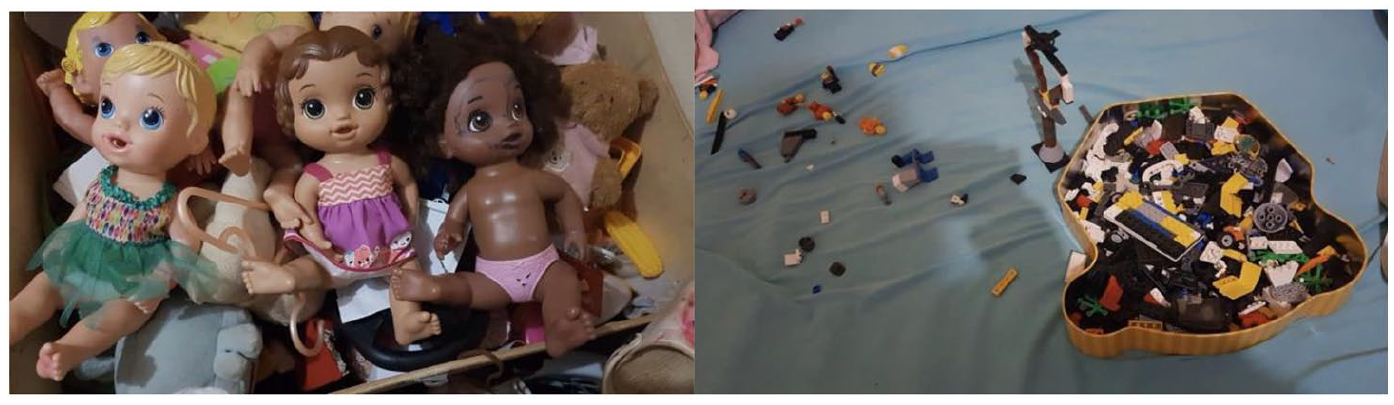
The toys purchased by Brazilian Turker Maria at Amazon USA, so she doesn’t have to go through the workarounds to send the money to her Brazilian bank account.
The fact these Turkers face such precarious conditions makes their work on the platform a source of anxiety, stress, and tension. Even when workers wrote to Amazon asking for a justification for their blocking, they were unable to obtain any answer. Pedro, a Brazilian Turker who works at AMT since 2019, explains that this unhealthiness is not only due to the blocking itself, which can even be permanent, but especially due to the absence of justification: It is quite uncomfortable to work in a place where you can get scolded and criticized at all times by your boss, right? Well, now think about the added fact that we, Turkers, are never told the reason for which we are being scolded or blocked. I’ve been blocked countless times and until today I never received a concrete reason for that . . . it’s always just a standard email from Amazon explaining that I violated the platform’s code of conduct. It’s very distressing.
Brazilian Turkers consciously go against the platform’s rules to continue working and earn their livelihood. Rather than framing these workers’ practices as “irregular” or even “illegal” behavior, we understand them as operations to, albeit temporarily, regain power in a system that does not care about working conditions and well-being. This is best described by Pedro: I think there are scammers, but this is also Amazon’s fault, because of their unfair rejections. In practice, all of us here [in Brazil] are scammers today, because we have to create fake accounts [to continue working after blocks]. I’m a scammer. But this is their fault . . . All of this is illegal under the AMT rules, but I think: Who actually built this notion of “legality” on the platform? It certainly wasn’t us.
We understand workers’ tactics as responses to platform scams, materialized in the opaque and unequal way platforms have engineered their working conditions (e.g. lack of communication and due process). When Turkers take on others’ identities to work while blocked or find alternative modes to move their money to their account they are considered scammers by the platform. However, as we have demonstrated, they only do so because of the problematic conditions created by the platform itself.
Case 3—when platforms lead workers to scam third parties: click farms and fake social media likes
Click farm platforms promise easy money as compensation for the “easy” task of liking, commenting, and sharing posts on social media platforms. However, such “easy money” comes with many caveats: workers are driven to create fake accounts on social media platforms, as well as operate against their Terms of Service. Furthermore, click farms lead workers to scam social media platforms, acting as parasites in the “platform tree” (i.e. the multiple layers of the platform ecosystem; Van Dijck, 2020). Gohil and Meniya (2020: 1), for example, stated that click farm platforms are swindling advertisers through “fraudulent clicks.” In this case, the platform scam takes shape as click farm workers having to use faking and deception to conduct the deceitful task given to them (Lindquist, 2021).
There are mainly three click farm platforms based in Brazil: GanharNoInsta, Dizu, and SigaSocial. Through these platforms, influencers, politicians, celebrities, companies, and other professionals buy packages of likes, comments, and shares on social media platforms (e.g. Instagram, currently the most popular for this service). These purchased boosts are not completely automated. Just like other forms of microwork, automation is backed by human labor (Ekbia and Nardi, 2017). Thus, such information flow is built/maintained by workers who spend their days liking, sharing, and commenting on content, earning up to US$0.0055 for each task.
Click farms are a consequence of social media platforms’ ever-increasing incentive for metrics, such as likes and views (Beer, 2016). As such, workers are used to perform the “invisible labor” (Poster and Crain Cherry, 2016) of social media engagement. Furthermore, these are all Brazilian companies located in smaller cities: click farm platforms, though locally based, subvert the mechanisms of the global social media platforms through their infrastructures. There is no click farm without the infrastructure of social media platforms—a dependence resulting not from a formal partnership, but from the subversion of these infrastructural arrangements.
In a more deliberate manner than in AMT’s case, click farm platforms, in their websites’ descriptions, foresee that workers will need fake accounts to do their job. This is exemplified by GanharNoInsta and Dizu encouraging workers to use up to ten profiles—either fake or owned by other people—to increase earnings. Such practices are prohibited by social media platforms, which have automated algorithms for blocking accounts they perceive are fake or performing illegal activities. However, if workers are blocked for not following the Terms of Service of social media platforms, they are the ones liable for these infractions. SigaSocial’s terms and conditions clearly state that the platform “is not responsible for untrue information transmitted by its users.” Similarly, GanharNoInsta affirms in its rules: “use only real accounts. Our system has advanced techniques for detecting fake accounts. If any fake account is detected, it will be deleted from the system.” 7
As much as this may go against the rules, faking is not a choice of workers, but a survival strategy. To earn a minimum amount of money, workers purchase fake accounts and bots to get more than US$0.20 a day—amount they would get using a single account. There are few workers who do not own more than one account or use bots, as detailed by Thalia, a click farm worker: “We create fake accounts . . . otherwise, you don’t make money. There are people who have up to 200 fake accounts.”
In a Facebook group, workers often share tips on the importance of maintaining back-up accounts so, in case of blocks, they always have available profiles to work with. Having an account blocked by a social media platform means that the click farm suspends the verification and payment of the worker’s activity on the previous 30 days (at least until they get the account unblocked). Roseli, a worker on GanharNoInsta, exemplifies this issue: “They deducted US$37 for 26 accounts of mine that were blocked. It was a struggle to unlock all accounts and get my money back.”
To reduce the risk of blocks, Brazilian click farm platforms define minimum requirements to add an account to their system. The profile must have a human picture (e.g. no pets or cars allowed), and the person’s name must be “Brazilian.” Other features required include: having previous posts, and posting periodically; following and being followed by at least a few dozen people; and having liked/commented on others’ pictures. One of the click farm platforms even suggests that “the more engagement and movement in the profile, the less chances of it being blocked.” This means that these platforms are aware of the need for workers to use fake accounts.
Workers, in turn, develop different strategies to avoid being reported or prosecuted for their fake accounts. As they cannot use their own pictures in each account, they: pick up photos of celebrities, as they believe they would be protected due to the multitude of other (fake) accounts using these images; use authorized photos of close family members as this work is important for the family’s own economic sustenance, or, more recently, use AI-created faces from the website “This Person Does Not Exist” (n.d.).
This is just one way workers create fakes to circumvent the rules of social media platforms at the request of click farms. While using fakes enables workers to multiply the potential earnings on click farms, bots serve to automate their tasks—another strategy of workers to penetrate the infrastructure of social media platforms. Camila, who works for many of these click farms, explains, There was a time when it was wrong to use a robot. We were banned/blocked. Nowadays we can only make money if we use bots. Those who do manual work are actually unable to get by.
Part of the “heteromated labor” (Ekbia and Nardi, 2017) is, thus, further outsourced to machines, as workers pay for bots designed to automate their click tasks. As these bots demand computers to be dedicated exclusively to such use, workers often borrow computers and phones from others, so they can run bots on more than one machine. In addition, they also share among themselves screenshots and pictures of daily earnings achieved through the use of bots, and discuss the blocks caused by this practice (Figure 3).
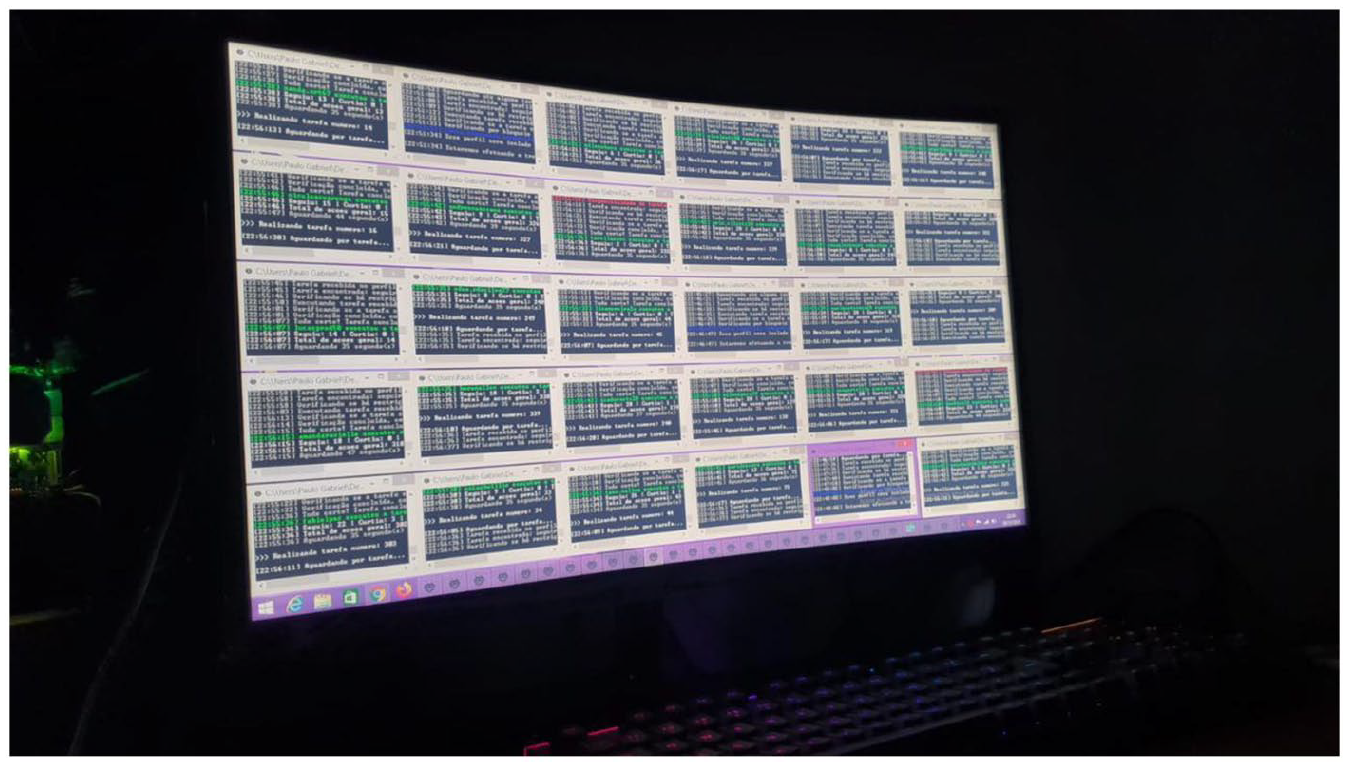
Picture taken by a click farm worker of a bot running in his computer, shared on a WhatsApp group.
Facebook and WhatsApp groups are turned into marketplaces for selling and buying fake accounts and bots. In the case of fake accounts, the more followers, likes, and photos an account has, the higher the price. One ad selling fake accounts in a group states: “I sell accounts for US$0.30. I have customers who have been using accounts for 2 weeks without blocks. The accounts come with a bio, 100 followers, 5 photos, and likes in all of them.” Ads for bots in these groups describe their potential: “the bot can do the actions of following and liking. After reaching the goal you set, it moves on to the next profile.” WhatsApp groups host intense arguments about which are the best bots, and workers share tips on how to improve their performance. One of them says, “You have to play it right. You have to know how to do things. Otherwise, you will be blocked. Keep an eye out!.” If workers need to scam social media platforms as part of the tasks given to them by click farms, fake accounts and bots are tactics so that they are able to work. Nonetheless, they still often end up being blocked and not paid by the click farm, who doesn’t take any responsibility.
Since early 2021, changes have occurred in Brazilian click farms, further demonstrating the instability of platform labor. Some platforms built their own bots, which they sell directly to workers. This meant that workarounds developed by workers were actually incorporated by mechanisms of the platforms themselves. Moreover, Instagram has been blocking the workers with higher frequency and speed. Workers have also been receiving fewer tasks, while platforms have further decreased their compensation, all of this without communicating to workers in advance.
This scenario of deteriorating conditions resulted in the first strike of click farm workers. Workers circulated their discontent in WhatsApp groups and YouTube videos: “If you want to live with rules, start by following your own rules,” “Let’s stop these parasites, bro,” “The owners of the platform are laughing at us because we are working for less than US$0.0018. The strike is necessary.” Another worker said: “Let’s stop following everyone. When buyers see they are losing followers, they will complain to the platform and they will go back to their previous price.” Workers even discovered the phone number of a platform owner and sent their claims directly to him—a form of direct action resistance to the platform practices.
Faking is at the core of click farms’ business model—it is founded on leading workers to scam third parties (i.e. violating the rules of social media platforms). Click farms only exist if there is a multitude of accounts to give likes to customer accounts at all times. In order for this to exist, as we have demonstrated, workers have to use fakes and bots and increase metrics, while facing the burden if they are ever detected.
Discussion: platform scams and workers’ responses
The case studies present how platform scams operate and are experienced by workers. These take place through the embedding of dishonesty and uncertainty in the algorithmic management of labor. Each case highlights a particular form of platform scams: when platforms scam workers; when workers (have to) scam the platform; and when platforms lead workers to scam third parties. In addition to the observation that platform scams originate in class contradictions (Cant, 2019), we argue that they are operated through/within platforms’ discourses and features. Our focus on “platform scams” thus highlights the particular dimensions of faking, fraud, and deception operating in platform labor.
Our analysis supports understanding platform labor as an “ongoing cat and mouse game with no clear winner” (Ferrari and Graham, 2021), but—very importantly—a game marked by many asymmetries. By foregrounding the way workers experience being scammed by platforms, we address the imbalance between platform workers and the system they operate in. The definitions of what is and is not dishonest in platform labor is unstable, unclear, or in constant dispute—even in the discourse of platforms or workers. However, we argue that the power asymmetries enacted by the algorithmic management of labor heavily favors platforms, as they define what is legal or illegal. This means that, while workers often take the fall for potential wrongdoings, the dishonesties of platforms are largely ignored. As this article shows, platforms themselves operate dishonestly and embed uncertainty in their features, such as when Uber does not offer rides to workers, or through AMT’s unfair blocking policies.
Asymmetry is also found in the instability created by platform scams. Platforms’ features and policies may change often, while also fading into the background as commonly accepted infrastructures. Platforms also incorporate some of workers’ subversions into their system, either as software fixes or concessions. The workers’ responses to these platform scams are always unstable, shape-shifting as they get continuously squashed by platforms. Brazilian Turkers, for example, collectively move through different workarounds to get paid, while click farm workers figure out new techniques for making/purchasing bots or fake accounts.
Similarly to instability, uncertainty as a governing practice is a mark of platform scams. Workers’ experiences are shaped not only by mid- and long-term uncertainty (e.g. earning enough money to make a living), but also by day-to-day uncertainty as they may or may not win the “surge pricing lottery” or get their accounts suspended. These equations of risk/uncertainty are not a problem faced by platforms, but one that they impose on workers for their own profit.
In addition, platform scams are situated in the wider circuit of platform labor. They are implemented in a top-down fashion, created by few people in companies’ offices, institutionalized through complicated Terms of Service or opaque algorithms, and protected by intense lobbying. The tactics used by workers, however, are markedly bottom-up, created through emerging collectivities, trial-and-error insistence, and their reliance on this work for subsistence. Often, these workarounds are the only reason why they can stay and work on these platforms.
Understanding the geopolitical aspect of platform scams means that, although platform work may be framed as a remote or global form of work, it is still directly shaped by workers’ locations and the singular conditions afforded to them by platforms (Graham and Anwar, 2019). The idyllic image of the technological age as the overcoming of national borders is an illusion—“cloud” work does not make geopolitics disappear. The case of AMT described earlier, for example, shows how the development of AI and other high-tech from “Global North” companies is born from platform scams in countries such as Brazil. Turkers, Uber drivers, or click farm workers in “Global South” countries are not particularly privileged or protected (by policies or governments), and so platforms find in them the possibility to do as they please, leaving workers to fend for themselves against platform scams.
Finally, it is important to make clear that while platforms use algorithms to control workers in uncertain and dishonest ways, workers find workarounds to “play the platform’s game”—producing fissures and creating tactics to survive within the system. We have highlighted how workers respond to platform scams through sociotechnical appropriations and tactical misuses (Galloway and Thacker, 2007; see also Scott, 1985). These practices are direct responses to the problematic rules and shady policies of platforms (e.g. the use of fake profiles and bots by click farm workers). As Scott (1985: 296) had previously described when researching rural peasants’ everyday acts of resistance, though such acts may appear rare or isolated they reflect how workers disrupt the system—but also these responses may be appropriated by those with more power. Worker responses are not necessarily a counter-scam or a form of resistance, but part of workers’ everyday survival tactics.
Conclusion
In this article, we presented three case studies of how Brazilian workers experience platform scam. By arguing for this conceptualization of platform scams, we turn the tables on the hegemonic understanding of scam, which is often excessively focused on workers’ practices understood as fraudulent. This notion of platform scam expands and complexifies the understanding of scam within platform labor studies. Departing from workers’ experiences, we engage with the asymmetries and unequal power relations present in the algorithmic management of labor. This framework highlights how platforms themselves act in ways that thrive on dishonesty and uncertainty, institutionalized and materialized in the features, discourses, and policies that drive their algorithmic management of labor. As platforms’ promises are often not kept and workers are left on their own in dealing with unfair systems, workers are forced to “play the platforms’ game.”
Thus, the article presents two fundamental contributions. Conceptually, through the analysis of workers’ experiences with platform labor, we articulate the notion of “platform scam.” This notion places dishonesty and uncertainty at the core of platform’s operations and power dynamics, and as unavoidable components of worker’s experiences and practices—whether they want it or not. This framing also entails a shift of perspective in which the spotlight falls on how platforms are themselves scammers, instead of prioritizing what could be seen as scamming practices stemming from the worker’s side. In addition, our three case studies make an important empirical contribution as they unveil how platform scam materializes differently across a diversity of lived realities, and how workers respond to and negotiate with these dynamics. More than that, focusing on workers’ experiences and practices proved to be a crucial methodological choice, since it is through such practices that platform scams are made visible.
As we have argued, understanding platform scams as a core feature of platform labor, a part of the game, means expanding what’s understood to be (il)legal and (ir)regular. Workers’ scams are often made visible in public debates, while those of platforms receive much less recognition. Rather than putting those two at the same level, we see them as dramatically different, as workers cannot choose to be legal/regular; they use scam mostly as a survival strategy; and, most often, they don’t want to be scammers at all. Across the asymmetries identified, scam seems to be the “ghost” haunting platform labor—at the same time ignored/unrecognized by platforms, and felt/exclaimed by workers. Going even further, one might argue that said scam is not exclusive to platform labor, and that it hounds a much wider spectrum of platform power relations, including those in settings that do not involve labor.
Footnotes
Acknowledgements
The authors wish to thank the Special Issue editor Winifred Poster for her outstanding support in the writing and revision of this piece, as well as the two anonymous peer reviewers for their constructive comments. In addition, they want to thank all the workers who shared their experiences with them.
Declaration of conflicting interests
The author(s) declared no potential conflicts of interest with respect to the research, authorship, and/or publication of this article.
Funding
The author(s) disclosed receipt of the following financial support for the research, authorship, and/or publication of this article: Parts of this research were supported by the University of Cambridge/Histories of Artificial Intelligence project; the National Council for Scientific and Technological Development (CNPq/Brazil); Center for Arts, Design, and Social Research (CAD + SR); The São Paulo Research Foundation (FAPESP/Brazil); and Coordination for Improvement of Higher Education (CAPES/Brazil).
