



Abstract
In this paper, we identify and describe a new practice for responding to unfinished requests, which we call telescoping responses, due to their being designed for telescoping the request sequence forward in the face of troubles with progressivity and in producing the request. Considering cases from an American shoe repair shop, we demonstrate that telescoping responses serve to telescope request sequences exactly because they are neither syntactically, prosodically or pragmatically fitted to the unfinished requests that they respond to.
Introduction
In our ongoing explorations of how requests are done and treated in the context of a small North American shoe repair shop, we have encountered a phenomenon which – to our knowledge – has not been described in any previous interactional literature. As we have demonstrated elsewhere, requests in the shoe repair shop can be formatted in a range of different ways (Fox and Heinemann, 2016, 2017), but they typically come off in more or less the same way, sequentially, so that a request by a customer is either granted 1 (or declined) by the staff, as in the following example:

While Extract (1) illustrates the general pattern of requesting in the shoe repair shop, we have found a few cases that run off rather differently. Extract (2) serves as a first illustration of this:


We will return in more detail to Extract (2) in the subsequent sections; for now we can observe that the customer starts to produce a problem description about her shoes; in the context of the shoe shop, such problem descriptions are routinely treated by the staff as initiating requesting sequences (cf. Kendrick and Drew, 2016). In this extract, the customer’s request is produced with perturbations, hesitation markers and pauses, and is not completed before the recipient – the staff member (whom we refer to as a shoetender) – produces a turn at talk (line 11). We can also observe that what the shoetender produces is neither a grammatically fitted continuation of the request, nor a typical granting (such as okay or sure), but a diagnostic solution to the customer’s incomplete problem description. Finally, we note that the customer responds to the shoetender’s turn by first completing her own problem description/requesting utterance, then confirming the diagnostic solution provided by the shoetender.
Extract (2) is a typical instance of the phenomenon we are concerned with here; the reason we find it intriguing is because of all the things it – and other examples like it – is not, and because of the implications of its uniqueness for systems of interactional organization. In particular, we are interested in the turn delivered by the shoetender, both with respect to its form and its action.
Our interest resides in the fact that while completing another’s unfinished turn seems quite routine, what the shoetender is doing in Extract (2) is quite unique. In other words, it is a relatively commonly occurring practice for a recipient to come in when his or her co-participant is displaying trouble with the formulation of a turn (Hayashi, 2005; Jefferson, 1984). As noted by Chevalier and Clift (2008), ‘unfinished turns’ that include perturbations, hesitations and other indicators of trouble can be seen to ‘constitute an invitation to the recipient to come in’ and ‘recipients regularly respond to unfinished turns with responses that progress the sequential development of the talk and the interactional projects that the turns perform’ (p. 1747). From this perspective, it may seem that there is nothing very puzzling about what the shoetender does in line 11 of Extract (2); after all, by providing a diagnostic solution to the customer’s problem, which the customer seems to have some trouble formulating, the shoetender is progressing the sequential development of the talk in general (or of the larger activity, as Lee (2011) suggests) and the more specific interactional project of making a request for a service. The way in which this is done in our collection, however, is in rather stark contrast to how recipients of unfinished turns may otherwise come in and progress the local turn or sequence, and it is this which we find interesting.
Unfinished turns and their responses
Previous literature has identified two alternative ways in which participants in interaction may react to the underlying invitation of an unfinished turn. First, recipients of such turns may produce what was first identified by Gene Lerner in his ground-breaking studies as an ‘anticipatory completion’ (Lerner, 1987, 1991, 1996, 2002, 2004). This phenomenon has since been described by a range of scholars across typologically different languages, including English (e.g. Bolden, 2003; Local, 2005), Finnish (e.g. Helasvuo, 2004; Vatanen, 2014), German (e.g. Brenning, 2015; Szczepek, 2000a, 2000b) and Japanese (e.g. Hayashi, 1999, 2003; Lerner and Takagi, 1999; Ono and Yoshida, 1996), as a practice which can be glossed in the following way: speaker A begins a turn but does not complete it, after which speaker B relies on the syntax of the language, as well as the action-projection of speaker A’s incomplete utterance or turn, to anticipate and then produce a grammatically fitted possible completion of that utterance.
We find instances of such anticipatory completions of customers’ requests in the shoe repair shop as well. As illustrated by Extract (3) below, this is clearly a very different practice for progressing the sequential development of a request than the phenomenon we are concerned with here:
In Extract (3), the shoetender clearly relies on the grammatical format of the customer’s request, by providing the relevant fitted noun phrase (rubber heels) at the point at which it is relevant next. Contrast this to the turn delivered by the shoetender in Extract (2), line 11, which is clearly not grammatically fitted to the customer’s unfinished turn, consisting as it is of a noun phrase (new heels), rather than a verb phrase (e.g. wear down).
Another relatively well-described way of responding to an unfinished or as-yet-incomplete turn is by providing a responsive turn. This practice was first described by Jefferson (1984) in her consideration of loci of overlap, where she referred to it as progressional overlap. Jefferson (1984: 12) provides the following initial description of the circumstances in which progressional overlap may occur: Roughly, a recipient/next speaker can be seen to be orienting to the ‘forward’ movement of an ongoing utterance, and acting upon the fact that at some point in it a problem arises in its progression towards completion and/or adequacy. Various types of
In contrast to anticipatory completions, which serve to jointly construct an utterance, the progressional overlaps illustrated by Jefferson (1984) are not grammatically fitted items; instead they consist of full turns that can best be described as agreements, answers and other responsive actions. This contrast is also illuminated by Chevalier and Clift (2008) in their description of how speakers of French may deal with unfinished turns, namely by responding and thus displaying ‘an understanding of the actions those unfinished turns performed, instead of completing them’ (p. 1733). We also find instances of such agreeing responses to unfinished turns in our data, as illustrated in Extract (4):

In Extract (4), the shoetender agrees with the customer’s incomplete need-request (Fox and Heinemann, 2016), thus treating the request as adequately complete for the current purpose – perhaps aided by the customer’s manual demonstration of the problem (Fox and Heinemann, 2015). The agreement is fitted to the incomplete request, that is, it is initiated with a ‘yeah’ which is followed by the confirming ‘you do’. Again, we can compare this way of responding to an unfinished request with what was done in Extract (2), and safely conclude that these are not the same practices: whereas the shoetender’s turn in line 7 of Extract (4) constitutes a grammatically fitted, type-conforming (Raymond, 2003) response to the unfinished statement I just need some new: NOUN PHRASE, the shoetender’s turn in line 11 of Extract (2) clearly does not.
A third possible – but ultimately unsatisfactory – explanation that could account for Extract (2) above, as well as for the other cases in our collection, could be that the customer’s request in lines 8–9 is not in fact incomplete. As previous studies have demonstrated, the status of a turn should not be determined solely on its verbal elements. Thus, there are many instances in the previous literature of cases in which a participant may stop the verbal production of a turn in progress, but complete some facet of the meaning with an embodied display (Ford et al., 2012; Hayashi, 2003, 2005; Keevallik, 2013; Mori and Hayashi, 2006; Olsher, 2004). Keevallik (2013) goes so far as to argue the case that some bodily demonstrations can receive a syntactic role in an ongoing unit, as long as it is ‘on time and appear[s] in next position, just like a corresponding word would’. (pp. 15). As we have discussed elsewhere (Fox and Heinemann, 2015, in press), bodily – or manual – demonstrations and manipulations of the item that has been brought in for repair play an important role in customers’ presentation of their request as well as in shoetenders’ interpretation and understanding of that request. We do not find, however, that customers attribute a bodily demonstration or manipulation with a syntactic role in the sense described by, for example, Keevallik (2013), but rather that customers align their manual and verbal actions, so that the verbally formulated requests are ‘interpenetrated by manual manipulation of the item brought in, which in turn locate and demonstrate either the problem or the solution (or both)’ (Fox and Heinemann, 2015: 359). Extract (2) – here provided with more details of the embodied actions – illustrates this in full:


Here, the customer’s manipulation of the heels of her shoes clearly constitutes a physical demonstration of the problem she is seeking help for and/or its solution. This manipulation is not placed, however, at the point at which the customer could otherwise produce a word to describe the problem (e.g. wear down). Rather, the manipulation is initiated even before the verbally formulated request is, that is, during the second part of the ‘how are you’-exchange and thus not at the place where the manual demonstration would serve a syntactic role in the ongoing unit. Neither can the composition of the customer’s request in Extract (2) and the format of the shoetender’s responding turn be explained by what Ford et al. (2012) term bodily visual practices (or BVPs), a term they use, similar to Keevallik (2013), to describe the construction of actions as a type of verbal + embodied ‘packaging’. Ford et al. identify five temporal positions in which BVPs may occur ‘at or near a place of possible turn completion’. Following Hayashi (2005), they note among other things that ‘BVPs can move the talk forward such that the progress of a current verbal TCU may be abandoned if the participants have established mutual understanding displayed through an exchange of BVPs’ (p. 196). However, again, this is not quite what happens in our cases. While it seems evident that the physical manipulations done by the customer, in for instance Extract (2), contribute to the projected trajectory of the unfolding turn and thus serve as resources for the shoetender in anticipating a relevant next action, there is no ‘exchange of BVPs’. Instead, the shoetender provides a verbal display of understanding, new heels. Moreover, this display of understanding does not, it seems, result in the customer’s ongoing verbal turn being abandoned or discontinued; as is evident from line 12, the customer in fact produces the syntactically fitted completion herself, before confirming the shoetender’s display of understanding with yeah.
What we are left with, then, is a collection of instances which are similar to, yet substantively different from, what has so far been described with respect to turns-at-talk that are in some manner not brought to completion, in verbal and/or embodied terms, before a co-participant steps in to produce something that in one way or the other can be understood as a contribution to the ongoing action. Having thus concluded that cases such as Extract (2) along with the other examples in our collection represent a practice that has yet to be described, we will, in the remainder of this article set out to explore and describe the details of this practice, which we refer to as ‘telescoping responses’. We use the term ‘telescoping’ 2 because the shoetender’s response collapses the organization of the sequence, moving as it does to progress the sequence at a higher level than just the level of the turn (cf. Lee, 2011). 3 With this response, the shoetender simultaneously announces a solution or diagnosis for the problem and grants the request, thus potentially bringing the requesting activity to a close. In our discussion below, we hope to illustrate that the practice demonstrates complex interactions among progressivity of action, turn design, responsivity, deontics and epistemics – in essence, most of the major interactional systems of organization observed in previous research.
The article is organized as follows: we begin with a brief description of the overall organization of encounters in the shoe repair shop; these encounters serve as the background data from which our collection of examples such as Extract (2) has been sourced. We then consider the details of how the customer’s incomplete requests are delivered, that is, the turn design of these requests. Second, we describe the relationship between the incomplete request delivered by the customer, on one hand, and the responsive turn delivered by the shoetender. Here, we identify three different forms that telescoping takes in our collection; shoetenders either (a) use a noun phrase to name the shoe part that needs to be fixed, (b) describe what needs to be fixed or (c) describe the problem that needs to be fixed. Common to all three forms, we argue, is that none of them are grammatically or prosodically fitted to the ongoing unfinished customer turn. Third, we consider the sequential organization of telescoping, illustrating that telescoping turns are also pragmatically unfitted, which allows them to progress the request sequence forward and towards a conclusion where the customer’s incompletely articulated request is granted (or declined). Finally, we consider the way in which customers respond to and deal with these telescoping turns and their action-consequences. We conclude by discussing the various systems of interactional organization that are involved in producing telescoping responses and how the production and reception of these turns display the participants’ orientation to important interactional matters such as progressivity of action, epistemics and deontics.
Data and methods
During the period from 2013 to 2015, we collected videorecordings at a shoe repair shop in a small college town in North America. We have a total of roughly 50 hours of recordings. All of the data are in American English.
The shoe repair shop has been owned and managed by the same family since its opening in 1922. Our data feature mostly the husband and wife team who are the current owners, but their adult daughter is also present in some of the data. There are also some employees who work at the counter and help customers.
The shop focuses mostly on repairs of shoes and boots, but they will attempt repairs on any leather item (including jackets, belts, baseball gloves and saddles). They also carry a small selection of boots and shoes for sale, as well as an assortment of related accessories.
There are typically three types of interactions at the shop. In the first type customers drop off items for repair. These interactions are typically characterized by a request from the customer and a granting or decline from the shoetender. If the item is left for repair, the customer is given a pink slip with the repair, estimated cost and date of pickup. In the second type of interaction, customers return to the shop (days, weeks or months after dropping it off) to pick up the item. In these interactions the customer provides either their name and the type of item, or the pink slip they were given at the time of dropping off, or both. The shoetender retrieves the item, checks that the repair is satisfactory and the customer pays. The third type of interaction involves a customer coming to purchase an item, either shoes/boots or an accessory.
This study focuses on instances of dropping off items. As we have discussed elsewhere, almost every request made by a customer dropping off an item is unique in its formulation (Fox and Heinemann, 2016, 2017). Despite differences in the formats used for making requests, however, the sequential organization of drop-off encounters follows a more general pattern: the request is made by the customer and either granted or declined by the shoetender (cf. Extract (1) above). The telescoping practice that we focus on here may at first glance appear to constitute an exception to this pattern, as telescoping responses are not formatted as standard grantings (or declinations). Telescoping responses’ deviation from the standard request + granting/declination pattern is reflected in their distribution: of roughly 200 requests produced during the drop-off phase, we have found 18 that involve telescoping by the shoetender. It is this collection of 18 instances which forms the basis of our study. All three of the main shoetenders engage in the telescoping practice and are represented in the examples shown in the body of the article.
The turn design of unfinished turns
As we have already noted above, the customer requests that are met by telescoping turns by the shoetender have in common with other ‘unfinished turns’ that they are produced with perturbations, hesitation markers and pauses – all features of turn-production that may indicate that the customer is having some trouble with progressivity (cf. Hayashi, 2005; Jefferson, 1984; Lerner, 1991). 4 In Extract (2), for instance, we see that there are several points at which the request (I wanted to see:: about two pairs, that I have, that are s: (0.6) startin’ tuh (0.3)) runs into trouble: first, there is lengthening on see, then the beginning of what may be start that is abandoned, followed by a long intra-turn silence, then what is hearable as a re-doing of startin’ tuh and another silence. Similar indications of progressivity being under threat are evident in the following extract:

Here we see the customer seemingly running into trouble formulating his request right after I was wondering has been produced: first, he produces the hesitation marker u:m, then a filled pause during which he touches the heel of the shoe and, finally, a long silence unfolds (line 4). The customer’s turn at line 3, furthermore, illustrates another common pattern in our collection of telescoped requests: even before the request is initiated, we see potential indications of trouble. In Extract (5) this is particularly evident because the shoetender here produces a request solicitation (how can I help ya), to which the customer fails to immediately respond. Instead, we get a 0.2 second silence. Extract (6) provides another – more extreme – version of a delayed articulation of a request:

Here we again have the shoetender producing a request solicitation; in this case the customer does show indication of beginning the request immediately, by opening her mouth and producing an audible click on an inbreath (.pt) (Wright, 2007, 2011). At the same time the shoetender produces the change of state token ‘oh’ (Heritage, 1984), which indicates that she has already registered the problem (line 4) (Keisanen, 2012). After 0.3 seconds the customer still has not produced the request, and after the customer has produced less than two syllables of her request (line 6) the shoetender produces the telescoping elastics.
Another tendency that can be observed for the turn design of those requests that get a telescoping response is that they are often grammatically complex, that is, formatted as embedded questions or as detailed declaratives of trouble. In Extract (2) above, for instance, the request is initiated with the declarative I wanted to see about, which is then followed by (the beginning of) a description of the problem the customer has observed (two pairs, that I have, that are s: (0.6) startin’ tuh). In Extract (5) the request is initiated as a wonder-request (Fox and Heinemann, 2017), and in the following extract the request is initiated through a declarative of trouble (though the trouble is never stated by the customer):

In other work (Fox and Heinemann, 2017), we have noted that wonder-requests (as in Extract 5) are often used by customers to indicate that their request is high in contingencies (cf. Curl and Drew, 2008), that is, that they believe that the request they are about to produce may be impossible or difficult to grant, or that it is an exceptional, non-routine request. Although other grammatically complex request-forms such as the I wanted to know used by the customer in Extract (2) have not been investigated in the same detail as wonder-requests, it seems reasonable to conclude the same for this type of request. Similarly, if we compare the complex requesting utterance being built (or at least initiated) in Extract (7) with direct statements of need and want (e.g. Extracts 1, 3 and 4 above), it seems quite evident that the customer in Extract (7) treats the problem as in need of a narrative background as to how the problem arose. This customer orientation to a request needing special considerations is also evident in the following extract, where we find a combination of a background description and a wonder-request:

A final turn design feature of our unfinished requests, like all of the requests in our data set, is careful manual manipulation of the object by the customer, which visually highlights the problematic area of the object. For example, if we consider Extract (2) again, we can see that early in her requesting turn the customer places her fingers on the heel of the shoe that needs to be repaired; in fact, her right hand is already touching the problematic heel during the greeting sequence (line 6):


The customer has thus made visible the problem with the object early in the turn. A similar practice can be observed in Extract (7). Here the customer does not touch the problematic area of the object but rather manipulates the angle of the object so that the problematic area is pointing towards the shoetender’s line of sight:

Thus although the customer does not touch the heel of her boot, she does make the problem visually accessible to the shoetender early in the requesting turn, thus facilitating early diagnosis and entry by the shoetender.
Each of our cases is organized in this way, with manual manipulation of the object done early in the requesting turn (or before), so that the problem is visually available to the shoetender early. As noted above, this physical practice is characteristic of our requests in general, but in our telescoping cases it serves as a resource for the shoetender in making an early entry into the turn. 5
It is thus clear that our cases have many traits in common, traits that in various ways display that the customers may be having some trouble in formulating these requests, and consequently in progressing the request sequence as a whole. As for the first trait, we can see that the initiation of this type of request is often delayed, even in cases where the request has been directly solicited by a request solicitation. Second, the actual production of this type of request is permeated with pauses, perturbations and repair, which further underscore formulation troubles and impede progressivity. Third, and finally, this type of request is frequently formulated in a grammatically complex and lexically ‘overdone’ manner, which further indicates that the customer may have the impression that his or her request is out of the ordinary and/or difficult for the shoetender to grant. In sum, all of these features of the requests may indicate to the shoetender that the customers in question are having problems formulating their request, which in turn may explain why this type of request is eventually telescoped by the shoetender, before the customer has brought the request to completion. In the following section, we consider in more detail the telescoping turns that are produced by the shoetender.
The turn design of telescoping turns
Just as the unfinished turns we have described above vary in their composition – but do so within a set frame of possible variation – so are there both similarities and differences in how the shoetenders’ telescoping turns are delivered. Most notable in this respect is that we find three different forms that they can take in our collection: shoetenders either (a) use a noun phrase to name the shoe part that needs to be fixed, (b) describe what needs to be fixed or (c) describe the problem that needs to be fixed. Extracts (2), (5), (6) and (7) above are all instances of type (a) telescoping, whereas Extract (8) provided an example of type (b) telescoping. 6 Here, we present Extracts (5) and (8) again to briefly consider the main difference between the two types of telescoping. Extract (5) represents type (a) while Extract (8) represents type (b):


As previously noted, the requests that are underway in both Extract (5) and (8) are prototypical examples of the requests that are telescoped in our collection: both are delivered with perturbations, hesitations and the like, and both are relatively complex request formats. In both examples, the shoetenders appear to recognize that the customer is having some trouble in formulating his request, and come in with a diagnostic solution to the unarticulated problem that the customer apparently has. In both cases, the diagnostic solution that is delivered is grammatically unfitted to the customer’s turn; the main difference between a type (a) and a type (b) response is that the former are noun phrases that identify the item that is to be fixed or replaced, whereas the latter are verb phrases that identify the action that needs to be done.
Another similarity among our telescoping turns is their prosodic characteristics. Just as telescoping turns differ from anticipatory completions by being grammatically unfitted to the unfinished turns they respond to, so are they prosodically unfitted to those turns as well. By this we mean that telescoping responses are typically designed, prosodically, to come across as new turns; they are initiated with a pitch reset and produced at a different rhythm than the turn they respond to. Moreover, all the telescoping turns in our collection tend to be produced at a louder volume than the customer’s unfinished turn and with higher and wider pitch range. By contrast, anticipatory completions are prosodically designed as incursions into the turn space of the other speaker, that is, with low volume, quick tempo, and low pitch and smaller pitch range (Local, 2005). Extract (8) above can here serve as an example: the pitch peak on the shoetender’s down in line 10 is at 54 dB, while the customer’s pitch peak on new is 51 dB, and the rest of his utterance is quieter. The pitch range on the shoetender’s telescoping turn is 136–180 Hz (a range of 4.8 semitones), while the pitch range during the last clause of the customer’s request (I’m just wondering (0.7) y’know about) is 90–109 Hz (a range of 3.3 semitones).
Type (c) responses share all the main characteristics of the other two types of telescoping, that is, they are prosodically and grammatically unfitted to the preceding unfinished turn. They do, however, differ somewhat from the other two types because what is provided by the shoetender is not a diagnostic solution but something more akin to a symptom description. Extract (9) illustrates this:

Just as in telescoping types (a) and (b), the shoetender’s got a hole in the sole is delivered in response to a turn that is unfinished and exhibits trouble with its production. The utterance is – as with the other telescoping turn types – not grammatically fitted to the customer’s turn, which projects a verbal expression, whereas the response constitutes a main clause in its own right (with subject and auxiliary omitted). In contrast to type (a) and (b) described above, the telescoping turn delivered by the shoetender in line 8 of Extract (9) does not provide a solution to the customer’s unarticulated problem, but instead identifies the problem (got a hole in the sole).
In this respect, it is perhaps interesting to note that for type (c) telescoping turns we see a clear inclination towards the shoetender taking a somewhat firmer position on the nature of the problem than the customer has so far. In Extract (9), the shoetender’s diagnosis of ‘a hole in the sole’ is thus somewhat more conclusive than the customer’s description of the problem as being in progress (starting tuh …). While type (c) telescoping turns are special, compared with types (a) and (b), by constituting diagnostic problem descriptions rather than solutions, we find the same tendency for the shoetender to take a firmer stand as in types (a) and (b); consider, for example, Extract (2), where a customer uses the same progressive description of the problem (starting tuh …) as in Extract (9) and the shoetender’s type (a) telescoping turn, though in the form of a solution describing noun phrase (new heels), similarly indexes that the shoetender has taken a position on the problem as an existing, rather than progressing one.
As we saw in section ‘The turn design of unfinished turns’, these telescoping turns have in common that they occur in the context of an ‘unfinished’ requesting turn, to which they are both syntactically and prosodically unfitted. In the following section, we will consider the sequential implications of these telescoping turns.
The sequential organization of telescoping turns
As established in the previous section, the telescoping turns that we are considering here formulate responsive actions of slightly different sorts. Nevertheless, they seem to work in the same basic fashion, sequentially, namely to move the sequence forward in the context of potential trouble. That turns delivered in response to an unfinished turn may assist in securing the progressivity of an interaction or even help to reestablish such progressivity is not in and of itself a new observation. In fact, this seems to be exactly what is achieved, both by the anticipatory completions described by (among others) Lerner (1991, 1996, 2004), and by the agreeing responses described by Jefferson (1984) and Chevalier and Clift (2008). Where the telescoping turns in our collection differ from these other types of responses to unfinished turns, however, is the interactional level at which progressivity seems to be resolved. Where both anticipatory completions and agreeing responses ‘merely’ address progressivity at turn-level, the telescoping turns in our collection appear to progress the overall
This distinction in level is particularly evident in examples such as Extract (2) above (repeated here for convenience):


As noted in earlier discussions of this and other examples, the shoetender responds in this case with a telescoping type (a) turn at a point at which the customer is displaying trouble with completing the requesting turn. Worth noting here is that the shoetender has already started writing on her pad at line 11, thus indicating that a diagnosis and repair solution has been made. When she produces the telescoping turn (new heels), she thus consolidates that diagnosis and repair solution, in effect both proposing a candidate repair solution and simultaneously granting the (incomplete) request. The customer also seems to understand the telescoping turn as a sequence-closing solution proposal and confirms the solution, though only after completing her requesting utterance (see section ‘Responses to telescoping turns’, below). Notably, the shoetender does not, subsequent to this, go on to confirm or grant the request, for example, with okay or sure (cf. Extract 1 above); in fact, both shoetender and customer treat the request sequence as now complete.
We see a similar pattern of unfinished turn + telescoping turn + confirmation, without any explicit granting of the request from the shoetender, in cases where the telescoping turn is of type (b), that is, where what the shoetender provides is a repair solution in the form of a verb phrase, as in Extract (8), repeated below:
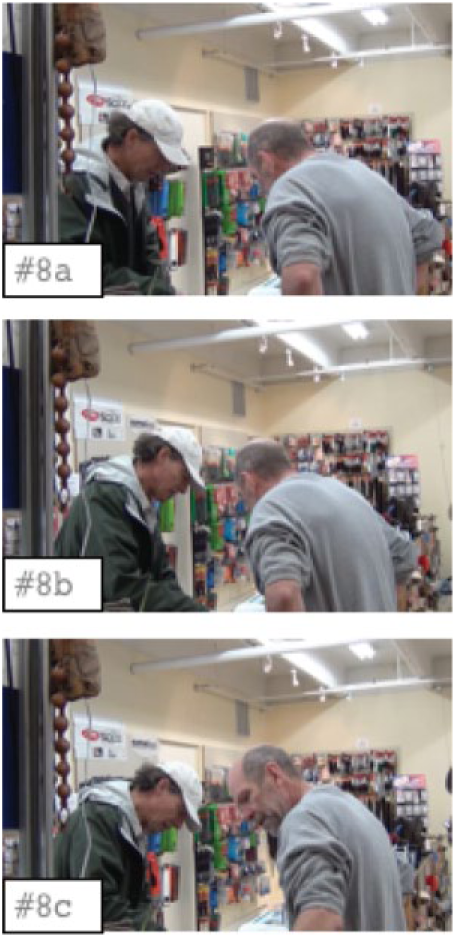
As in Extract (2) above, we have the shoetender coming in with a repair solution (stitch it down) before the customer has completed his request; this time the repair solution is in the form of a verb phrase, rather than a noun phrase. As in Extract (2) above, we also see that the customer confirms the repair solution with yeah (again after first having completed his as-yet unfinished turn, see section ‘Responses to telescoping turns’). In lines 11–12 the customer then goes on to describe a second problem with his boots (and I think it’s starting ta), for which he is also seeking a solution. By formulating a second problem, the customer treats the first request as having been granted and with this the first request sequence as having been completed.
Type (c) telescoping turns, in which the shoetender produces a description of the problem, work similar to close the requesting sequence, even though they do not – like the other types of telescoping turns – present a solution which the customer can subsequently agree to. Nevertheless, both shoetender and customer orient to agreement having been provided, as is evident in Extract (9). In Extract 9, after producing the telescoping response, the shoetender goes on to inquire what kinds of heels the customer would want (line 14), thus taking for granted that the customer wants some type of heel, though this has never been requested by the customer, nor proposed by the shoetender:

So we can see that the telescoping turns serve both as a candidate understanding of the type of repair needed and as a granting of the request (cf. Chevalier and Clift, 2008). It is in this sense that we can see that this way of responding to an unfinished requesting turn also serves to telescope the sequence, because it serves to expedite ‘the step-by-step procedure of the activity in progress’ by ‘providing the ‘economical’ solution to the accomplishment of the activity in progress’ (Lee, 2011: 912). In other words, by offering the suggested repair, the shoetender implicitly does granting of the request.
We can compare this sequence organization with what the sequential outcome would be had the shoetender, for example, in Extract (2), produced either an anticipatory completion (wear down) or an agreeing response (yes they are) in response to the customer’s unfinished turn, instead of the telescoping turn that is in fact produced. While each such response would have secured progressivity at the local turn/sequence level, they would also have resulted in an expansion of the basic request sequence, as outlined in the schematics below:
C: I wanted to see about two pairs, that I have, that are s: (0.6) startin’ tuh
S: wear down?
C: Yes.
S: Do you want/ we can do new heels
C. Yes please
S: Okay
C: I wanted to see about two pairs, that I have, that are s: (0.6) startin’ tuh
S: yes they are
S: Do you want/ we can do new heels
C. Yes please
S: Okay
When comparing these (invented) examples 7 with the telescoping turn that is in fact produced, we begin to see that this way of responding to an unfinished turn in effect conflates – or telescopes – the request sequence. Compared with, for example, anticipatory completions and agreeing responses, our telescoping responses thus have the following schematics:
Customer’s (unfinished) request;
Shoetender’s naming of shoe part, serve as a double-barreled turn that (a) proposes a repair solution and (b) grants a repair solution;
Customer accepts the repair solution/confirms the granting plus can refine/add to the request.
The telescoping quality of the shoetenders’ responses to unfinished turns in our collection appears to be a direct consequence of their non-fitted nature. In other words, they work to telescope the sequence forward exactly because they are not, for example, anticipatory completions, nor indeed agreeing responses. This can be illustrated by reconsidering the pragmatics of these different ways of responding as well as of the unfinished turns to which they respond. Specifically, we can observe that the telescoping turns in our collection are not only grammatically and prosodically unfitted at the local turn/sequence level, in contrast to the two other ways of responding to an unfinished turn which we have discussed, they are also pragmatically unfitted at that level as well; whereas the customers’ unfinished turns are in all cases projecting a troubles description, what the shoetender usually delivers in response is a formulation of the solution. This is not to say that anticipatory completions and agreeing responses cannot be used as solution deliveries; indeed we see this happening relatively frequently in the shoe shop encounters, as illustrated by Extracts (3) and (4), repeated below for convenience:

The main difference between, on one hand, cases such as (3) and (4) and, on the other hand, cases in which we find the telescoping turns being produced, is, that in the former cases the customers’ unfinished turns are in fact projecting the solution, which is then either provided by the shoetender (in (3)) or agreed on by the shoetender (in (4)). In this respect, the two types of ‘responses’ are pragmatically fitted to the unfinished turn. By contrast, in our telescoping collection, the customers’ turns are projecting a problem description/diagnosis, while the shoetender’s telescoping turn is providing a solution. This is similar to what Jefferson and Lee (1981) describe for troubles tellings that are responded to with the delivery of advice, rather than by sympathetic recipiency; in such cases, the troubles teller may either resist the advice as being premature, or alternatively become the recipient of advice instead of the teller of troubles. In our shoe shop cases, the customer effectively stops being the teller of troubles and instead becomes the recipient of a diagnosis/advice. 8 In this respect, the telescoping turns in our collection are not only grammatically and prosodically unfitted at the local level, but are also pragmatically unfitted at that level as well, and it is this latter unfittedness that allows for the requesting sequence to be telescoped forward.
Our type (c) turns may present a caveat to this schematic, given that they do not propose a solution, but rather describe a problem. Nevertheless, we find that even this type of response does appear to telescope the sequence forward in the sense that they are not followed by an inquiry or proposal from the shoetender about whether the customer would want the (unstated) solution to their problem implemented. That this type of response does telescope the sequence forward, despite the fact that it provides the projected problem description, may have to do with the way in which the problem description is formulated by the shoetender, in comparison with what was projected by the customer’s unfinished turn: As we noted in section ‘The turn design of telescoping turns’, the customer here is beginning a description that identifies the problem as still ongoing (starting tuh), whereas the telescoping response produced by the shoetender describes the problem as established (got a hole in the sole). In shoetending terms, these are two rather different perspectives on what the problem is and what can/needs to be done; a progressively evolving problem may, for instance, indicate that what is needed is not a replacement repair, but rather some type of preventive action that will stop the problem from evolving into a situation where a replacement repair is the only alternative (alongside of course the possibility of a problem being beyond repair). A firmer, more established diagnosis of a problem as existing (got a hole in the sole) on the other hand, indicates that the state of the shoes is such that only one repair solution (replacing the sole) is in fact possible. Indeed, as we saw in Extract (9) above, both shoetender and customer appear to take this for granted in their subsequent exchanges, where the specific details of the solution (rubber or leather) are discussed, but not the solution in more general terms. In this respect, even type (c) responses work to telescope the sequence, seemingly because the shoetender’s delivery of a firm and irreversible diagnosis also implicitly provides a solution.
We now turn to considering the customer’s response to the telescoping turns in more detail.
Responses to telescoping turns
In the preceding sections, we have largely glossed over the way in which customers respond to the telescoping turns, concluding, mainly, that the typical response is in the form of a confirmation, for example, yeah, which closes the requesting sequence. During our description of the overall sequence of telescoped requests, we have, however, also noted that customers typically do more than confirm the solution proposed by the shoetender. Customers’ reactions to the telescoping turn can be described in two ways: first, in one set of responses to the telescoping turn we find the customer completing their previously unfinished turn, before confirming the telescoping turn. In the other set of cases, customers confirm the telescoping turn (sometimes preceded by a repetition of that turn), but then go on to qualify the solution presented in that turn. Extracts 2 and 5 illustrate the two alternatives, respectively:


While these two types of responses to the telescoping turn differ, in terms of both form and content, they can both be seen as expressions of slight resistance from the customer; resistance that is not against the diagnostic solution provided by the shoetender (we have no instances in which the customer rejects the diagnostic solution offered by the shoetender), but against the implication that the sequences needed to be telescoped due to the customer’s inability to describe or determine the problem and/or its solution. Thus, in both the cases above, the customers, by ultimately confirming the shoetender’s telescoping turn with ‘yeah’, indicate that they are aligned with the shoetender in terms of the diagnostic solution. By either first completing their own turn (as in Extract 2) or subsequently qualifying the diagnostic solution (as in Extract 5), customers are at the same time indicating that they had in fact reached the same conclusion as the shoetender, independently of and before the conclusion was presented by the shoetender. Interestingly, this type of ‘push-back’ can be found in the context of other responses to unfinished turns and collaborative turn sequences. as noted, for example, by Lerner (2004), who argues that the ‘receipt position’, that is, the position after a co-participant has concluded another participant’s in-progress TCU, is ‘the place for the original speaker to maintain authority – i.e. authorship – over their turn’s talk’ (p. 249). Brenning (2015) who dedicates a whole chapter of a thesis to the analysis of the ‘receipt position’, establishes that it is more common for the original speaker of the unfinished turn to produce their own completion of the turn than to, for example, ratify the other speaker’s completion of the turn and concludes, in general, that the ‘receipt position’ thus allows the original speaker to demonstrate their independence and claim authorship of the overall turn. As we discuss below, the issue of authorship and independence seems applicable also to the ‘receipt position’ of telescoping responses, along with matters such as epistemics, deontics, progressivity, affiliation and alignment.
Summary
In this report, we have identified and described a new practice for responding to requests that are unfinished, which we call telescoping responses. Their unique design is designed perfectly for the sequential and turn-taking context of moving – or telescoping – the sequence forward in the face of troubles with progressivity producing the request. They are not fitted, syntactically, prosodically or pragmatically to the local turn or sequence of the request, which distinguishes them from other ways in which participants in interaction may respond to an unfinished turn, for example, with an anticipatory completion or an agreeing response.
Our exploration of this collection of telescoping responses has revealed a set of relatively stable parameters on which these responses are based. First, we have shown that the unfinished turns to which they are responding indicate in a number of ways that the customer is having trouble formulating the request, and that this trouble is apparent even before the request is initiated: requests that receive a telescoping response are typically initiated only after the shoetender has produced a request-solicitation (e.g. how can I help you) and are even then not initiated immediately, but with some delay. Likewise, requests that receive a telescoping response are typically complex and are formatted either as embedded questions (I wanted to know/I wonder) or as declarative descriptions of trouble. Finally, the request is produced haltingly, with perturbations, hitches and pauses – and is of course not brought to actual completion before the telescoping response is produced. Second, telescoping responses are neither syntactically, prosodically nor pragmatically fitted to the unfinished request itself. On the contrary, telescoping responses appear to be specifically designed as not fitted to the unfinished requesting turn, such that they cannot be understood as continuations of, or actual answers/agreements to, such turns. It is, we have argued, specifically this ‘unfittedness’ of telescoping responses which allows them to telescope the sequence at a point at which progressivity is severely threatened and where other means of responding to an unfinished turn would have only reestablished progressivity at a turn-by-turn level and not at the larger activity level (cf. Lee, 2011).
Discussion
It should be clear from the material above that we are dealing with a practice that is highly complex. Telescoping responses are grammatically unfitted to their requests and yet progress the sequence. And while they are generally accepted by the customer, they are often also resisted slightly. How can we understand these responses? In order to tease apart the complex issues, we start with the concepts of alignment and affiliation.
The term ‘alignment’ is typically used in the Conversation Analysis literature to capture practices used by recipients that structurally support the action initiated by the speaker; such responses progress the sequence as that sequence was set out by the initiating utterance (Stivers, 2008), and are fitted to the grammar of the initiating utterance. They are sometimes described as orienting to the ‘structural level of cooperation’ with regard to the initiating utterance (Stivers et al., 2011; see also Steensig, 2012). Affiliation, on the other hand, refers to the ‘affective level of cooperation’: Thus, aligning responses cooperate by facilitating the proposed activity or sequence; accepting the presuppositions and terms of the proposed action or activity; and matching the formal design preference of the turn. By contrast, affiliative responses cooperate at the level of action and affective stance. (Stivers et al., 2011: 28)
According to Stivers et al. (2011), affiliative responses to requests grant the request, while aligning responses meet the structural requirements of the requesting utterance: The affiliative response to most requests, regardless of format, is to grant them (Heritage, 1984). However, whether that granting is also aligning is contingent on the design of the request. (p.28)
In the case of our telescoping responses, then, we could say that they are affiliative, in that they move to grant the request; however, they could be seen as disaligning, in that they (a) begin before a place of possible completion of the requesting utterance and (b) are not fitted to the grammatical exigencies mobilized by the request.
However, another perspective on our responses suggests an alternative – perhaps even contradictory – understanding of their aligning and affiliative character: First, we could claim that the telescoping responses are strongly aligning because they progress the sequence to an extent not even projected by the request. A similar argument has been made by Lee (2011) in her study of customers’ unfitted – or nonconforming – responses to service providers’ questions, for which she argues that such responses ‘align with the project at hand’ and in effect ‘depart from type-conformity in the interest of promoting activity progressivity’ (p. 915). In the case of the shoe shop, we could thus say that the shoetenders depart from the ordinary, fitted way of completing an otherwise unfinished turn in the interest of progressing the overall requesting activity, thus aligning with this higher level sequential progressivity at the expense of not aligning with the turn constructional format mobilized by the unfinished requesting turn. Second, we could argue that the telescoping responses in our collection are strongly disaffiliative because they fail to reflect the affective stance that is displayed through the customers’ troubles description. A somewhat similar observation was made by Jefferson and Lee (1981), who note that there is a strong convergence between a troubles telling and a service encounter, given that many service encounters are framed around a customer or client’s need for advice or assistance, a need which is often relayed through the production of a troubles telling. As we have observed above, it is certainly often the case that requests in the shoe shop – and in particular those that receive telescoping responses – are produced as troubles tellings or, as we term them, declaratives of trouble. Consequently, it seems reasonable to conclude that part of the problem faced by the shoetenders in determining how to respond to what is ultimately a troubles telling is due to the fact that service encounters constitute a context in which ‘the emergence of advice as a logical outcome of description and diagnosis properly and harmoniously resides’ (Jefferson and Lee, 1981: 414).
Our cases are thus neither clearly affiliating nor disaffiliating, neither clearly aligning nor disaligning. Rather, they reveal the extraordinary complexity of response possibilities, complexity that cannot be easily reduced to binaries such as affiliation or disaffiliation. We thus need to explore all the domains that speakers orient to in constructing responsive actions to fully understand the practice of telescoping. To that end, we explore the following domains and practices in more detail: epistemics, deontics, practices of grammatical fittedness and issues of agency, responsivity, turn-taking and turn design.
Compared with the other known alternatives for responding to unfinished turns, our telescoping responses appear to be more efficient, so to speak, in progressing the sequence. From this perspective, it is probably not surprising that this practice has first been identified in the context of a service encounter such as the shoe repair shop, where the overall encounter has a relatively fixed structure organized around different sequences (e.g. Fox et al., in press; Merritt, 1976), and where the provision of a service to a customer or client is often very routine, at least for the service provider. Moreover, and perhaps more importantly, a service encounter such as the shoe repair shop may also set up the asymmetric epistemic and deontic relations needed to make the production of a telescoping response possible in the first place. In request-sequences such as those we find in the shoe repair shop, both epistemics and deontics are clearly relevant. First, it is necessary to know what is actually the problem that needs fixing (epistemics) and second, it is necessary to determine who has the authority to determine what will happen to the item needing repair (deontics). While the relationship between these two areas of human interaction and an individual’s relative status in terms of epistemics and deontics is commonly unstable, difficult to identify and not necessarily even agreed upon between participants in interaction (see e.g. Heinemann, 2009; Heinemann et al., 2011; Stevanovic, 2011, 2013; Stevanovic and Peräkylä, 2012), it seems quite evident to us that the telescoping response sequences that we have considered here are designed in a manner that allows the participants to display congruence with respect to ‘who knows what’ (epistemics) and ‘who determines what will happen’ (deontics). From the customer’s perspective, the format of the unfinished requesting turns clearly displays a lack of both epistemic and deontic access: in coming to the shoe repair shop in the first place, the customer must of course have been able to identify that there is a problem with their item and that this problem can potentially be solved by the professionals in the shoe repair shop. However, by hesitating in both initiating and formulating the request for service, as well as in using complex and/or problem-describing request formats, customers express a strong degree of uncertainty as to what exactly the problem with their item is and – not least – what can be done (if anything) to solve it. In this respect, the unfinished requesting turns in our collection indicate a low degree of epistemic and deontic status on behalf of the customer. By contrast, the telescoping responses that are produced by shoetenders in this context, display – not surprisingly perhaps – a strong degree of both epistemic and deontic status on behalf of the shoetenders: by delivering a solution or a firm problem description, shoetenders display that they are able to identify the problem and determine what needs doing, at a glance. Put simply, the unfinished turns produced by the customers clearly reveal the customers to be less knowledgeable about the problem with their shoe and less able to determine what (if anything) should be done to solve the problem, than the shoetenders. And in turn, the telescoping responses produced by the shoetenders display their status as more knowledgeable about the problem with the shoe and more able to determine what to do than the customers.
While the unfinished turns produced by the customers and the telescoping responses produced by the shoetenders thus indicate a strong degree of both epistemic and deontic congruence between the participants, in so far as their respective turns both display that shoetenders are expected to be both more knowledgable about shoes and their problems and more able to determine what to do to solve such problems, it is also possible to detect what we could refer to as a ‘push-and-pull’ between customers and shoetenders on exactly these issues. We see this in particular in the way in which customers respond to the shoetenders’ telescoping responses. While customers typically accept – even confirm – the shoetender’s response and the diagnosis embedded within this response, they also typically complete their own original utterance or provide slight alterations to the shoetender’s diagnosis. As suggested above, this may be a subtle way for the customer to reclaim at least some degree of authority or agency in a context where they have otherwise been released from any claims to knowing about the problem with their shoe and determining what should be done to solve this problem (see e.g. Stivers et al., 2018, for a similar situation from the medical treatment recommendation literature). This push-and-pull between shoetender and customer, should not, we believe, be taken as an indication of any deeper problems with the relationship between customers and shoetenders; 9 rather, it is a phenomenon occasioned by the convergence noted by Jefferson and Lee (1981) between troubles tellings and advice or service provision that we find in particular perhaps in certain contexts of service encounters.
As has been shown by a range of other scholars (e.g. Heritage, 2012; Rauniomaa and Keisanen, 2012; Steensig and Heinemann, 2014; Thompson et al., 2015), the grammatical ‘choices’ made in shaping a responsive action are sensitive to the specific sequential positions in which they are produced, as well as to matters such as agency and commitment. Considering our telescoping responses in this light, we can begin to see that this practice for responding to unfinished requesting turns is done with a high degree of agency, which is enacted in part by its grammatical unfittedness. As Thompson et al. (2015) have shown for a variety of sequence types, including requests, grammatically unfitted responses are done ‘for cause’, and thereby construct greater agency for the responder. The responder is not just conforming to the requirements mobilized by the grammar of the initiating utterance (Raymond, 2003), rather, she or he moves outside those requirements to build an utterance that resists the assumptions and presuppositions of the initiating utterance (Lee, 2011). The shoetenders use all of the resources available to them – for example, lexico-syntax, prosody, bodily movements – to design a turn that telescopes the sequence forward to its possible closing rather than simply responding to the previous requesting utterance. The heightened agency involved in such a manoeuvre is quite striking.
In our cases, the shoetender produces such unfitted turns in order to support the (as yet unfinished) request of the customer rather than to resist the request. In other words, the shoetender’s telescoping response could be seen as quite prosocial, in that it supports the request and progresses the larger sequence (see Lee, 2011).
While our telescoping responses are thus grammatically unfitted to the requesting utterance, and are even unfitted in terms of action because they do not directly grant the request, they are interactionally fitted at a higher level, in that they move the sequence forward to the sequence closing, even to a degree not projected by the requesting utterance. They provide exactly the type of response that is relevant sequentially, that is, in a position in which the customer has displayed not only trouble in the practical formulation of his or her request, but also in identifying what the problem with their item is and how it should be solved. Producing a grammatically fitted response in such contexts would only reflect the shoetender’s recognition of the first problem (the practical formulation of the request) and would consequently only progress the sequence forward at the turn level. The responses in our collection, by contrast, telescope the sequence forward at a higher level, in terms of action, exactly because of their grammatical unfittedness, which allows the shoetenders to claim the epistemic and deontic primacy they can lay claim to through the customer’s unfinished requesting turn (cf. Lee, 2011).
Through an exploration of the unusual practice of telescoping responses, we have been able to tease apart domains of responsivity that are normally tightly intertwined, making separate study of them challenging. While the practice described here occurs at the shoe shop, the issues raised are by no means unique to that setting or to institutional settings in general; rather, the fundamental issues of how turns are constructed, how sequences get progressed, and how epistemic and deontic authority are negotiated, are omnirelevant in talk-in-interaction in all contexts. Our telescoping responses have thus given us a view into these larger organizations of talk and revealed the immense complexity inhabited by spaces of responding.
Footnotes
Acknowledgements
We wish to thank the Linguistics Department at the University of Colorado Boulder for a small research grant which allowed us to collect the data presented here. Many thanks to the research assistants who helped gather the data, most especially Patricia Davidson. We are also grateful to Elizabeth Couper-Kuhlen and Sandra Thompson for talking with us about the concepts presented here. Elizabeth Couper-Kuhlen, Anna Lindström, Chase Raymond, Jakob Steensig and Sandra Thompson gave detailed and extremely valuable comments on an earlier version of the paper, for which we are very grateful. Our deepest gratitude goes to the owners of the shoe shop, for allowing us to record there.
Declaration of conflicting interests
The author(s) declared no potential conflicts of interest with respect to the research, authorship, and/or publication of this article.
Funding
The author(s) received no financial support for the research, authorship and/or publication of this article.