



Abstract
This paper explores the ascendancy of ‘softness’ in South Korea as it is experienced through the qualia of one of Korea’s most important social rituals: drinking soju. I combine an analysis of ethnographic evidence with widely-distributed advertisements to show how the experience of an abstract quality, softness, is made concrete by the cultural-semiotic renderings – and genderings – of alcohol consumption in various sensory modalities, including gustation, audition, kinaesthesis, and states of overall drunkenness. I introduce the concept of ‘qualic transitivity’ to account for the cross-modal perception of qualia as instances of the same quality. I argue that dramatic shifts in the qualia of soju and its consumption are emblematic of a higher-order change in how the ideal relationship between liquor and gender is being reconceptualized in contemporary South Korean society.
Qualities, qualia, qualisigns 1
This paper opens this special issue of Anthropological Theory by posing an ethnographic question: how do distinct sensorial and social experiences come to be construed as instances of the same quality? How are they made qualitatively similar? I explore this question by examining the commensal consumption of liquor in South Korea as a significant ritual site for the semiotic ordering and representation of experience.
In the autumn of 2010, I flew to Seoul to attend Mihwa’s wedding. A few days before the celebration, her parents thanked me for making the long trip by treating me to a lunch. After lunch, Mihwa’s father offered me a ride to my hotel. As we climbed into the car, I noticed that the small hatchback was filled with white-and-green boxes of Jinro soju. I presumed that they were intended for the wedding. As we drove away from the restaurant, Mihwa handed me a dark purple box from the back seat of the car. It contained not soju but three bottles of Bohae-brand Korean raspberry wine (pokpunjaju) and a small cup, packaged together as a gift set (so˘nmul set’ŭ). 2 Mihwa had received the wine as a gift for her wedding and now, blatantly and earnestly, was re-gifting it to me. I asked Mihwa’s father if he wanted to keep the wine for himself or for guests. He insisted that I take the wine, explaining that that he and his friends preferred to drink soju. I asked him which kind of soju was his favorite, and he pointed to the boxes in the back of the car and said, ‘Chillo. Ch’amisŭl. Ppalgan ko˘t’ (‘Jinro. True Dew. The red one’).
Mihwa leaned forward from the back seat. ‘What is the difference between the red one and the blue one?’ she asked. Mihwa was referring to the red dot on bottles of ‘Ch’amisŭl Original’ and the blue dot on bottles of ‘Ch’amisŭl Fresh’. Her father explained that the red one was stronger, with more than 20 percent alcohol. The blue one had only 19.8 percent alcohol. Mihwa responded that she preferred the taste of the blue one, but hadn’t known that it was lower in alcohol. She just thought it had a softer (to˘ pudŭro˘pta) taste. It gave her a softer feeling on the throat, she said. Her father explained that Soju used to be much stronger than it is today, and offered the example of Andong soju, which still can contain more than 40 percent alcohol. 3 Mihwa shrieked at the thought. ‘Too much!’ she said. Her father smiled and explained that all Korean soju used to be like Andong soju. ‘Our liquor was like Chinese liquor, very strong’, he said. ‘But these days it is soft. That is why I like the red one.’
For the past decade or so, people in South Korea have become increasingly concerned with the softness of their soju. Advertisements for, and reported experiences of, this clear spirit focus on the various qualitative dimensions through which this valued softness can be felt. The lowered alcohol content is understood to produce a softer taste, a softer sensation on the throat, softer sonic reactions to consumption, a softer feeling of inebriation, a softer mood among friends and colleagues, and softer embodiments of both masculine and feminine personhood. Note the contrast with a prestige comestible like wine, the ritual consumption of which is mediated by an elaborate ‘oinoglossic’ register (Silverstein 2003, 2004). By drawing from various lexical domains to comment on the phased sensory experience of consumption (visual, olfactory, gustatory, etc.), wine consumers performatively can become aesthetic connoisseurs whose own personal characterological attributes match the best of what they drink. With soju, however, there is a more unified axis of differentiation – from ‘hardness’ to ‘softness’ – across multiple areas of experience, sensory and beyond. But how can the quality of softness be present in all of these different dimensions? Can a single substance’s quality really be experienced through all of these different modalities? Is the softness of one really the same as the softness of another? How should we deal with these analogical relations, this cross-modal iconism, this seeming transitivity of quality from the substance itself to different related sensory, social, and embodied dimensions?
The relationship between qualities and value was central to Nancy Munn’s (1986) seminal study of value transformation on Gawa. One of Munn’s key ethnographic insights was that a culturally meaningful quality such as ‘buoyancy’ or ‘lightness’ (gagaabala) could be experienced via any number of objects of sensory experience, e.g. the wetness and expansiveness of the sea, the slipperiness of fish, the fluttering motion of birds, the lightness of the heated and dried wood of a canoe, or the quickness of a brilliantly-adorned dancing body. Munn’s analysis of quality was as Charles S. Peirce described it, ‘a mere abstract potentiality’ (Peirce 1997 [1896]: 1.422), not dependent on mind, on some material entity, or on sense. Qualities belong to the realm of ‘firstness’, i.e. indeterminacy, ‘not referring to anything nor lying behind anything’ (i.e. a monadic state, a ground; Peirce 1997 [1890]: 1.356–357).
So how do we go, analytically speaking, from quality as an abstract potentiality to the concrete stuff of qualitative experience? While Peirce does not provide a straightforward answer to this question, we can draw from across his writings to construct a relatively coherent framework to help us at least begin to address the problem. At the most basic level, qualitative experience is made up of what Peirce called qualia, the actual instantiations of quality that are inflected by and related to thought, materiality, sensory channels, etc. Qualia are lived. Whereas quality itself belongs to the realm of firstness, qualia as ‘facts of firstness’ (Peirce 1998 [1903]b: 272) are more complex. They are instances, i.e. secondnesses, which can stand for quality in two ways: iconically (by seeming to exhibit some quality), and indexically (by suggesting a contiguity with some quality). In this way, the abstraction of qualities is experienced and known through particular qualia (e.g. abstract redness versus the redness of the skin of a particular apple). 4
If, however, as Peirce wrote, ‘the pure indescribable quale [singular of qualia] … is gone in the twinkling of an eye and … bears no resemblance to any memory of it’ (2000 [1888]: 214), how can persons agree that they perceive two qualia as instances of the same quality? How can contemporary soju drinkers associate a reduced burning feeling in the throat and a lighter feeling of drunkenness with the same quality of softness? How is this intersubjectively ratified qualitative sameness achieved? This manner of inference obtains through the regimentation of qualic relations, i.e. through habituation and representation of qualia as forms of thirdness in different contexts and at various scales. Insofar as a sign points to both an object and an interpretant, then qualia which ‘stand to somebody for something in some respect or capacity’ (Peirce 1997 [1897]: 2.228) can be termed ‘qualisigns.’ Qualisigns are not symbols representing qualities (e.g. the word ‘red’), but rather are qualia serving as signs. 5
Munn focused on how ‘in particular, the body and certain elements’ (1986: 17) could become semiotic media for experiencing qualities, with such experiences serving as ‘qualisigns’ (Peirce 1997 [1897]: 2.254; Munn 1986: 276 fn14) within a system of cultural value. Like Munn, my own usage of the term is more complex than the well-known example of a paint chip, where the particular combination of hue, saturation, brightness, and gloss as qualia of color serve to signify a more general quality of a color. In this example, ‘color’ serves as a category of explicitly coded quality. Although the qualisign is necessarily an icon (Peirce 1997 [1897]: 2.254), the nature of qualitative iconicity in the realm of ‘feeling’ is not always so straightforward (see Parmentier 1994: 17–18). For one person, a dull feeling of pain in the elbow might signal the first stages of arthritis. For another person, such a pain might signal nefarious witchcraft. For a third, such a pain might reinforce an overall experience of painfulness. Or such a pain could signal all three. The ethnographic issue is whether some aspect of the signifying quale is also projected onto its object by an interpretant, e.g. whether painfulness and witchcraft (or even the redness of the skin of an apple and its ripeness) are understood or perceived or felt by people to have a qualitative similarity or some shared essence within a cultural system, or merely to have an indexical relation of causality or contiguity. Note that I consider qualia to be not purely mental, subjective experiences, but rather points of culturally regimented, socially realized intersubjective orientation (see Chumley and Harkness, this issue).
Cultural convention and institutionalized practice turn elements of qualitative experience into meaningful signs which people rely on to reflect upon, interpret, and engage with their world. As the relationship between multiple qualia and a particular quality is conventionalized, culturally valorized qualisigns emerge as points of orientation in social action – materialized in adorned bodies, decorated canoes, gardens, or alcoholic beverages like soju. For this reason, I further specify the signs that Munn and I (and others, e.g. Manning 2012) examine – ‘certain sensuous qualities [i.e. qualia] of objects that have a privileged role within a larger system of value’ (Keane 2003: 414, insertion mine) – as conventional qualisigns. Conventional qualisigns are types of qualitative experiences that are widespread, recognizable, and socially effective. They have cover terms, like ‘softness’ or ‘gagaabala’, which trace a pathway of linkages across multiple sensory realms. It is via semiotic regimentation and conventionalization in this sense that cultural value is manifest qualitatively. And so an important lesson from Munn’s pioneering work is that the semiotics of culture allow any given sensory experience or ‘bundling’ (Keane 2003; Meneley 2008) of qualia to be interpreted – to be ‘felt’ – as a conventional qualisign, as qualia signifying a culturally valuated quality.
In the analysis below, I show how the ascendancy of the quality of softness in South Korea is experienced as a shift in the qualitative experience of one of Korea’s most important social rituals: drinking soju. I view advertisements as conventionalizing and prescriptive representations of soju consumption in light of my own ethnographic research in Seoul since 2005. Drawing on a specific commodity register (Agha 2011), soju advertisements crystallize statements, sentiments, and behaviors that I observed many times in Seoul. They also show how the experience of softness is made possible by the cultural-semiotic renderings – and genderings – of the qualia of alcohol consumption in various sensory modalities. I argue that dramatic shifts in the qualia of soju and its consumption are emblematic of a shift in how features of masculinity and femininity are idealized as points of cultural orientation in contemporary South Korean drinking rituals. 6 The softness of soju in particular – via its multiple semiotic modalities – thus serves as a conventional qualisign of this change.
Give it a shake: Men, women, and the softening of soju
Drinking in postwar South Korea has been a manly activity. Men were expected to drink together and to get drunk. Obligatory military service for men – still in effect today – was a time for initiation into exclusive male drinking practices. During military rule under Park Jung-hee (Pak Cho˘nghŭi, in office 1963–1979), most young men were mobilized for mandatory military service; these men then carried this training and sociality into their participation in the industrializing economy (Moon 2005). As the military made Korean boys into men, it prepared them for their roles in schools and then companies, where they would continue to drink together as a part of institutional corporate culture. In what has been called a ‘cult of martial masculinity’ (Jager 2002, 2003), soju drinking and its resultant drunkenness were and are often primary sources for the display of this masculinity (Cheng 2000; Lee 2007). Much of this activity took place through the commensal consumption of a Korean liquor called soju.
Soju is a clear, non-prestige spirit of around 20 percent alcohol, usually found in 300-milliliter bottles made of green glass, which cost around 1000 wo˘n (approximately 90 cents) in a grocery store, and around 3000 wo˘n in a restaurant. The base spirits for contemporary soju can be made from a number of different starches, including rice, sweet potatoes, barley, and, more recently, tapioca; these spirits are then diluted with water and sweetener after distillation. Because it no longer follows a strict brewing procedure, the government has been reluctant to call it a ‘traditional Korean beverage’ in its recent campaign to market Korean traditional spirits to the world – instead focusing on the natural local ingredients and supposed health benefits of Makko˘lli, an opaque rice wine (Moon 2009).
The Korean term ‘soju’ is based on the Sino-Korean characters for ‘burn’ (燒/소) and ‘liquor’ (酒/주), which describe the historical use of fire in the distillation process. And this etymological fact seems to have provided qualitative fodder for earlier representations of the drink as produced from, and producing, flames. For example, a Bohae-brand soju commercial from 1982 is particularly powerful in its use of fire and masculine imagery to advertise its ‘30 percent’ soju as a manly drink. The commercial begins with a bottle of ‘Bohae 30’ rising from the erect skyline of a modern city (Figure 1). Against an electric guitar soundtrack, the male narrator, in a rough, strident voice, describes a ‘new wave’ (sae mulgyo˘l) surging. He emphasizes the 30 percent alcohol and introduces a sophisticated, modern man who finds the liquor ‘clean’ to consume. We are told: ‘If you’re a man, don’t ask’ (i.e. ‘Just drink it.’). The protagonist of the commercial – a modern businessman in a suit and overcoat (played by the actor Yi Cho˘nggil) – engages in explicitly male sociality by aggressively grabbing the arms of a colleague. Finally, we see him use his teeth to tear grilled meat from a skewer as flames rise before him. The commercial closes with a hoarse, scratchy man’s voice saying, ‘Hwaggŭn soju bohae samsip’ (‘Burning Soju, Bohae 30’).
If you’re a man, don’t ask! (Courtesy of Bohae Liquors).
Another Bohae commercial from the 1980s makes explicit the culturally conceptualized link between the consumption of this Korean liquor, the forging of masculine relationships, and Korea’s modernization. The same character arrives at the construction site for the 1988 Seoul Olympics and emits an imposing yell to his subordinates, which echoes through the stadium (Figure 2). He then grabs the arms of another man in the manner depicted above and announces, ‘I am proud of you’ (‘Na nŭn ne ka charangsŭro˘pta’). The closing scene shows the main character and another man toasting to their accomplishment.
I’m proud of you! (Courtesy of Bohae Liquors).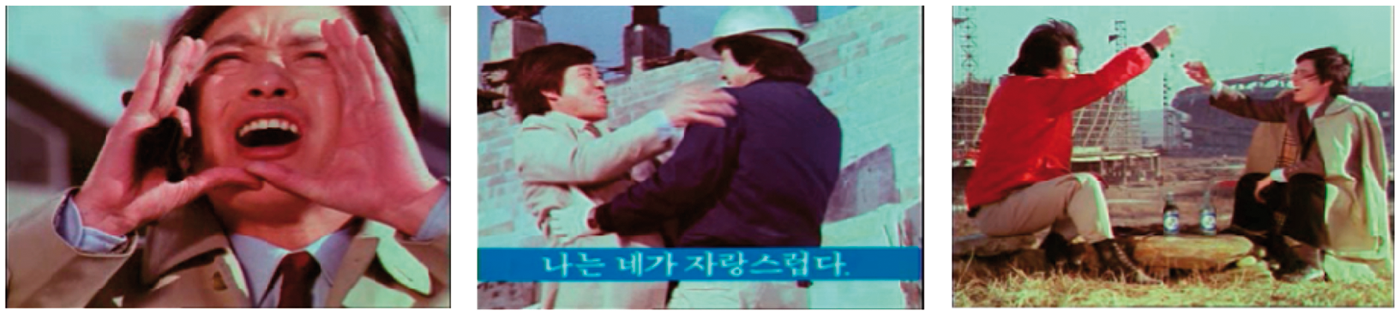
How, in a couple of decades, then, does the soju industry go from the celebration of soju drinking as an act of fire-eating, yelling, modernizing masculinity to a soju advertisement in 2008 that features the female pop-star Lee Hyori (Yi Hyori) dancing and singing for Lotte’s (formerly Doosan’s) soju brand Ch’o˘ŭm ch’o˘ro˘m (‘Like the First Time’)? Now women are present in the event. Now a woman’s voice narrates the commercial. Now the characters are dancing to pop music sung by a woman. And in a dramatic shift, now the commercial emphasizes the softness of the drink itself.
The advertisement characterizes soju drinking as a fun, light-hearted experience that can be had in any number of situations with any number of people. Lee Hyori sings the words ‘shake, divide, swallow, la-la-la-la’ (‘hŭndŭlgo tchogaego no˘mgigo ra-ra-ra-ra’) as she dances (Figure 3) with businessmen, girlfriends, a motorcycle gang, and friends and coworkers in a restaurant. Shaking, dividing, and swallowing, we learn, are three steps to ‘enjoying “Like the First Time” more softly’ (ch’o˘ŭm ch’o˘ro˘m to˘ pudŭro˘pke chŭlginŭn 3 tan’gye). According to the commercial, this shaking process creates a whirlpool that divides the particles of the beverage into smaller pieces to produce a softer feeling on the throat. The metaphorical extension from the drink to the corporeal and social experience that it enables is not subtle: shaking the bottle with one’s friends, coworkers, or acquaintances leads to dancing bodies that are more open and convivial with one another. For women in particular, as the relatively new participants in this public activity, the experience of drinking can become softer and gentler if the mood is right. All of the various qualia of the event – of the beverage, of its consumption, and of the social atmosphere that it facilitates – are coordinated and aligned one with another to point to an overarching quality of softness.
Give it a shake! (Courtesy of Lotte Liquors).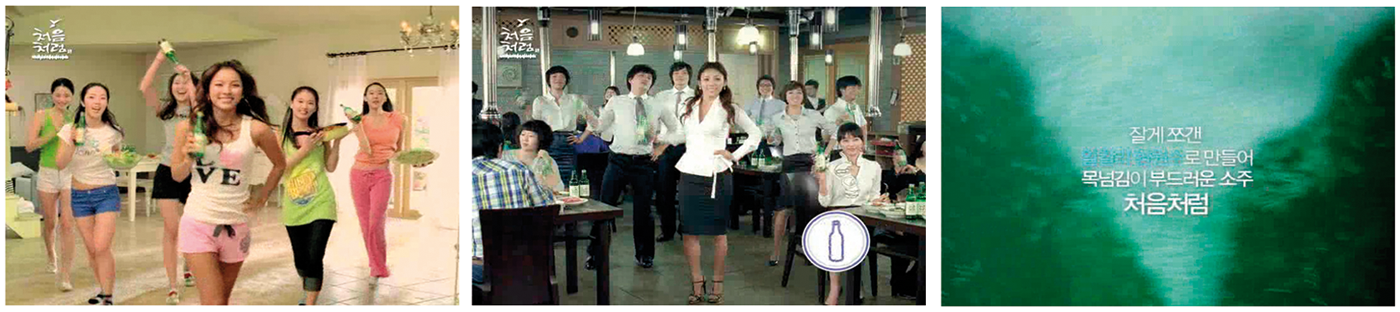
Introducing women into the public drinking event has changed the culture of alcohol consumption in Korea (Kim and Kim 2008).
7
What is especially important about this shift in the drinking event itself is its perceived linkage with continuously sinking alcohol content. The director of research and development for a major soju distillery explained to me his theory that the lowering of the alcohol content of soju was due primarily to women’s participation in drinking. Furthermore, he suggested that this shift in alcohol content had also resulted in a shift in the sensation of alcohol – from a ‘hard’ sensation to a ‘soft’ sensation’ (see Harkness 2011a).
Excerpt 1: Women and softer Soju
처음에 이게 알콜도수가 삼십도, 그게 이제 이십오도. 이십오도가 오랫동안 지속 되었어요. 그게 최근 이, 삼년 사이에 지금 이십도까지, 십구점팔도까지 낮아진 것 은 여자들의 음주층이 많아지 면서 독한 것 보다는, 하드한 것 보다는 소프트한 것. 그게 영향을 되게 많이 준 거죠. At first the alcohol percentage was 30 percent, and then it was 25 percent. This 25 percent lasted for a long time. In the space of the last two or three years, it has now fallen to 20 percent, to 19.8 percent. As the level of drinking among women has increased, more than strong, more than ‘hard’ [hadŭ], ‘soft’ [sop’ŭt’ŭ]. That has had a lot of influence, you know.
According to this theory, women are a catalyst for a change in soju, rather than soju being a catalyst for a change in women. That is, rather than ‘hardening’ Korean womanhood through the consumption of highly alcoholic soju, the soju is ‘softened’ by the market demands of an increasingly female consumer base. And this particular ideology, regarding the relationship between alcohol level of soju and the gendering of its consumption, is widespread.
Mihwa’s and her father’s differing tastes regarding soju thus figure into both generational and gendered axes of differentiation and preference. A businessman who reached adulthood in the 1970s and 1980s, her father prefers the ‘red one’ because of its higher alcohol content. A young woman in her mid-20s, his daughter prefers the ‘blue one’ because it is softer on her throat. 8 But why, within this ideological frame, should women’s involvement in drinking necessarily be a cause for the lowering of alcohol and the attendant qualitative transformation from ‘hard’ to ‘soft’? And why is the dilution of soju not seen as a devaluation of the drink (cf. Manning 2012 on alcohol content and ‘strength’ as a valuable quality of vodka)? What, more precisely, is the nature of the influence (yo˘nghyang) that is being spoken of?
캬∼!: From gustation to gesture
To begin to answer this question, let us turn to representations of gendered alcohol consumption in popular media. In the first episode of the Korean drama ‘Soulmate’ (Soul meit’ŭ), which depicts the lives of young urban singles in their search for sex, romance, and love, the confident and casual Tonguk treats the naïve and formal Yujin, a proofreader at a newspaper, to a meal of intestine soup.
9
Yujin, who has never tasted the food before, is hesitant and somewhat disgusted. But as she munches on the chewy intestines and lets the spicy juices seep into her mouth, she finds herself enjoying the meal – a sentiment she excitedly shares with Tonguk. Paying her a compliment, Tonguk tells Yujin that she is fun, and asks politely if she would like a drink (‘Han chan hallaeyo?’). Yujin, as she has done all along, responds in the most formal speech level (using the –(sŭ)mnida sentence ending). She agrees to have a drink, saying that it would be impolite to turn down an offer. Tonguk opens a bottle of soju and pours it into a small glass. Yujin turns away from Tonguk, as one is supposed to do with superiors, and drinks slowly. She then coughs and waves her hand in front of her mouth. Tonguk responds with some helpful guidance:
Excerpt 2
Yujin: 소주는 참 쓴 술입니다! Soju is very [ch’axm] bitter liquor! Tonguk: 에이, 그렇게 입에 담고 마시니까 더 그렇죠! Hey, you know, it’s like that because you are putting it into your mouth and drinking like that. 봐봐요 유진씨! Watch me, Miss Yujin. 이렇게 고개를 딱 뒤로 젖히고 Tilt your head back just like this. 한번에 툭 털어놓고 And in one motion pour it out 꿀꺽하고 삼키는 겁니다 and gulp it down. 그리고 이렇게 마지막으로: 크∼! And at the end, like this: [khƚx:::h:::]! 이렇게 해야 덜 쓰거든요 This way it’s less bitter. 해볼 래요? Want to try it? Yujin: 그럼 … 꿀꺽 털어 넣어보겠습니다 Well, I’ll try to gulp it down. [Using two hands, she turns away again, throws her head back and makes a gulping sound.] 캬∼! [khjah:::]! 어! 정말 쓴 맛이 안느껴집 니다 Ah! I really don’t feel the bitter taste! Tonguk [To himself] 이 아가씨 맞선시장에 나온 속물은 아닌가보네. Oh, this girl is not a snob in the dating market. 맑고 순수한 면도 있고 … She is both clear and pure …
This encounter hinges on what I have called the fricative voice gesture in Korean (Harkness 2011a). Fricative voice gestures (FVGs) are emissions of sound produced when air passes through sites of frication along the supralaryngeal vocal tract. Locatable in drinking events all over Korea, FVGs serve as reactive gestures following a sip of Korean soju, and also can be superimposed prosodically over adverbs and adjectives as a form of intensification. After coughing from the first drink of soju, Yujin produces a prosodic FVG when she tells Tonguk that soju is ‘very bitter liquor’. The prosodic FVG (noted above with the superscript [x] in ‘ch’axm’) marks the personally felt intensity of her description. Then, Tonguk and Yujin each produce reactive FVGs later on in the conversation, but their two tokens are differentiated by the softening and brightening of the sound from [khƚx:::h:::] to [khjah:::] respectively. This change signals the idealized movement away from the male-coded intensity associated with the Korean drinking event, toward a lighter mood, a softer atmosphere, and a less intense drinking experience overall. When Tonguk produces the old-fashioned FVG, he does so from the perspective of a man initiating a woman into the drinking experience. However, among women, and, increasingly, among men as well, the softer, lighter version prevails.
Drawing on the ubiquity of this type of sound in Korea, Jinro Brand Soju created a graphic representation of the sound as a form of what they call ‘voice marketing’ (Harkness, 2011a: 110–14). In the Jinro campaign, the softer, brighter fricative voice gesture (written as ‘캬∼’; see Figures 4 and 5) serves as an emblem of the lowered alcohol level by signaling indexically and iconically both the reduced phenomenal intensity of the alcohol (softening the sound of the FVG), and the milder sensation in the throat that one experiences (reducing the fricative intensity of the phonation).
Voice Marketing (Source: Ha et al. 2008: 72). Voice Marketing: Khjah::: (courtesy of Jinro USA).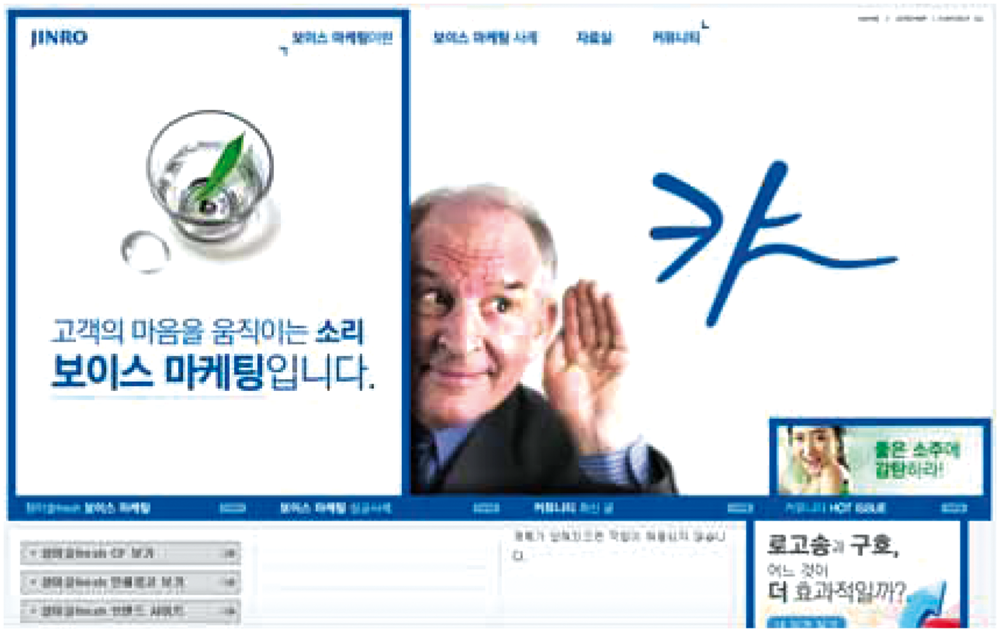
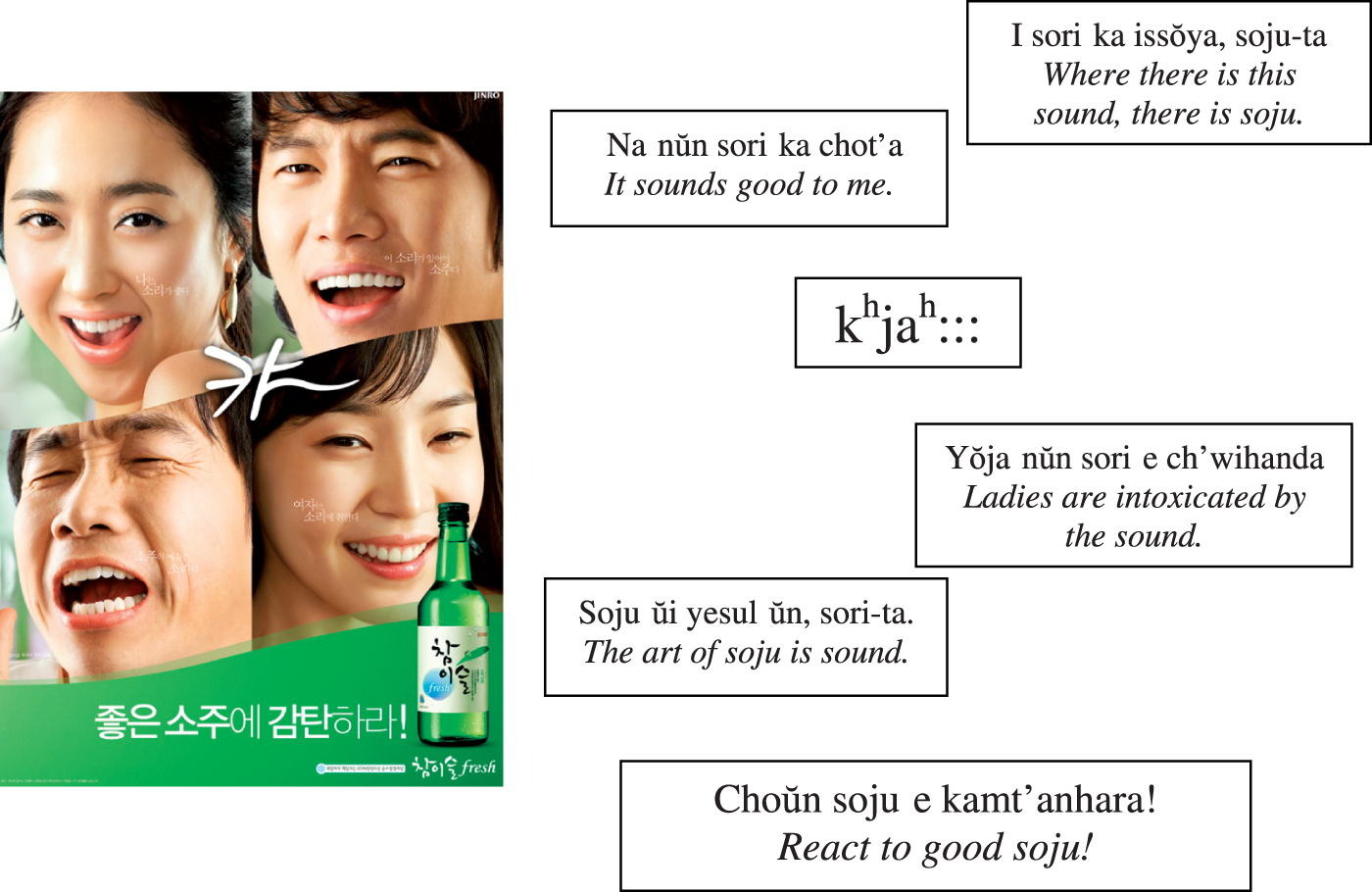
Jinro’s voice marketing campaign relies on identifiable, iterable phonosonic (see Harkness 2014, for a discussion of the voice as phonosonic nexus) emblems of the company’s increasingly soft product. In a similar manner, Lotte’s (formerly Doosan’s) ‘Give it a shake’ campaign can be said to mobilize ‘kinesic marketing’ in which the shaking of the bottle to achieve softer soju becomes an emblem for the shaking of bodies to achieve a softer mood. The change in sound, like the change in corporeal disposition and carriage, is related to the relative ‘dilution’ of the liquor and to the goal of softening of soju’s harsh, bitter feeling on the throat. As I explore below, this change has consequences for the gendered persona invoked by the contemporary soju-drinking event.
You are how much you drink: Drunkenness and personhood
In the case of contemporary soju, the prized quality of softness extends from the alcohol level to gustation to sound to mood to the actual state of drunkenness itself. Recently, drinking in Korea has come under scrutiny because of the historical expectation of working men to spend more time drunk with colleagues than sober with their families, and specifically because of the historical emphasis among these men on achieving states of extreme drunkenness. As a form of interpersonal introductions, people often gauge one another’s tolerance for liquor by asking, ‘How many bottles [of soju] can you drink?’ Entire websites are devoted to capturing the messy aftermath of public drunkenness in South Korea (e.g. blackoutkorea.blogspot.com). I recognize the scenes depicted there. Riding the subway home at night in Seoul, one is often compelled to help incapacitated strangers pick up their glasses from the floor, fish their phones out of their pockets, and even locate the doors to exit the train.
Because of the widespread emphasis on extreme drunkenness and the rituals that encourage such behavior, women who now participate in corporate drinking events sometimes are forced to consume beyond capacity, to get drunk, and, in the eyes of some, to embarrass or expose themselves by acting out aggressively or becoming objects of sexual aggression. The lowered alcohol content of softer soju is construed as a kind of preventative measure for these circumstances, allowing a woman to maintain the normatively prescribed softness of her feminine personhood even while consuming alcohol with men.
For example, a recent Bohae commercial depicts drunkenness in women as an unsightly trait. In what appears to be a conversation between a young heterosexual couple, we hear a man’s drunken voice (the comedian An Ilgwo˘n) superimposed over the image of a speaking woman (the actress Han Chimin). The female speaker, obviously intoxicated, is angry and aggressive with her boyfriend (Excerpt 3). She becomes so enraged that she even tries to strangle him (see Figure 6). Then we hear a calm woman’s voice tell us: ‘Not this. Even though you drink excessively, remain tender and soft.’ Suddenly, the drunken woman is sober and attentive and sweet to her interlocutor, and she speaks with her ‘own’ voice.
Excerpt 3
Even though you drink excessively, remain tender and soft (Courtesy of Bohae Liquors). 1) Girlfriend (male voice): (우후후, 와아, 씨) 내가 누구냐, 임마. 니 군대 면회 다니면서 기다려 준 니 여친 이시다. 그렇게 바람 피면 안돼, 이 자식아. 에이씨, 나쁜 놈아. [mumbling] Who am I? Buster, I’m your girlfriend who waited for you while you were in the military. You can’t cheat on me, asshole. Shit, you jerk. 2) Narrator (female voice): 이건 아니다. 과하게 여러 잔 했어도 여리고 부드럽게. Not this. Even though you drink excessively, remain tender and soft. 3) Girlfriend (female voice): 오빠 어디 아퍼? 어떻게 해? Older brother of a female [self-lowering term of endearment], are you sick? What can I do? 4) Narrator (female voice): 메이플 소주, 잎새주. Maple Soju, Leaf-Liquor.
The male voice, the aggressive speech, the violent behavior all point to a quality of roughness or harshness that is de-valorized in Korean women (even if these attributes are still understood to be widespread among men). By drinking Bohae’s softer soju, the speaker is transformed from a drunkard exhibiting male-coded behaviors to a caring, attentive woman, softened in both voice and demeanor. 10 After the transformation, she demonstrates her femininity by using a moderately nasalized and ventriculated voice quality that belongs to a speech register known in Korea as ‘aegyo’ or ‘cute’. 11 The paralinguistic voicing (Harkness 2011a, 2014) in the Bohae commercial makes clear reference to an actual typifiable persona or characterological type (Agha 2007; Hastings and Manning 2004), in a social universe that is experienced as real: the drunk Korean man, who is aggressive and angry, emotionally unrestrained, and around whom the drinking ritual is organized. The drunken woman’s harsh behavior in particular has its prototypical instantiation in the very personification in the drunken ajo˘ssi (‘uncle’, ‘guy’; see Harkness 2011a), the one who would make a [khƚx:::h:::] sound instead of [khjah:::], who would in drunken belligerence pick a fight with drinking companions, who would howl at and perhaps even grope women. The qualia of the voice form an emblem of outmoded, unbridled drunkenness in general, which is used explicitly as a warning to prohibit the masculine perspective of self-entitlement within a female body. The indexical linkage between the consumer and the beverage consumed has been made iconic; it has been ‘downshifted’ (Parmentier 1994: 18) via a process that Susan Gal, following Peirce, has called ‘rhematization’ (Gal 2005: 35 n5), where relations of contiguity and proximity are viewed as relations of sameness or formal resemblance (see also Irvine and Gall 2000 on ‘iconization’). The speaker, like the soju, should remain the soft object of attention, soft like the soju being consumed, still soft and tender even when the man has consumed too much and is ill.
The drunken ajo˘ssi is reviled by younger generations in Korea, especially younger women. 12 And his behaviors are encountered all over Seoul – on the streets, in subways, in stairwells, and in bars and restaurants. For example, I was having a drink with an informant at a bar in an upscale neighborhood not far from the Seoul Arts Center in southern Seoul. It was about 10 pm on a workday evening. As we chatted, we were interrupted by the harsh yells of an older Korean man. It turned out that he was a boss with some of his subordinates, both men and women, out for a post-work drinking event (hoesik). He was yelling at a few of them who had tried to leave before he had finished drinking. He cursed at them at the top of his lungs, and told them that since they had come out drinking they should stay to the end and not leave the team leader alone. In his drunken rage, he even threatened to fire them. After a few minutes of shouting, which his subordinates accepted with only a few interjections, the drunken boss calmed down – perhaps fatigued by his own anger.
Soju advertising campaigns seek to connect softer soju with new forms of masculinity as well as to emphasize more commonplace forms of femininity. The commercials, such as those from Jinro below, valorize soju’s lowered alcohol content and increased softness in both masculine and feminine ways – whether as facilitating the smooth moves of young player and the modest caution of a young princess (Figure 7), or as the potential link between modern, slightly older, romantic people who want to get just tipsy enough to open their hearts willingly, rather than by aggression or force (Figure 8).
Players and princesses (Courtesy of Jinro USA). Open your heart (Courtesy of Jinro USA).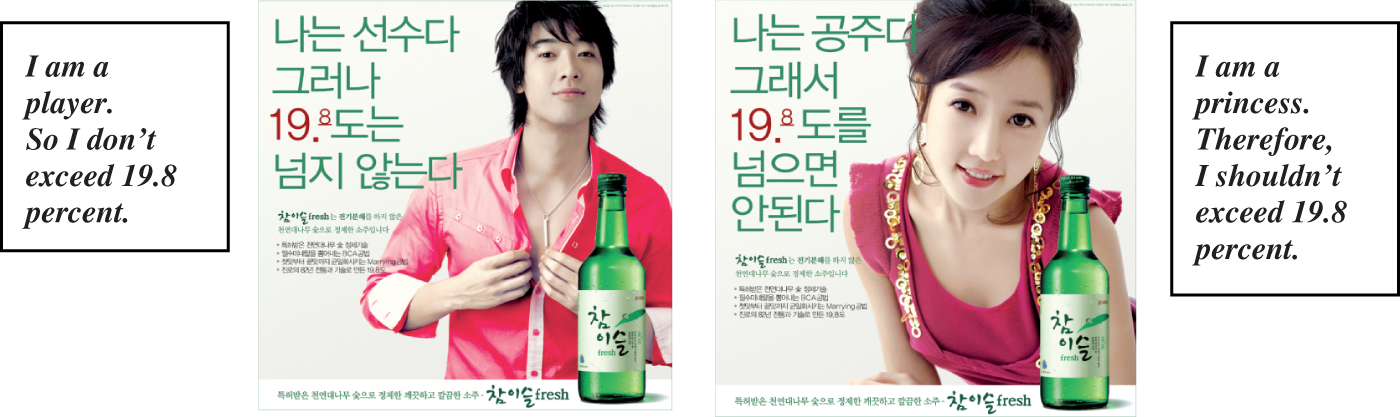
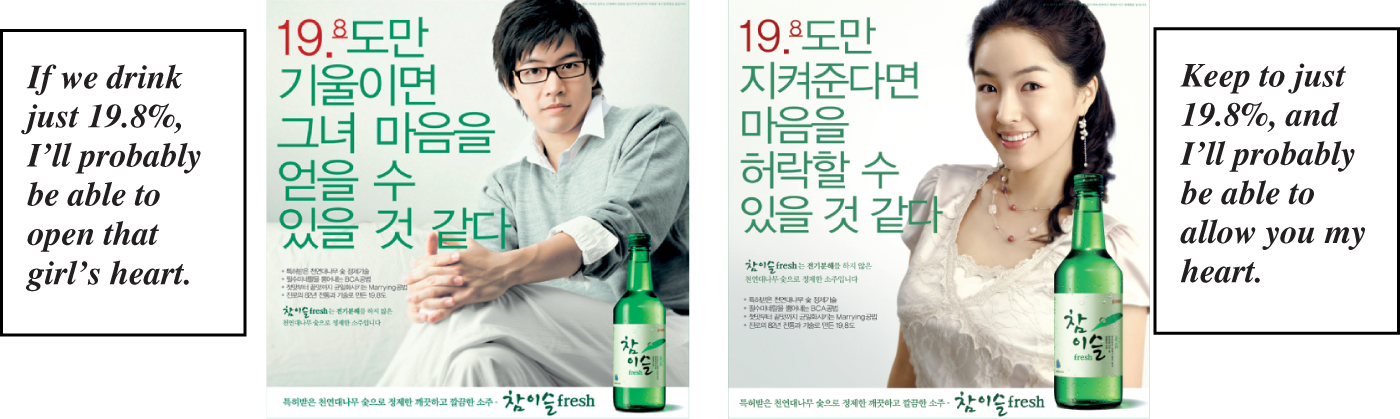
While so much of soju’s softness appears embodied in the figure or type of the ideal woman, for men the softening of the soju they consume also aligns with other dimensions of social life in which a soft quality is valorized. This can be found in what Sun Jung (2011) has described as Korean ‘soft masculinity’, emblematized in the sculpted body, polite manners, and tender charisma of Pae Yongjun, a Korean actor. It can be seen as well in the new cultural category of the ‘ch’osiknam’ (herbivore-man), who is concerned about his appearance, is not looking for marriage, and, thanks to his attentive and non-aggressive demeanor, can be friends with women without the relationship developing into a sexual one. 13 The ch’osiknam is contrasted directly with the yuksiknam (carnivore-man), the classic Korean male, who is aggressive and predatory – who yells, fights, drinks hard liquor, and perhaps even tears his meat directly from a hot skewer. The softening of soju extends from its chemical properties, to the sensory qualia produced by its material encounters, out into the very forms of behavior and identity that are produced through its socially structured and culturally regimented consumption.
Transitive softness
None of this is to say that people in Korea are getting any less drunk these days. According to the World Heath Organization (2011), South Korea is ranked 13th globally in liters of pure ethyl alcohol consumed per capita annually, first among Asian countries according to the same calculation, and first in the world in the consumption of spirits in particular (as opposed to wine or beer). And according to an earlier WHO report (2004), along with the continually rising per capita income level, Koreans also have shifted from drinking mildly fermented beverages like makko˘lli to strongly distilled spirits like soju. 14 Given how inexpensive soju is to buy, its decreasing alcohol level means – and this is common knowledge in Korea – that people simply drink more of it.
Still, softness appears to be on the ascent. In the explicit discourse and representations of soju over the past few years, the quality of softness is valorized and made concrete through the various qualia of the drinking event. Softness, as an abstract potentiality, is experienced across the linked qualitative dimensions of sensorial and social experience: from the alcohol level of the substance itself, to gustation in the form of reduced bitterness, to the reduced sensation of harshness on the throat, to the brighter reactive fricative voice gesture it elicits, to the quieted, calmed voices of its drinkers, to the light and cheerful mood it creates among people, and, ideally, to the reduced intensity and limited overall drunkenness it, in theory, is supposed to facilitate. The cultural transformation of soju drinking in Korea is taking place by making the newer, softer quality of soju consumption transitive from the substance itself to the different experiential dimensions through which it is encountered. This transitive softness then links consumers to culturally valorized, highly gendered, and temporally positioned identities within contemporary Korean society.
Softer soju in South Korea exists in a state of qualic transitivity, where relations among the qualia of soju consumption in their various semiotic modalities are regimented in terms of the overarching abstract quality of softness that seems to drinkers to emerge from the entity itself; the properties or features that apply to one modality (e.g. gustation) also apply to the various other modalities to which the former is indexically linked (e.g. sociality, speech, inebriation, etc.). For soju, qualic transitivity is the state in which ‘the concrete sensuous reality (e.g. color) … [can] act as a relay for the more abstract associations (Young! Fresh! Edgy!) that branding professionals try to “encode” in consumer experience’ (Moore 2003: 332). In soju consumption, as in Munn’s account of value transformation on Gawa, a quality like softness operates as a valorized, lexically coded but abstract potentiality that is experienced through multiple modalities, often at the same time (i.e. synaesthetically or transaesthetically).
It is not news that categories in one area of experience should be projected onto another in the form of metaphor, e.g. ‘bright and dark’ vowels in Korean (Harkness 2012), ‘rough and smooth’ speech, ‘high and low’ pitches, etc. (see Gal, this issue). What is of interest here is the literalization of metaphor through drinking itself – as a ritual central to Korean social life – which links these different areas of experience through the abstract quality attributed to a single type of entity. The cultural value of the quality of softness depends on the linkages, indexical and iconic, among the different experiential modalities engaged by consuming soju. Through advertising’s authoritative discourse and the rituals that coordinate sensory and social experience, iconic relations across different modalities emerge within a state of metapragmatically regimented transitivity. Through ritual and representation, soju consumption engenders analogical linkages across ontic dimensions. In such situations, a quality like softness is not restricted to any particular sensory channel or feature of an entity but seems to be exhibited in all of them simultaneously. In this manner, experiences of the qualically transitive softness of soju contribute to an increasingly conventional qualisign of cultural value in contemporary South Korean society.
Footnotes
Acknowledgements and Funding
This paper has benefited from the helpful comments of a number of people, among them Nancy Abelmann, Vivien Chung, Judith Farquhar, Olga Fedorenko, Kiho Kim, Sun Joo Kim, Taeho Kim, Paul Manning, and Saeyoung Park. Special thanks go to Eitan Wilf, who served as the original discussant for this paper. Funding for research, analysis, and writing was provided by a Mellon Foundation/Hanna Holborn Gray Fellowship at the University of Chicago, a Korea Foundation Fellowship at the University of Illinois, and an Asia Center Faculty Grant at Harvard University. All translations and errors are my own.