




Abstract
This article theorises the relationship between 1970s US Third World queer and feminist movements and Latin American anti-imperialist revolutions of the late twentieth century. I focus upon the historically occluded relationships between Third World feminists and queers in Chile and the United States throughout the transition to neoliberalism. My archive includes June Jordan’s little-known writings on Chile, the writings of Audre Lorde, and, primarily, a 1973 Third World feminist poetry reading staged in San Francisco shortly after the Pinochet coup. By assembling this unconventional archive, I intervene into the domestication of US anti-racist queer, black and feminist of colour politics. I argue for the profoundly internationalist foundation of these formations. I work to re-animate a moment when the affective economies of anti-colonial ‘global revolution’ opened up space for the imagination of joint struggle – allowing a visceral sense of struggle’s urgency and vitality in ways that have since been partially eclipsed.
Keywords
The critique of Israel, however necessary and justified, is not the equivalent of solidarity with Palestine which, in the U.S., can only ever augment and be augmented by our recognition of and resistance to the ongoing counter-insurgency in which we live. It is, therefore, of great significance that the boycott can help to refresh [the idea of] the alternative, both in the U.S. and in Israel, even in the midst of reaction’s constant intensification. Such refreshment takes the form of an anti-national [and anti-institutional] internationalism – the renewal of insurgent thought, insurgent planning and insurgent feeling. (Fred Moten, National American Studies Association Conference, 2009)
In his talk at a 2009 American Studies Association Conference Session dedicated to the Boycott Divestment Sanctions Campaign (BDS) against Israel, Fred Moten offered forth the provocative notion of an ‘anti-national internationalism’. For Moten, the black cultural critic and political theorist, the search for a formulation that can cut through one space of naturalised counter-insurgency to another is crucial, especially under our contemporary heightened conditions of empire and global war. Speaking from one location of structural dispossession to another, Moten works towards a form of solidarity that might simultaneously destroy two of the most fortified bastions of genocide cloaked in the rhetoric of ‘democracy’ that currently prevail today: the United States and Israel.
And thus begins (or continues) the tricky act of forging a complicated solidarity politics – one that neither mutes historical difference nor flattens vicissitudes of geopolitical power. Speaking traditions of black internationalism, Moten draws from a deeper genealogy of anti-racist politics that imagines complex linkages across vast geographies of empire. In so doing, he harkens back to an earlier moment of political possibility, calling forth a radical internationalist imaginary capable of a holistic attack upon empire’s multiple operations across spatial and temporal borders.
I begin here, convinced of the vital necessity of (re)forging a critical internationalist praxis, writing in a moment when – among other world events – protagonists of the ‘Arab Revolutions’ have challenged the inadequate holdovers of a promised ‘post’-colonial dream and I bear witness to the rejuvenated ‘left turn’ (in the form of indigenous insurgencies) which has animated much of Latin America in a ‘continent in motion’ (Zibechi, 2007). 1 Simultaneously, I find myself in multiple conversations with anti-racist feminist and queer activists, scholars, students and poets about the dire necessity of reinvigorating radical struggles of international proportion – revolutions we both deeply know and whose contours have yet to fully take form. 2 As a feminist, and one who believes in the historical continuity of ongoing struggles for de-colonisation, abolition and revolution – struggles that have not failed, but which are themselves perpetual 3 – I am inspired by Moten’s formulation that the internationalism we need is not new. Rather, it is the refreshment of an earlier historical iteration of struggle – or, more aptly stated – many struggles.
In this article, I re-engage one of the traditions from which such critical modes of insurgent thought, insurgent planning and – above all – insurgent feeling might be resurrected today: 1970s Third World queer 4 and feminist poetics. I re-examine the archive of radical US women of colour, Third Worldist and minoritarian queer feminist movements of the 1970s to theorise the decidedly anti-national internationalisms and insurgent modes of feeling emanating from this moment. I structure my analysis around feminist models of internationalist solidarity forged through poetic praxis during the Chilean revolution (1970–1973) and in response to the 11 September 1973 coup. I am particularly interested in the circulation of radical passions, hopes and dreams that crossed borders of race, class, gender, geography and sexuality, even in reference to revolutions that did not fully take up these axes of difference, as in the Chilean revolution. Informed by long-standing feminist theorisations of poetry as a wellspring for creative struggle (Lorde, 1984a), I probe the work of poetry for the alchemising of local and global struggles and the ignition of hope in a time when, as writer Margaret Randall put it, ‘poetry rallied people, moved them [and] empowered them to become active … in all our solidarity movements’ (M. Randall, pers. comm., 15 June, 2011).
My interventions are threefold. First, I provide a formulation of intimate internationalisms, which I define as feminist modes of poetic praxis that traversed scales of the intimate and the geopolitical in search of holistic revolutions to radically transform racism, imperialism and capitalism’s international yet also deeply internalised dimensions. Secondly, I theorise the poetic sphere as a site for the birthing of alternative histories and the forging of solidarities – particularly in moments of world-shattering violence, such as 11 September 1973, and the ensuing onslaught of counter-revolutionary backlash it heralded in Chile and beyond. Finally, I offer the framework of movements of feeling, which refers to the circulation of passions, desires, fears and hopes that bind subjects implicitly in moments of political struggle; affect therefore emerges as a rarely acknowledged, yet powerful collective historical force.
I thus work to re-animate eclipsed histories of solidarity across geographical borders, forged in a moment when the stakes of such endeavours were palpable. I engage this special issue’s theorisation of ‘feminist histories’, turning to the 1970s as a different moment in time when the discourse and affective economy of ‘global revolution’ opened up space for the imagination and enactment of joint struggle – allowing a visceral sense of struggle’s urgency and vitality in ways that have since been (partially) eclipsed through neoliberal narratives of global capitalism’s triumph and the appropriation of radical formations, including (often) feminism(s).
Reading this vibrant moment as emblematic of an ethos of the larger anti-racist feminisms in formation at the time, I map a passionate latticework of exchanges: complex circuitries and pathways of desire, dreams and affect – in short, modes of insurgent feeling – which served to galvanise what has since come to be referred to as ‘intersectional’ queer and feminist of colour politics in the US. Attending to the ways that earlier iterations of struggle ‘echo’ into the present, I ask: What modes of imaginations of struggle are triggered when we listen deeply to these archives? How do they reverberate and dialogue with the refreshed climate of protest unfolding in our midst? How might we hear them anew?
The affective economies of revolution: Re-theorising ‘second wave feminist’ histories
We must speak out at this time from the belly of the monster of all the oppressed throughout the world to tell them from whence we have come to join the struggle for a new people and a new world … Please send this to our great and courageous sisters in your country and tell them we embrace them and will do all that is necessary here. First, we must smash the myth of white supremacy. Then together we can work toward smashing imperialism and capitalism. (Patricia Robinson and Group, 1970: 194, emphasis mine) We, the Third World people of Asia, Africa, and the Original Americas, are the victims of the United States and the western European world. We are the workers who have not reaped the profits of the land. We are the descendants of captives from Africa, of coolied workers from Asia, and of the natives of the slave master’s sexual toy. We are cooks, launderers, janitors, convicts, dope addicts … [But no,] we are not conquered. We, the people of color, make up nine-tenths of the world. We have a heritage of Civilization extending back thousands of years. We are the most oppressed class in the United States and in the world. We will unite to take a stand. We will take what is rightfully ours by any means necessary. (Serrano et al., Third World Women, 1972: ii)
In the first statement above, the 1970s black feminist collective Patricia Robinson and Group writes in solidarity with the colonised women of the world. In their ‘Letter to a North Vietnamese Sister from an Afro-American Woman’, Robinson and Group’s comments frame the eradication of US imperialism in Asia, Africa and Latin America as predicated upon the destruction of racism and patriarchy in the United States. Importantly, within this analysis, the destruction of imperialism, patriarchy and white supremacy are mutually interdependent; a dismantling of white supremacy is foundational for entering alliance. This theoretical formulation helps Robinson and her comrades locate themselves as allies of the Third World from within the ‘belly of the beast’, a position from which they have a strategic location in what is – as they later put it – a struggle for nothing less than ‘total world revolution’ (Robinson and Group, 1970: 194).
Next to this, I have reproduced a portion of the introduction written by a collective of US Third World feminists who congregated in 1972 to produce the book Third World Women. Virtually forgotten today, Third World Women opens up what might now be called an interlocking analysis of the crosscurrents of different oppressions on an international scale – combined with a militant 1960s and early 1970s radicalism. As spelled out in the book’s preface, overlapping histories of economic exploitation, colonisation, slavery and hetero-patriarchy connected the fates of a broad coalition of ‘Third World’ women. These diverse communities, the authors argue, have been confined to a ‘colonial status’ characterised by ‘no heat in winter, welfare lines, rat-infested homes, unemployment’ (Serrano et al., 1972: ii). However, according to the authors, their position of structural subjugation in their analysis does not equal conquest. Rather, the militant ethos of the time pushes their analysis further, serving as a rallying cry to resist, organise and forge revolution. Thus – and following – despite the cogently articulated critique of violence as structural, the authors did not narrate oppression as over-determined; instead they boldly pronounce, ‘No, we are not conquered!’ – a sentiment that the editor’s introduction to Third World Women defiantly declares.
I begin with this juxtaposition, highlighting the embodied discourses of Third World solidarity brought to life through these words. Such archives of struggle are critical, marking out a space prior to now-canonical formations, including the ‘Combahee River Collective Statement’ (Combahee River Collective, [1977] 1981) and This Bridge Called My Back (Anzaldúa and Moraga, 1981) that are now often used to chart the origins of women of colour feminisms. Such archives rupture dominant contemporary historical narratives about the origins of the ‘second wave women’s movement’, whereby ‘woman of colour’, ‘global’, ‘nationalist’ and ‘lesbian’ feminisms can be siphoned off from larger anti-colonial struggles of the time, divided cleanly by geographical borders and reduced to the works of the most canonical figures who survived the era. Beginning here, I disrupt dominant renderings of the US women’s movement that position radical queer and women of colour feminists as forever begging entry into the (white, heterosexual, middle class) ‘second wave women’s movement’. Rather, I suggest that Third World liberation and US racial struggles created the conditions of possibility for this historical articulation of US feminisms. In so doing, I challenge the dominant narrative that women of colour and lesbian/queer feminisms came ‘after’ liberal white feminisms – a narrative which forever re-produces racial and sexual difference as seeking entry into the now stabilised frame of (whitened, heterosexualised) feminisms.
Situated here, this article theorises the archive of US Third World feminist solidarity with Chile, with attention to the implications of this re-reading for the rejuvenation and continued sustenance of struggle. Before doing so, however, a word on the contested site of ‘history’ – and its temporal and spatial continuities and (dis)continuities – is critical. Far from its serving as a neutral concept, contestations over what constitutes ‘the historical’ have long been debated. What does it mean, then, to theorise these histories from the vantage point of the present? What are the stakes of such endeavours? Who are the subjects of this history? And, how might listening to the archive of intimate internationalisms offer fresh insights about the salience of ‘feminist’ histories for us today – in a moment when the overt expression of global dissent is needed more than ever?
Once charged with the task of ‘diving into the wreck’ 5 to excavate submerged stories, critical feminist historical projects have largely shifted away from the aims of ‘recovery’, instead problematising many of the components bound up in such projects: cohesive subjects, linear temporalities, the vantage point of the historian and the existence of the archive itself (Rich, 1973). Indeed, as this special issue on Theorising Feminist Histories highlights, the dominant thrust of critical theories since the 1970s has largely favoured theorisations of the rupture, privileging the fragment and discontinuity over an excavation of submerged connections and continuities. This has particularly been so in feminist theoretical engagements and movement building efforts, where one could justifiably make the claim that concern over the ‘difference’/‘sameness’ binary and a critique of ‘essentialisms’ has been a foremost preoccupation.
Furthermore, as (what we might now refer to as) women of colour, queer, post-colonial and transnational feminisms have laboured to elucidate, ‘gender’ is always already cross-cut, intersected, 6 accompanied by 7 and refracted through ‘vectors’ of difference, thus rendering gendered collectivities as always a conglomeration of heterogeneity and difference (Wiegman, 2012). I would thus claim that a central problematic plagues the project(s) of charting ‘feminist’ (and other ‘subaltern’) histories: the simultaneous political imperative to forge collectivities – a task that largely hinges upon an identification of common stakes and a shared sense of collective community – and the need to leave enough space open for heterogeneity.
Exemplifying this tension is the recent work of Joan Scott (2001). Scott’s (1991) early claim that subjective ‘experience’ was a valid site for the production of history revolutionised the field, bringing feminist epistemologies into the forefront of movement building efforts and academic endeavours. However, in the wake of this intervention – and critiques of it – Scott has dedicated significant efforts to simultaneously problematising and rescuing the possibility of woman-as-coherent and history-as-coherent paradigms. Resonating with scholars of critical ethnic and transnational feminist studies, Scott is invested in a method of writing history that will neither flatten the many vectors of difference crosscutting ‘woman’ nor disavow the need for political collectivities. 8 Enmeshed in a simultaneous fear of and desire for constructions of the figure of ‘woman’ to ‘transcend history and difference’, for example, Scott has recently proposed the theoretical paradigm of ‘fantasy echo’, defined as ‘a set of psychic operations by which certain categories of identity are made to elide historical differences and create apparent continuities’ (2001: 288).
Scott’s formulation is interesting because it focuses on the affective experience of listening, as well as fantasy, as critical apparatuses of the historian as a sentient, historically situated being. Aligned with long-standing feminist interventions granting credence to ‘experience’ and subjectivity as central loci of politics, this is crucial; it neither disavows the feeling of identification nor denies historical contingencies that would privilege difference over continuity.
Simultaneously, this formulation allows for history-writing to be a dynamic process, always already mediated by a ‘present’ that is moulded by both the intimate and geopolitical conditions in which one writes. Scott thus attends to the ‘distortions and diffractions’ created through the out-of-time effect of the echo (2001: 303). Elsewhere (in a journal aptly called differences), Scott (2002) argues that the relation between past and present is one that is dynamic and mediated by listening with her notion of histories that ‘reverberate’ in the present. In both formulations, she allows for the materiality of difference and the possibility of coherence, casting a provisional continuity that provides her with the pleasure of ‘feminine jouissance’ afforded by the ‘fantasy’ of cohesion and belonging across borders (2001: 303).
The archive of US Third World internationalist solidarity with Latin America resonates with Scott’s critique of history-writing in several important ways. First, it accords importance to the psycho-affective sphere as a site for the production of histories, troubling easy classifications of time and space linear narrations of history. Indeed, the Chilean revolution stands as an exemplary case of the work of affect in the construction of revolutionary histories; it attests to the searing extra-political quality of affect that exceeded the rational geopolitical order. A symbolic site for the possibility of a ‘new kind of revolution’ waged at the ballot box, ‘la vía chilena’ was the site of identifications and anxieties far and wide. First, within Chile itself, the revolution included the participation of the many exile revolutionaries fleeing from recent coups in Brazil and Bolivia. Still reeling from brutal backlash in their home countries, these figures invested in victory in Chile, which served as a symbolic beacon for revolution’s re-kindling.
Such affective currents also bound Chileans across rigid hierarchies of class and political affiliation. As sociologists Norbert Lechner and Pedro Güell have argued, at the time of the Chilean revolution, there was a sense of affective intensity that bound subjects across all political affiliations. Rife with ‘hatred and happiness, hope and fear’, ideological enemies had one great commonality: they shared a politically charged subjectivity – one in which ‘affective indifference’ or apathy simply did not exist (Lechner and Güell, 2006: 30). Accounts of leftists and feminists in the United States speak to this affect-intense quality of the period – a time characterised by ‘boundary smashing Eros’ and an ‘irreverent and transgressive spirit [that] cours[ed] through these … times’ (Brown, 2005: 108). 9 When framed as such, we see unlikely resonances that echo back and forth between the Chilean revolution – a struggle now dominantly framed in hetero-masculine nationalist terms – and the transgressively ‘queer’ spirit of radical feminisms of the era, or what Audre Lorde dubbed ‘the erotic as power’ (Lorde, 1984b).
Additionally, the overflowing of such passions crossed geographical borders; a particular identification with Latin America imbued leftist communities in the United States. The intensifying political climate throughout the 1960s within the US had incubated a sense of internationalism and, for example, by 1968, more college students in the US identified with Ché than US presidential candidates (Gitlin, 1987: 344). This was only heightened in 1970 with the jubilation of the Allende victory, which only further politicised the US left against the backdrop of unprecedented anti-war, feminist and racial justice struggles. Cultivated amidst cries to ‘create one, two, three, many Vietnam’s’, the Pinochet junta arrived in the context of an increasingly fraught emotional landscape within the United States, serving as one more benchmark for a burgeoning analysis of a raging war between empire and revolution, worldwide. The stark image of La Moneda in flames dramatised a widely felt sentiment that revolution was imminent; it was just a question of who would win. Concurrent events, including the Attica Rebellion (1971), Angela Davis’s trial (1970–1972), and Wounded Knee (1973), underscored this cumulative environment in which many felt that ‘revolution was in the air’. 10 The recent victory of Ho Chi Minh’s forces in April of 1973 further strengthened belief in world revolution. Thus by the time of the victorious Chilean revolution, the US left was already subjectively positioned – swept up, as it were, in a current of insurgent feeling that lent to a deeply felt identification with leftist revolutions sweeping the Third World in general, and, specifically, in Chile.
Furthermore, this intensity of affect was not contained among protagonists of revolution; it interpolated transnational elite powers as they ratcheted up counter-revolutions to preserve imperialism. It was precisely this soul-laden investment in the political sphere that was placed under direct assault by counter-revolutionary forces, first explicitly by ‘shock doctor’ economists, torturers, CIA agents and the likes of Reagan, Thatcher and Pinochet – later to be internalised and re-produced by many leftists and feminists. The latter have since emerged to declare the ultimate triumph of global capitalism and to paint revolutionary transformation as either mere child’s play or crazy. Prior to this foreclosure, however, it is critical to crack open a space to listen to the affective economies of hope, rage, belief and promise that crossed multiple borders – bursting forth on a collective and international scale. Just beneath the surface, energies, visions and strategies were shared across borders, yielding affective economies of revolution that are seldom accounted for. ‘El sueño’ (and opposition to it) crossed geopolitical borders, captivating the imaginations of leftists (and the wrath of the right wing) worldwide.
Scott’s emphasis on the psycho-affective sphere highlights the passions that crossed normally policed borders – passions ignited in a time when, as one US (white) leftist put it ‘our imaginations cracked things open, and the intensity [of collective struggle] was intoxicating’ (Ayers, 2001: 71). This framing creates a moment of pause that allows us to unsettle the now over-determining categories of feminist ‘waves’, sects and genres, such as ‘liberal’, ‘radical’ and ‘separatist’ that can be easily cleaved off from one another. Taking the affective economies of struggle seriously as a driving historical force allows us to account for the circulation of passions that themselves could not easily be contained by neat compartmentalisations of time, space and politics. Rather than focusing on the histories of ‘women of colour’, ‘Latin Americans’, ‘Chileans’ as pre-formed subjects, this yields the feminised intimate sphere as a crucial site for the generation of history as a collective force – and one which crossed many borders and boundaries, offering creative formations of unreified struggle and history-in-the-making.
This leads me to one final pertinent aspect of Scott’s argument. By emphasising the ‘echoes’ of history as they ‘reverberate’ in the present, Scott scrutinises the ways that our current conditions – and political investments – allow certain histories to be heard, while others fall outside our radars. Until recently, ‘revolution’ has been constructed as passé and obsolete, at best ridiculed and at worst criminalised, even among its former protagonists. As John Beverly (2009) has importantly argued, armed struggles in Latin America are often re-narrated as having been doomed from the start. Imbued primarily with regret and remorse (which is different from a self-critical reflective stance), these narrations serve to discipline future generations from endeavouring to dream. Contingent upon what critic Neferti Tadiar calls a discourse of ‘revolution as hegemony, articulated as epistemic or discursive regime, now failed as well as past and therefore closed’, such constructions foreclose the ways that earlier iterations of struggle actually seeded the way for current forms of struggle (2009: 337, emphasis mine). Now easily dismissed as ‘failed’, the discourse of ‘global revolution’ – and the subsequent cross-bordered lifeworlds of struggle it opened up – frequently slip outside of the radar of contemporary debates (and, I would add, advantageously so for some).
What is yielded, however, when we hold open the space and take seriously the discourse of global revolution circulating at the time – and the imaginations of struggle it kindled? What solidarities across geopolitical borders were made possible through a discourse and affective economy of ‘global revolution’?
Scott’s formulation clears the analytic space to re-consider the embodied praxis of feminist revolution as it unfolded within a larger lived insurgency of feeling. This allows us to re-read the works of compañeras (such as those cited above) outside the disciplining operations of a pragmatism that overwhelmingly frames the field of feminist studies (and other marginal academic formations) and movements who must forever seek ‘legitimacy’ within the context of a downsized neoliberal academy and non-profit apparatus. Brought (back) into focus are the passions and radical aims that allowed movements to challenge what was ‘possible’ in the service of a more just world, working for total systemic transformation. Opening up this analytic space triggers memories (and new visions) of a world beyond imperialism, echoing back lessons that we direly need today.
It also reveals a bevy of formations that worked to forge solidarities. Often neglected in historiographies of the Chilean solidarity movement (Spira, 2013), feminist collectives explicitly linked support of struggles in Vietnam, Chile, Angola and elsewhere to an analysis of race, class and gender in the United States. For example, the Third World Women’s Alliance regularly included news about Chile alongside reports on reproductive health in Puerto Rico, Vietnamese women’s collectives and struggles against police brutality in the United States in their newsletter Triple Jeopardy. In March–April 1974, Triple Jeopardy ran a story entitled ‘U.N. Unmasks Chilean Fascism’, alongside headlines for articles entitled ‘Omani Women Fight Colonialism’, ‘Feminine Stink Mystique’ and ‘Scientific Racism’ (1974: 1). It advocated for an analysis of justice in multiplicity, wherein the fight against colonialism in the ‘Arab world’, anti-imperialist revolution in Chile, a critique of white bourgeois feminism and a challenge to scientific racism were part and parcel of one another.
By taking the discourse of ‘global revolution’ seriously, one sees how – far from flattening difference – it functioned as a powerful, embodied historical force, seeding nuanced solidarities across borders. Sparking hopes for change among a diversity of subjects, this framework did not rely upon ‘sameness’ in its demand for a just world for all. This offers insight into what Jason Ferreira has called ‘an identity forged out of a politics … of Third World revolution and the mutual struggle for self determination’ (2011: 38). Such affinities also took form in sophisticated feminist analyses that the struggle against racism, sexism and capitalism at home was also a struggle against imperialism – a sentiment articulated by Audre Lorde as well: ‘Genocide doesn’t only mean bombs/at high noon and the cameras/panning in on the ruptured stomach of somebody else’s pubescent daughter./A small difference in time and space/names that war/while we live/117th street at high noon/powerlessly familiar … ’ ([1974] 1992: 156).
Thus – and returning to our genealogy – by the time of the 1970 Allende victory, a diverse group of US-based constituencies envisioned their concerns to be deeply interwoven with the fate of the international fight against imperialism. Within this context, Chile represented both a discrete political project and a much broader vision that transgressed geopolitical borders far and wide, as embodied by a diverse constituency who, in the wake of the 1973 coup, took up the call to solidarity.
International insurgence of feeling: Glide Memorial Church poetry reading
The Chilean solidarity movement brought together people all over the world … It was a space where we began to develop a model for solidarity later used [worldwide] … Argentina, Nicaragua, El Salvador, South Africa… (Angela Davis, La Peña, 2011)
The Glide Memorial Church poetry reading was organised around the simultaneous deaths of two icons of revolution lost within weeks of one another: Salvador Allende, who died in the bombing of La Moneda (11 September 1973) and Pablo Neruda (23 September 1973), who died of cancer but who was said to have died of a broken heart. Notable in those early raw post-coup days was the deep feeling of identification summoned through the death of Neruda, and later singer Víctor Jara, the tragic poet-figures who came to stand in for a generation whose dream-summoning art had been so violently ripped away (Spira, 2013). Moreover, it is apt that the first public event in the United States against the coup should be a poetry reading. 12 As Nina Serrano, one of the reading’s organisers put it, poetry was not simply an incidental medium for the protest, it was central: ‘the poetry reading announced the arrival of the solidarity movement to the Bay Area’ (N. Serrano, pers. comm., 1 August, 2011).
Announced in the poster in Figure 1, the Glide Memorial Church reading was organised by the Third World Communications collective (TWC), an outgrowth of the Pocho-Ché collective that included poet and filmmaker Nina Serrano, Nicaraguan poet and activist Roberto Vargas and Chicano beat poets Alejandro Murguía and Luís García. It featured the prominent poet Fernando Alegría, a Chilean cultural attaché to Allende (Herrera, 1998). The reading was convened by Serrano, who was then working as the Director of Poetry in San Francisco schools and Vargas, the Director of the San Francisco Arts Commission. Also notable was the participation of a cohort of self-identified ‘Third World Feminists’ who had recently published the aforementioned Third World Women book, including the now well-known writers Nina Serrano, Janice Mirikitani and Jessica Hagedorn, as well as the exceptionally talented little-known Pamela Donnegan, an African American poet who disappeared from the scene in the mid-1970s and has not published since. As such, the very organisation of the event itself serves as testament to a time when ‘the boundaries separating these different struggles [of different communities of colour] were extremely porous and a profound cross-fertilization of both ideas and people occurred which has not been fully recognized’ (Ferreira, 2011: 31).
Glide Memorial Church poetry reading poster. Reproduced with permission kindly granted by Alejandro Murguía.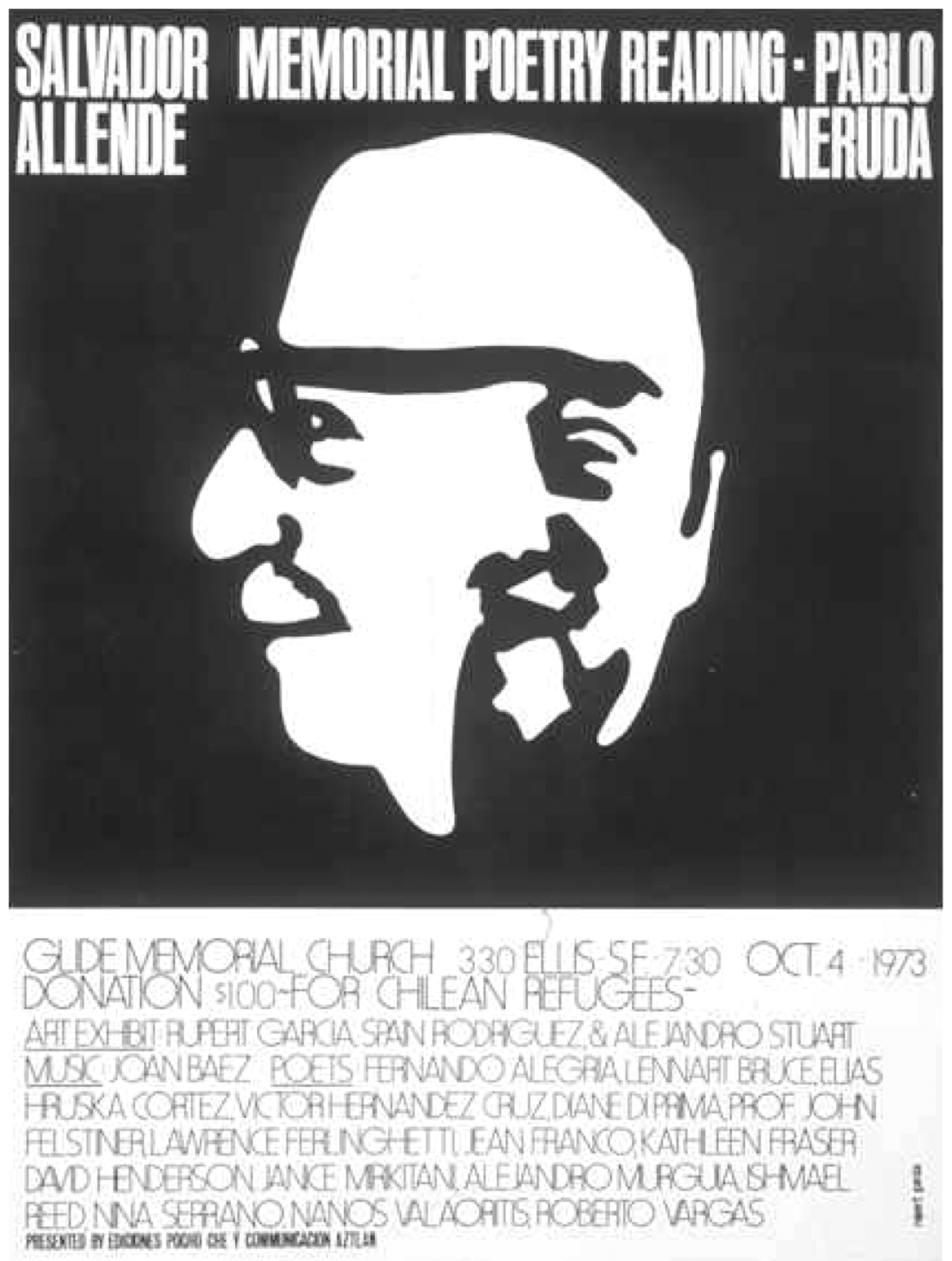
With this creative configuration of protagonists, the TWC reading summoned outrage and channelled the shock that was reverberating throughout communities after the coup. Opening up the event, Fernando Alegría read his fabled ‘Viva Chile mierda’, perhaps one of the most popular poems of the Chilean revolution. Working from his own poetic tradition, Alegría drew directly from the Nerudian poetic tradition to craft an international panorama that served as a backdrop for the larger event. Specifically, he opened up a very contoured internationalism through a literary technique I will call the ‘contoured sweep’, modelled after Neruda’s epic poem, ‘Canto General’ (General Song).
With his remarks, Alegría brought this Chile into the space of Glide Memorial Church – conjuring the living spirit of revolution that dwells both in the minute spaces of daily worker struggle and in the grand topographic view of Chile’s dramatic landscape. He prefaced his poem in a particularly Nerudian fashion, stating that: [T]he back of the Chilean people has not been broken. The hearts of both Allende and Neruda go on beating with the force of indignation and the will to bring back to us justice and liberty. Beating, beating, beating, like an angry fist, on the nitrate pampas, on the copper mines, on the white Andes, on the black coalmines. Beating, beating, beating, like the fists of the workers in jail, like the fists of the students in the national stadium, like the fists of the women in the poblacíones, beating, beating, beating, like the hearts of the executed who refuse to die, red and resplendent like the flame of resistance that will grow again and again …
Alegría’s framing raised key questions of what constituted ‘Chile’ or who might have a direct stake in combatting the coup, revealing the multiple layers of colonisation, imperialism and dispossession leading up to the junta. On this, it is interesting to note that Alegría was the only Chilean who actually read his own work. Importantly, Alegría named multiple histories of oppression that could not easily be contained to one vector of difference or historical relation of ‘class’, as reductionist understandings of the Chilean revolution would have it. By constructing this multi-layered history, Alegría revealed the many sources of energy that would be required for struggle, framing the ‘battle of Chile’ not as a singular nationalist issue; the movement against it would require the strongest, most diverse unity of communities possible.
De-stabilising a reified ‘nationalist’ or ‘identity’ politics, the TWC offered multiple entry points into movement(s) for radical transformation – pathways into myriad identifications with struggle. Here, we see a bridging of the ‘local’ and the ‘global’, another theoretical precursor to transnational feminist analysis. Indeed, poets spoke to the prevailing sentiment that the dichotomy between imperial aggressions ‘here’ and ‘there’ was false. Or, as Nina Serrano put it: ‘the struggle goes on here too. There is suffering, struggle, oppression and a fight right here … Right here in this neighborhood … people [are] being busted, for blocks around’. 13
Jessica Hagedorn read a poem about violent US media portrayal of communities of colour. ‘The Victim Precipitated His Own Death’ acerbically depicted a country hinged upon vast asymmetries – a world in which communities of colour were accused of violence, while the white and wealthy siphoned life from oppressed communities ‘get[ting] hipper by the day/ … [by] copping anthropological myths and musical secrets to solo with in symphony orchestras’. Within this television-saturated world, Hagedorn elaborated, fear, hysteria and racial panic were churned out with regularity, as the caricatures of the welfare queen, the rapist and the illegal ‘alien’ sat around ‘run[ning] out of food stamps’, shooting people and ‘rap[ing] movie stars’. Meanwhile, on the other side of the great divide, ‘proper Americans’ slept, dulled and numbed out ‘in their apartments and freeways and bungalows and ranches and condominiums and waterbeds…’.
With this picture of two interlinked ‘Americas’ bound by parasitic relations, Hagedorn laid bare the exploitative relationship of under/over-development at the heart of North America. On this, the contemporary listener might perceive her vocabulary of struggle to be hyperbolic. Heard anew, however, she beckons a form of clarity that has since been obfuscated by a neoliberal hegemony. Her insights reveal the intrusive nature of exploitation whereby the corporeal and psychic integrity of the colonised is ‘copped’. Against the backdrop of current discourses of post-racialism, post-feminism and post-coloniality, Hagedorn brings to the fore racialised sexual asymmetries that still organise the present. With utmost certainty about her allegiances, the young Hagedorn sides, unabashedly, with the Third World.
Pamela Donnegan brought the crowd to its knees with her riveting ‘Preservation of a Dark Romantic Melody on a Slow Boat to Africa’. The poem followed the narrative of a boat returning to ‘Africa’ as a metaphor for re-claiming a stolen humanity. It began with the piercing question: ‘How does one’s heart find comfort in the metal network of solitary?’ Staring central contradictions of US democracy straight in the face, Donnegan spoke quickly and with force, spinning images of prison bars and slave ships – toxicity and violence juxtaposed against a deep desire to find freedom.
‘Preservation of a Dark Romantic Melody’ challenged the internalisation of US racism within black communities: ‘Our bodies are the soil that make fertile the budding of this metal plant … Our blood is the irrigation that cultivates its vase’. Emphasising the word ‘our’, Donnegan dove straight into a central contradiction of American ‘democracy’: the labour, lives and dehumanisation of black communities that has served to constitute the ‘free world’. Exposing the workings of a nation in which black people were coerced into internalising a system reliant upon their own subjugation, she continued: We are blues people sleeping in a nation naked awakening Blues people sleeping in a nation where blood drips from the lips of liberty Where politicians erect two-handed V’s symbolizing defeat Where the peace sign is accepted at wartime Where the comical stage supports the tragical mass that hides the hideous faces That ride the donkey and elephant across the green dollar pasture called commercial enterprise
Donnegan implicated everybody in her exposé of the mechanisms of white supremacist capitalist patriarchy: political parties (the donkey and the elephant), the ‘green dollar pasture’ of capitalism and even those African Americans who tried to shy away from the struggle. Once again, Donnegan’s words echo powerfully into the present (particularly against our current context of a so-called ‘post-racial’ order), as she issued a particular warning against gatekeepers of racism and imperialism that came under many cloaks.
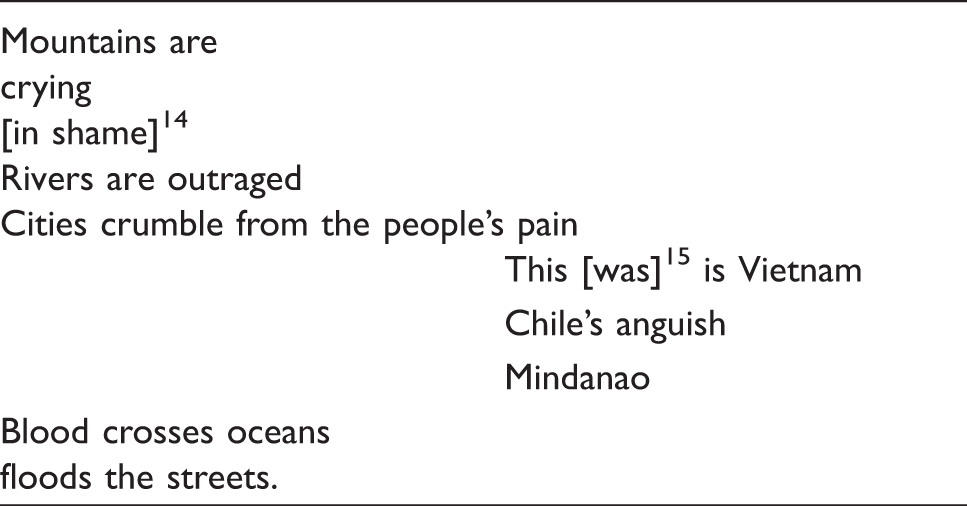
It was precisely this ability to link specific nodes of struggle with a larger panorama of movement building – or what I call a decidedly feminist relational analysis – that animated the brash young poets who took the stage at Glide. Janice Mirikitani’s reading grounded the golpe in a broader campaign of imperial warfare, read through her history with Japanese internment and identification with violence in Vietnam. Striking was the way that Mirikitani enacted this politics of relationality through her engagement with the coup – years before the aforementioned debates about ‘feminist transnationalism’ are currently dated. She juxtaposed ‘Attack the Water’, a poem about hunger, violence, poverty and nuclear attack in Japan with a new poem written for the occasion, ‘Canto a Neruda’ (‘Song for Neruda’). By juxtaposing Vietnam, Japan and Chile, Mirikitani opened up a palimpsestic analysis – a poetics and politics that began in the materiality of the body, to draw structural linkages across heterogeneous and ostensibly disparate sites.
Later published in her collection Awake in the River (1978), ‘Attack the Water’ was itself a work of juxtaposition. Here, Mirikitani recounts her reaction to an older Vietnamese woman’s face during the 1972 US bombing of waterways in Vietnam – an image that immediately brought back Mirikitani’s own memories of her grandmother during the 1945 nuclear attack in Japan. This poem wove together different moments of violence through the visceral experience of hunger. It located US militarism in Vietnam and Japan within a continuum of imperial violence, countering fabrications of World War II as ‘the good war’.
With ‘Canto a Neruda’, Mirikitani added one more layer to this palimpsest of struggle. She constructed a complicated geography of land, water and bodies connected across locales by the pain of war, hunger and violence.
The poem represented a world of rotting flesh, flies and hunger: a city ablaze. Multiple bodies – mountains and rivers – became feeling entities, connected by a common artery of blood that symbolically crossed oceans to unify the body of Third World struggle.
Importantly, Mirikitani did not allow the violence to remain distant or elsewhere.
With the metaphor of the worms of imperialism crawling beneath one’s skin, Mirikitani made visceral the fact that no one was immune from the effects of US propagated violence. Those residing in the United States could not evade their own complicity. While asymmetrically doled out according to a global racial hierarchy of power, everyone’s fate was intertwined. Supporting the people of Chile would therefore not be optional for one’s own political and spiritual survival: it would be imperative.
Other poets spoke to the idiosyncratic ethos of the times, interweaving subject positions now novel in our currently segregated landscape. Laurence Ferlenghetti apologised for not translating his work into English and then proceeded to almost howl, in terrible Spanish (turning French at moments), ‘Neruda está muerto!’ Nancy Fraser stated that Neruda’s work had taught her to appreciate and accept her own body – and then read her own ‘ode to my legs’ modelled after Nerudian verse. Ishmael Reed utilised sarcasm to reveal the political farce organising an imbalance of global power that was, quite literally, absurd, with his characteristically witty poem, ‘Poem Delivered Before Assembly of Colored People’. 16 Greek poets Dinos Siortis and Nanaos Valaortis lent to a much more serious tone by locating the (now often) forgotten history of the Greek coup as a key historical touch-point for thinking about Chile beyond now ossified categories of ‘first’ and ‘third’ world. For the contemporary listener, such contributions remind us of the experimental spirit circulating at the time – a spirit which ensues, but which is now more difficult to discern, as it would be difficult to find such figures working collaboratively today.
The TWC reading therefore forged a sophisticated set of relationships across varying geopolitical terrains and sites of struggle. It far exceeded nationalist trappings and essentialised categories of ‘third world’, ‘woman’ or ‘of colour’ as a heterodox cast of characters came together out of necessity to form a coalition united through a shared affective economy of struggle. In retrospect, this reading opens up a window into an international insurgence of feeling – and one whose articulation represented a much broader ethos of struggle and spirit of resistance that has yet to be fulfilled.
Conclusion: Against the ‘natural order’
In your country/How do you say copper/for my country? (June Jordan, ‘Problems of Translation: Problems of Language’, 1981) Natural order is being restored (June Jordan, ‘From Sea to Shining Sea’, 1985)
In 1985, June Jordan published her watershed anthology Living Room. With poems demystifying US sponsored terror in Chile, Nicaragua, Palestine and Lebanon, Living Room would continue in the tradition of the TWC event, serving as one more emblem of the intimate internationalisms I have theorised above.
In ‘Problems of Translation: Problems of Language’, cited above, Jordan asks what the equivalent of copper – a central symbolic resource for which revolution was waged in Chile – might possibly be in the United States. Sandwiched between ‘From Sea to Shining Sea’, on the Reagan backlash, and Jordan’s now famous ‘Moving Towards Home’ on Palestine, 17 ‘Problems’ indexed the battle of Chile – and the contestations between revolution and empire embedded therein – as a key moment for the global recalibration of capitalist white supremacy.
While the confines of this article do not allow for a reckoning with ongoing forms of US interventionism that continue to permeate our present, by the 1981 inauguration of Reagan, the terrible backlash – or what Jordan dubbed the ‘natural order’ – had officially set in. It would be another ten years before neoliberalism would obfuscate the sharp edges of counter-revolutionary backlash. Racial, gendered and sexual dissidence would be folded into the machinations of multi-cultural pluralism, ‘homo-normativity’ and ‘imperial feminism’ (Agathangelou, Bassichis and Spira, 2008; Melamed, 2011; Ferguson, 2012) and ongoing attacks upon dissenting communities in Chile would be elided under the banners of ‘free-market democracy’ and ‘low intensity war’ (Spira, 2011). All the while, this brazen ethos of rebellion and radical internationalism – the dream of justice with no holds barred – would grow fainter.
However, if Jordan’s work indexes the swiftness with which the ethos of the Glide Memorial poetry reading could be (temporarily) blotted out, it also offers us an invitation to co-create the radical feminist imaginations so direly needed today. Toward these aims, I have attended to the ‘echoes’ of history that ‘reverberate’ in the present, offering ‘fantasies’ of cohesion that engender connections across the divides of geography and history. Here, ‘fantasy’ is not a pejorative term. Rather it grants credence to the psychic workings of the imagination in the crafting of the social. This encourages us to dream, I would add, in the pursuit of a collective historical consciousness today.
Jordan’s work also reminds us of the necessity of the poetic as a crucible for forging such affinities. Audre Lorde famously described the poetic as a vehicle for the culling and expression of pre-formed objects and emerging relations, ‘nameless and formless, about to be birthed, but already felt’ (1984a: 36). For Lorde, the poetic sphere is vital because it allows us to dare imagine freedoms before we can bring them into the tangible word. I thus end with the words of June Jordan and her comrades not as a closing, but as an opening. Turning ‘back’ to re-animate multiple genealogies of anti-racist queer feminist internationalisms, I ask: What fuel might such poetic feminist visions provide for struggle today?

Footnotes
Acknowledgements
I am blessed to be surrounded by a living archive of communities whose quest for justice is ongoing. I extend my deepest thanks to Nina Serrano, Claude Marks, Margaret Randall, Angela Davis, Guillermo Delgado and Steve Volk for kindly sharing their memories with me of the Chilean revolution from the vantage points of the US, Chile and Cuba. I thank Anna Agathangelou, Morgan Bassichis, Keith Feldman, Macarena Gómez-Barris, Emily Hobson, Michael Lazzara, Alison Merz, Dana Olwan, Lisa Rofel, Heather Turcotte, and Kalindi Vora for discussing various drafts of this essay with me. Victoria Hesford and Lisa Diedrich offered their generous support and engagement, and I am grateful for this. Finally, the anonymous peer-reviewers provided excellent critiques and questions that pushed me to sharpen my argument, demonstrating an ethos of feminist collegiality and solidarity that was much appreciated.