




Abstract
Representations of rape and sexual violence abound in Victorian painting, but art historical analysis of this phenomenon has been scarce. This article uses Arthur Hacker’s 1892 painting Syrinx to examine late nineteenth-century approaches and responses to visually representing rape. How did the representation of rape relate to the newly respectable aesthetic category of the artistic nude? Syrinx depicts a standing unclothed young woman attempting to cover her body with reeds, subject matter derived from Book I of Ovid’s Metamorphoses. The painting has been on public display in Manchester Art Gallery since 1893. This article examines how a rape narrative from antiquity was remade as part of the public culture of Victorian Britain, examining the aesthetic, material, literary, legal, medical and museum contexts in which its meanings were produced. It also considers how the representation of rape in this Victorian painting continues to be rethought in Manchester Art Gallery today.
In 1892, Manchester City Art Gallery purchased Arthur Hacker’s painting Syrinx, its first acquisition depicting a nude body since opening to the public nine years previously at its current site on Mosley Street. The painting was shown in the gallery’s annual exhibition, which attracted some 77,000 visitors in four months (‘The City Art Gallery’, 1893: 8). Widely acknowledged as ‘perhaps the most memorable picture of the exhibition’, Syrinx was recommended across the board as an acquisition for the permanent collection (‘Autumn Exhibition’, 1892: 5; ‘Annual Exhibition’, 1892). It was purchased for £400, and in 1893 it went on show permanently, in the free and publicly accessible collections. Today the painting hangs in the far corner of Gallery 8, ‘In Pursuit of Beauty: Late Victorian Art and Design’, accompanied since 2002 by this label: Syrinx was the daughter of a Greek river god. In order to escape rape by the god Pan she was turned into a reed. The moment of her transformation is shown here. Experiencing the girl’s terror can be uncomfortable: she is desperately trying to hide but her body is exposed for the viewer’s pleasure.
But as I explore in this article, it also pits viewers as in some way complicit with the act taking place, positioned as experiencing ‘pleasure’ from Syrinx’s exposed body. The label identifies in the painting an anxiety-inducing tension between bearing witness, aesthetic pleasure and voyeurism. This tension is a crucial part of feminist analyses of the visual and literary culture of sexual violence and rape. Tanya Horeck argues that ‘it is necessary to unlock restrictive debates about whether images of sexualized violence promote “pleasure” or “horror”, in order to explore how contested images of rape bring to light public fantasies of gender, power, ethnicity and class in contemporary culture’ (2004: 154–155). I want to use these ‘public fantasies’ as a starting point from which to consider Syrinx, and to ask how today’s (re-)presentation of the image relates to understandings of and engagements with it in the nineteenth century. The painting, and its public display at Manchester, span self-consciously ‘high’ art, and late nineteenth-century attempts to engage with new mass audiences. How does Syrinx contribute towards the ‘public fantasies’ of gender, power, ethnicity and class? Do its classical connections and art historically-sanctioned nudity guard it against being a ‘contested image’ of rape? And what might such a manoeuvre suggest about canonical classics and art history?
My title invokes the term rape culture, ‘a concept of unknown origin and of uncertain definition; yet it has made its way into everyday vocabulary and is assumed to be commonly understood’ (Williams, 2007: 3783). A rape culture, in its broadest sense, implies a society where the act of rape is prevalent, and does not necessarily refer to artefacts (like Syrinx) that represent rape. The volume Transforming a Rape Culture (Buchwald, Fletcher and Roth, 2005), for example, focuses on rape in contemporary society, presenting culture as human social behaviour, rather than literature, cinema, music or the visual arts. Yet the ways in which representations of rape relate to acts of rape have long been contested. Like Horeck, my focus is on the representation of rape, not necessarily arguing for a causal connection between representations and acts, but analysing why and how rape has become such a significant aspect of public discourse. When the culture of rape is analysed, it is usually the role that rape plays within mass culture, in for example, pornography, television, or cinema. My study offers something different, in its concern with the role that rape plays within what is usually regarded as high culture, and how this is transmitted in public, civic spaces. Joyce Williams notes that the ‘[u]se of the word rape as descriptive of culture suggests a pattern of behaviour created, organized, and transmitted from generation to generation as part of the expectations associated with being male and being female’ (2007: 3784). Rape culture is related to a given social and historical context, but it is also something developed across time. The intergenerational aspect of rape culture, the ways in which it is made, remade and transmitted over time, is particularly pertinent to an analysis of this Victorian painting, which refers to a Roman poem, a poem that consolidates an older Greek myth. Feminist classicists have long acknowledged the numerous, often foundational roles that rape plays in Greek and Roman culture. 2 When redeployed in later culture – as Ovid’s story of Syrinx in Hacker’s painting – these myths can carry a certain gravitas and classical authority, endorsement even, a sense of continuity, that rape is and always will be part of society. These receptions, as Froma Zeitlin puts it, ‘invoke the prestigious authority of their entire culture to try to persuade us of the way things are and always have been’ (1986: 123). Zeitlin, however, is primarily concerned with rape in classical Greek antiquity. Here I explore how one rape narrative from antiquity was remade as part of the culture of Victorian Britain, and continues to be rethought in today’s art gallery.
Scenes of sexual violence abound in the canon of Western art, often coded as ‘seductions’, and in many cases drawn from Ovid. The peculiarity (and potentiality) of painting renders visual representations of rape elusive in a manner quite distinct from their literary counterparts; although it has many modes of reference and appeal across time and cultures, painting can only depict one frozen moment. Mieke Bal has argued that rape cannot be visualised ‘because rape makes the victim invisible’ – in literal, figurative, psychological and social ways. The rapist’s attempt to destroy the victim’s subjectivity makes rape something inner and psychological which cannot be directly represented by an image. Images displace rape, show episodes around it, and regularly depict the suicide of the victim, rape equating to death; all of which apply to Hacker’s Syrinx (Bal, 1991: 68). The displacement of rape in imagery is echoed in the very small number of art historical analyses of rape. These have focussed primarily on painting in medieval and early modern Europe. 3 Lynda Nead (1988) examines the role of images of ‘fallen women’ in constituting sexual mores in Victorian Britain. These are scenes of death, destitution and violent sexuality, certainly connected to rape. But there has been no detailed consideration of scenes dealing with rape in Victorian visual culture. 4 My discussion of Hacker’s painting consists of close visual and contextual readings, using Syrinx as a site through which to examine late nineteenth-century approaches and responses to visually representing rape. I do not want to dissolve the painting into a Victorian social context, in which it might be explained away through 1890s ideas about sexual violence. Rather, I keep to the fore the painterly qualities of this image, and its peculiarly visual means of communicating a sexually vulnerable woman’s body, examining the interconnectedness of painted content and form, and the ability (or failure) of these mutually produced aspects of the painting to sublimate violent content. 5 By keeping an eye on today’s label, I posit that this image, with all its Victorian visual and cultural specificities, is also part of a contemporary culture of representing and visualising sexual violence.
The sexual/textual relations of Hacker’s Syrinx
Rape appears in Ovid as a tool, a prop, a metaphor, as it did more widely in Roman culture (Richlin, 1992: 161). Ovid uses rape scenes for titillation, and brings out their visual effect. In another example from Metamorphoses Book I, Ovid freezes the new poses that Daphne makes as she runs away from Apollo, and comments on the increased ‘grace’ of her body in flight (Ovid, 1998: 16). But the Metamorphoses also emphasises the psychological impact of rape. Each transformation is a further violence enacted upon a woman’s body. Metamorphosis silences: Syrinx lives on as a reed unable to communicate with her human family, while Io (turned into a cow) pathetically moos and frightens herself (Richlin, 1992: 162–165). Hacker’s painting arguably maintains some of the ambiguities of Ovid’s pleasure in violence. Hacker seems to have been peculiarly interested in the works of the Roman poet. In 1890 he had used the same woman as a model for Daphne, another Ovidian story of a woman fleeing rape and transforming into a plant. Both depict the figure alone, with the perpetrator’s presence acknowledged only by the metamorphosis the women are undertaking. Ovid had a rather dubious literary reputation in nineteenth-century Britain (Vance, 1990). It may be that Hacker was interested in gaining the artistic cachet of engaging with Ovid, setting himself alongside sixteenth-century Venetian painter Titian’s canonical canvases based on the Metamorphoses. And in perpetuating and remaking this painterly tradition, Hacker was continuing the artistic preoccupation with episodes that depict bodily transformation after an attempted rape.
There are many more violent images in the history of art, in terms of both composition and facture. Syrinx, however, is a helpful nexus precisely because the painting is so readily absorbed into the institutionally sanctioned safety of both classical mythological painting and the academic tradition of the nude. The narrative of a progressive unshackling from constraint in the late nineteenth century is regularly expounded in writing on the art historical category of the (predominantly) female nude. Late Victorian art writers were keen to champion the increasing artistic freedom from ‘prudery’. But at the same time, social purity movements of the 1880s vehemently protested against nudity in art (Smith, 1996: 216–239). Twentieth-century feminist art historians have emphasised that the category of the artistic nude has a history that is formed through art criticism and institutions like museums, galleries and art schools (Nead, 1992: 43–46). The new sexual freedoms to paint and exhibit women’s bodies were liberating for some men and women, but they perpetuated and developed new modes of repression for others. The ability to paint and exhibit images of unclothed female bodies, and to merge an image of attempted rape into an acceptable and passive nude, is far more complex than a simple, single triumphant narrative of increasing sexual openness.
A single-figure, narrow rectangular canvas nearly 2 metres tall, Syrinx is one of many late nineteenth-century academic standing nudes. These images proliferated in Royal Academy exhibitions from the late 1860s. They were supposedly devoid of content (or at least lacked a connection to a specific narrative), and were understood by some to encourage a purely aesthetic form of viewing (Smith, 1996: 113–115). But I argue that the narrative of the attempted rape of Syrinx is crucial to the painting’s composition and facture, and that this is more than an empty invocation of a classical narrative as a safe excuse to paint a nude. Indeed, Syrinx’s nudity is Hacker’s innovation – in Ovid she is described as fully clothed. Syrinx is a little larger than life size. She stands still in contrapposto, with most of her weight on her left leg, throwing up her left hip and shoulders, and putting a twist into her torso (Figure 1). As a result, she seems to turn slightly away from the viewer. Her feet are submerged to just above the toes in clear, reflecting shallow water. This is not an image of a woman fleeing, but one beginning to literally take root in the river bed, as her transformation into a reed begins. The ripples diffusing from her toes imply that she has just stepped on to the scene, finally escaping Pan’s pursuit. Her knees cross a little more than is usual in contrapposto, suggesting an attempt to conceal her genitals. But as is usual in representations of women’s bodies from classical Greek antiquity until the nineteenth century, her genitalia are already effectively concealed, or at least replaced, by a smooth pubic mound. Through countless artistic reworkings and art historical writings, this violence done to the female body becomes an artistic convention with grand connections to the art of classical antiquity (Salomon, 1996).
Arthur Hacker, Syrinx (1892), oil on canvas, 193.4 × 61.4 cm. © Manchester City Galleries.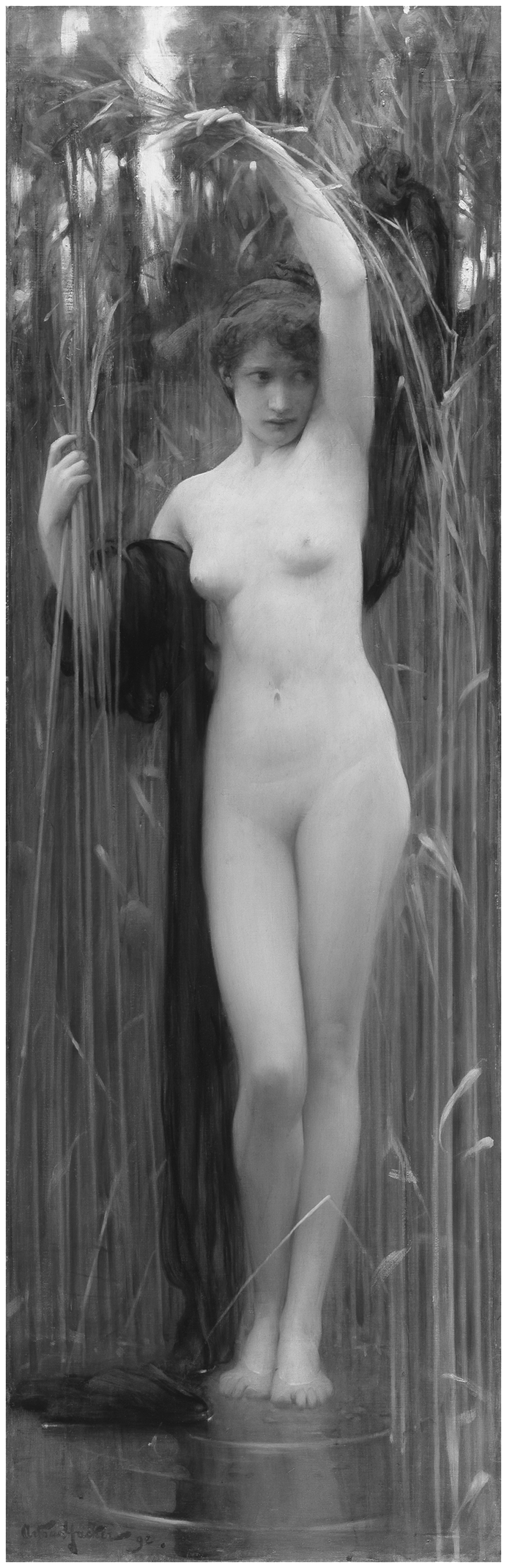
Unlike the classically derived Venus Pudica sculpture-type, Syrinx makes no attempt to conceal/draw attention to her pubic area with her hands. Instead, her arms are stretched out above, grasping at reeds in an attempt to cover herself. This, of course, serves the opposite purpose, providing the viewer with full frontal access to her body. The figure offered for the viewer’s scrutiny and aesthetic pleasure is trying to hide from their gaze. In this active gesture, Syrinx disrupts the tacit agreement made between viewers and the nude: this is a nude that does not want to be seen. Syrinx’s eyes are averted from the viewer, a convention in female nudes, rendering passive the person in the canvas. This supposed passivity has already been challenged by Syrinx’s active attempt to conceal herself. And there is more to her eyes. They are exaggeratedly large and opened wide, a sign of fear according to contemporary ideas about the human physiology of expression and emotion. Victorian artists were well acquainted with these ideas, thanks to Charles Bell’s 1844 The Anatomy and Philosophy of Expression as Connected with the Fine Arts. 6 Bell’s discussion of the expression of fear suggests further classical imbrications, as well as associations between sexual violence and the bodily display of fear. It opens with Ovid’s description of the rape of the Sabine women in the Ars Amatoria, and goes on to characterise the state of fear in terms that look very similar to Hacker’s painting: ‘The breath is drawn and the respiration suspended; the body fixed, and powerless; the eyes riveted, or searching and unsteady; and the action undetermined’ (Bell, 1844: 163). Sexual violence, fear and Ovid are all bound together in this handbook for artists. The black drape that cascades from the top right hand side of the painting, along her arms and down the right side of her body, and finally dipping into the water by her feet, emphasises both her pallid flesh and its lack of clothing. Along with the ripples in the water, and Syrinx’s large frightened eyes, it offers a sense of urgency and movement, while Syrinx herself remains ‘fixed, and powerless’. The story of Syrinx, and the sexual violence and threat that it bears are integral to the painting.
This account of the painting can be developed further by considering its textual context. As Bal has argued, also in relation to an image depicting rape, the relationship between literary text and painted object is not a one-way process, with text as source, painting as secondary layer, but a matter of ‘intricate interaction’ between the two (1991: 65). Contemporary viewers were invited to relate Syrinx not to Ovid, but to another more recent text, the 1884 poem ‘Silenus’ by Pre-Raphaelite sculptor Thomas Woolner. Manchester City Art Gallery catalogues quoted lines from the poem, and critics identified the painting’s narrative debt to Woolner (Stanfield, 1903: 19; ‘Annual Exhibition’, 1892). Woolner shifts the focus away from Syrinx and her experience, to the impact of her attempted rape and subsequent transformation on Silenus, who is newly paired as Syrinx’s lover in the poem. Pan attacks Syrinx while Silenus is in India, ‘taming savage tribes and winning them to till and cultivate the earth’ (‘Woolner’s Silenus’, 1884: 165). After Syrinx’s metamorphosis, Silenus descends into drunkenness, and abandons his ‘civilising’ duties. Criticism and praise for ‘Silenus’ hinged on what reviewers identified as its attempts to make classical myth relevant to contemporary society and politics, especially to temperance movements and imperial governance.
Contemporary reviews in both specialist art journals and the mainstream press did not comment on the social or moral aspects of the painting’s subject matter, even though it was displayed in a gallery that had grown out of a combination of a middle-class civic culture and philanthropic attempts to ethically and aesthetically better Manchester’s urban poor (Woodson-Boulton, 2012: 42–52). The art critics’ reviews evaluated the painting almost exclusively in terms of the aesthetic pleasure that its colour, paintwork and composition might bring to the viewer. They dwelt on the ‘consummately skilful’ application of paint; the ‘subtle beauty of line and arrangement’ (Phillips, 1892a: 451; Phillips, 1892b: 192). Hacker is celebrated for his ‘charming colour harmony of blacks and darkest blues and ashen yellows’, or criticised for creating a vision ‘devoid of rose-colour and greys’ (‘Autumn Exhibition’, 1892: 5; ‘Royal Academy’, 1892a: 639). The painting was widely praised as ‘the perfection of refinement in the nude’; in 1895 the editor of a widely circulated art establishment journal, the Magazine of Art, defined it as ‘one of the only good nudes in the Academy’ (Postlethwaite, 1894: 113; Spielmann, 1892: 253). Critics further distanced Syrinx from its violent subject matter by situating the painting in an art historical context, relating it to another purportedly subject-less nude, La Source (1820–1856), by French painter J.A.D. Ingres.
Art critics working for newspapers and journals in the later nineteenth century are usually regarded as being concerned primarily with explaining the subject matter of paintings to new mass audiences concerned with narrative, not aesthetics (Flint, 2000: 169). The reviews that deal with Syrinx, however, do not explicitly explain her story. The figure’s fearful eyes and attempts to cover her body go ignored or unnoticed, her story mentioned only obliquely through quotations of Woolner’s poem. The same reviews enter into a little more detail about the content of other images, but they are still not exactly garrulous when it comes to telling stories about paintings. The avoidance of narrative didacticism, and fixation on form, however, is typical of a different sort of later nineteenth-century art writing, associated with the aesthetic (or art-for-art’s-sake) movement which developed in Britain from the late 1860s. It may be that this (very loosely defined) movement had more of an impact on journalistic art writing than is typically acknowledged. Hacker’s paintings were regularly regarded as contributions to aestheticism, and reviews presented him as a painter who enjoyed the difficulty of paint, experimenting with form and colour, and ‘daring essays in painting for its own sake’ (Dixon, 1902: 618; Baldry, 1912: 175, 178). Hacker was situated as a painter preoccupied not only with narrative, but with form and the substance of paint.
Yet for all the critics’ attempts to discuss nothing but form and paint, sex was everywhere beneath the surface of these reviews. Every article emphasises the painting’s ‘modesty, simplicity’, its ‘absolute purity’, ‘a more chaste work generally can hardly be conceived’; Syrinx is a ‘pure, sweet nymph’ (Jope-Slade, 1895: 177; ‘Royal Academy’, 1892b: 2; ‘Annual Exhibition’, 1892; Spielmann, 1892: 253). The boundaries of acceptable imagery required constant reinforcing and policing, and literally so in the case of Syrinx. 7 Shortly after Manchester purchased the painting, Hacker signed a lucrative deal with the Fine Arts Society to have the painting engraved so that it could be reproduced in magazines and prints (‘Art Gallery Committee Minutes’, 1892: 101). In 1894, one of these reproductions was among the six prints removed by police from the window of a print shop in Glasgow, and deemed ‘unfit for public inspection’ by the city’s Chief Constable (Spielmann, 1894). 8 On 3 April 1913 the painting was one of thirteen in Manchester City Art Gallery that came under the hammer of Suffragettes protesting the incarceration of Emmeline Pankhurst. 9 In each instance, protestors targeted Syrinx in response to either the painting’s nudity or its depiction of a passive female beauty, rather than its violent narrative – although, as I have argued, the two are not readily separated. 10 The discomfort that Syrinx evidently incited in some social campaigners does not appear in the official archive, in the minutes of the Art Gallery Committee, or in the Art Gallery Curator’s Letter Book. But these experiences and engagements are part of the painting’s story, and illustrate that its reception is far from a straightforward matter of subsuming the nudity and violence and threat into an art establishment image. Not all viewing in the late nineteenth century was detached and ‘aesthetic’.
The painted matter of rape
Hacker was painting after a period of peculiarly intense art-critical attention to the ways in which the physical stuff of paint might both create meaning and mediate experience of artworks (Peters Corbett, 2004: 83–127). In looking more closely at the painting’s facture, I want to question how the material matter of paint relates to the subject of rape. Hacker is not a particularly well known painter today and, beyond a handful of catalogue entries and auction lots, this is the first article to deal with his oeuvre since his obituaries in 1919 (Christian, 1989: 125; Smith, 2001: 221). For all that his paintings might initially appear to cling to classical mythology, the Paris-trained Hacker stood somewhat apart from academic British art circles in the 1880s. 11 He was a founding member of the New English Art Club in 1886, an exhibiting society that presented itself as an alternative to the Royal Academy, and which art historians today associate with Impressionism and figures in British modernism like Walter Sickert (McConkey, 2006). Contemporaries observed a dramatic variety across his work, in terms of both subject matter and technique, from 1880s realist scenes of peasant life, 1890s nudes and mythological, symbolist works, to early twentieth-century quasi-impressionist scenes of London fog (Baldry, 1912). This openness and variety certainly connects him closely to his training with the French painter Leon Bonnat, whose work and teaching practices are similarly characterised for their variety, straddling both academic and radical tendencies (Weinberg, 1991: 156–166).
The differences between Hacker’s technique and that of contemporary British academic painters are readily apparent in Manchester, where Syrinx has long been displayed in close proximity to Captive Andromache (c.1888), a large multi-figured canvas by Frederic Lord Leighton, President of the Royal Academy from 1878 to 1896. Leighton’s figures are crisp and hard edged, with brushstrokes meticulously painted out to form what art historians refer to as a licked surface. This characteristic gloss of (some) academic art can be understood in the nineteenth century as ‘an estrangement, an alienation, not only from the reality that is represented, but from the reality of art’, an attempt to hide the messy business of painting which both diverts from and draws attention towards the ‘reality’ of what is represented (Rosen and Zerner, 1984: 221–229). Syrinx’s body is not contained in the safe licked surface of the academic nude, nor is it bordered with a sharp finished outline. A loose streak of pink flesh paint peels away from her left buttock, Syrinx’s painted body dissolving into the reeds around her as the physical form of the painting starts to tell its story. Paint here is both narrative and substance. Even the most aesthetic reading of the painting, concentrating on the harmony of colours and brushstrokes, is implicated in its threatening narrative.
The reeds in particular in Hacker’s painting seem to have come from a different order of representation to that of Captive Andromache. They are laid on thickly, sometimes with one brushstroke, thinning out from the bottom of the canvas to the top, as the paint transfers from brush to canvas: wet at the watery foot of the picture, dry and crackling under the sun at its top. With thick blobs of oil left to stand, they offer a sense of haste, a swaying movement that contrasts with the growing rootedness of the figure of Syrinx. Brushstrokes are more closely painted on Syrinx’s body, but are still visible, with different colour tones left layered, to be blended by the viewer’s eye, not the painter. This arguably throws the work of assembling the image back on the viewer, albeit in a less obvious and perhaps less challenging way than might be suggested by a pointillist or impressionist image. A certain self-awareness in the viewer might emerge, then, from both facture and composition. 12 The work of physically composing Syrinx’s body is down to us, and as we compose that body, we might realise that it is trying to hide from our gaze. We are both drawn closer to the subject matter and distanced from it; the persistent globs of oil a reminder that we are looking at the material facts of paint.
Hacker was celebrated for his use of colour and manipulation of light and shade. The art critic Alfred Baldry attributed Hacker’s interest in colour to his travels to Algeria and Morocco in the 1880s. For Baldry, this transformed ‘the quality of his colour and tone. His canvases became more luminous, more delicate, and more subtly harmonised’. Algeria and Morocco are not characterised as equal players in this exchange; they are described as being ‘beyond the boundaries of European civilisation’, their ‘natural’, uncivilised qualities only truly harnessed once transformed by a British painter (Baldry, 1912: 176). Hacker’s use of colour takes his paintings beyond European boundaries and implicates them in wider power relations – perhaps even dangerously so. As Jordanna Bailkin (2005) and Natasha Eaton (2012) have explored, in the nineteenth century, pigment had radical potential, its modes of production contested in relation to debates around gender, race, class and imperialism.
Contemporary critics fixated on Syrinx’s peculiar whiteness; ‘pallid’, ‘defective morbidezza’, ‘anaemic quality in the flesh’ (Phillips, 1892a: 451; ‘Royal Academy’, 1892a: 639; ‘Royal Academy’, 1892b: 2). Her bodily pallor troubles the ‘absolute purity’ of the painting that critics identified and emphasised (‘Royal Academy’, 1892b: 2). The associations made between her body and deathly decay are remarkably similar to late nineteenth-century French art-critical descriptions of paintings depicting, conceptualising and homogenising the body of ‘the prostitute’. In these accounts, anxieties centre around excessive – or abnormal – paint colouration as a matter of effeminacy on the part of the male artist, and connect colour to a lack of hygiene, and to social and racial degeneration (Callen, 1993). But as an image of a ‘Greek’ body, Syrinx’s whiteness might also be read as a sign of her purity, in nineteenth-century terms. Nineteenth-century representations of the ‘Greek’ body were particularly concerned with enforcing its pallor, in both sculpture and painting. This whiteness in colour is closely implicated in nineteenth-century racial thinking (Nelson, 2007). Black women appear in nineteenth-century visual culture almost exclusively to connote sexual availability and licentiousness (Gilman, 1985). Images of rape are produced out of, and contribute to, discourses of race and class as much as gender. In this context, the whiter Syrinx’s skin, the less she can be connected with sex and so the purer and more chaste she becomes. The hyper-white Syrinx may serve to reinforce – and even create – the vision of the ‘ideal’ ‘victim’ of attempted rape. But at the same time, her body’s extreme pallor renders it suspect. The image teeters on the borders of the realm of classical antiquity, where whiteness symbolises virtue, and everyday life, where a deathly pale body suggests unhealthiness, immorality, prostitution.
Rape, race, class and sexual morality do not explicitly feature in contemporary reviews of the painting. But they lie below the surface of these texts, and on the surface of the image, embedded in the discourses surrounding the physical stuff of its paint. The diffusion and neglect of the rape narrative marks critical responses to Syrinx. In this it has parallels with the tendency that Lynn Higgins and Brenda Silver identified in their foundational volume on rape and representation: rape is both present and vanishing from literary texts (1991: 3). It chimes too with Bal’s theorisation of the difficulty of accessing the semiotic of rape ‘because of the nature of the act, as well as the cultural attitude toward the act’ (1991: 61). But Syrinx was also part of an artistic experiment that sought to divorce subject matter from visual form. A scene of a woman fleeing sexual violence might seem to test, to its extreme, an ‘aesthetic’ focus on form and beauty, and lack of interest in morality. 13 Representations of the raped woman’s body are regularly understood – and explained away by critics – to stand in for something else, signifying, for example, the loss of social order. She is a mere figure, not the prime meaning of the text. Drawing on W.T.J. Mitchell’s argument that representation is a form of agreement, Horeck, however, interrogates this socially produced ‘agreement’ by which ‘a fantasy of the raped woman [is] made to stand in for the act of semiotic and political representation’ (2004: 47). Syrinx occupies a rather different territory to the texts that Horeck analyses. For Syrinx’s body – as critical responses to it suggest – makes its nineteenth-century meanings by referring back to itself and its own painted surface, rather than explicitly outwards towards any larger more obvious political and social themes.
The law and the aesthetics of violence
The Victorian men and women looking at Syrinx would probably not have had a particularly clear sense of the legal definitions of rape and indecent assault. Carolyn Conley cites one Justice William Brett explaining to a jury in 1875 that ‘I cannot lay down the law as to what is or is not indecent beyond saying that it is what all right-minded men, men of sound or wholesome feelings would say was indecent’ (1986: 523). His statement clarifies little legally, but demonstrates the fundamental significance of social and cultural ideas about ‘decency’ in prosecuting cases involving sexual violence. Later nineteenth-century newspapers related rape trials in a coded, desexualised manner, the term rape often replaced with ambiguous and multi-referential words such as ‘outrage’ or ‘ravishment’, the acts that had taken place usually described as ‘too disgusting’ to relate (Stevenson, 2007: 411–414). The Old Bailey had stopped publishing court transcripts of trials involving sexual offences in 1791, for fear that they might promote immorality or be offensive to public decency. As Kim Stevenson (2007) argues, this public silence and censorship of language prevented survivors of rape from publicly articulating their own experiences, and further perpetuated general confusion about what exactly constituted rape.
In a context of muted discussion about sexual violence, the public display of Syrinx is noteworthy. The painting, for all its harmonious colours, represents (for those familiar with its story) the mental and physical anguish of a woman fleeing rape, a remarkable focus on the individual at a time when political and judicial discussions of sexual violence were more concerned with the moral dangers for society at large than the wrongs inflicted on a particular person (Stevenson, 2000: 97). A cultural artefact like Syrinx, with all its layers of paint, art historical resonances and classical references, might, for some of those who looked at it in 1890s Manchester, have had some role to play in formulating understandings of what sexual violence looked like, especially given the imprecision of public discourses surrounding rape at the time.
Syrinx wills for bodily transformation to avoid rape. A visual representation of an episode of metamorphosis is peculiarly fitting to what Joanna Bourke has identified as a nineteenth-century tendency to focus on the impact of rape on the body, rather than the mind (2007: 426). Hacker’s painting does represent Syrinx in a state of fear, and arguably gives some weight to the psychological impact of rape. But it is also possible to trace similarities between Syrinx, transformed into a senseless reed, and the descriptions of survivors of sexual violence in the press as ‘insensible’, ‘motionless’, ‘speechless’, having ‘fainted’ (‘Singular Charge’, 1877: 4; ‘Police’, 1890: 10; ‘Bickley Outrage’, 1892: 5; ‘Assizes’, 1896: 16; Jones, 2000: 113). Although not direct references to Ovid, these too suggest that the raped woman’s body is silenced and inanimate. Syrinx’s transformation is, of course, death. In terms of nineteenth-century medico-legal beliefs about what constituted rape, Syrinx’s flight and preference for death is appropriate behaviour on the part of a ‘genuine’ victim. As the American gynaecologist Horatio Storer stated in an article on ‘The Law of Rape’, ‘[t]o all high-minded and pure women, death is preferable to dishonour’ (1868: 62). In 1894, the textbook Medical Jurisprudence, Forensic Medicine and Toxicology conclusively stated that ‘a fully matured woman, in full possession of her faculties, cannot be raped, contrary to her desires, by a single man’ (Bourke, 2007: 25). A woman actively attempting to escape constituted one of the few unambiguous ‘real’ victims in nineteenth-century medico-legal discourse. These medical and legal definitions were adapted and expanded upon in the popular press. Joanne Jones’ analysis of sexual violence in late nineteenth-century Manchester newspapers is particularly apposite here. These middle-class publications focus on the disorder of working-class life, and caution the sexual dangers inherent for women who move beyond prescribed domestic spaces (Jones, 2000). In visiting a newly sanctioned respectable public space, Manchester City Art Gallery, the same readers might come into contact with a high cultural artefact showing a woman who was, in nineteenth-century terms, in some way to blame for being attacked by roving the countryside alone, but who also demonstrated appropriate behaviour in her attempt to flee.
The 1885 Criminal Law Amendment Act raised the age of consent from thirteen to sixteen. The bill took four years to pass, delayed by extensive debate over how best to protect men from malicious accusations by girls. Stevenson describes this preoccupation with predatory women as ‘mythological’, an intriguing adjective in the context of this case study (2000: 100). At Manchester City Art Gallery, paintings set in the mythological realm of the classical past allowed a new viewing public to form and reiterate ideas about the dangers of female sexual predators. In 1896, Manchester purchased a large canvas populated by a cast of young female seductresses. John William Waterhouse’s Hylas and the Nymphs is based on an episode in the third-century BCE Greek poet Theocritus’ Idylls. It depicts the fatal seduction of Hylas by seven naked nymphs, who lure him into a pool where he drowns, and occupies a space in the late Victorian visual world of femmes fatales luring men to their deaths (Kestner, 1989: 296–300). But it is also a painting that deals with questions of desire, and as Simon Goldhill has suggested, ‘the tension between its delicate winsomeness and its narrative of seduction or seizure is like an extended gloss on the word “ravishing”: rape or ecstasy, dangerous lack of control or sweet abandonment?’ (2011: 55). It is both sexually transgressive and equivocal about where that transgression lies. Hylas himself is not exactly a normative masculine Victorian role model. Anyone who knew their Theocritus (not uncommon for educated male Victorians), might also recall that Hylas was Hercules’ ‘beloved’, a sexually ambiguous figure. It could even be argued that for 1890s viewers, seduction by nymphs is less a horror story and more a return to the ‘proper’ heterosexual order of things.
Hylas and the Nymphs and Syrinx have been displayed in close proximity to each other intermittently since the 1890s, and the ‘implications of relation’ (Baxandall, 1991: 34) suggested by this juxtaposition of classical mythological scenes are noteworthy. Might Hylas and the Nymphs’s narrative of female seduction, and its desiring ‘victim’ re-focus viewers’ attention? Was Syrinx also a coy seductress? She was certainly deemed so in a selection of poems on the Pan and Syrinx story from the late nineteenth-century periodical press, where ‘Cruel, cruel, cruel, Syrinx’ is to blame for the violence enacted against her, and Pan is figured as ‘miserable victim of unrequited love’ (Mathew, 1877: 282). 14 Hacker’s painting is less decisive. Official art gallery publications from the early 1900s do not blame Syrinx, but they lessen the violence of the image by describing her in euphemistic terms as ‘beloved of the Shepherd god Pan’ and as fleeing his ‘amorous pursuit’ (Stanfield, 1903: 19; Phythian, 1910: 50). Violence continued to be sidestepped through the twentieth century. The tone of the label in place from 1990–8 used the ambiguous language that one might more readily associate with newspaper reports and judicial processes from the nineteenth century. 15 Here Syrinx flees to avoid ‘the prospect of being ravished’, while the description of her as a ‘coquette’ suggests a certain flirtatiousness and willingness – perhaps even shifting the responsibility for her flight and transformation back on to Syrinx, and not Pan.
In pursuit of beauty
The label for Syrinx with which I opened has been in place since 2002, and offers a very different approach, making an important acknowledgement of its responsibility towards today’s viewers. Museum labelling is a challenging, often restrictive mode of communication. The label is only one part of the relationship between an object, its maker and its audience, but it is a crucial site for negotiating and producing meaning (Baxandall, 1991). I certainly do not wish to single out Manchester as a negative case study, but rather to reflect on the possibilities and responsibilities that a civic institution might offer to both audiences and images. 16 Manchester has taken an important step in noting the distressing content of Syrinx. But this label makes no reference to the historical context of the painting. It tells the Greek story, and focuses on the impact that the painting might have on the viewer. But ideas about gender, sex and sexualities in Victorian Britain do not figure anywhere; the same is true for the main information panel in Gallery 8. This notes that ‘[m]any of the paintings here feature a beautiful woman. Sometimes she is a passive, decorative form, but often she is a dark and brooding femme fatale, a symbol of seduction, deception and destruction. The “fatal woman” may reflect late Victorian male fears as women campaigned for equal rights and new roles.’ Victorian images of the femme fatale are explained (cautiously – ‘may reflect’) in relation to their social and political context. Woman as ‘passive, decorative form’ (like Syrinx) is, however, almost naturalised into being an aesthetic bauble. This is remarkable given the large number of painted naked women on display in the gallery. These include scenes of sexual violence and threat in Syrinx and Hylas and the Nymphs, while the painting that currently hangs adjacent to Syrinx, Charles-August Mengin’s brooding Sappho (1877), might also raise issues of same-sex desire.
I do not wish to argue that the gallery should attempt to dissolve its collection into the historical contexts in which it was produced – or that the historical contexts are only of gender and sexualities. These are images whose resonances and potential range of meanings are similarly fluctuating. But a painting like Syrinx can be used to start to question ideas that visitors bring with them regarding Victorian sexualities – and in this case sexual violence – and to put twenty-first-century people into dialogue with the society that produced these objects. How does this Victorian image relate to our own understandings of sexual violence? Once put under scrutiny, today’s all too prevalent ‘rape myths’ are barely distinct from those consolidated in the nineteenth century. 17 The museum can be a place where we question the present as much as the past. What I am suggesting might be understood as nothing more than what Griselda Pollock has described as a necessary, but nonetheless ‘cosmetic correction’ (2007: 10); but it is a correction that might open up this image to audiences in a manner that attempts to be sensitive, historically committed and aesthetically engaging. I would like to see more questions asked of Syrinx: a label that tells her story, but reminds us that this is only Syrinx’s story as told by a male Roman poet, as interpreted by a late Victorian male painter, via another late Victorian male poet; a provocation that makes viewers think about the relationship between the visual culture of then and now, and how this image relates to contemporary representations – and silences – around sexual violence.
I have located Hacker’s Syrinx in late Victorian legal, medical and cultural contexts of discourses around rape, and as a link in the chain of receptions between us, the Victorians and classical antiquity. The interplay between classical and contemporary twenty-first-century culture, through these intermediary moments of reception may also serve to further evacuate – or to emphasise – the violence of ancient representations. It seems grimly appropriate that today Syrinx, an image of a woman fleeing rape, hangs in a gallery titled ‘In Pursuit of Beauty’. The gallery name, of course, refers to late nineteenth-century ‘aestheticism’ rather than the subject matter of the paintings that hang in the gallery. But, as I have argued, an aesthetic style and violent content are not necessarily at odds.
Footnotes
Acknowledgement
The author would like to thank Ella Dzelzainis, Stacy Gillis and Emma Short for their insightful editorial work, Hannah Williamson at Manchester Art Gallery for her generous assistance in the archives, and Claire Jones, Alex Wardrop and Rhiannon Williams for thoughtful and encouraging discussions and comments on the article. This article was written while the author was a postdoc on a European Research Council funded project, and the author acknowledge their support under the European Union’s Seventh Framework Programme (FP7/2007-2013)/ERC Grant Agreement n.295463.