




Abstract
The article engages with feminist care theories and practices of community building in the context of armed conflict. Based on an ethnographic study (2016–2018) of the security concerns of Israeli citizens living in the Gaza Envelope and their positions regarding the siege on Gaza, we find that in this region, vernacular security is closely linked with care, social reproduction and communitarianism. Communitarian ethics is intertwined with separatist, state-centred discourses on national ‘trauma and resilience’. In this context, Jewish-Israeli women care for their own communities as a way to ensure survival and civilian resilience. They generally disengage from moral dilemmas concerning the suffering of Palestinians. On a deeper level, the practice of security as care combines the hegemonic Israeli security paradigm of women’s soldierhood with an institutional and cultural obsession with trauma-oriented activities. Showing strong ethno-nationalist identifications, these women tend to overlook and even support the state’s violent siege on Gaza, which is seen as a zero-sum game. We conclude that the gendered dimensions of communitarian ethics in Israel are relevant for understanding the limitations and challenges of contemporary cosmopolitan feminism and a global politics of care.
Introduction
As a philosophical tradition, feminist care ethics is a specific way to imagine alternative social and political orders. In this tradition, ‘care’ signifies a moral perspective that views human beings as relational and interdependent and emphasises future-oriented responsibility as a starting point for individual action and national or global policy (Engster, 2007; Tronto, 2013; Held, [1995] 2018). The underlying, ontological and universal assumption often associated with the term is that: ‘all people are vulnerable, dependent and finite, and that we all have to find ways of dealing with this in our daily existence and in the values, which guide our individual and collective behavior’ (Sevenhuijsen, 1998: 28, cited in Hankivsky, 2014: 253).
The terms ‘care ethics’ and ‘care as a practice’ first emerged in Western feminist scholarship in the 1980s (Gilligan, 1982), and since then have become fundamental concepts in feminist theory and moral philosophy. Sara Ruddick (1989) influentially argued that care work, which is often an invisible and undervalued form of labour performed by women, is an essential part of politics because it is necessary for sustaining and reproducing individual and community life. The idea of care as an everyday practice and moral orientation has expanded far beyond the family and gradually entered political theory. In her book The Ethics of Care: A Feminist Approach to Human Security, for example, Fiona Robinson (2011) argues that from an international perspective, efforts to enhance human security must recognise the importance of networks of responsibility and care in determining people’s everyday experiences of security and insecurity. Consequently, the global ethics of care as a moral theory became a critical tool to assess the growing interdependency and relationships between states, corporations, NGOs and individuals and to explore how they are structured by patterns of power (Greenswag, 2017). Recent feminist International Relations (IR) scholars even suggest that this take on care ethics should be adopted as a normative standpoint in foreign policy to encourage empathetic cooperation and responsibility towards distant others (Bergman-Rosamond and Phythian, 2012; Aggestam et al., 2019).
However, the application of care as a moral standpoint in feminist security studies still requires further theoretical elaboration. Indeed, feminist IR scholars have challenged mainstream accounts on security policies by paying close attention to their impact on people’s everyday lives and by ‘telling security narratives from the ground up and thereby adopting a bottom-up approach’ (Wibben, 2011: 21). While we follow this tradition of listening to women’s security narratives, we argue that the uncritical inclination to assume that care ethics is a universal moral ideal could be mistaken. In certain contexts, care, as an everyday practice, still operates as an epicentre of exclusionary national and communitarian constellations and is one of the major social mechanisms that distinguishes insiders from outsiders.
We draw on ethnographic research from 2016–2018 in communities along the southern border of the Gaza Strip – often called the Gaza Envelope – who have been living under constant rocket attacks for more than a decade, to present ordinary Jewish Israelis’ perceptions of security (hereafter Jewish-Israeli vernacular security), with a focus on women. One of our main findings is that contrary to certain assumptions about the transformative power of care, the Israeli case illustrates how militarisation, siege and fortification (as an extension of occupation) amplify communitarian care practices and may therefore, albeit indirectly, contribute to moral disengagement from the suffering of ‘distant’ others (in this case, Palestinians). Local residents, we show, are intensely preoccupied with their own trauma and resilience and are passionately engaged in caring for their families, their communities and for soldiers stationed nearby. Consequently, we argue that these acts of communal care and the disengagements from the suffering of distant others are an integral part of a local social-cultural repertoire of ‘vernacular security’ (Jarvis, 2018). We use the term ‘vernacular security’ to stress that ‘security’ is not a fixed, predetermined or consistent analytical category, but an embedded, socially situated and discursively defined practice which is open to comparison and political contextualisation (Bubandt, 2005).
By focusing on the co-constitution of security, communal care and resilience, we move away from essentialist claims about women’s natural tendency to care (Brennan, 2010) and join the second generation of care theorists. This approach ties care with differential access to citizenship rights, including the right to welfare, health services or education; and with the ability of certain individuals to gain state protection by police or military forces. These care theories also explore the role of care labour in communal social reproduction, namely, in the ability of certain communities (including indigenous, racial or ethnic groups) to survive and flourish over time. By focusing on care practices, as they are described by Israeli women and men who have been living near a volatile border – enjoying the protection of a heavily militarised state but still feeling acutely vulnerable – we seek to advance a situated and context-specific analysis of how ethical aspects of security are understood at the local or communal level. As such, the ethnographic approach adopted in this study offers a corrective to the tendency to ‘speak for, rather than to (or, perhaps better, with) “ordinary” people and the conditions of (in)security they experience, encounter or construct in everyday life’ (Jarvis and Lister, 2013: 158).
We find that this communitarian care ethic does not necessarily enhance women’s sensitivities to the suffering of Palestinian civilians under siege merely a few kilometres from their homes. In fact, it mostly engenders apathy towards the latter’s plight and a discourse of a zero-sum game, by which they are the victims of Palestinian aggression. We show that although communitarian ethics is encouraged by top-down national ‘resilience and trauma’ ideologies and policies, most Jewish-Israeli women share a sense of ownership and identification with the political implications of this position. Namely, we found that local residents openly describe their daily practices of care as part of a collective and communal effort to maintain resilience amidst the ongoing conflict. We read these narratives and activities as a manifestation of what Veena Das (2012) calls ‘ordinary ethics’. This ethical position ties care with security through a set of normative ideas that are created within the flux of collective life and not in separate and remote spaces (legislative bodies, judiciaries, academia). As we show later on, these normative ideas, which are embedded in authentic caring activities and emotional responses to crisis, are part of national and communitarians notions of ‘security’ and are not understood by local residents as universal principles.
The political economy of care in conflict
We start by taking seriously the postcolonial readings of care ethics. These suggest that ‘thinking about care-discourse in the colonial context highlights […] the roles it has historically played in justifying relationships of power and domination between groups of people, such as colonizers and colonized’ (Narayan, 1995: 134). Such a critique exposes not only the historical constructions of dependency and obligation under colonisation or slavery, but also the contemporary racialised and gendered aspects of domestic care labour. Taking this critique one step further, we investigate the political and economic construction of care as a practice and as an ethical perspective during armed conflict and crisis. Drawing on the notion of vernacular security (Bubandt, 2005; Jarvis, 2018) and its gendered manifestations (see for example: George, 2017), we use the term ‘security as care’ to capture how caring activities are valued as a source of communal resilience. This conceptual approach allows for a bottom-up investigation of how security threats are perceived and framed by ordinary Israeli-Jews as a collective threat, and of how this, in turn, shapes the community’s responses and reactions.
Similar to colonial logics, in nationalist/collectivists/militarised contexts, this understanding of care builds on a deep identification with the state, differentiating it from the cosmopolitan interpretation of feminist care ethics that adopts a universal conception of human security. According to this view, care is securitised and is intimately bound to the imagined boundaries of a ‘community’ (whether it is a family, a town, a state) and to thick relations that could be identified by actual practices of caring for proximate others and by shared memory and identity (Margalit, 2002). While ‘cosmopolitans do not differentiate between insiders and outsiders and assume that the same morality applies within and beyond the confines of the state’ (Aggestam et al., 2019: 25), communitarians view states as ‘situated selves’. Showing a clear preference towards state sovereignty (in legal terms) and formal citizenship status, communitarians are often associated with a selective adoption of international humanitarian norms. Hence, a communitarian perception of care may impact the prioritising and justification of rights among different groups, especially in situations where rights conflict (Bell, 2016). Prioritisation affects the subject of care (who is being taken care of), the access to care (who gets care from whom) and the distribution of care (who the state cares for). Since this ethical position has been historically linked with the creation of nation states and with the assumption that the bodies of women are valuable signifiers of collective values and their actual/symbolic reproducers (Yuval-Davis, 1993), its current manifestations call for feminist critique.
Recent feminist scholarship on social reproduction in crisis and conflict settings highlights the importance of studying care as a practice of ‘maintaining life’ in different geopolitical contexts. Social reproduction and unpaid labour are a ‘vital yet taken-for-granted resource for the survival of affected populations during and after conflicts especially in war-torn urban and rural communities’ (Rai et al., 2019: 562). In certain cases, women play an important role by choice or by force, in supporting modern military capabilities as well as in sustaining the livelihood of rebel groups as military wives or bush wives (Enloe, 1989; Coulter, 2011; Basham and Catignani, 2018). Other studies stress the importance of households, as the ‘basic unit of gender identities and roles, and a site of production and distribution of material resources and emotional support’ during conflict and war (Hedström, 2017: 583). Consequently, it has been argued that the various forms of material and symbolic care that women provide in militarisation processes are essential for sustaining and legitimising armed conflict.
Chilmeran and Pratt have studied caring activities in the context of armed conflict as a form of social reproduction that is oriented towards survival. These activities include not only biological reproduction in times of crisis, but also unpaid services and labour within a community as well as the transmission of cultural, ideological and political values. Building on the cases of Iraq and Palestine, they show the variation of state interference in social reproduction through ‘laws governing marriage, residency, and nationality; through regulating access to infrastructure and other provisioning necessary for social reproduction; and through the promotion of particular gender norms’ (Chilmeran and Pratt, 2019: 587) and argue that these carry differential implications for depletion, namely, the ‘harm that occurs in the form of a deterioration in the health and well-being of individuals, households, and communities’ (Chilmeran and Pratt, 2019: 586). Similar to other critical works by Israeli and Palestinian feminist scholars that explore marginal voices of Palestinian women under occupation (Shalhoub-Kevorkian, 2015), Chilmeran and Pratt (2019) see Israel’s policy towards the Palestinians as an attempt to target social reproduction and erase Palestinian life in line with a settler colonial logic. Within this political logic, Palestinian women see their reproductive labour as a form of resistance and political activism. This politicisation of social reproduction offers a paradox as it serves to solidify gender roles in ways that render Palestinian women more vulnerable to gender-based violence. As we show later on, Israel applies a different set of rules to its (mostly Jewish) citizens. These include domestic policies that enable social reproduction – health and welfare services, construction of infrastructures and physical protection. To a certain degree, these policies are officially meant to safeguard gender equality, for example by enhancing Jewish women’s participation in the military (Lomsky-Feder and Sasson-Levy, 2017; Harel-Shalev and Daphna-Tekoah, 2019) and alleviating Israeli civilian suffering from PTSD (Friedman-Peleg, 2017). Nonetheless, because of Israel’s excessive preoccupation with militarism and national security, it has been slow in addressing violence against women and children as a social problem and still maintains a strict religious monopoly on matters of personal status (Adelman, 2017).
Admittedly, our choice to listen to Israelis living near Gaza is a continuation of previous efforts to understand the complex impact of the ongoing conflict in Israel/Palestine on women (see also: Sachs et al., 2007). We assume that documenting the communal caring practices carried out by Jewish-Israeli women living near Gaza, as well as their victimhood narratives, serves two purposes. First, it is a way to further problematise the binary and often ‘flawed dichotomy between powerful/powerless’ in war (Harel-Shalev and Daphna-Tekoah, 2019). As Bubandt (2005) explains, such paradoxes are at the heart of vernacular security and remind us that ‘security’ as a political problem is neither unchanging nor semantically homogenous. Consequently, Israeli women can be active agents of militarism and victims of gender inequality at the same time. Second, paying attention to women’s everyday emotional and practical labour in the home or the community can highlight the hidden dimensions that sustain militarism and enable the state’s ability to wage war (Enloe, 1989; Basham and Catignani, 2018).
The study
The Israeli communities of the western Negev are colloquially referred to as residents of Otef Aza (the ‘Gaza Envelope’). As seen in Figure 1, the Gaza Envelope describes the liminal zone within 7 km (4.3 miles) of the Gaza border (which is 40 km long). This region has been affected by limited-range mortar shells and Qassam 1 rockets launched from the Gaza Strip since 2001. The region is home to approximately 65,000–70,000 residents and is predominantly Jewish. The local population includes families relocated from settlements in the Sinai (in the early 1980s) and the Gaza strip (post 2005). The Gaza Envelope has one town (Sderot) and fifty-eight small rural settlements called Kibbutzim (historically collective agricultural communities) and Moshavim (with private-owned agriculture). These regional councils suffered from multiple attacks during the 2014 War (Protective Edge) when out of approximately 4500 rocket and mortar attacks launched against Israel during the operation, the Gaza envelope took 2248 hits. Since then, they have been subjected to a new threat in the form of an offensive tunnel system (built by Palestinians) that runs beneath the Gaza Strip which is used to transfer goods and hide ammunition, causing anxiety among Israelis who fear the tunnels might be used to attack civilians (Elran et al., 2015).
Due to their geographical proximity, these communities have shared histories with Palestinians from Gaza. However, since the 2005 disengagement and the gradual fortification of the southern border, the contact between Israeli and Palestinian communities has been minimal. At present, while Jewish residents of the Gaza Envelope cannot enter Gaza, they can directly observe the Israeli military attacks and their impact on everyday life on the other side of the massive fortification system.
The present discussion is based on an ethnographic project lasting from May 2016 until July 2018. During this period, we travelled to the region regularly and met with dozens of local residents. We conducted thirty-two formal interviews (twenty-eight women, four men) that were recorded and transcribed. In addition, we received ongoing fieldnotes from two research assistants who live in the region and who were trained to conduct short-term participant observations and to document security-related events as they occur. All of the qualitative data, including photographs, printed materials and interview transcripts, were incorporated into a running field diary. The final diary reflects a rich documentation of public events, ceremonies, trainings, guided tours, public protest and extensive conversations with community organisers, regional policymakers, local emergency units, health professionals, social workers, police forces and other community members.
The interviews focused on general aspects of life under armed conflict. Our approach subscribes to the notion that bodies and objects matter in war, which is a lived experience (Sylvester, 2012), and that these experiences include the development of specific forms of ‘ordinary ethics’. We asked open questions about the daily experiences of insecurity and coping with existing conditions: ‘tell us about your life under the security situation’ and ‘tell us about your voluntary/professional/political activities’. As we show in this section, many of the interviews included extensive information about personal trauma, community organising and the state’s involvement in services and military protection. Our proximate position as Israeli-Jewish women provided us direct access to the field in terms of language, shared histories and cultural knowledge. Nonetheless, though we had an empathetic approach to the various life stories that were shared with us, we came into the field as critical feminist scholars with a cosmopolitan background. Consequently, the conversations and questions we asked about everyday practices and ethical dilemmas were also meant to provoke uncomfortable thoughts, as we insisted on asking about the situation of Palestinians in Gaza.
One of the things we noticed was that during the research period (post the 2014 War on Gaza), the southern region of Israel was undergoing a paradoxical development boom and economic revival, driven by massive tax-reduction benefits and state investments in housing and infrastructure projects, all amid recurring missile attacks from Gaza. Consequently, we were able to find many women and men who were long-time residents and were very involved in various projects directly sponsored and created by the government and the municipal/regional councils. Many of these projects were part of a state-orchestrated effort meant to enhance security and civilian resilience, to assist communities or individuals and to provide various services (Elran et al., 2015). Due to our interest in care as a practice and a moral perspective, we purposefully sought to speak specifically to Jewish women in order to better understand the gendering of care. We actively searched and interviewed women who work or volunteer on a daily or weekly basis in the security-care complex: social work, community organising, Community Emergency Units (CEUs) and healthcare services.
The majority of the people we met in the Gaza Envelope were middle, lower or working class, self-declared Zionists, family and community oriented. Many of them were above the age of thirty-five, mothers to three or more children, Mizrahi 2 and moderately religious. They live in agricultural communities (Kibbutzim and Moshavim) or in small development towns that were only connected to the Be’er-Sheva metropolitan area by train in the last decade. The social fabric of the region has thus been shaped within and by these distinct forms of settlements. More specifically, women and men in Kibbutzim have more access to various communal services and share a set of joint values that include ‘commitment to the collective and bearing the burden of national and societal missions, [which] continue to exist despite growing individualism’ (Drory et al., 2017: 121). In contrast, in the Moshavim and development towns, women’s exposure to conflict-related violence needs to be understood in line with previous accounts about the historical intersection of class, gender and ethnicity in Israel’s southern periphery which has contributed to the overall silencing of lower-class Jewish-Mizrahi women’s experiences. Due to ongoing discrimination, Mizrahi women in this region are less educated and are over-represented in the unskilled labour force (Benjamin et al., 2011). Affiliated with the religious and political right, they also exhibit high levels of identification with the military and the State of Israel (Lavie, 2018).
The context: siege warfare and massive fortification
In June 2007, after Hamas took control over the Gaza Strip, Israel and Egypt imposed a land, air and sea blockade by announcing the closure of all border crossings to Gaza. The Israeli government pronounced that ‘Hamas is a terrorist organization that has taken control of the Gaza Strip and turned it into hostile territory. This organization engages in hostile activity against the State of Israel and its citizens and bears responsibility for this activity’ (Cabinet Statement, 2007). The blockade was a continuation of Israel’s longstanding military occupation of Gaza from 1967 onwards, and its unilateral disengagement from the strip in 2005, which included the dislocation of approximately 8500 Israeli settlers. While, after 2005, Israel maintained control over Gaza’s land crossing and maritime borders, the blockade’s official purpose was to contain and separate Hamas from the Palestinian Authority in the West Bank and weaken its political power. In time, the ongoing process of constructing a massive separation barrier with surveillance technologies, fences and an underground barrier has established a ‘thick border’. After more than a decade, civilians in Gaza continue to experience a deteriorating humanitarian crisis aggravated by ongoing restrictions of movement and basic supplies (Chilmeran and Pratt, 2019). Three highly militarised escalations – Operation Cast Lead (2009), Operation Pillar of Defense (2012) and Operation Protective Edge (2014) – did not alter the political deadlock and resulted in further civilian casualties. According to UN official statistics, the number of civilian Palestinian fatalities in Gaza during 2008–2020 was 2315 (OCHA, 2019).
Despite growing concern within the international community, the Israeli government continues to insist that all its military activities, including the blockade, are actions of self-defence. Most importantly, the humanitarian crisis in Gaza also remains largely absent from civilian debates about Israeli-Jews’ security and wellbeing. In the following sections, we describe the role of communitarian ethics and caring activities, enacted mostly by women, in rendering the Palestinians’ calamity invisible.
Security as care: feminised labour and resilience
We interpret the dominant voice among Jewish-Israeli women living in this region as adhering to a communitarian ethics of care. Our findings reveal that this ethical position is deeply linked to daily practices of care and vernacular notions of security that are defined by the omnipresence of armed conflict. References to smells (smoke from Gaza, burnt fields), noise (military drills, faraway shootings, sirens, Muezzin prayers) and objects (rocket shell collections, pillboxes, portable shelters, the wall) appear throughout our fieldnotes and interviews. But unlike other conflict zones which struggle with depletion (Rai et al., 2019), governmental resources are channelled through security budget allocations to improve the political economy in the Gaza Envelope. Consequently, the region is relatively developed, both in terms of infrastructures (roads, housing, transportation, communication) and services (education, health, commerce, welfare). For example, we learned about a welfare-sponsored sports group (‘mental training’); a photograph workshop for women; a support group for battered wives; children’s clubs; various mother and child services; environmental projects (‘when the neighbourhood is clean, people feel better’); war tourism and more. While the government acts as a sponsor, many of these initiatives were created by local groups and individual entrepreneurs. For example, Leah,
3
a leading figure in one of the towns and an immigrant from the Former Soviet Union (FSU), described how she was able to utilise a security event to promote a local community centre for first-generation immigrant youth: We traced 150 young immigrants and were working to help them get into higher education. We tried to persuade the Mayor, for nine months, to give us a small building. With no success. One day, when the Qassam rockets started, the room was full of journalists and I entered this packed room and confronted the Mayor in front of everyone. That was how we got a place in 2007. (Individual interview, Leah)
While the Hebrew word for Trauma (Helem) is rarely used (everyone we spoke with used the English word ‘Trauma’), the vernacular term for Resilience (Hosen in Hebrew) has become common in Israeli media and public discourse since the Second Intifada (2000–2005). According to Elran et al. (2015), in Israel resilience is used in two overlapping ways. First, as a reference to an immunity to a disease, which manifests ‘a system’s ability to isolate itself from the hazard and thereby escape serious damage from it, mainly through conceptual, mental, and physical steadfastness’ (Elran et al., 2015: 8). The second meaning of the term relates to physical robustness, associated with manliness, manifested by physical and mental fortitude. Our findings indicate that Hosen was used by local residents as a vernacular term to describe the ongoing endurance of their communities, despite the various forms of trauma and harm they have experienced for two decades.
One effect of the intersection of trauma and resilience is that the household is an active site for maintaining resilience and that consequently, similar to other conflict societies, much of the community work is disproportionally feminised. Women we met in this region simultaneously embody the feminine emblem of caretakers inside and outside the household, and the traumatised female-victim of a militarised conflict. As such, they do not fit into a simplistic division of gender roles in war that often portrays men as soldiers/perpetrators and women as passive victims of violence (for more critique on gendered binaries in this context, see: Harel-Shalev and Daphna-Tekoah, 2019). Rather, As Carol Cohn (2013) argues, their actions represent a more complex repertoire of feminine and masculine roles which are related to other structures of power and inequality. Thus, as feminist IR scholars point out, it is necessary to analyse these women’s or men’s experiences and reactions to war vis-a-vis the broader context and ask where they are ‘situated in the multiple axes structuring power in their society, including not only gender but also, for example, race, ethnicity, caste, and class’ (Cohn, 2013: 15).
The traumatised female victim
Local residents spoke a lot about fear, trauma, anger and depression experienced by the women themselves or by close relatives (mostly children). For example, Sarit, a middle-aged single mother from a small town, recounted her daily struggle to help her twelve-year-old son who suffers from severe anxiety after continued exposure to Qassam attacks: My son was born into the war, he doesn’t know another reality […] He went to preschool in a nearby Kibbutz and I used to drive in the fields to pick him up, so every time I used to pass a certain place […] a rocket was falling behind me, another rocket was falling in front. He was young and he didn’t understand. I did understand the meaning of all this, but I didn’t give up, it’s like walking against the wind. So, he doesn’t know another reality, he only knows a reality of war, sirens [Red Color], secure spaces, hysteria, anxiety, escalation. This is what he knew until we realised that something was wrong as he started holding stool […] and then we started treatment at the resilience centre. (Individual interview, Sarit)
The depiction in Figure 2 of a heteronormative, middle-class, secular (probably Jewish-Ashkenazi) nuclear family assisting one another in a Residential Secure Space (Mamad in Hebrew) 4 conveys how the official language of preparedness intersects with various notions about gender and communal care. Similar to the positive aura that the image exudes, many of the women we met seemed genuinely happy, especially when they spoke about their children, family and community.
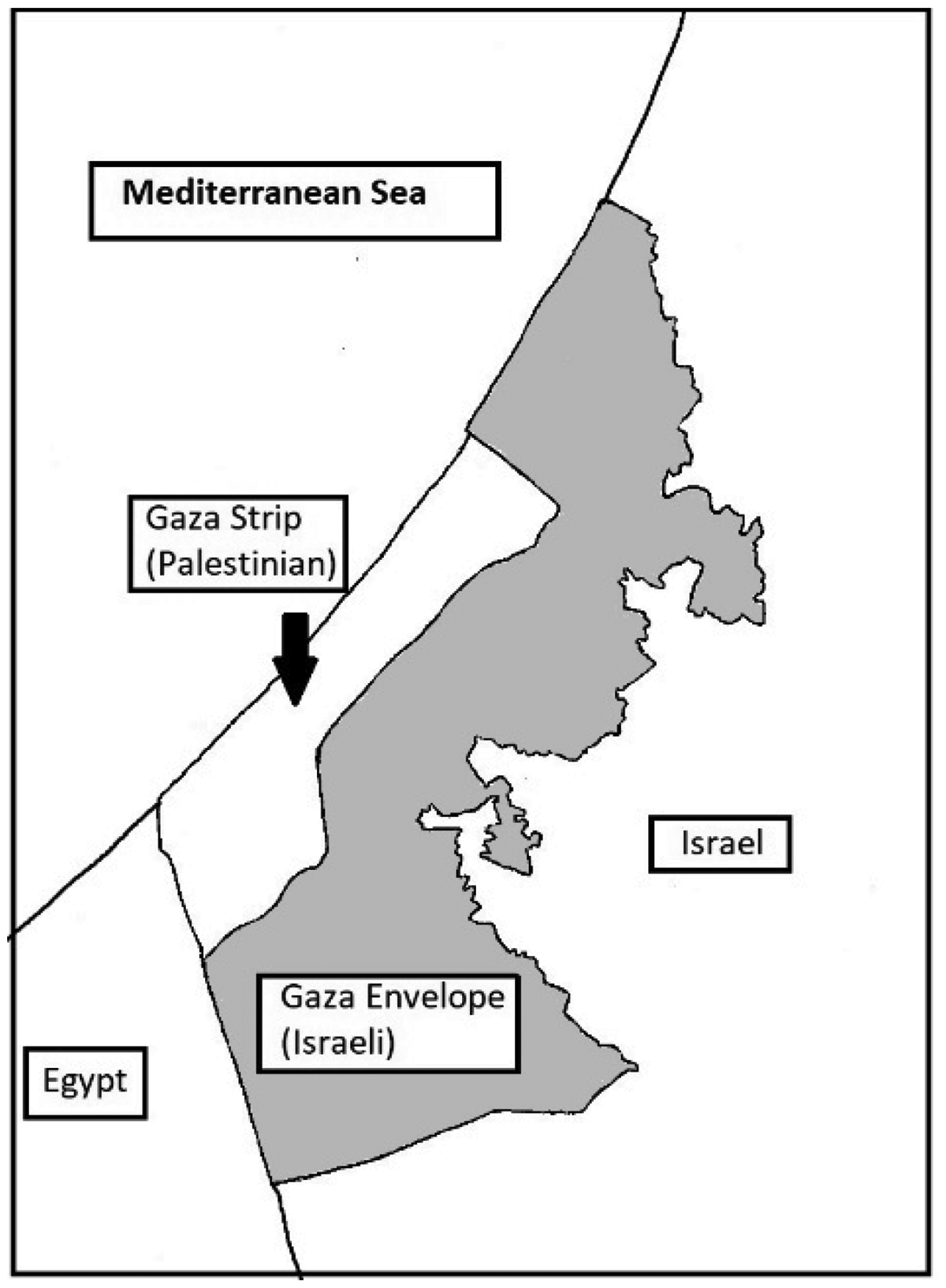
Map of the Gaza Envelope.

An image found in a publication by the Resilience Center, reading ‘We have resilience’.
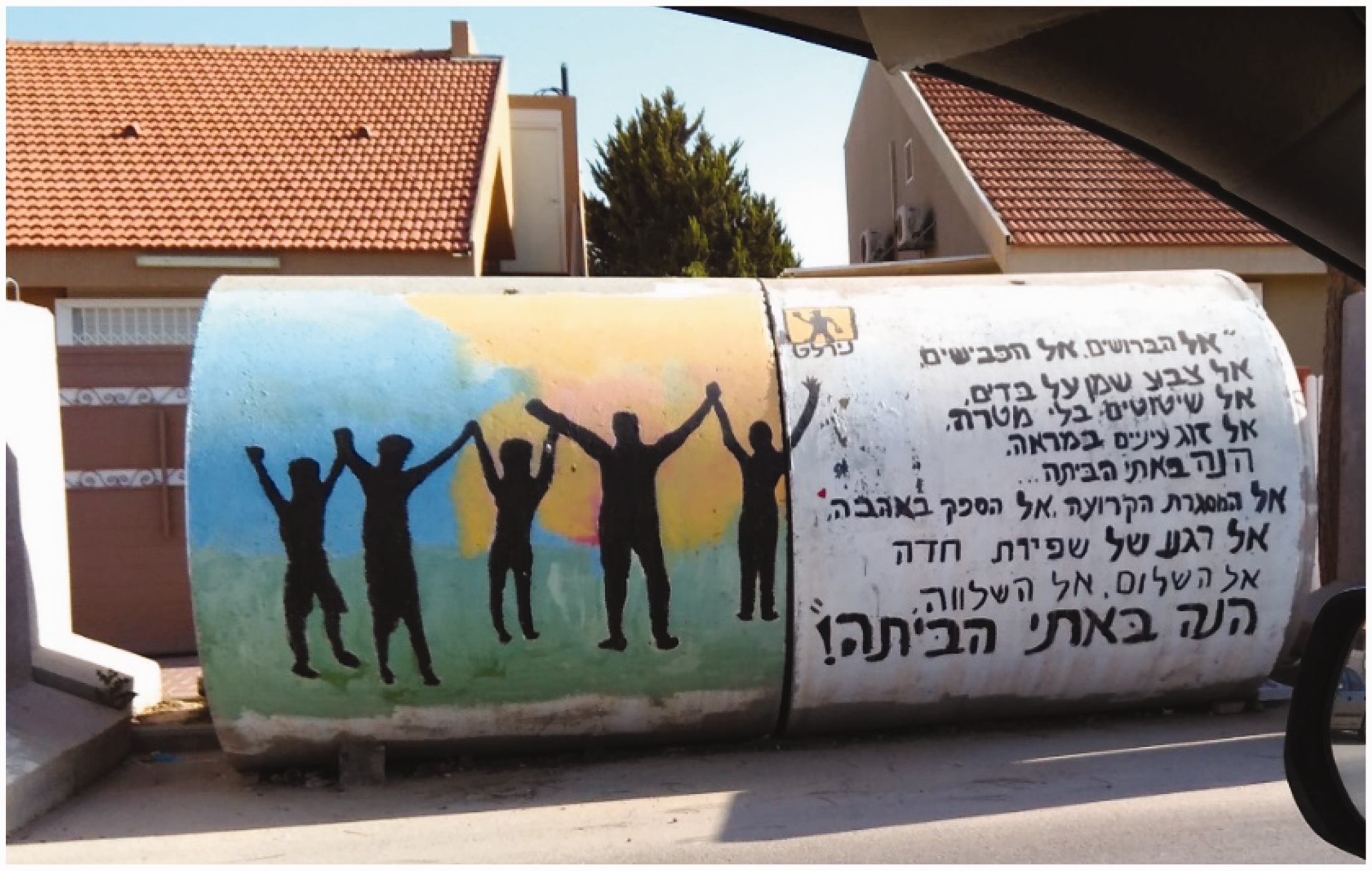
Large cement pipes are permanently positioned in residential neighbourhoods in the Gaza Envelope to protect pedestrians during unexpected missile attacks. The text is part of a popular radio song titled ‘I’m Coming Home’ (Date of photo: 19 April 2017).
The word ‘community’ (Kehila) appeared again and again in almost every meeting, interview or publication as an extremely important and positive aspect of life near the border, which involved various aspects of care. Residents receive daily information about activities, coordinated by municipality officials or the executive board through the local radio, newspaper, Facebook pages and WhatsApp groups. These include community events during national and religious holidays; ongoing activities for children, youth and the elderly; public artistic projects (see Figure 3); and charity initiatives – all meant to connect people and make them feel safe. Shani, who lives in a communal group of young Religious-Zionist families, echoed a ‘myth of community’ (Guijt and Shah, 1998), saying ‘I love this place so much that my mind keeps having creative ideas all the time […] my life revolves around the community 24/7 with a feeling that my work is not just work; it is life itself’. Other women spoke about professional and religious communities or mentioned their neighbours and friends in terms of a healthy extended family (taking care of each other’s children, for example), explaining that the sense of a strong and united community ‘is what makes us stay here’.
The militarised female caretaker
The second component of resilience, associated with bodily strength and physical health, was most evident in the involvement of women in security-related activities. Again, despite the fact that these activities were organised on a local level, they are part of a national strategic civil-military perception that encourages proactive, republican citizenship. Some of the women we met serve as active reservists in the military or had previously worked in the security sector (for example, in the Israeli Defense Forces [IDF] or in prison services). This, among other things, reflects how the militarised economy in the southern periphery of Israel, where the security forces also comprise a major source of employment, is an integral part of inter-generational community and family life. Women, as civilians, also maintained ongoing contacts with the military, serving as an auxiliary force in times of crisis in CEUs.
CEUs are run by small groups of volunteer residents who have undergone basic training to provide immediate and primary responses to emergencies and crises, such as military conflicts and natural disasters, until the arrival of official authorities. The CEUs are a hybrid mechanism developed by the state in 2002 during the Second Intifada. Several government resolutions from 2004–2014 determined that these units would be supervised and funded both by the Ministry of Welfare and the Ministry of Defense as part of a doctrine of ‘social cohesion’. 5 In 2015, there were seventy active CEUs in the Gaza Envelope (in 85 per cent of the residential communities), operating together with local Resilience Centers (Zeira, 2015).
Many of the CEU volunteers are local middle-aged women. One day we met Hannah, the head of a CEU, who invited us to enter a small building where we descended a concrete staircase to an underground shelter (see Figure 4). Downstairs, behind a heavy door, we entered a well-equipped room that serves as a war room. The room had an oval table in the middle with ten comfortable chairs and folders in front of each chair. Other desks had signs: ‘Factory’, ‘Logbook’, ‘Old-Age’ and the like. Each desk was assigned to a volunteer coordinator. Hannah’s desk had a computer connected to a large screen at the opposite end of the room, with data projected during an emergency. On the wall there were maps indicating all the Kibbutz houses by names and numbers. Apparently, the women volunteers had invented a system that enabled them to have direct contact with each family in case of emergency.

A civilian shelter that operates as a war room in a kibbutz near Gaza. Most of the volunteers who operate the room in times of crisis are women (Date of photo: 6 December 2016).
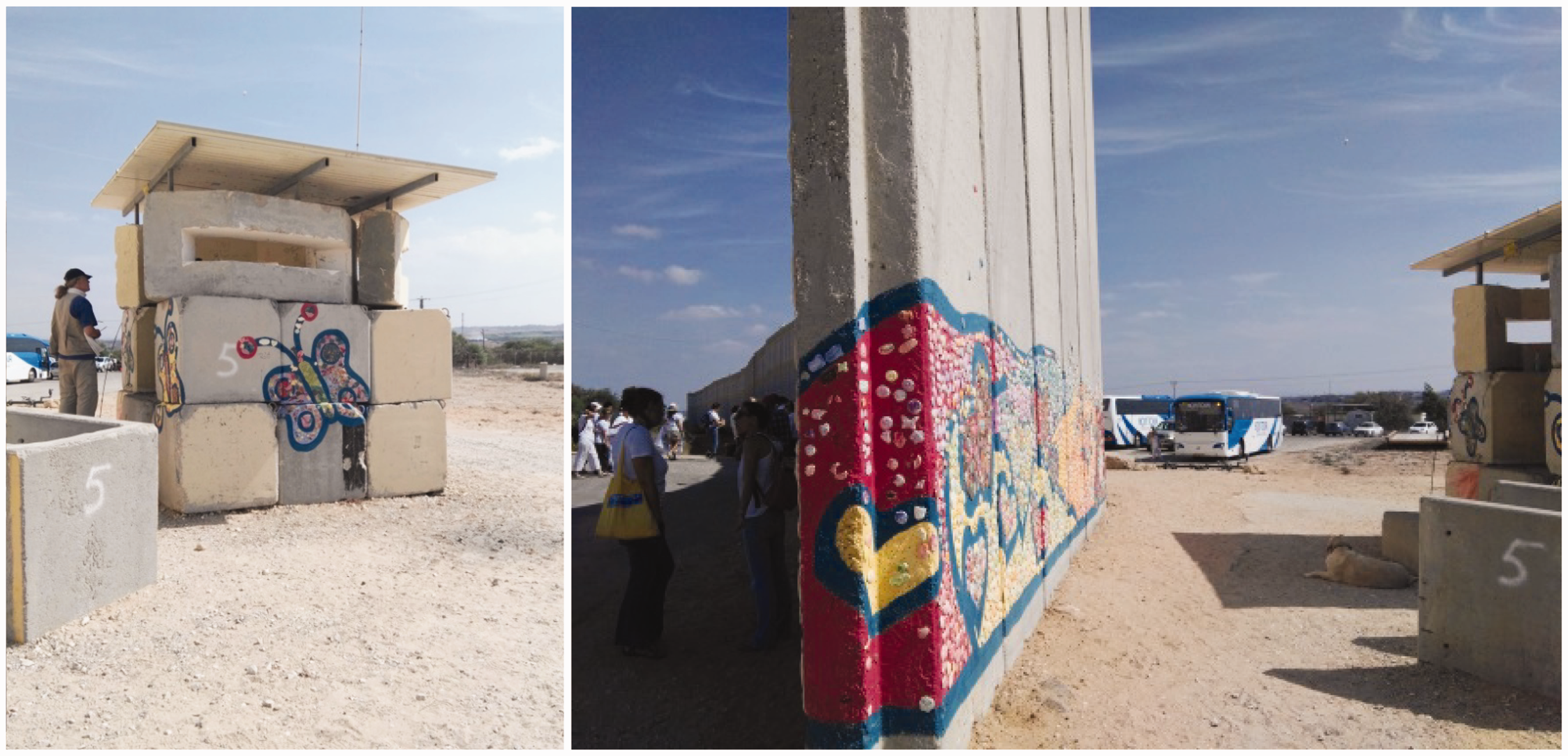
An ornamented permanent military outpost and wall near Netiv HaAsara, the closest Israeli community to the Gaza Strip, 400 metres away from the edge of the Palestinian town of Beit Lahiya (Date of photo: 18 October 2016).
In important respects, the discourse of Hanna and other heads of CEUs in the region is clearly continuous with the trauma-resilience discourse of social workers like Shani, as well as with that of other local residents like Sarit. She explained that her role also included emotional aspects, such as hugging people and helping them relax after a missile-rocket attack (for a more elaborate discussion of emotional discourses, see: Sa’ar et al., 2021). Consequently, women’s labour in providing resilience and security through care combines a hegemonic Israeli security paradigm of women’s soldierhood that has been previously linked to women’s military service (Lomsky-Feder and Sasson-Levy, 2017), with the institutional and cultural obsession with trauma-oriented activities to prevent or alleviate civilian exposure to PTSD (Friedman-Peleg, 2017). In vernacular terms, this logic assumes that Israeli women are not only traumatised victims who are exposed to ongoing forms of insecurity as civilians. Rather, they perceive themselves as active agents that must extend their caring activities beyond the household to defend their broader community.
Invisible Gaza
By listening to local residents’ descriptions and observing everyday lives, we also discovered the boundaries of care as a practice. Notably, together with their close attention to the needs of family, relatives and community, most of the people we met in the Gaza Envelope were emphatically disinterested in engaging with conflict-related politics (for more on apathy in Israel, see: Natanel, 2016). Paying attention to this vernacular position enabled us to see the ethical complications of security as care: despite the armed conflict’s clear visibility (military outposts, soldiers, fortified barriers, arms), the humanitarian aspects of the siege on Palestinians in Gaza remained relatively invisible. Our questions regarding Israel’s political and military strategies were consistently met with vague statements by our interlocutors, implying that these were decisions to be taken by ‘the people higher up’ in the government and the military.
As such, the intensive caring practices and social reproduction activities that we documented in the Gaza Envelope were applicable only within the boundaries of the Israeli community. This finding resonates with the broader postcolonial critique of care ethics as well as with the analysis of depletion as a settler-colonial practice. Thus, communitarian identity in this case is limited to groups that were invariably imagined as all-Jewish. While this corresponded with the typically nationally segregated character of residential localities in the region, some of the larger communities do include (very few) Arabs, primarily Bedouins or Palestinians from the north, or relocated Palestinian collaborators from Gaza. According to this logic, national identity (being Jewish/Arab) signifies the imagined boundaries within which care practices should be used to ensure resilience and survival.
Within this closed moral ecosystem that compounds warfare, communal practices of care, resilience and trauma, military responses (siege, surveillance, airstrikes, blockade) were identified by most residents as the ‘right thing to do’. Consequently, care for one’s own group is instrumental to the control of another. In vernacular terms, the Israeli military is seen not only as a protective force, but as an integral component of the community and its daily life (see Figures 5 and 6). Indeed, local women were tremendously appreciative of the military and shared stories about routine caring and mothering activities (hosting, cooking and baking) that they carry out to support the soldiers stationed nearby. Thus, in this region, military operations are part of a continuum of care and, similar to in other conflict societies (Hedström, 2017), gender relations are very important in upholding and enabling the economic infrastructure through domestic and emotional labour that is meant to provide a sense of ‘home’ for soldiers stationed nearby.
This support for military operations could also be interpreted as a sign of moral disengagement. When we asked direct questions about the wall or about Palestinians living in Gaza, many of our interviewees seemed detached, uninterested or confused. Sarit, for example, shared her various economic struggles, but when we asked about her sense of security she immediately expressed trust in governmental policies: ‘The town is totally protected!’, using a common Hebrew verb (Memugenet) which means ‘protected by armour’ to describe the completion of a bureaucratic-military procedure of building shelters, fences, anti-rocket missile systems etc. However, when asked about politics and the Palestinians in Gaza, she said the government is ‘not doing enough’, namely, not using military force to deter and punish Hamas. Given Sarit’s life circumstances and her daily struggle with a post-traumatic son and the cost of living beyond her income level, we read the moral reasoning in the following citation, which calls for a full-fledged attack on Gaza, to echo the logic of depletion: ‘The government should go inside [Gaza] and spray them. Spray them [the Palestinians]. Every time there is a siren, they should spray [e.g. shoot or bomb] them, so they don’t sleep at night. Why us? Let their children have anxieties! Why us?’.
While direct references to full-fledged war were not a common theme, this citation does reflect a broader perception of the conflict as a zero-sum game that could not be resolved diplomatically. Ariel, too, explained that she expected the government to act more decisively, and added: I am very very pessimistic. There is something inside me that really wants [a resolution of the conflict], and I wish that this could happen and change my life, our lives […] and make them so much better in the future. But it’s hard for me to believe that this can happen, because I think that there are extreme factions that will not let this happen. (Individual interview, Ariel) I would have wanted us to be good neighbours, but unfortunately the abyss is so deep that it will take a long long time to build trust, which is why for now the solution is separation. […] I also get angry sometimes when we drive on Friday afternoon and we see people in Yad-Mordechai junction holding signs saying that in Gaza there is no electricity, no water. I’m sorry but I need to take care of my home first. I cannot think about the fact that they do not have electricity or homes, when my children and I are in a constant state of anxiety, running in sirens. I’m sorry it sounds egotistic, and usually I’m not like that, but let’s not be gentle souls here. Those who stand with the signs, they also make me angry because of the soldiers who are standing next to them. They are ready to give their lives to save them. So how can they stand in front of a soldier and hold a sign like this? (Individual interview, Sivan)
We note that views concerning Hamas’s responsibility in the continuation of violence were sometimes complicated by humanitarian concerns. Some of the women insisted on differentiating between combatants and civilians in Gaza, arguing that while Palestinian women and children were poor victims of the situation, Hamas was the actual enemy that should be taken down. Men shared stories about long personal and professional contacts with other Palestinian men. Some of these contacts were regularly maintained despite the forced separation post 2005, though they were treated in non-political terms. Some even told us that they would periodically pass food, clothes and medicine to friends in Gaza. At least twice, we witnessed first-hand direct phone calls with Palestinian men from Gaza in which private and family matters were discussed cordially. These internal nuances were linked with political concerns about the long-term strategic viability of the siege/fortress. They also reveal how the long stalemate has trapped the Jewish communities in a double bind. As one of the men we met, a Kibbutz spokesperson, explained: ‘We don’t express our political views in public because we don’t want to clash with the government that helped us as a community after Operation Protection Edge [2014]. We have no choice’.
Conclusion
In ‘Rethinking Care Ethics’, Olena Hankivsky argues that the preference towards universalism or cosmopolitanism can cause care theorists to neglect the importance of difference, power relations or the ‘historically rooted ties and mutually constituting processes and patterns of a broader range of oppressions’ (2014: 253). She calls on empiricists to take up this challenge by adopting an intersectional approach, which would mitigate essentialist tendencies and favour a more fluid and flexible account of care. In this ethnographic study, we followed this challenge by exploring how vernacular security is interconnected with ‘care as practice’ in militarised, conflict-related settings – how, within conflict-related settings, security discourses and realities transform care practices into strengthening nationalistic and ethnically exclusionary communities.
The various sources of data gained through participant observations, interviews and textual analysis concerning daily life on the Israel-Gaza frontier revealed three general findings. First, the Israeli residents, and particularly women, along the border with Gaza are very involved in various public and community activities that enable care and social reproduction. Although these experiences and routines are understood through vernacular terms, they are part of a broader collective effort that is linked with national security and Jewish identity. In particular, the attempt to transform trauma into resilience is guided by the state, which provides a critical infrastructure for such efforts: through the direct and continuous engagement of welfare services, through military presence and by considerable economic subsidies. Nonetheless, residents derive a local sense of agency primarily through practices of communal care, which include securitised forms of preparation for crisis, such as voluntary women-led CEUs that operate in tandem with the military during Qassam rocket attacks.
Second, similar to other militarised domestic settings in developed countries like the USA, South Korea or the UK (Enloe, 1989; Basham and Catignani, 2018), as well as in developing countries like Myanmar or Sierra Leone (Coulter, 2011; Hedström, 2017), women in Israel play a prominent role in shaping this vernacular formation of ‘security as care’. In many respects, their participation appears to reinforce traditional gender roles: not only is it framed in terms of care work, but it is also voluntary (nearly all the paid civilian security positions we encountered were held by men). But, far from passive or transparent, the women we met doing community volunteer work were opinionated, proud and self-entitled individuals, who strongly identified with their state even when they criticised the government. Moreover, by immersing themselves in communal commitments, they also perceive themselves as very ethical persons.
Nonetheless, and this is our third finding, the boundaries of this ethical universe overlap with those of the nation. The strong communitarian-cum-nationalist atmosphere presiding over these women's lives results in moral disengagement from the suffering of Palestinians living under siege on the other side of the fortress-state. In other words, contrary to the ethical standpoint known as feminist ethics of care, we have found that siege and fortification involve an active construction of communitarian ethics, which effectively rejects cosmopolitan notions of universal human rights.
We conclude that contemporary armed conflicts that involve strong communitarian identities, including national identity, still have a clear impact on the way ordinary women engage in care as a practice and, consequently, as a moral standpoint. Accordingly, we argue that the tendency of Jewish-Israelis who reside near Gaza to morally disengage with dilemmas concerning the siege are shaped by their social proximity to the conflict, their exposure to personal danger and their deep identification with the state, the military and their own communities. This emotional attachment is continuously encouraged by various institutional actors in a way that exemplifies how, in reality, communitarian care ethics becomes intertwined with national and state-centred discourses. Jewish women are therefore expected to care for family and community members as a form of appropriate citizenship and loyalty to the state.
By exposing how vernacular security can be intimately connected with communal care in conflict-related zones, and how these attachments are instrumentalised by military actors and politicised by the state, this case reveals yet again an ongoing challenge to cosmopolitan feminism and a global politics of care. These challenges relate to the conditions and possibilities of creating cross-national solidarity among women (and men) in conflict zones – solidarity that is based not only on empathetic abilities to ‘see the other’, but also on decolonisation as a praxis. As the Israeli case exposes, women’s current caring activities are not only meant to secure the survival of their national communities. Rather, they operate within a broader structure of asymmetric power relations that not only differentiate Israeli-Jews from Palestinians, but determine access to resources, political rights and livelihood. As such, in this case study, caring for one’s own group indirectly contributes to the diminishing capabilities of the other, namely, of Palestinian communities in Gaza.
Taking this postcolonial critique into account may lead us to believe that it is impossible to maintain values of cosmopolitan and feminist ethics of care under the conditions of hyper-nationalism and armed conflict. Yet, while we as authors and Israeli-Jewish women cannot offer direct solutions to this moral complexity, by acknowledging these tensions and listening to stories of insecurity and resilience, a more nuanced understanding of the politics of care can be shared. Namely, that Israeli-Jewish women who experience conflict-related insecurity and trauma are not passive victims or blind supporters of militarised politics. Rather, by caring for their own community, they embody a feminine ideal of national resilience which also involves a moral expectation to disregard the suffering of others. As Cynthia Enloe and other feminist scholars have argued (e.g. Wibben, 2011), following the gendered logic of militarisation may have an emancipatory goal. In this case, it can provide an important starting point for future investigations of global networks of responsibility and care and for a better appreciation of the ways local feminists and anti-militarist groups respond to local militarised discourses and resist or subvert them over time.
Supplemental Material
sj-pdf-1-fty-10.1177_14647001211023644 - Supplemental material for Security as care: communitarianism, social reproduction and gender in southern Israel
Supplemental material, sj-pdf-1-fty-10.1177_14647001211023644 for Security as care: communitarianism, social reproduction and gender in southern Israel by Sarai B. Aharoni, Amalia Sa’ar and Alisa C. Lewin in Feminist Theory
Footnotes
Funding
The author(s) disclosed receipt of the following financial support for the research, authorship, and/or publication of this article: This article draws on a collaborative, inter-disciplinary project between the three authors. The research was made possible thanks to generous support from the Israel Science Foundation (grant #1092/15).

Supplemental Material
Supplemental material for this article is available online.
Notes
References
Supplementary Material
Please find the following supplemental material available below.
For Open Access articles published under a Creative Commons License, all supplemental material carries the same license as the article it is associated with.
For non-Open Access articles published, all supplemental material carries a non-exclusive license, and permission requests for re-use of supplemental material or any part of supplemental material shall be sent directly to the copyright owner as specified in the copyright notice associated with the article.
