



Abstract
This article examines what happens when local gender rights activism is taken up by international allies and appropriators, using case studies of activism in Saudi Arabia and India. The relationship between local and transnational activists is shaped by histories of Euro-Americans writing about the gendered organisation of Eastern societies. In an economic system where nongovernmental activist groups compete for donor support, political causes are commodities with value, and value is generated through representations (e.g. of patriarchal oppression). These representations of the sexuality and gender organisation of other societies are fetishes in the Marxian sense, essential to the commodity-cause that generates value in circulation. These representations gain value through the accretion of cultural images and texts that adhere to the cause, e.g. the stereotype of the violent brown man and oppressed woman. Such images in the cultural repository allow transnational consumers to make sense of issues they are called to support. But such images also reify stereotypes that activists seek to undermine, even at the same time that these representations generate an international audience. We analyse this process and identify strategies for how transnational allies can show solidarity without overshadowing or devaluing the voices of local activists, with primary focus on the case of activism against male guardianship laws in Saudi Arabia.
Introduction
In 2012, Sydney-based Saudi artist Ms Saffaa produced a series of works titled, I Am My Own Guardian (ana waliyyat amri). Featuring an image of a woman wearing the Saudi traditional male headdress and the Arabic and English phrase ‘I am my own guardian’, it drew attention to the legal structure that requires all Saudi women to have a male guardian, without whose permission she cannot travel, rent accommodation, enrol in university, get a job, have elective surgery or leave a shelter (e.g. after seeking refuge from domestic violence) or prison. 1 Ms Saffaa and other Saudi activists pasted stickers of the image on the streets of Jeddah, Riyadh and Bahrain (Figure 1), and shared the campaign through social media.
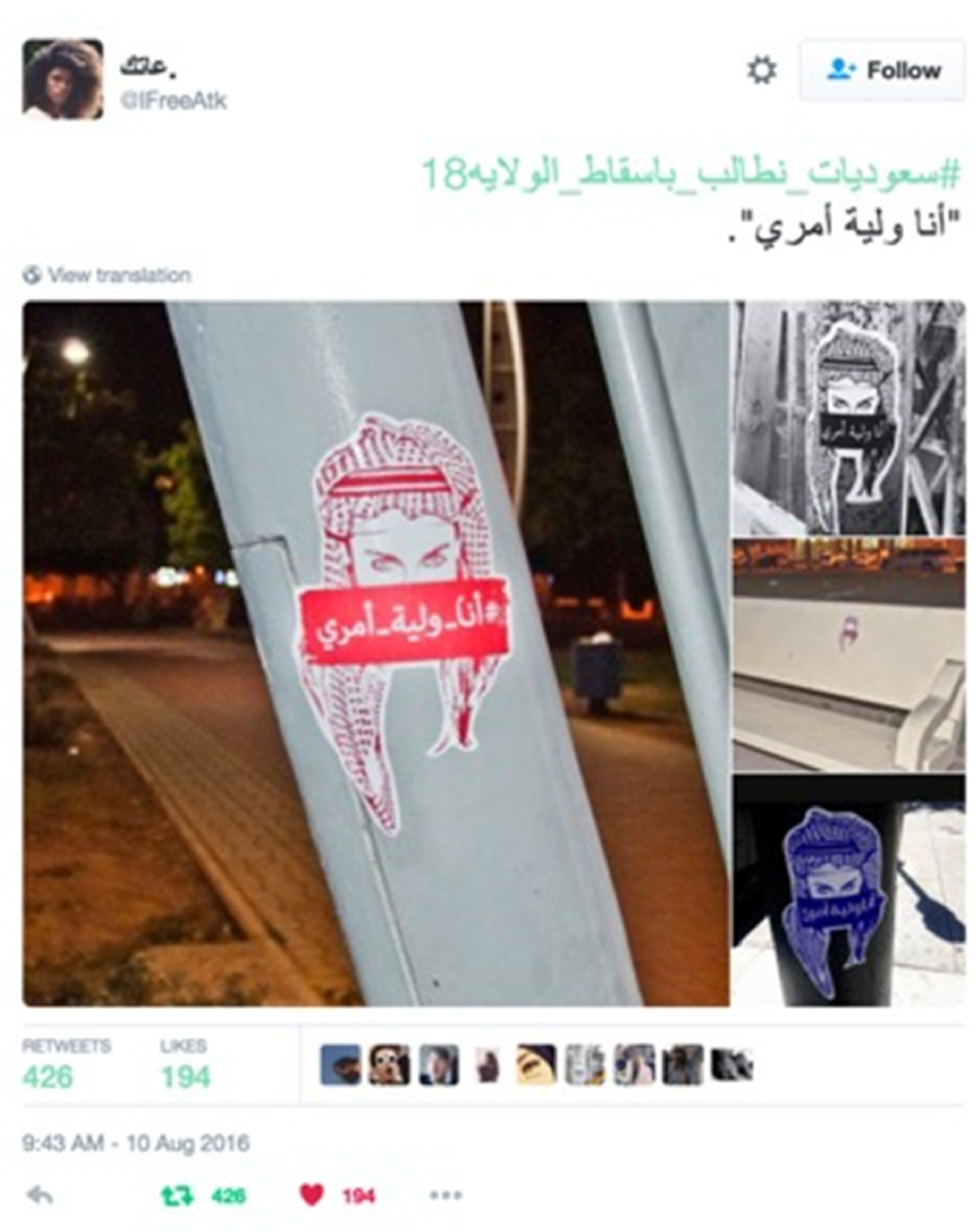
‘I Am My Own Guardian’ stickers on the streets of Saudi Arabia.
When, in 2016, a Saudi man using the name ‘Saudi Conscience’ (Dameer Sa’udi, @saudi100d100) discovered Ms Saffaa's images and attacked her on Twitter, a flood of both criticism and support from other Saudis followed. Soon #IAmMyOwnGuardian was trending.
Not long after, a US-based man named Isaac Cohen, calling himself an ‘independent terror analyst and human rights advocate’, appropriated the image to his own project as a self-proclaimed voice for Saudi women. He used the image in tweets criticising the Saudi state, and in calling for donations to support his work, all without crediting the original artist.
From being a story about progressive Saudi women and men calling for legal and social change, it had transformed into a story about oppressive Saudi traditions and a white man saving brown women from brown men, to paraphrase Spivak (1994). Drawing on local sensitivities to the history of Orientalist portrayals of Arab men, Saudis who opposed the feminist campaign seized upon Cohen's programme and used it to discredit the anti-guardianship laws movement, labelling the Saudi women activists ‘Cohen's odalisques’ (jawari Cohen). Three years after it was first used, the label continued to circulate to discredit Saudi activists.
This case illustrates a recurring and fraught dynamic between local and international forces in campaigns for gender and sexual rights. Many international feminists, responsive to ‘representations of the unfreedom of others’ (Abu-Lughod, 2013: 30) and driven perhaps by what Kasana refers to as ‘liberalism's guilt-ridden savior politics’ (2014: 243), are keen to take up the cause of ‘saving Muslim women’. In the process, however, they both respond to and contribute to the perennial construction and reconstruction of what miriam cooke (2007) calls the ‘Muslimwoman’: a monolithic representation of women oppressed by culture, religion, and patriarchy, an image that is commodified and circulates transnationally as part of a ‘neoliberal politics of distress’ and intervention (Chandra and Toor, 2014: 17).
Muslim feminists have argued that such representations of women who need saving from Muslim men ‘essentialise, denigrate and diminish the value of Muslim lives’ (Shaikh, 2013: 24). Such representations also advance particular neo-colonial and imperial agendas, including justifying military interventions and colonial occupations (Khan, 2005: 2017; Abu-Lughod and Mikdashi, 2012; Shaikh, 2013; Chandra and Toor, 2014: 16; Kasana, 2014; Wynn, 2018). In the process, feminism ‘becomes an alibi for war and state repression’ (Abu-Lughod, 2013; Sameh, 2014: 177). Representations of international feminist solidarity and Muslim women's freedom are also highly marketable (Kasana, 2014: 242; Siddiqi, 2014: 292–293), co-opted by both corporations and non-profit organisations alike (Abu-Lughod, 2013; Chandra and Toor, 2014: 17). In such ways, feminism, humanitarianism, militarism and corporatism are all deeply imbricated (Shaikh, 2013: 23–25; Sameh, 2014: 177). This ‘double bind’ (Tax, 2012) between imperialism and the discourses of human and gender rights, Rochelle Terman (2016: 77–78) argues, generates one of the most pressing concerns of contemporary feminist scholarship: how can local activists engage with an international audience without contributing to discourses that risk harming their communities?
Many local activists around the world are eager to reach an international audience, whether to generate solidarity, activate diasporic networks or raise money to support activist agendas (Sameh, 2014: 175). Yet, paradoxically, when international activists take up the causes of local activists, the international publicity that results often discredits the local activists or makes their activism invisible (Wynn, 2018). In the recent case of Indian activists against sexual violence, for example, the work of thousands of Indian activists was transformed in Western media coverage into a story about rape in India, not the power of grassroots activism. In the case of sexual violence in the Tahrir Square protests during the Egyptian revolution, the sexual assaults against activists resulted in protests and other forms of activism by Egyptian anti-gender violence activists, but the international media largely covered it as a story about rape and Arab patriarchal violence.
Thus as activism travels transnationally, the work of activists on the ground is effaced and appropriated to Western political projects and civilisational discourse. Local antifeminists then seize the opportunity to discredit local activists and claim that their projects are inherently Orientalist (Charrad, 2011: 431) or that they are being manipulated by external political forces (Sreberny, 2015: 358). Indeed, Terman (2016) argues that even international feminist scholars have ended up levelling the same critique against local activists by privileging their critique of Western imperialism over activist agendas. In short, the unintended effect of international appropriation of local activist struggles is frequently the discrediting of the activism at its source.
In this article, we examine this process by assessing several activist campaigns. Following Abu-Lughod’s (2010) call for close, ethnographic study of activism around ‘Muslim women's rights’, we focus particularly on the case study of Saudi activism and an example of its (mis)appropriation, and how that was used as fuel for reactionary politics. We also give an example of more successful transnational allyship around the same cause. This close look at international activism against male guardianship laws in Saudi Arabia allows us to understand how activism operates in an international arena, what its ‘mediations and transformations’ are (Abu-Lughod, 2010: 2) and the discourses and institutions with which it is entangled. We then briefly draw connections between the Saudi case study and women's rights activism in India, describing how representations of women's rights ‘travel’ and how international coverage of local activism often becomes a story about oppressive Oriental patriarchy, even outside of the Middle East and Muslim world.
We use these case studies to analyse how political campaigns against male guardianship laws in Saudi Arabia and against sexual violence in India work in the international arena as fetishes to generate global value. The ‘Oriental female’ as fetish has a long pedigree that attains new currency in the contexts of neoliberal capitalist philanthropy. In such a contemporary economy of representations, critical questions arise about who has the right to represent a cause, what activities constitute solidarity and allyship versus appropriation and what strategies serve to advance or discredit activist causes.
Case study: Saudi activism against male guardianship
The case study of the 2016–19 grassroots Twitter movement ‘Saudi Women Want the Fall of Guardianship Laws’ allows us to explore the confluence of art, politics and activism on social media through examples of opposition and support. Saudi Arabia's guardianship laws effectively endorse the financial, physical and psychological exploitation of women by their male guardians. Yet while these structures enable abuse and disempowerment, not everyone follows a clichéd script. Many Saudi women are successful leaders in business and education, and Saudi feminists have vocally and quietly worked to reform the system from within for decades. Saudi women's opportunities occur at the intersection of forces including the state, family and global capitalism (Al-Dabbagh, 2015).
An important context for recent Saudi activism is demographic change and access to online information and social media platforms. Saudi youth make up approximately two thirds of the national population (Murphy, 2011), and access to the outside world was facilitated by the controversial introduction of television satellite channels in the 1980s, followed by the late 1990s Internet boom (Yamani, 2000). The availability of such technologies has exposed Saudis to global politics, and the development of social media platforms in English and Arabic, particularly on individually controlled mobile phones, has facilitated social and political engagement across deeply entrenched cultural norms of gender segregation and political limitations on freedom of expression (Sreberny, 2015: 357–360).
One of the most important social media platforms for social and political engagement is Twitter. Saudi Arabia is one of the fastest growing Twitter markets in the world; in 2014, Arab Social Media Report (2014) identified the country as having the most active Twitter users in the Arab region, despite its relatively small population (compared to vastly more populous countries like Egypt). In that year, 2.4 million Saudi Twitter users collectively produced 40 per cent of all tweets in the Arab world. Partial anonymity on Twitter and other social media platforms allows a freedom of speech not possible beyond the cyber sphere. At the same time, Twitter has been used by the regime to monitor dissent, identify regime critics (Nakashima and Bensinger, 2019) and influence global public opinion (Paul, 2019), though Annabelle Sreberny reports that many activists ‘are digital adepts and have learned to use TOR software and fake online profiles for online anonymity and filter-breakers to circumvent state monitoring’ (2015: 360). This context shaped the viral circulation of the ‘I Am My Own Guardian’ campaign in 2016.
On 16 July 2016, Human Rights Watch published a report outlining the human rights abuses stemming from Saudi Arabia's male guardianship laws. Human Rights Watch used the hashtag #TogetherToEndMaleGuardianship to disseminate the report. Inspired by the report, a group of Saudi women activists created an Arabic hashtag that translates as ‘[We] Saudi women want the fall of the guardianship system’, provocatively echoing the rhyming slogan that emerged during the 2011 Arab uprisings: ‘The people want the fall of the regime’.
Soon after the Arabic hashtag was created in 2016 and the movement started gaining momentum, a Twitter user, @Outsider_S1, tweeted four images of the artist Ms Saffaa's work. The images were shared widely. Then, in August 2018, a Twitter user using the handle ‘Dameer Sa’udi’ (‘Saudi Conscience’) found the images and attacked the artist online, threatening to report Ms Saffaa to Saudi authorities for creating illegal ‘advertising’ materials that ‘encouraged women to break the law’ (Figure 2). His followers encouraged him to report the artist to Saudi authorities and called for her to be imprisoned. One tweeted: ‘another hashtag will emerge saying that the Sticker Girl has been arrested’ (Figure 3). He tagged the official Twitter account of the King of Saudi Arabia, and several other users also claimed to have reported Ms Saffaa to the Ministry of Interior (Figure 4). 2 But the efforts of ‘Saudi Conscience’ to silence Ms Saffaa as an activist and artist inadvertently brought her artwork more attention. Soon, her I Am My Own Guardian artwork had become the unofficial logo of the campaign.

10 August 2016 tweet by Dameer Sa’udi that reads: ‘I took a screenshot of her tweet and will report her to authorities. The laws of our country forbids the distribution of advertising materials that incite breaking the law’.

‘Soon a new hashtag will emerge saying “sticker girl has been arrested”’ (14 August 2016).

‘I will do my part and report her to Saudi authorities; these are internal matters’ and ‘Report her account to the Ministry of Interior, these are internal state matters and this lowlife is an expatriate intruder’ (14 August 2016).
Saudi anthropologist Madawi Al-Rasheed (2012) has urged Saudi women to unite their efforts in standing against a patriarchal system that continues to oppress them. Saudi activists against male guardianship laws did exactly that, using Twitter groups to organise, mobilise and coordinate efforts without ever meeting each other in person. The partial anonymity of Twitter allows Saudi women to evade the direct retaliation of reactionary conservative men, at the same time that women have used the platform to publicly articulate their demands vis-a-vis the royal family, religious authorities and the state more generally.
The movement against the male guardianship laws has been successful in three significant ways. The first is the level of local and international awareness the movement has raised about the laws. Second, the movement challenged the authority of the political elite in an unprecedented public display of civil disobedience. And third, it asserted the voices of Saudi women. The latter proved that, contrary to popular perception, Saudi women have the ability to speak for themselves and in fact have been speaking for a long time. As Indian novelist-turned-activist Arundhati Roy noted at the Sydney Peace Prize Lecture in 2004, ‘There's really no such thing as the “voiceless”. There are only the deliberately silenced, or the preferably unheard’ (Sataraka, 2016: 263).
The movement has been effective and far-reaching. During the Arab uprisings, Saudi Arabia seemed to have escaped the upheaval, with only minor protests and even fewer women's rights campaigns. However, the campaign against male guardianship laws has been the most inclusive political Saudi movement since the Arab uprisings, and it is driven primarily by Saudi women tweeting from inside the country. Just as Catherine Sameh (2014) describes of a network of Iranian activists in Iran and the diaspora, these networks of online Saudi activists are fluid and leaderless (Al-Dabbagh, 2015), horizontal and flexible, operating independently of both state control and foreign organisations.
Yet activists did encounter opposition, and the wide reach of Twitter also facilitated online abuse, threats towards activists and state retaliation. The Saudi state employs social media as a tool for social control, which Saudi activists were well aware of long before public reports that the state had used Twitter employees to spy on dissidents (Nakashima and Bensinger, 2019). One Twitter account called ‘Kulna Amen’ (which translates as ‘We Are All Safe’) is dedicated to receiving reports about unlawful acts online and in real life, much like the United States’ ‘If you see something, say something’ campaign. This account aimed to turn the Saudi population into vigilantes to keep citizens under constant self-surveillance and silence dissenters. For example, one Saudi man tweeted the ‘Kulna Amen’ account asking if he had the right as a citizen to sue the people behind the hashtag ‘Saudi women want the fall of the guardianship system’ for destabilising national security and inciting public disorder (Figure 5; translation ours).

‘Do I have the right as a citizen to sue the people behind this hashtag “Saudi women want the fall of the guardianship system” for destabilizing national security and for inciting public disorder?’ (16 August 2016).
These examples highlight how polarised Saudi public opinion is on issues concerning women. Local activists sought international allies to put pressure on the Saudi government to change. They also have connected with diasporic networks of Saudi and other Arab women to engage in their campaigning. (Indeed, the division between ‘local’, ‘international’ and ‘diasporic’ is blurry in reality, as Saudi women may divide their time between Saudi Arabia and elsewhere, travelling internationally and later returning, or they may live internationally while maintaining close local ties to relatives and friends in Saudi Arabia, while locally based activists using social media may be just as engaged with international allies as diasporic Saudis.) Yet, while Saudi women all over the world have been part of a transnational activist movement, the activists in Saudi Arabia were at greater risk from both Saudi political opponents and the Saudi state (and see Terman, 2016: 88, 97 for a discussion of diasporic privilege amongst activists). This form of resistance comes with a high level of risk in Saudi Arabia, especially for those tweeting using their real names. Many of the activists involved in the movement for women's rights have been punished by the Saudi state under Crown Prince Muhammad bin Salman. Loujain al-Hathloul, Iman al-Najfan and Aziza al-Youssef are among the women who were arrested in May 2018, less than a month prior to the lifting of the ban against women driving (Fahim, 2018). They had been vocal in calling for both the abolishment of male guardianship laws as well as the ban on women driving. While reaching an international audience was likely a critical component influencing the regime's decision to allow women to drive and, more recently, to allow women to travel without a guardian's permission, the regime has also retaliated against activists for bringing their reform calls to an international stage, thus highlighting the doubled-edged sword of transnational activism and allies (Khan, 2005; Tax, 2012; Shaikh, 2013; Chandra and Toor, 2014; Terman, 2016).
Transnational appropriation and allyship
The sudden overnight Internet fame triggered by the attacks by ‘Saudi Conscience’ brought global attention to the I Am My Own Guardian artwork. A US-based man calling himself Isaac Cohen found the artwork and used it, without permission, on his own website and Twitter feed, where he presented himself as a voice for oppressed Saudi women. At the time, Cohen had over 10,000 Twitter followers and described himself on his profile as an ‘independent terrorism analyst’ with no academic, corporate or governmental association (Figure 6).
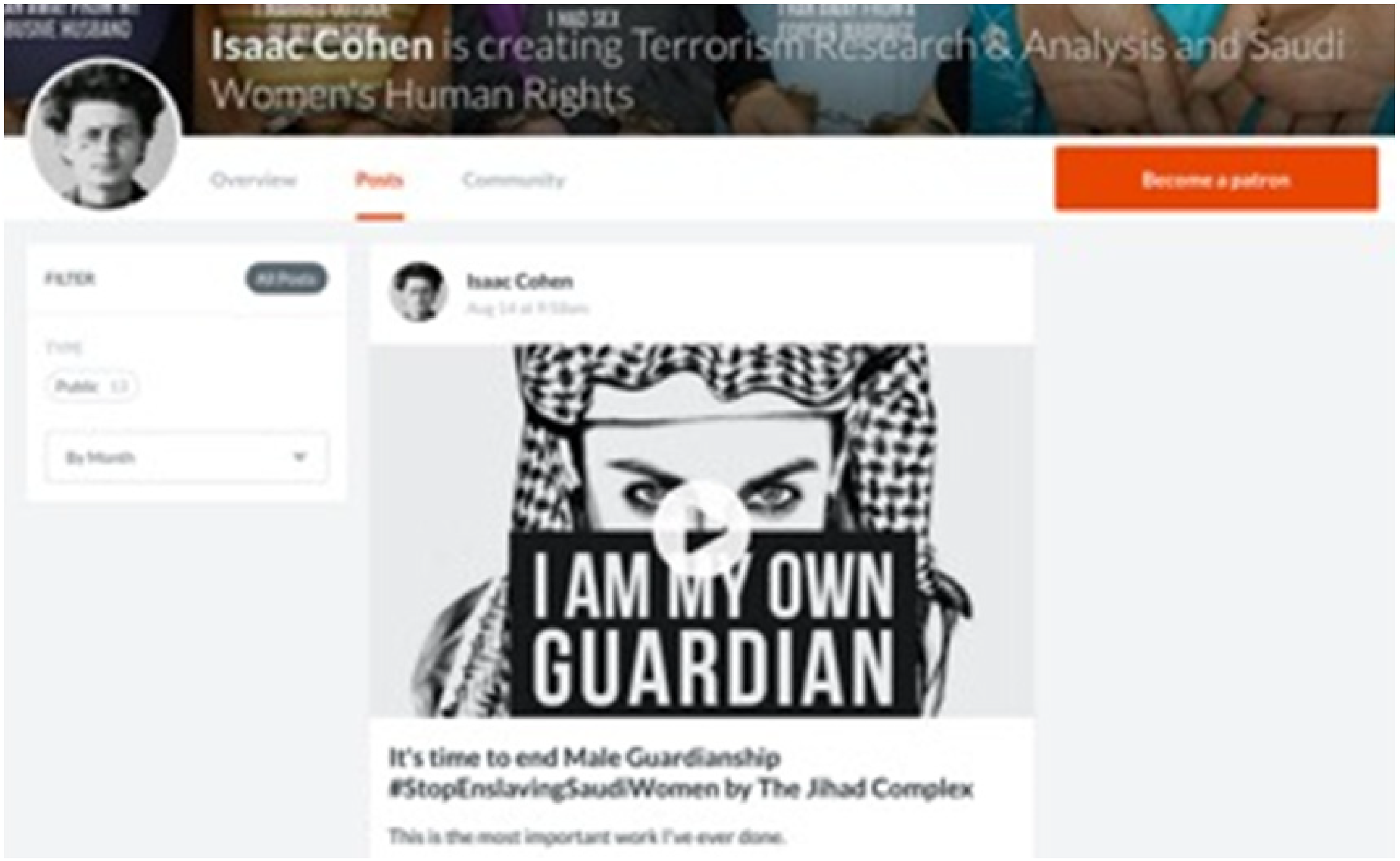
Isaac Cohen's Patreon page seeking support for his activism on behalf of Saudi women, featuring the (uncredited) work of Saudi artist Saffaa.
Pinned to his Twitter feed, at the time, was a link to a podcast where he talked about Saudi women and the male guardianship system. In one of his podcasts, he explained that it was crucial that his English-speaking audiences become aware of the current situation in Saudi, because they ‘give a fuck about human rights’. In contrast, he argued, Arab and Muslim communities ‘don't care about you guys’ (Jihad Complex, 2017b). In another podcast, he claimed that ‘in some cases’ women in Saudi Arabia ‘are treated like glorified dogs’ (Jihad Complex, 2017a).
In addition to these podcasts, Cohen also created a video portraying putative Saudi women and disseminated it through the Twitter account of his non-profit organisation, ‘SAFE Movement’ (the acronym stands for ‘Saudi Arabian Female Empowerment’). The video depicts a veiled woman covered in black from head to toe running on a beach while several different women's voices repeat, in English, ‘We are Saudi women, and we can't leave, we can't even run. The only thing we can do is watch our own lives pass us by while we are unable to change anything. Please hear our voices. End the male guardianship system’. Different voices repeat these phrases, overlapping each other, while sorrowful music plays in the background, suggesting that this is a script that women are reading. The script's author is never identified or credited. The video caption says in English ‘Please hear the voices of the Saudi Women Suffering’, and two hashtags are splashed across the page: #StopEnslavingSaudiWomen and an Arabic hashtag that translates as ‘We Saudi women demand the end of the guardianship system’ (Figure 7) (S.A.F.E Movement, 2016).

Video Cohen produced to dramatise the ‘suffering’ of Saudi women.
Cohen created an account on Patreon.com in order to collect funds for the purpose of ‘helping inform people about the women in Saudi Arabia in order to end the Male Guardianship system’, although it is unclear how sending money to an American man with a modest social media platform and no known government or academic affiliation could change the law in Saudi Arabia. He also claimed in his profile to conduct ‘research’ into the ideology and motivations of ISIS and Al Qaeda, and stated that his objective was to collect enough funds so he could turn his ‘research’ and his non-profit organisation into his fulltime job. The artwork splashed across the top of his Patreon (n.d.) page was Ms Saffaa's I Am My Own Guardian.
When the artist publicly questioned the ethics of Cohen using her images without credit or permission and asked him to stop using them, he responded in a series of public tweets, first declaring that he would remove the images 3 but then qualifying that by stating, incorrectly, ‘They were images distributed by the UN and bought the rights I believe’ 4 and finally justifying his plagiarism, saying, ‘I was unaware that I was supposed to credit her still upon every use apparently’. 5 Ironically, in his claim to provide a platform for Saudi women's voices, Cohen had erased the intellectual authorship of the Saudi artist whose images he had appropriated. Three years after the artist asked him to stop using the image, it remained at the top of Cohen's Patreon page.
On 16 August 2016, Ms Saffaa tweeted Cohen, saying, ‘We, Saudi women, are not a political pawn to advance your own agenda and your bank account’. He responded, ‘I don't have an agenda, I spend all my spare time on this, I used to spend all of it on monitoring Isis. Really disappointed in you … You realize I made a non profit organization just to help, I use my platform to give Saudi women a speaking box to yell from’. 6
This concept of a ‘speaking box’ raises key questions about international allyship and appropriation. Cohen claimed to have given Saudi women ‘a speaking box’ so they could be heard. In fact, any Twitter user has their own ‘speaking box’, and many Saudi women have larger Twitter followings and thus more influence than Cohen. Indeed, as Mehreen Kasana (2014: 239) has pointed out with regards to her own and other activists’ presence on social media, it is one of the only places where their views can be expressed without ‘any kind of tailoring or censoring’. On Cohen's platform, however, their voices are filtered through his American, male, Orientalist lens, through a framing that associates male guardianship laws in Saudi Arabia with ISIS and enslavement.
Cohen's portrayal perpetuates misconceptions and stereotypes that many Saudi women are trying to dismantle in their research and activism. His podcasts retell questionably sourced stories about abusive Saudi men and disempowered women, rendering women perennial passive victims of patriarchal domination and male predators. By representing Saudi women as victims, Cohen ignores how women have developed forms of resistance that enable them to navigate and subvert the complex social and political systems that exist in Saudi Arabia. Women can, of course, be agents and victims simultaneously, and the inside world of Saudi women is dynamic, diverse and far from the binary of oppressed and oppressor. These simplistic portrayals perpetuate representations of Muslim women as victims, a portrayal that fuels anti-Muslim and anti-Arab sentiment, pegged to images of faceless, veiled women (Figure 7) that resonate with histories of Orientalist portrayals of the Middle East (Alloula, 1986; Abu-Lughod, 2010). Reinforcing stereotypes is neither empowering nor inspiring.
The irony of Cohen's project was that the law that Saudi activists have been trying to abolish is one that allows men to represent women, yet this American man proposed that people send him money so that he could represent Saudi women, setting himself up as a substitute ‘guardian’ to those who suffer from their abusive legal guardians. Yet both legal and substitute guardians marginalised women's voices. Cohen marginalised Saudi voices, expressions and efforts – as when, for example, he appropriated a Saudi artist's images as the graphic face of his fundraising campaign without licensing the work or crediting the artist – while framing himself as a saviour in the classic model of what Spivak called ‘white men saving brown women from brown men’.
In her germinal essay ‘Can the Subaltern Speak?’, Spivak (1994) addressed the issues of who can represent the voice of the subaltern, i.e. social groups who are politically, socially and geographically outside of the power structure of the coloniser. Spivak argued that Western intellectuals should learn to speak to, rather than for, the ‘historically muted subject’. She asserted that the subaltern is indeed speaking, and that our task is to merely lend an ear.
As Lila Abu-Lughod (2013) has argued, the rhetoric of ‘saving Muslim women’ has been used to justify military interventions in Iraq and Afghanistan and continues to imagine Arab and Muslim societies as barbaric. Western allies, she argues, need to move beyond the rhetoric of salvation (Abu-Lughod, 2013). The Saudi women's anti-guardianship movement is a case study in some of the harms that can arise when a local social movement is internationally appropriated. When Cohen started campaigning on behalf of Saudi women, Saudi male critics seized on the irony, calling him ‘the guardian of the female/feminist activists’, 7 and subsequently using the label ‘Cohen's odalisques’ (jawari Cohen) to refer to Saudi women activists, using Cohen's Orientalist approach as a pretext to discredit the movement. The term ‘odalisque’ refers to colonial-era Western artists’ portrayals of Middle Eastern harem women as sensually in repose on her side, half-dressed or naked and bared to the Western erotic gaze (DelPlato, 2002: 9). In recognition of his Jewish surname, some Saudi critics referred to Saudi activist women as ‘the odalisques of Cohen the atheist Zionist’ (jawari Cohen al-mulhid al-sihiuni), combining implicit anti-Semitism with their critique of the neo-colonial underpinnings of his rescue politics. 8 They created hashtags like ‘the scandals of Cohen's odalisques’ (fada’ih jawari Cohen), and in 2016 a number of Saudis tweeted using this hashtag to attack women and men engaged in the movement. For example, one Twitter user created a meme with Cohen's profile photo surrounded by women and the Arabic phrase ‘I love you my bitches’ (kalbaty). Cohen's involvement was used as ammunition to discredit the movement and the women involved. After his intervention, many Saudi women told Saffaa that they were refraining from participating in the movement because they did not want to be associated with the ‘Cohen's odalisques’ hashtag, despite being in agreement with the movement's principles (personal communications).
Cohen has not posted or updated his Patreon page since 2016. Yet, three years later, the phrase ‘Cohen's odalisques’ continues to circulate as a derogatory term for any advocate for women's rights in Saudi Arabia, linking women's rights activism with the long history of the sexualisation of Muslim women by Western artists. Saudis on social media have often used the phrase in conjunction and interchangeably with the terms feminist and liberals. 9 For example, women who were in favour of lifting the driving ban were also labelled ‘Cohen's odalisques’, and Saudi men who advocate for women's rights have also been described as the ‘allies of Cohen's odalisques’. 10 The term has also been used to express opposition to any ideology perceived as progressive and foreign, with phrases such as ‘Cohen's odalisques the feminists’, ‘Cohen's odalisques the liberals’ and ‘Cohen's odalisques the atheists’ (translations ours). 11 The Arabic phrase ‘Cohen's odalisques’ has even appeared as a phrase in articles in the official Saudi newspaper, Okaz (2016). The case neatly substantiates the claims of Saudi academic May Al-Dabbagh, who argues that ‘the dominant Western representation of Saudi Arabian women as oppressed/victimised Muslims in need of saving severely undermines the legitimacy of Saudi women's groups seeking to create authentic projects of liberation and constrains the potential for effective feminist solidarity across national boundaries’ (2015: 237). Beyond that, it highlights the complexity of Orientalism and the politics of representation, as antifeminist Muslim Saudi men mobilise a critique of persistent sexualised, colonial tropes about the Arab world in the service of attacking contemporary Saudi feminists. Yet in doing so, they remove the demonised and stereotypical Arab male figure from colonial narratives and replace it with the figure of a Western (and assumed to be Jewish) man, Cohen (with overtones of anti-Semitism). 12
In contrast to this story of transnational appropriation, the movement has also seen instances of successful transnational allyship. Kristine Beckerle is a Human Rights Watch researcher and the person who led the research for the report ‘Boxed In’, in collaboration with Saudi activists (Human Rights Watch, 2016). Beckerle created the hashtag #togethertoendmaleguardianship to disseminate the report online. In contrast with Cohen's hashtag, #stopenslavingSaudiwomen, which employs confrontational language and reduces an entire, complex history of enslavement into the contemporary oppression of women, the Human Rights Watch hashtag embraces the language of alliance and solidarity. Another example of how language matters in transnational solidarity is when Beckerle was interviewed by CNN. 13 In the interview, she highlighted the efforts, bravery and creativity of her Saudi collaborators, and explicitly drew attention to decades of Saudi women's activism. Instead of claiming the report for herself or co-opting Saudi voices, Beckerle deliberately shifted international attention to Saudi women's agency and self-determination, as well as to the long-term efforts of local activists.
Hypervisibility: the silencing of local activist voices in international media
This in-depth case study of how Saudi activism against male guardianship laws has travelled internationally finds parallels in other case studies of activism in India and Egypt, both of which have recently seen local activist campaigns taken up by transnational allies and media. Here, we extend Wynn’s (2018) analysis of the way that international coverage of local activism often has the effect of effacing the voices of activists while at the same time making hypervisible the social phenomena that activists are fighting against. We use ‘hypervisible’ in the same sense that Baudrillard (1994) uses the term ‘hyperreal’ to highlight the way media representations make things more real than real, replacing reality on the ground with its representation. The social problems that activists fight against become the only visible aspect of those societies for outside observers, making invisible other aspects of complex societies – even, paradoxically, the activism that drew international attention to those social problems.
Indian case study: representations of rape, not activism
In 2012, an Indian student of physiotherapy, Jyoti Singh Pandey, was gang-raped and beaten while travelling on a moving bus; she later died of her wounds. After her death, thousands of men and women protested in the streets (Roychowdhury, 2013). These demonstrations were widely covered in local and international media, and led to legislative changes in the definition of sexual violence and prescribed punishment for convicted offenders (Roychowdhury, 2013).
While many have described the 2012 rape as the key moment that triggered changes in how sexual violence has been discussed in India, activist Kavita Krishnan, the secretary of the All India Progressive Women's Association (AIPWA) and a prominent figure in the movement against sexual violence in India, argued that the current activism has deep roots: This is not the first massive protest against sexual violence in India. For instance, in the 1980s, there was a big rape case […] that led to important changes in terms of protesting. In that case, the Supreme Court judgement [sic] acquitted the policemen that had raped a 16-year-old indigenous girl while in custody. They were able to claim that because she had been sexually active before, she had consented to the act, even though she was in custody during that time. When the Supreme Court's verdict came, it sparked immense protests. Activists and women's groups demanded a re-visit of India's rape laws. I would say that there is a relationship between this movement and the one in 2012. What was, however, significant for the 2012 event was the scale of protest, and especially the amount of young people that attended (Krishnan and Lundmark, n.d.).
The activism led to a number of local grassroots initiatives to curb sexual violence. For example, an Indian photojournalist, Smita Sharma, founded a Kickstarter campaign to make a film about the survivors of rape, portraying them as fighters and heroes (Watson Pelaez, 2016). The Hyderabad City Police formed the ‘She Team’, a group of police officers patrolling the street in plainclothes, carrying hidden cameras to document and discourage sexual harassment. 14 The Red Brigades in Lucknow offered support to rape survivors, taught women and girls self-defence and targeted alleged rapists by reporting them not only to police but also to their parents (Equal Times, 2016). 15
In their struggles to change legislation, policing and social norms, these female and male activists against gender violence in India have drawn international attention to the ways that rape occurs in particular structures of gender and caste discrimination as well as the structural violence of capitalism. The fact that there is any coverage of these cases, locally or internationally, is the direct product of a vibrant culture of activism.
And yet, much international coverage of these activists’ work has focused sensationally on the violence, not the activism, reinscribing colonial narratives of violent Indian masculinity and feminine submission (Roychowdhury, 2013; Durham, 2015). Headlines reported on an ‘Epidemic of sexual violence against women’ (International Business Times, 2015), asking, ‘How can India end this tide of violence against women?’ (Dasgupta, 2014), declaring women in India ‘second-class citizens’ (Dasgupta, 2014) and proclaiming that ‘sexual violence continues in India’ (News Corp Australia Network, 2014). The New York Times (2013) reported that gang rape in India is ‘routine and invisible’, while other sites debated which city was the ‘rape capital of India’ (Grocchetti, 2016).
The representation of India in terms of a geography of rape is premised on a curious double standard in media representations of sexual violence, according to Jessica Valenti (2013): ‘American media covering the Indian protests have repeatedly referenced the sexist culture, reporting how misogyny runs rampant in India’, but when speaking about US rapists, media coverage predominantly describes them as ‘sociopaths, shameful anomalies’. Although feminists have decried rape culture in the US, and recent coverage of President Donald Trump's comments about grabbing women's genitals has drawn attention to the pervasiveness of sexual assault in the US, mass media coverage of rape cases in the US rarely reports ‘a tide of violence against women’, does not speak about the entire country experiencing an ‘epidemic of sexual violence’ and does not debate which American city is the country's ‘rape capital’.
As Patil and Purkayastha (2015) have demonstrated, representations of rape in international media vary significantly depending on whether the rape survivor is Indian (or a woman of colour more generally) or white, regardless of whether the international media in question is Western (in their case studies, the New York Times) or Indian (Times of India). In both newspapers, they demonstrate, Indian women rape survivors are much more visible than white rape survivors. Yet Western media are far more likely to represent rape in India in terms of local traditions and patriarchal culture and to make it a parable about Indian culture and misogyny more generally, while portraying rapes in the United States as local deviance rather than exemplars of American rape culture. In contrast, Indian newspaper coverage of rape in the United States portrayed it as equally tragic as Indian cases, and was far more likely to report on rape cases in India in terms of subsequent activism and calls to action and reform than American media. These media portrayals, Patil and Purkayastha argue, are the legacy of a complex intersectional mix of colonial/imperial/neo-colonial histories and the history of racialised constructions of brown and Black sexualities.
Discussion: transnational appropriation and allyship
In both the Saudi and Indian cases discussed here, when causes were taken up by the international media and would-be allies, activists’ efforts became codicils to representations of male violence in the ‘Orient’ that have long historical pedigrees (Amar, 2011; Abu-Lughod, 2013; Nazra for Feminist Studies, 2015; Wynn, 2018: 207).
Given such an international political economy of representations that thrives on Orientalist stereotypes to drum up Western sympathies, how can international activists contribute to local struggles for reform in ways that do not delegitimate the efforts of local activists? How can transnational activists be allies and avoid appropriation?
In response to an interviewer who asked for advice on how to ‘practice transnational solidarity’, Indian activist Kavita Krishnan replied: It is in fact quite easy […] For instance, an easy way would be for an activist in the UK not to ask questions such as ‘is it still really bad in India?’ or ‘when is it going to get better for women in India?’ but instead ask what we together can do about this. Ask activists in India about what success and troubles they are experiencing and share experiences and solidarity amongst one another. So the focus should not be to try and ‘uplift Indian women’, but see that struggles happen in so many different parts of the world, including the UK (Krishnan and Lundmark, n.d.).
Effective international activism, Catherine Sameh (2014) argues, rests on the premise that activists are related in shared power and ‘mutuality’, not in a hierarchy of saviour and saved, and must ‘acknowledge shared oppressions’ (Sameh, 2014: 179; see also: Chandra and Toor, 2014: 17).
As Rogers (2006) points out in his taxonomy of cultural appropriation, the concept is imbricated with issues relating to commodity exchange and value, debates about authenticity and hierarchies of power. The boundaries between allies and appropriators are not clear-cut, and are imbricated with complicated questions about interests and agendas, how participants are situated within a transnational distribution of geopolitical power and the way all of these partake in the legacies of Orientalist tropes and imperial histories. We start by discussing the fetish power of these tropes and the commodity value that they have in an international neoliberal political economy of representations and philanthropy. We then turn to the literature on cultural appropriation for insights into the ways that activism is appropriated by media and would-be transnational allies.
Cultural commodities, fetishes and stereotypes
Richard Rogers defines cultural appropriation as ‘use of a culture's symbols, artifacts, genres, rituals, or technologies by members of another culture’ (2006: 474). But not all appropriation is alike. Rogers classifies types of cultural appropriation according to how they are situated within webs of global power, which shapes not only the processes of cultural appropriation but also the moral value we might give to any act of cultural appropriation. This observation is equally true for the appropriation of activist causes. As we saw in the case study of Saudi activism, the relationship between local and transnational activists is structured by a political-economic and cultural history that includes a long Euro-American tradition of writing about the sexuality and gendered organisation of Eastern societies. While Chandra and Toor argue that, thanks to new forms of media, ‘any cause can become global today’ (2014: 17), the fact is that certain causes resonate more powerfully with Euro-American audiences as a result of this legacy of representations of ‘Oriental’ societies. They become hypervisible, while other representations fade into invisibility. The tropes that have enduring resonance include the punishment of women for ‘honour crimes’ (Abu-Lughod, 2011; Grewal, 2013), the stoning of women and men accused of adultery (Khan, 2005), sex trafficking and slavery (Siddiqi, 2014: 293). The image of the Saudi woman imprisoned by male relatives deployed by Cohen participates in the legacy of European representations of the harem (Kasana, 2014: 239), which often portrayed women as incarcerated by powerful male relatives. Tropes such as these are ‘easily recruitable by empire’ (Terman, 2016: 78) because their long histories ensure their legibility and familiarity to audiences who have been exposed to similar ‘discourses of salvation’ (Siddiqi, 2014: 302). These discourses ‘render some geographies of violence visible’ while obscuring others (Siddiqi, 2014: 302).
This history of power relations, in which Euro-American writers have monopolised depictions of Arab society in terms of the male oppression of women, is the entire structure on which transnational allyship is built and also undermined. On the one hand, it was what allowed Cohen to attempt to drum up support for his alleged spokesmanship, by providing a template with a long historical pedigree for Westerners to sympathise with the plight of Saudi women. On the other hand, it provided the grounds for Saudi opponents to dismiss Cohen and his Saudi allies in terms of the Orientalist aesthetics of the odalisque. In other words, a colonial-era sexualised Western fantasy underpinned the transnational appeal of contemporary Saudi women's activism as exemplified by Cohen, and simultaneously undermined any alliance between Saudi activists and Cohen (or, indeed, any Western activist who sought to play the role of hero and saviour), not only for conservative reactionaries but even would-be supporters and feminists. In contrast, Beckerle's report for Human Rights Watch avoided this imagery by hanging her campaign not on images of veiled, oppressed, ‘imprisoned’ women but on a portrayal of Saudi women activists as powerful actors and collaborators, a critical move that actively sought to escape the problematic dialectic.
Rogers argues that commodity exchange and value, both in terms of intellectual property issues as well as Marx's concept of commodity fetishism, are essential in analysing cultural appropriation. In Marx's analysis, commodities under the conditions of capitalism are abstracted from the origins of their production and become ‘a fetish, a representation of values with no intrinsic relation to the object's use-value, production, and circulation [… which] both enhances the illusion of the commodity's “intrinsic” (fetishised) value and serves to mystify the social relations involved in its production and consumption’ (Rogers, 2006: 487–488). Rogers’ analysis of the fetish quality of cultural commodities, wherein culture is a commodity that is appropriated for value, is equally applicable to social and political activism. In this case study of Saudi activism, Cohen drew on Orientalist tropes (oppressed, voiceless, veiled Saudi women in need of saving from violent Muslim men) to create a fetish that had commodity value as it circulated through markets (e.g. news consumers and potential donors to Cohen's fundraising campaign). Under conditions of contemporary neoliberal capitalist philanthropy (Morvaridi, 2012), where NGOs compete for donor support from governments, wealthy industrialists and dot-com billionaires, political causes are commodities, and their value is generated through fetishes, i.e. representations. These representations of other cultures (e.g. the women-as-slaves trope that informed Cohen's fundraising) are not just the inadvertent by-product of ignorant Western activists. They are essential to the value of the commodity-cause that is being circulated in order to generate value. They gain value through the accretion of cultural images, texts and affects (Ahmed, 2004) that adhere to the cause (such as nineteenth-century erotic artwork that portrayed semi-clothed Eastern beauties behind bars – see for example: Alloula, 1986; Kabbani, 1986; Hoodfar, 1992).
Such representations and images in the cultural repository allow transnational consumers to make sense of and identify with issues that they are called to support. This explains the apparently endless fundraising appeal of national and regional crisis caricatures, such as women oppressed by patriarchy in the Middle and Far East, or starving villagers in Africa. But such images also, as we have argued here, reify and stereotype and thus fuel criticism of activists (particularly where activists themselves engage in perpetuating imperialist stereotypes about their societies). As self-described ‘queer black writer, activist, nerd’ Maisha Z. Johnson has argued, a core problem with cultural appropriation is the way that it both ‘trivializes violent historical oppression’ while perpetuating racist stereotypes (Johnson, 2015). Similarly, Cohen's elision between Saudi male guardianship laws, slavery and ISIS dehistoricised all these phenomena, ignored a history of violent Western military interventions and colonialism that have been justified in the name of saving oppressed women (Khan, 2005; Chandra and Toor, 2014; Terman, 2016) and perpetuated stereotypes that are at such a remove from most Saudis’ lived experiences that they discredited not only Cohen but also his would-be or imagined Saudi activist allies. As Donelson points out (in the context of discussing allyship and Indigenous pedagogies), cultural appropriation is particularly harmful ‘when we fail to even consider the overarching effects of colonialism on Indigenous peoples in our work’ (2018: 59–60). So, too, was Cohen's campaign harmful as a result of his failure to consider the effects of his imagery and approach on local activists. Three years later, his name is still used to discredit Saudi activists.
Another way that economic value informs discussions around cultural appropriation and transnational activism is in terms of intellectual property; in our case study, intellectual property claims originally spurred Saudi artist Ms Saffaa to critique Cohen for using her artwork without permission, acknowledgment or compensation. But when it comes to either cultural appropriation or transnational activism, the issue of intellectual property is far broader than just a matter of activists appropriating an artist's work. The very concept of property has its roots in colonial forces’ application of European concepts of land ownership to displace and extract value from the colonised (Berson, 2010). The literature on cultural appropriation points out how problematic individual notions of ownership – including intellectual property – are when it comes to rituals, traditions and material culture claimed by groups of people. So, too, when it comes to a political cause, identifying who is the ‘owner’ of that cause is a shibboleth. The artist had the right to control the use of her image that became the unofficial logo of the activist campaign, but beyond that particular case of intellectual property are broader questions about who has the right to claim the cause of Saudi women fighting against male guardianship laws. Who are the gatekeepers who define ownership of a social or political cause?
Authenticity, gatekeepers and hierarchies of power
As Nisi Shawal (2016) points out in her discussion of cultural appropriation in creative writing: there are no officially elected gatekeepers. Particular organizations have heads, councils, spokespersons, and so on, but there's no overarching authority, no one clearing house to vet and approve all a writer's transcultural efforts […] it's unrealistic for an author [or, we might add, an activist] to expect to be awarded an embossed, beribboned certificate proclaiming the authenticity of her work.
Just as the ‘my best friend is a …’ defence has become a cliché, so too is demonstrating social ties with members of a social group insufficient for good allyship. More effective is an approach to transnational activism that acknowledges and amplifies the voices of local activists instead of claiming to speak for them. This approach characterised Beckerle's authorship of the Human Rights Watch report for which she consulted with and quoted multiple Saudi activists, as well as her subsequent media appearances in which she repeatedly acknowledged the work of decades of Saudi activism. As Shawal (2016) argues, transcultural writers (and, we would add, activists as well as academic researchers) should ask for help and directions, listening humbly and focusing on specificities and individual stories rather than resorting to simple generalisations and stereotypes. The ultimate ideal of transcultural writing (or activism), per Shawal, is one in which, if international activists engage with a cause, it is because they have been invited and their collaborations with local activists are reciprocal and characterised by long-term commitments. Moreover, effective transnational allyship must rest on an acknowledgment of shared struggles and oppressions (Chandra and Toor, 2014: 17; Sameh, 2014: 179) – for example, the fact that sexual violence is endemic across many societies, not endemic in one country and exceptional in another – and also on an awareness of the imperial and colonial histories that have generated enduring representations of oppression.
Conclusions
As Leigh Potvin points out, ‘where there are social movements, there are allies’ (2016: 13), and yet there are many pitfalls to allyship, including the risk of transnational allies – actual, would-be, self-appointed – appropriating and sabotaging the work of local activists they ostensibly seek to support. The international media and transnational allies can add value to local causes by publicising issues and putting international pressure on government decisionmakers. Yet they can also, as we have seen in the cases of media coverage of activists against sexual violence in India as well as in Cohen's appropriation of the anti-male guardianship campaign in Saudi Arabia, reinscribe tired tropes and representations and fuel local backlash against activists. Local activists need transnational allies who are prepared to publicise the struggles and successes of activists without contributing to international media coverage that reifies stereotypes. This can be a hard line to walk. Being an ally is not only a matter of supporting other activists, but also of recognising one's own privilege and how activism is situated within a broader political economic history of relations between peoples, sources of oppression and beneficiaries of oppression (Bishop, 2002; Land, 2015; Potvin, 2016).
Black Lives Matter activist DeRay Mckesson (2018) has recently argued that ‘allyship’ is a buzzword with contemporary currency, but that it does not go far enough. For Mckesson, an ally is an activist who is willing to support others’ struggles, and who acknowledges the way she benefits from existing power structures, but who does not go far enough to work to dismantle those structures. Mckesson calls, instead, for ‘accomplices’, who not only stand with the activists calling for change, but who also work alongside them to effect that change, even when it means dismantling the structures that shore up their own privilege.
Mckesson's definition of the ‘accomplice’ in social activism is consonant with the kind of international allyship that we have argued for here: an activist who not only recognises and helps publicise the struggles of women and minorities elsewhere in the world, but who does so in partnership and respectful dialogue with local partner activists. This accomplice finds ‘relations of mutuality that acknowledge shared oppressions’ (Sameh, 2014: 179), including the problems of her own society, and retains a critical awareness of the legacy of imperial and colonial histories in generating not only those oppressions but also their representations.
Footnotes
Acknowledgements
We wish to thank Laetitia Nanquette, Sarah Collins, Bill Ashcroft, Ramaswami Harindranath and Fiona Morrison at the University of New South Wales for feedback on an early formulation of the arguments presented in this article, as well as members of the London School of Economics Middle East Centre and two anonymous reviewers for thoughtful comments on later drafts. The views expressed in this article are our own and do not necessarily reflect the views of these reviewers.
Declaration of conflicting interests
The author(s) declared the following potential conflicts of interest with respect to the research, authorship, and/or publication of this article: The first author, Saffaa Hassanein, is the artist, Ms Saffaa, whose work and activism are described in the article.
Funding
The author(s) disclosed receipt of the following financial support for the research, authorship, and/or publication of this article: This project was supported by the Australian Research Council (grant number DP120103974) and in part by a Macquarie University Outside Studies Program grant.
