




Abstract
This article examines newspaper reaction in the immediate aftermath of the London bombings 2005 to identify the repertoires they use to respond to this large-scale terrorist incident perpetrated on UK soil. It introduces to our established view of media reporting of terrorism, a moment when traditionally differentiated newspapers respond collectively to this incident with coverage marked by its representations of condemnation, solidarity and law and enforcement brought together within human-interest story treatments. These findings point to newspaper journalists employing a generic reporting template at this time to reproduce copy so ordered as to respond consensually to this incident. Newspapers’ performances across this period privilege official responses and collective national reaction to the bombings as they cauterise an identified social wound produced by the incident. Their investigation calls attention to the ritual character of reporting produced against this context, pointing in particular to the enacted images of ‘Britishness’ central to its performance.
Introduction
The UK media covered the London bombings on 7th July 2005 extensively for several months. This article explores the narratives and ideas presented in news media reporting of this incidents’ aftermath. Of interest is whether the characteristics of its reporting simply reflect the often-cited conclusions that media narratives – limited to criticising terrorism – delimit our understanding of the context, actors and actions involved. Studies on media and terrorism offer a clear steer on the features of such reporting and the reasons that produce it. Media hostility to terrorism forms in part within the closed presentational parameters of the news story. Genetic conventions of the news form delimit the possible range of its symbolic expression in the first instance (Schlesinger et al., 1983), while its story-telling function highlights instances of suffering and destruction and terrorist tactics in the aftermath of incidents (Altheide, 1987). Decisions on the legitimacy of news voices define what is said and by whom here too. Government leaders and spokespeople’s primary definitions of events (Entman, 2003; Montgomery, 2005) viewed as credible commentary at this time not only predominate on this basis in these event-centred and decontextualised accounts of terrorism but structure their omissions including the absence of the objectives informing terrorist actions and the wider context (and sometimes conflict) surrounding them (McDonald and Lawrence, 2004). If a view of terrorism emerges from this coverage, it describes terrorism’s role as the cause rather than a symptom of a conflict or context (Schlesinger, 1989) and the terrorist as operating within this situation according to their inner drives or brainwashed misconceptions as psychotic thugs or religious zealots, respectively (Chermak, 2003; Curtis, 1987; Karim, 2002).
Adding to these descriptions are those on news reporting practices operating behind the headlines. That journalists reproduce these features is evidence enough that terrorism incidents suspend the normal practices of news production, particularly reporters’ everyday use of professional values of objectivity and impartiality (Allan and Zelizer, 2004) and any scepticism cast towards announcements from official sources (Freedman and Thussu, 2012). In short, report authors following this media logic (Altheide, 2006) act as deferential to authority and scathing to terror. However, there are complexities in news representations of terrorism that are overlooked in this overview. As we will hear, representations of terrorism on home soil form as part of mediated events within national media coverage. This process provokes questions about the importance of national context to reporting as it covers the proximate, not distant, terrorist incident.
Terrorism as a mediated event
Examining terrorism incidents as mediated events reveals the importance given to ‘immediacy’ and ‘location’ within their reporting. Research shows how through the process of scripting and choreographing news of terrorism, reporting magnifies some attributes of pre-planned ‘media events’ (Dayan and Katz, 1992), including ‘high drama’ and ‘personification’ (e.g. Weimann, 1987). When reporting incidents committed on national (home) rather than international soil, journalists shape for their audiences the way ‘witnessed worlds are represented as shared and who may depict them and appear in them’ (Frosh and Pinchevski, 2009: 11). This is illustrated in research that traces the US media reaction to the terrorist attack on 11th September 2001. US media tasked with covering these unique circumstances, abandoned their routine media practices and usual ‘prose of information’ to console and provide comfort for readers instead, using for this purpose a written ‘prose of solidarity’ (Schudson, 2002: 41).
The dramaturgical display of society to itself common to mediated events (Dayan and Katz, 1992) and outlined in research on 9/11 originates in ritual communication theory. Conceptualising the relationship between society and media directly, this approach offers a way to understand the features and political significance of news content produced to respond to different moments, specifically those ‘crises’ induced by terrorism. The media does not simply impart information, it represents shared beliefs and literally maintains society at such times Carey (1989) and others suggest, including constructing solidarities and grounds for attachment in its celebratory media rituals (Alexander and Jacobs, 1998). In applying processes of conflict and resolution outlined in the work of Victor Turner (1974) to coverage, other likeminded research suggests these unfolding moments of ‘mediatised crisis’ contain transformative capabilities (Cottle, 2007; Ettema, 1990) and have equal potential to divide polity and audiences more deeply than simply reconcile them on occasion (see Carey, 1992). Despite the differences in character and outcome, media rituals provide a powerful optic with which to view events perceived to wound society, such as terrorism committed on national soil. The work of Elliott (1980), 1 for example, directs attention to moments of newspaper performance that facilitate a political ritual. Newspapers enacting what he describes as a ‘press rite’ at these times deliver similar content packaged with comparable grammar and treatment on an event. These reporting features include (1) reports of bombings themselves and the aftermath in human-interest terms; (2) reports of messages of sympathy and acts of solidarity by civic, political and religious leaders; (3) reports of statements of condemnation by such leaders and (4) reference given to political and law enforcement issues and law and order activity. Performed within these self-defined boundaries are revulsion at the tragedy, human connection to victims and survivors and agreed condemnation to perpetrators as well as efforts to bring them to justice as newspapers concretise society ‘as under threat, overcoming threat, or working in a consensual way’ (Elliott, 1980: 142). Communally enacted, a political ritual forms in this reporting to affirm a sense of represented collectively or ‘we-ness’ as it progresses to cauterise and move beyond the social wound inflicted by the terrorist incident (Elliott, 1980).
On balance, the ritual approach widens expectations of the general character and variety of the reporting repertoire used to cover terrorism events. For all the insights that this and the example of Elliott’s study provide, the approach leaves, however, tantalisingly underdeveloped our understanding of how news writing negotiates ideas of the nation when representing connections between an event on ‘national soil’ and wider collective understandings of solidarity, such as is witnessed in the reporting of 9/11 and other issues. Partial answers to these queries emerge within the theorising of journalists’ practices. Informing this type of reporting, studies suggest, are strategies encoded within production culture (Fenton et al., 1998) that journalists apply at such moments. Among the various explanations of routine encoding, those that explain journalists using ‘media templates’ in their work capture something of the understandings that ‘highlight one perspective with great clarity’ (Kitzinger, 2000: 61) in event coverage like the London bombings. Kitzinger (2000) adds, ‘they [media templates] are instrumental in shaping narratives around particular social problems, guiding public discussion not only about the past, but also the present and the future’. Of value then are these insights into potential rules and ideas journalists use to write about the London Bombings. These sensitise us not only to the process where reporting is reproduced but also to think more about those narratives and ideas privileged as legitimate in the reporting of terrorism on UK soil. With this now established, the following discussion will comment on the way chosen to study the UK reporting of the London bombings.
Studying the coverage
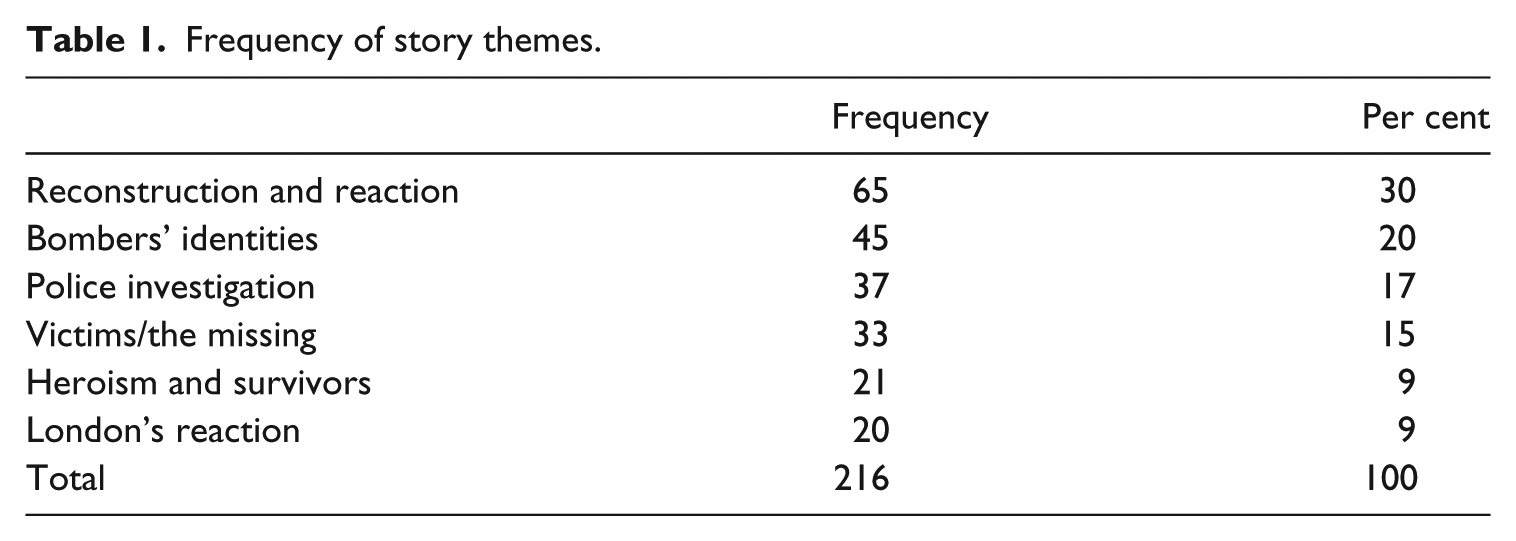
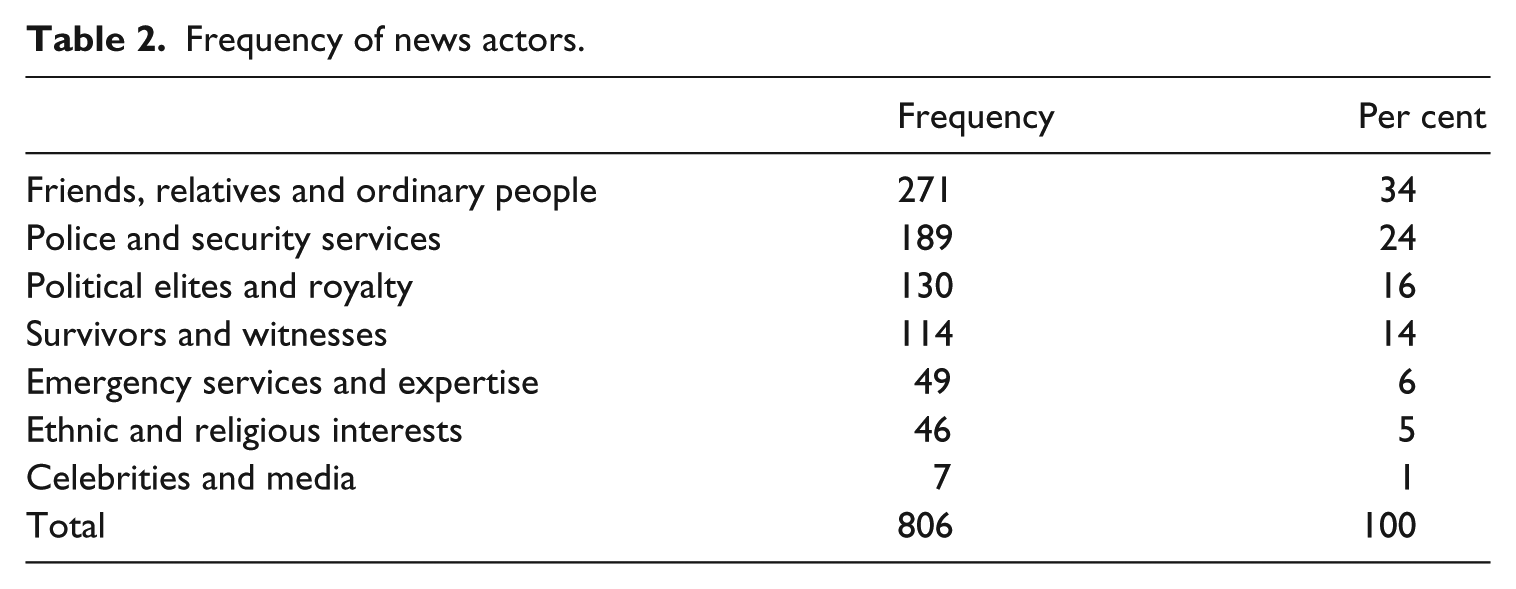
Ritual communication theory is applied here to interpret the news coverage. This predicts that newspapers will fuse wider concerns over the health of the social system in their retelling of the incident, producing from their unified commentary a recognisable, yet ephemeral, reporting genre characterising the moment. To grasp journalists’ reporting of this communicative moment and to assess these predictions, this article followed a specific approach. Of primary importance was to select relevant material – a process that involved collating immediate reactions to the bombing incident across an 8-day ‘aftermath’ period that followed the actual bombings (8 July 2005–15 July 2005). A news database, NewsBank, provided the sample from which three lead articles from each of the nine UK newspapers (and their Sunday equivalents) – The Star, The Sun, Daily Mail, Daily Mirror, Daily Express, The Times, The Telegraph, The Guardian and The Independent – per day were selected, producing an overall count of 216 articles. Of equal concern was to record the features pertinent to this genre of reporting. Three techniques were applied to achieve this aim: First, a content analysis was conducted to capture the significant elements of this reporting. The headline and content of each article were compared to assess their focus, and these foci were then recoded into one of the six categories (see Table 1). Second, a content analysis was conducted of the various news voices that appeared across the sample. Over 50 different actor types were noted as speaking in coverage. These were then recoded into seven general categories for the purpose of analysis (see Table 2). Finally, this analysis recorded the role that each voice played in the story, including voices offering various statements in addition to those of condemnation and solidarity and performing the contrary roles of analysis and explanation.
Frequency of story themes.
Frequency of news actors.
Analysis
In a bid to explore the aftermath coverage of 7/7, this analysis identified the main themes present in 8 days of UK press reporting. Table 1 introduces the ordered elements performed by the newspapers and reveals their similarity with those earlier ideas outlined by Elliott. Evidently, this coverage uses typified reactions to respond to the event. In doing so, newspapers build experiential accounts based on ordinary people directly involved (e.g. tales of heroism and survivors; victims/the missing) and indirectly involved (e.g. London’s reaction) and those focused around considered and analytical responses of the institutionally powerful (e.g. reconstruction and reaction; police investigation – including bombers’ identities), in addition to providing their own coherent account. They report these themes in even number. 2 That these features cohere into a seamless and structured coverage supports the prediction that coverage forms an ongoing political ritual at this time. Further evidence for this can be gathered from exploring the character of the news content as it develops.
Constructing the national wound
Ritual communication theory suggests that coverage will discuss the terrorism event as wounding society. This outcome is produced in the UK coverage and appears primarily through the stories that reconstruct the event and include various reactions to it (n = 65; see Table 1). The newspaper headlines that assist in building this theme provide a place to start the analysis. For instance, those offered on the first day of coverage show the specific foundations of newspapers’ reconstruction of the terrorism event (see Figure 1).
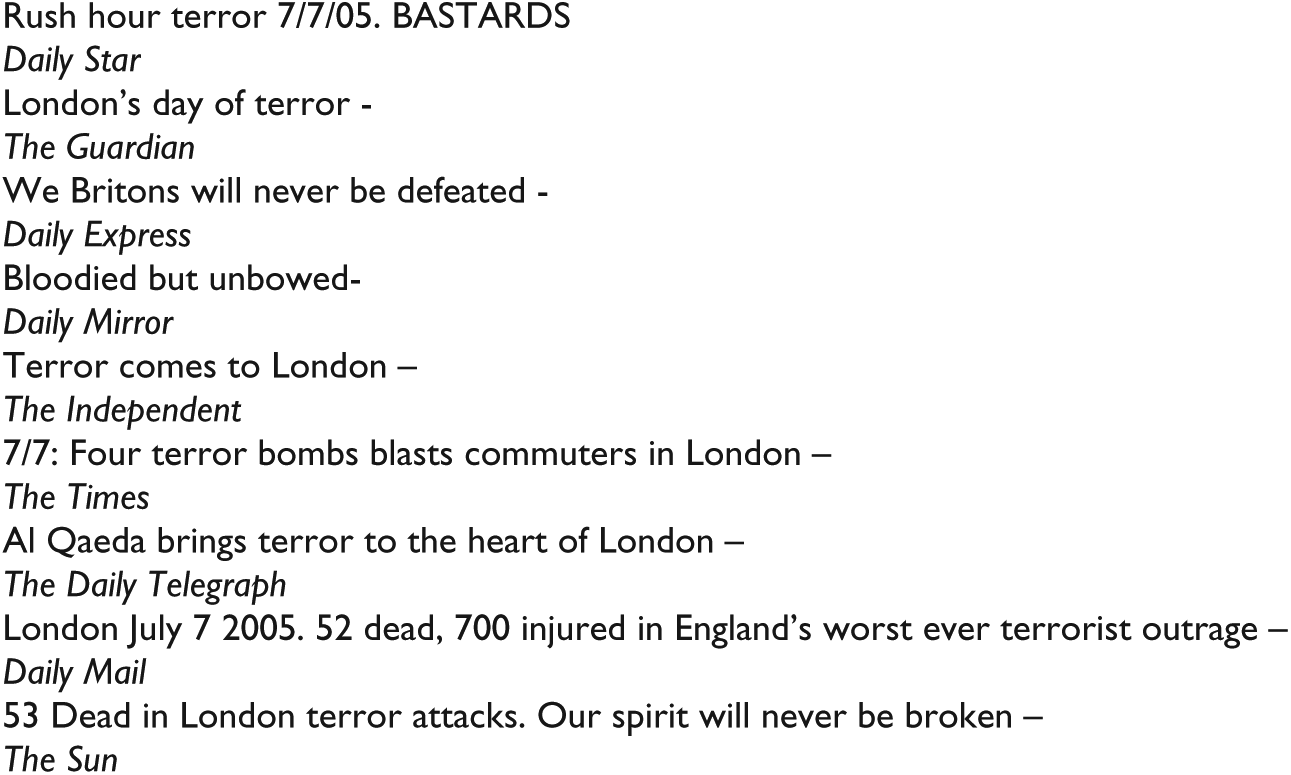
Newspaper headlines (8 July 2005).
The headlines reveal a reporting template is underpinning the coverage. This produces two outcomes in early stories: first, it connects the framing of the event with previous media commentary on recent terrorism (e.g. Al Qaeda brings terror to the heart of London), particularly press speculation that London would become a site for Islamic terrorism following an incident in Madrid, Spain. The fact that this aspect does not overshadow others shows the greater importance the template bestows on constructing a national backdrop to the incident. Second and more specifically, this introduces the nation as a setting on which to construct links between the incident, its victims (those acutely involved) and everyday citizens illustrated by the newspaper readership. As prominent in the mid and lower market newspapers’ headlines, this framing is embedded also in the rest of the accompanying newspaper stories. Together, this coverage articulates not only horror at the incident but also collective resolve in the face of it. The often-used phrase ‘nation’s spirit’ exemplifies the latter and stronger variant that reporting later articulates as ‘blitz spirit’ in coverage.
The reporting template expands these headline reactions into the coverage that follows and in this way shapes its ritual character. Important to these reconstructions of the event is the balance that stories strike between the representation of factual and human-interest elements. Finalised accounts that include background details and commentary are developed first on a foundation of facts. Across the coverage, available incident details are arranged into sentence length summaries as is shown here: ‘In a savage 56 minutes at least 37 people died and 700 were injured as Al-Qaeda inspired killers blasted three rush hour Tube trains in the City and a suicide bomber tore apart a No.30 bus’ (Daily Mirror, 8 July 2005). Thereafter, timelines and maps are used to unpack some of the event details and to demarcate the boundary of the newspapers’ reconstructions. Presented in this space are the timings and locations of bomb detonation and the actions and reactions of the emergency services, as is shown below:
8.51am: Explosion on Circle Line Underground train near Aldgate 8.56: Blast on Piccadilly line train near Russell Square 9.00: Sir Ian Blair, Commissioner of the Metropolitan Police, informed 9.17: Edgware Road Underground station-third bomb explodes 9.33: London Underground services put on amber alert. Trains evacuated 9.40: British Transport Police say power surge incidents caused blasts 9.47: Bomb explodes on no 30 Hackney to Marble Arch bus at the junction of Woburn Square and Tavistock Place 10.00: National Grid confirms no problems with its system 10.00: Mainline stations closed: Euston, King’s Cross, St Pancras, Victoria, Paddington … 10.00: Government’s top emergency committee, COBRA, takes ‘operational command’ of situation. Tony Blair updated at the G8 summit […]. (‘How the Day Unfolded’, The Times, 8 July 2005)
This outline appears in various forms in all of the newspapers. It provides an underpinning for the narratives that weave commentary around the facts in newspapers’ reconstruction stories. A key feature is the tone that this writing adopts. In stories, this leans closer towards established human-interest commentary than distanced objective reportage. Another feature is the use of firsthand testimony. The voices of witnesses and survivors secure positions in these early stories that are maintained throughout the coverage (see Table 2). For example, a witness on an affected tube train, Zeyned Basci, begins, ‘I thought we were all going to die. I was waiting for a fire’, in The Independent’s opening story (8 July 2005). Newspapers do not position ordinary voices in these prime positions in their everyday coverage. At this time, they are included in reporting as reference points for wider commentary on the social wound that follows.
Reflecting this aim, the reporting template slowly moulds personal commentary into wider national commentaries and reactions to the bombings. Firsthand witnesses and later survivors provide the raw material for this process. Accounts of their human suffering accompany newspapers’ descriptions of the ‘horrid and senseless’ bombings and the ‘carnage’, ‘horror’ and ‘atrocity’ of their outcomes. Furthermore, these voices perform as part of the national backdrop to the event that newspapers simultaneously develop. Here, a terminology of the nation is evoked to couch their individual experiences in collective terms, and this definitional work is embedded within narrativised explanations on British life in moments before and those after the incident. Newspapers build this context using references to the normality and national emotion of the previous day in London to add poignancy. Reporting contrasts the national adulation following the successful bid to host the Olympic Games in London in 2012 on 6 July with the assault and injury inflicted on Britain by the bombings a day later. The technique is applied subtly and with sophistication on occasion as an example from The Observer makes clear:
There is a stabbing poignancy, too, in the fact that the memory will contain an echo of the day before: the euphoric high followed by the cataclysmic low. From winning the Olympics on Wednesday, Londoners, some reading of that heart lifting victory as they commuted to work, descended into the horror of the bombings on Thursday. Up to 70 died and 700 were injured, victims of a barbaric and cowardly act. The still mounting list of those missing or feared dead represent a tragic cross-section of our capital. (The Observer, 9 July 2005)
Those reconstruction stories are attuned to the imagined wound inflicted on British society and the ‘asocial and irrational forces’ (Elliott, 1980: 155) behind it. In constructing this social lesion, newspapers denounce the unknown perpetrators as ‘barbaric and cowardly’ and speak of their ‘ruthlessness and meticulous planning’ across their coverage. Another feature of the reconstruction coverage is its focus on the victims. The victims of the bombings are represented in early reconstruction and reaction stories along with those later designated ones on ‘victims/the missing’ (n = 33) as outlined in Table 1. In this position, they become a lens for the ‘human tragedy’. Newspapers use victims in statistical form to quantify the bombing outcomes (e.g. 52 dead, 700 injured in England’s worst ever terrorist outrage – Daily Mail, 8 July 2005) before introducing them discursively as objects of innocence affected by the bombers’ actions. Furthermore, this coverage uses the families of the missing as an entrance point to emphasise the horror in this form, as is shown in this example: ‘the cruellest part of the aftermath of Thursday’s carnage is the long wait for the families and friends of the missing’ (The Times, 11 July 2005). Later in this process, the release of the names and faces of the victims provides material to sustain this focus in coverage. Reflected as part of the larger number in Table 2, voices of the relatives and friends of victims (n = 125) are positioned in those reconstruction and victims stories to introduce something of the character of their loved ones, to witness their last moments or simply to express their loss/grief.
Moreover, the news template begins a symbolic cauterising of the social wound in the time before outlining elite political reaction to the incident. Representations of solidarity illustrated in newspaper accounts of bravery and heroism (Elliott, 1980) are integral to accomplishing this process. This theme appears in 20 stories in the sample (see Table 1), each of which addresses survivors and those who assisted in rescues (e.g. transport workers and emergence services) throughout the week in particularised ways. Individual heroism is a particularly prominent feature that is often repeated as is shown in this example of Paul Dadge:
The good Samaritan. IT was one of the most memorable pictures to emerge from the bomb horror a barefoot woman, her burned face covered in a surgical mask, being led from Edgware Road station by a caring stranger. Yesterday that stranger was identified as Paul Dadge, a part-time fireman who had used his first-aid training to help victims at the scene. (Daily Mail, 9 July 2005)
Such individuals feature across coverage and take their place in reporting focused on the reaction of London residents and the public to the incident. Appearing on 21 occasions (see Table 1), these accounts attribute behaviour displaying ‘courage and resilience’ to them at this time. Combined, they couch observed reactions in national terms, often exploring in this way associations between public behaviour and that in War World II, specifically the mythic idea of London residents’ experience of the German bombing campaign known collectively as ‘the blitz’. In effect, newspapers introduce ‘blitz spirit’ as a shorthand term to refer to individuals’ collective action to carry on with life amid heightened threats of further bomb attacks. ‘Defiance’ in the face of terrorism is a motif similarly embossed on the publics’ observed return to work in these stories, as is shown here:
Bloody but unbowed, London yesterday hurled a defiant message of no surrender to the terrorists, who unleashed four bombs in 56 minutes on the city. Despite suffering Britain’s, worst-ever terror attack, Londoners poured in to work by rail, Tube, car and bus as life returned to normal. (Daily Express, 9 July 2005)
The voices of ordinary Londoners expressing ‘defiance’ in the face of the situation are interwoven within these narratives to bolster this coverage. On occasion, the bombings are suggested as awakening deeper reactions in Londoners and the nation’s psyche as it rekindles ‘… Britain’s passion to defend itself and its way of life from attack’ (Daily Mirror, 11 July 2005). Historical episodes outlining misfortunes endured by the populace of London in different eras follow those expressions on contemporary reactions and develop the theme. Across coverage, these appear in both blatant and lyrical forms – the latter variety is illustrated in the example from The Sunday Times:
As Wren was beginning his work on St Paul’s, a fragment of stone was found bearing the word Resurgam: ‘I shall rise again’. The architect chose to place the stone at the heart of his design, a motto for the renewal of the city. Today, still shocked by the latest blow inflicted upon it, mourning its dead, but mindful of its history and its future, the city is rising once more. (The Sunday Times, 10 July 2005)
As we have seen, the generic reporting template is working to reconstruct this event in the coverage. Selected voices emerge against this patterned backdrop to reinforce these emerging interpretations of the event. Their presence helps to structure the reporting (including headlines) and editorialising on aforementioned national reaction to the bombing incident. An overview of these appears in Table 2.
Voices play an important role in this coverage. The numerical significance of the category of ‘friends, relatives and ordinary people’ (n = 271) demonstrates the human-interest focus in the missing/victims, defiant Londoners and those close to the bombers as we will hear. Voices of survivors and witnesses (n = 114) alongside those of the emergency services and experts (n = 49) materialise to reconstruct the horror of the incident. This discussion will return to some of these voices later. Now, however, it is important to dwell on the positioning of comments from the then Prime Minister and, to a lesser degree, those of The Queen, who together make up the greater number of the ‘political elites and royalty’ category (n = 130). They appear in the headlines and corresponding articles in the first wave of coverage. Their reactions are reproduced wholesale in headlining positions as is shown in these examples: ‘Blair: We will not give in’ (Daily Mail, 8 July 2005) and ‘They will not change our way of life, says the Queen’ (The Telegraph, 8 July 2005). World leaders such as President Bush, significant members of the Cabinet and religious leaders act as a second tier, voicing words of support and addressing particular issues. Articles such as ‘How the world reacted’ (The Sunday Telegraph, 11 July 2005) and ‘Faiths: Religious Leaders unite to condemn evil’ (The Guardian, 11 July 2005) bring an international context to the reactions. Appearing in opening paragraphs, comments voice solidarity such as in this illustration: ‘World leaders led by George Bush stood shoulder to shoulder with Tony Blair yesterday as he issues a defiant “no surrender” cry to the Islamic terrorists who brought carnage to London’ (Daily Mail, 8 July 2005). Ordinary people complete the pattern of comments. Of a wider category (see Table 2) including the relatives of the missing (n = 125) and those of the bombers (n = 66), other ‘ordinary people’ (n = 80) feature most often to offer witness statements or experiential reactions. Appearing occasionally to actually voice defiance or condemnation, their reactions appear most prominently in newspaper summaries, such as in the following two extracts:
As rescuers picked through the blood spattered wreckage and people desperately searched for news of missing loved ones, the people of Britain had a defiant message for the evil bombers who brought terror to London: TO HELL WITH YOU. (Daily Express, 9 July 2005) IS THAT all you’ve got? That was the City traders’ defiant two-finger message to the terrorists responsible for the grotesque murder of their fellow Londoners on Thursday. (The Times, 10 July 2005)
Evidently, the reporting template uses a human-interest angle to reconstruct this incident within a national context. Moreover, this incorporates actual events. The World War II commemorations that followed several days after the bombings on 11 July 2005 are used to cement newspapers’ collective representations of ordinary people’s views, opinions and responses. An example from the Daily Mirror (12 July 2005) illustrates the outcome of this process. Under the heading ‘7/7: War on Britain: Unbreakable’, it explains how ‘More than 50,000 people packed into the Mall yesterday to defy the cowardly terrorists who were determined to bring London to its knees with their bombs’. In addition, reporting includes the voices of war veterans (n = 11) and others speaking reaction statements that reinforce newspapers’ framing. Having gained a sense of the general structure of the early reporting, let us now discuss the features that remain particular to its production of a social drama.
Cauterising the national wound: Elite condemnation, sympathy and solidarity
As has been introduced above, representations of the thoughts and reactions of political leaders feature prominently in and across the early coverage. Of the 120 stories on reconstruction and reaction in which these appear, their voices offer condemnation, solidarity and claims on political intentions and actions.
3
A portion of stories (n = 26) appearing early in coverage focus on elites’ voiced condemnation. Viewed in context of the social drama in which they participate, these reported segments offer forthright denunciation of the terrorist incident, adding gusto to the newspapers’ performance of what Elliott (1980) summarises as commentaries on society as under attack from ‘irrational and asocial forces’ (p. 149). Broadsheet, mid-market and tabloid coverage include statements on the London bombings in line with this, providing most space to the reported comments originating from the then Prime Minister, Tony Blair, as is demonstrated in this example:
Speaking for the entire free world, Mr Blair told reporters ‘we condemn utterly these barbaric attacks. We send our profound condolences to the victims and their families. All of our countries have suffered from the impact of terrorism. Those responsible have no respect for human life. We are united in our resolves to confront and defeat this terrorism that is not just an attack on one nation, but on all nations and civilised people everywhere’. (Daily Express, 8 July 2005)
In addition, others condemn the bombings including the police and security services (n = 7), friends and family of victims (n = 9) and ethnic and religious groups (n = 23), survivors, witnesses and celebrities at lesser amounts. With the effect to reproduce elite voices’ framing of the event, their words and phrases are visible across the coverage. For instance, stories (n = 26) reproduce several phrases. Specific utterances on the ‘barbaric’ and ‘ruthless’ perpetrators from the Prime Minister become preferred definitions these stories carried along with descriptions of a ‘poisonous ideology’ as the motivating factor for the terrorists’ actions. Included across coverage also is the phrase ‘Britain’s values’ that The Guardian explains as ‘tolerance and mutual respect for those from different cultural and ethnic backgrounds’ (The Guardian, 8 July 2005). The phrase ‘British way of life’ as similar to ‘British values’ is also reproduced widely in coverage to explain what must be promoted and protected in context of this incident. However, there is a complexity to the way that these newspapers introduce condemnatory comments.
Newspapers reproduce the reporting template yet introduce news voices in stories in ways common to their news forms. The more expansive and politically sensitive broadsheet newspaper form embeds condemnatory comments within a larger narrative on the bombings. The Times, for example, places the Prime Minister’s voiced condemnation to the end of its article (entitled ‘Revulsion and resolve – the need for extra vigilance after the London terrorist outrages of 7/7’), followed by the soothing words of ‘Despite the shock, horror and outrage, the calm shown in London was exemplary’ (8 July 2005). The level of detail, accessed voices and variety of topics contrast sharply with the character of the mid-market and tabloid newspaper coverage. Despite the size of their story formats resembling broadsheet newspapers rather than their tabloid cousins, the Daily Mail and The Express develop narratives around large sections of the then Prime Minister’s speech. Before detailing his words, the Daily Mail announces its story with ‘Yesterday, trembling with emotion, Mr Blair was grappling with a crisis London had been warned was inevitable ….’ (8 July 2005), while the focus of the Daily Express story is read clearly from its headline, ‘Blair’s steely resolve is needed more than ever’ (8 July 2005). Moreover, elites’ voices are integral to the character of tabloid news coverage of the event. As similar to the form adopted in mid-market newspapers, tabloid stories centre on speech quotations as is expressed by The Sun’s headline ‘We shall prevail … terrorists shall not: Blair’s words of defiance’ (8 July 2005) and the Daily Mirror’s lead ‘War on Britain: They’ll never succeed’ (8 July 2005). Both articles similar to that from The Star go on to summarise the reactions given in speeches by Tony Blair and others. Despite these observed differences, similarities continue in the newspapers’ reporting of the reactions to the bombings and their enacting of the political ritual.
Furthermore, newspapers provide opportunities for the institutionally powerful to express notions of sympathy and solidarity in equal measure (Elliott, 1980: 163). Elites voice sympathy in 21 stories early in the coverage, with each episode framed in a fashion similar to those commentaries on condemnation. Stories provide opportunities for selected individuals to express these notions, with The Queen appearing most frequently alongside the then Prime Minister. Her public address delivered to hospital staff is reproduced verbatim in the newspapers as this example from The Times illustrates:
The Queen addressing 250 staff at the East London hospital, which received many of the injured from the explosions said ‘atrocities such as these simply reinforce our sense of community, our humanity, our trust in the rule of law’. […] Evoking the spirit of the Blitz as she led a day of commemoration of the end of the Second World War, the Queen said ‘Sadly, we in Britain have been all too familiar with acts of terror, and members of my generation, especially at this end of London, know we have been here before. But those who perpetrate these brutal acts against innocent people should know that they will not change our way of life’. (The Times, 9 July 2005)
In addition to the presence of the Head of State and other political elites on the news stage, similar opportunities are granted to representatives of religious and ethnic groups (n = 10), ordinary people (n = 10), the police (n = 2) and others at lesser numbers in these stories. Nonetheless, replicated wholesale in their headlines are elite groups’ messages of sympathy and statements of solidarity, the substance of which literally frame the direction of news commentary as is shown here: ‘A nation united in courage’ (Daily Mail, 11 July 2005). Comments and responses of other political and religious dignitaries emerge to have a collective effect also. Newspapers recycle the comments of elites to construct a collective idea of solidarity. Reproduced in the 21 stories are common discursive formations – our way of life/our values/our sense of community/our societies – that appear here to explain the focus of what has been threatened by this act of terrorism, for example. These terms ‘our doggedness/our resolve/our determination’ are reproduced from speeches to introduce the national reaction to the bombings – comments which evolve into ‘our spirit/blitz spirit/our courage’ in later coverage. Furthermore, newspapers’ commentary on the reaction of the people of London to the bombings is constructed using aspects of the Queen’s speech and is shown thereafter applying these following terms: ‘defiantly/defy/defiant’. Amid this conformity, a complexity lurks in their mediation in a way similar to observed differences in newspapers’ expression of condemnation.
Healing the social wound: Political action and law and order
Elliott (1980: 149) reminds us that newspaper coverage of terrorism will include law and order considerations, and these appear to represent societies’ response to the terrorism incident. Overshadowing stories on elite comments on condemnation and solidarity are those that focus on elite statements and comments on political action (n = 73). In addition to reasserting political intentions to find the perpetrators, political elites voice desires to change legislation, including gaining access to individuals’ personal phone communications, restricting entry to Britain for radical Muslim clerics and producing new legislation to fight the ‘perverted ideology’ underpinning the attacks. In addition, stories on the police investigation (n = 37) and those focusing specifically on the bombers’ identities (n = 45) occur throughout coverage (see Table 1). The place of police and security service representatives in the overall number of voices in coverage (see Table 2) reveals their significance within these newspaper discussions. In stories, the voices of the UK police services and the security services (n = 189) offer statements and explanations on the ongoing investigation or reveal their thinking or analysis on occasions. These voices discuss issues in a consensual manner – a position on these undertakings which newspapers do not challenge, preferring in these instances to have issues of law and order dictated to them. Furthermore, the comments from Sir Ian Blair, The Metropolitan Police Commissioner, feature repeatedly (n = 16) to reassure victim’s families, offer appeals for calm and provide a context to the investigation in terms of explanations or condemnation on those involved, the latter featuring here:
Metropolitan Police Commissioner Sir Ian Blair described the atrocities yesterday as a ‘pitiless example of man’s inhumanity to man’. After visiting one of the bomb sites, Sir Ian said Scotland Yard would be ‘implacable in its determination to find the people responsible’. (Daily Mail, 12 July 2005)
When newspapers discuss the case, it is only to celebrate the agents of the state and their ongoing handling of the incident. They introduce complimentary statements such as ‘remarkable’ (e.g. Daily Mirror, 8 July 2005) in these reviews that allow only for the barest hint of criticism towards these agencies as either ‘unprepared’ (The Times, 8 July 2005) or later ‘unresponsive’ to the families of the missing (The Guardian, 12 July 2005). Praise and support for the reaction to and performance within the incident by emergency services feature widely at this time and are extended to the then Prime Minister, Tony Blair, as is shown in the following sentiments:
One does not have to be a Labour supporter to acknowledge the skill and authority with which Mr Blair responded. He struck exactly the right balance between expressing sympathy for the victims and displaying a Churchillian determination to defeat the terrorists. (Daily Express, 8 July 2005)
As a result, incident details and not political conflict dominate coverage of law and order as the newspapers track the wider investigation to find those responsible for the bombings. Intrigued by what one newspaper describes as ‘the biggest criminal investigation in British history’ (The Independent, 8 July 2005), others explore the daily efforts of police and security forces, including details on their forensic examinations, lists of suspects, hunts for terrorist cells and their summaries on the overall progress of the investigation. Nonetheless, revelations of the bombers’ identities and residences on 12 July 2005 shatter the uniformity in this line of the reporting and newspaper coverage moves towards analysis and explanation.
Press analysis and explanation
Table 1 shows that the second most significant number of stories in the sample discuss the identities of the bombers (n = 45). In line with previous coverage, these stories develop the account of the national context to the incident. Their commentary responds first to revelations on (1) the perpetrators’ status as UK citizens and (2) those reactions from relatives that explain them as fully integrated within local institutions and domestic and work environments. As a representative headline from the Daily Mail shows, newspaper coverage is openly wrestling with the ‘ordinary origins’ of this extraordinary event at this time: ‘Suicide bombers from suburbia’ (Daily Mail, 13 July 2005). They mobilise ideas of ordinary Britishness to assist in their explanations. Formed in this way, newspaper commentary articulates the surprise and repulsion of local residents to news of the bombers’ residences. The Independent illustrates this as ‘Reaction in Yorkshire: This is a normal place where people do normal things’ (The Independent, 13 July 2005). After commenting on their locations, this coverage responds next to the bombers.
A significant number of these stories mobilise a construction of banal Britishness and its sanctity to tease out something impure motivating the bombers. For example, in early coverage, these individuals are characterised into generic types with a degree of variation. A first version from the Daily Star poses the perpetrators as ‘The mastermind; The smooth bachelor; the Leeds United fan; The gentle giant’ (Daily Star, 13 July 2005), themes similar to The Telegraph’s formulation of ‘The cricketer; the teacher; the teenager; the fourth man’ (The Telegraph, 14 July 2005) and the Daily Mirror’s formulation of ‘The four fanatics: The teenager; the teacher; the graduate; the mystery Russell Square bomber’ (Daily Mirror, 14 July 2005). With the exception of the ‘mystery’ or ‘mastermind’ figure, the theme of the perpetrators as ‘ordinary’ people is emphasised to assist in newspapers’ evaluations of their motivations. A significant number of comments from the suspects’ friends and family in addition to their neighbours are used to support this view (n = 66). Where neighbours offer witness statements on the suspects’ movements, their friends and family members voice either statements on the bombers’ moral characters (often as ordinary ‘nice’ people) or those of shock, disbelief or denial at the allegations of their actions. None of these performances develops newspapers’ general understanding. Hence, the question ‘Why four men turn to terror?’ forms the title and subject of an article in The Independent, like many others:
What turned seemingly ordinary young men into suicide bombers prepared to sacrifice their lives to commit mass murder? The pieces of the jigsaw are now emerging, charting the journeys of the dedicated teacher, the cricket-loving student, the self-effacing teenager and the fitness enthusiast into martyrs for a virulent brand of Islam. (The Independent, 13 July 2005)
The questioning tone is reproduced across the coverage along with an acknowledged difficulty to reconcile the bombers’ lives with their later actions on 7th July 2005. The following story featuring in the Daily Mirror entitled ‘The Voice of the Mirror: An act of the insane’ provides a useful illustration:
THE more we discover about the bombers, the harder it is to understand them. They were ordinary young men. No different, apparently, from countless others. Their family and friends saw nothing unusual in them. They found them kind, normal and decent. One was a primary-school teacher. A father with another baby on the way. Another was a teenager who loved cricket and planned to go to university. Another was already a graduate. Yet these were the cold killers who slaughtered scores of genuinely ordinary people. (Daily Mirror, 14 July 2005)
Establishing the sanctity in the ordinariness of the bombers’ British lives and locations allows the newspapers to uncover ‘a virulent brand of Islam’, as The Independent describes it above, as a present and motivating factor in their local communities. As this rudimentary analysis and explanation develops, the influence of the template on collective reporting diminishes. It is at this moment that newspapers begin to return to their original reporting norms.
Conclusion
This article has explored the reporting of the London Bombings 2005, finding that UK newspapers produce coherent and marked repertoires in response to this event. To the literature on media and terror, it has introduced a communicative moment characterised by structured connections between reporting rather than simple similarities. Notably, newspapers produce reconstructions of the terrorism event that include the voices of significant societal actors and represent society in action. Newspapers’ readers are invited here to share understandings of the incident and its aftermath, witness condemnation and representations of solidarity as well as the efforts of law enforcement and ordinary citizens to manage the crisis.
From Elliott’s (1980) perspective, this is an example of an enacted political ritual that provides a narrow response to the incident underpinned by elite political commentary. What he calls the ‘enactment’ between the social drama produced by newspapers and the definitional activities of political elites can be examined further with regard to the insights from this case study. It is only by considering the interaction between political actors and newspapers in constructing a national context to the bombings do we understand how this coverage forms and works. Interwoven into these accounts were references to constructed ideas of Londoners and British citizens. Both political actors and newspapers engaged collectively in connecting the bombings to historical episodes, the most prevalent of which – the ‘blitz spirit’ idea – was used as a shorthand to explain their contemporary reactions and resilience. Ideas of Britishness were also used to comment on the bombers. As offset against ‘a virulent brand of Islam’, these ideas helped newspapers to reflect on the motivation behind the incident. In short, the constructed context in which voiced condemnation and solidarity emerge in reporting is significant.
Its presence demands we look closely at the relationship between this enactment and those elements of the Elliott’s press rite. Although the press rite provides an outline for the social drama, it does not recognise the ideas of the nation as underpinning newspaper reconstructions or predict the ordering of those elements that newspapers reproduce. In contrast, this close study of the UK aftermath coverage has described the communicative moment when newspaper journalists stage various elements of the social drama in unison. Those observed similarities point to the fact that journalists are using a reporting template. Recognising this feature helps to ground coverage in journalists’ culture and explain how similar reporting practice occurs among journalists positioned differently across a structured UK news ecology.
Furthermore, this view reveals that journalists do not stand outside of their national communities when reporting such incidents (Schudson, 2002). As we have seen, their reporting of terrorism on home soil involves more than reproducing a ‘prose of solidarity’ (Schudson, 2002). In operation, the reporting template negotiates observed complexities at the level of the individual newspaper story and their positioning of voices to reconstruct events and reactions. Additionally, this sensitises us to the importance of temporal context for explaining those observed connections between society, culture and news reporting. It is in the aftermath period of incidents where coverage on condemnation and solidarity usurps critical analysis and explanation that we witness a reaffirmation and thus display of associations between the political elite, dominant discourses of the nation and UK newspapers. Given these insights, it would be appropriate next to go behind the headlines and research the construction of this coverage with newspaper journalists before doing so with other news voices. Furthermore, we could compare this newspaper discourse with the UK television coverage of the 7/7 bombings to explore the additional impact of visual formats of news (Altheide, 1987; Schlesinger et al., 1983) on the emphasis adopted in television news reporting of this incident.
Footnotes
Declaration of Conflicting Interests
The author(s) declared no potential conflicts of interest with respect to the research, authorship, and/or publication of this article.
Funding
The author(s) received no financial support for the research, authorship, and/or publication of this article.