




Abstract
Conflicts that occur across ethnic and/or religious identity lines generally have underlying root causes such as economic marginalization and political competition. Yet when these causes are ignored by politicians and the media, and conversely differences in ethnicity and religion are simply propagated as the main conflict causes, this may have serious consequences for people’s perceptions concerning the possibility and feasibility of peaceful conflict resolution and coexistence. In this paper, we investigate to what extent Nigerian newspapers practice peace journalism by emphasizing underlying causes of conflict in their reporting rather than stressing ethnic and religious divisions. We make use of a sequential mixed methods approach, which combines a quantitative content analysis of news reports with semi-structured interviews with Nigerian newspaper editors and journalists. Our results indicate that Nigerian newspapers do not explicitly use divisive language when discussing conflicts, but they rarely stress underlying structural causes either. While there is a willingness among Nigerian journalists to avoid potentially escalatory language, a dearth of resources and capacities impedes independent and in-depth analysis concerning the underlying drivers of conflicts.
Keywords
Introduction
In diverse societies, mass media may contribute to exacerbating inter-group tensions and violent conflict as well as promote national unity and stability. The most famous example of the media’s potential negative role in contributing to violence is arguably the case of Rwanda, where fake news designed to generate fear and distrust, and recurrent references to the Tutsi people as cockroaches by Radio Libre des Mille Collines, paved the way for the 1994 genocide (e.g. Des Forges, 1999). In Kenya, however, Onyebadi and Oyedeji (2011) found that in contrast to what they call the ‘Rwandan model’, newspapers propagated messages of peace and unity in the wake of the 2007/2008 post-electoral crisis.
Whether a country’s media contribute to fuelling or mitigating inter-group divisions can depend, for example, on the media’s level of independence from political inference or media outlets’ level of professionalism and training. Given the diversity of media landscapes across countries, the actual impact of the media on the political situation and conflict dynamics may differ sharply from case to case. Interestingly, while the study of (foreign) conflict reporting in Western news media already has a long history (e.g. Galtung and Ruge, 1965), relatively less attention has been devoted to the representation of domestic conflict in developing societies. This paper aims to contribute to this latter field of study by analysing how Nigerian media have reported on recent conflict events in the country.
Nigeria is a highly ethnically and religiously diverse country, which has experienced severe and recurrent violent conflict and political instability since gaining independence in 1960. While many violent conflicts have had a clear ethno-religious dimension, cultural differences as such were usually not the main causes for these conflicts to emerge (Langer et al., 2009). Indeed, most conflicts appear to have been caused by the presence of severe political and economic ‘Horizontal Inequalities’, corruption, and elite competition for resources and power (Langer et al., 2009; Stewart, 2008). Illustratively, these factors were not only at the heart of the secessionist Biafra conflict in the 1960s (Graf, 1989: 41–43), but are also crucial for explaining the lingering ‘secessionist’ tensions in the South-East, the insurgency in the Niger Delta region (Obi and Rustad, 2011), the Boko Haram crisis in the North-East (Langer and Demarest, 2017) and herder-pastoralist violence in Nigeria’s Middle Belt (Olabode and Ajibade, 2010). Importantly, when the underlying economic and political causes of these conflicts are ignored by politicians and media, and conversely cultural differences are simply propagated as the main conflict causes, this could give rise to ‘primordial’ views on ethnicity and religion among the general population. While a widely discredited view among academics, primordialism essentially sees conflicts to be the almost inevitable result of (ancient) hatred and animosities between different ethno-cultural groups (e.g. Varshney, 2009). Clearly, the dissemination of primordial views of conflict by media and politicians alike may have serious consequences for people’s perceptions concerning the feasibility of peaceful conflict resolution and coexistence.
Indeed, in the literature on peace journalism (e.g. Lynch and McGoldrick, 2005), stressing the underlying causes of conflict is argued to hold the potential to change media audiences’ views on the nature of conflicts and their intractability. ‘Peace journalism’ was originally conceptualized by Johan Galtung and contrasted with ‘war journalism’ (Galtung and Fischer, 2013). The latter is defined as war/violence-oriented, propaganda-oriented, elite-oriented and victory-oriented, while the former is peace/conflict-oriented, truth-oriented, people-oriented and solution-oriented. Peace journalism intends to change the representation of armed conflict to support conflict transformation by stressing potential solutions and peacebuilding efforts, seeking out the root causes of the conflict, and avoid seeing the conflict in black and white terms as opposed to focusing on violence, military strategy, and winners and losers.
Peace journalism encompasses a broad array of representational strategies. In this article, we focus on one element of peace journalism, that is, the way emphasis is placed on root causes of conflicts. We draw on framing theory, as the causal interpretations of conflicts in news reports can be analysed from a media framing perspective (Entman, 1993). In line with framing theory and empirical evidence, it is important to qualify the effect framing has on audiences’ attitudes and behaviours, however. It is widely agreed, for instance, that the effects of media messages are dependent on individuals’ prior beliefs and preconceptions (Scheufele and Iyengar, 2017). While studies focusing on the effects of peace journalism do find positive changes in audience’s empathy and understanding, these results are often also dependent on prior beliefs (Kempf, 2017: 8–12; McGoldrick and Lynch, 2016). Nonetheless, analysing the frames used in news reports remains an important research line as it investigates the messages media outlets produce as well as the messages audiences are exposed to.
In order to systematically analyse conflict framing in Nigerian newspapers, we employ a sequential mixed methods approach, which combines a quantitative content analysis of news reports with semi-structured interviews with Nigerian newspaper editors and journalists. For our content analysis, we define a set of issue-specific conflict frames (e.g. De Vreese, 2005), which largely correspond to the main causal models available in the contemporary conflict literature and focus on ‘Religious’, ‘Ethnic’, ‘Demographic’, ‘Economic’ and ‘Political’ causes of conflict. The Religious and Ethnic frames can be considered ‘primordial’ frames, as they refer to cultural differences as such as the main cause of conflict. The other causal frames direct attention to more structural causes. The reports analysed consist of all news reports on conflict events which have appeared in three Nigerian newspapers – The Guardian, ThisDay and The Nation – in the period April 2014–March 2015. This corresponds to the 1-year period before the 2015 presidential elections and was also a period in which the Boko Haram conflict and violent inter-group conflict in Nigeria’s Middle Belt were particularly active.
The content analysis shows that the selected newspapers rarely use inciting language depicting diversity or a particular religion/ethnic group as the cause of conflict, even when discussing Boko Haram and violence that occurs along ethnic lines. This appears to be a positive finding, but we must also acknowledge that underlying structural causes are discussed even less frequently. While not explicitly depicting violence as caused by ethnic or religious differences, the mentioning of particular groups and group names (e.g. ‘Boko Haram’, ‘Fulani herdsmen’) can still support implicit associations with identity as a cause of conflict, especially when these messages are not complemented by in-depth analyses of the main causes of these conflicts.
In our interviews, we further explore the underlying considerations for the press to report in this manner. Our analysis shows that Nigerian journalists, out of a sense of social responsibility, consciously aim to avoid divisive and potentially escalatory language, but that a dearth of resources and capacities impede independent analysis concerning the underlying drivers of conflicts. These findings correspond to earlier studies on conflict reporting in African news media, which relate gaps in in-depth reporting of causes and attention to different sides in the conflict, to structural weaknesses in the media field rather than to a ‘Rwandan model’ of deliberately enflaming tensions (e.g. Hackett, 2003: 61–63; Khan, 1998; Omenugha et al., 2013; Rodny-Gumede, 2015). This is important from a policy perspective as it supports the view that more (donor) investments in news media in divided contexts can enable them to play a more supportive role in peacebuilding.
This article proceeds as follows. In the next section, we first briefly reflect on the role of the Nigerian media in conflict in the country. Section ‘Research design’ presents the quantitative research approach and the dataset, while section ‘Results’ discusses the results of our content analysis. Section ‘Insights from Nigerian journalists and editors’ contextualizes the findings by drawing on interview data. Section ‘Conclusion’ concludes and identifies some interesting avenues for future research.
The media’s role in conflict in Nigeria
Nigeria is known to have one of the most vibrant (print) media landscapes in Africa with numerous publications circulating on a daily basis (Freedom House, 2016). Historically, newspapers helped to shape public opinion towards independence in 1960, and played a virulent role in criticizing authoritarianism and corruption under previous civilian as well as military regimes (Adebanwi, 2002; Ekwelie, 1979, 1986). Since the inception of Nigeria’s Fourth Republic in 1999, the press media has continued to play a watchdog role by revealing high-profile cases of corruption and fraud, and by opposing unpopular government decisions (Adesoji, 2010). Hence, the media in Nigeria often demonstrate themselves to be strong supporters of democracy and accountability.
Yet, the media have also played a more dubious role in Nigeria by reinforcing ethnic and religious divisions in the country. Many press publications have been, and continue to be affiliated to political parties and strongmen, which commonly rely on ethno-regional voter support (e.g. Adesoji, 2010; Yusha’u, 2015: 144–145). Press media were used to sow distrust among the major ethnic blocs in the run-up to independence and during the First Republic, for instance (Adebayo, 2017: 146–148). Press freedom was curbed under military rule, in part to prevent these forms of ethnic hate speech and promote unity (Agbaje, 1993).
The Second Republic (1979–1983) saw inciting language and hate speech come back to the fore (Ekwelie, 1986). And while the Third Republic (1993) never really came into function, divisive language in the media has also been pointed out as a major problem of the Fourth Republic. Scholars have argued that Nigerian newspapers still show an ethno-regional bias in conflict reporting, especially along North–South and Muslim-Christian fault lines. Biases in the reporting of Northern and Southern newspapers have been found with regard to the 2002 Hausa-Yoruba clash and the Danish cartoon crisis of 2006 (Omenugha et al., 2013: 102–103), the violent Muslim-Christian riots of 2008 in Jos (Musa and Ferguson, 2013), and the 2009 Niger Delta and Boko Haram crises (Yusha’u, 2015). Media reports may not only fuel tensions in the way they report on politically sensitive issues, however. In certain cases they may actually directly trigger violent reactions. In 2002, for example, a ThisDay-newspaper report concerning the Miss World pageant was considered blasphemous by important sections of Nigeria’s Muslim community and led to Muslim-Christian violence in Kaduna.
Since the start of the index, Freedom House has consistently rated freedom of the press in Nigeria as ‘Partly Free’ (2002–2016). This is mostly due to stringent press laws, harassment of journalists and bribery in media reporting. While these issues are worrying, the topic of press laws, often remnants of military rule, is also interesting as it reveals how Nigeria still appears to struggle with on one hand, supporting democratic competition and debate, while on the other hand avoiding divisive media messages. Indeed, hate speech and fake news continue to be prosecuted in Nigeria. In 2017, for example, a journalist was jailed and sued for reporting a false Fulani attack. 1
Research design
As mentioned in the ‘Introduction’, we make use of a mixed methods design, combining quantitative content analysis with semi-structured interviews. In this section, we describe the quantitative research strategy. While previous analyses on divisive reporting in Nigeria have relied on qualitative approaches, focusing on language use, the identity of actors cited in reports and specific cases (Musa and Ferguson, 2013; Omenugha et al., 2013; Yusha’u, 2015), this quantitative research approach allows for higher generalizability of findings, but focuses on a more narrow topic, that is, the reporting of conflict causes.
Newspaper data
For our empirical analysis, we make use of news reports on conflict which have appeared in three Nigerian newspapers in the period April 2014–March 2015. This corresponds to the 1-year period before the presidential elections on 28 and 29 March 2015. 2 The reports were selected from hard-copy newspaper issues by the coder team based on a series of indicative key words. Interviews, editorials and opinion pieces were excluded in order to focus on actual news journalism practices. Conflict events concern protests, strikes, riots, armed conflict and terrorist attacks. The newspapers selected are The Guardian, ThisDay and The Nation. All three newspapers are nationally distributed, although their production offices are based in the south of the country. From their advertisement – a major indicator of political affiliation in Nigeria – The Guardian and ThisDay appear to have been oriented towards the then incumbent government of the Peoples Democratic Party or PDP. The Nation leans towards the former main opposition party, the All Progressives Congress, and is owned by APC strongman Bola Tinubu.
A possible shortcoming is that the news reports used do not reflect reporting in the north of the country, which could differ substantially. The major Northern newspaper, the Daily Trust, was not available in Lagos during the data collection period (Summer 2015), while travels to Abuja were restricted for security reasons. Nonetheless, most violent conflict took place in the North, including Boko Haram conflict and herder-pastoralist clashes in Central Nigeria. Hence focusing on how Southern newspapers report on these establishes a ‘most likely case’ of ethnically or religiously biased reporting.
It is also important to note that, as in many developing countries, newspaper reading in Nigeria is limited to a small sub-section of citizens. 3 This group is, however, highly relevant for our analysis, as it forms part of the country’s political and economic elite and is therefore important in terms of policymaking. Furthermore, a broader audience reads the newspaper front pages, commonly hanging out at vending stalls. In our analyses, we also include a front-page indicator variable to investigate how reports may differ from others in the paper. We reflect further on the above-mentioned shortcomings in our discussion of further research directions.
To select relevant news reports, all newspaper issues between April 2014 and March 2015 were read by the coder team to identify events taking place in the same period. Reports of events that had taken place before April 2014 were not included. If an event was described in more than one report, it was coded each time it was mentioned in a report. If a report described more than one event, each event mentioned in the report was coded separately. The data used closely correspond to the methods of communication scholars focusing on the relative exposure of audience members to specific messages, or here, frames. A first important difference is that we do not work with a sample of events, but have aimed to record all reports concerning conflict events. 4 A second important difference is that the unit of analysis is the fragment of a specific article concerning the event rather than the whole article. However, the dataset allows us to cluster on report to compensate for similarities in framing in case multiple events stem from one report.
Content analysis
Most of the quantitative content analysis focused on events, locations, timing, actors involved and so on. Yet we also constructed specific variables to measure the use of Ethnic, Religious, Economic, Political and Demographic frames on conflict causes. As mentioned above, peace journalism entails a broader array of representational characteristics than investigated here. Our coding scheme can be associated with Galtung’s peace/conflict-oriented dimension of peace journalism (Galtung and Fischer, 2013) as well as one of the five main characteristics of peace journalism as identified by Shinar (2007), that is, providing background information on conflicts and its causes by taking into account all sides in a conflict. Other characteristics are not considered in the purview of this research, such as the reporting of peace initiatives.
Ethnic and religious framing of causes relates conflict to divisions between cultural groups. The economic and political frames rather see conflict as the result of economic interests, poverty and inequality, or political competition. Finally, the demographic frame relates conflict to problems of population pressure and large youth populations (e.g. Urdal, 2004). The frames can be termed ‘issue-specific frames’ (De Vreese, 2005). The five frames are measured by coders via indicative yes/no questions (see Table 1).
Operationalizing media frames on conflict causes.
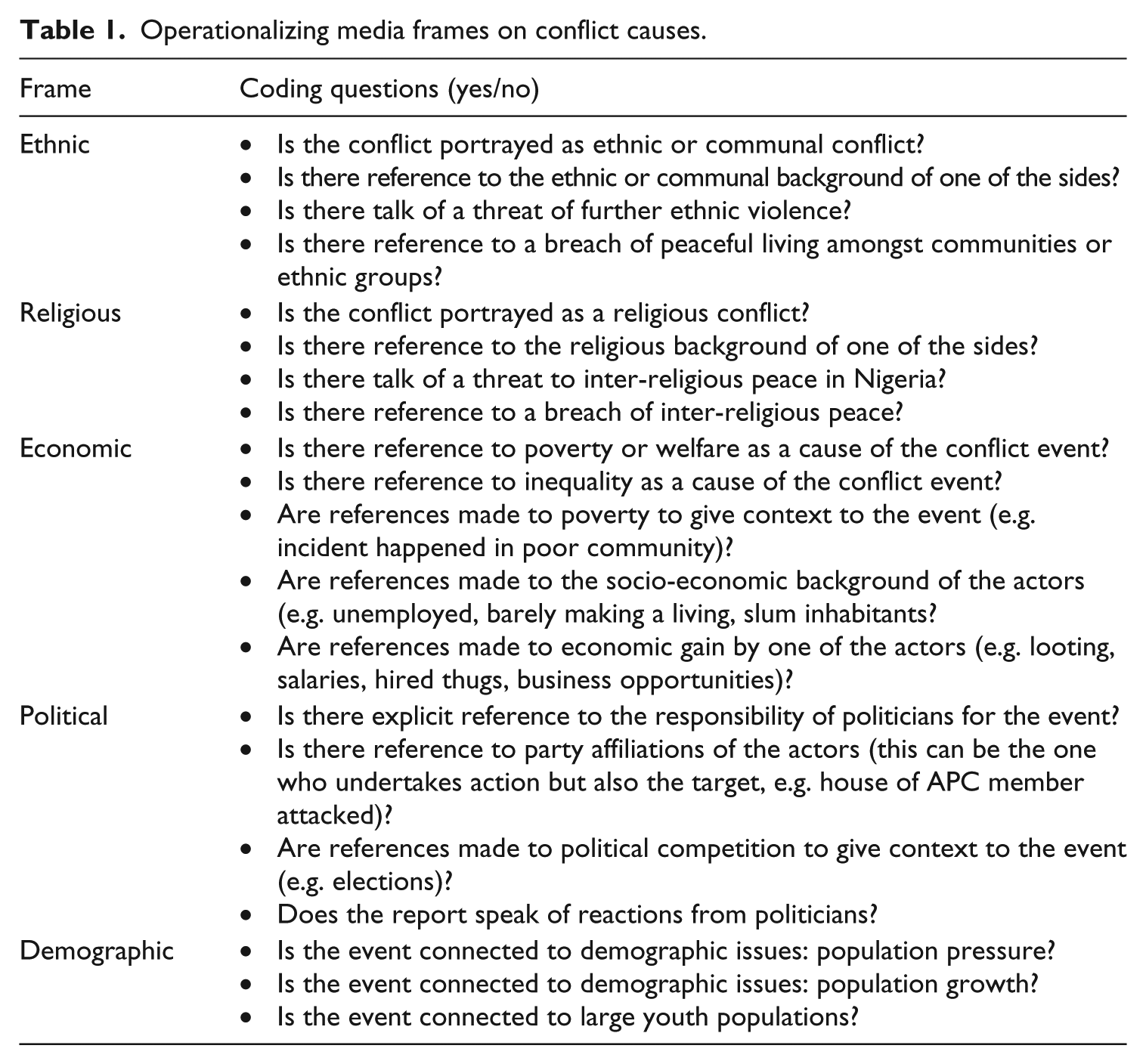
As the presence of the frames is not mutually exclusive, we also included the following question in the codebook: ‘Which of the frames is most dominant? The dominant frame is the frame that is mentioned the most in terms of length/focus of the article: None of the frames, Ethnic, Religious, Economic, Political, Demography’. It is important to point out that ‘None’ does not necessarily mean that no causes are discussed, but that it is not necessarily captured by the frames defined here. This is mostly applicable to protests, which can also be a reaction to human rights violations. As this six-category variable was measured with the highest inter-coder reliability, we use it for our subsequent analyses. Krippendorff alpha scores for this variable ranged between 0.63 and 0.93, with the lowest score also based on the lowest N (63) (Krippendorff, 2013). Nonetheless, summing the binary variables to construct frame indices provides similar results.
Besides analysing the overall use of causal conflict frames in news reports, we also distinguish between event types and investigate whether different events are framed differently. The event type variable (Krippendorff alpha > 0.85) distinguishes between strikes, protests, riots (violent protests or mob justice), kidnappings (kidnapping for non-criminal purposes), armed attacks (assassination attempts, battles government troops and rebels, violence against civilian populations etc.) and terrorist attacks (IED, suicide bomber, car bomb, etc.).
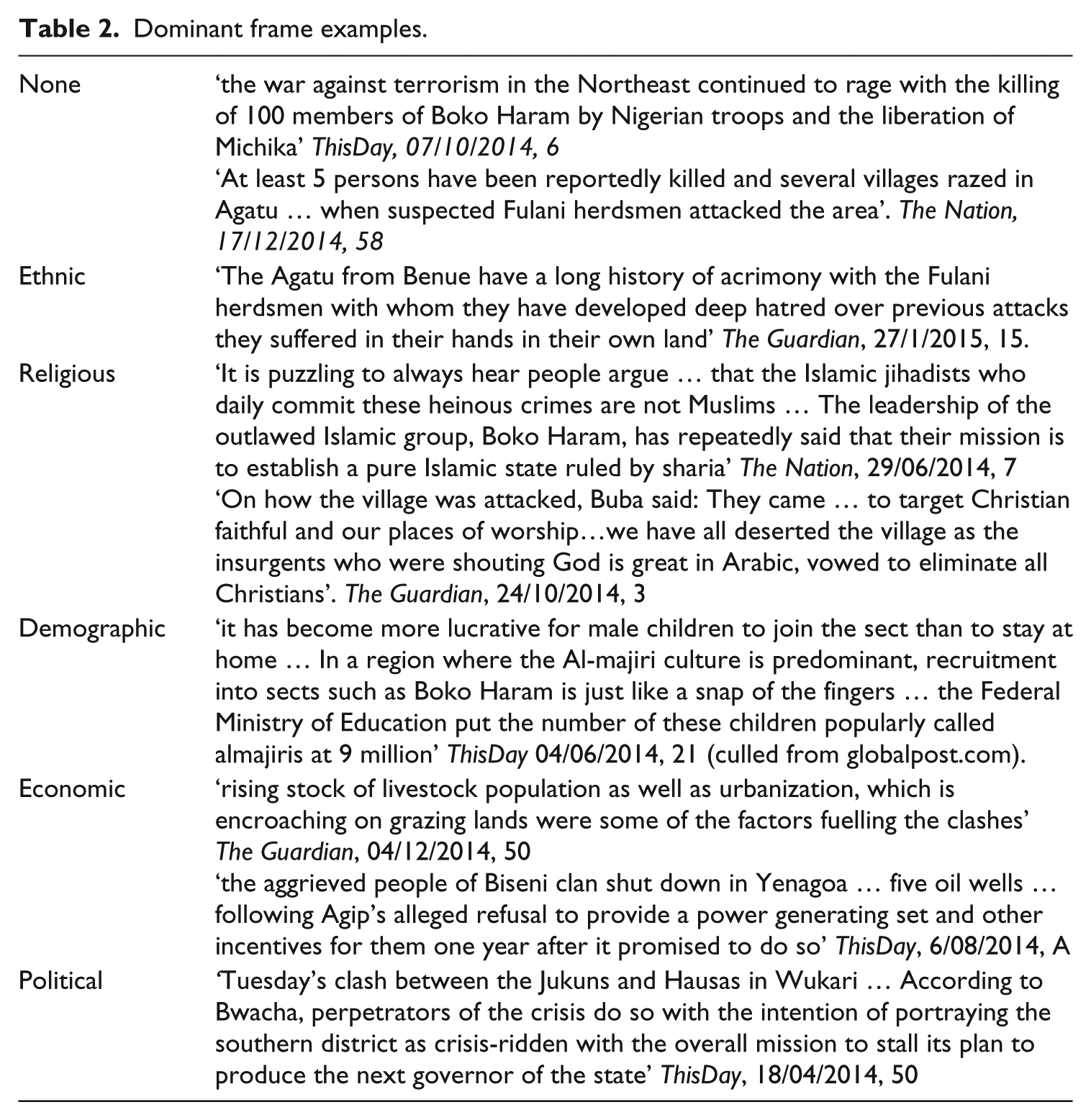
We also investigate the framing of conflict when particular actors are involved such as ‘Boko Haram’ or an ‘Ethnic Group’. These values are coded separately under an ‘Actor’ variable (Krippendorff alpha > 0.77). It is important to note that events related to Boko Haram are not automatically seen as framed religiously simply because the wording ‘Boko Haram’ is used. It also does not automatically lead to a ‘yes’ on the question of reference to religious background. This is the case when reference is made to ‘Islamist’ insurgents, for instance. While the mentioning of an ethnic group does affect the ethnic reference question, this is also not taken as an indication of dominant ethnic framing. Nonetheless, explicit mentioning of group names can also be considered implicit ethnic/religious framing which associates the identity itself with the cause of conflict, in particular if no other causes are mentioned. We hence investigate the extent to which events with these actors are framed in an Economic or Political sense. Table 2 shows some qualitative examples of the types of messages included in the studied news reports, focusing specifically on Boko Haram and ethnic conflicts.
Dominant frame examples.
Results
Descriptive statistics
The total number of observations in the dataset is 8545:2276 reports from the Guardian, 2556 from ThisDay, and 3713 from The Nation (see Table 3). About one-quarter of the reports have appeared (partly) on the front page. Table 3 also shows the frequency of dominant frames. A first important observation is that for many reports, none of the causal frames were considered dominant, or even applicable (as shown by ‘no’ answers to all binary questions). Indeed, in many reports no reference is made to potential causes of conflict. A second observation is the non-use of the demographic frame, which was identified in only one report (and was drawn from another source, see Table 2). Third, we can also note the relatively rare use of dominant ethnic or religious frames in conflict reporting. This lends support to the view that Nigerian news media refrain from attributing conflict to ethnic and religious differences. The economic frame was identified in 10 per cent and the political frame in about 16 per cent of event reports.
Descriptive statistics.
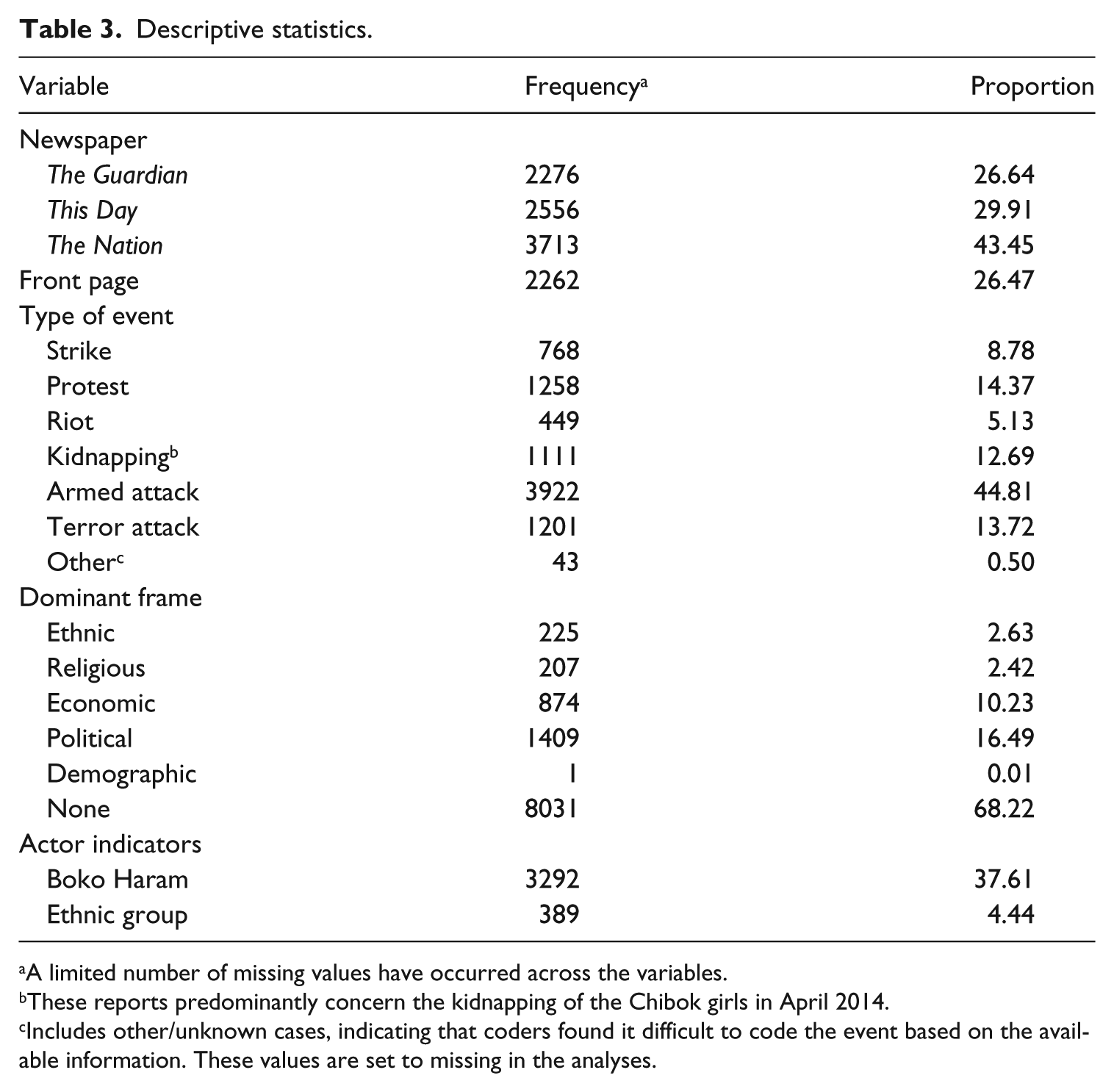
A limited number of missing values have occurred across the variables.
These reports predominantly concern the kidnapping of the Chibok girls in April 2014.
Includes other/unknown cases, indicating that coders found it difficult to code the event based on the available information. These values are set to missing in the analyses.
As Boko Haram was highly active during the period of investigation, the group was identified as an actor in almost 38 per cent of reports. Ethnic groups were mentioned in about 5 per cent of reports. Most events concern herder-pastoralist violence in the Middle Belt region. Interestingly, the frequencies are higher than those for dominant religious and ethnic frames, hence clearly indicating that the Nigerian news media do not appear to follow what we could call a ‘primordial model’ of reporting on identity-based conflicts.
Regression results
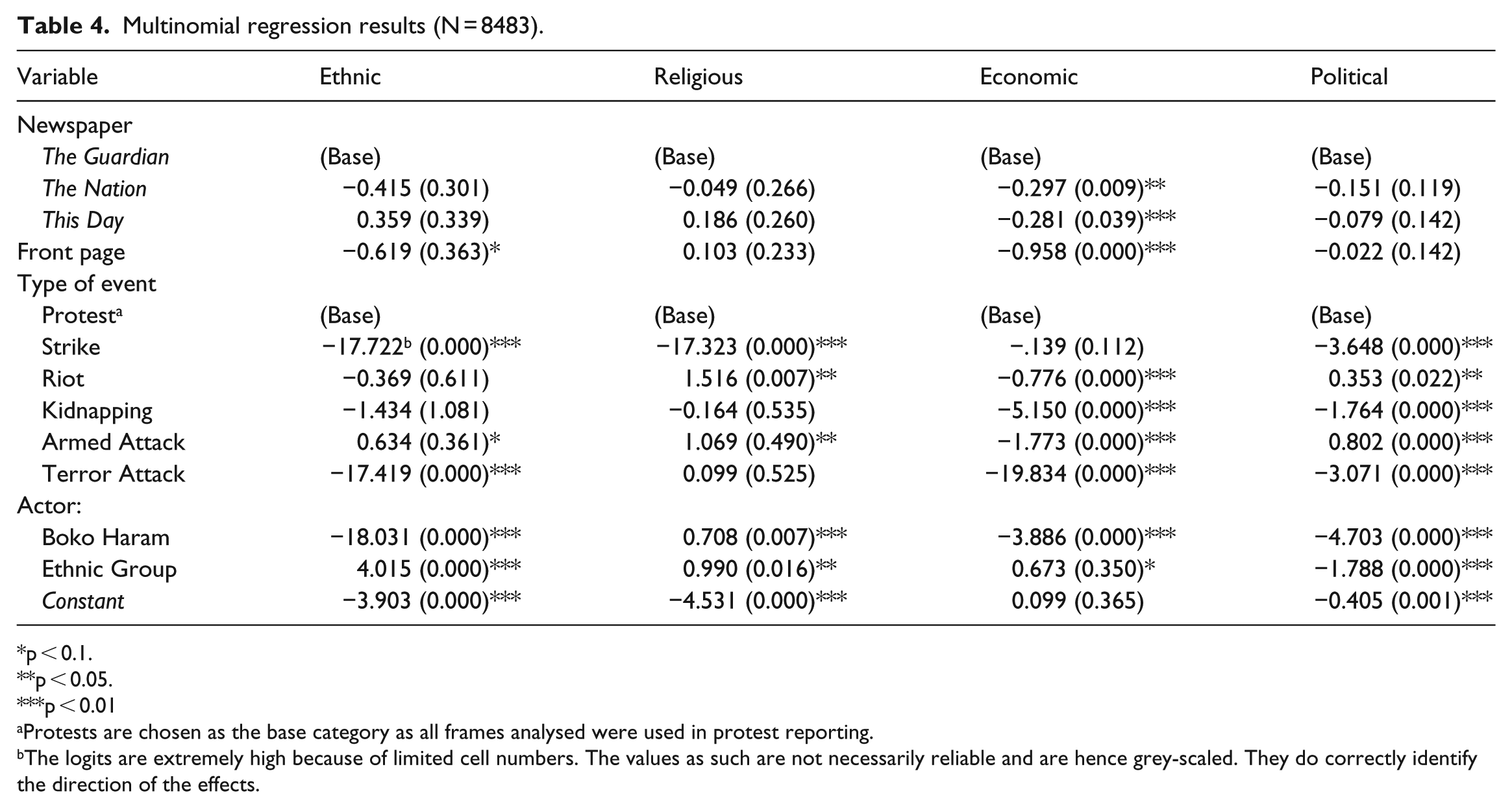
In our analysis we investigate whether the use of frames depends on the type of event covered, front-page coverage and the involvement of Boko Haram or Ethnic Groups. The ‘Dominant frame’ variable is used as the dependent variable in a multinomial regression with ‘None’ as the base outcome with the largest number of observations (the Demographic frame observation is dropped). We also control for the Newspaper as the source of the report. We use standard errors clustered on the report (see section ‘Newspaper data’).
Table 4 reports the results. A first important finding is that there appear to be no strong differences between newspapers. The Guardian does appear more likely than The Nation and ThisDay to use economic frames versus none of the frames. Reports on the front page also do not appear to be framed differently, although economic frames are less likely compared with none of the frames. For Ethnic versus None, we find that Strikes are significantly less likely than protests to be framed ethnically, yet interestingly, the same applies to terrorist attacks. Boko Haram events are also not framed ethnically. Clearly the use of ethnic frames is more likely when an Ethnic group is involved in the conflict, although it is important to keep in mind that in general the use of a dominant ethnic frame is less frequent than events that involve ethnic groups (see Table 3).
Multinomial regression results (N = 8483).
p < 0.1.
p < 0.05.
p < 0.01
Protests are chosen as the base category as all frames analysed were used in protest reporting.
The logits are extremely high because of limited cell numbers. The values as such are not necessarily reliable and are hence grey-scaled. They do correctly identify the direction of the effects.
For Religious frames versus None, we find that riots and armed attacks appear to be reported more frequently in religious terms, while the reverse is true for strikes. We also find that reports mentioning Boko Haram or Ethnic groups are more likely to be framed religiously. Protests and strikes are most likely to be reported in economic terms. Of course, protests are often directed at wages or bursary fees while the strike is a typical instrument of worker action. Other types of events are less likely to be associated with economic causes. Moreover, Boko Haram events are also less likely to be contextualized in an economic sense. The opposite seems to apply for events involving Ethnic groups (although the effect is only significant at the 10%-level). If anything, violent events are most likely to be associated with political causes, with the exception of kidnapping and terrorist attacks. Interestingly, terrorist attacks do not appear to be given much causal interpretation overall. Most terrorist attacks involve Boko Haram. In general, Boko Haram events and events involving Ethnic Groups are less likely to be framed in a political sense.
Our first main finding from the quantitative content analysis is that Nigerian news media rarely frame conflict explicitly in simple ethnic and/or religious terms. This is also the case for conflicts and violence related to the Boko Haram insurgency as well as more localized communal conflicts. Nonetheless, while group names such as ‘Boko Haram’ or ‘Fulani herdsmen’ are used in reporting, there is rarely any deeper reflection on underlying economic or political root causes. This constitutes our second main finding and raises doubts on the presence of peace journalistic practices in Nigeria.
Insights from Nigerian journalists and editors
Based on our quantitative findings, we conducted 14 interviews with Nigerian journalists and editors in Abuja and Lagos in November–December 2017 to gain deeper insights into prevailing practices with regard to conflict reporting. The interviews focused in particular on the question of why causes are only limitedly addressed in reporting, but also whether the relatively rare use of explicit ethnic and religious framing was a deliberate process, by which the media take on a role as defenders of unity in the country. 5
Interestingly, respondents themselves thought newspapers quite regularly addressed the root causes of Nigeria’s violent conflicts. With regard to the Boko Haram insurgency, for example, interviewees pointed out that newspaper reports often referred to the effects of poverty, unemployment and escalatory government repression as the root causes of the insurgency rather than pointing to Islamic radicalism. Similarly, with regard to the Fulani crisis, they mentioned that news reports regularly made reference to issues of climate change and desertification as explanatory factors for this crisis. Several reporters also raise the question of why Fulani herdsmen have become so violent over the years, and debate whether they are foreigners, externally funded, or steered on by political interests. While these causes were found to be rarely mentioned in news reports in our analysis, this does not necessarily contradict interviewees’ perceptions. At the height of the Boko Haram crisis in 2014–2015, battle reports came in on a daily basis. It is possible that more reflective pieces were published in the beginning of the crisis, but were replaced with more factual reporting as the crisis intensified and perhaps a certain news saturation arose. While communal conflict in the Middle Belt occurred a lot less frequently than Boko Haram events during this period, it has been pervasive for years. This could also partly explain why not much reporting attention is directed to the issue, as it has almost become too common.
A second reason for the relative predominance of factual versus in-depth reporting on conflict causes are capacity constraints: The first issue is capacity, lack of training. Conflict reporting is a specific field. It’s not part of media operations here… Not all parties agree on the rules of engagement, reporters can be attacked… there is also the challenge of adequate funding. When there is a situation of emergency, the capacity to move is important. But journalists are not enabled.
6
This has the consequence that ‘reports are often limited to official releases by police, military etc… journalism needs to be paid for, but most don’t. They cannot even pay salaries’. 7 The lack of salaries and in-the-field reporting leads journalists to simply ‘copy and paste things’ 8 from official briefings predominantly consisting of factual statements (see Table 2).
The reproduction of factual press statements could also explain why divisive ethnic and religious framing rarely occurs in news reports. Nonetheless, from the interviews it appears that the toning down of such language is also deliberate. This process is driven by a sense of responsibility, but also self-protection. Interviewees argued that: People should be conscious in what they write … You must look at the implications, this could be inciting violence’
9
, ‘We must be fair to all those concerned, also the consumers of information, and think of the consequences of reporting’
10
, ‘Our job is to report, but our duty is also not to escalate violence. News must be reported as it is but not enflame passions … We have a stake in the peace of the country,
11
and ‘We have to keep society intact … This is also important when dealing with centrifugal forces. We need to keep Nigerian unity intact’. 12
Another interesting response focused on the question of how one wants to see one’s own identity group reflected in the news: We aim to no longer use ‘Fulani herdsmen’. Herdsmen can have any ethnic identity, it is not ‘Fulani’ what matters. Targeting a specific group in reporting is bad. I am Yoruba, I would not want to see a report on ‘Yoruba’ herdsmen … There was a good argument to change the narrative. A Fulani in the newsroom could say: ‘I am here, I haven’t killed anyone!’ … For me when some years ago a Brit killed a woman on the street, I was offended when Sky News reported ‘a Nigerian-born UK citizen’, no he was a UK citizen, why say he was Nigerian-born?’
13
Other respondents as well argued that diversity in the newsroom prevents divisive reporting.
Yet interviewees also highlighted other reasons for toning down ethnic and religious language. For instance, they argued that religion and ethnicity continue to be very sensitive topics in Nigeria, and that it can be better to avoid references to identity as they can be interpreted wrongly: Before people read a report, they will ask what’s your angle, where do you come from? For example, South-West, Yoruba, North etc … They look at the name of the journalist and the ownership of the medium … For example, if you state that Buhari appoints mostly Fulani, they say you write it because you’re from the South. If you say Buhari is doing well it must be because you’re also Fulani.
14
There is also the fear of actual attacks, which tones down reporting: Most media houses have been careful, also with the attack on ThisDay 3 years ago, the attack on The Sun in Kaduna. … they just report casualties: some people have come, so many killed etc … some media houses do not even say suspected Boko Haram, but unidentified gunmen. Before, they would dramatize more, for example that they came in shouting ‘Allahu Akbar’.
15
At the height of the attacks we reduced the number of times we said Boko Haram but just wrote ‘insurgents’.
16
Not only fear of Boko Haram attacks play a role, however, but also the fear of other religious violence. A reporter stated, for instance, that a fatwa was placed on him after reporting on attack in a church. Several others mentioned the beauty contest riots of 2002. Finally, there is the fear of litigations: Yes, there are litigations, our superiors taught us to be very careful … The terminology of ‘suspected’ Boko Haram, Fulani, is to be on the safe side, that’s true, this used to happen. If you don’t know, don’t name a specific group, say gunmen instead of suspected ‘group name’. Avoid anything that can be one-sided.
17
Unfortunately, however, it is not because ethnic and religious references are toned down, that the naming of specific groups does not have consequences. This has been argued with regard to the herdsmen crisis, for example: They might just be criminals, attackers, but there is the narrative of Fulani violence. Stigmatizing a group like that is bad, it aggravates the situation. The government should investigate and verify these facts, but the government is not doing enough. You need to verify your source and information, if you can’t, you say ‘suspected’ or ‘alleged’ Fulani. [Interviewer question] No this probably does not make a difference in the stigmatization of Fulani, but it saves you from litigations.
18
Even basic robbery attacks: people will think it’s Fulani while they can be local bandits … It also gives rise to new laws to evict Fulani herdsmen even if they were there 5 or 10 years. This could lead to further crisis.
19
Avoiding stigmatization of particular groups may hence require a more active peace journalistic approach, rather than a ‘factual’ approach to violent conflict reporting.
Conclusion
In this article, we have systematically analysed and explained the nature of conflict reporting in Nigerian newspapers. We started from the premise that while conflict, and in particular violent conflict, often takes an ethno-religious dimension in Nigeria, the underlying causes of these conflicts are usually linked to the presence of horizontal inequalities and elite competition for resources and political power. It was further argued that the dissemination and propagation of ethnic and religious differences as conflict causes was a potentially dangerous activity because of the news media’s prospective influence in shaping people’s perceptions of the origins and possible resolution of the country’s conflicts.
We first conducted a quantitative content analysis of conflict reports from three Nigerian newspapers, The Guardian, This Day and The Nation, to investigate whether Ethnic, Religious, Economic, Political or Demographic causes of conflict were more likely to be presented. A key finding of our analysis was that overall, few newspaper reports actually discussed or explained the underlying causes of the conflicts mentioned in the reports. In case reference was made to the conflict causes, explicit framing of ethnic and religious divisions occurred very rarely. Nonetheless, economic and political frames were used rarely as well, in particular for violent events. Looking specifically at conflicts involving Boko Haram and those which explicitly identified ethnic groups, we found that these types of events were extremely unlikely to be discussed from an economic or political viewpoint.
Interviews with Nigerian newspaper editors and journalists further contextualized these findings. It emerged that the relative lack of discussion and explanation of the causes of conflict in newspaper reports was to an important extent the result of capacity constraints, predominantly engendered by a lack of journalistic training and a dearth of resources and funding to conduct independent newspaper investigations. As a result, journalists often simply reproduce official police and/or military statements concerning particular conflict events and episodes. Nonetheless, there also appears to be a sense of responsibility among Nigerian media houses and journalists not to overly frame conflict in religious or ethnic terms. While there certainly appears to be a willingness to practice peace journalism in Nigeria, in practice, this happens on a ‘shoestring’ budget which hampers its overall effectiveness.
Indeed, while very explicit framing along ethnic and religious lines occurs very rarely, reference to group names such as ‘Boko Haram’ and ‘Fulani’ can still engender implicit associations of violent conflict behaviour with specific ethno-cultural or religious groups. Some interviewees argued in this respect that the ‘narrative of Fulani violence’ seems to suggest that almost every attack is caused by Fulani, with potential consequences for the stigmatization of the group in society. Thus, while Nigerian newspapers are not actively fuelling the ‘primordial’ fires as we have seen in some African countries, unfortunately, Nigeria’s news reporting appears to stop short of making a substantial contribution towards sustainable peacebuilding in the country. Investments supporting media independence and journalist training hence continue to be important ways to improve conflict reporting in Nigeria (see also Hackett, 2003), and elsewhere in the developing world (e.g. Rodny-Gumede, 2015).
There are some limitations to our study which are worth pointing out here, because they simultaneously suggest a number of interesting avenues for further research. First, we were unable to include Northern newspapers in our analysis because of access constraints. Clearly, it would be highly interesting to explore further to what extent conflict news reporting in Northern newspapers differs from Southern newspapers. Our focus on Southern newspapers can potentially also explain some of the differences found between our study and previous qualitative analyses which found starker ethno-regional biases (e.g. Musa and Ferguson, 2013; Yusha’u, 2015). Another limitation of our study was that we did not include editorials and opinion pieces which may also at times provide reflections vis-à-vis the causes of violent conflict. Indeed, one of our interviewees noted the following regarding news reporting on the Boko Haram insurgency: News reports state what happened: so and so attacked, so many killed. But in opinions, interviews etc. some can state it is not Islam perhaps, while Christians can say Christians are under attack. 20
Third, our study focused on print media, while radio and television are clearly also very important media outlets. Finally, while we have argued that conflict news reporting may shape people’s perceptions and understandings of the causes of conflicts, more experimental and survey research is needed to assess the actual influence of media messages in Nigeria. Indeed, several studies have shown that the way in which conflict is reported can influence people’s views, but also that this influence is dependent on prior beliefs (Kempf, 2017: 8–12; McGoldrick and Lynch, 2016). In societies characterized by highly salient divisions along ethnic and religious identity lines such as Nigeria, the power of news reporting to reinforce or undermine existing stereotypes can thus be highly specific, and hence requires further empirical investigation.
Footnotes
Authors’ Note
Arnim Langer is also affiliated to Heidelberg University, Germany.
Funding
The author(s) disclosed receipt of the following financial support for the research, authorship, and/or publication of this article: Research Foundation Flanders (FWO).