



Abstract
The transformation of Russian news agencies has not previously attracted much academic attention outside Russia, although it provides an interesting case for the study of state–media relations and the growth of digital media technologies. This article explores how TASS, as a state-owned news agency, has been able to retain its position as a domestic and international provider of news in competition with other state- and privately owned agencies in Russia. It uses a case-study approach, employing in-depth elite interviews together with existing research, news sources, professional databases and marketing reports. The particular focus is on management issues and on the technological challenges affecting TASS’ strategic actions and ongoing operations. We analyse (1) the historical development of TASS, (2) its role as a national and international agency, (3) its relations with the state and (4) its move to a B2C model. The article concludes that state financial support, combined with the strong managerial decisions taken by new executives, have restored TASS’ strong position in Russia’s highly competitive news market after the agency’s significant decline in the 1990s and early 2000s.
Introduction
Traditionally, news agencies have been considered an ultimate information provider, supplying news to newspapers and broadcasters and setting the news agenda for national and global media. News wires have always been a bridge between news and the media, between B2B and B2C worlds, and this has resulted in the creation of a new competitive environment, at national and international levels, with a limited number of market players (Bartram, 2003; Schudson, 1995). But the process of digitalization has placed news agencies in an absolutely new media ecosystem, which has been a serious factor in their institutional transformation, with new technological possibilities for delivering their products directly to audiences and a subsequent erosion of the old business models (Boyd-Barrett, 2008). This process touches all news agencies, no matter what their ownership form, including state-owned agencies that were often thought of as being protected from any media crisis.
This article aims to analyse how the Russian state-owned news agency TASS has managed in the context of digital media transformation to re-establish its position in the second decade of the 21st century as one of the leading national news agencies by responding both to state requirements and to pressure from media competitors who began their transformation in the 1990s, while implementing up-to-date managerial visions.
Literature review
One popular theoretical approach to news-agency research has a background in political economy, and scholars have focused on the scope and specifics of owner influence on the content and editorial independence of news agencies (Welbers et al., 2018; Xin, 2008). As a unique type of media company, news agencies play a complex role in national media systems, responding to demands for news from domestic and international media. Research on news agencies has embraced a multidisciplinary approach, focusing simultaneously on their economic strategies, organizational structures, corporate cultures, work routines and professional standards, all in the context of safeguarding editorial independence and quality of news (Boyd-Barrett, 2000).
The role of news agencies in the digital era continues to be viewed from various angles. Welbers et al. (2018) suggest that media dependence on news agencies as key media enterprises has even increased in the digital age, but some research affirms the opposite (Rantanen et al., 2019). The socio-organizational approach (Schudson, 2000) has been widely used, and analysis within this frame often presents a multilevel analysis at the levels of text, organizational structure and competitive environment in the news-agency segment (Machin and Niblock, 2010; Palmer, 2017). The study of national news agencies that operate as international agencies, such as AFP, Reuters, AP and the now leading Chinese agency Xinhua, with an emphasis on the historical diversity of organizational and ownership structures supporting their global presence, also provides an interesting approach (De Burgh, 2003; Lee, 2000; Rantanen, 2002; Xin, 2008). But much academic research has continued to concentrate on the largest Western agencies, with very little research carried out on agencies outside the West (Rantanen, 2019).
Important findings of recent research underline how news agencies are still the ‘backbone’ of the media system, providing the news agenda for mass media enterprises (Welbers et al., 2018), while, despite the willingness of agencies to preserve and use the best reporting practices (Rantanen, 2019), models of news reporting and professional values have evidently changed as a result of technology-driven changes (Machin and Niblock, 2010). These changes will become increasingly instrumental in the competition among the news giants like Reuters and Bloomberg (Palmer, 2017). Global competition in news production also remains a comparatively popular research subject, but only a limited number of studies have dealt with the experience of national news agencies (Polynov, 2018; Rantanen et al., 2019; Watanabe, 2017; Xin, 2006).
Media systems and journalism practices in post-Socialist countries including Russia have become a new multidisciplinary area of media research. In transitional studies, scholars have focused on the shift from ideologically dependent Russian media structures to new economic and political models, mostly exploring media power relations in the context of a particular type of authoritarian, neo-authoritarian or hybrid media system. Such work has been done by both foreign (Becker, 2004; De Smaele, 1999; Dunn, 2014; Oats, 2006; Toepfl, 2013; Voltmer, 2008) and Russian scholars (Kiriya, 2019; Koltsova, 2001, 2006; Richter, 2007).
The transformation of the Russian news-agency segment has not yet attracted much attention, although a focus on news agencies can provide an interesting empirical case for the study of how media companies that are still state-owned have met the political demands and audience preferences of the transitional period while trying to survive a competitive struggle with private media and other state agencies in the emerging media industries (Vartanova, 2019). TASS has changed, from an ideological tool of Soviet propaganda to a conservative and inefficient enterprise in the 1990s and early 2000s, and now to a digitally focused state-owned news agency competing for audiences and financial resources with two other national and international agencies within a particular political, industrial, institutional and regulatory context (Alekseyenko, 2014; Gel’man, 2015; Kiriya, 2019; Rantanen and Vartanova, 1995; Vartanova, 2019).
Theoretical framework
Modern news reporting and news distribution in the national and global media industries, including in Russia, faces serious challenges resulting from the complexity of the digital environment (see, for example, Garrison, 2001; Reinardy, 2010; Rowe, 2011; Sherwood and Nicholson, 2013). Picard (2014) argues that ‘news production is in a period of transformation’ and points out that the nature of news production in the digital media landscape is changing more and more because of the spread of a craft, non-industrial and even non-professional production model (p. 503).
Many scholars have envisaged an inevitable transformation of the basic business models of all media enterprises (see, for example, Küng, 2008). They argue that the core activities of traditional media companies need to change in order to meet the challenges of digital media. Two key and globally important consequences are evident: a rise in media competition (Küng, 2008: 89), whereby different media – television, radio, newspapers, and also news agencies – become able to create convergent media products and to compete with each other. (Vartanova et al., 2016) the transformation of media companies into ‘content factories’ (Deuze, 2009: 147) characterized by a non-stop inflow of information (resources) into the media and subsequent outflow of packaged content (product) (Deuze, 2007: 142). Nevertheless, the importance of content quality to consumers, and vice versa, is increasing. (Knee et al., 2011: 159)
Digital technologies are dramatically transforming the newsroom environment (Vyrkovsky, 2016) in many countries, including Russia. Anikina (2014) points to the fact that in many Russian newsrooms, ‘one journalist works usually for 1.5 platforms in order to deliver his or her text (TV, radio, print press, online medium etc.) to an audience’. She considers this a sign that future multimedia practices in newsrooms will include more and more multitasking.
In the current situation, the core of news reporting probably faces both the severest of challenges and promising opportunities. As Boyd-Barrett (2008) argues, The Internet accentuates the critical importance of content in competition between news providers. Here, the agencies are well positioned in terms of resource and brand identity by comparison with emergent new voices of the web . . . They need to provide more analysis and enterprise reporting, within the framework of what I call a ‘points-of-concern’ dialogue with all stakeholders. (p. 163)
Audiences nowadays are not dependent on just a few news sources, since numerous, often even non-professional, alternative sources have emerged at the global and national level, including in Russia (Biryukov and Sharonin, 2018). This has inevitably led to an erosion of the news agencies’ traditional model. Thus, news agencies have a chance to broaden their activities by moving towards a B2C mode, directly providing news products not only to the media but also to mass or fragmented audiences, using advertising-based or other new business models in order to increase web traffic (Polynov, 2018).
But new market conditions are only one part of the complex process of news agencies’ transformation. Schudson (2000) points to the need to apply political economy as one of the predominant theoretical approaches to a news production analysis. Control of key news producers clearly results in control over the national or global news agenda presented in the media. This is also relevant for societies whose transition to new post-socialist sociopolitical realities started after 1991. Countries like Russia and China have developed hybrid national media systems that preserve a traditionally strong presence of the state. This has resulted in a multiplication of the roles played by the state as a policy-maker, regulator, owner and financial supporter (Vartanova, 2019; Wu, 2000; Xin, 2008). Given the complexity of the digital transformation, paralleled by ongoing sociopolitical change and the global dominance of technological platforms like Google and Facebook, the phenomenon of the ‘national’ independent news agency is in danger (Rantanen et al., 2019).
Some theoretical implications for future research may come from the Xinhua case studies. One important point is that the modern state agency, under an authoritarian regime, could noticeably transform its model by implementing new functions and tasks. Hong (2011) points out that ‘the multiple functions and new characteristics Xinhua has displayed imply a somewhat “hybrid” media model that has been adopted and implemented in China, though silently’ (p. 391). Xin (2008) argues that work principles in the agencies’ newsrooms are being influenced by multiple factors and the agenda set by state-owned news agencies becomes a product of the interaction of various driving forces, among which state power is possibly the key but not the only one.
Methodology
The empirical frame of this study extends from the beginning of 2010 to April 2019, but also places present changes in a historical context. The authors investigated open news sources, professional databases, the TASS newsroom guidebook (Lebedev, 2019) and marketing reports provided by official representatives of TASS, and also conducted in April 2019 in-depth elite interviews with Sergey Mikhaylov (TASS Director General), Maxim Filimonov (TASS Deputy Director General) and Darya Penchilova (TASS Deputy Chief Editor).
The combination of historical analysis, business data from open sources and interviews with top managers is a common method in case studies of media businesses (Hong, 2011). Yet, interviews with news-agency executives are considered as elite interviews, although they have some substantial methodological limitations (Odendahl and Shaw, 2001). Information received from elite representatives can be seriously biased by their own opinions, which do not necessarily match corporate values (Herzog and Ali, 2015). Furthermore, given the state-owned status of this agency, an interviewer may expect a certain level of self-censorship when speaking to top executives. Elite interviews, in the case of a state-owned news agency, are the only way to find out about the actual strategic development of the company, which will not be revealed through interviews with journalists. Because of the strong dependency on interpersonal communication at the top managerial level, the real driving forces of corporate policy remain unknown both to competitors and to employees, so elite interviews are a means of broadening the context in which personal decisions concerning corporate activity are viewed (Kezar, 2003).
The range of questions was broad, with a core focus on production, organization and technological dimensions. This approach has been used quite often in news-agency research, allowing access to relevant data and expertise (see, for example, Bartram, 2003; Xin, 2008). The particular focus was on management issues and on the technological challenges affecting TASS’ strategic actions and ongoing operations. The results are presented below in four sections: (1) historical development, (2) role as an international and national agency, (3) relations with the state and (4) moving to a B2C model.
The following was our research question: To what extent if any has TASS been able to transform itself in the context of its particular relations with the state, given the need to overcome a severe corporate crisis and to meet the new digital challenges?
Results and analysis
The development of Russian news agencies: Historical background
Russian news agencies have been under strict state control during almost all their history. This history can be divided into three periods, in all of which the state has played a significant role: (1) Imperial Russia, 1866–1917; (2) Soviet Russia and the Soviet Union, 1917–1991; and (3) the Russian Federation, 1991–2019.
News agencies in imperial Russia, 1866–1917
The first news agencies in Russia were founded in the second half of the 19th century, when, after the ‘great reforms’ of the 1860s, industry, trade and agricultural production experienced a boom. However, the press remained subject to regulation by state authorities, including the censorship existing since 1804 and the economic subsidies granted to loyal newspapers (Yesin, 1989). The first national news service – the privately owned Russian Telegraph Agency (RTA) – was established in 1866 and followed by other private agencies whose news was controlled by the state. Russian agencies were allowed to exchange news outside Russia only through the Wolff agency in Germany (Rantanen, 1990). In order to break their dependence on Wolff for foreign news and to increase its own control over domestic news, the Russian government decided to found in 1904 the St. Petersburg Telegraph Agency (SPTA), the first ‘official’ Russian news agency, which it both financed and controlled.
News agencies in Soviet Russia and the Soviet Union, 1917–1991
The second period began after the October Revolution of 1917, when the SPTA (renamed in 1914, the Petrograd Telegraph Agency) was nationalized by the Bolshevik government. Within a short period, all the information services in St Petersburg, in the regions and in news offices abroad were fused into the Rossiyskoye Telegraphnoe Agentstvo (Russian Telegraph Agency) (ROSTA), whose functioning was placed under strict state and party control. This agency was given straightforward directions regarding the kind of information to be spread. Newspapers and magazines were obliged to publish the information obtained from ROSTA. In 1925, the agency was renamed the Telegraph Agency of the Soviet Union (TASS). Despite some suggestions of organizing its ownership in a cooperative form through the incorporation of the largest newspapers, as in other countries, the state kept total control of TASS. In Soviet Russia, TASS became an information backbone of the Soviet media system, which was subordinated to ideological control, with an absolute dominance of the state in media ownership and a large volume of state investment in telecommunication infrastructure (Minaeva, 2018).
In the Soviet time, TASS remained the only source of official information and the only news service ensuring the ideologically correct and well-coordinated functioning of the Soviet media. Although the Communist Party and the government strictly controlled the activities of TASS, it played an important role within and outside the Union of Soviet Socialist Republics (USSR), becoming from the 1950s one of the ‘Big Five’ world news agencies, together with Associated Press (AP), United Press International (UPI) (United States), Reuters (United Kingdom) and Agence France-Presse (AFP) (France). In the early 1990s, TASS employed about 5000 people – more than any of the leading Western news agencies (Rantanen and Vartanova, 1995).
The international reputation of TASS was strong, although it was different from other international agencies, seen to be acting as a mouthpiece to the world of the Soviet Communist Party and government (Kruglak, 1962). However, this status had a negative impact on the agency: it was unable to develop as an information service because the requirements of modern news transmission were not compatible with the demands placed on a government- and party-controlled agency. This is why, according to Rantanen, TASS, regardless of its ‘world status’, was never able to compete with the top Western agencies (Rantanen, 2002).
In 1961, at the time of Khrushev’s ‘thaw’, another news agency, Agentstvo pechati Novosti (Agency Press News) (APN), was established by a number of public organizations under the aegis of the Sovinformbjuro (Soviet Information Bureau), which had a non-governmental status but was under government control. APN specialized in producing and distributing news about Soviet life for foreign clients with the aim of improving the image of the USSR abroad. APN’s news products were not available inside the country (Viren and Frolova, 2015).
News agencies in the Russian Federation, 1991–2019
The third period in the history of the Russian news agencies coincided with the growth of the media market. Since 1991 the cancellation of censorship, the privatization of media companies, the rise of the media business and challenges to journalistic professionalism were among the crucial changes in the media system (Vartanova, 2011). A high number of newly established agencies all over Russia have appeared to be an alternative to the state-run TASS, renamed ITAR-TASS (Rantanen and Vartanova, 1995). In the early post-Soviet years, professional journalists established hundreds of regional and niche news agencies. However, many of these ‘young’ news agencies subsequently ceased to operate, mostly for financial reasons, although the monopoly of the state-owned news services was destroyed (Rantanen and Vartanova, 1995).
The most successful was the privately owned Interfax news agency, which realized the importance of financial information and economic analysis and of selling financial information to corporate customers and private banks. Specialized bulletins issued by the agency included information about key Russian industries – the oil and gas industries, finance and metallurgy. Access to world markets and partnerships with leading providers of business information contributed to its financial success and market position as the leading agency for financial news and information (Boyd-Barrett, 2014; Viren and Frolova, 2015). This agency also places emphasis on new digital technologies and introduced Interfax SPARK, an information and analytical database focused on market companies. Among its partners are such giants of world business as Reuters, Moody’s, Dun & Bradstreet, Experian, Business Wire and LexisNexis (Interfax History Highlights, 2019).
The former APN in 1991 became the Russian International Information Agency Novosti (RIA Novosti) and by the early 2000s was a leading state-owned news agency, having transformed itself into the most advanced Russian multimedia company through large-scale reconstruction and management reform (Viren and Frolova, 2015). Its multimedia website (ria.ru) is the leading mass media platform in the Russian Federation in 2019 (LiveInternet, 2019). RIA Novosti has been since the end of 2013, the de facto brand of the state-owned media company MIA Rossiya Segodnya (Russia Today), which includes, along with the domestic news wire RIA Novosti, the foreign radio wire Sputnik, the business wire Prime and others. RIA Novosti partly continues to fulfil the role of its predecessor, APN, aimed at building Russia’s image abroad.
The three agencies, TASS, Interfax and RIA Novosti, the ‘Big Trio’, have now stabilized their position as the leading news agencies in Russia, each with different specializations. RIA introduced the model of the multimedia news agency. Interfax was the first to focus on distributing business information in the growing market. Only TASS until recently kept to the traditional model of a general news agency strongly dependent on state financing and its old subscription base. It relied mostly on its old brand and was slow to understand the need for a new market strategy. However, even TASS had to recognize the need for change under pressure from its owner, the state, to improve its market presence and facing strong competition in the new digital environment.
TASS as a national and international agency
Like all other international agencies except Reuters, TASS has continued to fulfil a double role as a national and international agency. Since the 1990s, the legal form of TASS as a federal state-unitary enterprise has remained unchanged, and this has allowed it to obtain direct budget financing without obligation to earn a net profit, enabling the agency to function without economic or commercial pressures. However, despite the financial support from the state and its worldwide brand recognition as the key news agency in Russia, TASS became relatively weak compared to its competitors, both at the international and national levels, gradually losing its position from the 1990s. The agency’s strong brand, huge information archives, wide subscription base, highly professional employees and relatively stable state financing all became obstacles to an understanding of the need to transform itself. TASS’ rigidity and unwillingness to change were partly caused by its management, with many heads of departments keeping their positions from 1991 right up to 2012, when a new top-management team took office.
In 2012, Russians perceived TASS as ‘obsolete’, ‘clumsy’ and ‘official’. 1 Only 65 per cent of the territory of the Russian Federation was covered by the TASS service, the number of its correspondents in Russia declined to less than 50, and their average age had increased to 54.8 years. The total number of employees remained extremely high – about 2000 – and their average age also increased, to 50 years, with about 200 employees (10%) who were aged 80 and older. In addition, 61 per cent of staff held administrative positions and were actually not involved in news production. The largest in-country photo archive, with millions of pictures, was hardly being used. 1
TASS had also lost some of its formal global presence when it radically reduced the number of its foreign offices. Before 1991, the TASS information network operated in 116 countries, while in 2018, TASS supported bureaus in half that number of states (59). By 2012, the majority of the foreign correspondent bureaus had almost ceased active operation. 1 Russia was losing its international influence and its largest news agency was doing the same.
The current stage of TASS’ development began late in 2012, when a new TASS Director General, Sergey Mikhaylov, was appointed. The state financial investment increased, in 2011 direct budget subsidies to TASS amounted to 1.1 billion rubles (US$37.5 million); in 2012, to 1.4 billion rubles (US$46.1 million); and in 2013, to 1.8 billion rubles (US$55.6 million) (Budget Laws, 2011, 2012, 2013). Meanwhile, a new management team allowed changes to begin both nationally and internationally. TASS also invested in research; the TASS Research Centre was established in 2014 to investigate economic and social processes in Russia and abroad (TASS Today, 2019). Mikhaylov’s major goal was to transform the ‘old-school’ conservative news agency into a modern media company able to compete both at the national level with such leaders as RIA Novosti and Interfax and at the global level with the most advanced (in his view) global players – Reuters, AP and CNN (Mikhaylov, 2019).
In 2014, the ITAR-TASS agency returned to the old, globally known TASS brand ‘for delivering news to global audiences’ (TASS History, 2019). The rebranding was a marketing paradox, since the agency was reclaiming a Soviet brand, while wishing to win new positions in the Russian media system and to comply with technology-driven changes. The official position of TASS was ‘rebranding the oldest news agency in Russia is destined to become a symbol of professionalism, enthusiasm, readiness of its team for personal development and the agency’s bid to preserve and develop its best traditions’ (TASS History, 2019). According to the TASS mission statement (TASS Corporate Style, 2018), By combining a modern technological base and professional expertise, TASS is an important part of the global information system. TASS is a collector, integrator, custodian and distributor of news. It works for the sole purpose of creating a coherent and reliable coverage of what happens in and around Russia, and of creating and supporting a united information space in the Russian-speaking world.
By 2018, the number of its own correspondents in Russia had increased to 80 and their average age had fallen to 36.6 years. Total staff numbers have declined by 10 per cent to 1800 employees, with an average age of 40 (562 employees were aged 30 or younger). The number of employees in news production departments has reached 54 per cent of the total, compared with 39 per cent in 2012. 1
The agency has maintained and even strengthened its foreign correspondent network, which in 2018 included 61 correspondent bureaus in 59 states; in 16 foreign countries, TASS reporters remain the only Russian correspondents. TASS plans to launch offices in 12 new countries in 2019 and to start news production in five more foreign languages (now only two languages, Russian and English, are in use; until 1991, news feeds in 24 languages were distributed). 1 TASS now has more than 5000 corporate subscribers in Russia and around the world (1000 mass media clients, 200 diplomatic missions, 250 financial companies and banks, and 200 industrial enterprises, research and educational organizations and libraries) (TASS Today, 2019). It produces more than 100 news products, with a daily volume of about 1200 news items and 500 images (TASS Today, 2019).
In 2015, TASS became the news source most cited by the Russian mass media (Medialogiya, 2015), and by the end of 2018, the agency was also the national news agency most cited by international news agencies. 1 In 2019, the ‘Big Trio’ led the market in Russia in terms of citations (Medialogiya, 2019). In terms of market share, counted in media citations, there have been two leaders in recent years, TASS and RIA Novosti, while Interfax is gradually losing its position (see Table 1).
Citations in mass media of the ‘Big Trio’, 2015–2018.
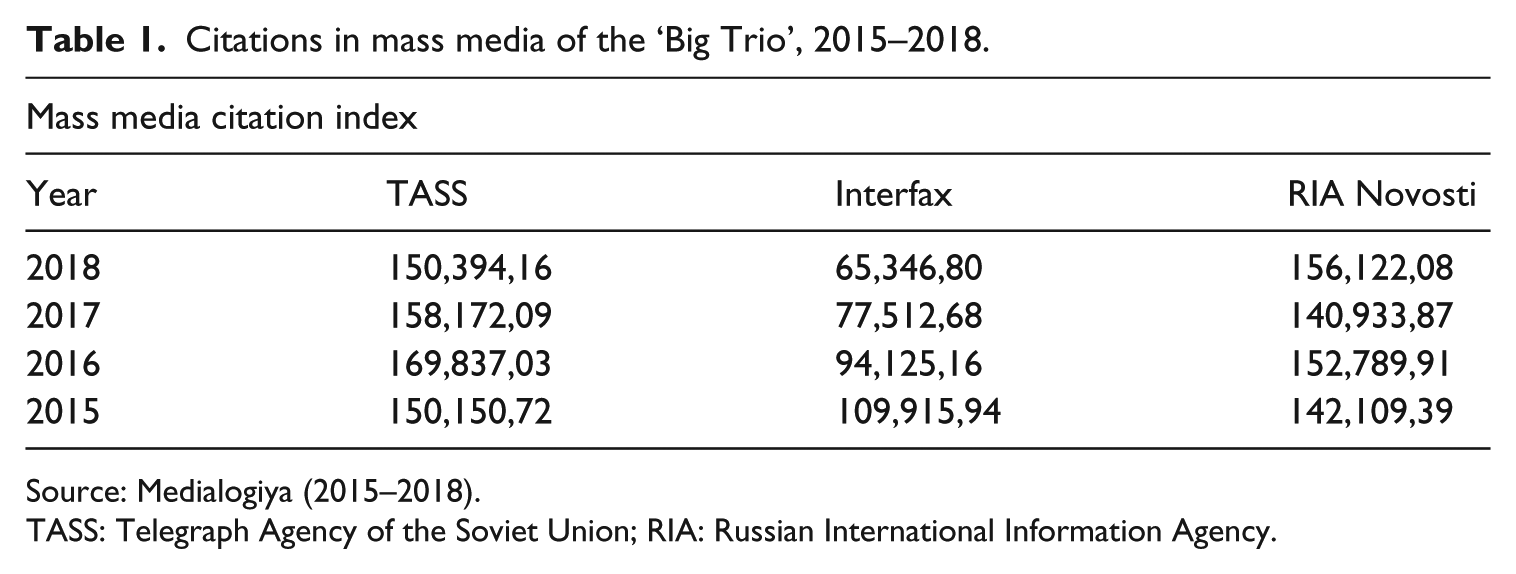
Source: Medialogiya (2015–2018).
TASS: Telegraph Agency of the Soviet Union; RIA: Russian International Information Agency.
Mikhaylov considers RIA Novosti as TASS’ main competitor in Russia, but has pointed out that it is rapidly being transformed because the state is willing to use some of its services as a propaganda tool abroad. This may inevitably cause bias in the agenda set by RIA and therefore a loss of quality of news content.
Relations with the state
Four contemporary international agencies, Anadolu in Turkey, Xinhua, EFE in Spain, and TASS, are state-owned, while AFP is publicly owned (Vyslozil and Surm, 2019). Since state-owned agencies are under-researched, we know very little about how these are managed or governed. The specificity of TASS’ legal form means that there is a single owner – the state – and this determines the mode of corporate management. The TASS Director General has to be appointed by the government of the Russian Federation (Resolution of the Government of the Russian Federation, 1994). The Director General then appoints the Editor-in-Chief and the TASS Board. The corporate strategy and budget are determined by the Board, consisting of the Director General, his deputies and the heads of leading divisions of the agency, and approved by the Director General. 2
Political factors are extremely important in the agency’s activity, first due to the specificity of ownership structures and the fact that the state remains the largest investor in TASS. In 2018 alone, the volume of direct budget financing of the agency was 2.9 billion rubles (US$46.2 million) (Budget Law, 2018), while the total share of state financing in the agency balance sheet was about 65 per cent, a very high percentage compared with EFE (51%) or AFP (38%) (Surm, 2019). However, the forms of state financial control are extremely sophisticated and difficult to track (Lebedev, 2019), especially when it comes to influence on news content. As Rantanen and Kelly (2019) show elsewhere in this issue, all news-agency directors, whatever the ownership form of the agency, deny any influence on their journalists.
TASS Deputy Director General Maxim Filimonov (2019) said, TASS is important to the state because it has to set the news agenda, and moreover the national news agenda. [. . .] We have to cover the Russian vision everywhere, how our compatriots live everywhere . . . what they think, what matters for them, and what is important for the state. There are two traditional sources of information: embassies and TASS . . . The state holds the information defense, with the help of a national agency. The state cannot defend itself, it must be protected, so our work is national information protection.
TASS management emphasizes the agency’s role as a public servant rather than as the voice of the state. Some of our interviewees underlined how, despite being a state-owned and mostly state-funded media company, TASS attempts to offer a public service. They tend not to separate the agency, society and the state, and to argue that the agency has a public role they find unique. They consider state financial support acceptable, but also argue that the state often cannot set tasks – actually what it wants to be done – and therefore cannot control any results except financial ones. According to our interviewees, the news agency itself seeks to identify its own goals, deciding what is actually needed in terms of news agenda, news supply and editorial standards. Consequently, the agency formulates its tasks and then receives money for their execution. TASS executives did not disclose specific details of mechanisms or interrelations with state bodies, but they mentioned that regular meetings and discussions served to maintain the process.
According to these same interviewees, TASS covers stories which match state interests, such as the economic strategy of import substitution or major issues in foreign policy. This further influences the national news agenda presented in the mass media by drawing the attention of other Russian news media. 2 The interviewees underlined how reporters who use the TASS newsroom guidebook when compiling news are not censored at the newsroom level, but they also mentioned that ‘taking into account the position of the state’ happens at higher levels of the administration hierarchy (for instance, editors).
The influence of state ownership on news agencies is difficult to study when relying mainly on elite interviews and official documents. As academics, we can study managerial discourses (Kezar, 2003), but to find evidence of the influence of ownership through conducting interviews at the top level is almost impossible. This becomes possible only by interviewing journalists and news-agency clients, together with a content analysis of news.
Moving towards a B2C model
Some news agencies in Europe have successfully diversified their operations (Jääskeläinen and Yanatma, 2019), but it has turned out to be more difficult for state-owned agencies to change their old business models (Surm, 2019). TASS remains a general news agency. Movement towards a niche business model, via the launching of new wires and thematic products has been considered inefficient because of the absence of enough demand. The agency’s shift towards a B2C market has been seen as a difficult and slow process. In 2012, the overall level of TASS’ technological development was extremely poor. The agency was using only manual modes of searching, gathering and handling information, without any use of mobile platforms or apps. Traffic on the website (tass.ru) was less than 5 million unique visitors per month.
In 2013, the TASS site was relaunched, increasing traffic from 5 million visitors monthly in 2013 to 12 million in 2014. 1 After the site was relaunched on a new platform in 2018, traffic jumped to 19 million unique visitors monthly in 2018 and almost 23 million at the beginning of 2019. 1 According to LiveInternet data for monthly traffic in May 2019, tass.ru was in the second ten of media sites, the leader being ria.ru (the RIA Novosti site), with approximately 2.5 times more traffic (LiveInternet, 2018). TASS also delivers news on a mobile version of the site and on the major mobile platforms (Facebook, Twitter, Vkontakte, Odnoklassniki, YouTube); moreover, it has launched three mobile applications of its own (TASS Seichas, TASS Kalendar’ and TASSSnimki).
TASS managers consider the development of new technologies as the key factor influencing the agency’s future strategy. They argue that the major obstacle to becoming a more serious competitor with the largest global international agencies is a lack of advanced and sophisticated digital technologies. Mikhaylov confirms TASS’ willingness to develop both B2B and B2C market segments: We want to stand on two legs: B2B and B2C. The B2B segment will somehow migrate in the direction of technology and services but with no service setting that would allow receiving any information more quickly, better, more conveniently, contextually. And of course we will not give the B2C segment up.
By 2018, more than 850,000 images from the TASS photo archives had been digitalized. 1 The recently launched in-house infographics studio produces a range of visual products on key topics in politics, economics and so on. TASS was even a winner of the 2018 European Design Awards in the infographics category. 1 The latest TASS project, TASS-Audio, produces news in audio format and delivers this mainly to radio stations.
TASS management cites artificial intelligence and virtual and augmented reality as the most important technologies to be implemented by media companies. The agency now implements systems of automated monitoring, gathering and handling of information, tests robotized news production and plans to develop artificial intelligence models. For instance, it uses robotized production of news covering Russian Central Bank activity, national budgeting and other financial processes. TASS has introduced a system, allowing the creation of semi-automated descriptions of incoming news materials and has launched an internal archive with fast access to information. 1
TASS executives remark that the products of news agencies designed for a B2C market, for consumers able to pay small amounts, are almost absent from the Russian market. Online advertising revenues have been estimated as low, and therefore, the agency has continued to work on special projects development. TASS managers confirmed that these investments are the largest in the digital environment.
2
The agency’s strongest competitors remain digital media platforms such as search engines or social media, TASS managers emphasized. Collaboration and association with digital platforms are seen as a potential path to further development. At the same time, these platforms are regarded as the most dangerous threat to the agency’s own development. Mikhaylov (2019) said, We see a big threat from international and Russian platform solutions – Yandex, Google, Facebook, etc. They could begin to dictate to us the terms for how we distribute content, how we should earn on this content, and what content we have to make. There are a lot of dangerous stories here. This will affect both the volume of our audience and our advertising income. This is a big problem, especially for media that do not have such state participation as we do. It may all be very sad if there is a large dependence on advertising income. The margin taken by the platforms does not allow the media to have positive economic effects from content production.
The digital platforms are considered by TASS executives as the intermediaries that disconnect legacy media from their audience and, therefore, deprive them of direct access to potential revenues. Compared with its domestic and international competitors, technology-driven changes at TASS have come late but fast. Obviously, the role of the state has been rather a contradictory one in this context; in the early stage of technological transition, TASS’ development was delayed by rigid management and state financing, but it was the state that then sharply accelerated the agency’s movement towards modern technological solutions and thus new business models.
Conclusion
In this article, we have looked at whether TASS, as probably the world’s most famous state-owned news agency, has, following a crisis, adjusted to the rapidly changing digital environment where it competes with both state- and privately owned news agencies. We have argued that in the Russian historical context, the state has always played and still plays a crucial role in news production and dissemination. This tradition dates from the 19th century and goes through all political systems. But what has changed is the new competitive media market where TASS cannot take for granted its previous monopoly position. Our article also shows that even state-owned and state-funded agencies go through crises and need to change their strategies – not necessarily because they need to do so for financial reasons, but because they are losing their dominant position and/or credibility as a news source in the market. Our case study shows how a state-owned news agency that survived a period of financial crisis and decline in its operations has managed to regain its domestic position as one of the ‘Big Trio’ in Russia.
Since the 1950s, TASS has played a role as one of the leading international agencies. This was seen as especially important in the times of the global ideological divide, when the Soviet news agency was one of the world’s key news providers and competing with ‘Western’ agencies such as AP, UPI, Reuters and AFP. In the 1990s, the post-Soviet sociopolitical transformations dramatically changed TASS’ international position and the role that TASS had had as the leading ‘socialist’ agency disappeared. It took several decades before TASS again found its role as an international agency. In the years of post-Soviet transformation, unlike its international competitor Xinhua and domestic rival RIA, TASS underestimated the importance of digital transformation and thus fell behind its competitors for at least a decade.
Increased competition in the digital media environment has posed new challenges for every news agency, including TASS. In its efforts to regain and maintain its status both as an international agency and as a domestic market leader, TASS needs to redefine itself. While this potentially calls for more state funding, it also calls for innovative new business and management strategies. Whether TASS will be able to succeed in both depends on internal and external factors.
Footnotes
Acknowledgements
The authors would like to thank the TASS news agency and especially TASS Director General Sergey Mikhaylov, TASS Deputy Director General Maxim Filimonov and TASS Deputy Chief Editor Darya Penchilova.
Funding
The author(s) received no financial support for the research, authorship and/or publication of this article.
Interviews
Maxim Filimonov (TASS Deputy Director General).
Sergey Mikhaylov (TASS Director General).
Darya Penchilova (TASS Deputy Chief Editor).