




Abstract
While earlier news agency studies have often concentrated on Reuters in the United Kingdom (now in Canada) and on the Associated Press in the United States as the leading international news agencies, there is less up-to-date research in English on international agencies outside the Anglo-American sphere. This article intends to help bridge that research gap and to analyse the recent development of Agence France-Presse in France, EFE in Spain and Deutsche Presse-Agentur in Germany. The article uses a case study approach, employing in-depth interviews with agency representatives. The results of the analysis show that all three agencies fulfil the criteria for an international agency. However, to do so, they all not only need a large domestic market, together with linguistic and cultural markets outside their home countries, but also state support, in case of Agence France-Presse and EFE. The findings emphasize the relevance of diversification and innovation in response to the changing structure and demands of national and international markets.
Introduction
While earlier news agency studies have often engaged with the international agencies in the Anglo-American sphere (Tunstall, 1994), claiming that these are the leading agencies, other international news agencies have received less attention. International agencies, such as Agence France-Presse (AFP) in France, EFE in Spain and Deutsche Presse-Agentur (dpa) in Germany, are often included in the category of international agencies (Vyslozil and Surm, 2019), but there are very few studies published in English on their recent development. While the global system of news agencies is going through several changes, it is important to understand how all international news agencies, not only those in the Anglo-American world, operate. The continuing existence of these three agencies is of the utmost importance to the global news system: ‘If they are important to the public sphere, we need to know whether they are safe, whether they will survive, what dangers they face’ (Boyd-Barrett, 2000: 13).
The lack of research on AFP, EFE and dpa available in English is surprising, since they all have a long history. In the case of AFP, its development as an international agency began in the course of the 6 or 7 years after the end of World War II. AFP did not simply take over all the old Havas or Agence française d’information (French Information Agency) (AFI) offices; it inaugurated new branches in South America and sent permanent correspondents to regions of Africa and Asia where French news had not been present. By 1957, AFP had 46 offices in other countries – as well as 13 in French overseas territories – its correspondents were present in 116 countries, and it supplied news in 73 countries (AFP, 2019). On 1 January 1969, its Arabic news service was launched (Frédérix, 1959: 434). By 2018, AFP had around 5000 clients, 43 per cent (2150) inside and 57 per cent (2850) outside France (AFP, 2018c).
EFE’s development as an international agency began while Carlos Mendo was its President (1966–1969), in order to ‘obtain its own and objective news, without any other orientation than that of satisfying faithfully the journalistic interests of Spain and of the Hispano-American world [. . .]’ (Kim, 1989: 98). In 1965, EFE opened a bureau in Buenos Aires, Argentina, to serve as its Latin American headquarters (Kim, 1989: 99). To provide its clients there with adequate and relevant news, EFE also established a European news-gathering network and, in August 1967, expanded into Asia by opening a bureau in Manila (Kim, 1989: 14). EFE’s transformation from a ‘lethargic domestic organ into an active international news service’ was complete (Kim, 1989: 103). In 2018, EFE had 2517 clients, 52 per cent (1305) inside and 48 per cent (1212) outside Spain (Aguado Olmos, 2018, personal communication).
dpa was founded in 1949 as a consolidation of DENA (Deutsche Nachrichtenagentur or German News Agency), DPD (Deutscher Pressedienst or German News Service) and SÜDENA (Süddeutsche Nachrichtenagentur or Southern German News Agency) (dpa, 2019). Immediately after its founding, dpa began to develop an – initially cursory – news service from Germany, which was first distributed internationally in German, English, Portuguese and Spanish via airmail, radio or telegraph (Sänger, 1989 [1978]: 146). ‘The idea was that Germany needs news from a German perspective from a different region. But even more important was the idea to bring information from Germany and from the German perspective to the target markets’ (Kropsch, 2018, personal communication). In 2018, dpa had around 1870 clients, 20 per cent (around 1500) inside and 80 per cent (around 370) outside Germany (Kropsch, 2018, personal communication).
This article first provides a literature review and introduces a brief definition of the concept of an international news agency. It then presents a research question and method. An analysis of the data gathered follows. The concluding section discusses the future of international news agencies, as well as addresses the limitations of this study and suggests an agenda for future research.
Literature review
The following review shows that the literature on news agencies is rather extensive but focuses primarily on specific international and national agencies. The first and most comprehensive study of all types of news agencies was conducted in the 1950s for UNESCO’s 1953 report, News Agencies: Their Structure and Operation, the objective of which was to study ‘the problems involved in the transmission of news and the informing of public opinion’ (p. 7). The European news agency cartel had ended only in 1934, and the rise of new ‘world’ agencies such as Telegrafnoe agentstvo Sovetskogo Soiuza (TASS), Associated Press (AP), United Press International (UPI), International News Service (INS) and AFP caught UNESCO’s attention.
News agency research became more popular in the 1970s and 1980s (Rantanen, 2019). Boyd-Barrett (2000) lists several research issues and types of publications (p. 11), including company histories written by (former) insiders, accounts of historical development researched by academics or others with access to the respective agencies, sociological studies focusing on news agencies as part of the communication system, policy-oriented research by international organizations such as UNESCO and mainly quantitative studies focusing on the news flow of news agencies.
International news agencies, especially those in the United Kingdom and the United States, have received considerable attention (Rantanen, 2019). The lacuna, however, when it comes to research on certain agencies, stems from various factors. First, news agencies are geographically dispersed and operate in many different languages (Boyd-Barrett, 2000: 11), thus requiring extensive travel on the part of small research projects with budgetary restrictions and the crossing of language barriers by monolingual researchers. Second, access to news organizations can be difficult not only because researchers may not be proficient in the necessary languages but also because some agencies may not have maintained historical records while others may not wish to be investigated (Boyd-Barrett, 2000: 11). Third, academic research on news agencies is Western-centric (Rantanen, 2019); however, even within the ‘West’ it has concentrated on only a few agencies.
Boyd-Barrett’s (1980) and Boyd-Barrett and Palmer’s (1981) books constitute pioneering studies of the ‘Big Four’ news agencies (AFP, AP, Reuters and UPI) in the pre-Internet period of the 1970s. A further research study of the ‘Big Four’ news agencies is Jonathan Fenby’s (1986) The International News Services, in which he focuses, like Boyd-Barrett and Palmer, on AFP, AP, Reuters and UPI. Fenby provides an insight into the agencies’ situation in the early 1980s, describing their history, business operations, finances and clients, and indicating possible future trends.
There is a growing body of literature available that investigates individually the historical development of AFP, EFE and dpa. Early examples of research into the history of AFP include Frédérix’s (1959) description of the agency’s development from the early Havas to the AFP of the 1950s (Frédérix, 1959), as well as Pigeat’s (1987) characterization of the world’s news system up to the 1980s, in which he dedicates several chapters to AFP and its historical development. To date, several studies by Palmer (2003, 2004) have investigated the historical development of AFP, focusing on the time of Havas between 1835 and 1940.
In various publications, Wilke (2004, 2011) examines the historical development of the German news agency landscape up to 1949. In a publication with Wilke and Rosenberger (1991), he provides in-depth analysis of the structures and working methods of news agencies using the examples of AP and dpa. Tworek (2014, 2019) investigates Germany’s policies before World War II aimed at dominating international news by establishing a powerful news agency. Schulten-Jaspers (2013), in her research on the future of news agencies, concentrating on the German news agency landscape and the agencies AFP, dapd, dpa and Reuters, provides an introductory disquisition on the historical development of these agencies. He (1996) made a seminal contribution, analysing the development of news agencies in Germany from 1849 (the foundation date of Wolffsche Telegraphenbüro) up to the time before the fall of the Berlin Wall in 1989, when a plurality of news agencies existed.
The first official history of EFE, from its foundation in 1938 to the implementation of new technological innovations in 1995, was written by Olmos (1997). In the same vein, Kim (1989) investigated the history of the Spanish news agency EFE from 1936 until its growth into an international and professionalized organization in the mid-1980s. In his major study of the three news agencies in Catalunya – Agència Catalana de Notícies (ACN), EFE and Europapress (EP) – Sànchez Marín (2015) analyses the professional profiles of their journalists and reinitiated a debate about productivity versus quality in the digital revolution of the 2000s.
This literature review demonstrates the existence of a considerable body of work on the historical development of AFP, dpa and EFE. Nevertheless, what was lacking was more recent analyses of the agencies’ recent development using in-depth interviews with news agency CEOs and managers.
Conceptual framework
The present case study involved a comparison of the three news agencies AFP, EFE and dpa, which can all be characterized as international news agencies (Vyslozil and Surm, 2019). As a first step, we outline below how these can be differentiated from national news agencies, first in general and then in more specific terms, referring to each of the three agencies investigated.
On the basis of previous research (Vyslozil and Surm, 2019), the concept of an international news agency is defined here in its broadest sense as referring to all agencies that
Work both domestically and globally (expect Reuters which merely operates globally);
Operate numerous bilateral news exchanges with national news agencies;
Operate correspondent bureaus worldwide constituting a global network;
Supply their news services to global media clients;
Administer international news services in their own national language(s) as well as in several foreign languages.
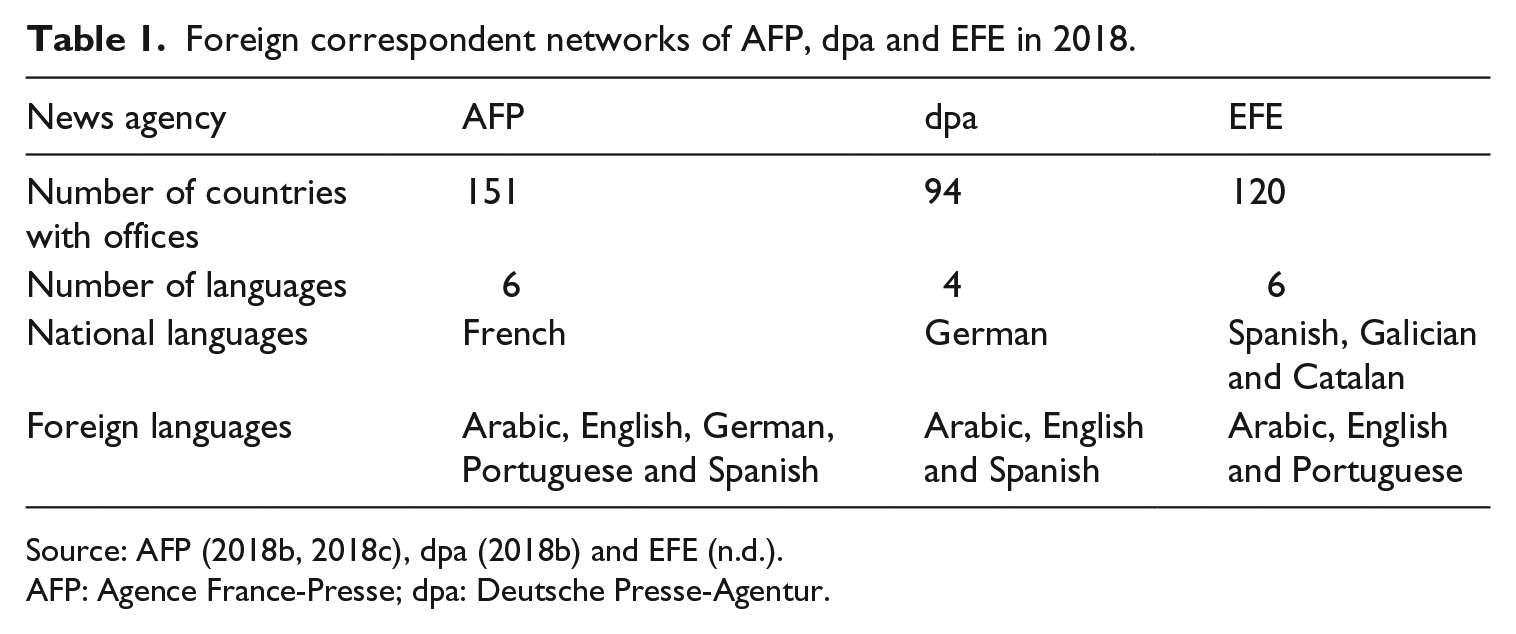
International and national news agencies have from their beginnings maintained a dependent and symbiotic relationship with one another (Boyd-Barrett, 1980), given the interdependence of their news sources. International agencies provide their general news services (GNS) to national agencies, for which a GNS is a fundamental source of foreign news. Moreover, the international agencies’ foreign correspondents are themselves reliant on the national agencies’ GNS in order to obtain information about events in the countries they are reporting on (Table 1).
Foreign correspondent networks of AFP, dpa and EFE in 2018.
Source: AFP (2018b, 2018c), dpa (2018b) and EFE (n.d.).
AFP: Agence France-Presse; dpa: Deutsche Presse-Agentur.
Research question
This study sought to address the following research question:
How do AFP, EFE and dpa maintain and develop their operations as international agencies?
Methodology
A case study approach was adopted in order to obtain a deeper insight into AFP’s, EFE’s and dpa’s operations. A case study undertakes a detailed examination (Abercrombie et al., 1984: 34), concentrating either on a ‘single case of a particular phenomenon’ (Orum, 2001: 59) or on investigating and comparing a small number of cases (Bennett, 2001: 1513) ‘within [their] real-life context’ (Yin, 2009: 13). A case study approach is advantageous because it characterizes the subject under study in a detailed manner (Flick, 2009: 134).
In this case study, the method of in-depth interviews was implemented in order to generate new knowledge in the research field of international news agencies, especially concentrating on the three agencies. When seeking to gain a detailed understanding, interviews are a suitable method for looking at different contexts which the persons involved are themselves best able to explain (Keuneke, 2005: 257). Qualitative research may therefore involve as a technique the conducting of in-depth interviews with a limited number of interviewees in order ‘to explore their perspectives on a particular idea, program, or situation’ (Boyce and Neale, 2006: 3).
To ensure comparability, an interview schedule comprising structured and open questions was designed and employed during all interviews. The interviews were conducted with eight news agency representatives, CEOs and management team members from AFP, dpa and EFE in June and July 2018 within the scope of the research project on The Future of National News Agencies in Europe (Vyslozil and Surm, 2019). The interviewees were selected on the basis of their professional status and their specific expertise in the field of news agency management.
The advantages and drawbacks of elite interviews are a matter of ongoing discussion among scholars in the social sciences (see, for example, Harvey, 2011; McDowell, 1998; Richards, 1996; Smith, 2006; Welch et al., 2002). As Harvey (2011) emphasizes, there is a lack of a clear-cut definition of the term ‘elites’; this makes it difficult to compare the results of various studies, which may differ in the way they select the interviewees to include in the sample (p. 433). In addition, the interview situation can be unbalanced because the interviewee, in the case of elites, is accustomed to employing authority over others, while here the interviewer is setting the agenda (see Harvey, 2011; Schoenberger, 1991; Smith, 2006).
Nonetheless, gaining access to elites gives highly beneficial insights into organizations (Harvey, 2010: 196), for instance, because elites are seen as influential in the process of building and changing the features and policies of these organizations. Furthermore, scholars like Schoenberger (1991) argue that interviews with elites can provide a wide-ranging analytical perspective when researching organizations: ‘they can generate responses that would be difficult to obtain through other more traditional methods’ (Harvey, 2010: 195).
The interviews were recorded with a digital audio-recorder, after obtaining informed consent from the interviewees. Prior to analysing the data, the interviews were transcribed and prepared, adopting the following process outlined by Austin et al. (1972) and Coleman et al. (2000): categorizing, comparing, refining of categories and review of data.
Results and analysis
The double role as a national and international agency
Although all of these three agencies can be labelled as international, they fulfil a double role as national as well as international news agencies. EFE, for instance, delineates itself as both a domestic and an international agency, particularly present in Latin America: ‘We have to be global, because we need to offer this global diffusion of our country and of the actuality of Spain and Latin America around the world’ (Muñoz Sánchez, 2018, personal communication). Or, as Crespo described it, ‘I think that Spain needs EFE because nobody else can speak out [for the country]. Not because we are the best, but because we are in all countries’ (Crespo, 2018, personal communication).
Looking at their correspondent networks, we see that each of these international agencies has a global network of bureaus divided by language or cultural grouping into (from four to six) different regions. A distinctive characteristic of international agencies is that they provide international news services in foreign languages as well as in their own national language(s). The intentions behind this are various: EFE emphasizes the need to be more global in future, while AFP mentions worldwide competition for sales as a priority. As Buhagiar explained, providing foreign-language services ‘helps us to level the sales situation around the world and we can approach other than French clients; this gives us the possibility to integrate some downsizing markets’ (Buhagiar, 2018, personal communication).
Like EFE, AFP defines itself as a national news agency for the French market and as an international agency for its global markets: ‘We have a mission of general interest; it’s called “la mission d’intérêt général.” This mission asks us to report from all over the world about breaking news’ (Buhagiar, 2018, personal communication). dpa pursues a so-called ‘one network policy’, implying that ‘being an international news agency we gather international information over the whole network, and sell parts of this information back to the international market’ (Kropsch, 2018, personal communication).
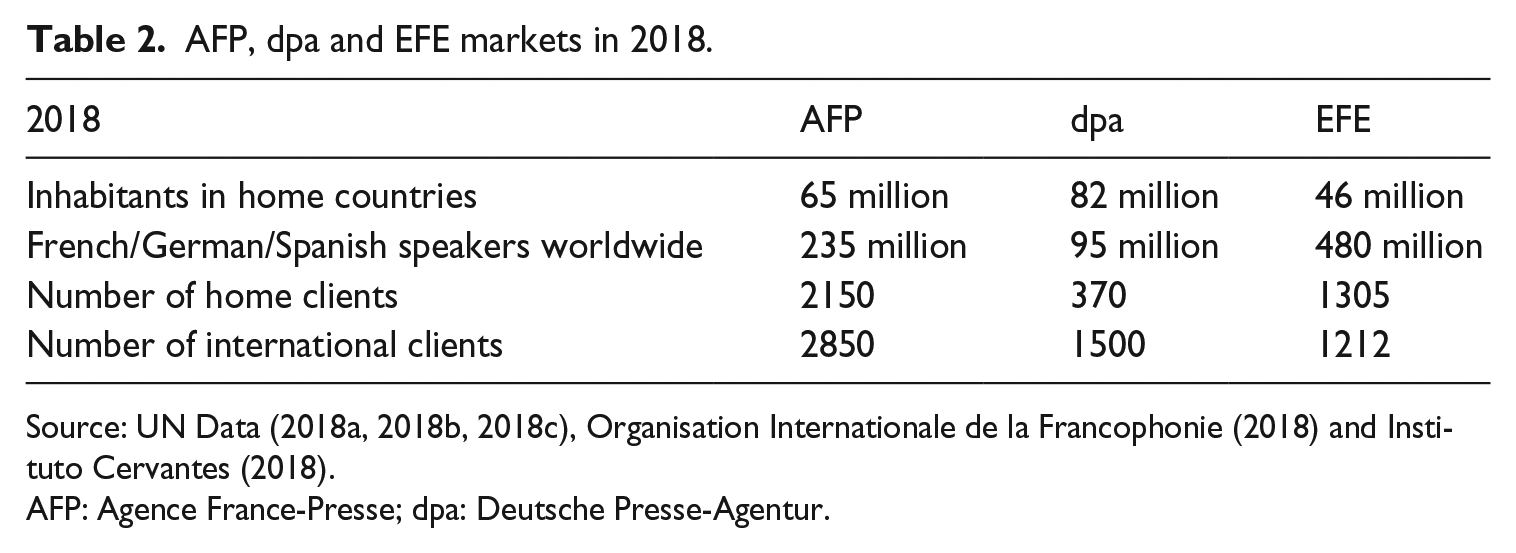
As we can see from the above quotations, this double role as an international and national agency does not come without costs, since running an international agency is expensive because of the maintenance of an international correspondent network and a news service in various languages (Table 2).
AFP, dpa and EFE markets in 2018.
Source: UN Data (2018a, 2018b, 2018c), Organisation Internationale de la Francophonie (2018) and Instituto Cervantes (2018).
AFP: Agence France-Presse; dpa: Deutsche Presse-Agentur.
Different structures of ownership
In the past, the ownership forms of international news agencies were a mixture of co-operative (AP), privately owned (Reuters) and state-owned (AFP and TASS) (UNESCO, 1953). Recent research (Rantanen et al., 2019; Vyslozil and Wippersberg, 2014) has found changes within and across these categories and a new category of publicly owned agencies (Juntunen and Nieminen, 2019; Rantanen et al., 2019). AFP, EFE and dpa each fall into a different category of ownership. AFP is a publicly owned agency: ‘an autonomous organization with a civil personality and whose functioning is ensured in accordance with the commercial rules’ (Loi n° 57–32, 2015). EFE is a state-owned agency belonging to a parent company, the Sociedad Estatal de Participaciones Industriales (SEPI) (State Industrial Holding Company) (EFE, n.d.). dpa (2018a) is a privately owned agency – owned by the German media (Geschäftsbericht (Annual Report)). In short, these international agencies are not defined by any one ownership form.
Despite their differing ownership structures, the three news agencies testify that they share identical value systems, with the provision of factual, trustworthy and unbiased national and international information as their guiding principle. AFP may under no circumstances take account of influences or considerations likely to compromise the accuracy or objectivity of the information; under no circumstances should it be subject to legal control or the control of an ideological, political or economic group. (Loi n° 57–32, 2015)
Likewise, dpa (2018a) is obliged to ‘provide impartial news independent of ideological positions, business and finance groups or governments’. In the same way, EFE is obliged to supply information ‘impartially, independently and objectively, to guarantee the information needs of Spanish society and to promote the external projection of Spain’ (Ley 9/2017 de 8 de noviembre 2017, de Contratos del sector público (Law of 8 November 2017 on Public Sector Contracts), 2017).
National politics influence AFP’s and EFE’s top-level management appointments. AFP President Emmanuel Hoog withdrew his candidacy for re-appointment in April 2018 ‘after failing to secure government support’ (AFP, 2018a). Over the last 40 years, 10 different presidents have been appointed. Likewise, national elections in Spain often result in a change of EFE’s President. For example, when Prime Minister Mariano Rajoy’s government stepped down in June 2018, EFE’s President, José Antonio Vera, resigned 1 day later and was subsequently replaced by Fernando Garea (El Confidencial Digital (Digital Confidential), 2018). At dpa, a longer length of service has been typical of top management: only five CEOs have headed the agency during the last 40 years.
Subsidies to AFP and EFE
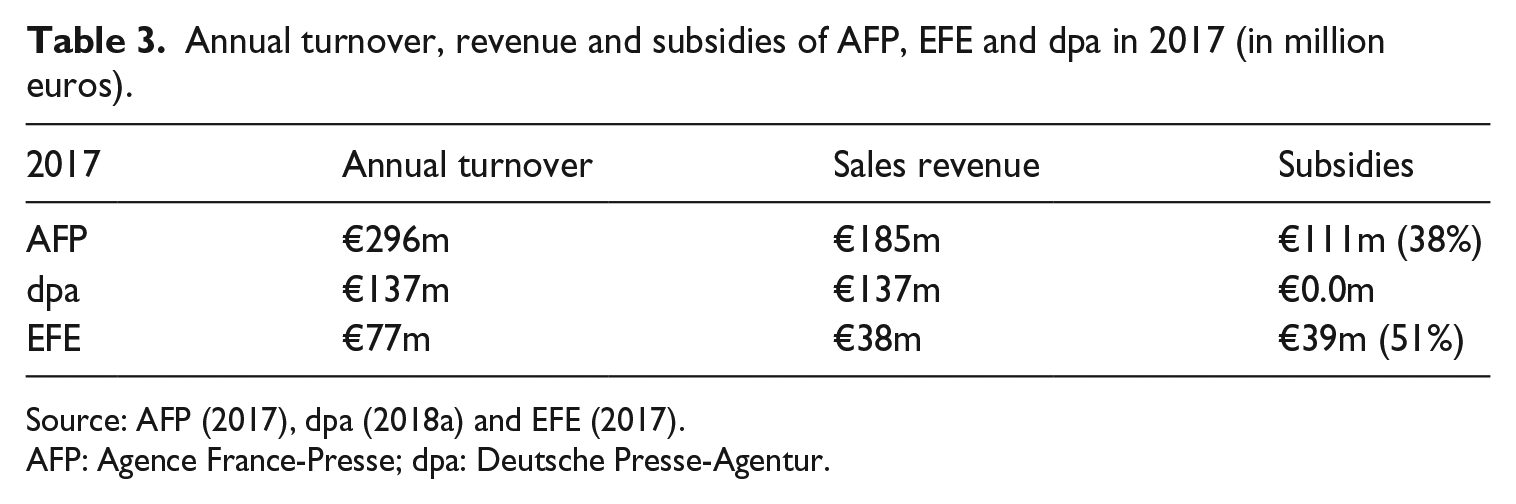
Two of the three agencies, AFP and EFE, receive subsidies accounting for up to 40–50 per cent of their revenue. It is not feasible to anticipate sales revenue completely supplanting the substantial volume of financial support they are currently receiving from state or government. In terms of turnover and subsidies, EFE is a much smaller agency than AFP or dpa, but its subsidies are higher than AFP’s (Table 3).
Annual turnover, revenue and subsidies of AFP, EFE and dpa in 2017 (in million euros).
Source: AFP (2017), dpa (2018a) and EFE (2017).
AFP: Agence France-Presse; dpa: Deutsche Presse-Agentur.
The above figures clearly reflect the fact that a considerable percentage of AFP’s and EFE’s income derives from subsidies received under the terms of their contracts with state or government. These contracts were drafted in conformity with European Union (EU) regulations and authorized by the European Commission. According to AFP’s (2014) Contrat d’objectifs et de moyens (Contract of Objectives and Means), the French state subsidizes the agency’s ‘mission of general interest’, which is defined as the supply of ‘breaking news for the French and foreign user worldwide’. In this context, the French state maintains AFP’s global foreign correspondent network. Likewise, from 2014 to 2018, the French state funded a strategic innovation programme, subsidizing image and video services, digital reliability and innovative sports applications, as well as enhancements to service quality (AFP, 2014). Similar to AFP, EFE provides a general interest service and receives subsidies on the basis of a commitment that – in contrast to the case of AFP – involves the Spanish government and not the state as a contracting party. This contract obliges EFE to provide coverage of all events of Spanish interest, which requires extensive financial and personnel resources (Juntunen and Nieminen, 2019).
While AFP and EFE both incurred losses in 2017, dpa realized profits. dpa is following a diversification strategy whereby more than 30 per cent of its sales are derived from diversified services and products such as news aktuell, which delivers press releases to the media (Kropsch, 2018, personal communication).
Markets and the media crisis
The protracted structural crisis that the worldwide print media industry has been encountering has heavily impacted the world of news agencies, which have been weakened economically and consequently in terms of their editorial power in both domestic and foreign markets (Rantanen et al., 2019). As Buhagiar of AFP emphasized, ‘We are in a crisis because the media is in crisis all over the world’ (Buhagiar, 2018, personal communication). According to Crespo, EFE’s situation is particularly serious as the Spanish media market is encountering two crises simultaneously – the commercial crisis in Spain, which has affected the media and the global digital crisis (Crespo, 2018, personal communication).
The three agencies are trying to respond to the crises in different ways: (1) AFP by covering its losses in the domestic market from international customer revenues, (2) EFE by asking for more state subsidies and (3) dpa by increasing its income from the domestic market. Although sales of its French GNS have declined, AFP anticipates strengthening sales by supplying its services in English and in other foreign languages: Supplying services in foreign languages is what helps us to level the sales situation around the world. If we did not have that, then when the French media market is going down we would be . . . in a major crisis. (Buhagiar, 2018, personal communication)
Nevertheless, given the problematic economic conditions, AFP’s current President, Fabrice Fries, enforced in 2018 the so-called ‘Plan Fries’, which aims to scale down AFP’s staff by 125 employees by 2023 in order to save on costs (SUD-AFP, 2018).
In an interview in 2019, Fernando Garea, the current President of EFE, characterized EFE’s situation as ‘dramatic’, stressing the consequent need for enforcement of a ‘shock plan’ (Arranz, 2019) and asking for increased state funding. As Crespo explained (Crespo, 2018, personal communication): During the first crisis our clients went down, our clients lost income and so they cut services, therefore we are dealing right now with a deep crisis in the Spanish media. And the second crisis is the digital crisis: all over the world, you know, news media are changing. The newspapers are suffering a lot of changes.
Unlike AFP and EFE, dpa is relying wholly on income from the German market. As Kropsch, about 90 per cent of dpa’s business volume is derived from business activities within Germany: ‘I would say the turnover coming from the international market is not more than 10%’ (Kropsch, 2018, personal communication). Consequently, dpa’s international activities are for the most part funded by its revenues from the German market. Nevertheless, the intensifying cost pressure on its international activities forced dpa to restructure its Spanish text service. The reorganized service is oriented to a greater extent towards visual services – photo and video – while the text service will be reduced by dismissing 40 staff members, primarily in Spain and Latin America, who produced the Spanish text service on site (APA-DeFacto, 2018).
Competition
While in the past, international news agencies were in competition with one another and with national agencies, all agencies now face a different type of new competition from social media companies such as Google News, Yahoo and Facebook. It is often impossible to track the flow of international news between sources, but there is evidence that many world news items originate from international news agencies, although these news items are not always attributed systematically or clearly to these agencies (Segev, 2019: 939). Companies such as Facebook or Google tend to provide their users with the news agencies’ content without reimbursing the agencies for the items used. ‘We can’t go to court all the time on every single story. We need a licensing business’ (Buhagiar, 2018 personal communication). As a first step towards a fairer future, the international news agencies are aiming for a reform of copyright and ‘neighbouring’ rights, on the grounds that a future without news agencies would result in a severe deficit for democracy: ‘They will be the only ones left, you know’ (Buhagiar, 2018, personal communication).
Furthermore, Buhagiar argued that it was nearly impossible to make a profit from online business, as all advertising revenues are diverted to Facebook and Google, ‘who are siphoning all of the ad revenue, so we need to do something’ (Buhagiar, 2018, personal communication). AFP, EFE and dpa, together with the European Alliance of News Agencies (EANA, 2019), representing 32 European national news agencies, were among the many agencies, publishers, journalists and other media representatives supporting the EU Copyright Directive, which was approved by the European Parliament on 26 March 2019. The principal components of this directive are as follows: (1) the establishment of ‘neighbouring’ rights for publishers, (2) the strengthening of rights-holders’ ability to negotiate and request remuneration for the use of their content online and (3) the remuneration of content creators as a result of new transparency rules (European Commission, 2019).
In terms of competition between news agencies, AP and Reuters are identified as traditional competitors, while Anadolu, TASS and Xinhua have now also become significant competitors (Table 4). The main characteristics of each of these competitors can be summarized as follows:
AFP, EFE and dpa compared with other international agencies (2018).

Source: AFP (2018b, 2018c), dpa (2018b), EFE (n.d.), AP (2018), Reuters (n.d.-a; n.d.-b), Anadolu (n.d.), TASS (n.d.) and Xinhua (2019).
AFP: Agence France-Presse; dpa: Deutsche Presse-Agentur; AP: Associated Press; TASS: Telegrafnoe agentstvo Sovetskogo Soiuza.
As can be seen from Table 4, Anadolu is offering its news services in most languages (13), although it is represented in the smallest number of countries. Xinhua, meanwhile, operates most branches, in 170 countries. Overall, these numbers show that these other international agencies offer their news services in more languages but some of them run fewer foreign offices than the three agencies studied here.
A common view among our interviewees was that Anadolu, TASS and Xinhua, as state-owned agencies, are pursuing different objectives. In all cases, the interviewees accentuated the particular stance of Xinhua as a result of its rapid development and expansion, especially in Africa. As Kropsch (2018) noted, Africa was the backyard of France before, and now Xinhua is there. I think Xinhua is enhancing the number of language services, and this is not because they want to supply [news in a specific African language] better than before.
Moreover, Xinhua is seen as in the process of resurrecting the ancient Silk Route, ‘beginning in Beijing and leading to Duisburg. And all along the way they [Xinhua] invest and watch’ (Kropsch, 2018, personal communication).
New business and innovation strategies
International news agencies are affected by a heavy economic pressure that will only intensify in future, with the continuing decrease in newspaper circulation resulting in the worsening of the agencies’ income situation. Therefore, there appear to be three main strategic options:(1) additional cost reductions to take account of the potential deterioration in the agencies’ economic conditions; (2) appealing to the state for (further) subsidies, potentially resulting in greater political dependency; and (3) focusing on diversification and innovation – an option entailing substantial independence for the agency (Vyslozil and Surm, 2019).
Considering these strategic options, our interviewees acknowledged that priority needed to be given to the diversification of markets and products in order to secure the news agencies’ economic future by counterbalancing losses in the core business. From this perspective, international news agencies can only be successful if their core activity, the GNS, remains sustainable in the long run (Kropsch, 2018, personal communication). As Chasseriau put it (Chasseriau, 2018, personal communication): Maybe we have to diversify ourselves, going to the corporate markets, going to the on-demand business, making sure that the source of revenue is sufficient, or bringing in enough revenue to keep the core activity at its level which makes the reputation and credibility.
Like Chasseriau, other interviewees highlighted the significance of introducing business strategies and establishing related services around their core business, in what Kropsch called the ‘bacon belt’ (Kropsch, 2018, personal communication). Inside this ‘belt’, news agencies would need to establish a business portfolio covering three major markets: (1) media markets; (2) corporate markets; and (3) governmental and institutional markets. Given these factors, the strategic option for news agencies seems to involve prioritizing their diversification processes and conquering new markets in order to sustain their GNS.
In order for agencies to operate on a global scale and reach international customers, Vyslozil and Surm (2019) have identified the following approaches: (1) development of automatic translation technologies, (2) distribution of services in foreign languages and (3) improving access to markets in other countries and regions. With respect to foreign languages, two main developments were highlighted: first, the increasing use of English as a working language, as is the case, for instance, at AFP, which no longer works in French on its photo service. Buhagiar acknowledged that ‘For video, the English service is the flagship; it’s not the French service, not any more’ (Buhagiar, 2018, personal communication). Chasseriau underlined one reason for this development: ‘It’s a trend because the younger journalists are more and more speaking English rather than French, so it’s something we have to take care of’ (Chasseriau, 2018, personal communication).
Second, recent developments in the field of technology have led to the application of automatic translation technologies and an associated greater distribution of services in foreign languages. Buhagiar underlined one of the advantages of this, ‘The fact that we are working in French, English, Spanish, Portuguese, German and Arabic helps us to develop the soft power of AFP, and therefore maximize the impact the French government is putting in our budget’ (Buhagiar, 2018, personal communication). Moreover, Crespo highlighted the economic aspect of foreign languages (Buhagiar, 2018, personal communication): I think the more interesting part of the future is reaching a global audience. If you are just a national provider and you can’t reach the rest of the world, you are competing in the worst scenario. You need all the possibilities. We are trying right now to get rights in India. It’s a very exotic market for us, but we think that we need that to survive in the future.
In their accounts of events affecting the news agencies, their representatives agreed that images and video would be the commercial future of international news agencies. For AFP, visual services, and especially video, are the products with the greatest economic potential. At present, AFP generates about 80 per cent of its video turnover beyond national borders. Thus, Chasseriau asserted that ‘Video is our most internationalized product’ (Chasseriau, 2018, personal communication). AFP’s video services grew by 30 per cent in 2017, leading him to assert (2018) that ‘Video is the future for us’ (Chasseriau, 2018, personal communication). A further innovation project is the provision of ‘production on demand’, a service that expanded by more than 60 per cent in 2017 at AFP and was in the implementation phase at EFE in 2018. An innovation project at dpa is the founding of the ‘Next Media Accelerator’, a branch accelerator that invests in start-ups with links to the media business (Kropsch, 2018, personal communication).
Conclusion
This article investigates three European news agencies, AFP in France, EFE in Spain and dpa in Germany, which are all labelled as national and international agencies. According to the criteria developed here for defining a news agency as international, all three of the above fulfil these criteria. While turnover and profits vary considerably, they all maintain an extensive network of foreign correspondents and all provide their services in a number of languages. Their shared mission is the provision of factual, trustworthy and unbiased national and international news.
While international and national news agencies have in the past often been studied separately, this article emphasizes that the understanding of international agencies has to be contextualized also in a national setting, especially when considering ownership. All three of the agencies studied fell into different ownership categories, AFP being publicly owned, EFE state-owned and dpa in private (media) ownership. The form of ownership as such, then, does not prevent any agency from operating as an international agency. State and public ownership forms clearly provide financial support for a national agency to establish and maintain its international activities.
Two of the agencies in this case study obtain up to 50 per cent of their income in subsidies from the state. It appears highly unlikely that they could replace their state subsidies with a profitable diversification policy. Consequently, it can be anticipated that the demand for financial assistance will increase rather than decline in the long run. For international news agencies, the costs both of their foreign correspondent networks and of developing new products are considered as significant factors of strategic relevance. If the top management is changed after every governmental election, long-term planning and innovation may suffer. Alongside the pursuit of a diversification strategy, the equally consistent pursuit of a future cost-cutting strategy may be inevitable.
News agencies are severely affected by the wide-ranging crisis in the global print media industry. Declining newspaper circulation has been witnessed by news agencies as resulting in intensifying economic pressure. Two of the three agencies in this case study have carried out marginal diversification. Nonetheless, a further diversification of markets and products is fundamental to safeguarding the agencies’ economic futures and to sustaining their GNS which embodies a fundamental value of news agencies. In order to further develop the diversification of income, three innovation strategies were pinpointed: (1) advances in digitization (e.g. by implementing new types of sales platforms), (2) development of new products (e.g. visual services) and (3) deployment of new markets by operating foreign-language services (including progress in the use of technology for automatic translation) and accessing new markets (e.g. in Asia and Latin America).
In the new digital markets, the role of international agencies is subject to constant change. They may be seen as a supplier, then as a customer, and at another moment as a competitor. This process of change and transformation underlines the significance of the agencies’ adjustment to these new roles through the adaptation of their infrastructure to their clients’ demands. What remains is for news agencies to prepare themselves for the future, whether this proves troublesome or conquerable. Of the utmost relevance will be that they do not stand still or remain satisfied with the status quo but strive for further development and progress.
The generalizability of these results is subject to certain limitations, and research with larger samples and different methodologies could provide more definitive evidence. Further research is undoubtedly necessary, as there is a lack of robust, directly comparable data on international news agencies that goes beyond single case studies. It will also be important to study other international agencies, such as Agenzia Nazionale Stampa Associata (ANSA), AP, Reuters, TASS, Xinhua and Anadolu, and the extent to which these are influencing the future of the international news network. This needs to be embedded in a comparative framework in order to analyse the status quo and future situation of both national and international news agencies. It remains for this research to begin.
Footnotes
Acknowledgements
The author would like to thank Prof. Terhi Rantanen for her thoughtful comments on this article, for constructive criticism and suggestions; Jean Morris for her language revision and proofreading; as well as the two anonymous reviewers for their helpful comments on the manuscript.
Funding
The author disclosed receipt of the following financial support for the research, authorship and/or publication of this article: This work was supported by the Media Research Foundation of Finland: Jyllands-Posten Foundation, Denmark; LSE Knowledge Exchange and Impact (KEI) Fund, UK; and Department of Media and Communications, LSE, UK.
Author biography
List of interviewees
Sara Bhagchandani (Deputy Sales Director, EFE)
Christine Buhagiar (Europe Director, AFP)
Franck Chasseriau (Sales Director Europe, AFP)
Emilio Crespo (Editorial Director, EFE)
Peter Kropsch (CEO, dpa)
Miguel Ángel Muñoz Sánchez (CFO, EFE)
Ángel Aguado Olmos (Director Sales, EFE)
Rosario Pons Correa (Director of International Relations, EFE)