



Abstract
This article studies the role of translation as a first-level gatekeeping mechanism in news production. Contrary to previous views that translation was secondary for the selection and dissemination of news events, it is posited that the translational activity reflects the decisions made by news media, particularly, in the case of services in languages aimed at non-native audiences. The article is structured as follows. First, it surveys the concepts of gatekeeping and ideological affinity with regard to news translation. Then a research question concerning the reporting of the Catalan secessionist crisis in Spain is presented. This will serve to examine how translation functions as a gatekeeping mechanism. The corpus selected for the analysis comprises the Spanish articles and English versions posted by El País in the 3 months prior and the 3 months posterior to the simultaneous appointments of Spain’s new Prime Minister and of the new editor of El País. This coincidence constitutes a unique opportunity to delve into the relationship between translation and gatekeeping. The findings show that the ideological affinity between the political leader and the editor may have prompted a significant change in the way the Catalan crisis was reported, particularly in the translated versions.
Introduction
This article aims to address the crucial role of translation as a gatekeeping mechanism in relation to the principle of ideological affinity. Within Translation Studies, the interest in journalistic translation has grown steadily since the late 20th century, particularly after the introduction in 1989 of the term ‘transediting’ by Karen Stetting. Since then, researchers within the discipline have explored linguistic issues (Károly, 2017; McLaughlin, 2011), journalistic practices involving translation (Bielsa and Bassnett, 2009; Hernández Guerrero, 2009), multilingualism, interculturalism and convergence (Davier and Conway, 2019) and ideological uses of translation in news writing (Conway, 2010; Harding, 2012). Following calls for interdisciplinarity, translation scholars delving into journalistic translation have applied a number of concepts widely used by journalism scholars such as framing (Baker, 2006) and gatekeeping (Valdeón, 2016).
In the digital age, news companies increasingly rely on translation not only for news production and consumption by their domestic readership, but also as part of their globalization strategies. The transmission of texts in English is a response to a contemporary feature of news production as news organizations try to exert an influence upon audiences speaking other languages and belonging to other cultures. In this article, I would like to explore the role of translation as part of the complex and often hidden processes of selection and suppression of news texts and events. In this context, translation has a twofold function. On the one hand, it serves to deliver news originating in other languages, on the other hand, it may serve to select what news is to be delivered to foreign audiences of a news organization. In other words, it is suggested that the role of translation can be traced on two distinct levels: on a macro-level translation functions as filter to allow news writers/translators and companies to consider what should be published and what should not, and on a micro-level it serves to select the parts of the original articles that need to be adapted or omitted during the translational and editing process. In Translation Studies, the latter has been labelled ‘transediting’ (Stetting, 1989; Van Doorslaer, 2009; Zhang, 2013). Both levels are related to the concept of gatekeeping, central to Journalism Studies and also used in Translation Studies, as mentioned. To delve into this relationship, I will focus on the role of translation as a gatekeeping mechanism rather than as a mere writing strategy, as suggested by some communication scholars ( Palmer, 2009: 819; Raymond, 1998: 10), which will be illustrated with a controversial issue that, in recent years, has featured prominently on Spain’s news media in general, and in El País in particular.
This article is organized as follows. The next section introduces the relation between gatekeeping and translation in news production, as discussed by both journalism and translation scholars. Then I will discuss the concept of ideological affinity, drawing on Mark Fishman’s discussion of bureaucratic affinity. Ideological affinity will be posited to be instrumental in gatekeeping processes involving translations. In the next section, I will illustrate how ideological affinity conditions the use of translated texts as a gatekeeping mechanism. More precisely, I will discuss the way in which the appointments of Socialist Pedro Sánchez as Spain’s Prime Minister, and Soledad Gallego as the new editor of El País newspaper may have impacted the reporting of the Catalan secessionist crisis for international readers in English, focusing on 2 periods: the 3 months prior to the appointments and the 3 months ensuing them. The choice of this news organization and this news event is of particular significance: rarely do we find a situation in which both a Prime Minister and the editor of a news corporation occupy their positions simultaneously. The article will conclude with a final discussion of the findings.
Gatekeeping
The concept of gatekeeping was introduced in communication studies in the 1950s. The study of gatekeeping, a process that refers to the various gates that information has to go through before it is finally published (Shoemaker and Vos, 2009), has become a key issue in Journalism Studies, as gatekeeping is part and parcel of the way in which a social reality is transmitted and constructed. Shoemaker et al. (2009: 73) define gatekeeping in relation to the processes of selecting, writing, editing, positioning, scheduling and repeating information, while Van Der Meer et al. (2017), who have analysed the sources reporters use to cover political crises, stress the crucial role of journalists as gatekeepers, as they have the power to select the sources they rely on to write their texts.
Admittedly, journalists’ decisions can be affected by a number of external agents. Tandoc (2018: 2345) posits that gatekeeping is a multi-layered process which results from the influence of several agents such as audiences, peers and institutional forces of various types, while Shoemaker and Reese (1996) also mention media workers, media routines, news corporations, advertisers, and governments and ideology. Of particular relevance for this study is the taxonomy proposed by Hanitzsch et al. (2010), who have identified the following six types of influences: political, organizational, economic, procedural, professional, and reference groups. The first two will be the focus of this article.
With regard to journalistic translation, translation scholar and journalist Claire Tsai finds a close relation between transediting and gatekeeping. Tsai, who has worked for news organizations in Taiwan, stresses that ‘the whole news trans-editing process can be best described as a gatekeeping process’ (p. 204), while Valdeón (2016: 39) claims that gatekeeping and transediting function on two different levels: the institutional one and the individual one, the former being related to the role of the news organization and the latter to the decisions taken by the journalists as news writers and/or translators.
In the first serious attempt to study the role of translation in a news organization, as part of a special issue of Journalism devoted to news translation, Cheesman and Nohl (2011) analysed the translation of domestic news events for a global readership, namely the US presidential election for the BBC’s English-language global market, and then the re-localization of the same event for a domestic readership, that is, the same topic was prepared for audiences, say, in India or Pakistan. Cheesman and Nohl proposed the following figure to represent the various localization and globalization processes involved:
Figure 1 represents an international news organization which reports on a news event in two different ways: the initial step involves the selection of a news event worth reporting for a global audience. Once the topic has been selected, news writers produce a global text first and, allegedly, translate it for a local market second. This would involve various degrees of adaptation or transediting (Stetting, 1989). However, Figure 1 is only one example of the possible ways in which gatekeeping and translation can interact. This article focuses on a different process, that is, a domestic news event selected by a national news outlet to be reported for the domestic market first, and for an international readership at a later stage. Figure 2 represents this process.
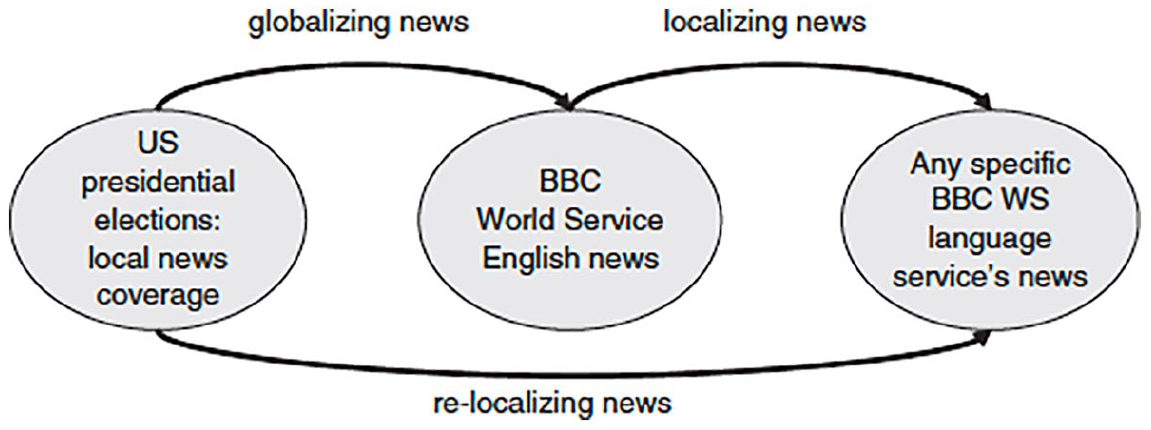
Globalizing, localizing and re-localizing (Cheesman and Nohl, 2011).
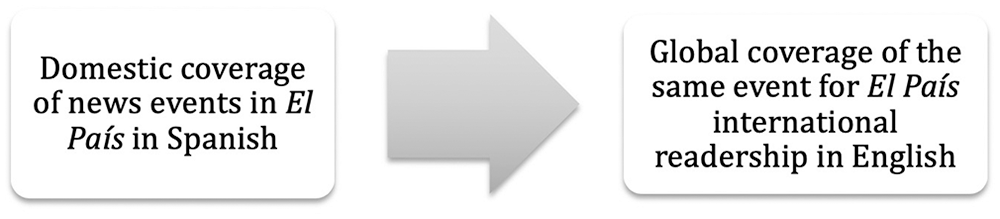
Coverage of domestic news events and globalization for international readers.
As mentioned, in journalistic translation research, the translation of news articles has been studied in relation to the concept of transediting. Cheesman and Nohl (2011: 218–219) point out that, although gatekeeping and transediting have often been used as synonyms by journalism and translation scholars respectively, the former is preferred when referring to the selection of a news text worth publishing as well as to the organization of its parts. In contrast, the latter is used to account for the semantic changes that occur during the translation process. Transediting has indeed been used for semantic changes in the target texts, but these do not necessarily involve the replacement of single words of phrases by others, but also the reorganization of paragraphs as well as the addition and omission of information. Therefore, transediting should not be understood as a synonym of gatekeeping, but rather as a special type of translational process that is specifically applied to the translation of news texts.
To conclude this section, it is worth mentioning that translation scholars (Conway, 2010; Hernández Guerrero, 2009) have increasingly become interested in interdisciplinary approaches to journalistic translation and have applied concepts from Translation and Journalism Studies, viewing translation as a second-level gatekeeping mechanism. In other words, translation strategies will impact the interpretation of the source stories by omitting information, adding data or modifying the original text or texts upon which the target text is based on. However, I would like to suggest that translation may in fact function as a first-level gatekeeping mechanism. Or to put in a different way, the selection of texts for translation is already a gatekeeping mechanism: journalists and/or translators make decisions concerning what should be translated and, consequently, passed on to their readers. In the case of national news corporations disseminating national news content for international audiences, translation may be indicative of the selection processes prior to the actual interlinguistic transformations applied to the texts made available to non-domestic audiences. I contend that gatekeeping and translation can be explored taking into account the ideological affinity between the political and organizational agents that may affect news production.
Finally, it should be mentioned that the results below could also be discussed taking into consideration the concept of framing, widely used in Journalism Studies and also familiar to translation scholars. Reese (2007) defines frames as ‘organizing principles that are socially shared and persistent over time, that work symbolically to meaningfully structure the social world’ (p. 150), while Tankard et al. (1991) consider framing mechanisms as central organizing ideas ‘for news content that supplies a context and suggests what the issue is through the use of selection, emphasis, exclusion, and elaboration’ (p. 11), strategies that are also used in Translation Studies. However, given the space constraints of a research article, only passing remarks will be made in the sections below.
From bureaucratic to ideological affinity
In his study of journalistic practices in New York City, Mark Fishman (1988) showed that news production is often dependent on a variety of bureaucracies, ranging from government to private corporations. According to Fishman (1988: 95), reporters are provided with prepacked information by officials who are granted legitimacy derived from their position, which entails that ‘newsworkers are predisposed to treat bureaucratic accounts as factual because journalists participate in upholding a normative order of authorized knowers’ (p. 96). In addition, news writers are likely to accept or support the ideological stance of the news company they work for and, therefore, might contribute to the dissemination of those bureaucratic accounts that support preconceived interpretations of the events they report on. In this sense, Fishman (1997) claims, news writers construct an image of reality which is neither a reflection or a distortion of that reality (p. 211) but rather an interpretation based on the selection of news events and their relation to one another (p. 212). According to Herman and Chomsky (1988), this ideological outlook or agreement is part of a five-filter propaganda model that makes the media align themselves with the state. This model includes the allegiance to corporate interests, the influence of advertisers, the reliance on official sources and media fear. Although Herman and Chomsky applied their five-filter model to what they term anti-Communism discourse, other authors have successfully used it to discuss liberal media such as The New York Times and, more specifically, its coverage of the US-Iraq conflict (Boyd-Garrett, 2004). In addition to Herman and Chomsky’s five filters, Boyd-Garrett (2004) added a sixth filter pertaining to the penetration of government funding into mainstream media (p. 436). For the purposes of this article, I will focus on Fishman’s bureaucratic affinity and Herman and Chomsky’s ideological affinity, which will be subsumed into one, not only for space limitations but also because the working assumption is that it might be difficult, if not impossible, to dissociate where bureaucratic affinity ends and where ideological affinity begins. The final discussion will also draw on the concept of nonevent (Fishman, 1997). Nonevent makes reference to the ability of news organizations and news writers to decide on the newsworthiness of an event. Their decisions will depend on schemas of interpretation originating in the institutions that provide journalists with information, but also in the institutions news writers work for. Or, as Fishman (1997) puts it, news writers may exclude from public view ‘occurrences that might challenge the legitimacy of the institutions reporters depend on for news’ (p. 210).
In Translation Studies, the relationship between bureaucracies has been described as part of the institutional routines news corporations and other companies and institutions share. In the case of non-Western nations, this relationship is obvious: news production is funded by governmental agencies, which exert a great influence on the texts that are translated and how they are translated, as news outlets are expected to be supportive of their governments. For instance, Pan (2014) studied the case of the Reference News Newspaper, a news company that translates foreign reports for Chinese audiences. In principle, in this state-sponsored venture, translators are expected to render the foreign texts into Chinese faithfully. However, Pan shows that the so-called ‘faithful translation’ expected of translators involves selecting or deselecting paragraphs and sections, taking into account institutional practices and expectations. For his part, Van Leeuwen (2006) has shown that translators working for the English-language Vietnam News adapt the Vietnamese source texts following two types of institutional practices: on the one hand, Anglophone news writing conventions are followed as news translators are expected to cater for a global readership, on the other hand, institutionalized source-culture themes such as tourism and Western perceptions of the Orient are preserved (Van Leeuwen, 2006: 234). In this context, journalists/translators do not only select the articles to be translated, they also select the parts that can be translated. In other words, translators may act as gatekeepers or even censors, as translation serves to preserve official orthodoxy.
The above cases explore news media with obvious ideological and bureaucratic affinities with their respective governments. This can indeed be expected in news media such as Vietnam News and Reference News, which are produced in non-Western-style regimes. To be sure, ideological affinity can also be traced in news outlets based in Western-style democracies. Neto and Undurraga (2018), for instance, have studied the case of economic journalists in Brazil and have proposed the term ‘elective affinity’ to refer to the relationship between elite journalists and economic ‘efficient agents’, such as Central Bank directors and mainstream economists, as these two groups need each other (p. 2255) either for pragmatic reasons (e.g. journalists and news outlets need to be in the favour of governmental institutions) or to convince the readership of the correctness of specific policies. For his part, Tandoc (2018), who has studied the influences of various external and internal agents on journalists in the Philippines, has concluded that high-level journalists seem to be more concerned with organizational or institutional agents than with political ones.
The role of ideological affinity in the gatekeeping process: El País as a case study
In line with the above, this article aims to explore how ideological affinities go hand in hand with the gatekeeping process. In other words, it will attempt to show that the ideological affinity between a government and the so-called free press can affect the selection and deselection of news events to be reported on. For this purpose, the digital version of El País newspaper was selected, as it was hypothesized that the simultaneous changes in the Spanish government and the editorship of the newspaper may provide insights into the dynamic nature of the concept of ideological affinity. The selection of this news outlet at a specific time was based on the assumption that it may provide us with a unique case in which a head of government and a newspaper editor are replaced at the same time. In addition, both seemed to share a similar ideological stance regarding issues such as women’s rights, the exhumation of former dictator Francisco Franco’s remains, and the Catalan secessionist crisis. El País was in fact criticized by other news media for siding with the ruling Socialist Party following the demise of the Popular Party and coinciding with the rise to power of controversial Socialist politician, Pedro Sánchez, who managed to be elected Prime Minister with the votes of parties such as radical left Podemos (who have staunchly supported the Venezuelan regime) and Catalan secessionists. As mentioned, these events were coincidental with the appointment of Soledad Gallego as the new editor of El País. Gallego replaced Antonio Caño, who, during his tenure, had been critical of Pedro Sánchez’s handling of the political situation in Spain. Leftist news media welcome Gallego’s appointment, while conservative ones were more critical. 1 In the weeks following her appointment, El País seemed to start working in synchrony with the new government, as it began to give prominence to various feminist issues (from supporting measures in favour of women’s rights to publishing articles about the sexist nature of pop songs in the 1960s), and to post articles delving into the Francoist period. Both topics were given great visibility on the front page of the print version and occupy salient positions in the digital edition.
In line with the above, the working hypothesis was that Gallego’s stronger political affinities with the new Socialist government was bound to affect journalistic practices in general, and translational ones in particular. Thus, this article aims to explore how ideological affinity places news translation at the centre of the gatekeeping process, selecting and distorting news events for international audiences (Clausen, 2004). Translation may function as a first-level gatekeeping mechanism that may throw light on the relationship between El País and the current ruling party, as the newspaper may have sacrificed independent reporting in favour of its strong support of the new Prime Minister’s policies concerning the issues mentioned above. In fact, it may function as a gatekeeping mechanism running parallel to other gatekeeping processes such as selecting, shaping and repeating information (Shoemaker and Reese, 1996). This would run counter to claims that translation functions merely as a second-level gatekeeping process (Valdeón, 2016: 39), and might highlight the role of translation as a first-level gatekeeping mechanism, at least when translation becomes a visible process, as is the case of El País in English, which contributes to the selection and publication of news texts and to the shaping and repeating of information.
Of the three topics mentioned earlier, and given the space limitations of a research article, I selected the Catalan move for separation from the rest of Spain as a case in point. Considered the most important political crisis in the country since Spain’s return to democracy in 1975, separatist parties have been pushing for secession from Spain for a number of years. In October 2017, the ruling party in the region and its political allies (including the anti-capitalist organization, CUP) organized a referendum, declared unconstitutional, which was the climatic event resulting from a series of political, social and economic disagreements over a 10-year period, and which ended up with the secessionist leaders being imprisoned on charges of rebellion. In the spring of 2018, the Spain’s Conservative Prime Minister lost a vote of confidence, and Socialist Pedro Sánchez replaced him with the support, among others, of the Catalan secessionist parties and far-left party Podemos. Sánchez promised a new era in the relations between the central and the regional governments. A new Catalan premier had also been appointed in the previous weeks, following an early election in the region in December 2017.
The article aims to analyse the use of translation as a gatekeeping mechanism by trying to answer the following research question:
RQ1: To what extent did reporting of the Catalan crisis change both in Spanish and in the translated English texts after the appointment of Pedro Sánchez as Spain’s Prime Minister and Soledad Gallego as editor of El País?
To explore this issue, I proceeded as follows. Using the search engine of El País, I gathered a corpus comprising the articles (hard news and op-ed columns, as no analysis pieces were published during the period examined) focusing on the Catalan crisis in the 3 months before and after the appointments of Pedro Sánchez and Soledad Gallego. In other words, March, April and May 2018 for the period prior to their appointments, and June, July and August for the period posterior to their appointments. Subsequently, similar searches with the same parameters were conducted for El País in English. Given the specificity of the criteria for the selection of the articles, the size of both corpora had to be limited, as Zanettin (2012: 43) suggests, both the Spanish and the English corpora were bound to be formed by a small number of texts posted in a limited period of time. However, and as a result of the specificity of the criteria, these corpora can be described as ad hoc rather than parallel. The use of ad hoc corpora has been supported by a number of authors (Corpas, 2001; Malmkjær, 1998). After gathering the articles, an analysis of the content was carried out taking by considering differences and similarities between headlines, leads, pull quotes and photographs, as well as the content of the articles in order to ascertain whether gatekeeping was used as a mechanism to provide different narratives based on the ideological affinity between the new government and the new editor of the newspaper. 2
Results and discussion
The two corpora provide us with a clearly distinct picture as regards the number of articles posted by El País and El País in English during the two periods. The following tables show numerical data for the 3 months prior to the appointments and for the 3 months after the appointments.
Before comparing the two periods, it should be pointed out that the total number of articles in the two versions varies significantly, which is standard practice. The webpage of the newspaper states that ‘The English Edition offers a selection of stories from the Spanish version of the publication, translated into English and with added context and explanation’. 3 In other words, the statement seems to indicate that the English-speaking journalists and translators working for El País act as gatekeepers on the two levels mentioned earlier: First, they select the stories that will make it into the English version, second, they transedit the texts for the target readers, making choices as regards what should be translated, omitted, added or adapted.
As regards the news event studied here, the number of articles in Tables 1 and 2 show a clear decrease in both the Spanish and English versions. It is worth noting that only texts that addressed Catalan separatism directly were included in the Spanish and the English subcorpora. These comprise articles focusing on the political crisis but also on its economic, social and cultural impact. Taking this into account, the number of articles reporting on the various aspects of the Catalan crisis in Spanish was reduced by around 50% after the appointments, whereas the reduction of English articles is even more evident. This number was lower for the March–May period to begin with, as only 78 texts focused on Catalan separatism in English. As for the number of translated texts on the Catalan crisis in El País in English, the decrease is more noticeable: from 78 in the March–May period to 28 in June–August, that is, almost a third.
Articles before the appointments.

Articles after the appointments.
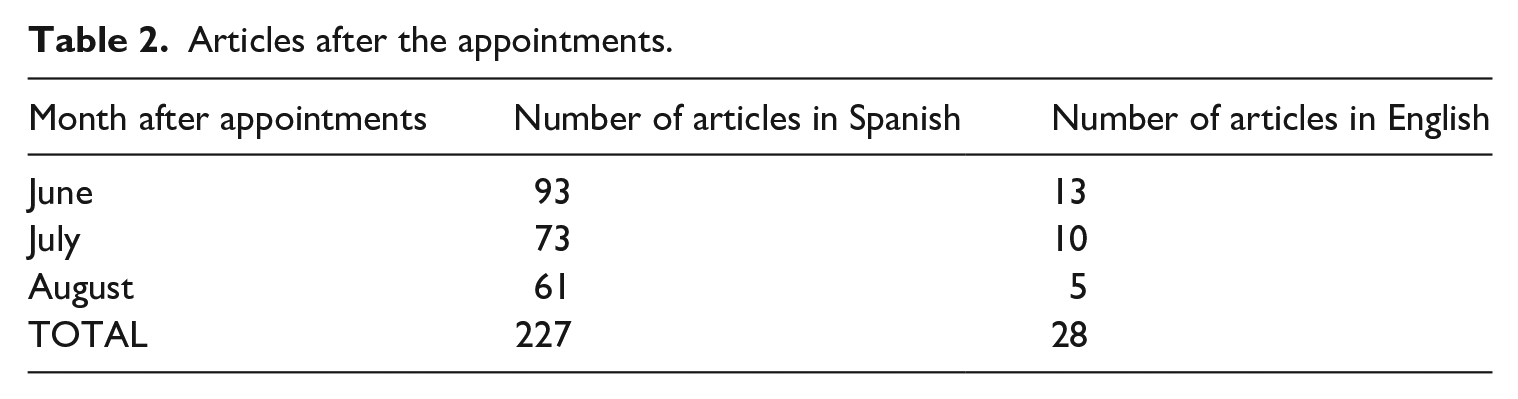
It might be argued that this noticeable reduction in the two services could be the result of the Prime Minister’s allegedly new approach to the Catalan problem, as he promised to avoid what he considered the political confrontation of his predecessor. However, it is highly unlikely that Sánchez’s new policy could have been delivered overnight: the divisive issues that have defined the relationship between the Catalan separatist movement and its various political branches on the one hand, and the central government on the other hand, could hardly be expected to change so dramatically in a matter of days or even weeks.
As regards content variation, we can also observe an important shift from the critical stance taken in the months prior to the appointments and the narratives of the articles of the second period. The following headlines illustrate the emphasis on the negative aspects of the conflict of the first period: ‘There’s no possible comparison between Kosovo and Catalonia and to draw one makes no sense’ (02/05/2018) Quim Torra: A man of exclusion and conflict (14/05/2018) New Catalan premier to be investigated for hate speech (17/05/2018) An extremist rises to power (18/05/2018) Either fascists or Europeans (18/05/2018)
These and other similar headlines tend to portray separatists in a negative light. Thematically, they focus on the damaging effects of the conflict (Catalan government misused public money, the central government needs to protect public servants in the region); linguistically, they select negative adjectives and nouns to describe the situation and those responsible for it (conflict, nightmare, extremist, hate). This falls in line with Bednarek’s analysis of affect in different types of public discourse, including news texts. Bednarek (2008: 194) points out that negative emotions tend to outweigh positive ones in news texts. Negative emotions are exemplified by adjectives, nouns and verbs such ‘hate’, ‘anger’, ‘fury’, ‘tension’ and ‘shocked’ (Bednarek, 2008: 195). Although Bednarek acknowledges the limitations of her study, similar claims have been made by Baker (2006), who uses the term labelling to refer to a discursive practice involving lexical items to identify a person, place, group or event (p. 122). In her view, these elements contribute to framing news actors or events in a certain light, this conditioning the receptors’ responses. More recently, Bednarek and Caple (2019: 60) have stressed the importance of ‘negative vocabulary’ to construe both ‘Negativity and Impact’. Negative vocabulary includes items related to natural disasters and ‘negative behaviour’ such as ‘a man of exclusion and conflict’ (Bednarek and Caple, 2019: 61), which may in turn lead to the use of evaluative language such as ‘an extremist’ or ‘fascists’.
In addition to the earlier, some of these texts underscore Catalan premier Quim Torra’s past writings, that is, ‘New Catalan premier to be investigated for hate speech’ reports on his inflammatory comments against the rest of Spain and the Spanish, published in books and articles and posted on social media. The article, by José Antonio Hernández, recorded some of these comments in the Spanish original, which were also translated into English: Some of his statements include the following: ‘Spaniards only know how to plunder’; and: ‘Above all, what is surprising is their tone, poor manners, their Spanish snobbery, the sense of filth. Horrible’.
As with most other articles, the original text is transedited: the information is reorganized, part of the content is eliminated but the basic message remains intact in both, focusing on the xenophobic and racist nature of Torra’s comments. The quoted adjectives and nouns exemplify Bednarek’s discussion of the use of mediated quotes (2008: 195) to construe negative narratives, which in turn, contribute to framing the Catalan premier negatively (Baker, 2006: 122).
Another interesting example is the interview with Ramush Haradinaj, Kosovo’s Prime Minister. Over the past few years, Catalan separatists have attempted to draw comparisons between Catalonia and other European territories such as Slovenia and Kosovo. The headline of the interview with the Kosovan leader emphasizes the fact that comparisons of this type are unacceptable: ‘There’s no possible comparison between Kosovo and Catalonia and to draw one makes no sense’. Indeed, the direct quote (in English and Spanish) delegitimizes previous claims made by Catalan separatists. Direct quotes are crucial to support the editorial line of a news corporation, even if they can be problematic, particularly in translated form because ‘if the language of the interview is not the first language of all the interlocutors, nuances may be lost. Quotes translated from such interview material may be vague’ (Haapanen and Perrin, 2019: 20). Despite this, the Spanish and English versions use several direct quotes by the Kosovan leader. The opening paragraph provides a clear example: El primer ministro kosovar, Ramush Haradinaj (Glodane, antigua Yugoslavia, 1968), no se cansa de repetirlo: “Nunca reconoceríamos la independencia de Cataluña. Kosovo y Cataluña no tienen nada en común, y establecer cualquier analogía es un sinsentido. Kosovo Prime Minister Ramush Haradinaj never tires of making a clear distinction between his country and Catalonia. ‘We would never recognize an independent Catalonia. Kosovo and Catalonia have nothing in common and to draw any kind of comparison makes no sense’, he says.
The English text follows the Spanish original closely (which, in turn, we may assume, is a translation from another language, English presumably), albeit with some adaptations for the international readers, and, above all, with some omissions. This is a standard transediting procedure in the English translations as a second-level gatekeeping mechanism: news writers or translators select the material that is susceptible of being translated. Five of the remaining direct quotes in this article refer to the Catalan crisis, highlighting the fact that Kosovo emerged from the breakup of Yugoslavia and after an extremely bloody conflict. The words of the Kosovar leader allow El País in English to construct a discourse of illegitimacy cemented on the experience of a leader who survived a bloody conflict in a region scarred by continuous violence and a lack of democracy. This text also exemplifies a more negative framing of the Catalan secessionist conflict in the English version than in the Spanish one. As mentioned, framing has been used by translation and journalism scholars, but, given the space limitations, I will not be able to further build on this aspect here. Suffice it to say that the interview illustrates some of the framing mechanisms identified by Tankard (2001: 100), notably headlines and selection of quotes and pull quotes.
It is also worth noting that the two versions use different pull quotes. While the two quotes in the Spanish text focus on the problems in the Balkans, the English version translates those quotes and adds two more to highlight the Catalan issue: ‘You can’t compare the repression under Milosevic with the Spanish rule of law, and to do so is even offensive’ and ‘We were fighting for democracy, but particularly for human rights. That is not the case in Catalonia’. Pull quotes are claimed not only to give prominence to the news story but also to reflect the public journalistic ideals, and thus, the connection between the editorial line and the readers (Gibson et al., 2001).
In addition, hard news is complemented with op-ed columns and editorials in both Spanish and English. In ‘An extremist rises to power’ and ‘Either fascists or Europeans’, the new Catalan leader is portrayed as racist, bigoted and anti-European. In his column, Carlos Yárnoz describes Quim Torra as a xenophobe and a racist whose ideas mark a sharp contrast with the European defence of ‘human dignity, democracy, equality and non-discrimination’. Yárnoz draws a comparison with far-right leaders such as Hungary’s Vikto Orban and Poland’s Andrzej Duda, who are described as mere ‘dilettantes’ when compared with Torra. In fact, Yárnoz quotes French historian Benoît Pellistrandi who, in a piece published in the French conservative newspaper Le Figaro, compared Torra’s brand of nationalism with that of Yugoslav leader and war criminal Slobodan Milošević and of Italy’s Benito Mussolini. Thus, while in the case of the interview with the Kosovar leader the Spanish journalist and the translator allow the voice of experience to speak, in the op-ed column moral evaluation is achieved by quoting an authority, a historian with an academic background whose views may be relied upon.
Consequently, the translation of op-eds exemplifies the two levels abovementioned. First, the translation of the texts highlights the translators/journalists’ choices regarding what should be translated. As we are dealing with opinion columns rather than hard news, the rationale behind the selection does not come from the obligation to inform the readership but rather from the attempt to influence them. This, in turn, is likely to result from external factors including the ideological affinity between the editorial line of the newspaper and the political actors involved. The second level pertains to the lexical and grammatical choices in the target texts, even though second-level gatekeeping in op-eds and editorials may be argued to have a limited effect: the tendency in this case is to preserve the original by resorting to word-for-word translation with only limited adaptations. Ultimately, both translated hard news and op-eds share the same function: to legitimize the ideological position of the newspaper and the power group and/or political stance it supports.
As for the June–August period, the smaller number of articles translated into English after 1 June remind readers of the existence of the conflict. However, the headlines tend to avoid the negativized presentation discussed earlier. In general, these headlines can be described as more factual in tone: In face-to-face meeting, Spain’s PM and PP leader fail to bridge gap over Catalonia (03/07/2018) Catalan premier meets Spanish PM, insists on right to self-determination (07/07/2018) Tensions rise in Catalonia over yellow ribbons (27/08/2018) Eighty people wearing white suits and masks remove yellow ribbons in Catalonia (29/08/2018)
Negative words remain, but verbs, adjective and nouns are limited to factual representations. The bodies of the articles also provide a different picture. For instance, in the article ‘In face-to-face meeting, Spain’s PM and PP leader fail to bridge gap over Catalonia’, the opening paragraph reports on the meeting between the Prime Minister and the conservative leader. The second paragraph serves to highlight the differences between the two politicians: But the meeting ended without any significant agreement, serving instead to highlight the division between the conservatives and the Socialist Party (PSOE) on the subject of Catalonia: while the latter thinks it is possible to respect the law and still hold talks with separatists, the PP rejects any form of dialogue with those who defend unilateral independence.
In sharp contrast, in ‘Catalan premier meets Spanish PM, insists on right to self-determination’ El País begins with a lead that describes the head of the Catalan region government as ‘hardline separatist’, but goes on to the describe the meeting as the ‘first official effort to normalize relations between Madrid and Barcelona’ by using direct quotes from both political leaders. While Pedro Sánchez claims that ‘A political crisis requires a political solution’ and describes the meeting as constructive, Quim Torra’s words at a press conference are reproduced thus, ‘the meeting has been long, honest and work-based, and we have given our visions for Catalonia (. . .) Sánchez has admitted that this is a political problem that requires political solutions’. In addition to this, the article is accompanied by a screenshot of Pedro Sánchez’s original Spanish words in his tweeter account, thus making the direct quote of his words twice as prominent. The article also includes a photograph of the two politicians walking up the stairs of the Prime Minister’s official residence in what seems to be a friendly encounter, thus reinforcing the mostly positivized account provided in the text.
Apart from the few informative news texts posted during the June–August period, the English versions are not complemented with any editorials or op-ed columns, as was the case of the articles in the March–May corpus, except for one with a significant title, rendered into English as ‘A New Chapter’. In it, the writer makes a passing reference to the Catalan crisis but avoids referring to the fact that the new central government was supported by Catalan separatists, Basque nationalists and radical left parties in addition to Sánchez’s much reduced Socialist Party. We are told, however, that ‘Prime Minister Pedro Sánchez’s main task is to repair the damage done by Mariano Rajoy’s Popular Party’ and that he has availed himself of ‘a capable government’ to do so. Most importantly, the ‘new chapter’ symbolically refers to a new relation between the newspaper and the Socialist party and the new government, thus cementing a tighter ideological affinity between the two institutions. This is materialized in the concluding sentence ‘Prime Minister Sánchez knows that’.
Conclusion
This article has delved into the gatekeeping function of translation as characteristic of the relationship between a news corporation and a government. The period has provided us with a rare opportunity to explore the changes resulting from the simultaneous changes in the leadership of both, which resulted in a much closer ideological affinity between Prime Minister Sánchez’s political positions and the new editorial line of El País. This article has studied this dynamic relationship by focusing on a crucial issue, that is, the secessionist political crisis in Catalonia, which, as we have seen, was gradually relegated to a less prominent position within the medium’s staple news feed. This reflects the policies of the new Socialist government formed after the conservative party lost the confidence motion in late May 2018. Even though the handling of the crisis itself does not qualify as a journalistic nonevent, in Fishman’s (1997) terms, since events related to the Catalan crisis could not be completely eliminated, their relegation to a secondary position in the Spanish and, most notably, in the English version does exemplify Fishman’s nonevent as a relational concept which refers to ‘a discontinuity between perspectives’ (p. 213). This discontinuity entails a different construction of reality where certain events should be reported while others are omitted. As Fishman (1997), puts it, ‘news stories, if they reflect anything, reflect the practices of the workers in the organization that produces news’ (p. 211). These institutional practices transform ‘interpreted phenomena’ into nonevents as a result of the more or less hidden relationship between the various agents involved: the journalists/translators responsible for the news texts, the editors of the newspaper and the actors involved in a given event (Fishman, 1997: 212–213), in this case the government vis-à-vis the Catalan conflict. It is worth noting that Fishman distinguishes between news selectivity and nonevents and argues that the latter presupposes some degree of objectivity that news selectivity would not have as journalists or news promoters construct public accounts. In other words, nonevents support the illusion that a news event does not exist and, therefore, objectivity is preserved.
In line with this, the articles translated for El País in English suggest that public accounts are constructed not only on the basis of what is selected for publication, but also on the understanding that some occurrences are not worth publishing. As regards the articles analysed here, part of the events reported during the March–May period were transformed into nonevents in the June–August period. The findings of the study tell us that the simultaneous changes in the leadership of El País and in the government made a very noticeable impact on what should be reported in Spanish and translated into English: the secessionist crisis became the locus of different schemes of interpretation prior and posterior to the appointments, constructing different (if not contrasting) representations for the newspaper’s readership. The schemes of interpretation and representation for the June–August period resulted from the simultaneous occurrence of two changes at an institutional level: the appointment of a new Prime Minister on the one hand, and of a new editor on the other hand. Thus, the ideological personas of the Prime Minister and the editor of El País entailed a de facto renegotiation process performed through new discursive practices, both in quantitative and qualitative terms. Therefore, the ideological affinity between these two institutions affected the gatekeeping processes, the selection of the material to be published and the decisions concerning the events that should be turned into nonevents (e.g. the Catalan premier’s xenophobic views). In the same way, as ‘selection, shaping and repetition of information’ (Shoemaker and Reese, 1996: 255) were gatekeeping processes in the period March–May, deselection, reshaping and attenuation processes replaced them in the period June–August.
While the above is observable in the Spanish original texts, it becomes more marked in the English version, where translation functioned as a significant first-level gatekeeping filter with regard to the number of translated texts, only 28 for the June–August period, that is, a third of those posted during the March–May period. This has implications for the understanding of the very concept of translation within Journalism Studies, as Baumann et al. (2011: 136) have suggested, turning our attention to the centrality of translation may contribute to the (re)definition of concepts such as mediation, manipulation and, as shown in the present article, gatekeeping. Translation has proved to function as a major gatekeeping force, not merely as a secondary or second-level mechanism as previously suggested (Valdeón, 2016). This does not erase the existence of two levels on which translation can function when translating or transediting a text for an international readership, but it does entail that, in specific contexts, translation plays a much more crucial role in news production. This role reflects and is reflective of the close ideological affinity between news media and governments. In this study, the convergence between El País and the Spanish government as a result of the changes that coincidentally took place at approximately the same time exemplifies the dynamic nature of the ideological position of the former, as a new editor who concurs with the leftist agenda of the new cabinet took over the management of the newspaper. In fact, we can hypothesize that this might have impacted the target audience: while some readers might have considered the move closer to their own ideological positions, others might have disagreed with the new editorial stance. In any case, this can only be confirmed by means of a reception study.
Footnotes
Funding
The author(s) received no financial support for the research, authorship, and/or publication of this article.
