



Abstract
This article presents a case study that examines the translation of multimedia news stories, a journalistic narrative that presents news using two or more media formats, such as spoken and written word, moving and still images or graphics, including interactive and hypertextual elements. The research focuses on the news reports of the digital newspaper Theguardian.com which is translated by Eldiario.es, a digital Spanish newspaper. Drawing on a corpus of 30 pairs (of English and Spanish versions), I explore the strategies used by journalists in preparing the multimedia news story for its new audience. The methodology used combines comparative content analysis with a semi-standardised interview with the head of the International section of Eldiario.es. Translated news reports are respectful of the original written content from Theguardian.com but they replace multimedia content with other, different, content. The discursive effects of these substitutions are discussed and the reasons underlying these changes are analysed. The findings suggest that substitution of hypermedia content facilitates intercultural circulation of the multimedia journalistic narrative, but the modification of these contents on the part of the target medium produces its own range of effects.
Keywords
Introduction
Today’s technological changes have transformed media organisations. The processes of media convergence have brought about the integration of tools, spaces, work methods and languages. New media have forged a type of language and narratives different from those of traditional journalism. This change at the linguistic and communicative level has modified the structure of news and reveals a new model: the hypermedia narrative, an integrated multimedia narrative. This new digital writing presents news using two or more media formats, such as spoken and written word, music, moving and still images, graphic animations, including interactive and hypertextual elements (Deuze, 2004).
Although academic research is analysing the characteristics of this type of digital discourse (Díaz Noci, 2009; Deuze, 2003, 2004; Goode, 2009; Jacobson, 2012; Larrondo Ureta, 2011; Quandt, 2008; Ray, 2013; Thurman and Lupton, 2008; Sánchez-García and Salaverría, 2019, among others), it does not reflect the fact that translation is a part of its production and that this kind of discourse is translated in turn for audiences that are linguistically and culturally different. Recently, in the area of Translation Studies, studies have appeared which analyse the translation of multimedia news on the part of media such as the French-language newspaper published in Canada, Le Droit (Davier, 2019), or the Russian outlet RT (Hernández Guerrero and López Díaz, 2020). The findings point to the use of substitution strategies in relation to multimedia contents in both media, but for different reasons. In the case of Le Droit, in a conflictual diglossic context, the editors justify the exclusion of audiovisual material such as video clips in English due to technological constraints when in fact this technical justification hides an institutional decision: English voices are not deemed welcome for the audience of Le Droit, which is viewed as very protective of French. In the case of RT, the strategy of substitution allows the company to optimise resources and facilitates the process of production of information, making it faster, an aspect which is fundamental in this multilingual news platform. Altahmazi (2020), on the other hand, has analysed the translation practices in the English and Arabic versions of news reports published on the websites of BBC, CNN, Reuters, Al-Jazeera and Al-Arabiya. His research investigates ideological storytelling and its role in creating coherent narratives with manipulative potentials. His analysis demonstrates how linguistic and visual recontextualisations could reinforce each other’s manipulative effects when used collaboratively.
These preliminary studies show mixed results which call for more empirical research on the factors which determine how the multimedia news reports are translated and, above all, on the reasons behind the modification of multimedia content.
The present research analyses the case of the news of the digital newspaper Theguardian.com which is translated by Eldiario.es, a digital Spanish newspaper. Drawing on a corpus of 30 pairs (of English and Spanish versions), I explore the strategies used by journalists in preparing the multimedia news story for its new audience. The methodology used in this article combines comparative content analysis with a semi-standardised interview with the head of the International section of Eldiario.es. The translations of this media outlet are respectful of the original written content from Theguardian.com, but they replace multimedia content with other, different, content. The discursive effects of these substitutions are discussed and the reasons of the medium for making these changes are analysed.
This paper is structured as follows. First, I will briefly introduce the theoretical and conceptual framework of this study based on prior research in journalistic translation and the concept of rewriting proposed by André Lefevere (1992). In the next sections, I will present the background information and methodology used and I will examine the findings. I will conclude with a final discussion.
Journalistic translation as rewriting
Journalistic translation, a subarea of research within Translation Studies, has studied the role of translation in news production extensively (Valdeón, 2015; 2020a). Some scholars in journalism and communication studies have also looked into this question, although to a lesser extent (e.g. Palmer, 2009; Baumann et al., 2011a, 2011b; Palmer, 2019). Existing studies have revealed that translation plays a part in journalistic practices and that translated material is reshaped by the media, which play a dual role involving selection and dissemination processes. They select and filter the information, giving it a specific treatment, style and type of language according to the target audience while at the same time marking it both ideologically and culturally. Not only do communication companies use translation to produce new content, but also to grow, reach new audiences and achieve a greater social impact. Nor should the economic factor be overlooked: the use of translation relates to criteria of economic profitability. It is less costly to draw on external sources to obtain information than to produce it (Hernández Guerrero, 2009: 24).
In the new journalistic context which emerged from media convergence, the use of translation has multiplied (Davier and Conway, 2019; Hernández Guerrero, 2019). Media convergence, understood as a complex network of organisational, professional and narrative changes (Quandt and Singer, 2009), has not only affected the production and consumption of journalistic content but also its intercultural circulation. Narrative changes have fostered a new type of journalistic narrative: an integrated multimedia narrative, called hypermedia. This multimedia journalistic narrative is understood as a hybridisation of languages and interactivity (Sánchez-García and Salaverría, 2019). I have examined how this new digital discourse functions in a distinct linguistic and cultural space. Sánchez-García and Salaverría (2019: 1) sustain that the narrative convergence of the multimedia and hypermedia story, propitiated by a participatory audience, is the axis upon which the other spheres of media convergence come together, ‘because all journalistic content is the result of a productive process and a kind of organisation’. These communication scholars (2019: 5–8) propose a concept of multimedia journalistic narrative based on three elements: (1) syntactic coherence between the multiple languages used, (2) open and collective authorship and (3) participatory reception by the audience.
For the study of the intercultural circulation of this multimedia journalistic narrative, we have adopted the theoretical framework proposed by Lefevere (1992), for whom every translation is a rewriting, in other words, a way of appropriating and transforming a text. Lefevere bases his ideas on the belief that the diffusion of culture, and therefore a majority of our knowledge, is not based directly on originals, but rather on other texts which spread and represent them. Rewriting refracts texts, making them more relevant to the receiving culture. The intercultural circulation of rewritings is subject to a dynamic which responds to structures of power and prestige, and falls under the concept of patronage (Lefevere, 1992: 11–25), that is, persons, institutions or other actors/organisations who exercise control over the discourses that are published. In general, rewritings pass incoming texts through the filter of cultural values of the target context, even adapting and moulding them to produce a refracted text that is acceptable in the target culture. Though Lefevere developed this theoretical framework applied to literary translation, he urged others to extrapolate it to different areas (Lefevere, 1985).
In the journalistic translation field, this concept has been shown to have acceptance and applicability. For example, Bielsa and Bassnett (2009: 57), in their study on translation in news agencies, establish a parallel when they state that: ‘Like literary rewritings, journalistic rewritings are the form in which news is made available to readers worldwide, although this fact is either generally hidden or taken for granted’. Hernández Guerrero (2009: 83–99) also uses the concept of rewriting to broach the study of translation in the Spanish press and has linked this concept with the methods of rewriting used in journalism. Hernando (1990: 57) describes these methods as processes of collective production in which one or several editors rewrite the news using content created by other journalists. Seen from this perspective, rewriting is standard practice in journalism, with or without translation. Where rewritings are based on a translation, Hernández Guerrero (2009: 84–85) points out the crucial role they carry out in the creation of news, especially in international news. For this scholar, journalistic rewriting encompasses not only translated texts in the traditional sense, but also rewritten texts based on different originals written in other languages. In journalistic text production, as Van Doorslaer (2009: 183) states, ‘translating and writing are brought together in one process that is both creative and re-creative at the same time. In most cases it is impossible to distinguish the two activities involved in this integrated process. The same goes for the two functions in a newsroom: journalists writing “original” reports or journalists translating and rewriting on the basis of existing sources’.
In this broad context, the objective of this research is to describe and analyse how the translation of multimedia news is carried out. For this, I have based this research on Eldiario.es and its translations of news stories from Theguardian.com. I investigate, in essence, how this type of digital narrative combining multimedia content and interactivity crosses borders and reaches out to new audiences.
Background information and methodology
Theguardian.com and Eldiario.es are media with very different trajectories and outreaches. The British newspaper, created in 1821, has two centuries of history to draw on. In the words of Küng (2015: 9), it is ‘a pioneer in legacy reinvention. It has successfully transformed itself from liberal British broadsheet into a leader global provider of digital news in the English language’. Eldiario.es, on the other hand, is a Spanish net-born site founded in 2012 by a group of journalists from other newspapers. It has grown in the digital environment using a model that combines advertising with income from voluntary subscriptions. The Digital News Report, published by the Reuters Institute for the Study of Journalism 1 , places this newspaper fourth in the ranking of the online media most read in Spain. These two media outlets differ in size and outreach but concur in their stance in favour of independent news, social values and their left-of-centre inclination.
In 2016, Theguardian.com and Eldiario.es reached a commercial agreement which allowed Eldiario.es to reproduce the international news stories from Theguardian.com. Ignacio Escolar, the editor-in-chief of the Spanish newspaper, spoke of this agreement in an article published on January 16 of the same year 2 : ‘We teamed up with the best newspaper in the world, to offer our readers an international news section of the highest quality (…). We want eldiario.es to be a reference media outlet for readers seeking international reference information in Spanish, and we know that, in the Internet age, collaboration between journalistic projects with common elements can be more productive than the competition’. Since then, the Spanish newspaper has nourished its international section with translations of news from Theguardian.com, which it combines with international news produced by its own journalists and by collaborators in other parts of the world.
This study looks at a corpus of 30 pairs (of English and Spanish versions) of multimedia news reports published on the websites of Theguardian.com and Eldiario.es. It collects all the translated news stories that were published during the month of March 2020 in the International section of the Spanish newspaper, which for the most part revolved around the two major issues of international news at that time: the presidential elections in the US and the coronavirus pandemic (see Appendix). The month of March was chosen randomly so that the sample analysed was representative of the production of the two media studied. These online news outlets were chosen for several reasons: first, because of the commitment of both media to new multimedia formats; second, because of the possibility of analysing the translation of multimedia news between two different media, since previous studies had focused on only one organisation; and finally due to the nature of their relationship. The commercial agreement between both media only allows Eldiario.es to reproduce the written contents of Theguardian.com. This last aspect is especially relevant for this research, as we will see.
From a methodological perspective, this research adopts the qualitative, case study approach given its value for obtaining information about the research topic, gathering explanatory data and finding answers to how and why questions (Hartin Iorio, 2003; Brennen, 2013). This study evaluates 60 multimedia news reports published on the websites of Theguardian.com and Eldiario.es. Each multimedia news report underwent analysis of its hypertextual and multimedia content. The analysis evaluated qualities that would help answer the following research questions: RQ1: What are the narrative characteristics of these multimedia news reports? RQ2: What multimedia content did both media use and to what extent? RQ3: What translation strategies were used with the multimedia content and why?
The comparative content analysis was combined with a semi-standardised interview with the director of the International section of Eldiario.es. 3 This qualitative technique provided additional data regarding the production process, considered from the viewpoint of the medium’s strategy. This interview made it possible to verify how the translation process is carried out at Eldiario.es and what journalistic routines are used inside the online newsroom regarding hypertextual and multimedia content.
Findings
The findings in this study fall into two categories: first, they provide some general observations about the process of translation in the Spanish outlet, and second, they reveal specific characteristics of the multimedia news reports that are the focus of this study.
Translation at Eldiario.es
In March 2020, Eldiario.es published 30 items in its International section, items from TheGuardian.com and which are noted in the appendix. Collaboration with the British newspaper is a sign of prestige for the Spanish medium, and it is openly displayed: in the drop-down menu with the different sections of the newspaper, international information appears under the heading ‘International - The Guardian’. By clicking on this link and entering the International section, the reader finds a banner specifying that said section is made ‘in collaboration with The Guardian’. In addition, next to each article from the British newspaper there is a link to information that expands on the details of this association. These paratextual elements highlight the translation work necessary to offer these contents in Spanish. It is a declared and open translation policy that can also be seen in the inclusion of the name of the translators at the end of the articles.
The comparative analysis of the written content shows that they are examples of what has traditionally been considered an accurate translation that is true to the original. When asked about this, the director of the International section of Eldiario.es replied that they respect ‘the philosophy of the text, the idea and the perspective’ and that they only make specific interventions, such as in the case of the headlines, because headline elements are not constructed the same in Spanish; or contextual interventions that facilitate the reader’s understanding. He also indicated that when they intervene in these texts, they indicate it by means of a note, between brackets or by introducing the extra information that they want to add separately at the end of the article.
Every day the journalists in the International section select the content from The Guardian that they consider most interesting, which is then translated by free-lance translators who are for the most part ‘professionals or journalists with vast experience in the translation of news in international agencies’, explains the director. In the corpus analysed for this study, the translated news items are signed by four different translators. Only in three articles does the name of the translator not appear, which is attributable to the fact that there are ‘last minute translations that are made in the newsroom’, clarifies the head of the International section.
The journalists of the International section are in charge of the subsequent editing of these translations. When they edit, ‘they check that the translation is correct, that the data is accurate and that there are no factual errors’. The edition also includes the introduction of all the multimedia content presented with the translated news (images, links, videos...), since the agreement with The Guardian only allows the use of written content. In this case, we cannot speak of a transediting process (Stetting, 1989), that is, translation and edition in the same operation. At Eldiario.es there are two separate processes: first of all, the written content is translated, and then it is edited.
Characteristics of the multimedia news reports
The digital news in the two media companies analysed presents the complex organisational content structures typical of hypertexts. In general, they combine hypertext and multimedia formulas for presenting content. Written content is the core of these news reports, which use other communicative codes (image, video, audio...) as resources to complete and enrich the written information.
Number and type of elements in sample study.
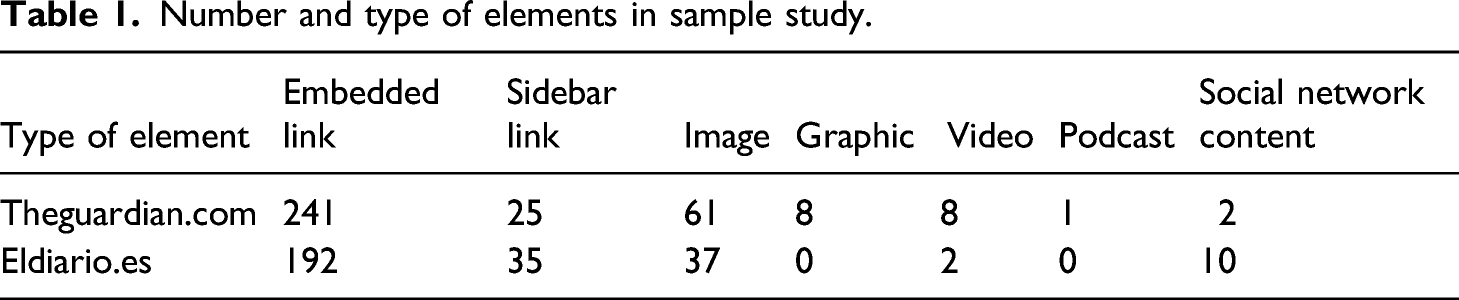
Our comparative analysis reveals that the hypertextual and multimedia content present in the news translated by Eldiario.es is not the same content as that included in the originals from Theguardian.com. In the process of editing the news in Spanish, different hypertext and multimedia content has been introduced. Therefore, there is a double process of rewriting: of written content and of multimedia content. This dual process in which different actors intervene results in a translated news story that is part of the digital narrative of Eldiario.es. This media outlet is conditioned by two aspects: the limitation of its agreement with The Guardian – which only facilitates access to written content – and the need to present the information to its audience while maintaining the interactive formulas commonly used. The following sections describe how this rewriting process works.
Links
The hypertext narrative is configured as an ‘unfinished structure composed of multiple lexias which multiply the production of meaning and introduces elements of rupture in the textual unit established by the author’ (Larrondo Ureta, 2009: 71). Based on the hypertext, the narrative use of links broadens the relations between discourses and the context of the information. This technique of non-linear writing is the one most used by both newspapers. Furthermore, the data shows that embedded links are preferred over sidebar links. The function of these elements is similar in both media: they are used to explain concepts present in the news and to provide background information, documentation or additional content. The links are also used to provide access to other multimedia content such as graphics, maps, infographics, etc. related to the news item.
In translated news, the new informative context determines the treatment these elements receive. The editors of Eldiario.es rarely use the links present in the texts of the British newspaper (which link to information in English). For the most part, they are replaced by other links with content that has already been produced by the medium, generally other news stories, other multimedia elements or additional data related to the news item.
Links, as Dimitrova et al. (2003) point out, work as an additional gatekeeping resource. Thus, Eldiario.es not only selects the news it publishes and its contents – a gatekeeping function on two different levels: the institutional one and the individual one (Valdeón, 2020b) – it also controls the links it includes in its news, influencing the way in which the target audience reads the work. In this way, the news is rewritten in a new narrative framework that ties together the facts being narrated with other information culturally and linguistically close to the reader. The additional information, as well as the navigational route created, transform the meaning and the structure of the original message, but the refracted text is endowed with unity and coherence and is inserted into the digital narrative of this medium.
Still images
Under this name I include photographs, illustrations and screenshots. These elements are present in all the news stories, are always located at the beginning, after the headlines, and are sometimes interspersed in other parts of the text. In the analysed sample, photographs constitute 97% of the images while the use of illustrations and screenshots is less frequent. We also see that images are used much more often in Theguardian.com news items than in those of the Spanish newspaper; furthermore, the images inserted in Spanish news stories are different. Only in two articles (numbers 9 and 3 in the appendix) has the same photo been used. In our conversation with the director of the International section, he made it clear that they did not have access to photos from The Guardian and used ‘our photos or other photos that we have access to as Eldiario.es from international agencies or other kinds that we can find’. In the aforementioned cases of matching photos, one photo came from AP, an agency with which the Spanish newspaper also works, and the other belonged to The Markup, a nonprofit newsroom, which encourages free republishing of their work under the terms of its Creative Commons licence.
The selection of different photos affects the narrative of the event, and, hence, the audience’s perception, as has been observed in previous studies (Park, 2016; Valdeón, 2019; Altahmazi, 2020). In the case of Eldiario.es, the selection is made seeking maximum similarity (see Figure 1). The section chief indicates that, when he cannot use the same photo, ‘I have to look for another of the same subject, probably the same day, probably of the same people, the same protagonists, if possible, but I cannot use the same photo if I don't have the rights’. When replacing the images, the editors of Eldiario.es do not intend, therefore, to change ‘the philosophy’ of the originals from The Guardian and the photographs chosen show their willingness to reproduce the same situation, but, even so, they still do not transmit the same information. As can be seen in Figure 1, the photographs of Senator Elizabeth Warren chosen by the British and Spanish newspapers (number 7 in the appendix) present the same elements – stage, flag and person – but the focus is different, and provides alternative interpretations. The use of a low camera angle, for example, puts the image participant in a dominant position in relation to the viewer of the image and enhances the status of Warren (Caple and Bednarek, 2016: 450). Photo substitution. On the left, in Theguardian.com; on the right, in Eldiario.es.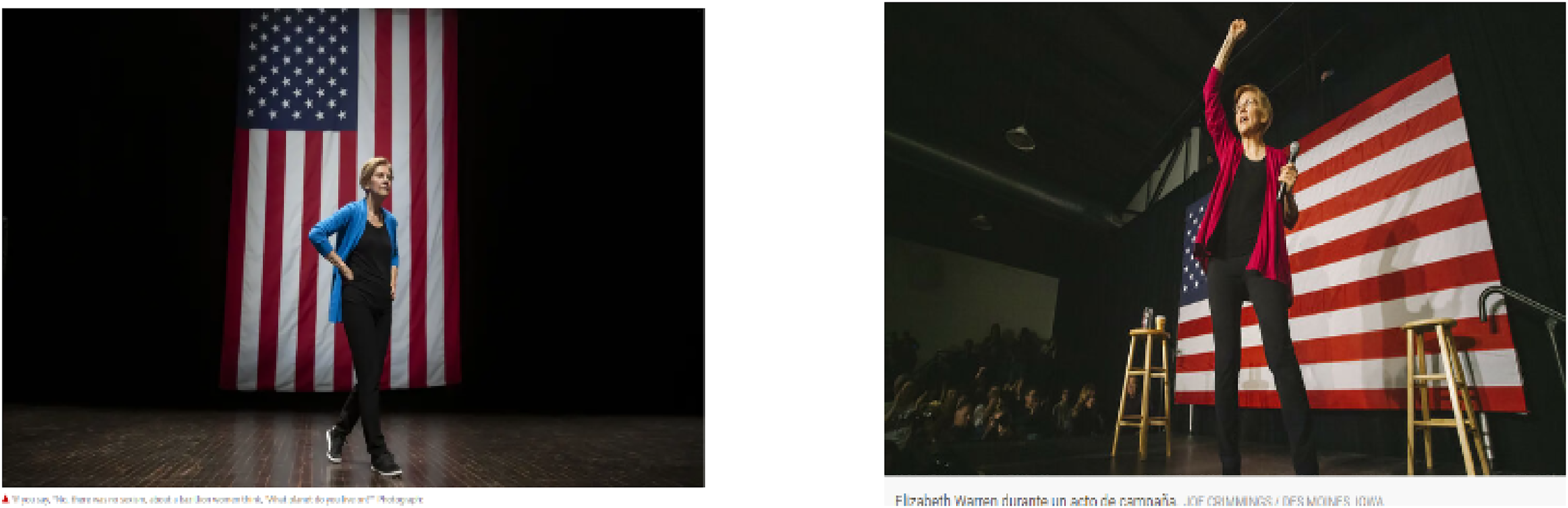
Graphics
Graphics are part of the visual narrative of the media. Readers pay special attention to figures and graphs because they are elements that better explain some information. Newsrooms need resources and experts for these new narrative characteristics and only top-notch media have the technical and financial capacity to present them. In the sample analysed, they are present in eight news items from The Guardian, but they have been omitted from the Spanish news and have not been replaced by other elements. Eldiario.es is a more modest medium and does not have the same resources as The Guardian. Economic reasons seem to be behind these decisions. The head of the International section points out that management is pushing the drive towards multimedia and the use of other languages to go beyond the classic formats, although he also notes that ‘it is more expensive in terms of time and people to make multimedia displays’. These limitations also affect the use of other elements such as podcasts or videos.
Video clips
Embedding video into the news story is a practice used in eight news stories in The Guardian. In the sample analysed, videos have a complementary function focused on supporting text journalism. In the news translated by Eldiario.es, seven of the videos from the British newspaper have been omitted and only in one case (number 7 of the appendix) has the original video clip been replaced by a different one with Spanish subtitles. The Spanish newspaper has also embedded a video in a translated story that originally did not have this element (number 28 of the appendix). Paradoxically, it is a video in English, also subtitled in English, produced by the University of Cambridge on the same topic as the news story: the coronavirus vaccine. The practices of Eldiario.es show, in general, little use of this element. In fact, in my interview with the head of the section, there is also a certain reluctance towards the use of this element: ‘Actually, not all video clips are as successful as one might imagine. When it comes to designing video content, you have to choose it very well and that always takes more time’. However, translated news presents audiovisual material from social networks, as we will see later.
Podcasts
In the sample analysed, the use of podcasts is anecdotal. Only one The Guardian article contained this element and it was omitted from the Spanish news story.
Social media content
Professional journalists incorporate user-generated content and citizen journalism into their daily routines. In my sample, these elements all come from social networks – specifically, from Twitter – and I observe a greater use by the Spanish newspaper. Embedding this type of content so that we can easily access the text of the tweet plus its accompanying images, videos, etc., is both royalty-free, and a fast, very versatile resource. The only two tweets used in the corpus analysed, both report on the problems of parents after the closure of schools in Asia due to the coronavirus. The tweets were by Robert E. Kelly – the American political analyst who rose to fame when his live interview on BBC World News was gatecrashed by his children and wife. Those two tweets, with text and images of Kelly playing with his children, were reproduced by Eldiario.es, which added another one along the same lines (number 4 in the appendix). In another case, the Spanish newspaper supplemented information on the coronavirus quarantine of a cruise ship in Japan with a tweet that included a photograph and text in English and Japanese. Another five tweets embedded in the target texts combine text and video in languages other than Spanish (three in English and two in Portuguese). In her study on how foreign tweets are presented to audiences and how they are translated when inserted in news texts, Hernández Guerrero (2020: 386) analyses this practice of presenting untranslated tweets and notes that non-translation appears when the inserted tweets are presented as graphic images used as additional information and support in the articles. Readers who know the foreign language ‘read them and the tweets complement the information provided. When, on the contrary, readers do not know the language or have a very low level of proficiency and cannot understand the tweets, then the tweets function as an informational design element’ (2020: 386). This latter function predominates in the tweets used in the corpus.
In only one case does Eldiario.es include a tweet as a quote, a recent convention in newspaper reporting (Broersma and Graham, 2013). We see this discursive practice with a tweet by Donald Trump which the British newspaper included in an article about the advance of the pandemic in the United States. This quote was translated into Spanish, and a screenshot of the original tweet had also been embedded.
Interactive elements
Both the British and Spanish newspapers offer the user the possibility of interacting. Rost (2006) distinguishes two types of interactivity: selective interactivity, which is related to the power of selection of the users, and communicative interactivity, which has to do with their possibilities of expression and communication. Both are found in the two media analysed: the first, through the links, which allow free selection within the site and within the texts themselves; the second, through interactions on social networks and through comments.
The interactive options through social networks are the most marked trend in both media. Next to each story in The Guardian there is a share button which leads to a range of possibilities (Facebook, Twitter, Pinterest, email and LinkedIn). Eldiario.es presents buttons to share on Facebook, Twitter and Menéame 4 while The Guardian also includes the participation of readers (citizen journalism) to complete the data in its narrative. In the news about the coronavirus, for example, there are sidebar links of the type ‘share your story’, ‘share your memories and tributes for those who have died from Covid-19′ or ‘tell us: how have you been affected by the coronavirus?’ which request the participation of the reader. This is something that does not happen in the Spanish medium.
Finally, on The Guardian website there is no space provided for comments from readers but they can comment on the platforms where they share the pieces. In the Spanish newspaper, however, the stories are followed by comments and we can see how many there are. Hypertextuality, through internal and external hyperlinks, provides different possibilities for interaction in the two media. Both selective and communicative interactivity take place in the readers' mother tongue and each medium has its own style of interaction. The rewriting of the news implies its anchoring in a distinct linguistic and cultural space, as well as in the hypertext and multimedia narrative (hypermedia narrative) of the target medium. Only then do readers have the possibility to interact with the medium and other users, to comment in their native language and to participate in the creation of new content.
Discussion and conclusions
The translations of international news stories in Eldiario.es are a privileged field of study to investigate the translation of the discourse arising from the new journalistic narratives, a multimedia journalistic narrative based, as pointed out by Sánchez-García and Salaverría (2019), on the hybridisation of languages and interactivity. Contrary to what happens in many contexts of journalistic translation, where many scholars are faced with the total or partial absence of a traceable source text (Davier and Van Doorslaer, 2018), these news stories come from clearly identifiable originals – the multimedia news reports from Theguardian.com – whose written content is respected, but is presented to the Spanish audience with a different hypermedia and multimedia content.
For the study of the processes involved in the intercultural transfer of this type of discourse, the concept of rewriting proposed by Lefevere (1992) is very useful. In the journalistic field, translation also takes the form of rewriting, an appropriation of foreign news that adapts it to the target medium’s requirements. From this perspective, Eldiario.es offers its audience a rewrite of the multimedia news reports from Theguardian.com. These rewritings perform the same function as the originals, since, for the readers of Eldiario.es, they replace those originals, and are integrated into the framework of the hypermedia narrative of the target medium. The rewriting process facilitates its reception by the Spanish public and offers them a product that meets their expectations, similar to other products created by the medium. The rewriting of this narrative allows for reader participation and breaks down intercultural barriers. However, multimedia content choices on the part of Spanish journalists play a significant role in reshaping the medium’s messages.
Eldiario.es, as an institution, exercises the role of patronage and, through its editors, selects and controls the stories that it is going to broadcast, which are ideologically related due to a framework of values shared by both media. The association with The Guardian places the Spanish newspaper in an advantageous position in its area of influence and provides it with the backing of a major medium, a brand of international prestige. The Spanish newspaper ostensibly boasts of this association from which it obtains a double reward, in terms of status (prestige), on the one hand, and, on the other, in terms of influence or authority within the system of the Spanish press.
In the intercultural transfer, the medium exercises control over the discourse produced by the British newspaper: it selects, translates, edits, repackages, in a word, rewrites its content in a new digital and hypermedia environment. In the rewriting of this news, there is a concern for the faithful reproduction of the written content, but the medium is forced to replace much of the hypermedia content for two reasons: the limitations of its agreement with The Guardian and the need to reflect the information in its own media narrative. As a result, the refracted texts produced by Eldiario.es make sense and are acceptable in their new framework, but present changes in meanings. The images, videos, links and interactive elements inserted in the content of these news stories create a new hypermedia narrative for the Spanish reader, different from that of the originals, which influences the readers' interpretations.
Various agents intervene in the transfer of this multimedia news report: translators, editors, writers, etc. There is not ‘a multimedia team’ in Eldiario.es, as the director of the International section points out. They have ‘different people in different sections' who focus on work, ‘on data, on video or on social networks', who promote the use of multimedia and new languages, and who are supported by the editorial team. Therefore, it is ‘a narrative that is characterised by being a collective and open work’ (Sánchez-García and Salaverría, 2019: 5). The rewriting of this narrative is carried out in two differentiated processes: a translation process of the written content carried out by external collaborators and an editing process in which the editors of the medium adapt the written content to the new journalistic framework and to its new recipients and in which they rewrite the multimedia elements.
The strategies they use are varied, but these three stand out: omission, addition and, above all, substitution. The omission strategy has been used with multimedia content such as graphics, videos or podcasts, elements which, in any event, are rarely used in the originals analysed from Theguardian.com. These omissions have been influenced by the limited capacity in time and resources of the Spanish newspaper, a more modest medium. The addition strategy is only observed in the case of content from social networks and is limited to the use of embedded tweets from users of this social network. This accessible and attractive content – which presents text, image, audio and video – is increasingly present in the new digital narrative. Paradoxically, editors have chosen foreign tweets that many readers will not be able to understand, which reinforces the impression of their use as informational design elements. Finally, substitution is the most used strategy, affecting links and photographs. The replacement of the links inserted in the original content with new links that refer to content in the readers' language anchors this interactive and non-linear narrative in the target cultural system and offers a different navigational route. The images have also been replaced due to the restrictions on access to these contents established by the agreement between the two media outlets. Substituting images and links in the target language make it easy to rewrite journalistic narratives, but can significantly affect meaning and offer alternative interpretations.
Prior research in international news translation identified omission as the predominant strategy (Bassnett, 2005: 125; Bielsa and Bassnett, 2009: 8; Hernández Guerrero, 2010: 63–64; Matsushita, 2015 and 2019: 102). However, in the new formats that have emerged from the digital and hypermedia environment, substitution is emerging as a key strategy to export news to other linguistic and cultural areas. As shown earlier, in Eldiario.es, substitution facilitates the intercultural transfer of hypermedia narrative when it is constrained by economic factors (i.e. an agreement that only allows the reproduction of written content) and cultural factors (i.e. an audience accustomed to receiving information in their own language and in a certain way).
The content substitution strategy allows the media to rewrite the foreign digital journalistic narrative quickly and effectively. There is still little literature on the intercultural circulation of this new digital narrative, but research carried out to date allows us to observe three types of factors that favour the use of substitution:
Cultural factors
The barrier between languages leads to replacing multimedia content with other content in the target language. The reasons are varied: in the Canadian case pointed out by Davier (2019), English voices are not deemed welcome for the francophone audience, which is viewed as very protective of French; in the Spanish case described in this study, interactivity requires links to content in the target language.
Economic factors
The resources available to the media to produce multimedia material determine their capacity to produce these contents. Availability also influences access to content provided by other distributors, subject to property rights. In this context, the replacement by in-house or available content meets the needs of the target medium.
Professional factors
The speed and immediacy that characterise news production also encourage substitution. In the translation processes described within the same organisation, such as the case of RT (Hernández Guerrero and López Díaz, 2020), a multilingual news platform, the substitution of foreign multimedia content allows the company to optimise resources and facilitate the process of production of information making it faster, an aspect which is fundamental to keep up with the demand for 24/7 multimedia content.
Multimedia news stories are being produced more and more in digital media. The intercultural circulation of this journalistic narrative based on the hybridisation of languages and interactivity opens up a new scenario in news translation which will require more comprehensive studies. The rewriting of these news stories for readers of other linguistic and cultural settings highlights the use of strategies such as substitution due to cultural, economic or professional factors. That said, this rewriting process reshapes the contents and gives rise to a second journalistic construction of reality by the target medium which produces its own range of effects.
Footnotes
Declaration of conflicting interests
The author(s) declared no potential conflicts of interest with respect to the research, authorship, and/or publication of this article.
Funding
The author(s) received no financial support for the research, authorship, and/or publication of this article.
