



Abstract
Major news outlets increasingly use immersive techniques in their journalistic productions. The idea is that, through the application of immersive technologies, the news consumer can engage with and be part of the story. However, we do not know, to what extent this promise is actually fulfilled in productions currently accessible to news audiences. This study uses a multi-step approach to fill this knowledge gap. First, based on an interdisciplinary literature review, we propose a conceptual model of immersive journalism. We then use the elements of this model to content analyze 189 journalistic productions that are labeled as immersive by the producers, including 360 degree videos, computer-generated VR, and interactive, 360 web productions, stemming from a variety of outlets and countries. Results show that the level of user immersion in these productions is actually limited, with little interaction and technical inclusion possibilities. Our results contribute to an emerging field of journalism studies, in which the user plays a new role when interacting with advancing technologies.
Introduction
Major news outlets increasingly apply immersive techniques in their journalistic productions. They use a range of new technologies, such as 360 degree videos that allow news users to gain a comprehensive impression of a location, or virtual reality (VR) technologies that transport the news user from the real to a virtual world. For example, the New York Times 360 degree film ‘We Who Remain’ takes the user into the heart of a forgotten conflict in the Nuba Mountains of Sudan, by showing real footage of the conflict and the victims. Similarly, the ARTE VR production ‘Notes on Blindness’ mediates the experience of blindness in daily life to users; it offers a virtual world in which the experience of losing one’s sight is simulated. In short, immersive technologies should allow the news user to engage with and be part of the story, and, in other words, allow the user to gain a first-person experience (De la Peña et al., 2010; Sánchez Laws, 2017). When being present in the story as it unfolds, the assumption is that news users are more likely to be engaged, and that they develop stronger emotional responses toward the covered social issues.
Many have used the term immersive journalism to refer to VR or 360 video journalism (Aronson-Rath et al., 2016; Doyle et al., 2016; Watson, 2017). However, when De la Peña and colleagues introduced it in 2010, they described ‘immersive journalism’ as a novel storytelling technique, which does not only revolve around the used technology, but also involves the concept of a ‘sense of presence’. This refers to the user’s feeling of actually being in the place depicted in the story rather than in the real world. In this article, we look at what which factors create this sense of presence and how this is manifested in current journalistic immersive productions.
The rise of immersive journalism in news production is augmented through technological advancement, as well as by current challenges journalism faces in countries across the world. It has, for instance, gained popularity since Facebook acquired Oculus VR in 2015 (Ryan, 2015), which prompted the idea that VR headsets would become more accessible for the general public in a near future. However, news organizations who use it also felt that it provides a possible solution to the decline of readers and waning loyalty in traditional news brands (Harbers, 2014). This represents a reawakening of the narrative movement of the 1960s, where journalists make themselves a part of complex issues with the aim to tell stories in an engaging way (Neveu, 2014).
However, so far, there is no clear understanding what immersive journalism represents to the field of journalism studies. Based on available research on the concept of immersion in other disciplines, such as (cyber)psychology, human computer science and film studies, we conducted an extensive review of literature. While taking also into account a small handful of relevant studies from the journalism scholars, this review is the first to provide the journalism field with a better understanding of what ‘immersive’ journalism actually is. We then develop a conceptual model of the different elements of immersive journalism, and test this model with empirical data in the form of a content analysis of 189 journalistic productions that have been labeled as ‘immersive’ by their producers. This analysis includes a variety of digital formats, such as 360 degree videos, computer-generated VR, and interactive, 360 web productions. The content analysis measures the extent to which different elements of immersive productions as generated in our model are present, and how these elements depend on organizational factors, such as type of media organization. Taken together, the aim of our article is to uncover the core elements of immersive journalism, and to offer future research a framework on which to build upon.
The elements of immersive journalism
The need to find new forms of journalism is a constant endeavor (Harbers, 2014; Neveu, 2014). This need for innovation has led to integrating cutting-edge technologies within journalism to foster their informative goals, a development often summarized under the headline of immersive technologies (Domínguez, 2017). Using these technologies, immersive journalism seeks to generate a ‘first-person experience’ of a news event (De la Peña et al., 2010; Domínguez, 2017). The idea is that these first-person experiences will elicit emotions that normally accompany only real-life situations (De la Peña et al., 2010; Hullett et al., 2003; Watson, 2017), and that this emotional experience will lead to a better understanding of the story told (Deuze and Beckett, 2016; Sánchez Laws, 2017; Watson, 2017). Although these immersive technologies have already been applied for many years within disciplines such as psychology, cinema and video gaming, a new storytelling grammar of immersive production within the journalism sector has yet to be established (Domínguez, 2017; Jones, 2017; Sánchez Laws, 2017). More specifically, news media outlets are experimenting with immersive elements in their journalistic coverage, and they do so by adopting a logic generated in other communicative parts of society. But, is this logic applicable to journalistic communication? We argue that, before we can analyze which and how different immersion elements are applied in contemporary immersive journalistic productions, we need a systematic overview of the immersive elements that are used. We, therefore, ask the following:
RQ1: What are the core elements of immersive journalism?
We address this question with an interdisciplinary literature review. This review suggests that immersive journalism is defined by the following four main elements: (1) Immersive technologies (e.g. VR, 360 degree video), (2) immersive features in the narrative (e.g. is the user passive or active in a story), (3) interaction or agency possibilities for the user, and, finally, the outcome of (4) sense of presence and emotional engagement.
Immersive technology
Slater and Wilbur (1997: 4) argue that ‘(i)mmersion is a description of a technology, and describes the extent to which computer displays are capable of delivering an inclusive, extensive, surrounding and vivid illusion of reality to the senses of a human participant’. Inclusiveness is the extent to which physical reality is shut out. Extensiveness indicates the range of sensory modalities provided. Surroundings refer to the field of view in an experience. Vividness indicates the resolution, fidelity, and variety of energy simulated. Immersive journalism is thus defined by the richness, information content, resolution, and quality of the displays used in its technological representation (Slater and Wilbur, 1997).
This means that specific technological elements of a journalistic product can have an effect on the level of immersion. The first is the device used for the experience (i.e. a desktop computer, mobile phone, head mounted displays (HMD), and CAVE-systems) (Grassi et al., 2008). Newer technologies, such as Oculus Rift (or VR headsets), provide distinct multisensory stimuli for a more ‘natural’ interaction with the virtual world, and deliver a more inclusive illusion to the participant, as opposed to more traditional devices such as desktop or a mobile phone. A second technological element that affects level of immersion is the type of modality integrated in the experience, such as display format (i.e. photography, real-life 360 degree videos, computer-generated VR) (Higuera-Trujillo et al., 2017) and the range of the display (in what range can the audience look around in the displayed environment), audio (i.e. background music, ambient noise, auditory cues; Andreano et al., 2009), and text. The quality of the modalities, such as stereoscopic versus monoscopic video (Baños et al., 2008; Cummings and Bailenson, 2016; IJsselsteijn et al., 2001; Narciso et al., 2017), and stereoscopic versus spatialized sound (Narciso et al., 2017) also influences immersion. For example, it has been argued by pioneers of immersive journalism like Nonny de la Peña, that the use of real audio and spatialization of sound is a relevant way to transport the user to the time and place of the event (Domínguez, 2017).
Finally, immersion requires a match between the proprioceptive feedback of body movements and the information on the display. That means, when the user looks in a different direction, the technology should give corresponding visual and auditory displays (Sanchez-Vives and Slater, 2005; Slater and Wilbur, 1997). In sum, technological elements of immersion show that, the closer the technology comes to how we experience and sense things in real life, the higher the level of immersion is likely to be. This means that immersive journalism can vary depending on the level of immersive technology applied in the production, from 360 degrees with low level of inclusion to VR and spatial sound with higher level of inclusion.
Immersive narratives
Next, there is evidence that specific types of narratives play an important role in how immersive a journalistic production is (Baños et al., 2004; Gorini et al., 2011; Grassi et al., 2008; McRoberts, 2018; Ryan, 2008; Villani et al., 2009). While narratives in immersive journalism still consist of standard journalistic content (i.e. subject, actors, location, time frame), they can offer the user an active role in the story, instead of merely observing it (Domínguez, 2017). The user of the immersive experience can either be invisible within the plot, experiencing the narrative as an observer (third-person perspective), or representing a real character being a ‘visible’ spectator in the scene by having a virtual body, and by recognition of other characters in the virtual world (first-person perspective; Cummings and Bailenson, 2016; Domínguez, 2017). It is often argued that the latter would cause a higher level of immersion (De la Peña et al., 2010; Sanchez-Vives and Slater, 2005). What is more, virtual body representations can render the virtual environment easier to accept as real. Not only the visual aspect of the narrative is important to consider in immersive production, the auditory aspects are too. An immersive experience can, like a movie or game, consist of diegetic narration (from a source existing in the virtual environment) and non-diegetic-narration (from a source not present in the virtual environment) (Jørgensen, 2011). Both can influence the experience of the immersive story. In sum, narratives can support or hinder the active participation of users in journalistic productions, leading to varying levels of immersion.
Interaction possibilities for the user
A third element of immersive journalism is the extent to which the user can interact and change the virtual environment in a story. This interaction is interrelated with both technology and narratives: Technological interactivity facilitates interaction with the virtual environment (i.e. looking around in 360 degree, walking around in the virtual environment, grabbing virtual objects; Ryan, 2008; Villani et al., 2009), while narrative interactivity facilitates the agency the user has on the story (i.e. the pace of experience, shifting between storylines, influence the unfolding of events; Domínguez, 2017; Ryan, 2008). This means the level of immersion mediated by interaction depends on the possibilities the used technology provides, and the narrative structures of the story. Interestingly, this does not mean that only high-end HMDs provide interaction possibilities. On a desktop, it is also possible to interact with the virtual world and have some level of autonomy in how to navigate through the story, for example, by choosing the storylines in a story.
All in all, the higher the level of autonomy in the virtual environment and the more agency the user has in the story, the more the user could feel engaged (Coelho et al., 2006; Sherman and Craig, 2002).
Sense of presence and emotional engagement
The use of immersive elements in journalistic production can lead to a sense of presence. Where immersion can be an objective and quantifiable description of elements (such as technology, interaction, and narrative), presence is a state of consciousness, or, the psychological sense of being in a virtual environment (Slater and Wilbur, 1997). Steuer (1992) states that presence refers to experiencing one’s environment. More specifically, it refers to a person’s perception of their surroundings, mediated by sensory stimuli and mental processes. Feeling present in the mediated environment, rather than in the immediate physical environment, is described as ‘telepresence’ (Steuer, 1992). Lee (2004) describes the concept as ‘a psychological state in which virtual (para-authentic or artificial) objects are experienced as actual objects in either sensory or non-sensory ways’ (p. 37). This psychological state occurs, when the users do not notice the para-authentic or artificial nature of the mediated environments (Lee, 2004).
Presence is a subjective experience and a psychological state, where the virtual environment is perceived as the actual environment by the user – rather than the immediate physical environment – and where the user is less or not aware of the artificial nature of the environment and mediation of the technology. In short, following Slater and Wilbur (1997), when we discuss ‘(the sense of) presence’ we refer to a psychological sense of being in the mediated environment.
Sense of presence is likely influenced by the following three immersive elements: technology, interaction, and narrative (Cummings and Bailenson, 2016; Gorini et al., 2011; Grassi et al., 2008; Slater and Wilbur, 1997; Steuer, 1992). Although it is a challenge to measure sense of presence as a fleeting psychological state, empirical studies have typically relied on questionnaires to form presence evaluations (Riva et al., 2007; Villani et al., 2012; Witmer and Singer, 1998). This empirical research shows that immersive technologies can make it possible to have the immediate physical world disappear from the user’s awareness (something that is referred to as inclusion). These technologies also determine the immersive quality of the experience (i.e. vividness). This again can influence the sense of presence (Baños et al., 2004; Cummings and Bailenson, 2016; Gorini et al., 2011; IJsselsteijn et al., 2001; McMahan, 2003; Riva et al., 2007). At the same time, immersive narratives and agency within the story evoke emotion and enhance involvement with the story (Baños et al., 2004; Gorini et al., 2011). The more immersive the experience, the more the user will feel present in the virtual world as opposed to the physical world (Cummings and Bailenson, 2016). Of course, the experience of the user can also be influenced by user characteristics such as age and prior use with this type of technologies (Narciso et al., 2017; Archer and Finger, 2018).
Research shows that presence is strongly related to emotional experience. The effects of immersive journalism can be described as emotional engagement, a term chosen in this study to include subjective (e.g. experiences of empathy), behavioral (e.g. laughing), and physiological emotional responses (i.e. sweating). Emotional engagement of the user is influenced in two different ways. First, emotional engagement of the user tends to increase as a production is more immersive (Archer and Finger, 2018; Higuera-Trujillo et al., 2017; Moghimi et al., 2016; Narciso et al., 2017; Sánchez Laws, 2017, Visch et al., 2010). Second, research shows a circular relation between emotional engagement and the sense of presence (Baños et al., 2004; Riva et al., 2007). The higher the sense of presence, the higher the emotional engagement, and vice versa.
Hence, the immersive elements of technology, interaction, and narrative, influence both sense of presence and emotional engagement with users, and both effects are reciprocal. Relating to immersive journalism, this would mean that the news user will be more emotionally engaged in a news story when experiencing an immersive production as compared to a traditional journalistic production. Importantly, research shows that this also influences cognitive variables. For example, sense of presence and emotional engagement have a positive effect on memory encoding (Andreano et al., 2009; Makowski et al., 2017; Mania and Chalmers, 2001; Ragan et al., 2010), information processing, and learning (Andreano et al., 2009; Hullett et al., 2003; Sundar et al., 2017). It can even lead to different attitudes and perceptions of the respective news subject and outlet (Peters, 2011; Sundar et al., 2017).
In sum, we thus propose a conceptual model (see Figure 1) for evaluating immersive journalistic productions. This model shows that an immersive production can generate the experience of feeling present in and engaged with the news event for the news user. This, in turn, can then lead to learning and attitude change. Immersive technologies, the narrative, and interaction elements can be applied in different ways to create different levels of presence. To provide empirical backup for our model, we next ask the following:
RQ2: To what extent are immersive elements (technology, narrative, and interaction) actually used in immersive journalistic productions?

Conceptual model of immersive journalism introduced by the authors.
Organizational determinants of the production of immersive journalism
We argue that type of technology, narrative, and interactive features influence the level of immersion a journalistic production can achieve. As immersive productions require investment and editorial skills and commitment, we also consider what triggers media organizations to produce immersive stories and which factors are considered when doing so.
Since 2015, new immersive technologies have become increasingly available to consumers, ranging from high-end consumer headsets, smartphone-based headsets, and the introduction of 360 cameras, to the 360 YouTube platform and Facebook 360 (Doyle et al., 2016; Ryan, 2015; Watson, 2017). The Knight Foundation marked 2015 and 2016, when several outlets started producing VR stories, as experimental years for immersive journalism (Doyle et al., 2016). Since then, the number of productions has been growing exponentially, particularly thanks to accessible and affordable 360 cameras and cardboard headsets. A 2017 report of the Reuters Institute on VR shows that several leading outlets find it important to be the first to invest in this new storytelling technology. Some are looking into the possibility of adapting VR as a new revenue model (Watson, 2017). For example, in 2016 New York Times, in collaboration with Google, sent a Google Cardboard to their digital subscribers to encourage them to watch the immersive stories available on the NYT app.
However, many organizations still have doubts, since the technology only reaches a small audience segment, which makes it particularly difficult for public broadcasters to justify their choice to invest in it (Watson, 2017). Also, it questions new dilemmas on journalism ethics on the issue of objectivity versus subjectivity, a contested debate, also in the field of narrative journalism (Harbers, 2014).
The availability of technologies plays a crucial role in the making of immersive productions. Even though the technologies on the consumer side of VR have become more accessible and affordable, the technology needed on the production side is often not integrated in newsrooms, and thus requires external specialists (Aronson-Rath et al., 2016). Consumer 360-cameras have made the technology more accessible for non-specialists and smaller organizations to experiment with (Tse et al., 2017), yet this new way of journalism demands new skills from journalists and collaboration with other specialists within and outside the newsroom. Therefore, media organization must increasingly collaborate with technical VR agencies (Watson, 2017). At the same time, we can distinguish a trend of diversification among immersive stories being told. While 2015 showed productions that were highly produced documentaries and used quite complex technologies, by 2017, with more possibilities for smartphones and the use of VR card boards, a wider range of short stories were told (Jones, 2017; Watson, 2017).
The level of interaction in immersive productions differs and is partly dependent on the VR device used. Head-mounted VR can support autonomy for the user to choose the viewpoint or even agency on how the story unfolds (Aronson-Rath et al., 2016). The agency granted to the user raises questions about the positionality of the journalist. Are they visible in the scene or does the user take over (part of) the role of the journalist, making independent decisions on what to watch?
A few reports have been published, particularly on VR journalism, providing a first overview of what this type of journalism entails and how it influences the production process (Aronson-Rath et al., 2016; Watson, 2017). Others highlight specific case studies (De la Peña et al., 2010; Domínguez, 2017; Pavlik and Bridges, 2013; Sánchez Laws, 2017). However, up until now, no systematic analysis has been done on the range of immersive productions. In our content analysis, we seek to understand which organizational factors influence the use of immersive elements in journalistic productions. For instance, while type and size of a media organizations will most likely matter, there should also be a relationship between journalistic skills-sets within an organization and the use of immersive journalistic techniques. Therefore, our second research question is,
RQ3: Which organizational factors influence the use of immersive elements (technology, narrative, and interaction) in journalistic productions?
Methods
To be able to answer our second and third research questions, we conducted a quantitative content analysis of immersive journalistic productions (N = 189 productions), which includes interactive web productions, 360 degree videos (to be viewed on desktop or smartphone), and computer-generated VR productions (to be viewed in HMD). We used two inclusion criteria to define what we consider an immersive production. The first criterium for selection was that the immersive productions need to serve a journalistic function. Since it is nowadays difficult to make a clear distinction between journalistic and non-journalistic content, we decided that at least one journalistic organization needed to be involved in the production. Films or documentaries were therefore not included in our selection. Also, immersive productions produced by commercial parties, NGO’s, or VR agencies were not included if no journalistic organization was involved. The second criterium was that the journalistic productions needed to be immersive according to the producer. We did not define what should be included as immersive, since defining this is the objective of this study. We operationalized this criterium through an analysis of the lead or description of the production, where we looked for terms such as ‘immersive’, ‘first-person experience,’ and ‘part of the scene’. This led to a range of different kinds of immersive productions included in our sample, such as 360 degree videos, computer-generated VR, and interactive 360 web productions.
Sample
Immersive journalistic productions have been available since about 2015. However, unlike newspaper articles that can be found in databases (e.g. LexisNexis), this type of productions is not centrally archived. Productions are scattered across platforms such as YouTube, news websites, and apps. This means that we were forced to use the snowball method to accumulate a large enough sample – we created our own database of immersive journalism. Our initial step was to collect productions of journalistic organizations that are known for being early adopters in immersive journalism, such as The Guardian, The New York Times, the BBC, and ARTE (Watson, 2017). Second, productions were collected through nominations for prices within immersive categories (i.e. IDFA, Tribeca Film festival, Sundance), and through the VR app-store ‘Oculus Store’. We also included productions in and beyond the English-language to understand, if journalistic traditions in other countries are being influenced by global technological innovation pressure (Thomson et al., 2008). Immersive productions from different continents were selected, including Finland, Belgium, France, Germany, the Netherlands, the United Kingdom, Spain, Canada, the United States, Japan, Russia, Australia, Brazil, and Qatar. This means that, even though our research questions do not specifically refer to a comparative research goals, we are able to juxtapose productions from countries with different political- and/or media systems (Hallin and Mancini, 2004), which means we can begin to understand if cultural factors play a role in the construction of immersive journalism. From February until July 2018, we collected productions that were published between 2015 and July 2018. Table 1 shows an overview of the topic of each immersive production in our sample, showing that culture, environment/sustainability, and war/ defense were the most prevalent topics. Appendix A1 contains the full list of included productions.
Overview of the topics used in immersive journalistic productions.

Coding procedure and data analysis
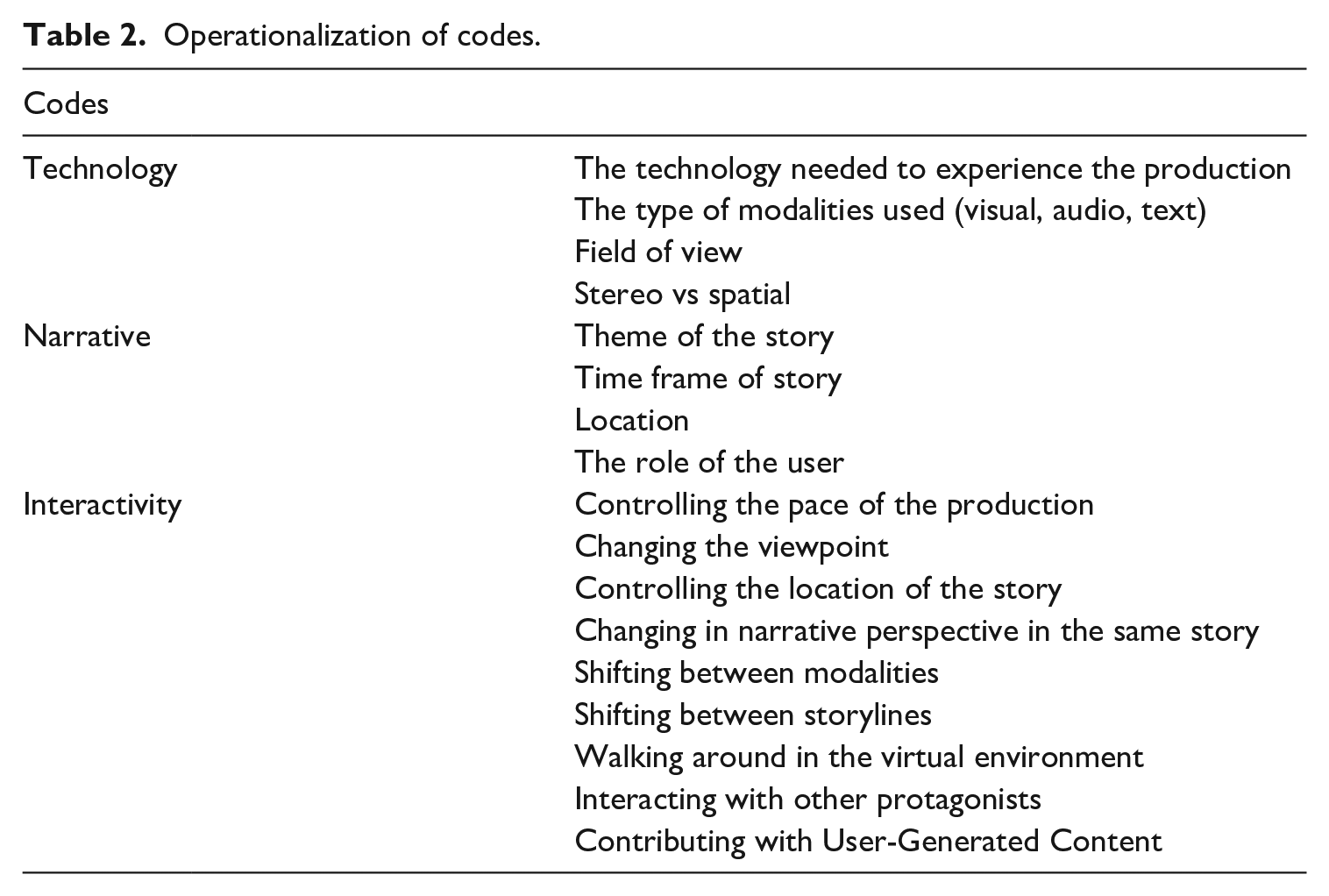
We developed a codebook on the basis of the three main elements of immersion in our conceptual model. First, we operationalized technology in the following elements: the technology required to experience the production, number of modalities used, range of visuals (e.g. real footage, animation, illustrations), audio (e.g. diegetic vs non-diegetic sound, background music, ambient sound), and text elements (does text tell the same as other modalities in the story, text support the other modalities or tell a different story, subtitles or instruction texts), the field of view (e.g. 180 vs 360 degrees), and stereo versus spatial sound. Second, we operationalized narrative as theme of the story, the time frame in which the story takes place, the location (i.e. one or multiple locations) the role of the user (i.e. main role, supporting role or observer), and the viewing perspective of the user (i.e. first-person or third-person). Third, interactivity was operationalized by coding which forms of interactivity can be used. We made the following distinction: controlling the pace of the production, changing the viewpoint, controlling the location of the story, changing in narrative perspective in the same story, influence on the storyline, shifting between modalities, shifting between storylines, walking around in the virtual environment, interacting with other protagonists and contributing with User-Generated Content (see Table 2). Finally, we coded the type of media organizations, the number of producers, type of producers (journalist, design, technical company, producer), and the subject of the production. The coding was done by four coders, first watching the production entirely, after which in a second viewing the coding was done systematically, using the code book. Most codes could be found in the production itself, except for type of producers and the year of production. This was found in related articles on the production. STATA version 15.1 was used to examine the research questions.
Operationalization of codes.
Intercoder reliability
We double-coded 20 productions to assess intercoder reliability (ICR). Because nominal variables were used in this study, we calculated ICR using the Standardized Lotus (Fretwurst, 2015) in SPSS version 25. The Standardized Lotus is adjusted for change. Analysis of the ICR using the Ratio of Agreement shows that we have reliable data, the mean Lotus is 0.90. If there is perfect agreement, Lotus should be 1. For on overview of all the ratios, see Appendix A2.
Results
To show which immersive elements are included in immersive productions (RQ2), we first examined the technology used, after which we will explain the narrative elements, and the interactive possibilities (autonomy) in the story.
Immersive technologies
First, we looked at what technologies were needed to be able to experience the production, whether those are more advanced technologies such as AR headsets, VR gear, CAVE system, or 360 audio installation or whether more accessible technologies sufficed such as laptop, smartphone (with headphones), or cardboard. We found that almost all productions used more accessible technologies (98.9%; that is Desktop, smartphone, simple headset), while a quarter of the productions also included advanced options (28.6%).
Next, we examined which modalities were used. Visuals and audio are used in almost all productions (respectively, 99.5% and 98.4%), while text is used in half of the productions (51.9%). Table 3 gives an overview of all the modalities. In our sample, we found that 15.9% used one type of audio, 27.0% used two types of audio, and 55.6% used three or more types of audio. When we take a closer look at the quality of audio, we found that the most often used audio is stereo (96.3%), while spatial sound was rarely used (2.7%). When text was used, this was often to support the content of other modalities, such as text to provide context or introductions to the visuals (34.4%) or as subtitles (11.6%). Finally, we found that 75.7% used one type of visual, 18.5% used two types of visuals, and 5.3% used three or more types of visuals. Most productions use actual footage, presumably because these render ‘realistic’ experiences. Only 4.8% uses illustrated video, for instance, when it is not possible to use actual footage (e.g. a production about the South Korean wall and a production about a person suffering from psychosis). In 17.5%, a computer-generated video is used, for example for the topic of ‘home assault’ in ‘Kiya’, a production of the Emblematic Group and Al Jazeera America. In such a case, it is more difficult to use actual footage. When we link the specific topics toward the use of illustrations or computer-generated video, we find that often these are productions about the environment (19.2%). For example, the production ‘Global Warming: signs & effects’ from Associated Press lets you experience the melting ice in the Artic, using computer-generated video.
Overview of the modalities used in journalistic immersive productions.
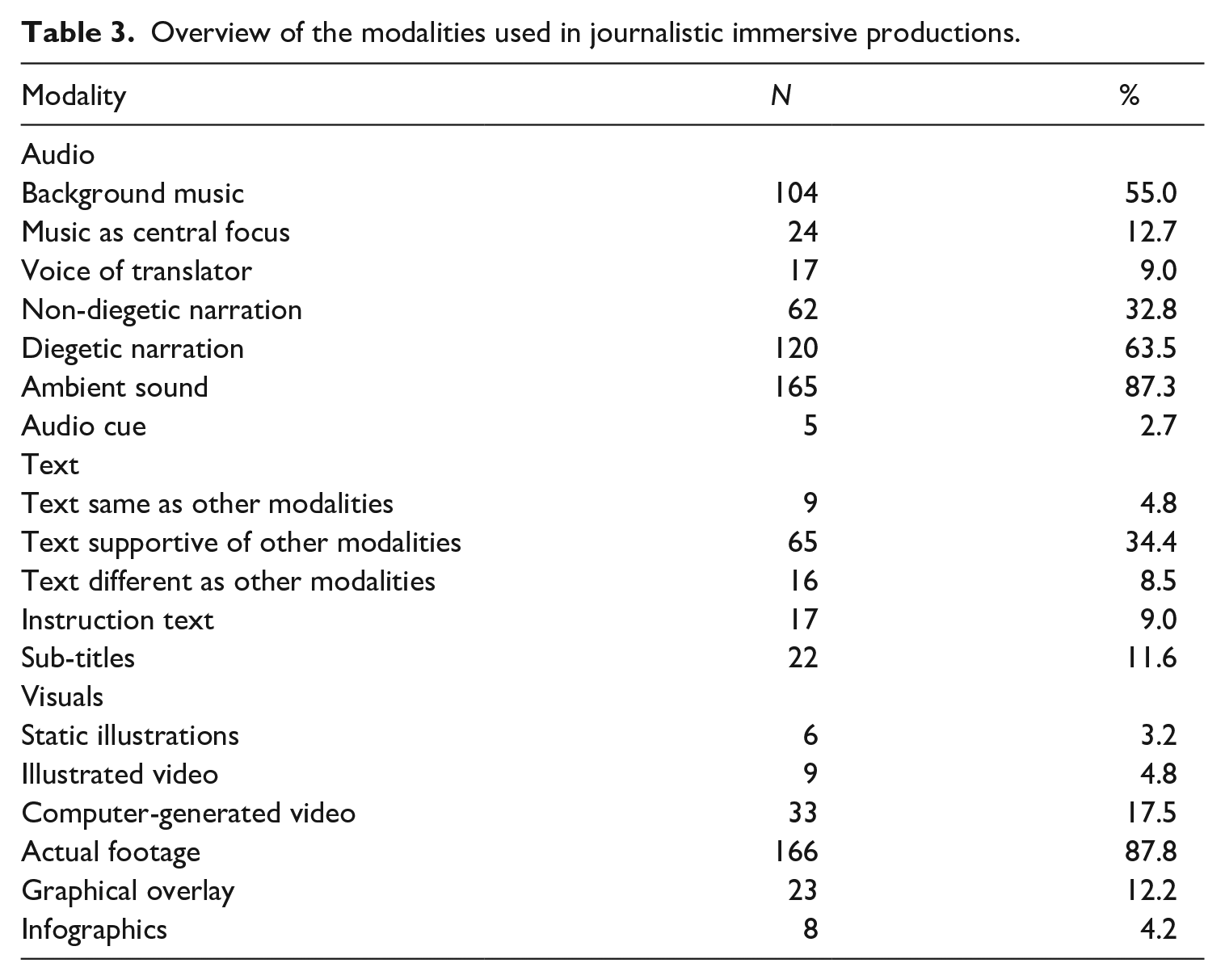
Overall, many immersive journalistic productions do not demand advanced technologies. A mix of different modalities are used, including text, video, and audio, with a focus on the latter. While the innovative technologies creating spatial sound is not used much, producers try to create an immersive experience, using different forms of audio, including background sound, music, and diegetic and ambient sounds.
Narrative elements
With regard to the narrative, our results show that the user remains an observer within the majority of productions (92.1%; for example, in the production The Displaced by The New York Times, users observe the story of three children displaced from their homes by war). The user rarely has a main role (7.4%; one example is Notes on Blindness, by ARTE, where the user is the person who is blind) and the user almost never has a supportive role (0.5%). We did not anticipate this, as the literature states that immersion is equalled with being a part of the story in a virtual world, while we find that in almost all cases, the viewer is an observer (the third person) in a virtual world. In only 3.2% of the productions, the viewers see a representation of themselves in the virtual environment (i.e. an avatar).
Interactive features
Surprisingly, our analysis shows that most productions only use few interactive features. The only clear interactive feature that is almost always present is the option to change viewpoint, a feature easily possible with 360 videos (98.9%). The second most used form of interactivity is controlling the pace of the production (5.8%), such as the Dutch production of a man who experiences a psychosis, where the user can control the pace of the story. The third one is shifting between modalities (4.8%). Table 4 shows the use of interactive features in immersive productions.
Overview of interactive features used in the immersive journalistic productions.

In sum, we see only a limited use of immersive elements in journalistic productions with hardly any advanced and inclusive technology needed, and little interaction features. In addition, users are still third-person observers, instead of being catapulted into a first-person perspective.
Organizational factors
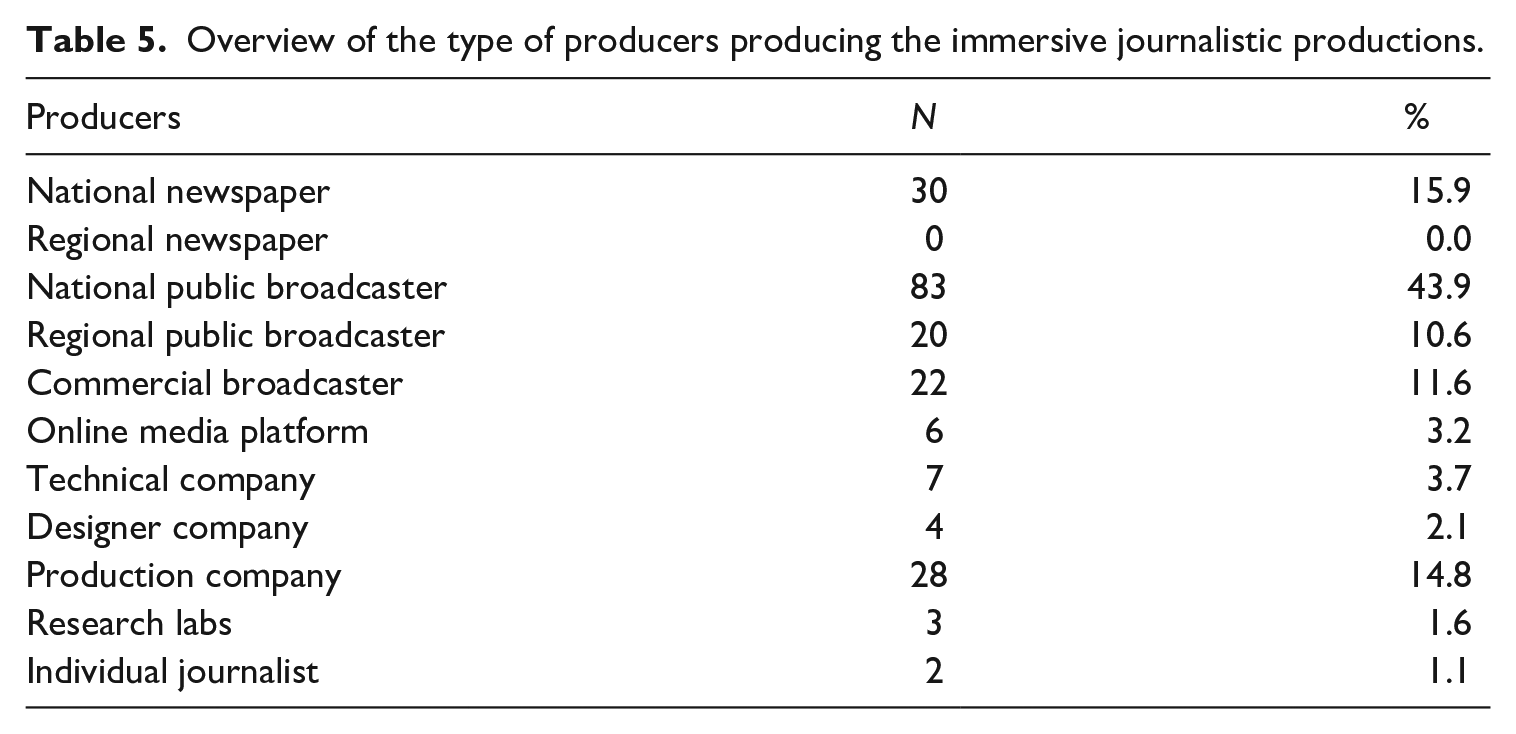
To examine RQ3, we investigated organizational factors that influence the use of immersive elements in journalistic productions. To be able to answer that question we first identified, how many and what type of companies were involved in creating an immersive production. Most immersive productions were created by one company (78.3%), a minority was produced by two companies (14.3%), and only a few were made by three or more companies (7.4%). Only 1 production was produced by 11 companies. More information about the producers can be found in Table 5.
Overview of the type of producers producing the immersive journalistic productions.
In the final step, we performed several multi-level (logistic) regression analyses to investigate the organizational factors that influence the use of immersive elements in journalistic productions (see Table 6). Multi-level models were needed because the data are hierarchical (nested within countries). In three models, we examine whether the use of more modalities (Model 1), interactivity (Model 2), and having the first-person perspective (dichotomous; Model 3) were linked to the number of producers, type of media systems (Liberal Model vs Democratic Corporatist Model vs other), the use of more inclusive technologies, and specific types of producers (e.g. public broadcasters, newspapers). We found only two marginally significant links. If a technical, design, or production company is involved in the production, more modalities were used (b-coefficient = .70, p = .073), and when more producers are involved, it is more likely that the user has a first-person perspective (b = .96, p = .091). This shows that immersive productions that require technological advancements and aim to feature interactive possibilities are not only made by news organizations, but demand an interdisciplinary team of experts, also from outside the journalism sector.
Multilevel analyses.
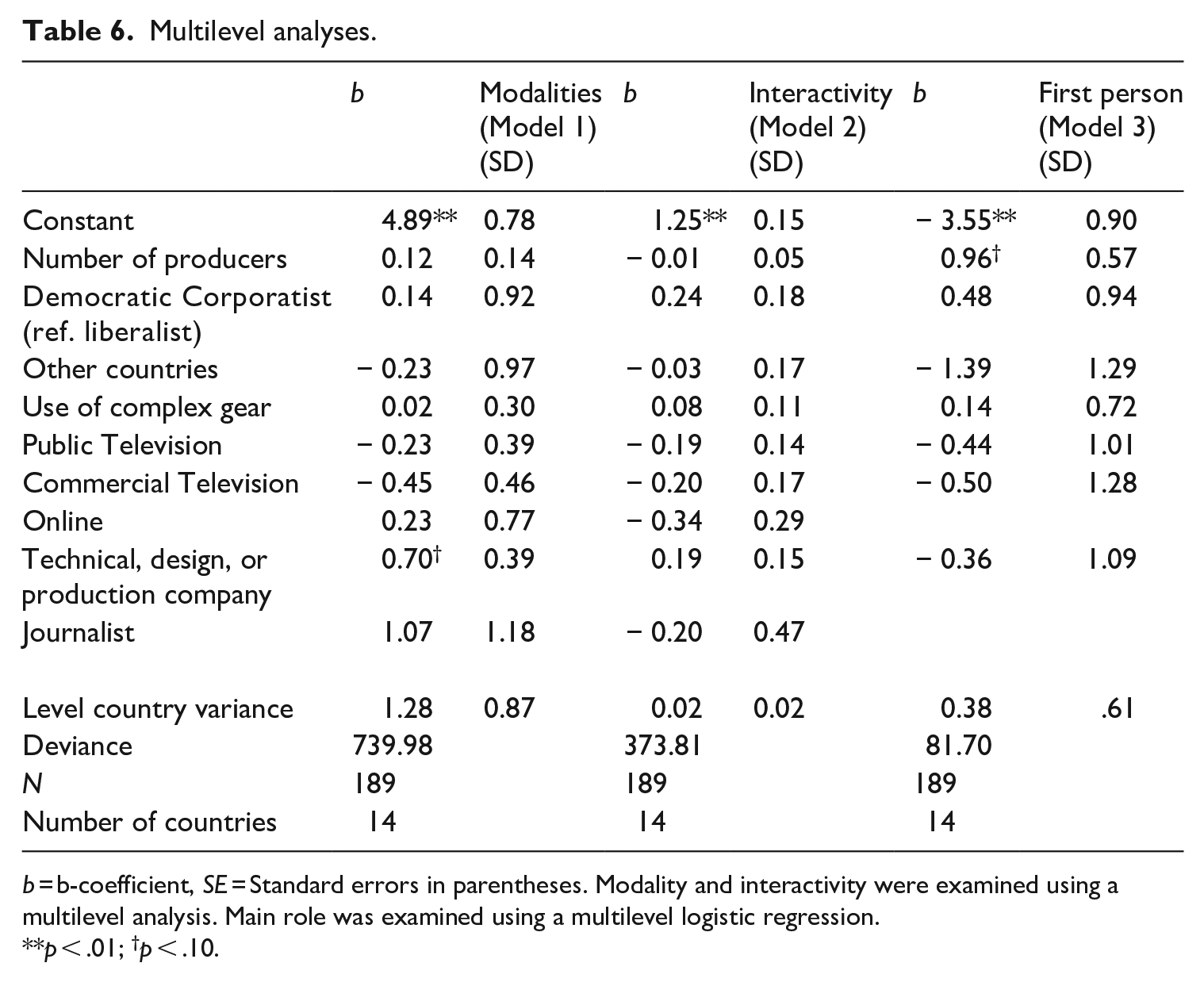
b = b-coefficient, SE = Standard errors in parentheses. Modality and interactivity were examined using a multilevel analysis. Main role was examined using a multilevel logistic regression.
p < .01; †p < .10.
Discussion
Immersive technologies offer audiences the chance to be part of a story, leading to emotional engagement (Riva et al., 2007), and increased levels of understanding of this story and the larger social context it describes. The journalism sector has shown significant interest in immersive technologies, particularly with the introduction of accessible smartphone-based headsets and 360 cameras (Aronson-Rath et al., 2016; Doyle et al., 2016; Watson, 2017). This article examines how ‘immersive’ journalistic stories using these technologies actually are, or how well the technological and theoretical elements of immersion are being used by media organizations today. Our model of immersive journalism shows a relationship between what journalists can do to stimulate immersion (use of immersive technologies, features in the narrative, and forms of interactivity), and what consequences this has for the user, including a feeling of presence, emotional engagement and the influence this might have on knowledge and attitude. Results of our content analysis however suggest that, even though journalists believe they are offering more immersion in their productions, the actual level of immersion is limited. Possibilities for the user to interact or have control over how a story develops is only visible in a few productions. In the majority of the productions analyzed in this study, the user is an observer stuck on the side lines, only able to watch the story a journalist wants to tell, albeit in 360 degree view.
Our results are relevant to the journalism studies literature in at least three ways. First, they suggest that it is impossible to judge journalistic innovation without a closer look at the technological possibilities that underlie it. The majority of productions analyzed in this article require a laptop, a mobile phone with headset or at most a VR cardboard. While a VR headset or a cave system can create more presence, this research shows that newsrooms prefer the use of more accessible technologies that are less expensive and easy to use. Thanks to affordable 360-cameras and new headsets, immersive technologies are now at the point of main stream adoption. However, one can question which effect such technologies have on presence and emotional engagement and, consequently, whether these less technologically advanced immersive productions actually have an added value for information processing. Consequently, this poses questions on how to combine different elements of immersion to still create a feeling of engagement and presence and also leave some level of autonomy for the user. News organizations are experimenting with interactive documentaries and interactive digital narratives as this potentially can reach a larger audience. This type of immersive stories uses more accessible technologies but at the same time make the user immerse in a story, by letting the user choose different aspects of a story (Goutier, 2019).
Next, while the journalism sector and profession are undergoing disruptive changes, this research shows a dilemma between new journalism practices and established conventions. Applying practice theory (Ahva, 2016), where journalism activities are shaped by sayings (conventions), doings (activities), and objects used (artifacts), this research shows that immersive journalism is at the crossroad, creating new questions on journalistic activities and conventions. Immersive technologies, or new objects within journalism, offer the public a more active role, letting them become not only a passive user, but an active participant. However, it is exactly these technological objects that have created new tensions between sayings and doings, posing new questions about the agency of the user and the influence of the journalist. While newsrooms see the opportunity of using immersive technologies for journalistic storytelling, the daily practice shows that journalists stick to established conventions of autonomy, and refrain from user influence on the story.
Third, the new technologies observed in this study also challenge the established structure of newsrooms. Productions with more immersive technologies offer the possibility of the user being able to interact in the story and have more influence on how the story unfolds (agency). However, such productions are most likely to be produced through a collaboration of different companies. Again, this shows that advanced immersive technologies demand new activities, even outside the journalism realm, which poses questions on established conventions in journalism organizations.
Our study has the following shortcomings. First, our sample was not generated from a centralized database, which means that we might have missed several relevant productions. Also, while we did a selection from different countries across the globe, these were not sufficient to analyze possible differences between cultures. Research on this topic is still in the explorative phase as this field of journalism is still upcoming. With the number of immersive productions increasing since 2015, future research can focus on a more systematic selection of immersive productions.
Second, in this article, we seek to provide some answers about the organizational factors that influence the production of immersive journalism. In line with preliminary reports of immersive journalism, immersive productions demand expertise outside the journalistic field and are, therefore, produced with other types of companies. However, this content analysis cannot provide answers on how costly immersive productions are and what other organizational factors might be of influence. While this research is a first step to understand immersive journalism, a following research within this larger research project will provide more answers on the production through interviews with makers of a range of immersive productions.
New technologies not only change journalistic storytelling itself, but also impact the user-journalist relationship. This study contributes to research in the emerging field of immersive journalism and the impact digital technology has on journalistic production, by showing how journalistic production today can and does connect to users in digital spaces. However, at this point in time, we conclude that technologies seem to be developing at a faster rate than journalistic norms and routines connected to their use, leading to immersive productions that do not fulfill the promise of first-person experiences.
Supplemental Material
appendix_a1 – Supplemental material for A first-person promise? A content-analysis of immersive journalistic productions
Supplemental material, appendix_a1 for A first-person promise? A content-analysis of immersive journalistic productions by Kiki de Bruin, Yael de Haan, Sanne Kruikemeier, Sophie Lecheler and Nele Goutier in Journalism
Supplemental Material
appendix_a2 – Supplemental material for A first-person promise? A content-analysis of immersive journalistic productions
Supplemental material, appendix_a2 for A first-person promise? A content-analysis of immersive journalistic productions by Kiki de Bruin, Yael de Haan, Sanne Kruikemeier, Sophie Lecheler and Nele Goutier in Journalism
Footnotes
Acknowledgements
The authors thank Nina Pušić for her help coding a large part of the immersive productions. They also thank the consortium partners NOS, NTR, VARA, KRO-NCRV, Dutch Institute for Sound and Vision, for their valuable contributions. Furthermore, they thank their advisory board. This article benefited from being presented at conferences (e.g. Etmaal, NECS and ECREA).
Funding
The author(s) disclosed receipt of the following financial support for the research, authorship, and/or publication of this article: This research is part of the two-year research project Immersive Journalism and the Engaged Audience, funded by SIA The Dutch Academic Research Fund.

Supplemental material
Supplemental material for this article is available online.
Author biography
References
Supplementary Material
Please find the following supplemental material available below.
For Open Access articles published under a Creative Commons License, all supplemental material carries the same license as the article it is associated with.
For non-Open Access articles published, all supplemental material carries a non-exclusive license, and permission requests for re-use of supplemental material or any part of supplemental material shall be sent directly to the copyright owner as specified in the copyright notice associated with the article.
