



Abstract
As one of the major venues for articulating and disseminating national agendas and opinion discourse, national newspapers play a critical role in promulgating ideology. Underpinned by Intertextuality and Social Actor Theory, this study explores intertextual aspects of China Daily’s reporting of COVID-19 to unearth hidden ideology behind texts. The analysis reveals diversified voices from multiple actors around the globe, with China’s official leaders appearing most frequently. In the portrayal of social actors, some strategies like impersonalisation, and genericisation are utilised to add impersonal authority or power to an actor’s activity, actant’s engagement, and increase the trustworthiness of news. These reprsentational strategies belies a transformation in Chinese media discourse with a softer approach is used in wielding ideological intentions through journalistic practices of intertextuality. Our findings help to unravel how news texts draw on, echo, and bring together multiple intertextual resources realised in the forms of discourses. The circulations, dissemination and incorporation of these intertextual relations and practices construct specific understandings of ideology consolidation and public relations within the context of China and its response to the COVID-19 pandemic.
Introduction
The diversity of news sources and actors reflects the extent to which the media can function as an arena for public discourse. Diversity, as a pluralistic political goal addresses the issue of representation (McQuail, 1992; Sjøvaag and Pedersen, 2019). Within the context of journalism, particularly national news media, diversity of news representation includes a wide plurality of standpoints and viewpoints, gleaned from multiple sources within and outside the home country (Curran, 2011; Humprecht and Büchel, 2013). However, diversity can also be co-opted for ideological purposes wherein the goal of featuring diverse social actors in news coverage is not so much for democratic or inclusive representation per se, but rather as an intertextual tool to support national agendas. Media and public discourse of COVID-19 is replete with ‘diversity’ in terms of conspiracy (Romer and Jamieson, 2020; Zeng and Schäfer, 2021), representation and framing, as well as blaming (Gong and Firdaus, 2022; Wicke and Bolognesi, 2020).
Although China initially enjoyed considerable success in combating COVID-19 (Lancet, 2020; Salzberger et al., 2020) as it flattened the curve of new infections throughout 2020, international reaction towards China remained negative and accusatory. China Daily (hereafter referred to as CD) is the English version of the defacto official state newspaper, The People’s Daily. As shown in previous studies discussed further below, it is likely that CD’s reporting of the COVID-19 pandemic is informed by national ideology. This study, therefore, aims to examine intertextuality in CD’s representation of COVID-19 social actors, and the ideology implicit (or explicit) ideology embedded within its news text, as China and the world grappled through the first year of the unprecedented pandemic.
The current study advances our understanding of COVID-19 news representations by using linguistics analysis. It also enhances our knowledge of how China has employed a diverse range of voices, from international bodies, world leaders, Chinese government officials, medical experts and ordinary grassroots to portray China’s pandemic efforts both in positive light whilst simultaneously advancing state ideology.
Theoretical preliminaries
Intertextuality
Intertextuality refers to the relation between texts that are inflected by means of quotations and allusion (Marta, 2019). It revolves around how quoted utterances are selected, changed, and contextualised in relation to specific social and discursive practices in certain contexts (Fairclough, 2007; Li, 2009). Thibault (1994: 1751) explains intertextuality as “all texts, spoken and written, are constructed and have the meanings which text-users assign to them in and through their relations with other texts in some social formation.” In the same vein, Fairclough (1992) explicates it as “the property texts have of being full of snatches of other texts, which may be explicitly demarcated or merged in, and which the text may assimilate, contradict, ironically echo, and so forth” (p. 84). Although some researchers analyse intertextuality solely from a linguistic perspective (Hamm-Rodríguez and Medina, 2021; Lemke, 2005), most scholars see it as a social practice that involves particular socially regulated ways of producing and interpreting discourse rather than a form in which texts are interrelated.
In this article, intertextual voices refer to the representation of different viewpoints in CD. An intertextual voice in a text represents a perspective of someone other than the author, which the author has taken from one context (e.g., a politician or medical professional) and referred, cited, or otherwise borrowed. Intertextuality and multiple voices can be seen as inevitable parts of using language and creating texts (Bazerman, 2003; Fairclough, 2003; Komulainen, 2007; Li, 2009).
Social actor theory
Power and ideology struggle are termed the most powerful influences in the symbolic role of globalized mass media. Language use and implicit meanings embedded and within media content are influenced by numerous factors. In particular, linguistic and social factors of media discourse are embedded in social and linguistic networks (Sundar and Nass, 2000). Van Leeuwen (1996) of social actors. According to the critical postulates of Critical Discourse Analysis, the theoretical underpinnings of Leeuwen’s framework emphasised the ways by which social actors are represented in discourse and discursive construction of legitimation (Van Leeuwen, 2008).
Social actors are defined as the “doer” in a discourse. Social actors serve as useful tools of discourse, in the hand of the writers (Van Leeuwen, 1996), where they are presented in media through exclusion and inclusion strategies. Social actor theory is embedded in linguistic basis and aims to deconstruct the single side of the reality represented by media forums.
Van Leeuwen divides the representation of social actors into two major categories: Exclusion and Inclusion. Through Exclusion, the media omits certain social actors from the field of discourse. Exclusions in media representation can be deliberate attempts informed by propaganda strategies, rarely the result of innocent unintended omissions (Van Dijk, 2017). Media discourse excludes some social actors in ways which may create fear and disordered situations.
Exclusion in media studies falls into two categories; the first is suppression which is known through passive agent deletion (Van Leeuwen, 1996). Passivation strategy is used to present the social actors in a way that hides the original identity of the perpetrator. Other sub-strategies of Exclusion include Nominalisation, deleting content related to the beneficiaries. Many times, the original data is omitted to benefit certain government or capital owners. Through backgrounding of the social actors, the Exclusion becomes less radical (Norris, 2004; Van Leeuwen, 2014).
The second discursive practice is Inclusion. It refers to the involvement of social actors in discourse. Activation is one of the most important types of Inclusion. Activation happens when social actors are symbolised as dynamic and active forces in an event or an activity. Generalisation and specification are also used as inclusion techniques. In the former case, social actors are mentioned in general, whereas in the latter case, specific things are mentioned, such as concrete places, people, and actions. Social actors can also be referred to as one community, group, or nation. This strategy is named Assimilation. Presenting social actors in this way assigns responsbility (or blame) to the entire community. Besides, social actors share functions and identities with each other (Machin and Van Leeuwen, 2005). It can be either religious, physical, or social status that others know in common. Such methods are based on the function to marginalise or a means of dominance exploited by, or enacted upon a particular social actor. Figure 1 shows the network of social actor theory. The representation of social actors in discourse: System network. (Source: Van Leeuwen, 2008: p. 52).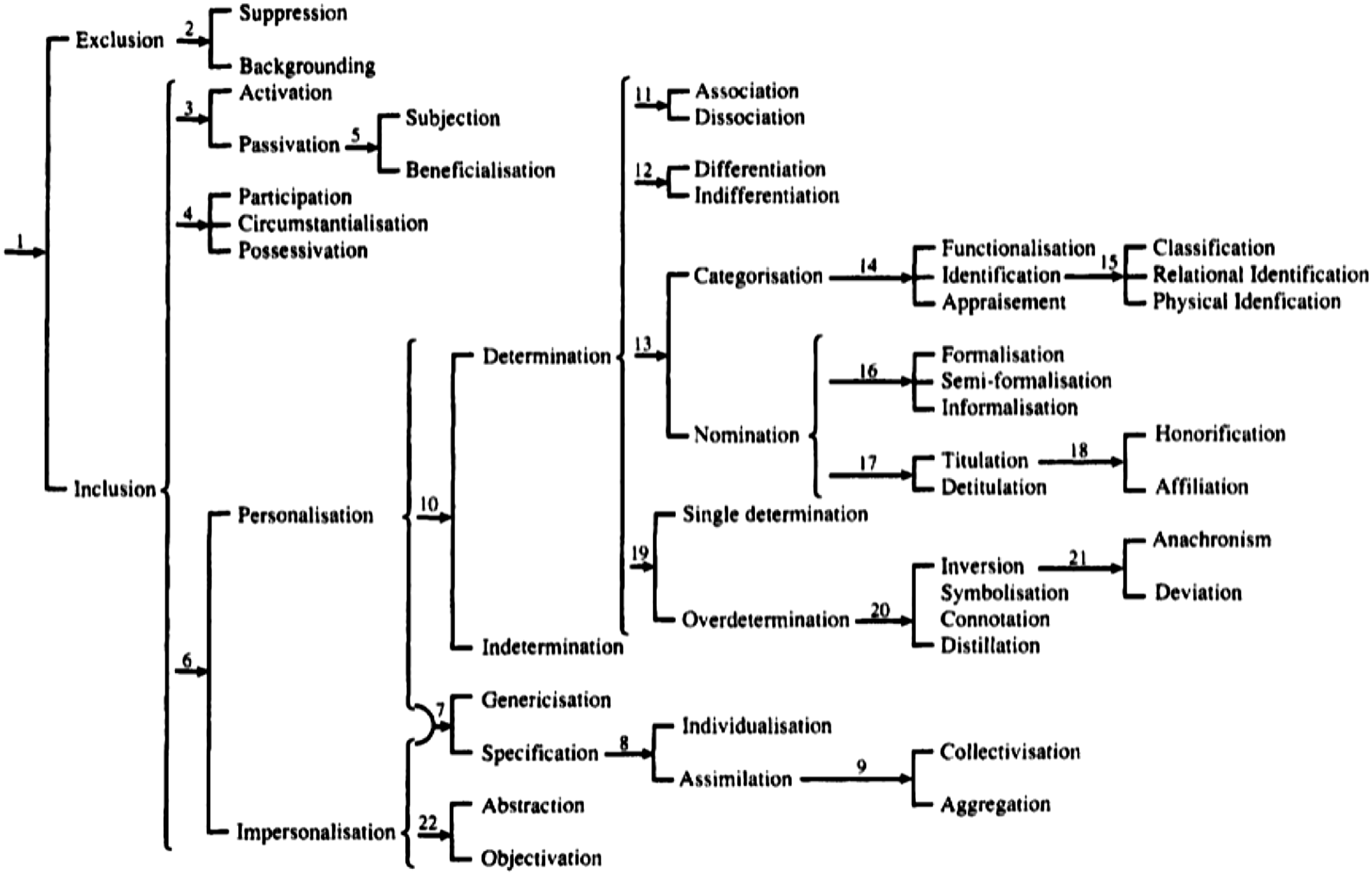
In media discourse, when the matter concerns government authorities, the government’s perspectives seem very dominant. This is the chief reason the social actors (e.g., government or the elites) are always nominated and specified comprehensively during the press release. The elites appear in the media with their complete identity, including their rank and position. In contrast, the middle to lower-class-oriented media works oppositely (Downs, 2002). In the face of COVID-19, China employed its official voices to facilitate public action en masse to battle the virus. Moreover, with the transformation of China’s mediascape, the representational strategy has evolved from a dominant official actor to a more “softened” approach, with ordinary people and other social actors also portrayed in the media. Amid the pandemic, it appears that diverse social actors are portrayed as playing crucial roles in addressing the COVID-19 pandemic. Through an examination of Exclusion and Inclusion strategies in CDs, we examined all actors and voices that emerged in CD’s reporting.
China daily: A brief dossier
Recapping the literature, studies have examined how China Daily (hereinafter CD) plays a significant role in creating national identities and ideologies (Li, 2020; Lihua, 2009), what topics appeared in combatting the pandemic via CD (Yuan et al., 2022) and how it portrays certain issues (e.g., hackers) in CD (Pei et al., 2022). However, there is little research attention on the actors, actants, and voices commonly portrayed and why so. CD’s portrayal of COVID-19 social actors is important because it is a major agenda-setter in the Chinese media system (Duan and Takahashi, 2017; Pei et al., 2022), serving as the English version of The People’s Daily, the defacto “official mouthpiece” of the Chinese Communist Party, conveying the government’s attitudes and positions (Lihua, 2009). CD is widely read in over 200 countries and areas outside China with an average daily circulation of 600,000 worldwide and 300,000 domestically. 1 CD was launched and financially supported by Chinese government, designing to meet the needs of China’s open policy, to serve the increasing number of foreigners (Hong, 2013), and to brand China and its government to the world. Hence, it is a critical conduit through which China connects with the world.
Research methodology
Data collection and analysis
CD news articles related to the COVID-19 pandemic were searched using the Lexis-Nexis database. The search covered the time span between (and including) February 1st 2020 when China officially announced the discovery of the coronavirus in Wuhan, to December 31st 2020 which marked the close of the first year of the pandemic. The corpus search string included COVID-related keywords, namely: “Novel coronavirus” OR “Novel coronavirus 2019” OR “2019 Novel coronavirus” OR “2019 nCoV” OR “COVID-19” OR “Wuhan coronavirus” OR “Wuhan pneumonia” OR “SARS-CoV-2 OR COVID-19.” The search included raw text data from news articles published in the online version of CD. Blogs, commentaries, and other web-based content are excluded. The corpus underwent data cleaning to remove duplicates and texts not meeting the abovementioned inclusion criteria. A total of 308 news articles were collected.
Next, the 308 articles were independently examined by the first and fifth authors who are both Chinese nationals. They identify and extract texts relevant to social actors and voices represented within the context of the COVID-19 pandemic. Words, phrases and sentences with intertextual, representational or ideological denotations and connotations were highlighted for potential analysis. At this stage, the two authors collaboratively reviewed their shared corpus to select excerpts suitable for potential analyses, identifying a total of 27 intertextual excerpts with representational or ideological denotations and connotations. These 27 excerpts were then analysed employing relevant techniques from Van Leeuwen’s social actor network framework (1996; 2008) as illustrated in Figure 1. The analyses also draw upon Van Dijk’s (2006) use of Critical Discourse Analysis (CDA) for exploring pressing social issues, in this case, the intertextuality of COVID-19 news coverage and the representation of various social actors and voices during China’s first calendar year of the pandemic.
CDA, according to Van Dijk (2006), is primarily interested in and motivated by the endeavour to understand pressing social issues. It aims to uncover the ideological assumptions that are hidden in the worlds of our written text or oral speech (Wodak and Meyer, 2015). The aims aptly suit to the current study with the focus of examining CD representations of social actors within public/media discourses. It should be noted, as suggested by Van Leeuwen, this study employs only selected relevant techniques from the network (Figure 1).
Findings
Voices of quoted news actors
In the analysis section, this study focuses specifically on representation of prominent social actors via the patterns of their quotations in CD’s COVID-19 media discourse.
In news discourse, quotations and news reports of relevant actors’ speech, both in an explicit or implicit manner, are a significant aspect of referring to news actors and construct what Fairclough calls “manifest intertextuality” of text. Quotations of news actors are neither transparent nor simple citations. Rather, they constitute (re)interpretations of events and power relations among news participants (Teo, 2000). News texts reconfigure the power structure and generate meanings about the world that news actors inhabit through their selections, quotes, and changes in the speech of various news actors (Li, 2009). Therefore, analysing intertextuality can offer deeper insights into the interconnectedness between social actors’ positions and identities in the text.
Table 1 lists the social actors whose voices are featured in CD’s COVID-19 news reports, as found in the 308 articles analysed in the study. As shown in the table, social actors quoted can be categorised into six groups: Chinese Leaders/Officials (17 actors), WHO/UN (Seven actors), Medical experts and specialists (11 actors), Frontliners (13 actors), International reaction (Seven actors), and Public/Volunteers (13 actors). As we will show, the representation of social actors through quotation patterns serves to empower and justify what “we” (China) do and disempower or ignore what “they” (other countries) do, showing dichotomic justification and delineating an ideological framework. In this sense, CD attempts to convince its readers of the importance and role of these news actors in helping contain the virus. In other words, it portrays China as responsibly and effectively coordinating resources from all sectors to flatten the COVID-19 infection curve, and ultimately to serve the people. Most actors are affiliated with various organisations with certain positions. By indicating the specific position and organisations of various social actors, CD is designed to convey that COVID -19 is not a normal domestic disease but a global issue that affects every individual, organisation, and country. By doing so, CD tries to convey that China should not be blamed for the outbreak of COVID-19 or it is a political problem. Instead, it is a worldwide disease that everyone should be concerned about.
“What you should do now is stay confident. We all should be confident that we will win this war,” the man said through a video link at Huoshenshan Hospital in Wuhan, the epicentre of the COVID-19 outbreaks, in Central China’s Hubei province. (2020/03/11) Voices of mentioned news actors.
Noticeably, the most salient actor mentioned in CD articles is General Secretary of the Chinese Communist Party- Xi Jinping, whose voice is echoed repeatedly throughout the news reporting. Two articles titled “Xi’s diplomacy bolsters epidemic fight” and “Moment of truth: Xi leads war against COVID-19” (11 March 2020), for example, depict the pandemic via Xi’s expressions and comments regarding the battling of the pandemic. Some quotations of Xi in articles are rendered in a free indirect manner. For example, in
Victory for Wuhan, victory for Hubei, and victory for China! He declared with a clenched fist. (2020/03/11)
In
Additionally, there is a prominent dichotomy in describing China and other countries, especially the United States. This is because U.S. former president Donald Trump blatantly delivered speeches like “Wuhan Virus” or “Chinese Virus,” which triggered counterarguments from the Chinese government and relevant media outlets. Examples are abundant in CD. Linguistically, it is in-group and out-group or us versus them discourse. The conceptual framework of the in-group/out-group dichotomy has been reapplied to investigations of unequal power relations in institutional and media discourses.
Do Kazianis and others like him base their arguments on the hypothesis of the virus escaping from a Wuhan lab? Can any accusation stand without evidence? There are conspiracy theories that the Wuhan outbreak was caused by a virus leaked by a U.S. lab… Should the Chinese people buy such conspiracy theories and file lawsuits against the U.S.? (2020/04/22)
“We lied, we cheated, we stole.” This is a line from a speech made by U.S. Secretary of State Mike Pompeo, former CIA director. Since taking office as the country’s chief diplomat, U.S. diplomacy has continued to promote lies without ceasing. (2020/10/14)
In
“I have just one message: the U.S. is the gravest threat to global strategic security and stability.”
Another quotation from Geng Shuang, spokesman of China’s Foreign Ministry (
Public health experts and politicians around the world have been unanimous in lambasting the U.S.’ decision, calling it ‘senseless,’ ‘astounding,’ ‘awful,’ ‘rogue’, and ‘short-sighted’, among other things
Additionally, CD utilises international voices to bolster the in-group as prosocial and helpful, while others (the U.S.) as evil and awful. In
Social actors analysis
Impersonalisation
Impersonalisation is a strategy of impersonalising social actors, and it is realised by referencing non-human elements. Social actors are represented by other means like abstract nouns or concrete nouns whose meanings do not contain the semantic feature “human” (Van Leeuwen, 2008). Moreover, this strategy could be utilised for different purposes. It could add impersonal authority or power to a social actor’s activity or quality. Also, it could lend positive or negative connotations to actors’ activities. In CD, the impersonalisation method is designed to mirror the positivity of social actors in combating disease. The purpose is to build perceptions about the identity of relevant actors as they are identified as powerful, authorised, and united actors.
… China resolutely rejects the ‘baseless accusation’ against it and opposes ‘political virus’, said China’s permanent representative to the United Nations, Zhang Jun, following U.S. President Donald Trump’s criticism of China’s handling of COVID-19 at the U.N. General Assembly. (2020/09/23)
… China has always actively carried out international vaccine cooperation through multilateral and bilateral channels and has maintained close communication and cooperation with international organisations. (2020/12/04)
… the Communist Party of China (CPC) united and led the Chinese people in a fierce battle against the pandemic and achieved important strategic success. (2020/09/09)
This impersonalisation strategy is used to represent both the positive side of China and the negative side of the U.S. In
Assimilation
The concept of Assimilation can be achieved using nouns that symbolises a group of people. Assimilation also has its subdivisions, namely, aggregation and collectivisation, with the former referring to the quantitation of groups and participants and the latter does not quantify groups of participants. In the data, various examples utilised this strategy, where social actors were collectivised in a specific term. Specifically, these actors are termed as nurses, medical workers, medics, people, villagers, drivers, and volunteers, etc. The reporter’s purpose is to represent a solidarity atmosphere and make it sweep across the country.
Nurses have played an important role in the fight against the novel coronavirus outbreak…, according to the National Health Commission. (2020/02/29)
Nurses have made significant contributions to disease prevention and control, and they have demonstrated the great spirit of respecting lives…. Showing great love for others across borders, Xi said. (2020/05/12)
In
Nomination
Social actors can be represented in terms of their unique identity (nomination) and functions they share with others (categorisation), and it is always interesting to explore which social actors are categorised and which are nominated in given discourse (Van Leeuwen, 1996). The representation of social actors in CD witnesses the broad application of the nomination strategy. In
… Soonman Kwon, a professor and former dean at the School of Public Health at Seoul National University, said at the beginning of the outbreak there were discussions on whether testing on a massive scale was needed. It turns out that mass-scale testing is quite an effective mechanism to find the cases, isolate them….(2020/04/06)
Functionalisation and classification
Functionalisation is achieved using a noun formed from a verb with the addition of suffixes such as -er, -ant, -ent, -ian, or -ee. This can be seen in the examples of “speaker,” “employee,” or “driver.” It can also be realised through the use of a noun that is formed from another noun with the addition of suffixes such as -ist and -eer. Regarding classification, social actors are referred to in terms of the major categories by means of which a given society or institution differentiates between classes of people. In the following
Chinese scientists and medical professionals have worked diligently and effectively to rapidly identify the pathogen behind this outbreak, put significant measures to reduce its impact…. (2020/02/19)
Van Kerkhove, an epidemiologist from the United States, praised China’s public health infrastructure, saying there is a system in place to deal with infectious disease outbreaks, a system for surveillance and a ready…. (2020/09/09)
Bruce Aylward, a Canadian physician and epidemiologist who was the co-head of the first WHO-China Joint Mission on COVID-19, agreed, noting the public health infrastructure at all levels in China. (2020/09/09)
China has just gone through a very dark moment. However, with it (the virus) still spreading … and I hope that … our experience as a first wave can be shared by other countries,” said Zhang Wenhong, the director of Huashan Hospital’s department of infectious disease (2020/04/06)
Specification and Genericisation
The specification is the strategy of representing the social actors as specific identifiable individuals (Van Leeuwen, 2008). In this sense, the social actors are named by employing linguistic items, say, a proper noun like “Mr Peter.” By contrast, Genericisation is realised when social actors are given general references via the utilisation of mass nouns or plurals such as “Chinese people” and “non-European immigrants”. Genericisation also be realised using singular nouns with a definite and indefinite article like “the Child” and “a Child”. In depicting the in-group social actors, CD characterised the social actors in both collective and specific terms.
Vice-Premier Sun Chunlan said that since the start of the novel coronavirus pandemic, large numbers of China’s medical workers have put themselves forward and made outstanding contributions…. (2020/08/20)
The representation of social actors in CD includes the use of specifications. For example, in
Tedros Adhanom Ghebreyesus, WHO Director-General, reiterated that almost 99% of cases and all deaths have been within China, with only 68 confirmed cases as of Wednesday and no deaths in 15 countries and regions outside China. “For that, China deserves our gratitude and respect … China is implementing very serious measures, and we cannot ask for more” he said. (2020/01/03)
In
Although scattered COVID-19 cases emerged in several regions, it’s basically impossible for the virus to spread far… said Zhang Wenhong, director of the infectious disease department at Huashan Hospital affiliated with Fudan University in Shanghai. (2020/12/30)
Despite increased risks with the arrival of the peak travel season, there is little chance of the mainland witnessing another wave of mass outbreaks of COVID-19, … said Zhong Nanshan, a prominent expert in respiratory diseases and a member of the Chinese Academy of Engineering. (2020/12/31)
In
It’s the sense of mission that supports us. As medical workers, it’s our duty to save lives. (2020/09/22)
Medical staff at the front line of the anti-COVID fight receive the profession’s highest honour. Premier Li Keqiang underlined on Wednesday…. (2020/08/20)
More foreign leaders, including Russian President Vladimir Putin, sent telegrams or issued statements. According to the Ministry of Foreign Affairs, leaders from more than 170 countries and 40 international or regional organisations voiced support for China. (2020/03/11)
The above Excerpts display the usage of genericisation. It is a method of viewing the social actors in a general way. The purpose is to create a perception of goodwill and a responsible national image of China (Lihua, 2009). Precisely, in
Activation/passivation
Van Leeuwen (1996) has asserted that there are two kinds of social actor representations, namely passivation or activation. Activation can be defined as the portrayal of the social actors as major operating forces behind an activity. In contrast, passivation is defined as the scenario where the social actors are impacted because of some activities.
We later began to look for possible worksites where the two cases (on November 20) had been exposed. We finally identified an aircraft container from North America… Tests also showed the virus they were infected with was a strain from North America. (2020/11/27)
In
“We later began to look for possible worksites where the two cases (on November 20) had been exposed. We finally identified an aircraft container from North America, which the workers entered without wearing face masks on October 30. Tests also showed the virus they were infected with was a strain from North America.” (2020/11/27)
Results from Italy indicate that SARS-CoV-2 circulated in Italy earlier than the first official COVID-19 cases were diagnosed in Lombardy, even long before the first official reports from the Chinese authorities…. (2020/12/01)
In
Trump’s ‘Chinese virus’ tweet, therefore, has simply been played as his ‘get-out-of-jail-by-framing-someone-else’ card. (2020/03/23)
Discussion and conclusion
Underpinned by intertextuality and social actor theory, this study employs a qualitative method to reveal the portrayal of social actors in handling COVID-19. It showcases news text with its representational, identificational, and actional meanings, which can be realised in various textual features (Fairclough, 2003; Guo, 2019). This approach to news discourse emphasises the multidimensionality and multifunctionality of news text and views the text as intrinsically connected to the socio-cultural background in which it is produced, to the world’s events, and to the humans involved in the events. In CD, the analysis of the intertextual properties revealed that voices from officials and Party leaders are dominant (17), which is consistent with the prior findings (Don and Lee, 2014; Hendriks and Lees-Marshment, 2019; Li, 2020). By using certain coverage strategies, political elites, the media, and other actors may influence how an issue is perceived, hence influencing public opinion. In other words, political elites can employ media discourse effectively to further their own political and ideological ends (Meraz, 2009; Schnell, 2001).
In the Chinese context of the COVID-19 pandemic, other voices (international stakeholders, medical specialists, and ordinary people etc.) also emerged due to the uniqueness of events. This implies that when wielding ideological intentions via media discourse, the representational strategy has evolved from deploying authoritative voices (e.g. international bodies and Chinese officials) to a more “softened” inclusive approach of including wider range of voices (e.g. grassroots, global stakeholders, etc.) It is more apparent in the current China mediascape wherein China faces mixed portrayals and sentiments from other countries. The media employs this way to defend and legitimatise certain events.
Additionally, the critical discourse analysis revealed that CD is employing various methods to depict how “Actors” handle COVID-19 and how “Actants” engage in the moves. For example, impersonalisation is utilised to add impersonal authority or power to an Actor’s activity or quality and mirror the positivity of social actors in combating disease. Actants were portrayed by assimilation to display collective measures of them. Specification and Genericisation are employed to increase the trustworthiness of news and highlight the Chinese government for its efforts. Coupled with intertextuality (emerged quotes and voices), this study also uses socio-semantic analysis to unravel the media coverage strategy (visible) and ideology intention behind the text (invisible). It is true that the news is produced and consumed within a socio-cultural context, and media organisations are inextricably linked to specific ideologies, institutional cultures, and practices (Van Dijk, 2011). Despite a more softened approach to ideological news coverage, the scope for fundamental change in China’s mass media is constrained by its long history as the Party’s mouthpiece and the paternalistic top-down approach to news framing and representation (Wang, 2008; Zhao, 1998). Overall, this intertextual analysis helps deepen our understanding of how China portrays the COVID-19 pandemic and relevant social actors respond to the pandemic. Van Dijk (2013) argued that discourse, including news discourse, is a common social practice influenced by ideology. CD uses media discourse to consolidate its national image in the face of conspiracy, stigma and unfavourable comments (Yu, 2022).
Limitations and future directions
This study has several limitations. Although state-controlled newspapers are prevalent in China, other sources such as commercial newspapers and “self-media” exist. Future research should examine topics in other mediums to uncover nuances of media discourse in China. Secondly, the question of why news texts are produced in the ways they are is always a complex one. Apart from intertextuality other representational approaches might also shape our understanding of how and why news texts are produced. Future studies should interview news producers (journalists and practitioners, and editors) to unravel the text-producing process and how ideology works within it. Thirdly, it may contain researcher’s bias regarding the selection of articles and the analytical, interpretative process. Future studies should employ quantitative research methodologies (e.g. computational analysis) to objectively analyze larger corpus of texts.
Footnotes
Declaration of conflicting interests
The author(s) declared no potential conflicts of interest with respect to the research, authorship, and/or publication of this article.
Funding
The author(s) received no financial support for the research, authorship, and/or publication of this article.
