



Abstract
The COVID-19 pandemic has made older adults one of the main foci of media. This article explores age-related language through a comparative analysis of headlines in the five highest-circulation Spanish newspapers during the first and second waves of the 2020 pandemic and the 2 years before the pandemic. The results show a decrease in the frequency of headlines that represent older people as subjects of an action associated to positive affection, as well as an increase in representation of older adults as a homogenous group in a negative way, and an increase in ageist terms, especially “elders.” We discuss to what extent the COVID-19 pandemic can reinforce ageism and the possible repercussions.
Introduction
A fundamental characteristic of this pandemic is that it affects social groups differently. Although COVID-19 can affect people of all ages, the disease poses a greater risk to older people or those with pre-existing conditions or illnesses (Li et al., 2020).
This has made older adults one of the main foci of media attention. The media uses the representation, images, and stereotypes available in our culture. The use of one term or another is important, as it contributes to reinforcing some representations over others (Edström, 2018; Loos and Ivan, 2018). The media, as constructors of reality, transform facts and events into news and promote certain topics to influence public discourse. Each topic's weight in the social agenda depends on the relevance the media give to the issues and the attributes they associate with the objects or subjects. Likewise, the media have a fundamental role in the formation of public opinion, since they build cognitive frameworks that influence the public's perception of events. Hence the importance of the information they transmit and how they transmit it, since they can be an important instrument for eradicating age discrimination and building a more responsible society.
Research has shown that language is a powerful tool for transmitting culture and is crucial in forming and maintaining stereotypes and associated discrimination (Formanowicz and Hansen, 2021). Language is key for conveying meanings and assumptions: language is not only influenced by societal ideas about aging, but also contributes to the creation of meaning, and can lead to the development of ageist stereotypes and discrimination (Gendron et al., 2016; Kervin et al., 2022). Therefore, examining how the media portray older people offers a means of exploring which representations of older people are sustained and reinforced over others.
Aging and the media
The image traditionally held of older people has been negative, associating them with characteristics such as illness, dependency, and vulnerability (Fernández-Ballesteros et al., 2020; WHO, 2021). Faced with this pessimistic image of older people and aging, in recent decades a more positive representation has appeared, exemplified by the concepts of successful aging (Rowe and Khan, 1987, 1997) or active aging (WHO, 2021), which are positive ways of aging, characterized by the maintenance of health and healthy lifestyles (Liang and Luo, 2012).
People’s attitudes and beliefs about older people and the process of aging are heavily influenced by the portrayal of older people in the mass media.
Traditional media such as newspapers, television, and radio have visually underrepresented older people or misrepresenting them in a prejudiced way (Loos and Ivan, 2018; Ylänne, 2012, 2015, 2022)- Loos and Ivan (2018) labeled this phenomenon as ‘visual ageism’- and have long reinforced ageist stereotypes by portraying older adults as a burden to society and aging as a social problem. Indeed, researchers have shown the contribution of media representation on social discourse, influencing the way older people are perceived and treated, the way older people see themselves (Skoss et al. 2022), as well as the effects on patterns of communicative behavior in intergenerational contact (Zhang and Liu, 2021). More recent studies have also shown that one’s beliefs about older people and aging, which develop at least partly in response to exposure to mass media content, in turn influence the process of aging. Furthermore, negative beliefs about aging impacts in other adults self-esteem (Levy et al., 2002a), may contribute to less healthy habits (Levy and Myers, 2004), promote cardiovascular disease (Levy et al., 2002a) or chronic diseases (Stewart et al. 2012), harm older people's memory performance (Hess et al., 2003, 2004; Levy, 1996; Levy et al., 2002a), and even reduce life expectancy (Kotter-Grühn et al., 2009). This is in line with Levy’s embodiment theory (2003) argues that stereotypical beliefs are internalized during lifespan through repeated reinforcement, and in old age, these beliefs begin to operate as self-fulfilling prophecies: older people tend to behave and perform in ways that match their own beliefs about their age group.
Age related discourses contribute to ageism (or, potentially, towards age equality). Ageism is defined as: “a process of systematic stereotyping and discrimination against people because they are old.” (Butler, 1975). Butler (1969) describes ageism with three characteristics: negative stereotypes, prejudicial attitudes, and discriminatory practices and institutional policies or acts against older adults.
During the COVID-19 pandemic, the relevance of older people in our society and in the media allow us to examine representations of them and the extent to which the media reinforced ageism. During crises people consume more media. The media system dependency theory (Ball-Rokeach and DeFleur, 1976) and risk information seeking and processing (RISP) model (Griffin et al., 1999) predict that in a crisis individuals may be motivated to seek information and become increasingly dependent on mediated information sources to manage uncertainty.
Stereotypes of older adults in print newspaper
Theoretically and empirically, older adults are the most diverse and heterogeneous age group in the population (Nelson and Dannefer, 1992; Kelley-More and Lin, 2011; Wellin, 2018). Stereotypes are important in media studies because they are a key filter through which groups learn about each other (Ross, 2019). For example, researchers have found that print newspaper discourses support dominant assumptions and social constructions of aging that influence both older people’s behavior and societal action towards older people (Fealy et al., 2012). According to Levy’s embodiment theory, when stereotypes recur in the media, people internalize the messages and may change their perceptions of themselves and other groups within society.
Various studies have identified ageist discourses in the media, and they seem to have increased during the pandemic:the media have transmitted a negative and homogeneous image of older people as a group, since many news items have been related to deaths, infections and disease, and loneliness, showing only the most vulnerable aspects of old age (Masson et al., 2010; Yläne, 2015). Ayalon et al. (2018) writes that because of this pandemic, “people over 70 are represented as if they were all helpless, as if they were fragile and unable to contribute to society.”
Print news media studies also report rendering older people as a family "burden” and a burden on the health and social systems (Rozanova et al., 2016). The language is even more marked in the case of people living with dementia (Bailey et al.,2021; Peel, 2014; Van Gorp and Vercruysse, 2012).
Bravo-Segal and Villar (2020) analyzed 501 headlines from ABC and El País newspapers referring to elderly people during the first wave of the pandemic in Spain. They classify headlines as positive, negative, and ambivalent, and find that certain terms for this population, such as “ancianos,” perhaps “elders” or “the elderly” in English, are associated with negative headlines.
Given these circumstances, as highlighted by media scholars, one of the most crucial questions is whether, and to what extent, the media has improved or eroded images and stereotypes of older adults. Therefore, this study seeks to compare the representation of older people in the media before and during the first year of the COVID-19 pandemic.
We propose the following hypotheses:
As suggested by previous studies (Ayalon et al., 2018; Bravo-Segal and Villar, 2020) we hypothesized that the pandemic increased negative views of older people, so there would be an increase in the frequency of ageist terms in the media that refer to them. Previous studies (eg. Alam et al., 2020; Bravo-Segal and Villar, 2020), showed that headlines portrayed older adults unfavorably by depicting them as a homogeneous group and associating them with death or extreme vulnerability. This affects social perceptions (Schmidt et al. 2017), reinforcing ageist perceptions by spreading negative stereotypes of older people as frail, infirm, unproductive, and burdensome to society (Zhang and Liu, 2021) and it might influence the affect older adults generate (Cuddy et al., 2007). Therefore, we hypothesized:
There will be a decrease in the frequency of headlines representing elderly people as subjects of an action associated with positive affect.
There will be a relationship between ageist terms and the representation of older people as subjects of an action linked to negative affect.
Residential care facilities reported the highest deaths rates at the beginning of the pandemic (Comas-Herrera et al., 2022) News coverage of COVID-19 mortalities are likely to exacerbate discourses of exclusion toward older adults and exclude older adults socially (Le Couteur et al., 2020; Rahman and Jahan, 2020), generating a harmful infodemic (Cinelli et al., 2020; Zaracostas, 2020). Therefore, we hypothesized that there will be a relationship between headlines related to nursing homes, where the most vulnerable elderly live, and their representation as subjects associated to negative affect.
Method
This study did not require ethical approval as news media is widely available publicly.
This study uses a mixed qualitative and quantitative methodology. In the qualitative part, we performed a content analysis of a sample of headlines. Newspaper headlines constitute an essential part of media discourse. Specific attributes of news headlines and how they guide readers’ focus have facilitated the interface between linguistic analysis of newspaper headlines and the formation of readership opinions (Mehmood et al., 2019).
In the quantitative part, we analyzed differences in the probability of certain codes or groups of codes before and during the COVID-19 pandemic. In addition, we analyzed the correlation between these codes and the terms used to refer to older people. Finally, we studied the representation of older people in headlines mentioning nursing homes or mortality.
We used the second wave of the 2021 General Media Study (AIMC, 2021: https://www.aimc.es/egm/acceso-los-datos/) to select media for this study. We selected the five media outlets with the biggest audiences in the “Dailies” category, excluding sports newspapers such as As and Marca. We chose five outlets, to include both national and regional newspapers. We included El País, ABC, El Mundo, La Vanguardia and La Voz de Galicia.
We selected articles that represented older people in some way (individually, in a group or as a social group). To do this, we used the MyNews library search tool (https://mynews.es/). We selected articles that had any of the following terms or expressions in the title or subtitle, with their corresponding variations in gender and number: “ancianos” (elders), “ancianidad” (old age), “pensionistas” (pensioners), “jubilados” (retirees), “vejez” (old age), “envejecimiento” (aging), “longevidad” (longevity), “hexagenarios” (sexagenerian), “heptagenarios” (septuagenarians), “septuagenarios” (septuagenarians), “octogenarios” (octogenarians), “nonagenarios” (nonagenarians), “edadismo” (agism), “personas mayores” (older persons), “gente mayor” (older people), “mayores dependientes” (elderly dependents), “tercera edad” (literally third age; old age), “cuarta edad” (literally fourth age; very old age), “edad avanzada” (advanced age), “edades avanzadas” (advanced ages), “seniors” (seniors), “economía plateada” (silver economy), “silver economy” (silver economy), “mayores de 60” (over 60s), “mayores de 65” (over 65s), “mayores de 70” (over 70s), “mayores de 75” (over 75s), “mayores de 80” (over 80), “los mayores” (the elderly), “nuestros mayores” (our elders), “los viejos” (the old), or “abuelos” (grandparents).
We selected the time period of the study using mortality during the first two waves of the pandemic, as reported by the Daily Mortality Monitoring System (MoMo). The data can be consulted at the following link: https://momo.isciii.es/public/momo/dashboard/momo_dashboard.html). In Spain, the peak of COVID-19 deaths during the first wave occurred on March 31, with 3148 recorded deaths, while the peak of deaths of the second wave was on November 6, with 1578 recorded deaths (National Epidemiology Center, 2020: https://cnecovid.isciii.es/covid19/). We included in this study the two weeks before and the 4 weeks after both peaks of each wave: from 55,299 to 97,255 in the first wave and from 85,596 to 35,809 in the second wave. For the pre-pandemic period, we selected the same dates in 2018. We chose the most recent year prior to the appearance of COVID-19 in Wuhan at the end of 2019 (Zhu et al., 2020), and examined headlines published during the same periods of each year in both subsamples.
The total sample was 25,634 headlines. Of these, we excluded duplicate headlines and headlines that did not refer to older people during the analysis. This resulted in a final sample of 1432 headlines, as shown in Figure 1. Flow diagram of news headlines identification and selection.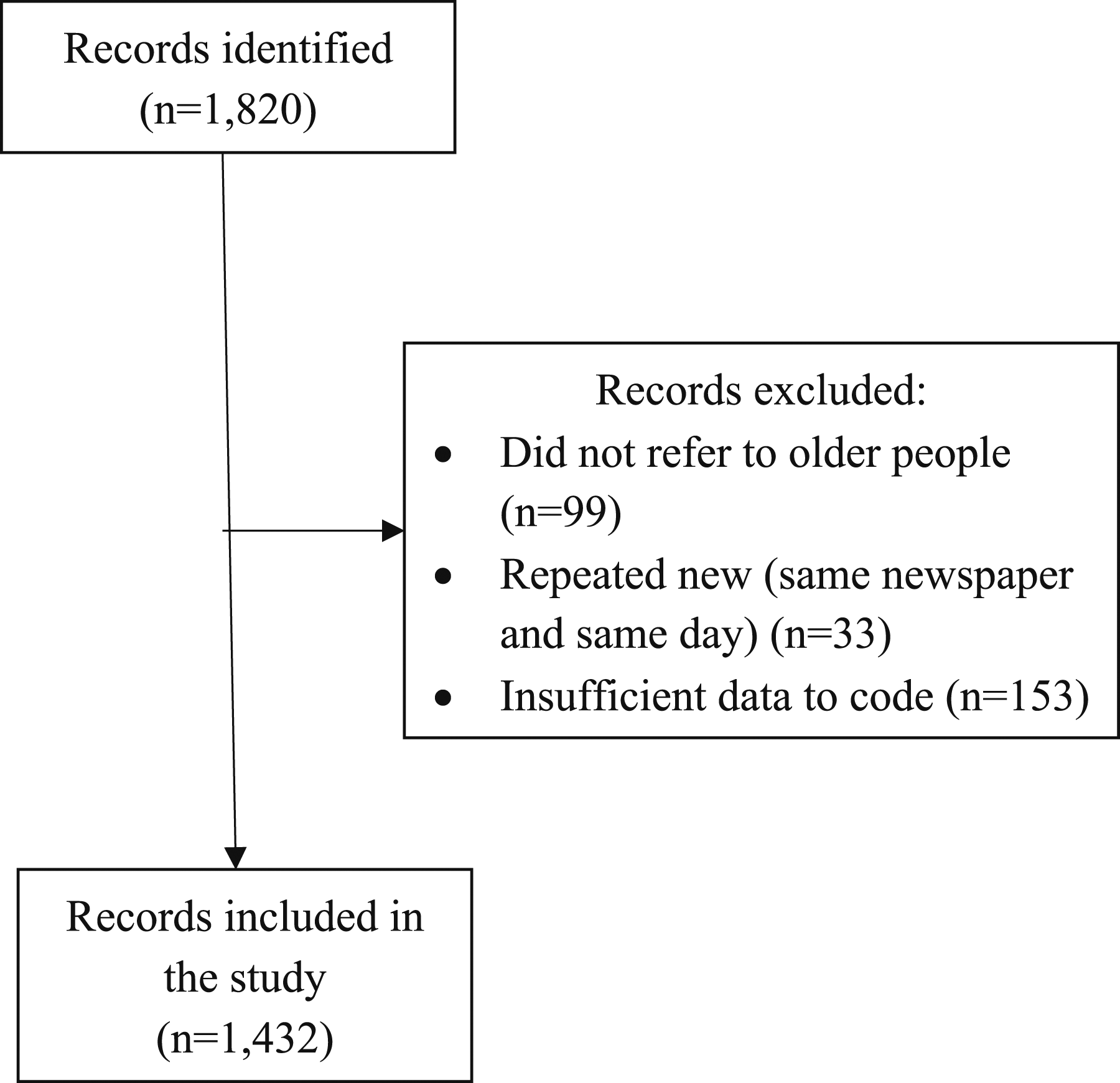
Procedure
We coded headlines with ATLAS.ti 9 software (Friese, 2021).
We developed the codes progressively over six steps: 1. Following the Image of Aging Scale by Levy et al.(2004), we created a list of initial codes with which to perform preliminary coding. 2. A team psychologist coded the 22,853 headlines following this initial list. During this first coding, the psychologist took notes about possible codes to include or difficult-to-code headlines. 3. Expert evaluation of the possible codes to include and difficult-to-code headlines. Four independent experts, psychologists specialized in gerontology and methodology with more than 10 years of working experience in older adults’ health and ageism, and a journalist, assessed the appropriateness of all the codes, yielding inter-judge agreement when more than three judges agreed, and deleting those overlapping codes. As a result, we designed the definitive coding manual (Annex I). 4. We used the definitive coding manual to code 96,885 headlines. 5. To establish inter-coder reliability, we performed a random selection of 10% of the sample (182 holders) and a second member of the research team performed their coding. This enabled us to establish the inter-coder agreement for each code. The degree of inter-coder agreement was calculated through Cohen's kappa index (Carletta, 1996). The codes have a reliability between 0.8132 and 1, so they are considered reliable enough to be included in the analyses. 6. To make the analyses and their interpretation more comprehensive, we grouped the 22 representation codes into four groups. We grouped them along two axes, comparable to the Cuddy and Fiske model (2002). The axes are affect (positive or negative) and the older people’s roles (agents or patients). Table 1 shows the classification. Grouping of representation codes.

Complementarily, we coded ageist terms, such as: “abuelos” (grandparents), “ancianos” (elders), “nuestros mayores” (our elders) and “viejos” (the old).
Finally, given the greater vulnerability and mortality in the case of nursing homes, we considered it necessary to codify all those headlines that took place in this context: “residencia” (nursing home), “geriátrico” (geriatric), “asilo” (asylum), “resident” (nursing home resident) and their plural variations.
Data analysis
We examined differences in the four groups of codes before and after the pandemic. Then we analyzed these differences separately for each code, and performed a chi-square test of independence (Pardo Merino and San Martín Castellanos, 2010). In addition, we studied the correlation between these codes and groups of codes with the use of ageist terms. Finally, we analyzed the correlation of representation codes and age-related terms with the codes “Residencias” (nursing homes) and “Muerte” (Death). We used the statistical analysis software R Studio (R Core Team, 2016).
The general procedure for the analyses is as follows: 1. The differences or correlations are analyzed for the four groups of codes. This provides a general idea of where the effect is located along the two axes (positive or negative affect, agents or patients). 2. We report the differences or correlations for the 22 representation codes that were statistically significant (p-value <.05).This enables a more precise understanding of the changes observed in each group of codes.
Results
Representation, before and during the pandemic
Chi-squared test of independence for the groups of codes.

*p<.05. **p < .01. ***p<.005. ****p<.001.
Chi-square test of independence for the codes.

*p<.05. **p < .01. ***p<.005. ****p<.001.
In both groups of codes there are differences in opposite directions. In the case of the Negative affect-Patients group, the code Sick is more frequent during the pandemic while, to a lesser extent, the code Victimizers is more frequent before the pandemic. In the Positive affect-Agents group, Active and Mobilized are more frequent before the pandemic, while Capable is more frequent during the pandemic.
Ageist terms: Period and correlations
Following various authors, we defined the following terms as ageist: “abuelos” (grandparents) (Ng and Indran, 2022; North and Fiske, 2013), “ancianos” (elders) (Chrisler et al.,2016; Nelson, 2005), “nuestros ancianos” (our elders) (Bergman et al., 2020; Fraser et al., 2020), and “los viejos” (the old) (Chrisler et al., 2016; Fraser et al., 2020). Of these terms, only “ancianos” (elders) is more prevalent in the pandemic period (χ2=135.45, g.l.= 1, p <.001).
Correlation between representation code group and age term.

*p<.05. **p < .01. ***p<.005. ****p<.001.
Correlation between representation codes and ageist term.

*p<.05. **p < .01. ***p<.005. ****p<.001.
The term “ancianos” (elders), on the other hand, appears negatively associated with the code groups that represent older people as agents, with either positive or negative affect. It also shows a positive correlation with the Negative affect-Patients group. As Table 5 shows, the negative association with the Positive affect-Agents group is due to its negative correlation with codes such as Active, Capable, Mobilized or Tenacious. Its positive correlation with the Negative affect-Patients group is due to the codes Sick and Victims.
The expression “nuestros mayores” (our elders) was independent of the representation codes.
Finally, the term “viejos” (the old) relates positively to the Negative affect-Patients group, and to its codes Victims and Societal burden. However, the level of statistical significance of these three correlations is not very high.
Themes: Nursing homes and death
The correlation between nursing homes and death is 0.3926 (χ2 =218.42, g.l.=1, p <.001). In more than a third (36.18%) of the headlines on nursing homes were coded with the code Death. These codes are associated almost exclusively to the pandemic: 96.05% of the sample holders who refer to nursing homes belong to the pandemic period, and 97.73% of those coded Death. They also represent a high proportion of the pandemic period holders included in the sample: the code Death appears in 21.26% of the pandemic period holders, and the code Nursing homes in 43.11%.
Correlation between representation code group and age term.

*p<.05. **p < .01. ***p<.005. ****p<.001.
Correlation between representation codes and term themes.

*p<.05. **p < .01. ***p<.005. ****p<.001.
The Nursing homes code also shows a negative relationship with five codes of the Positive affect-Agents group and with the Societal burden and Solitary codes. It also presents a positive relationship with the code Sick.
Correlation between representation codes and term topics.

*p<.05. **p < .01. ***p<.005. ****p<.001.
Discussion
People's attitudes and beliefs about older people and the aging process are heavily influenced by media portrayals of older people. This study investigated how Spanish written media represented older people during the weeks when the COVID-19 pandemic most critically affected Spain and compared this representation to before the pandemic. One of the most notable effects of the pandemic is the decrease in the frequency of the appearance of headlines that represent older people as subjects of an action associated to positive affect. It starts from a baseline where older people were Mobilized and Active and moves to a period where the likelihood of older people appearing in headlines as Sick increases. This type of discourse reinforces a narrative, traditionally deeply rooted in Western societies, that links old age to disease, deterioration, and social burden.
This has also occurred in social media, for example the #coffindodger and #boomerremover Twitter hashtags, which were widely shared on social media at the beginning of the pandemic (Lichtenstein, 2021). Other studies have also reported offensive content or jokes about older adults during the pandemic (Jimenez-Sotomayor et al., 2020; Soto- Perez-De-Celiz, 2020).
One of the fundamental characteristics of this pandemic is its special effect on older people since the disease has meant a greater risk to life for older people or those with pre-existing conditions. Most of the headlines analyzed represent older people as a homogeneous group and in a negative way. This type of headlines goes against the great heterogeneity of older people, that has been shown by studies reporting increasing variability with age (for a review see: Stone et al., 2017). Even Losada-Baltar et al. (2021) have shown their strength and resilience, since age is not per se a decisive risk factor, so much as the presence of pre-existing conditions or diseases (Bravo-Segal and Villar, 2020).This vision of older people is deeply rooted in Western societies, where old age is linked to illness, deterioration, and societal burden (Ayalon and Tesch-Römer, 2018).
This view of older people has occurred in much of the world during the pandemic. For example, in New Zealand, 74% online news media articles used negative stereotypes, especially the vulnerable category (dependent, frail, physically ill, sedentary, slow, weak, victims and vulnerable), positioning older people as a weak or vulnerable group (Amudsen, 2022b). In Hungary, Kovacs et al.(2021) suggest that under-representation and invisibility imply that older people are less important, less worthy than other age groups, or noncontributing, non-participators in society. Lichtenstein (2021) analyzed 35 newspapers, media websites, and current affairs magazines in Australia, the United Kingdom, and the United States, and reports that those media blame older adults, as if they have lived past their usefulness to society, with high rates of age discrimination in all three countries. Makita et al. (2021) analyzed the representation of aging and older people in 1,200 Twitter posts, and reported that the language in the posts often reinforced negative stereotypes of older people as a powerless, vulnerable, and homogeneous group, and aging as something to resist, delay, or even disguise.
However, the results of this study show several nuances: in the pandemic, it is less frequent for older people to appear as Victims (that is, there is less frequency of headlines such as “Police arrest a man for posing as a gas inspector and stealing from elderly women”). The most restrictive measures with respect to older people, the reduction of social contacts, has made such crimes less frequent than before the pandemic, and therefore, there are fewer such headlines.
On the other hand, it is also necessary to point out that the headlines also represent, albeit in a minority way, a more positive image of older people, which highlights their strengths and not their weaknesses. Newspapers described older people more frequently as Capable, especially in headlines describing the return to work of retired health professionals (“Retired doctors are preparing to return to service: many casualties are expected, and you have to lend a hand”). This was the case in Bravo-Segal and Villar (2020). This positive vision of older people reflects a fact that several studies have also shown that older people had the best compliance with COVID-19 regulations imposed by authorities (Fernández-Ballesteros and Sánchez-Izquierdo, 2020), and even showed that they continued to have emotional well-being (López et al., 2020). It seems that older people, although expressing concern about COVID-19 in the first waves, seem to have adapted over time (Fernández-Ballesteros et al. 2020).
The headlines that have described older people as a homogeneous group have contributed to justify ageist behaviors and policies, in addition to promoting stress, anguish and greater anxiety among older people themselves. It is relevant to highlight the importance of the effect of this view of older people in political spheres, some of which have enacted discriminatory policies based solely on chronological age which are unequivocally ageist, such as protocols based on age or a non-intubation protocol for over-70s (Rosenbaum, 2020), or triage protocols based on life-years (Emanuel et al., 2020). We have also seen shocking initiatives such as asking older people to sacrifice themselves for the sake of the economy or new generations (Reynolds, 2020). And all this has an impact on the health of older people: a meta-analysis showed that exposure to COVID-19 news and information was associated with adverse psychological reactions (Chu et al., 2022).
Ageist terms
Regarding ageist terms, the only ageist term that increases in frequency in the pandemic is “ancianos” (elders), closely linked to a frequent theme during that period: Nursing homes. The frequency of the expression “residencias” (nursing homes) makes both terms have similar relationships with the rest. In this sense, their differences are interesting: while “Residencias” (nursing homes) does not have a positive or negative correlation with the Victims code, “ancianos” (elders) does have a positive correlation with “víctimas” (victims). Despite the high number of reports that spoke about the dramatic situation experienced in nursing homes, due to the high number of deaths, older people have not been associated as victims.
The term “abuelos” (grandparents) is related to the group of terms Positive affect-Passive. It is possible that this is due to the fact that this term is not only used to talk about older people in general, but also to refer to members of a family. This is likely to explain its association with “Acompañadas” (accompanied), “Apreciadas” (appreciated), and even “Victimarias” (victimizers), such as in the headline “Three grandparents in Valencia on trial for sexual assault and abuse of their underage grandchildren.” It is striking that no association has been found with headlines talking about being a burden on the family. In future studies, it would be worth including this term in the content analysis, to differentiate between its use to refer to relatives and its use to refer to older people in general or to a group of them.
Finally, the expression “nuestros mayores” (our elders) is positively associated with headlines that speak of a generational debt, for example in headlines such as: “The noblesse oblige of caring for our elders.” It seems that although older people have been seen as the most vulnerable and those who required the most restrictive measures to “protect” them, even to the point of intergenerational resentment, since young people saw them as the culprits of social distancing measures (Mesiner, 2021), people may have also recognized the value of older people and of giving back everything they have done for younger people.
Nursing homes and mortality
To understand these changes in media representation, it is essential to address two issues almost exclusive to the pandemic period: nursing homes and mortality. Both codes relate negatively to the representation of older people as Active, Mobilized, and, to a lesser extent, as Capable and Tenacious. Headlines mentioning nursing homes or synonyms also show a positive correlation with representation as Sick. In the pandemic, there were many headlines about deceased people, at the same time enhancing the association of older people with residents in institutions, when only 3% of those over 65 live in nursing homes, a minority of a very specific profile, very aged and with great dependency problems and pre-existing conditions (Networked Aging, 2020).
The situation, such as the delays in responding to the higher risks for people in nursing homes, the lack of personal protection equipment during the peaks of greatest infection, and the high mortality rates, justify reviewing the current situation of nursing homes, their financing, and resources, as well as the quality of care given to older people. However, the headlines also promoted a catastrophic discourse, which reinforced the traditional negative image of these institutions, overlooking their improvements over recent decades and the commitment of most of their professionals (European Aging Network, 2019).
Despite this, there is a difference in articles of the pandemic period in general: headlines on nursing homes representing older people as Solitary appear less often.
Conclusions
In short, and as we hypothesized, we conclude that there have been some changes in the representation of older people in the media analyzed in this study:the media represent older adults as subjects of actions linked to negative affect more than to positive affect, and use more ageist terms than before. It is important to know and point out how such changes reinforce pre-existing ageist prejudices.
How the media describe older adults matters. People often internalize media messages, changing how they see themselves and how they behave. The media also changes how society sees groups (Fraser et al., 2016; Wiles et al., 2012). The role of the media in perpetuating age stereotypes has been widely acknowledged (Soto-Perez-de-Celis, 2020). If the media represent older people as a homogeneous group and with negative stereotypes, that can enhance ageism and contribute to older adults feel socially excluded and induce others to exclude them. Also, it is important to convey a realistic image of older people, since unrealistic positive attributes of older people in our society could also have ageist dimensions (Loos and Ivan, 2018); Loos and Ivan (2018) labeled this phenomenon as ‘visual ageism’.
Headlines and messages concerning older adults are important for achieving age equality and avoiding discriminatory behaviors (United Nations, 2020; WHO, 2021). The media can help raise awareness and understanding of what age discrimination is like and why it should be a priority to challenge these negative narratives and images. It is essential that the media unite efforts with the various global entities to learn to identify systemic discrimination and contribute to fighting it (United Nations, 2020).For example, accepting that the social responsibility of news media is to report news that informs and serves the needs of all citizens by presenting the heterogeneity of older adults, addressing their complexity and diverse perspectives.
We have three recommendations for media efforts to change how older adults are perceived and treated. First, we need more positive and supportive attitudes towards older adults, for which it is necessary to be aware of the language used in the headlines and messages regarding older adults, and designing highly realistic portrayals of older people. Linguistic guidelines can help improve public discourse about aging in design research and practice, challenging subconscious ageist biases and stereotypes (Comincioli et al., 2021). Second, we need news media to take responsibility for knowledge-building, identifying, and addressing ageism. Third, build a global commitment to changing the language and narrative around aging and old age, supporting inclusive language to avoid ageism, as highlighted by the North American Network in Aging Studies (2021).
Strengths and limitations
This study explores age-related language in the headlines of the five highest-circulation Spanish newspapers before and during the Covid pandemic. The main strength of this study is the use of a combination of qualitative and quantitative approaches for analyzing different aspects:the representation of older adults, the use of ageist terms, and the themes that have emerged, especially about nursing homes and death.
This study has some structural limitations. First, it relies solely on five nationally circulated newspapers, albeit the five most widely circulated ones. There is a displacement of traditional media to more innovative communication modes, even among older adults (Loos, 2012; Loos and Ivan, 2022; Taipale et al. 2021), and this study neglects those. Future studies can compare our findings with language during the same period in new media including digital media, email newsletters, chat channels and social network sites. Ivan et al. (2020) found that older people in six countries, including Spain, also use new media technologies and platforms, although they may adopt them at a slower pace than younger adults.
This study was conducted in Spain and over a limited period of time; future research should include additional non-Western countries and extend the time period to understand the evolution of the portrayal of older people and ageism in the media in the wider wake of the Covid pandemic.
We also lacked information on the type of article such as editorials, features, opinion, which can impact the interpretation and generalizability of the findings. Furthermore, we only studied the headlines, without analyzing the content of the news itself. To address this limitation, future researchers could consider obtaining access to the full articles or incorporating additional methods, such as qualitative interviews or content analysis, to gain a more comprehensive understanding of the language used in this articles. This would provide a more robust and nuanced analysis of age-related language in the context of the COVID-19 pandemic and the years preceding it.
Supplemental Material
Supplemental Material - Aging and the media in Spain: Reinforcement of ageism in times of COVID-19
Supplemental Material for Aging and the media in Spain: Reinforcement of ageism in times of COVID-19 by Macarena Sánchez-Izquierdo, L. Cables-Chozas, Cristina Villanueva-Peleteiro and Rocío Fernández-Ballesteros in Journalism.
Footnotes
Author contributions
Conceptualization, RFB and MSI.; methodology, RFB, LCC and MSI, software, LCC; formal analysis, MSI, RFB, LCC.; investigation, RFB, MSI, LCC and CVP; data curation, RFB, MSI, LCC; writing—original draft preparation, MSI, LCC; writing—review and editing, all authors. All authors have read and agreed to the published version of the manuscript.
Declaration of conflicting interests
The author(s) declared no potential conflicts of interest with respect to the research, authorship, and/or publication of this article.
Funding
The author(s) disclosed receipt of the following financial support for the research, authorship, and/or publication of this article: This work is part of the R&D Activities Program ENCAGEn-CM: “Active Aging, Quality of Life and Gender. Promoting a positive image of old age and aging, and combating ageism”. Funded by the Community of Madrid, Programs of R&D on Social Sciences and Humanities, and co-financed with the European Social Fund (Ref. H2019/HUM-5698) ( , accessed on 1 December 2022).
Supplemental Material
Supplemental material for this article is available online.
Author biographies
References
Supplementary Material
Please find the following supplemental material available below.
For Open Access articles published under a Creative Commons License, all supplemental material carries the same license as the article it is associated with.
For non-Open Access articles published, all supplemental material carries a non-exclusive license, and permission requests for re-use of supplemental material or any part of supplemental material shall be sent directly to the copyright owner as specified in the copyright notice associated with the article.
