




Abstract
Gatekeeping in contemporary journalism unfolds within platformized environments where audience signals, technological affordances, and organizational histories intersect. This study examines how engagement within topical beats relates to subsequent editorial volume across platforms and outlet types. Using two and a half years of data from 39 English language outlets in the United States, United Kingdom, Canada, and Ireland during 2017 to 2019, the analysis models whether prior month engagement predicts changes in story counts by platform and organizational lineage. While prior research offers mixed evidence on whether audience metrics translate into editorial change, this study shows that responsiveness to engagement is systematically conditional, varying across platforms and between legacy and digitally born outlets. Results indicate that engagement predicts increased coverage overall, with the strongest effects on Facebook pages of digitally born outlets, weaker effects on Facebook pages of legacy outlets, and the smallest effects on legacy websites, while websites of digitally born outlets fall in between. The pattern supports a contextual account of gatekeeping in which platform logics, embedded to different degrees in newsroom workflows, shape responsiveness to audience signals, whereas editorial autonomy remains more salient on websites and in legacy organizations. The period is positioned as a historical baseline of heightened social media dependence and a benchmark for assessing later shifts toward subscriber-oriented strategies, informing theory and policy on platform power and editorial independence.
Keywords
Contextual gatekeeping: Rethinking editorial decision-making in the platform era
The rise of social media platforms has intensified scholarly attention to audience engagement metrics as inputs to editorial decision-making (Ferrer-Conill and Tandoc, 2018; Napoli, 2011). Research examining how these metrics influence gatekeeping processes— the editorial power to determine which issues merit news coverage (Vos and Russell, 2019)— has produced contradictory findings. Interviews and ethnographies find that journalists describe a strong influence from audience metrics on topic selection, headline formulation, and story placement (Dodds et al., 2023; Ferrer-Conill and Tandoc, 2018; Fürst, 2020; Tandoc Jr and Vos, 2016). However, content analyses often find mixed results (Lee et al., 2014; Magin et al., 2021; Mukerjee et al., 2023).
This divergence suggests that the effects of audience engagement measures are contextually bounded, consistent with Hartley et al.’s (2023) shifting “configurations of dependency and autonomy” across institutional and technological contexts. Platform power operates through multiple mechanisms simultaneously, making editorial responsiveness to engagement signals neither uniformly present nor absent, but contingent on the specific ways platform logics become integrated into editorial practices.
While gatekeeping scholarship has long recognized that editorial decisions vary by context, existing theoretical frameworks have not adequately addressed how digital platform integration creates new forms of contextual variation in news selection processes. We address this gap by extending Shoemaker and Vos’s (2009) hierarchical gatekeeping model to account for platformization—the gradual integration of platform logics into editorial practices (Van Dijck et al., 2018). Platform logics are the algorithmic and metric-based rules that structure visibility and feedback, incentivizing engagement optimization (Ananny, 2016; Hartley et al., 2023).
We argue that platformization creates systematic contextual variation in gatekeeping across two dimensions, technological variation and lineage variation.
Technological platformization variation examines how technological environments within the same organization embody different degrees of platform logic. Social media pages of news organizations with real-time engagement feedback and algorithmic visibility represent a more platformized context than organizational websites with delayed analytics and direct audience relationships.
Organizational lineage platformization variation considers how news organizations exhibit different baseline orientations toward platform-driven editorial practices based on their founding contexts. Digitally born (DB) outlets developed editorial practices within platform ecosystems from inception, while legacy organizations had to adapt existing practices, potentially creating greater resistance to platform-driven change.
This framework yields clear theoretically derived predictions. Editorial responsiveness to engagement should vary by technological context (stronger on social media than websites), by organizational context (stronger in DB than legacy outlets), and by their interaction (DB strongest on social media, legacy most resistant on websites).
We test these predictions using data from 39 English-speaking news outlets in four countries between 2017 and 2019, comparing news websites and Facebook pages and contrasting legacy and DB organizations. We focus on this period because it reflects a mature stage of platform dependence, in which editorial decisions were strongly exposed to social media engagement signals, but precedes the widespread shift toward paywalls and subscriber-led revenue strategies (Rashidian et al., 2019). This allows us to observe platform engagement dynamics at a point when reach maximization still structured newsroom incentives, before the post-2020 pivot toward retention and loyalty as primary objectives (Dodds et al., 2023). We treat this moment as a baseline for theorizing how evolving revenue models may alter the balance between editorial autonomy and engagement pressures. Our analysis reveals systematic variation in editorial responsiveness to engagement signals that aligns with platformization theory, demonstrating how contextual factors mediate the relationship between audience metrics and gatekeeping processes in the digital age.
Gatekeeping in the age of digital platforms
Content selection is the responsibility of newsroom editors, earning them the title of gatekeepers, who “selectively gather, sort, write, edit, position, schedule, repeat, and otherwise massage information to become news” (Vos, 2019: 90). This “gatekeeping authority” (Walters, 2022) enabled news organizations to dictate what information is produced and distributed. The gatekeeping role carries a normative dimension, as journalists recognize a responsibility to filter information and decide what is essential for the public.
Emerging in the mid-20th century (White, 1950), gatekeeping theory initially viewed news selection as a centralized process managed by traditional media institutions in an era of limited information and controlled distribution pathways. Digital platforms complicate this model, as contemporary gatekeeping operates within a complex, multi-actor information ecosystem where editorial authority is negotiated among newsrooms, platforms, algorithms, and audiences (Heinderyckx and Vos, 2016; Røsok-Dahl and Kristine Olsen, 2025).
The digital transformation has ushered in a new paradigm of editorial decision-making, often termed participative gatekeeping. This concept captures the growing influence of audience analytics and engagement metrics on news production (Blanchett, 2021). Editorial choices are increasingly guided by real-time data—from short-term promotional strategies that optimize content placement online to longer-term experimental approaches informed by behavioral hypotheses derived from audience analytics (Blanchett, 2021; Blanchett Neheli, 2018). This marks a fundamental shift in gatekeeping: audience feedback is no longer peripheral but embedded within algorithmic systems that mediate the distribution and visibility of news content.
Today, newsroom operations are more responsive to audience preferences (Blanchett, 2021). Journalists and editors monitor behavior through web analytics and social media metrics, tracking clicks, shares, and likes (Ferrer-Conill and Tandoc, 2018; Tandoc Jr, 2014; Tsuriel et al., 2021). The availability of these metrics, visible to users, has led organizations to adopt them as key indicators of engagement (Nelson, 2021). However, this data-driven approach introduces tensions between editorial autonomy – defined as journalism’s structural independence from other institutions (Penttilä, 2024) - and external influence. Scholars note that metrics empower audiences, media companies and platforms to exert control over journalistic practice (Dodds et al., 2023; Fürst, 2020; Penttilä, 2024). At the same time, as Firmstone (2023) notes, the kind of “audience influence” reflected in metrics is largely based on passive unintentional traces of consumption rather than deliberate attempts by audiences to shape coverage. Framing metrics as participation can therefore overstate the extent to which editorial authority is ceded to the public.
Existing research provides mixed evidence about engagement metrics’ influence on editorial processes. Interview and ethnographic studies consistently find that journalists describe strong influence on topic selection, headline formulation, and story placement (Ferrer-Conill and Tandoc, 2018; Fürst, 2020; Tandoc Jr and Vos, 2016). By contrast, content analyses often show negligible effects in actual editorial choices (Lee et al., 2014; Magin et al., 2021).
This divergence suggests two possibilities: journalists overestimate metric influence in interviews, or content analyses miss subtle but meaningful shifts in editorial behavior. We propose a third explanation: engagement effects may be contextually bounded rather than uniform, making them difficult to detect without accounting for systematic variation across institutional and technological contexts. Such an interpretation closely aligns with the understanding of journalistic autonomy as networked (Ananny, 2014), that is, autonomy as conditioned and dynamic, influenced by various institutions and pressures, rather than simply increasing or decreasing over time (Ananny, 2018; Lindblom et al., 2024; Penttilä, 2024).
Extending contextual gatekeeping theory
Gatekeeping scholarship has long recognized that editorial decisions vary by context. Shoemaker and Vos’s (2009) hierarchical gatekeeping model explicitly theorizes how individual, organizational, institutional, and social system factors shape contextual variation in news selection processes. However, this framework was developed before digital platforms created new forms of contextual variation through what Van Dijck et al. (2018) term platformization - the gradual integration of platform logics into social practices.
While evidence of the platformization of news production is substantial (Hendrickx and Opgenhaffen, 2024), research has not considered platformization as a contextual element in Shoemaker and Vos’s (2009) hierarchical gatekeeping model. We therefore argue that platformization creates systematic contextual variation in gatekeeping through degrees of platform logic integration. To demonstrate this claim, we focus on two interconnected dimensions that reflect different aspects of the same underlying theoretical mechanism, which we term technological platformization variation and organizational lineage platformization variation.
Technological platformization variation: Social media versus news websites
Different technological environments within the same news organization embody varying degrees of platform logic influence. Specifically, the editorial process on news organizations’ social media accounts reflects stronger platform logics through several mechanisms.
First, social media engagement metrics are determined by the platforms and fall outside the autonomy and control of news organizations (Dvir-Gvirsman, 2025). These systems of “networked information algorithms” function as assemblages of institutionally situated code, practices, and norms “with the power to create, sustain, and signify relationships among people and data through minimally observable, semiautonomous action” (Ananny, 2016: 93). Second, algorithmic curation creates immediate feedback loops between engagement levels and content visibility, establishing what Hartley et al. (2023) identify as structural incentives for engagement optimization. Third, social media editors operate in platform-native interfaces designed to maximize engagement, shaping how editorial decisions are framed and evaluated (Lamot, 2022; Magin et al., 2021; Tsuriel et al., 2021).
By contrast, organizational websites represent a less platformized context. Audience analytics on organizational websites operate as internal infrastructure under newsroom control, allowing greater editorial discretion. Website content visibility depends less on engagement algorithms, and editorial decisions can be made with greater independence from real-time audience signals. The technological affordances of websites preserve more traditional gatekeeping relationships between editors and audiences.
Research demonstrates that these differences translate into systematic editorial variation. Social media editors use different selection criteria than newsroom editors, adapting editorial practices to platform-specific engagement optimization (Tsuriel et al., 2021). Studies find that topics posted on Facebook tend to be “softer” than those on organizational websites, reflecting platform-driven editorial adaptation (Lamot, 2022; Magin et al., 2021). Social media editors review past performance metrics to identify “what works” and adjust future content, creating feedback loops between engagement and editorial decisions (Tsuriel et al., 2021).
This creates platform-sensitive gatekeeping where editorial processes adapt to the technological environments in which they operate. We therefore expect stronger editorial responsiveness to engagement signals on social media platforms than on organizational websites, reflecting technological variation. Extending this work, we test whether engagement signals predict subsequent changes in editorial volume, and whether responsiveness varies systematically not only across platform context but also by organizational lineage.
Organizational lineage platformization variation: Legacy versus DB organizations
News organizations exhibit different baseline orientations toward platform-driven editorial practices based on their founding contexts and historical development (Anter, 2023; Sehl et al., 2021). This represents what we term organizational lineage platformization variation, the degree to which platform logics are embedded in organizational cultures and editorial practices.
DB organizations developed editorial practices within platform ecosystems from their inception. As Nicholls et al. (2016) observe, these organizations “have to fight for attention and live only off their digital operations as they cannot rely on subsidies from legacy operations” (p. 12). This operational necessity creates strong platformization pressures: their business models, editorial workflows, and professional cultures evolved around platform-mediated audience engagement. DB outlets operate according to “digital and technological imperatives” and maintain strong orientation toward audience engagement metrics (Nicholls et al., 2018; Thomas and Cushion, 2019).
Legacy organizations, conversely, developed professional cultures and editorial practices before digital platforms existed, then adapted these practices to platform requirements. Legacy outlets “developed a brand name as news companies offline before expanding into social-network sites” and seek to preserve established reputations through consumer loyalty rather than viral engagement (Fisher et al., 2021; Nicholls et al., 2016). For legacy outlets, adapting pre-platform routines to platform requirements entails complex negotiations of autonomy within platform dependencies (Hartley et al., 2023).
Contemporary autonomy scholarship illuminates how these organizational differences manifest in editorial practices (Gajardo and Mellado, 2025). For example, Lindblom et al.’s (2024) analysis of digital heteronomy demonstrates how organizations with different historical relationships to digital technology exhibit varying patterns of “virality capital” and “feel for engagement”, the kind of systematic variation our platformization framework predicts. These organizational differences represent varying configurations (Ananny, 2018). Legacy organizations maintain stronger separations from platform imperatives through established professional cultures, while DB organizations exhibit deeper dependencies on platform-mediated success metrics. This creates systematic variation in how editorial autonomy is negotiated within platform ecosystems.
We therefore expect DB organizations to exhibit stronger editorial responsiveness to engagement signals than legacy organizations, reflecting lineage variation embedded in organizational cultures and editorial practices.
Our platformization framework generates clear theoretically derived predictions:
Levels of Facebook users’ engagement with specific topics will affect the frequency of these topics being covered during the following month.
Social media engagement has a greater effect on topic selection on news organizations’ Facebook pages than on their official news websites.
Social media engagement has a greater effect on topic selection in DB than in legacy media organizations.
Platform power and the 2017–2019 moment
Our 2017–2019 analysis captures what Hartley et al. (2023) identify as a distinctive moment in platform-news evolution—the period before “news organizations increasingly turn toward digital subscription or similar revenue sources rather than attention-based business models based on reach” (p. 1386). During this period, platform power operated most directly through engagement-driven visibility algorithms, making editorial responsiveness to audience metrics a particularly salient organizational challenge (Meese and Hurcombe, 2021).
This historical specificity strengthens rather than limits our theoretical contribution. By examining platform-engagement dynamics in relatively “pure” form—before the industry-wide “pivot to paid” complicated the relationship between reach and revenue—our analysis provides a baseline for understanding how different forms of platformization variation condition editorial behavior when engagement pressures are most direct, and for theorizing how subscriber-oriented strategies may later reweight these pressures and shift where responsiveness is most likely to emerge.
Method
Data collection and sample
List of publishers and the respective number of observations in the sample.

We rely on data collected by NewsWhip, which monitors social media activity for more than 50,000 publications. NewsWhip tracks the accumulation of interaction across Facebook’s and Twitter’s application programming interfaces (APIs) on all public posts, including retweets, likes, shares, and comments. Of the abovementioned list, six outlets were excluded as NewsWhip did not monitor them. For seven additional outlets, the data collected by NewsWhip during the time-period targeted was insufficient in scope (a limited number of articles or posts), and for three more outlets, NewsWhip had collected data for only a short period. These 10 outlets were omitted from the sample. All in all, our sample included 39 news organizations, and data covered a period of approximately two-and-a-half years (January 2017 to August 2019).
Our analysis is based on articles published by the 39 sampled news outlets on their official websites, and posts posted on their official Facebook account. Data were retrieved in November 2019 directly from NewsWhip’s API as follows: (A) for the news articles posted on websites, NewsWhip scraped the headline, subheading, and entities discussed such as people or groups; (B) for Facebook posts, NewsWhip scraped all content, including the link to the article itself, allowing us to identify whether the article was posted on social media; (C) social media engagement metrics for both articles and posts. Overall, we retrieved 1,473,767 Facebook posts and 17,926,079 news articles.
Variables
Engagement on Facebook. In this study we rely on users’ engagement with news on Facebook – which, at the time of data collection, was the largest social media platform. Engagement on Facebook is commonly assessed as the total number of shares, comments, likes, and emoticons. Importantly, at the technostructural level, engagement with news articles on social media platforms, including Facebook, could involve two distinct entities: either the article’s URL or a Facebook post linking to the article. Users can share an article using its URL, and a news organization can publish a Facebook post about the article on its official Facebook page. NewsWhip captures this distinction, providing two separate engagement measurements. For each article, it captures the total engagement with the URL if the article was also posted in the news organization’s official Facebook account, it also supplies additional data about the engagement with the post. Since all of the engagement measurements were highly skewed, with a small number of posts and articles receiving massive engagement and a long tail with zero engagement, a log transformation was carried out. 1
Time. For each article, we collected the timestamp (i.e., the date and hour it was originally published).
Topics. In line with recent research (Ben-David and Soffer, 2019; Grimmer et al., 2021), we opted for a supervised machine-learning topic modeling. Before deciding on this approach, we had considered and tested two other methods: zero shot text classification (with facebook/bart-large-mnli) and top2vec; however, the tests did not yield satisfactory results. 2
We began by compiling a list of news topics. First, we followed Jung et al.’s (2022) classification, which is based on automated and human coding of Facebook news posts. Their list included nine topics: Media & Celebs, Lifestyle, Sports, Travel, Politics, Crime & Law, Business & Economics, Education & Science, and Environment. Based on this list, four human coders coded 3000 items from our database. All four coders agreed that six more topics needed to be added to the original list: Health, Tech, Social, Ads, and Accidents & Injuries. We also separated Science from Education and merged that topic with Technology. The final list includes the following topics: Media & Celebs, Lifestyle, Sports, Travel, Politics, Crime & Law, Business & Economics, Education, Environment, Science & Technology, Health, Social, Ads, Accidents & Injuries, and Radio/non-specific content (i.e., general radio programs and general headlines). Inter-coder reliability (Krippendorff’s alpha) was tested on 296 items and stood at 0.87.
Next, we created a training data set, by randomly selecting from all news publishers 2960 items that were coded by the same four coders according to the above 15 topics. The model employed was Distilbert-Base-Uncased based on the following libraries: transformers, pandas, torch, and sklearn. This model was deemed adequate to handle the vast amount of data targeted, based on its description: “DistilBERT is a small, fast, cheap and light Transformer model trained by distilling BERT base. It has 40% less parameters than bert-base-uncased, runs 60% faster while preserving over 95% of BERT’s performances as measured on the GLUE language understanding benchmark” (Sanh et al., 2019).
After the first training/run, we randomly sampled 2304 items. These were coded by the four coders, and the results were compared to those of the model, yielding 81.6% agreement. However, the agreement for the topics of Lifestyle, Social, Science, and Technology was relatively low. In the case of Science and Technology, the main reason for the low agreement between the topics assigned through manual coding and by the model seemed to stem from these topics’ interchangeability. In consequence, these two topics were merged. We also noticed that the problematic topics were those which occurred less frequently in the sample and yielded a lower N for the training model. We re-sampled the topics of Lifestyle, Social, and Science & Technology ensuring that the number of items was sufficient for training purposes. To this end, we revisited the dataset samples and identified items that could address these topics based on the entities mentioned or the topic codes specified by NewsWhip, and then manually coded them. All in all, we added to the coded dataset 400 items specifically covering these topics and then re-trained the model. After the second training/run, we again randomly sampled 2236 items, subjected them to human coding, and compared the result to that of the model, reaching an average agreement of 88.6%, with all topics but two (Social and Ads) over 85%.
DB and legacy media organizations. 3 Based on existing literature, we classified as DB the outlets which originated online, irrespective of whether they produce news or aggregate it from other websites. This category includes outlets that belong to what Nicholls et al. (2016) define as first- and second-wave digital media organizations: respectively, MSN and Yahoo versus Huffington Post, BuzzFeed, and Vice. By contrast, we defined legacy media outlets as those that originally emerged offline, namely TV, radio, and newspapers. 4
Statistical analysis
To examine the cross-lagged correlations stipulated in our hypotheses, we aggregated the data. To that end, we restructured the data, calculating, for each organization, the monthly number of stories per topic and the engagement with them on each platform: the website and Facebook (Lischka and Garz, 2021). 5 This process resulted in a total of 27,557 observations (Organization>topic>month/year>platforms). An example of a single observation would be the number of sports-related stories published by the New York Times on its website in May 2017 and the average engagement with these stories. A single parallel observation for Facebook would be the number of sports-related posts published by the New York Times on its page in May 2017, along with the average engagement with these stories. The analysis did not include the two topics that are not news: Ads and Radio/non-specific content.
Using this restructured data, we conducted a multi-level analysis where engagement, platform type (Facebook vs website), and organization type (DB vs legacy) constituted the first level, nested within outlets and topics, which served, respectively, as the second and the third levels. We also controlled for time, and the number of articles/posts published on each topic in the respective month (a model that includes the monthly amount of likes for a given Facebook account and Twitter engagement is presented in the Online Appendix). A model like the one described above offers the advantage of effectively controlling variance between outlets, thereby eliminating many potential alternative explanations. Considering the non-linear distribution of our data, rather than using a linear regression model, we opted for a non-linear mixed model that employed a gamma distribution.
Results
Our analysis starts with a descriptive presentation of the data. Figure 1 displays the number of articles (left) and posts (right) per topic over time. Compared to websites, on Facebook, editors tend to post articles on politics more frequently (27% and 17%, respectively; coef. = 0.70, Std. Error = 0.036, p < 0.01), and less so on sports (5% and 19%, respectively; coef. = −0.84, Std. Error = 0.036, p < 0.01) and business (5% and 10%, respectively; coef. = −0.32, Std. Error = 0.036, p < 0.01).
6
The latter finding could be due to the comparatively high sports coverage on websites. Thus, according to a common classification of news in the literature as “hard” and “soft” (Fogel-Dror et al., 2021),
7
the blend of news on news organizations’ Facebook accounts does not appear to be “softer” than on their websites (as is also evident in Figure 2). This contravenes the conclusions reached in past studies (Lamot, 2022). Topics over time. Website left panel, Facebook right panel. Number of articles (blue bars) and posts (orange circles) according to topic.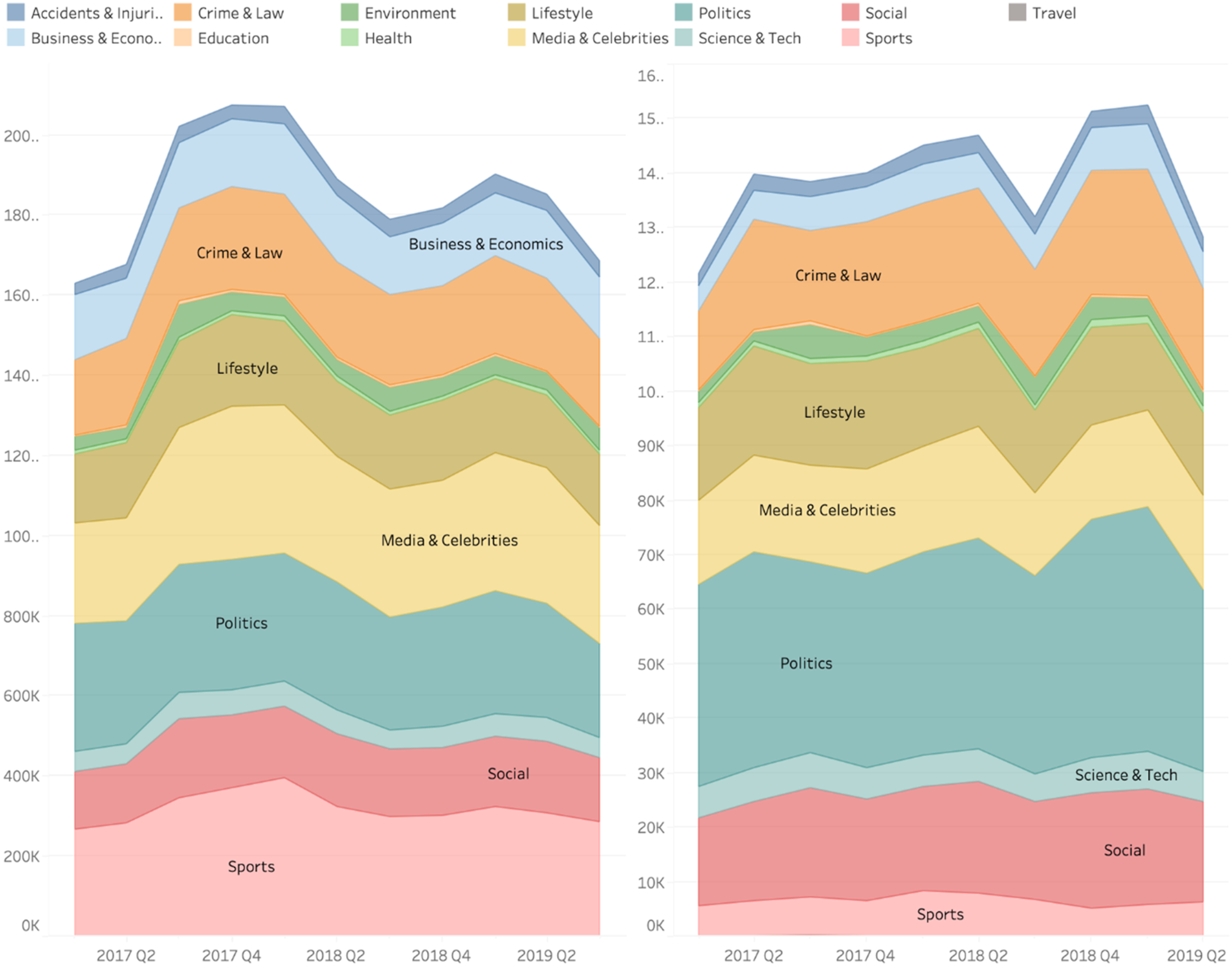
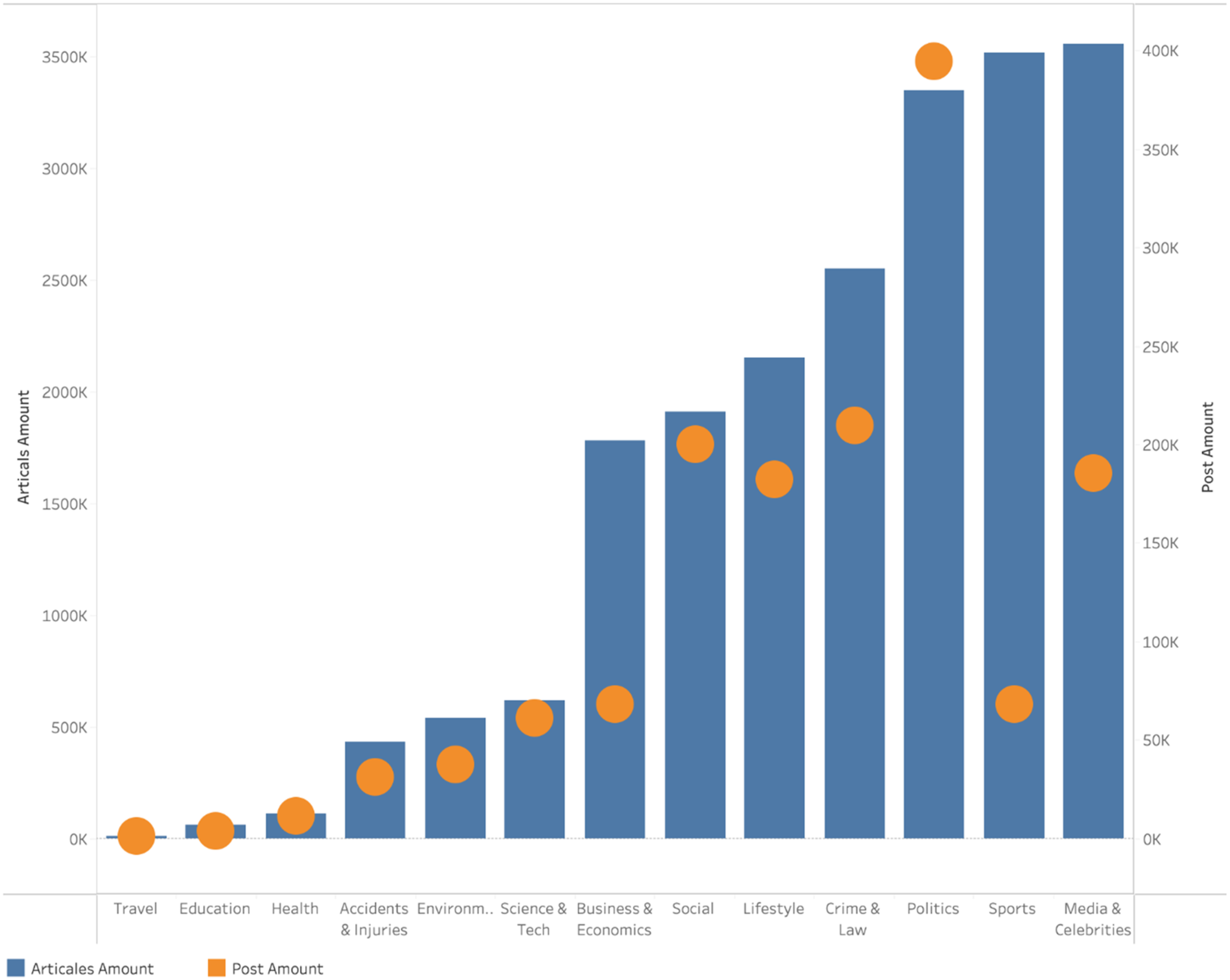
Furthermore, in either websites or Facebook, no clear trend can be identified in the amount of coverage according to the topic. No clear longitudinal growth was observed in the coverage of any given topic, and neither a general growth in the coverage of softer news topics (interaction between time and hard/soft news: coef. = -0.05, Std. Error = 0.04, p = 0.35). 8 Likewise, when comparing DB news organizations and legacy media, no significant differences emerged in the number of articles per topic. The only exception were the topics of Lifestyle and Media & Celebs, where DB organizations published at a higher monthly rate (Lifestyle: 13%, or 2072 articles; Media: 19%, or 4608 articles) compared to legacy media (Lifestyle: 9%, or 1190 articles; Media: 11%, or 1551 articles).
Figure 3 presents the average level of Facebook engagement with URLs and posts according to topic. Facebook accounts and websites differ in audience engagement with a given topic. Generally, soft topics receive somewhat more engagement on Facebook than on websites, while for hard topics an opposite pattern is observed (b = −0.76, Std. Error = 0.013, p < 0.01).
9
Engagement according to topic and platform (website – bars; Facebook – circles).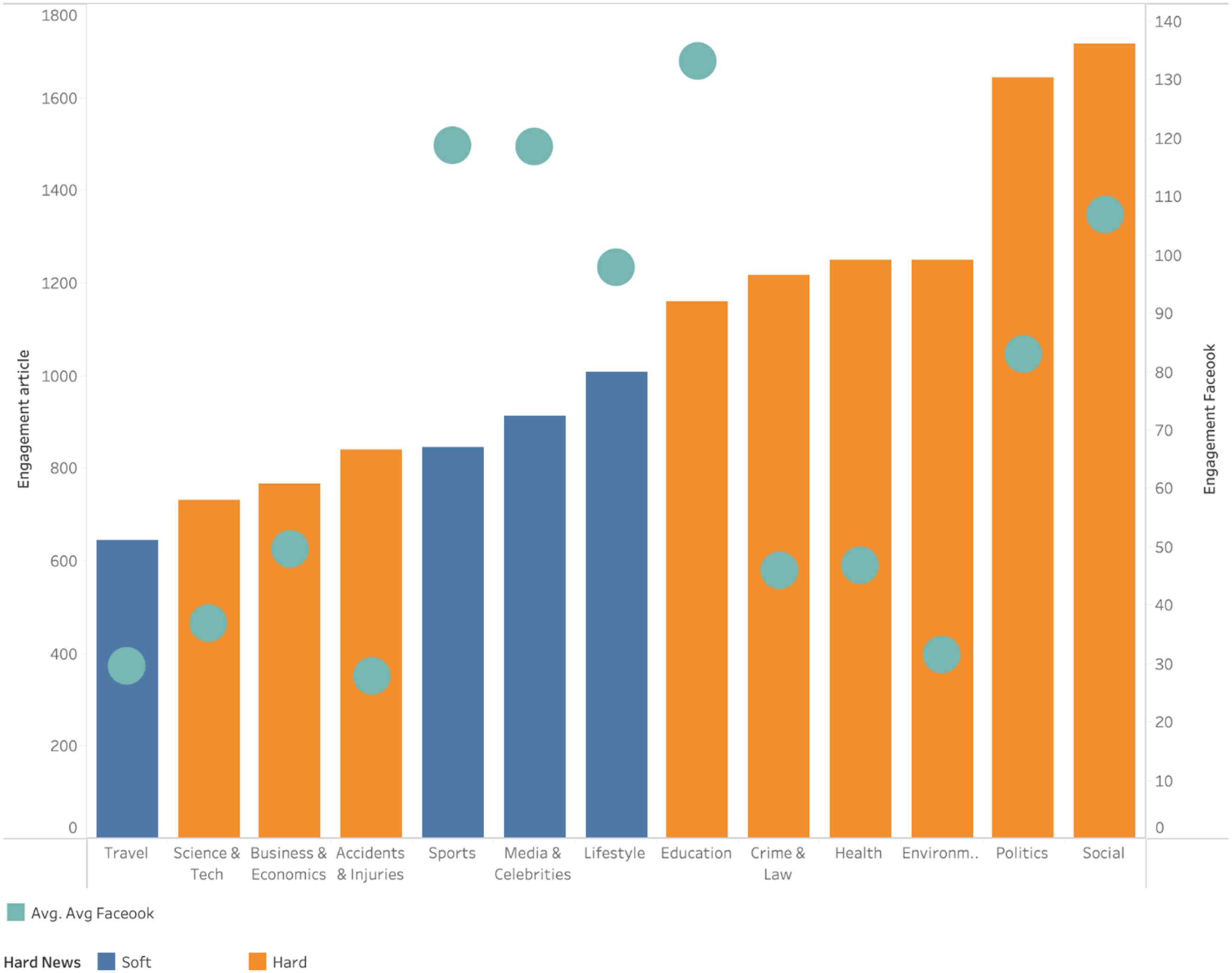
Also noteworthy is the finding that the Facebook engagement scores for articles posted on the official Facebook page of a news organization, i.e., by a social media manager of its website, are 10 times higher than for those that were not posted on the official page. Specifically, an average Facebook engagement score of articles shared on the official page was 5,146, while those that were not – 381. This suggests that news organizations’ official pages still wield significant power in news distribution, and that their editors act as important gatekeepers, even in today’s age of social media (Welbers and Opgenhaffen, 2018).
Hypotheses testing
Results of a multi-level model predicting the number of articles/posts per topic.

Consistent with H1, Facebook engagement was found to have a positive and statistically significant effect on the number of articles/posts published on a given topic – which varied, as is attested by significant interactions that emerged in the model. 10 According to the model, for every 1% increase in engagement per month (equivalent to 10 likes or emoticons), the number of articles is expected to increase by approximately 0.10% (equivalent to 4 articles or posts, see Model A). The results align with both H2 and H3 (Model B), which predict that the effect of Facebook engagement will be stronger for an organization’s official Facebook pages than for its website (H2), and for DB media compared to legacy media (H3). 11
Discussion
This study examines how engagement metrics shape topic selection, and how responsiveness varies across technological (websites vs Facebook) and lineage (legacy vs digitally born) contexts. We show how platform logics reshape gatekeeping and editorial autonomy.
Our findings make two interconnected theoretical contributions to understanding platform-news relationships in contemporary journalism.
Editorial autonomy within platform dependencies
Our results provide empirical support for Ananny’s (2018) networked autonomy framework by demonstrating that autonomy is “negotiated and contingent” across different configurations. The contextual variation we document—where engagement effects range from strongest on digitally born Facebook pages to weakest on legacy websites—shows that editorial independence is being renegotiated rather than uniformly eroded. Organizations navigate platform relationships differently based on founding contexts and technological environments, providing concrete empirical evidence for how “conditioned autonomy” (Waldenström et al., 2019) operates across institutional configurations.
Importantly, relatively low engagement (10 likes, 5th percentile) is associated with a 57% increase in coverage relative to baseline, indicating that platform economic pressures operate through calibrated rather than deterministic influence. While organizations depend on platforms for traffic and revenue (Meese and Hurcombe, 2021), this dependency translates into editorial influence differently across contexts. This calibrated influence may be particularly consequential because changes accumulate gradually, below the threshold of explicit professional resistance, making platform pressures more persistent than dramatic control would be. The gradient of effects reveals how platform economic dependencies and editorial autonomy interact as counter-forces, with the balance varying systematically across lineage and technological contexts (Hartley et al., 2023).
Addressing a gap in gatekeeping theory
Our platformization framework addresses a key gap in existing gatekeeping scholarship. Traditional gatekeeping theory emphasizes individual and organizational factors (Shoemaker and Vos, 2009). We extend this model by specifying how platformization structures contextual variation across platform contexts and across outlet lineages: technological variation captures differences between social media pages and news websites, and lineage variation operates as an organizational-level factor, reflecting variation in how platform logics become embedded in newsroom culture and routines. This provides a concrete mechanism for understanding the shifting configurations of dependency and autonomy that Hartley et al. (2023) identify as central to contemporary journalism.
The relatively stable topic coverage patterns we observe—with no consistent “softening” of news—suggest platform influence operates through subtle adaptation rather than wholesale transformation. This supports Blanchett’s (2021) conception of “participative gatekeeping” as a negotiated process, with engagement metrics functioning as one input among many rather than a deterministic driver.
Methodological triangulation: Reconciling perception and practice
Our findings underscore the value of methodological diversity. Interview studies report strong perceived metric influence, while content analyses often find mixed effects (Lee et al., 2014; Magin et al., 2021).
Journalists accurately perceive engagement metrics as influential in their decision-making processes, and our data confirm this influence is real, systematic, and measurable. However, the magnitude suggests adaptation without erasing editorial autonomy. Engagement pressure may be felt more intensely than it appears in aggregate content patterns. Three mechanisms may account for this gap. First, cognitive salience, real-time engagement feedback heightens psychological pressure beyond what aggregate change reflects. Second, professional anxiety, concerns about platform dependency and audience retention amplify perceived influence beyond observed editorial shifts. Third, temporal dynamics, day-to-day engagement pressures feel overwhelming while producing only gradual cumulative change.
This divergence highlights why methodological triangulation is essential for understanding complex phenomena like platformization. Ethnographic methods capture how platform pressures and professional anxieties shape journalists’ understanding of their environment. Content analysis reveals aggregate patterns in thousands of editorial decisions over time. Neither method alone is sufficient. Without behavioral validation, interview studies may overstate platform influence by treating journalists’ perceptions as direct measures of impact. Conversely, content analysis without ethnographic context may underestimate the significance of platform relationships by focusing only on output patterns.
Our findings suggest that platform influence operates through systematic but bounded mechanisms—significant enough for journalists to experience and discuss, limited enough to preserve substantial editorial discretion. This nuanced understanding emerges only through combining large-scale behavioral measurement with existing qualitative insights about journalists’ platform experiences.
Limitations and future research
Alongside its contribution, the study has some limitations. First, the online news environment evolves rapidly. As a 2017 to 2019 snapshot, these results provide a baseline for tracking how platform policies and organizational strategies reshape engagement pressures and editorial routines. Future research could expand on our findings by exploring how ongoing changes affect gatekeeping in digital news ecosystems. Second, although we used longitudinal data, model complexity and non-normal distributions of key variables prevented a test of reverse causality (Leszczensky and Wolbring, 2022). Therefore, we cannot establish causality. Third, although our dataset compares many publishers, they represent few countries and a limited number of media system types. This restricts the scope of any conclusion, and the validity of our findings needs to be tested by further research in other cultural contexts.
This also relates to the fact that our sample focuses on DB outlets in the US market, which limits cross-national comparisons within this organizational category. This limitation is a result of our focus on relatively dominant websites. Further research focusing on small outlets is needed to capture variations between DB outlets across countries more effectively. Lastly, while we refer to the division between hard and soft news in our data, it is important to note that this differentiation is somewhat crude and topic-based, rather than being coded at the article level. Future research should prioritize the distinction between hard and soft news.
Conclusions
Against concerns about uniform platform influence eroding editorial independence, our findings reveal a more complex picture of contextual negotiation between platform logics and editorial practices. Engagement metrics influence topic selection in systematically different ways depending on technological and lineage contexts, suggesting that autonomy is being renegotiated rather than simply diminished in the platform era.
This calibrated influence may be particularly concerning for journalism practitioners and policymakers because engagement-driven editorial drift operates below the threshold of explicit professional resistance. The non-transformative magnitude means changes accumulate gradually rather than triggering immediate professional pushback, potentially making platform influence more persistent and harder to counteract than dramatic editorial control would be. Our findings thus suggest that concerns about platform dominance may be both overstated and understated—overstated because effects are contextually bounded rather than deterministic, understated because platform logics become systematically embedded in organizational practices in predictable ways. Understanding this nuanced pattern of platform influence becomes increasingly important as news organizations navigate evolving platform relationships and revenue strategies in contemporary media ecosystems.
Supplemental material
Supplemental material - Contextual gatekeeping in a platformized news ecology
Supplemental material for Contextual gatekeeping in a platformized news ecology by Shira Dvir-Gvirsman, Lidor Ivan in Journalism.
Footnotes

Funding
The authors disclosed receipt of the following financial support for the research, authorship, and/or publication of this article: This work was supported by the European Research Council (ERC) under Grant (680009).
Declaration of conflicting interests
The authors declared no potential conflicts of interest with respect to the research, authorship, and/or publication of this article.
Supplemental material
Supplemental material for this article is available online.
Notes
Author biographies
References
Supplementary Material
Please find the following supplemental material available below.
For Open Access articles published under a Creative Commons License, all supplemental material carries the same license as the article it is associated with.
For non-Open Access articles published, all supplemental material carries a non-exclusive license, and permission requests for re-use of supplemental material or any part of supplemental material shall be sent directly to the copyright owner as specified in the copyright notice associated with the article.
